6
Fundamentals of Product and Service Costing
Solutions to Review Questions
6-1.
Cost allocation is the assignment of costs in cost pools to cost objects. The cost objects
may be products, services, customers, processes, or anything for which we want to
know the cost. Product costing uses cost allocation to calculate product costs. Product
costing is an application of cost allocation where products are the cost objects.
6-2.
Cost management systems should satisfy the following criteria:
6-3.
Cost flow diagrams serve two purposes. First, they help describe how a cost
6-4.
A job costing accounting system traces costs to individual units or to specific jobs
(typically custom products). A process costing accounting system is used when identical
units are produced through a series of uniform production steps. Operation costing is
used when goods have some common characteristics (process costing) and some
individual characteristics (job costing).
6-5.
All three systems assign costs from cost pools to cost objects using a cost allocation
rule. They differ in detail of the cost assignments to individual units.
6-6.
The predetermined overhead rate is the value at which overhead is applied to one unit
of the cost allocation base. It is used in product costing to apply the overhead to the
units produced.
6-7.
It would be ideal, but unlikely, that an allocation base would reflect direct causality
between the activity and the overhead cost.
6-8.
A two-stage allocation first allocates overhead costs to two or more cost pools and then
allocates costs from these intermediate pools to the cost objects, generally using
different allocation bases.
6-9.
6-10.
Solutions to Critical Analysis and Discussion Questions
6-11.
Although there may be no one correct way to allocate cost, cost allocation can provide
managers with information about the costs of the resources they use. Ignoring costs
that cannot be directly assigned leads to the possibility that managers forget that it is a
real resource that is being used.
6-12.
6-13.
6-14.
It is sometimes difficult (and frustrating) for managers when the cost accountant says
that the cost depends on the decision being made. Many people feel that there is one
cost that is “correct.” However, as we saw in Chapter 2, costs behave in different ways
and this behavior is affected by the decision being made.
6-15.
Reasons to agree with approach: If the products are not contributing to company profits,
then the products should be eliminated. This will increase overall company profits.
Reasons not to agree with approach: The reported product costs and the associated
product profits depend on the allocation of indirect costs. Under a different allocation
process, the results could be very different. In addition, many of the indirect costs are
unavoidable. If the products are eliminated, the costs will be allocated to the remaining
products.
6-16.
6-17.
Answers will vary. Common answers include the number of students, the number of
credit hours, number of classes, number of class sessions, and so on.
6-18.
The two most important criteria in determining an allocation base are (1) causality and
(2) measurability. We would like an allocation base that “causes” costs. This is rarely
possible, but it is a good criterion to use. Second, we need to be able to measure the
allocation base at reasonable cost.
6-19.
6-20.
The allocation base determines the costs assigned to the cost objects. If these costs are
used to make decisions and if they are based on inappropriate or improper allocation
bases, they could lead the manager to make bad decisions.
6-21.
There are many reasons why two companies may have different cost systems. First,
6-22.
6-23.
Although it is true that the cost of the product will be the same regardless of the cost
allocation method, it does not mean that cost allocation does not matter. We might be
interested in identifying profitable customers or profitable markets. Therefore, even
single product or service companies need to consider the allocation method used.
Solutions to Exercises
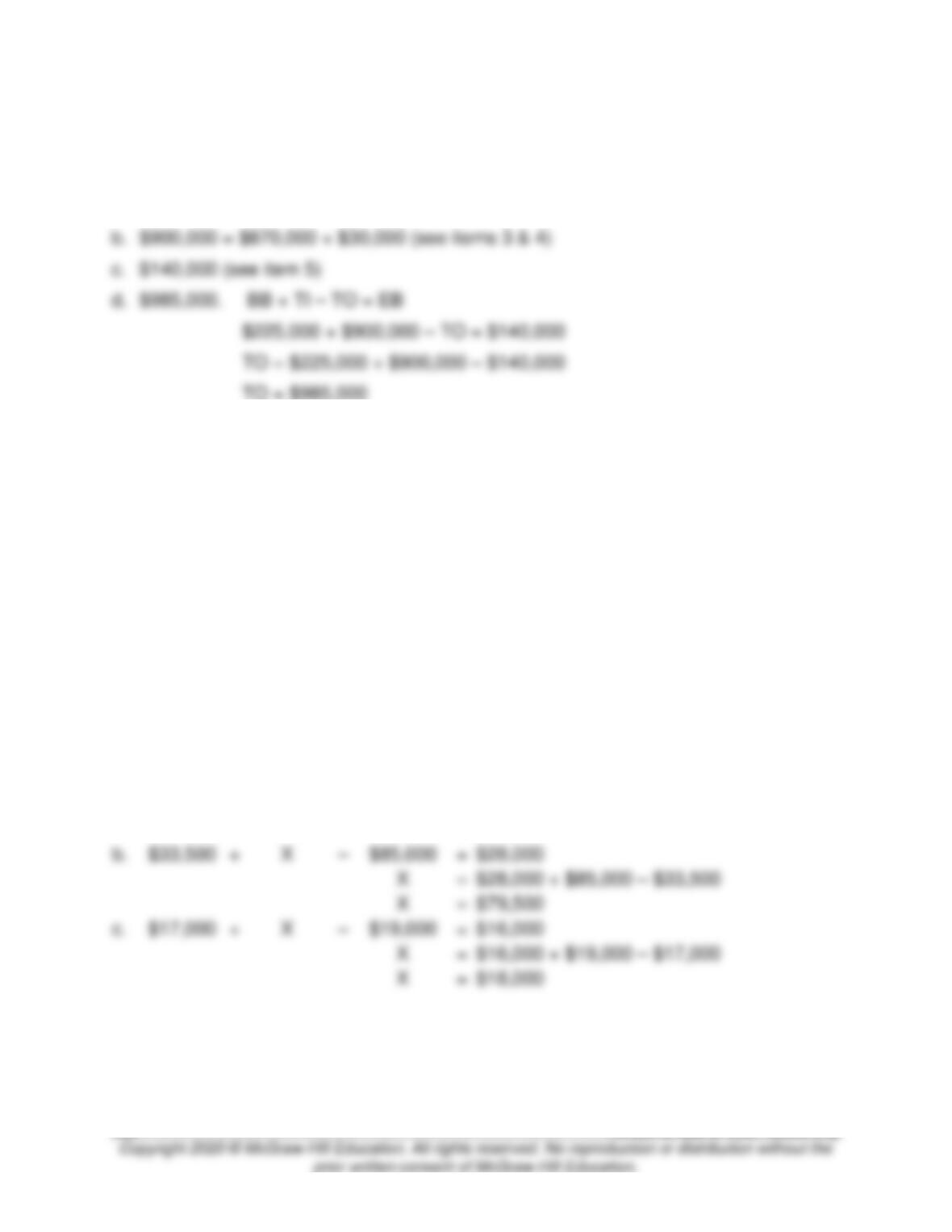
6-24. (20 min.) Basic Cost Flow Model: Ralph’s Mini-Mart.
a. $225,000 (see item 5)
6-25. (20 min.) Basic Cost Flow Model: Generic Electric.
a. $32.0 million = $8.0 million + $13.5 million + (.7 $15.0 million)
b. $20.8 million = .65 $32.0 million
c. BB + TI – TO = EB
0 + $32.0 million – $20.8 million = EB
EB = $11.2 million
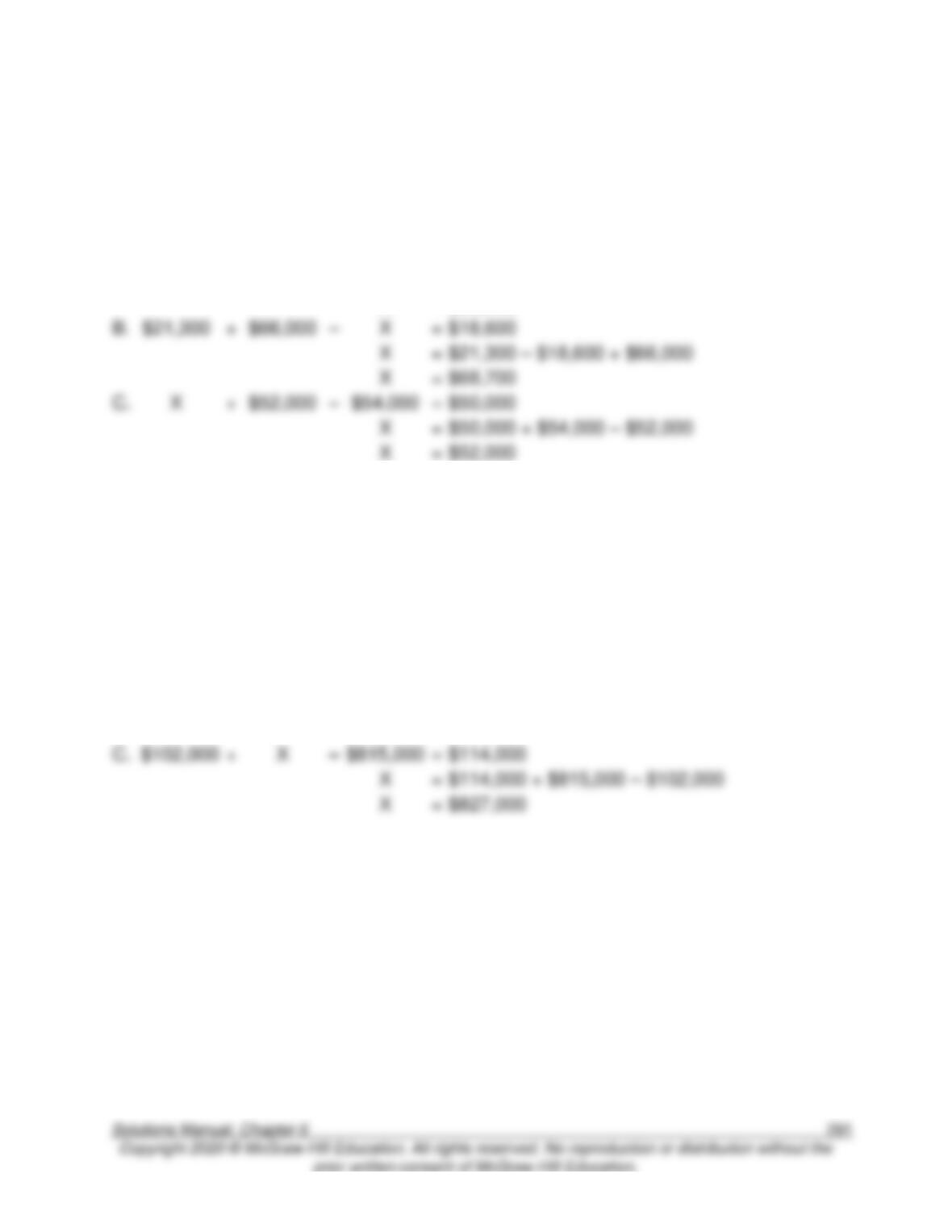
6-26. (20 min.) Basic Cost Flow Model.
Based on the basic formula:
BB
+
TI
–
TO
=
EB
a.
$14,200
+
$44,000
–
X
=
$12,400
X
=
$44,000 + $14,200 – $12,400
X
=
$45,800
b.
+
–
=
X
=
c.
+
–
=
X
=
X
=
6-27. (20 min.) Basic Cost Flow Model.
Based on the basic formula:
BB
+
TI
–
TO
=
EB
A.
$39,000
+
X
–
$70,000
=
$32,000
X
=
$32,000 + $70,000 – $39,000
X
=
$63,000
B.
+
–
X
=
X
=
$21,300 – $18,600 + $66,000
X
=
$68,700
+
$52,000
–
=
$50,000
X
=
$50,000 + $54,000 – $52,000
X
=
$52,000
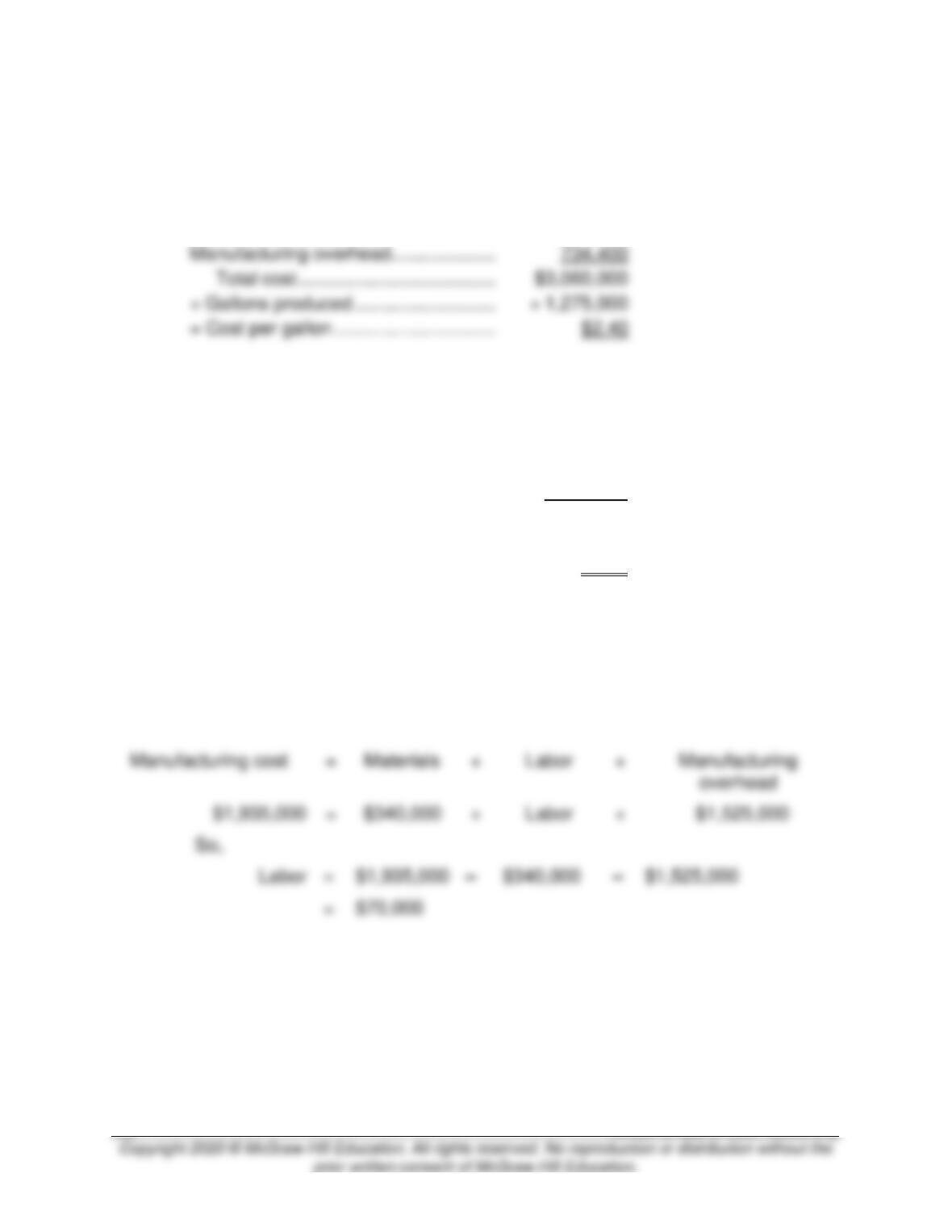
6-28. (20 min.) Basic Cost Flow Model.
Based on the basic formula:
BB
+
TI
–
TO
=
EB
A.
X
+
$108,000
–
$127,000
=
$12,000
X
=
$12,000 + $127,000 – $108,000
X
=
$31,000
B.
$30,000
+
$210,000
–
X
=
$22,000
X
=
$30,000 + $210,000 – $22,000
X
=
$218,000
$102,000
+
X
–
$815,000
=
$114,000
X
=
$114,000 + $815,000 – $102,000
X
=
$827,000
6-29. (10 min.) Basic Product Costing: Enviro Corporation.
Materials ……………………………………..
$2,142,000
Labor ………………………………………….
183,600
Manufacturing overhead ………………..
$3,060,000
÷ Gallons produced ………………………
÷ 1,275,000
6-30. (10 min.) Basic Product Costing: Sara’s Sodas.
Materials ……………………………………..
$310,000
Labor ………………………………………….
55,000
Manufacturing overhead ………………..
1,315,000
Total cost ………………………………..
$1,680,000
÷ Liters produced………………………….
÷ 4,000,000
= Cost per liter ……………………………..
$0.42
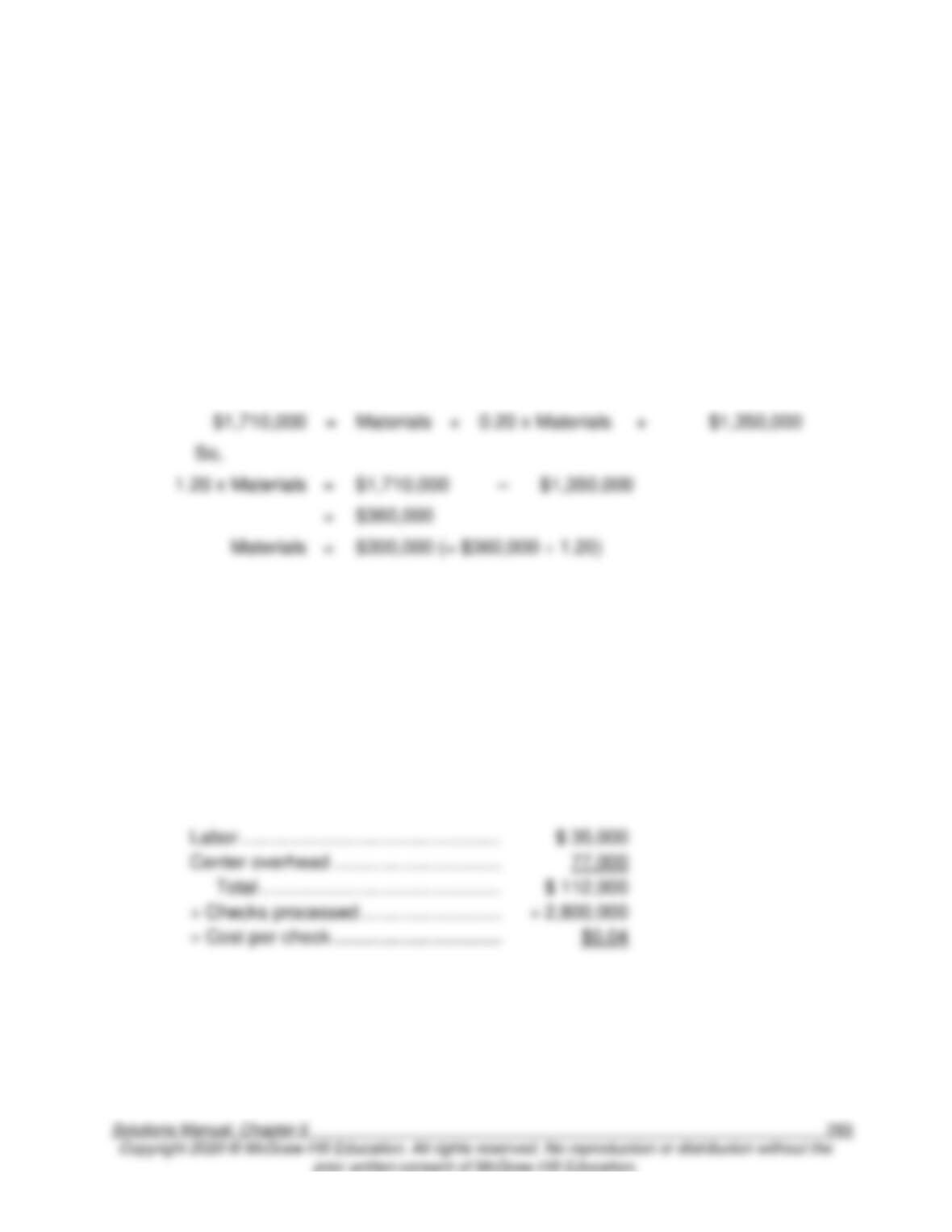
6-31. (15 min.) Basic Product Costing: Sara’s Sodas.
If the cost per liter is $0.43 and 4.5 million liters were produced, the total manufacturing
cost must have been $1,935,000 (= $0.43 4.5 million). But total manufacturing cost is
computed as:
=
6-32. (15 min.) Basic Product Costing: Sara’s Sodas.
a. If the cost per liter is $0.45 and 3.8 million liters were produced, the total
manufacturing cost must have been $1,710,000 (= $0.45 3.8 million). But total
manufacturing cost is computed as:
Manufacturing cost
=
Materials
+
Labor
+
Manufacturing
overhead
b. Labor = 0.20 Materials
= 0.20 $300,000
= $60,000.
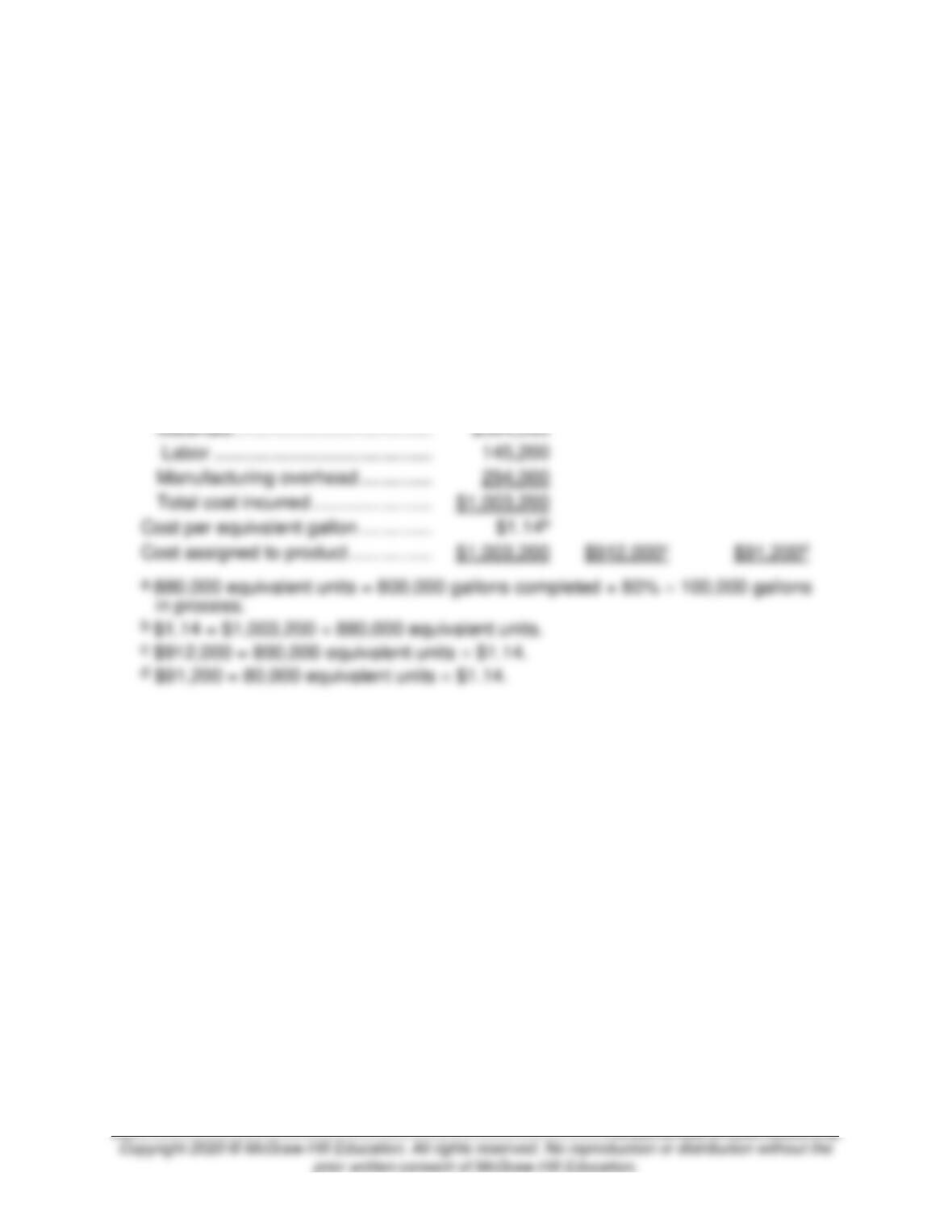
6-33. (10 min.) Basic Product Costing: Big City Bank.
6-34. (20 min.) Basic Product Costing: Luke’s Lubricants.
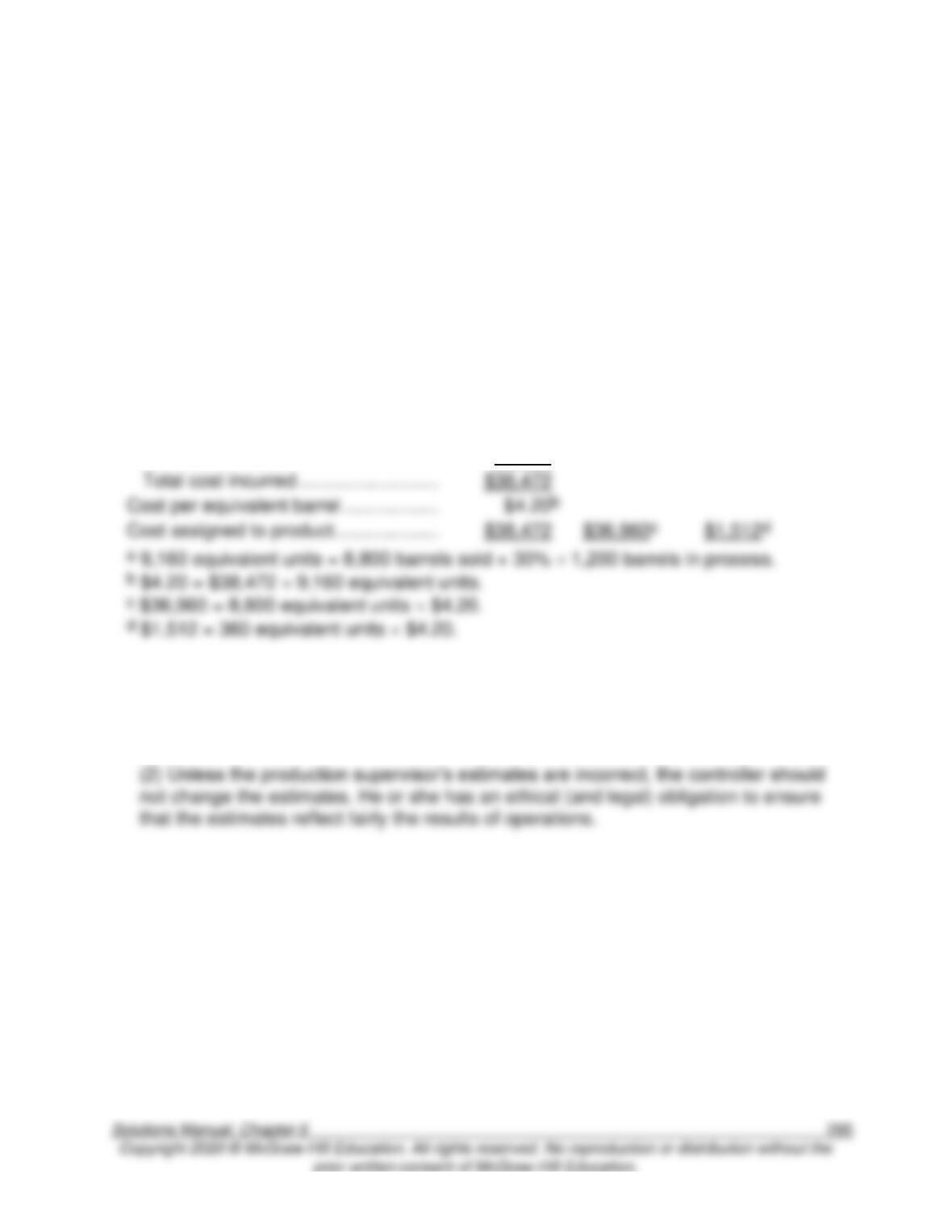
Total
a.
Sold
b.
Work-in–
Process,
January 31
Production:
Gallons …………………………………..
900,000
800,000
100,000
Percentage complete ……………….
100%
80%
Equivalent gallons……………………
880,000a
800,000
80,000
Costs:
Materials ………………………………..
Labor ……………………………………
Manufacturing overhead …………..
294,000
Total cost incurred …………………..
Cost per equivalent gallon …………..
6-35. (20 min.) Basic Product Costing—Ethical Issues: Old Tyme Soda.
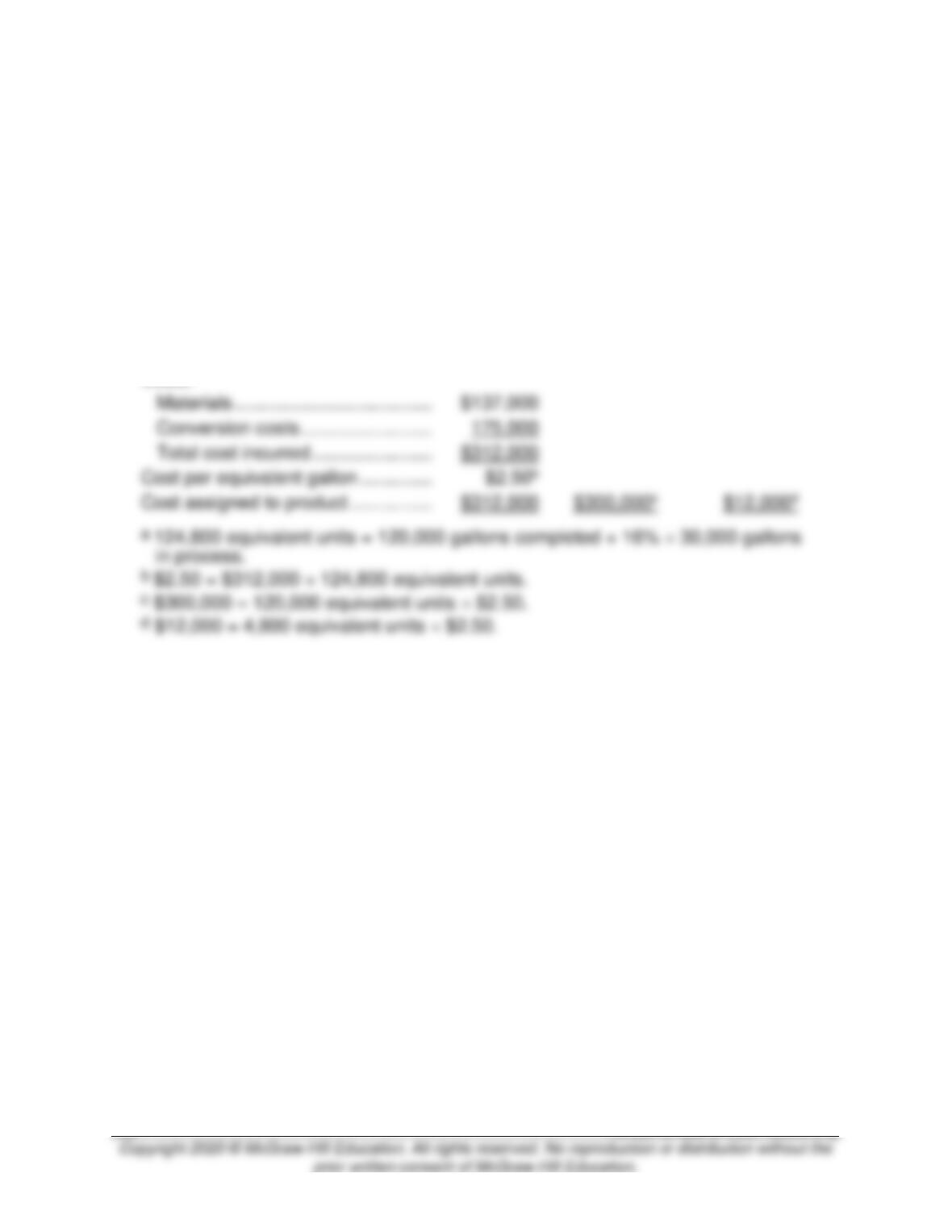
a. and b.
Total
a.
Sold
b.
Work-in–
Process,
November 30
Production:
Barrels …………………………..…………..
10,000
8,800
1,200
Percentage complete ………………….
100%
30%
Equivalent barrels ……………………….
9,160a
8,800
360
Costs:
Materials …………………………..……….
$18,072
Conversion costs ………………………..
20,400
Total cost incurred ………………………
c. (1) He would raise the estimated degree of completion. The change in the estimate
will cause more cost to be assigned to work-in-process inventory and less to finished
goods. As the finished goods are sold, cost of goods will be lower and income
higher.
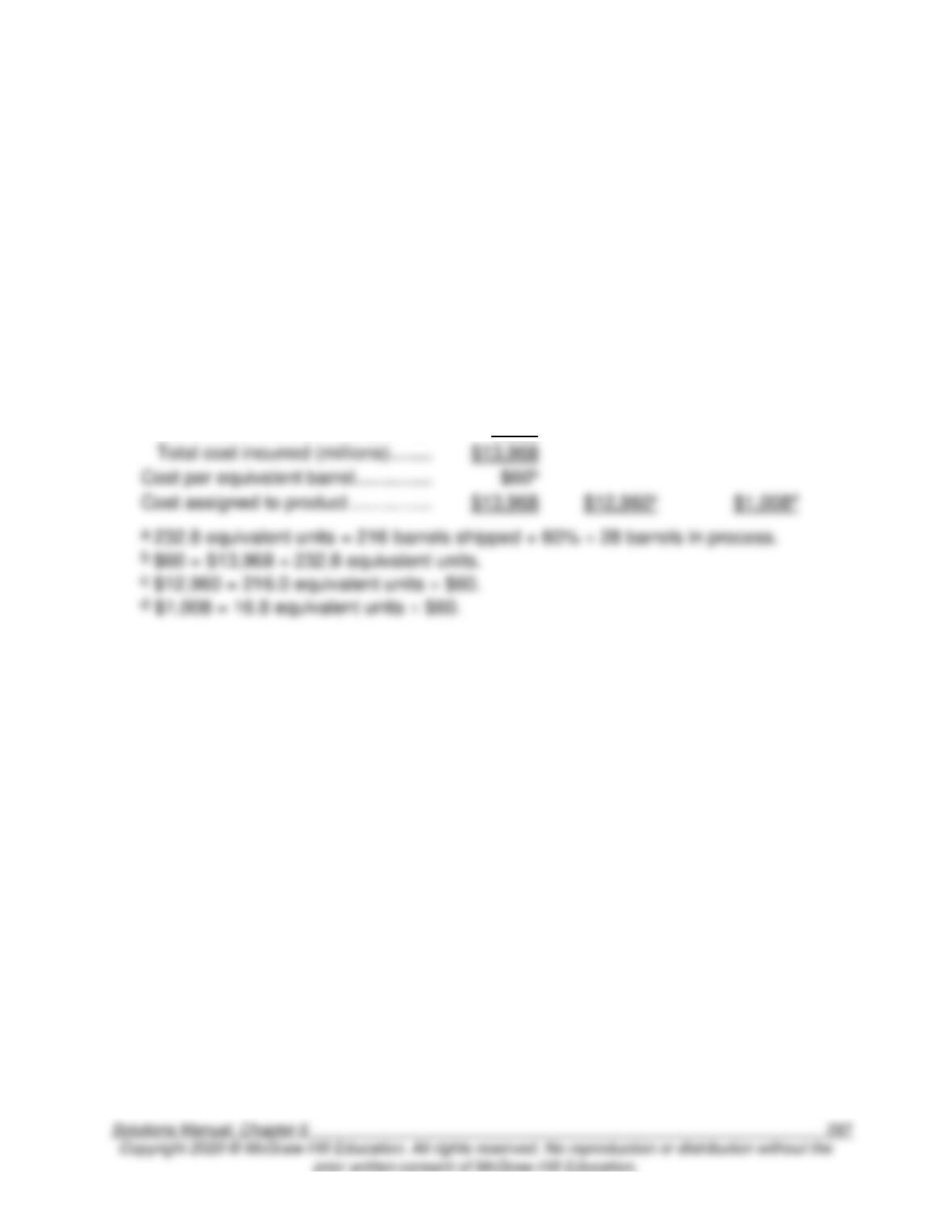
6-36. (15 min.) Process Costing: Sanchez & Company.
Total
Transferred
to Finished
Goods
Work-in–
Process,
July 31
Production:
Gallons …………………………………..
150,000
120,000
30,000
Percentage complete ……………….
100%
16%
Equivalent gallons……………………
124,800a
120,000
4,800
Costs:
Materials ………………………………..
Conversion costs …………………….
175,000
Total cost incurred …………………..
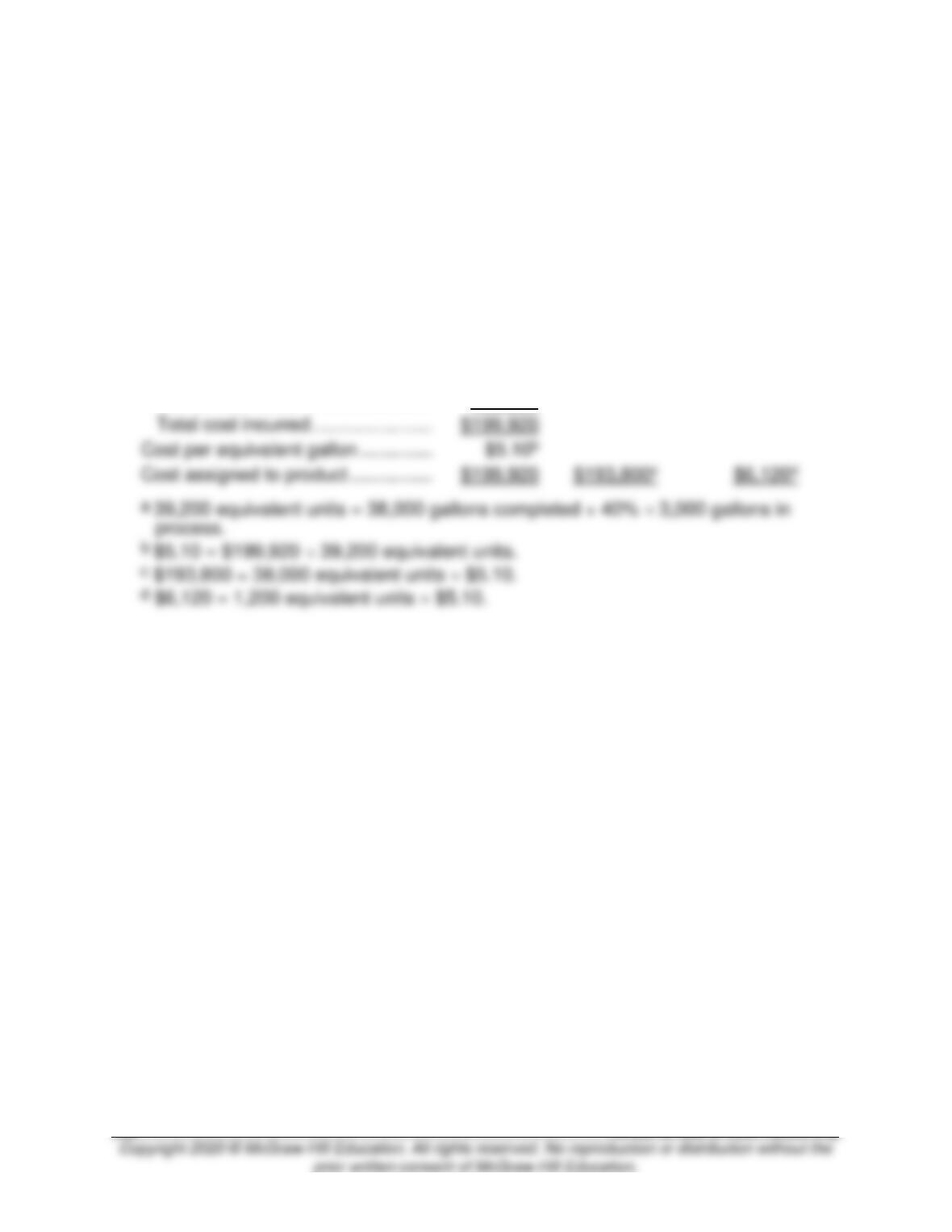
6-37. (15 min.) Process Costing: Graham Petroleum.
Total
Shipped
Work-in–
Process,
May 31
Production:
Barrels (millions) ……………………..
244.0
216.0
28.0
Percentage complete ……………….
100%
60%
Equivalent barrels (millions) ………
232.8a
216.0
16.8
Costs:
Materials (millions) …………………..
$6,000
Conversion costs (millions) ……….
7,968
Total cost incurred (millions) ……..
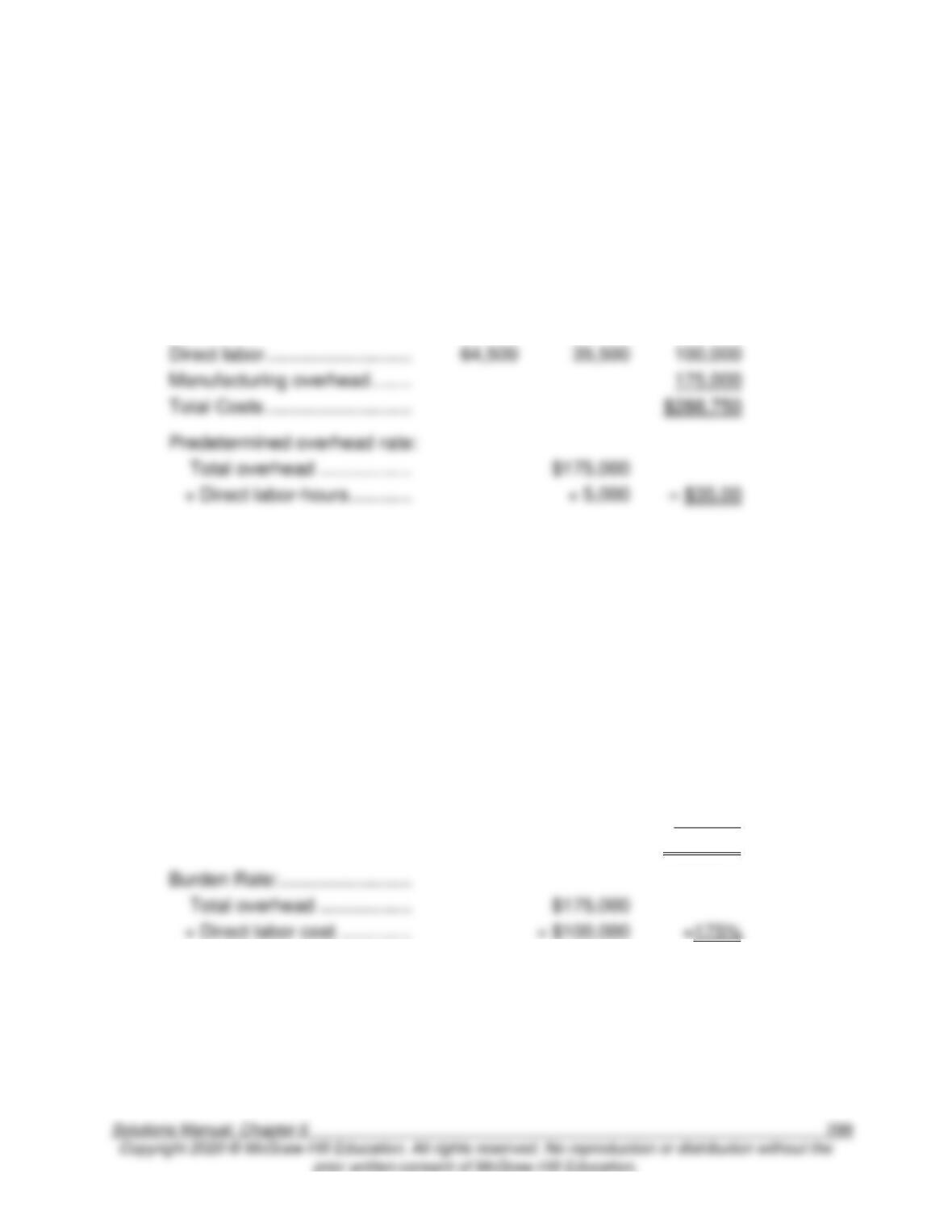
6-38. (15 min.) Process Costing: Joplin Corporation.
Total
Completed
Work-in–
Process,
November 30
Production:
Gallons ………………………………….
41,000
38,000
3,000
Percentage complete ……………….
100%
40%
Equivalent gallons……………………
39,200a
38,000
1,200
Costs:
Materials ………………………………..
$89,100
Conversion costs …………………….
110,820
Total cost incurred …………………..
6-39. (15 Minutes) Predetermined Overhead Rates: Tiger Furnishings.
Predetermined overhead rate = $35.00 per direct labor hour.
Basic
Dominator
Total
Units produced ………………….
1,000
250
1,250
Machine-hours…………………..
4,500
2,500
7,000
Direct labor-hours ………………
3,000
2,000
5,000
Direct materials …………………
$10,000
$3,750
$13,750
Direct labor ……………………….
35,500
100,000
Predetermined overhead rate:
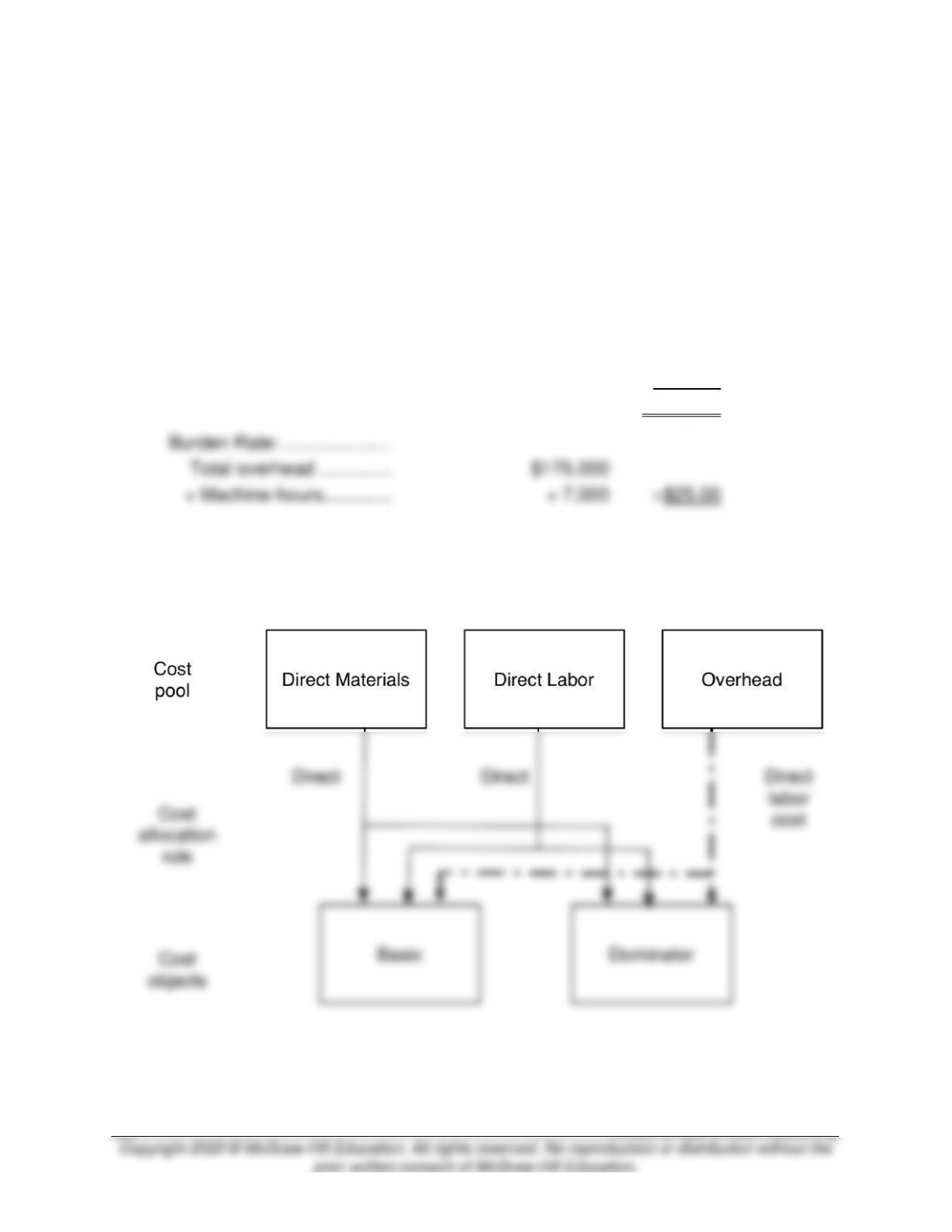
6-40. (15 Minutes) Predetermined Overhead Rates: Tiger Furnishings.
Predetermined overhead rate = 175% of direct labor cost.
Basic
Dominator
Total
Units produced ………………….
1,000
250
1,250
Machine-hours…………………..
4,500
2,500
7,000
Direct labor-hours ………………
3,000
2,000
5,000
Direct materials …………………
$10,000
$3,750
$13,750
Direct labor ……………………….
64,500
35,500
100,000
Manufacturing overhead ……..
175,000
Total Costs ……………………….
$288,750
Burden Rate: …………………….
6-41. (15 Minutes) Predetermined Overhead Rates: Tiger Furnishings.
Predetermined overhead rate = $25.00 per machine-hour.
Basic
Dominator
Total
Units produced ………………
1,000
250
1,250
Machine-hours……………….
4,500
2,500
7,000
Direct labor-hours …………..
3,000
2,000
5,000
Direct materials ……………..
$10,000
$3,750
$13,750
Direct labor ……………………
64,500
35,500
100,000
Manufacturing Overhead …
175,000
Total Costs ……………………
$288,750
6-42. (20 Minutes) Predetermined Overhead Rates: Tiger Furnishings.
6-43. (15 Minutes) Predetermined Overhead Rates and Product Profitability:
Social Media, Inc.
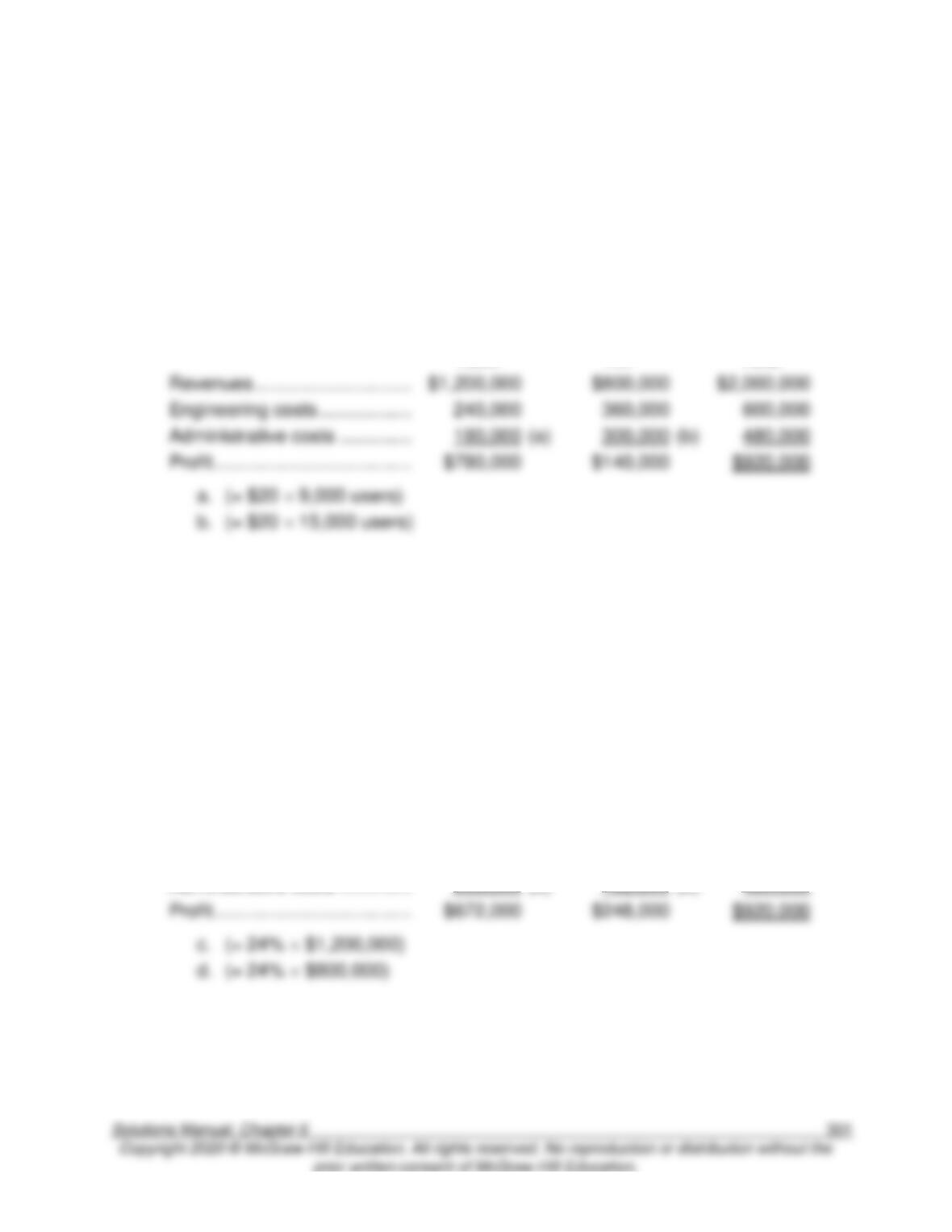
a. $20 per user.
Predetermined rate
=
Administrative costs
÷
Number of users
=
$480,000
÷
24,000
=
$20 per user
b.
6-44. (15 Minutes) Predetermined Overhead Rates and Product Profitability:
Social Media, Inc.
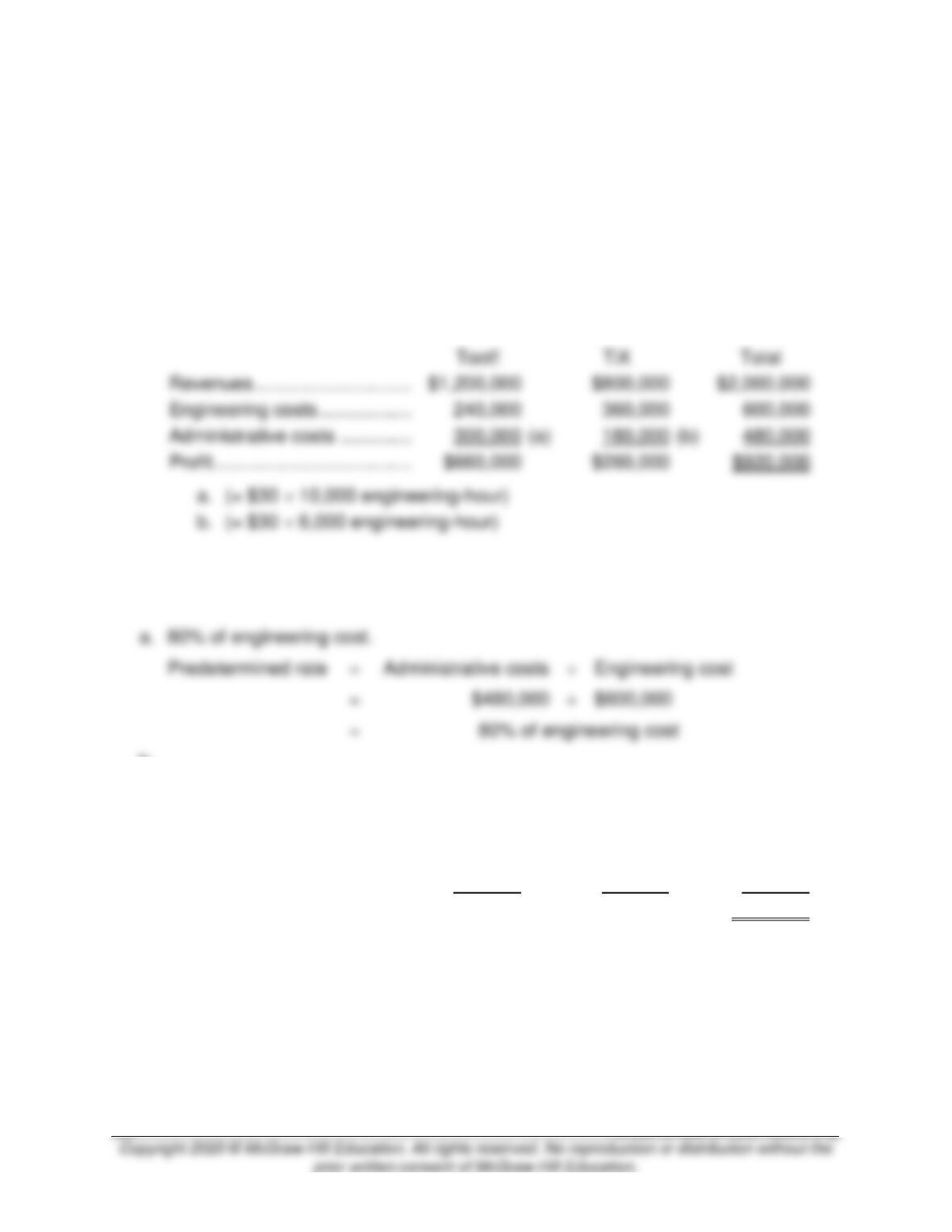
a. 24% of revenue.
Predetermined rate
=
Administrative costs
÷
Total revenue
=
$480,000
÷
$2,000,000
=
24% of revenue
b.
Toot!
TiX
Total
Revenues …………………………
$1,200,000
$800,000
$2,000,000
Engineering costs ………………
240,000
360,000
600,000
Administrative costs …………..
288,000
480,000
c. (= 24% $1,200,000)
6-45. (15 Minutes) Predetermined Overhead Rates and Product Profitability:
Social Media, Inc.
a. $30 per engineering hour.
Predetermined rate
=
Administrative costs
÷
Engineering hours
=
$480,000
÷
16,000
=
$30 per engineering-hour
b.
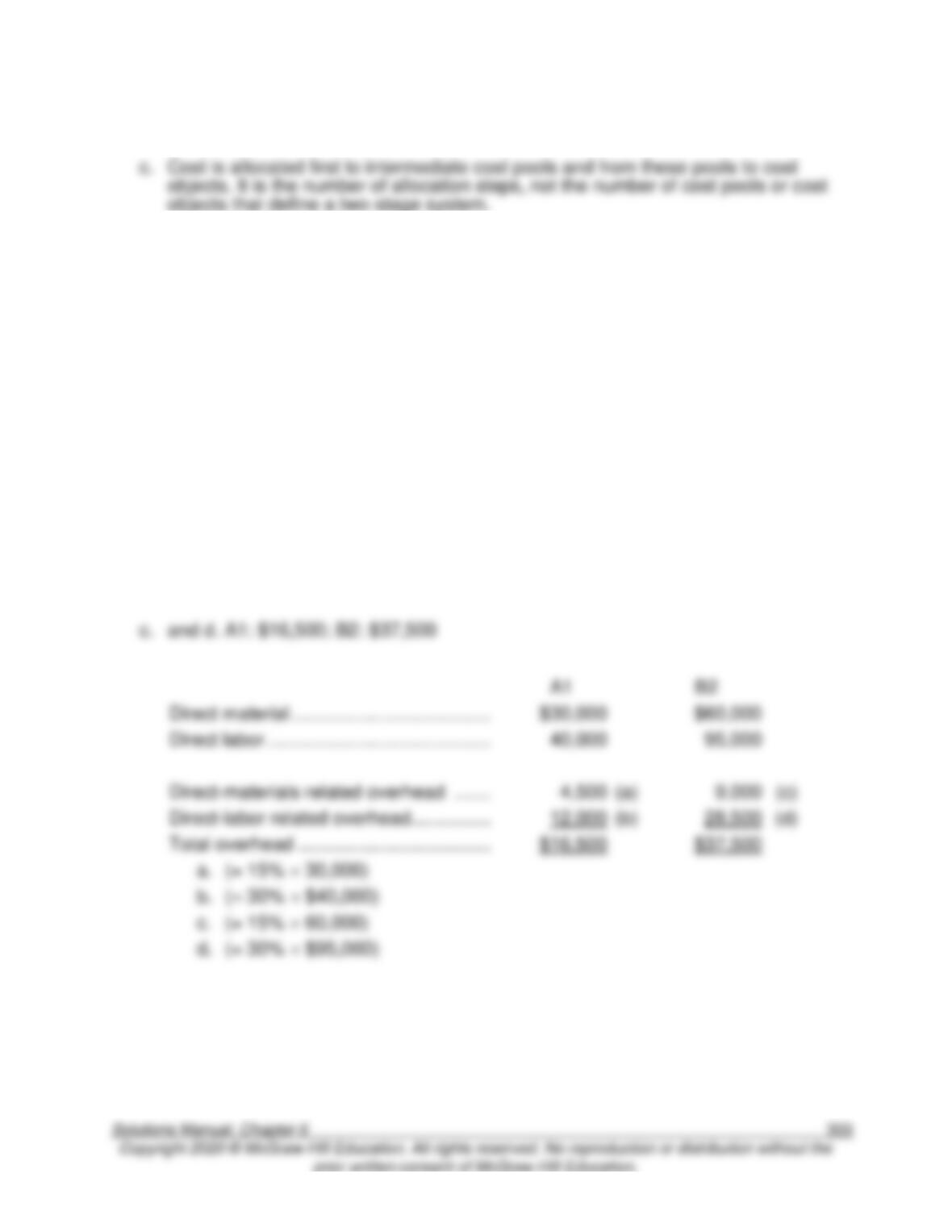
6-46. (15 Minutes) Predetermined Overhead Rates and Product Profitability:
Social Media, Inc.
Predetermined rate
=
Administrative costs
÷
Engineering cost
=
$480,000
÷
$600,000
=
b.
Toot!
TiX
Total
Revenues …………………………
$1,200,000
$800,000
$2,000,000
Engineering costs ………………
240,000
360,000
600,000
Administrative costs …………..
192,000
(a)
288,000
(b)
480,000
Profit ………………………………..
$768,000
$152,000
$920,000
a. (= 80% $240,000)
b. (= 80% $360,000)
6-47. (10 min.) Two-Stage Cost Allocation: Multiple Choice
6-48. (15 Minutes) Two-Stage Cost Allocation and Predetermined: Channing
Corporation.
a. 15% of direct-material costs.
Predetermined rate
=
Material-related overhead
÷
Direct-materials cost
=
$13,500
÷
$90,000
=
15% of direct-materials cost
b. 30% of direct-labor costs.
Predetermined rate
=
Labor-related overhead
÷
Direct-labor cost
=
$40,500
÷
$135,000
=
30% of direct-labor cost