CHAPTER 6
Reporting and Analyzing Inventory
Learning Objectives
1. Describe how to classify inventory and inventory quantities.
2. Explain the basis of accounting for inventories and apply the inventory cost flow methods under a
periodic inventory system.
3. Explain the financial statement and tax effects of each of the inventory cost flow assumptions.
4. Explain the lower-of-cost-or-market basis of accounting for inventories.
5. Compute and interpret the inventory turnover ratio.
6. Describe the LIFO reserve and explain its importance for comparing results of different companies.
*7. Apply the inventory cost flow methods to perpetual inventory records.
*8. Indicate the effects of inventory errors on the financial statements.
Summary of Questions by Learning Objectives and Bloom’s Taxonomy
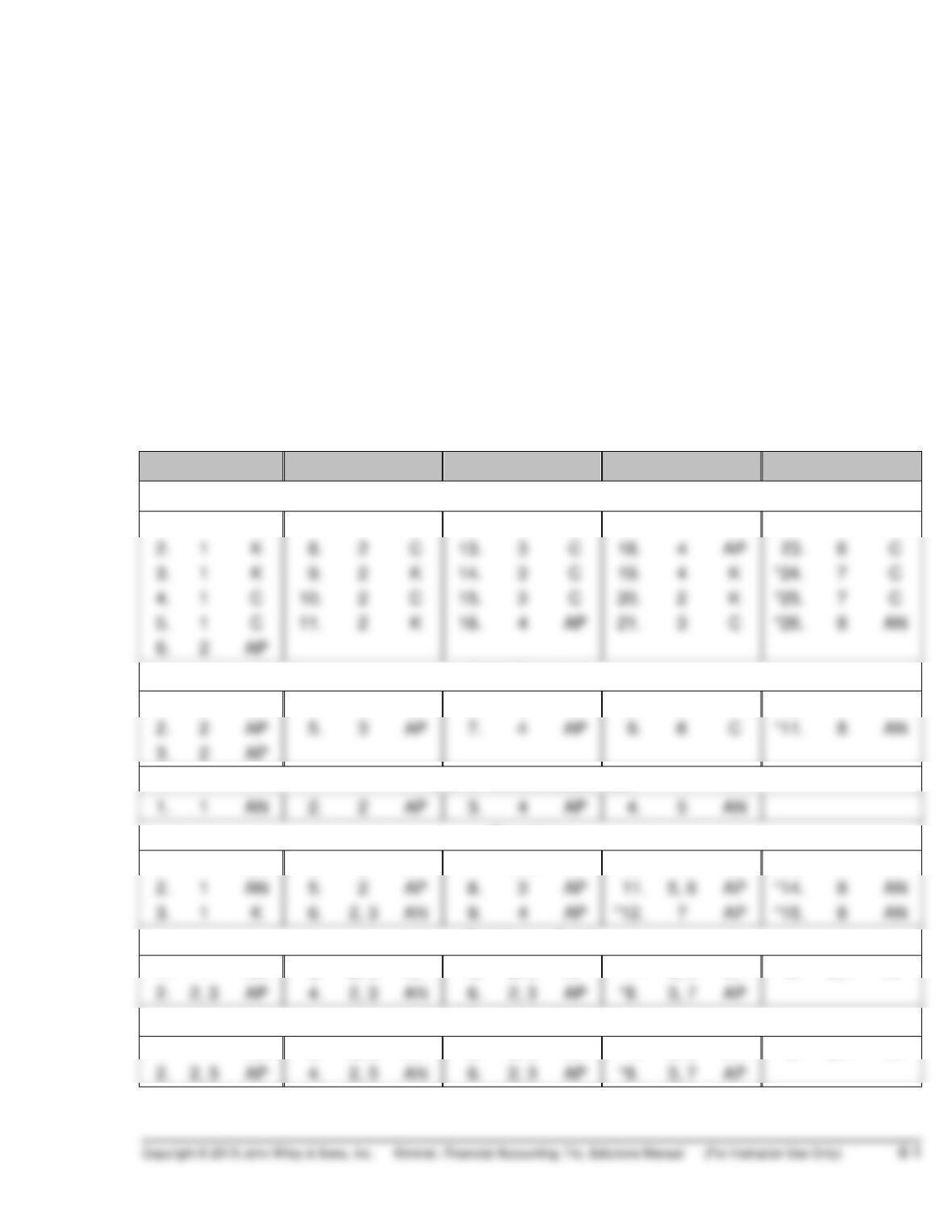
Item LO BT Item LO BT Item LO BT Item LO BT Item LO BT
Questions
1. 1 C 7. 2 C 12. 3 C 17. 4 K 22. 5 AN
Brief Exercises
1. 1 C 4. 3 C 6. 3 C 8. 5 AP *10. 7 AP
DO IT! Review Exercises
Exercises
1. 1 AN 4. 2 AP 7. 2, 3 AP 10. 5 AP *13. 7 AP
Problems: Set A
1. 1 AN 3. 2, 3 AP 5. 2, 3 AP 7. 5, 6 AP *9. 3, 7 AP
Problems: Set B
1. 1 AN 3. 2, 3 AP 5. 2, 3 AP 7. 5, 6 AP *9. 3, 7 AP
*Continuing Cookie Solutions for this chapter are available online.
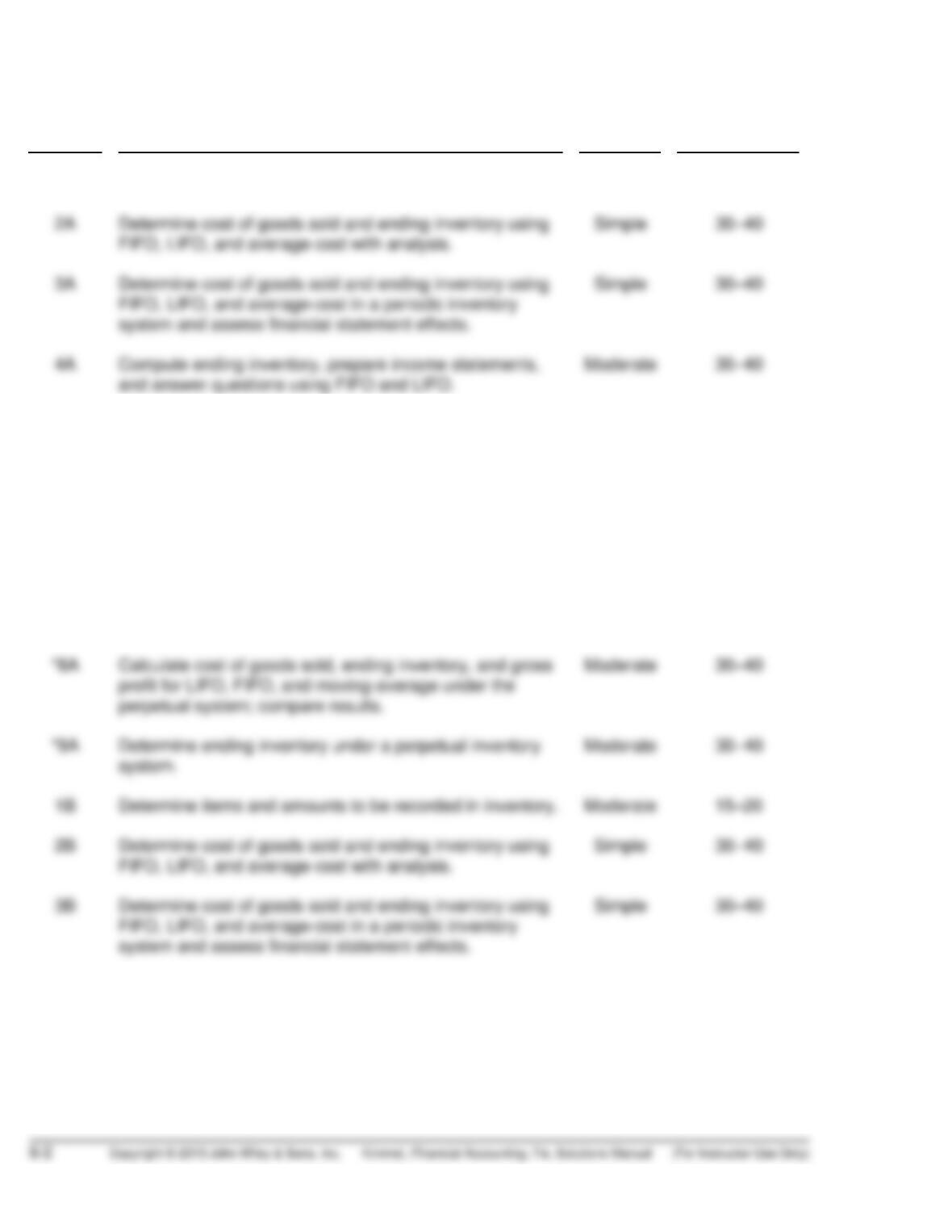
ASSIGNMENT CHARACTERISTICS TABLE
Problem
Number
Description
Difficulty
Level
Time
Allotted (min.)
1A Determine items and amounts to be recorded in inventory. Moderate 15–20
5A Calculate ending inventory, cost of goods sold, gross
profit, and gross profit rate under periodic method;
compare results.
Moderate 30–40
6A Compare specific identification, FIFO, and LIFO under
periodic method; use cost flow assumption to influence
earnings.
Moderate 20–30
7A Compute inventory turnover and days in inventory;
compute current ratio based on LIFO and after adjusting
for LIFO reserve.
Moderate 20–30
4B Compute ending inventory, prepare income statements,
and answer questions using FIFO and LIFO.
Moderate 30–40
5B Calculate ending inventory, cost of goods sold, gross
profit, and gross profit rate under periodic method;
compare results.
Moderate 30–40
ASSIGNMENT CHARACTERISTICS TABLE (Continued)
Problem
Number
Description
Difficulty
Level
Time
Allotted (min.)
6B Compare specific identification, FIFO, and LIFO under
periodic method; use of cost flow assumption to influence
earnings.
Moderate 20–30
7B Compute inventory turnover and days in inventory;
compute current ratio based on LIFO and after adjusting
for LIFO reserve.
Moderate 20–30
ANSWERS TO QUESTIONS
1. Agree. Effective inventory management is frequently the key to successful business operations.
Management attempts to maintain sufficient quantities and types of goods to meet expected
customer demand. It also seeks to avoid the cost of carrying inventories that are clearly in ex-
cess of anticipated sales.
2. Inventory items have two common characteristics: (1) they are owned by the company and (2) they
are intended to be sold to customers in the ordinary course of business.
5. (a) (1) The goods will be included in Millar Company’s inventory if the terms of sale are FOB
destination.
(2) The goods will be included in Branyan Corporation’s inventory if the terms of sale are
FOB shipping point.
8. Actual physical flow may be impractical because many items are indistinguishable from one
another. Actual physical flow may be inappropriate because management may be able to manipu-
late net income through specific identification of items sold.
9. The major advantage of the specific identification method is that it tracks the actual physical flow
of the goods available for sale. The major disadvantage is that management could manipulate
net income.
Questions Chapter 6 (Continued)
12. Long Company is using the FIFO method of inventory costing, and Windsor Company is using
the LIFO method. Under FIFO, the latest goods purchased remain in inventory. Thus, the
inventory on the balance sheet should be close to current costs. The reverse is true of the LIFO
method. Long Company will have the higher gross profit because cost of goods sold will include
a higher proportion of goods purchased at earlier (lower) costs.
13. Espinosa Corporation may experience severe cash shortages if this policy continues. All of its
net income is being paid out as dividends, yet some of the earnings must be reinvested in
inventory to maintain inventory levels. Some earnings must be reinvested because net income is
15. When prices are increasing, LIFO results in higher cost of goods sold, and lower income relative
to FIFO. Because LIFO income is lower the company pays lower taxes, which results in higher
cash flows. The quality of earnings ratio is net cash provided by operating activities divided by
income. The use of LIFO will increase the numerator (net cash provided by operating activities)
and decrease the denominator (net income), both of which increase the value of the ratio.
16. Tootsie Roll uses LIFO for U.S. inventories and FIFO for foreign inventories. LIFO is not allowed
in most countries outside the U.S., therefore Tootsie Roll uses a different method for foreign
inventories.
17. Alison should know the following:
(a) A departure from the cost basis of accounting for inventories is justified when the value of
the goods is no longer as great as its cost. The writedown to market should be recognized in
20. Freight-out expense is not a cost associated with purchasing goods, so it should not affect cost
of goods sold. It is an expense incurred to sell goods already purchased, so it should be reported
as a selling expense.
Questions Chapter 6 (Continued)
21. Dipoto Company should disclose (1) the major inventory classifications, (2) the basis of accounting
(cost or lower-of-cost-or-market), and (3) the costing method (FIFO, LIFO, or average).
22. An inventory turnover that is too high may indicate that the company is losing sales opportunities
because of inventory shortages. Inventory outages may also cause customer ill will and result in
lost future sales.
23. The LIFO reserve is a required disclosure for companies that employ LIFO. It is the difference
between ending inventory using LIFO and ending inventory if FIFO were used instead. Ignoring a
SOLUTIONS TO BRIEF EXERCISES
BRIEF EXERCISE 6-1
(a) Ownership of the goods belongs to the consignor (Tiffee). Thus, these
goods should be included in Tiffee’s inventory.
(b) The goods in transit should not be included in the inventory count
because ownership by Tiffee does not occur until the goods reach the
buyer.
BRIEF EXERCISE 6-2
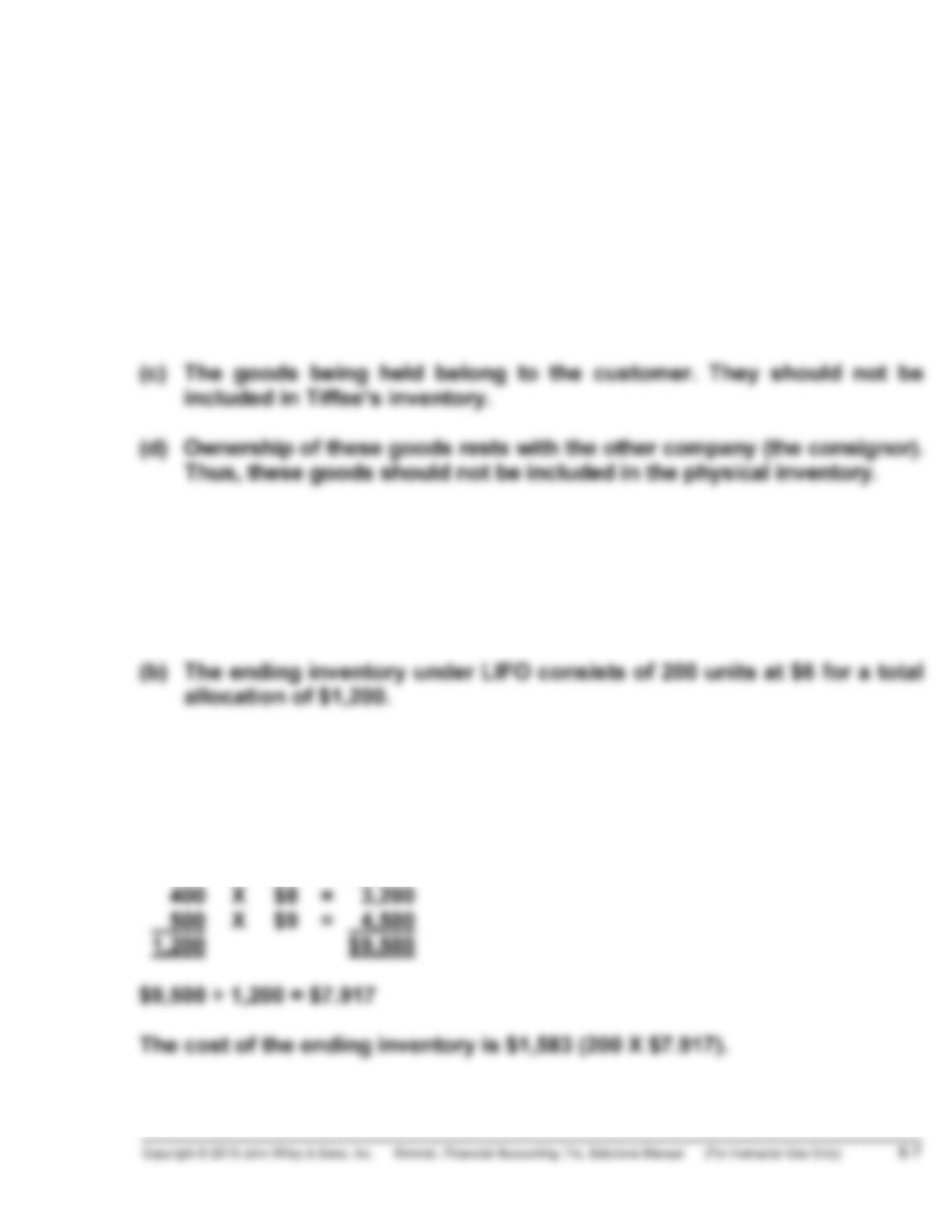
(a) The ending inventory under FIFO consists of 200 units at $9 for a total
allocation of $1,800.
BRIEF EXERCISE 6-3
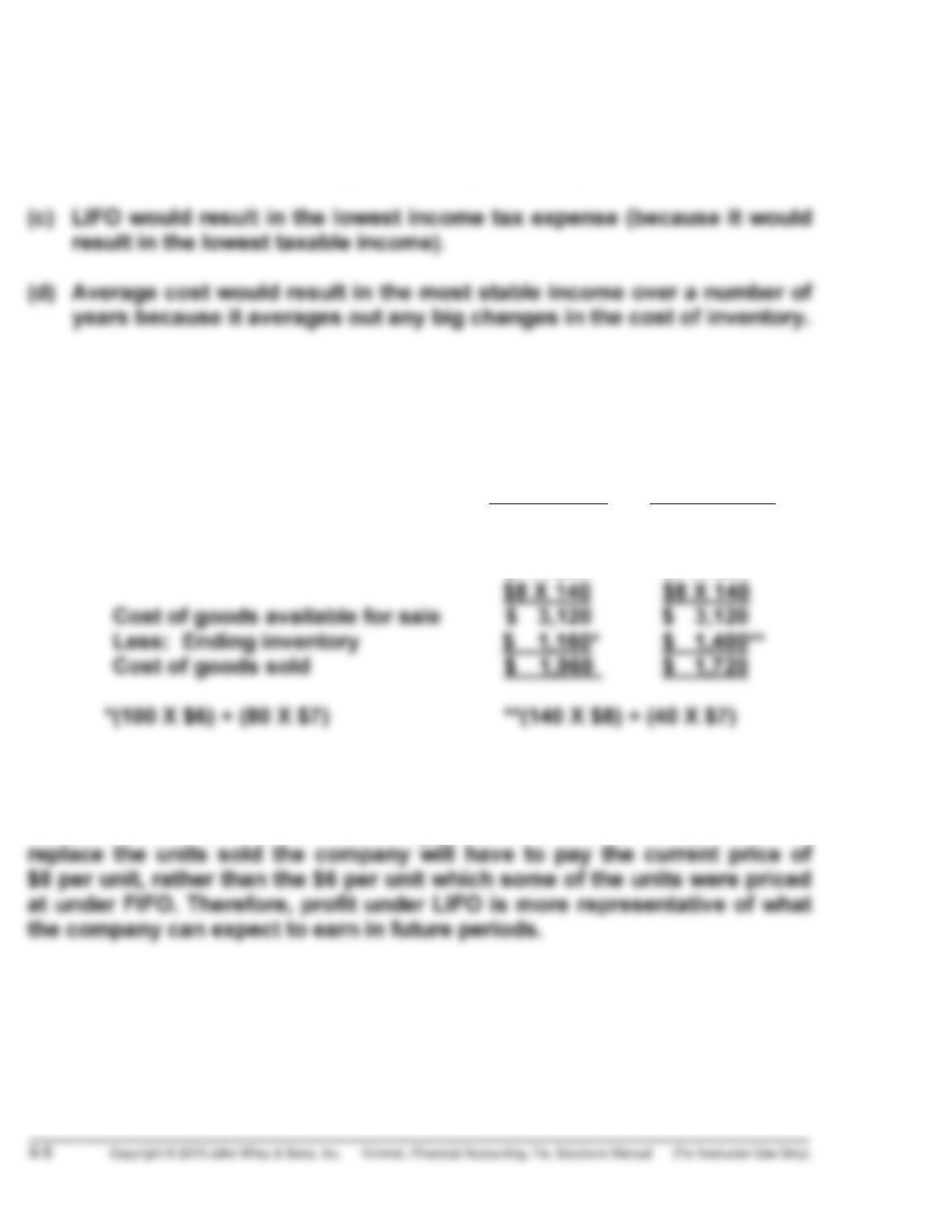
Average unit cost is $7.917 computed as follows:
300 X $6 = $1,800
BRIEF EXERCISE 6-4
(a) FIFO would result in the highest net income.
(b) FIFO would result in the highest ending inventory.
BRIEF EXERCISE 6-5
Cost of goods sold under:
LIFO FIFO
Purchases $6 X 100 $6 X 100
$7 X 200 $7 X 200
Since the cost of goods sold is $240 ($1,960 – $1,720) less under FIFO that
is the amount of the phantom profit. It is referred to as “phantom profit”
because FIFO matches current selling prices with old inventory costs. To
BRIEF EXERCISE 6-6
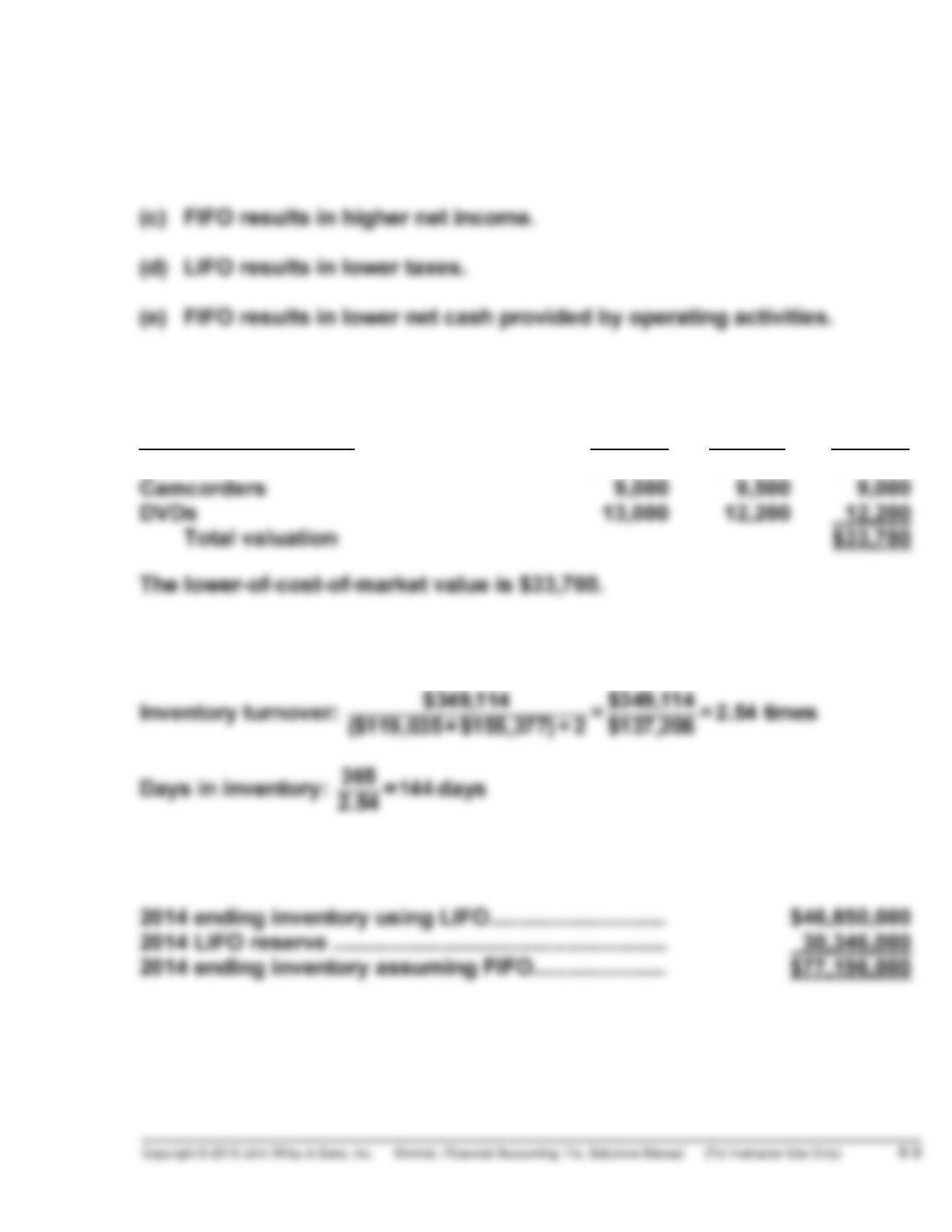
(a) LIFO results in a higher quality of earnings ratio.
(b) FIFO results in higher phantom profits.
BRIEF EXERCISE 6-7
Inventory Categories Cost Market LCM
Cameras $12,500 $13,400 $12,500
BRIEF EXERCISE 6-8
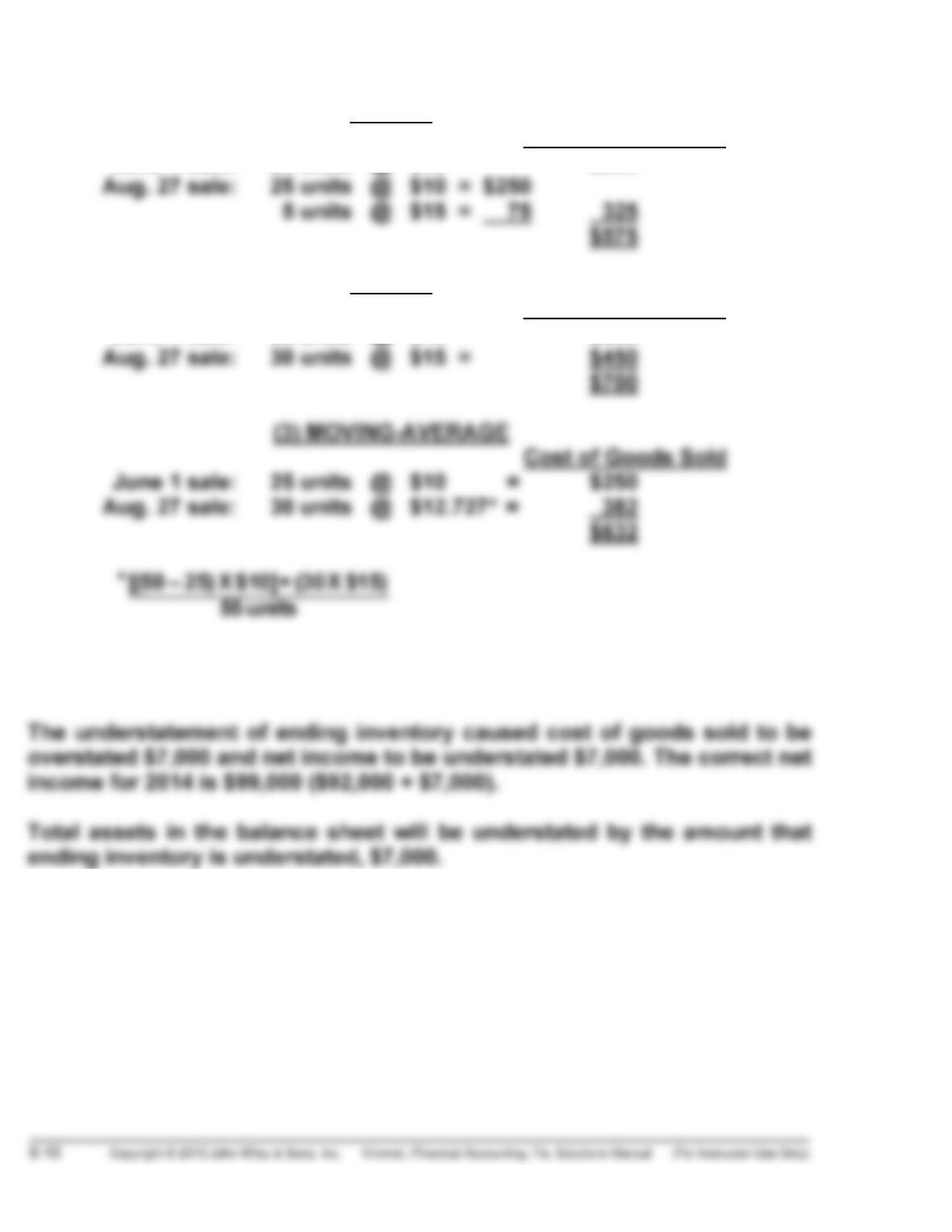
BRIEF EXERCISE 6-9
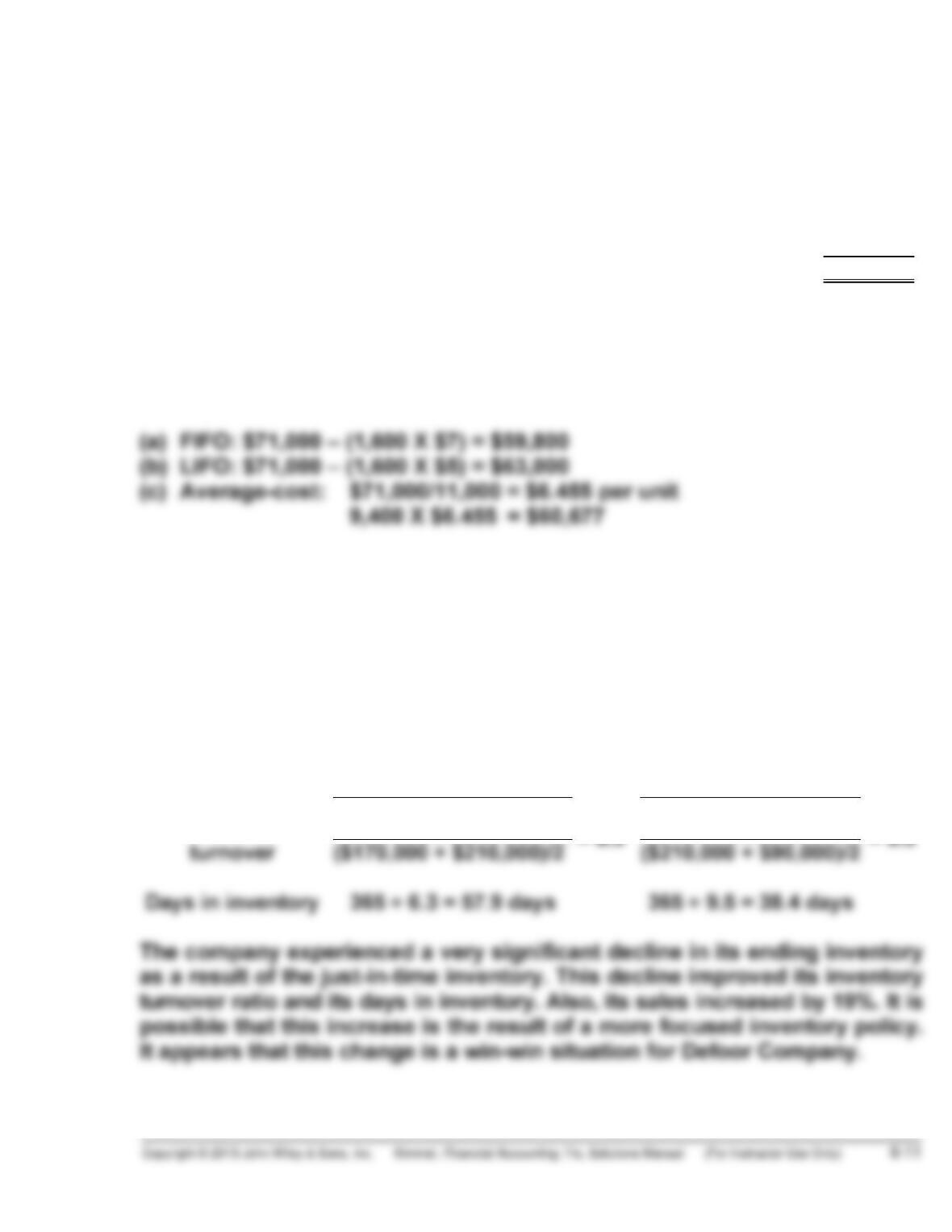
*BRIEF EXERCISE 6-10
(1) FIFO
Cost of Goods Sold
June 1 sale: 25 units @ $10 = $250
(2) LIFO
Cost of Goods Sold
June 1 sale: 25 units @ $10 = $250
*BRIEF EXERCISE 6-11
SOLUTIONS TO DO IT! REVIEW EXERCISES
DO IT! 6-1
Inventory per physical count …………………………………………… $300,000
Inventory out on consignment ………………………………………… 28,000
Inventory sold, in transit at year-end ……………………………….. 0
Inventory purchases, in transit at year-end ……………………… 13,000
Correct December 31 inventory ………………………………………. $341,000
DO IT! 6-2
Cost of goods available for sale = (3,000 X $5) + (8,000 X $7) = $71,000
Ending inventory = 3,000 + 8,000 – 9,400 = 1,600 units
DO IT! 6-3
The lowest value for each inventory type is: Small $61,000, Medium $260,000,
and Large $152,000. The total inventory value under the lower-of-cost-or-
market approach is the sum of these figures, $473,000.
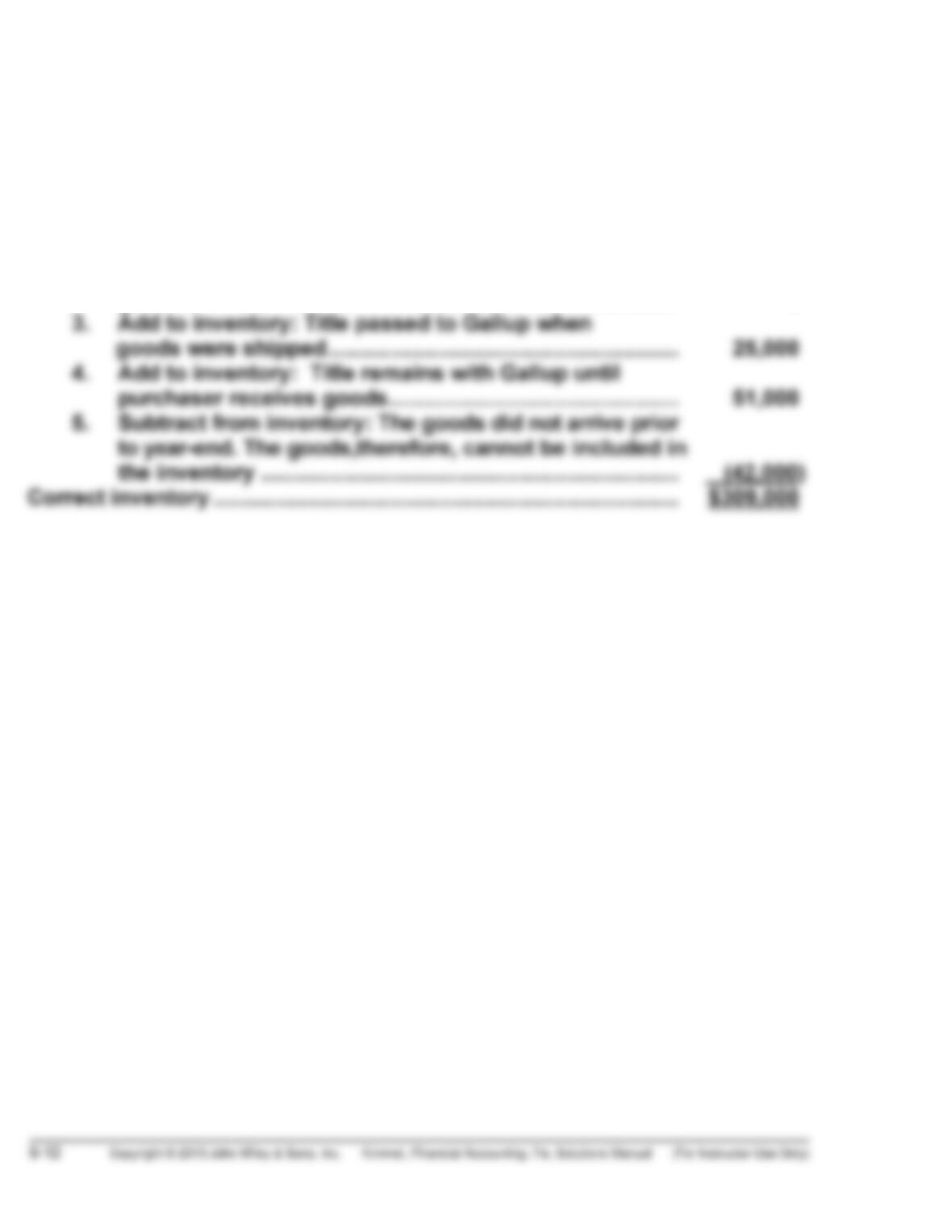
DO IT! 6-4
2013 2014
Inventory $1,200,000 = 6.3 $1,425,000 = 9.5
SOLUTIONS TO EXERCISES
EXERCISE 6-1
Ending inventory⎯physical count …………………………………………. $275,000
1. No effect−title passes to purchaser upon shipment
when terms are FOB shipping point …………………………. 0
2. No effect−title does not transfer to Gallup until
goods are received ………………………………………………….. 0
EXERCISE 6-2
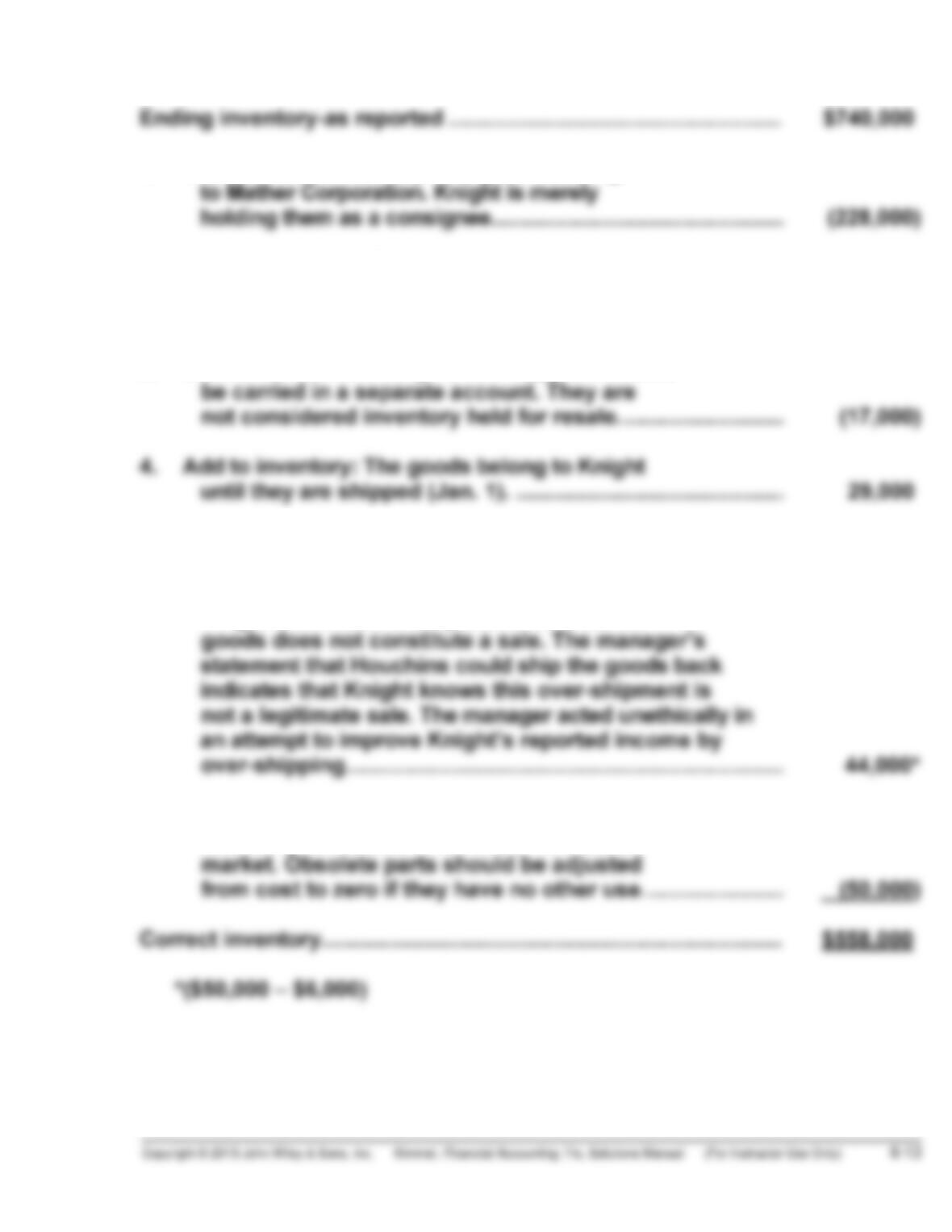
1. Subtract from inventory: The goods belong
2. Add to inventory: The goods belong to
Knight as soon as they are shipped
(December 28). …………………………………………………………….
.
40,000
3. Subtract from inventory: Office supplies should
5. Add to inventory: Houchins Sales ordered goods with
a cost of $6,000. Knight should record the
corresponding sales revenue of $10,000.
Knight’s decision to ship extra “unordered”
6. Subtract from inventory: GAAP requires that
inventory be valued at the lower of cost or
EXERCISE 6-3
(a) Do not include—Mateo does not own items held on consignment.
(b) Include in inventory—Mateo still owns the items as they were only
shipped on consignment.
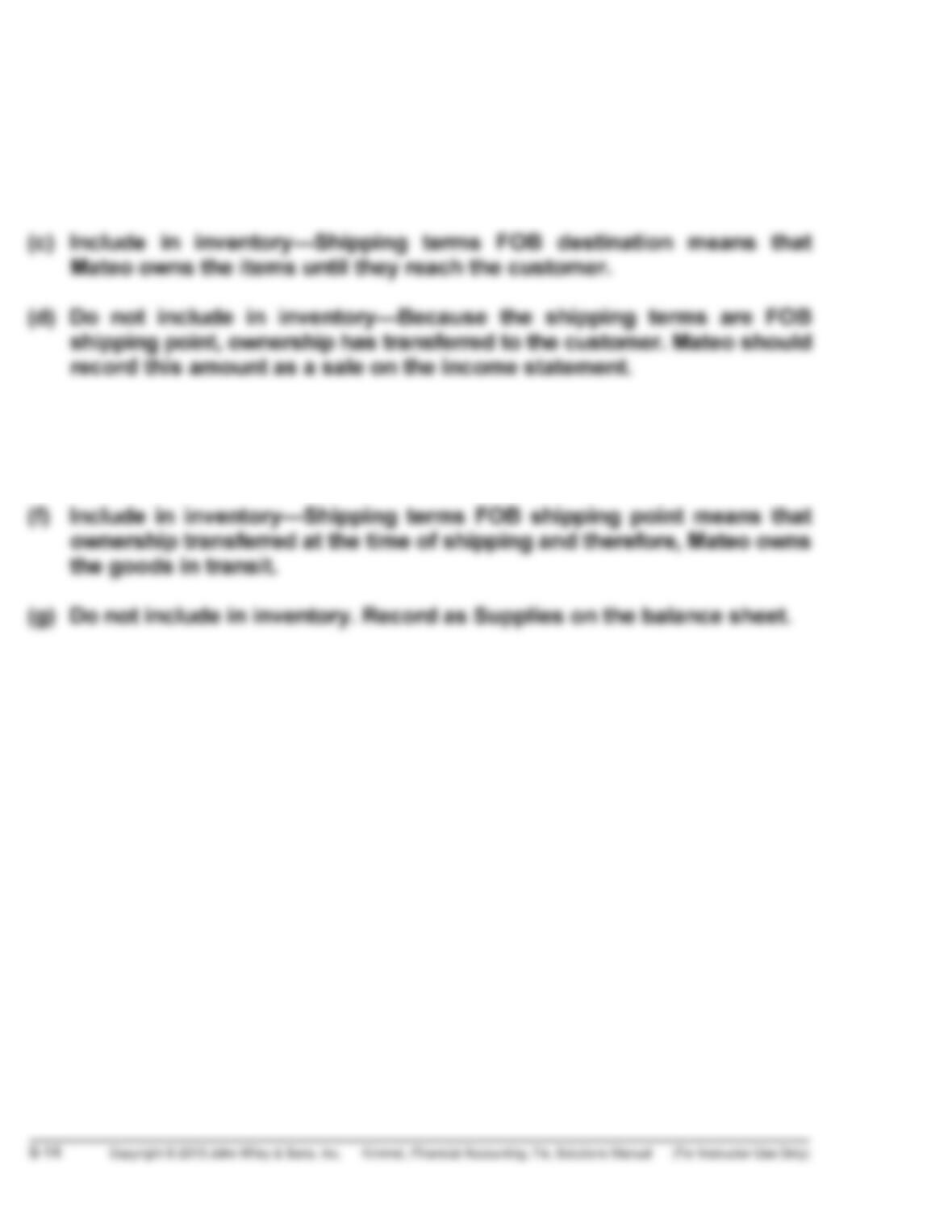
(e) Do not include in inventory—Because the shipping terms are FOB
destination, Mateo does not own the goods until they arrive at Mateo’s
premises.
EXERCISE 6-4
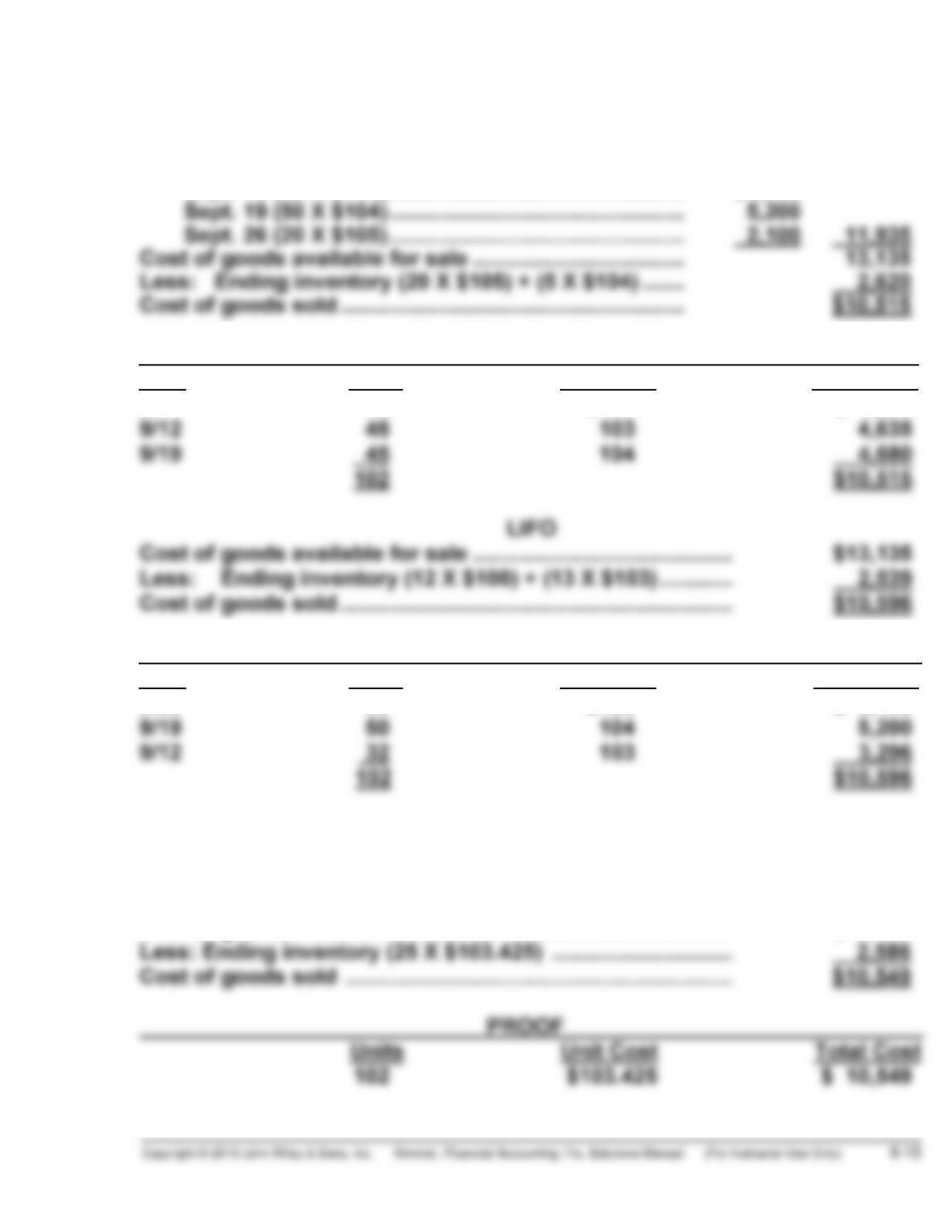
FIFO
Beginning inventory (12 X $100) …………………………….. $ 1,200
Purchases
Sept. 12 (45 X $103) …………………………………………. $4,635
PROOF
Date Units Unit Cost Total Cost
9/1 12 $100 $ 1,200
PROOF
Date Units Unit Cost Total Cost
9/26 20 $105 $ 2,100
AVERAGE-COST
$13,135 ÷ 127 = $103.425 weighted-average unit cost
Cost of goods available for sale ……………………………………. $13,135
EXERCISE 6-5
(a)
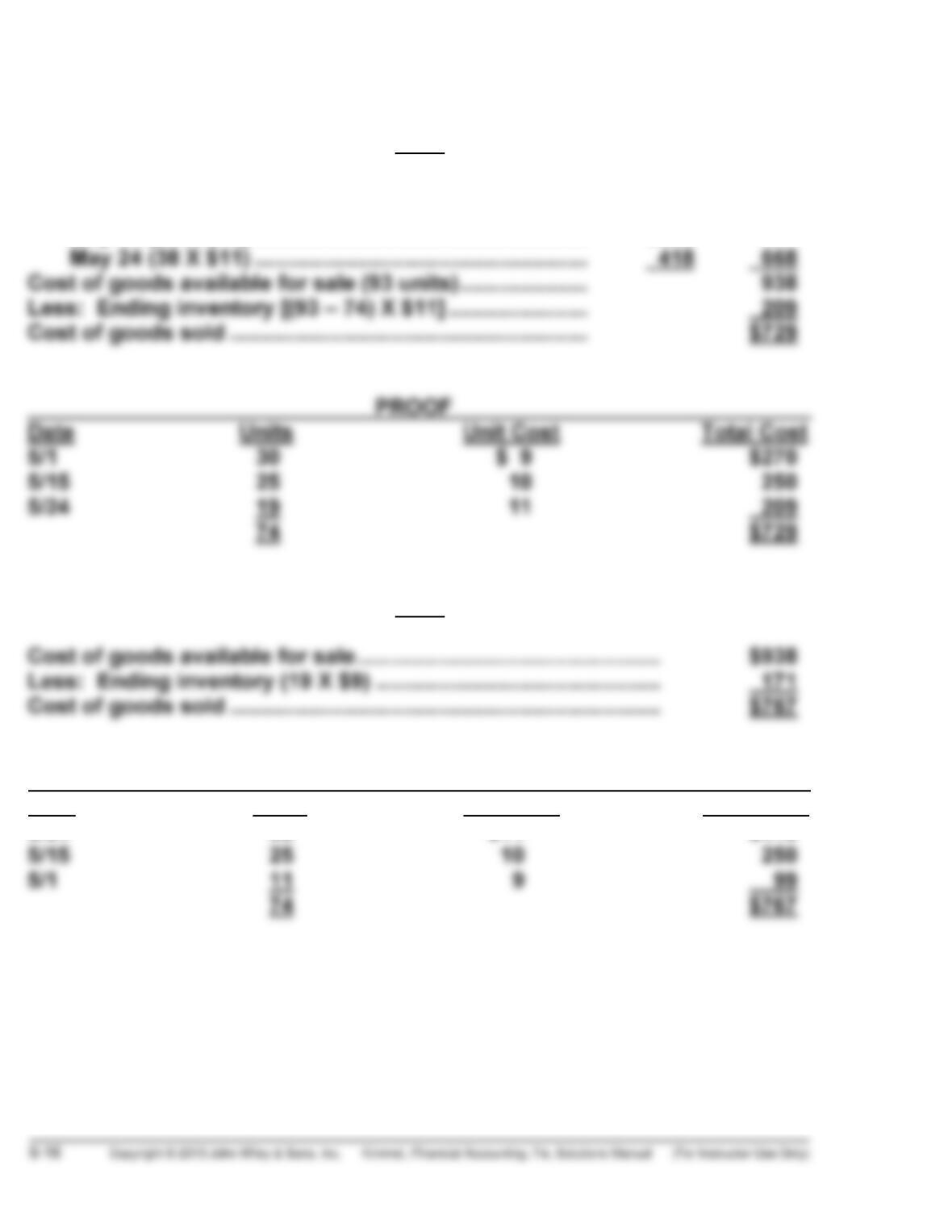
FIFO
Beginning inventory (30 X $9) ………………………………….. $270
Purchases
May 15 (25 X $10) ………………………………………………. $250
(b)
LIFO
PROOF
Date Units Unit Cost Total Cost
5/24 38 $11 $418
EXERCISE 6-5 (Continued)
(c)
AVERAGE-COST
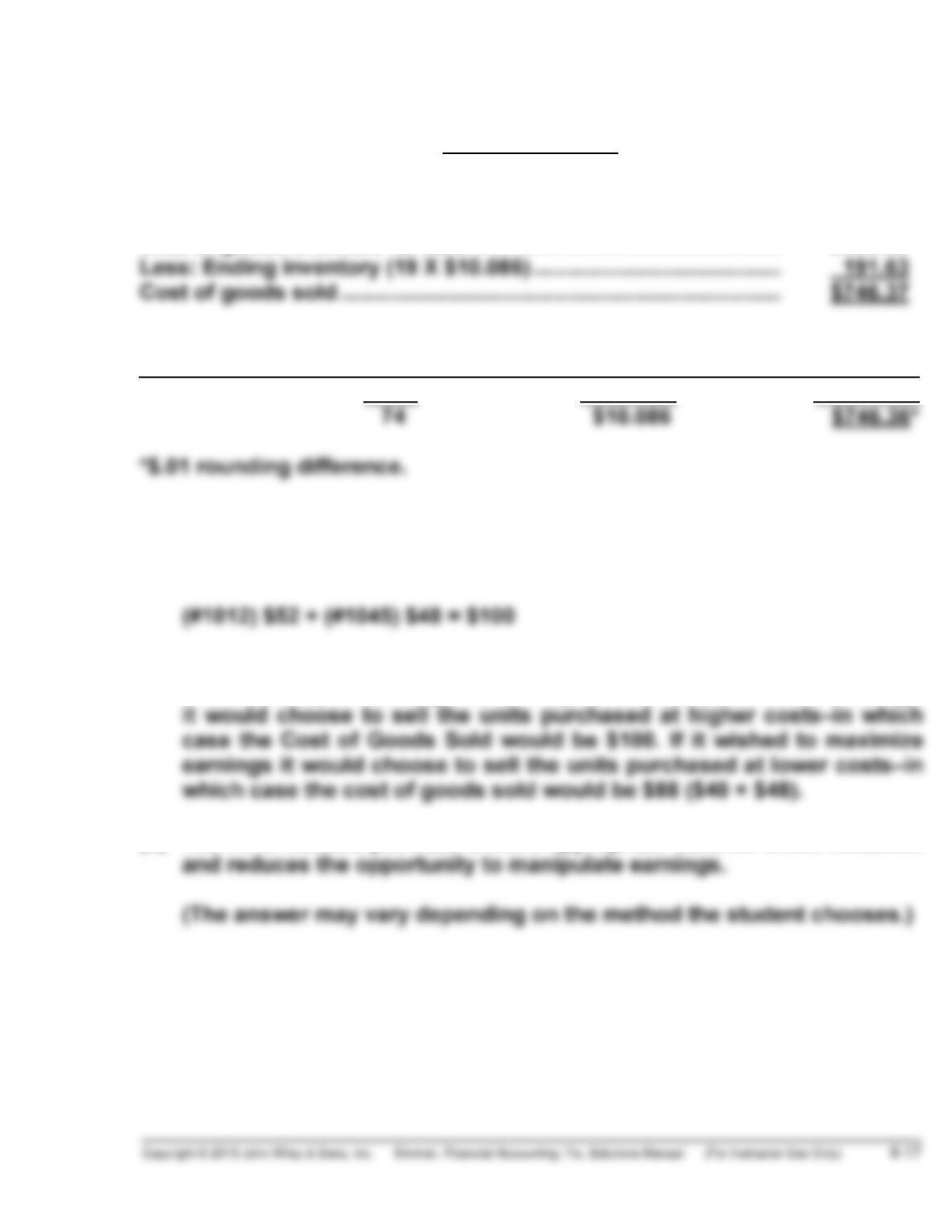
$938 ÷ 93 = $10.086 weighted-average unit cost
Cost of goods available for sale …………………………………………… $938.00
PROOF
Units Unit Cost Total Cost
EXERCISE 6-6
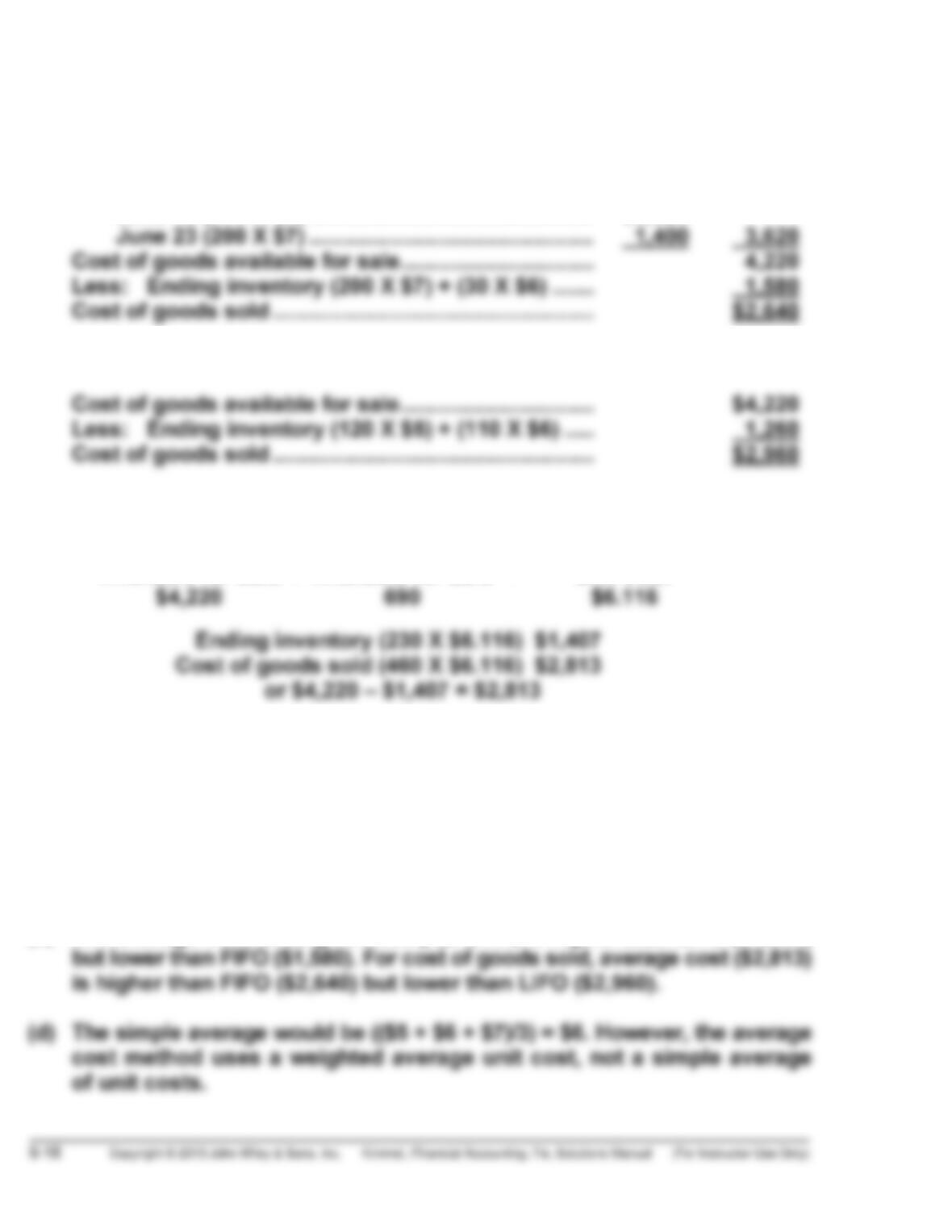
(a) FIFO Cost of Goods Sold
(b) It could choose to sell specific units purchased at specific costs if it
wished to impact earnings selectively. If it wished to minimize earnings
(c) The FIFO method provides a more appropriate balance sheet valuation
EXERCISE 6-7
(a) (1) FIFO
Beginning inventory (120 X $5) …………………………… $ 600
Purchases
June 12 (370 X $6) ……………………………………….. $2,220
(2) LIFO
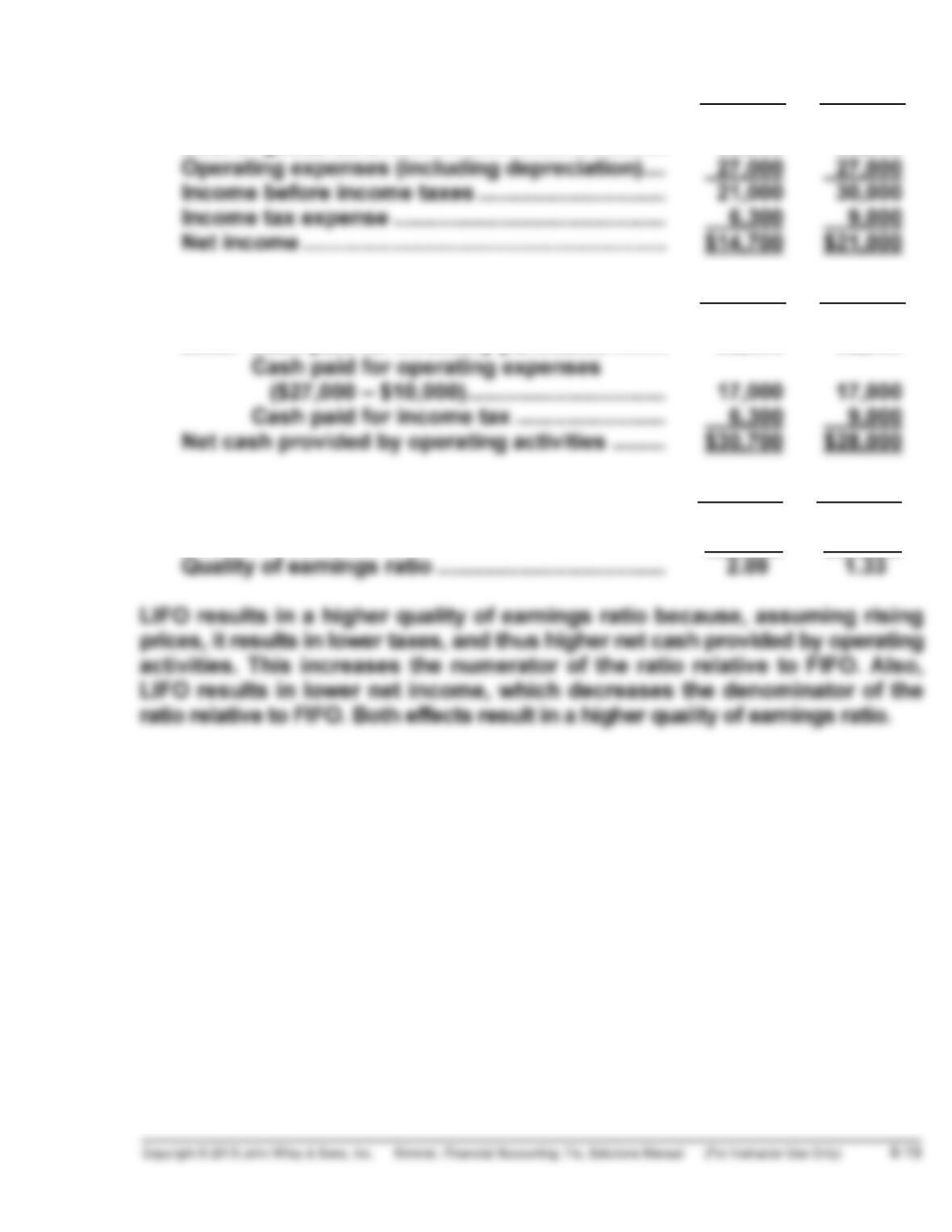
(3) AVERAGE-COST
Cost of Goods Total Units Weighted-Average
Available for Sale ÷ Available for Sale = Unit Cost
(b) The FIFO method will produce the highest ending inventory because costs
have been rising. Under this method, the earliest costs are assigned to
cost of goods sold, and the latest costs remain in ending inventory.
The LIFO method will produce the highest cost of goods sold for
Eggers Company. Under LIFO the most recent costs are charged to
cost of goods sold and the earliest costs are included in the ending
inventory.
(c) The average-cost ending inventory ($1,407) is higher than LIFO ($1,260)
EXERCISE 6-8
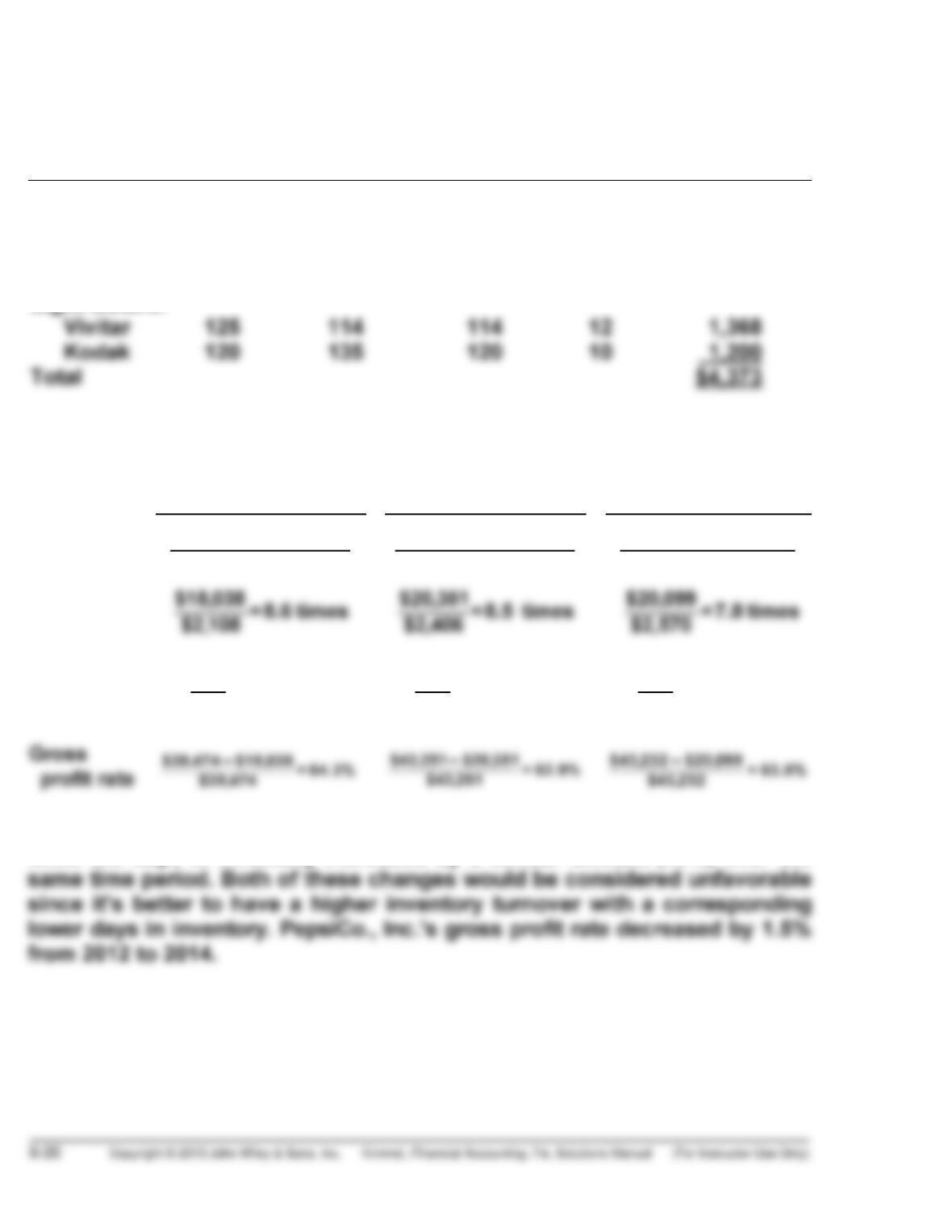
LIFO FIFO
(a) Sales ……………………………………………………………. $86,000 $86,000
Cost of goods sold ……………………………………….. 38,000 29,000
LIFO FIFO
(b) Sales ……………………………………………………………. $86,000 $86,000
Less: Cash paid for inventory purchases ……… 32,000 32,000
LIFO FIFO
(c) Net cash provided by operating activities ……… $30,700 $28,000
÷ Net income ………………………………………………… $14,700 $21,000
EXERCISE 6-9
Cost/Unit
Market
Value/Unit
Lower-of-Cost-
or-Market Units
Inventory at
Lower-of-Cost-
or-Market
Cameras:
Minolta $170 $158 $158 5 $ 790
Canon 145 152 145 7 1,015
Light Meters:
EXERCISE 6-10
2012 2013 2014
Inventory
turnover
$18,038
($1,926 + $2,290) ÷ 2
$20,351
($2,290 + $2,522) ÷ 2
$20,099
($2,522+ $2,618) ÷2
Days in
inventory
365
8.6 =42.4 days 365
8.5 =42.9 days 365
7.8 =46.8 days
The inventory turnover decreased by approximately 10% from 2012 to 2014
while the days in inventory increased by a similar amount (10%) over the