Exercise 6-18A, Obj. 1, 2
1-May Beginning inventory ……..……. $900
15 Purchase………..………………… $604
26 Purchase………..…………………. $2,240
At May 31, 10 of these programs are on hand. Journalize the following for Cranwell Company
under the perpetual system:
1. Total May purchases in one summary entry. All purchases were on credit.
2. Total May sales and cost of goods sold in two summary entries. The selling price was $550 per
unit, and all sales were on credit. Assume that Cranwell uses the FIFO inventory method.
3. Under FIFO, how much gross profit would Cranwell earn on these transactions? What is
the FIFO cost of Cranwell Company’s ending inventory?
6 units @ $150 =
4 units @ 151 =
14 units @ 160 =
Cranwell Company’s inventory records for a particular development program show the following
at May 31:
Show how to account for inventory transactions; apply
the FIFO cost method
Financial Accounting
Student Name
Course Name
Student ID:
Date:
Students: Please fill-in areas that are shaded. Use
formulas as requested.

Exercise 6-18A
1
2
3
Test Your Knowledge
Gross Profit
Ending Inventory
Solution Sun, Sept 30, 2007
Exercise 6-18A, Obj. 1, 2
1-May Beginning inventory ……..……. $900
15 Purchase………..………………… $604
26 Purchase………..…………………. $2,240
At May 31, 10 of these programs are on hand. Journalize the following for Cranwell Company
under the perpetual system:
1. Total May purchases in one summary entry. All purchases were on credit.
2. Total May sales and cost of goods sold in two summary entries. The selling price was $550 per
unit, and all sales were on credit. Assume that Cranwell uses the FIFO inventory method.
3. Under FIFO, how much gross profit would Cranwell earn on these transactions? What is
the FIFO cost of Cranwell Company’s ending inventory?
6 units @ $150 =
4 units @ 151 =
14 units @ 160 =
Financial Accounting
Show how to account for inventory transactions; apply
the FIFO cost method
Cranwell Company’s inventory records for a particular development program show the following
at May 31:
Students: Please fill-in areas that are shaded. Use
formulas as requested.
Student Name
Course Name
Student ID:
Date:
BU121 ID 0503
Solution Sun, Sept 30, 2007
Exercise 6-18A
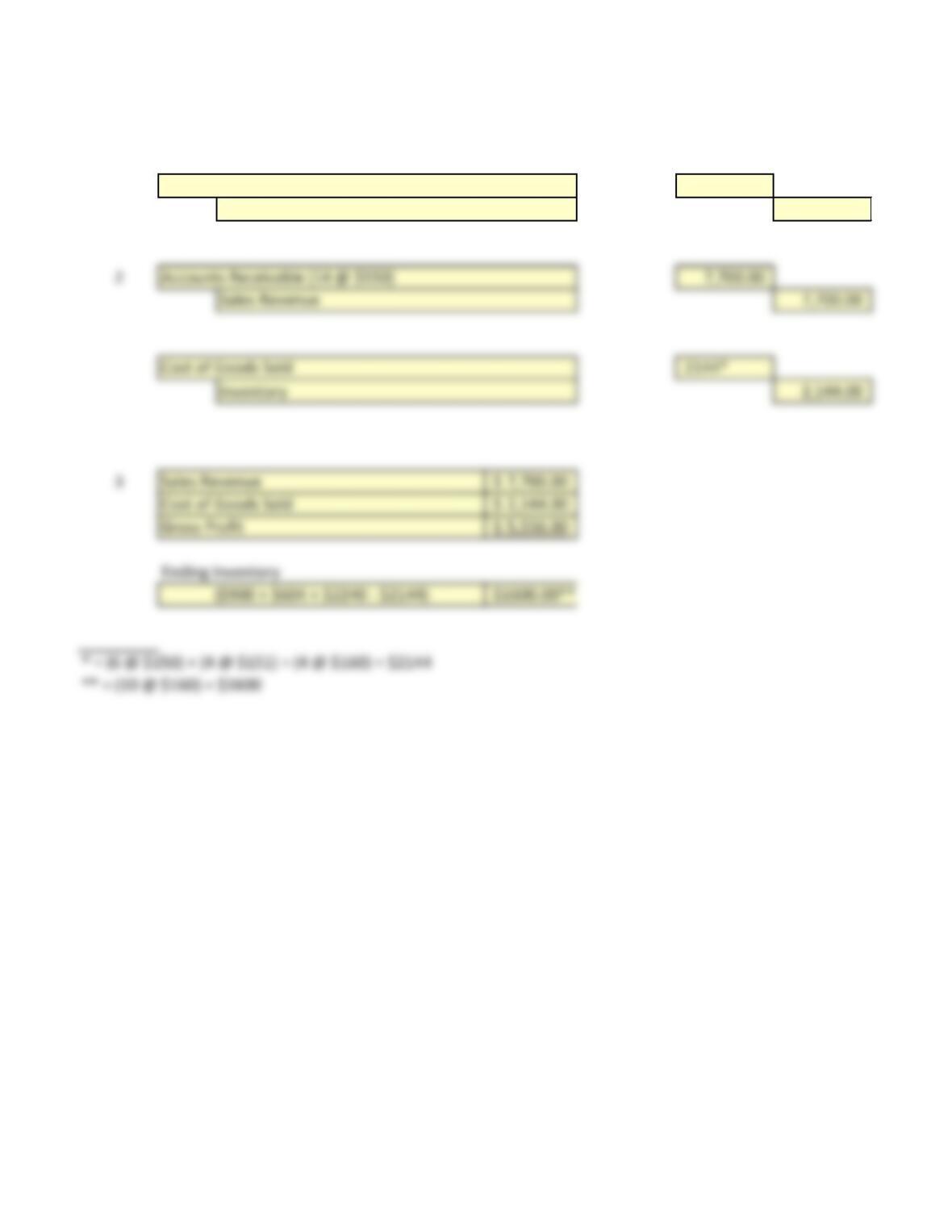
1 2,844.00
2,844.00
Test Your Knowledge
Accounts Payable
Inventory ($604 + $2240)
BU121 ID 0503
Gross Profit
Ending Inventory
Accounts Receivable (14 @ $550)
Sales Revenue
Cost of Goods Sold
Sales Revenue
Cost of Goods Sold
Exercise 6-22A, Obj. 2
Student Name
Course Name
Student ID:
Date:
Date Item Quantity Unit Cost Sale Price
June 1 Balance 15 $42
2 Purchase 7 73
7 Sale 6 $118
13 Sale 4 111
Students: Please fill-in areas that are shaded.
Financial Accounting
MusicPlace specializes in sound equipment. Because each inventory item is expensive,
MusicPlace uses a perpetual inventory system. Company records indicate the following
data for a line of speakers:
Compare ending inventory and cost of goods sold—FIFO vs.
LIFO
Exercise 6-22A
Instructions
1. Determine the amounts that MusicPlace should report for cost of goods sold and ending
inventory two ways:
a. FIFO b. LIFO
2.
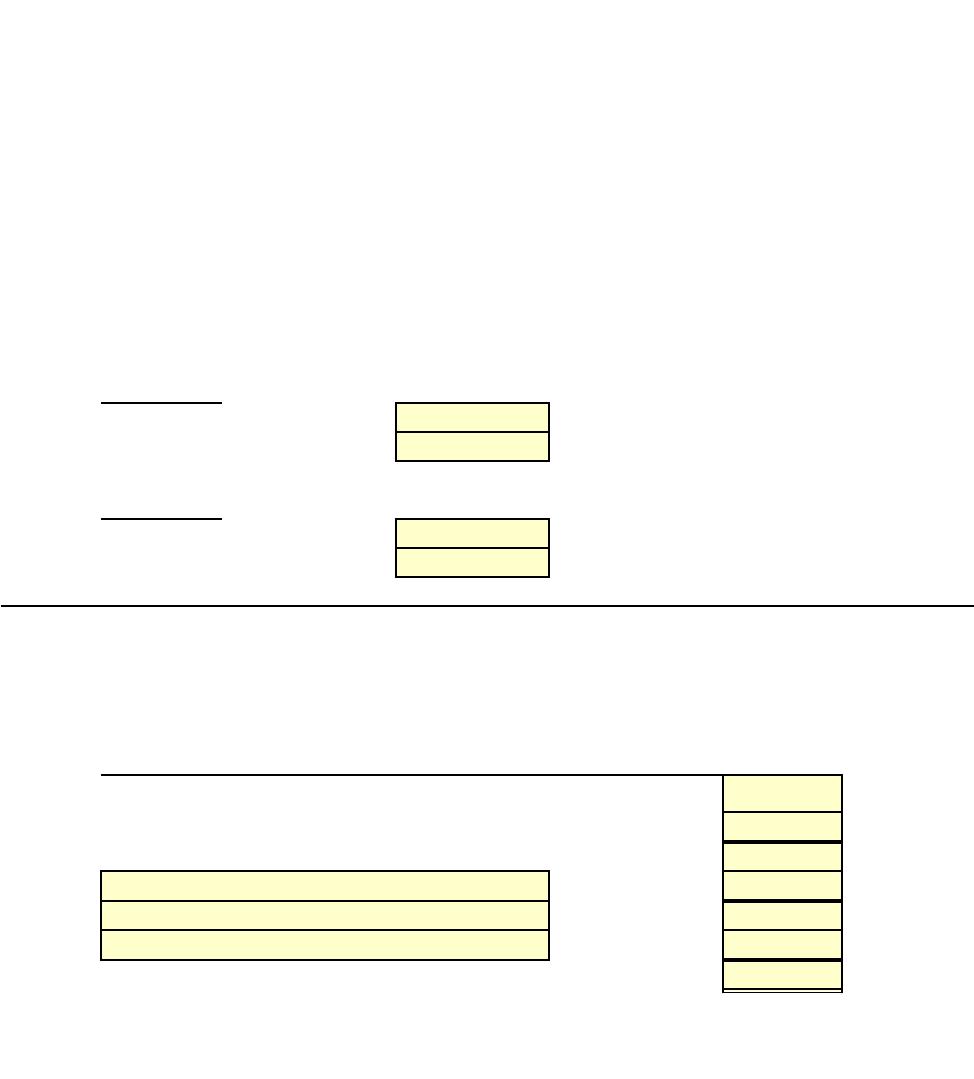
Requirement 1
Part a. FIFO
Cost of goods sold: FORMULA
Ending inventory: FORMULA
Part b. LIFO
Cost of goods sold: FORMULA
Ending inventory: FORMULA
Requirement 2
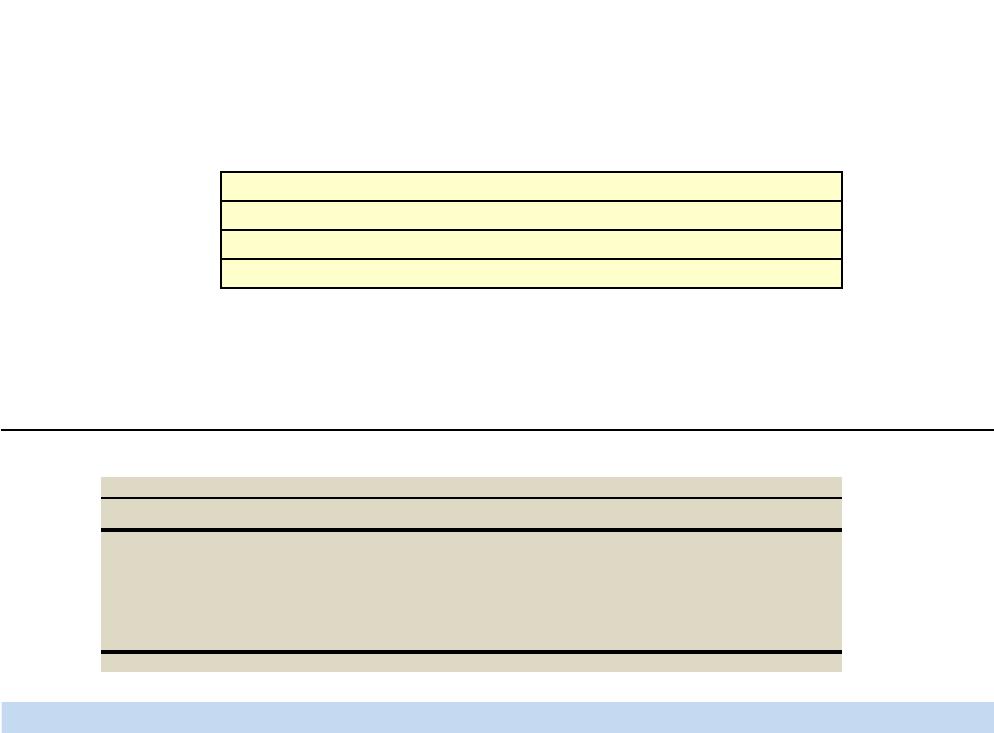
Sales revenue . . . . . . . . . . . . . . . . . . . . . . . . . . . . .
Cost of goods sold . . . . . . . . . . . . . . . . . . . . . . . . . CELL REF
Gross profit . . . . . . . . . . . . . . . . . . . . . . . . . . . . . . .
FORMULA
Net income . . . . . . . . . . . . . . . . . . . . . . . . . . . . . .
MusicPlace uses the FIFO method. Prepare MusicPlace’s income statement for the month
ended June 30, 2016, reporting gross profit. Operating expenses totaled $280, and the income
tax rate was 40%.
Test Your Knowledge
MusicPlace
Income Statement
Month Ended June 30, 2016
Exercise 6-22A, Obj. 2
Student Name
Course Name
Student ID:
Date:
Date Item Quantity Unit Cost Sale Price
June 1 Balance 15 $42
2 Purchase 7 73
7 Sale 6 $118
13 Sale 4 111
Compare ending inventory and cost of goods sold—FIFO vs.
LIFO
Students: Please fill-in areas that are shaded.
Financial Accounting
MusicPlace specializes in sound equipment. Because each inventory item is expensive,
MusicPlace uses a perpetual inventory system. Company records indicate the following
data for a line of speakers:
Exercise 6-22A
Instructions
1. Determine the amounts that MusicPlace should report for cost of goods sold and ending
inventory two ways:
a. FIFO b. LIFO
2.
Requirement 1
Part a. FIFO
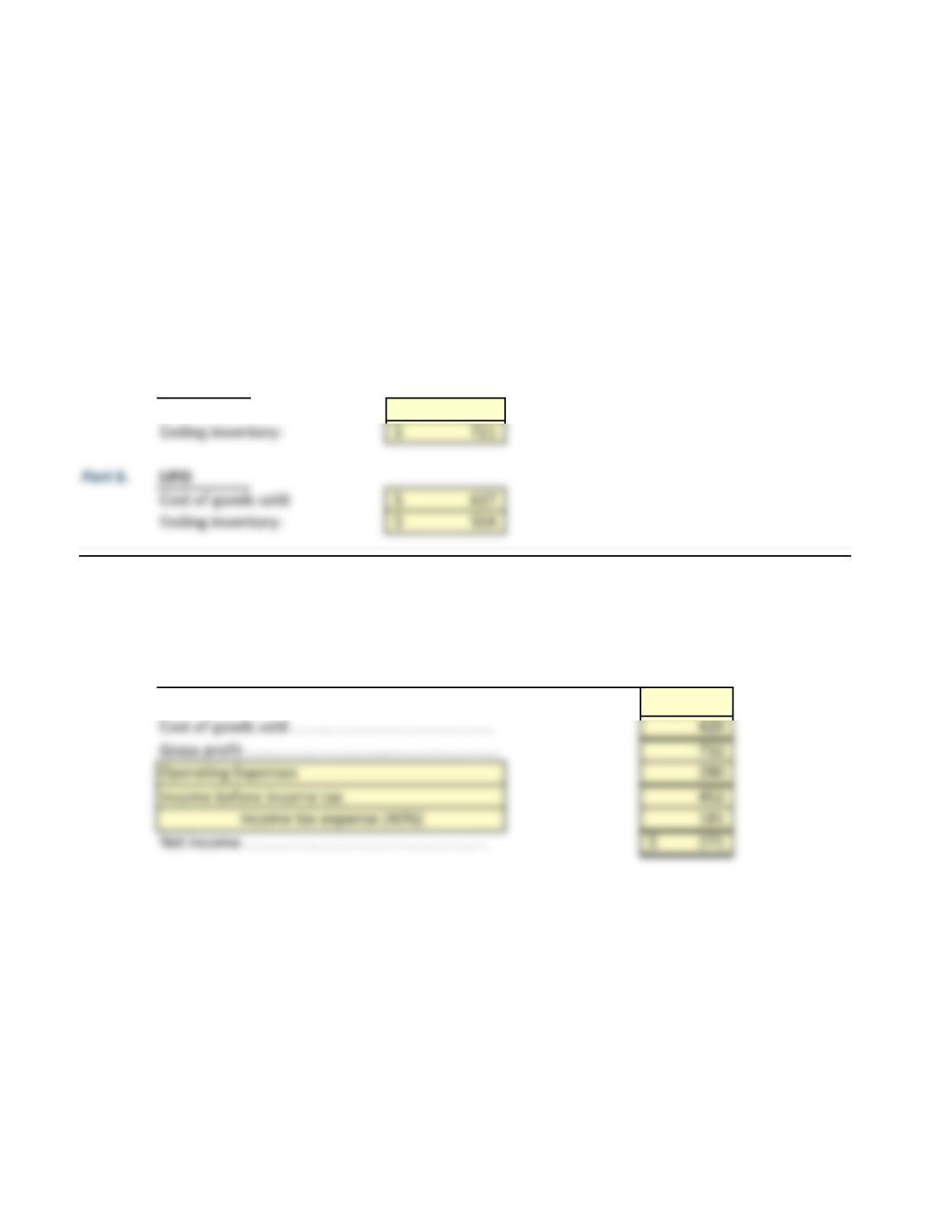
Cost of goods sold: 420$
Requirement 2
Sales revenue . . . . . . . . . . . . . . . . . . . . . . . . . . . . . 1,152$
Gross profit . . . . . . . . . . . . . . . . . . . . . . . . . . . . . . . 732
MusicPlace uses the FIFO method. Prepare MusicPlace’s income statement for the month ended
June 30, 2016, reporting gross profit. Operating expenses totaled $280, and the income tax rate
was 40%.
Test Your Knowledge
MusicPlace
Income Statement
Month Ended June 30, 2016
Ending inventory: 721$
Part b. LIFO
Cost of goods sold: 637$
Ending inventory: 504$
Exercise 6-25A, Obj. 4
Student Name
Course Name
Student ID:
Date:
Net Sales
Beginning
Inventory
Purchases
Ending
Inventory
Cost of Goods
Sold
Gross Profit
106,000 19,000 60,000 17,000 (a) (b)
132,000 27,000 ( c ) 26,000 (d) 40,000
(e) (f) 57,000 22,000 63,000 32,000
86,000 8,000 32,000 (g)
35,000 (h)
Financial Accounting
Supply the missing income statement amounts for each of the following companies (amounts adapted, in millions):
Company
Arnold
Donahue
Students: Please fill-in areas that are shaded.
Compute cost of goods sold and gross profit
Allen
Nugent
Exercise 6-25A
Instructions
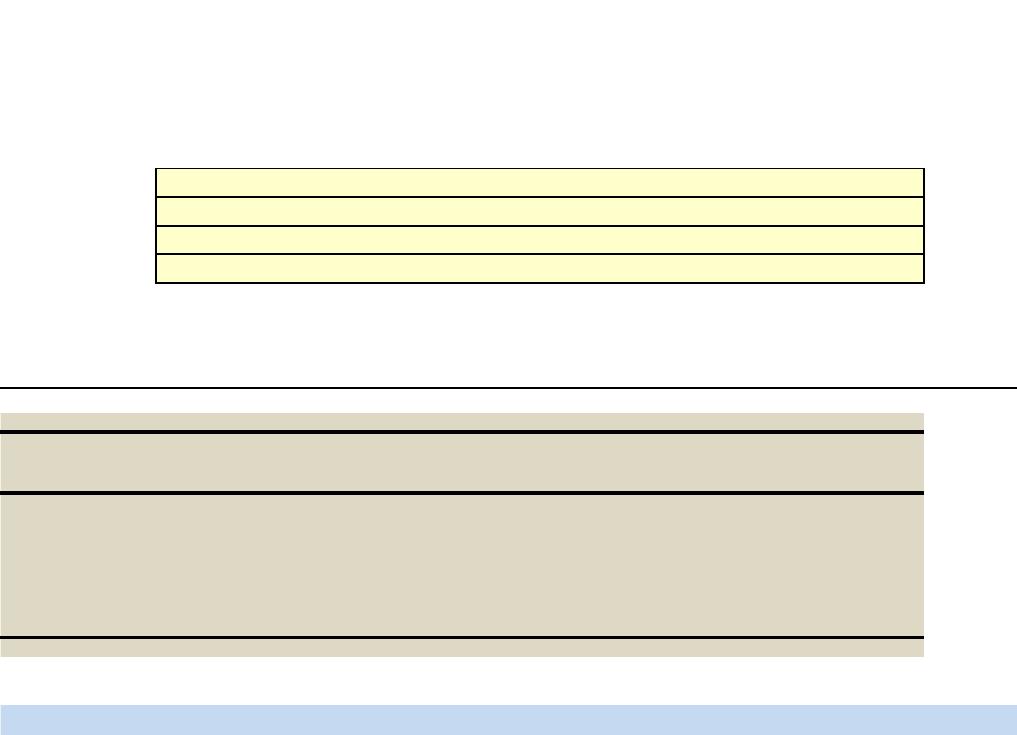
Prepare the income statement for Arnold Company for the year ended December 31, 2016.
Use the cost-of-goods-sold model to compute cost of goods sold. Arnold’s operating and other
expenses, as adapted, for the year were $41,000. Ignore income tax.
Answer:
a) Cost of Goods Sold
b) Gross Profit
c) Purchases
d) Cost of goods sold
e) Net sales
f) Beginning inventory
g) Ending inventory
h) Gross Profit
(Millions)
Net sales 106,000$
Cost of goods sold
FORMULA
Ending inventory (17,000)
Gross profit 106,000$
Test Your Knowledge
Arnold Company
Income Statement
Year Ended December 31, 2016
Exercise 6-25A, Obj. 4
Student Name
Course Name
Student ID:
Date:
Net Sales
Beginning
Inventory
Purchases
Ending
Inventory
Cost of Goods
Sold
Gross Profit
106,000 19,000 60,000 17,000 (a) (b)
132,000 27,000 ( c ) 26,000 (d) 40,000
(e) (f) 57,000 22,000 63,000 32,000
86,000 8,000 32,000 (g)
35,000 (h)
Company
Arnold
Donahue
Allen
Financial Accounting
Supply the missing income statement amounts for each of the following companies (amounts adapted, in millions):
Nugent
Students: Please fill-in areas that are shaded.
Compute cost of goods sold and gross profit
BU 121 ID 503
Exercise 6-25A
Instructions
Prepare the income statement for Arnold Company for the year ended December 31, 2016.
Use the cost-of-goods-sold model to compute cost of goods sold. Arnold’s operating and other
expenses, as adapted, for the year were $41,000. Ignore income tax.
Answer:
a) 62,000 Cost of Goods Sold ($19,000 + 60,000 – 17,000 = 62,000)
Test Your Knowledge
BU 121 ID 503
Problem 6-62A, Obj. 1, 2
Student Name
Course Name
Student ID:
Date:
Jul (30,000 units @ cost of $58) ……………………
$ 1,740,000
Big Box purchases inventory in crates of merchandise; each crate of inventory is a unit. The fiscal year
of Big Box ends each January 31.
Assume you are dealing with a single Big Box store in Rosedale, Minnesota. The Rosedale store began
2016 with an inventory of 23,000 units that cost a total of $1,219,000. During the year, the store
purchased merchandise on account as follows:
Financial Accounting
Students: Please fill-in areas that are shaded.
Use formulas were possible.
Show how to account for inventory in a perpetual system using the
average-costing method
rate of 30%.
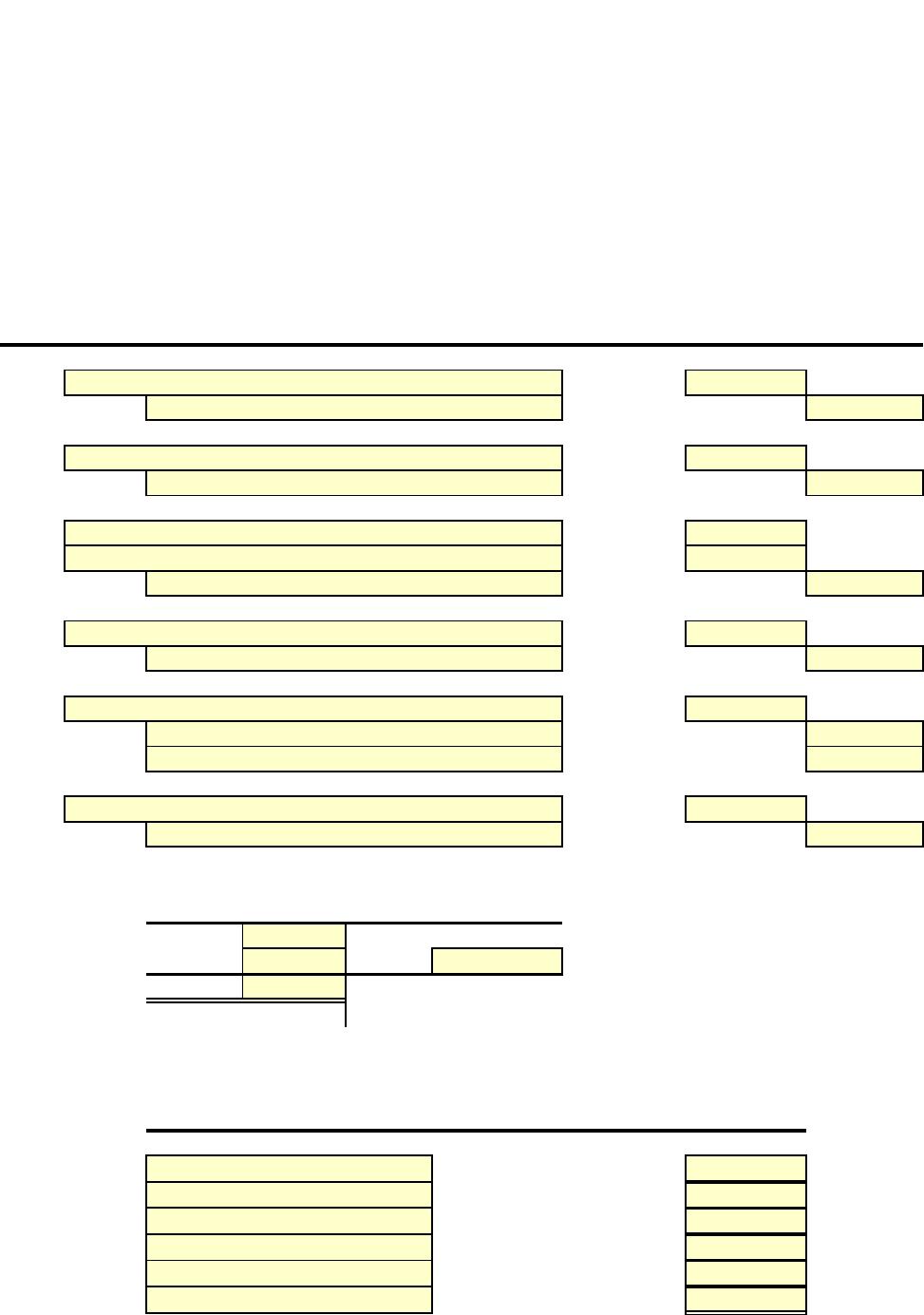
Problem 6-62A
Instructions
1. Make summary journal entries to record the store’s transactions for the year ended
January 31, 2016. Big Box uses a perpetual inventory system.
2. Prepare a T-account to show the activity in the Inventory account.
3. Prepare the store’s income statement for the year ended January 31, 2016. Show totals for
gross profit, income before tax, and net income.
Requirement 1
DATE DEBIT CREDIT
Requirement 2
Beg. Bal.
Purchases COGS 9,392,200
End. Bal.
Requirement 3
Sales revenue . . . . . . . . . . . . . . . . . . . . . . . . . . . . . . . . . . . . . . . . 15,477,500$
. . . . . . . . . . . . . . . . . . . . . . . .
. . . . . . . . . . . . . . . . . . . . . . . .
. . . . . . . . . . . . . . . . . . . . . . . .
. . . . . . . . . . . . . . . . . . . . . . . .
. . . . . . . . . . . . . . . . . . . . . . . .
. . . . . . . . . . . . . . . . . . . . . . . .
Test Your Knowledge
ACCOUNT TITLES
Inventory
Big Box Store, Rosedale
Income Statement
Year Ended January 31, 2016

Problem 6-62A, Obj. 1, 2
Student Name
Course Name
Student ID:
Date:
Jul (30,000 units @ cost of $58) ……………………
$ 1,740,000
Nov (50,000 units @ cost of $62) …………………
3,100,000
Dec (60,000 units @ cost of $68)………………..…
4,080,000
Total purchases . . . . . . . . . . . . . . . . . . . . . . . . . . .
$ 8,920,000
Cash payments on account totaled $8,592,000. During fiscal year 2016, the store sold 151,000 units of
merchandise for $15,477,500, of which $5,300,000 was for cash and the balance was on account. Big
Box uses the average-cost method for inventories. Operating expenses for the year were $2,500,000.
Big Box paid 70% in cash and accrued the rest as accrued liabilities. The store accrued income tax at
the rate of 30%.
Financial Accounting
Big Box purchases inventory in crates of merchandise; each crate of inventory is a unit. The fiscal year
of Big Box ends each January 31.
Assume you are dealing with a single Big Box store in Rosedale, Minnesota. The Rosedale store began
2016 with an inventory of 23,000 units that cost a total of $1,219,000. During the year, the store
purchased merchandise on account as follows:
Students: Please fill-in areas that are
shaded. Use formulas were possible.
Show how to account for inventory in a perpetual system using the
average-costing method
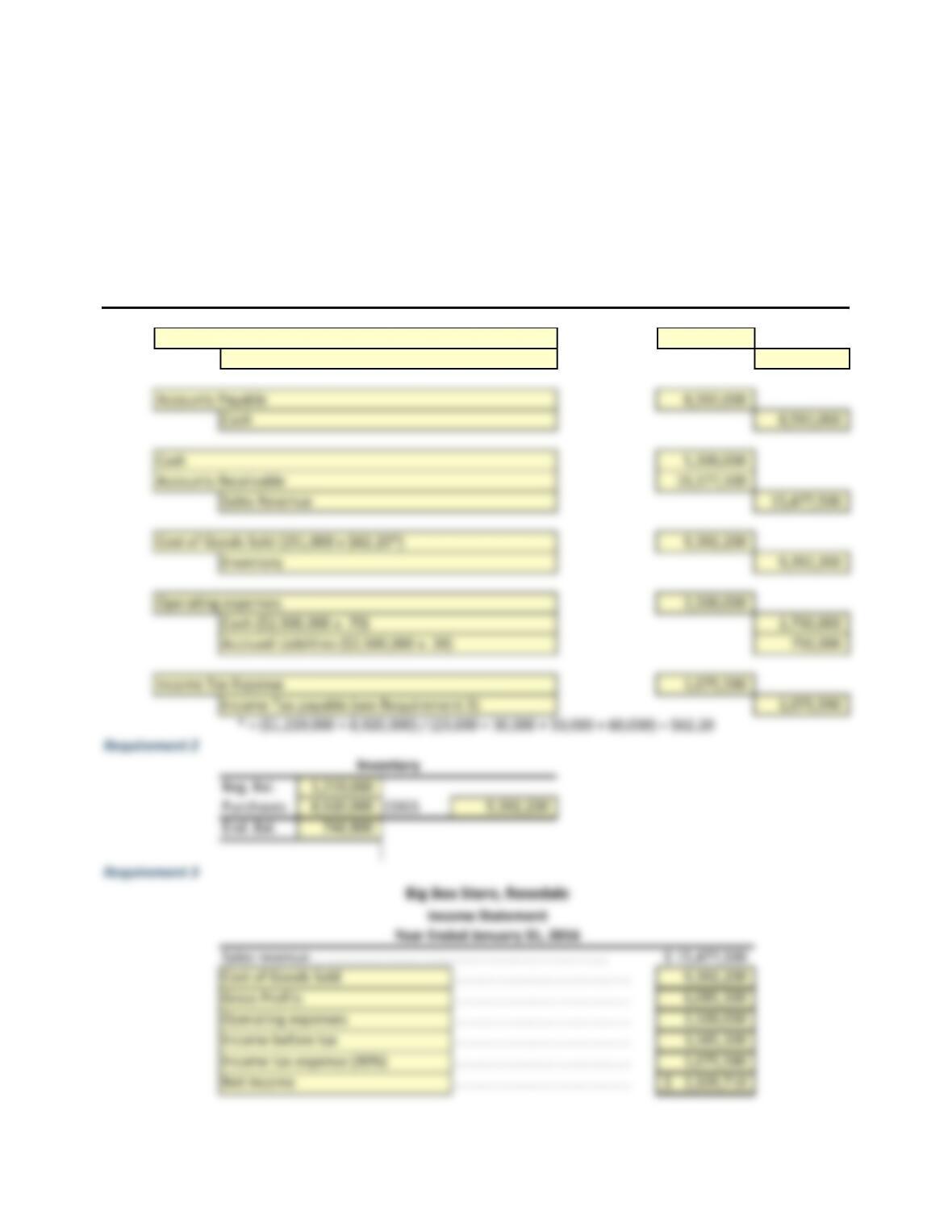
Problem 6-62A
Instructions
1. Make summary journal entries to record the store’s transactions for the year ended
January 31, 2016. Big Box uses a perpetual inventory system.
2. Prepare a T-account to show the activity in the Inventory account.
3. Prepare the store’s income statement for the year ended January 31, 2016. Show totals for
gross profit, income before tax, and net income.
Requirement 1
DATE DEBIT CREDIT
8,920,000
8,920,000
Test Your Knowledge
ACCOUNT TITLES
Inventory
Accounts Payable
8,592,000
8,592,000
5,300,000
9,392,200
9,392,200
2,500,000
1,750,000
1,075,590
1,075,590
Requirement 2
Cash ($2,500,000 x .70)
Accounts Payable
Cash
Accounts Receivable
Cost of Goods Sold (151,000 x $62.20*)
Inventory
Operating expenses
Income Tax Expense
Cash
Sales Revenue
Income Tax payable (see Requirement 3)