
Chapter 6 Cost Allocation and Activity-Based Costing
6-17
Jiambalvo Managerial Accounting
6-18
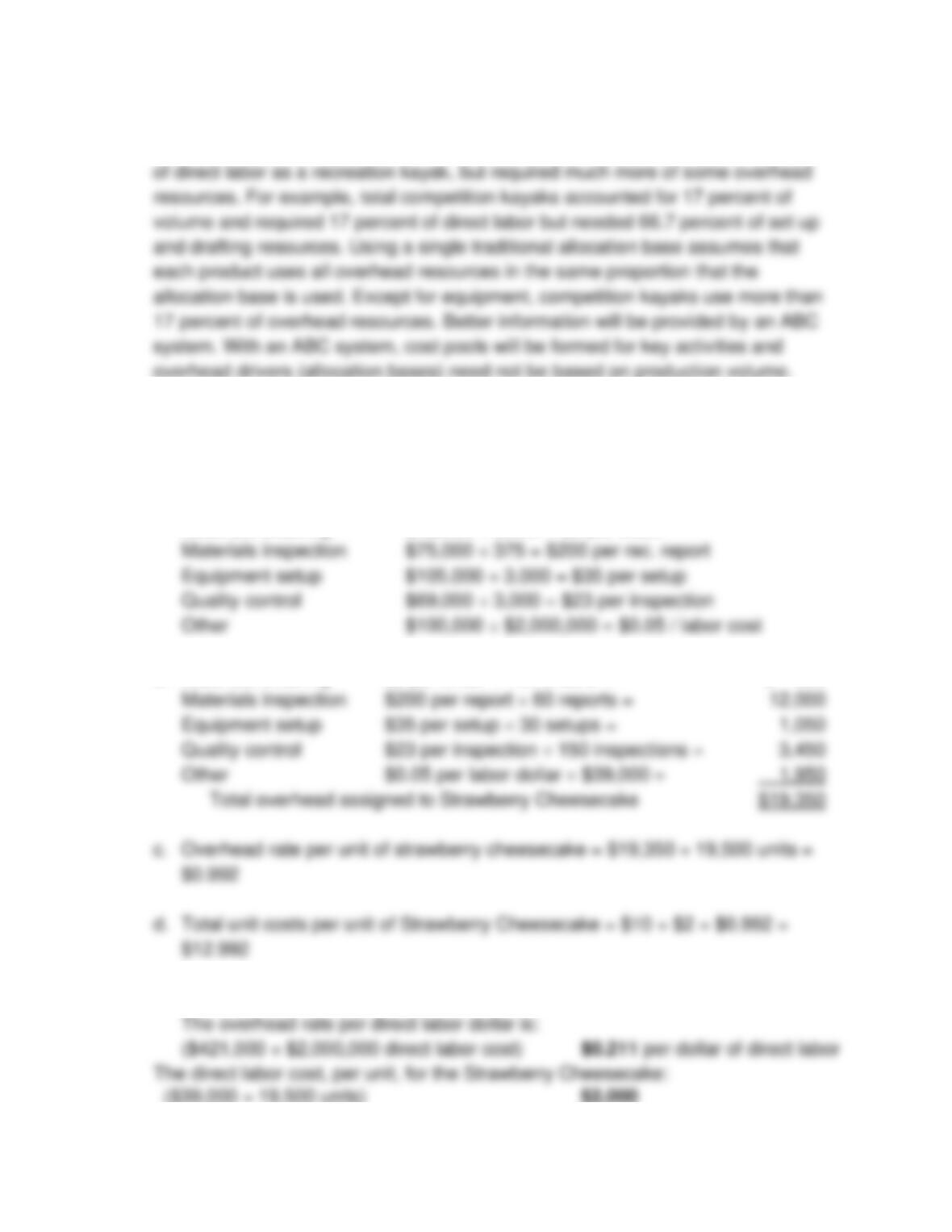
d. The traditional allocation method used by Summit is essentially a volume-based
method. In this problem, each unit of the competition kayak used the same amount
P12. [LO 2]
a.
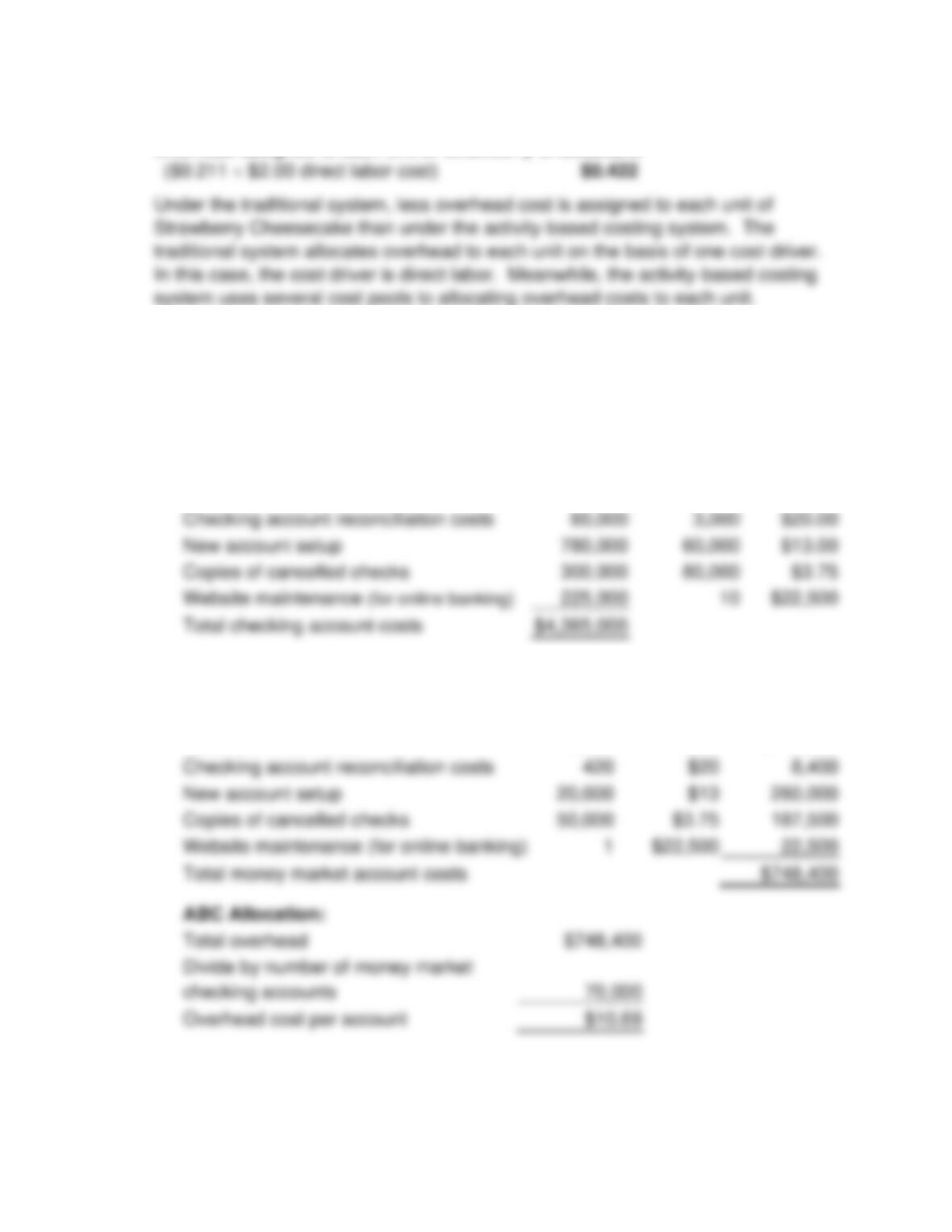
Cost Pool Overhead rate
Materials ordering $72,000 ÷ 8,000 = $9 per order
b. Materials ordering $9 per order 100 orders = $ 900
e. With a traditional system:
Chapter 6 Cost Allocation and Activity-Based Costing
6-19
Overhead assigned to each unit of Strawberry Cheesecake
P13. [LO 2]
a.
Cost Pool
Cost
Total cost
driver
activity
Cost
pool rate
Returned check costs
$3,000,000
200,000
$15.00
Checking account reconciliation costs
60,000
New account setup
$13.00
Copies of cancelled checks
Website maintenance (for online banking)
Total checking account costs
b.
Costs
Activity
Usage
Cost Pool
Rate
Total Cost
Allocated
Returned check costs
18,000
$15
$270,000
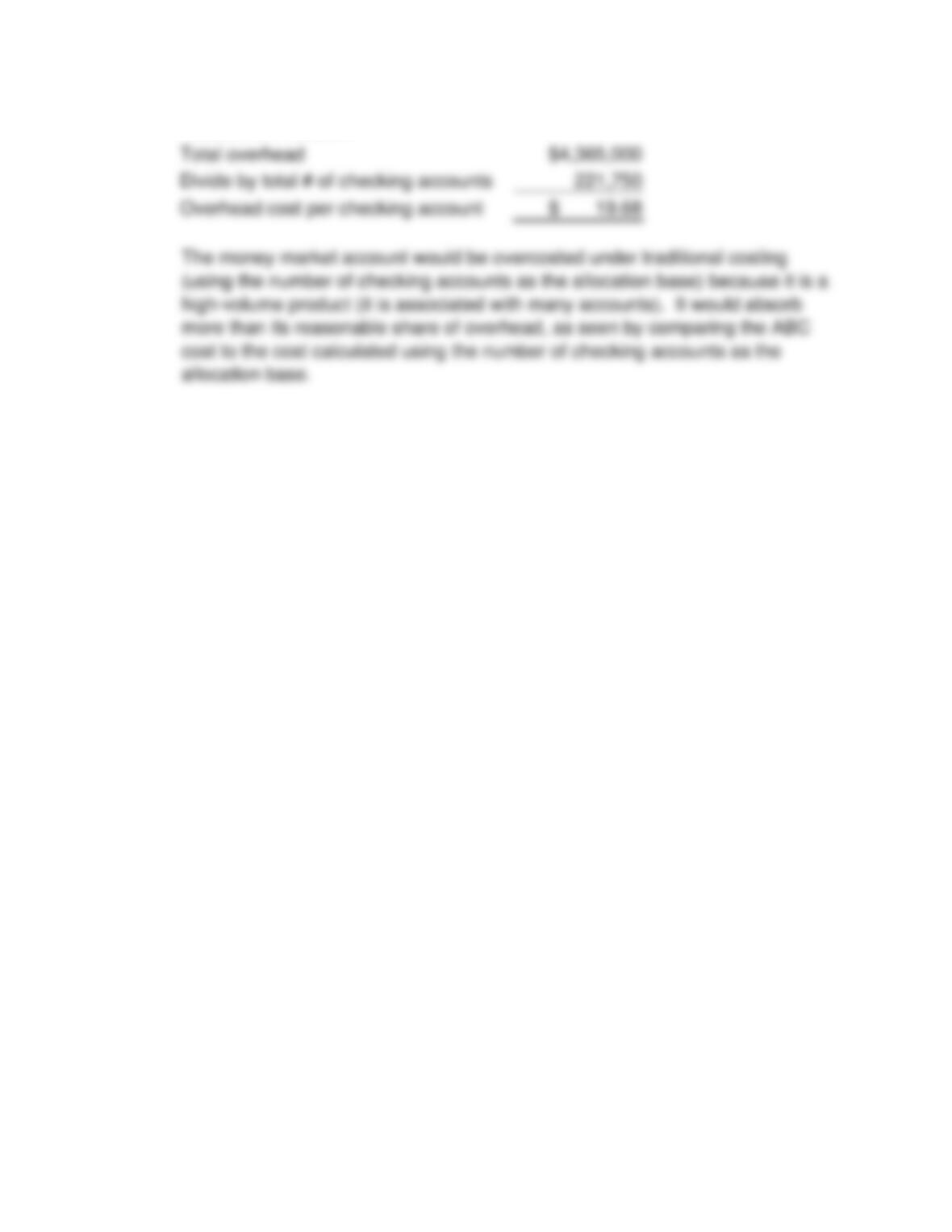
Checking account reconciliation costs
New account setup
Copies of cancelled checks
50,000
Website maintenance (for online banking)
Total money market account costs
Total overhead
Overhead cost per account
c.
Jiambalvo Managerial Accounting
6-20
Traditional Allocation:
P14. [LO 1, 2]
a.
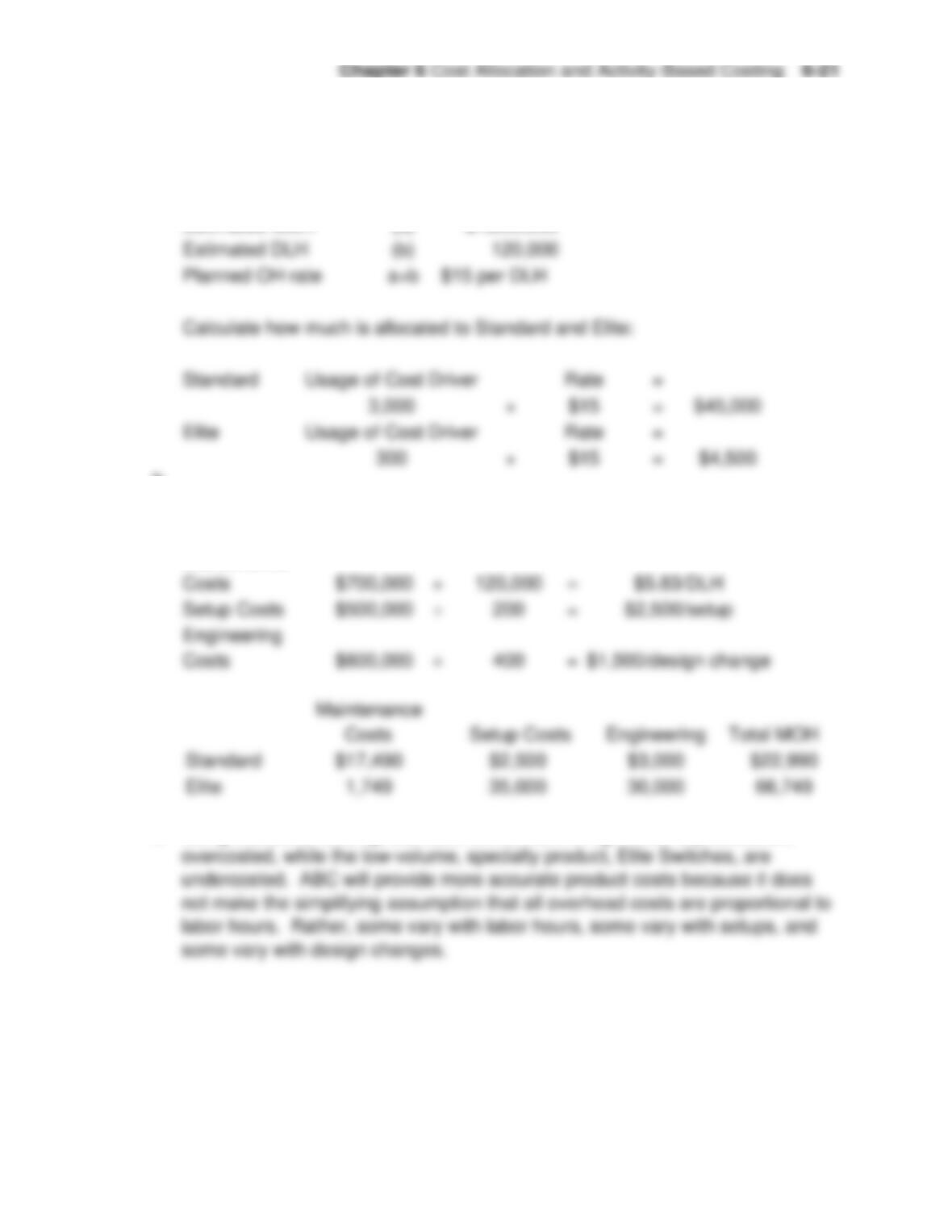
Calculate predetermined overhead rate based on DLH:
Estimated MOH
(a)
$1,800,000
Estimated DLH
Planned OH rate
$15 per DLH
Calculate how much is allocated to Standard and Elite:
Standard
Elite
b.
Calculate individual pool
rates:
Cost pool rate
Setup Costs
$1,500/design change
Total MOH
Standard
Elite
Maintenance
c. Using traditional costing, Standard Switches, the high-volume product, are
P15. [LO 2]
a.
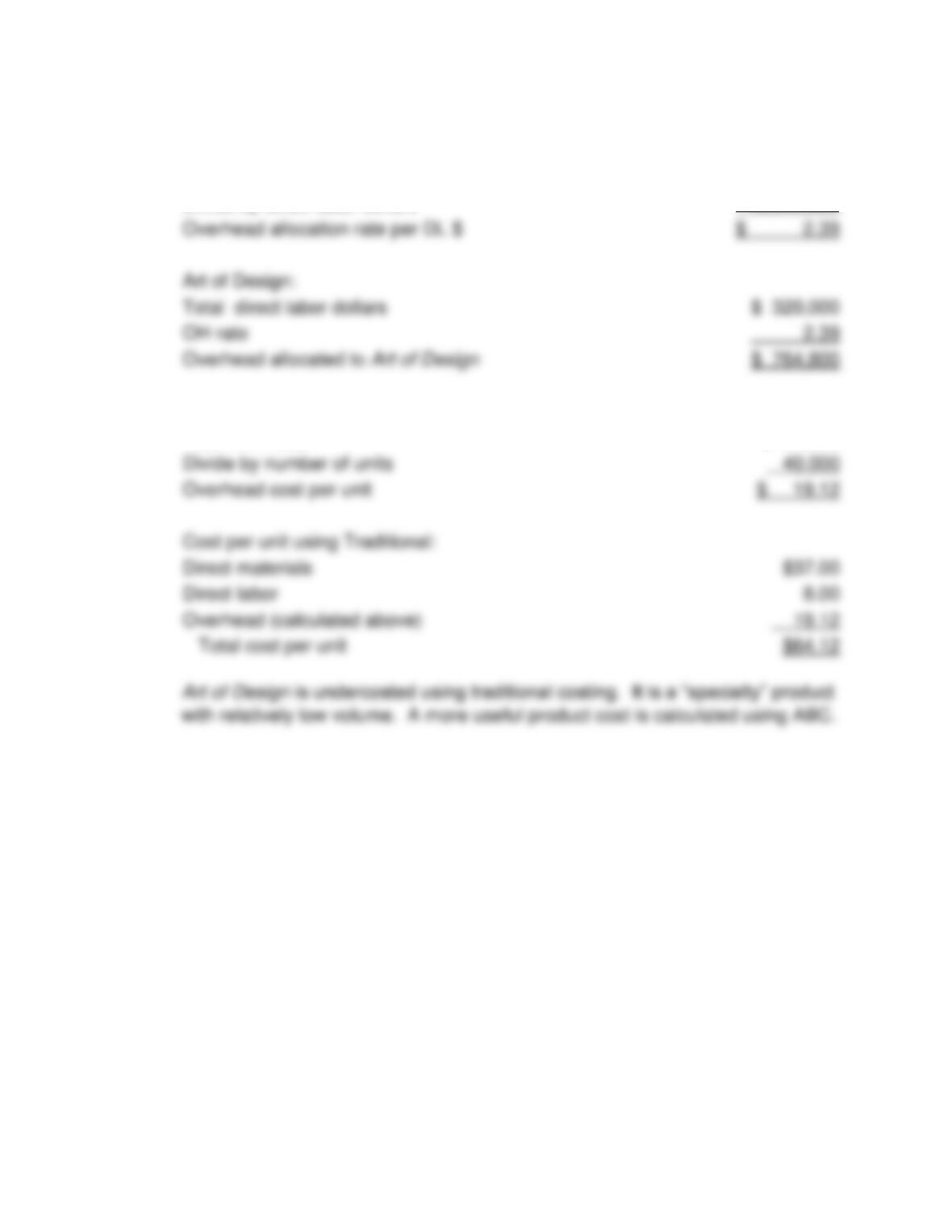
Cost Pool
Cost pools
Total cost
driver activity
Cost pool rate
Materials ordering
$ 840,000
120,000
$7
Equipment setup
Other
$2
Total mfg. overhead
b.
Costs
Activity
usage
Cost
pool rate
Total cost
allocated
Materials ordering
1,200
$7
$8,400
Materials inspection
$250
78,750
Quality control
$200
c.
ABC overhead cost per unit:
Total overhead
Divide by number of units
d.
Cost per unit using ABC:
Direct labor
Overhead (calculated above)
Chapter 6 Cost Allocation and Activity-Based Costing
6-23
e.
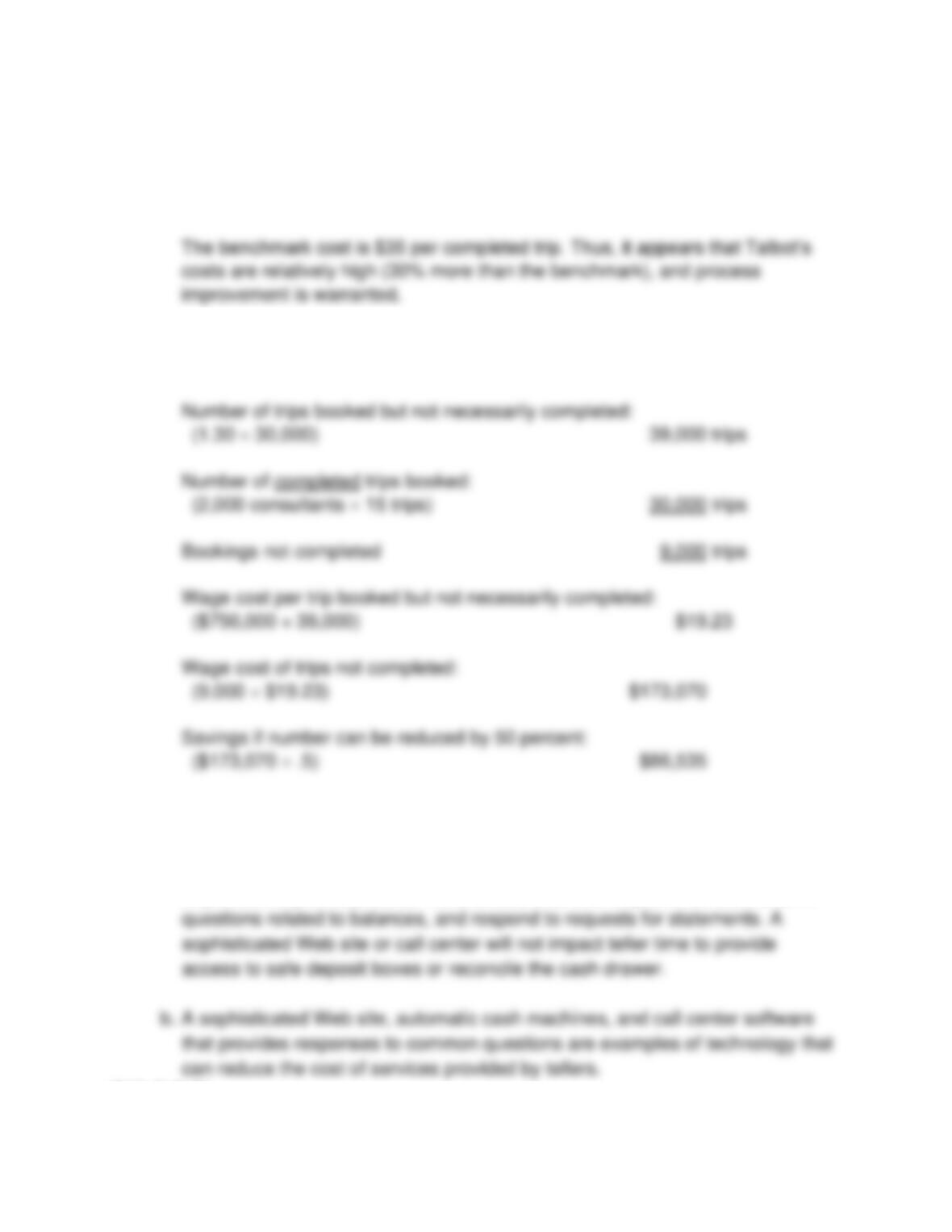
Traditional Allocation:
Total overhead
$29,865,000
Divide by direct labor dollars
12,500,000
Traditional overhead cost per unit:
Total overhead
$764,800
Divide by number of units
Overhead cost per unit
Cost per unit using Traditional:
Direct materials
Direct labor
Overhead (calculated above)
Overhead allocation rate per DL $
$ 2.39
Art of Design:
Total direct labor dollars
OH rate
Overhead allocated to Art of Design
Jiambalvo Managerial Accounting
6-24
P16. [LO 2]
a. Cost to book travel (per completed trip):
$1,500,000 ÷ 30,000 completed trips = $50 per completed trip
b. The wages paid to employees who book travel are $750,000 (15 employees
$50,000.
P17. [LO 2]
a. A sophisticated Web site and call center can reduce demands placed on tellers
to process deposits, process withdrawals, deal with requests for CDs, answer
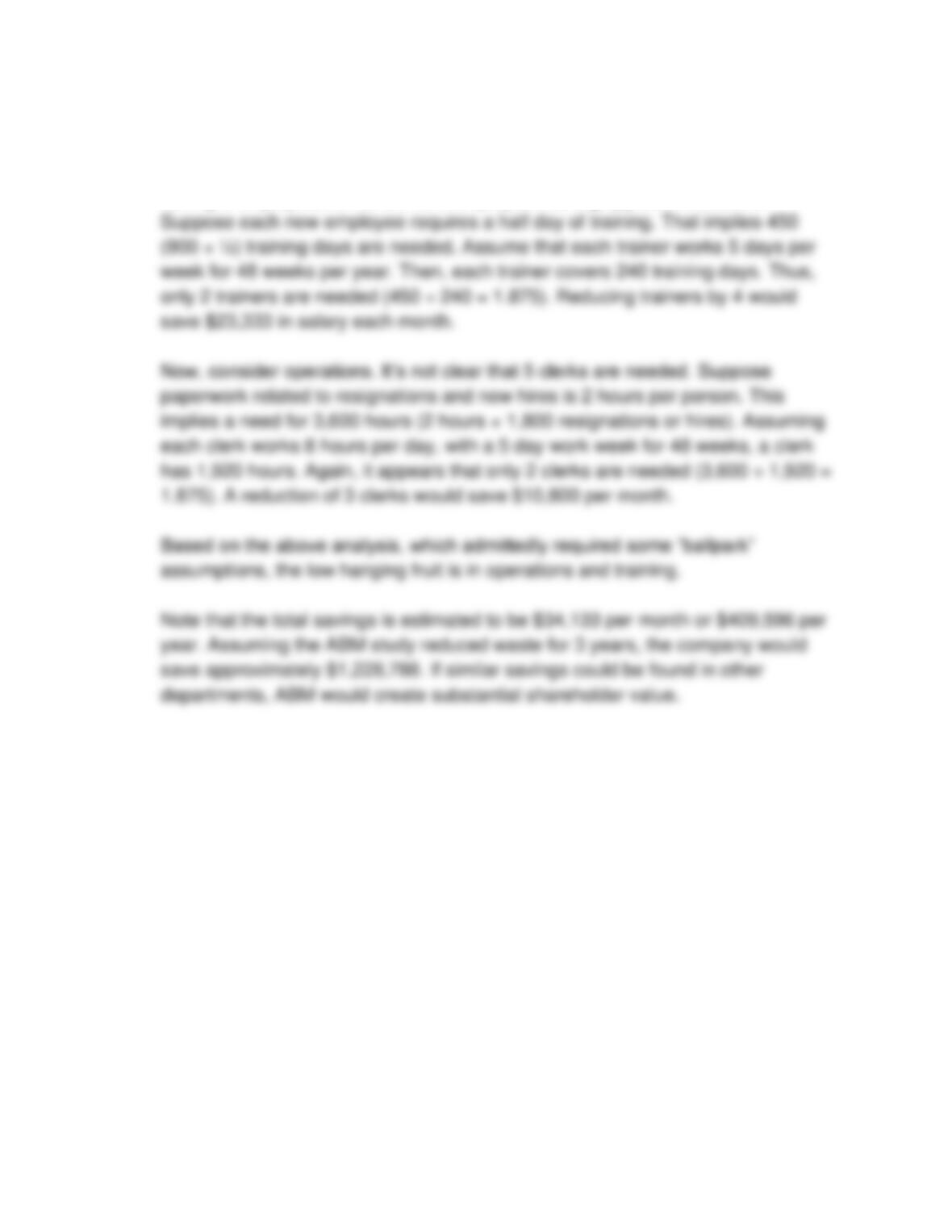
P18. [LO 2]
Chapter 6 Cost Allocation and Activity-Based Costing
6-25
With 6,000 employees and turnover of 15%, 900 people leave the company and
900 are added to take their place each year (.15 × 6,000). With this in mind,
having 6 employees to handle new employee training appears excessive.
Jiambalvo Managerial Accounting
6-26
Case 6-1 [LO 2]
EASTSIDE MEDICAL TESTING
Summary
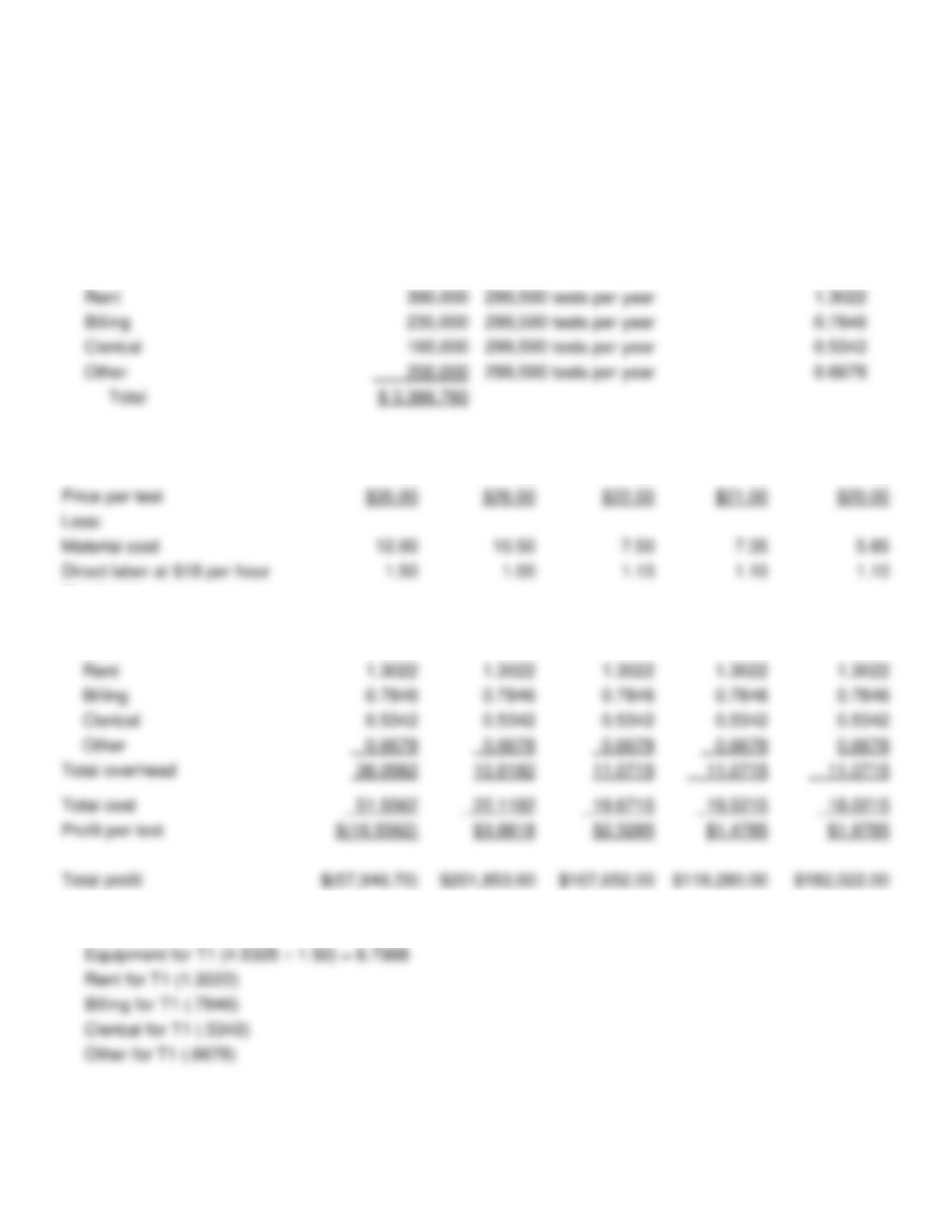
Service company example of ABC.
• Demonstrates that ABC costing will generally lower the cost of high volume,
simple procedures and increase the cost of low volume, complex procedures.
Questions to ask students
1. What is the situation at Eastside Medical Testing?
2. What is the ABC cost of each test?
3. Should Emmet (the owner of Eastside Medical Testing) lower the price of T1 or keep
the current price and risk losing the business of Nuclear Systems?
4. What will be the effect on profit, if the company loses the business of Nuclear
Systems (i.e., T1 tests decrease by 1,750)?
Discussion
What is the situation at Eastside Medical Testing? Eastside Medical Testing conducts
tests to detect drug use. A client is questioning the high price of a test and doubts that
the price is justified by significantly higher costs to conduct the test.
Chapter 6 Cost Allocation and Activity-Based Costing
6-27
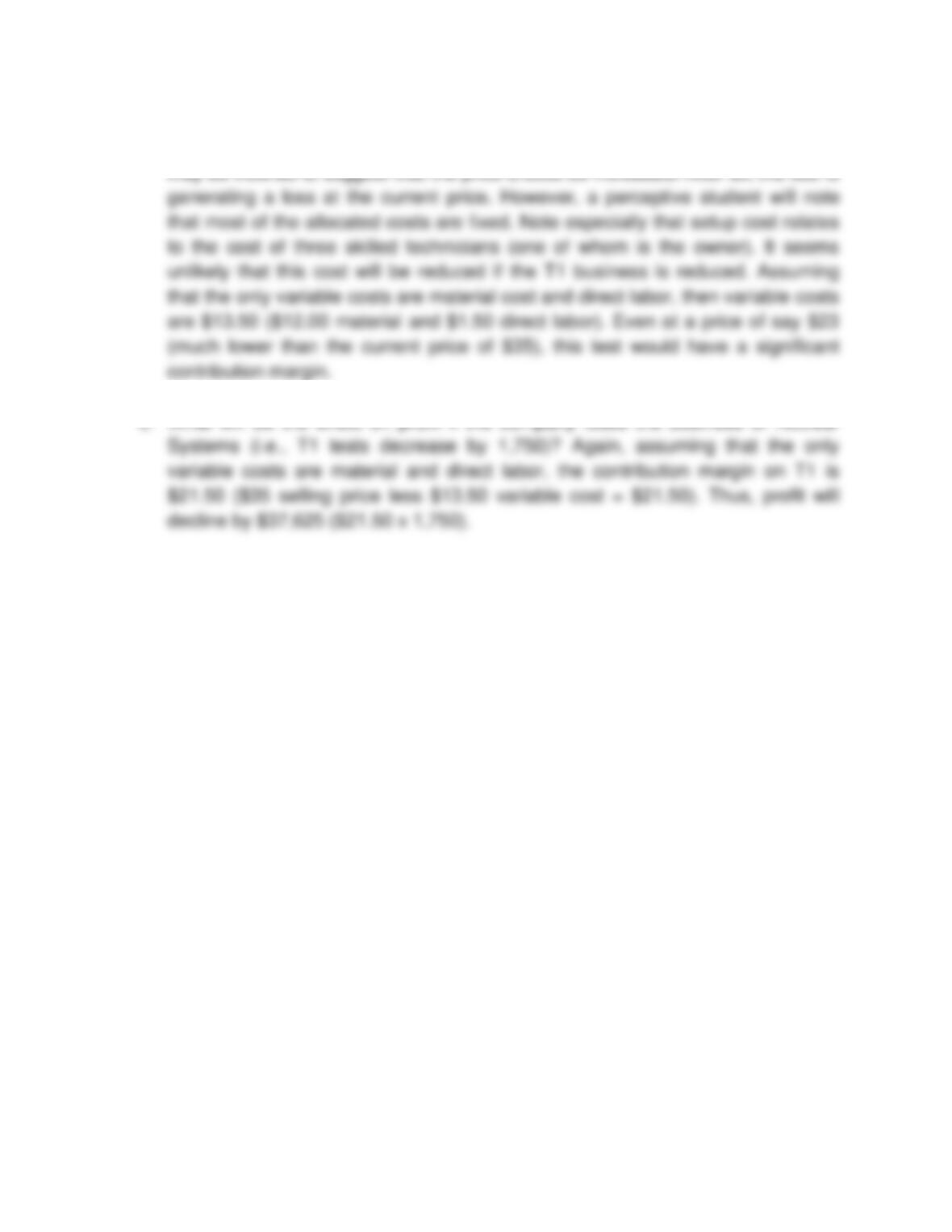
a. What is the ABC cost of each test? Note especially that the cost of T1 increases
under ABC from $29.10 to $51.5562. Rather than being the most profitable test,
ABC indicates that the test is being sold at a loss.
Overhead
Costs
Driver
Rate
Setup labor
$ 925,760
3,310 setups per year
$325,650 direct labor cost per year
279.6858
Equipment
1,476,000
4.5325
T1
T2
T3
T4
T5
Price per test
$35.00
$26.00
$22.00
$21.00
$20.00
Less:
Material cost
Direct labor at $18 per hour
Overhead
Setups
27.9686
2.7969
2.7969
2.7969
2.7969
Equipment
6.7988
4.5325
4.9858
4.9858
4.9858
Rent
1.3022
1.3022
1.3022
1.3022
Billing
0.7846
0.7846
0.7846
0.7846
Clerical
0.5342
0.5342
0.5342
0.5342
0.5342
Other
0.6678
0.6678
Total cost
Profit per test
Total profit
$118,280.00
Setup for T1 (279.6858 350 ÷ 3,500) = 27.9686
299,500 tests per year
Rent
Billing
Clerical
Other
Total
Jiambalvo Managerial Accounting
6-28
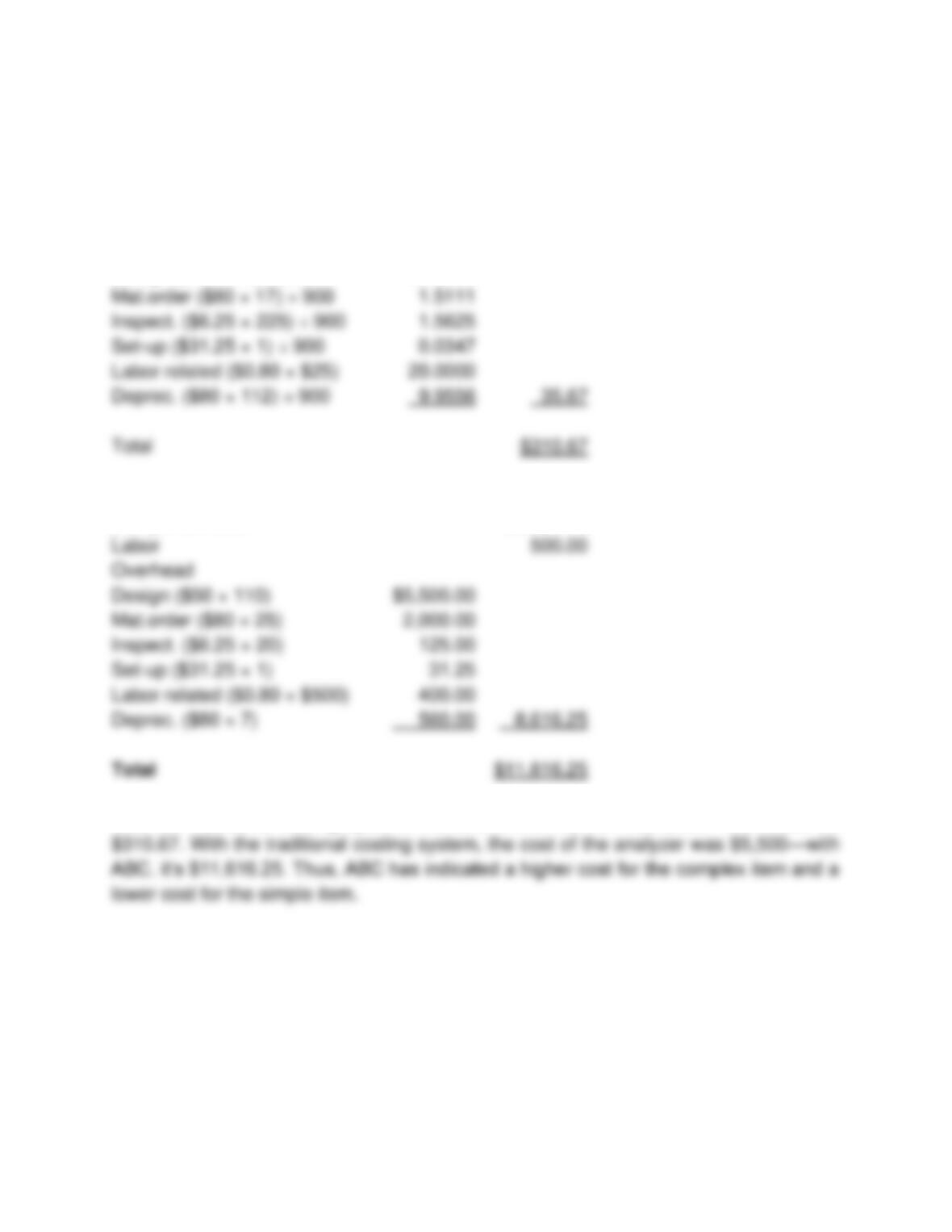
b. Should Emmet (the owner of Eastside Medical Testing) lower the price of T1 or
keep the current price and risk losing the business of Nuclear Systems? Students

Case 6-2 [LO 2]
QuantumTM
Summary
A company finds that it is receiving fewer large orders for electronic testing instruments
that are relatively simple to produce—customers are saying the company is not price
competitive for such products. On the other hand, the company is receiving more small
orders for complex instruments and customers seem happy with the prices they pay for
them.
• Shows how a traditional costing system can systematically overcost or undercost
certain products.
• Links ABC to decision making.
Questions to ask students
1. What’s the situation facing QuantumTM?
2. What’s the ABC cost of the Monitor and the Analyzer?
3. What’s the ABC cost of the data logging device?
4. The customer for the data logging device has a bid from a competitor for $22,000.
Should QuantumTM meet this price?
Discussion
I begin by asking a student to summarize the situation. As noted, QuantumTM finds that
it is receiving fewer large orders for electronic testing instruments that are relatively
Jiambalvo Managerial Accounting
6-30
a. What’s the ABC cost of the monitor and the analyzer?
Temperature Monitor
Component cost $250.00
Labor 25.00
Overhead
Design ($50 × 47) ÷ 900 $2.6111
Analyzer
Component cost $2,500.00
With the traditional costing system, the cost of the monitor was $395—with ABC, it’s
Chapter 6 Cost Allocation and Activity-Based Costing
6-31
b. What’s the ABC cost of the data-logging device?
Data-Logging Device
Component cost $9,000.00
Labor 3,000.00
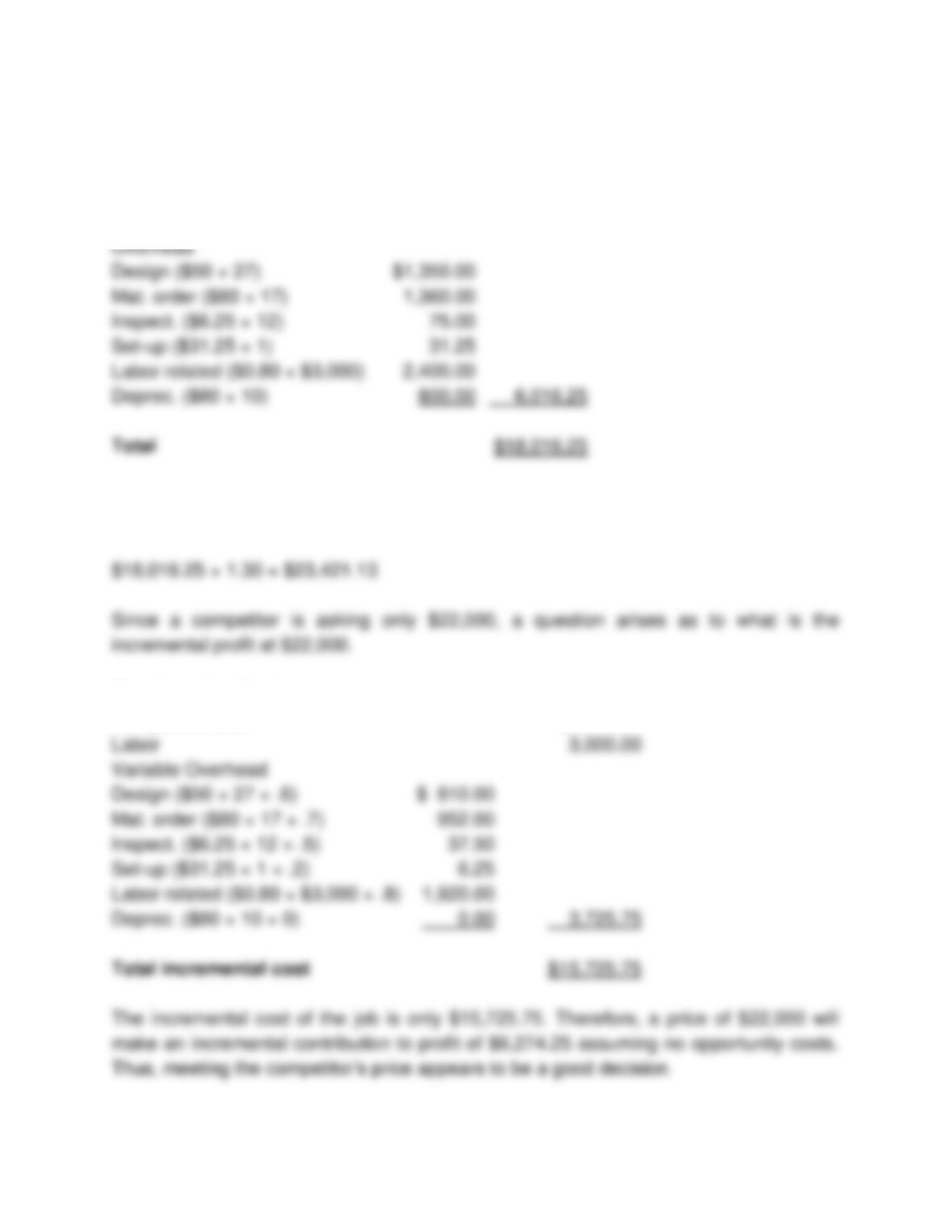
c. What will the price be if the company follows its normal policy and marks cost up
by 30%?
Data-Logging Device
Component cost $9,000.00
Jiambalvo Managerial Accounting
6-32
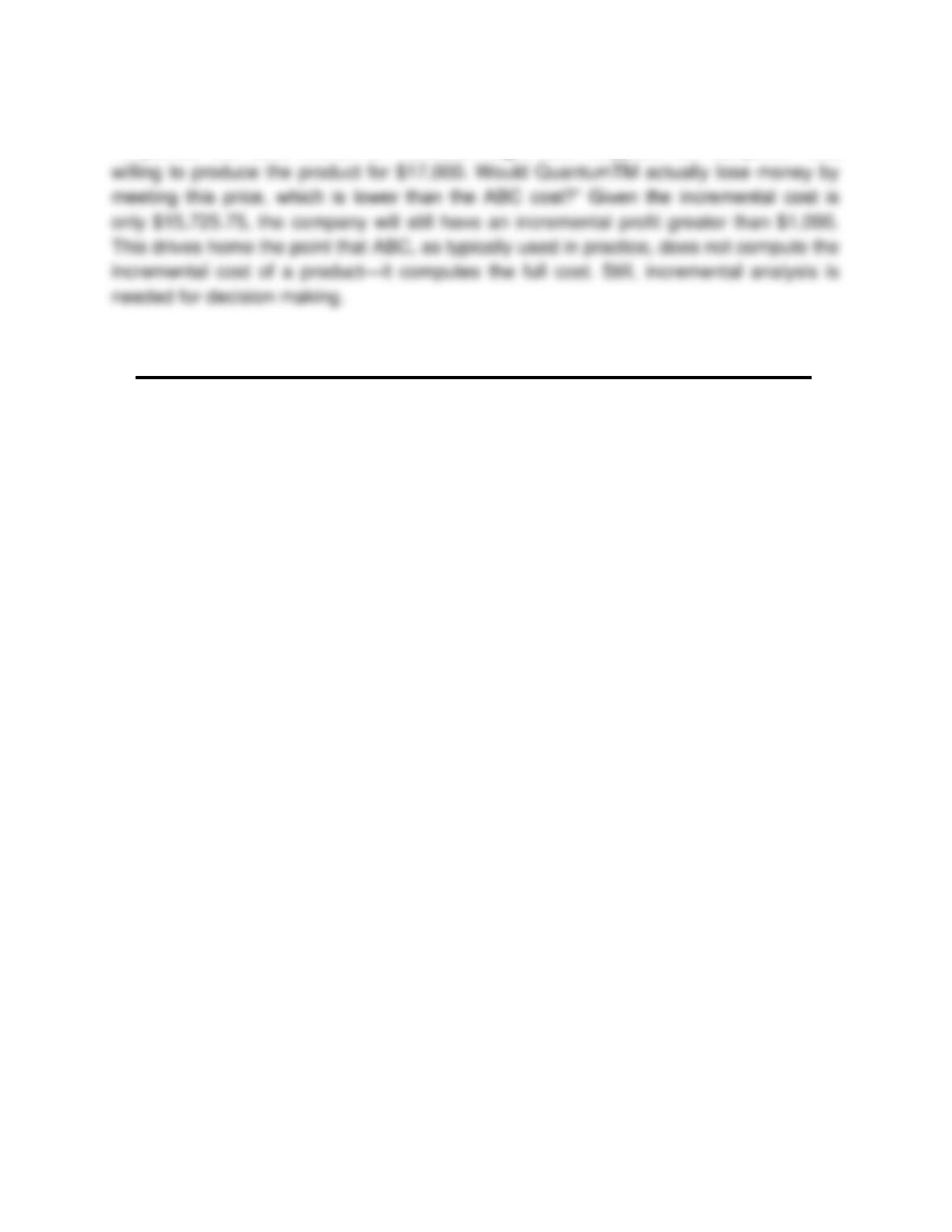
To pursue this case further, an instructor might ask, “Suppose the competitor was