Notes Receivable ……………………………………………
Record note collection.
30
Accounts Receivable— S.Nilson …………………………..
Cash ……………………………………………………….
Charge the account for NSF check.
30
Computer Equipment ……………………………………………
Cash ……………………………………………………….
30
Correct an entry error.
Problem 6-5A (50 minutes)
Part 1
CHAVEZ COMPANY
Bank Reconciliation
September 30
Bank statement balance ……..
$18,453
Book balance …………………………..
$17,404
Add
Add
Interest earned ….. $ 12
Part 2
Sept. 30
Cash ……………………………………………………….
12
Interest Earned ……………………………………………….
12
Record interest earned.
30
Cash ……………………………………………………….
1,485
Wild and Shaw, Financial & Managerial Accounting, 8e Solutions Manual: Chapter 6
418
PROBLEM SET B
Problem 6-1B (20 minutes)
Part 1
a. Maintain adequate records.
Part 2
a. Good recordkeeping helps protect assets from theft or loss and helps
managers monitor company activities. Keeping poor records of its
equipment leaves the company vulnerable to misuse or theft of these
c. The company needs to have three employees handle these functions
instead of two. One employee should place purchase orders, one
should receive merchandise, and the third should pay vendors.
Wild and Shaw, Financial & Managerial Accounting, 8e Solutions Manual: Chapter 6
419
Problem 6-2B (20 minutes)
Jan. 3
Petty Cash …………………………………………………………..
150.00
Cash ………………………………………………………………
150.00
Establish the petty cash fund.
Office Supplies Expense ………………………………………
14.29
Merchandise Inventory* ……………………………………….
19.60
Repairs Expense—Computer ……………………………….
38.57
Miscellaneous Expenses ……………………………………..
12.82
Cash Over and Short ……………………………………………
Cash ………………………………………………………………
87.72
Jan. 15
Petty Cash …………………………………………………………..
50.00
Cash ………………………………………………………………
50.00
Increase the petty cash fund.
Jan. 31
Advertising Expense ……………………………………………
50.00
Postage Expenses ……………………………………………….
48.19
Delivery Expense …………………………………………………
78.00
Cash Over and Short ……………………………………………
Cash ………………………………………………………………
182.65
Reimburse the petty cash fund.**
Jan. 31
Petty Cash …………………………………………………………..
50.00
Cash ………………………………………………………………
50.00
Increase the petty cash fund.**
Wild and Shaw, Financial & Managerial Accounting, 8e Solutions Manual: Chapter 6
420
Problem 6-3B (30 minutes)
Part 1
Mar. 5
Petty Cash ……………………………………………………….
250
Cash ……………………………………………………….
250
Establish the $250 petty cash fund.
Part 2
Blues Music Center
Petty Cash Payments Report (for March)
Delivery expense
Mar. 11
Delivery of customer’s merchandise ……………………..
$ 10.75
Mileage expense
Mar. 30
Reimbursement for mileage …………………………..
56.80
Postage expense
Mar. 28
Paid postage ……………………………………………………….
18.00
Merchandise inventory (transportation-in)*
Mar. 6
Mar. 27
45.10
57.60
Office supplies expense
Mar. 12
Purchased file folders …………………………………………..
14.13
Mar. 14
Reimbursement for office supplies ……………………….
11.65
Mar. 18
Purchased paper ………………………………………………….
20.54
46.32
Total
$189.47
* Transportation-in costs are included in Merchandise Inventory under a perpetual system.
Part 3
a. Mar. 31
Delivery Expense ………………………………………………….
10.75
Mileage Expense ………………………………………………….
56.80
Postage Expense ………………………………………………….
18.00
Merchandise Inventory …………………………………………
57.60
Office Supplies Expense ………………………………………
46.32
Cash Over and Short ……………………………………….
Cash ……………………………………………………….
Reimburse the petty cash fund.
Petty Cash ……………………………………………………….
50.00
Cash ……………………………………………………….
50.00
Increase the petty cash fund to $300.
Wild and Shaw, Financial & Managerial Accounting, 8e Solutions Manual: Chapter 6
Problem 6-4B (30 minutes)
Part 1
SEVERINO CO.
Bank Reconciliation
December 31
Bank statement balance ……..
$46,822.40
Book balance …………………………..
$32,878.30
Add
Add
Deduct
Deduct
Part 2
Dec. 31
Cash …………………………………………………………………….
9.00
Office Supplies ……………………………………………….
9.00
Correct an entry error.
31
Cash …………………………………………………………………….
18,980.00
Notes Receivable …………………………………………….
Record note collection.
31
Accounts Receivable—Titus Industries …………………
Cash ……………………………………………………….
Charge the account for NSF check.
31
Miscellaneous Expenses ………………………………………
Cash ……………………………………………………….
Wild and Shaw, Financial & Managerial Accounting, 8e Solutions Manual: Chapter 6
Problem 6-5B (50 minutes)
Part 1
SHAMARA SYSTEMS
Bank Reconciliation
May 31
Bank statement balance ………
$21,762.70
Book balance …………………………..
$15,177.30
Add
Add
Deposit of May 31………………
2,727.30
24,490.00
Proceeds of note …………………………..
7,350.00
22,527.30
Deduct
Deduct
Part 2
May 31
Cash ……………………………………………………………………
7,350.00
Notes Receivable ……………………………………………
7,350.00
Record note collection.
31
Accounts Receivable—W. Sox …………………………..
431.80
Cash ……………………………………………………….
431.80
Charge the account for NSF check.
31
Miscellaneous Expenses …………………………..
Cash ……………………………………………………….
Record bank service fee.
31
Cash ……………………………………………………….
Correct an entry error.
Wild and Shaw, Financial & Managerial Accounting, 8e Solutions Manual: Chapter 6
423
SERIAL PROBLEM — SP 6
Serial Problem — SP 6, Business Solutions (50 minutes)
Part 1
BUSINESS SOLUTIONS
Bank Reconciliation
March 31, 2020
Bank statement balance …..
$67,566
Book balance …………………………..
$68,057
Add
Add
Bank error …………………………
500
Bank interest …………………………..
33
Part 2
Mar. 25
Miscellaneous Expenses ……………………………………..
677
50
Cash ……………………………………………………….
101
50
Record safety deposit box rental.
Miscellaneous Expenses ……………………………………..
677
Cash ……………………………………………………….
101
Record charge for printing checks
101
33
Interest Revenue ……………………………………………
404
33
Record interest earned.
Wild and Shaw, Financial & Managerial Accounting, 8e Solutions Manual: Chapter 6
424
Company Analysis — AA 6-1
$ millions
1. (a) $20,289
(b) $20,484
2.
$ millions
Balance
September
30, 2017
Cash and
equivalents
as % of:
Balance
September
24, 2016
Cash and
equivalents
as % of:
Cash and cash
3. (a) Per the statement of cash flows for year ended September 30, 2017
($ millions):
Cash and equivalents, beginning-year …………… $20,484
Wild and Shaw, Financial & Managerial Accounting, 8e Solutions Manual: Chapter 6
Company Analysis (Concluded)
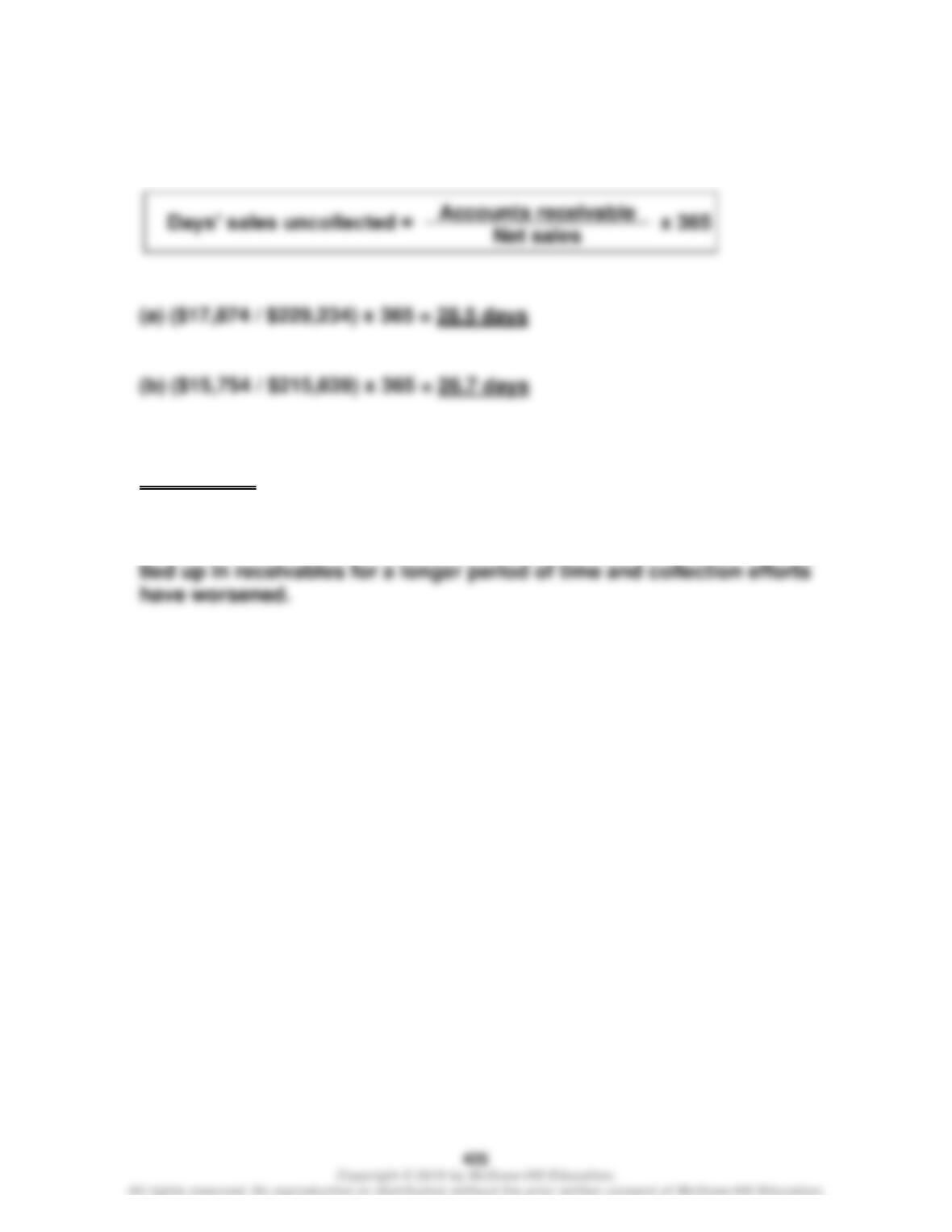
4. Days’ Sales Uncollected ($ millions)
5. Unfavorable
Explanation: The number of days of uncollected sales in accounts
receivable increased. This increase indicates Apple’s assets are being
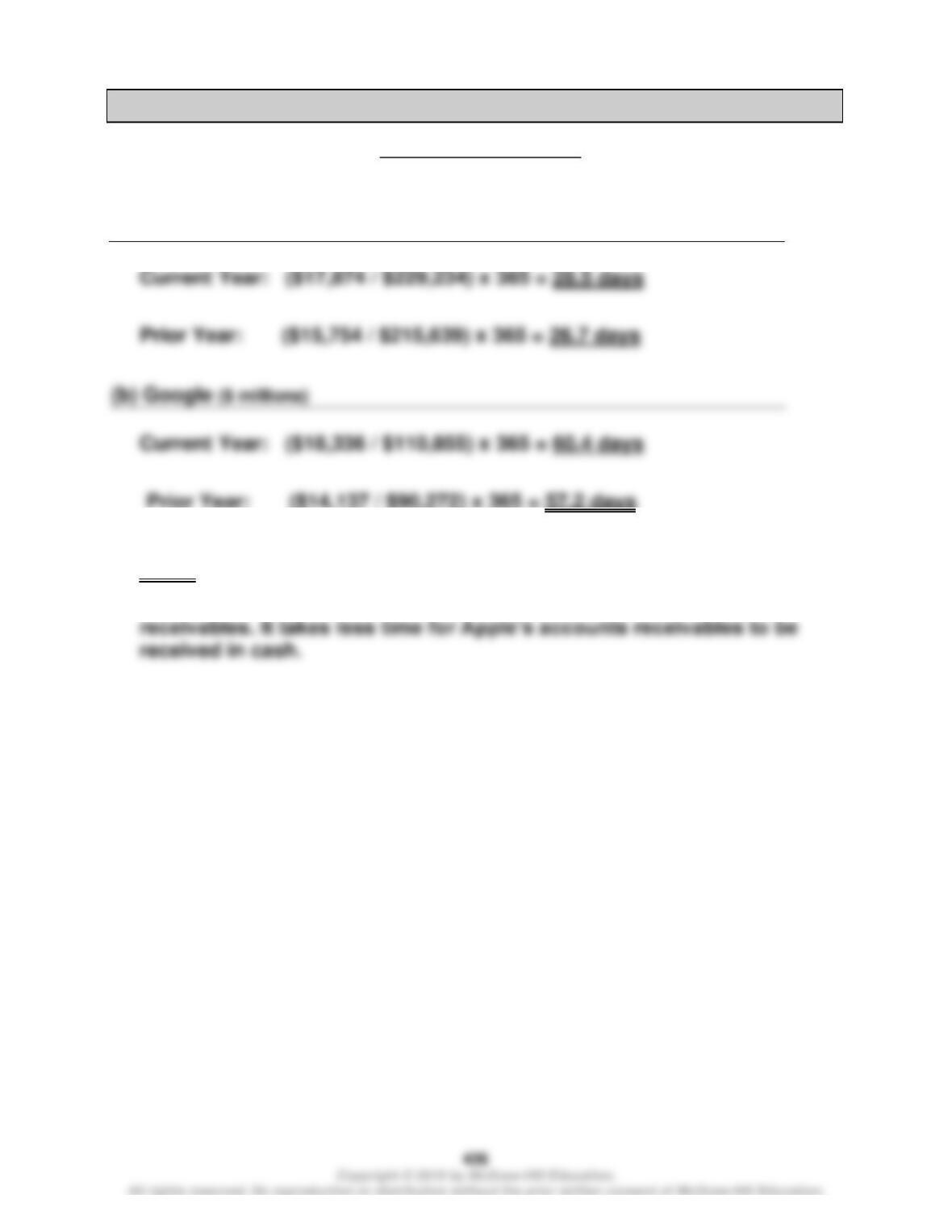
Wild and Shaw, Financial & Managerial Accounting, 8e Solutions Manual: Chapter 6
Comparative Analysis — AA 6-2
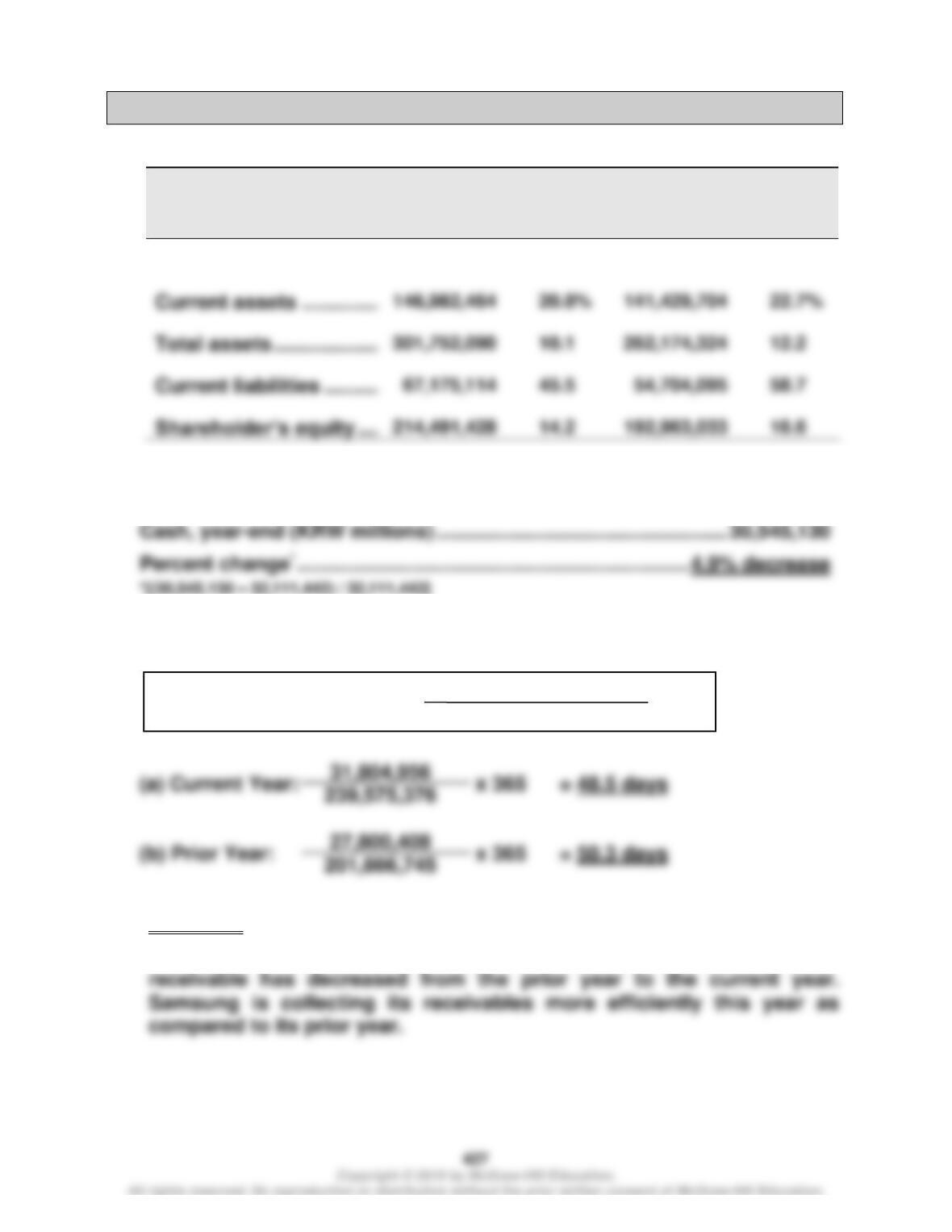
Days’ sales uncollected = x 365
1.
(a) Apple ($ millions)
2. Apple
Explanation: Apple had more success than Google in collecting
Accounts receivable
Net sales
Wild and Shaw, Financial & Managerial Accounting, 8e Solutions Manual: Chapter 6
Global Analysis — AA 6-3
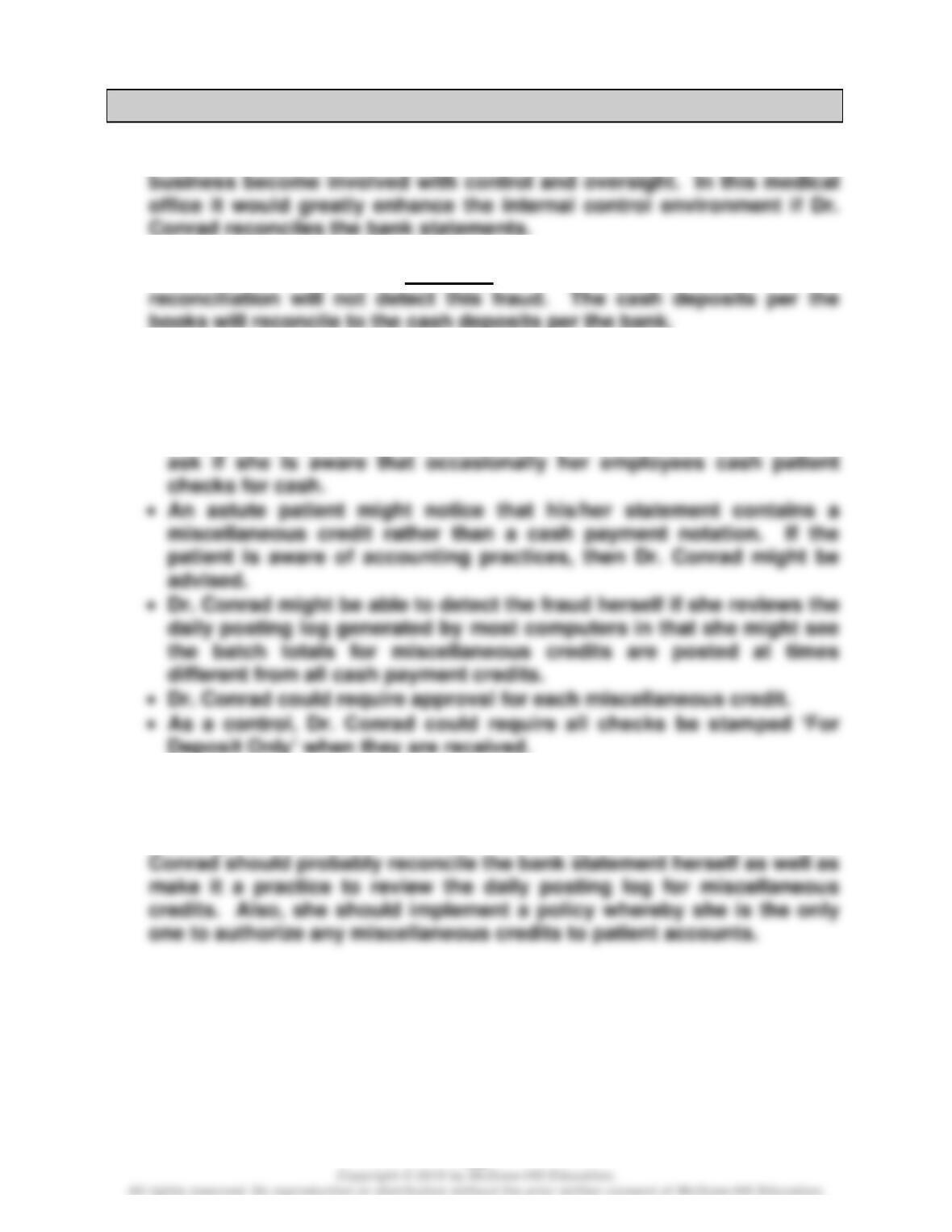
1.
(KRW millions)
Current
year
balance
Cash as
percent
of:
Prior year
balance
Cash as
percent
of:
Cash …………………………..
30,545,130
—
32,111,442
—
2. Cash, beginning-year (KRW millions) ………………………………….. 32,111,442
3. Days’ Sales Uncollected Formula (KRW millions)
Days’ sales uncollected = x 365
4. Favorable
Explanation: The number of days of uncollected sales in accounts
Accounts receivable
Net sales
Wild and Shaw, Financial & Managerial Accounting, 8e Solutions Manual: Chapter 6
428
Ethics Challenge — BTN 6-1
1. In a small business office it is very important that the owner of the
2. Unfortunately, due to collusion of the employees, the bank
3. Despite the collusion, the scheme is not foolproof. For example, some
ways in which the scheme might be uncovered or prevented include the
following:
• A bank employee may become suspicious and call Dr. Conrad and
4. Dr. Conrad should review her salary schedules for employees to make
sure that she is at least offering market pay. She may want to consider
bonding her employees to insure herself against material losses. Dr.
Wild and Shaw, Financial & Managerial Accounting, 8e Solutions Manual: Chapter 6
429
Communicating in Practice — BTN 6-2
Memorandum
To: “Owner”
From: “Consultant”
Date: __________
Subject: Advice on monitoring purchase discounts
[Instructor’s Note: The response should acknowledge the owner’s concern and
recommend the net method of recording purchases. It should explain how this method
results in the recording of “Discounts Lost,” which will flow through to the income
statement, thus providing the information desired. The memo might look something like
the following.]
lost, such as oversight, carelessness, or unfavorable terms.
This practice gives management better control over persons responsible
for paying bills on time to take advantage of favorable discounts. This also
means it’s less likely that favorable discounts are lost.
Wild and Shaw, Financial & Managerial Accounting, 8e Solutions Manual: Chapter 6
430
Taking It to the Net — BTN 6-3
[Instructor Note: These answers were taken from the ACFE’s 2016 Report to the Nations.]
s3–us-west-2.amazonaws.com/acfepublic/2016-report-to–the-nations.pdf
2. The typical organization loses 5% of revenues in a given year as a result of
fraud.
3. The median duration — the amount of time from when the fraud
4. Asset misappropriation was by far the most common form of occupational
5. Financial statement fraud was on the other end of the spectrum, occurring
6. The most common detection method in our study was tips (39.1% of
cases).
Wild and Shaw, Financial & Managerial Accounting, 8e Solutions Manual: Chapter 6
Teamwork in Action — BTN 6-4
Common internal controls visible in a typical retail store include:
1. Door locks and roll–down screens for after-hours lock-up.
2. Electronic detection devices stationed at entrances or anti-theft
3. Security cameras.
4. Security guards.
5. Cash registers.
9. Dressing room attendants.
Wild and Shaw, Financial & Managerial Accounting, 8e Solutions Manual: Chapter 6
432
Entrepreneurial Decision — BTN 6-5
1. Seven principles of internal control along with examples are:
a. Establish responsibilities. The clerks at the counter should be
responsible for handling cash. The other employees should be
responsible for preparing the orders and helping customers. There
also should be employees assigned responsibilities such as
maintaining inventories, cleaning premises, clerical duties, locking
doors, etc.
d. Separate recordkeeping from custody of assets. The employee
who is responsible for inventory should not be in control of the
recordkeeping for the inventory. Similar separation should exist
for all important assets.
e. Divide responsibility for related transactions. The employee
responsible for ordering inventory should be separate from the
2. As the business grows, controls will become more important. The
owner will have more employees and will have to delegate more
responsibilities. Strong controls will be important to make sure that
Wild and Shaw, Financial & Managerial Accounting, 8e Solutions Manual: Chapter 6
Hitting the Road — BTN 6-6
No formal solution exists for this activity. It is usually interesting for the
class to exchange their discoveries via class discussion. This is
particularly the case with respect to popular college service/product
centers. Common controls found in college units include:
1. Door locks and roll–down screens for after-hours lock-up.
2. Electronic detection devices stationed at entrances or anti-theft devices
on merchandise that must be removed by a cashier.

Wild and Shaw, Financial & Managerial Accounting, 8e Solutions Manual: Chapter 6
434