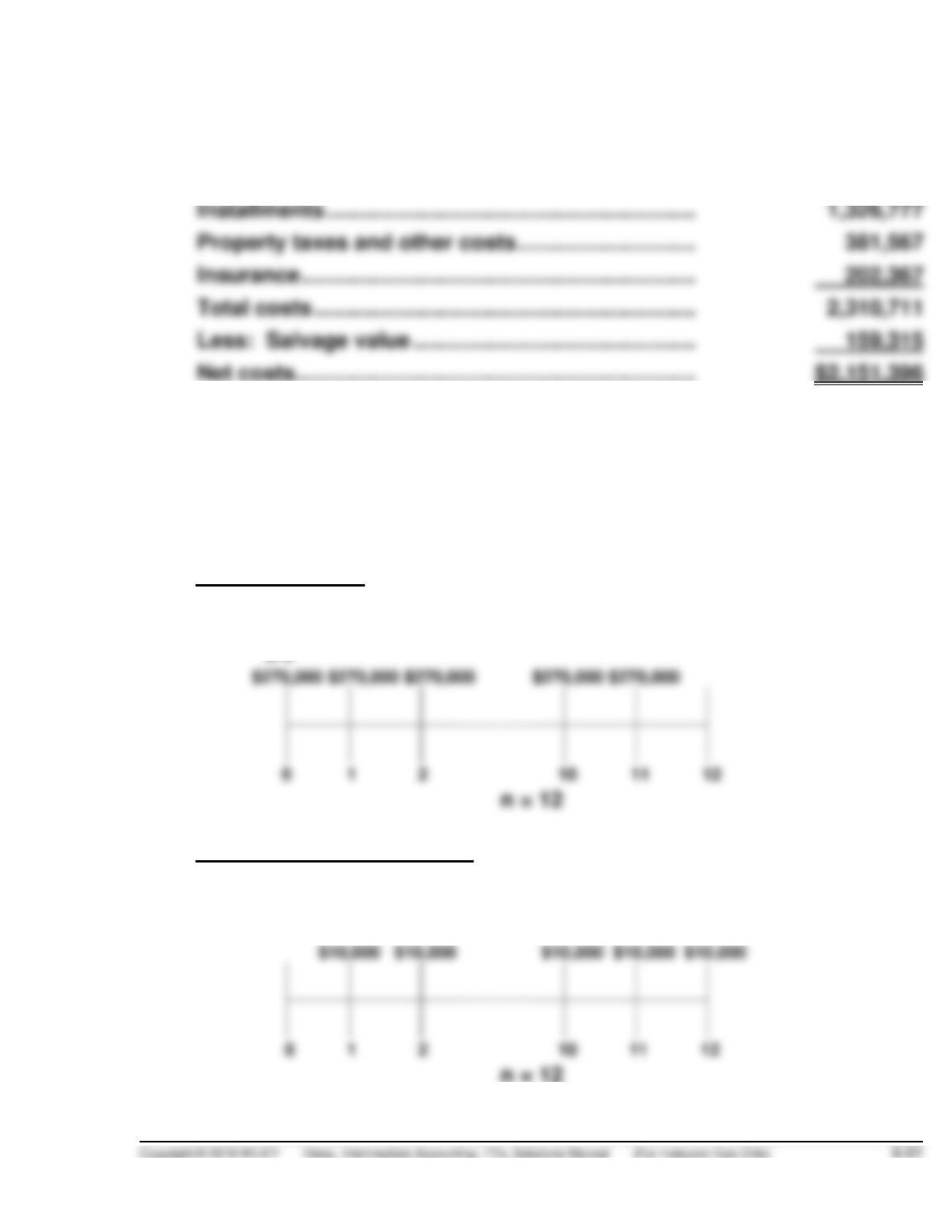
PROBLEM 6.10 (Continued)
Present value of net purchase costs:
Down payment ……………………………………………….
$ 400,000
Installments ……………………………………………………
Property taxes and other costs ………………………..
Insurance ……………………………………………………….
202,367
Total costs ……………………………………………………..
Less: Salvage value ……………………………………….
159,315
2. Lease.
Time diagrams:
Lease payments
i = 10%
PV – AD = ?
Interest lost on the deposit
i = 10%
PV – OA = ?
R =
PROBLEM 6.10 (Continued)
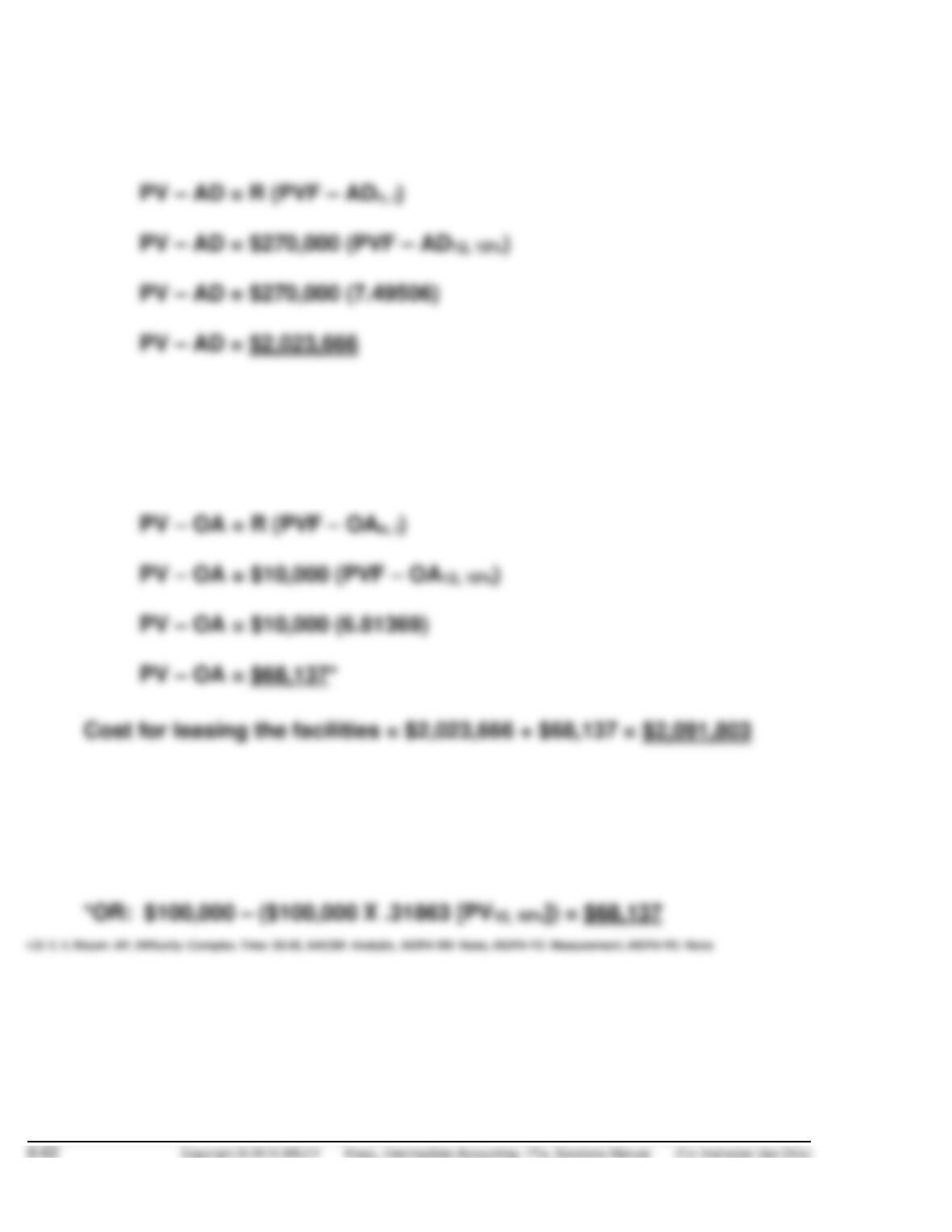
Formula for lease payments:
Formula for interest lost on the deposit:
Interest lost on the deposit per year = $100,000 (10%) = $10,000
Dunn Inc. should lease the facilities because the present value of the
costs for leasing the facilities, $2,091,803, is less than the present
value of the costs for purchasing the facilities, $2,151,396.
PROBLEM 6.11
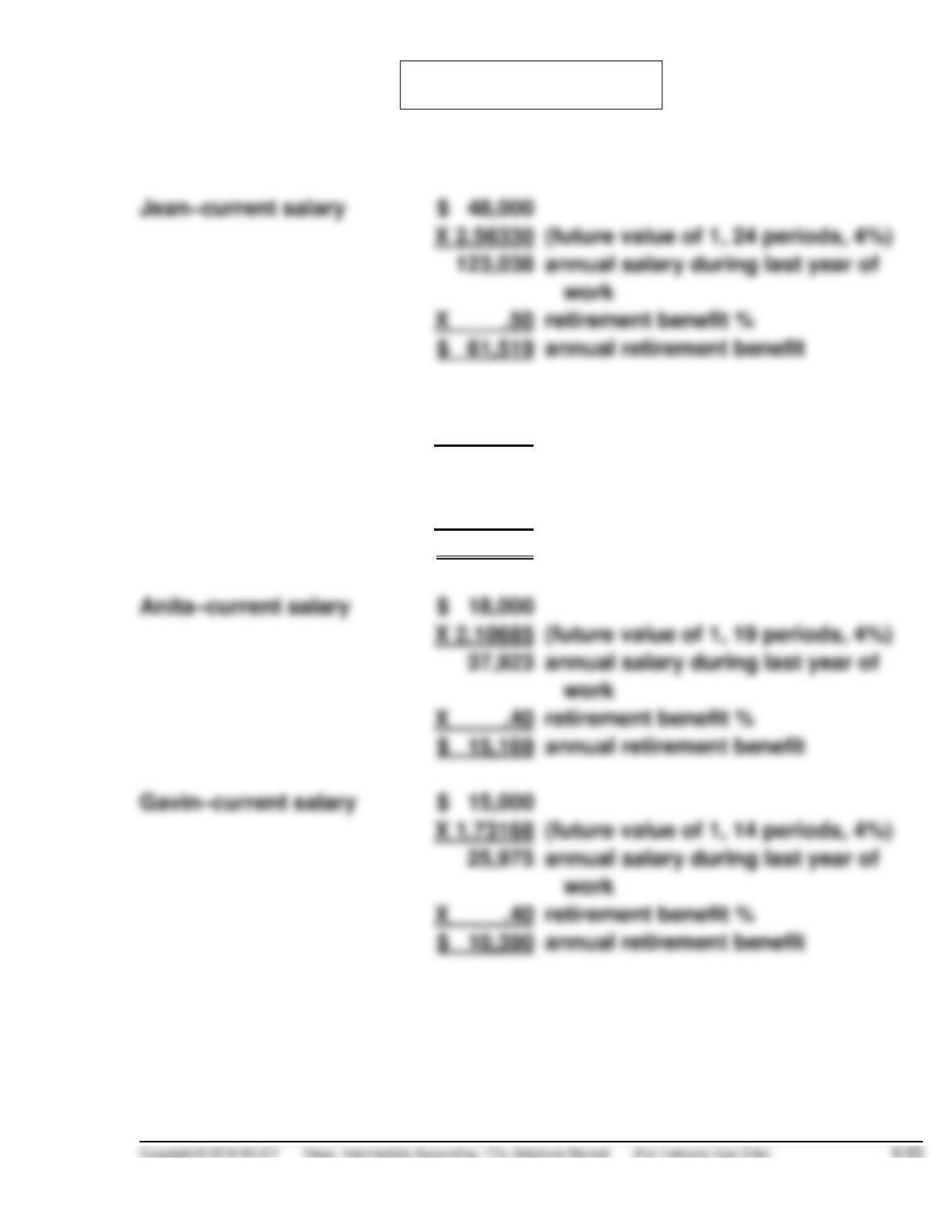
(a) Annual retirement benefits.
$ 48,000
X 2.56330
(future value of 1, 24 periods, 4%)
123,038
annual salary during last year of
work
X .50
retirement benefit %
Colin–current salary
$ 36,000
X 3.11865
(future value of 1, 29 periods, 4%)
112,271
annual salary during last year of
work
X .40
retirement benefit %
$ 44,908
annual retirement benefit
Anita–current salary
$ 18,000
annual salary during last year of
work
X .40
retirement benefit %
$ 15,169
annual retirement benefit
Gavin–current salary
$ 15,000
X 1.73168
(future value of 1, 14 periods, 4%)
annual salary during last year of
work
X .40
retirement benefit %
$ 10,390
annual retirement benefit
PROBLEM 6.11 (Continued)
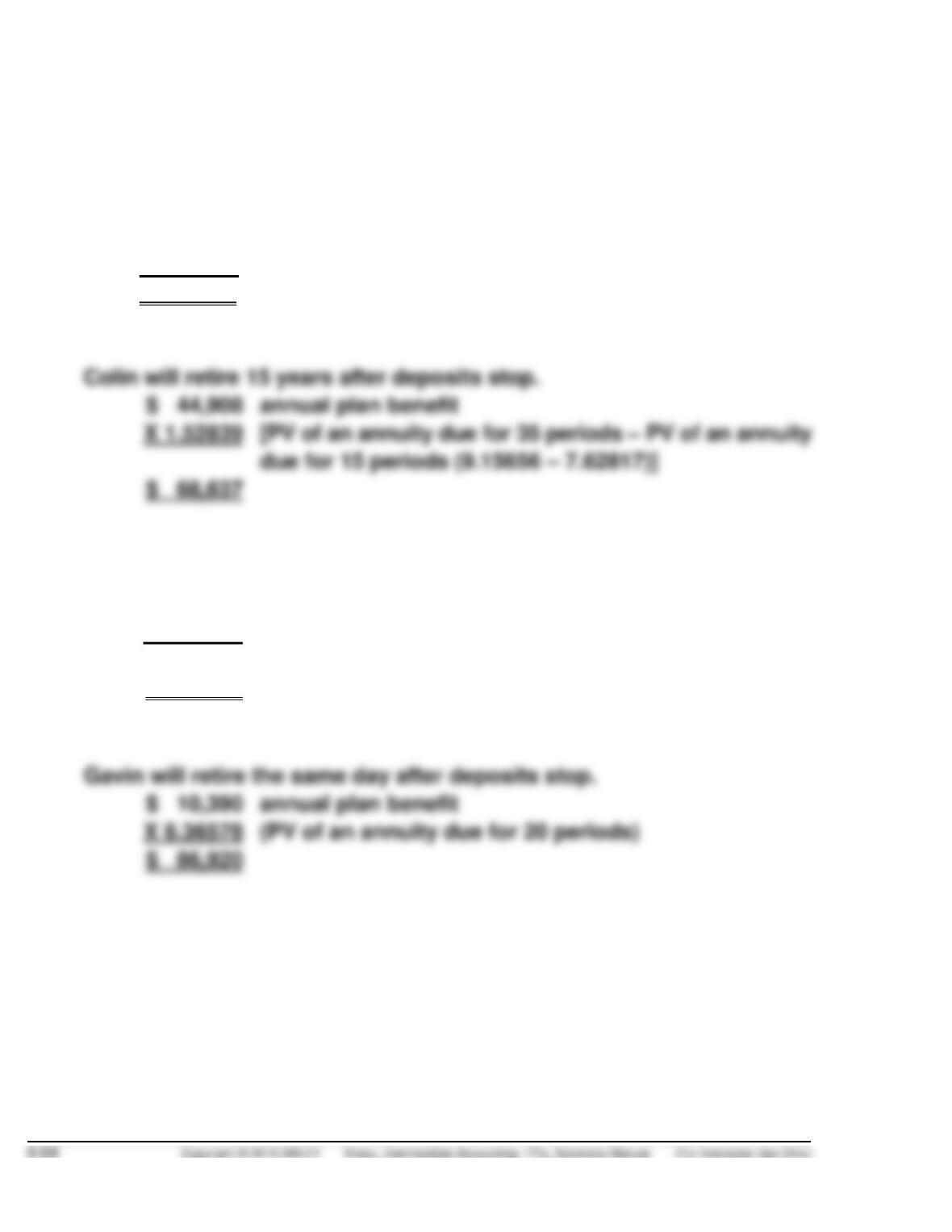
(b) Fund requirements after 15 years of deposits at 12%.
Jean will retire 10 years after deposits stop.
$ 61,519 annual plan benefit
[PV of an annuity due for 30 periods – PV of an
X 2.69356 annuity due for 10 periods (9.02181 – 6.32825)]
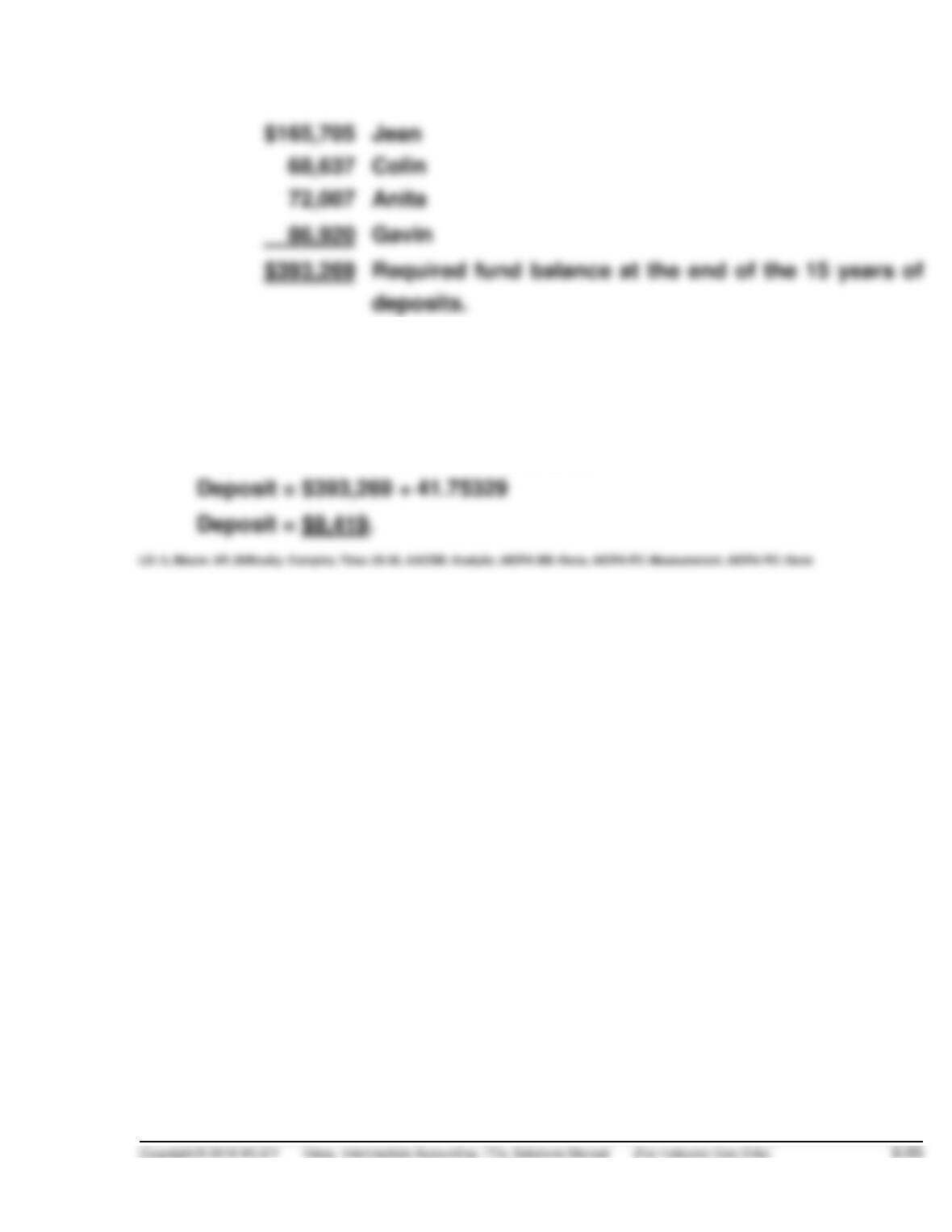
$ 165,705
$ 44,908
annual plan benefit
$ 68,637
Anita will retire 5 years after deposits stop.
$ 15,169
annual plan benefit
X 4.74697
[PV of an annuity due for 25 periods – PV of an annuity
due for 5 periods (8.78432 – 4.03735)]
$ 72,007
$ 10,390
annual plan benefit
(PV of an annuity due for 20 periods)
PROBLEM 6.11 (Continued)
Colin
(c) Required annual beginning-of-the-year deposits at 12%:
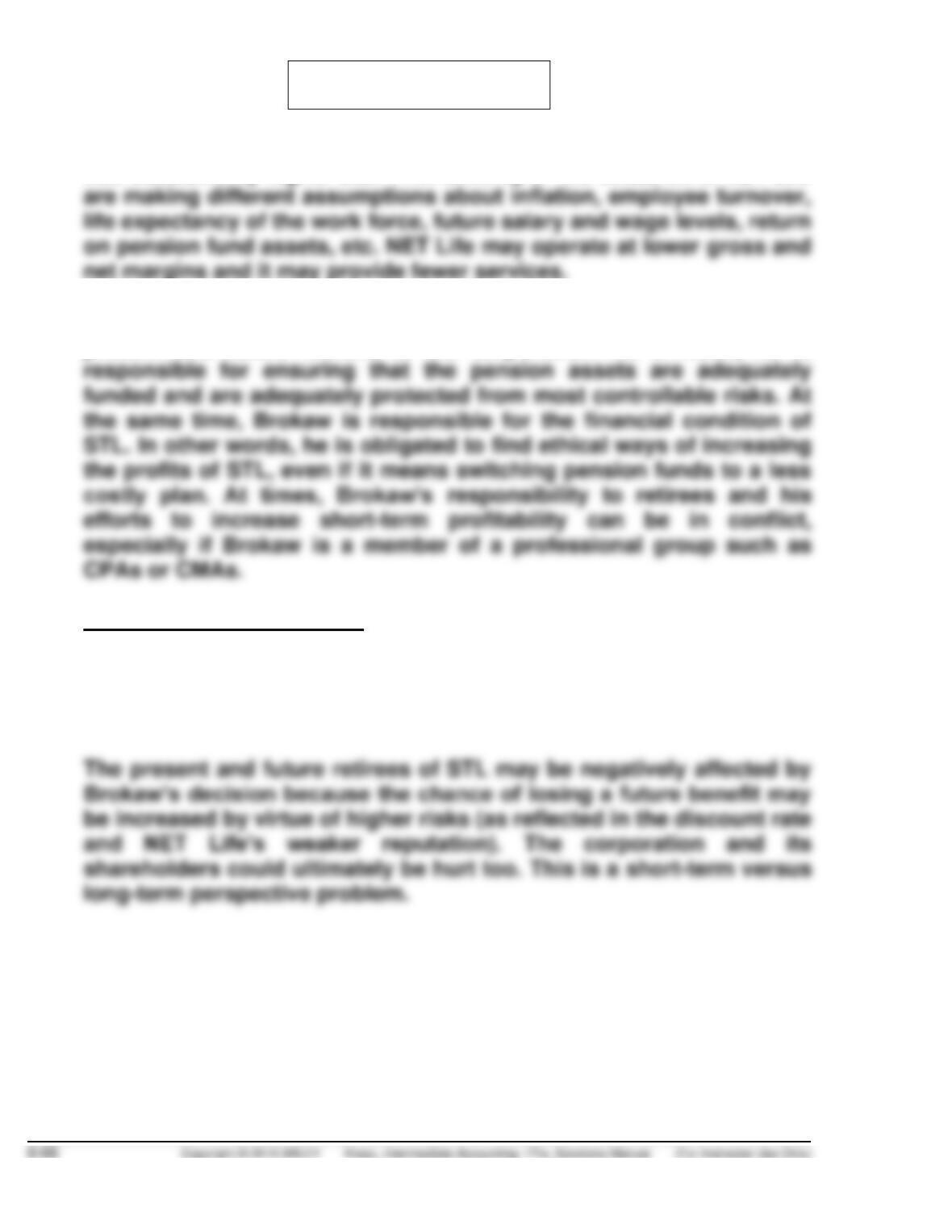
Deposit X (future value of an annuity due for 15 periods at 12%) = FV
Deposit X (37.27972 X 1.12) = $393,269
PROBLEM 6.12
(a) The time value of money would suggest that NET Life’s discount rate
was substantially higher than First Security’s. The actuaries at NET Life
(b) As the controller of STL, Brokaw assumes a fiduciary role to the
present and future retirees of the corporation. As a result, he is
(c) If STL switched to NET Life
The primary beneficiaries of Brokaw’s decision would be the corporation
and its many stockholders by virtue of reducing 8 million dollars of
annual pension costs.
PROBLEM 6.12 (Continued)
If STL stayed with First Security
In the short run, the primary beneficiaries of Brokaw’s decision would
be the employees and retirees of STL given the lower risk pension
asset plan.
PROBLEM 6.13
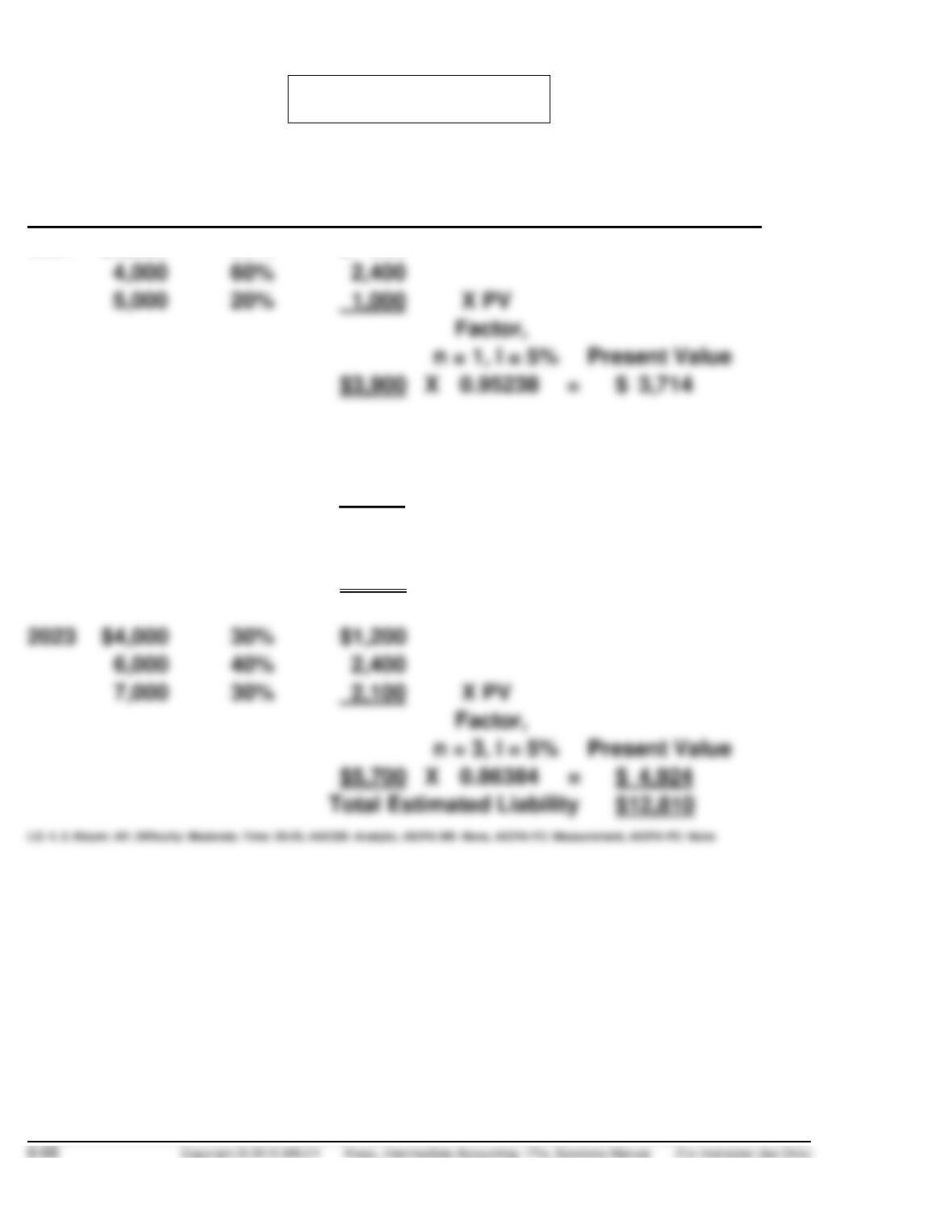
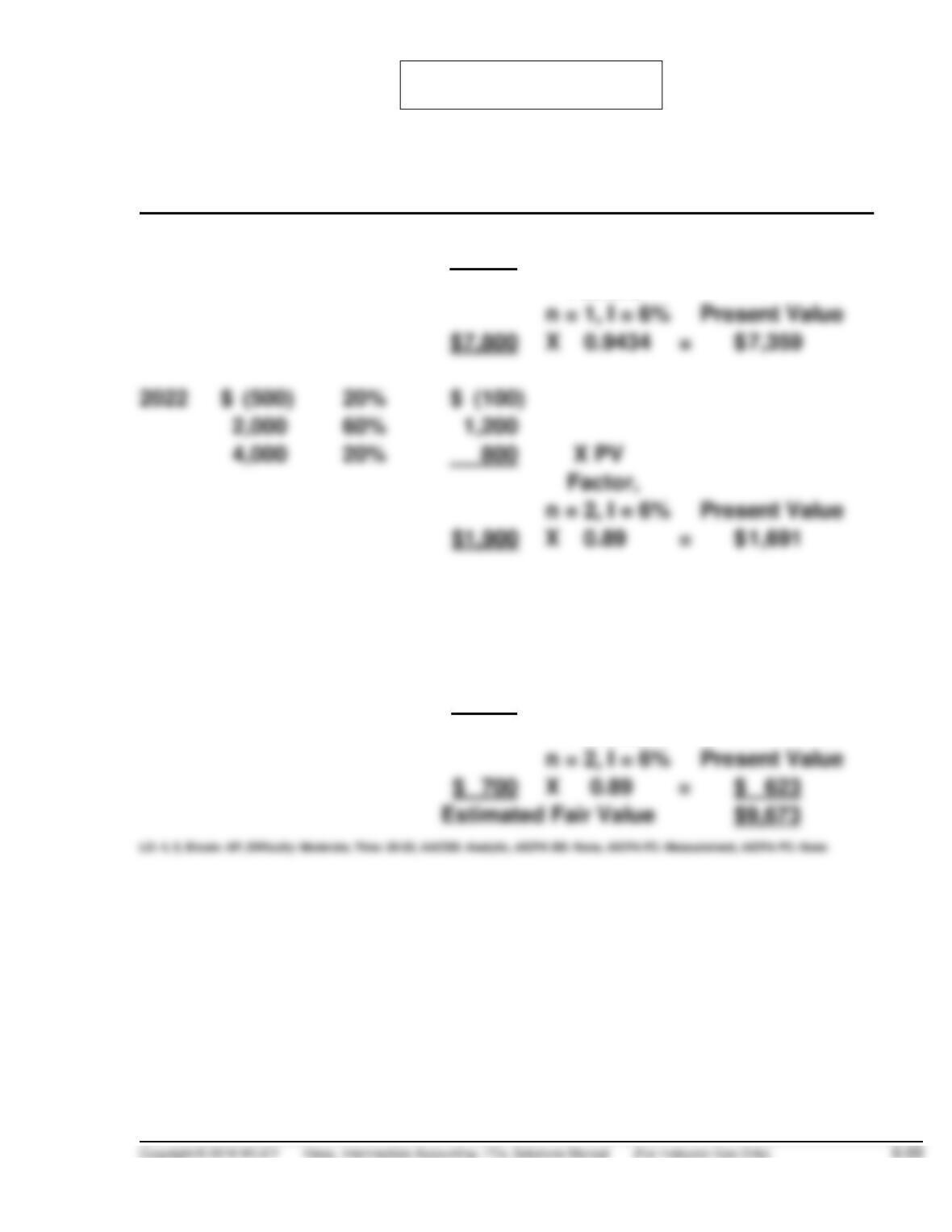
Cash Flow Probability
Estimate X Assessment = Expected Cash Flow
2021 $ 2,500 20% $ 500
2022 $3,000 30% $ 900
5,000 50% 2,500
6,000 20% 1,200 X PV
Factor,
n = 2, I = 5% Present Value
$4,600 X 0.90703 = $ 4,172
PROBLEM 6.14
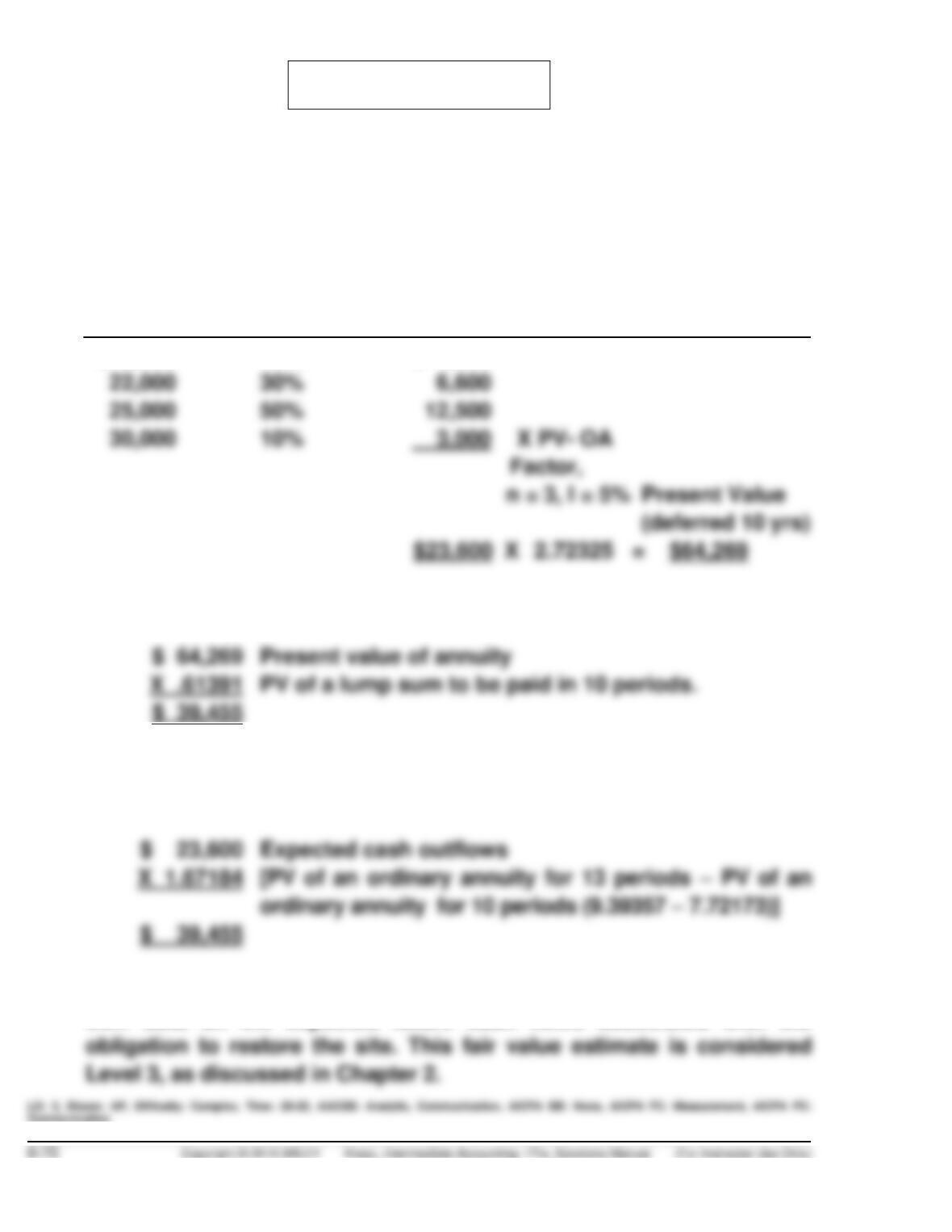
Cash Flow Probability
Estimate X Assessment = Expected Cash Flow
2021 $ 6,000 40% $ 2,400
9,000 60% 5,400 X PV
Factor,
Scrap
Value
Received
at the End
of 2022 $ 500 50% $ 250
900 50% 450 X PV
Factor,
PROBLEM 6.15
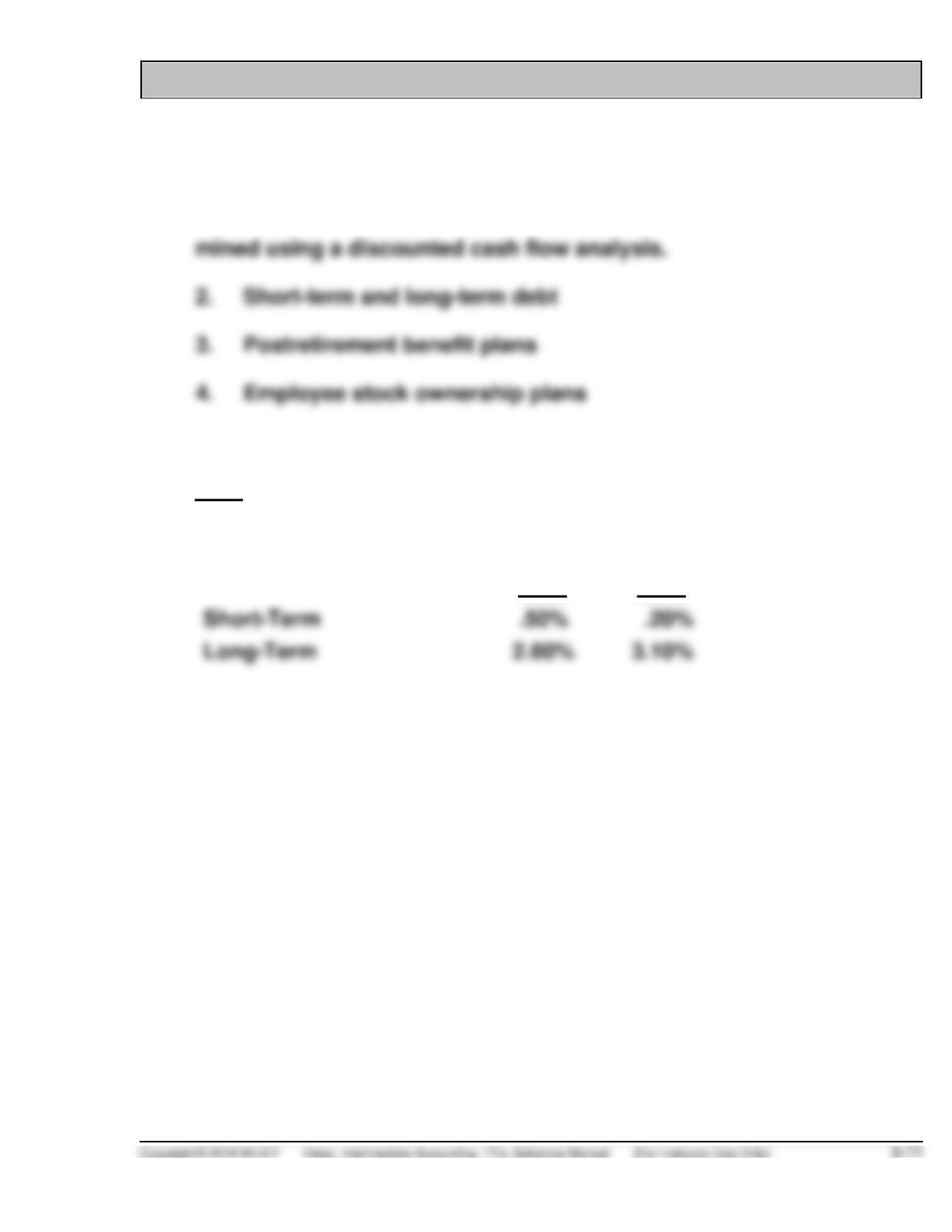
(a) The expected cash flows to meet the asset retirement obligation repre-
sent a deferred annuity. Developing a fair value estimate requires
determining the present value of the annuity of expected cash flows
to be paid in three years and then determine the present value of that
amount today.
Cash Flow Probability
Estimate X Assessment = Expected Cash Flow
$15,000 10% $ 1,500
The value today of the annuity payments to commence in ten years is:
Alternatively, the present value of the deferred annuity can be computed
as follows:
(b) This fair value estimate is based on unobservable inputs—Murphy’s
own data on the expected future cash flows associated with the
Communication
FINANCIAL REPORTING PROBLEM
(a) 1. Long-lived assets, goodwill
For impairment of goodwill and long-lived assets, fair value is deter-
(b) (1) The following rates are disclosed in the accompanying notes:
Debt
Weighted-Average Effective Interest Rate
At December 31
2017
2016
Short-Term
Long-Term
FINANCIAL REPORTING PROBLEM (Continued)
Benefit Plans
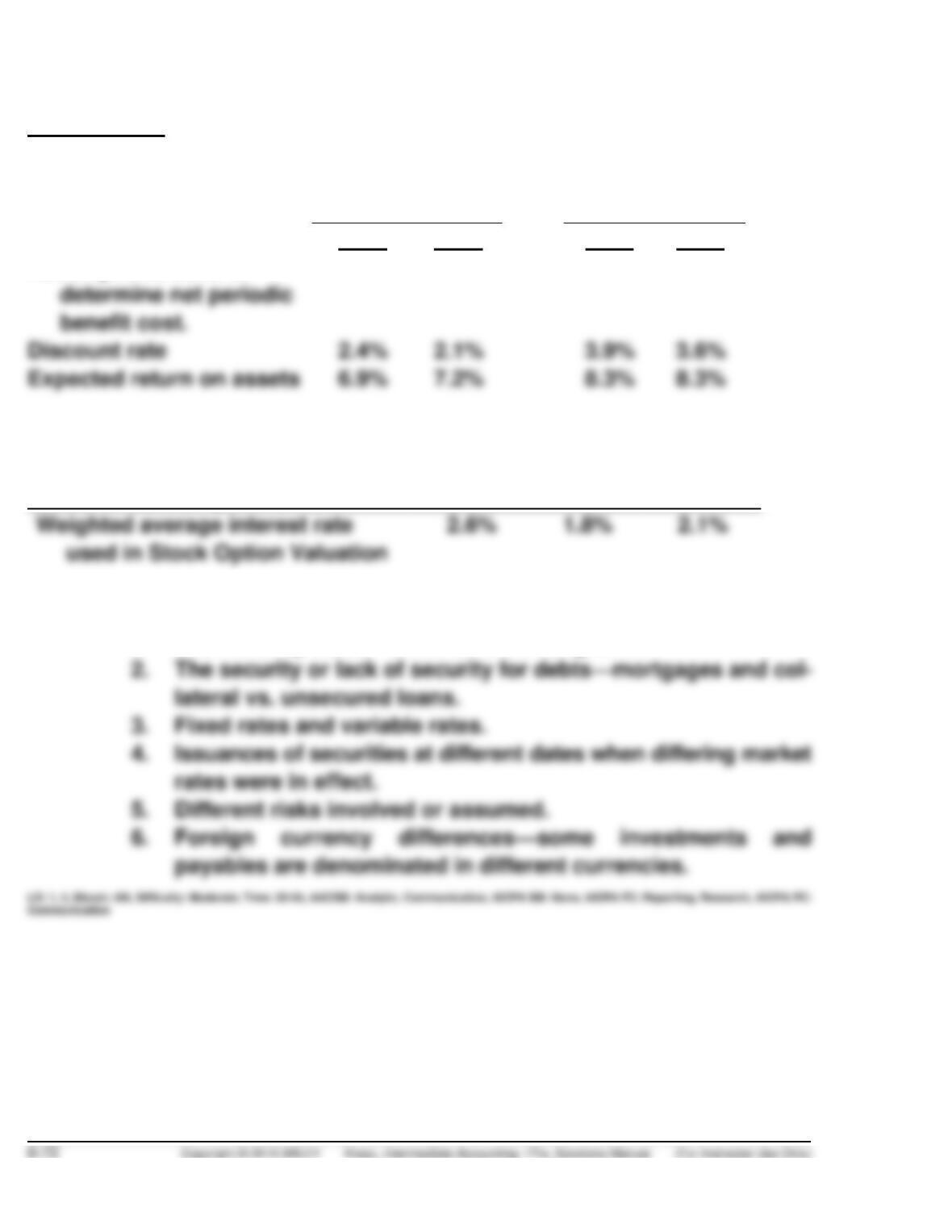
Pension Benefits
Other Retiree
Benefits
United States
2017
2016
2017
2016
Discount rate
2.4%
Expected return on assets
6.9%
7.2%
Assumptions used to
Stock-Based Compensation
Assumptions
2017
2016
2015
used in Stock Option Valuation
(2) There are different rates for various reasons:
1. The maturity dates—short-term vs. long-term.
FINANCIAL STATEMENT ANALYSIS CASE
(a) Cash inflows of $375,000 less cash outflows of $125,000 = Net cash
flows of $250,000.
(c) The estimate of future cash flows is very useful. It provides an under-
standing of whether the value of gas and oil properties is increasing
ACCOUNTING, ANALYSIS, AND PRINCIPLES
Accounting
(a) The present value of the note is presumably equal to the fair-value of
the inventory. The note has 20 semi-annual periods to maturity.
Analysis
If interest rates increase, the fair value of the note will decline. This is
Principles
Fair value versus historical cost potentially involves a trade-off between
the primary qualities of relevance and faithful representation. The fair
values of various assets (and liabilities) is potentially more relevant to
CODIFICATION EXERCISES
CE6.1
(a) According to the Master Glossary, present value is a tool used to link uncertain future amounts
(cash flows or values) to a present amount using a discount rate (an application of the income
CE6.2
50-2 For each goodwill impairment loss recognized, all of the following information shall be dis-
closed in the notes to the financial statements that include the period in which the impair–
ment loss is recognized:
a. A description of the facts and circumstances leading to the impairment.
CE6.3
Interest cost includes interest recognized on obligations having explicit interest rates, interest imputed
on certain types of payables in accordance with Subtopic 835-30, and interest related to a capital lease
05-1 This Subtopic addresses the imputation of interest.
05-2 Business transactions often involve the exchange of cash or property, goods, or services for a
note or similar instrument. When a note is exchanged for property, goods, or services in a
bargained transaction entered into at arm’s length, there should be a general presumption that
05-3 This Subtopic provides guidance for the appropriate accounting when the face amount of a note
does not reasonably represent the present value of the consideration given or received in the
exchange. This circumstance may arise if the note is non-interest-bearing or has a stated
CODIFICATION RESEARCH CASE
Search strings: “present value”, present and value, Present value $, “best
estimate”, “estimated cash flow”, “expected cash flow”, “fresh-start
measurement”, “interest methods of allocation”
(a) Statement of Financial Accounting Concepts No. 7, “Using Cash Flow
(b) See Appendix B: APPLICATIONS OF PRESENT VALUE IN FASB
STATEMENTS AND APB OPINIONS, CON7, Par. 119
119. . . . The accompanying table is presented to assist readers in
Some examples are:
• Debt payable and related premium or discount
• Asset acquired by incurring liabilities in a business combination—“An
asset acquired by incurring liabilities is recorded at cost—that is, at
CODIFICATION RESEARCH CASE (Continued)
• Employers’ Accounting for Postretirement Benefits Other Than
Pensions . . . Effective settlement rate—“. . . as opposed to ‘settling’
(c) 1. CON7, Glossary of terms: Best estimate: The single most-likely
amount in a range of possible estimated amounts; in statistics, the
2. CON7, Glossary of terms: Estimated Cash Flow and Expected Cash
Flow: In the past, accounting pronouncements have used the terms
3. CON7, Glossary of terms: Fresh-Start Measurements: Measurements
in periods following initial recognition that establishes a new
carrying amount unrelated to previous amounts and accounting
CODIFICATION RESEARCH CASE (Continued)
4. CON7, Glossary of terms: Interest Methods of Allocation: Reporting
conventions that use present value techniques in the absence of a
fresh-start measurement to compute changes in the carrying amount
Note to instructor: The concepts statements are not in the codification.
Thus, the references to previous FASB standards