Financial and Managerial Accounting, 9th Edition
6-1
CHAPTER 6
CASH, FRAUD, AND INTERNAL CONTROL
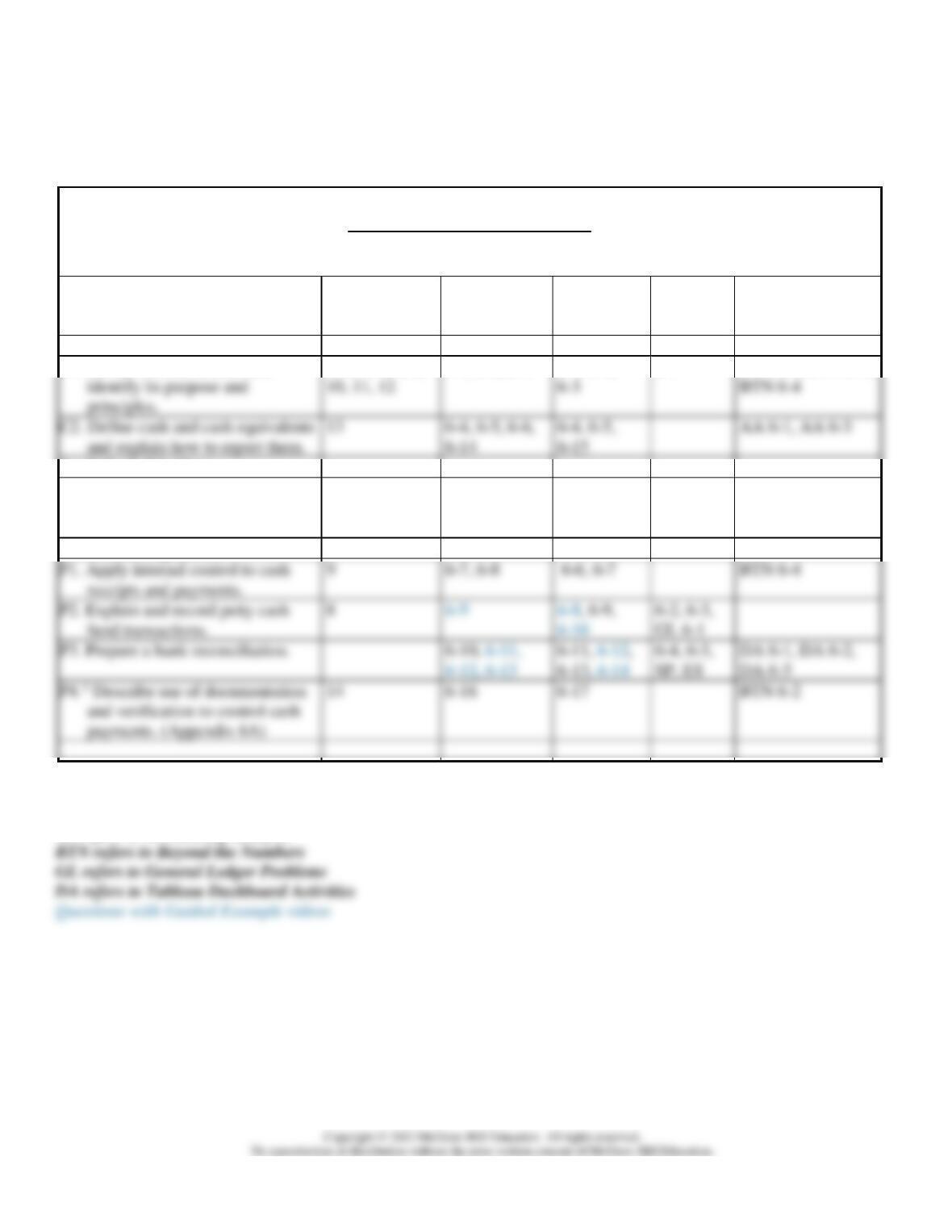
Related Assignment Materials
Student Learning Objectives
Questions
Quick Studies*
Exercises*
Problems*
AA, BTN, DA
Conceptual objectives:
principles.
and explain how to report them.
6-14
6-15
C1. Define internal control and
1, 2, 3, 4, 5, 6,
6-1, 6-2, 6-3
6-1, 6-2,
6-1
BTN 6-1, BTN 6-3,
Analytical objectives:
A1 Compute the days’ sales
uncollected ratio and use it to
assess liquidity.
6-15
6-16
AA 6-1, AA 6-2,
AA 6-3
Procedural objectives:
receipts and payments.
fund transactions.
GL 6-1
SP, ES
DA 6-3
14
6-16
6-17
BTN 6-2
*See additional information on next page that pertains to these quick studies, exercises, and problems.
SP refers to the Serial Problem
AA refers to Accounting Analysis
0:25
1:34
Apply internal control to cash receipts and payments.
1:50
1:24
Financial and Managerial Accounting, 9th Edition
Additional Information on Related Assignment Material
See Chapter 1 of the Instructor’s Resource Manual for more information on materials for this text available in
Connect.
Connect
Available on the instructor’s course-specific website, Connect:
• All numerical Quick Studies, all Exercises and Problems Set A.
Hints/Guided Examples
Please note that the Guided Examples are labeled as “Hints” in Connect assignments. The animated PowerPoints
without the video and audio functions for the Guided Examples are also available in the Connect Instructor Library
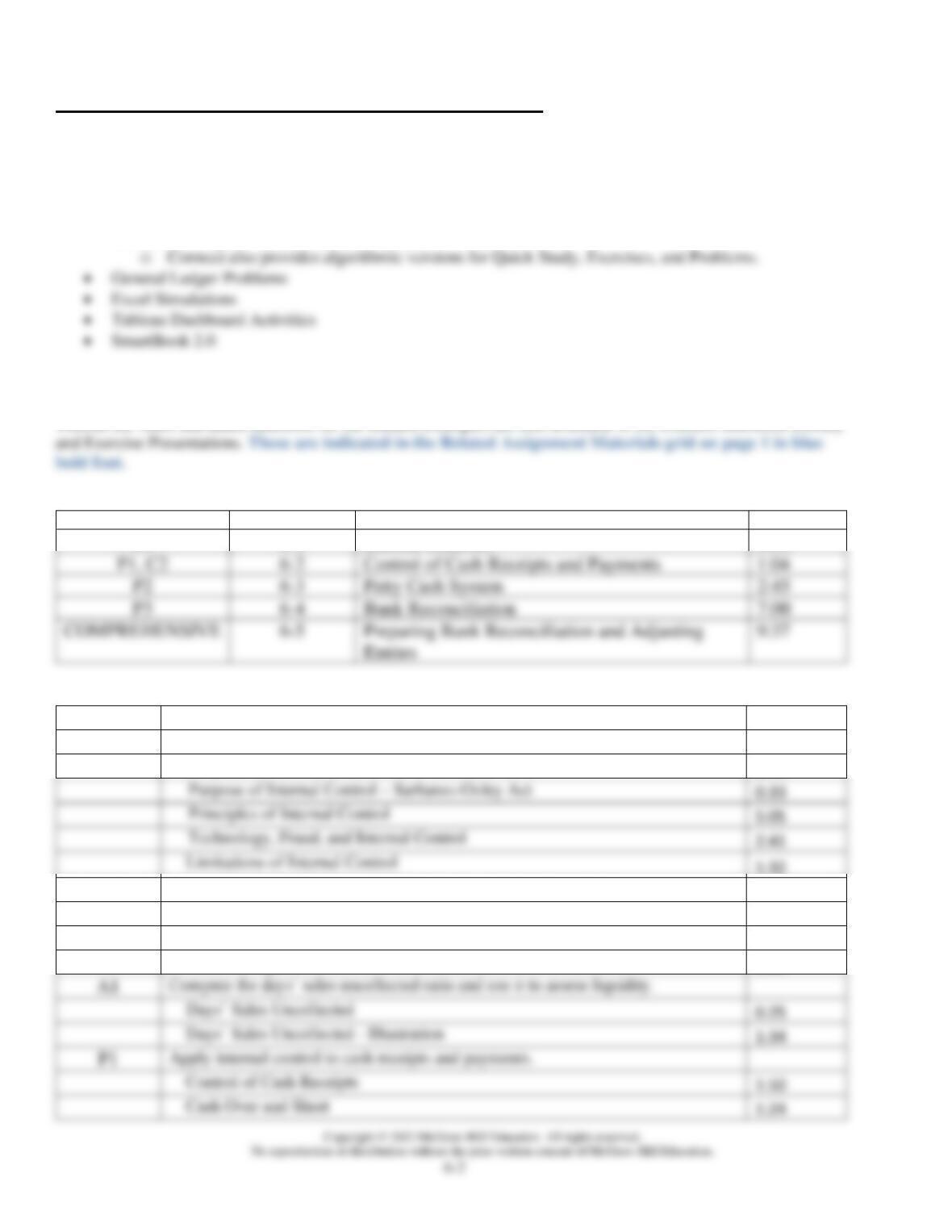
Need-to-Know Videos
LO
Need–to-Know
Title
Time
C1
6-1
Internal Controls
0:58
6-2
Control of Cash Receipts and Payments
1:04
6-3
Petty Cash System
2:45
6-4
Bank Reconciliation
7:00
Entries
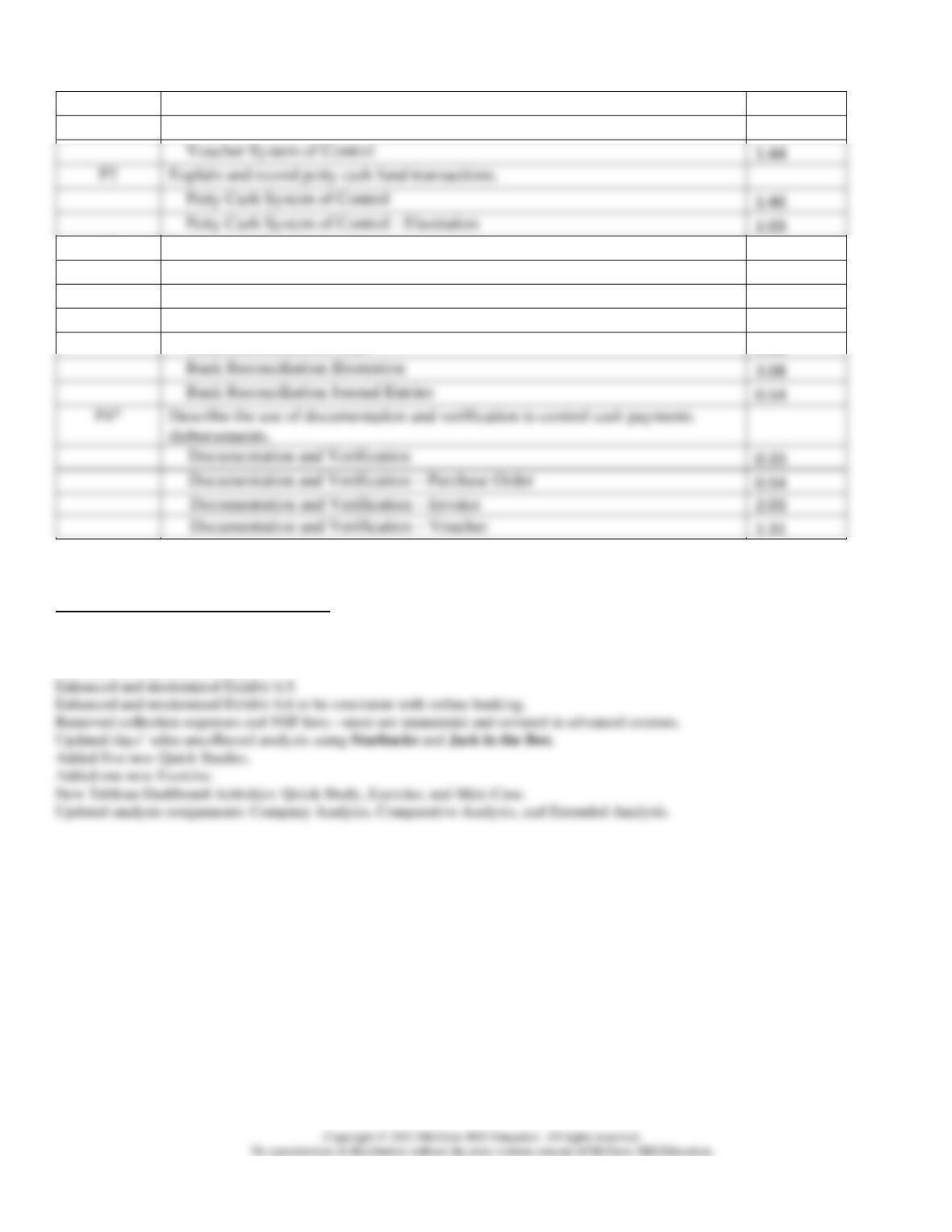
Concept Overview Videos
LO
Title
Time
C1
Define internal control and identify its purpose and principles.
Purpose of Internal Control
1:04
Purpose of Internal Control – Sarbanes-Oxley Act
0:33
Principles of Internal Control
5:05
2:41
1:32
C2
Define cash and cash equivalents and explain how to report them.
Control of Cash
1:04
Cash, Cash Equivalents, and Liquidity
1:18
Cash Management
1:21
Financial and Managerial Accounting, 9th Edition
6-3
Cash Receipts by Mail
0:54
Control of Cash Payments
0:45
Voucher System of Control
1:44
Explain and record petty cash fund transactions.
Petty Cash System of Control
1:46
Petty Cash System of Control – Illustration
1:03
P3
Prepare a bank reconciliation.
Basic Bank Services
1:35
Bank Statement
1:32
Bank Reconciliation
3:52
Bank Reconciliation Steps
1:08
Bank Reconciliation Illustration
3:08
Bank Reconciliation Journal Entries
0:54
Documentation and Verification
0:33
Documentation and Verification – Purchase Order
0:54
2:03
Documentation and Verification – Voucher
1:31
Synopsis of Chapter Revisions
NEW opener—Didi and entrepreneurial assignment.
New section on blockchain and its implications for accounting.
Revised and improved NTK 6-1.
Financial and Managerial Accounting, 9th Edition
6-4
Chapter Outline
I. Fraud and Internal Control
A. Purpose of Internal Control
1. Internal Control System—policies and procedures used to:
a. Protect assets
2. Sarbanes-Oxley Act (SOX)
Requires managers and auditors of companies whose stock is traded on an exchange (called
public companies) to document and verify internal controls.
3. Committee of Sponsoring Organizations (COSO)
B. Principles of Internal Control
1. Establish Responsibilities
C. Technology, Fraud, and Internal Control
Technology allows quick access to information. Examples of how technology impacts internal
control:
1. Reduced Processing Errors—technology reduces but does not eliminate errors in processing
information.
D. Blockchain as a Control – viewed as a new, more secure type of accounting ledger which is
continuously and simultaneously updated and verified. Makes it impossible for the ledger to be
modified without a detailed record of changes. Records cannot be destroyed or hidden as the
record is shared and stored by multiple users.
E. Limitations of Internal Control
1. Human Element
II. Control of Cash—Basic guidelines for control of cash and cash equivalents include:
handling of cash must be separate from recordkeeping of cash, cash receipts are promptly
Financial and Managerial Accounting, 9th Edition
6-5
A. Cash, Cash Equivalents, and Liquidity
1. Liquidity refers to a company’s ability to pay for its current liabilities.
B. Cash Management
1. Goals of cash management
2. Effective cash management strategies:
a. Encourage collection of receivables
C. Control of Cash Receipts
Procedures for protecting cash received over-the-counter and by mail:
1. Over-the-Counter Cash Receipts—receipts from sales should be recorded on a cash register at
D. Control of Cash Payments—to safeguard against theft:
1. Use a cash budget to summarize receipts and payments.
4. Voucher system of control establishes procedures for:
2. Require all payments be made by checks. (Exception—small payments made from petty cash
fund.)
and credit Cash for the amount reimbursed to the petty cash fund.
5. Petty cash system of control:
a. Write and cash a check to establish petty cash fund. Record as a debit to Petty
Cash and credit to Cash. (Petty Cash account is debited or credited only when
Financial and Managerial Accounting, 9th Edition
6-6
III. Banking Activities as Controls
A. Basic Bank Services
B. Bank Statement
Shows activities of a bank account and is used to prove the accuracy of the depositor’s
cash records in preparing a bank reconciliation.
1. Bank Reconciliation—a report that explains (reconciles) the difference between the
2. Purpose of Bank Reconciliation
Factors causing the bank statement balance to differ from the depositor’s book balance
3. Steps in preparing the bank reconciliation:
h. Compute the adjusted book balance.
a. Enter the bank balance of the cash account (balance per bank).
b. Add any unrecorded deposits (deposits in transit) and any bank errors that
understate the bank balance.
4. Adjusting entries from a Bank Reconciliation
a. All reconciling additions to book balance are debits to cash. Credit depends on
reason for addition (Example: Credit Notes Receivable when bank collected
IV. Decision Analysis—Days’ Sales Uncollected
A. Also called days’ sales in receivables.
B. Used to estimate how much time is likely to pass before the current amount of accounts
Financial and Managerial Accounting, 9th Edition
6-7
V. Documentation and Verification (Appendix 6A)
Important documents of a voucher system of control include:
A. Purchase Requisition—lists the merchandise needed and requests that it be purchased.
B. Purchase Order—used by purchasing department to place an order with a vendor (seller or
supplier).
Financial and Managerial Accounting, 9th Edition
6-8
Chapter 6 Alternate Demonstration Problem
The Betsy Dough Company wants to prepare a bank reconciliation for the month of
June. When the bank statement for the month of June arrives from the bank, the
following steps are performed:
1. The deposits to the bank account, as recorded on the bank statement, are
2. Checks returned with the bank statement are compared to the checks written and
3. The ending balances on the statement and in the company’s books are
4. Other information contained on the bank statement, not previously known to the
company, is determined. This includes the following: (a) a note of $180 plus $20
5. A bank reconciliation is prepared; it does not balance! The difference is $18, so
a transposition error is looked for (whenever the difference is a multiple of 9,
Required:
Prepare a bank reconciliation for the Betsy Dough Company at June 30.
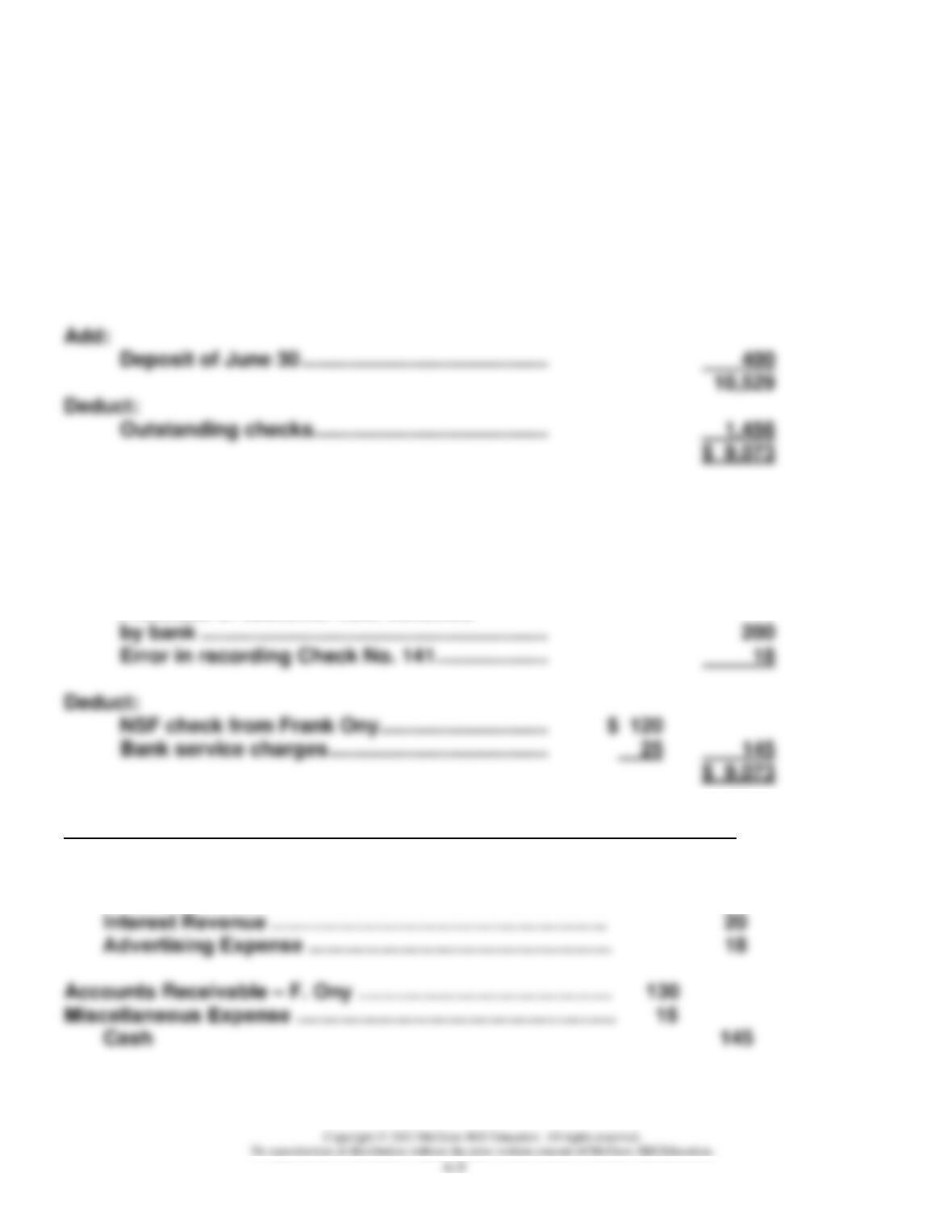
Financial and Managerial Accounting, 9th Edition
Chapter 6 Solution: Alternate Demonstration Problem
BETSY DOUGH COMPANY
Bank Reconciliation
June 30
Bank Statement
Bank statement balance ………………………………………
$10,129
Add:
Deduct:
$ 9,073
Depositor’s Books
Book balance of cash ………………………………………….
$ 9,000
Add:
Deduct:
NSF check from Frank Ony …………………………
Bank service charges …………………………………
$ 9,073
Proceeds of customer note collected
Journal entries based on the Bank Reconciliation (made by depositor)
Cash………………………………………………………………. 218
Notes Receivable …………………………………………. 180