P a g e | 41
9. Biker Nightmare (Chapter 6, pages 464-465)
What this case has to offer
Most Professional Accountants (PAs) have found themselves in the position of discovering an illegal act,
and have wondered what to do about it. In this case, the company president has asked for you to
summarize a number of illegal transactions, and to sign the summary. If discovered or reported to the
Teaching suggestions
The most expedient way to approach the case is to ask the class to recap the ethical issues presented in
the case. That will lead to a discussion of the items above, and then to the end-of-case questions as
noted below.
Discussion of ethical issues
1. What does our professional code say about this?
Most codes contain general, if not specific, provisions against acting in or covering up an illegal
2. If this issue is uncovered by the government regulatory authorities, will I be implicated?
3. Should I quit my job and then go and report this situation to the regulatory authorities?
Not unless the president refuses to change the practice after you advise him or her of the

P a g e | 42
P a g e | 43
10. Budget Conflict (Chapter 6, page 465)
What this case has to offer
As CFO of an organization, particularly one where financial acumen may be weak, it is expected that a
Professional Accountant (PA) will try to clarify any perceived misunderstanding on financial matters.
Consequently, if the Board of Directors approves a “stretch budget” that assumes unreasonable
Teaching suggestions
The discussion could start by asking if a PA’s duties are different with a charitable organization
compared to a profit-oriented one. The answer should be no, and then the class should be asked which
Discussion of ethical issues
1. What should the CFO do?
The CFO should put his or her comments in writing and present a copy to the President and
2. Beyond resigning, how can the CFO protect him or herself?
The best protection is to take the steps laid out above and to document the meetings held to try
P a g e | 44
11. An Exotic Professional Accountant (Chapter 6, page 465)
What this case has to offer
The issues involved in this case are:
• The limits of damage to the profession’s reputation
Both the reputation of a PA and the profession can be impacted by personal-time activities, for better or
worse. For the professional, such activities can enhance reputation if the activities reflect high levels of
the values of integrity, duty and so on, excellent judgment, or demonstrated competence in financial or
organizational matters. They might diminish her or his personal reputation if the choices made were not
respected.
Teaching suggestions
I would ask the two questions one at a time, and entertain discussion and manage it to cover the points
in the commentary above.
• Do activities on a Professional Accountant’s (PA’s) personal time matter, and if so what kind of
activities?
P a g e | 45
Discussion of ethical issues
1. What advice would you give?
A PA contemplating such a choice should consider:
• employer codes, values and guidelines
P a g e | 46
12. Freebie Services for Staff (Chapter 6, pages 465-466)
What this case has to offer
The case examines the grey area of duty to employer, conflicts of interest (COI), how to combat frivolous
charges related to them, and what red flags they might involve.
Since the employer has no formal policy for the provision of services on personal time in regard to
matters not directly affecting the town, it seems that an external lawyer has influenced the town
Teaching suggestions
Ask the class what the ethical issues are raised by the case. This should lead to a discussion of:
• what duty a PA owes his or her employer
Discussion of ethical issues
1. What advice would you give to the Professional Accountant?
The advice to the PA should include:
• Asking the town manager:

P a g e | 47
P a g e | 48
13. Summer Camp Holdback (Chapter 6, page 466)
What this case has to offer
A Professional Accountant (PA) has been asked to agree to allow his or her employer to:
• retain monies (for General Sales Tax (GST) recoveries) belonging to customers,
• issue charitable receipts to give the customers partial credit (less than 100% depending on the
back the GST recovered.
Unless the right to reimbursement is made clear to the customers, and they agree to leave the money
with the Camp as a donation, the plan for retention and issuance of charitable donation receipts is
illegal. The GST recovery is money held in trust and does not belong to the Camp. Moreover, it is likely
that an audit of the GST records of the Camp would find the illegal retention.
Teaching suggestions
The class should be asked to clarify what the PA has been asked to do.
Discussion of ethical issues
1. What is your advice?
The company’s officers should be told that what they propose is illegal and could subject the
P a g e | 49
14 Theft Reimbursement Twice (Chapter 6, pages 466–467)
What this case has to offer
The controller has instructed the assistant controller to deposit a second check for $16,583 into a high
interest account to earn interest to defray legal and other costs of the related court case. He said that
Teaching suggestions
After eliciting the facts, the class could be asked if they thought the proposed action was unethical or
illegal, or both.
In the ensuing discussion, the class could be led to use the ethical challenges discussed in Chapters 3 and
4, such as:
1. Consider the consequences in the short and long term.
Discussion of ethical issues
1. How would you answer the assistant controller?
The assistant controller should be encouraged to perform the above analysis and come to the
P a g e | 50
2. What advice would you give to the controller?
3. What aspects of the organization’s governance process and/or internal controls were flawed?
The check preparation, authorization, and distribution systems are flawed because:
4. Should the directors be told about the fraud and/or any other matters?
Yes. The directors have a right to know about the fraud and other matters related to insurance,
P a g e | 51
Accounting & Auditing Dilemmas
15. Sino-Forest Fraud?—Audit Challenges in China (Chapter 6, pages 468–473)
What this case has to offer
The Sino-Forest Fraud case presents the difficulties of auditing in a foreign jurisdiction and culture, the
consequences of not meeting these challenges appropriately, and raises questions about how best to
meet those challenges. The case also illustrates the difficulties for investors and capital markets
participants where the operations of a company are in jurisdictions significantly different than in North
America, U.K., Europe, Australia or New Zealand.
The role of the board of directors also comes under scrutiny. Is it enough to rely upon the audit firm, or
should other measures be taken to insure the accuracy of financial reporting and the integrity of
company operations?
In addition, the case offers the opportunity to explore what “professional skepticism” means, and how it
Teaching suggestions
It is useful to begin the Sino-Forest case discussion with the statement and question: Everyone knows
that investing in the stock market is very risky, so why isn’t the Sino Forest Fraud considered just a case
of “buyer beware” in which investors took a chance and have to suffer the loss without recourse? This
will lead to questions on and discussion of the
• facts of the case
P a g e | 52
Discussion of ethical issues
1. Describe the fraud that allegedly occurred through Sino-Forest Corporation Inc.? Who benefited and
how?
These details are in the case. Essentially, operations were falsely inflated, records and systems
were insufficient, legal frameworks were too loose or not in place, auditors failed to discover
2. Why did regulators not prevent this fraud from occurring? What were they relying on?
Regulators were unaware of the fraud because they relied upon the work of a Big 4 audit firm,
3. Why did the directors of Sino-Forest not prevent this fraud from occurring? What should they have
done to discover the problems that were subsequently uncovered?
The directors should have been more familiar with the risks in doing business in China. If they
had been, they would probably have: (1) visited company operations and offices in China, (2)
P a g e | 53
4. Why did shareholders not foresee this fraud? What were they relying on?
As stated above, the investors relied upon the auditors, as well as the board of directors and the
5. Why did Carson Block author the Muddy Waters Research Report? Was he altruistic or self-
interested? What did his company stand to gain?
Carson Block was probably both self-interested and altruistic. His company was established to
6. What basic assumptions were erroneously made by Ernst & Young that contributed to the audit
problems of concern to the OSC?
• E & Y erroneously assumed that the entrepreneurs behind Sino-Forest and its management
were honest and possessed integrity, so that they believed they could rely upon
7. What audit risks become important when auditing in unfamiliar cultures?
• Mistaken assumptions:
P a g e | 54
8. If you had been on the audit team of Sino-Forest, how would you have avoided allegations of a lack
of adequate professional skepticism?
You would need to have:
• investigated any procedures or activities that differed from North American practice.
9. If the Chinese system of recording property rights was known to be incomplete, how would you
have performed the audit of Sino-Forest’s assets?
Where there was significant uncertainty, multiple legal opinions should have been sought, in
English, as to the ownership questions, and appraisals should have been sought from several
10. What audit problem was caused by the Sino-Forest practice of selling timber without receiving cash
payments, and how would you have resolved it?
By selling timber without receiving cash payments, Sino-Forest made it almost impossible to
11. What would you do if you were a company director or auditor, and you were advised that your
company had incomplete or inadequate record creation and retention practices and no integrated
accounting system and that employees conducted company business from time to time using
personal devices and non-corporate email addresses?
P a g e | 55
It should be obvious that all of the inadequacies noted above are serious and threaten or
undermine an investor’s ability to monitor a company’s performance and to rely upon its assets,
and prior audit opinions.
a. As a director, I would immediately ensure that my director’s and officer’s insurance was
adequate, and either resign, or immediately cause the company to retain a reputable
Additional Issues Raised by Professor Dushyantkumar Vyas, Rotman School of Management
Issue 1
Even before fraud allegations by Carson Block, could investors have used Sino Forest’s
Issue 2
What type of governance mechanisms should be in place within audit firms to encourage internal
dissent and whistleblowing activities? It appears in this case that at least some E&Y employees had
misgivings about the work conducted by Pöyry Forest. See article by McFarland, Hoffman and Gray
(2012).
Issue 3
Auditors often rely on evidence from independent third party agencies (e.g., valuation experts,
Issue 4
Consider the regulatory model: More generally, and beyond the case at hand, should there be greater
P a g e | 56
Subsequent Events
July 2014
Sino-Forest CFO, David Horsley, settles with OSC for $700,000 fine; is barred from directorships;
August 2014
In a settlement with the Ontario Securities Commission (OSC), David Horsley—former CFO for Sino-
Forest—is fined, and prevented from ever again sitting as a director of a public company. Author
Peter Koven writes, “Mr. Horsley was the only member of Sino–Forest’s senior management team
Useful Articles, Links, and Videos
“Block Interview on Sino–Forest .” [June 6, 2011], Bloomberg Television, accessed at
In this interview of Carson Block by Erik Schatzker on Bloomberg Television’s “InsideTrack,”
Carson Block is questioned about Sino-Forest, his company’s short position, why Block considers
Sino-Forest to be a Ponzi scheme and, Schatzker asks, why cable companies, with similar capital-
raising requirements and negative cash flow, are not. Schatzker also questions Block’s
company’s potential conflicts of interest.
Chevreau, Jonathan (June 10, 2011). “Sino-Forest shows importance of doing your homework.” Financial
P a g e | 57
Lu, Vanessa (July 22, 2014). “Former Sino-Forest CFO barred from serving as director of public
company.”The Toronto Star, accessed on July 22, 2014 at
In this article, the author says, “Sino-Forest trumps Bre-X precisely because it happened after
Bre–X…Twice, Canada’s fragmented and undermanned regulatory regime failed.”
Pavlo, Walter (April 8, 2011). “Fraud In Chinese Reverse Mergers on American Exchanges — And We’re
P a g e | 58
16. Massive Acquisition Write-Downs in the Mining Industry (Chapter 6, pages 473-474)
What this case has to offer
The case identifies the problem that several mining companies have purchased other companies, have
absurdly found almost immediately that they paid too much, and so have written off the massive
overpayments very quickly. There are several possible explanations, including the following. The
purchasing-company executives…
• used the wrong valuation method to calculate the amount paid
The four most common methods are:
1. Asset based
a. Adjusted book value approach
2. Earnings based
a. Capitalized earnings approach
Teaching suggestions
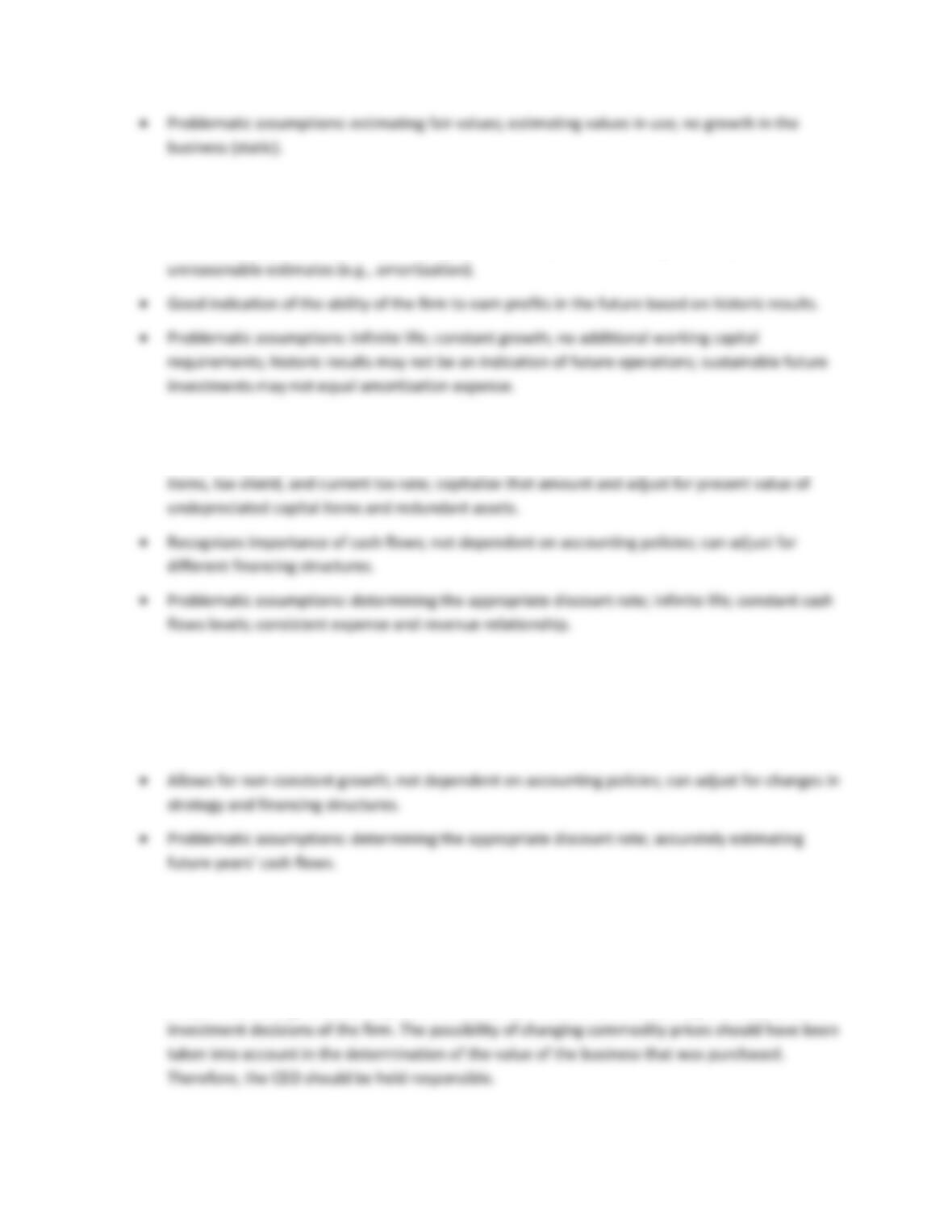
For each of the following valuation methods, have a student briefly summarize the computational
Adjusted Book Value
• Methodology: calculate a revised book value by adjusting net tangible assets and liabilities to
their fair values or values in use.
P a g e | 59
Capitalized Earnings Approach
• Methodology: calculate normalized (sustainable) earnings by adjusting for non-recurring items,
discontinued operations, non-arm’s length transactions, excessive compensation, and
Capitalized Cash Flows
• Methodology: calculate after-tax cash flows by adjusting for non-cash revenue and expense
Discounted Cash Flows
• Methodology: calculate year-by-year free cash flows (i.e., operating cash flows less required
capital expenditures to maintain the cash flows); discount those amounts (normally using
weighted average cost of capital).
Discussion of ethical issues
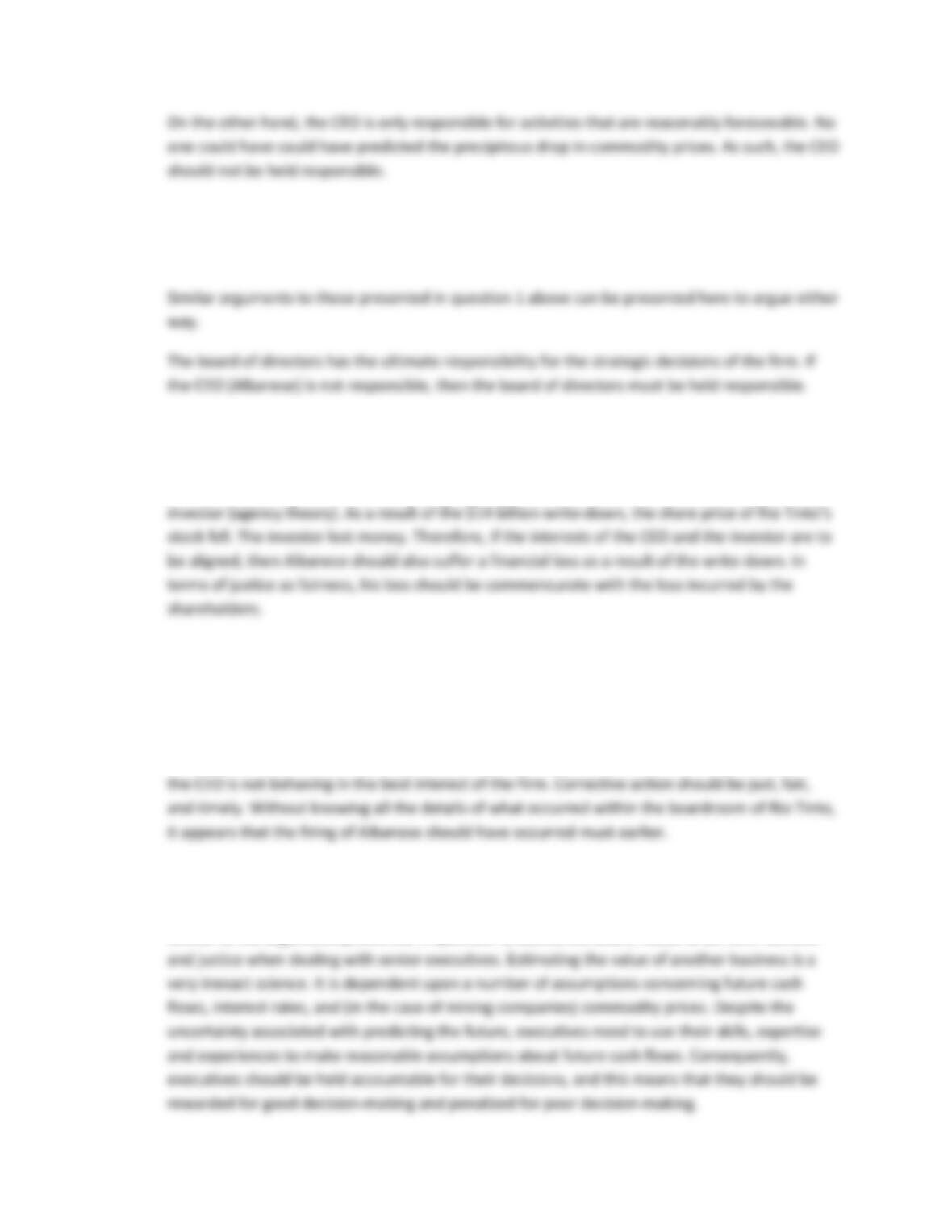
1. Should the CEOs of these mining companies be held accountable for commodity prices that have
dropped precipitously while operating costs have soared?
It is possible to argue either way. On the one hand, the CEO has ultimate responsibility for the
P a g e | 60
2. Should Albanese be held responsible for the fact that the Chinese market did not open as he
predicted and that the price of aluminum dropped precipitously? If not Albanese, then who should
be held responsible?
3. Because of the $14 billion write-down should Albanese be forced to forfeit his lucrative stock
options?
Part of the objective of stock options is to align the interests of management with those of the
4. Alcan was purchased in 2007, and there were two subsequent write-downs, reducing its value by
more than half of its original purchase price. But Albanese did not resign until 2013. Was this
resignation too late? When should a board of directors fire a CEO who has made a significant
mistake?
The board of directors has the responsibility to take corrective action when the board feels that
5. The Rio Tinto executives made massive errors in judgement that cost the company billions. Were
they treated too gently?
Similar to the arguments presented in question 4, above, the board needs to act with fairness