Chapter 6
Variable Costing and Segment Reporting:
Tools for Management
Solutions to Questions
6-1 Absorption and variable costing differ in
6-2 Selling and administrative expenses are
treated as period costs under both variable
costing and absorption costing.
6-3 Under absorption costing, fixed
manufacturing overhead costs are included in
product costs, along with direct materials, direct
6-4 Absorption costing advocates argue that
absorption costing does a better job of matching
6-5 Advocates of variable costing argue that
fixed manufacturing costs are not really the cost
of any particular unit of product. If a unit is
made or not, the total fixed manufacturing costs
will be exactly the same. Therefore, how can
one say that these costs are part of the costs of
the products? These costs are incurred to have
absorption and variable costing. When
production equals sales, inventories do not
increase or decrease and therefore under
absorption costing fixed manufacturing overhead
cost cannot be deferred in inventory or released
from inventory.
6-7 If production exceeds sales, absorption
period is immediately expensed under variable
costing.
the level of production without any increase in
sales. If production exceeds sales, units of
product are added to inventory. These units
carry a portion of the current period’s fixed
manufacturing overhead costs into the inventory
account, reducing the current period’s reported
6-10 Differences in reported net operating
income between absorption and variable costing
arise because of changing levels of inventory. In
6-11 A segment is any part or activity of an
organization about which a manager seeks cost,
6-12 Under the contribution approach, costs
are assigned to a segment if and only if the
6-13 A traceable cost of a segment is a cost
that arises specifically because of the existence
of that segment. If the segment were
eliminated, the cost would disappear. A common
cost, by contrast, is a cost that supports more
6-14 The contribution margin is the difference
between sales revenue and variable expenses.
6-15 If common costs were allocated to
segments, then the costs of segments would be
were eliminated because of the existence of
arbitrarily allocated common costs, the overall
6-16 There are often limits to how far down
an organization a cost can be traced. Therefore,
costs that are traceable to a segment may
become common as that segment is divided into
smaller segment units. For example, the costs of
The Foundational 15
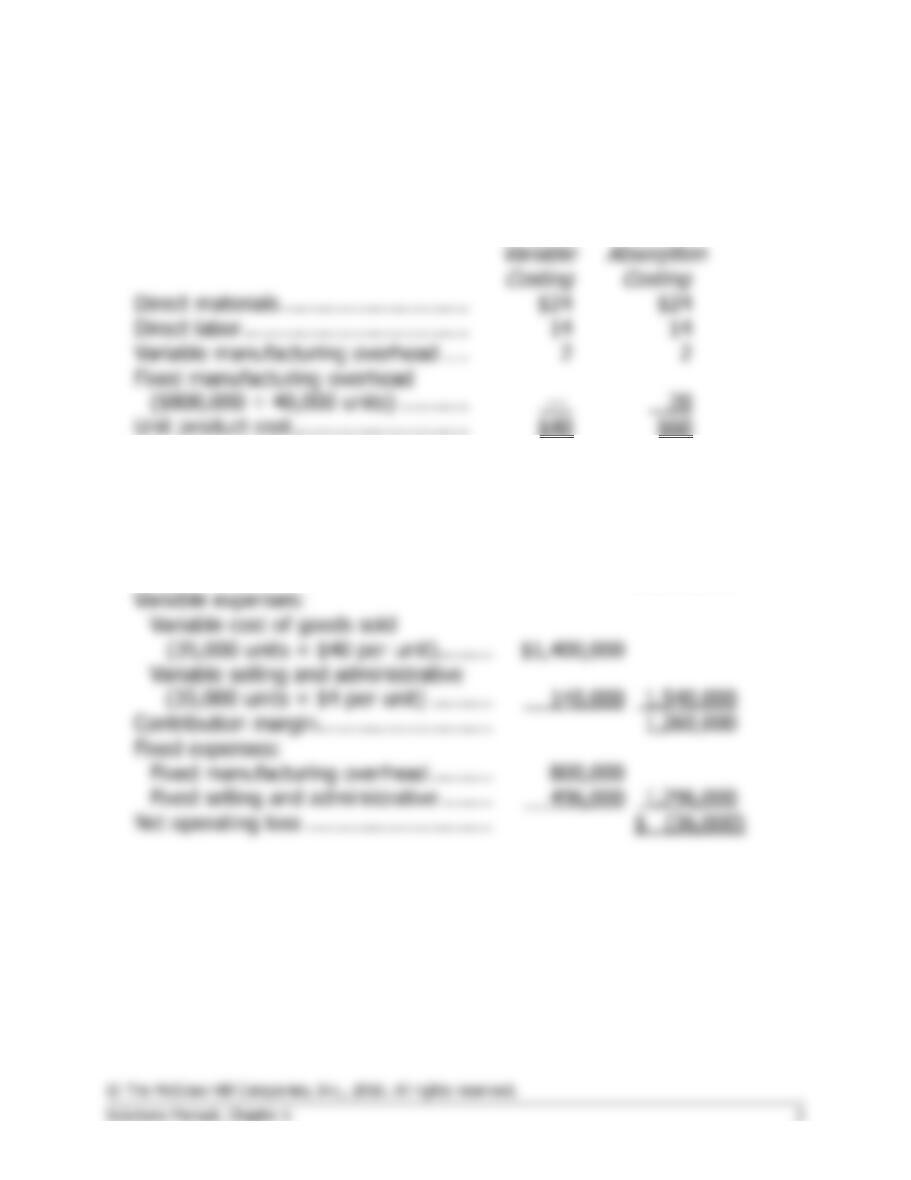
1. and 2.
The unit product costs under variable costing and absorption costing are
computed as follows:
Direct labor ………………………………
Variable manufacturing overhead ….
3. and 4.
The total contribution margin and net operating income under variable
costing are computed as follows:
Sales ………………………………………….
$2,800,000
Net operating loss …………………………
The Foundational 15 (continued)
5. and 6.
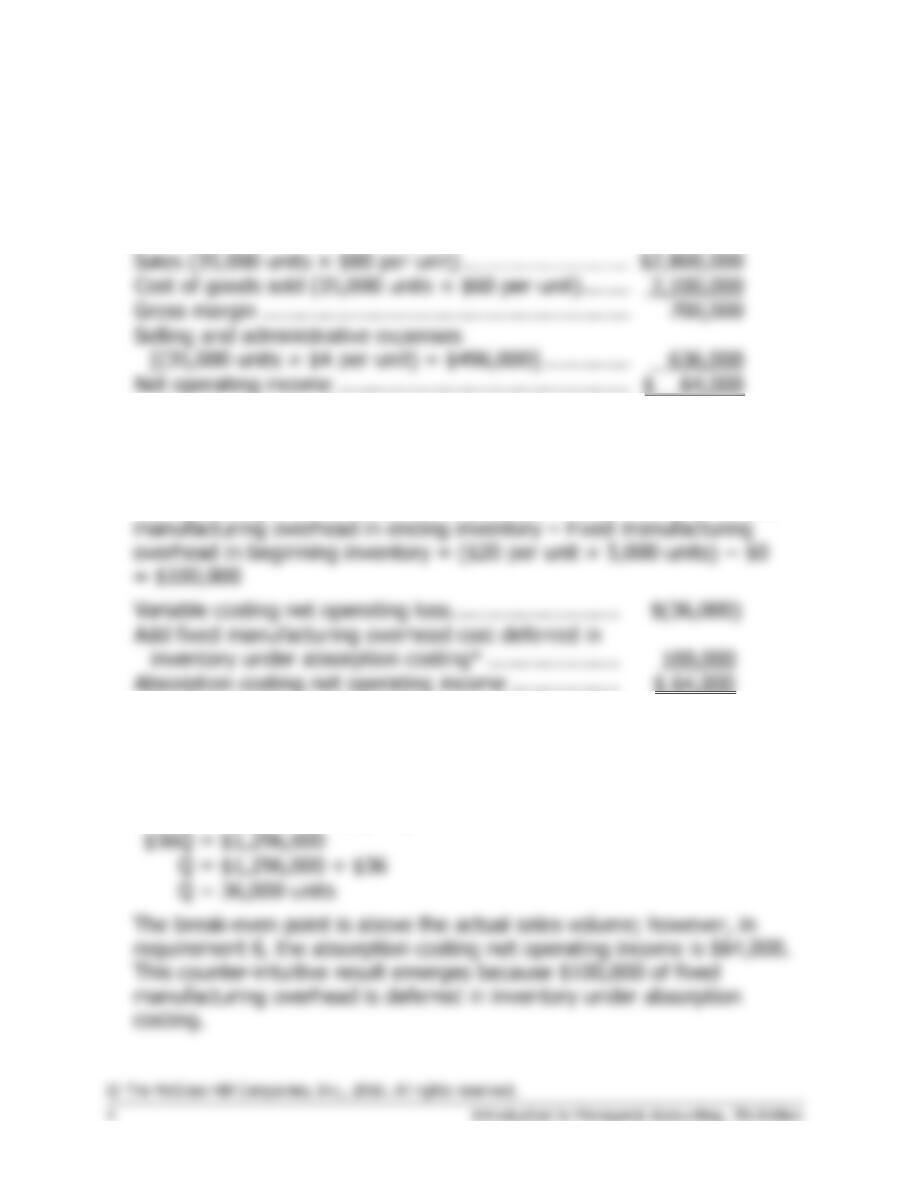
The total gross margin and net operating income under absorption
costing are computed as follows:
Sales (35,000 units × $80 per unit) ………………………
Cost of goods sold (35,000 units × $60 per unit) ……..
Gross margin …………………………………………………..
Net operating income ………………………………………..
7. The difference between the absorption and variable costing net
operating incomes is explained as follows:
Manufacturing overhead deferred in (released from) inventory = Fixed
Absorption costing net operating income ……………..
8. The break-even point in units is computed as follows:
Profit
= Unit CM × Q − Fixed expenses
$0
= ($80 − $44) × Q − $1,296,000
$0
= ($36) × Q − $1,296,000
= $1,296,000
= 36,000 units
The Foundational 15 (continued)
9. The break-even point of 36,000 units would remain the same. This
10. and 11.
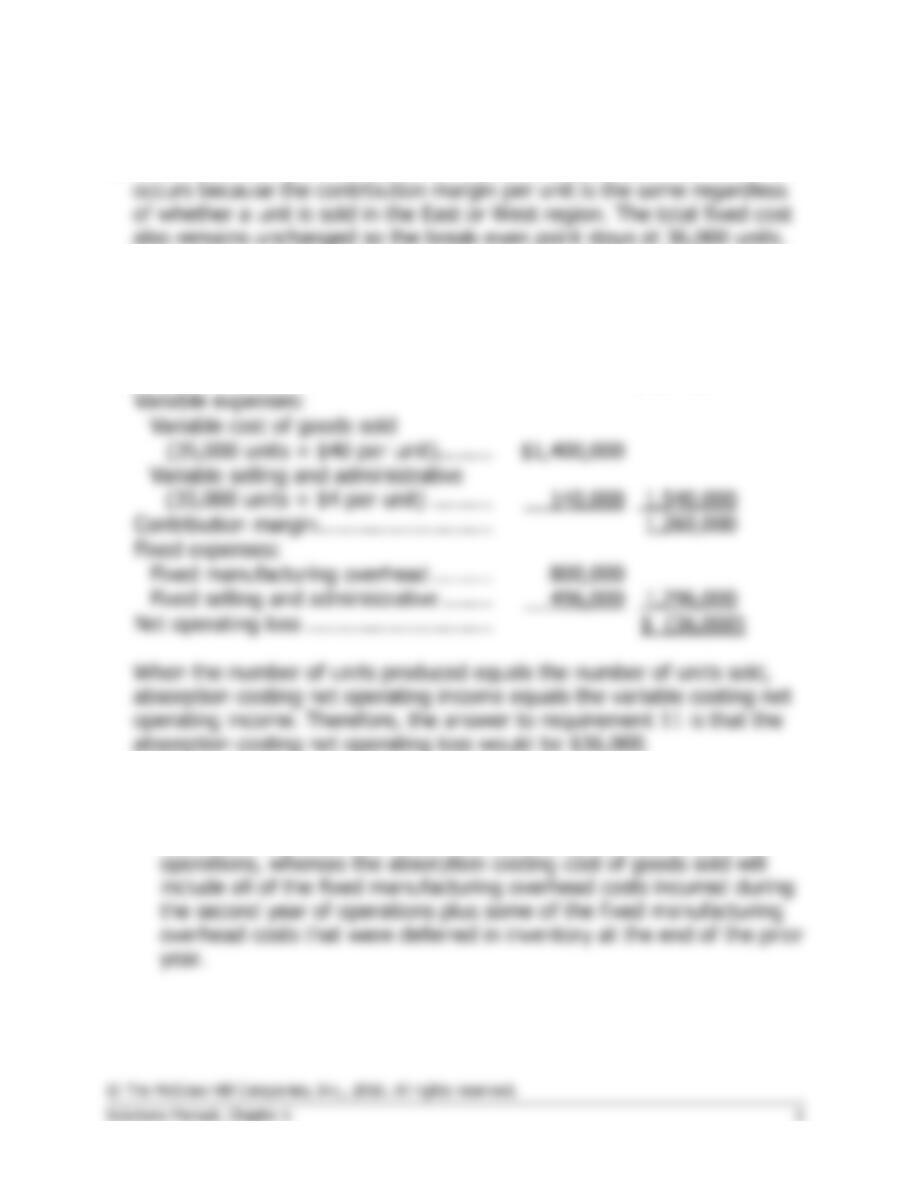
The variable costing net operating income would be the same as the
answer to requirement 4 as shown below:
Sales ………………………………………….
$2,800,000
Fixed expenses:
Net operating loss …………………………
12. Absorption costing income will be lower than variable costing income.
The variable costing income statement will only include the fixed
manufacturing overhead costs incurred during the second year of
The Foundational 15 (continued)
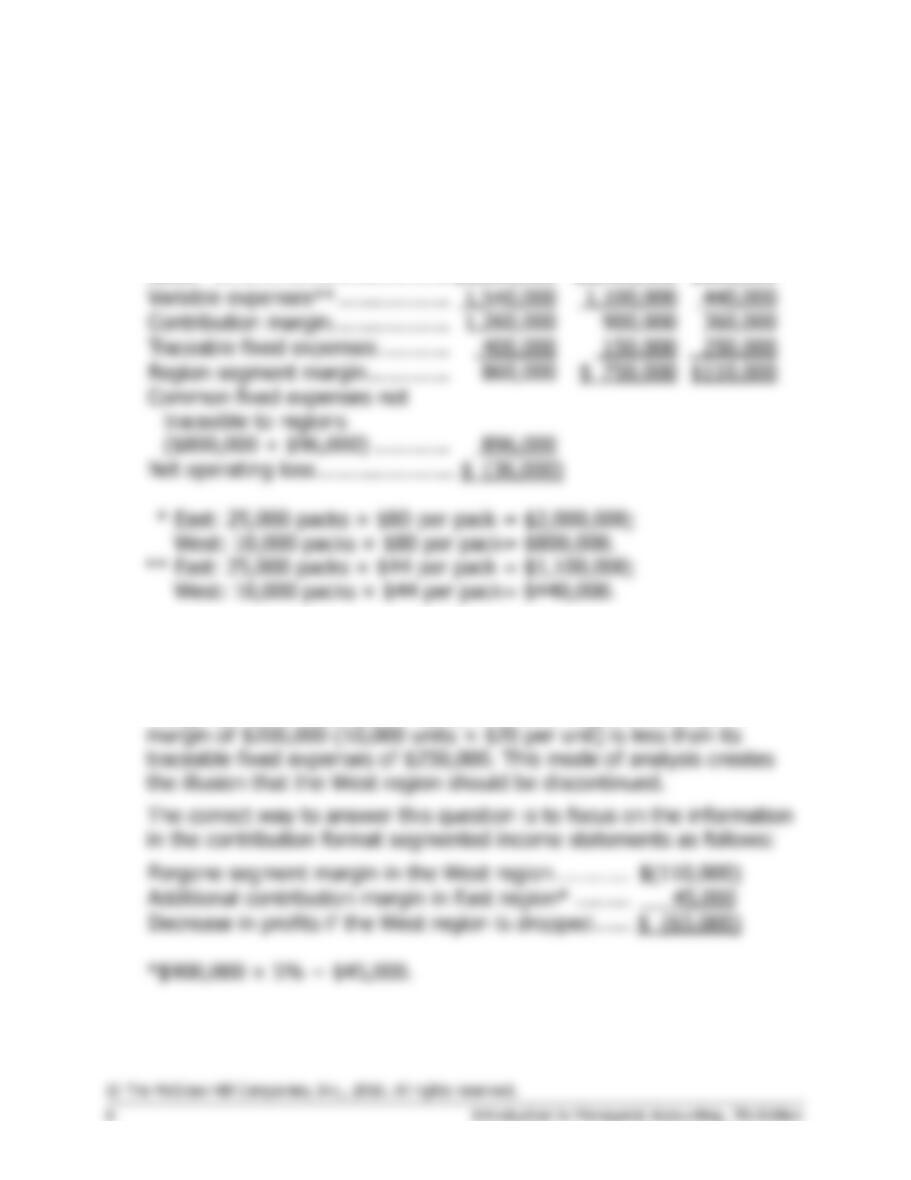
13. The segment margins for the East and West regions are computed as
follows:
Total
Company
East
West
Sales* …………………………..………
$2,800,000
$2,000,000
$800,000
Variable expenses** …………………
1,540,000
Contribution margin ………………….
14. Diego has apparently determined that the total
gross margin
in the
West region equals $200,000. As computed in requirement 1, the unit
product cost under absorption costing is $60; therefore the gross
margin per unit is $20 ($80 – $60). The West region’s total gross
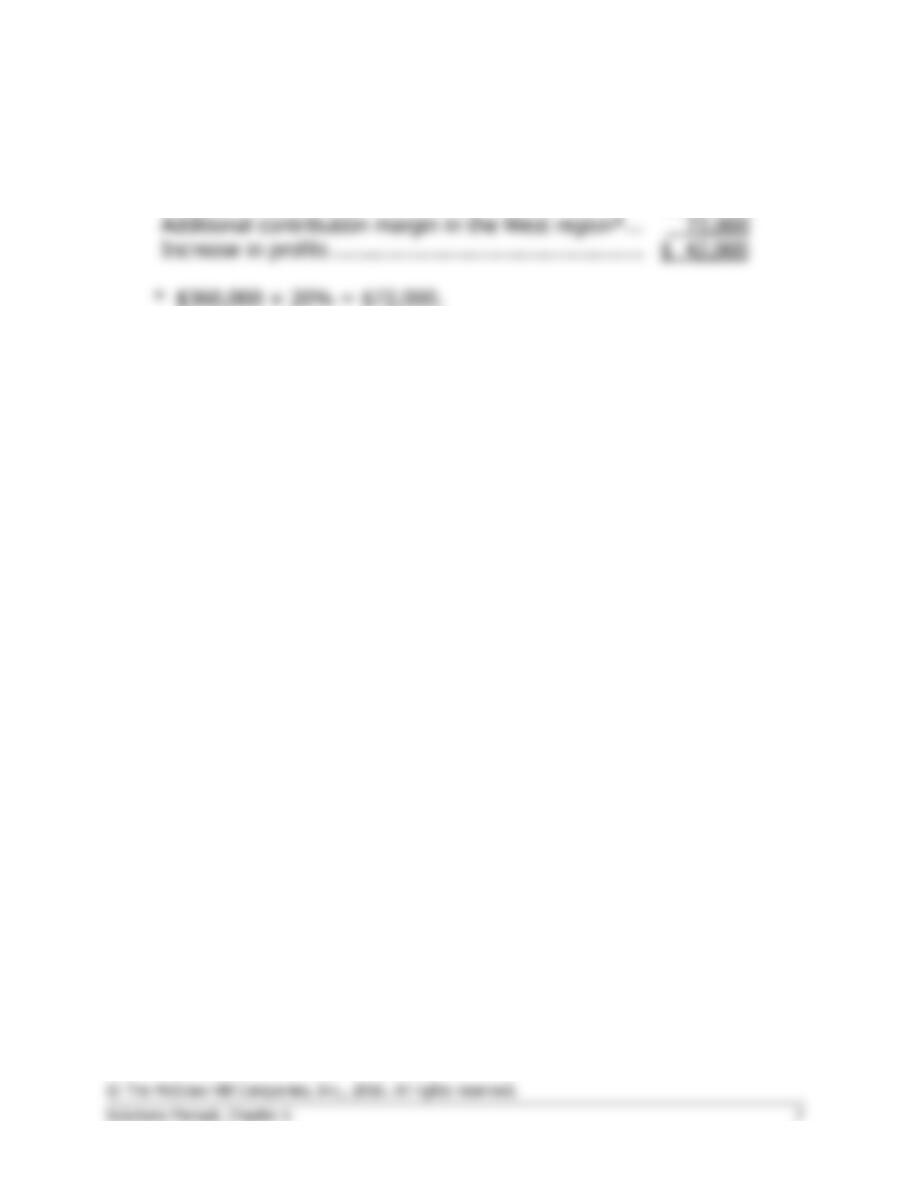
Forgone segment margin in the West region ………….
The Foundational 15 (continued)
15. The profit impact is computed as follows:
Additional advertising ……………………………………….
$(30,000)
Additional contribution margin in the West region*….
Exercise 6-1 (15 minutes)
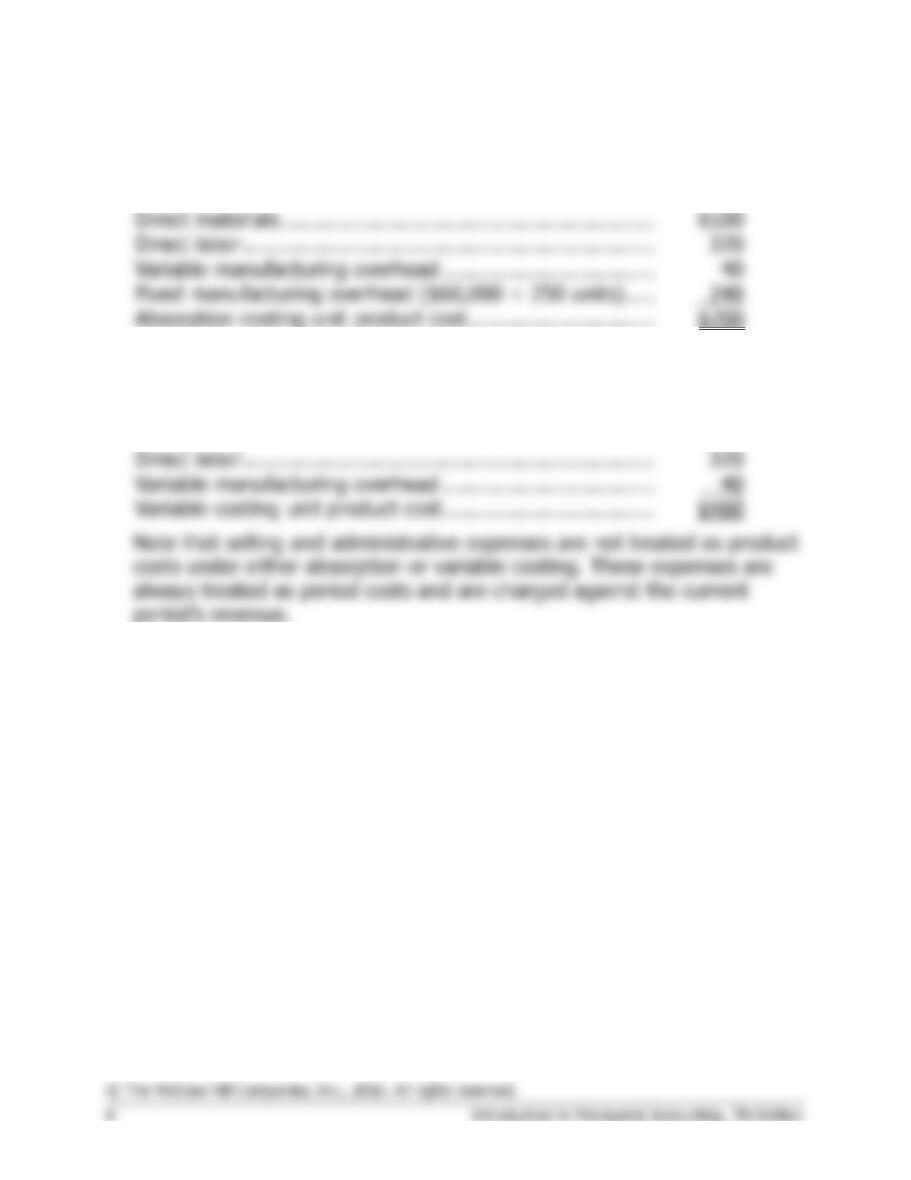
1. Under absorption costing, all manufacturing costs (variable and fixed)
are included in product costs.
Variable manufacturing overhead …………………………….
Fixed manufacturing overhead ($60,000 ÷ 250 units) …..
Absorption costing unit product cost …………………………
$700
2. Under variable costing, only the variable manufacturing costs are
included in product costs.
Direct materials ……………………………………………………
$100
Direct labor …………………………………………………………
Exercise 6-2 (20 minutes)
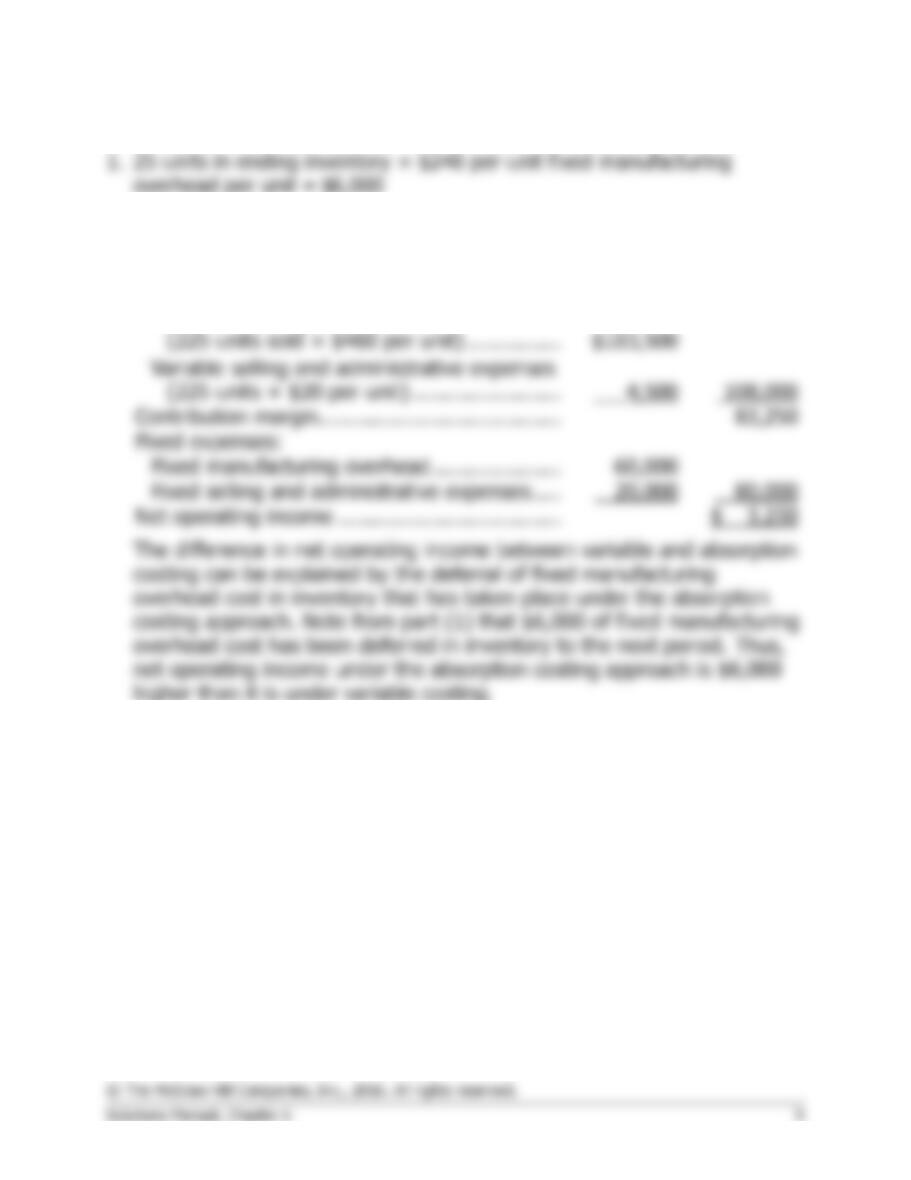
2. The variable costing income statement appears below:
Sales ……………………………………………………
$191,250
Variable expenses:
Variable selling and administrative expenses
Fixed expenses:
Net operating income ………………………………
Variable cost of goods sold
Exercise 6-3 (20 minutes)
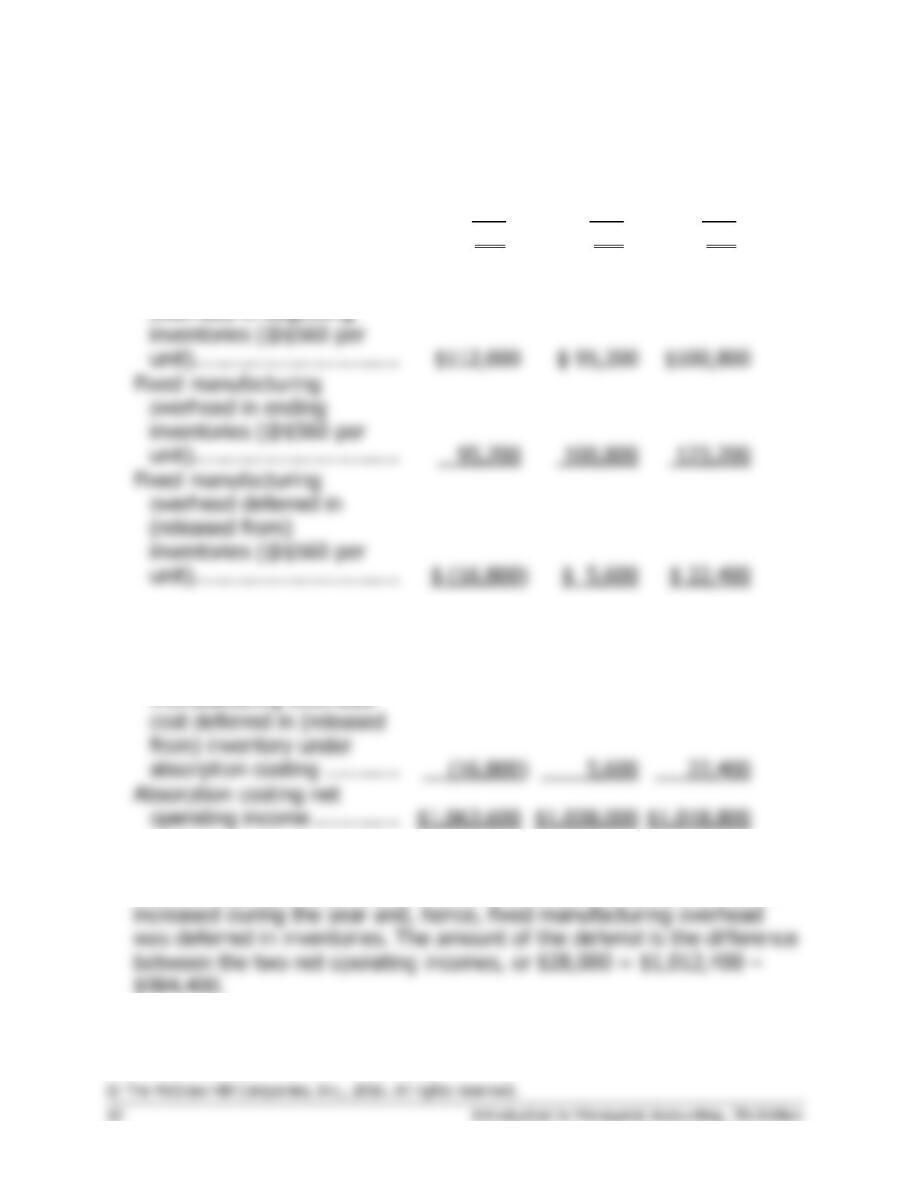
1.
Year 1
Year 2
Year 3
Beginning inventories ……….
200
170
180
Ending inventories ……………
170
180
220
Change in inventories ……….
(30)
10
40
Fixed manufacturing
overhead in beginning
Variable costing net
operating income …………..
$1,080,400
$1,032,400
$ 996,400
Absorption costing net
operating income …………..
$1,063,600
$1,038,000
$1,018,800
Add (deduct) fixed
manufacturing overhead
2. Because absorption costing net operating income was greater than
variable costing net operating income in Year 4, inventories must have
Exercise 6-4 (10 minutes)
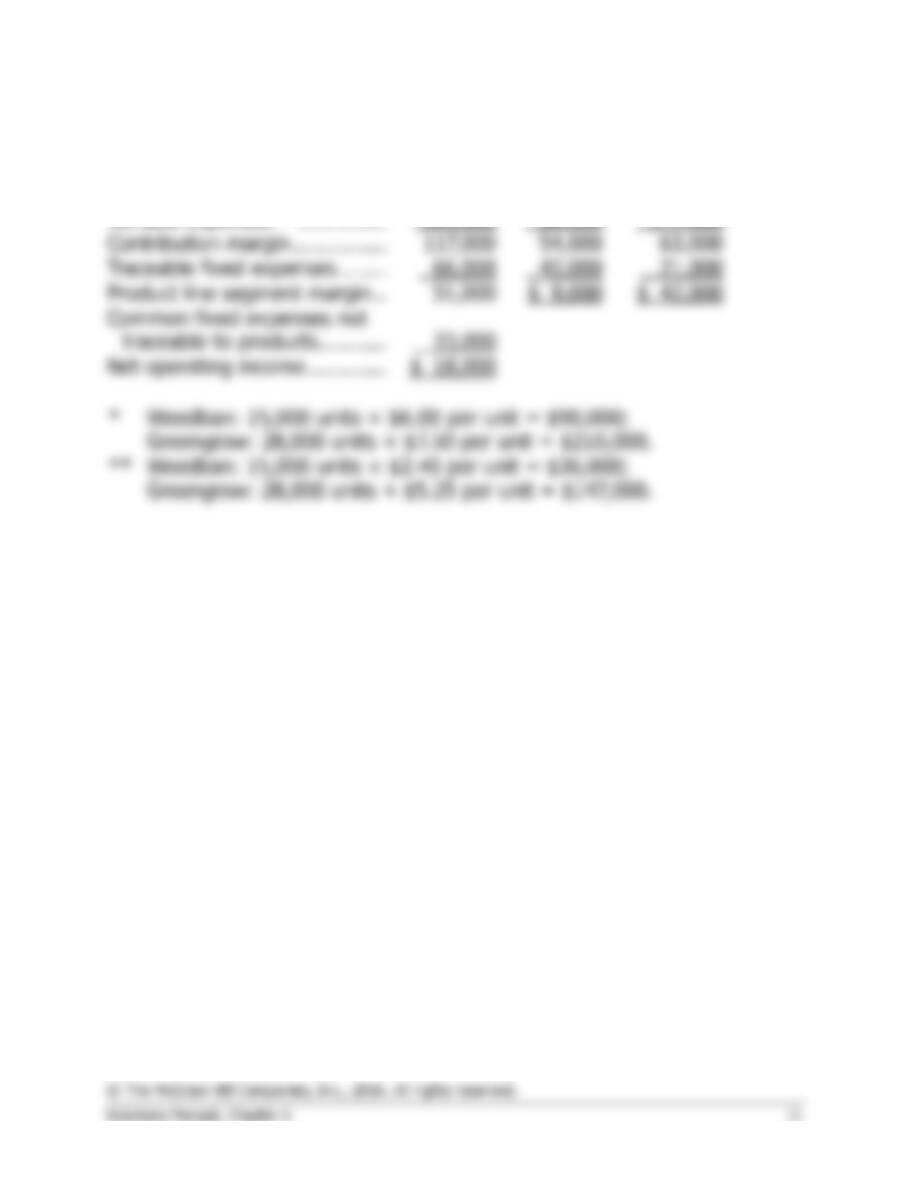
Total
Company
Weedban
Greengrow
Sales* ……………………………..
$300,000
$90,000
$210,000
Variable expenses** …………..
183,000
36,000
147,000
Contribution margin ……………
Traceable fixed expenses ……..
Product line segment margin ..
$ 9,000
$ 42,000
Net operating income ………….
Exercise 6-5 (10 minutes)
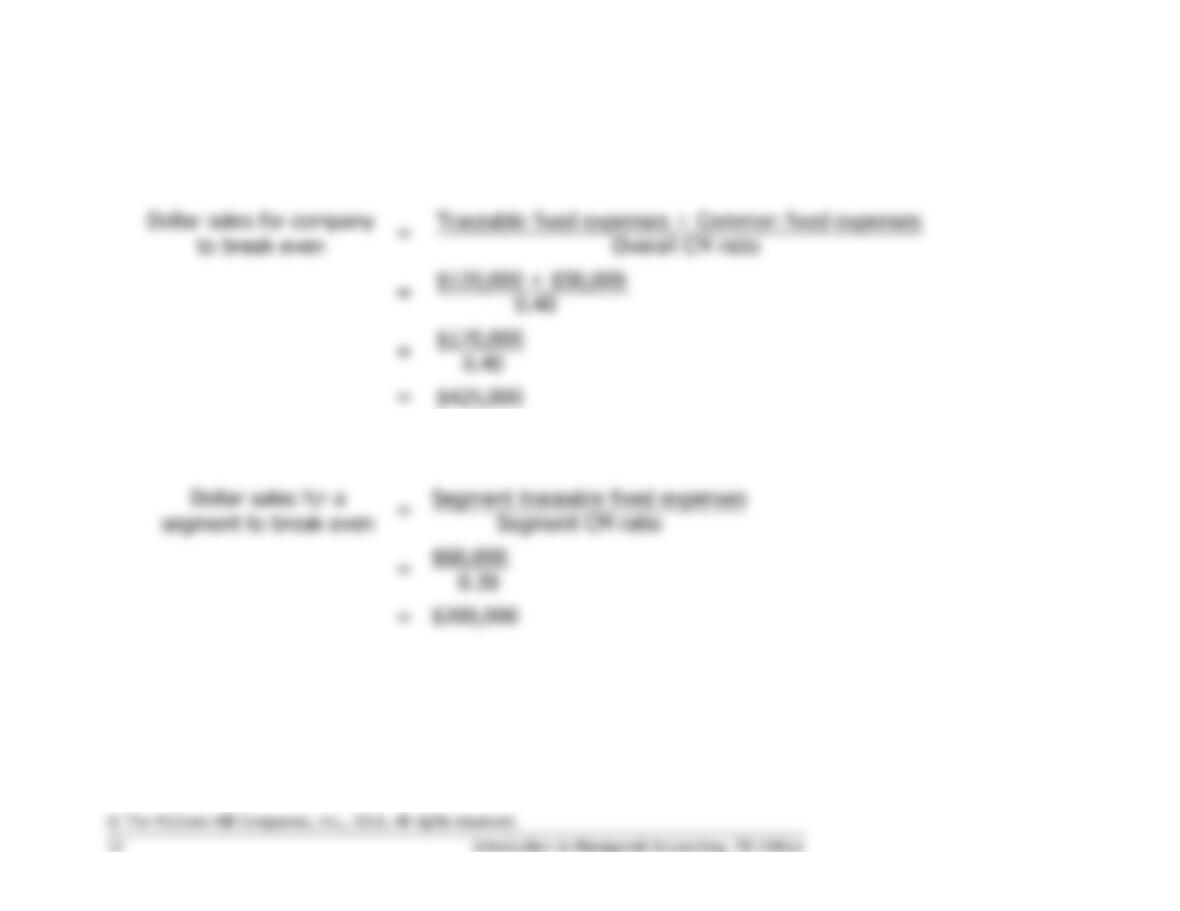
1. The companywide break-even point is computed as follows:
2. The break-even point for the North region is computed as follows:
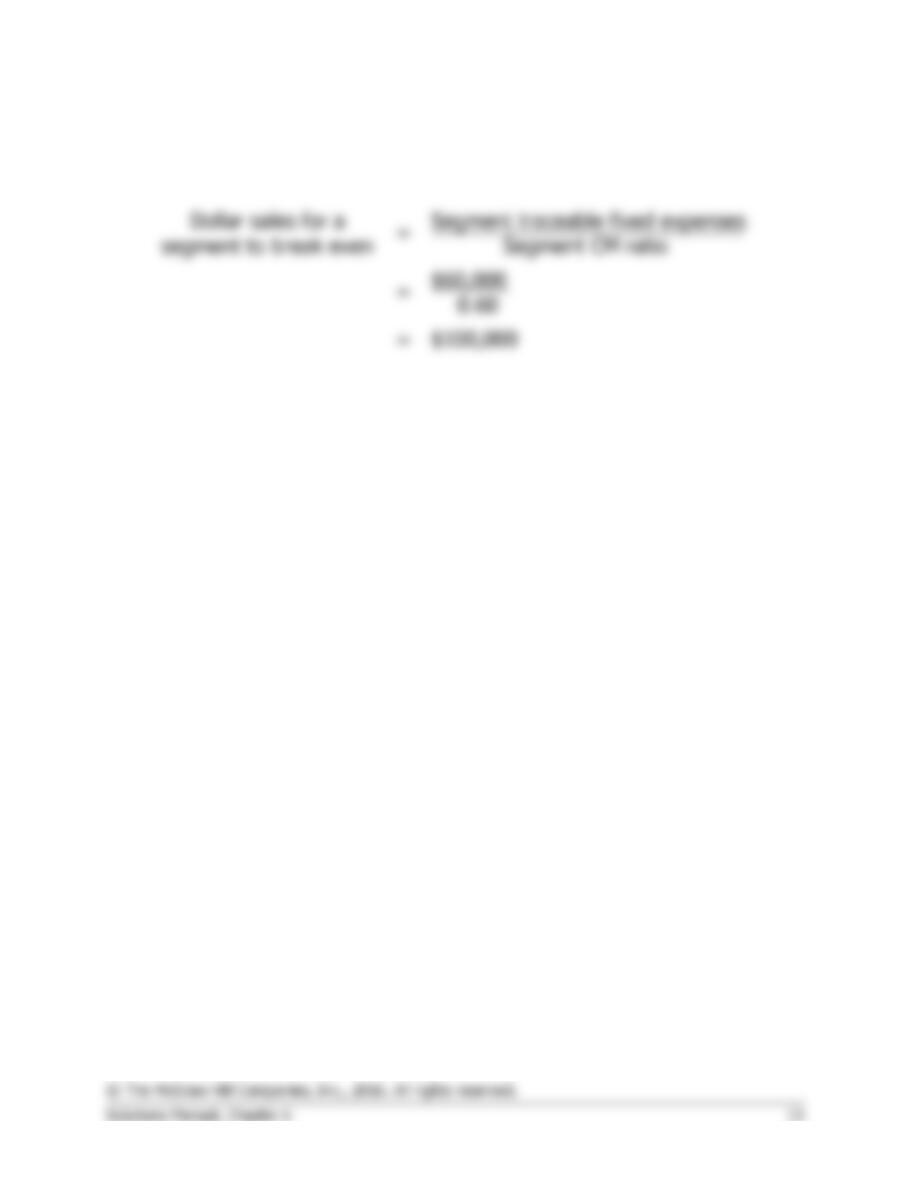
Exercise 6-5 (continued)
3. The break-even point for the South region is computed as follows:
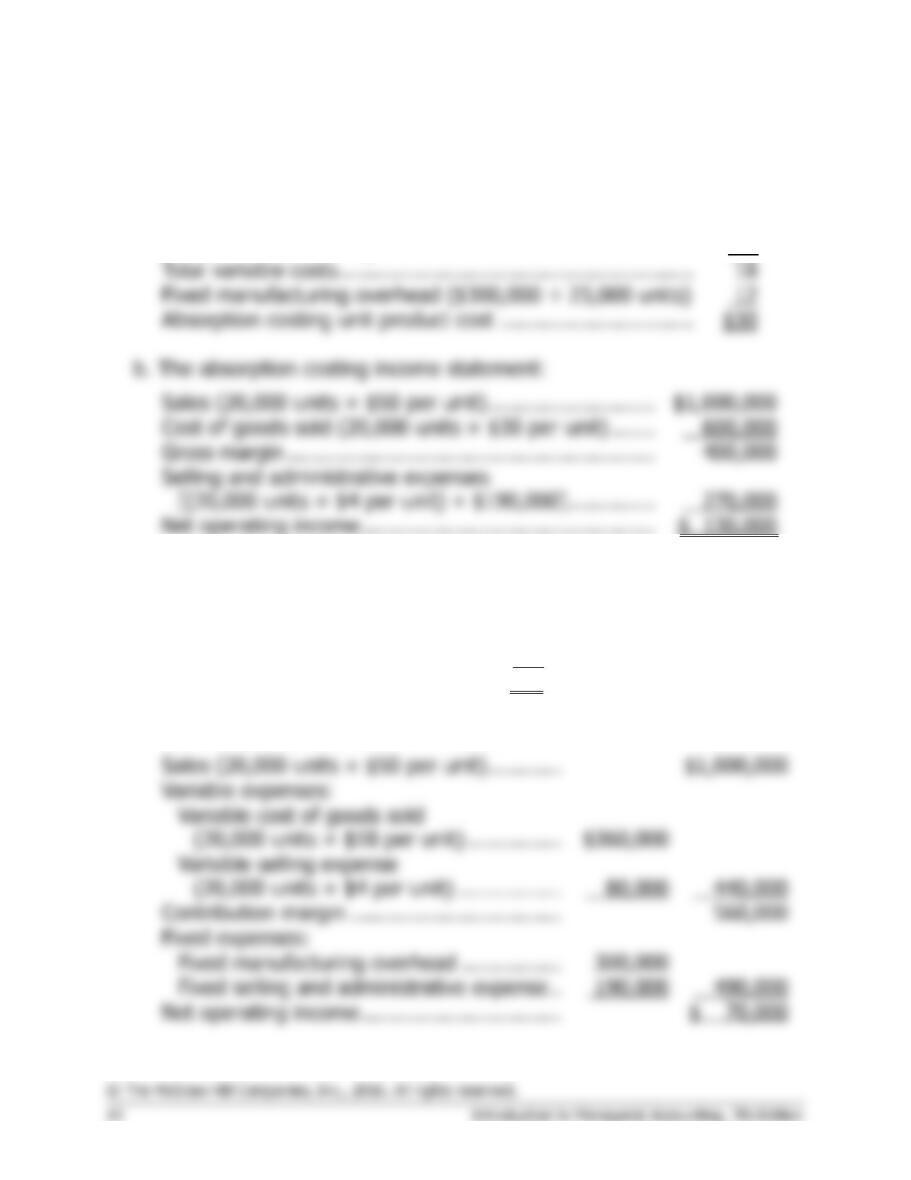
Exercise 6-6 (30 minutes)
1. a. The unit product cost under absorption costing would be:
Direct materials……………………………………………………..
$ 6
Direct labor…………………………………………………………..
9
Variable manufacturing overhead ………………………………
3
Total variable costs …………………………………………………
Fixed manufacturing overhead ($300,000 ÷ 25,000 units)
Absorption costing unit product cost ………………………….
$30
Sales (20,000 units × $50 per unit) ………………………
Cost of goods sold (20,000 units × $30 per unit) …….
Gross margin …………………………………………………..
Net operating income ………………………………………..
2. a. The unit product cost under variable costing would be:
Direct materials……………………….
$ 6
Direct labor…………………………….
9
Variable manufacturing overhead ..
3
Variable costing unit product cost ..
$18
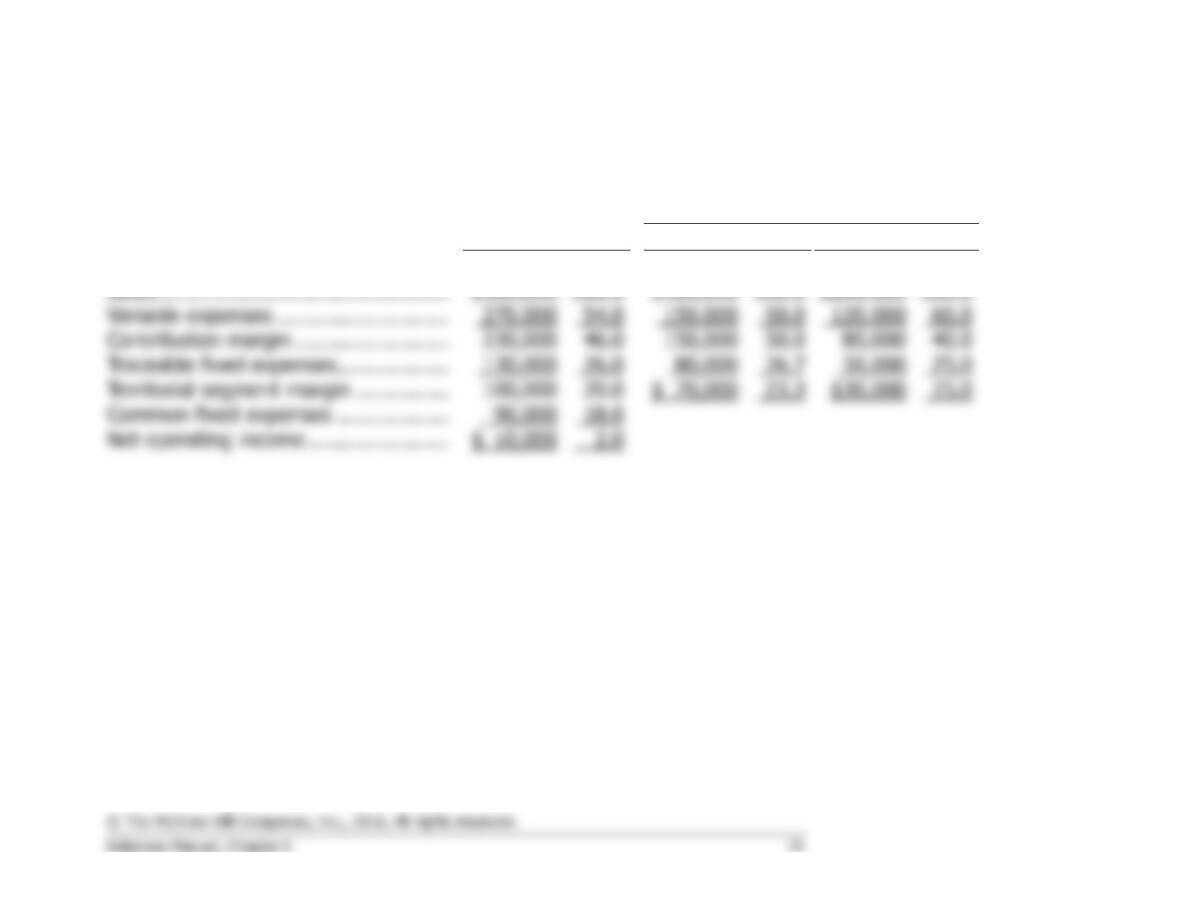
b. The variable costing income statement:
Sales (20,000 units × $50 per unit) …………
Variable expenses:
Contribution margin …………………………….
Fixed expenses:
Net operating income …………………………..
Exercise 6-7 (10 minutes)
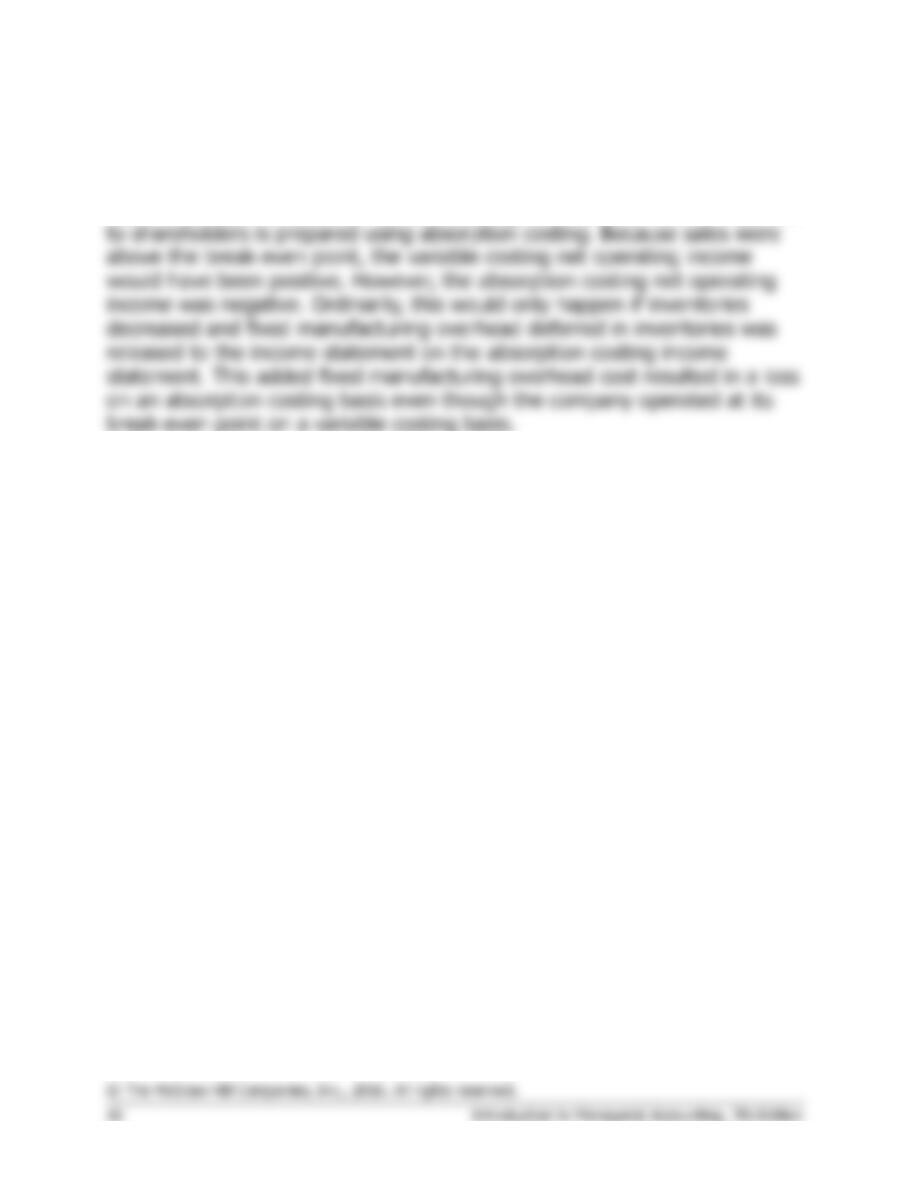
The completed segmented income statement should appear as follows:
Divisions
Total Company
North
South
Amount
%
Amount
%
Amount
%
Sales ………………………………………..
Variable expenses ……………………….
Contribution margin …………………….
Traceable fixed expenses ………………
Net operating income …………………..
Exercise 6-8 (10 minutes)
Sales were above the company’s break-even sales and yet the company
sustained a loss. The apparent contradiction is explained by the fact that
the CVP analysis is based on variable costing, whereas the income reported
Exercise 6-9 (30 minutes)
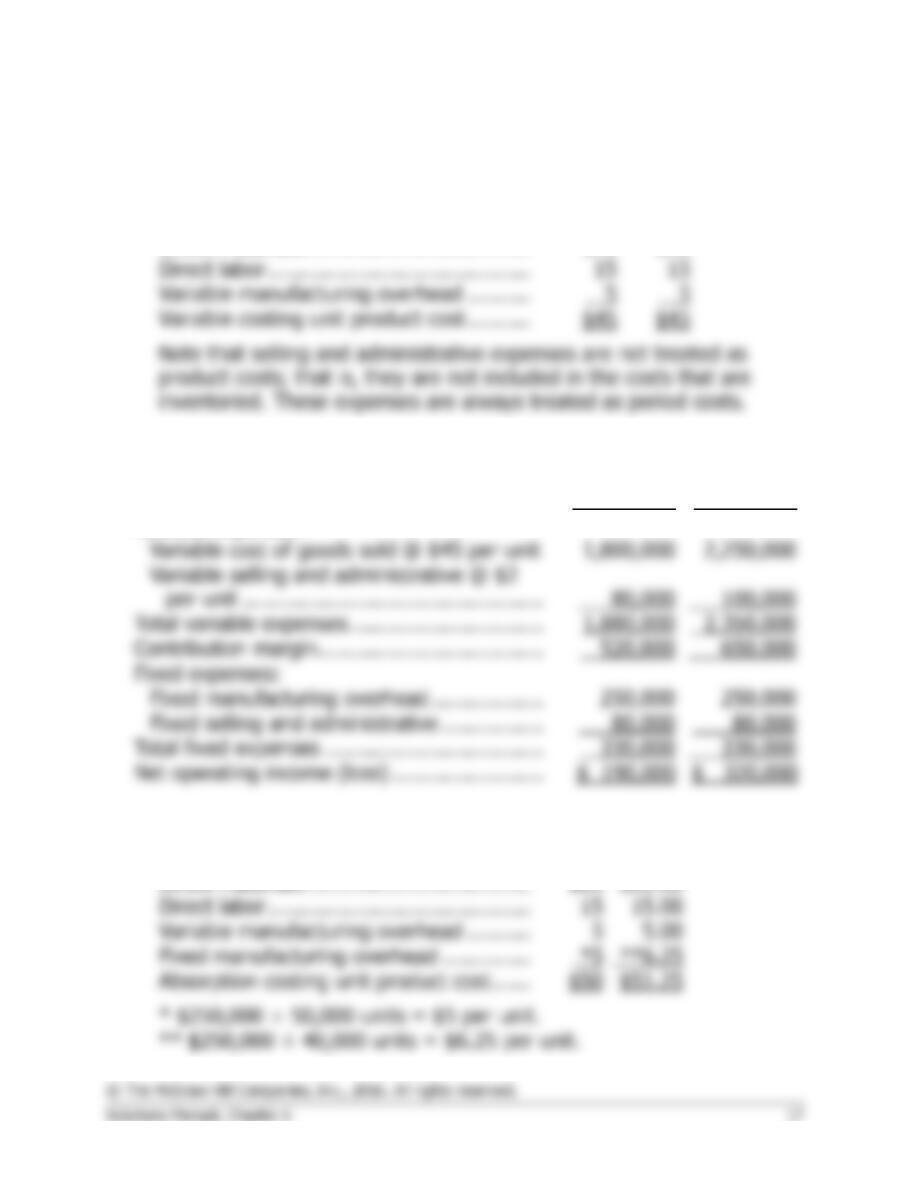
1 a. Under variable costing, only the variable manufacturing costs are
included in product costs.
Year 1
Year 2
Direct materials ………………………………
$25
$25
Direct labor ……………………………………
Variable manufacturing overhead ……….
Variable costing unit product cost ……….
1 b.
Year 1
Year 2
Sales …………………………………………………
$2,400,000
$3,000,000
Variable expenses:
Total variable expenses ………………………….
1,880,000
Contribution margin ………………………………
Fixed expenses:
Total fixed expenses ……………………………..
Net operating income (loss) ……………………
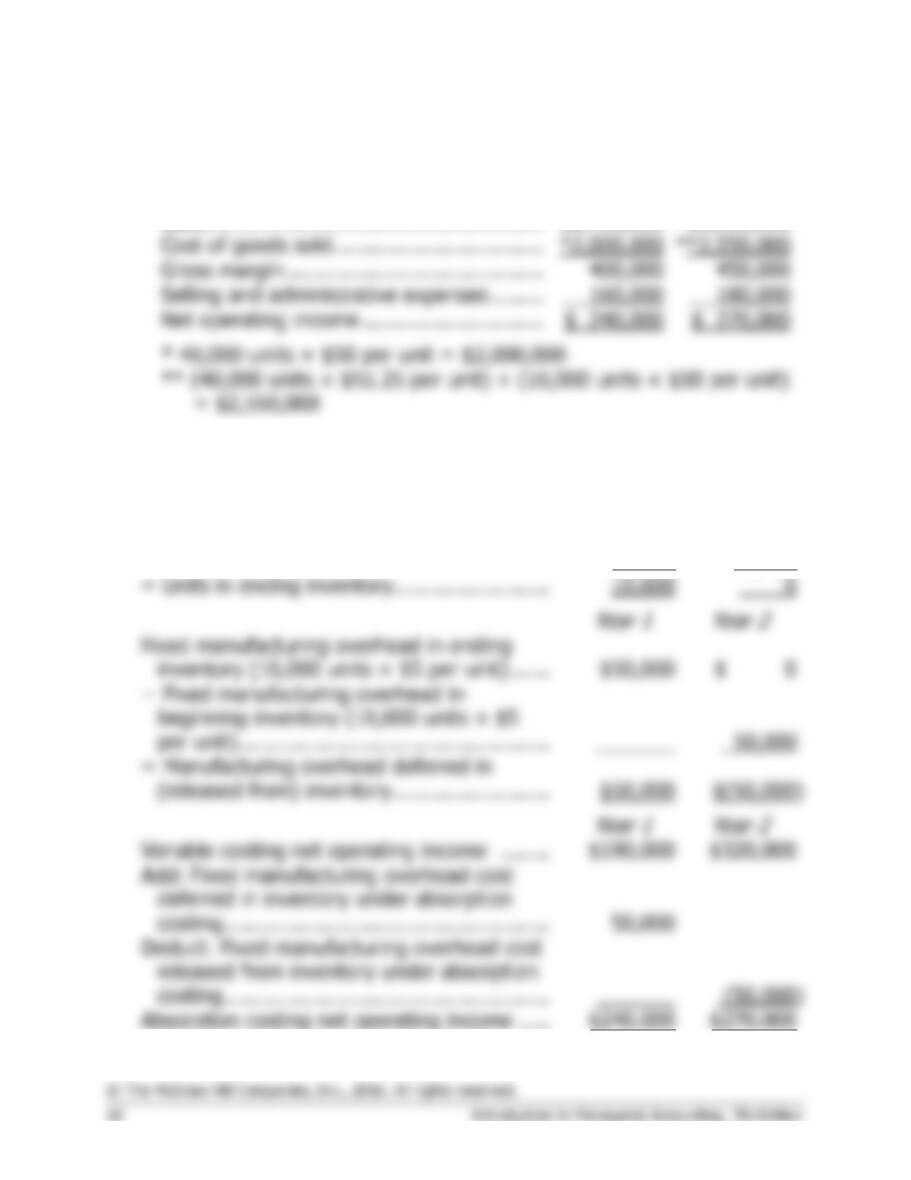
2 a. The unit product costs under absorption costing:
Year 1
Year 2
Direct materials ………………………………
$25
$25.00
Direct labor ……………………………………
Variable manufacturing overhead ……….
Fixed manufacturing overhead …………..
Absorption costing unit product cost ……
* $250,000 ÷ 50,000 units = $5 per unit.
Exercise 6-9 (continued)
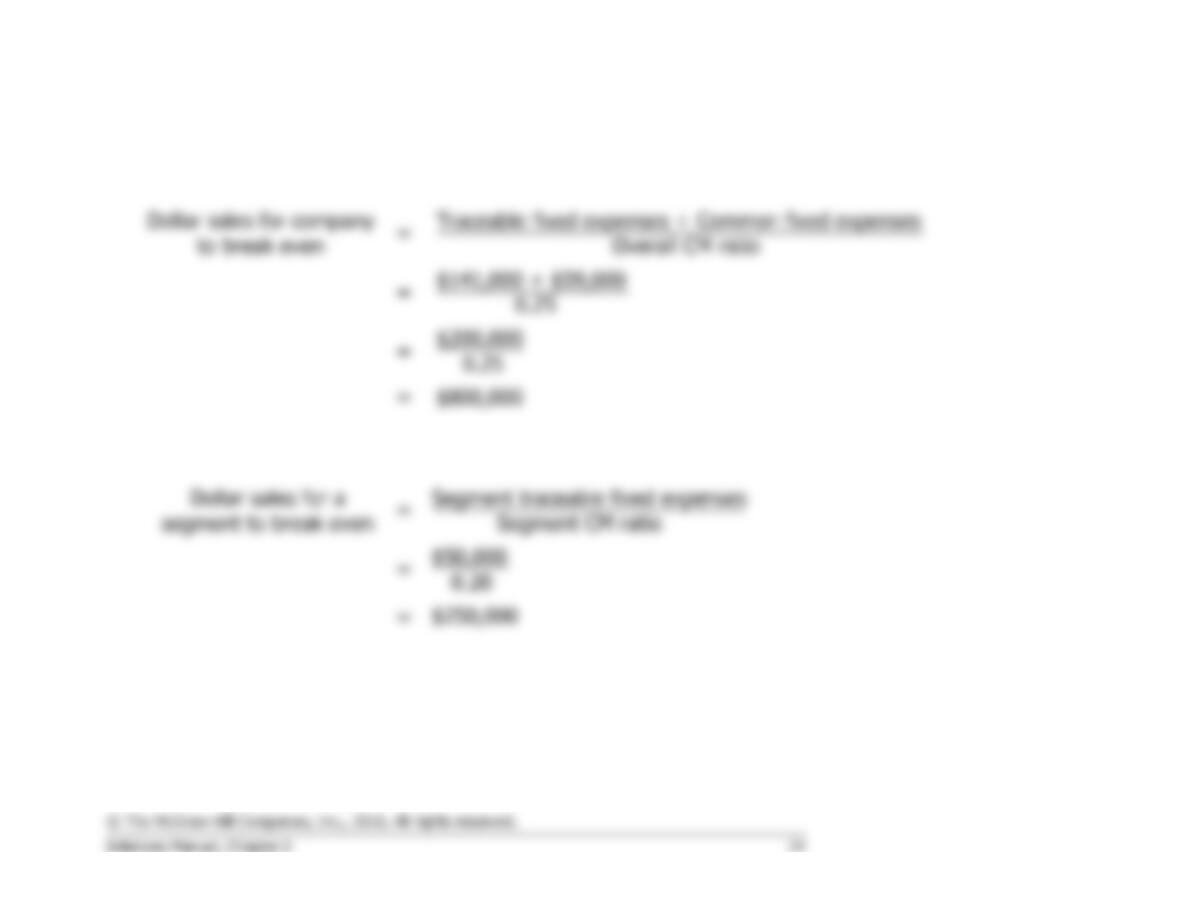
2 b. The absorption costing income statements appears below:
Year 1
Year 2
Sales ……………………………………………..
$2,400,000
$3,000,000
Cost of goods sold…………………………….
Gross margin …………………………………..
Selling and administrative expenses ……..
Net operating income ………………………..
3. The net operating incomes are reconciled as follows:
Year 1
Year 2
Units in beginning inventory ……………………
0
10,000
+ Units produced …………………………………
50,000
40,000
− Units sold ………………………………………..
40,000
50,000
10,000
Year 1
Year 2
Year 1
Year 2
Variable costing net operating income ……..
50,000
Exercise 6-10 (20 minutes)
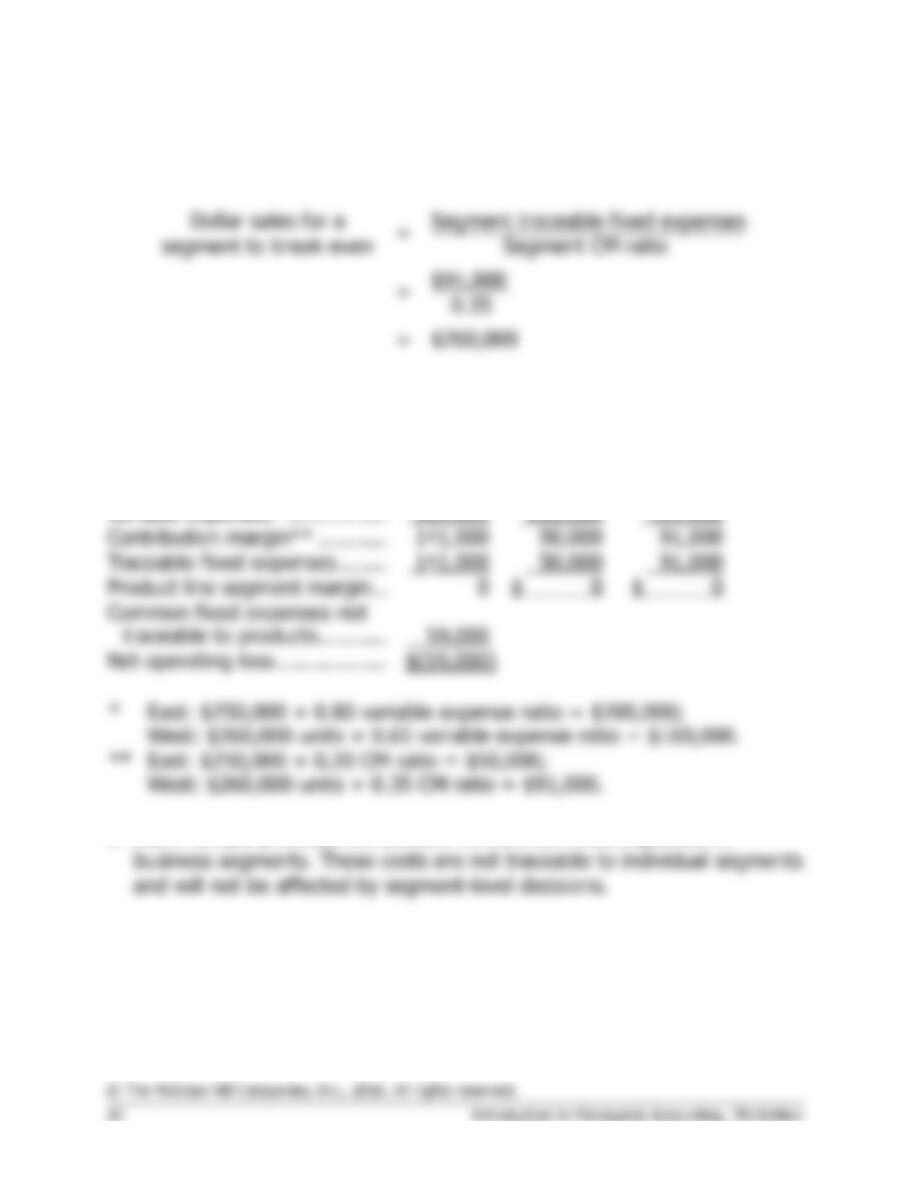
1. The companywide break-even point is computed as follows:
2. The break-even point for the East region is computed as follows:
Exercise 6-10 (continued)
3. The break-even point for the West region is computed as follows:
4. The new segmented income statement is computed as follows:
Total
Company
East
West
Sales ……………………………….
$510,000
$250,000
$260,000
Traceable fixed expenses ……..
Product line segment margin ..
$ 0
5. No, a company should not allocate its common fixed expenses to