Chapter 10
Reporting and Analyzing
Long-Term Liabilities
QUESTIONS
3. Bonds can allow a company’s owners to increase their return on equity without investing
additional amounts. This result occurs as long as the rate of return on the assets
4. A bond indenture is a legal contract between the issuing company and the bondholders
that identifies the obligations and rights of both parties. It specifies such items as the
5. A trustee for bondholders has the responsibility of monitoring the issuer’s actions,
6. The contract rate (also known as the coupon rate, stated rate, or nominal rate) is the rate
8.B The effective interest method creates a constant rate of interest over a bond’s life
9.C When issuing bonds between interest dates, a company collects accrued interest from
the purchasers to avoid keeping detailed records of bond purchasers and the dates
12. The debt-to-equity ratio is calculated by dividing total liabilities by total equity. The
higher a company’s debt–to–equity ratio, the higher proportion of a company’s assets
13. An entrepreneur (owner) must repay the bondholders the principal (par value) according
14. Apple reports long-term debt of $28,987 million on its balance sheet. Apple also reports
$384 million of interest expense on its income statement (included in the line item titled:
17. The balance sheet of Google indicates that for the year ended December 31, 2014, the
$0.25 is contributed by debt holders.
18.D If a lease qualifies to be recorded as a capital lease, an asset account for the leased
19.D An operating lease is a short-term or cancelable lease in which the lessor retains the
risks and rewards of ownership. The lessee expenses operating lease payments when
20.D Pension plans can be designed as defined benefit plans or defined contribution plans. In
a defined benefit plan the employer estimates the contribution necessary to pay a pre-
defined benefit amount to its retirees. For example, an employee’s monthly pension
QUICK STUDIES
Quick Study 10–1 (5 minutes)
a.
A
d.
D
b.
D
e.
A
c.
A
f.
D
Quick Study 10-2 (10 minutes)
2016
218,750
Discount on Bonds Payable …………………………………..
Quick Study 10-3 (10 minutes)
Using facts in QS 10-2, the bond’s cash proceeds for the bond selling at
a discount are computed as follows
Cash Flow
Table Value
Present Value
$250,000 par (maturity) value …………….
0.3769
$ 94,225
$10,000 interest payment …………………..
Quick Study 10-4 (10 minutes)
2016
Jan. 1
Cash ……………………………………………………………………..
281,400
Quick Study 10-5 (10 minutes)
Using facts in QS 10-4, the bond’s cash proceeds for the bond selling at
a premium are computed as
Cash Flow
Table Value
Present Value
$240,000 par (maturity) value …………….
0.3083
$ 73,992
$12,000 interest payment …………………..
Quick Study 10-6 (10 minutes)
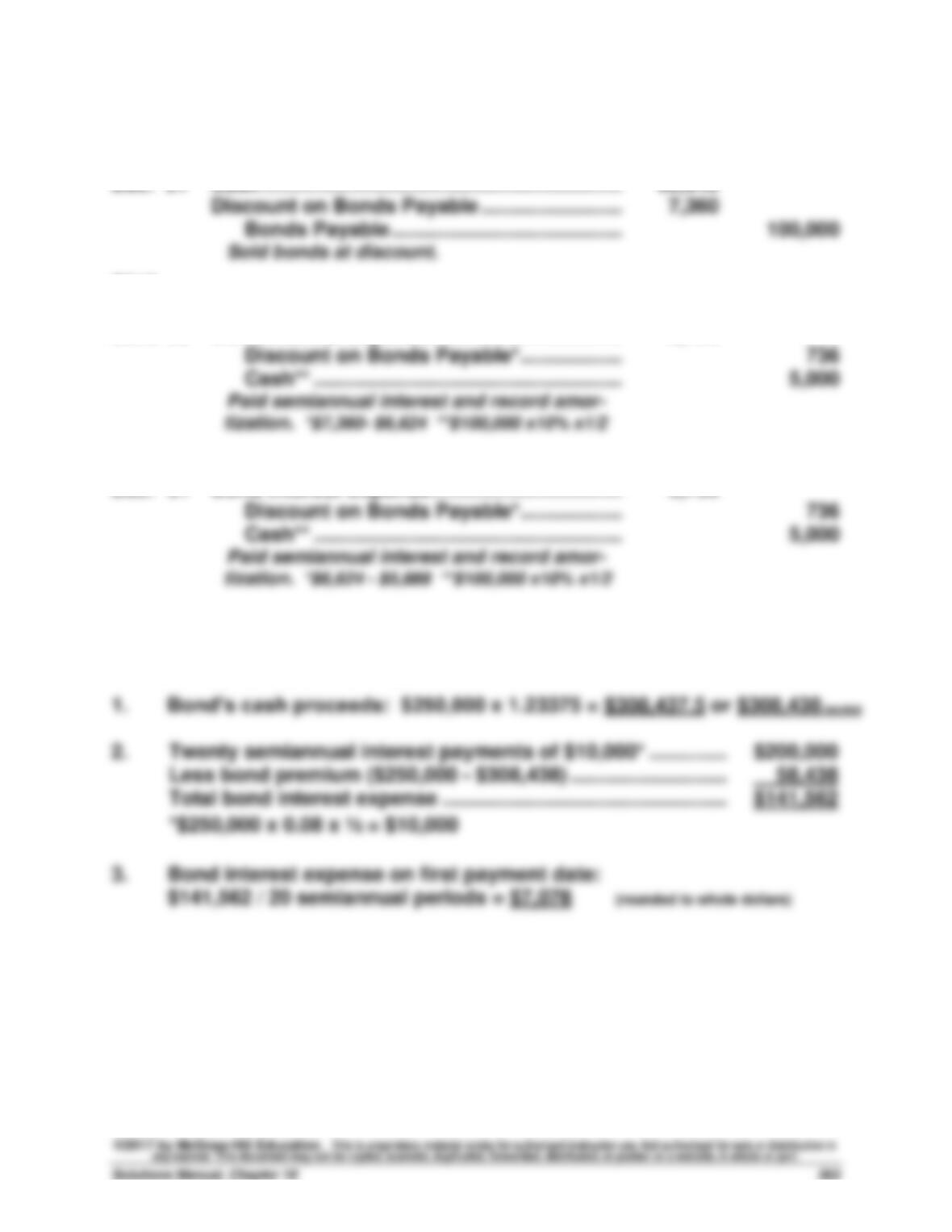
2.
Twenty semiannual interest payments of $10,000* ……………
$200,000
Quick Study 10-7 (15 minutes)
2015
(a)
Dec. 31
Cash ……………………………………………………………………..
92,640
Discount on Bonds Payable …………………………..
7,360
2016
(b)
June 30
Bond Interest Expense …………………………………………..
5,736
(c)
Dec. 31
Bond Interest Expense …………………………………………..
5,736
Quick Study 10-8 (10 minutes)
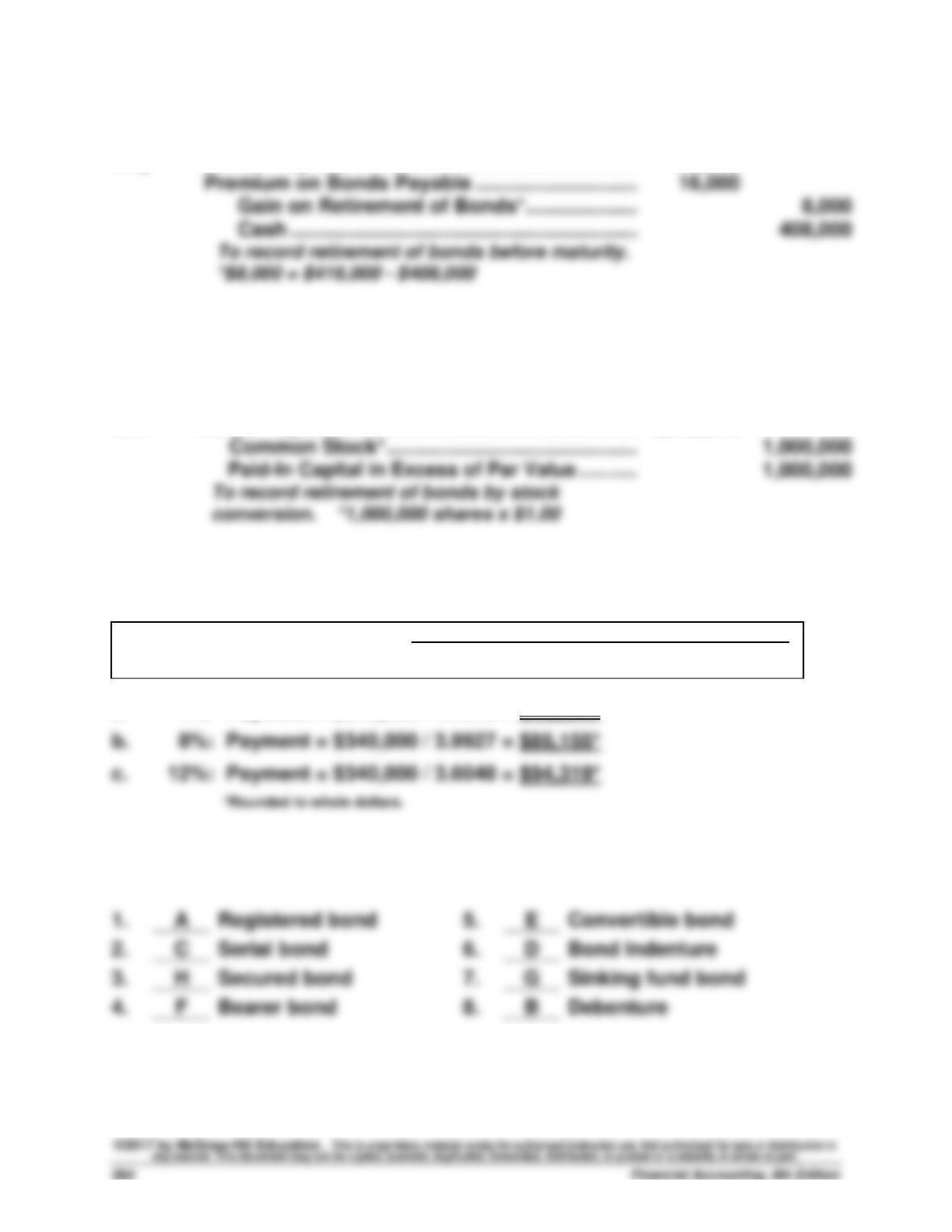
2.
Twenty semiannual interest payments of $10,000* ……………
Quick Study 10-9 (10 minutes)
2016
July 1
Bonds Payable ………………………………………………………
400,000
Premium on Bonds Payable …………………………..
408,000
Quick Study 10–10 (10 minutes)
2016
Jan. 1
Bonds Payable ……………………………………………………….
2,000,000
1,000,000
1,000,000
Quick Study 10–11 (10 minutes)
Amount of annual payment =
a. 4%: Payment = $340,000 / 4.4518 = $76,374*
Quick Study 10–12 (10 minutes)
Registered bond
Secured bond
Bearer bond
Debenture
Initial cash proceeds from note
Table B.3 present value for 5 payments
Quick Study 10-13 (10 minutes)
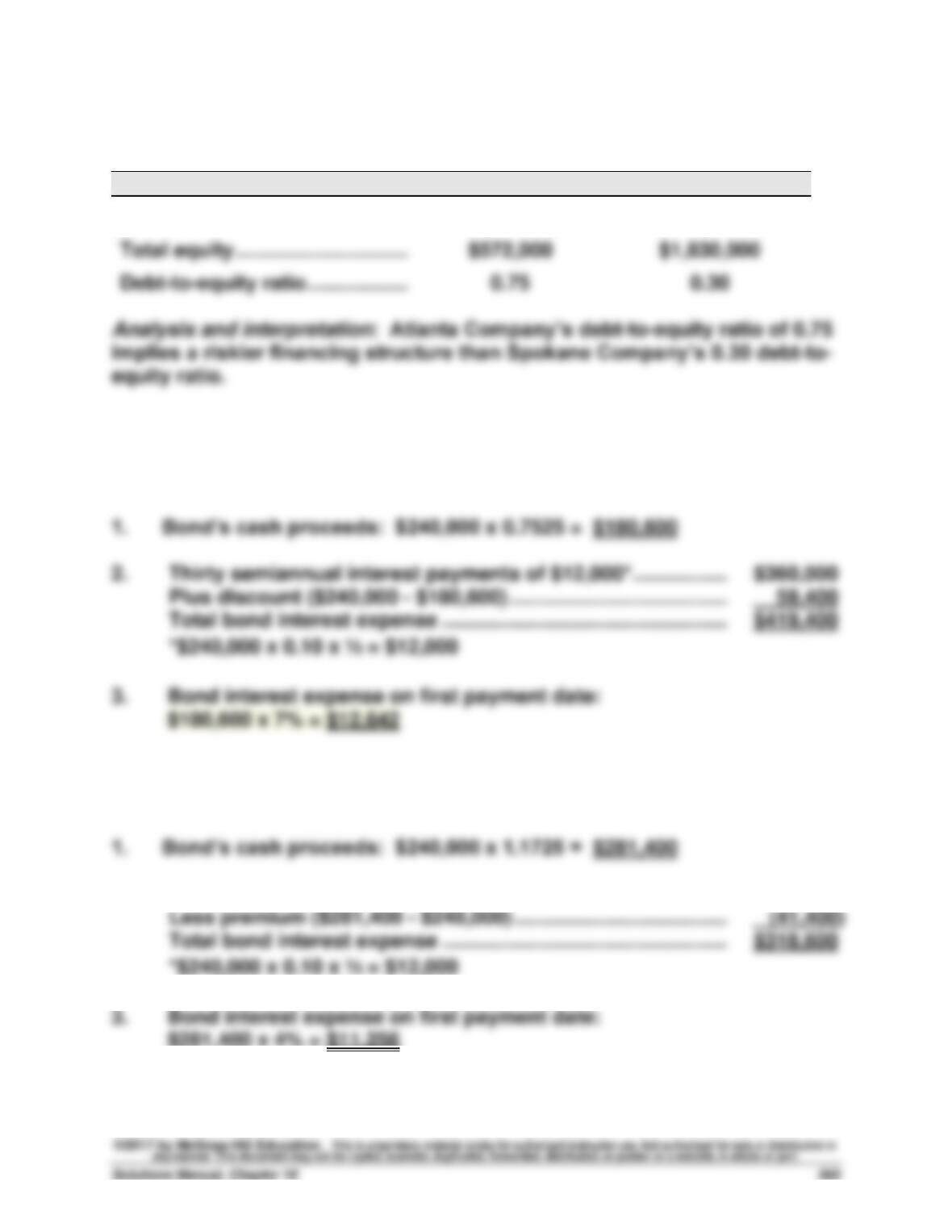
Ratio of debt to equity
Atlanta Company
Spokane Company
Total liabilities ……………………..
$429,000
$ 549,000
Total equity ………………………….
$572,000
Quick Study 10–14B (10 minutes)
2.
Thirty semiannual interest payments of $12,000* ………………
$360,000
Quick Study 10-15B (10 minutes)
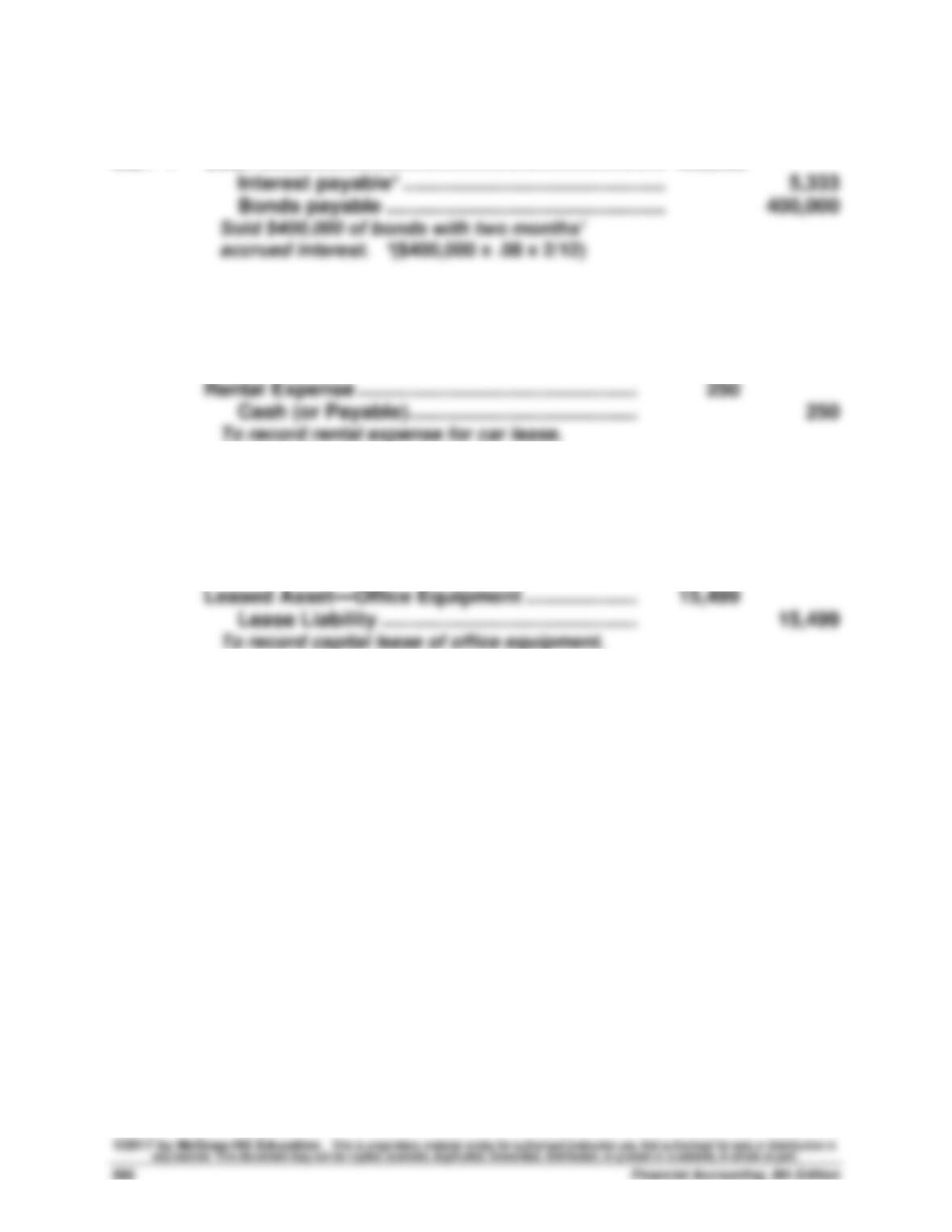
2.
Thirty semiannual interest payments of $12,000* ………………
$360,000
Less premium ($281,400 – $240,000) …………………………………
Quick Study 10-16C (10 minutes)
2016
Mar. 1
Cash ……………………………………………………………………..
405,333
Quick Study 10-17D (10 minutes)
Quick Study 10-18D (10 minutes)
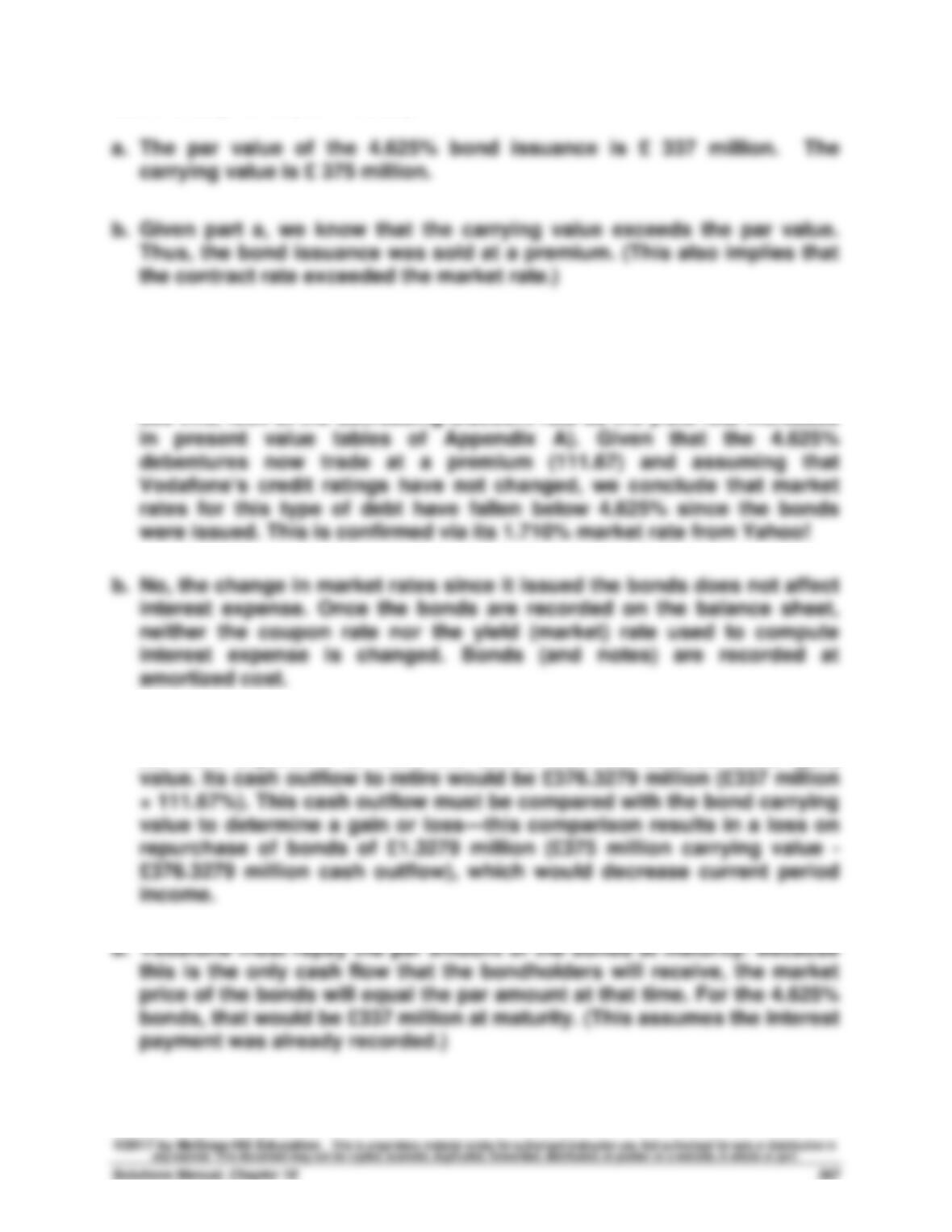
Quick Study 10-19 (10 minutes)
Quick Study 10–20 (10 minutes)
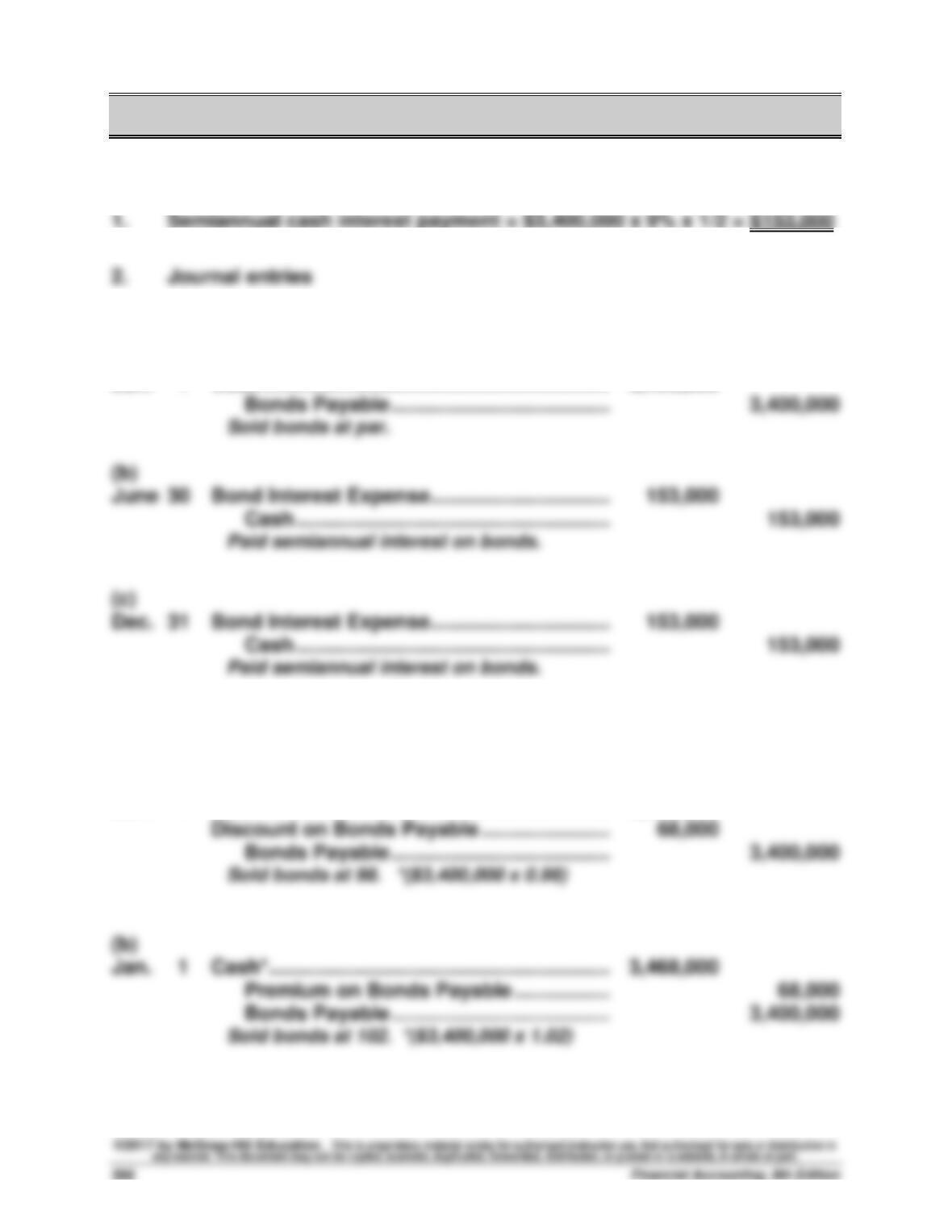
a. There is an inverse relation between market rates and bond prices (to
see this, look at the decreasing discount rate as the yield rate increases
c. Because the bonds trade at a premium in the market (111.67), it would
be more expensive to retire the bonds than the balance sheet (par)
EXERCISES
Exercise 10-1 (15 minutes)
2016
(a)
Jan. 1
Cash ……………………………………………………….
3,400,000
(c)
Dec. 31
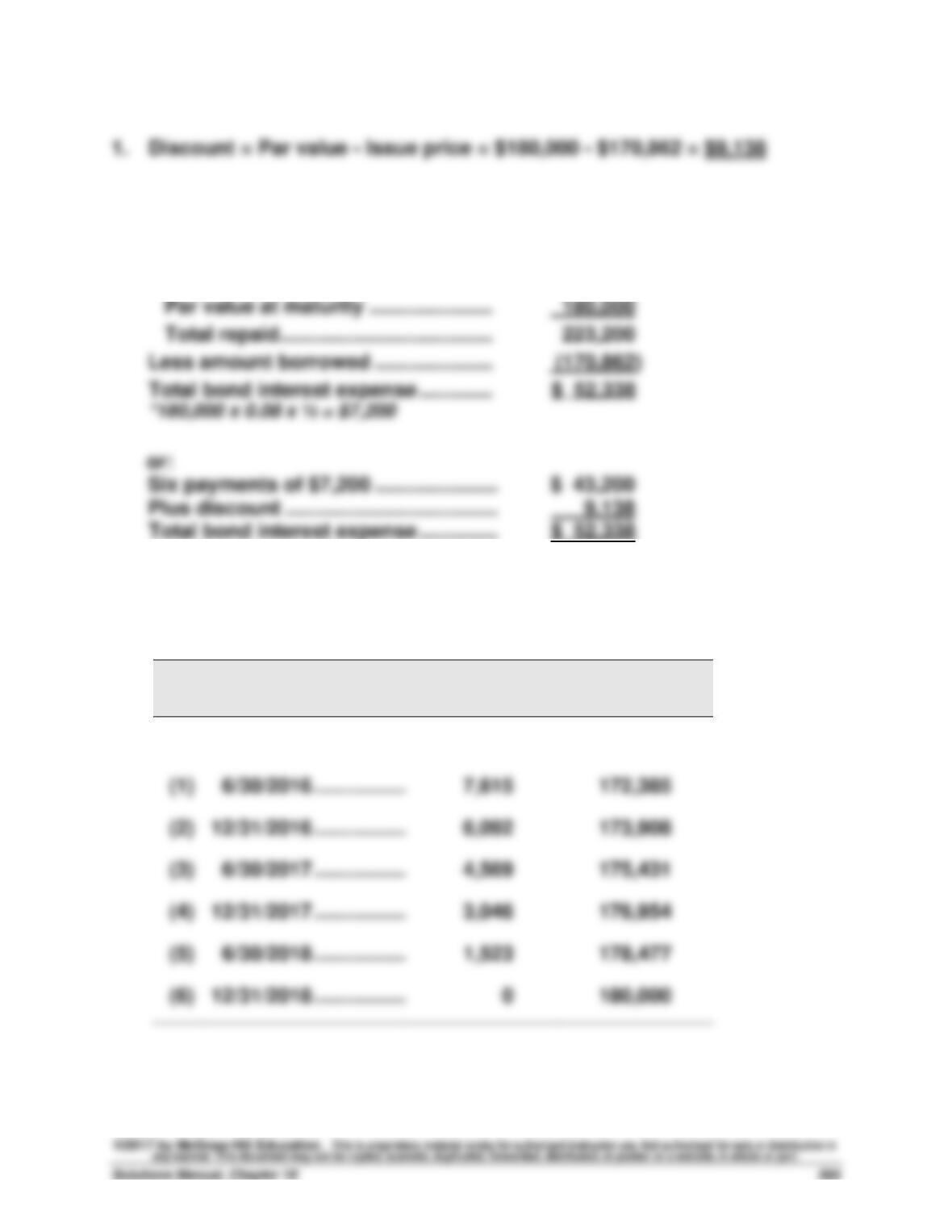
3.
2016
(a)
Jan. 1
Cash* ……………………………………………………….
3,332,000
Jan. 1
Cash* ……………………………………………………….
3,468,000
Exercise 10-2 (30 minutes)
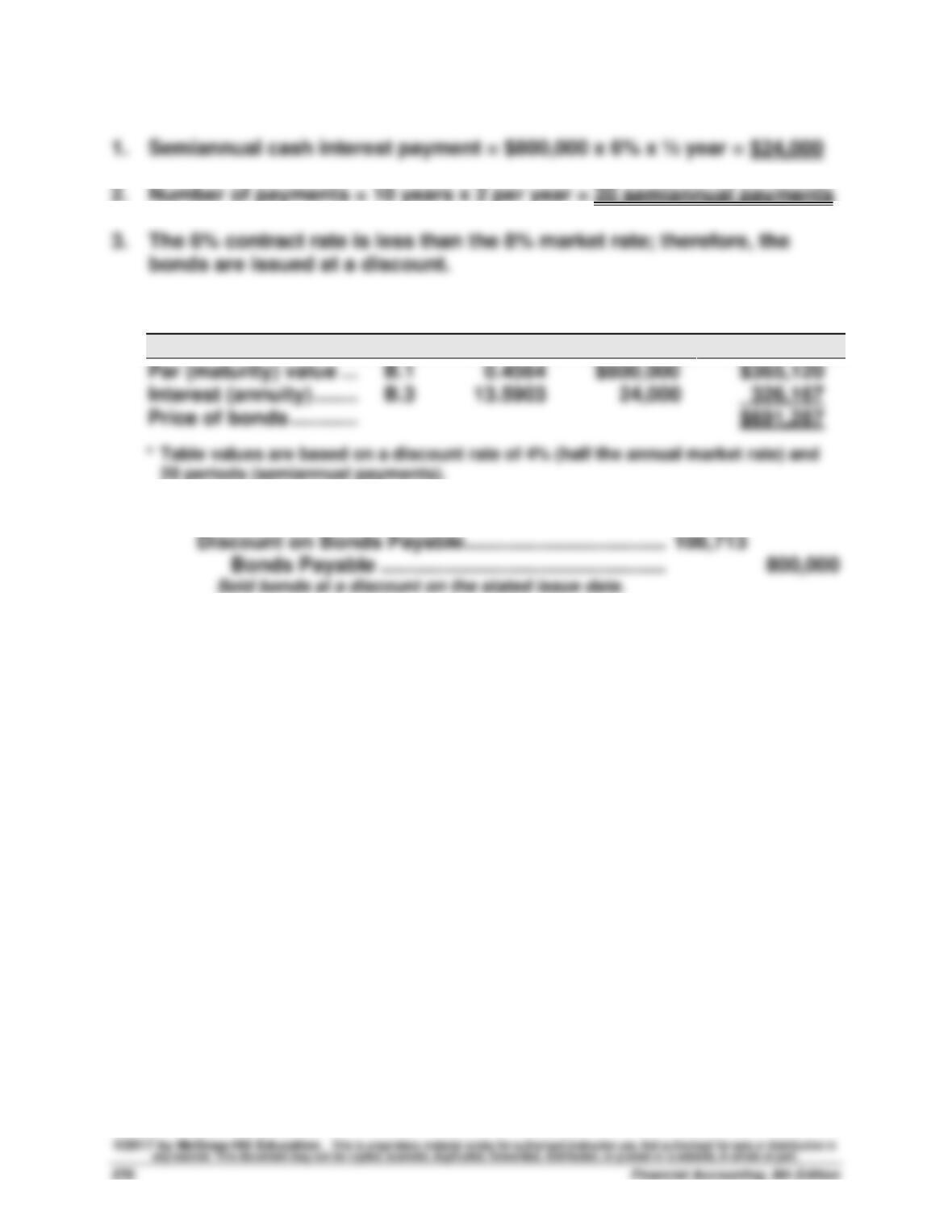
2. Total bond interest expense over the life of the bonds
Amount repaid
Six payments of $7,200* ……………..
$ 43,200
Par value at maturity ………………….
Total repaid ………………………………..
3. Straight-line amortization table ($9,138/6 = $1,523)
Semiannual
Period-End
Unamortized
Discount
Carrying
Value
(0)
1/01/2016 …………………….
$9,138
$170,862
(2)
(4)
Exercise 10-3 (25 minutes)
4. Estimation of the market price at the issue date
Cash Flow
Table
Table Value*
Amount
Present Value
Par (maturity) value ……..
5.
Cash ……………………………………………………………………..
691,287
Discount on Bonds Payable……………………………………
108,713
800,000
Exercise 10-4 (20 minutes)
2016
(a)
2017
(b)
(c)
Exercise 10-5 (35 minutes)
2016
(a)
Dec. 31
Cash ……………………………………………………….
188,000
Discount on Bonds Payable …………………………..
(b)
2017
June 30
Bond Interest Expense …………………………..
8,000
Dec. 31
Bond Interest Expense …………………………..
8,000
2018
June 30
Bond Interest Expense …………………………..
8,000
Dec. 31
Bond Interest Expense …………………………..
8,000
(c)
Dec. 31
Bonds Payable ………………………………………………………
200,000
Exercise 10-6 (20 minutes)
2015
(a)
Dec. 31
Cash ……………………………………………………………………..
216,222
2016
(b)
June 30
Bond Interest Expense …………………………………………..
8,378
Premium on Bonds Payable* …………………………..
1,622
Exercise 10-7 (30 minutes)
2. Total bond interest expense over the life of the bonds
Amount repaid
Six payments of $26,000* ……………
$156,000
Par value at maturity ………………….
Total repaid ………………………………..
$156,000
3. Straight-line amortization table ($9,850/6 = $1,642)
Semiannual
Interest Period–End
Unamortized
Premium
Carrying
Value
1/01/2016
$9,850
$409,850
6/30/2017
6/30/2018
Exercise 10-8 (25 minutes)
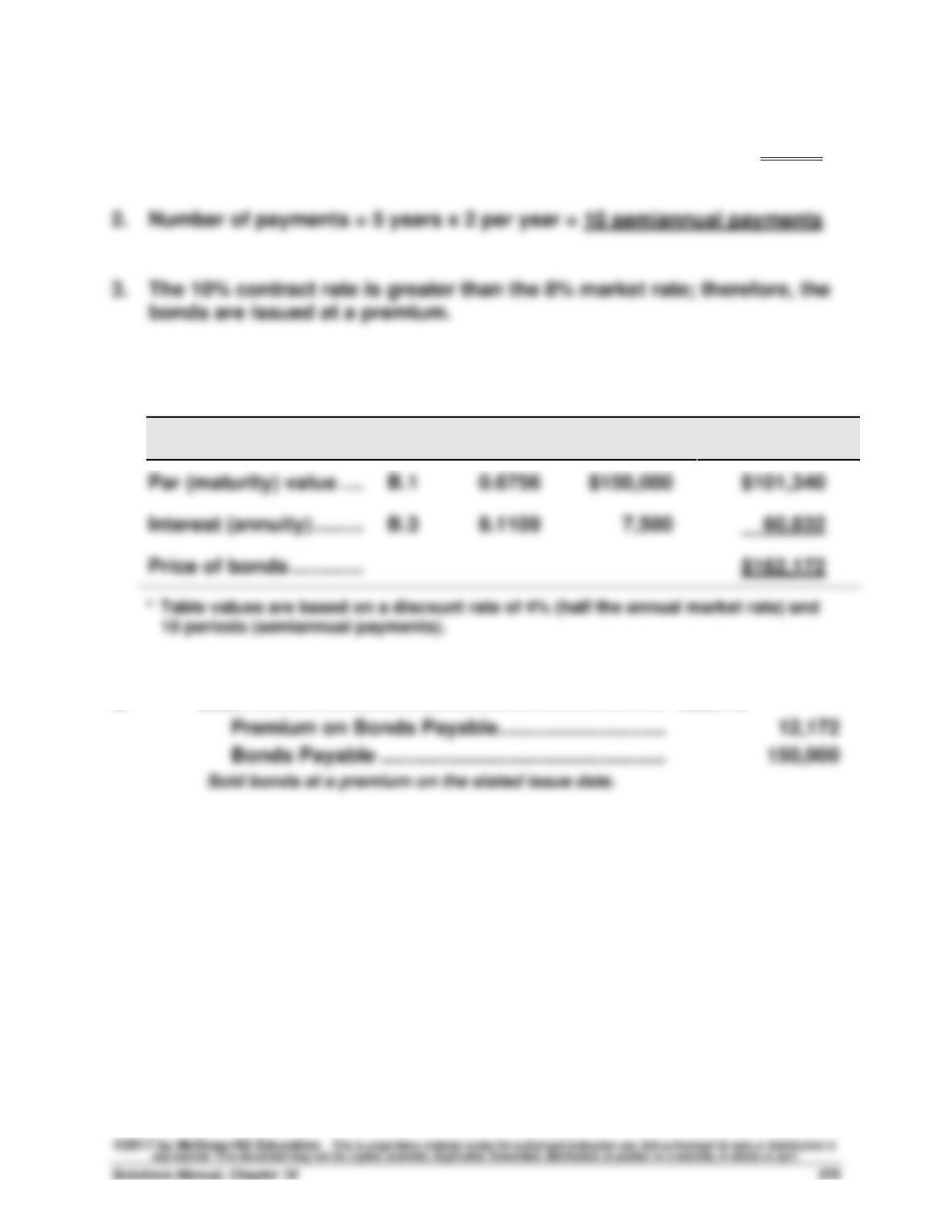
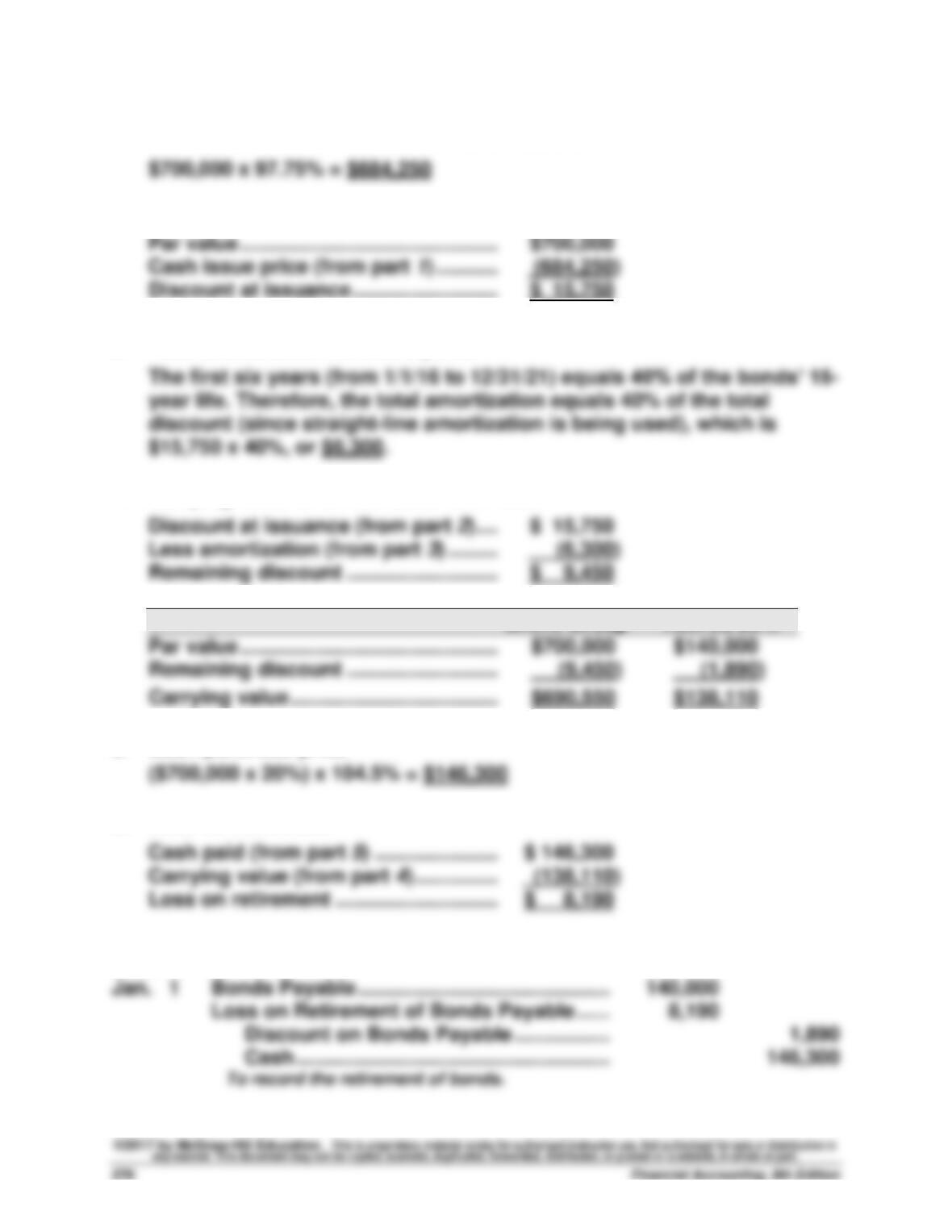
1. Semiannual cash interest payment = $150,000 x 10% x ½ year = $7,500
4. Estimation of the market price at the issue date
Cash Flow
Table
Table Value*
Amount
Present Value
5.
Cash ……………………………………………………………………..
162,172
Exercise 10-9 (20 minutes)
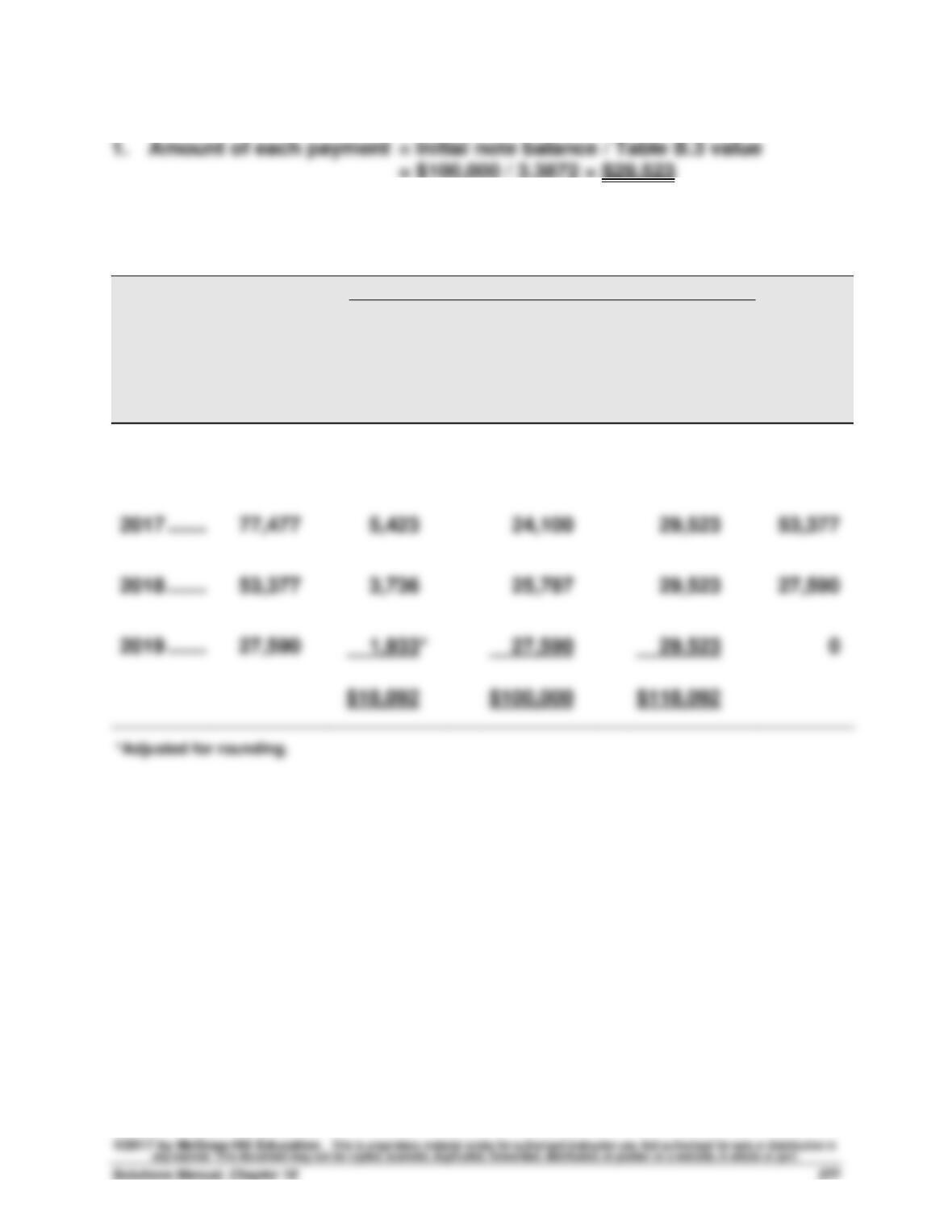
1. Cash proceeds from sale of bonds at issuance
2. Discount at issuance
Par value …………………………………………
Cash issue price (from part 1) ………….
3. Total amortization for first 6 years
4. Carrying value of the bonds at 12/31/2021
Less amortization (from part 3) ………..
Entire Group
Retired 20%
Par value ………………………………………….
5. Cash purchase price
6. Loss on retirement
Cash paid (from part 5) ………………….
Carrying value (from part 4) ……………
7. Journal entry at retirement for 20% of bonds
2022
Bonds Payable ………………………………………………………
Exercise 10-10 (20 minutes)
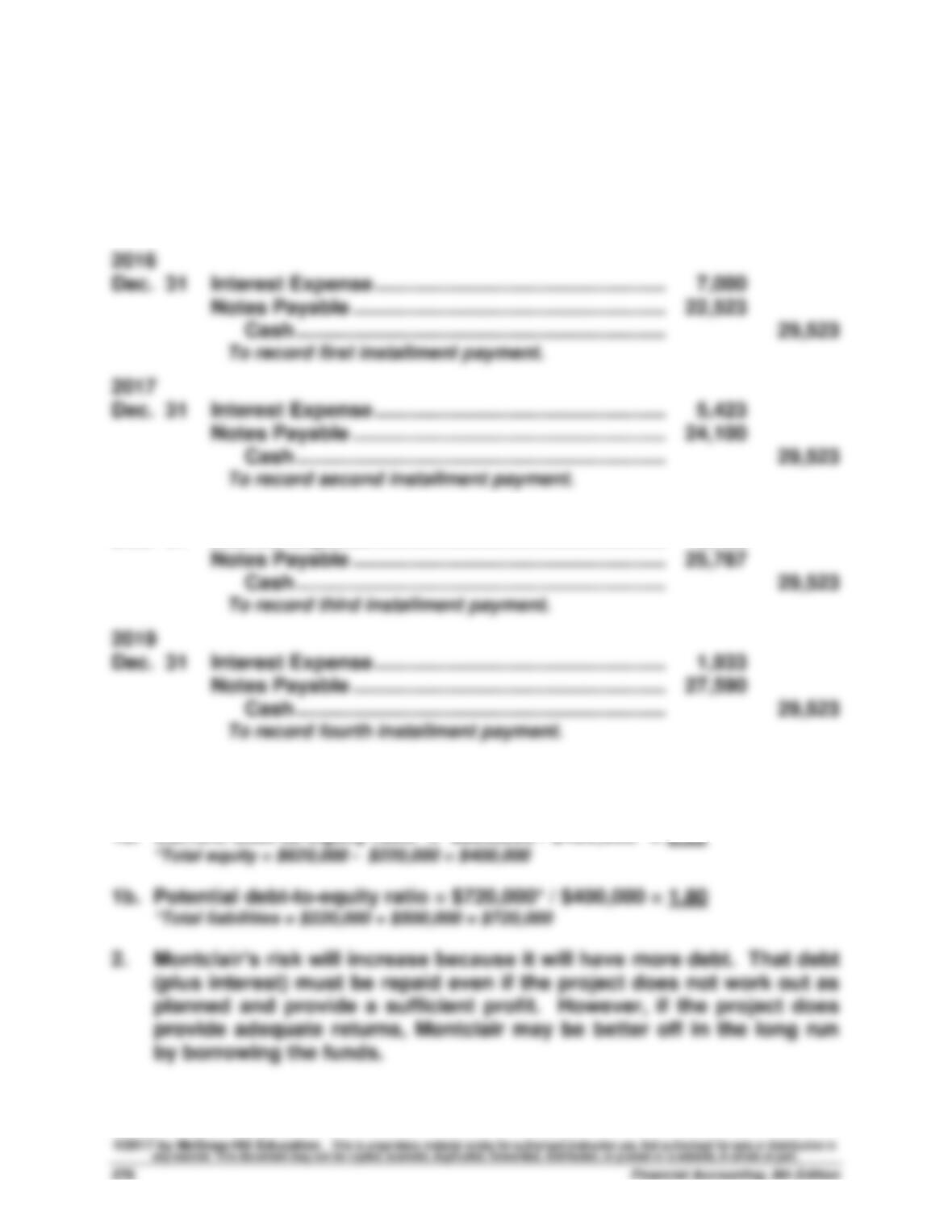
2. Amortization table for the loan
Payments
Period
Ending
Date
(A)
Beginning
Balance
[Prior (E)]
(B)
Debit
Interest
Expense
[7% x (A)]
+
(C)
Debit
Notes
Payable
[(D) – (B)]
=
(D)
Credit
Cash
[computed]
(E)
Ending
Balance
[(A) – (C)]
2016 …….
$100,000
$ 7,000
$ 22,523
$ 29,523
$77,477
2018 …….
$18,092
$100,000
$118,092
Exercise 10-11 (20 minutes)
2016
Jan. 1
Cash ……………………………………………………………………..
100,000
Notes Payable ………………………………………………….
100,000
Borrowed $100,000 by signing a 7%
installment note.
2016
Dec. 31
Interest Expense ……………………………………………………
7,000
Notes Payable ……………………………………………………….
Cash ………………………………………………………………..
To record first installment payment.
2017
Dec. 31
Interest Expense ……………………………………………………
5,423
Notes Payable ……………………………………………………….
Cash ………………………………………………………………..
To record second installment payment.
2018
Dec. 31
Interest Expense ……………………………………………………
3,736
Notes Payable ……………………………………………………….
Cash ………………………………………………………………..
To record third installment payment.
2019
Dec. 31
Interest Expense ……………………………………………………
1,933
Notes Payable ……………………………………………………….
Cash ………………………………………………………………..
To record fourth installment payment.
Exercise 10-12 (15 minutes)
1a. Current debt–to–equity ratio = $220,000 / $400,000* = 0.55