Problem 10-8BB (Concluded)
Part 4
2016
June 30
Bond Interest Expense …………………………..
7,940
Discount on Bonds Payable …………………………..
740
Cash ……………………………………………………….
2016
Dec. 31
Bond Interest Expense …………………………..
7,969
Discount on Bonds Payable …………………………..
769
Cash ……………………………………………………….
Problem 10-9BB (45 minutes)
Part 1
Ten payments of $14,400 ……………………..
$144,000
Par value at maturity …………………………..
320,000
Total repaid ………………………………………….
Less amount borrowed ………………………..
Ten payments of $14,400 ……………………..
$144,000
Less premium………………………………………
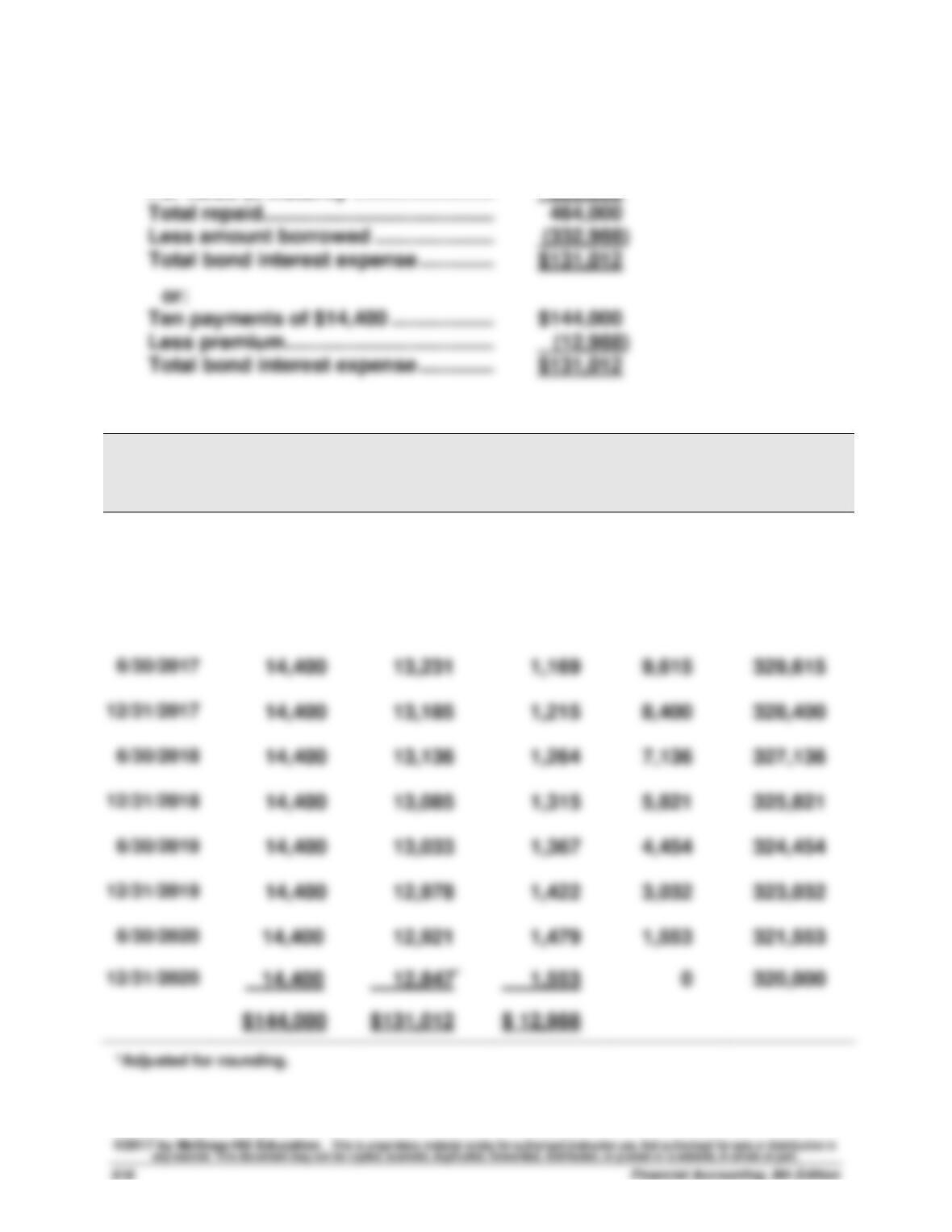
Part 2
Semiannual
Interest
Period-End
(A)
Cash Interest
Paid
[4.5% x $320,000]
(B)
Bond Interest
Expense
[4% x Prior (E)]
(C)
Premium
Amortization
[(A) – (B)]
(D)
Unamortized
Premium
[Prior (D) – (C)]
(E)
Carrying
Value
[$320,000 + (D)]
1/01/2016
$12,988
$332,988
6/30/2016
$ 14,400
$ 13,320
$ 1,080
11,908
331,908
12/31/2016
14,400
13,276
1,124
10,784
330,784
14,400
13,231
1,169
329,615
12/31/2017
14,400
13,185
1,215
328,400
6/30/2018
13,136
327,136
12/31/2018
14,400
13,085
1,315
325,821
14,400
13,033
324,454
6/30/2020
12,921
1,553
321,553
1,553
320,000
$144,000
$131,012
Problem 10-9BB (Concluded)
Part 3
2016
June 30
Bond Interest Expense …………………………..
13,320
2016
Dec. 31
Bond Interest Expense …………………………..
13,276
Part 4
As of December 31, 2018
Cash Flow
Table
Table Value*
Amount
Present Value
Par value ……………..
B.1
0.8548
$320,000
$273,536
Comparison to Part 2 Table
Except for a small rounding difference, this present value ($325,807) equals
Problem 10–10BB (70 minutes)
Part 1
2016
Jan. 1
Cash ……………………………………………………….
493,608
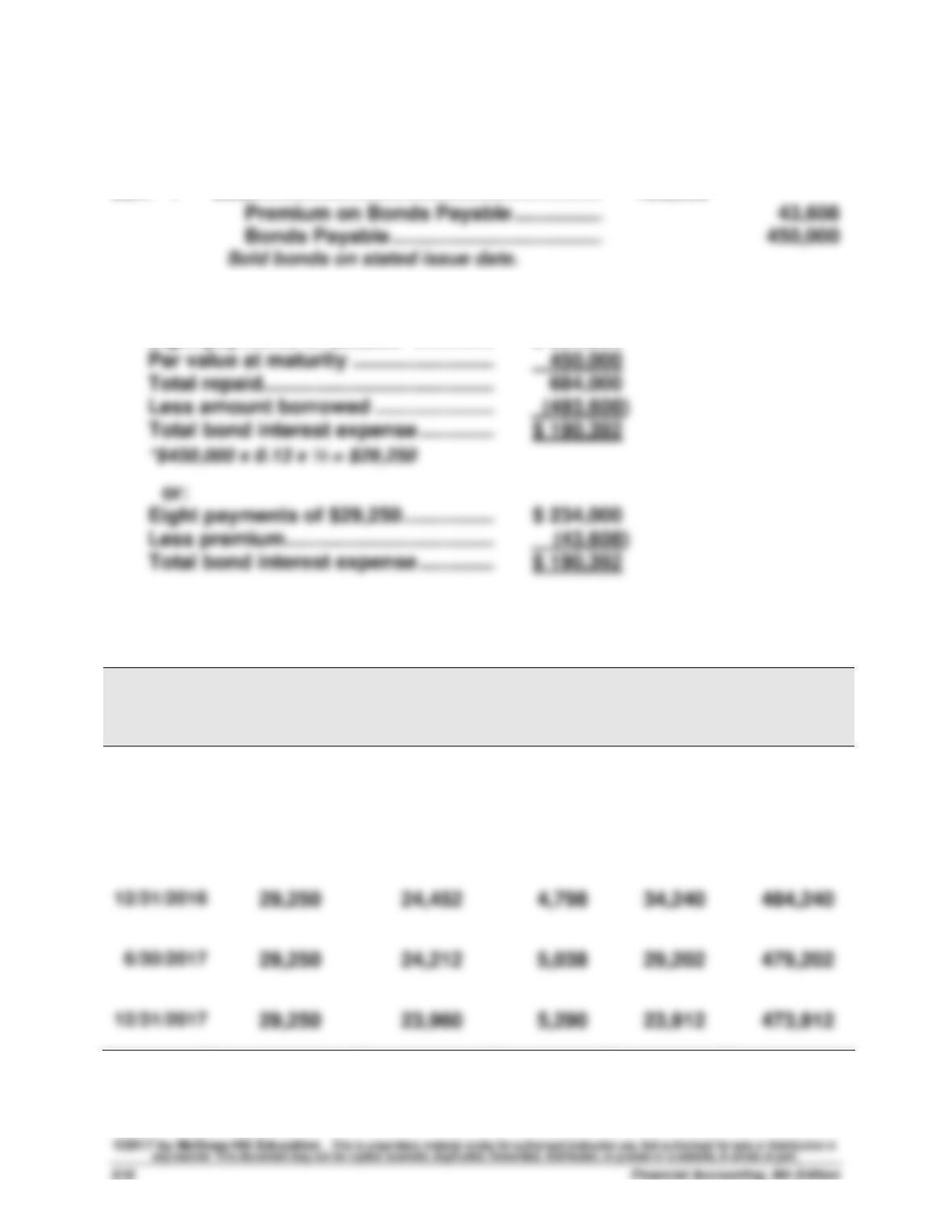
Part 2
Eight payments of $29,250* ………………….
$ 234,000
Eight payments of $29,250 ……………………
$ 234,000
Part 3
Semiannual
Interest
Period-End
(A)
Cash Interest
Paid
[6.5% x $450,000]
(B)
Bond Interest
Expense
[5% x Prior (E)]
(C)
Premium
Amortization
[(A) – (B)]
(D)
Unamortized
Premium
[Prior (D) – (C)]
(E)
Carrying
Value
[$450,000 + (D)]
1/01/2016
$43,608
$493,608
6/30/2016
$29,250
$24,680
$4,570
39,038
489,038
6/30/2017
5,038
29,202
479,202
5,290
23,912
473,912
Problem 10–10BB (Concluded)
Part 4
2016
June 30
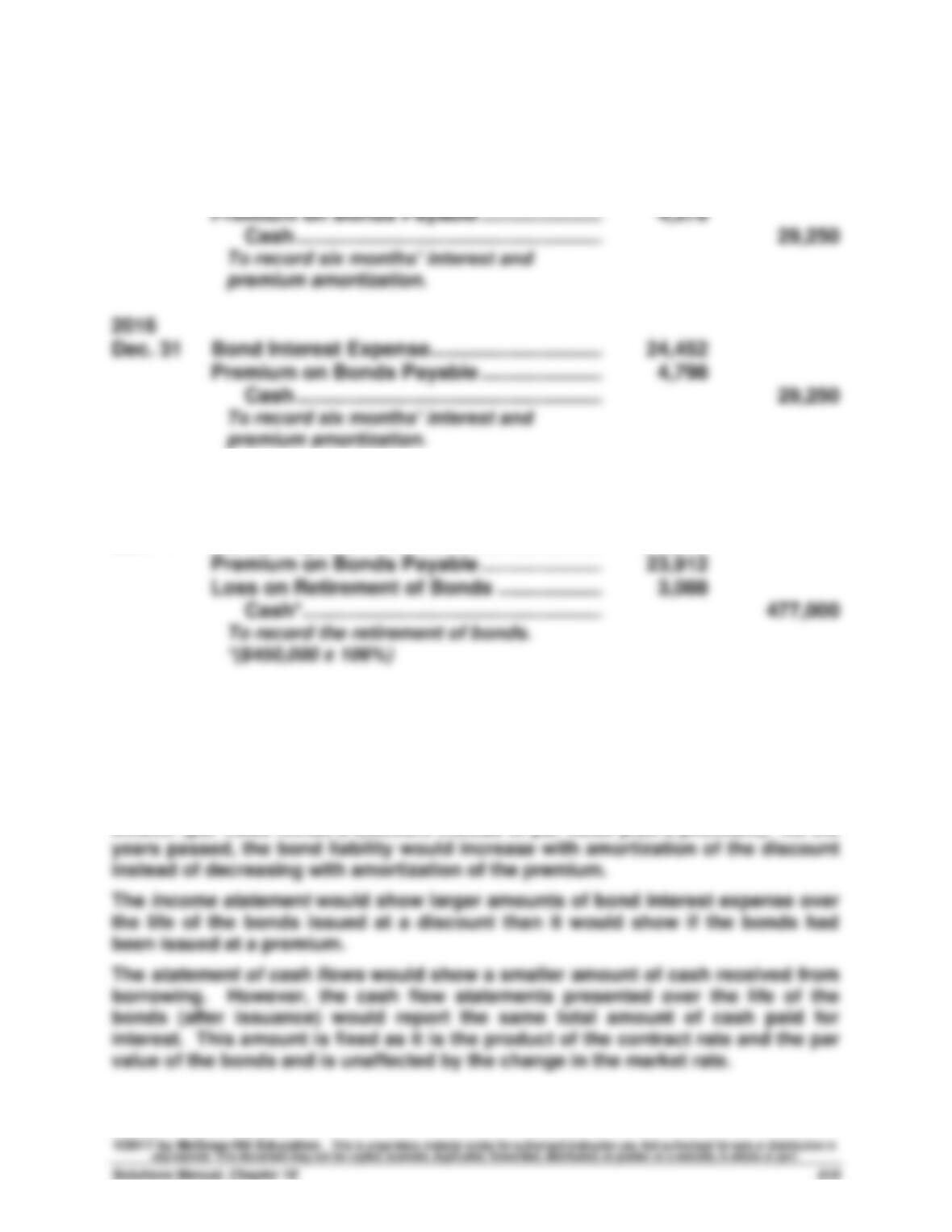
Bond Interest Expense …………………………..
24,680
Premium on Bonds Payable …………………………..
Dec. 31
Bond Interest Expense …………………………..
24,452
Premium on Bonds Payable …………………………..
Part 5
2018
Jan. 1
Bonds Payable ……………………………………………………..
450,000
Premium on Bonds Payable …………………………..
23,912
Part 6
If the market rate on the issue date had been 14% instead of 10%, the bonds
would have sold at a discount because the contract rate of 13% would have been
lower than the market rate.
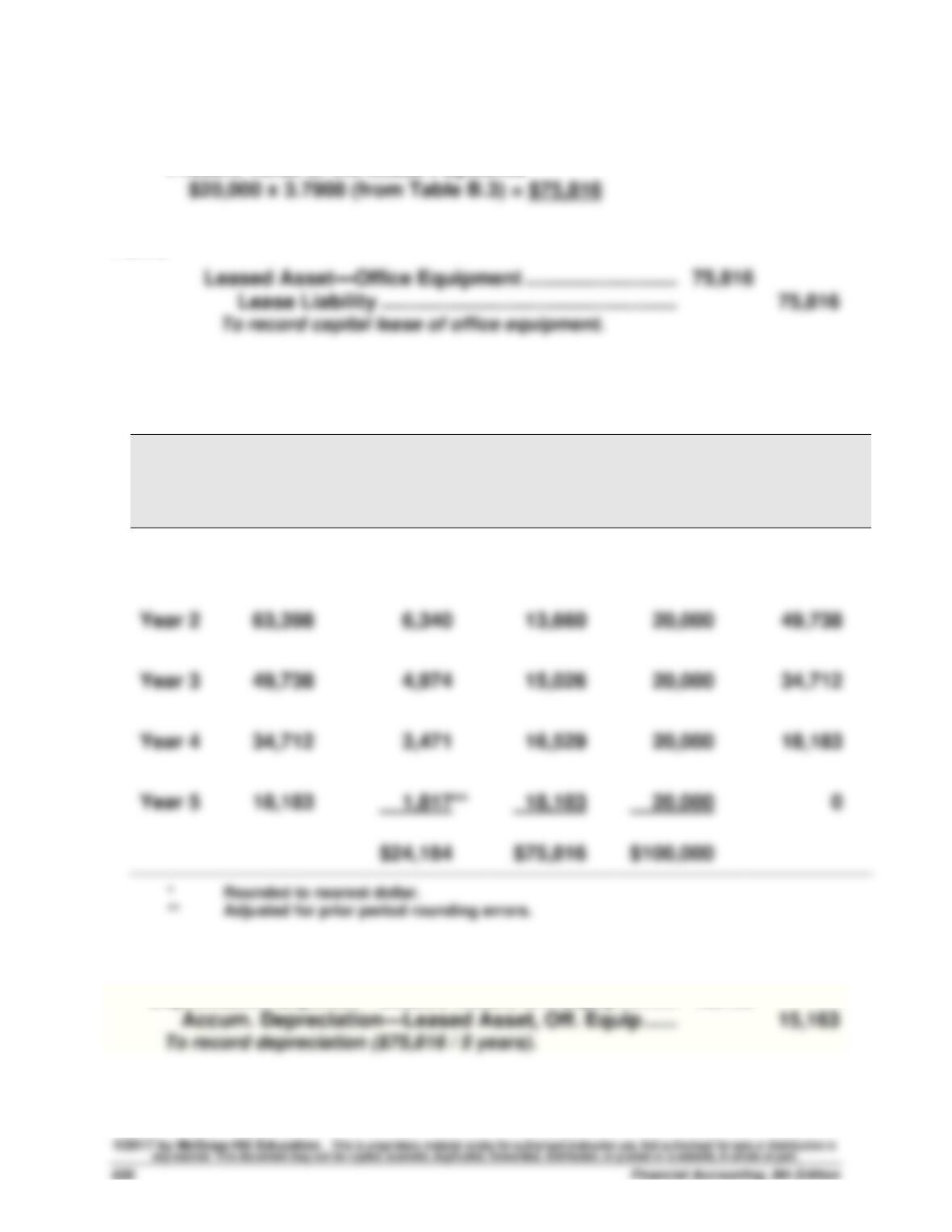
This change would affect the balance sheet because the bond liability would be
smaller (par value minus a discount instead of par value plus a premium). As the
Problem 10-11BD (35 minutes)
Part 1
Present Value of the Lease Payments
Part 2
75,816
Part 3
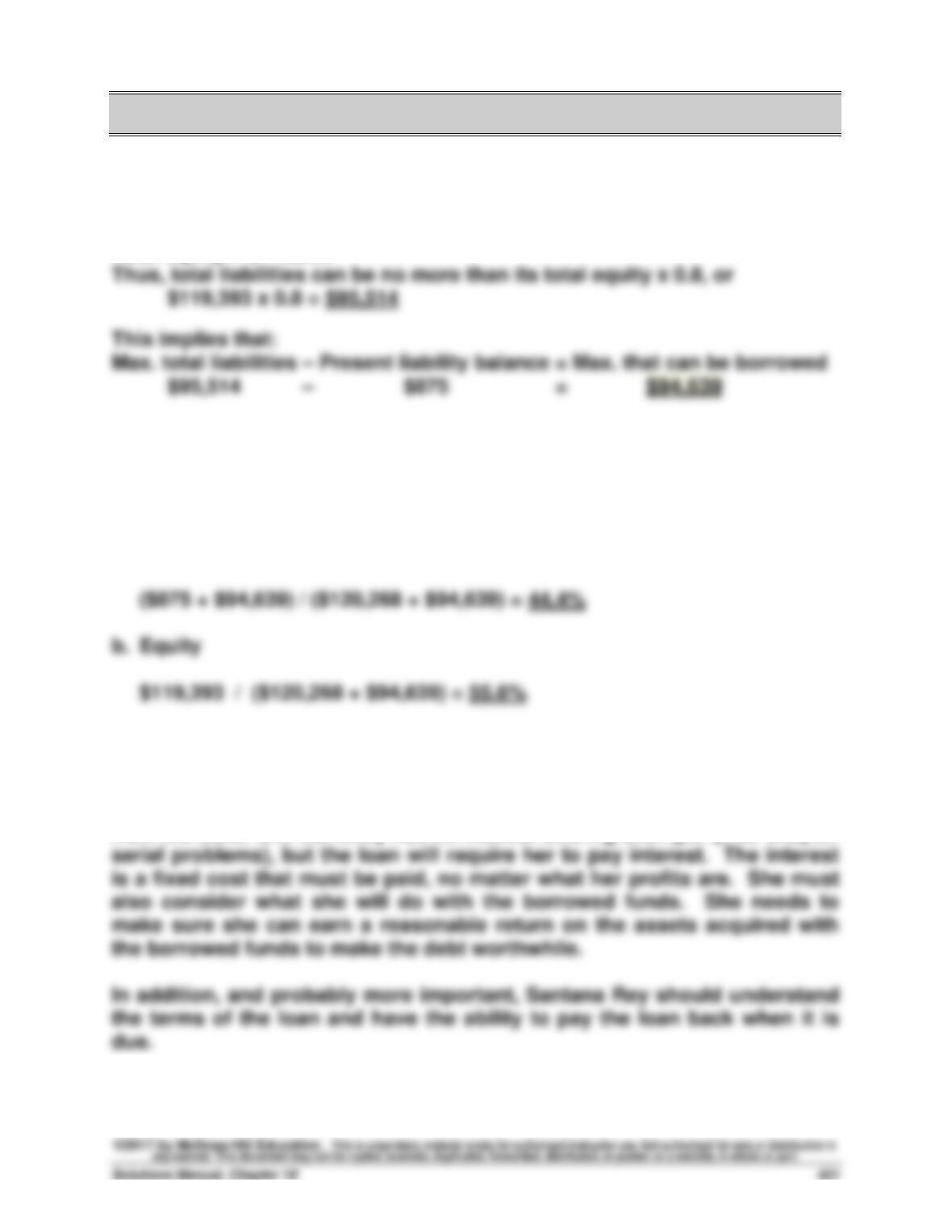
Capital Lease Liability Payment (Amortization) Schedule
Period
Ending
Date
Beginning
Balance of
Lease
Liability
Interest on
Lease
Liability
(10%)
Reduction
of Lease
Liability
Cash
Lease
Payment
Ending
Balance of
Lease
Liability
Year 1
$75,816
$ 7,582*
$12,418
$ 20,000
$63,398
Year 3
Year 5
20,000
Part 4
Depreciation Expense—Leased Asset, Off. Equip ……………….
15,163
SERIAL PROBLEM — SP 10
Serial Problem — SP 10 (75 minutes)
Part 1
Total equity = $119,393
Part 2
Assume the secured loan is taken, then the percent of assets financed by:
a. Debt
Part 3
Santana Rey should understand the risks she is taking by borrowing funds
from the bank. She currently has no interest-bearing debt (per prior chapter
Reporting in Action — BTN 10-1
1. Apple reported long-term debt of $28,987 million as of September 27,
2. The interest that Apple must pay on $100 million of 4.25% convertible
3. Assuming that Apple had $100 million carrying value of convertible
bonds that convert into 20,000 shares of stock, the following entry
would be recorded upon conversion:
Comparative Analysis — BTN 10-2
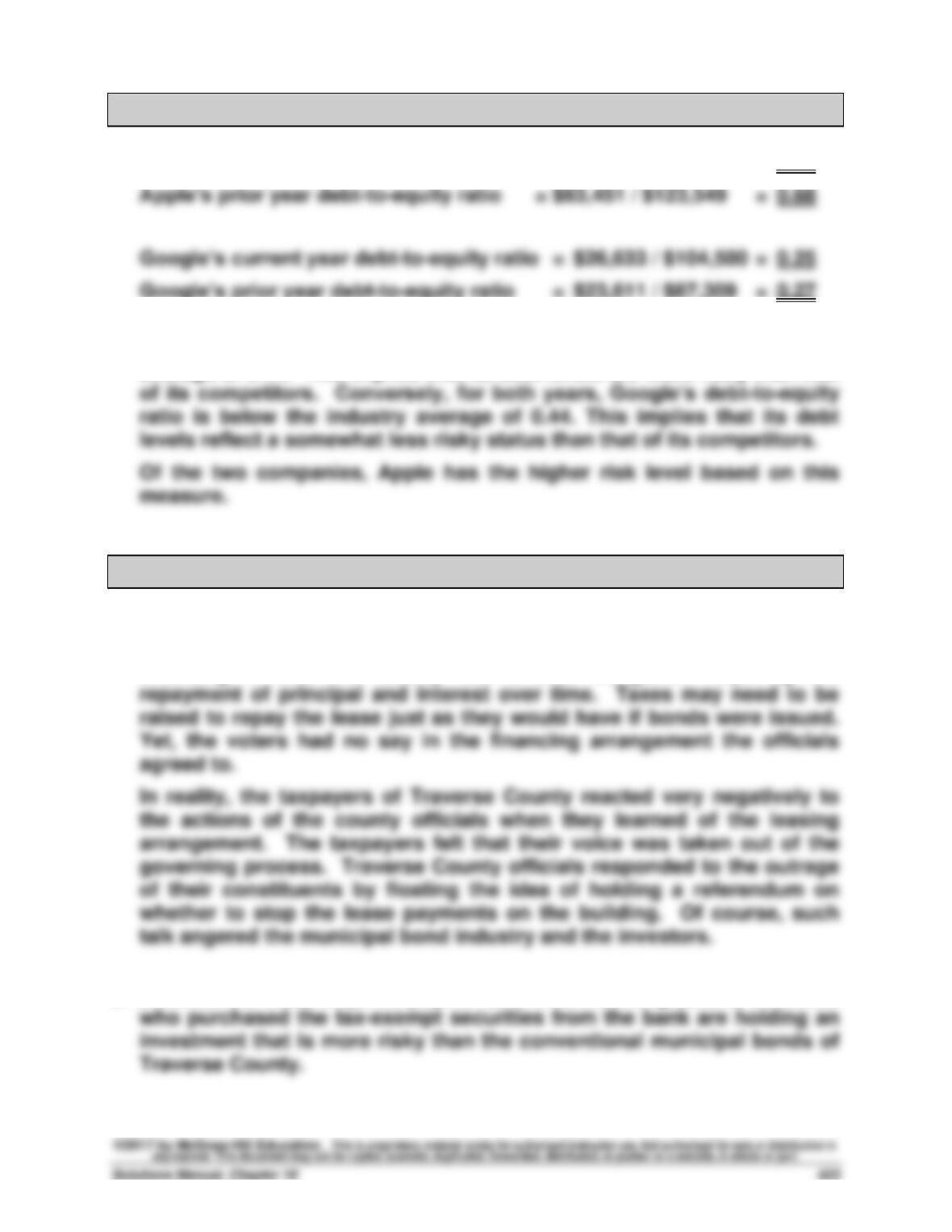
1. Apple’s current year debt-to–equity ratio = $120,292 / $111,547 = 1.08
2. For both years, Apple’s debt–to-equity ratio is above that of the industry
average of 0.44. This implies that its debt levels are more risky than that
Ethics Challenge — BTN 10-3
1. The ethics of the Traverse County officials are questionable. The
financial impact of the leasing arrangement is the same as bond
financing in that the county has a debt obligation requiring the
2. Because the lease requires payments of a non-binding nature, investors
Communicating in Practice — BTN 10-4
MEMORANDUM
TO:
FROM:
SUBJECT:
The body of the memorandum should make the following points:
The associate is confused about the concept of a bond premium. Bonds
that sell at a premium provide the issuing company more cash than they
Taking It to the Net — BTN 10–5
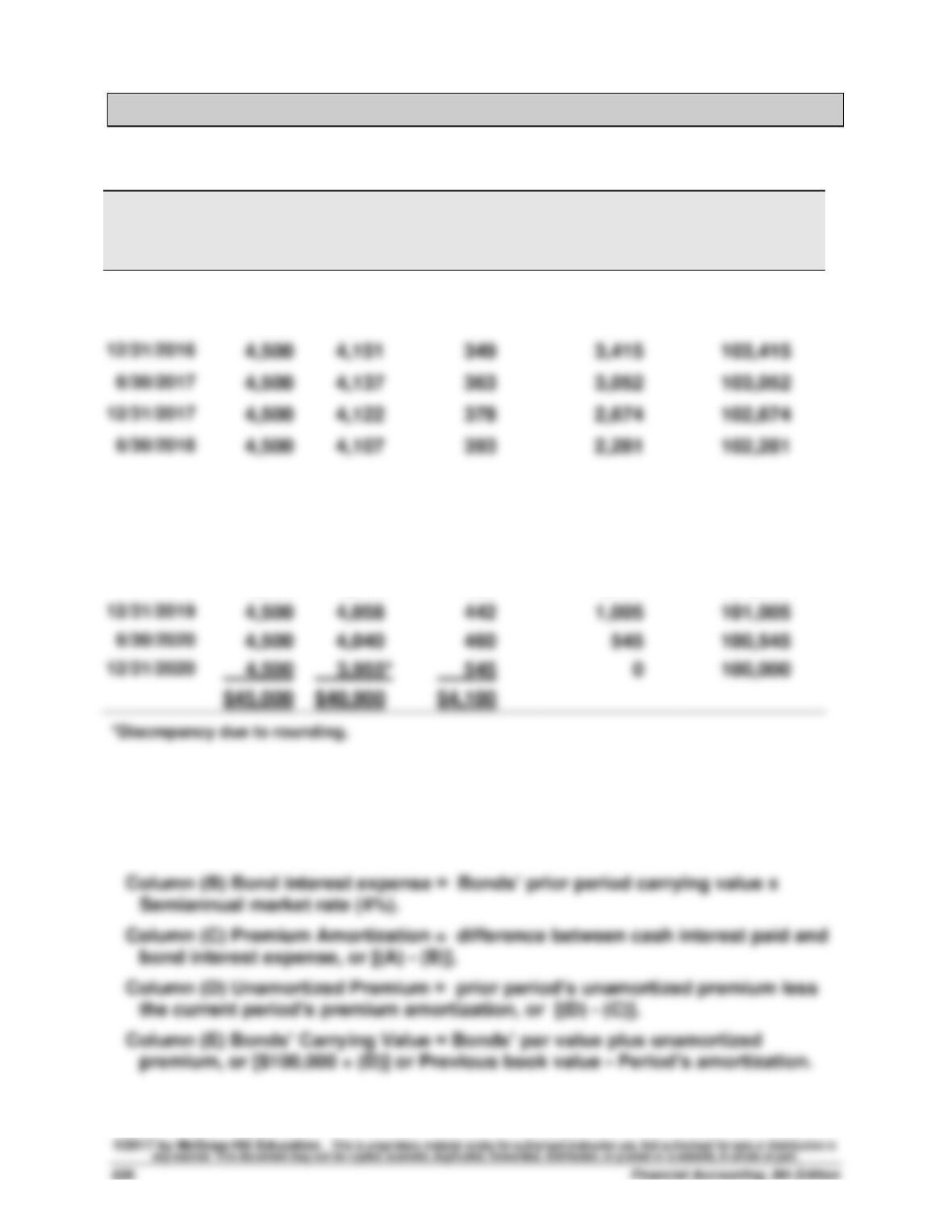
1. Home Depot’s long-term liabilities as of February 1, 2015, follow:
2 a. These Home Depot notes offer a 5.875% interest rate. If the interest
rate for similar notes from companies with similar risk was 5.875%,
Teamwork in Action — BTN 10-6
Parts 1 and 2
Effective Interest Amortization of Bond Premium
Semi-
annual
Period-end
(A)
Cash
Interest
Paid
(B)
Bond
Interest
Expense
(C)
Premium
Amortization
(D)
Unamortized
Premium
(E)
Carrying
Value
1/01/2016
$ 4,100
$ 104,100
6/30/2016
$ 4,500
$ 4,164
$ 336
3,764
103,764
3,415
103,415
2,674
102,674
6/30/2018
2,281
102,281
Since teams generally have 4 or 5 members, the team solution will likely end about
here. The remainder of the table is shown for help in answering part 3.
12/31/2018
4,500
4,091
409
1,872
101,872
6/30/2019
4,500
4,075
425
1,447
101,447
12/31/2019
4,500
4,058
442
1,005
101,005
100,000
The following computations should be articulated by team members as
each line is explained and prepared:
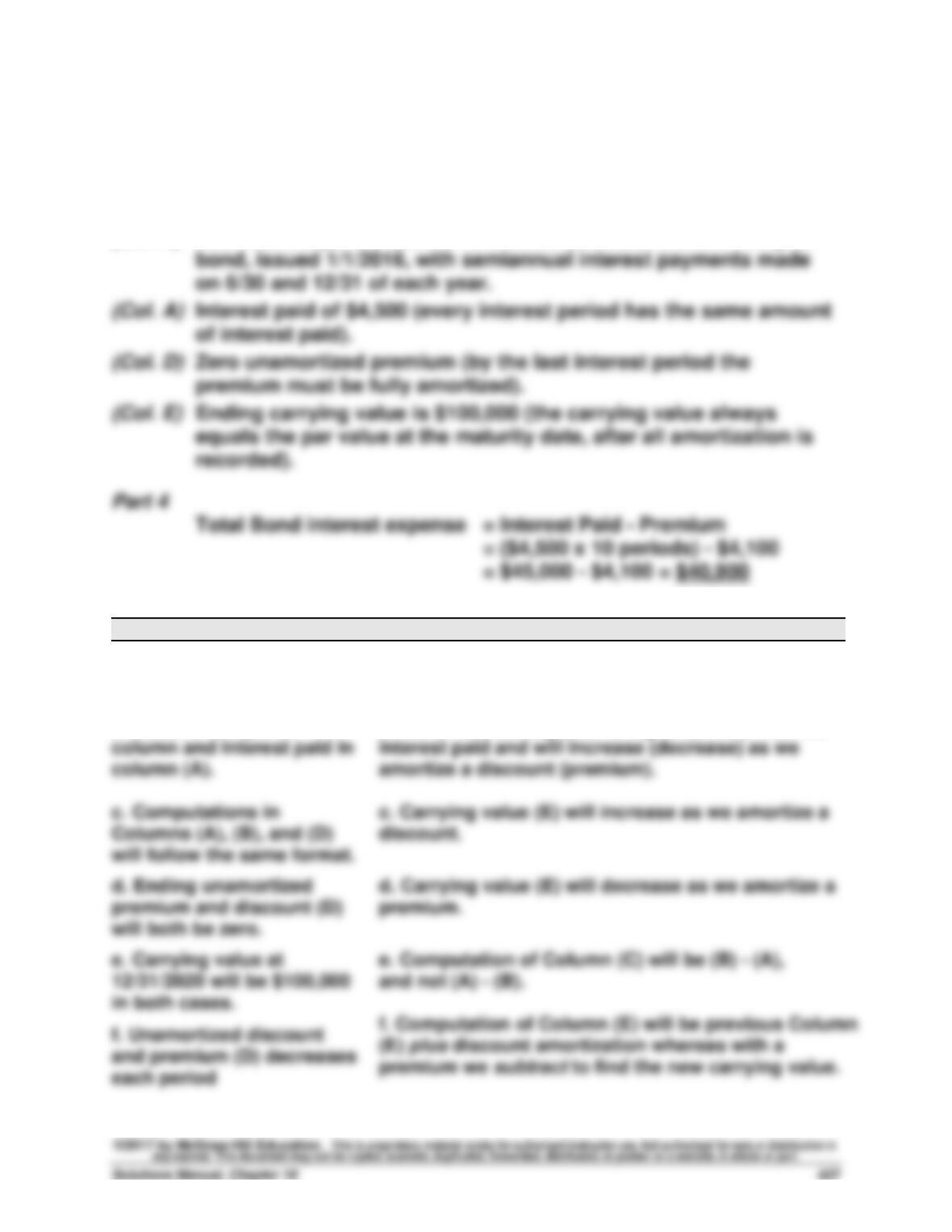
Column (A) Cash Interest Paid = Bonds’ par value ($100,000) x Semiannual
contract rate (4.5%).
Teamwork in Action (Concluded)
Part 3
Without completing the table, team members should be able to project the
final number in the first column and for each of the columns (A), (D), and
(E). Specifically:
(Col. 1) Last interest period date is 12/31/2020 because this is a five-year
Part 5 List likely includes:
Similarities
Differences
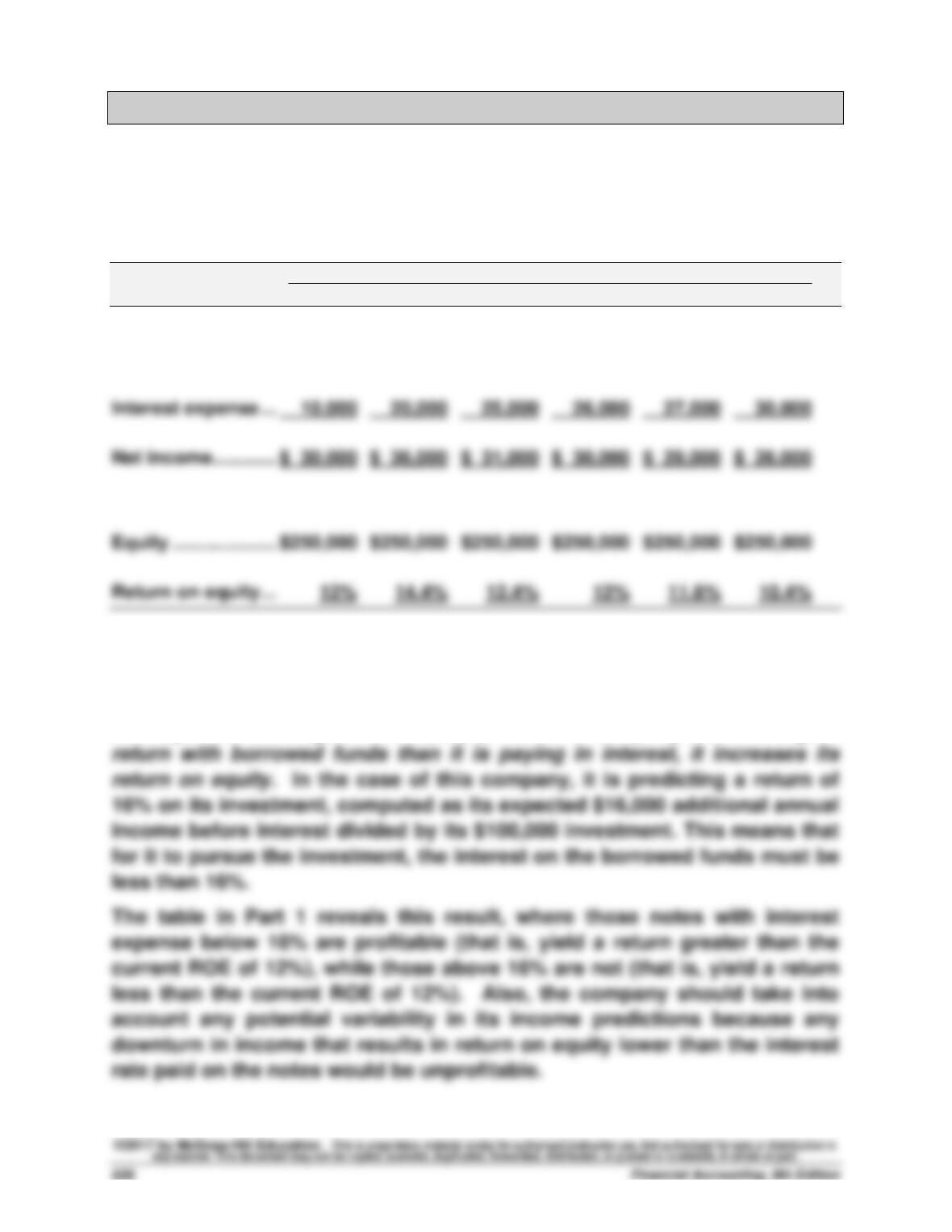
a. Table column headings
for the period and for
columns (A), (B), and (E).
a. Column (C) will be Discount Amortization and
Column (D) will be Unamortized Discount.
c. Computations in
Columns (A), (B), and (D)
will follow the same format.
c. Carrying value (E) will increase as we amortize a
discount.
b. Dates in the period
b. Bond interest expense is higher (lower) than the
Entrepreneurial Decision — BTN 10–7
Part 1
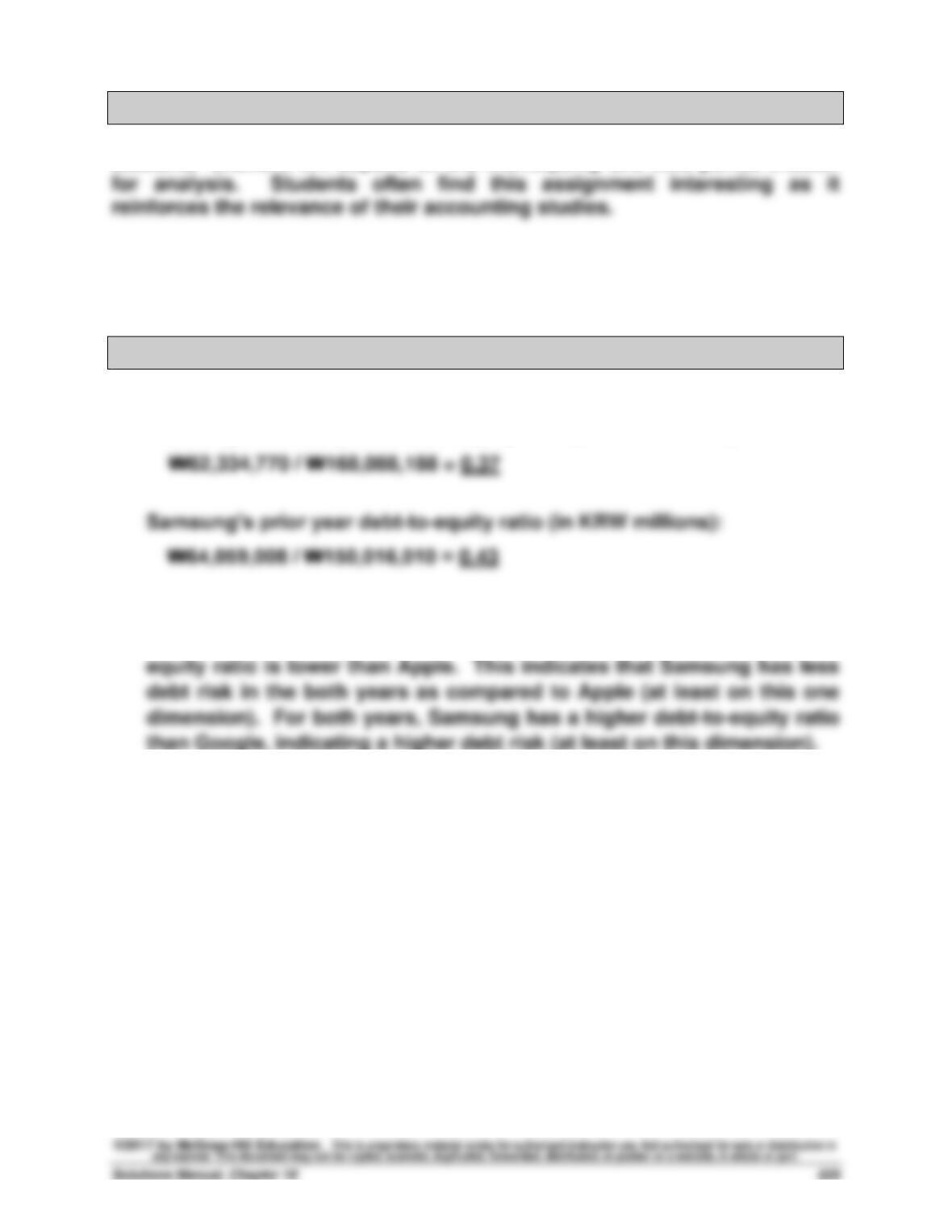
The table below reveals how the five alternative interest-bearing notes
would affect this company’s interest expense, net income, equity, and
return on equity (net income/equity):
Alternative Notes for Expansion
Current 10% Note 15% Note 16% Note 17% Note 20% Note
Income before
interest …………. $ 40,000 $ 56,000 $ 56,000 $ 56,000 $ 56,000 $ 56,000
Part 2
The analysis in Part 1 illustrates the general rule (called “financial
leverage” or “trading on the equity”): When a company earns a higher
Hitting the Road — BTN 10-8
Students’ answers will depend on the municipality and time period chosen
Global Decision — BTN 10–9
1. Samsung’s current year debt–to-equity ratio (in KRW millions):
2. Samsung’s debt–to–equity ratio decreased slightly from the prior year to
the current year. For the current and prior years, Samsung’s debt–to–