
Chapter 9
Reporting and Analyzing
Current Liabilities
QUESTIONS
1. A current liability is expected to be paid within one year or the company’s operating
cycle, whichever is longer. Any liability that is not current is considered to be long
term.
2. An estimated liability is an obligation to make a future payment, the exact amount of
which is uncertain, but it is capable of being reasonably estimated.
3. The three questions are: (1) Who must be paid? (2) When is payment due? (3) How
much is to be paid?
4. The amount of the sale for the item only is $950 ($988/1.04).
5. The combined Social Security tax rate (assuming the maximum wage amount is not
yet reached) is 12.4% (6.2% + 6.2%). The maximum level of earnings [wage base on
which taxes are due] for 2015 is $118,500.
6. The Medicare tax rate is 1.45%. This rate is applied to all wages earned by an
employee—no maximum limit exists. (There is also an “additional medicare tax on
those individuals with wages exceeding $200,000.)
7. The employee is responsible for federal income taxes, state income taxes, local
income taxes (if any), and the employee portion of the FICA taxes. The employer is
responsible for both federal and state unemployment taxes and the employer
portion of the FICA taxes.
8. An employee’s gross earnings along with the number of withholding allowances that
an employee claims, as well as whether they are married or single, determine the
amount deducted for federal income taxes.
9. An unemployment merit rating is based on an evaluation of an employer’s
experience in creating or avoiding unemployment with its employees. The merit
rating affects the state unemployment taxes that the employer must pay. Merit
ratings cause more of the cost of unemployment benefits to be paid by those who
create more unemployment.
10. The obligation to correct or replace defective products (or services) is created when
the products are sold with the warranties. Even though the seller does not know
with certainty when the obligation will be paid, to whom it will be paid, or the amount
to be paid, past experience shows that some amount will probably be paid. If the
seller can reasonably estimate that amount, the warranty liability must be reported
on the balance sheet.

11. There are no conditions in which a probable loss tied to a future event can create a
liability, regardless of its probability. A liability is an obligation created by a past
event, not by a future event. If a disaster occurs, the company must report the loss
in the period when it occurs.
12.A A wage bracket withholding table shows for a pay period of a given length (weekly,
biweekly, semimonthly, monthly), the amounts of federal income taxes to be
withheld from the pay of an employee, at varying amounts of gross pay and varying
numbers of withholding allowances.
13.A Single employee earning $725 with two allowances has $76 taxes withheld.
Single employee earning $625 with no allowances has $81 taxes withheld.
14. At September 27, 2014, Apple reports accounts payable of $30,196 million.
15. At December 31, 2014, Google reports the following accrued expenses:
Accrued compensation and benefits
Accrued expenses and other current liabilities.
16. At December 31, 2014, Samsung reports eleven current liabilities: Trade and other
payables; Short-term borrowings; Other payables; Advance received; Withholdings;
Accrued expenses; Income tax payable; Current portion of long-term borrowings
and debentures; Provisions; Other current liabilities; and Liabilities held for sale.
17. Samsung’s current liabilities include one income-tax-related liability titled: Income
tax payable. This account reflects taxes that must be paid to the government in the
short term.
Instructor note: Samsung has a current liability titled “Withholdings.” This may represent
some tax withholdings (such as related to employee compensation), however, it is likely not
income tax related. Samsung also has one noncurrent income-tax-related account on its
balance sheet titled: Deferred income tax liabilities.
QUICK STUDIES
Quick Study 9-1 (5 minutes)
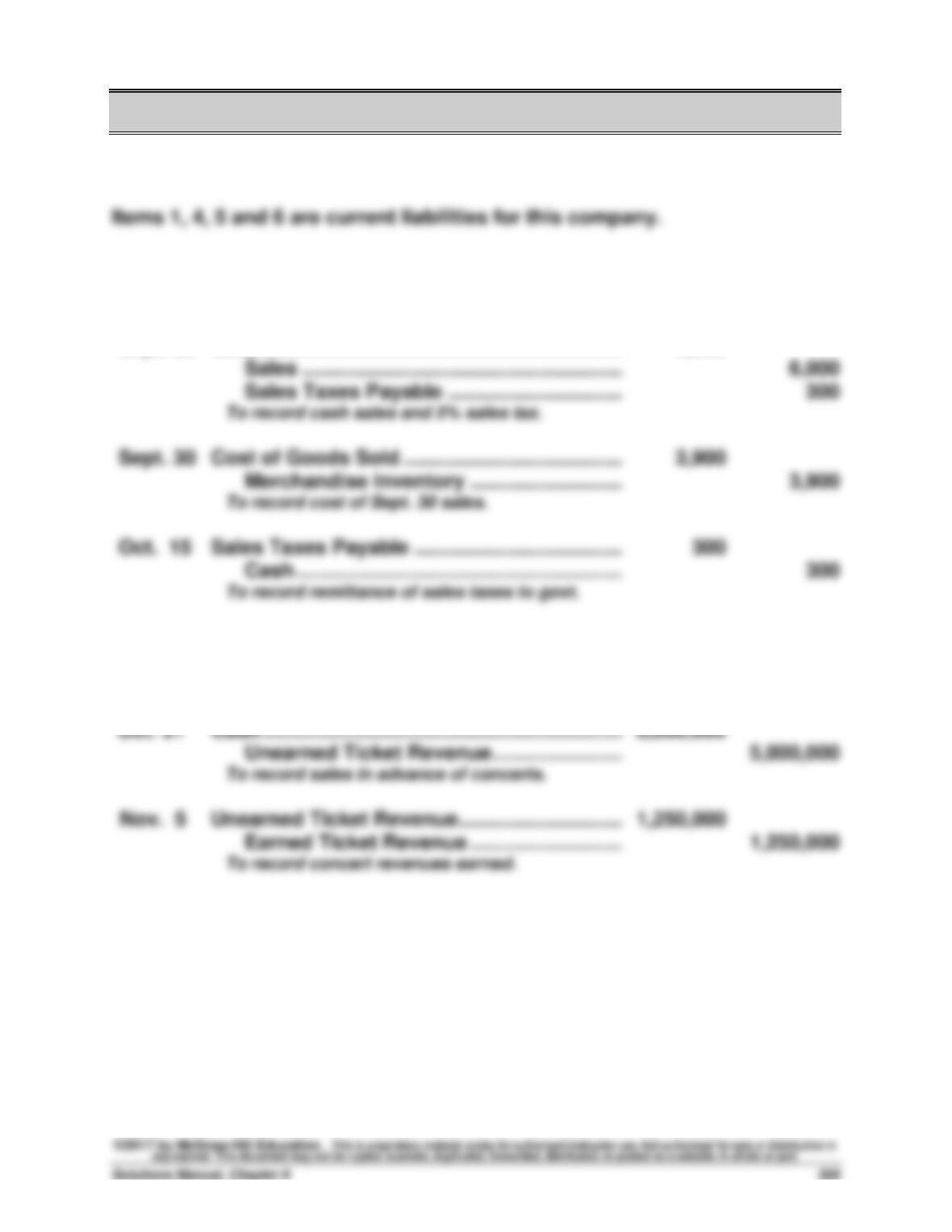
Quick Study 9-2 (10 minutes)
Sept. 30
Cash ………………………………………………………………..
6,300
Sept. 30
3,900
Quick Study 9-3 (10 minutes)
Cash ………………………………………………………………..
Quick Study 9-4 (15 minutes)
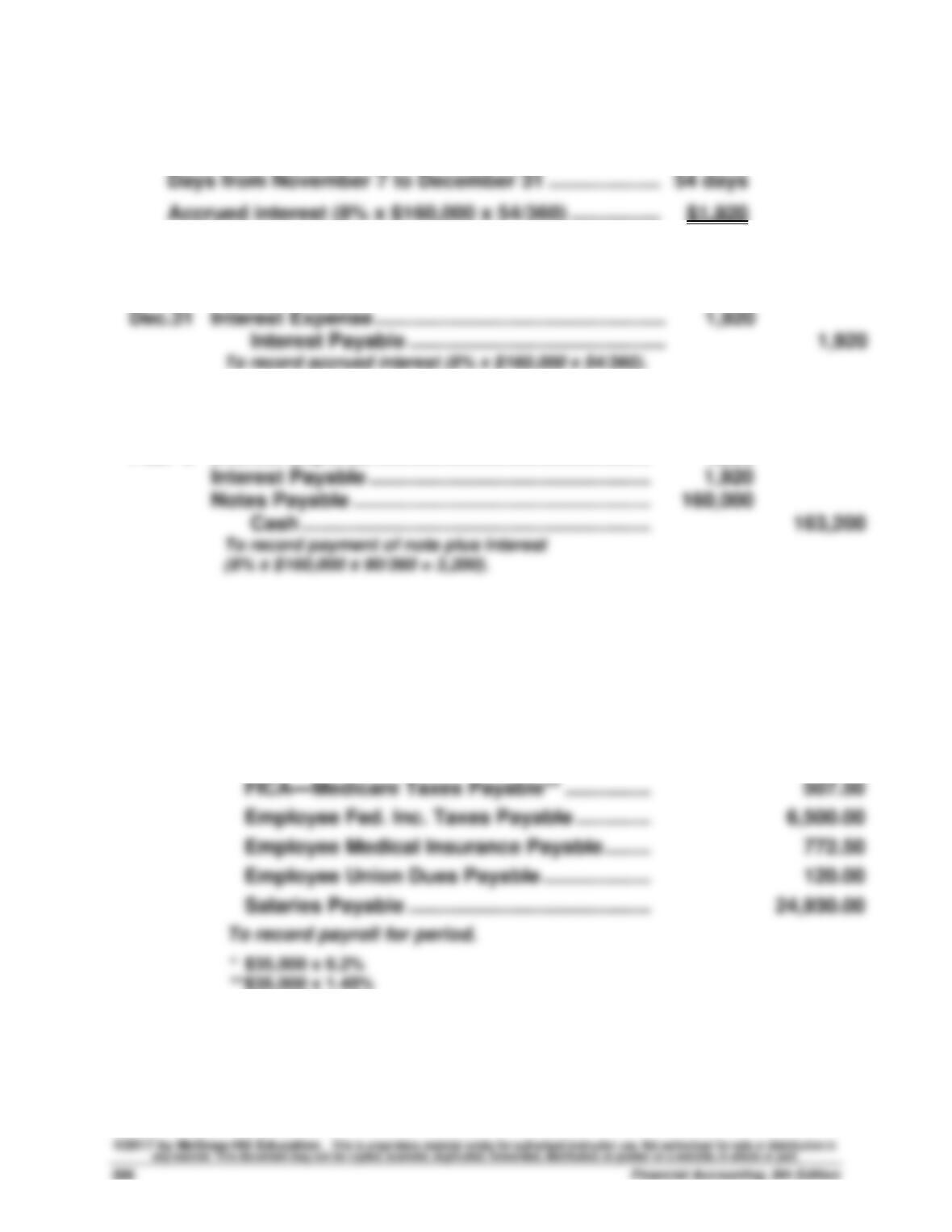
1. Computation of interest payable at December 31, 2016:
Days from November 7 to December 31 ………………..
54 days
Accrued interest (8% x $160,000 x 54/360) …………….
2. 2016
Interest Expense ………………………………………………
Interest Payable …………………………………………
3. 2017
Feb. 5
Interest Expense ………………………………………………
1,280
Interest Payable ……………………………………………….
1,920
Notes Payable ………………………………………………….
Cash ……………………………………………………….
Quick Study 9-5 (15 minutes)
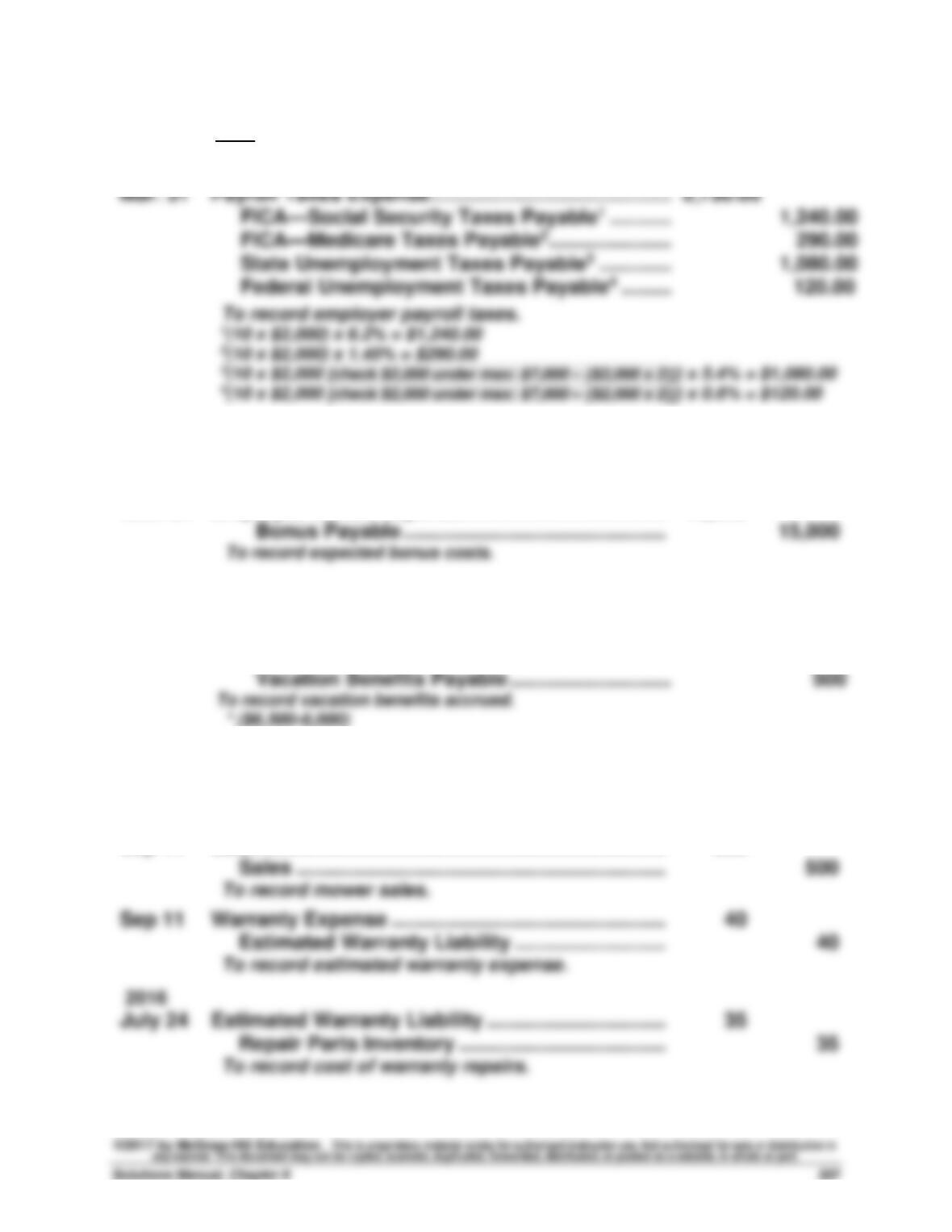
Jan. 15
Sales Salaries Expense …………………………………….
35,000.00
FICA—Social Sec. Taxes Payable* ………………
2,170.00
FICA—Medicare Taxes Payable** ………………..
Employee Fed. Inc. Taxes Payable ………………
6,500.00
Employee Medical Insurance Payable ………….
Employee Union Dues Payable ……………………
Salaries Payable …………………………………………
Quick Study 9-6 (15 minutes)
[Note: Two months (January and February) of earnings have
already been recorded for each of the 10 employees.]
Mar. 31
Payroll Taxes Expense ……………………………………..
Quick Study 9-7 (5 minutes)
Dec. 31
Employee Bonus Expense ………………………………..
15,000
Quick Study 9-8 (5 minutes)
Vacation Benefits Expense* ……………………………..
500
Quick Study 9-9 (10 minutes)
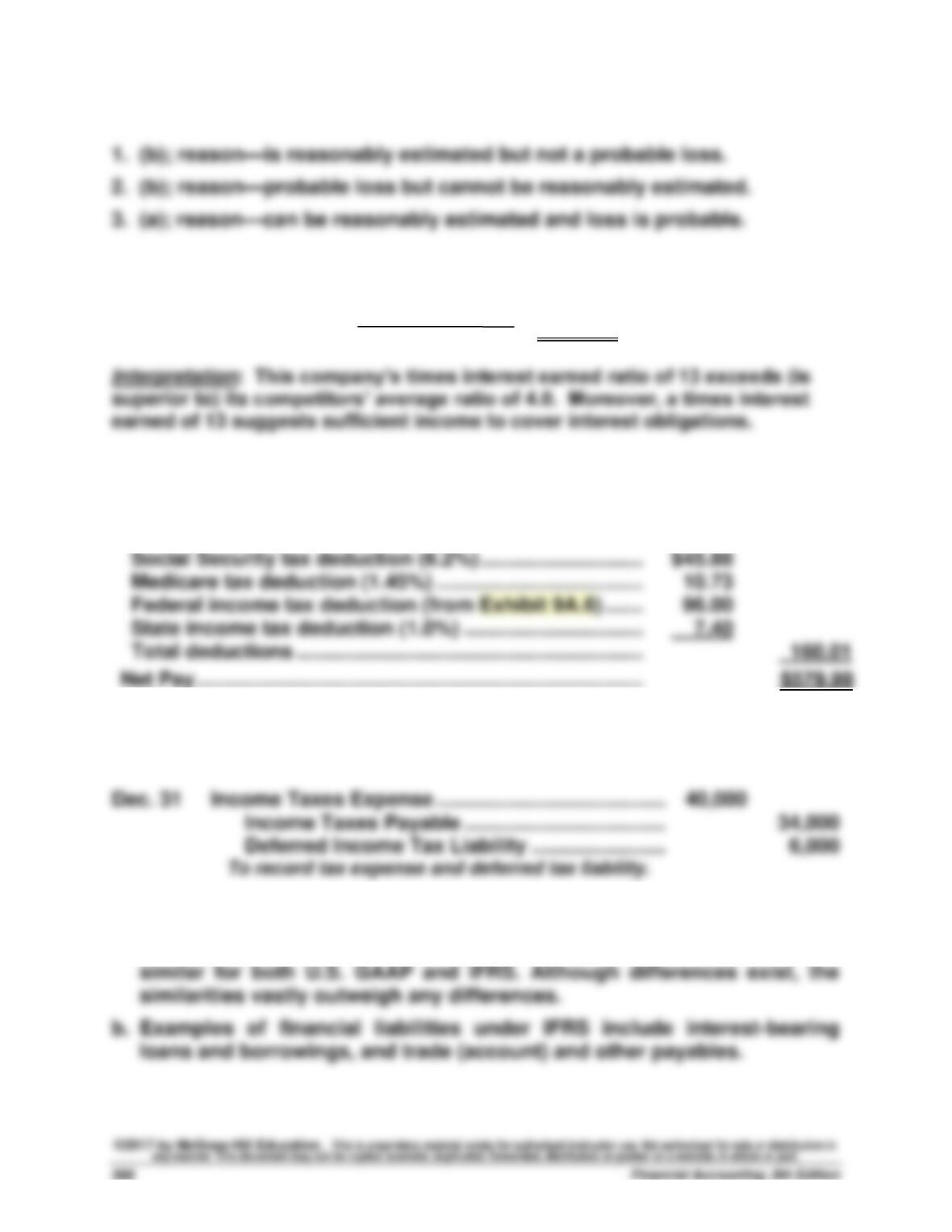
2015
Sep 11
Cash ………………………………………………………………..
500
Sep 11
Warranty Expense ……………………………………………
Estimated Warranty Liability …………………………..
Quick Study 9-10 (10 minutes)
Quick Study 9-11 (10 minutes)
Times interest earned = = 13 times
Quick Study 9-12A (15 minutes)
Gross Pay ………………………………………………………………….
$740.00
Quick Study 9-13B (10 minutes)
Quick Study 9-14 (10 minutes)
a. The definitions and characteristics of current liabilities are broadly
$1,885,000
$145,000
EXERCISES
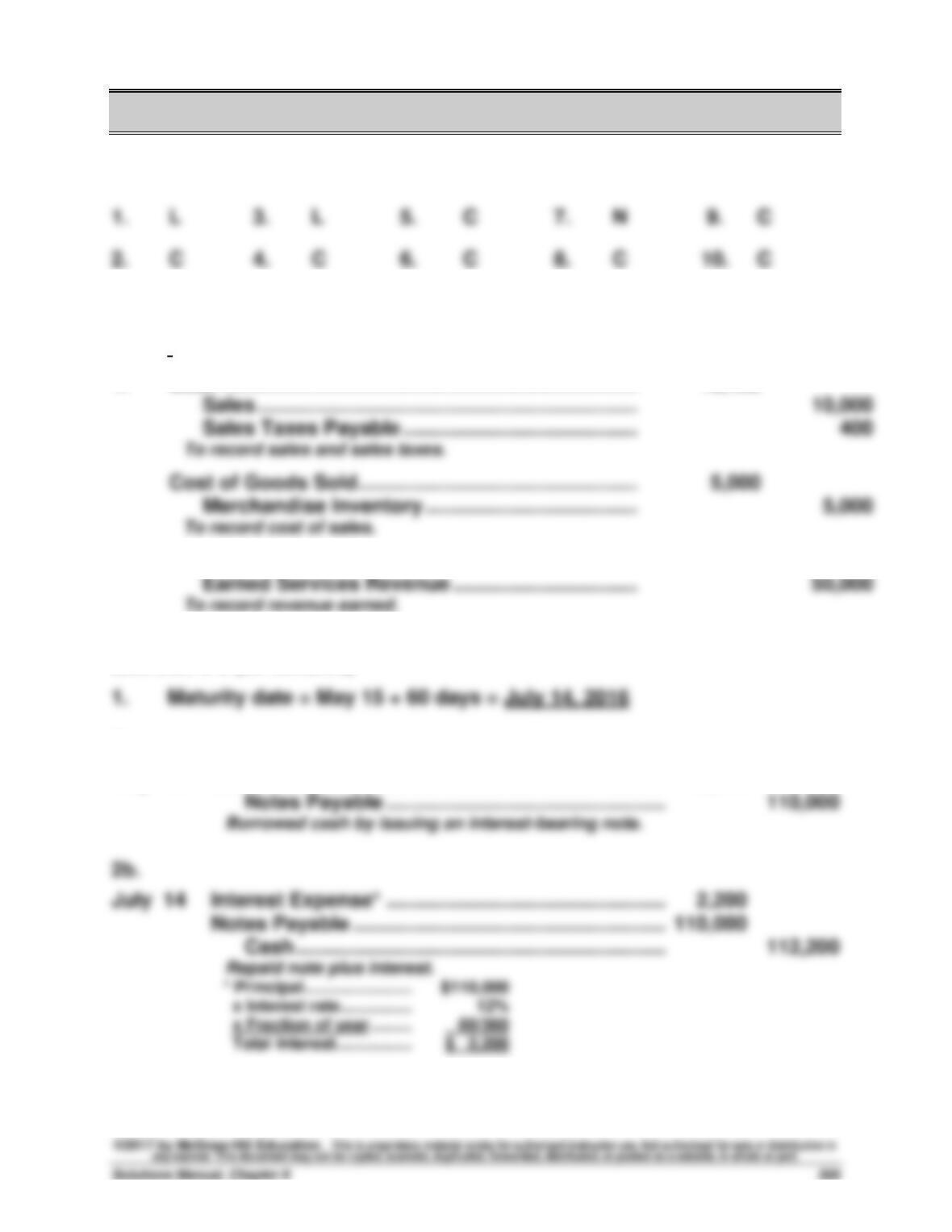
Exercise 9-1 (10 minutes)
1.
L
3.
L
5.
C
N
9.
C
2.
C
C
6.
C
8.
C
C
Exercise 9-2 (10 minutes)
[Note: All entries dated December 31, 2016]
1.
Cash ………………………………………………………………..
10,400
2.
Unearned Services Revenue ……………………………..
50,000
Exercise 9-3 (30 minutes)
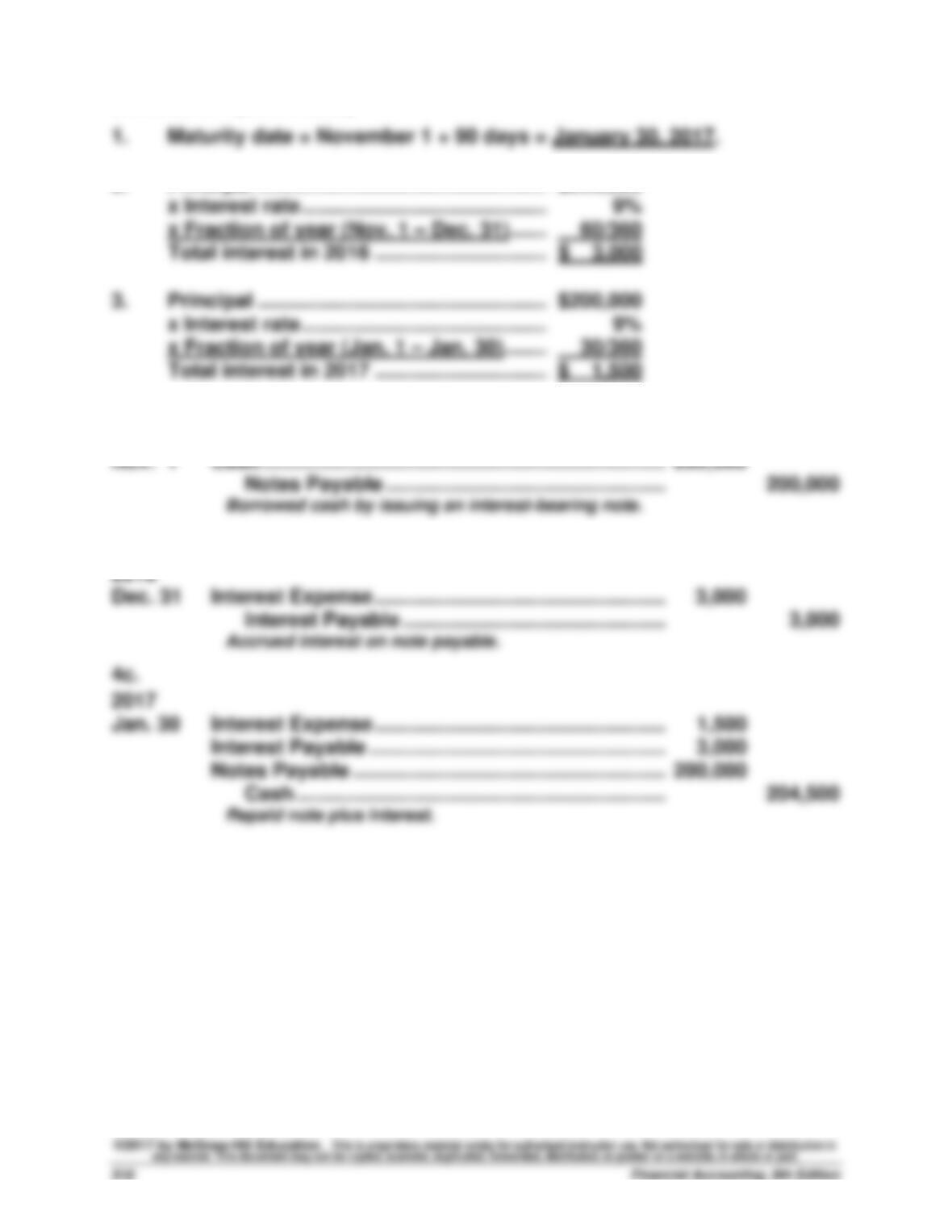
2a.
May 15
Cash ………………………………………………………………..
110,000
Notes Payable ………………………………………………….
110,000
Exercise 9-4 (30 minutes)
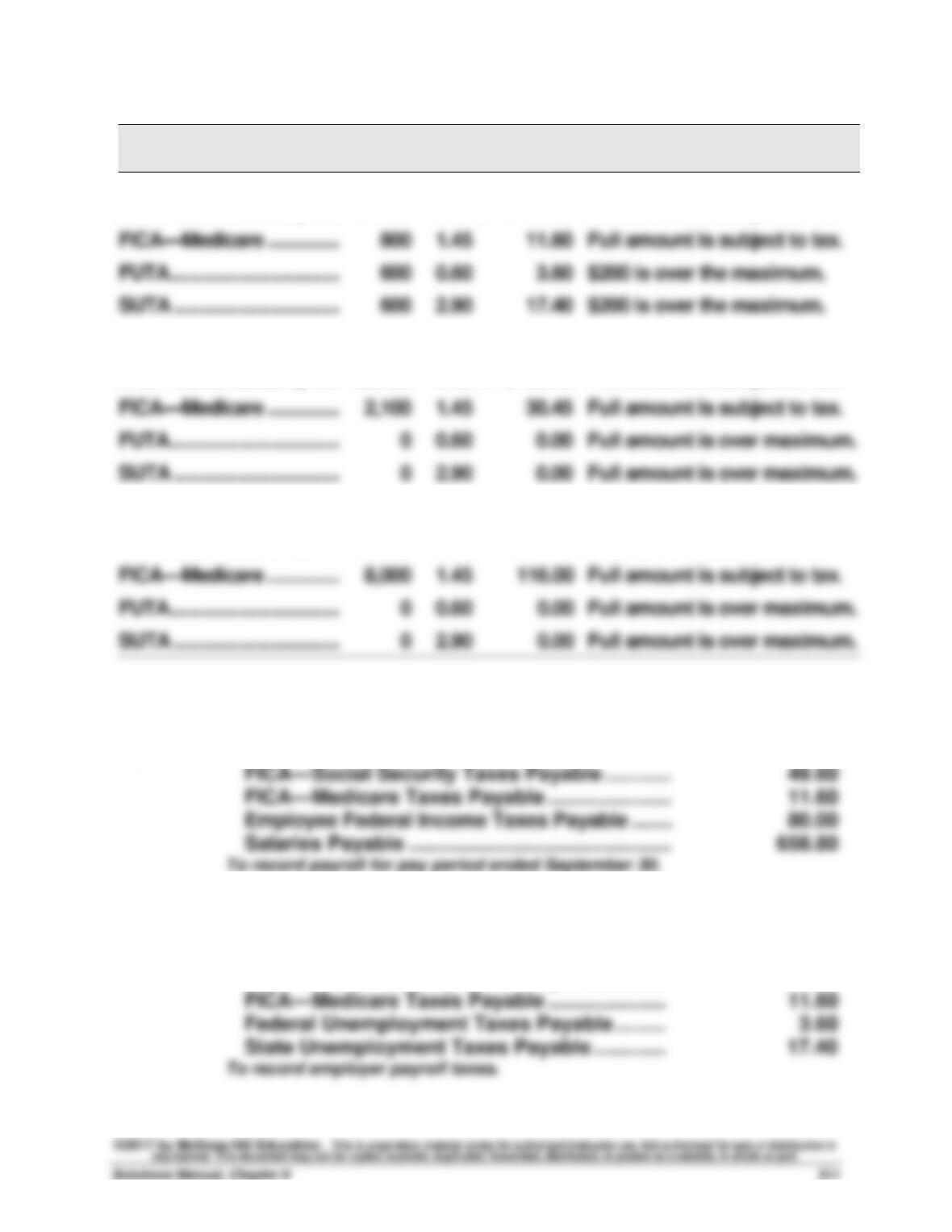
2.
Principal …………………………..…………………
$200,000
3.
Principal …………………………..…………………
$200,000
4a.
2016
4b.
2016
Notes Payable ………………………………………………….
Exercise 9-5 (20 minutes)
Subject
to Tax
Rate
Tax
Explanation
a.
FICA—Social Security ……
$ 800
6.20%
$ 49.60
Full amount is subject to tax.
SUTA …………………………….
b.
FICA—Social Security ……
$2,100
6.20%
$130.20
Full amount is subject to tax.
FICA—Medicare ……………
1.45
Full amount is subject to tax.
SUTA …………………………….
c.
FICA—Social Security ……
$6,300
6.20%
$390.60
$1,700 is over the maximum.
Exercise 9-6 (10 minutes)
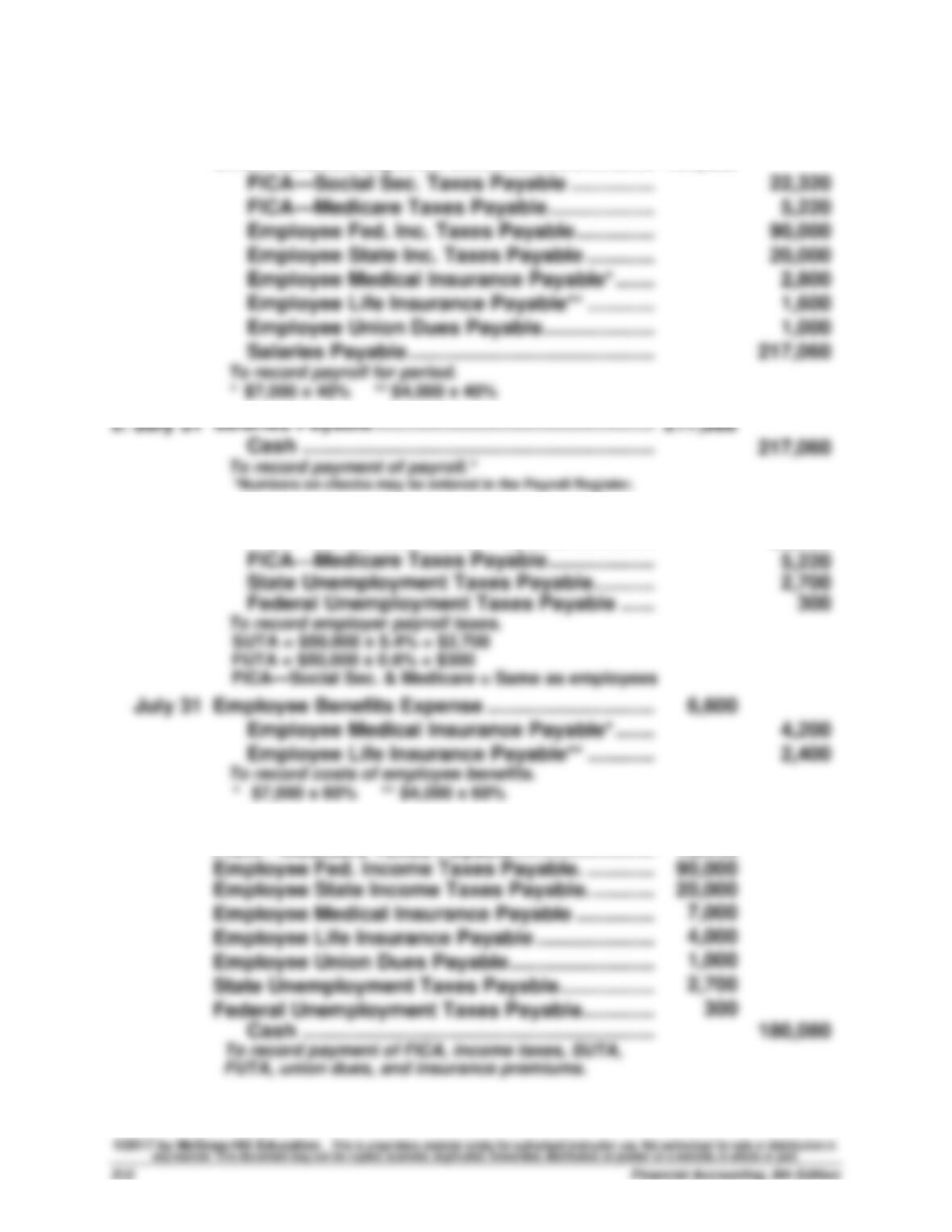
Sept. 30
Salaries Expense ……………………………………………..
800.00
FICA—Social Security Taxes Payable ………….
49.60
FICA—Medicare Taxes Payable …………………..
11.60
Employee Federal Income Taxes Payable ………
80.00
Salaries Payable …………………………………………
Exercise 9-7 (10 minutes)
Sept. 30
Payroll Taxes Expense ……………………………………..
82.20
FICA—Social Security Taxes Payable ………….
49.60
FICA—Medicare Taxes Payable …………………..
11.60
Federal Unemployment Taxes Payable ………..
State Unemployment Taxes Payable ……………
17.40
Exercise 9-8 (30 minutes)
1. July 31
Sales Salaries Expense …………………………………….
200,000
Office Salaries Expense ……………………………………
160,000
FICA—Social Sec. Taxes Payable ………………..
22,320
FICA—Medicare Taxes Payable ……………………
Employee Fed. Inc. Taxes Payable ……………….
90,000
Employee State Inc. Taxes Payable ……………..
20,000
Employee Medical Insurance Payable* …………
Employee Life Insurance Payable** ……………..
Employee Union Dues Payable …………………….
Salaries Payable ………………………………………….
217,060
2. July 31
217,060
3. July 31
Payroll Taxes Expense ……………………………………..
30,540
FICA⎯Social Sec. Taxes Payable ………………..
22,320
State Unemployment Taxes Payable…………….
Federal Unemployment Taxes Payable ………..
Employee Benefits Expense …………………………..
Employee Medical Insurance Payable* …………
Employee Life Insurance Payable** ……………..
4. July 31
FICA⎯Social Security Taxes Payable………………..
44,640
FICA⎯Medicare Taxes Payable …………………………
10,440
Employee Fed. Income Taxes Payable. ……………..
90,000
Employee Medical Insurance Payable ……………….
Employee Life Insurance Payable ……………………..
Employee Union Dues Payable ………………………….
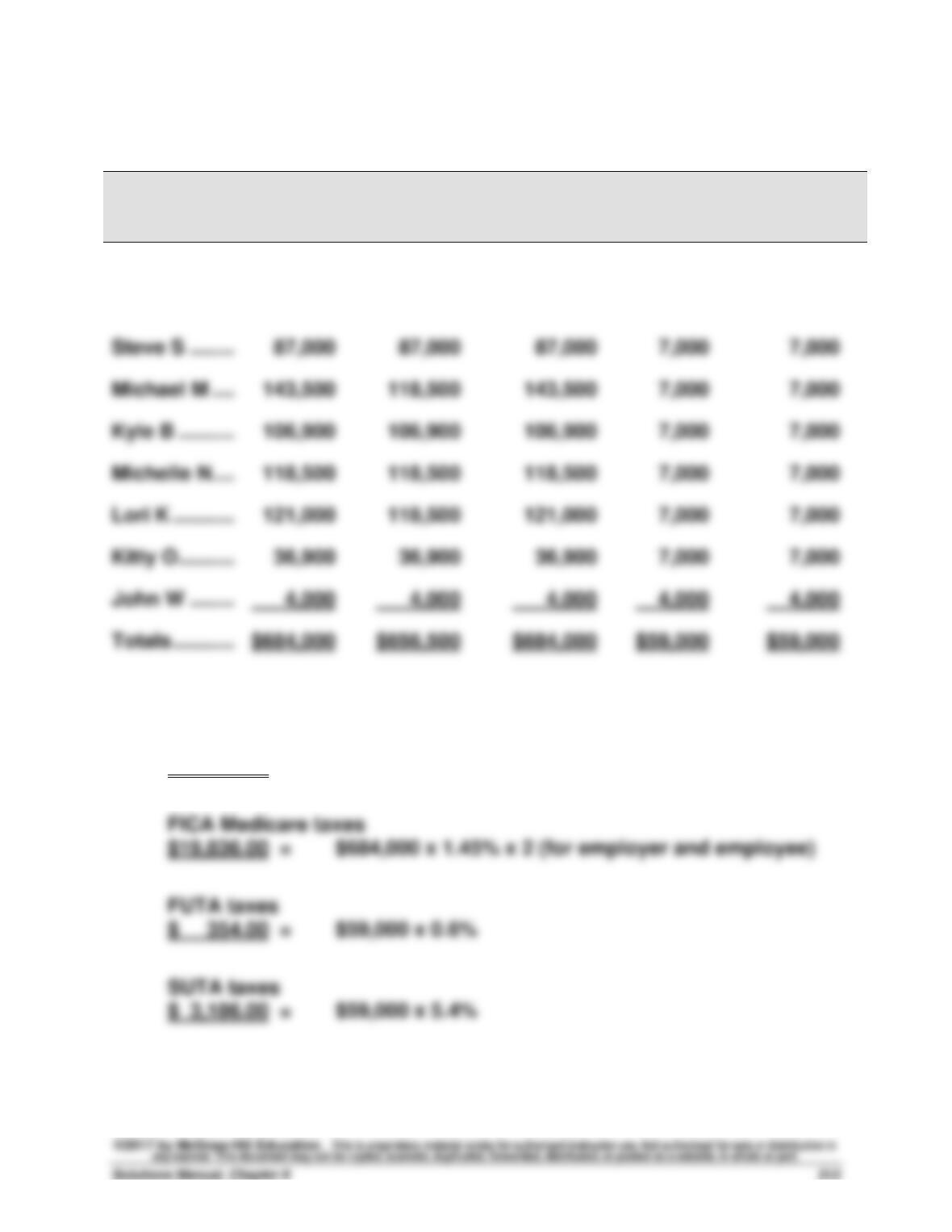
Exercise 9-9 (30 minutes)
a.
Employee
Cumulative
Pay
Pay Subject to
FICA Social
Security
Pay Subject
to FICA
Medicare
Pay Subject
to FUTA
Taxes
Pay Subject
to SUTA
Taxes
Ken S ……………….
$ 6,000
$ 6,000
$ 6,000
$ 6,000
$ 6,000
Tim V ………………..
60,200
60,200
60,200
7,000
7,000
Michael M …………
118,500
7,000
7,000
106,900
Michelle N …………
118,500
7,000
7,000
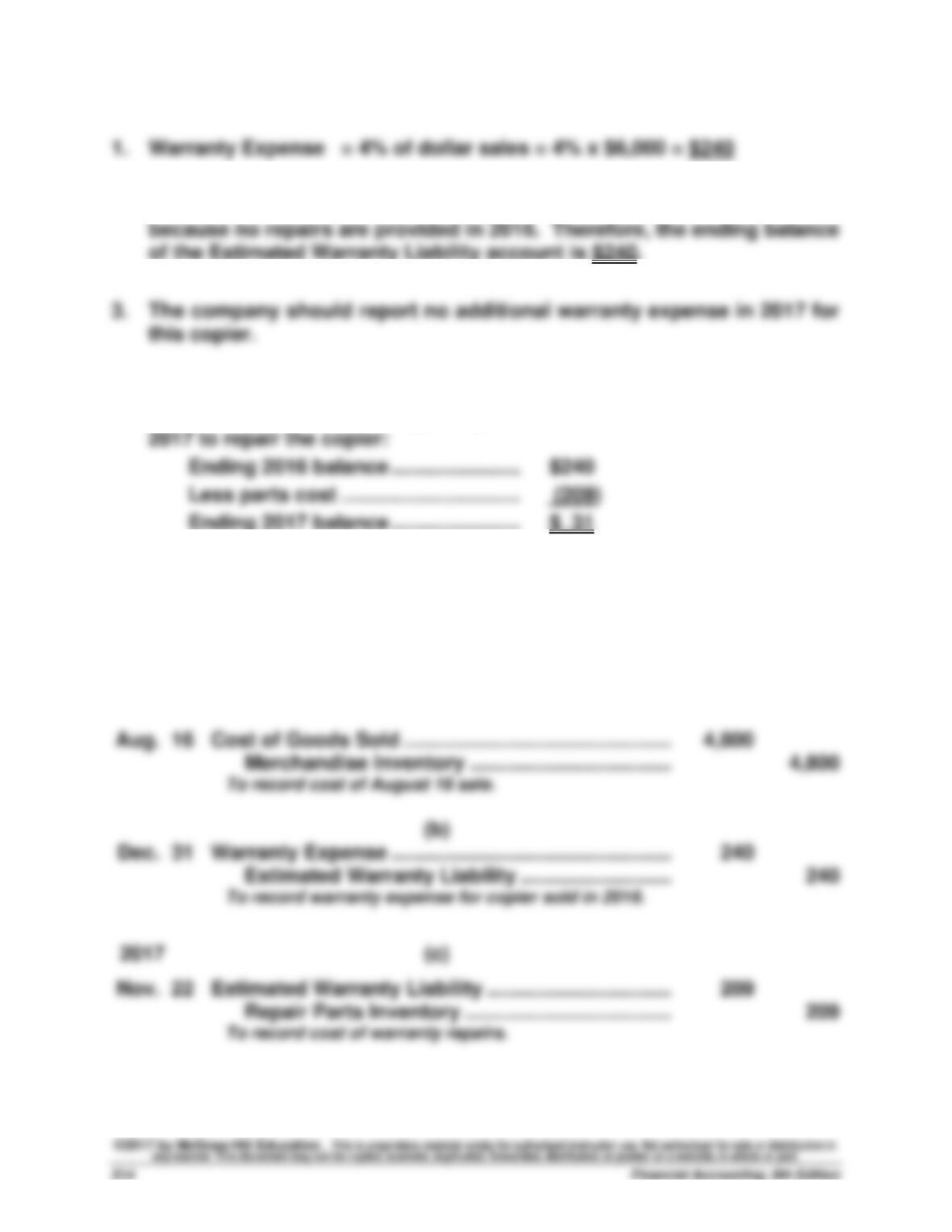
b. FICA Social Security taxes
$81,406.00 = $656,500 x 6.2% x 2 (for employer and employee)
Exercise 9-10 (25 minutes)
2. The December 31, 2016, balance of the liability equals the expense
4. The December 31, 2017, balance of the Estimated Warranty Liability
account equals the 2017 beginning balance minus the costs incurred in
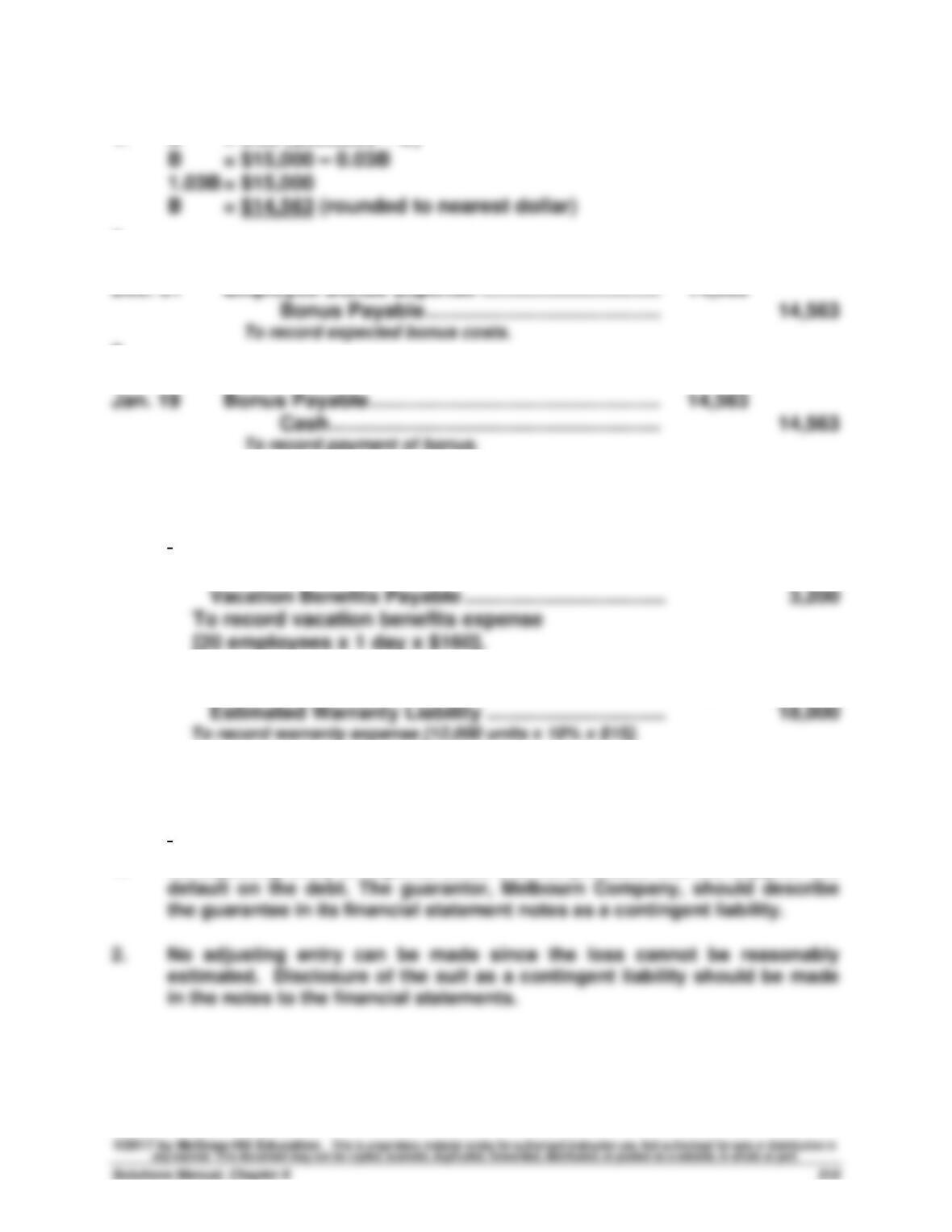
5. Journal entries
2016
(a)
Aug. 16
Cash ………………………………………………………………..
6,000
Sales ………………………………………………………….
6,000
To record cash sale of copier.
Aug. 16
4,800
Merchandise Inventory ……………………………….
4,800
To record cost of August 16 sale.
Warranty Expense ……………………………………………
Estimated Warranty Liability ……………………….
To record warranty expense for copier sold in 2016.
2017
(c)
Estimated Warranty Liability …………………………….
Repair Parts Inventory ………………………………..
To record cost of warranty repairs.
Exercise 9-11 (15 minutes)
1. B = 0.03 ($500,000 – B)
2.
2016
3.
2017
Exercise 9-12 (10 minutes)
[Note: All entries dated December 31, 2016.]
1.
Vacation Benefits Expense …………………………………….
3,200
2.
Warranty Expense………………………………………………….
18,000
Exercise 9-13 (10 minutes)
[Note: All entries dated December 31, 2016.]
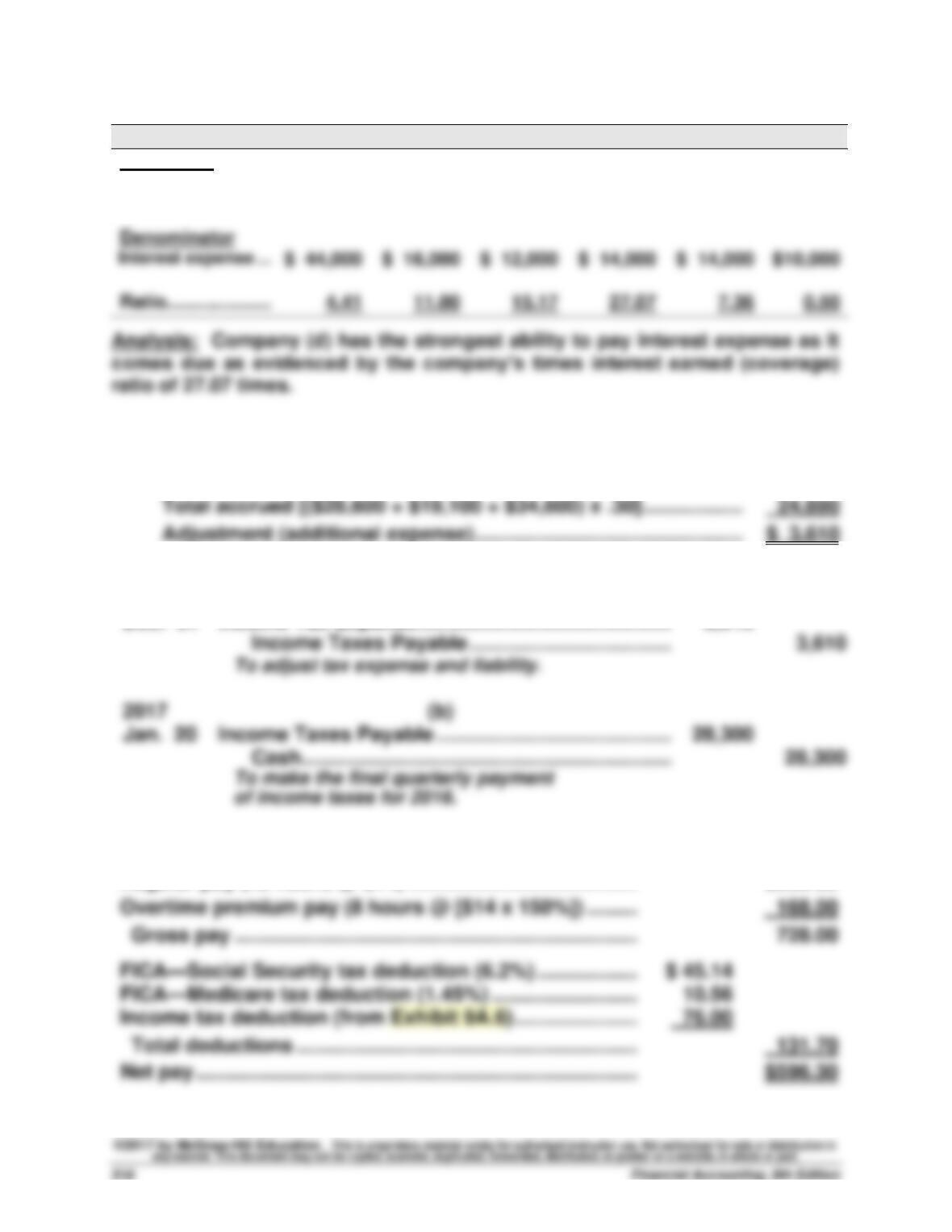
1. No adjusting entry is required since it is not probable that the supplier will
Exercise 9-14 (15 minutes)
(a)
(b)
(c)
(d)
(e)
(f)
Numerator
Income before
interest & taxes ….
$194,000
$176,000
$182,000
$379,000
$103,000
$ 5,000
Denominator
$ 44,000
$ 16,000
$ 12,000
$ 14,000
$ 14,000
Exercise 9-15B (25 minutes)
1.
Income Taxes Payable (target balance) ………………………………………..
$28,300
Total accrued [($28,600 + $19,100 + $34,600) x .30] ……………………….
24,690
Adjustment (additional expense) …………………………..……………………..
$ 3,610
2.
2016
(a)
Dec. 31
Income Tax Expense …………………………………………
3,610
2017
Jan. 20
Income Taxes Payable ………………………………………
Cash ……………………………………………………………
Exercise 9-16A (15 minutes)
Regular pay (40 hours @ $14) …………………………………….
$560.00
Overtime premium pay (8 hours @ [$14 x 150%]) ………..
Gross pay ……………………………………………………….……….
Income tax deduction (from Exhibit 9A.6) ……………………
Total deductions ………………………………………………………
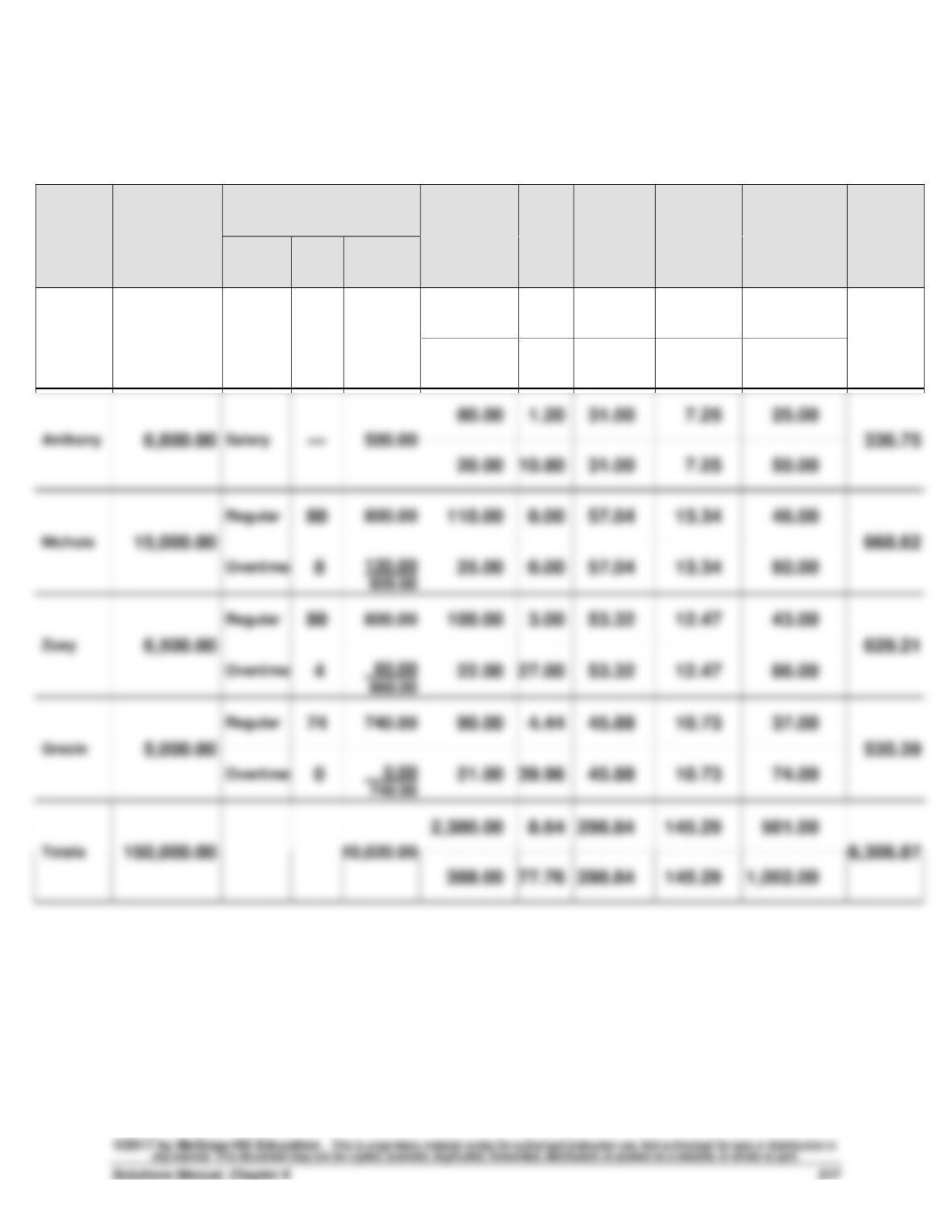
Exercise 9-17 (30 minutes)
(a)
Employee
Cumulative
Pay (Excludes
Current Period)
Current Period Gross Pay
FIT
Withholding
FUTA
FICA S.S.
Employee
FICA
Medicare
Employee
Employee—
Benefits Plan
Withholding
Employee
Net Pay
(Current
Period)
Pay
Type
Pay
Hours
Gross Pay
SIT
Withholding
SUTA
FICA S.S.
Employer
FICA
Medicare
Employer
Employer—
Benefits Plan
Expense
Kathleen
116,700.00
Salary
—
7,000.00
2,000.00
0.00
111.60
101.50
350.00
4,136.90
300.00
0.00
111.60
101.50
700.00
110.00
0.00
100.00
3.00
4.44
Totals
2,380.00
8.64
298.84
145.29
501.00
6,306.87
388.00
145.29
Exercise 9-17 (concluded)
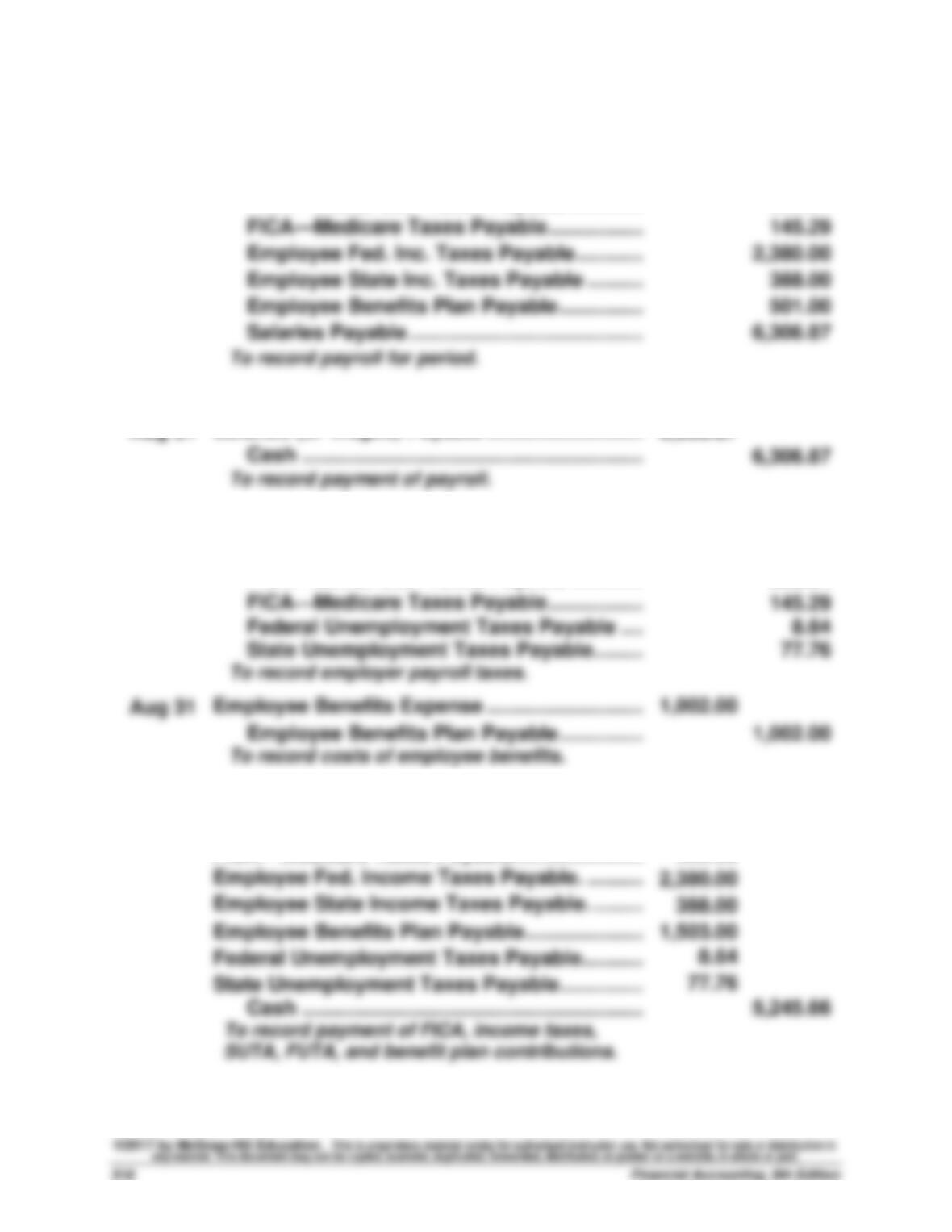
(b)
Aug 31
Salaries (or Wages) Expense …………………………..
10,020.00
FICA—Social Sec. Taxes Payable ………………..
298.84
FICA—Medicare Taxes Payable ……………………
145.29
Employee State Inc. Taxes Payable ……………..
388.00
Employee Benefits Plan Payable ………………….
501.00
Salaries Payable ………………………………………….
(c)
Aug 31
Salaries (or Wages) Payable …………………………..
6,306.87
(d)
Aug 31
Payroll Taxes Expense ……………………………………..
530.53
FICA⎯Social Sec. Taxes Payable ………………..
298.84
Federal Unemployment Taxes Payable ………..
State Unemployment Taxes Payable…………….
Aug 31
Employee Benefits Expense …………………………..
Employee Benefits Plan Payable ………………….
(e)
Aug 31
FICA⎯Social Security Taxes Payable………………..
597.68
FICA⎯Medicare Taxes Payable …………………………
290.58
Employee Fed. Income Taxes Payable. ……………..
2,380.00
Employee Benefits Plan Payable ……………………….
1,503.00
Cash ……………………………………………………….
Exercise 9-18 (25 minutes)
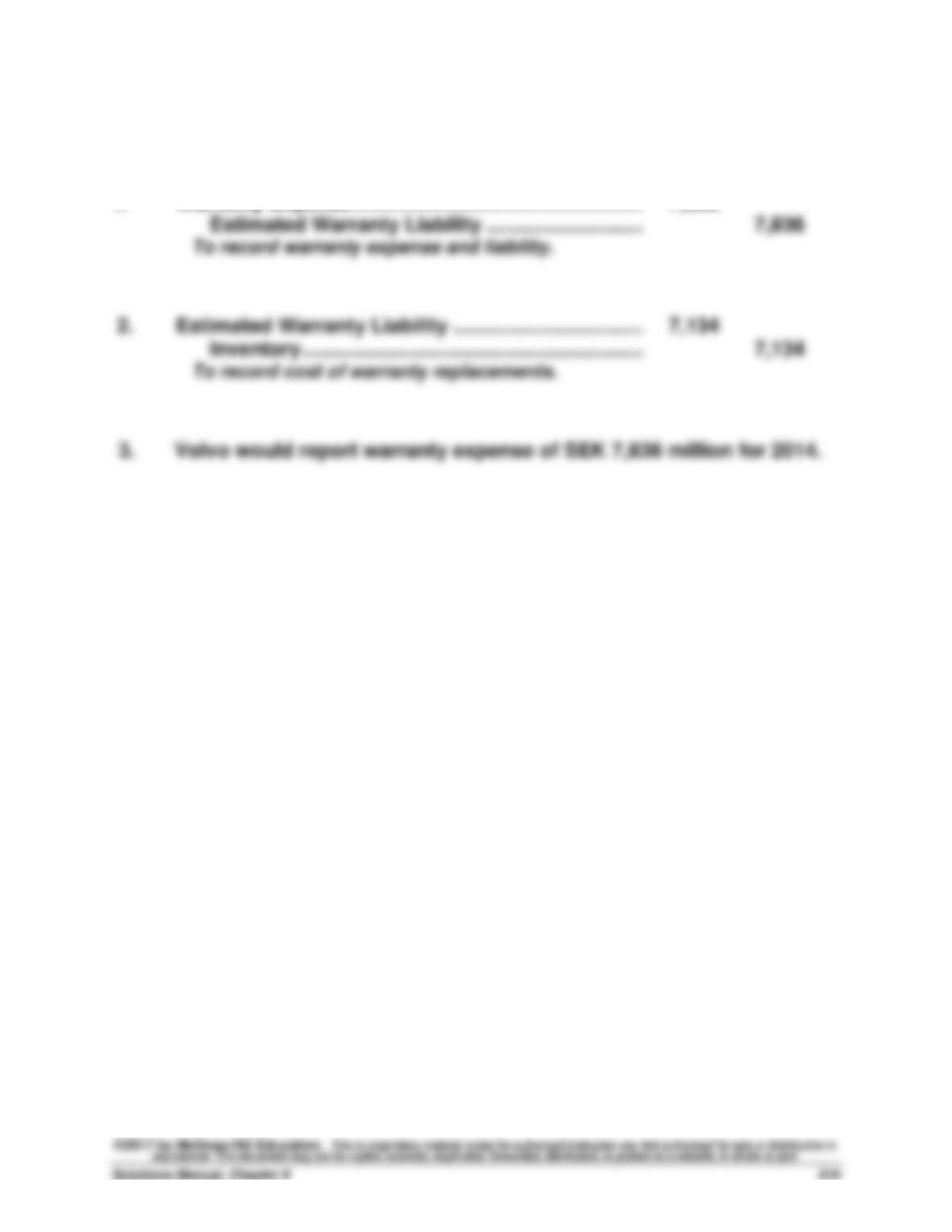
(in SEK millions)
1.
Warranty Expense…………………………………………….
7,836
Estimated Warranty Liability …………………………….
7,134
PROBLEM SET A
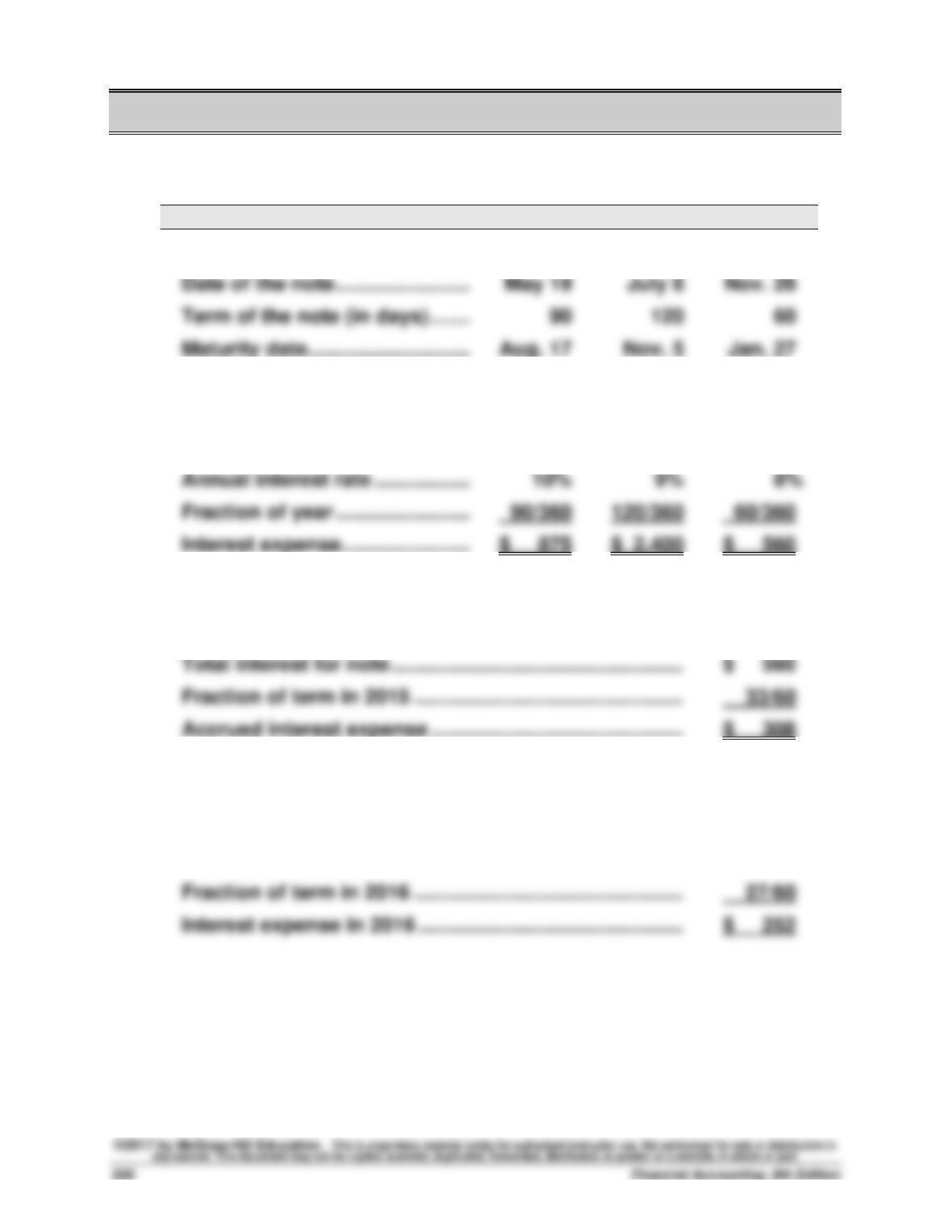
Problem 9-1A (45 minutes)
Loco
NBR Bank
Fargo Bank
1.
Maturity dates
Term of the note (in days) ………….
Maturity date …………………………..
2.
Interest due at maturity
Principal of the note ………………….
$35,000
$80,000
$42,000
120/360
$ 875
$ 2,400
$ 560
3.
Accrued interest on Fargo note at the end of 2015
Total interest for note …………………………………………….
$ 560
Accrued interest expense …………………………..………….
$ 308
4.
Interest on Fargo note in 2016
Total interest for note …………………………………………….
$ 560
$ 252
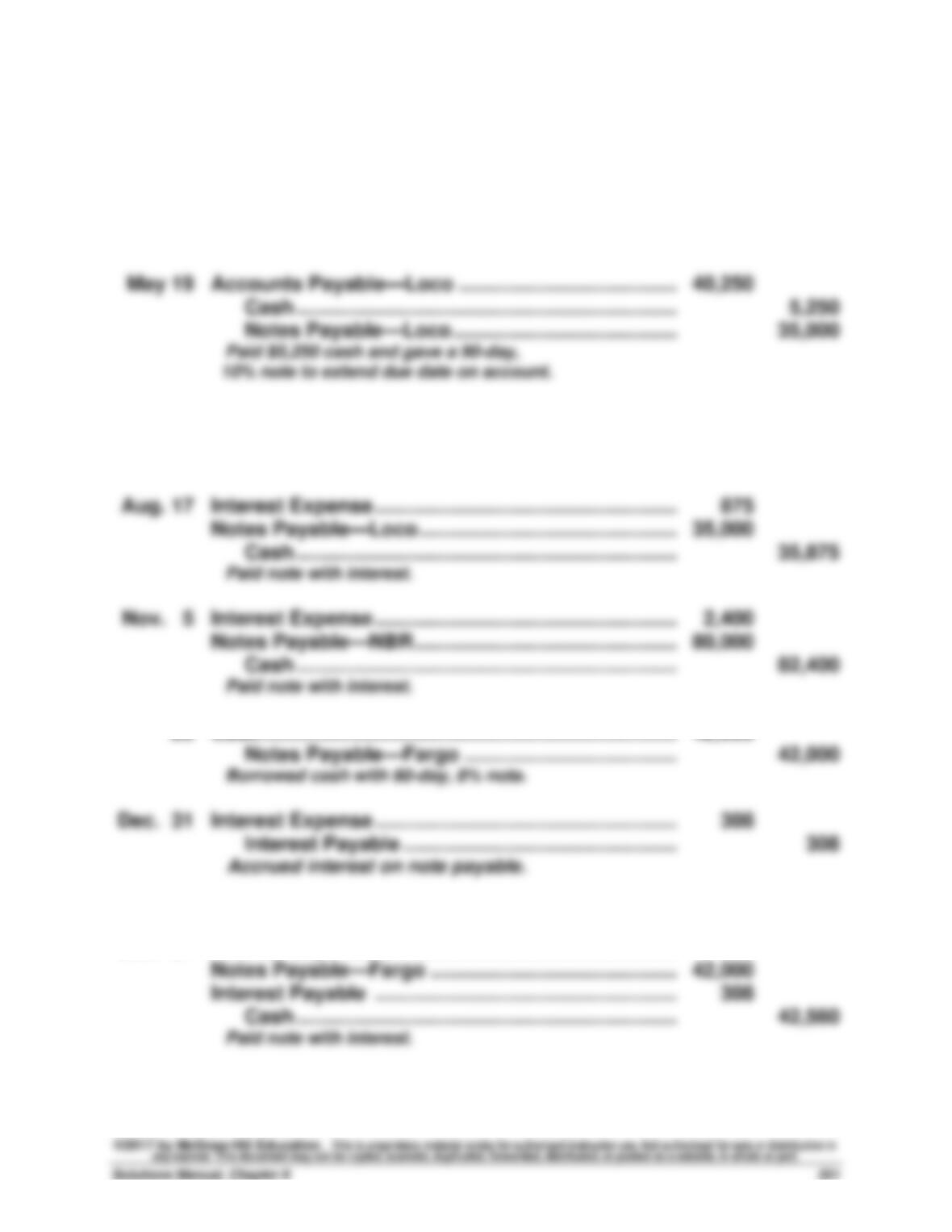
Problem 9-1A (Concluded)
5.
2015
Apr. 20
Merchandise Inventory …………………………………….
40,250
Accounts Payable—Loco …………………………...
40,250
Purchased merchandise on credit.
Accounts Payable—Loco …………………………………
40,250
Cash …………………………………………………………..
Notes Payable—Loco ………………………………….
35,000
July 8
Cash ………………………………………………………………..
80,000
Notes Payable—NBR …………………………………..
80,000
Borrowed cash with a 120-day, 9% note.
Interest Expense ………………………………………………
875
Notes Payable—Loco ……………………………………….
35,000
Cash …………………………………………………………..
35,875
Paid note with interest.
Interest Expense ………………………………………………
Cash …………………………………………………………..
82,400
Paid note with interest.
28
Cash ………………………………………………………………..
42,000
Notes Payable—Fargo ………………………………..
42,000
Borrowed cash with 60-day, 8% note.
Interest Expense ………………………………………………
308
Interest Payable ………………………………………….
2016
Jan. 27
Interest Expense ………………………………………………
252
Notes Payable—Fargo ……………………………………..
42,000
Interest Payable ………………………………………………
308
Cash …………………………………………………………..
42,560
Paid note with interest.
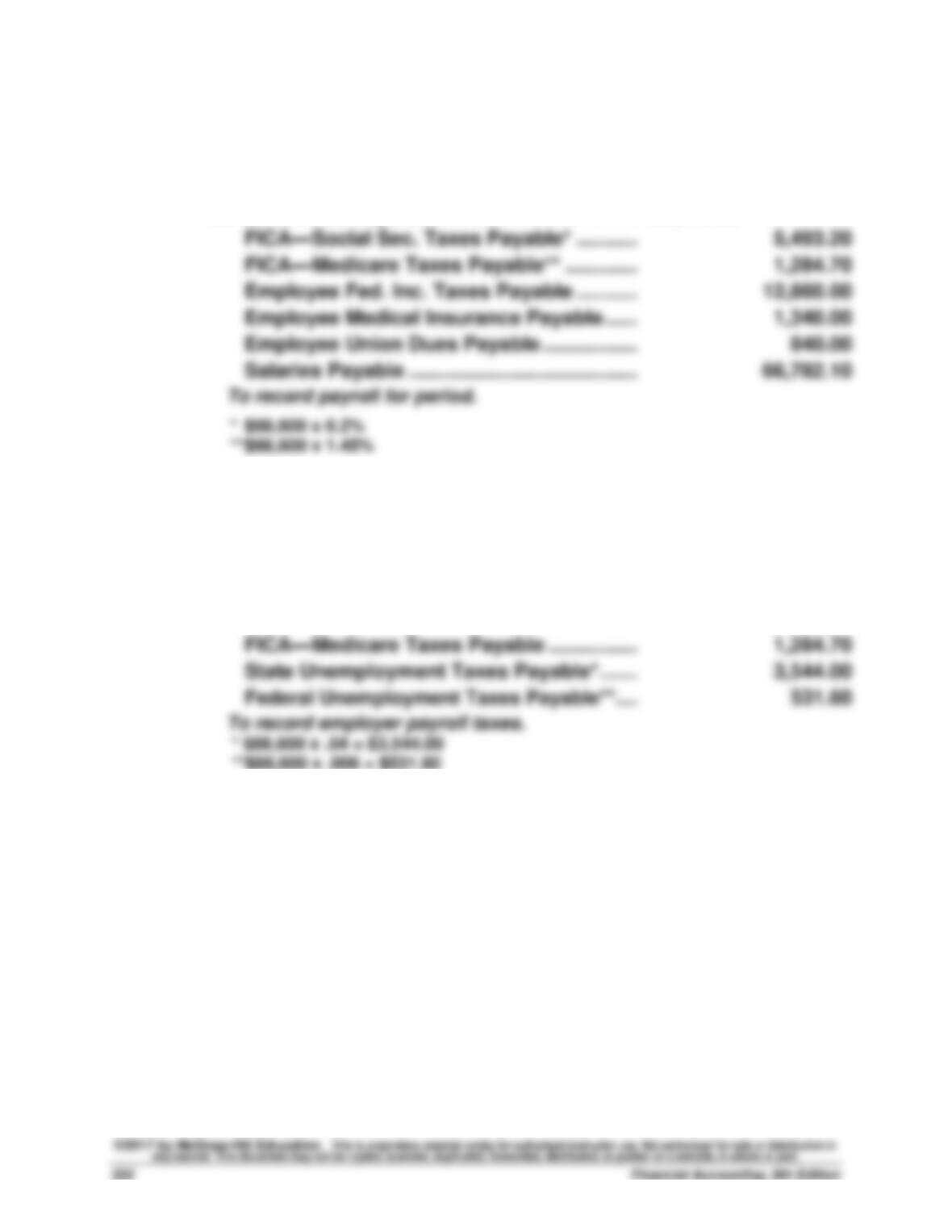
Problem 9-2A (25 minutes)
Part 1
Jan. 8
Office Salaries Expense ……………………………………
22,760.00
Sales Salaries Expense …………………………………….
65,840.00
FICA—Social Sec. Taxes Payable* ………………
5,493.20
FICA—Medicare Taxes Payable** ………………..
Employee Fed. Inc. Taxes Payable ………………
12,860.00
Employee Medical Insurance Payable ………….
Employee Union Dues Payable ……………………
Salaries Payable …………………………………………
66,782.10
Part 2
Jan. 8
Payroll Taxes Expense ……………………………………..
10,853.50
FICA—Social Sec. Taxes Payable ………………..
5,493.20
FICA—Medicare Taxes Payable …………………..
State Unemployment Taxes Payable* …………..
Federal Unemployment Taxes Payable** ………..
**$88,600 x .006 = $531.60