Chapter 5
Communicating and Interpreting
Accounting Information
ANSWERS TO QUESTIONS
1. The primary responsibility for the accuracy of the financial records and conformance
with Generally Accepted Accounting Principles (GAAP) in the financial statements
rests with management, normally the CEO and CFO. Independent auditors or
2. Financial analysts, who normally work for brokerage and investment banking
houses, mutual fund companies, and investment advisory services, gather
3. Information services provide a wide variety of financial and nonfinancial information
4. A material amount is an amount that is large enough to influence a user’s decision.
5. a. Income statement—Accrual basis required by GAAP.
6. Private companies normally issue quarterly and annual reports, both of which are
7. Public companies issue quarterly press releases, quarterly reports, and annual
reports to shareholders and Forms 10-Q (quarterly reports), 10-K (annual reports),
and 8-K (special events) reports to the SEC. Press releases include a summary of
the quarterly report information and are the first announcement of quarterly financial
information. The quarterly reports normally present unaudited summary income
8. The four major subtotals or totals on the income statement are: (a) gross profit, (b)
income from operations, (c) income before income taxes, and (d) net income.
9. The six major classifications on the balance sheet are: (a) current assets, (b)
10. Property, plant, and equipment are reported on the balance sheet. Property, plant,
and equipment are those assets held by the business not for resale but for use in
operating the business, such as a delivery truck. (a) Property, plant, and equipment
are reported at their acquisition cost which represents the amount of resources
11. The major classifications of stockholders’ equity are: (1) common stock and
Financial Accounting, 10/e 5-3
12. The three major classifications on the Statement of Cash Flows are (a) cash from
13. The three major categories of notes to the financial statements are: (1) descriptions
of accounting rules applied to the company’s statements, often called significant
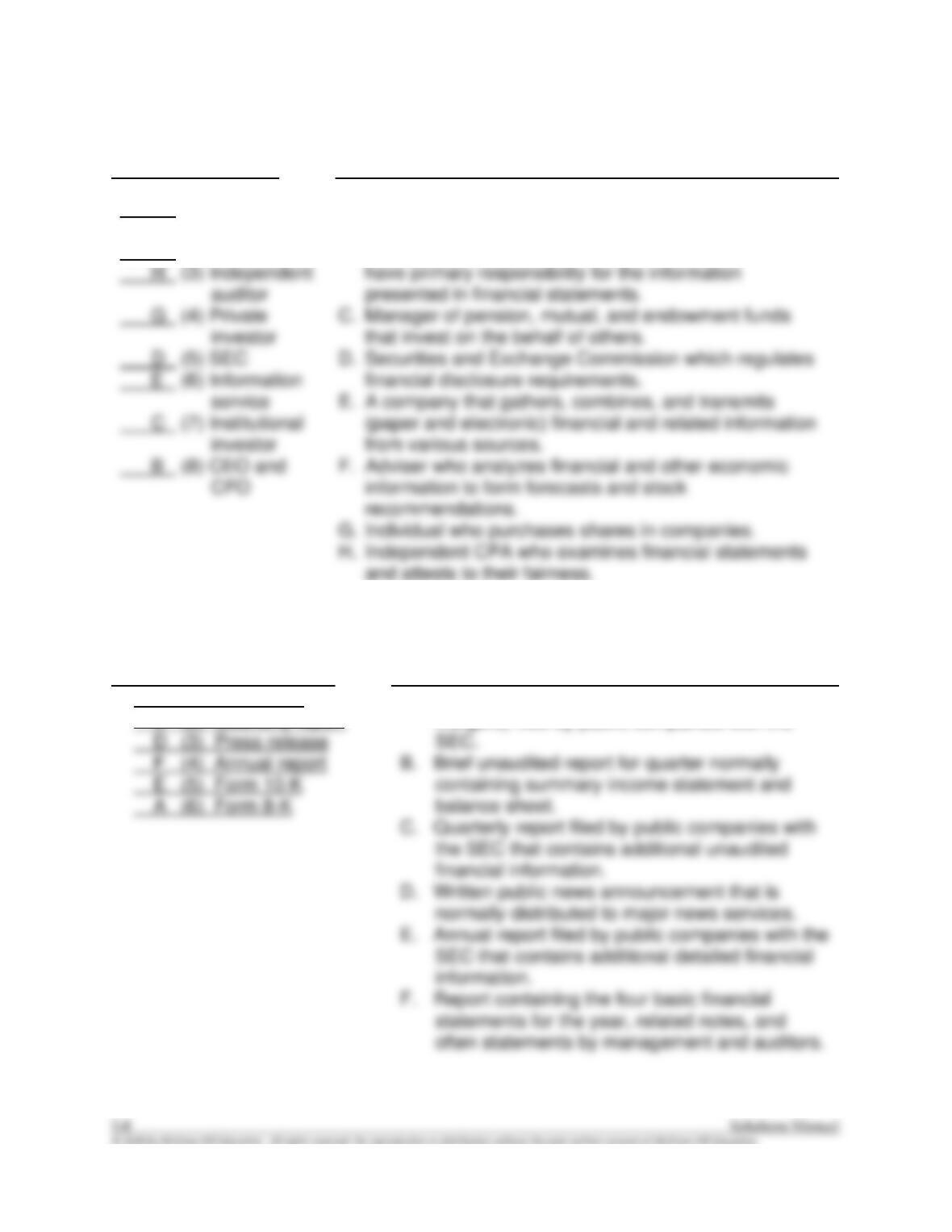
14. Return on assets (ROA) is a ratio measure defined as net income divided by
average total assets. It measures how much the firm earned for each dollar of
ANSWERS TO MULTIPLE CHOICE
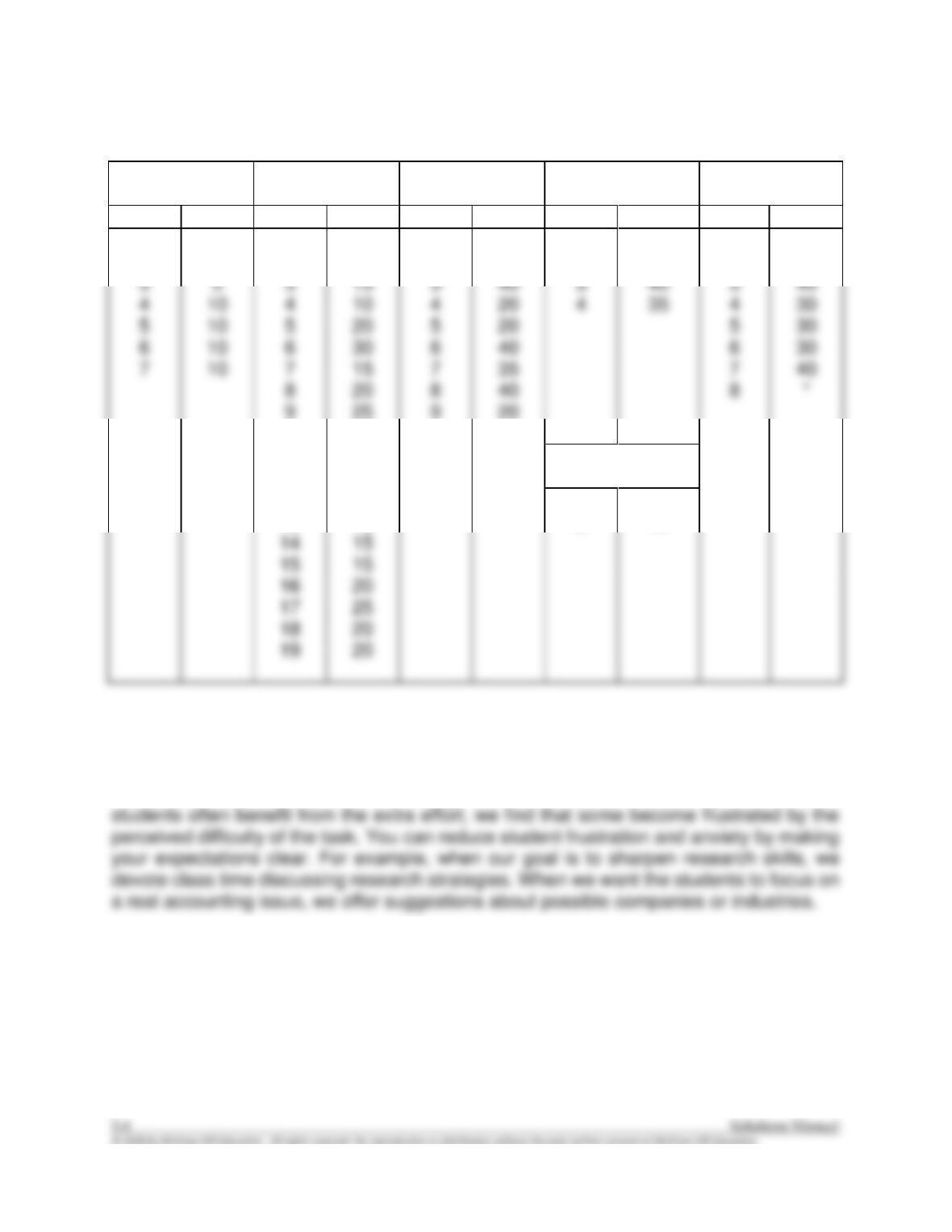
Authors’ Recommended Solution Time
(Time in minutes)
Mini-exercises
Exercises
Problems
Alternate
Problems
Cases and
Projects
No.
Time
No.
Time
No.
Time
No.
Time
No.
Time
1
5
1
10
1
30
1
40
1
30
2
5
2
10
2
20
2
20
2
30
3
5
3
15
3
40
3
40
3
40
4
10
4
10
4
20
4
35
4
30
5
10
5
20
5
20
5
30
6
10
6
30
6
40
6
30
7
10
7
15
7
35
7
40
8
20
8
40
8
9
25
9
20
10
25
11
25
Continuing
Problem
12
12
1
45
13
15
2
45
14
15
15
15
16
20
17
25
18
20
19
20
* Due to the nature of these cases and projects, it is very difficult to estimate the amount
of time students will need to complete the assignment. As with any open-ended project,
it is possible for students to devote a large amount of time to these assignments. While
MINI-EXERCISES
M5-1.
Players
Definitions
____D____ (1) Independent auditor
A. Adviser who analyzes financial and other economic
M5-2.
No.
Title
____3_____
Form 10-K
____1_____
Earnings press release
____2_____
Annual report
M5–3.
Elements of
Financial Statements Financial Statements
A (1) Expenses A. Income statement
M5–4.
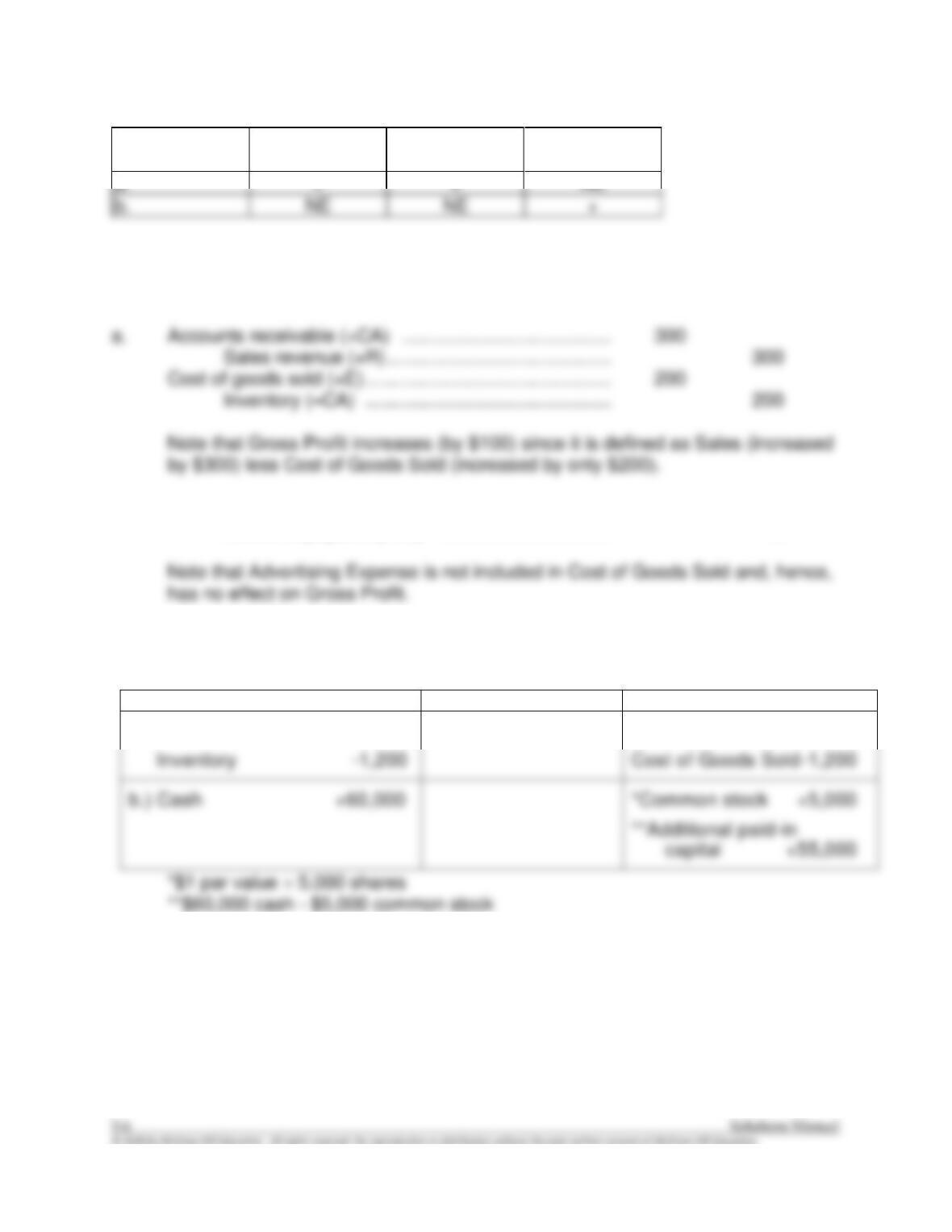
Transaction
Current
Assets
Gross Profit
Current
Liabilities
The effects of the transactions can be seen by making the related journal entries and
using CA, CL, R, and E to denote current asset, current liability, revenue, and expense,
respectively.
b. Advertising expense (+E) …………………………………… 10
Accounts payable (+CL) …………………………... 10
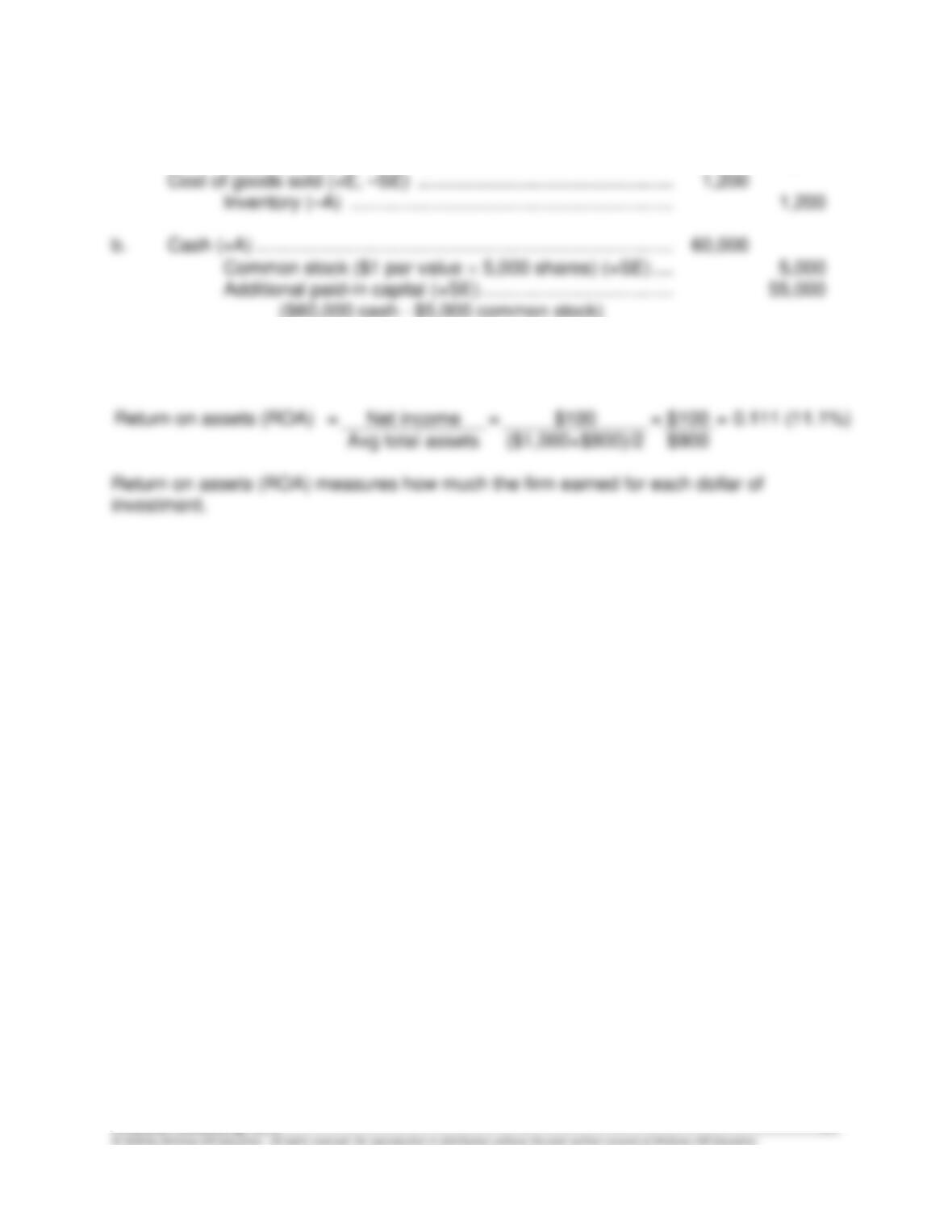
M5–5.
Assets
Liabilities
Stockholders’ Equity
a.) Accounts Receivable +1,800
Sales Revenue +1,800
Financial Accounting, 10/e 5-7
M5–6.
a. Accounts receivable (+A) ……………………………………………….. 1,800
Sales revenue (+R, +SE) ……………………………………… 1,800
M5–7.
EXERCISES
E5-1.
Players Definitions
F (1) Financial
analyst
A (2) Creditor
A. Financial institution or supplier that lends money to the
company.
B. Chief Executive Officer and Chief Financial Officer who
E5–2.
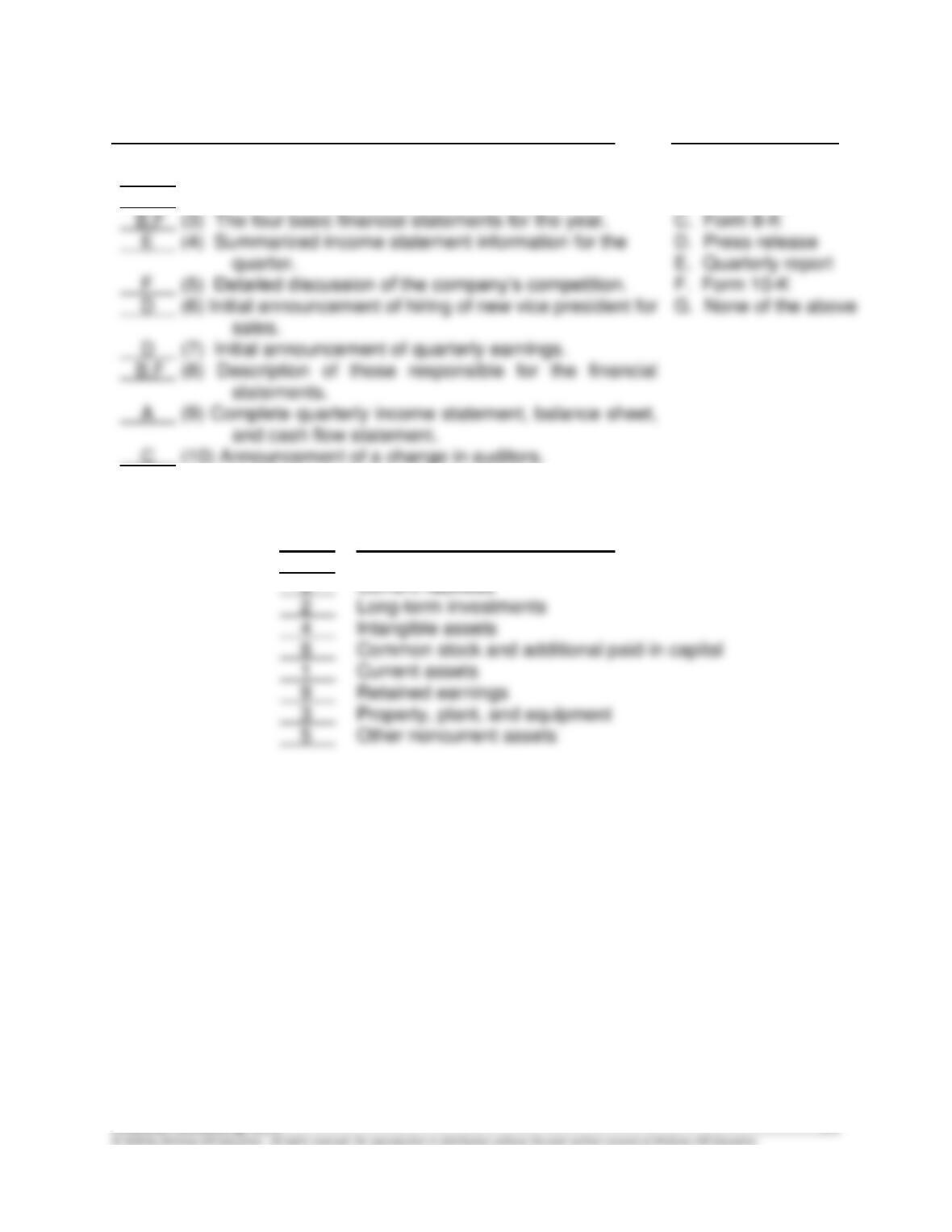
Information Release Definitions
C (1) Form 10-Q
B (2) Quarterly report
A. Report of special events (e.g., auditor changes,
mergers) filed by public companies with the
Financial Accounting, 10/e 5-9
E5–3.
Information Item Report
B,F (1) Summarized financial data for 5-year period.
B,F (2) Notes to financial statements.
A. Form 10-Q
B. Annual report
E5–4.
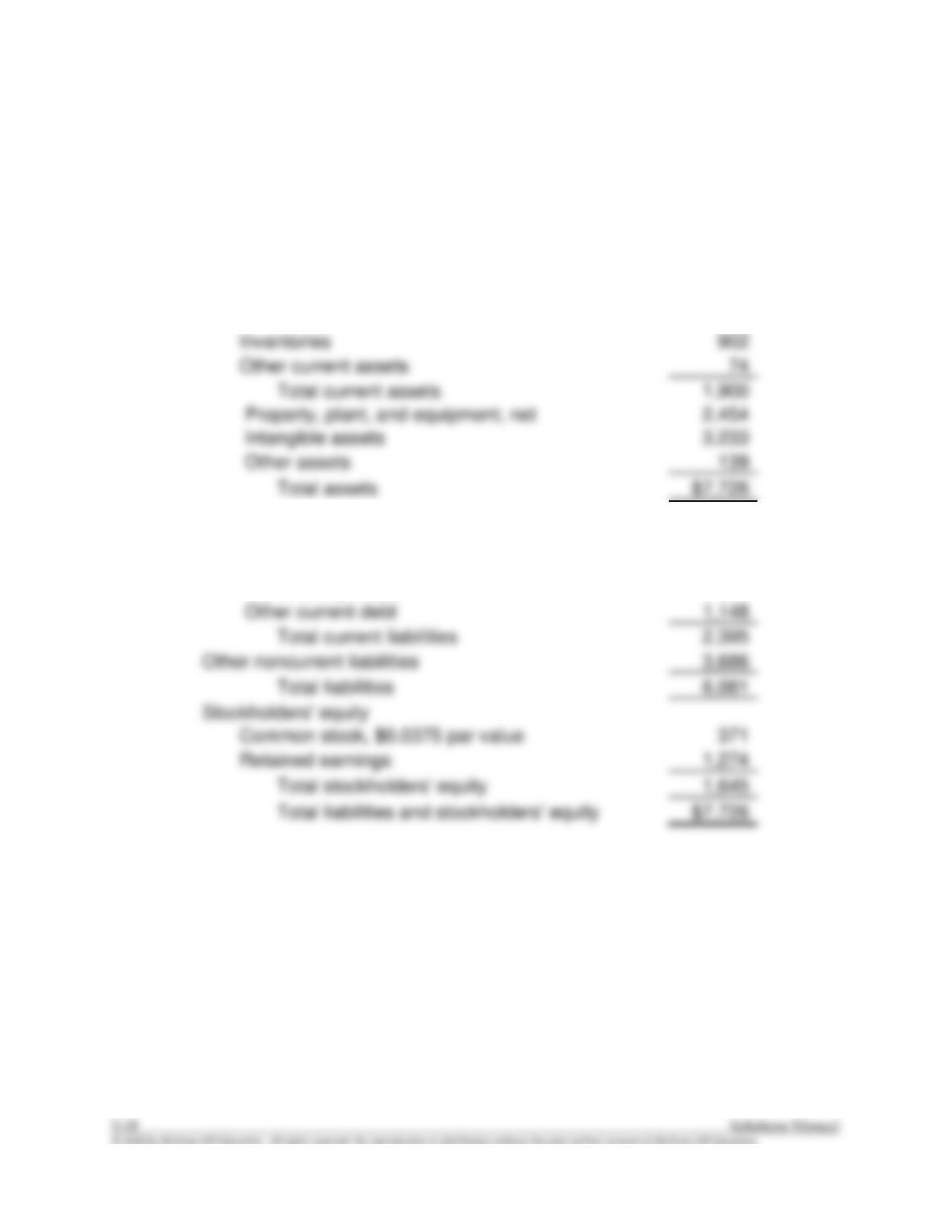
No. Title
7 Long-term liabilities
E5–5.
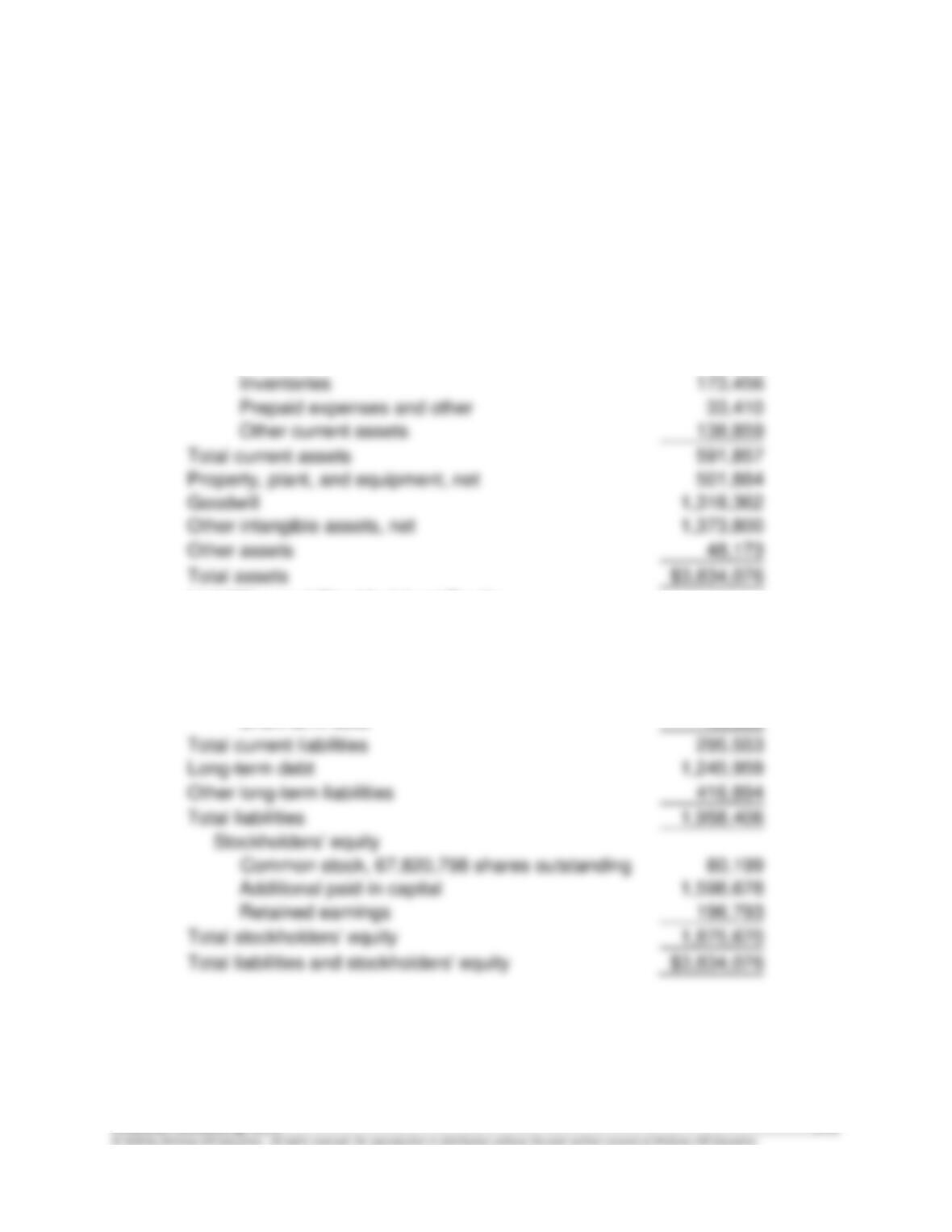
Campbell Soup Company
Consolidated Balance Sheet
July 31, Current Year
(in millions)
Assets
Current assets
Cash and cash equivalents
$ 319
Accounts receivable
605
Inventories
902
Other current assets
Property, plant, and equipment, net
Intangible assets
Other assets
139
$7,726
Liabilities and Stockholders’ Equity
Current liabilities
Accounts payable
$ 666
Accrued expenses
581
Other current debt
Other noncurrent liabilities
Stockholders’ equity
Common stock, $0.0375 par value
Retained earnings
$7,726
Financial Accounting, 10/e 5-11
E5–6.
Req. 1.
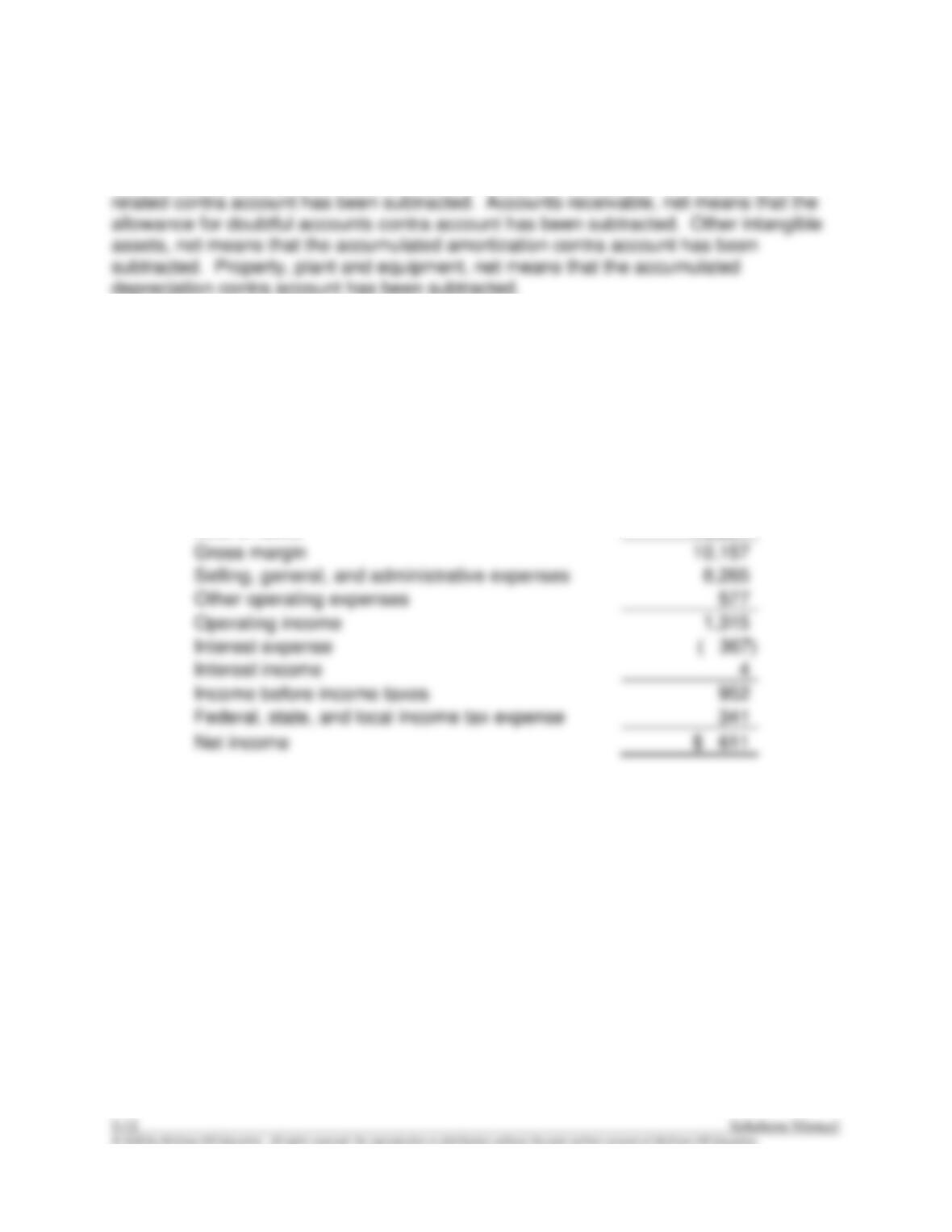
Snyder’s-Lance
Consolidated Balance Sheet
December 31, Current Year
(in millions)
Assets
Current assets
Cash and cash equivalents
$ 35,409
Accounts receivable, net
210,723
Inventories
173,456
Prepaid expenses and other
33,410
Other current assets
138,859
Total current assets
591,857
Property, plant, and equipment, net
501,884
Goodwill
Other intangible assets, net
Other assets
48,173
Total assets
Liabilities and Stockholders’ Equity
Current liabilities
Accounts payable
$ 99,249
Accrued compensation
44,901
Other payables and accrued liabilities
102,403
Short-term debt
49,000
Total current liabilities
295,553
Long-term debt
Other long-term liabilities
416,894
Total liabilities
Stockholders’ equity
Common stock, 67,820,798 shares outstanding
80,199
Additional paid-in capital
Retained earnings
196,793
Total stockholders’ equity
Total liabilities and stockholders’ equity
E5–6. (continued)
Req. 2.
In each case, the term “net” means that the account is reported after the balance in the
E5-7.
Macy’s, Inc.
Consolidated Statement of Income
For the Year Ended February 1, Current Year
(in millions)
Net sales
$25,778
Cost of sales
15,621
Gross margin
10,157
Selling, general, and administrative expenses
Other operating expenses
Operating income
Interest expense
Interest income
Income before income taxes
Federal, state, and local income tax expense
Net income
Financial Accounting, 10/e 5-13
E5-8.
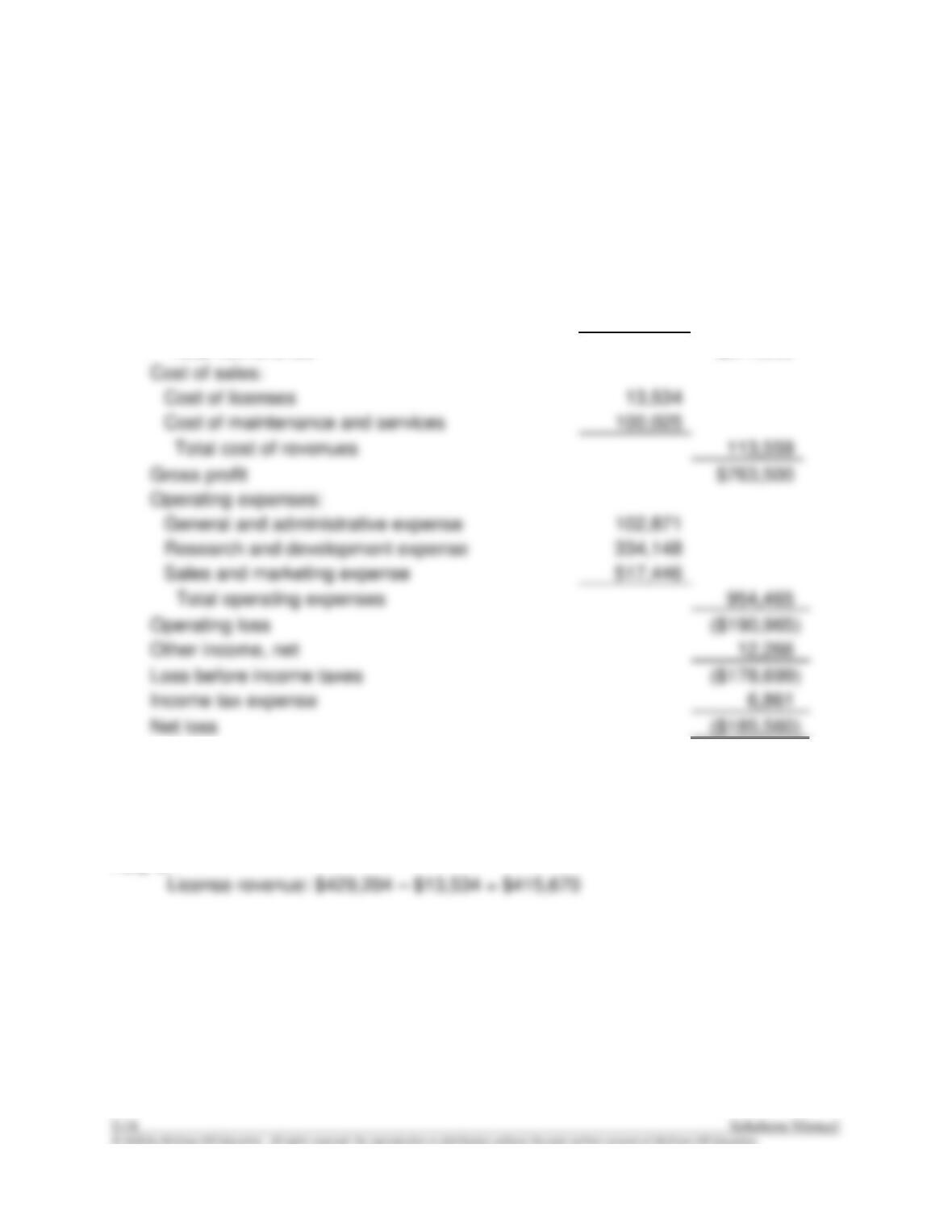
TOWNSHIP CORPORATION
Income Statement
For the Year Ended December 31, Current Year
Computations in Order
Sales revenue ………………………….. Given $85,000
Cost of goods sold…………………….. (a) $85,000 – $30,000 55,000
Gross profit ………………………………. Given 30,000
E5-9.
Req. 1.
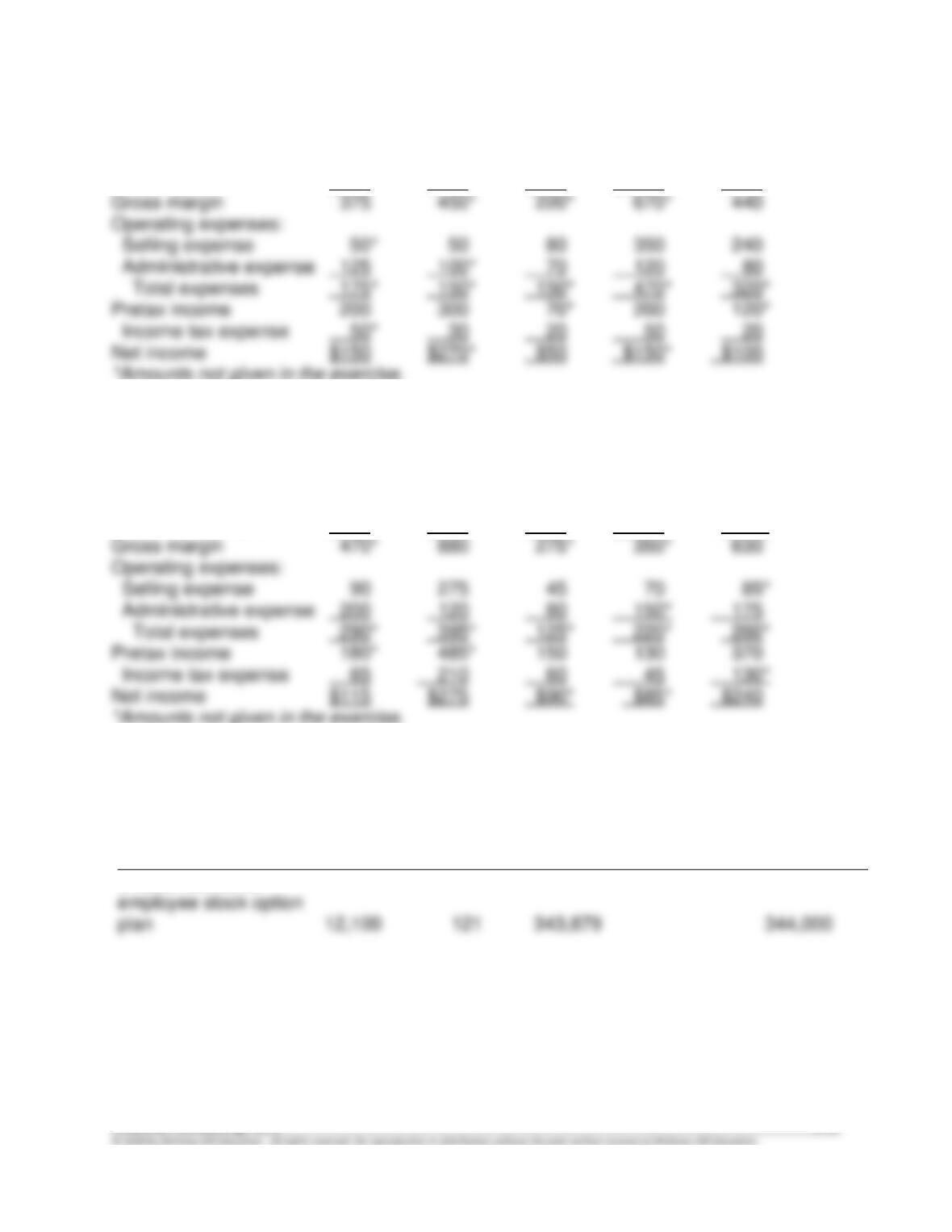
Tableau Software
Consolidated Statement of Income
For Year Ended December 31, Current Year
(In thousands, except per share amounts)
Net revenues
License revenue
$429,204
Maintenance and services revenue
447,855
Total net revenue
$877,059
13,534
100,025
Gross profit
$763,500
Operating expenses:
102,871
334,148
517,446
Operating loss
Other income, net
12,266
Loss before income taxes
Income tax expense
Net loss
Net earnings per share
($2.35)
Weighted average shares outstanding
78,869
Req. 2.
Financial Accounting, 10/e 5-15
E5–10.
Case A Case B Case C Case D Case E
Sales revenue $800 $600 $500 $1,170* $760*
Cost of goods sold 425* 150 280* 500 320
E5–11.
Case A Case B Case C Case D Case E
Sales revenue $770 $1,200* $400* $600 $1,050
Cost of goods sold 300* 320 125 250 420*
E5–12.
Common Stock
Additional
Paid-in
Retained
Total
Stockholders’
Shares
Amount
Capital
Earnings
Equity
Shares issued for
E5–13.
Req. 1.
Beginning RE + Net income – Dividends = Ending RE
Req. 2.
E5-14.
Transaction
Current
Assets
Gross Profit
Current
Liabilities
a.
+$2,449.3
+$2,449.3
NE
b.
NE
NE
NE
The effects of the transactions can be seen by making the related journal entries and
using CA, CL, R, and E to denote current asset, current liability, revenue, and expense,
respectively.
a. Accounts receivable (+CA) …………………………………. 4,285.6
Sales revenue (+R) ……………………………………. 4,285.6
Financial Accounting, 10/e 5-17
E5-15.
Transaction
Current
Assets
Gross Profit
Current
Liabilities
Cash Flow from
Operating Activities
a.
NE
NE
NE
+ 40.8
b.
– 5.6
NE
– 5.6
NE
The effects of the transactions can be seen by making the related journal entries and
using CA and CL to denote current asset and current liability, respectively.
E5-16.
AVALOS CORPORATION
Statement of Cash Flows
For the Year Ended December 31, Current Year
From Operating Activities
Net income ……………………………………………………….. $25,000
Increase in accounts receivable …………………………... (9,000)
From Financing Activities
Borrowed cash on three-year note ………………………… 30,000
Issued stock for cash ………………………………………….. 24,000
Cash flows from financing activities …………………… 54,000
E5-17.
Req. 1.
Current
Year
Prior
Year
Net Income (given)
$2,298,234 = 0.189
$2,277,658 = 0.203
Req. 2.
ROA Analysis
Current
Year
Prior
Year
Net Income
Net Sales
$2,298,234 = 0.0693
$33,183,744
$2,277,658 = 0.0736
$30,944,938
Average Total Assets
$12,187,120
Return on Assets
E5-18.
Req. 1.
Current
Year
Prior
Year
Net Income (given)
$59,387 = 0.147
$55,425 = 0.141
Req. 2.
Security analysts would be more likely to increase their estimates of share value on the
E5–19
a. Notes payable (long-term) (–L) ……………………………. 2,000
Cash (–A) ……………………………………………….. 2,000
PROBLEMS
P5–1.
P5–2.
P (1) Capital in excess of par B (11) Current liabilities
E (2) Assets C (12) Long-term liabilities