Chapter 5
Financial Analysis
Discussion Questions
1. Which of the following types of firms do you expect to have particularly high or low asset turnover?
Explain why.
Supermarket—High asset turnover. Supermarkets tend to be high volume businesses. Many of the
Pharmaceutical Company—High asset turnover. Drugs typically have a limited shelf life. Once
past their expiration date, drugs cannot be sold and are worthless. Consequently, pharmaceutical
Jewelry Retailer—Low asset turnover. Jewelry is typically durable, expensive, and infrequently
Steel Company—Low asset turnover. Production of steel is extremely asset intensive. A steel
2. Which of the following types of firms do you expect to have high or low sales margins? Why?
Supermarket—Low margins. Competition in the supermarket industry is very intense. Different
2 Instructor’s Manual
Pharmaceutical Company—High sales margins. Drugs manufactured by pharmaceutical
companies are often protected from competition by patents, allowing them to charge monopoly
Jewelry Retailer—High sales margins. Jewelry is a differentiated product where the typical buyer
Software Company—High sales margins. Margins are high for several reasons:
1. There are relatively high switching costs for consumers learning a new system.
3. James Broker, an analyst with an established brokerage firm, comments: “The critical number I look
at for any company is operating cash flow. If cash flows are less than earnings, I consider a company to
be a poor performer and a poor investment prospect.” Do you agree with this assessment? Why or why
not?
Disagree. Operating cash flows and earnings numbers are both important in evaluating the
diminished.
Chapter 5 Financial Analysis 3
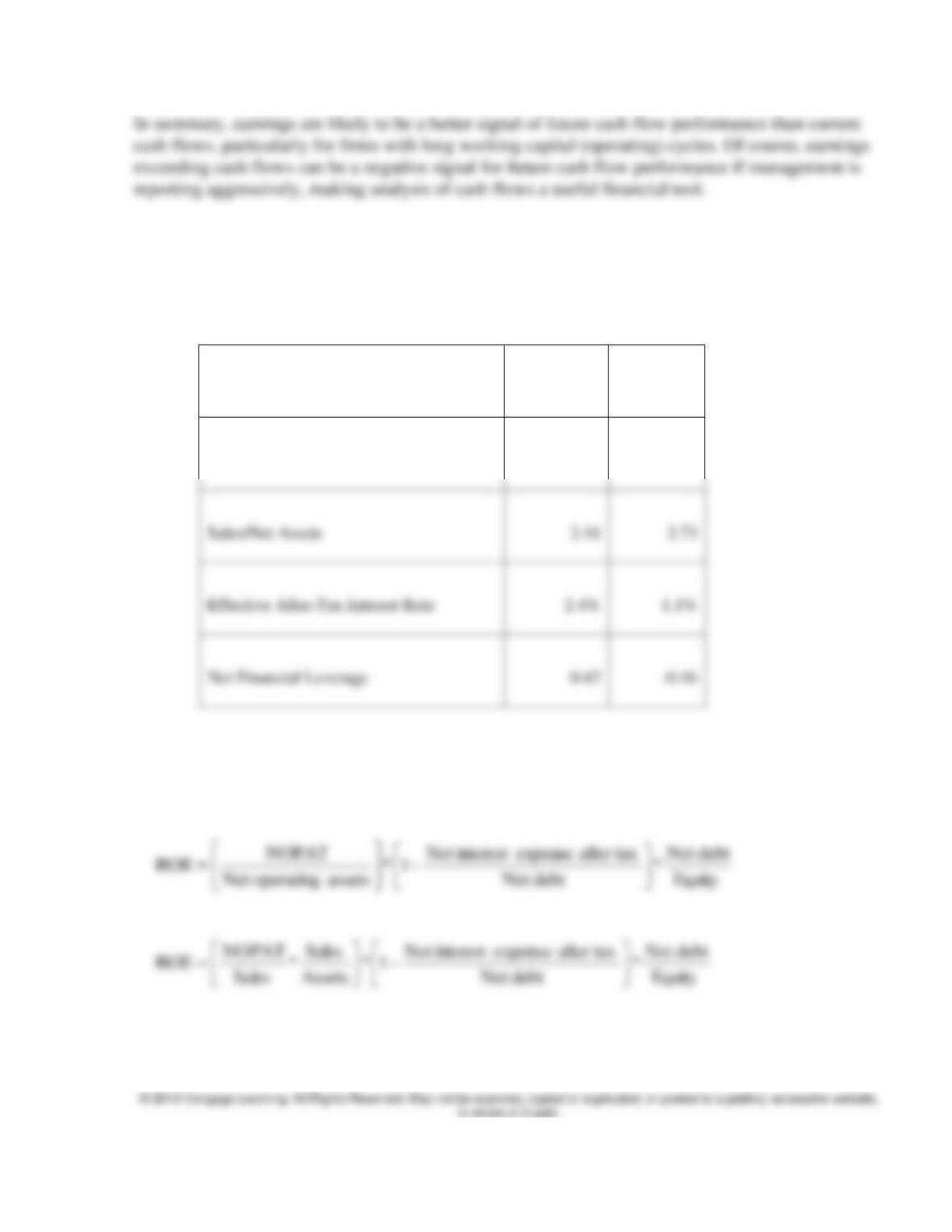
4. In 2005 IBM had a return on equity of 26.7 percent, whereas Hewlett-Packard’s return was only 6.4
percent. Use the decomposed ROI framework to provide possible reasons for this difference based on the
data below:
IBM
HP
NOPAT/Sales
9.0%
2.7%
Effective After-Tax Interest Rate
2.4%
1.1%
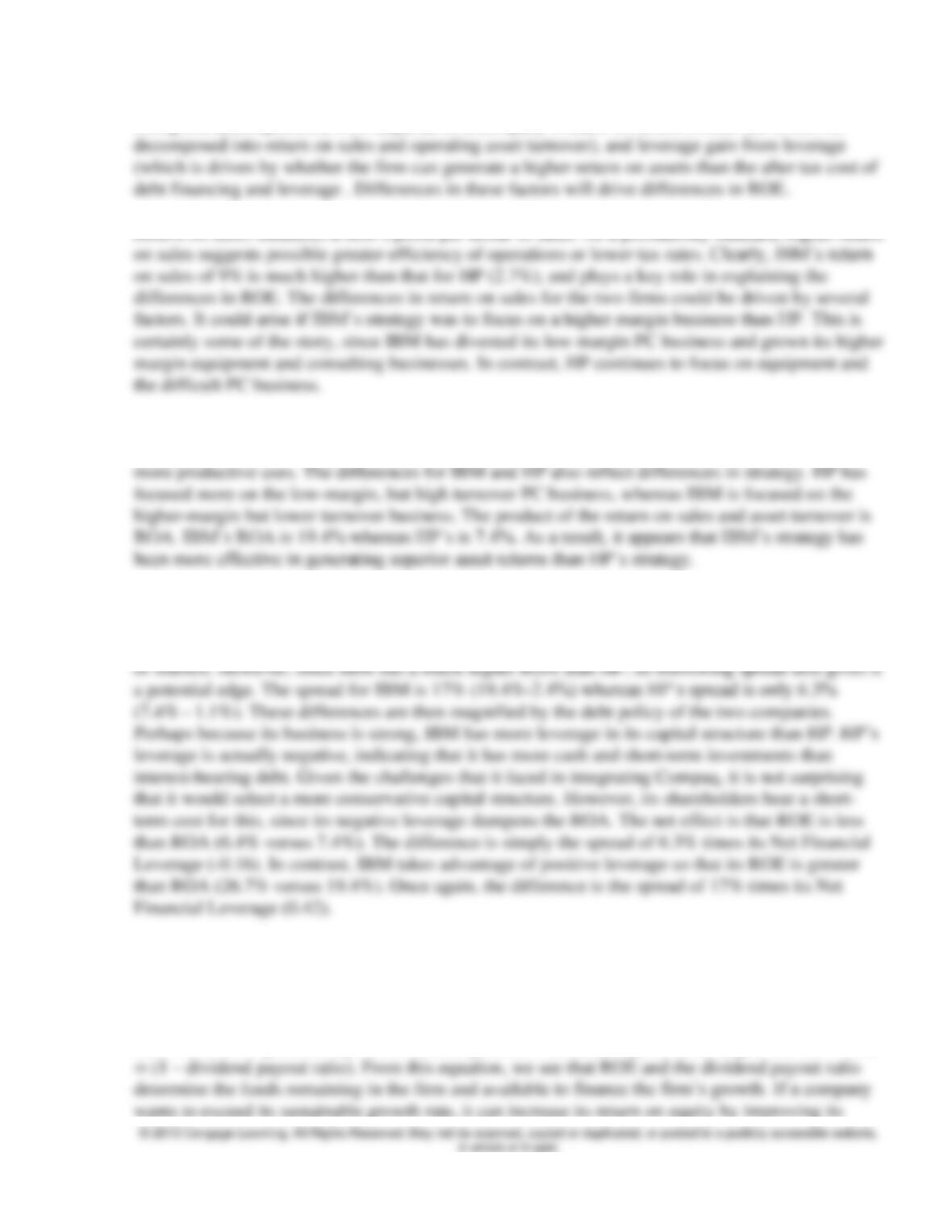
ROE can be decomposed as follows:
4 Instructor’s Manual
Using this decomposition, ROE depends on a company’s return on assets (which can in turn be
Return on Sales measures a firm’s profit per dollar of sales. As a profitability measure, higher return
Asset Turnover assesses how productively a firm uses its assets. A higher asset turnover ratio
suggests that a fixed level of assets generates a greater level of sales, i.e., the firm put its assets to
Leverage describes the capital structure of the firm. If a firm is able to generate higher returns from
using funds raised from debt than the after tax cost of debt, it will be able to generate additional
value for stockholders. Both IBM and HP are able to generate higher ROAs than the after-tax cost
5. Joe Investor asserts, “A company cannot grow faster than its sustainable growth rate.” True or false?
Explain why.
False. The sustainable growth rate is the speed at which a company can expand without changing
either its level of profitability or its financial policies. Mechanically, sustainable growth rate = ROE
6. What are the reasons for a firm having lower cash from operations than working capital from
operations? What are the possible interpretations of these reasons?
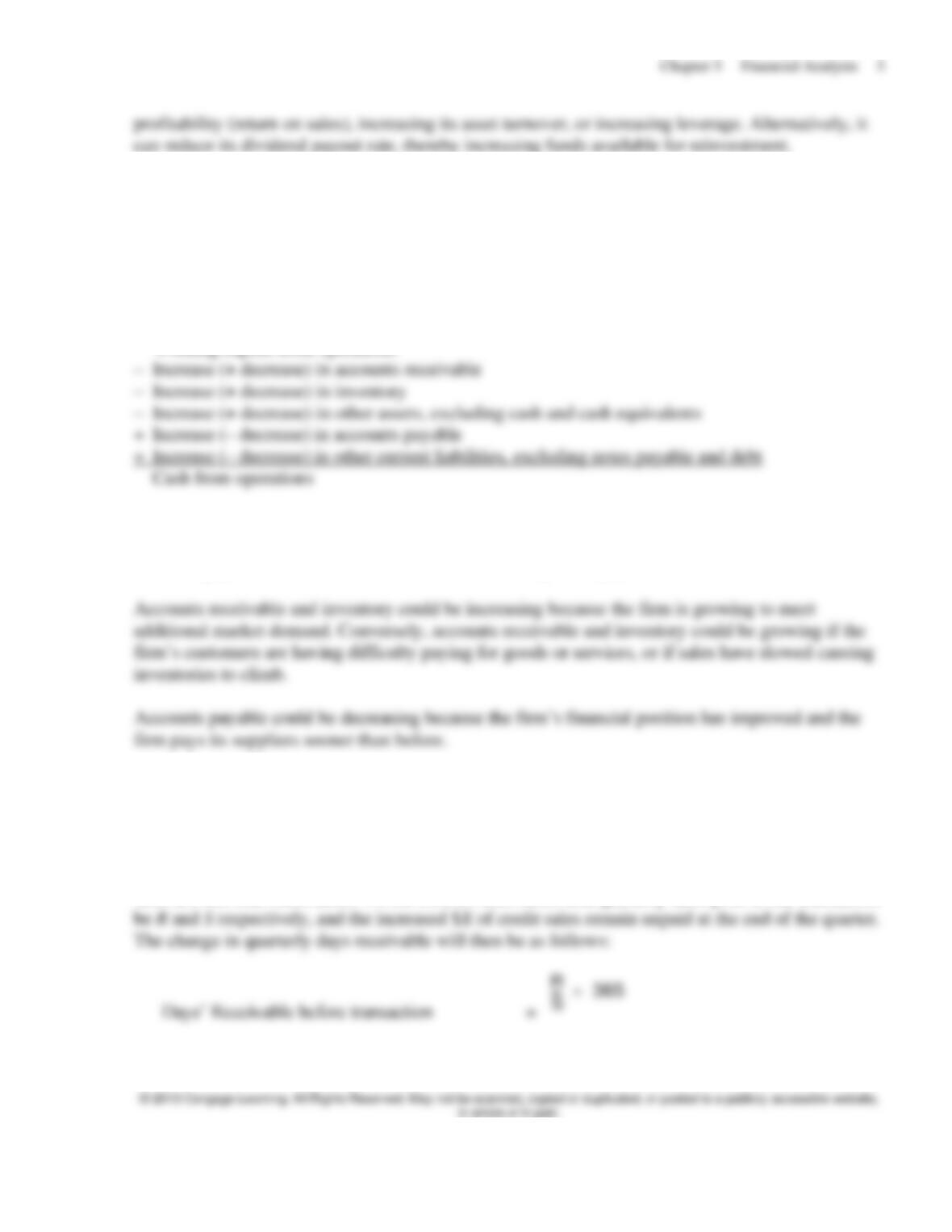
Cash from operations will differ from working capital from operations due to current accruals
related to operations. In general, the differences between the two methods can be reconciled using
the following approach:
Working capital from operations
Cash from operations will be lower than working capital from operations when current assets (e.g.,
accounts receivable, inventory, and other non-cash assets) increase and when current liabilities (e.g.,
accounts payable and other current liabilities, excluding notes payable and debt) decrease.
7. ABC Company recognizes revenue at the point of shipment. Management decides to increase sales for
the current quarter by filling all customer orders. Explain what impact this decision will have on the
following:
Days’ receivable for the current quarter. Increase, provided that, prior to the transaction, quarterly
sales are less than receivables. To see this, let receivables and quarterly sales prior to the transaction
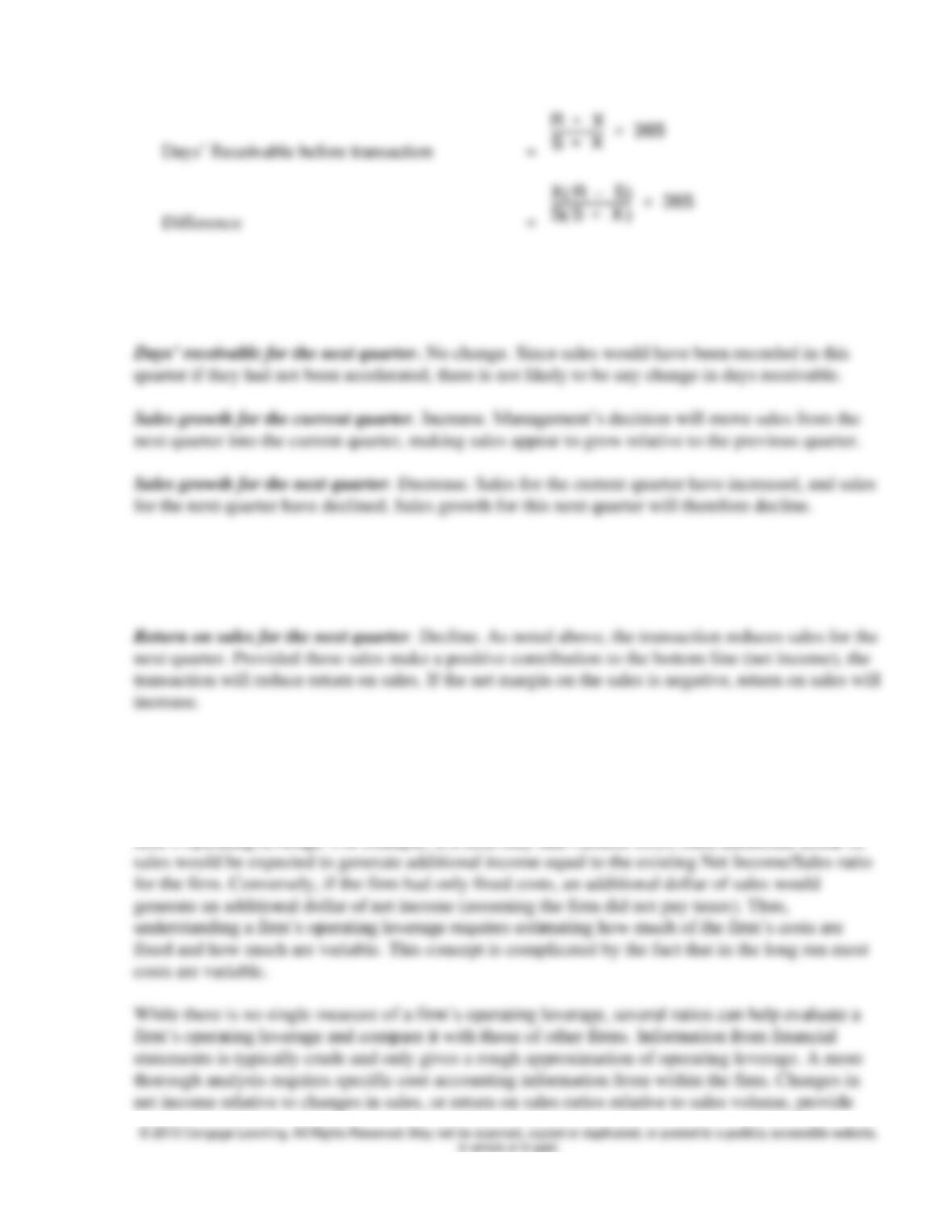
6 Instructor’s Manual
Thus, if R < S, days receivable will increase after the transaction. This is especially likely for
companies with short credit periods (less than one quarter) and those that measure days receivable
on an annual basis, since annual sales are very likely to exceed receivables.
Return on sales for the current quarter. Increase. Provided additional sales make a positive
contribution to the bottom line (net income), the transaction will increase return on sales. If the net
margin on the sales is negative, return on sales will decline.
8. What ratios would you use to evaluate operating leverage for a firm?
Operating leverage measures the extent to which an additional dollar of sales increases the firm’s
net income. The greater the increase in Net Income for a given increase in sales, the greater the
firm’s operating leverage. For example, if a firm only had variable costs, each additional dollar of
Chapter 5 Financial Analysis 7
9. What are the potential benchmarks that you could use to compare a company’s financial ratios? What
are the pros and cons of these alternatives?
Comparison to Firm’s Prior History. By comparing the company with itself over time, it is
possible to document changes (improvements or declines) in the company’s performance. Changes
Comparison to Firm’s Expected or Budgeted Performance. This could be relative to
management or external analysts’ forecasts. These types of comparisons can be very helpful by
Comparison to Industry Average. Industry average financial ratios provide a benchmark against
which to interpret individual company ratios. A firm’s return on sales, asset turnover, and financial
comparison group is, since many firms operate in more than one business segment.
Comparison to Market. Benchmarking the performance of an individual firm against the market
can be informative. Ultimately, investors want to allocate resources within the economy as a whole.
8 Instructor’s Manual
likely to be very different for construction firms than for supermarkets.
10. In a period of rising prices, how would the following ratios be affected by the accounting decision to
select LIFO, rather than FIFO, for inventory valuation?
The impact of the selection of LIFO rather than FIFO for inventory valuation will appear in
Inventory and Cost of Goods Sold. Under LIFO, the most recent and most expensive (during
Current ratio falls. The current ratio equals current assets divided by current liabilities. Current
assets are lower under LIFO because inventories are lower. Hence, the value of current assets
divided by current liabilities drops under LIFO.
Average tax rate remains the same. The LIFO firm reports higher expenses which lowers income
before tax. Because the firm reports smaller income before tax, it has less taxable income and,
hence, has a smaller tax liability. However, the average tax rate is likely to remain the same.