Problem 5-20A (continued)
c. This problem illustrates the difficulty faced by some companies. When
variable labor costs increase, it is often difficult to pass these cost
Problem 5-21A (30 minutes)
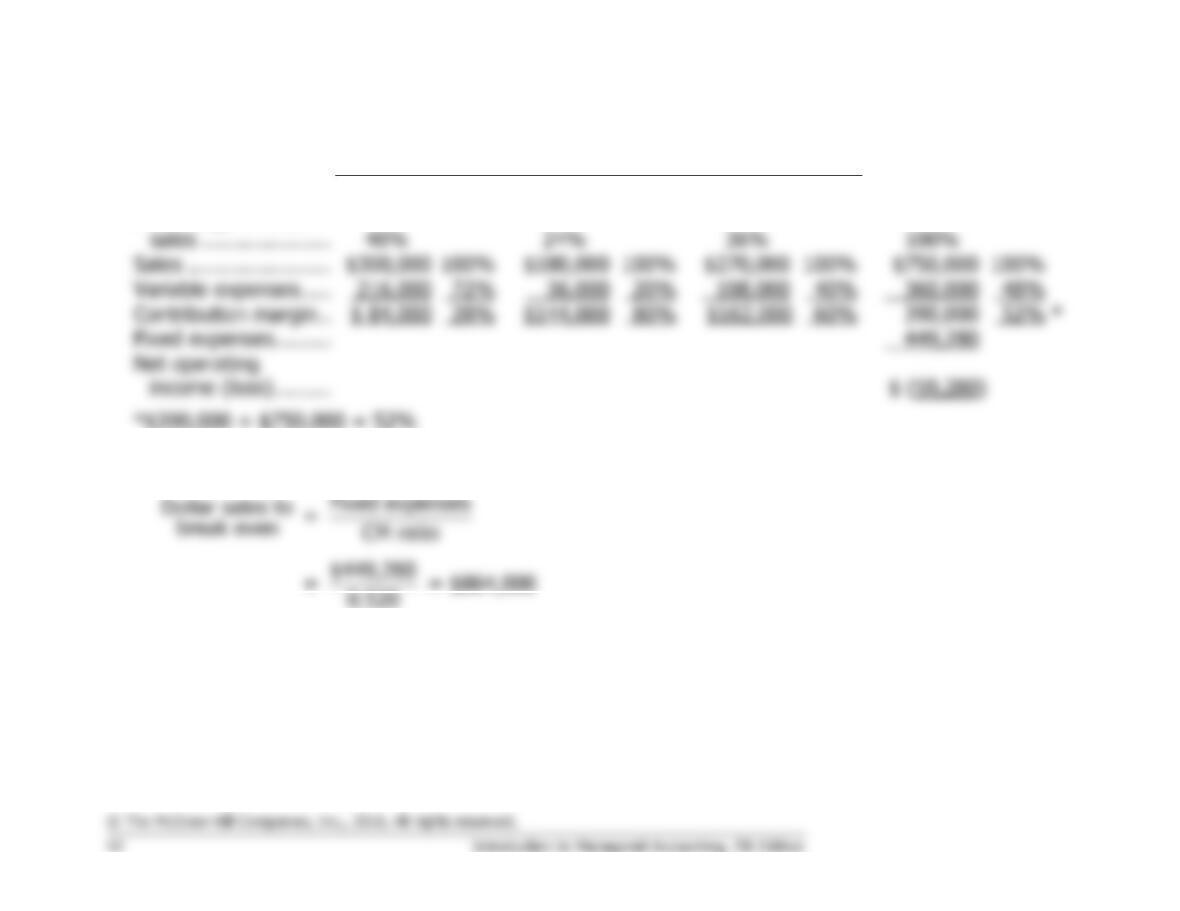
1.
Product
White
Fragrant
Loonzain
Total
Sales …………………..
Variable expenses …..
Contribution margin ..
*
Fixed expenses ………
Net operating
Percentage of total
2. Break-even sales would be:
Problem 5-21A (continued)
3. Memo to the president:
Although the company met its sales budget of $750,000 for the month,
the mix of products changed substantially from that budgeted. This is
the reason the budgeted net operating income was not met, and the
Problem 5-22A (60 minutes)
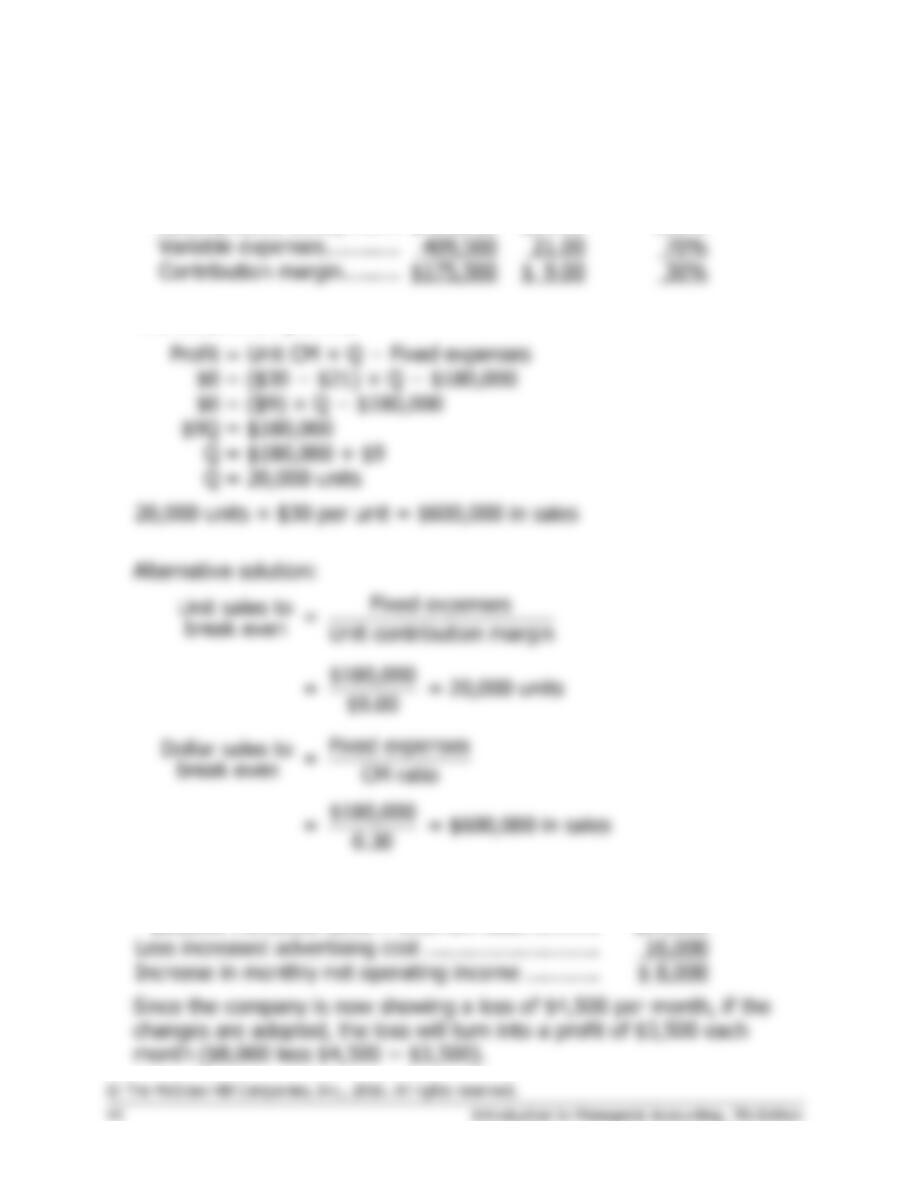
1. The CM ratio is 30%:
Total
Per Unit
Percent of Sales
Sales (19,500 units) ………
$585,000
$30.00
100%
Variable expenses …………
Contribution margin ………
$175,500
$ 9.00
The break-even point is:
= ($30 − $21) × Q − $180,000
= ($9) × Q − $180,000
= $180,000
2.
Incremental contribution margin:
$80,000 increased sales × 0.30 CM ratio …………
$24,000
Problem 5-22A (continued)
3.
Sales (39,000 units @ $27.00 per unit*) ………
$1,053,000
819,000
Contribution margin …………………………………
Fixed expenses ($180,000 + $60,000) …………
Net operating loss …………………………………..
Variable expenses
4.
Profit
= Unit CM × Q − Fixed expenses
$9,750
= ($30.00 − $21.75*) × Q − $180,000
$9,750
= ($8.25) × Q − $180,000
$8.25Q
= $189,750
Q
= $189,750 ÷ $8.25
Q
= 23,000 units
*$21.00 + $0.75 = $21.75
Alternative solution:
5. a. The new CM ratio would be:
Per Unit
Percent of Sales
Sales ……………………….
$30.00
100%
Variable expenses ………
18.00
Contribution margin ……
$12.00
Problem 5-22A (continued)
The new break-even point would be:
b. Comparative income statements follow:
Not Automated
Automated
Total
Per
Unit
%
Total
Per
Unit
%
Contribution
Sales (26,000
Problem 5-22A (continued)
c. Whether or not the company should automate its operations depends
on how much risk the company is willing to take and on prospects for
future sales. The proposed changes would increase the company’s
fixed costs and its break-even point. However, the changes would
Note to the Instructor: Although it is not asked for in the problem,
if time permits you may want to compute the point of indifference
between the two alternatives in terms of units sold; i.e., the point
where profits will be the same under either alternative. At this point,
total revenue will be the same; hence, we include only costs in our
equation:
Problem 5-23A (60 minutes)
1. The CM ratio is 60%:
Sales price ………………….
$20.00
100%
Variable expenses ………..
3. $75,000 increased sales × 0.60 CM ratio = $45,000 increased
b. 4 × 20% = 80% increase in net operating income. In dollars, this
increase would be 80% × $60,000 = $48,000.
Problem 5-23A (continued)
5.
Last Year:
18,000 units
Proposed:
24,000 units*
Amount
Per Unit
Amount
Per Unit
Sales ………………………
Variable expenses ………
Net operating income …
6.
Expected total contribution margin:
18,000 units × 1.25 × $11.00 per unit* ……………………
$247,500
Present total contribution margin:
*$20.00 – ($8.00 + $1.00) = $11.00
Problem 5-24A (30 minutes)
1. The contribution margin per sweatshirt would be:
Selling price ………………………………………
$13.50
Variable expenses:
Purchase cost of the sweatshirts ………….
$8.00
Contribution margin …………………………….
$ 4.00
2. Since an order has been placed, there is now a “fixed” cost associated
with the purchase price of the sweatshirts (i.e., the sweatshirts can’t be
returned). For example, an order of 75 sweatshirts requires a “fixed”
Selling price …………………………………..
Variable expenses (commissions only) …
Contribution margin …………………………
Problem 5-25A (45 minutes)
1. The contribution margin per unit on the first 16,000 units is:
Per Unit
Sales price ……………………..
$3.00
Variable expenses …………….
1.25
Contribution margin ………….
$1.75
Per Unit
Sales price ……………………..
Variable expenses …………….
Contribution margin ………….
Fixed costs on the first 16,000 units …………………..
Less contribution margin from the first 16,000 units
Remaining unrecovered fixed costs …………………….
Total fixed costs to be covered by remaining sales …
Problem 5-25A (continued)
The additional sales of units required to cover these fixed costs would
be:
3. If a bonus of $0.10 per unit is paid for each unit sold in excess of the
break-even point, then the contribution margin on these units would
drop from $1.60 to $1.50 per unit.
The desired monthly profit would be:
Problem 5-26A (60 minutes)
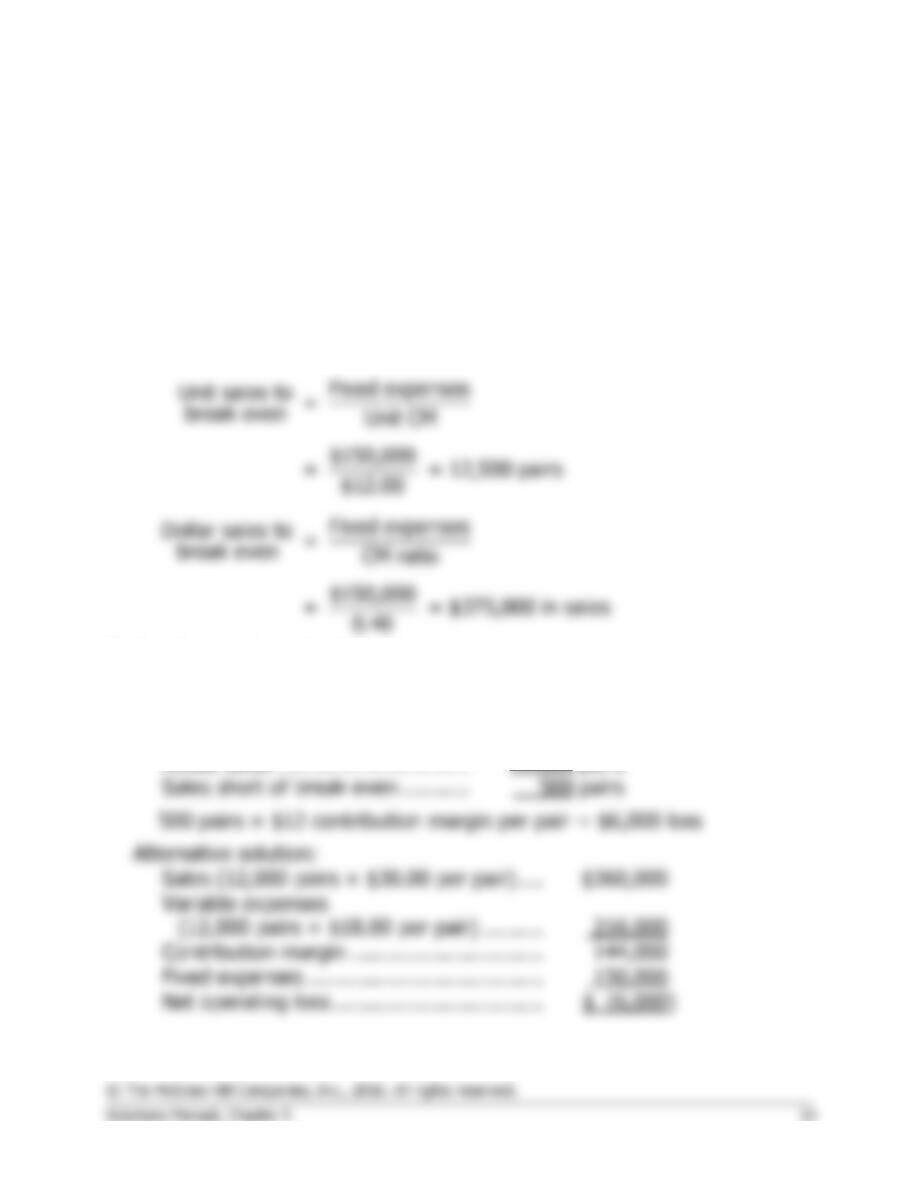
1.
Profit
= Unit CM × Q − Fixed expenses
$0
= ($30 − $18) × Q − $150,000
$0
= ($12) × Q − $150,000
$12Q
= $150,000
Q
= $150,000 ÷ $12
Q
= 12,500 pairs
12,500 pairs × $30 per pair = $375,000 in sales
Alternative solution:
2. See the graph on the following page.
3. The simplest approach is:
Break-even sales ……………………
12,500 pairs
Actual sales ………………………….
12,000 pairs
Sales short of break-even ………..
Sales (12,000 pairs × $30.00 per pair) ….
Contribution margin ………………………….
Fixed expenses ………………………………..
Net operating loss …………………………….
Problem 5-26A (continued)
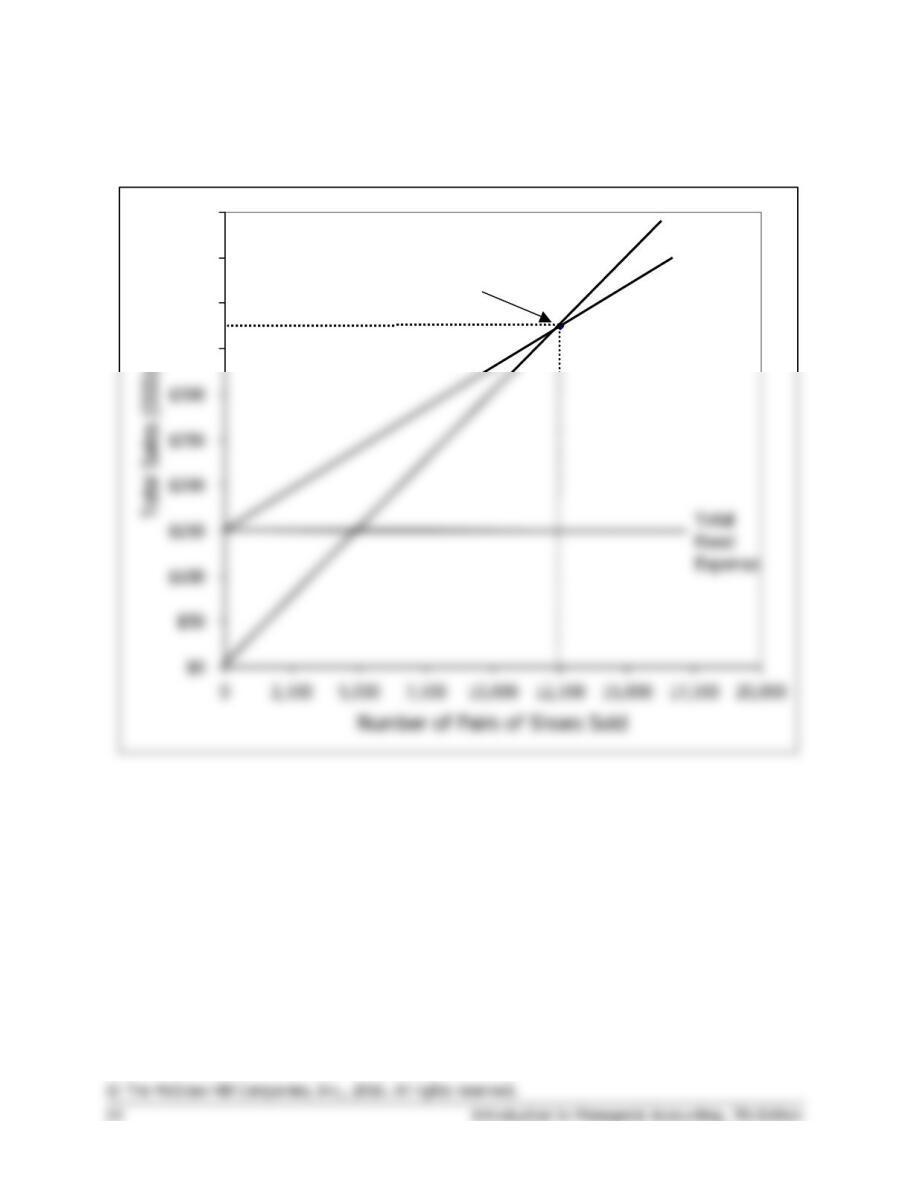
2. Cost-volume-profit graph:
$350
$400
$450
$500
Break-even point:
12,500 pairs of shoes or
$375,000 total sales
Total Sales
Total
Expense
Problem 5-26A (continued)
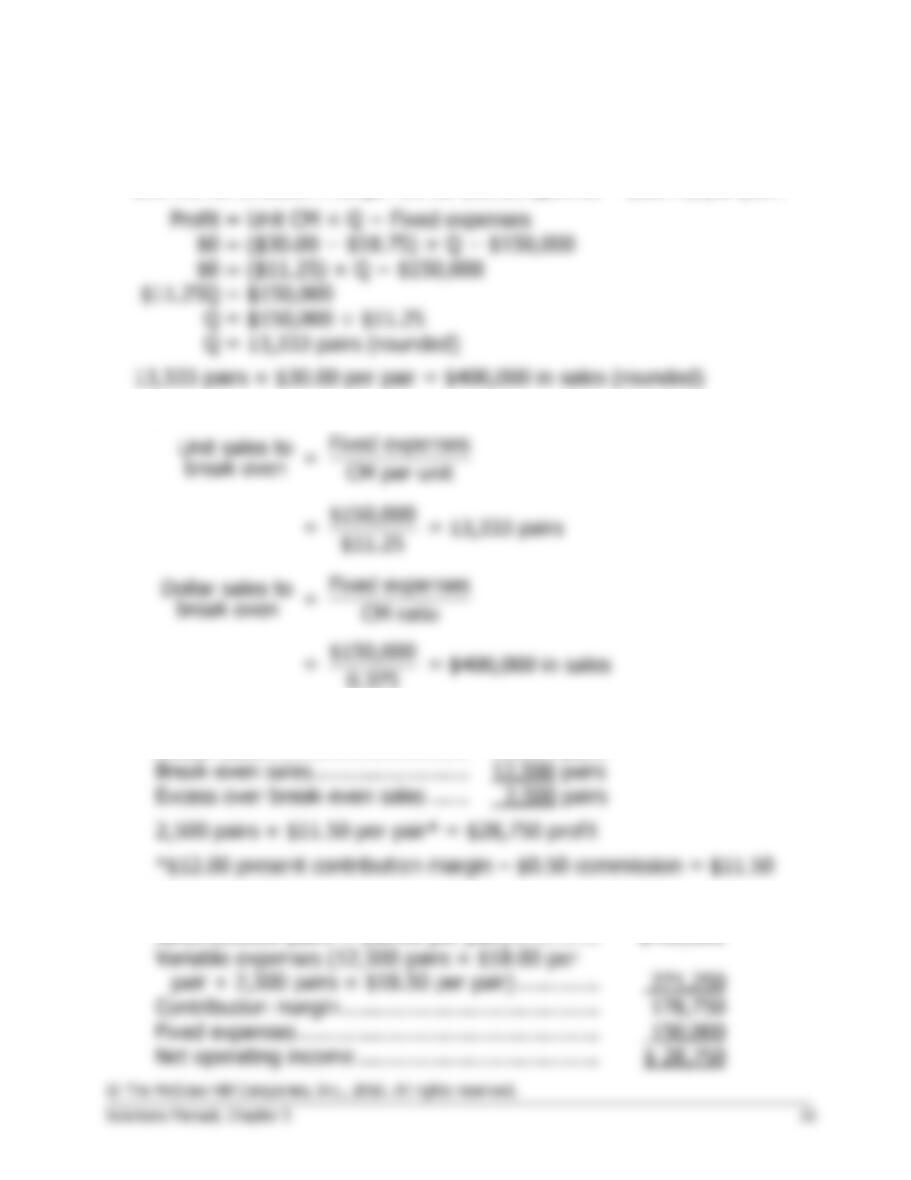
4. The variable expenses will now be $18.75 ($18.00 + $0.75) per pair,
and the contribution margin will be $11.25 ($30.00 – $18.75) per pair.
= Unit CM × Q − Fixed expenses
= ($30.00 − $18.75) × Q − $150,000
= ($11.25) × Q − $150,000
= $150,000
= $150,000 ÷ $11.25
= 13,333 pairs (rounded)
Alternative solution:
0.375
5. The simplest approach is:
Actual sales …………………………..
15,000 pairs
Break-even sales …………………….
12,500 pairs
Excess over break-even sales ……
2,500 pairs × $11.50 per pair* = $28,750 profit
*$12.00 present contribution margin – $0.50 commission = $11.50
Alternative solution:
Sales (15,000 pairs × $30.00 per pair) …………..
$450,000
Contribution margin …………………………………..
Problem 5-26A (continued)
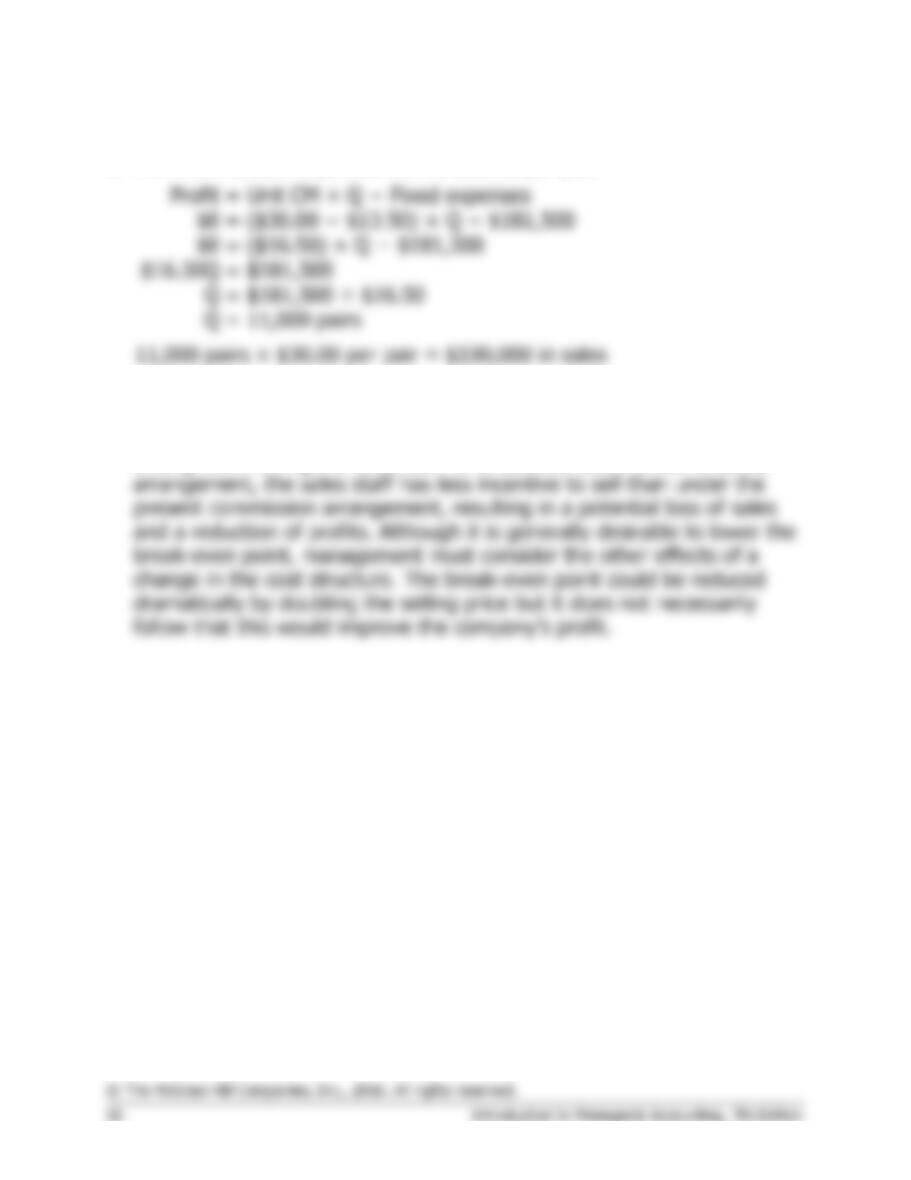
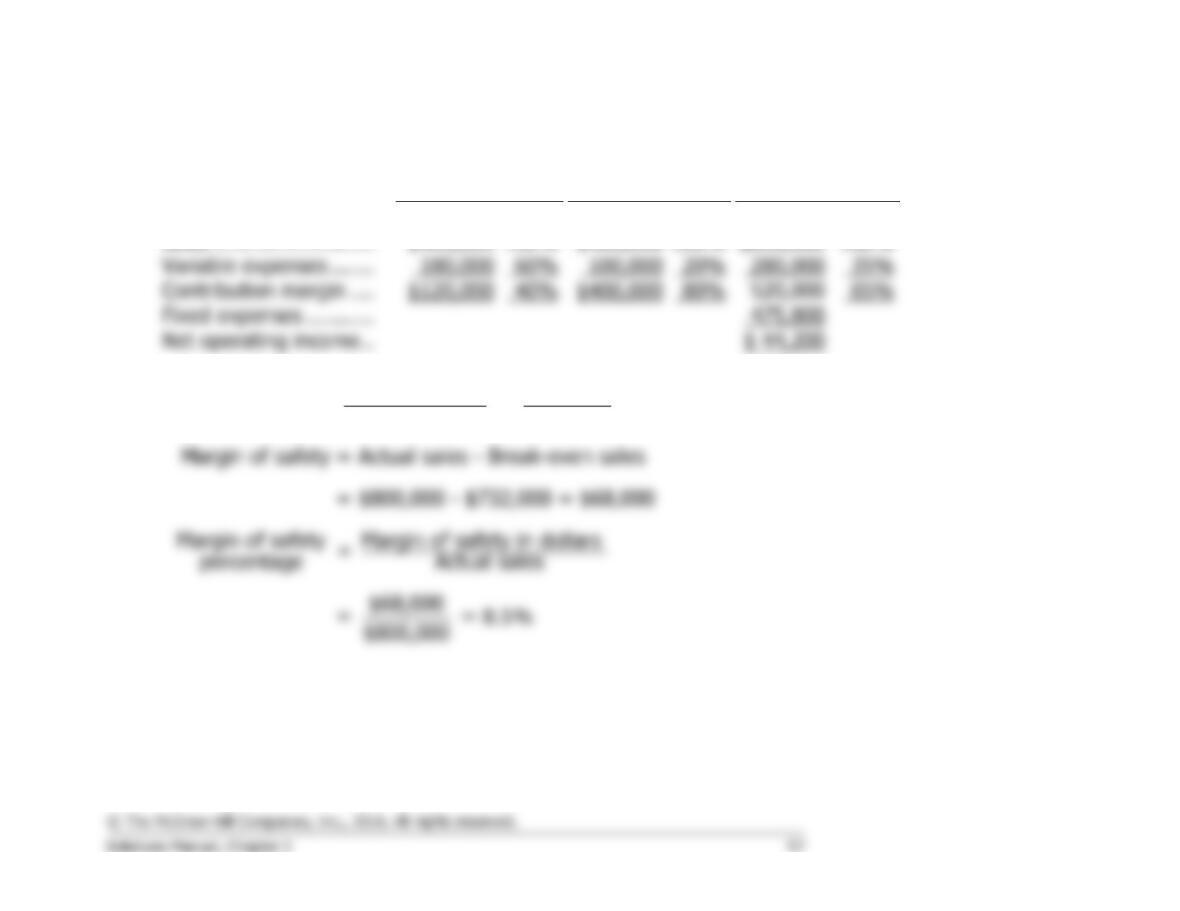
6. The new variable expenses will be $13.50 per pair.
Although the change will lower the break-even point from 12,500 pairs
to 11,000 pairs, the company must consider whether this reduction in
the break-even point is more than offset by the possible loss in sales
arising from having the sales staff on a salaried basis. Under a salary
Problem 5-27A (45 minutes)
1.
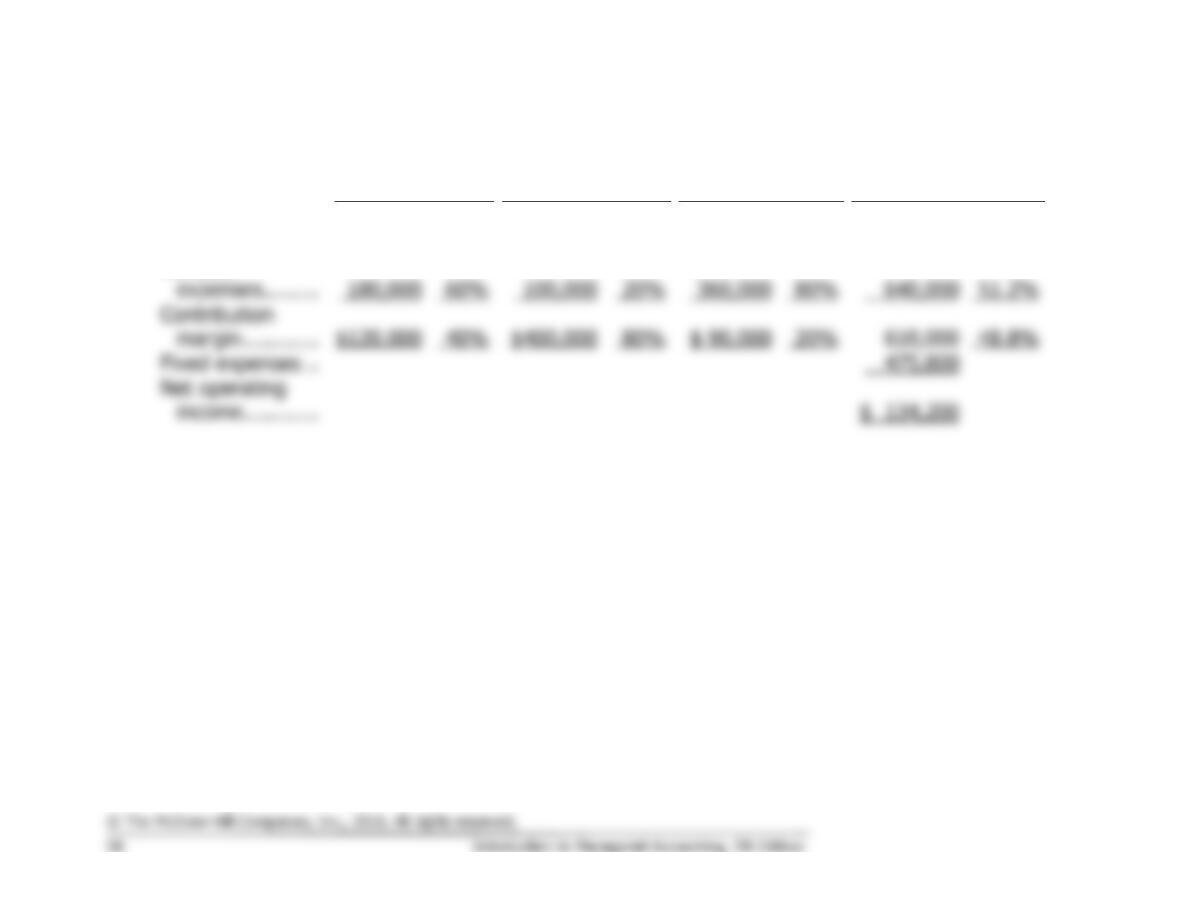
a.
Hawaiian
Fantasy
Tahitian
Joy
Total
Amount
%
Amount
%
Amount
%
Sales ……………………..
$300,000
100%
$500,000
100%
$800,000
100%
Variable expenses …….
Net operating income ..
b.
Fixed expenses $475,800
Dollar sales to = = = $732,000
break even CM ratio 0.65
Problem 5-27A (continued)
2.
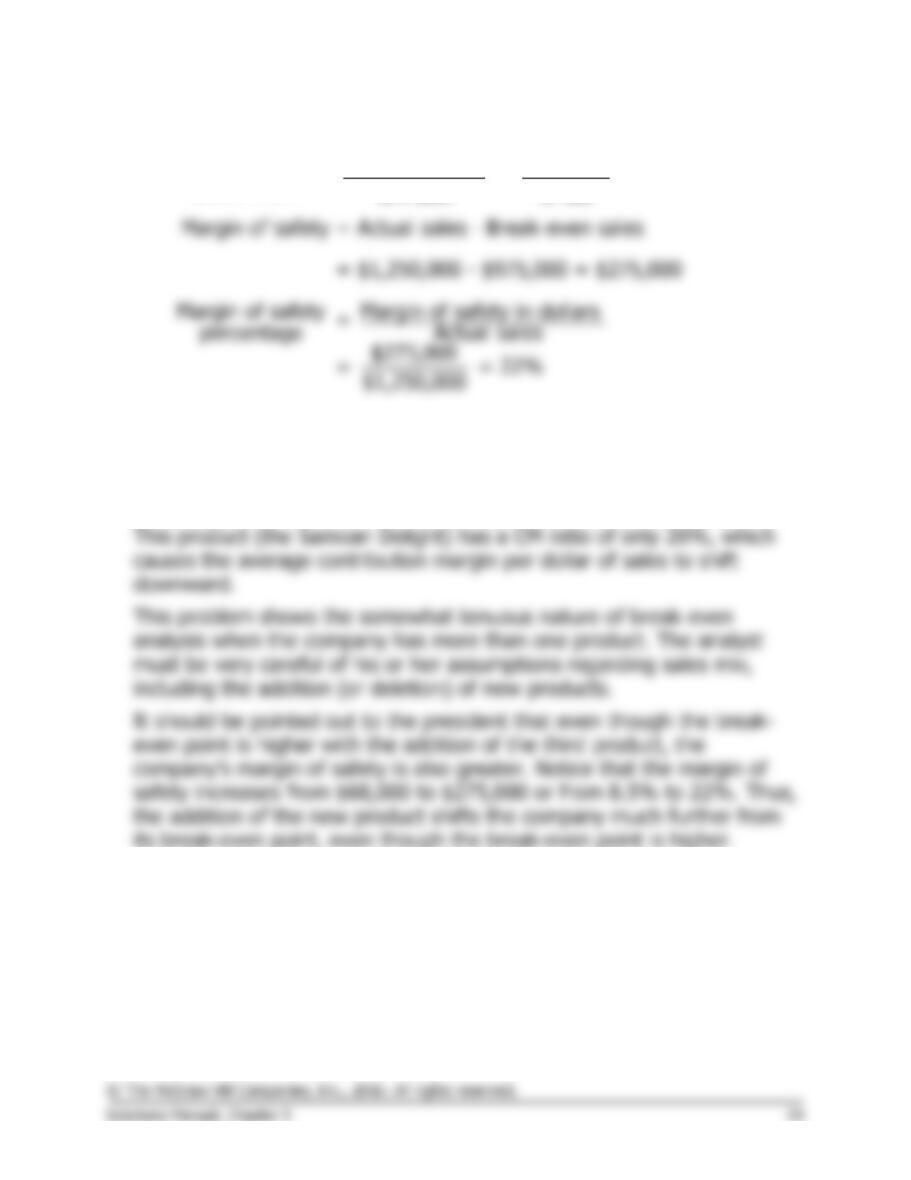
a.
Hawaiian
Fantasy
Tahitian
Joy
Samoan
Delight
Total
Amount
%
Amount
%
Amount
%
Amount
%
Sales ……………..
$300,000
100%
$500,000
100%
$450,000
100%
$1,250,000
100.0%
$120,000
$400,000
Fixed expenses ..
Variable
Problem 5-27A (continued)
b.
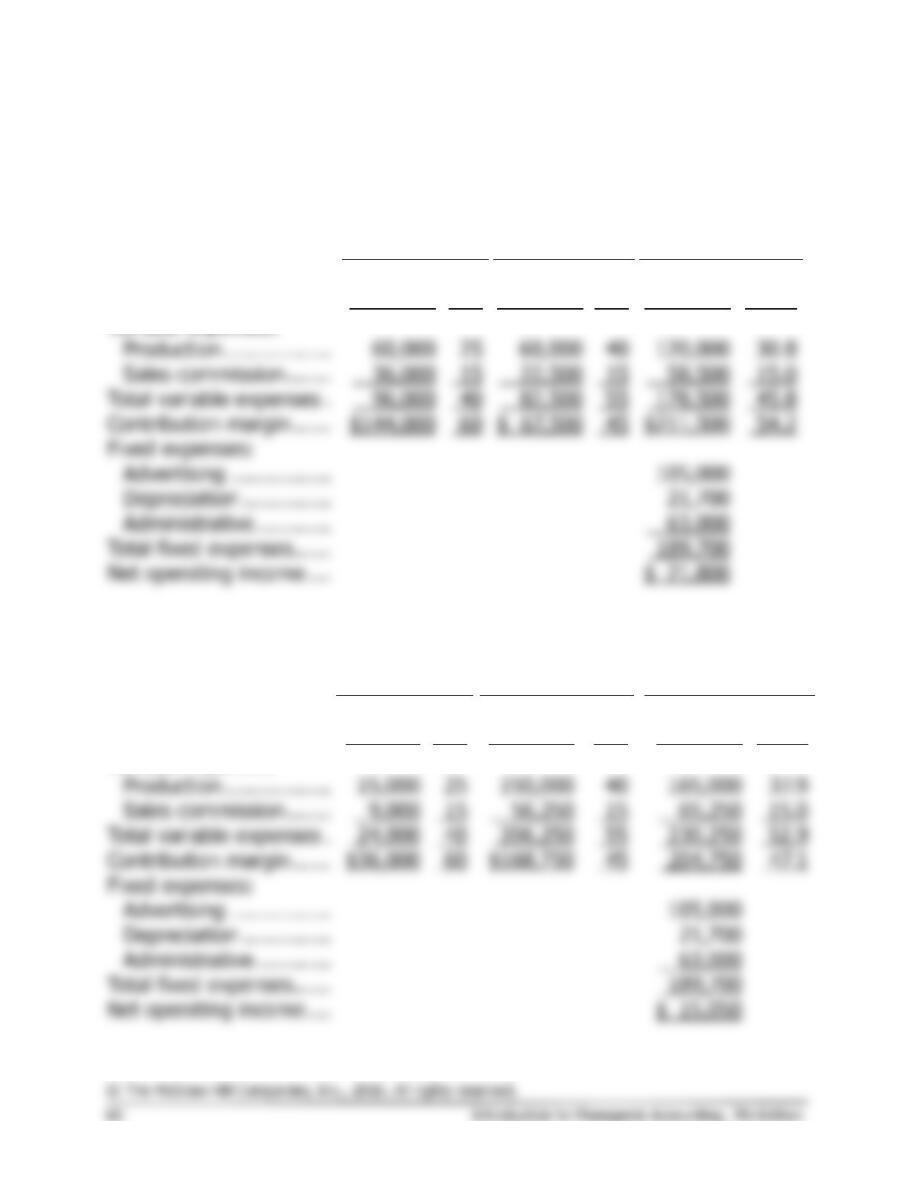
Fixed expenses $475,800
Dollar sales to = = = $975,000
break even CM ratio 0.488
3. The reason for the increase in the break-even point can be traced to the
decrease in the company’s overall contribution margin ratio when the
third product is added. Note from the income statements above that this
ratio drops from 65% to 48.8% with the addition of the third product.
Problem 5-28A (60 minutes)
1.
Carbex, Inc.
Income Statement For April
Standard
Deluxe
Total
Amount
%
Amount
%
Amount
%
Sales ……………………….
$240,000
100
$150,000
100
$390,000
100.0
Variable expenses:
22,500
58,500
Total variable expenses .
96,000
178,500
45.8
Contribution margin ……
$ 67,500
54.2
Fixed expenses:
63,000
Total fixed expenses ……
189,700
Net operating income ….
Carbex, Inc.
Income Statement For May
Standard
Deluxe
Total
Amount
%
Amount
%
Amount
%
Sales ……………………….
$60,000
100
$375,000
100
$435,000
100.0
Variable expenses:
Total variable expenses .
Contribution margin ……
$36,000
$168,750
Fixed expenses:
Total fixed expenses ……
Net operating income ….
$ 15,050