P a g e | 61
Business & Professional Ethics for Directors, Executives & Accountants, 8e
14. The Ethics of Repricing and Backdating of Employee Stock Options (Chapter 5,
pages 317-318)
What this case has to offer
This is a good case for addressing agency theory, executive compensation and stock options. Given that,
Teaching suggestions
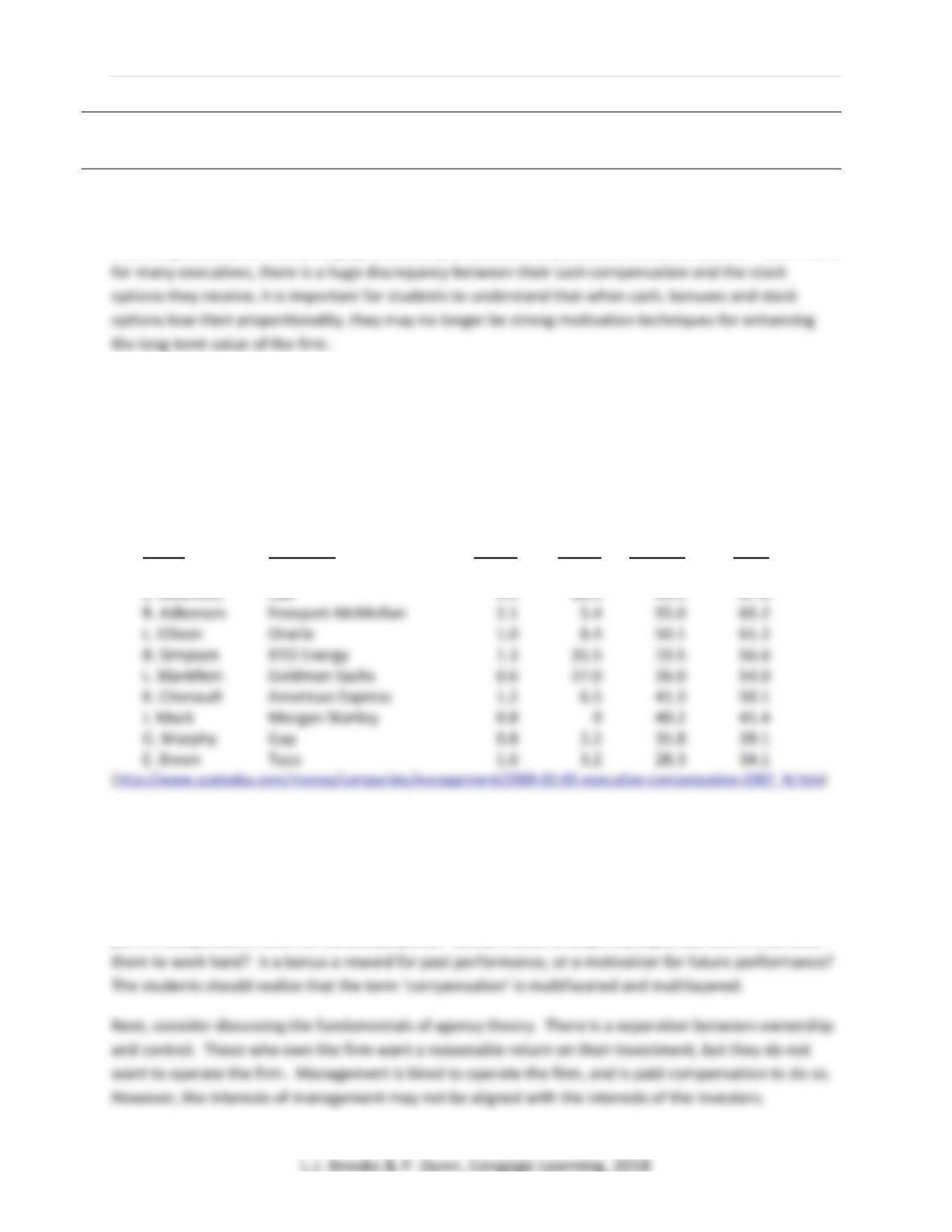
Consider bringing in a chart with the names of the highest paid executives, the amount of their cash
compensation, their bonuses, their stock options and their total pay. These data are available from
many periodicals, including Forbes, Business Week, and the Report on Business.
The following data are from USA Today on the 10 highest paid executives in 2007.
Name
Company
Salary
Bonus
Options
Total
J. Thain
Merrill Lynch
0
15.0
68.0
83.1
L. Moonves
18.5
43.5
67.6
R. Adkerson
Freeport-McMoRan
55.0
65.2
B. Simpson
XTO Energy
35.5
19.5
56.6
L. Blankfein
Goldman Sachs
27.0
26.0
54.0
K. Chenault
American Express
41.3
50.1
J. Mack
Morgan Stanley
0
40.2
41.4
G. Murphy
35.8
39.1
E. Breen
Tyco
28.3
34.1
After reviewing the table, there can be a general discussion about compensation, its form and its
purposes. Compensation can be given through salary, bonuses, stock options, allowances and non-
pecuniary perks such as vacation time, and large offices with large staffs. Compensation is used to hire
and acquire employees, to motivate them, to reward them for good performance, and to punish them
for poor performance. The problem with compensation is untangling the relationship between each
part of compensation and the various purposes. Salary is used to acquire people, but does it motivate
P a g e | 62
Business & Professional Ethics for Directors, Executives & Accountants, 8e
Management may not want to take risks on behalf of the investors lest the risky venture fails and the
Discussion of important issues
1. Do you think that stock options actually motivate employees to work for the long-term good of the
company?
Stock options are an attempt to align the interest of managers with those of the investors.
Investors are interested in a reasonable return on their investment; as result they are risk
takers. Managers are assumed to be interested in compensation and are risk averse. Stock
2. Do you think that stock options inadvertently encourage manager to engage in questionable
accounting activities, such as earnings management, to artificially increase the company’s net
income and thereby the value of the executives stock options?
Stock options are a means of transferring risk onto the manager. Managers will take on risky
projects so as to increase net income and have the stock price rise. As the stock price increases,
P a g e | 63
Business & Professional Ethics for Directors, Executives & Accountants, 8e
The students can then discuss the pros and cons of each strategy. Some aspects of the
accounting strategies include the following.
• Net income is altered without changing cash flows.
3. Do you agree or disagree with the four ethical arguments summarized above and contained in more
detail in the article by Raiborn et al.? Explain why.
4. Should a board of directors approve repricing or backdating stock options for outstanding executives
whose current stock options are underwater due to uncontrollable economic factors, and who will
be lured away unless some incentives to stay are created? What other incentives might work?
Stock options are a means of transferring risk onto the manager, and risk means that there is
the possibility of both success and failure. If the firm is unsuccessful, then net income falls as

P a g e | 64
Business & Professional Ethics for Directors, Executives & Accountants, 8e
P a g e | 65
Business & Professional Ethics for Directors, Executives & Accountants, 8e
Cases on Fraudulent & Questionable Financial Reporting
15. Satyam Computer Services, The Enron of India (Chapter 5, pages 318-320)
What this case has to offer
This case resembles several of the large accounting scandals in the U.S. It highlights several failures
within the company’s corporate governance mechanisms and the negative consequences of excessive
power concentrated in the hands of the company’s Chairman, who allegedly perpetrated the fraud
alone.
Teaching suggestions
The first questions that come to mind in this case are what happened with the company’s controls over
financial reporting and who was responsible for the fraud. As it has been the case with previous
Discussion of ethical issues
1. Will the Satyam fraud damage India’s reputation as a reliable provider of information technology
outsourcing?
Given the size of Satyam and its importance as an outsourcing company, serving over one third
P a g e | 66
Business & Professional Ethics for Directors, Executives & Accountants, 8e
2. How long will it take to restore Satyam Computer’s reputation, and how would you recommend that
the restoration be facilitated?
The recovery of the company’s reputation is going to be a long process that will take several
years. In the Chairman’s Letter, published together with the Annual Report 2008-09 — 2009-10
(Mahindra Satyam 2010), the new Chairman notes that:
“As you may be aware, the Mahindra Group has always been known for its value system,
which uncompromisingly applies to all the Group Companies:
• Be responsive to customers
In addition, the Letter highlights the importance of strengthening internal controls:
“Strengthening our internal controls and reporting systems has acquired its own
The company seems to have taken a number of good steps to recover from the loss of
reputation after the fraud. Several actions, already taken by the company, included:
P a g e | 67
Business & Professional Ethics for Directors, Executives & Accountants, 8e
• Adopting a revised code of conduct and ethics policy for the board of directors and
employees of the company;
3. Mr. Raju did not commit this fraud on his own. What types of individuals probably assisted him
either actively or by keeping quiet about what they knew he was doing?
In a fraud of this magnitude, several individuals probably assisted Raju or kept quiet about the
4. To whom should potential whistleblowers have complained?
A potential whistleblower could have gone through the following steps to complain:
• Talk to an immediate superior or relevant company officials in the accounting or internal
audit department;
5. Mr. Raju likened his fraud experience to “riding a tiger, not knowing how to get off without being
eaten.” This is an aspect experienced by some people trapped on a slippery slope from small to ever
larger fraudulent acts. If Mr. Raju had come to you for advice during the tiger ride, what would you
have advised him?
Mr. Raju has to understand that sooner or later the fraud will be uncovered and that accounting
P a g e | 68
Business & Professional Ethics for Directors, Executives & Accountants, 8e
6. Should PwC worldwide have to pay any investors for their losses caused by faulty audit work of
personnel in PW India?
It depends on the type of agreement between the affiliate of the accounting firm in India and
Useful Articles, Links, and Videos
Mahindra Satyam (2010). Annual Report 2008-09 — 2009-10.
Business & Professional Ethics for Directors, Executives & Accountants, 8e
16. Nortel Networks’ Audit Committee Was In The Dark (Chapter 5, pages 320-329)
What this case has to offer
Nortel Networks is one of the most notorious companies to emerge from the 1990’s dot-com stock
bubble that burst spectacularly. Nortel’s own stock – which accounted for more market capitalization
than any other stock in Canada – went from $124.50 to $0.63. Following the collapse of its Internet
business, Nortel entered into a dramatic restructuring process focusing on containing losses and
The case offers several interesting points for discussion, including:
• Nortel’s loss of its earlier strong ethics reputation, and its ethical culture,
• Audit Committee processes and how they might have avoided finding themselves in the dark,
Teaching suggestions
I start the case with a brief background of Nortel, giving the students a sense for the company’s size,
operations, and significant market changes that drove its share price up to C$124.50 and eventually
down to less than one dollar in 2002. In light of these events, I ask the students what actions could have
P a g e | 70
Business & Professional Ethics for Directors, Executives & Accountants, 8e
I then deal with the questions posed at the end of the case, which follow below, stressing the role of the
various players and pieces of an ethical culture. All are required to ensure that problems are minimized.
Even when they are all operating effectively – a due diligence requirement of the board – unethical
problems cannot be eliminated entirely.
Discussion of important issues/questions
1. Why would Nortel Networks, a Canadian company, hire a U.S. law firm to undertake an independent
review of factors that led to restatement of accounting reports?
The choice of an investigator was multifaceted. A law firm was probably chosen so that any
2. Why did the independent review focus on the “establishment and release of contractual liability and
other related provisions” (also called accruals, reserves, or accrued liabilities)?
The legal review mandated by the audit committee expected to verify the company’s liability
3. How did the failure to follow U.S. GAAP permit the manipulation of Earnings before Taxes (EBT) and
lead to fraudulent behavior?
As per general accounting principles, accrued liabilities arise from recognition of expenses for
P a g e | 71
Business & Professional Ethics for Directors, Executives & Accountants, 8e
Contingent losses are one type of these estimated liabilities. A contingent loss is a possible loss
(or expense), derived from past events, which will be resolved as to existence and amount by
4. Describe the Nortel Return to Profitability (RTP) and Restricted Stock Units (RSU) bonus plans. What
did the board of directors expect these plans to achieve?
The board intended to motivate employees to stop losses and generate profits, while motivating
employees to stay with Nortel. The bonus plans also were intended to motivate executives over
time to maintain a profit trend.
• The RTP bonus plan contemplated a one-time bonus payment to every employee, save
5. Were the misstatements of EBT and bonuses paid material in an accounting sense?
Materiality – measured by the ability of a change to affect the decision of an informed lay
reader of financial statements – refers to a threshold that varies somewhat depending on the
P a g e | 72
Business & Professional Ethics for Directors, Executives & Accountants, 8e
6. Why didn’t Nortel’s auditor discover the misstatements?
At the time of writing, we do not know why the auditors did not discover the cookie jars or there
fraudulent use. Provisioning involves significant judgment on the part of company executives.
Auditors review and challenge the provision estimates but rarely have more expertise than
7. Why did the audit committee or the board as a whole, not anticipate the manipulations?
The audit committee should have queried management regarding the components of the
income statement, including the accrual reversals, particularly when the financials triggered the
pro forma based bonus plans. It appears that Nortel’s directors did not ask the appropriate
P a g e | 73
Business & Professional Ethics for Directors, Executives & Accountants, 8e
8. What questions should the Audit Committee of the board have asked?
9. What internal control flaws permitted the fraudulent manipulation to occur without detection?
The following is a list of potential flaws. Some will not be clarified until expert witnesses testify.
• Control environment:
o Lack of thoroughness in audit committee oversight
• Risk assessment:
o Ineffective risk assessment by the board of directors, failing to identify risk factors
(business risk), dubious transactions (opportunity to commit fraud), and inadequate
compensation programs (motive for fraud)
10. Would the new SOX requirements have prevented the manipulation per se –why or why not?
The Sarbanes Oxley Act of 2002 includes helpful broad provisions such as establishing a Public
Company Accounting Oversight Board (PCAOB), maintaining auditor independence, improving
P a g e | 74
Business & Professional Ethics for Directors, Executives & Accountants, 8e
corporate responsibility and enhancing financial disclosure. In addition, it spawned several
more specific requirements that might have prevented this manipulation. For example, SOX
11. How have the expectations of the Audit Committee changed since SOX with regard to corporate
culture? How can the audit committee ensure that these are met?
Prior to the enactment of SOX, there was a general sense that the CEO was really in charge of
the company and its affairs. SOX reaffirmed the primacy of the board of directors, clarified roles
12. Should the Audit Committee or the whole board be held legally liable for the weaknesses noted in
the review? Why and why not?
Management is responsible for designing and implementing an effective system of internal
control. The audit committee must determine that management has implemented policies that
ensure the company’s risks around financial reporting are identified and that controls are
adequate, in place, and functioning properly. As part of its assessment of the processes relating
P a g e | 75
Business & Professional Ethics for Directors, Executives & Accountants, 8e
13. In February 2005, Nortel hired a new Chief Ethics and Compliance Officer using an incentive
compensation scheme based upon profits. Is this a sound arrangement?
Given the recent fraud motivated by Nortel’s bonus scheme, this is not the best way to maintain
or appear to this officer’s independence and objectivity. Sensitive posts such as this should be
14. Nortel has issued a new code of conduct with striking similarity to their previous version. Why
might this new code be more effective than the last?
A code of conduct has to be part of a thorough and comprehensive ethics program to be
15. In retrospect, what were the major failings of the Nortel Audit Committee? Were they the same as
those for the board as a whole?
As noted in the answer to question 12, the board and the audit committee have overlapping
responsibilities.
P a g e | 76
Business & Professional Ethics for Directors, Executives & Accountants, 8e
The audit committee failed, at a more technical level, to oversee the compliance with GAAP and
the integrity of the provision process. Moreover, besides their technical accounting role, the
audit committee is expected to continuously evaluate specifically whether management is
properly promoting an ethical culture (which is supportive of strong internal control systems).
To facilitate the review, the committee should request updates and briefings from management
and others (internal and external auditors, chief ethics officer, and so on) on how compliance
with policies and other relevant company procedures is being achieved.
Useful Articles, Links, and Videos
“Canada’s technology star becomes financial black hole.” (September 16, 2009), CBC News,
Business & Professional Ethics for Directors, Executives & Accountants, 8e
17. Adelphia – Really the Rigas’ Family Piggy Bank (Chapter 5, pages 329-333)
What this case has to offer
This case focuses on the fiduciary duty of managers, directors and auditors and allows examination of
the potential implications of family control in publicly-owned companies. It offers a lesson about the
importance of an independent and objective board of directors that effectively challenges management,
with the necessary technical skills and knowledge to understand the business and its financial reporting.
Teaching suggestions
I suggest starting by asking students what is the major problem presented by the case and managing the
discussion until it produces the paragraph immediately above. This will facilitate a discussion of:
• differences between family-owned and publicly-owned businesses,
Discussion of ethical issues
1. What breaches of fiduciary duty does the Adelphia case raise?
Fiduciary duty involves the responsibility of a second party to act in the best interest of a first
P a g e | 78
Business & Professional Ethics for Directors, Executives & Accountants, 8e
2. Why do you think the Rigas family though they could get away with using Adelphia as their own
piggy bank?
A potential rationalization argument is possible if the Rigas’ Family, former sole proprietors of
3. What allowed the Rigas family to get away with their fraudulent behaviour for so long?
The Rigas’ family got away with their fraudulent behavior for so long due to several weaknesses
in the control environment: Rigas’ family members occupied key management posts;
4. What concerns should have been raised in the following areas of risk assessment in Adelphia’s
control environment: integrity and ethics, commitment, Audit Committee participation,
management philosophy, structure, and authority?
P a g e | 79
Business & Professional Ethics for Directors, Executives & Accountants, 8e
A company’s control environment, or internal control environment, refers to the framework of
attitudes, awareness, and actions of directors and management that are needed to support
Concerns should have been raised about:
• The competence, independence, professionalism, ethical awareness and ethicality of
senior accounting, financial, and legal management who should have recognized and
reported family misdeeds.
• How committed where these senior people, as well as middle management, to an
ethical culture that placed duty to all shareholders above their duty to the Rigas family?
5. What concerns should have been raised in the following areas of risk assessment in Adelphia’s
strategy: changes in operating environment, new people and systems, growth, technology, new
business, restructurings, and foreign operations?
In Adelphia, the need for meeting targets and for keeping the company’s debt levels within
P a g e | 80
Business & Professional Ethics for Directors, Executives & Accountants, 8e
6. What is your opinion on the importance of independence in corporate governance? What are the
most recent rules on corporate governance for public firms?
Independence is a basic element to ensure objective judgment. Directors and auditors are key
control elements that can assess and stop management’s opportunistic behavior in a timely
7. Discuss which changes could be done to the Adelphia’s control system and corporate governance
structure to mitigate the risk of accounting fraud in future years.
The investing public and lending institutions must ensure that there is sufficient independence
of mind and expertise on the board to create and monitor an effective governance system. At
8. What is the auditor’s responsibility in case of fraud?
Although fraud risk factors (motive, opportunity, lack of ethics or rationalization) do not