CA 5.4
(a). The ethical issues involved are integrity and honesty in financial reporting, full disclosure,
transparency, and the accountant’s professionalism.
(b). While presenting property, plant, and equipment net of depreciation on the balance sheet may be
acceptable under GAAP, it is inappropriate to attempt to hide information from financial statement
users. Information must be useful, and the presentation Keene is considering would not be. Users
CA 5.5
Date
President Kappeler, CEO
Kappeler Corporation
125 Wall Street
Middleton, Kansas 67458
Dear Mr. Kappeler:
I have good news and bad news about the financial statements for the year ended December 31, 2020.
The good news is that net income of $100,000 is close to what we predicted in the strategic plan last
year, indicating strong performance this year. The bad news is that the cash balance is seriously low.
CA 5.5 (Continued)
There are several possible remedies for the current cash problem. First, prepare a detailed analysis of
monthly cash requirements for the next year. Second, investigate the changes in accounts receivable
and inventory and work to return them to more normal levels. Third, look for more favorable terms with
suppliers to allow the accounts payable to increase without loss of discounts or other costs. Finally,
FINANCIAL REPORTING PROBLEM
(a) P&G could use the account form or report form. P&G uses the report
form.
(b) The techniques of disclosing pertinent information include (1) paren–
(c) There are available-for–sale investments reported on P&G’s balance sheet
under current assets. Note 1 (Significant Accounting Policies) states
that investments are readily marketable debt and equity securities.
(d) The following table summarizes P&G’s cash flows from operating,
investing, and financing activities in the 2015–2017 time period
(in millions).
2017
2016
2015
Net cash provided by operating activities
$ 12,753
$15,435
$ 14,608
Net cash used in financing activities
FINANCIAL REPORTING PROBLEM (Continued)
P&G’s net cash provided by operating activities increased by 5.7%
from 2015 to 2016 and decreased by 17.47% from 2016 to 2017. When
(e) 1. Net Cash Provided by Operating Activities ÷ Average Current
Liabilities = Current Cash Debt Coverage
3. Net cash provided by operating activities less capital expenditures
and dividends
Net cash provided by operating activities …….
$12,753
Less: Capital expenditures …………………………
$3,384
Free cash flow …………………………..……………….
COMPARATIVE ANALYSIS CASE
(a) Both the Coca-Cola Company and PepsiCo, Inc. use the report form.
(b) The Coca-Cola Company has working capital of $9,351 million
(c)
Total assets
Annual
Three-Year
The Coca-Cola Company
.71%
−2.33%
PepsiCo, Inc.
Long-term debt
The Coca-Cola Company
PepsiCo, Inc.
(d) The Coca-Cola Company has decreased net cash provided by operat-
ing activities from 2015 to 2017 by $3,533 million or 33.6%. PepsiCo,
Inc. has decreased net cash provided by operating activities by $870
COMPARATIVE ANALYSIS CASE (Continued)
(e) The Coca-Cola Company
Current Cash Debt Ratio
Free cash flow
Net cash provided by operating activities …………….
$6,995
Less: Capital expenditures …………………………………
Coca-Cola Company’s free cash flow is $(1,000). Note that Coca-Cola is
also using cash to repurchase shares.
PepsiCo, Inc.
Current Cash Debt Coverage
COMPARATIVE ANALYSIS CASE (Continued)
Free cash flow
Net cash provided by operating activities ……………….
$9,994
Less: Capital spending …………………………………………
2,969
FINANCIAL STATEMENT ANALYSIS CASE 1
(a) The raw materials price increase is not a required disclosure. However,
the company might well want to inform shareholders in the management
discussion and analysis section, especially as a means for company
poorer than expected operating results.
(b) The information in item (2) should be reported as follows: The $4,000,000
outstanding should, of course, be included in the balance sheet as a
FINANCIAL STATEMENT ANALYSIS CASE 2
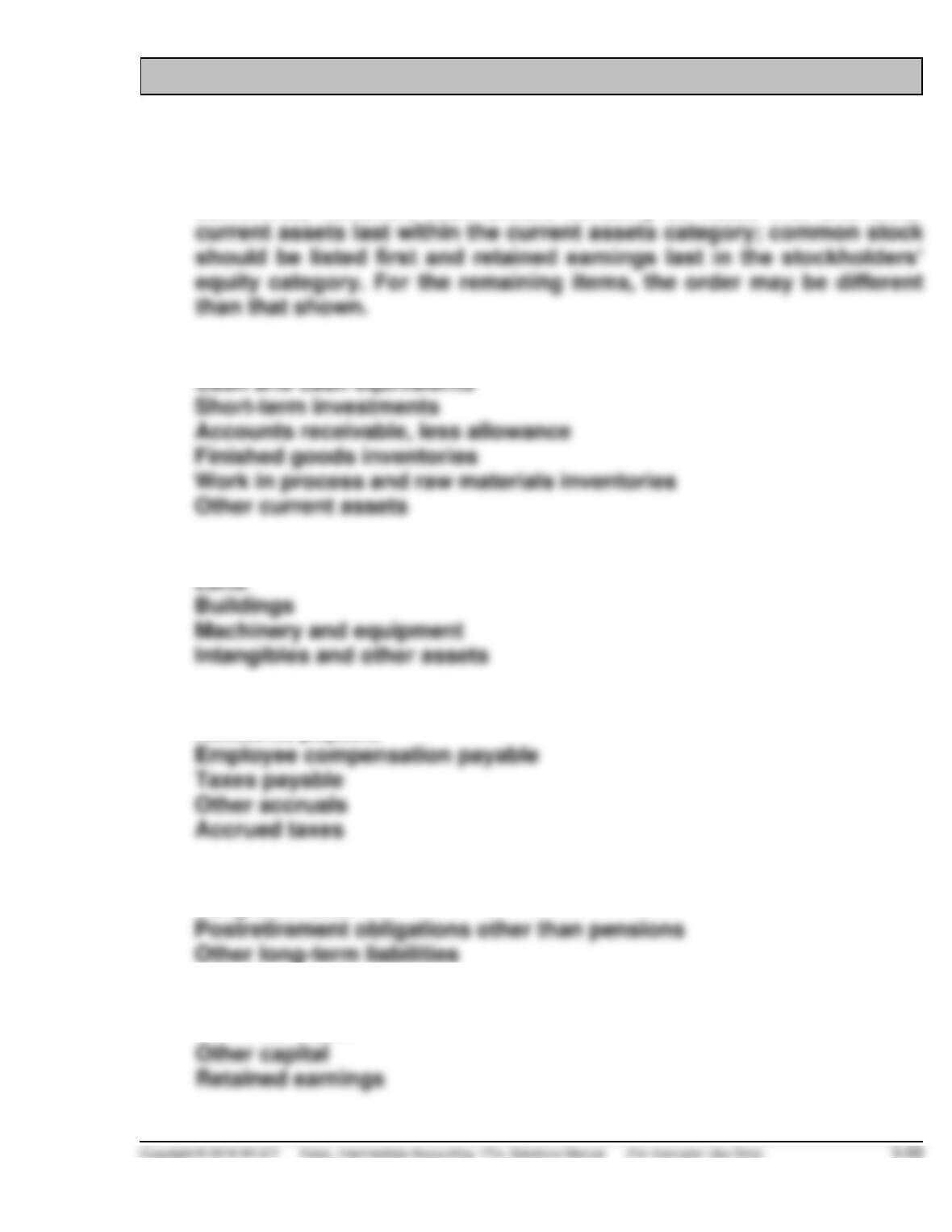
(a) These accounts are shown in the order in which Sherwin-Williams
actually presented the accounts. The order shown may be modified
somewhat; however, cash should certainly be listed first and other
CURRENT ASSETS
LONG-TERM ASSETS
CURRENT LIABILITIES
Accounts payable
LONG-TERM LIABILITIES
Long-term debt
STOCKHOLDERS’ EQUITY
Common stock
FINANCIAL STATEMENT ANALYSIS CASE 2 (Continued)
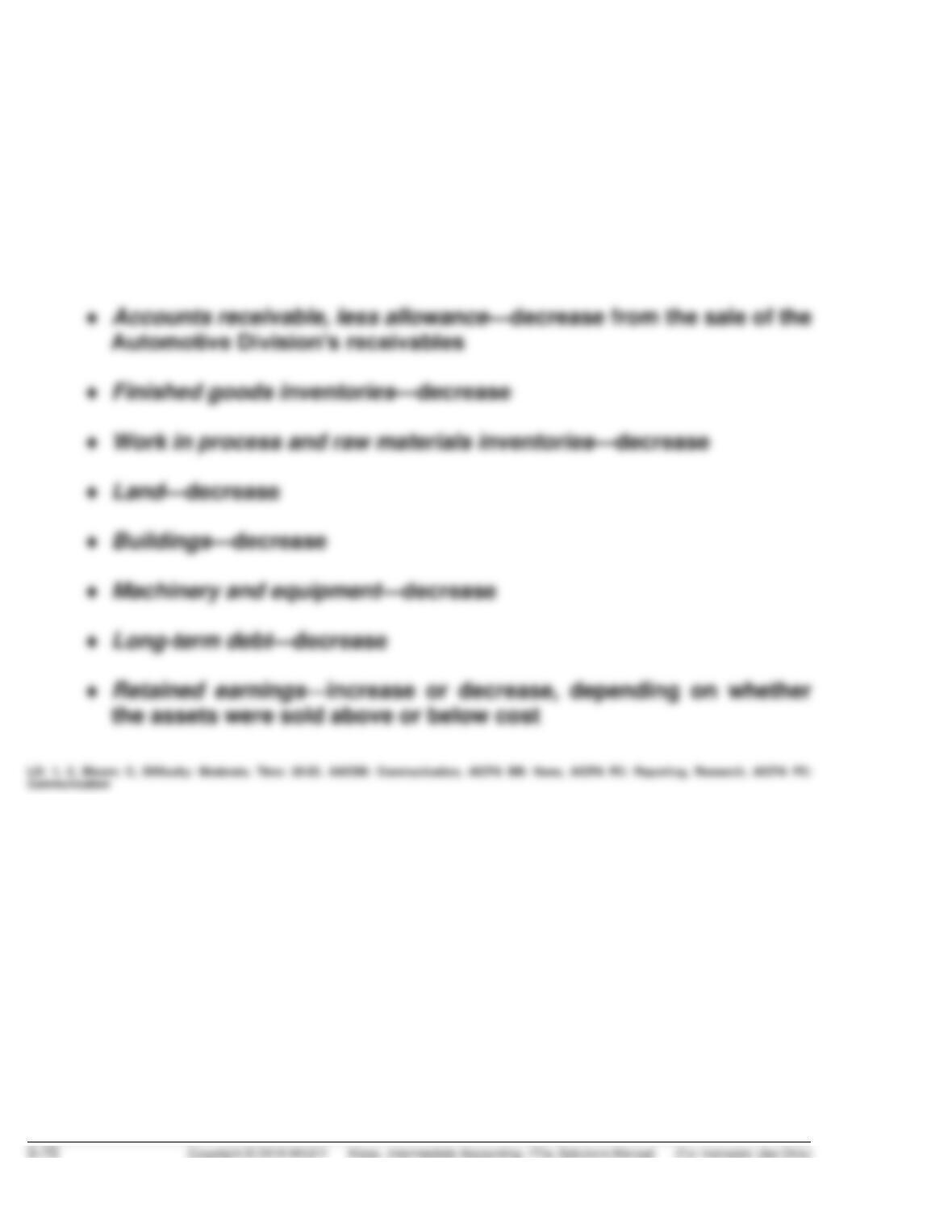
(b) There is some latitude for judgment in this question. The general
answer is that the assets and liabilities specific to the automotive
division will decrease and that cash will increase. Some students may
be aware that retained earnings will increase or decrease, depending
upon whether the assets were sold above or below historical cost.
Cash and cash equivalents—increase from the sale of the assets
FINANCIAL STATEMENT ANALYSIS CASE 3
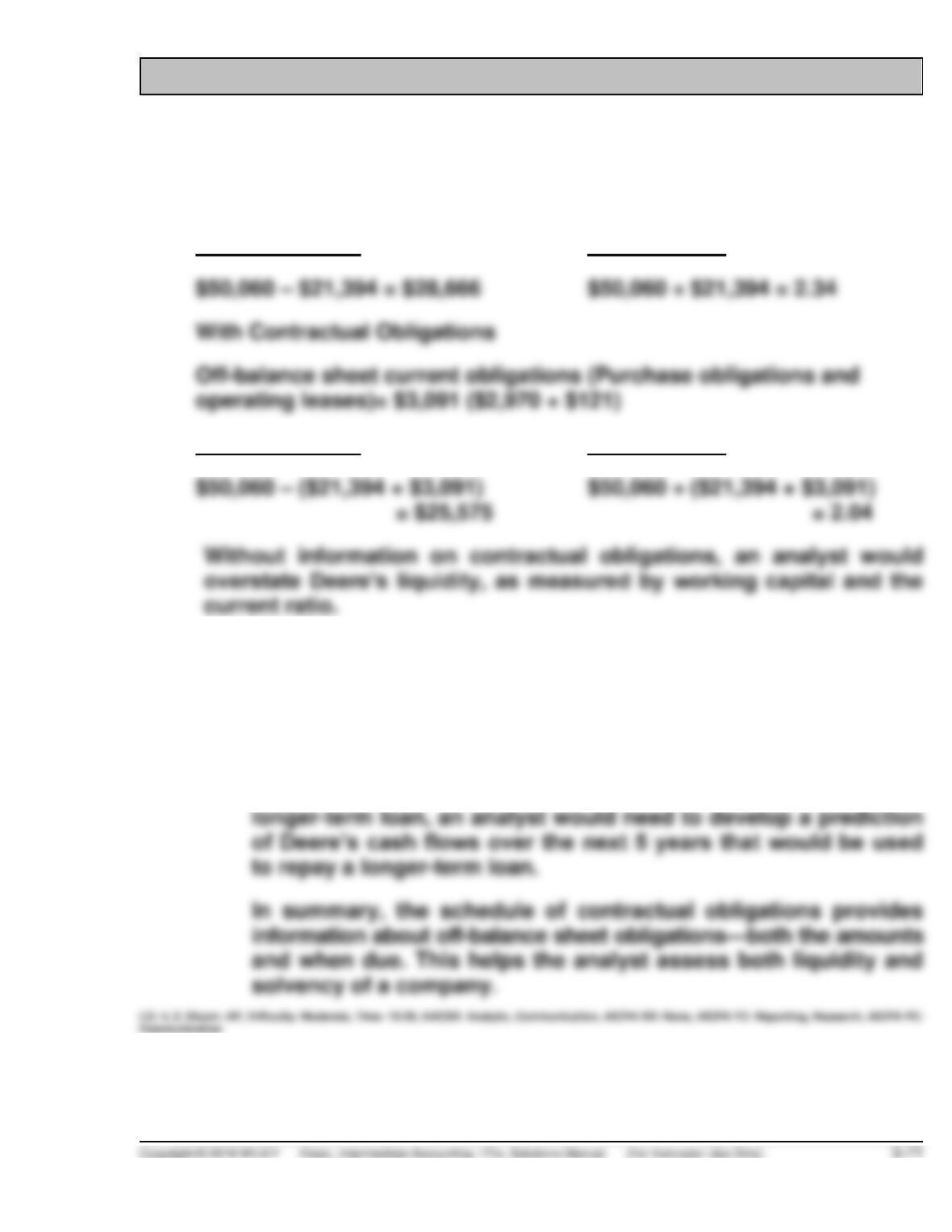
(a) Working Capital, Current Ratio
Without Contractual Obligations
Working Capital Current Ratio
Working Capital Current Ratio
(b) 1. Based on the analysis in Part (a), Deere has a pretty good liquid–
ity cushion. It would be able to pay a loan of up $25,575 billion if
due in one year.
2. Additional contractual obligations of $13,119 in years 2 and 3
and $8,211 in years 4 and 5 are relevant to assessing whether
Deere can repay a loan maturing in 5 years. In evaluating a
FINANCIAL STATEMENT ANALYSIS CASE 4
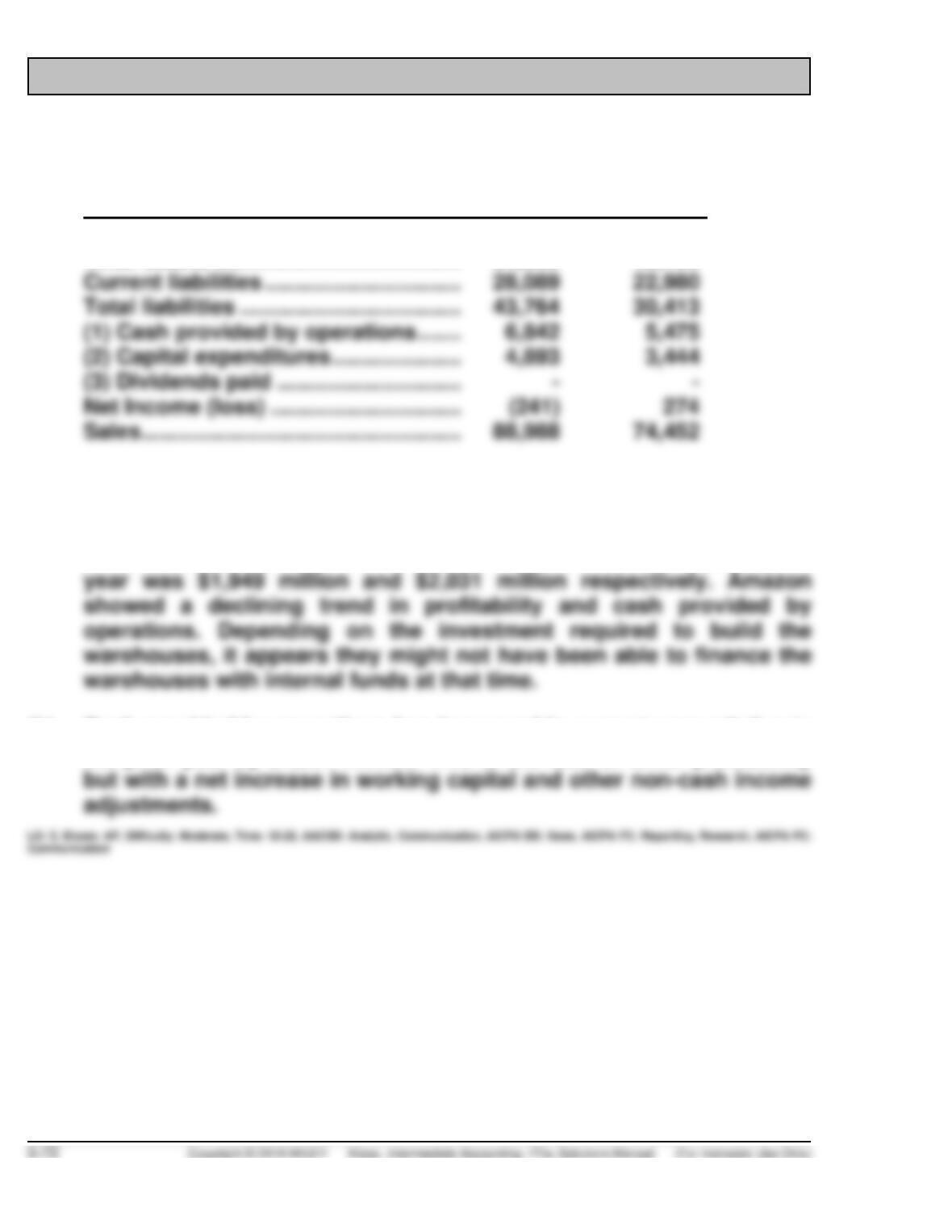
(a) ($ in millions) Current Prior
Year Year
Current assets ……………………………… $31,327 $24,625
Total assets …………………………………. 54,505 40,159
Free Cash Flow …………………………….. 1,949 2,031
(1) – (2) – (3)
As indicated above, Amazon’s free cash flow in the current and prior
(b) Cash provided by operations has increased in current year relative to
the prior year by $1,367 million. This is the face of lower profitability
ACCOUNTING, ANALYSIS, AND PRINCIPLES
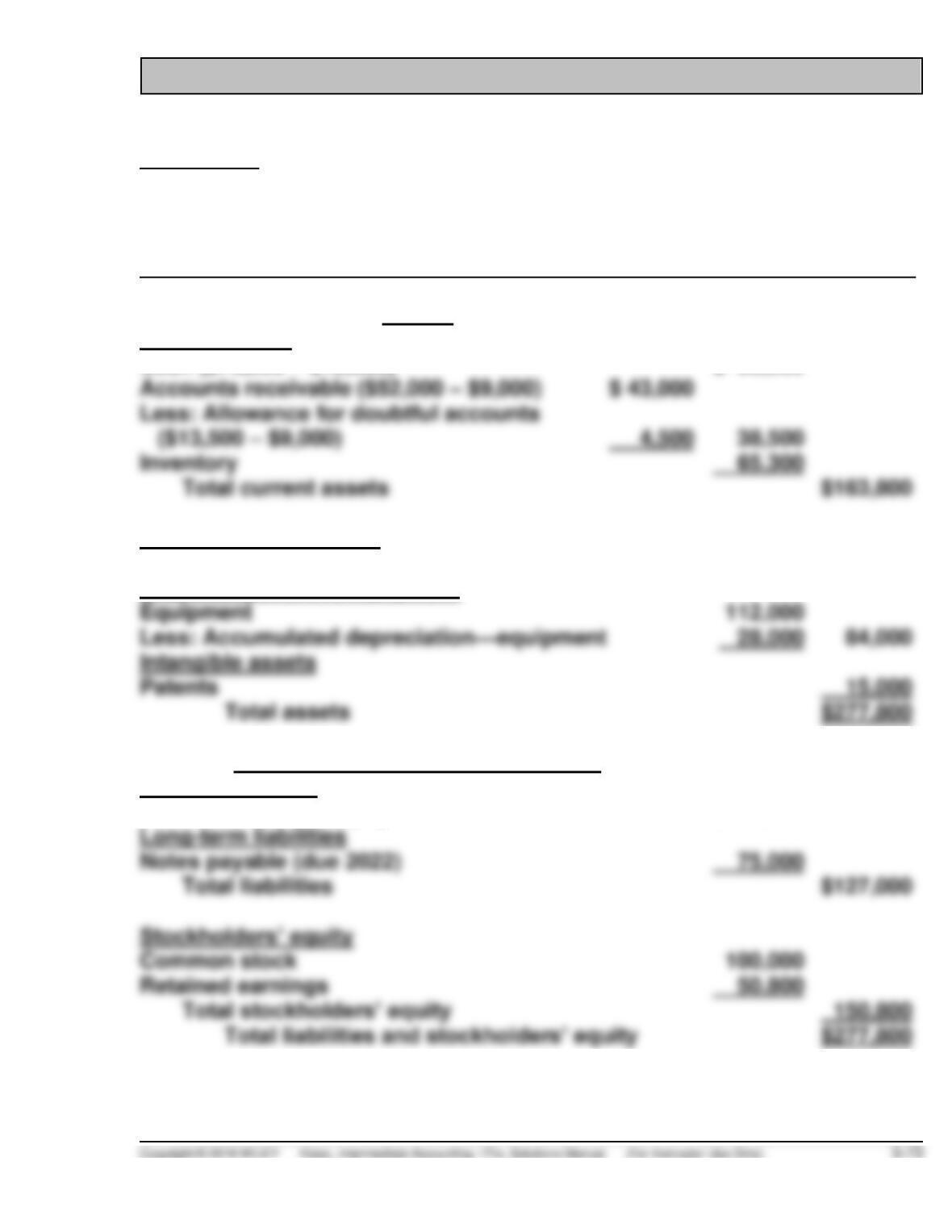
Accounting
Hopkins Company
Balance Sheet
December 31, 2020
Assets
Current assets
Cash ($75,000 – $15,000)
$ 60,000
Inventory
65,300
Total current assets
$163,800
Long-term investments
Bond sinking fund
15,000
Property, plant, and equipment
Equipment
Less: Accumulated depreciation—equipment
84,000
Intangible assets
Patents
15,000
Total assets
$277,800
Liabilities and Stockholders’ Equity
Current liabilities
Notes and accounts payable
$ 52,000
Long-term liabilities
Notes payable (due 2022)
75,000
Total liabilities
$127,000
Common stock
Retained earnings
50,800
Total stockholders’ equity
Total liabilities and stockholders’ equity
$277,800
ACCOUNTING, ANALYSIS, AND PRINCIPLES (Continued)
Analysis
The classified balance sheet provides subtotals for current assets and
current liabilities, which are assets expected to be converted to cash (or
liabilities expected to be paid from cash) in the next year or operating cycle
Principles
The primary objection that the bank is likely to raise about this supple–
mental information is the subjectivity (which reduces faithful representation)