Financial and Managerial Accounting, 8e
5-1
CHAPTER 5
INVENTORIES AND COST OF SALES
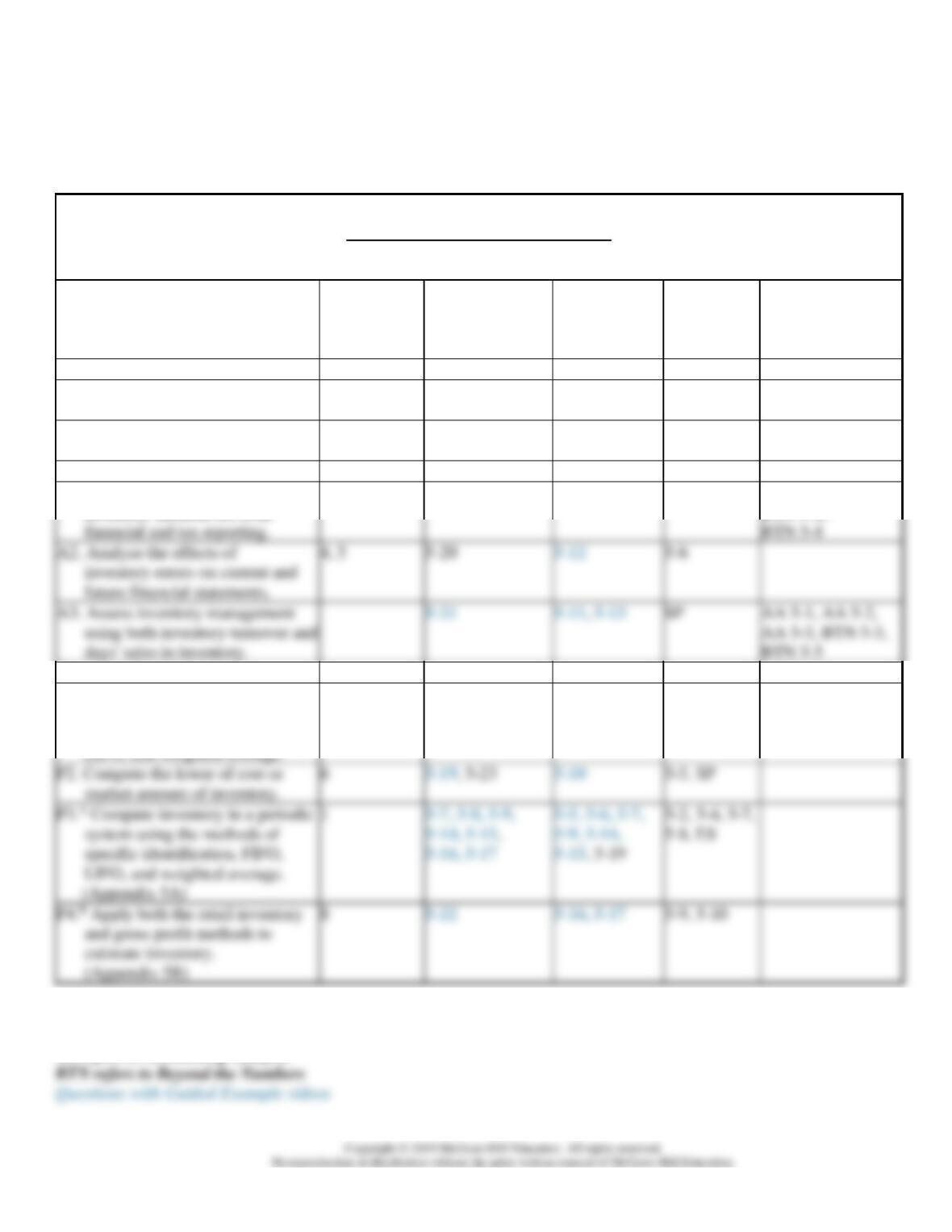
Related Assignment Materials
Student Learning Objectives
Questions
Quick Studies*
Exercises*
Problems*
AA and BTN
Conceptual objectives:
C1. Identify the items making up
merchandise inventory.
7
5-1, 5-17, 5-23
5-1
BTN 5-6
C2. Identify the costs of merchandise
inventory.
1, 2
5-2, 5-23
5-2
AA 5-1,
BTN 5-6
Analytical objectives:
financial and tax reporting.
BTN 5-4
A2. Analyze the effects of
inventory errors on current and
4, 5
5-20
5-12
5-6
days’ sales in inventory.
BTN 5-5
A1. Analyze the effects of
inventory methods for both
3, 9, 10, 11, 12
5-18
5-4, 5-6, 5-11
5-8
BTN 5-1,
BTN 5-2,
Procedural objectives:
LIFO, and weighted average.
(Appendix 5A)
estimate inventory.
(Appendix 5B)
P1. Compute inventory in a perpetual
system using the methods of
specific identification, FIFO,
1
5-3, 5-4, 5-5,
5-6, 5-10, 5-11, 5-
12, 5-13
5-3, 5-8, 5-18
5-1, 5-3
BTN 5-4
*See additional information on next page that pertains to these quick studies, exercises, and problems.
SP refers to the Serial Problem
AA refers to Accounting Analysis
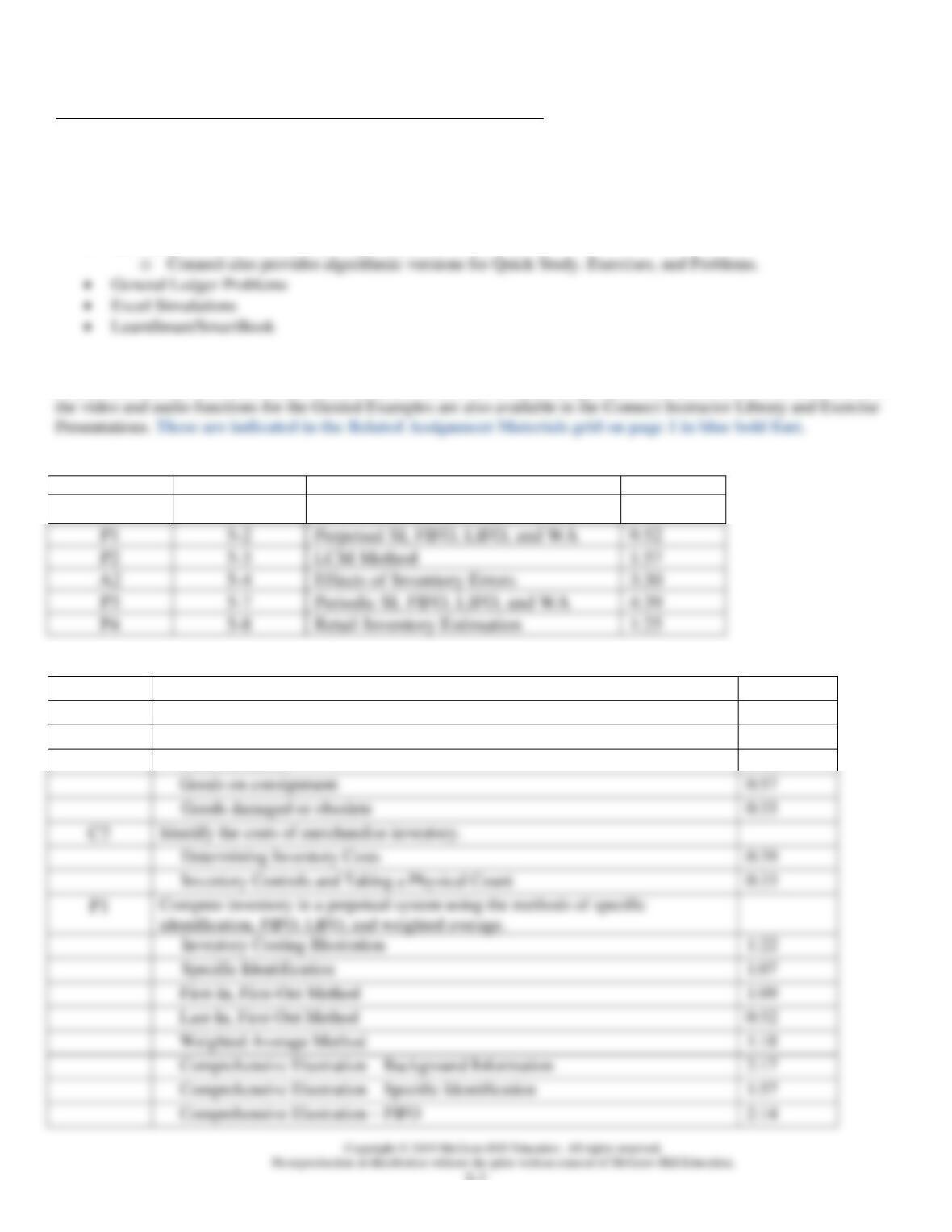
Goods on consignment
0:57
Goods damaged or obsolete
0:33
C2
Identify the costs of merchandise inventory.
0:39
0:33
Inventory Costing Illustration
1:22
Specific Identification
1:07
First-In, First-Out Method
1:09
Last-In, First-Out Method
0:52
Weighted Average Method
1:18
Comprehensive Illustration – Specific Identification
1:57
Comprehensive Illustration – FIFO
2:14
Financial and Managerial Accounting, 8e
5-2
Additional Information on Related Assignment Material
See Chapter 1 of the Instructor’s Resource Manual for more information on materials for this text available in
Connect.
Connect
Available on the instructor’s course-specific website, Connect:
• All numerical Quick Studies, all Exercises and Problems Set A.
Hints/Guided Examples
Please note that the Guided Examples are labeled as “Hints” in Connect assignments. The animated PowerPoints without
Need-to-Know Videos
LO
Need–to-Know
Title
Time
C1, C2
5-1
Inventory Items and Costs
2:34
Concept Overview Videos
LO
Title
Time
C1
Identify the items making up merchandise inventory.
Determining Inventory Items
0:17
Goods in transit
0:56
Financial and Managerial Accounting, 8e
5-3
Comprehensive Illustration – LIFO
2:14
Comprehensive Illustration – Weighted Average
1:22
A1
Analyze the effects of inventory methods for both financial and tax reporting.
Financial Statement Effects of Costing Methods
1:19
Tax Effects of Costing Methods
0:48
A2
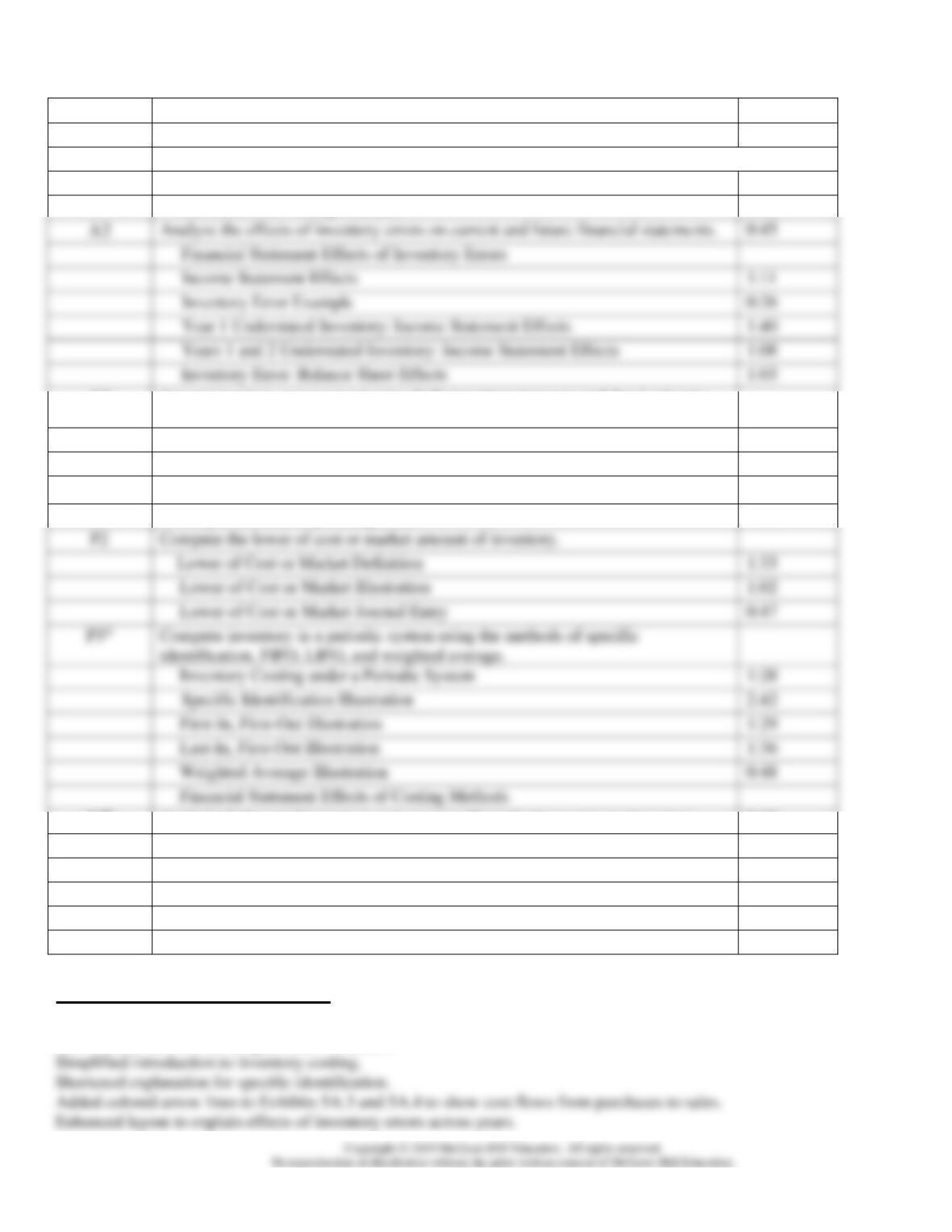
Analyze the effects of inventory errors on current and future financial statements.
0:45
Financial Statement Effects of Inventory Errors
Income Statement Effects
1:11
Inventory Error Example
0:26
Year 1 Understated Inventory: Income Statement Effects
1:40
Years 1 and 2 Understated Inventory: Income Statement Effects
1:08
Inventory Error: Balance Sheet Effects
1:03
A3
Assess inventory management using both inventory turnover and days’ sales in
inventory.
Inventory Turnover
1:05
Inventory Turnover Illustration
1:48
Days’ Sales in Inventory
0:56
Analysis of Inventory Management
1:04
Compute the lower of cost or market amount of inventory.
Lower of Cost or Market Definition
1:33
Lower of Cost or Market Illustration
1:02
Lower of Cost or Market Journal Entry
0:47
Inventory Costing under a Periodic System
1:28
Specific Identification Illustration
2:42
First-In, First-Out Illustration
1:29
Last-In, First-Out Illustration
1:36
Weighted Average Illustration
0:48
Financial Statement Effects of Costing Methods
P4B
Apply both the retail inventory and gross profit methods to estimate inventory.
0:35
Inventory Estimation Methods
1:46
Retail Inventory Method
1:20
Retail Inventory Method Illustration
0:41
Gross Profit Method
1:29
Gross Profit Method Illustration
1:33
Synopsis of Chapter Revisions
NEW opener—Shake Shack and entrepreneurial assignment.
New Ethical Risk on the alleged fraud of Homex.
Financial and Managerial Accounting, 8e
5-4
Updated inventory turnover and days’ sales in inventory analysis using Costco and Walmart.
New Cheat Sheet reinforces chapter content.
Chapter Outline
I. Inventory Basics
A. Determining Inventory Items
Merchandise inventory includes all goods that a company owns and holds for sale. The following
inventory items require special attention:
1. Goods in Transit—if ownership has passed to the purchaser, the goods are included in the
purchaser’s inventory. Ownership is determined by reviewing the shipping terms.
3. Goods Damaged or Obsolete
a. Damaged and obsolete (and deteriorated) goods are not reported in inventory if they cannot be
sold.
b. If these goods can be sold at a lower price, they are included in inventory at their net realizable
value, the sales price minus the cost of making the sale.
B. Determining Inventory Costs
1. The cost of an inventory item includes its invoice cost minus any discount, plus any incidental costs
C. Internal Controls and Taking a Physical Count
1. Events (theft, loss, damage, and errors) can cause the Inventory account balance to differ from the
actual inventory on hand.
2. Nearly all companies take a physical count of inventory at least once a year; the physical count is
II. Inventory Costing under a Perpetual System One of the most important issues in accounting for
inventory is determining the per unit cost assigned to inventory items. The periodic system is covered in
Appendix 5A.
A. Inventory Cost Flow Assumptions
Four methods are used to assign costs to inventory and cost of goods sold. Each method assumes a
Financial and Managerial Accounting, 8e
5-5
particular pattern for how costs flow through inventory. Physical flow and cost flow need not be the
same.
1. First-In, First-Out (FIFO)—assumes costs flow in the order incurred. (Results are identical under
the periodic and perpetual systems.)
B. Under the perpetual inventory system, Merchandise Inventory is updated for each purchase and sale of
inventory. Cost of goods available for sale must be allocated between cost of goods sold and ending
inventory.
1. Specific identification—Each item can be identified with a specific purchase and invoice. Specific
identification is usually only practical for companies with expensive, custom-made inventory.
C. Financial Statement Effects of Costing Methods
1. Rising Costs—when purchase costs regularly rise:
a. FIFO reports lowest cost of goods sold and highest gross profit and net income.
b. LIFO reports highest cost of goods sold and lowest gross profit and net income.
D. Tax Effects of Costing Methods
Since inventory costs affect net income, they have potential tax effects.
III. Valuating Inventory at LCM and the Effects of Inventory Errors
A. Lower of Cost or Market
Inventory is reviewed to ensure it is reported at the lower of cost or market (LCM).
1. Computing the Lower of Cost or Market—Market in the term LCM is replacement cost for LIFO,
Financial and Managerial Accounting, 8e
5-6
3. When market value is lower than inventory cost, a loss is recognized;
4. When market value is higher than inventory cost, no adjustment is made.
B. Financial Statement Effects of Inventory Errors
An inventory error causes misstatements in cost of goods sold, gross profit, net income, current assets,
and equity. It also causes misstatements in the next period’s financial statements because ending
inventory of one period is the beginning inventory of the next.
1. Income Statement Effects:
a. If ending inventory is understated, cost of goods sold is overstated and net income is
understated.
2. Balance Sheet Effects:
a. If ending inventory is understated, assets and equity are understated.
b. If ending inventory is overstated, assets and equity are overstated.
IV. Decision Analysis—Inventory Turnover and Days’ Sales in Inventory
A. Inventory Turnover
1. Inventory turnover, also called merchandise inventory turnover, measures the number of times a
company’s average inventory was sold during an accounting period.
B. Days’ Sales in Inventory
1. Day’s sales in inventory measures the adequacy of inventory to meet sales demand.
2. It reveals how much inventory is available in terms of the number of days’ sales.
C. Analysis of Inventory Management
Financial and Managerial Accounting, 8e
5-7
V. Inventory Costing under a Periodic System (Appendix 5A)
One of the most important issues in accounting for inventory is determining the per unit cost assigned to
inventory items.
A. Inventory Cost Flow Assumptions
Four methods are used to assign costs to inventory and cost of goods sold. Each method assumes
a particular pattern for how costs flow through inventory. Physical flow and cost flow need not
be the same.
1. First-in, first-out (FIFO)—assumes costs flow in the order incurred. (Results are identical
under the periodic and perpetual systems.)
B. Inventory Costing Illustration
1. First-in, first-out (FIFO)—At period-end, FIFO charges costs of the earliest units acquired
to cost of goods sold, leaving costs of the most recent purchases in inventory.
2. Last-in, first-out (LIFO)—At period-end, LIFO charges costs of the most recent purchase to
cost of goods sold, leaving costs of the earliest purchases in inventory.
C. Financial Statement Effects of Costing Methods
1. When purchase prices do not change, each inventory costing method assigns the same
amounts to inventory and to cost of goods sold. When purchase prices are different, the
methods assign different cost amounts.
2. Rising Costs:
a. FIFO assigns the lowest amount to cost of goods sold, resulting in the highest gross
4. Method Advantages:
a. FIFO inventory on the balance sheet approximates its current replacement cost; it also
mimics the actual flow of goods for most businesses.
Financial and Managerial Accounting, 8e
5-8
b. LIFO cost of goods sold on the income statement approximates current costs; better
VI. Inventory Estimation Methods (Appendix 5B)
Inventory sometimes is estimated for two reasons. First, companies often report interim financial
Financial and Managerial Accounting, 8e
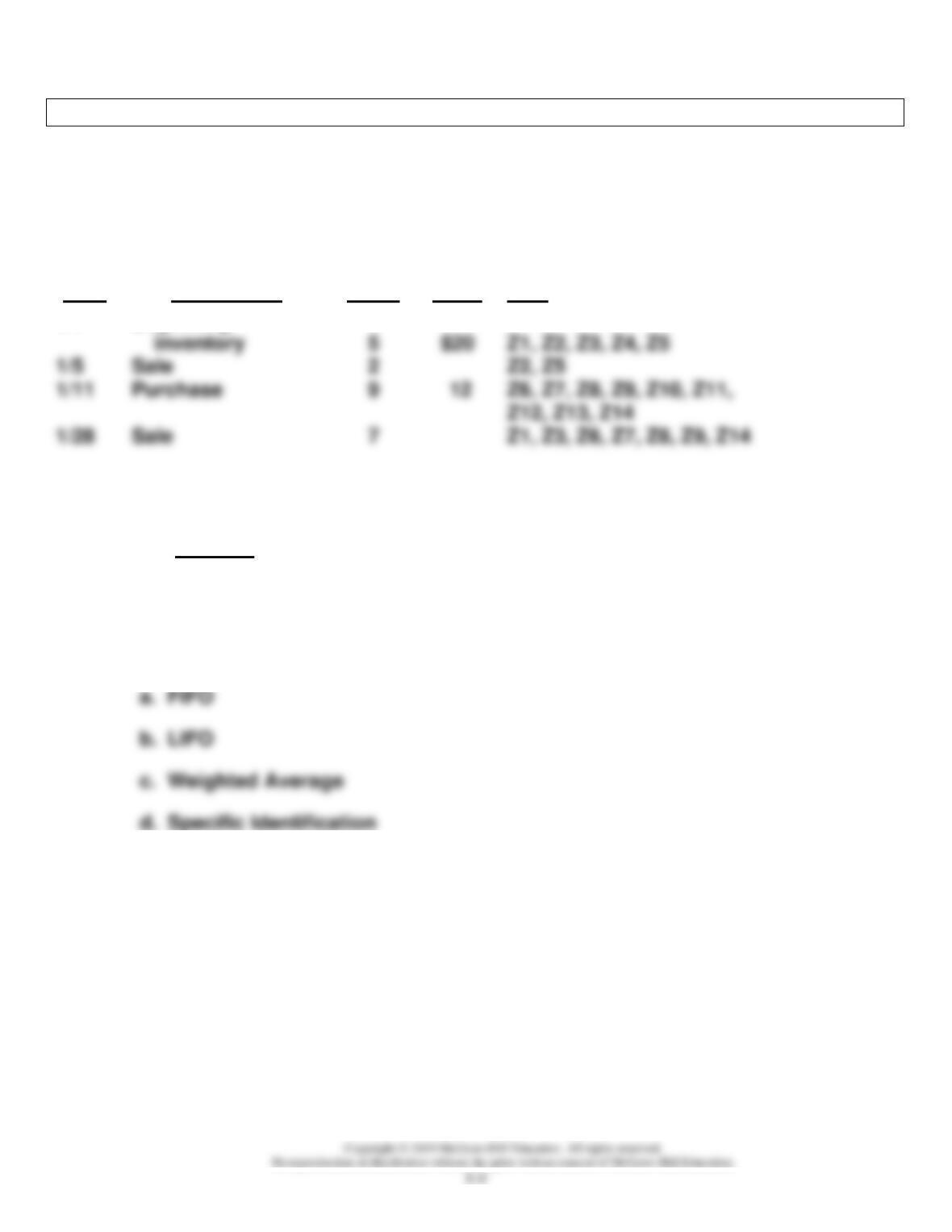
Chapter 5 Alternate Demonstration Problem #1 (Periodic)
The ABC Company had the following inventory record for the month of January:
# of
Unit
Date
Description
Items
Price
Item
1/1
Beginning
Required:
Assuming a periodic system is in use, determine the following:
1. Cost of goods available for sale.
2. Cost of goods sold and the ending inventory using each of the following
methods:
Financial and Managerial Accounting, 8e
5-10
Solution: Chapter 5 Alternate Demonstration Problem #1
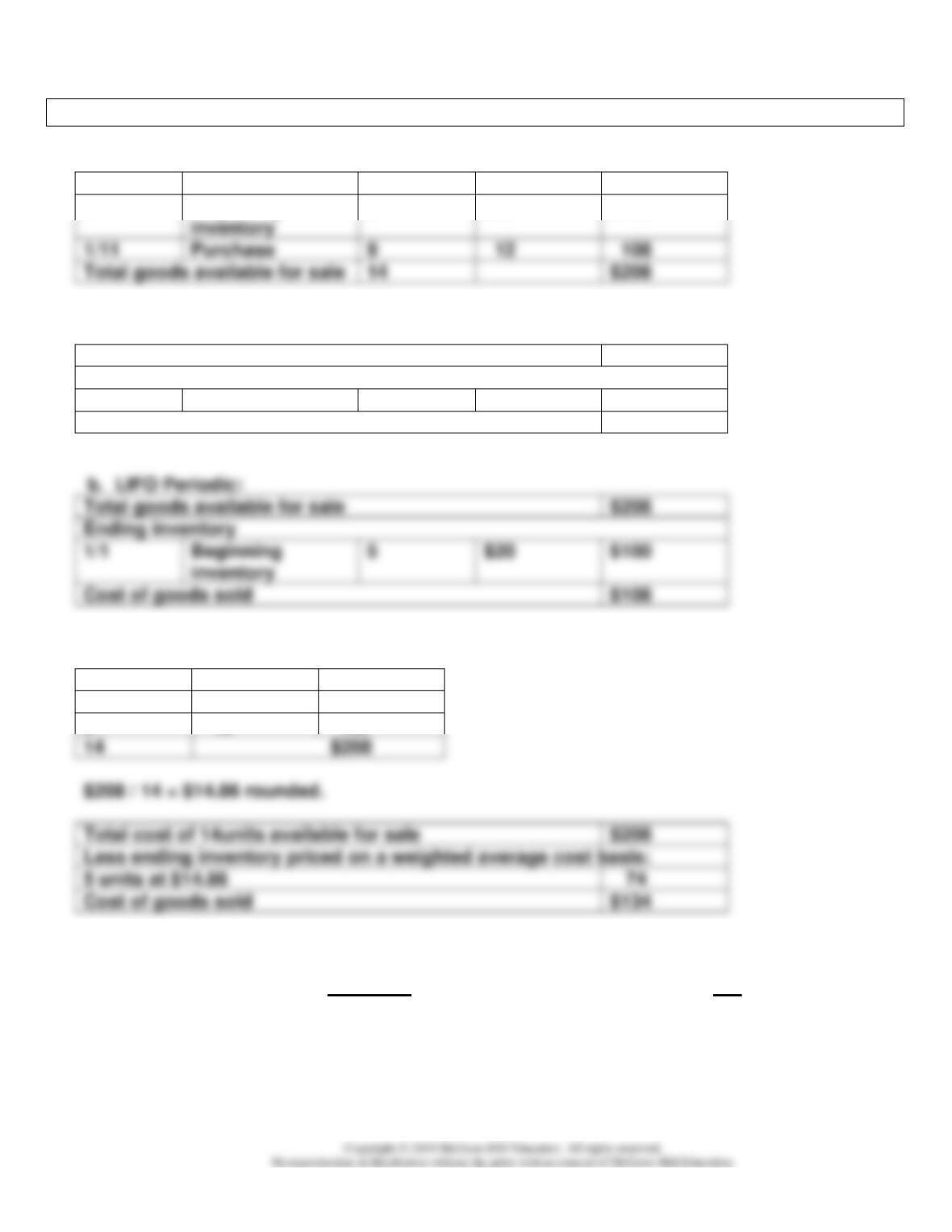
1. Cost of goods available for sale:
Date
Units
Unit Cost
Cost
1/1
inventory
1/11
Purchase
9
12
108
Total goods available for sale
14
$208
Beginning
5
$20
$100
2. a. FIFO Periodic (FIFO under periodic and perpetual yields identical results).
Total goods available for sale
$208
Ending inventory
1/28
Purchase
5
$12
$60
Cost of goods sold
$148
Total goods available for sale
$208
Ending inventory
1/1
Beginning
inventory
5
$20
$100
Cost of goods sold
$108
c. Weighted Average Periodic:
Units
Unit cost
Total cost
5
$20
$100
9
12
108
14
$208
Total cost of 14units available for sale
$208
Less ending inventory priced on a weighted average cost basis:
5 units at $14.86
74
Cost of goods sold
$134
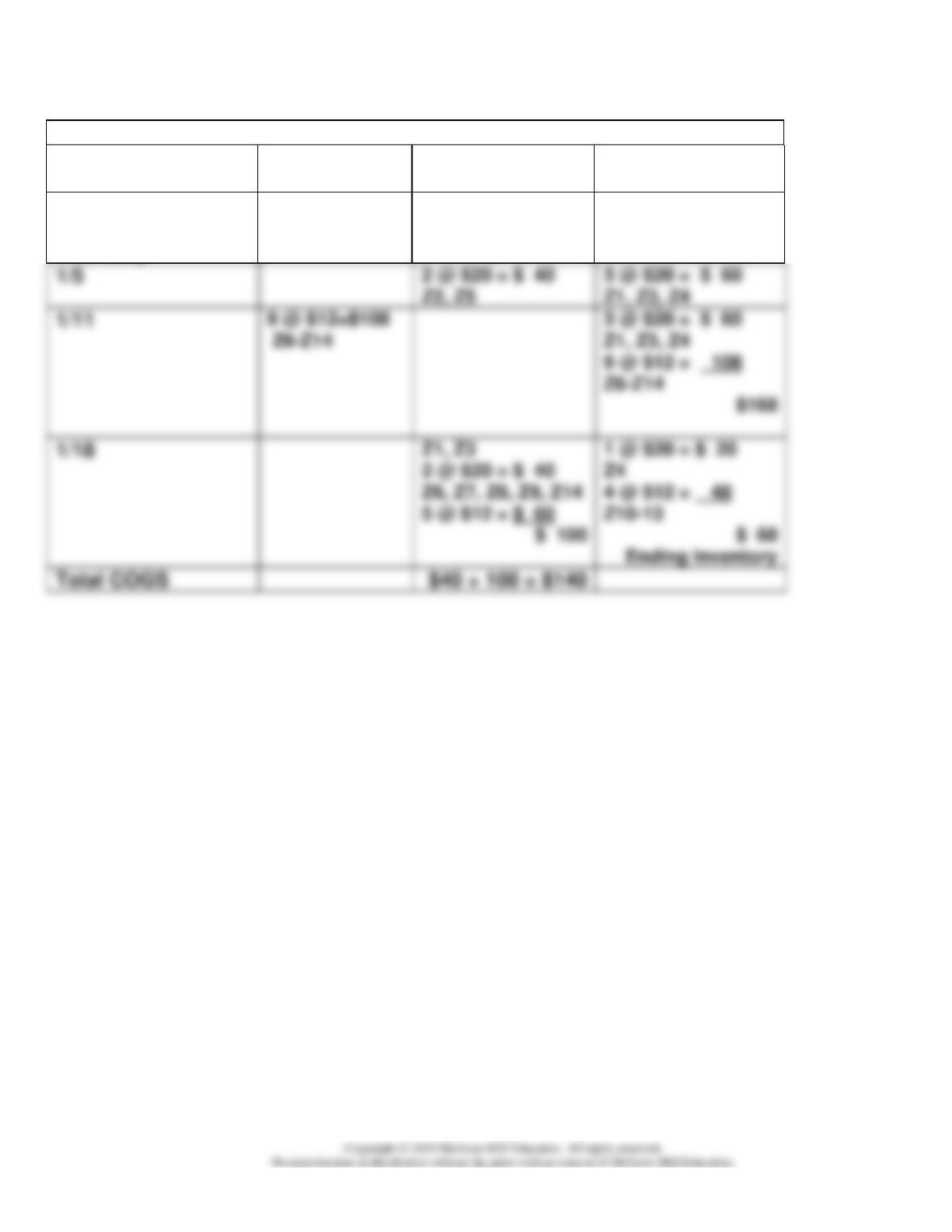
d. Specific Identification:
Specific identification method: solution is identical to the solution shown in alternative
demonstration problem for perpetual because specific identification is not a cost flow
assumption; it is a method which specifically identifies each item in inventory and each
item that is sold.
Financial and Managerial Accounting, 8e
5-11
Specific Identification Periodic
Date
Purchases
Sales at Cost
Inventory
Balance
1/1
Beginning
Inventory
5 @ $ 20 = $100
Z1–Z5
Financial and Managerial Accounting, 8e
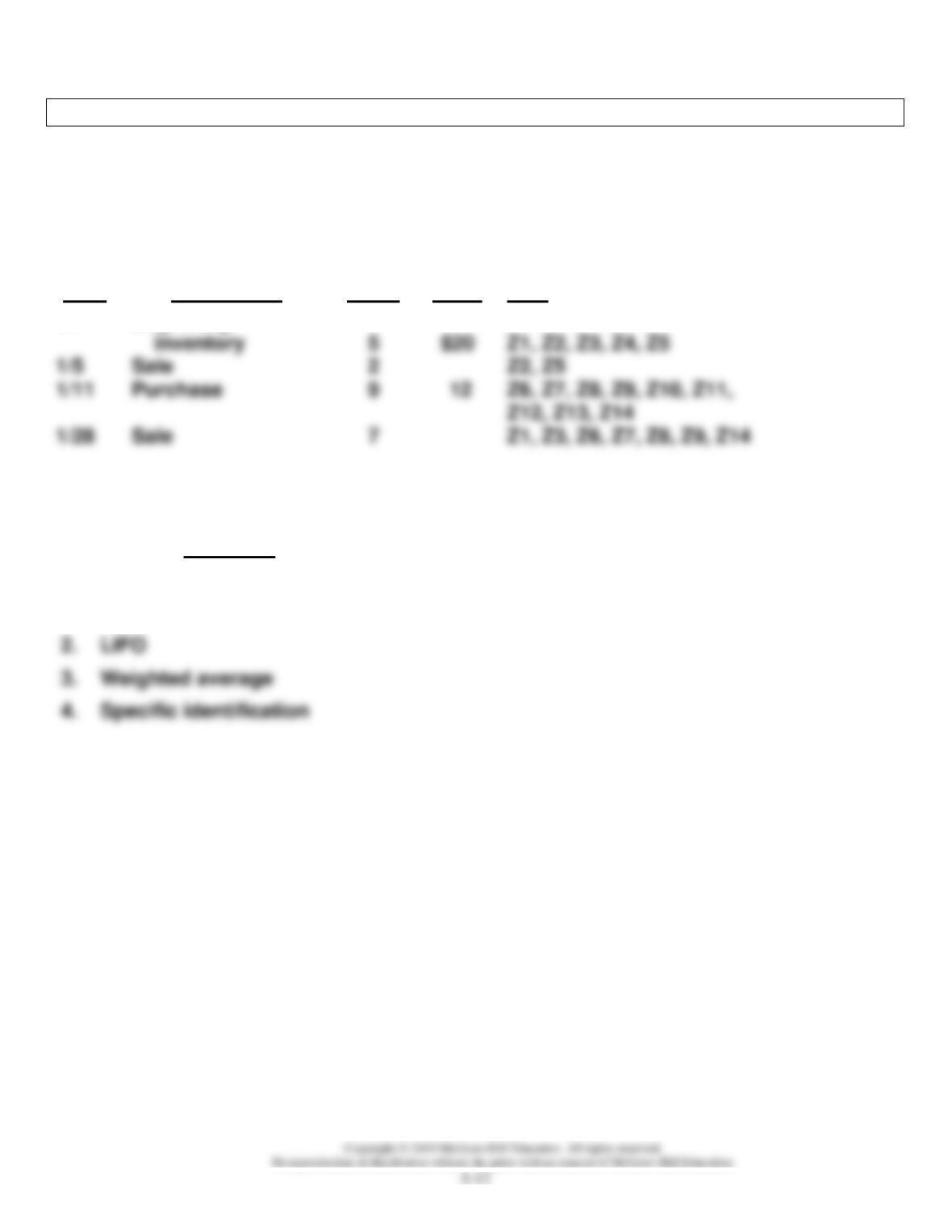
Chapter 5 Alternate Demonstration Problem #2 (Perpetual)
The ABC Company had the following inventory record for the month of January:
# of
Unit
Date
Description
Items
Price
Item
1/1
Z12, Z13, Z14
Beginning
Required:
Assuming a perpetual system is in use, determine the cost of goods sold and the
ending inventory using each of the following methods:
1. FIFO
5-13
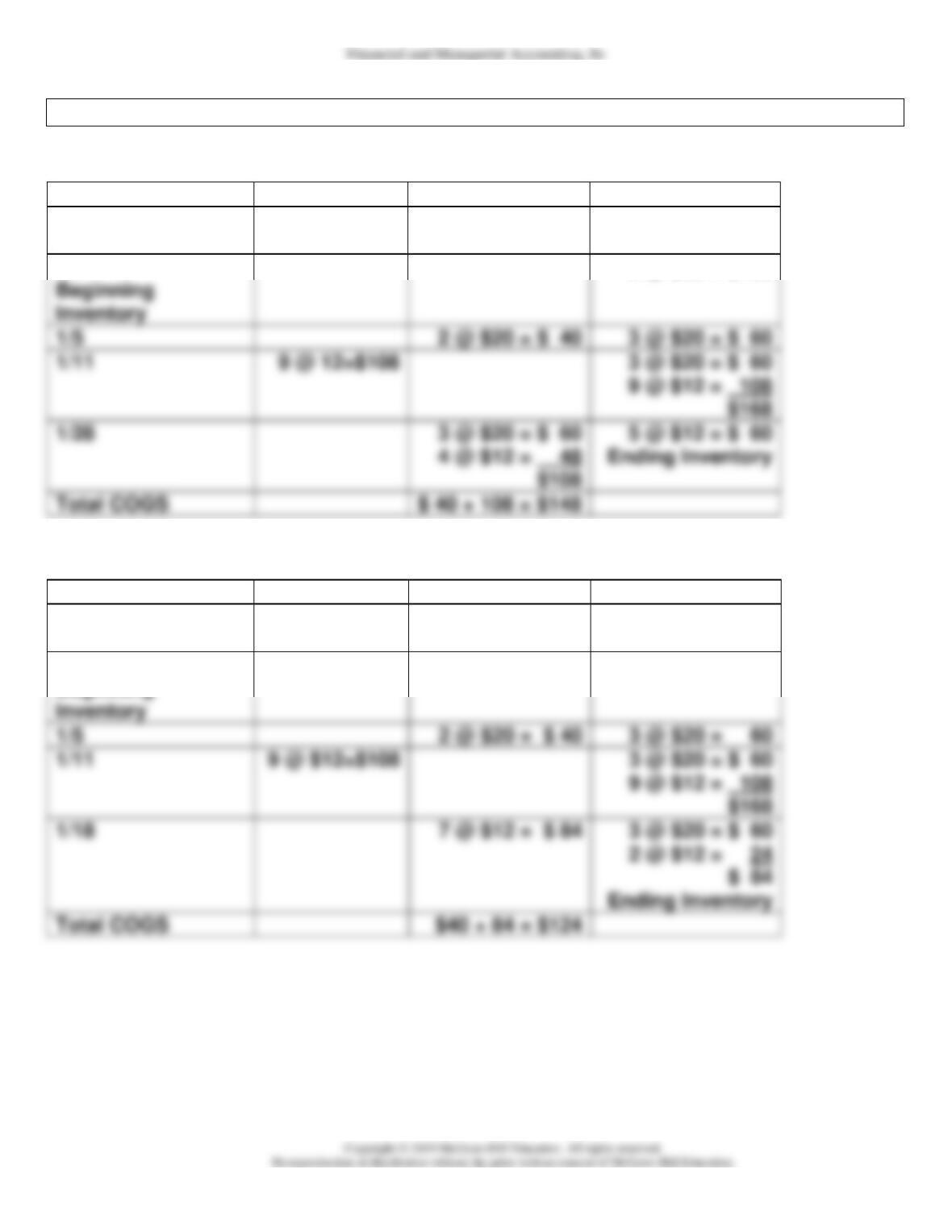
Solution: Chapter 5 Alternate Demonstration Problem #2
1.
FIFO Perpetual
Date
Purchases
Sales at Cost
Inventory
Balance
1/28
5 @ $12 = $ 60
Total COGS
$ 40 + 108 = $148
1/1
5 @ $20 = $100
2.
LIFO Perpetual
Date
Purchases
Sales at Cost
Inventory
Balance
1/11
3 @ $20 = $ 60
Total COGS
$40 + 84 = $124
1/1
Beginning
5 @ $ 20 = $100
Financial and Managerial Accounting, 8e
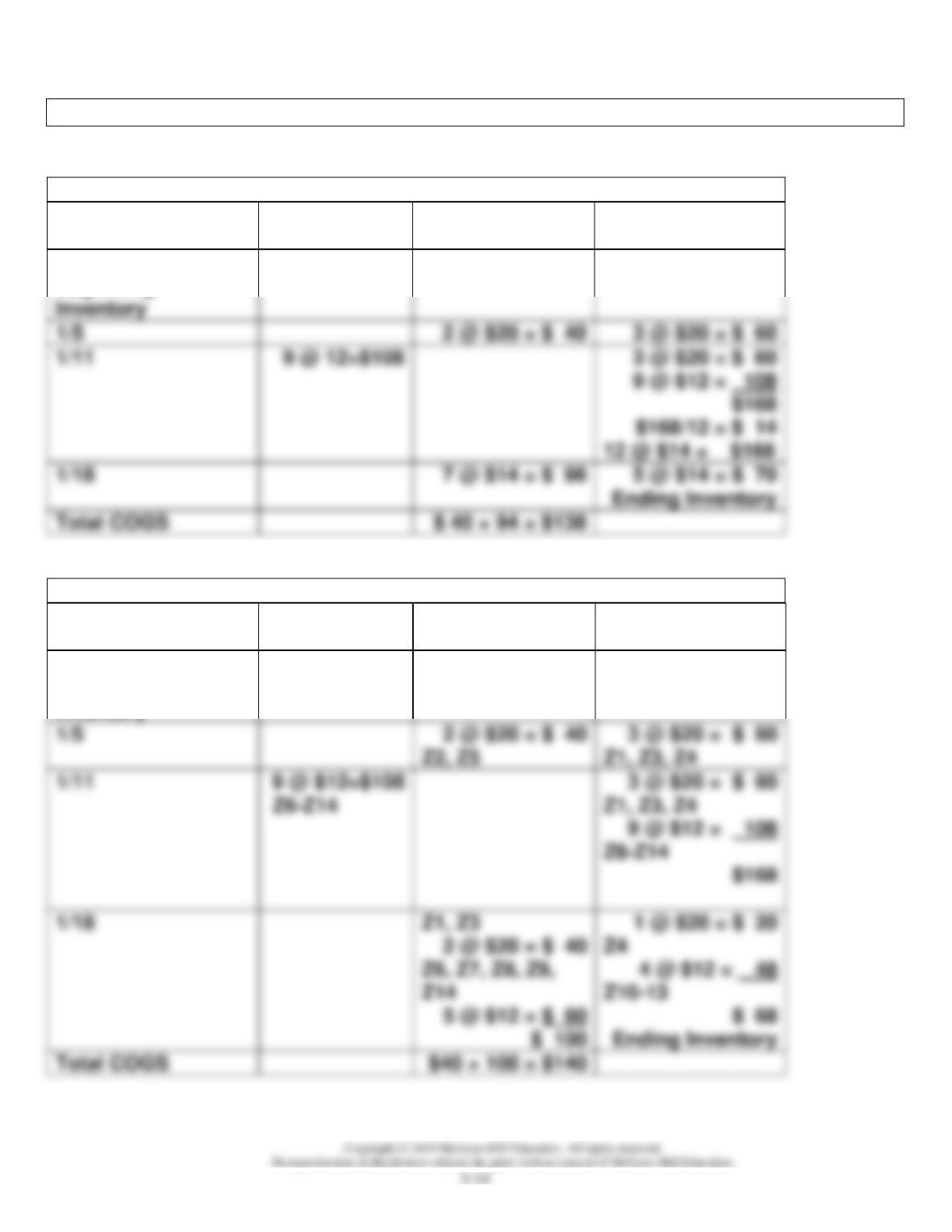
Solution: Chapter 5 Alternate Demonstration Problem #2, continued
3.
Weighted Average Perpetual
Date
Purchases
Sales at Cost
Inventory
Balance
Inventory
12 @ $14 = $168
Total COGS
1/1
Beginning
5 @ $20 = $100
4.
Specific Identification Perpetual
Date
Purchases
Sales at Cost
Inventory
Balance
1/1
Beginning
Inventory
5 @ $ 20 = $100
Z1–Z5
Total COGS