CODIFICATION EXERCISES
CE5.1
(a) Current assets is used to designate cash and other assets or resources commonly identified as
those that are reasonably expected to be realized in cash or sold or consumed during the normal
operating cycle of the business.
(b) Intangible assets are assets (not including financial assets) that lack physical substance. (The
Generally, only investments with original maturities of three months or less qualify under that
definition. Original maturity means original maturity to the entity holding the investment. For
example, both a three-month U.S. Treasury bill and a three-year Treasury note purchased three
months from maturity qualify as cash equivalents. However, a Treasury note purchased three years
ago does not become a cash equivalent when its remaining maturity is three months. Examples of
items commonly considered to be cash equivalents are Treasury bills, commercial paper, money
market funds, and federal funds sold (for an entity with banking operations).
CE5.2
See FASC ASC 210-10-45 (Other Presentation Matters)
Classification of Current Liabilities
45–5A Total of current liabilities shall be presented in classified balance sheets.
45-6 The concept of current liabilities shall include estimated or accrued amounts that are expected
to be required to cover expenditures within the year for known obligations the amount of which
CE5.2 (Continued)
45-7 Section 470-10-45 includes guidance on various debt transactions that may result in current
liability classification. These transactions are the following:
a. Due on demand loan agreements
CE5.3
The following discussion is provided at 235-10-50 Disclosure
> Accounting Policies Disclosure
50-1 Information about the accounting policies adopted by an entity is essential for financial
statement users. When financial statements are issued purporting to present fairly the
financial position, cash flows, and results of operations in accordance with generally accepted
50-2 The provisions of the preceding paragraph are not intended to apply to unaudited financial
statements issued as of a date between annual reporting dates (for example, each quarter) if
50-3 Disclosure of accounting policies shall identify and describe the accounting principles followed
by the entity and the methods of applying those principles that materially affect the determina-
tion of financial position, cash flows, or results of operations. In general, the disclosure shall
50-4 Examples of disclosures by an entity commonly required with respect to accounting policies
would include, among others, those relating to the following:
a. Basis of consolidation
b. Depreciation methods
CE5.3 (Continued)
50-5 Financial statement disclosure of accounting policies shall not duplicate details (for example,
the composition of inventories or of plant assets) presented elsewhere as part of the financial
50-6 This Subtopic recognizes the need for flexibility in matters of format (including the location) of
disclosure of accounting policies provided that the entity identifies and describes its significant
CE5.4
The following section: 230-10-05 Overview and Background provides a discussion of the objectives of
the Statement of Cash Flows.
05-2 Specific guidance is provided on all of the following:
a. Classifying in the statement of cash flows of cash receipts and payments as either
230–10-10 Objectives
CE5.4 (Continued)
10-2 The information provided in a statement of cash flows, if used with related disclosures and
information in the other financial statements, should help investors, creditors, and others (including
donors) to do all of the following:
a. Assess the entity’s ability to generate positive future net cash flows
CODIFICATION RESEARCH CASE
(a) Codification String: FASB ASC 235-10-05—Presentation > 235 Notes
(b) Codification String: Presentation > 235 Notes to Financial Statements
> 10 Overall > 05 Background
05-3 The accounting policies of an entity are the specific accounting
(c) Codification String: Presentation > 235 Notes to Financial Statements
> 10 Overall > 50 Disclosure
50-3 Disclosure of accounting policies shall identify and describe the
accounting principles followed by the entity and the methods of
applying those principles that materially affect the determination
CODIFICATION RESEARCH CASE (Continued)
(d) 50-4 Codification String: Presentation > 235 Notes to Financial
Statements > 10 Overall > 05 Background
Examples of disclosures by an entity commonly required with
respect to accounting policies would include, among others,
those relating to the following:
a. Basis of consolidation
b. Depreciation methods
IFRS CONCEPTS AND APPLICATION
IFRS5.1
In general, the disclosure requirements related to the statement of financial
IFRS5.2
Among the similarities between IFRS and U.S. GAAP related to the
statement of financial position presentation are as follows:
• Both IFRS and GAAP allow the use of the title “balance sheet” or
“statement of financial position.” IFRS recommends but does not
require the use of the title “statement of financial position” rather than
Differences include:
• IFRS requires a classified statement of financial position except in very
IFRS5.2 – Continued
• Under IFRS, current assets are usually listed in the reverse order of
liquidity. For example, under GAAP, cash is listed first, but under
IFRS5.3
The IASB and the FASB have worked on a project to converge their
standards related to financial statement presentation. A key feature of the
IFRS5.4
Rainmaker Company will report a net revaluation gain of $165,000 ($200,000 –
IFRS5.5
(a) Some of the differences are:
1. Report form and subtotals—Tomkins uses a modified report form
with current liabilities deducted from current assets to determine
net current assets and remaining liabilities deducted from total
(b) Although there are differences in terminology and some groupings and
subtotals are different, the British balance sheet does group assets and
liabilities with similar characteristics together (Fixed assets, Current
IFRS5.6
(a) International Accounting Standard 8 covers the disclosure of
accounting policies.
(b) Accounting policies are the specific principles, bases, conventions,
(c) An entity shall select and apply its accounting policies consistently
for similar transactions, other events and conditions, unless an IFRS
(d) Disclosure
When the initial application of an IFRS has an effect on the current
period or any prior period or would have such an effect except that it
is impracticable to determine the amount of the adjustment, or might
have an effect on future periods, an entity shall disclose:
a. the title of the IFRS;
(ii) if IAS 33 Earnings per Share applies to the entity, for basic and
diluted earnings per share;
IFRS5.6 (Continued)
g. the amount of the adjustment relating to periods before those
Financial statements of subsequent periods need not repeat these
disclosures. (para. 28)
When a voluntary change in accounting policy has an effect on the
current period or any prior period, would have an effect on that period
except that it is impracticable to determine the amount of the
adjustment, or might have an effect on future periods, an entity shall
disclose:
a. the nature of the change in accounting policy;
b. the reasons why applying the new accounting policy provides
IFRS5.7
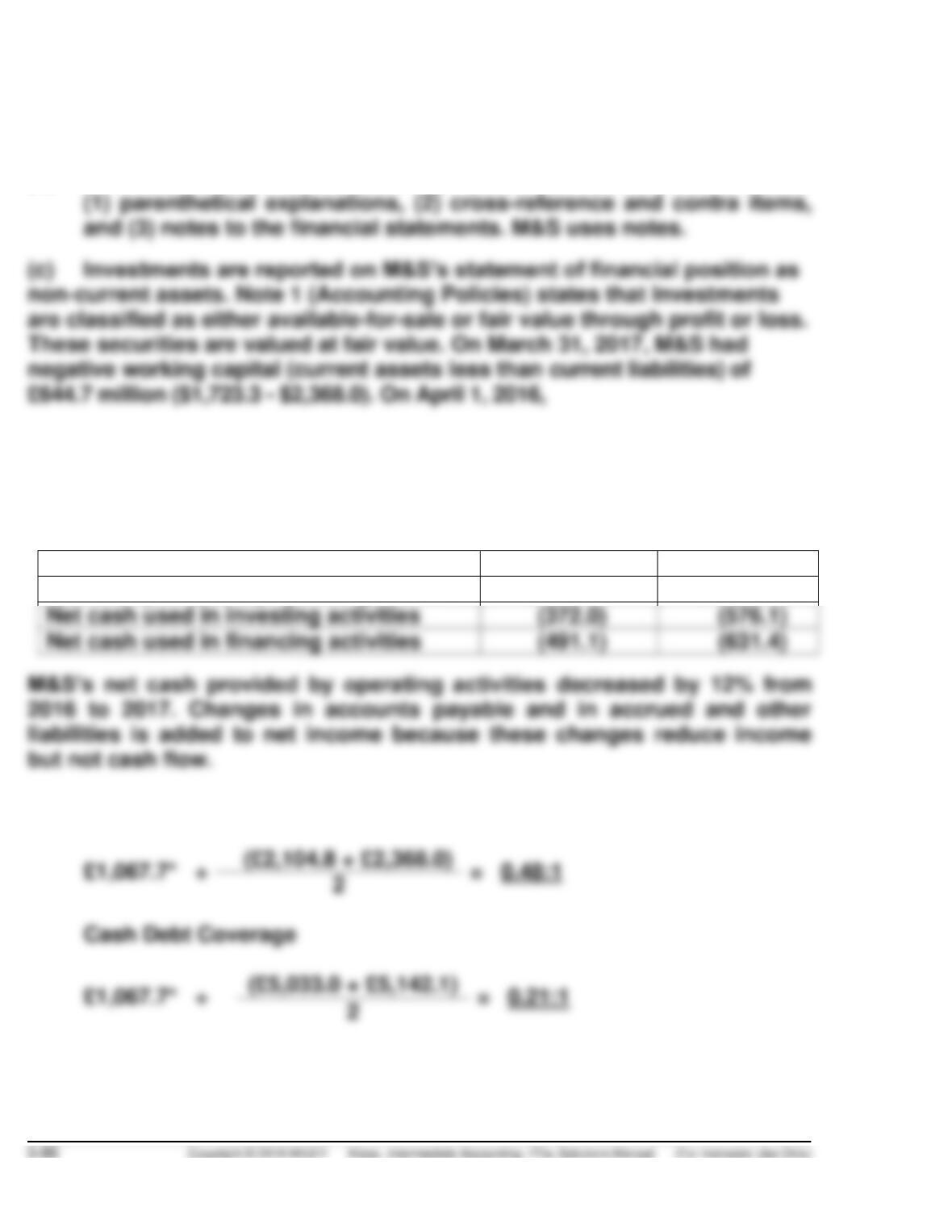
(a) M&S could have adopted the account form or report form. M&S uses
the report form.
(b) The techniques of disclosing pertinent information include
M&S’s negative working capital was £643.4 million ($1,461.4 − $2,104.8).
(d) The following table summarizes M&S’s cash flows from operating,
investing, and financing activities in 2017 and 2016 (in millions).
2017
2016
Net cash provided by operating activities
£1,067.7*
£1,212.0
Net cash used in financing activities
(e) Current Cash Debt
IFRS5.7 (Continued)
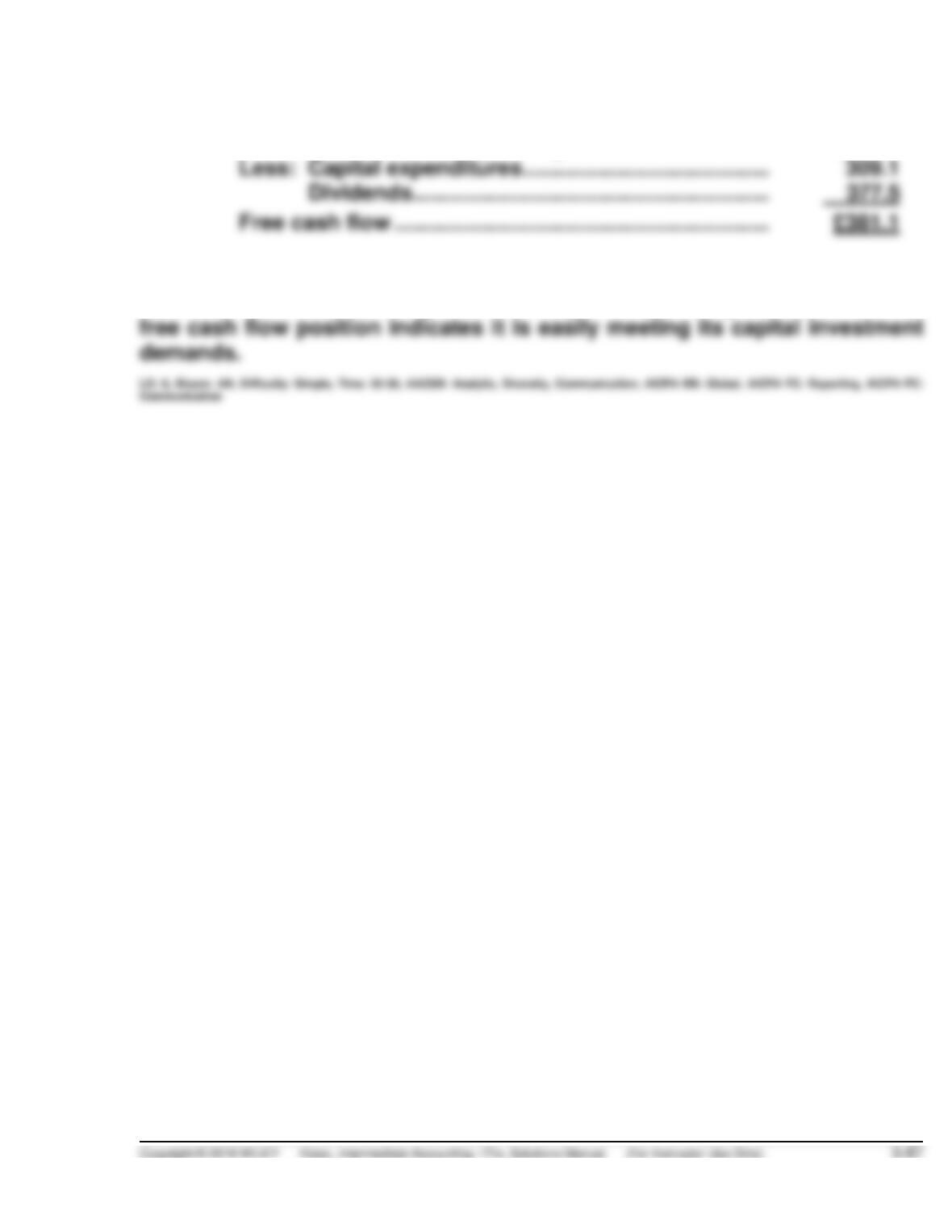
Free cash flow
Net cash provided by operating activities ……………..
£1,067.7*
Less: Capital expenditures ………………………………….
M&S’s financial position appears adequate. Approximately 21% of its total
liabilities can be covered by the current year’s operating cash flow and its