Analytical Thinking (continued)
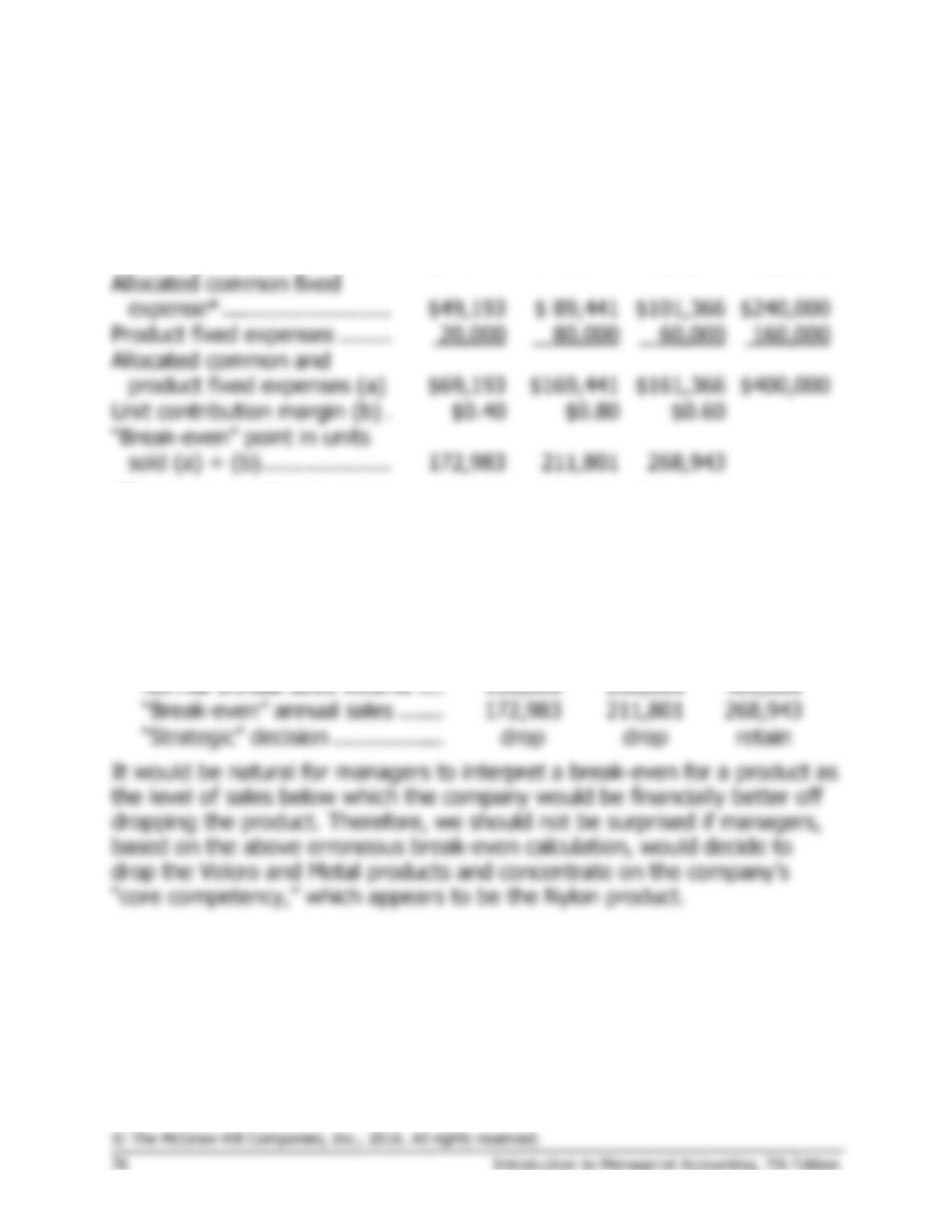
Allocation of common fixed expenses on the basis of sales revenue:
Velcro
Metal
Nylon
Total
Sales ……………………………..
$165,000
$300,000
$340,000
$805,000
Percentage of total sales ……
20.497%
37.267%
42.236%
100.0%
Product fixed expenses ……..
$169,441
$161,366
$400,000
Unit contribution margin (b) .
268,943
*Total common fixed expense × percentage of total sales
If the company sells 172,983 units of the Velcro product, 211,801 units of
the Metal product, and 268,943 units of the Nylon product, the company
will indeed break even overall. However, the apparent break-evens for two
of the products are higher than their normal annual sales.
Velcro
Metal
Nylon
Normal annual sales volume ….
Analytical Thinking (continued)
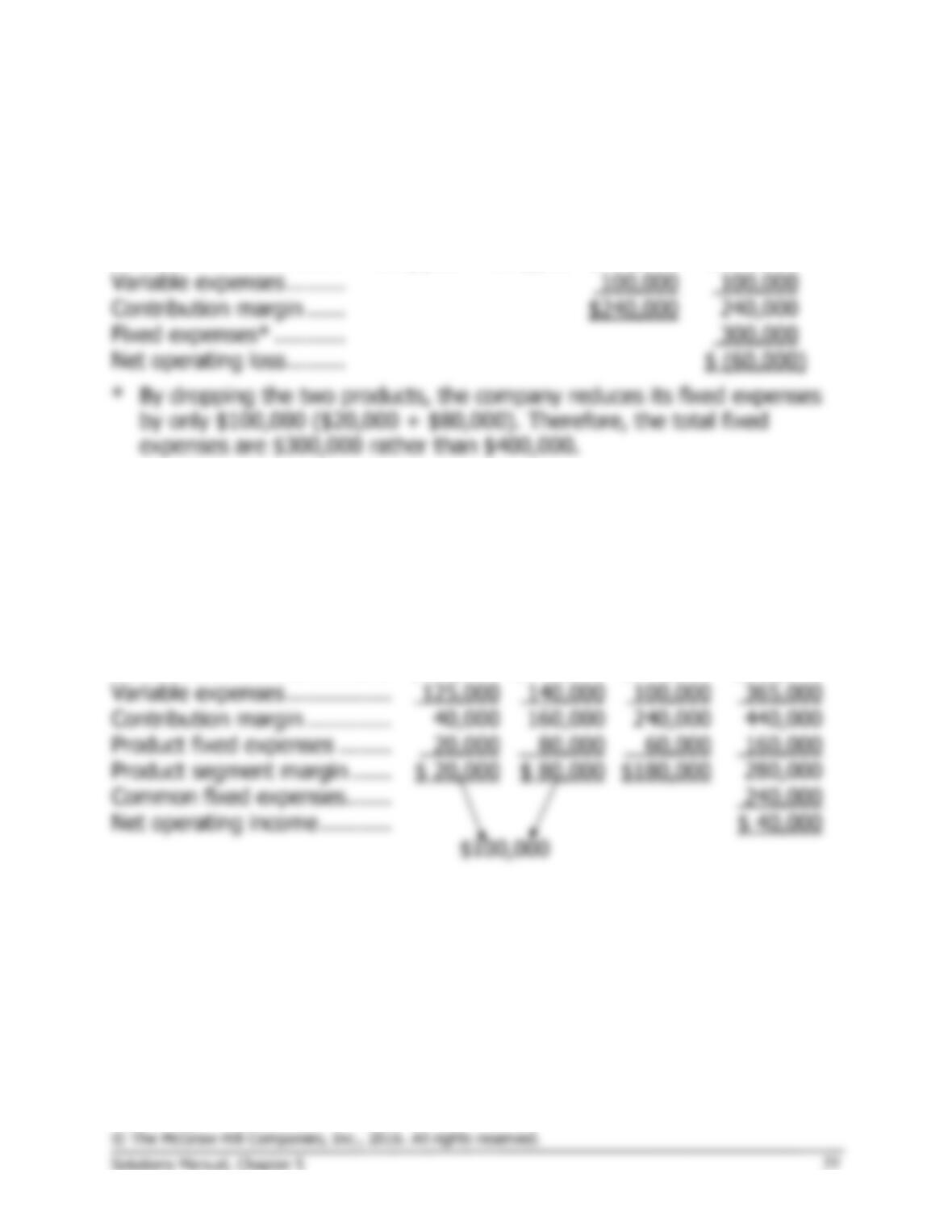
If the managers drop the Velcro and Metal products, the company would
face a loss of $60,000 computed as follows:
Velcro
Metal
Nylon
Total
Sales ……………………….
dropped
dropped
$340,000
$340,000
Variable expenses ………
100,000
Contribution margin ……
$240,000
Fixed expenses* ………..
Net operating loss ………
By dropping the two products, the company would go from making a profit
of $40,000 to suffering a loss of $60,000. The reason is that the two
dropped products were contributing $100,000 toward covering common
fixed expenses and toward profits. This can be verified by looking at a
segmented income statement like the one that will be introduced in a later
chapter.
Velcro
Metal
Nylon
Total
Sales ……………………………..
$165,000
$300,000
$340,000
$805,000
Variable expenses …………….
100,000
Contribution margin ………….
240,000
Product fixed expenses ……..
80,000
Product segment margin ……
$180,000
Common fixed expenses …….
Net operating income ………..
Teamwork in Action
1. The answer to this question will vary from school to school.
2. Managers will hire more support staff, such as security and vending
personnel, for big games that predictably draw more people. These
on.
3. The answer to this question will vary from school to school, but a clear
distinction should be drawn between the costs that are variable with
4. The answer to this question will vary from school to school. The lost
5. The answer to this question will vary from school to school.
Chapter 5
Take Two Solutions
Exercise 5-4 (10 minutes)
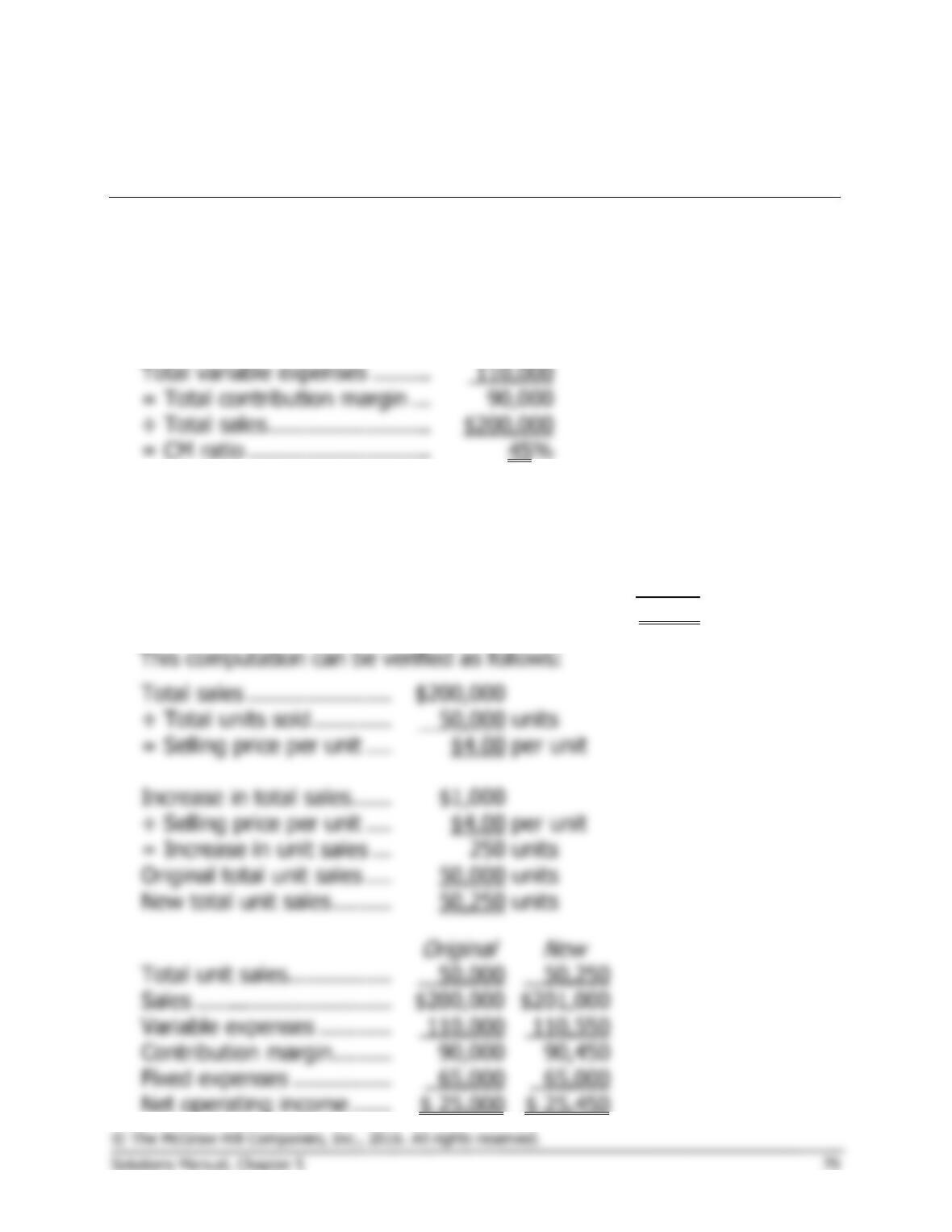
1. The company’s contribution margin (CM) ratio is:
Total sales ……………………….
$200,000
÷ Total sales …………………….
$200,000
= CM ratio ……………………….
2. The change in net operating income from an increase in total sales of
$1,000 can be estimated by using the CM ratio as follows:
Change in total sales …………………………………
$1,000
× CM ratio ………………………………………………
45
%
= Estimated change in net operating income ….
$ 450
÷ Total units sold …………
units
per unit
Increase in total sales ……
Original total unit sales ….
units
New total unit sales ………
units
Sales …………………………
Variable expenses ………..
Contribution margin ………
Exercise 5-5 (20 minutes)
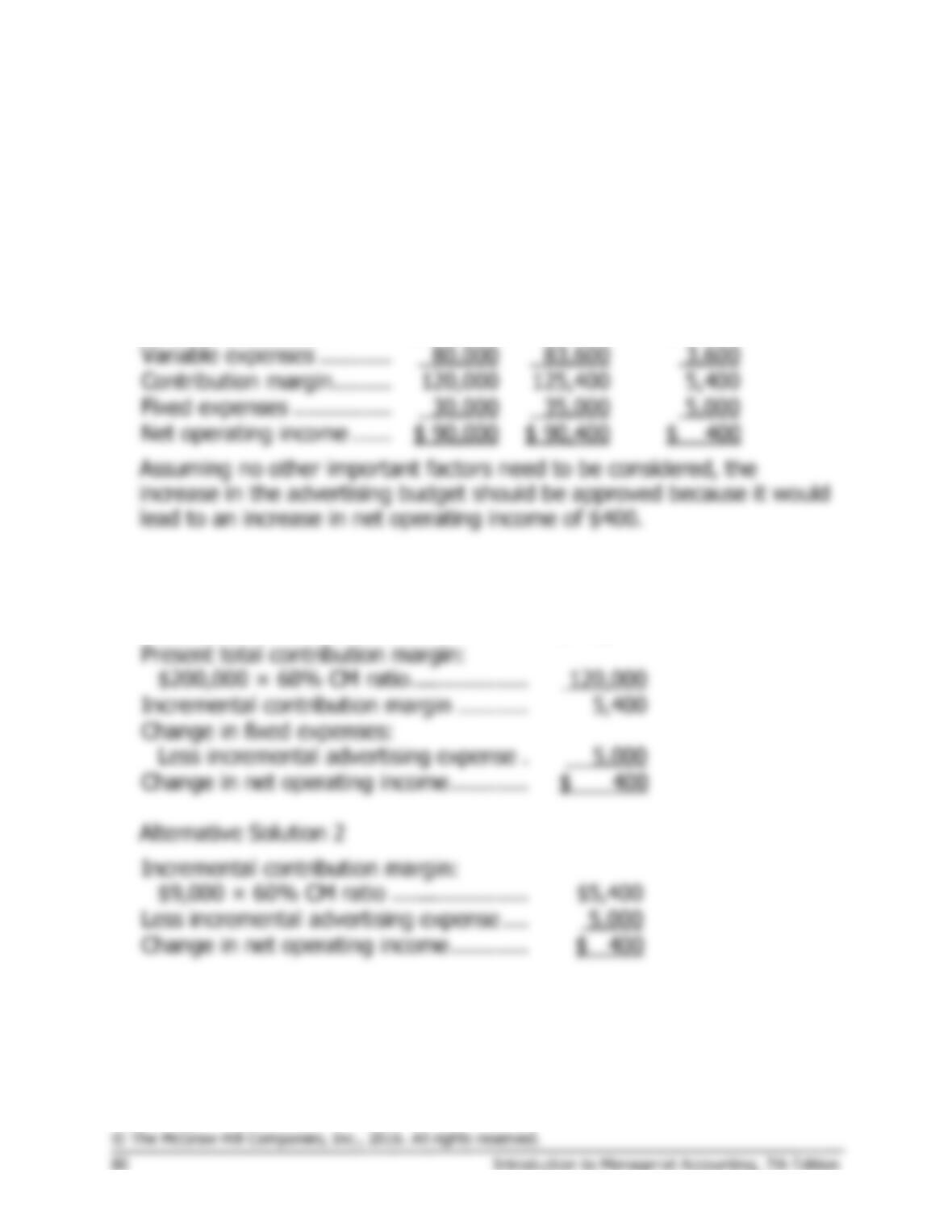
1. The following table shows the effect of the proposed change in monthly
advertising budget:
Sales With
Additional
Current
Advertising
Sales
Budget
Difference
Sales …………………………
$200,000
$209,000
$ 9,000
Variable expenses ………..
Net operating income ……
$ 400
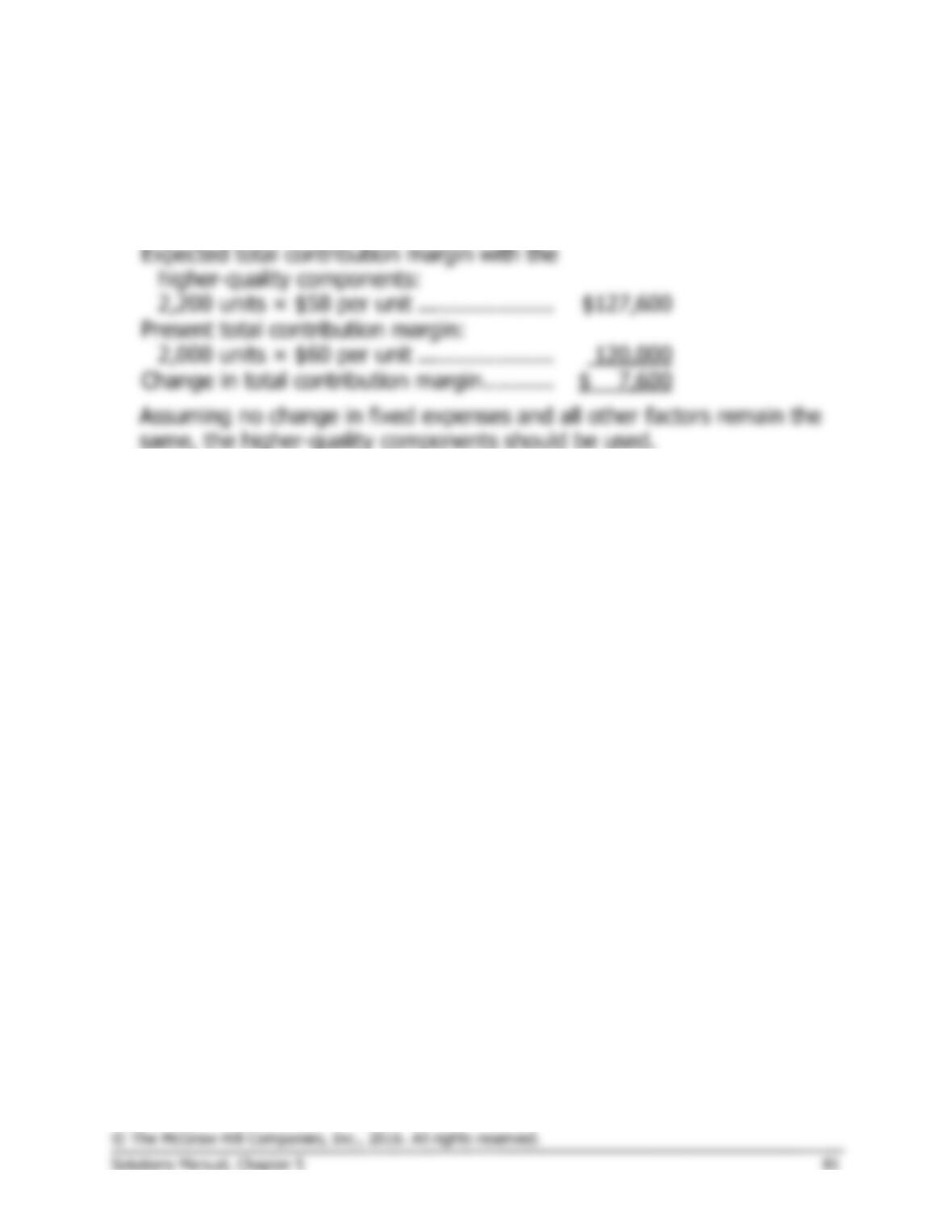
Alternative Solution 1
Expected total contribution margin:
$209,000 × 60% CM ratio ………………
$125,400
Change in fixed expenses:
Change in net operating income …………
Less incremental advertising expense ….
Exercise 5-5 (continued)
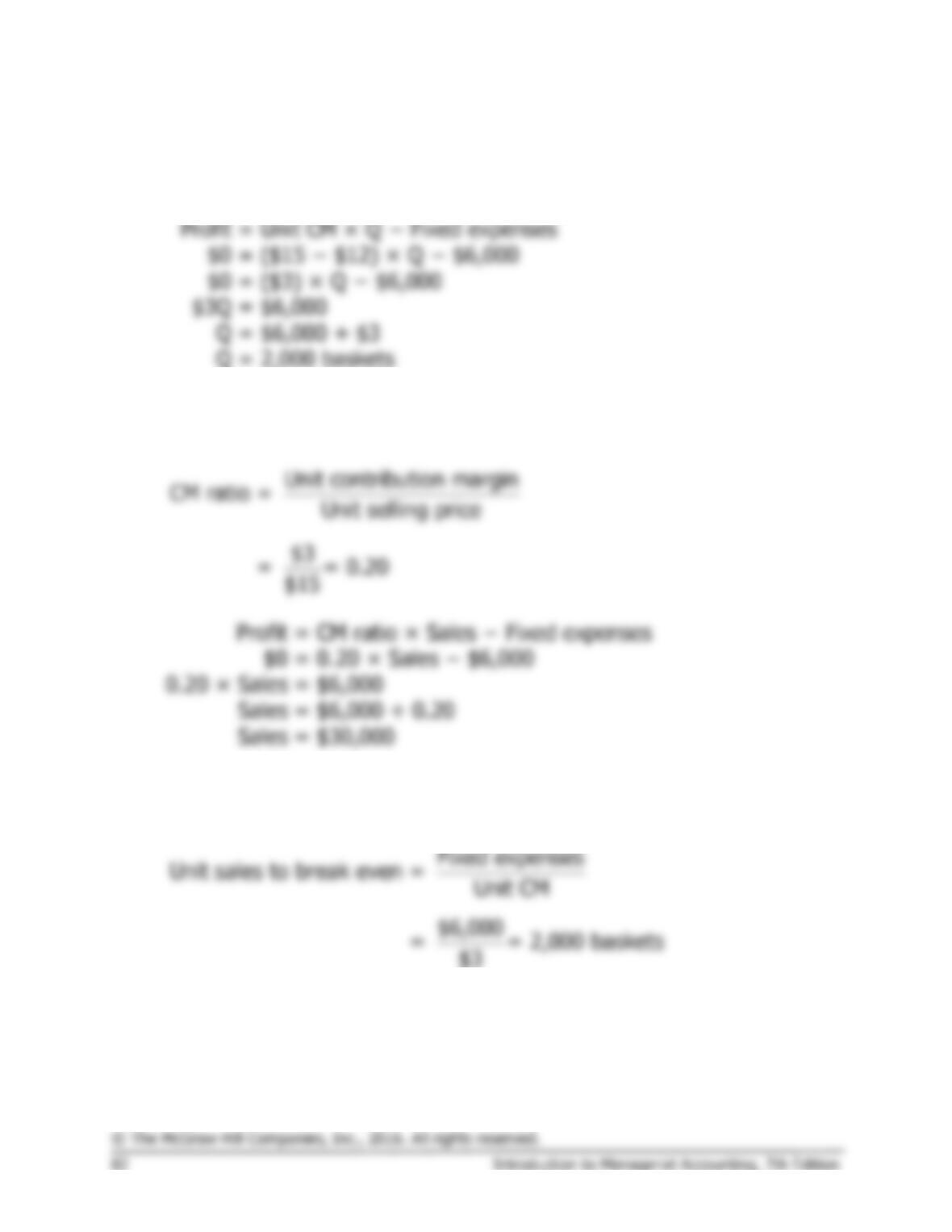
2. The $2 increase in variable expense will cause the unit contribution
margin to decrease from $60 to $58 with the following impact on net
operating income:
Exercise 5-6 (20 minutes)
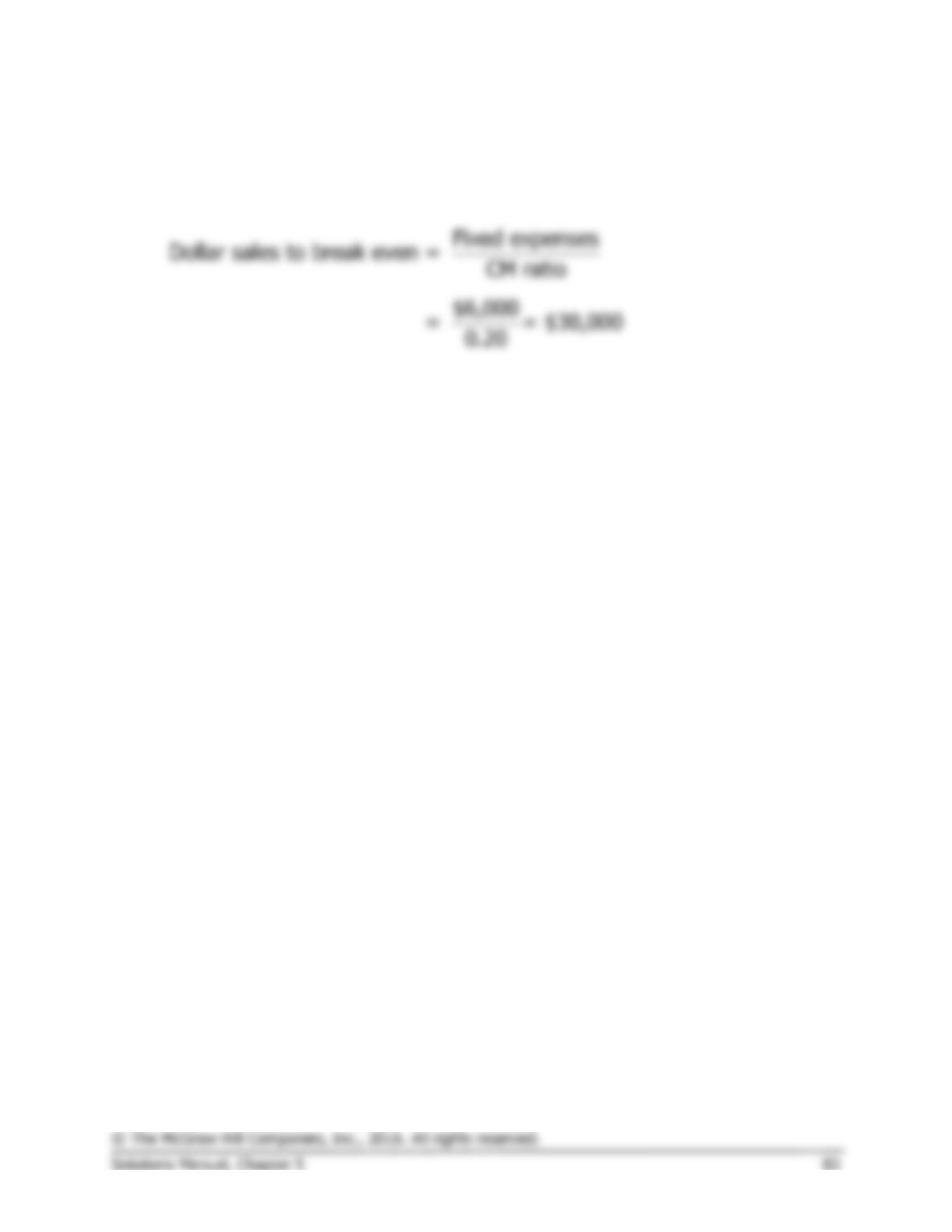
1. The equation method yields the break-even point in unit sales, Q, as
follows:
2. The equation method can be used to compute the break-even point in
dollar sales as follows:
3. The formula method gives an answer that is identical to the equation
method for the break-even point in unit sales:
Exercise 5-6 (continued)
4. The formula method also gives an answer that is identical to the
equation method for the break-even point in dollar sales:
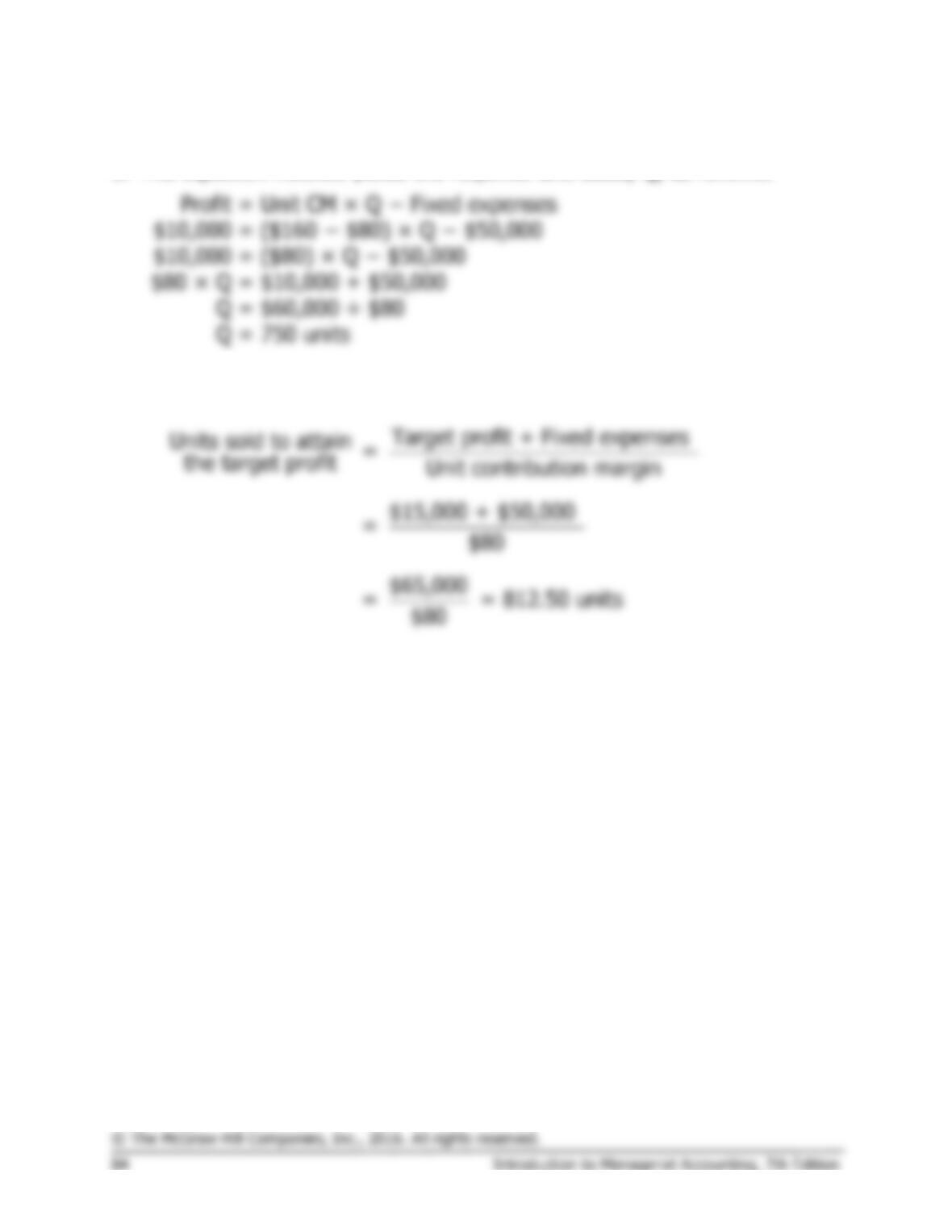
Exercise 5-7 (10 minutes)
1. The equation method yields the required unit sales, Q, as follows:
2. The formula approach yields the required unit sales as follows:
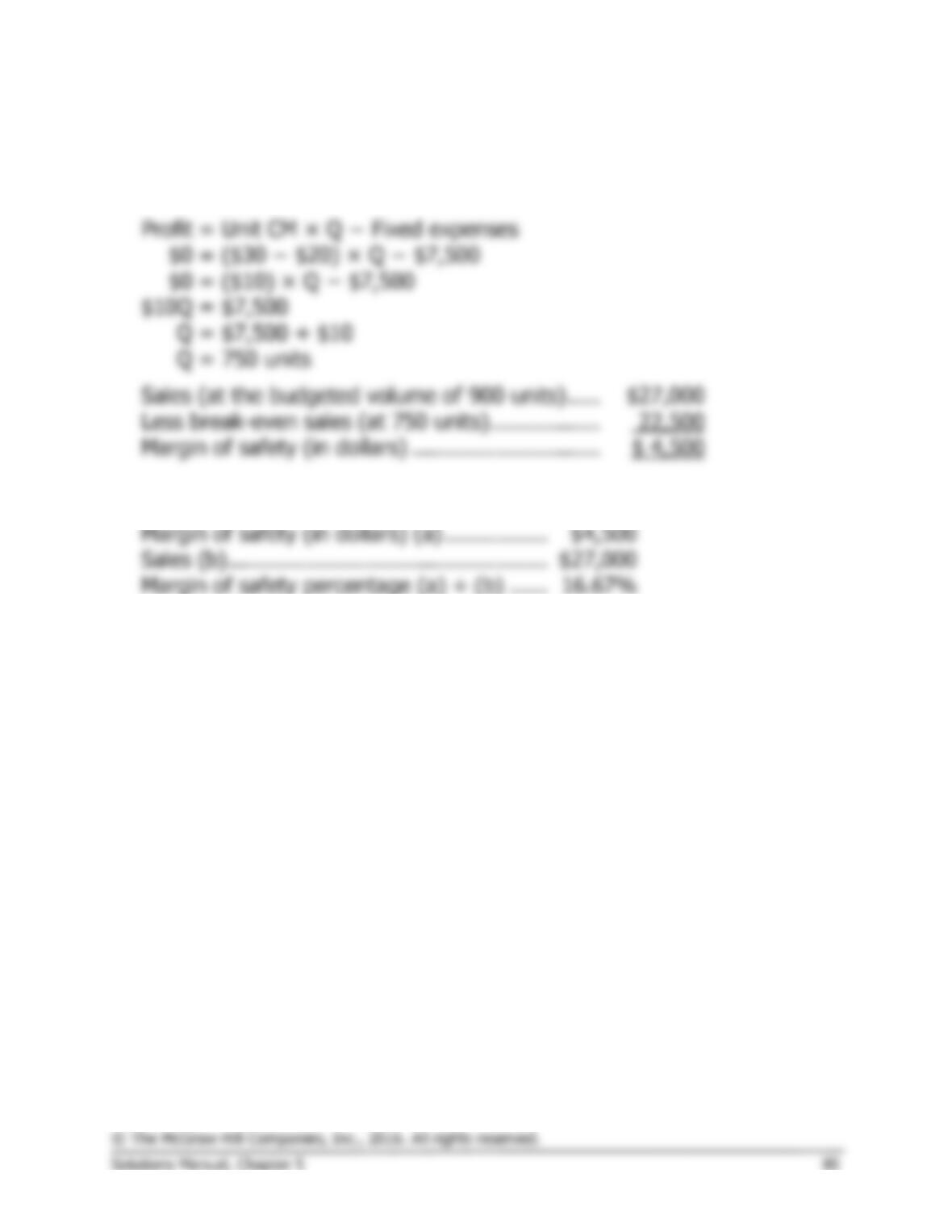
Exercise 5-8 (10 minutes)
1. To compute the margin of safety, we must first compute the break-even
unit sales.
2. The margin of safety as a percentage of sales is as follows:
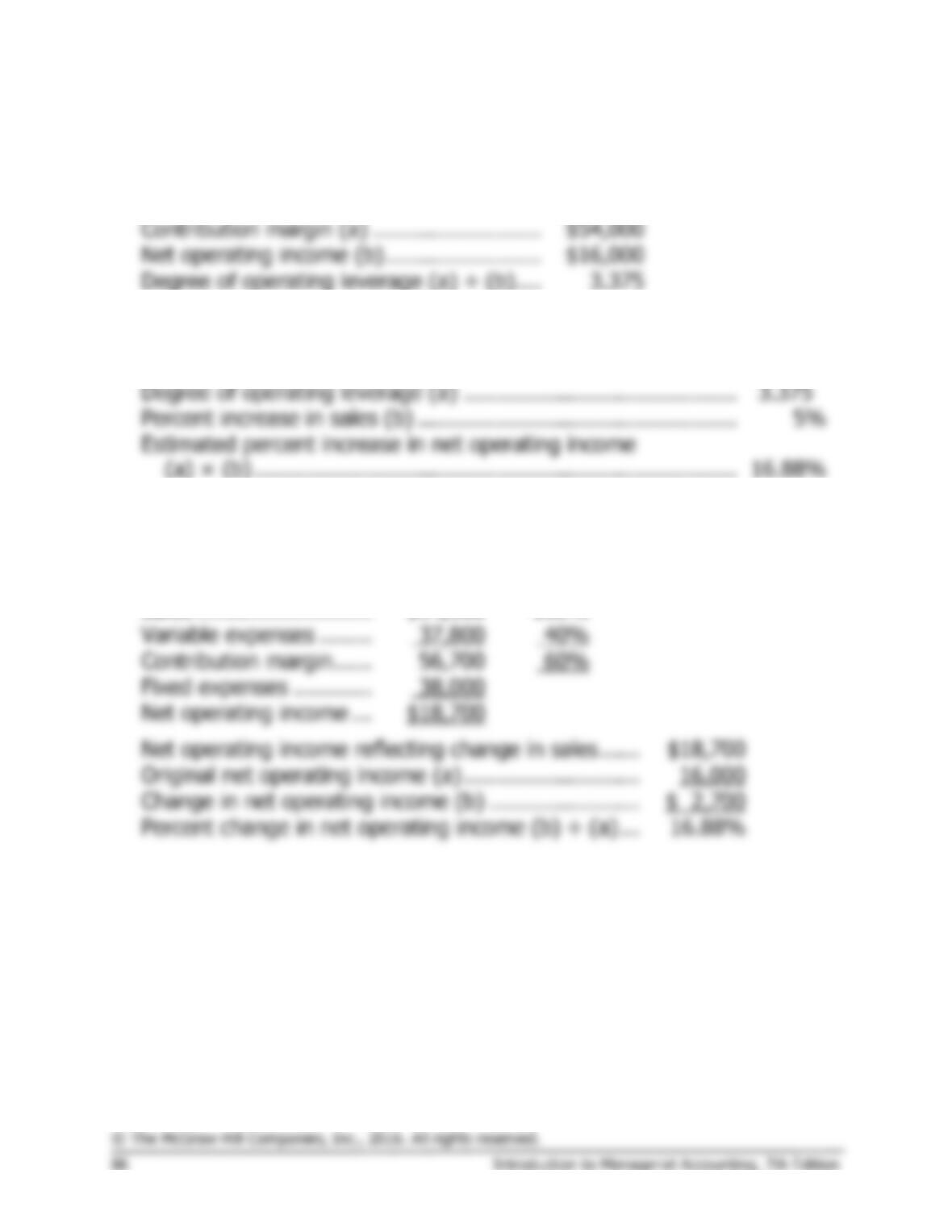
Exercise 5-9 (20 minutes)
1. The company’s degree of operating leverage would be computed as
follows:
Contribution margin (a) ……………………..
Net operating income (b) ……………………
2. A 5% increase in sales should result in a 16.88% increase in net
operating income, computed as follows:
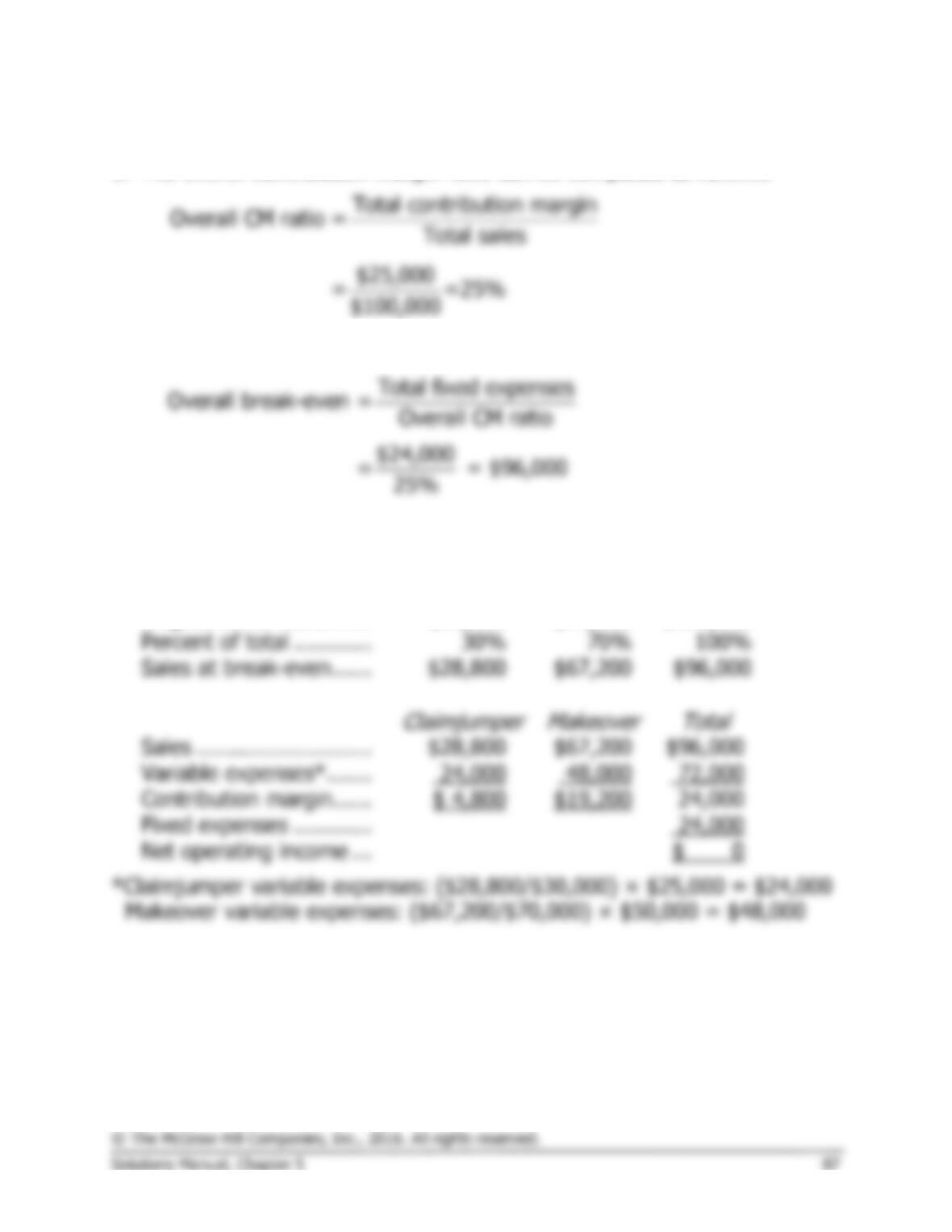
3. The new income statement reflecting the change in sales is:
Amount
Percent
of Sales
Sales ………………………
$94,500
100%
Original net operating income (a) ………………………
Change in net operating income (b) …………………..
Exercise 5-10 (20 minutes)
1. The overall contribution margin ratio can be computed as follows:
2. The overall break-even point in dollar sales can be computed as follows:
3. To construct the required income statement, we must first determine
the relative sales mix for the two products:
Claimjumper
Makeover
Total
Original dollar sales ……
$30,000
$70,000
$100,000
Percent of total …………
Sales at break-even ……
Claimjumper
Makeover
Total
Sales ………………………
Variable expenses* …….
Contribution margin ……
Fixed expenses …………
Net operating income …
Exercise 5-15 (15 minutes)
1.
Total
Per
Unit
Sales (15,000 games) ………
$300,000
$20
Variable expenses ……………
90,000
6
Contribution margin …………
Fixed expenses ……………….
Net operating income ………
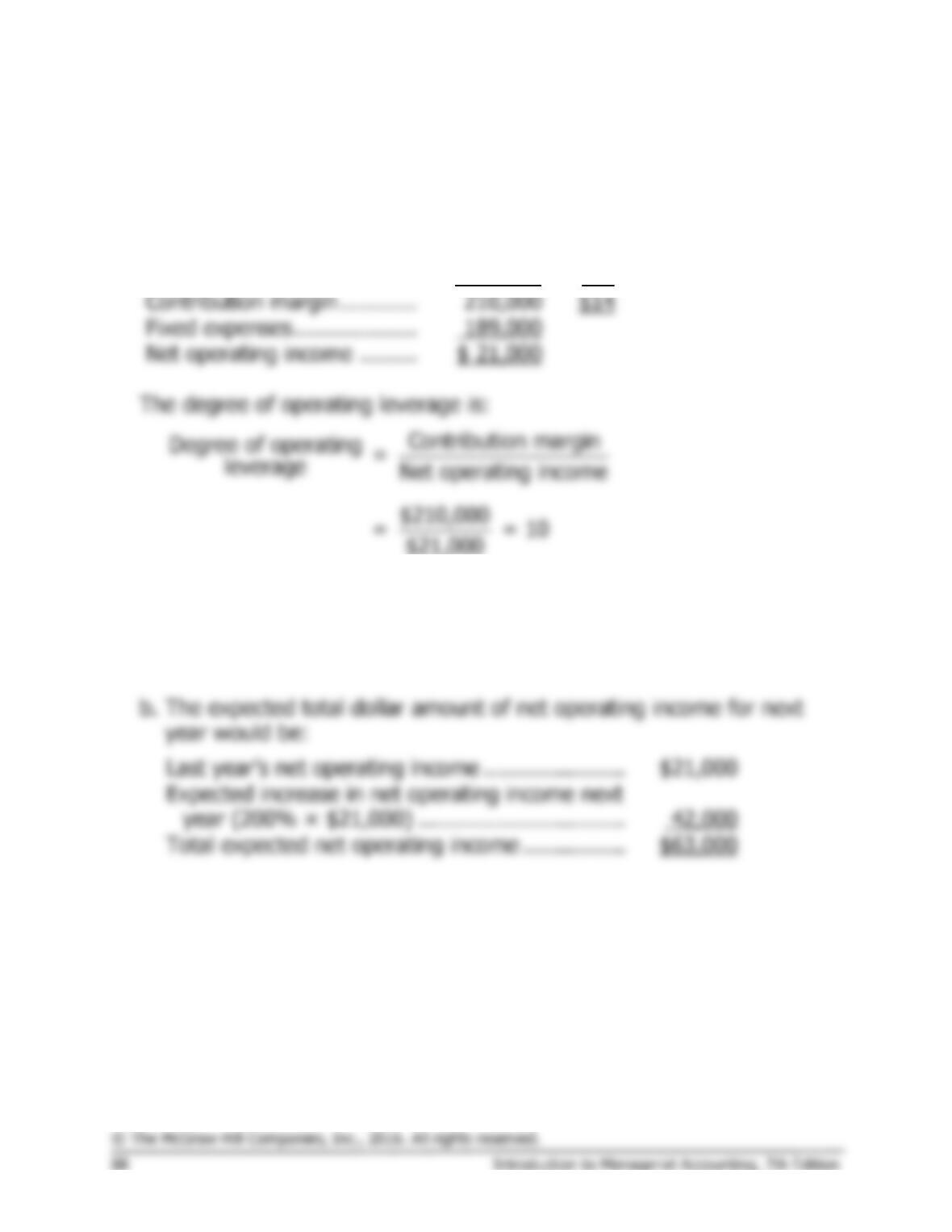
2. a. Sales of 18,000 games represent a 20% increase over last year’s
sales. Because the degree of operating leverage is 10, net operating
income should increase by 10 times as much, or by 200% (10 ×
20%).
Total expected net operating income …………….
Exercise 5-17 (30 minutes)
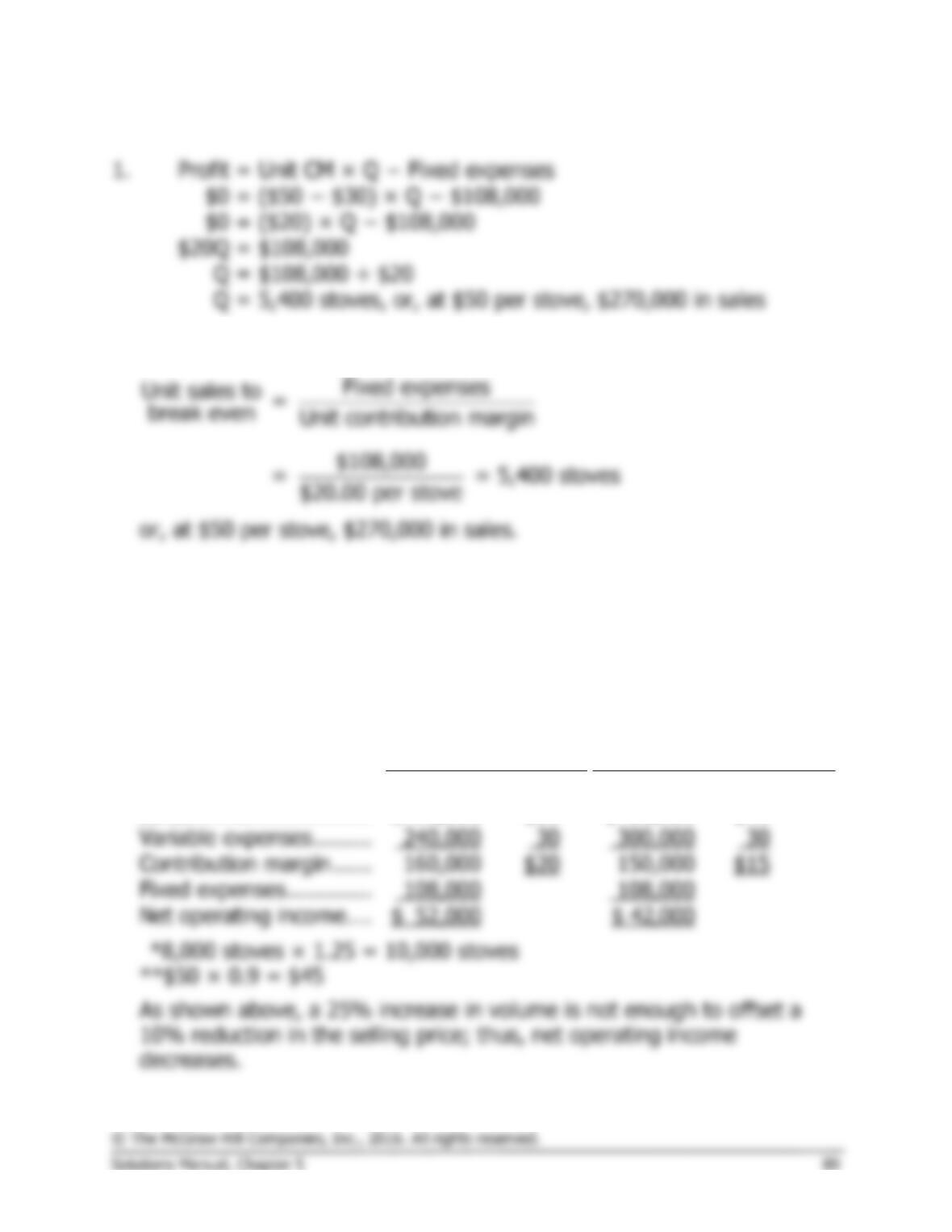
= $108,000 ÷ $20
= 5,400 stoves, or, at $50 per stove, $270,000 in sales
Alternative solution:
2. An increase in variable expenses as a percentage of the selling price
would result in a higher break-even point. If variable expenses increase
as a percentage of sales, then the contribution margin will decrease as a
percentage of sales. With a lower CM ratio, more stoves would have to
be sold to generate enough contribution margin to cover the fixed costs.
3.
Present:
8,000 Stoves
Proposed:
10,000 Stoves*
Total
Per Unit
Total
Per Unit
Sales ……………………….
$400,000
$50
$450,000
$45
**
Exercise 5-17 (continued)
4.
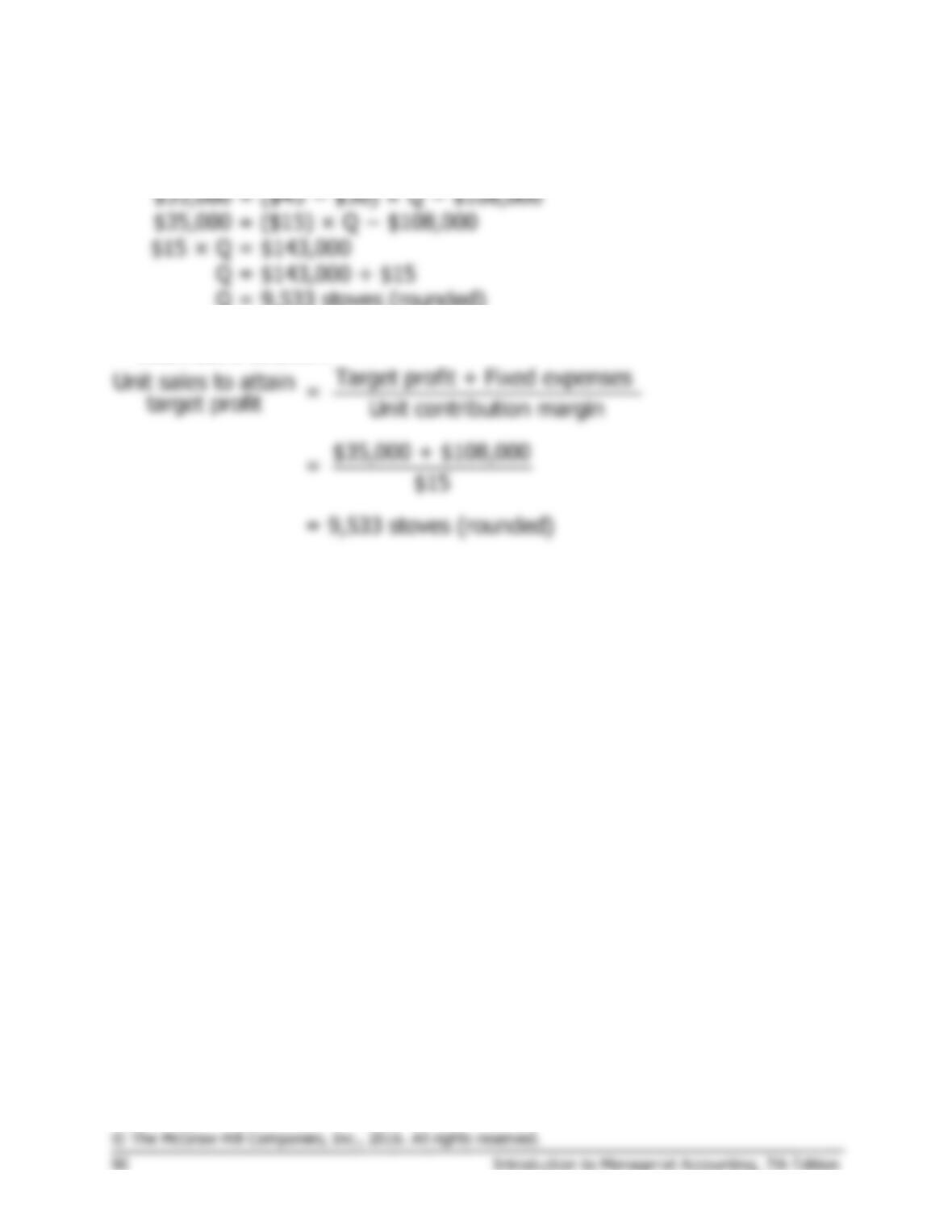
Profit
= Unit CM × Q − Fixed expenses
= ($45 − $30) × Q − $108,000
= ($15) × Q − $108,000
= $143,000
Q
= $143,000 ÷ $15
Q
= 9,533 stoves (rounded)
Alternative solution: