Wild and Shaw Financial and Managerial Accounting 9e Solutions Manual: Chapter 5
438
Problem 5-8BA (30 minutes)
Part 1
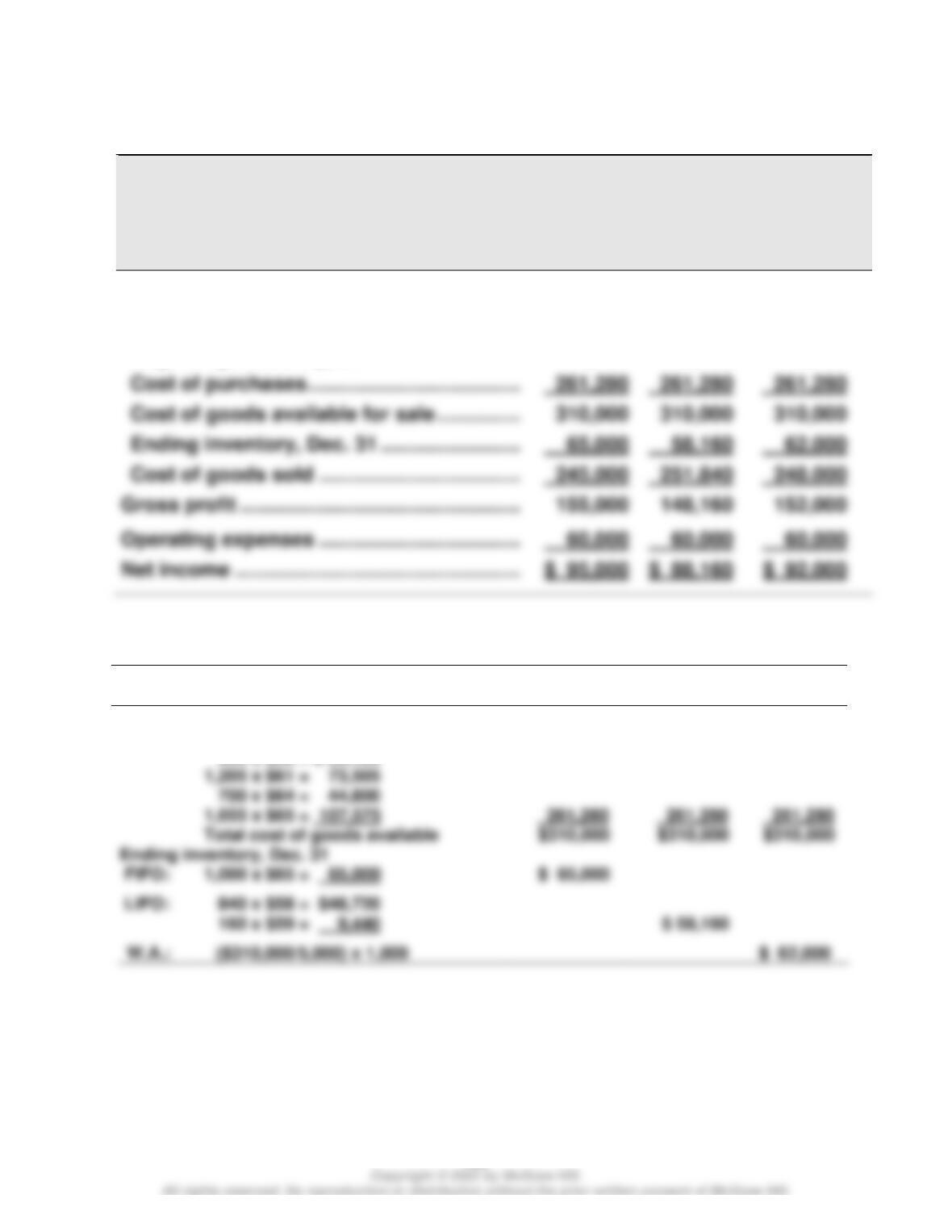
SHEPARD COMPANY
Income Statements Comparing FIFO, LIFO, and Weighted Average
For Year Ended December 31
FIFO
LIFO
Weighted
Average
Sales …………………………………………………….
$400,000
$400,000
$400,000
Cost of goods sold
Beginning inventory, Jan. 1 ………………….
48,720
48,720
48,720
Cost of purchases ………………………………..
Cost of goods sold ………………………………
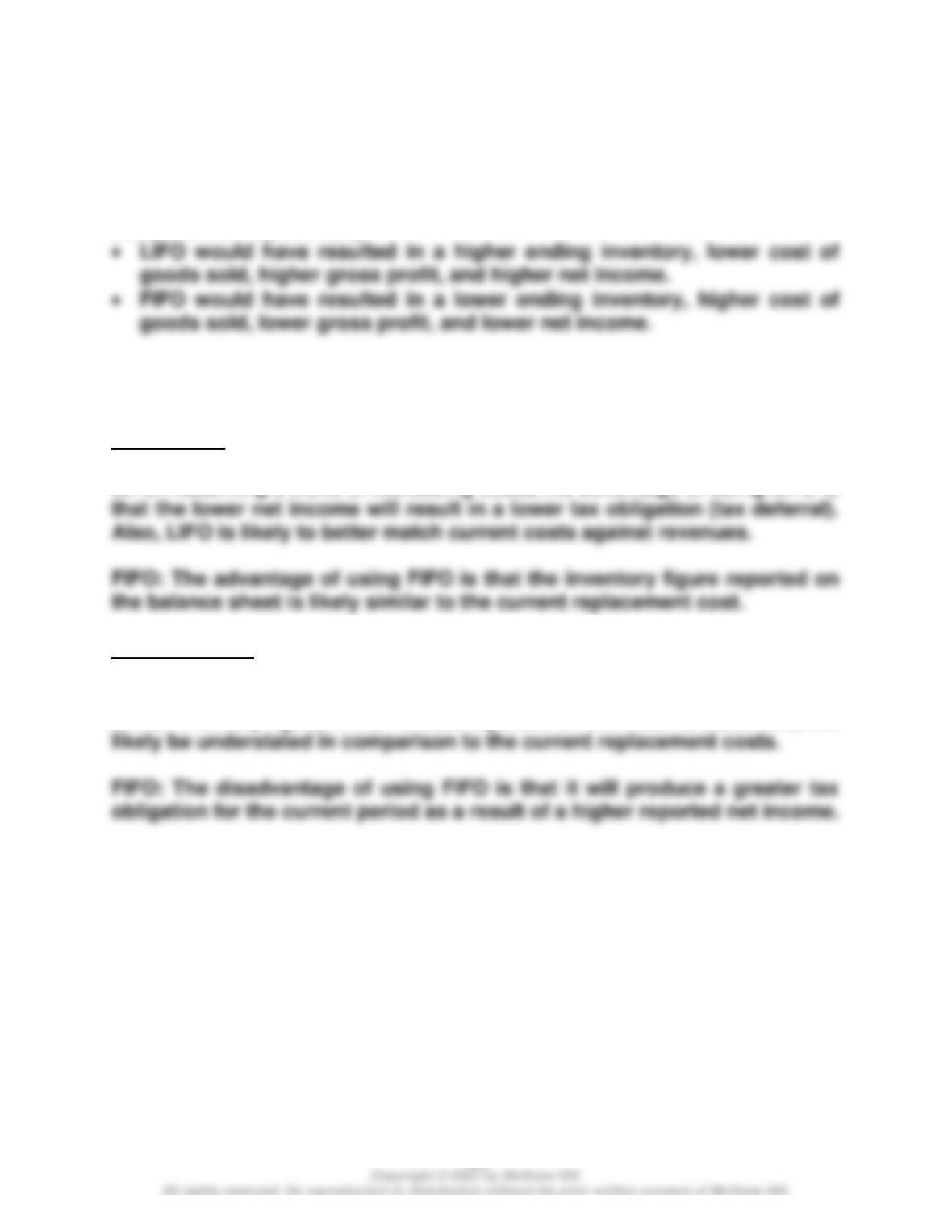
Supporting calculations
FIFO
LIFO
Weighted
Average
Beginning inventory, Jan. 1 (840 x $58) ………..
$ 48,720
$ 48,720
$ 48,720
Purchases
600 x $59 = $ 35,400
700 x $64 = 44,800
Ending inventory, Dec. 31
W.A.:
$ 62,000
Wild and Shaw Financial and Managerial Accounting 9e Solutions Manual: Chapter 5
439
Problem 5-8BA (Concluded)
Part 2
If Shepard Company had been experiencing decreasing costs in the
acquisition of inventory, we would observe the opposite results in our
comparisons. Specifically:
Part 3
Advantages
LIFO: Assuming a trend of increasing costs, the advantage of using LIFO is
Disadvantages
LIFO: Assuming a trend of increasing costs, the disadvantage of using LIFO
is the inventory figure, which is also reported on the income statement, will
Wild and Shaw Financial and Managerial Accounting 9e Solutions Manual: Chapter 5
440
Problem 5-9BB (25 minutes)
Part 1
MACKLIN COMPANY
Estimated Inventory
December 31
At Cost At Retail
Goods available for sale
Beginning inventory ………………………………………
$ 90,022
$115,610
Cost of goods purchased ……………………………….
Less: Sales returns …………………………………………..
Net sales …………………………………………………………
Part 2
MACKLIN COMPANY
Inventory Shortage
December 31
At Cost At Retail
Estimated inventory (from part 1) …………………….
$66,555.00
$98,600.00
Physical inventory* …………………………………………
Wild and Shaw Financial and Managerial Accounting 9e Solutions Manual: Chapter 5
441
Problem 5-10BB (25 minutes)
OTINGO EQUIPMENT CO.
Estimated Inventory at March 31
At Cost
At Retail
Goods available for sale
Beginning inventory, Jan. 1 ………………………
$ 802,880
Cost of goods purchased …………………………
Goods available for sale …………………………..
Less estimated cost of goods sold
Sales …………………………..…………………………..
Less sales returns ……………………………………
Net sales ………………………………………………….
Estimated cost of goods sold
[$3,680,960 x (1 – 35%)] ………………………..
Wild and Shaw Financial and Managerial Accounting 9e Solutions Manual: Chapter 5
SERIAL PROBLEM — SP 5
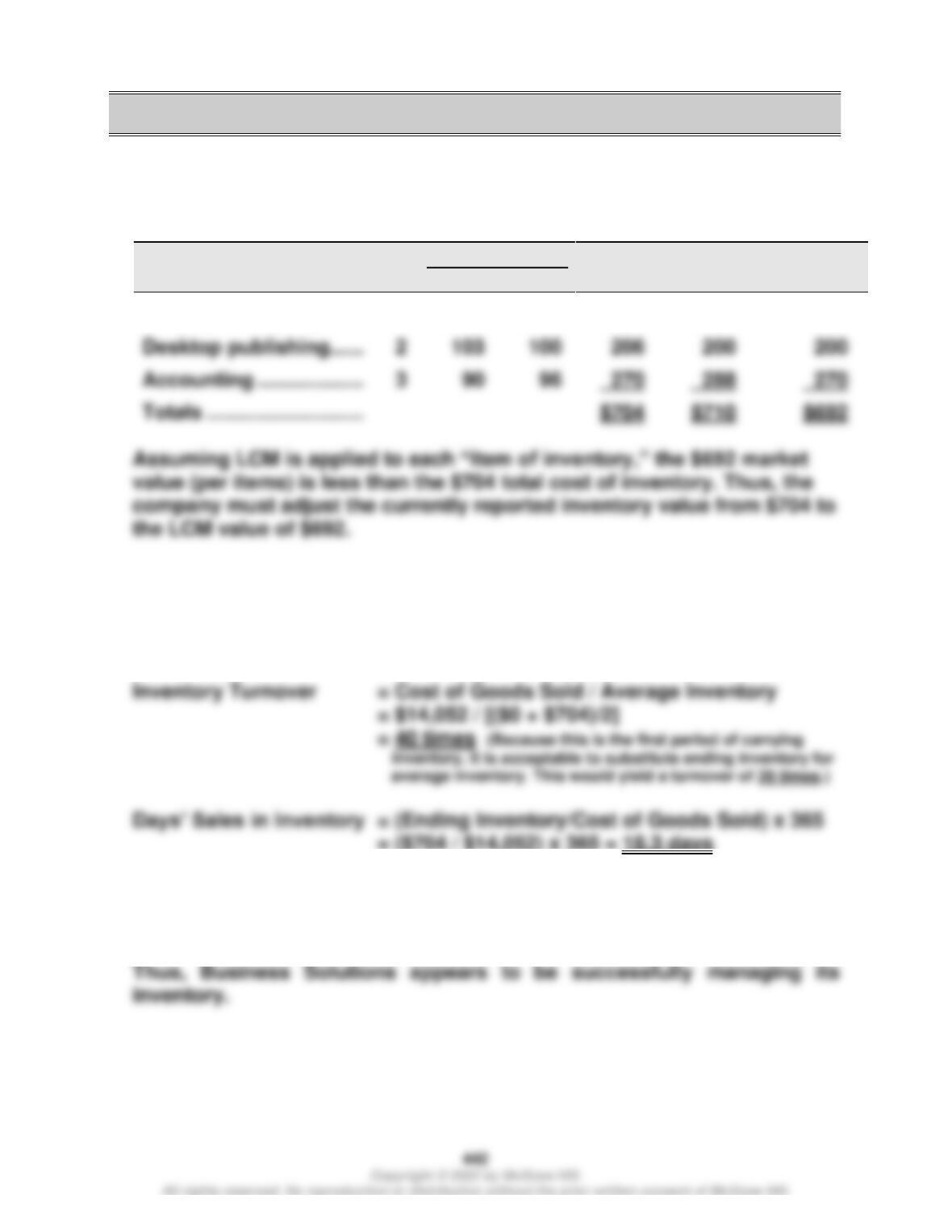
Serial Problem — Business Solutions (20 minutes)
Part A
Per Unit
Total
Total
LCM Applied
Inventory Items
Units
Cost
Market
Cost
Market
To Items
Office productivity …….
3
$ 76
$ 74
$228
$222
$222
2
3
$704
$710
$692
Part B
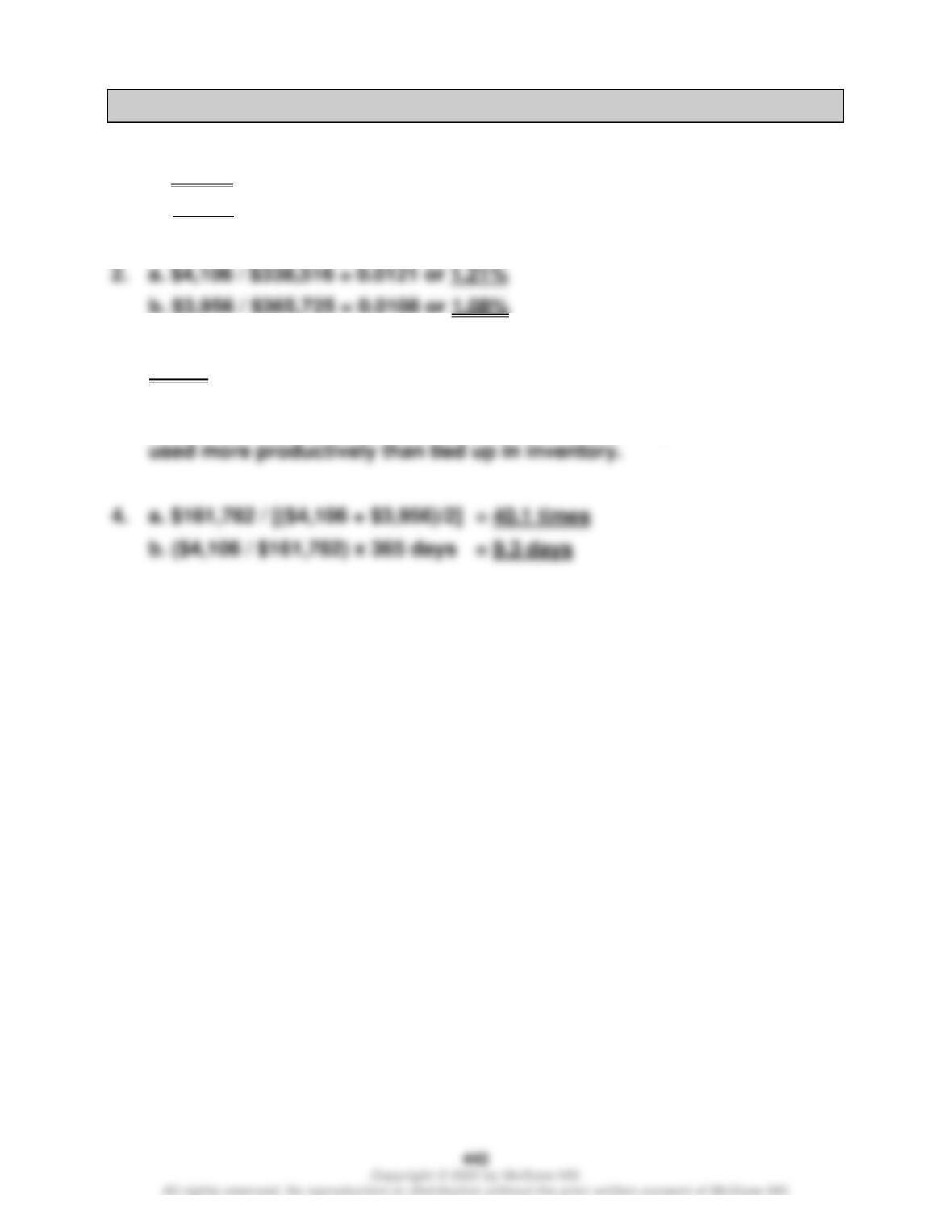
1. Ratio computations for the three months ended March 31, 2022:
= ($704 / $14,052) x 365 = 18.3 days
2. Business Solutions outperforms its competitors on both ratios.
• Its inventory turnover is 40 (or 20) times versus competitors’ 15 times.
• Its days’ sales in inventory is 18.3 days versus competitors’ 25 days.
Wild and Shaw Financial and Managerial Accounting 9e Solutions Manual: Chapter 5
Company Analysis — AA 5-1 (20 minutes)
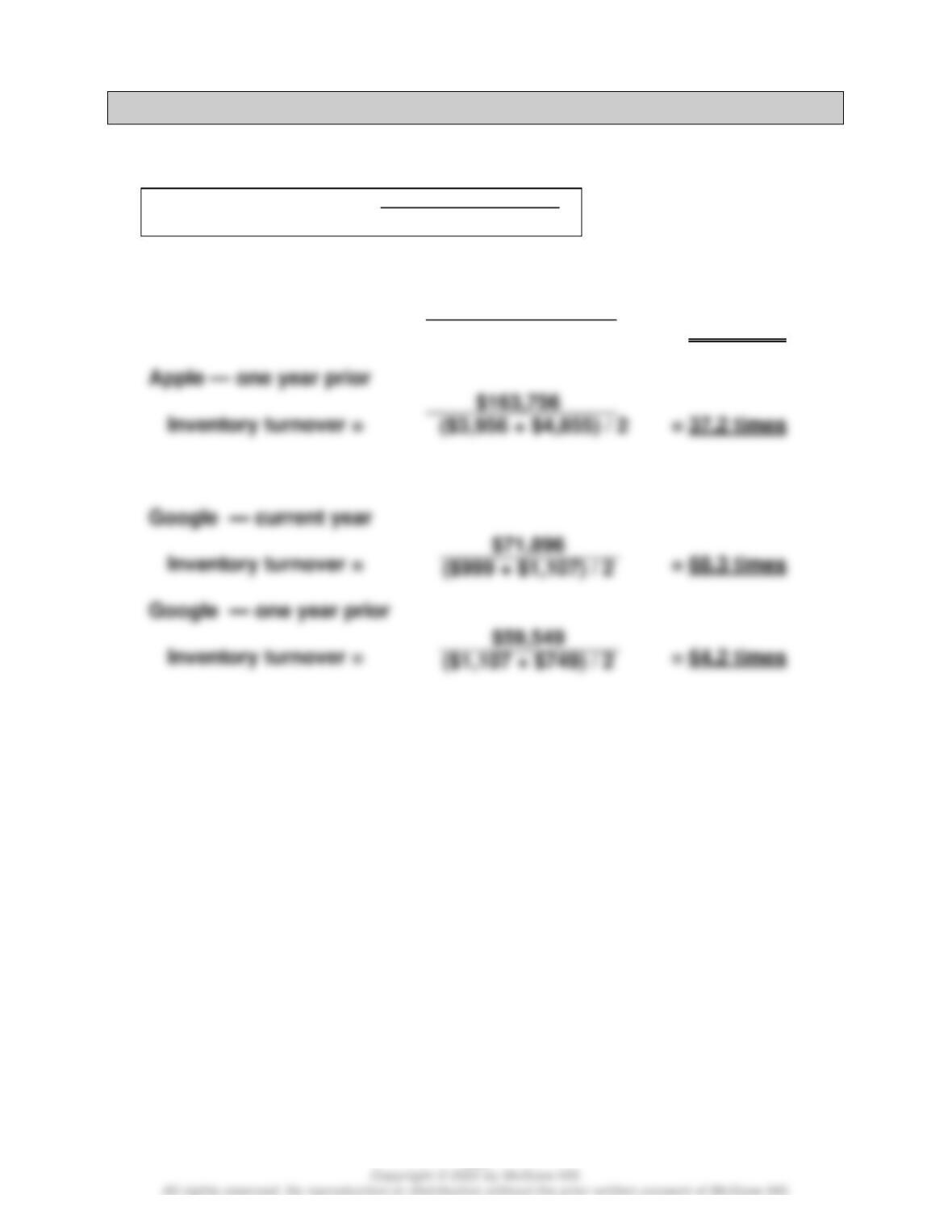
($ millions for all parts)
1. a. $4,106
b. $3,956
3. Lower.
Explanation: As long as Apple has enough inventory to meet demand,
Apple would prefer inventory to be lower. Companies prefer assets to be
Wild and Shaw Financial and Managerial Accounting 9e Solutions Manual: Chapter 5
444
Comparative Analysis — AA 5-2 (35 minutes)
($ millions)
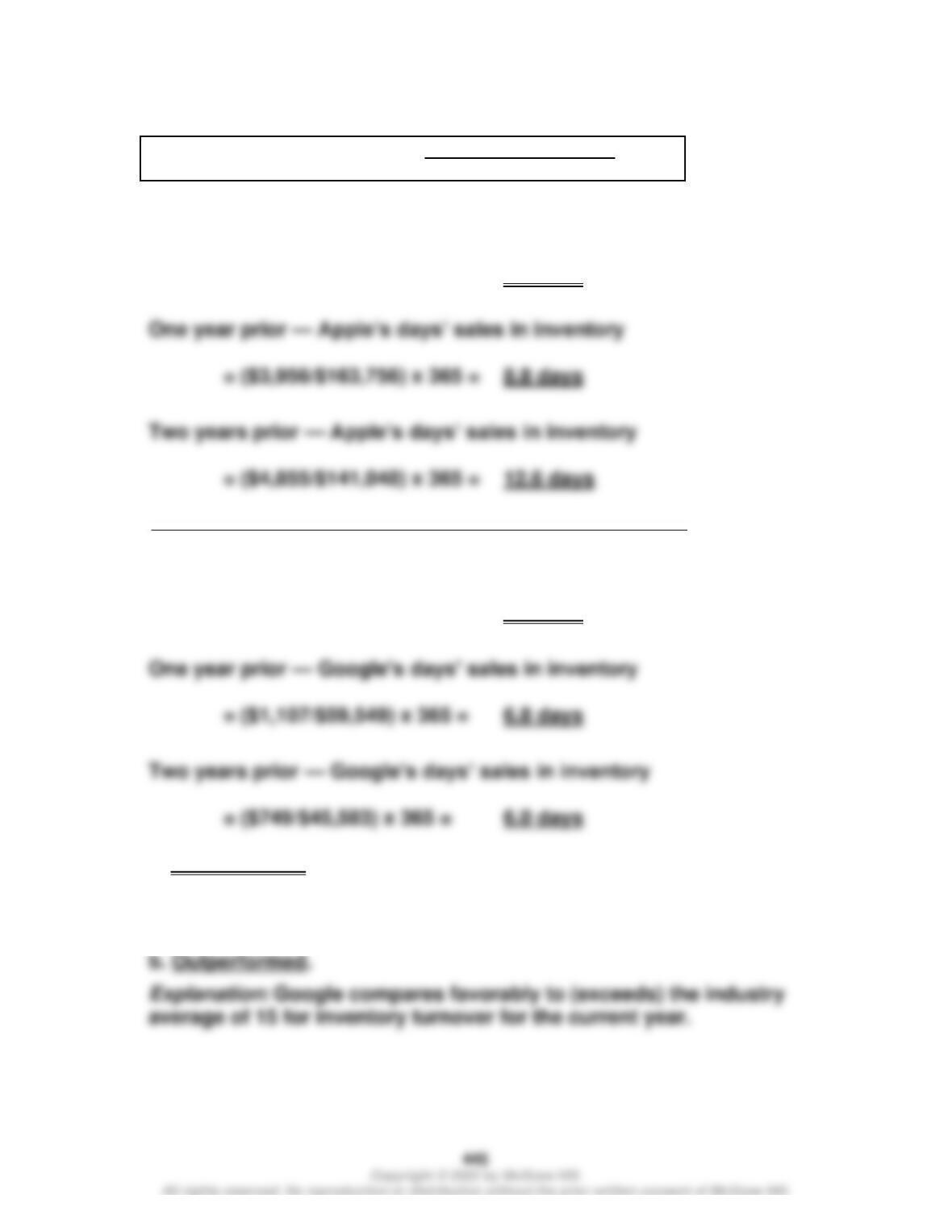
1. Inventory turnover =
Apple — current year
Inventory turnover = = 40.1 times
Cost of sales
Average inventory
$161,782
($4,106 + $3,956) / 2
Wild and Shaw Financial and Managerial Accounting 9e Solutions Manual: Chapter 5
Comparative Analysis (Concluded)
2. Days’ sales in inventory = x 365
Current year — Apple’s days’ sales in inventory
= ($4,106/$161,782) x 365 = 9.3 days
Current year — Google’s days’ sales in inventory
= ($999/$71,896) x 365 = 5.1 days
3. a. Outperformed.
Explanation: Apple compares favorably to (exceeds) the industry
average of 15 for inventory turnover for the current year.
Ending Inventory
Costs of Goods Sold
Wild and Shaw Financial and Managerial Accounting 9e Solutions Manual: Chapter 5
446
Extended Analysis — AA 5-3 (25 minutes)
1. Inventory turnover =
Days’ sales in inventory = x 365
2. Favorable.
3. Underperform.
Explanation: Samsung compares unfavorably to (is below) the industry
average of 15 for inventory turnover for the current year.
Cost of sales
Average inventory
Ending Inventory
Costs of Goods Sold
Wild and Shaw Financial and Managerial Accounting 9e Solutions Manual: Chapter 5
DISCUSSION QUESTIONS
1. (a) FIFO: The cost of the first (earliest) items purchased in inventory flow to cost of
2. Merchandise inventory is disclosed on the balance sheet as a current asset. It is also
3. LIFO will result in the lower cost of goods sold when costs are declining because it
assigns the most recent, lower cost purchases to cost of goods sold.
4. Many people make important business decisions based on period–to-period
fluctuations in a company’s financial numbers, including gross profit and net income.
5. An inventory error that causes an understatement (or overstatement) for net income
in one accounting period, if not corrected, will cause an overstatement (or
6. Market as used in the LCM rule refers to replacement cost for LIFO, but net realizable
value for FIFO, WA, and SI.
Wild and Shaw Financial and Managerial Accounting 9e Solutions Manual: Chapter 5
448
Ethics Challenge — BTN 5-1
1. Profit Margin: In an economic environment of rising costs, the use of
FIFO results in a lower cost of goods sold than LIFO. If cost of goods
sold is lower, then net income will be higher. A higher net income will
2. First, it is true that managers have discretion in choosing an inventory
costing method. It appears, however, that Golf Challenge’s owner does
not understand that changing methods can only be done very selectively
over time. A change in method must be justified by management for
improving the financial reporting of the company.
Wild and Shaw Financial and Managerial Accounting 9e Solutions Manual: Chapter 5
449
Communicating in Practice — BTN 5-2
[Note: An acceptable memorandum format should be used.]
The body of the memo would likely recommend use of the LIFO method for
this start-up business. The memo should explain that this would allow for
Taking It to the Net — BTN 5-3
1. Apple designs, manufactures, and markets mobile communication and
2. Its summary of significant accounting policies (Note 1) reports:
“Inventories are computed using the first-in, first-out method.”
3. Its gross profit is ($ millions):
Sales ……………………………………………………………
$ 265,595
4. Inventory turnover
$163,756 mil./ [($3,956 mil. + $4,855 mil.)/2] = 37.2 times
Wild and Shaw Financial and Managerial Accounting 9e Solutions Manual: Chapter 5
450
Teamwork in Action — BTN 5-4
Concepts and procedures to illustrate in expert presentation:
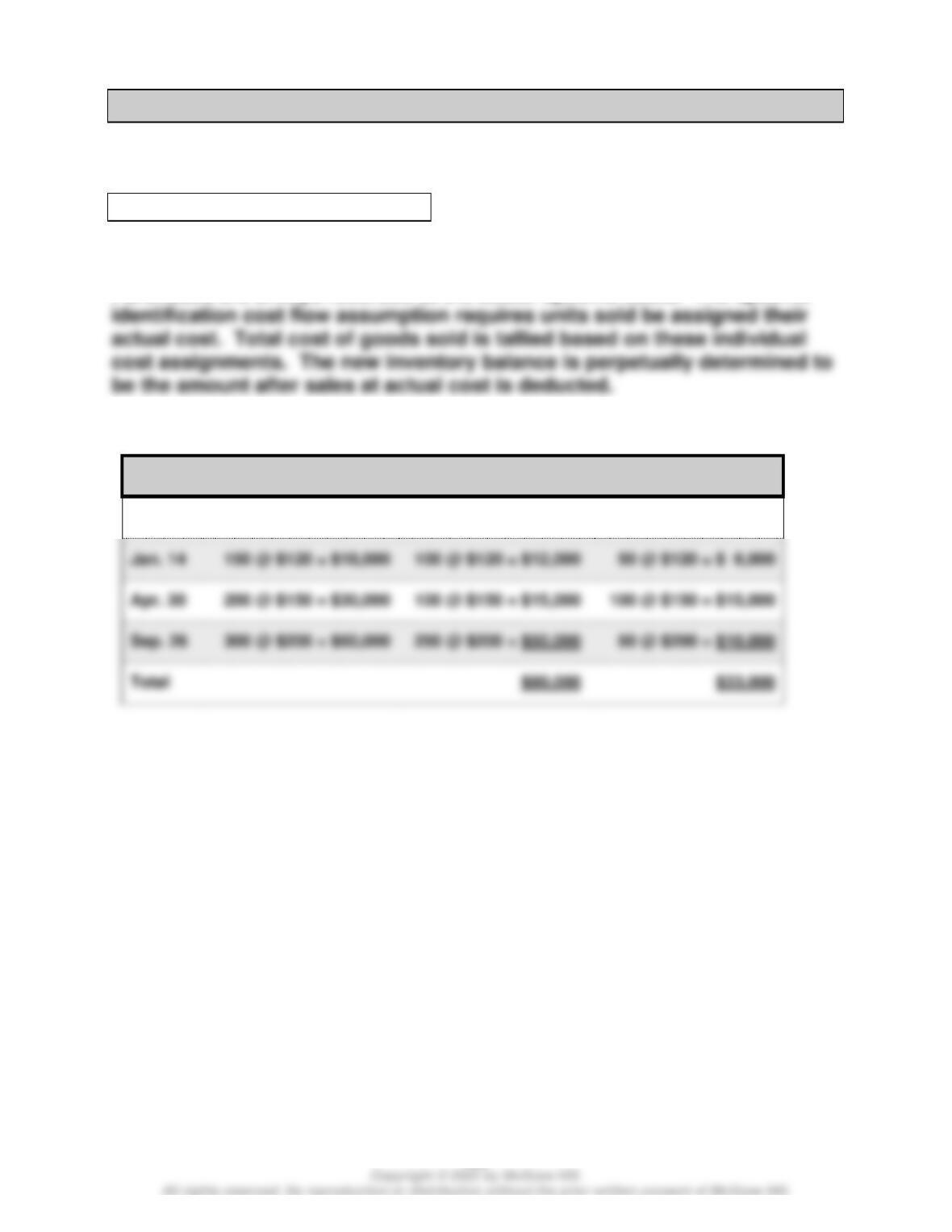
Specific Identification Expert:
(a) and (b) Concept:
Purchases are always recorded at the actual specific costs. The specific
(a) and (b) Procedures:
Date
Goods Available for Sale
Cost of Goods Sold
Ending Inventory
Jan. 1
50 @ $100 = $ 5,000
30 @ $100 = $ 3,000
20 @ $100 = $ 2,000
Jan. 14
Apr. 30
Wild and Shaw Financial and Managerial Accounting 9e Solutions Manual: Chapter 5
451
Teamwork in Action (Continued)
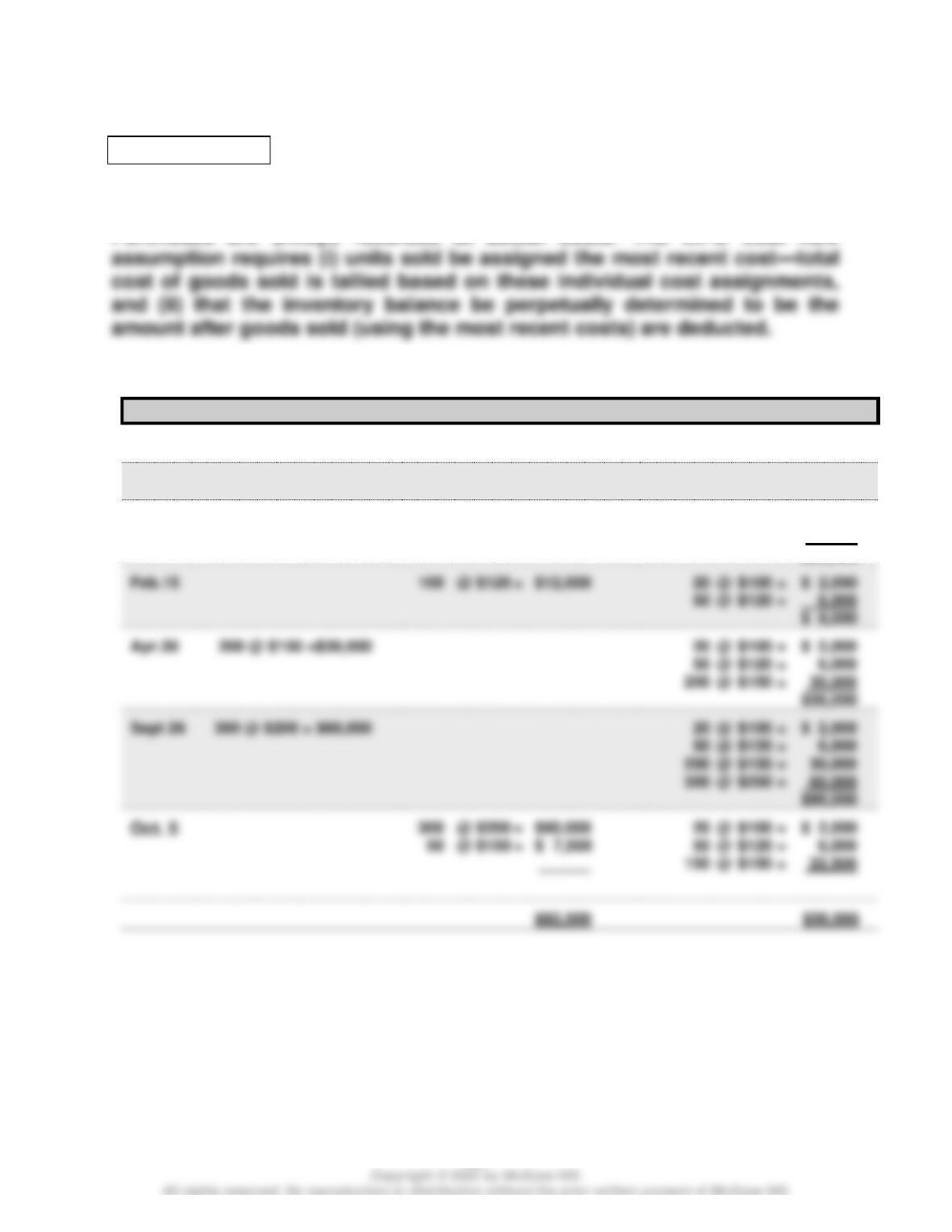
LIFO Expert:
(a) and (b) Concept:
Purchases are always recorded at actual costs. The LIFO cost flow
(a) and (b) Procedures:
Date
Goods Purchased
Cost of Goods Sold
Inventory Balance
Jan. 1
50 @ $100 = $ 5,000
Jan.10
30 @ $100 = $ 3,000
20 @ $100 = $ 2,000
Jan.14
150 @ $120 = $18,000
20 @ $100 = $ 2,000
150 @ $120 = 18,000
$20,000
$ 8,000
$38,000
$98,000
Wild and Shaw Financial and Managerial Accounting 9e Solutions Manual: Chapter 5
452
Teamwork in Action (Continued)
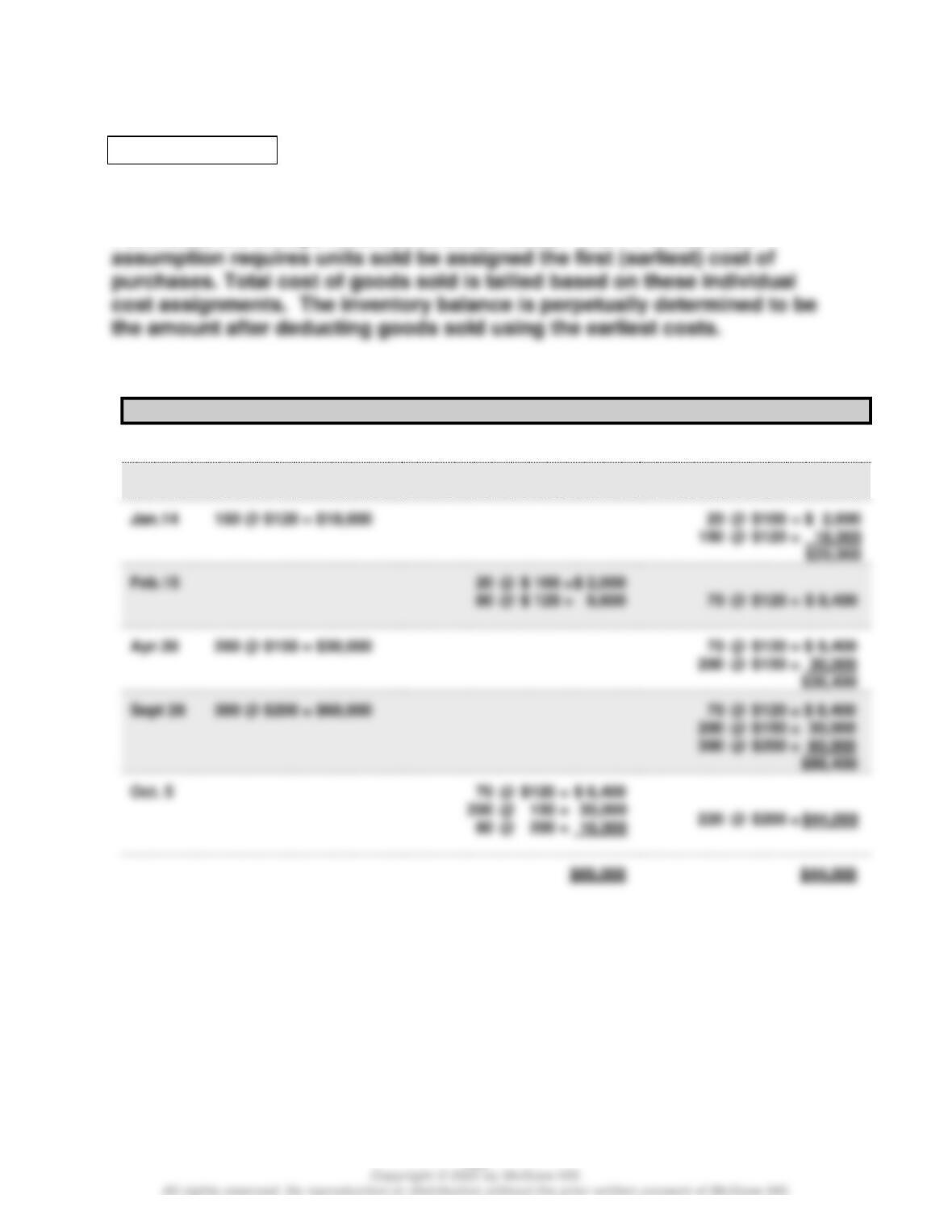
FIFO Expert:
(a) and (b) Concept:
Purchases are always recorded at actual costs. The FIFO cost flow
(a) and (b) Procedures:
Date
Goods Purchased
Cost of Goods Sold
Inventory Balance
Jan. 1
50 @ $100 = $ 5,000
Jan.10
30 @ $100 = $ 3,000
20 @ $100 = $ 2,000
Wild and Shaw Financial and Managerial Accounting 9e Solutions Manual: Chapter 5
453
Teamwork in Action (Continued)
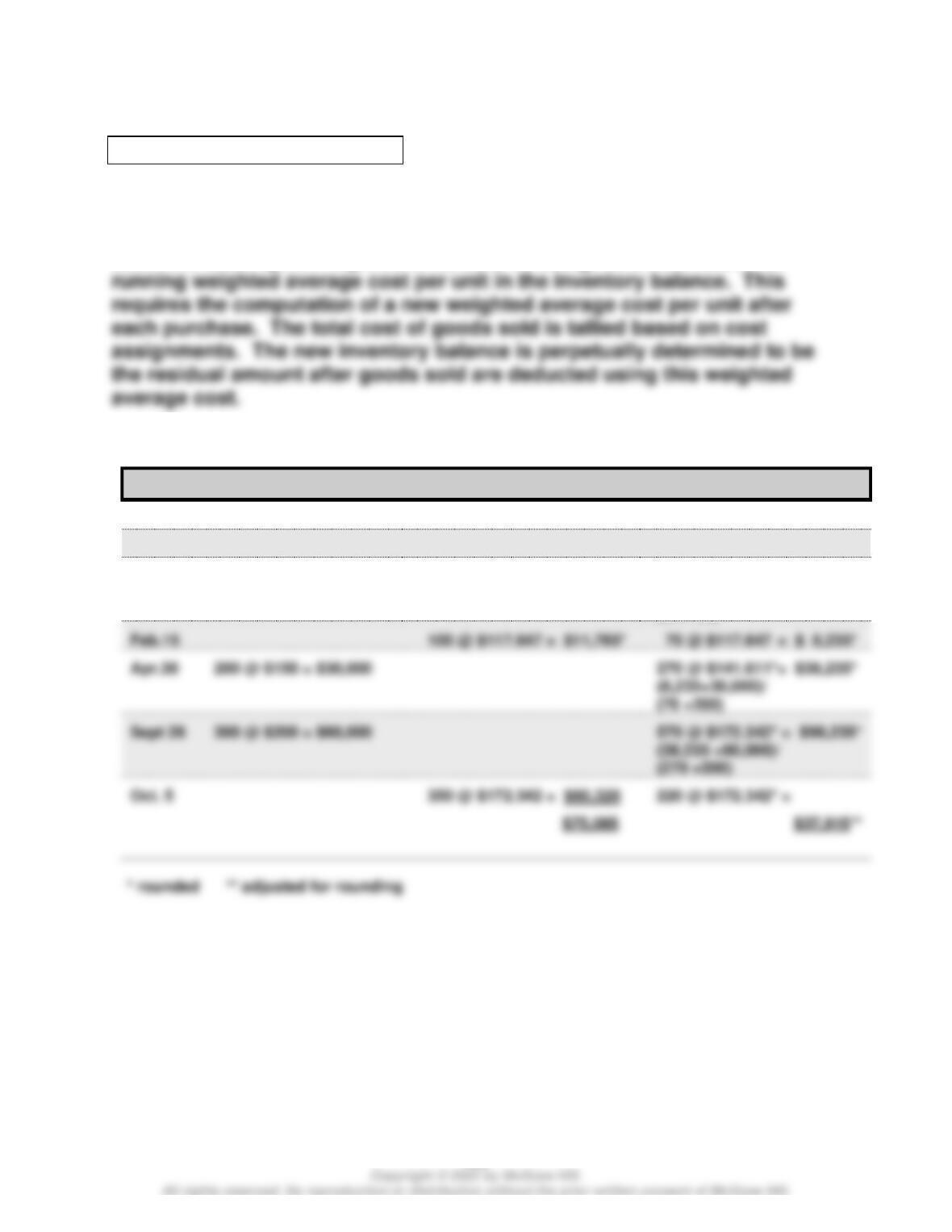
Weighted Average Expert:
(a) and (b) Concept:
Purchases are always recorded at actual costs. The Weighted Average
cost flow assumption requires units sold be assigned a cost based on
(a) and (b) Procedures:
Date
Goods Purchased
Cost of Goods Sold
Inventory Balance
Jan. 1
50 @ $100 = $ 5,000
Jan.10
30 @ $100 = $ 3,000
20 @ $100 = $ 2,000
Jan.14
150 @ $120 = $18,000
170 @ $117.647 = $20,000
(2,000 +18,000)/
(20+150)
Feb.15
100 @ $117.647 = $11,765*
70 @ $117.647 = $ 8,235*
Sept 26
300 @ $200 = $60,000
570 @ $172.342* = $98,235*
(270 +300)
Oct. 5
350 @ $172.342 = $60,320
220 @ $172.342* =
Wild and Shaw Financial and Managerial Accounting 9e Solutions Manual: Chapter 5
454
Teamwork in Action (Concluded)
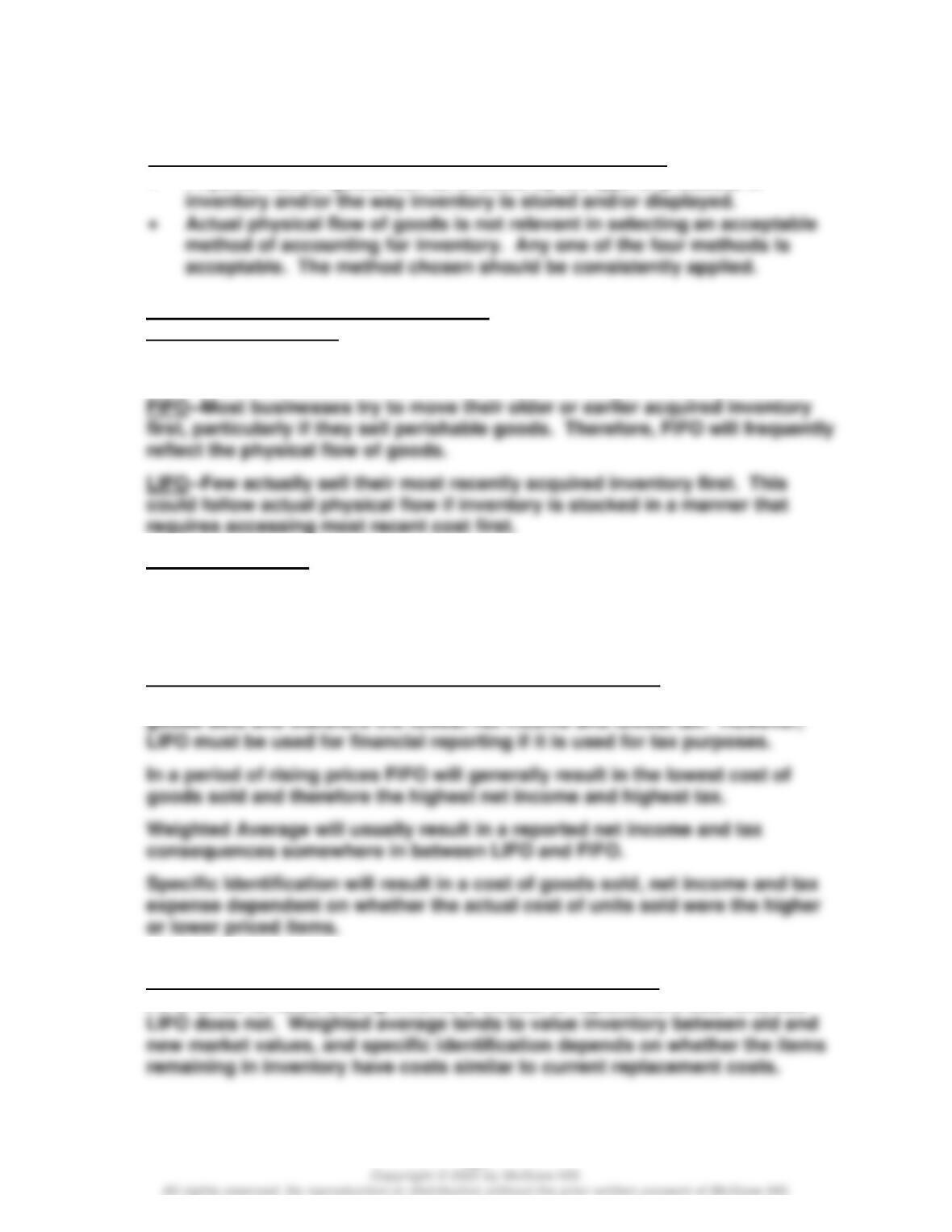
(c) Cost Flow versus Actual Physical Flow
Typical comments experts may express in response to (c):
• Physical flow of goods can be affected by the type of products in
More Specific Expert Comments to (c):
Specific Identification—Always reflects the actual cost flow. Electronic
scanning has increased the ability to use this method in businesses that sell
homogeneous goods.
Weighted Average—This cost is rarely the actual cost flow. This would
require the mixing or combining of units on hand. This is possible for
inventory such as oil but it still unlikely that the actual blending would be as
complete as the averaging of costs.
(d) Impact of Methods
Typical comments experts may express in response to (d):
In a period of rising prices LIFO will generally result in the highest cost of
(e) Valuation
Typical comments experts may express in response to (e):
FIFO tends to value ending inventory closest to replacement cost whereas
Wild and Shaw Financial and Managerial Accounting 9e Solutions Manual: Chapter 5
455
Entrepreneurial Decision — BTN 5-5
Part 1
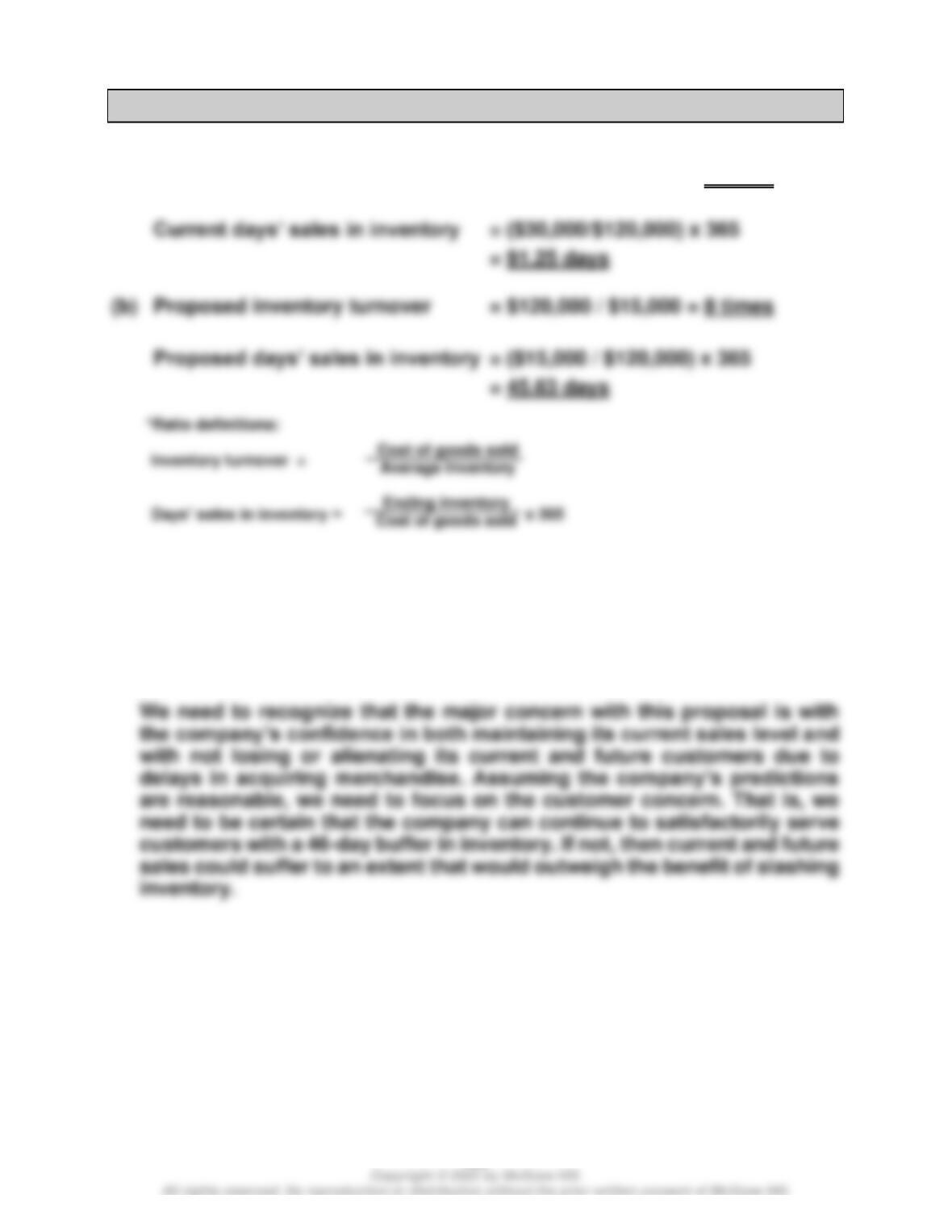
(a) Current inventory turnover = $120,000 / $30,000 = 4 times
Part 2
The proposal would yield a much improved inventory turnover of 8 vis-à-
vis the current turnover of 4. On the downside, its days’ sales in inventory
would dramatically decline from 91 days to 46 days. Assuming an
inventory buffer of 46 days is sufficient, then the proposal should be
implemented.

Wild and Shaw Financial and Managerial Accounting 9e Solutions Manual: Chapter 5
456