Chapter 05 – Communicating and Interpreting Accounting Information
5-1
CHAPTER 5
COMMUNICATING AND INTERPRETING
ACCOUNTING INFORMATION
Learning Objectives and Related Assignment Materials
Learning Objectives
Mini-
Exercises
Exercises
Problems
Alternate
Problems
Cases and
Projects
intermediaries, and users), their
and professional standards.
5-1 Recognize the people involved in
the accounting communication
1
1
1
6, 7, 8
5-2 Identify the steps in the
accounting communication
2
2, 3
1
1, 2, 8
profit percentage.
5-3 Recognize and apply the different
financial statement and disclosure
3, 4, 5,
6
4, 5, 6, 7,
8, 9, 10,
2, 3, 4, 5,
6, 7, 9
1, 2, 3, 4
1, 2, 4, 6, 7, 8
5-4 Analyze a company’s
performance based on return on
financial ratios.
7
17, 18,
19
7, 8
4
1, 3, 5, 8
Synopsis of Chapter Revisions
Focus Company: Apple Inc.
• Chapter 5 has been rewritten around the most recent financial statements and corporate
governance and disclosure processes of Apple Inc., students’ favorite technology company.
• Focus and contrast company data updated.
Chapter 05 – Communicating and Interpreting Accounting Information
5-2
• Section on the effects of transactions on key ratios ties the chapter to material in Chapters 2, 3,
and 4.
• New DATA ANALYTICS feature that introduces students to how data analytics are changing
the nature of auditing.
• Highlighted GUIDED HELP feature provides free access to step-by-step video instruction on
PowerPoint Slides
Learning Objectives
PowerPoint® Slides
5-1 Recognize the people involved in the accounting communication process
(regulators, managers, directors, auditors, information intermediaries, and
users), their roles in the process, and the guidance they receive from legal
and professional standards.
5-3 through 5-15
components and the effects of transactions on financial ratios.
Chapter Take-Aways
5-1 Recognize the people involved in the accounting communication process (regulators, managers,
directors, auditors, information intermediaries, and users), their roles in the process, and the
guidance they receive from legal and professional standards.
Management of the reporting company must decide on the appropriate format (categories) and level
of detail to present in its financial reports. Independent audits increase the credibility of the
Chapter 05 – Communicating and Interpreting Accounting Information
5-3
Chapter Take-Aways, Continued
5-2 Identify the steps in the accounting communication process, including the issuance of press
releases, annual reports, quarterly reports, and SEC filings, as well as the role of online
information services in this process.
Earnings are first made public in press releases. Companies follow these announcements with annual
5-3 Recognize and apply the different financial statement and disclosure formats used by
companies in practice and analyze the gross profit percentage.
Most statements are classified and include subtotals that are relevant to analysis. On the balance
5-4 Analyze a company’s performance based on return on assets and its components and the
effects of transactions on financial ratios.
ROA measures how well management used the company’s invested capital during the period. Its two
determinants, net profit margin and asset turnover, indicate why ROA differs from prior levels or the
Key Ratios
Gross profit percentage measures the excess of sales prices over the costs to purchase or produce the
goods or services sold as a percentage. It is computed as follows:
Gross profit percentage = Gross Profit ÷ Net Sales
Chapter 05 – Communicating and Interpreting Accounting Information
5-4
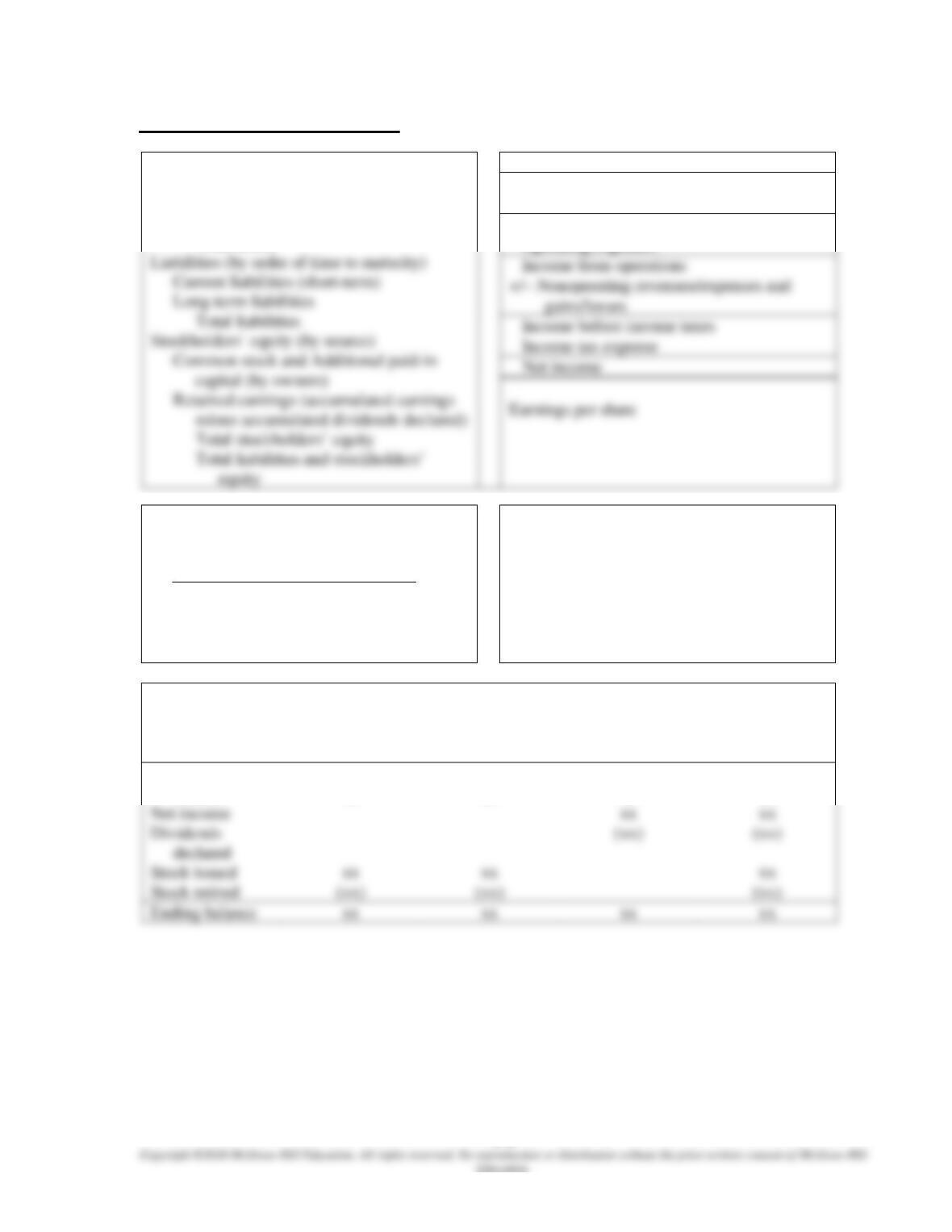
Finding Financial Information
BALANCE SHEET
INCOME STATEMENT
Income from operations
Income before income taxes
Net income
Earnings per share
Assets (by order of liquidity)
Current assets (short-term)
Noncurrent assets
Total assets
Net sales
– Cost of goods sold
Gross profit
– Operating expenses
STATEMENT OF CASH FLOWS
NOTES
Operating activities:
Net income
+/– Adjustments for noncash items
Cash provided by operating activities
Investing activities:
Financing activities:
Key Classifications:
Descriptions of accounting rules applied
in the statements
Additional detail supporting reported
numbers
Relevant financial information not
disclosed on the statements
STATEMENT OF STOCKHOLDERS’ EQUITY
Common Stock
Additional
Paid-In Capital
Retained
Earnings
Total
Stockholders’
Equity
Beginning
balance
xx
xx
xx
xx
Net income
declared
Stock issued
xx
xx
xx
Stock retired
Ending balance
xx
xx
xx
xx
Chapter 05 – Communicating and Interpreting Accounting Information
5-5
Chapter Outline
Teaching Notes
LO 5-1 Recognize the people involved in the accounting communication process (regulators,
managers, directors, auditors, information intermediaries, and users), their roles in the
process, and the guidance they receive from legal and professional standards.
I. Players in the Accounting Communication Process
Summarized in Exhibit 5.1
A. Regulators (SEC, FASB, PCAOB, Stock Exchanges)
1. U.S. Securities and Exchange Commission (SEC) –
mission is to protect investors and maintain the integrity
of the securities markets
See a Question of Ethics
feature “The Fraud
Triangle”
2. SEC oversees the work of the:
b. Public Company Accounting Oversight Board
(PCAOB), which sets auditing standards for
independent auditors (CPAs) of public companies,
which, along with state governments, set overall
corporate governance standards
3. SEC staff reviews the reports filed with it for compliance
a. Financial Accounting Standards Board (FASB), which
violators
B. Managers (CEO, CFO, and Accounting Staff)
1. The primary responsibility for the information in a
company’s financial statements and related disclosures
lies with management, specifically the:
a. Highest officer in the company, often called the
chairman and chief executive officer (CEO)
b. Highest officer associated with the financial and
accounting side of the business, often called the chief
financial officer (CFO)
2. Each officer must certify:
c. They have disclosed to the auditors and audit
committee of the board any weaknesses in internal
a. Each report filed with the SEC does not contain any
untrue material statement or omit a material fact and
fairly presents in all material respects the financial
3. An executive who knowingly certifies false financial
reports is subject to a $5 million fine and a 20-year prison
term
Chapter 05 – Communicating and Interpreting Accounting Information
5-6
C. Board of Directors (Audit Committee)
1. Board of directors
a. Elected by the stockholders to represent their interests
directors with financial knowledge
b. Responsible for hiring the company’s independent
b. Responsible for maintaining the integrity of the
auditors
D. Auditors
3. Unqualified (clean) audit opinion – an auditor’s statement
material respects in conformity with GAAP
often required by agreements with lenders and private
b. Independent verification reduces the risk that the
1. SEC requires publicly traded companies to have their
statements and their control systems over the financial
reporting process audited by an independent registered
E. Information Intermediaries: Analysts and
Information Services
1. Filing of SEC Forms performed electronically through the
EDGAR (Electronic Data Gathering, Analysis, and
Retrieval) Service
a. Each fact in the report is now tagged to identify its
source and meaning using a language called XBRL
b. Users can retrieve information from EDGAR within
financial statements and other information over the
web.
2. Information services
much of the information they use from the wide
variety of commercial online information services
a. Allow investors to gather their own information about
the company and monitor the recommendations of a
3. Financial analysts obtain and analyze information about
the company
Chapter 05 – Communicating and Interpreting Accounting Information
5-7
a. Receive accounting reports and other information
from electronic information services
and competitors
c. Results of their analyses are combined into analysts’
reports, which include:
iii. Explanations for these judgments
F. Users: Institutional and Private Investors, Creditors, and
Others
1. Institutional investors – managers of pension, mutual,
endowment, and other funds that invest on the behalf of
others
shares in companies
a. Institutional investors usually employ their own
4. Cost-effectiveness
a. Suggests that the benefits of accounting for and
reporting information should outweigh the cost
b. Accounting regulators consider when they consider
requiring new disclosures
Chapter 05 – Communicating and Interpreting Accounting Information
5-8
LO5- 2 Identify the steps in the accounting communication process, including the issuance of
press releases, annual reports, quarterly reports, and SEC filings as well as the role of
online information services in this process
II. The Disclosure Process
A. Press Releases – A written public news announcement
normally distributed to major news services
Illustrated in Exhibit 5.3
2. Press releases related to earnings often precede the
1. Public companies announce quarterly and annual earnings
See Financial Analysis
B. Annual Reports and Form 10-K
1. Private companies
a. Annual reports are relatively simple documents
b. Normally include only the following:
2. Public companies – annual reports on Form 10-K contain
two sections:
a. Nonfinancial section, which includes:
i. Letter to stockholders from the chairman and CEO
ii. Descriptions of the company’s management
philosophy, products, successes and failures, etc.
b. Financial section includes:
• Summarized financial data for a 5-year period
C. Quarterly Reports and Form 10-Q
1. Private companies also normally prepare quarterly reports
on Form 10-Q for their lenders
2. Public companies prepare quarterly reports that include:
a. Letter to shareholders
2. Other filing requirements for public companies are
Chapter 05 – Communicating and Interpreting Accounting Information
5-9
described on the SEC website.
LO 5-3 Recognize and apply the different financial statement and disclosure formats used by
companies in practice and analyze the gross profit percentage.
Use Supplemental
related disclosures designed to make them more useful:
1. Comparative financial statements
a. To allow users to compare performance from period to
2. Additional subtotals and classifications in financial
statements; slightly different statement formats used by
different companies
3. Additional disclosures
a. Most companies present voluminous notes that are
B. Classified Balance Sheet
Illustrated in Exhibit 5.4
1. Assets (by order of liquidity)
a. Current assets (short-term)
b. Noncurrent assets
i. Fixed assets (reported net of accumulated
depreciation)
c. Total assets
2. Liabilities (including deferred revenues, by order of time
to maturity)
a. Current liabilities (short-term)
b. Long-term liabilities
c. Total liabilities
3. Stockholders’ equity
Use Supplemental
Chapter 05 – Communicating and Interpreting Accounting Information
5-10
Enrichment Activity #2
C. Classified Income Statement – Basic structure:
Illustrated in Exhibit 5.5
1. Basic structure:
Net sales
Use Supplemental
− Cost of goods sold
Enrichment Activity #3
Gross profit or gross margin (not always reported)
− Operating expenses
Operating income (or Income from operations)
+/− Nonoperating (other) Items
Income before income taxes (or Pretax earnings)
− Income tax expense (or Provision for income taxes)
Net income
2. Nonoperating (Other) Items
a. Revenues, expenses, gains, and losses that do not
relate to the company’s primary operations
given its nonrecurring nature.
b. If discontinued operations are reported, an additional
3. When a major component of a business is sold or
abandoned, income or loss from that component earned
before the disposal, as well as any gain or loss on
4. Finally, earnings per share is reported; calculated as:
(Net income – Preferred dividends) ÷ Average number of
shares of common stock outstanding during the period
Refer students to Pause for
Feedback – Self-Study Quiz
Refer students to Guided
Help 5-1
D. Key Ratio Analysis – Gross Profit Percentage
1. Gross Profit Percentage = Gross Profit ÷ Net Sales
2. Measures a company’s ability to charge premium prices
and produce goods and services at low cost
3. All other things equal, a higher gross profit results in
higher net income.
gross profit percentage.
Chapter 05 – Communicating and Interpreting Accounting Information
them to charge premium prices, producing a higher
gross profit percentage
and increase the gross profit percentage
5. A Few Cautions
change in the gross profit percentage.
R&D and advertising costs, which reduce net income
a. To assess the company’s ability to sustain its gross
profits, you must understand the sources of any
and can offset any increase in gross profit.
E. Statement of Stockholders’ Equity
Illustrated in Exhibit 5.6
1. Reports the changes in each of the company’s
stockholders’ equity accounts during the accounting
period.
2. Format:
a. The statement has a column for each stockholders’
equity account and one for the effect on total
stockholders’ equity
balances in each account, which correspond to the
which correspond to the ending balances on the
balance sheet
F. Statement of Cash Flows
1. Three statement classifications:
Illustrated in Exhibit 5.7
a. Cash Flows from Operating Activities – cash flows
associated with earning income
(i) productive assets (other than inventory) and
b. Cash Flows from Investing Activities – cash flows in
2. Statement of cash flows can be reported using direct or
indirect method
a. Indirect method
i. First section reconciles accrual basis net income to