Chapter 5
Cost-Volume-Profit Relationships
Solutions to Questions
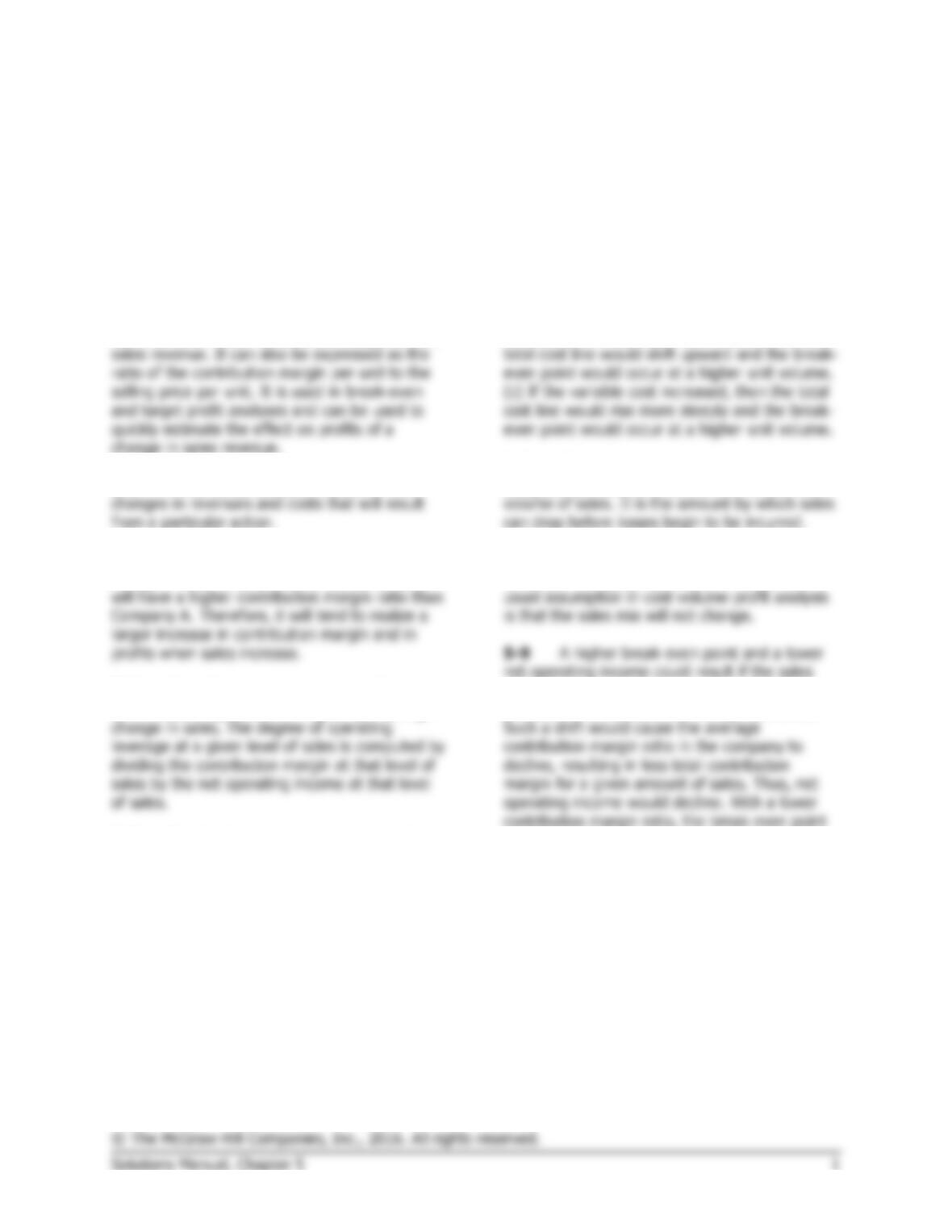
5-1 The contribution margin (CM) ratio is
the ratio of the total contribution margin to total
5-2 Incremental analysis focuses on the
5-3 All other things equal, Company B, with
its higher fixed costs and lower variable costs,
5-4 Operating leverage measures the impact
on net operating income of a given percentage
5-5 The break-even point is the level of
sales at which profits are zero.
5-6 (a) If the selling price decreased, then
the total revenue line would rise less steeply,
and the break-even point would occur at a
higher unit volume. (b) If the fixed cost
increased, then both the fixed cost line and the
5-7 The margin of safety is the excess of
budgeted (or actual) sales over the break-even
5-8 The sales mix is the relative proportions
in which a company’s products are sold. The
mix shifted from high contribution margin
products to low contribution margin products.
would be higher because more sales would be
required to cover the same amount of fixed
costs.
The Foundational 15
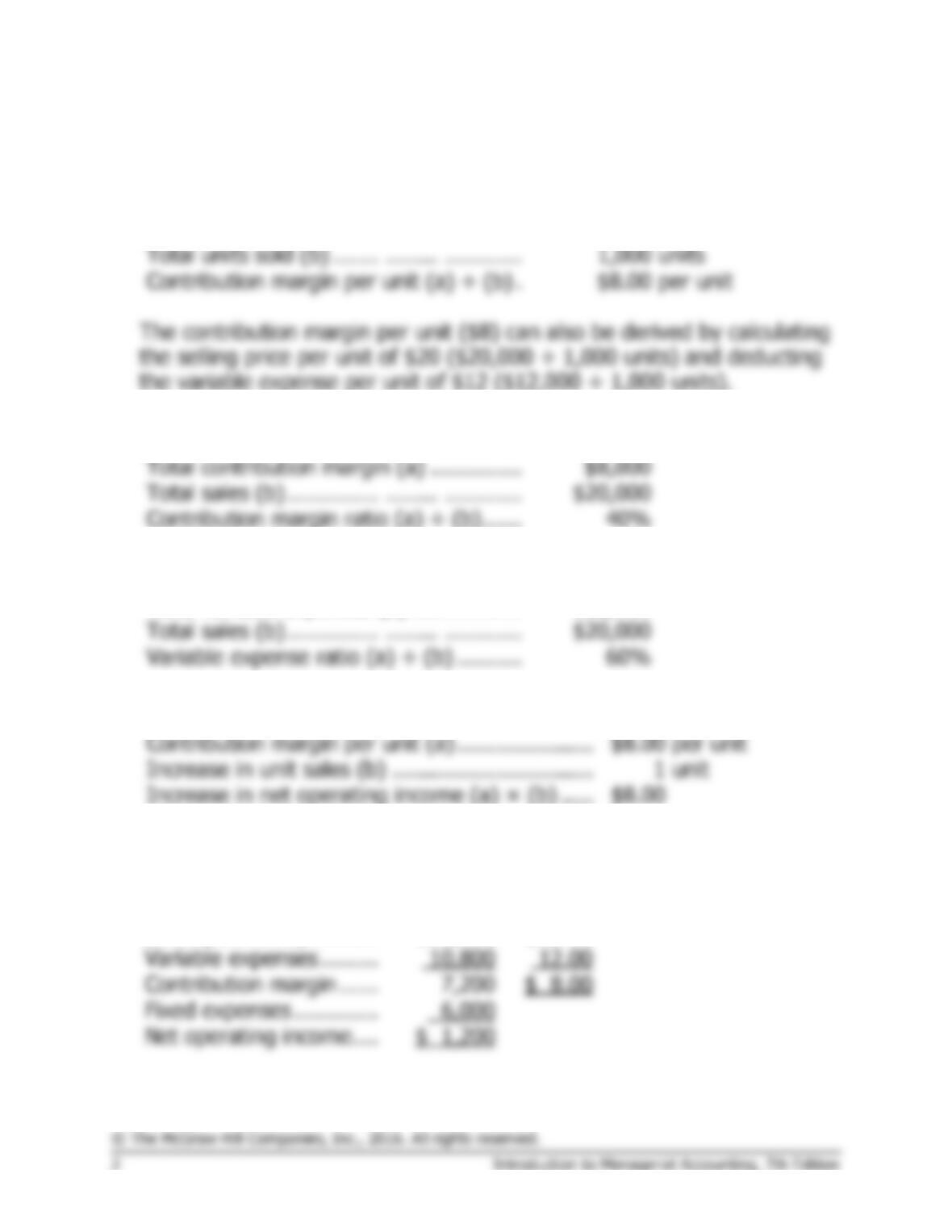
1. The contribution margin per unit is calculated as follows:
Total contribution margin (a) …………..
$8,000
Total units sold (b) ……. …….. …………
units
Contribution margin per unit (a) ÷ (b) .
per unit
2. The contribution margin ratio is calculated as follows:
Total contribution margin (a) …………..
$8,000
Total sales (b) ………….. …….. …………
Contribution margin ratio (a) ÷ (b) ……
3. The variable expense ratio is calculated as follows:
Total variable expenses (a) ……………..
$12,000
Variable expense ratio (a) ÷ (b) ……….
4. The increase in net operating is calculated as follows:
Contribution margin per unit (a) …………………
per unit
Increase in unit sales (b) ………………………….
unit
Increase in net operating income (a) × (b) …..
5. If sales decline to 900 units, the net operating would be computed as
follows:
Total
Per Unit
Sales (900 units) ……….
$18,000
$20.00
Variable expenses ………
Contribution margin ……
Fixed expenses ………….
Net operating income ….
The Foundational 15 (continued)
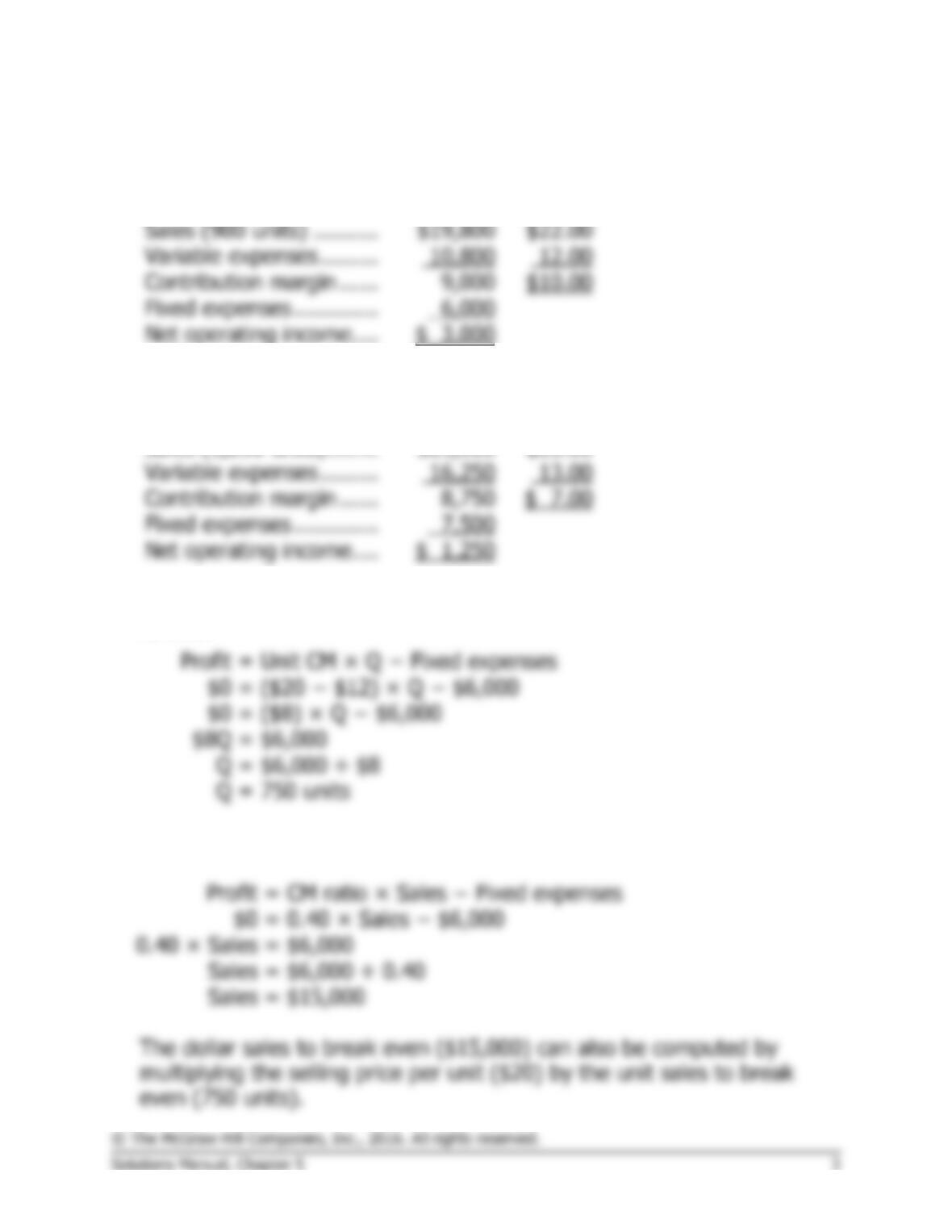
6. The new net operating income would be computed as follows:
Total
Per Unit
Sales (900 units) ……….
$19,800
$22.00
Fixed expenses ………….
Net operating income ….
7. The new net operating income would be computed as follows:
Total
Per Unit
Sales (1,250 units) ……..
$25,000
$20.00
Variable expenses ………
Contribution margin ……
8. The equation method yields the break-even point in unit sales, Q, as
follows:
= ($20 − $12) × Q − $6,000
= ($8) × Q − $6,000
= $6,000
= $6,000 ÷ $8
9. The equation method yields the dollar sales to break even as follows:
0.40 × Sales
= $6,000
= $6,000 ÷ 0.40
= $15,000
The Foundational 15 (continued)
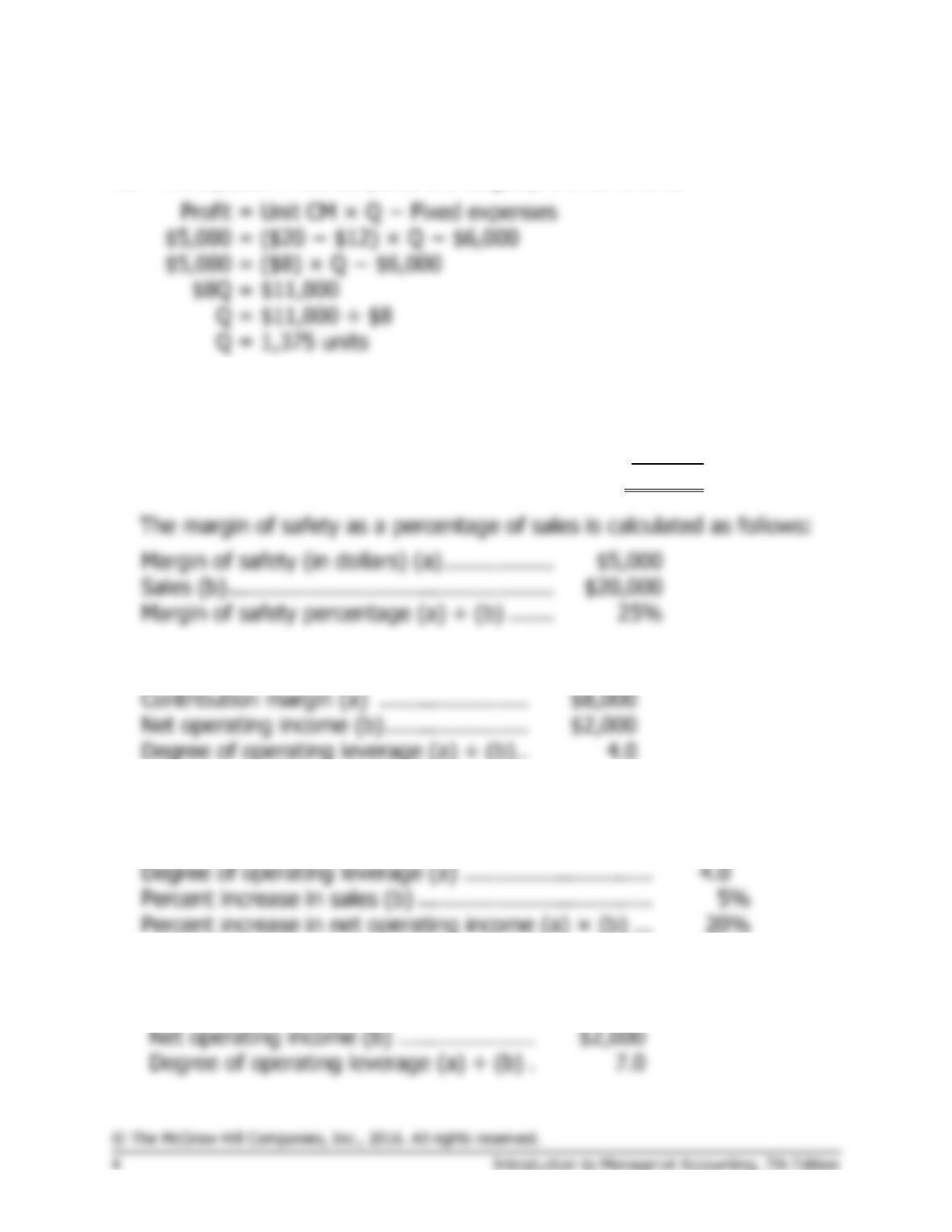
10. The equation method yields the target profit as follows:
= Unit CM × Q − Fixed expenses
= ($20 − $12) × Q − $6,000
= ($8) × Q − $6,000
= $11,000
= $11,000 ÷ $8
= 1,375 units
11. The margin of safety in dollars is calculated as follows:
Sales ……………………………………………………..
$20,000
Break-even sales (at 750 units) ……………………
15,000
Margin of safety (in dollars) ………………………..
$ 5,000
Margin of safety (in dollars) (a) ……………..
Sales (b) …………………………………………..
Margin of safety percentage (a) ÷ (b) …….
12. The degree of operating leverage is calculated as follows:
Contribution margin (a) …………………..
Net operating income (b) ………………….
Degree of operating leverage (a) ÷ (b) ..
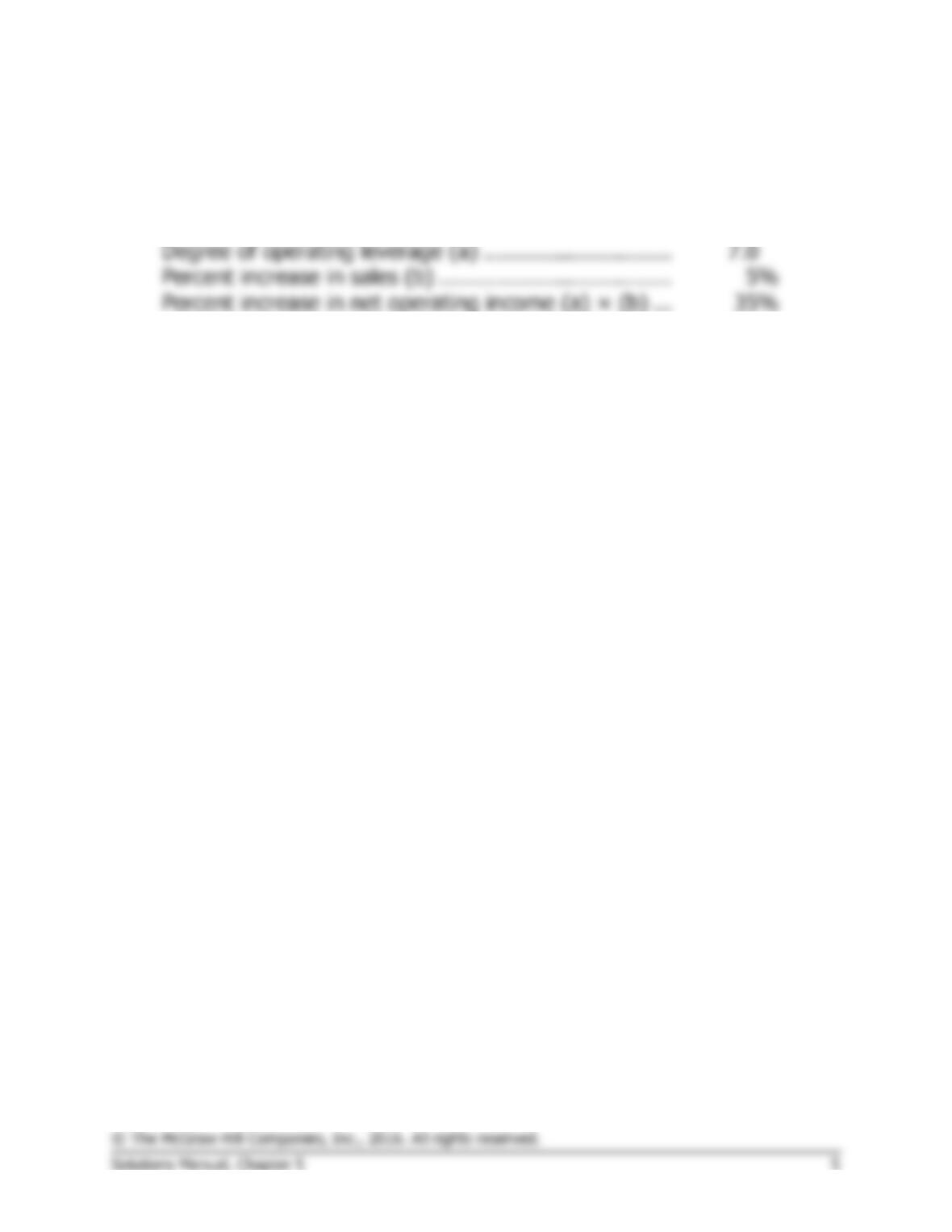
13. A 5% increase in sales should result in a 20% increase in net
operating income, computed as follows:
Degree of operating leverage (a) ………………………..
Percent increase in sales (b) ………………………………
Percent increase in net operating income (a) × (b) …
14. The degree of operating leverage is calculated as follows:
Contribution margin (a) . ………………….
$14,000
Net operating income (b) …………………
Degree of operating leverage (a) ÷ (b) .
The Foundational 15 (continued)
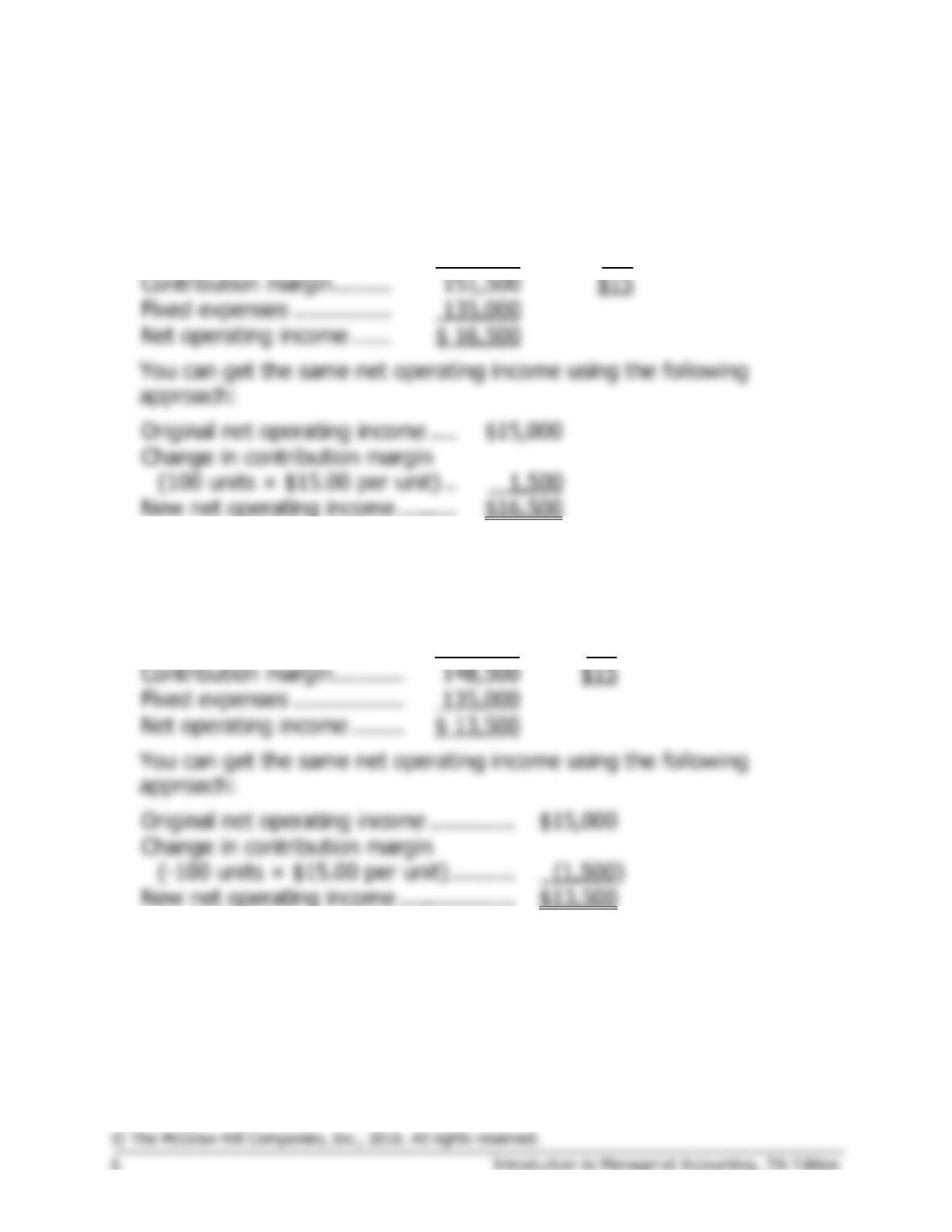
15. A 5% increase in sales should result in 35% increase in net operating
income, computed as follows:
Exercise 5-1 (20 minutes)
1. The new income statement would be:
Total
Per Unit
Sales (10,100 units) ……..
$353,500
$35
Variable expenses ………..
202,000
20
Contribution margin ………
$15
Fixed expenses ……………
135,000
Net operating income ……
Original net operating income ….
$15,000
New net operating income ………
$16,500
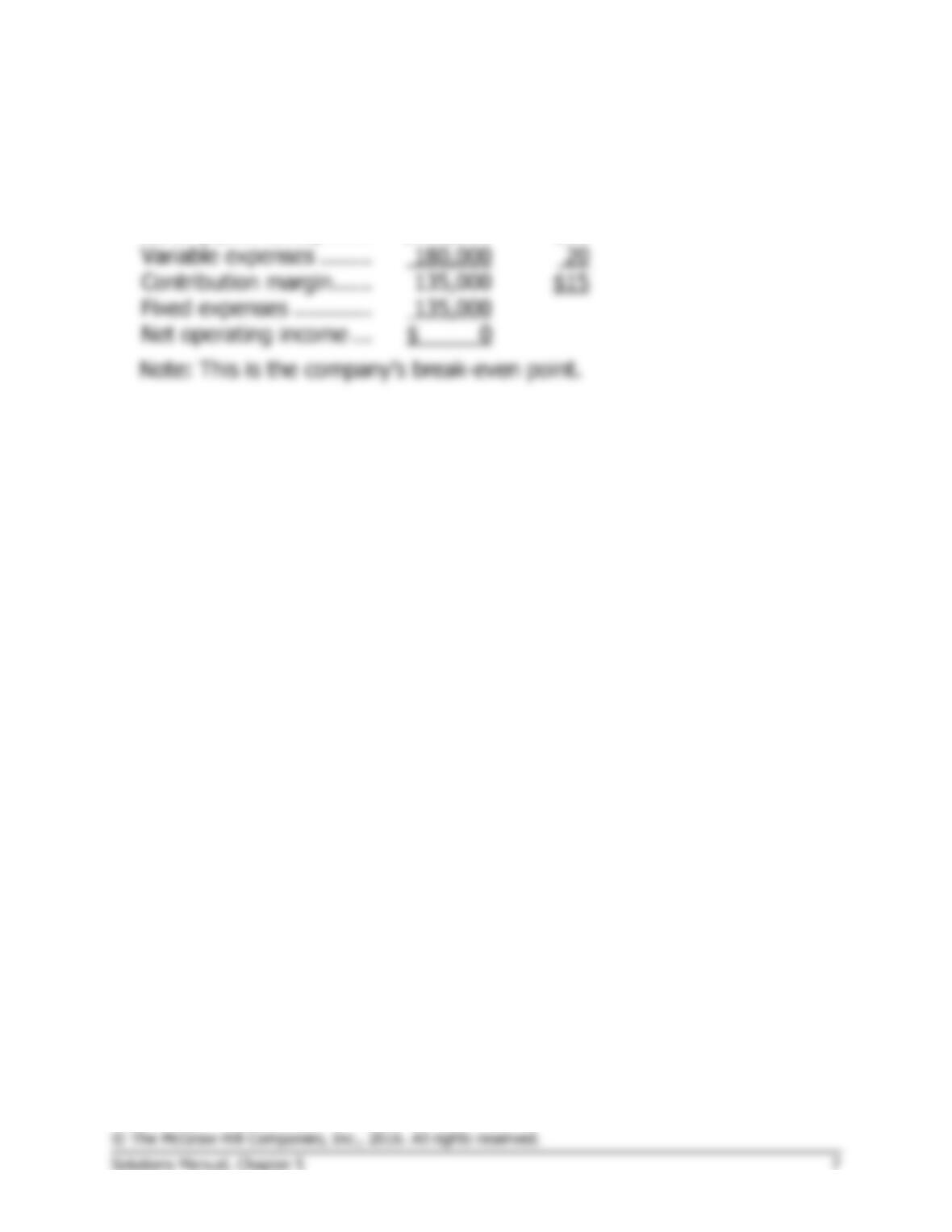
2. The new income statement would be:
Total
Per Unit
Sales (9,900 units) …………
$346,500
$35
Variable expenses ………….
198,000
20
Contribution margin ………..
Fixed expenses ……………..
Net operating income ……..
$ 13,500
Original net operating income ………….
New net operating income ………………
$13,500
Exercise 5-1 (continued)
3. The new income statement would be:
Total
Per Unit
Sales (9,000 units) …….
$315,000
$35
Fixed expenses …………
Net operating income …
Exercise 5-2 (30 minutes)
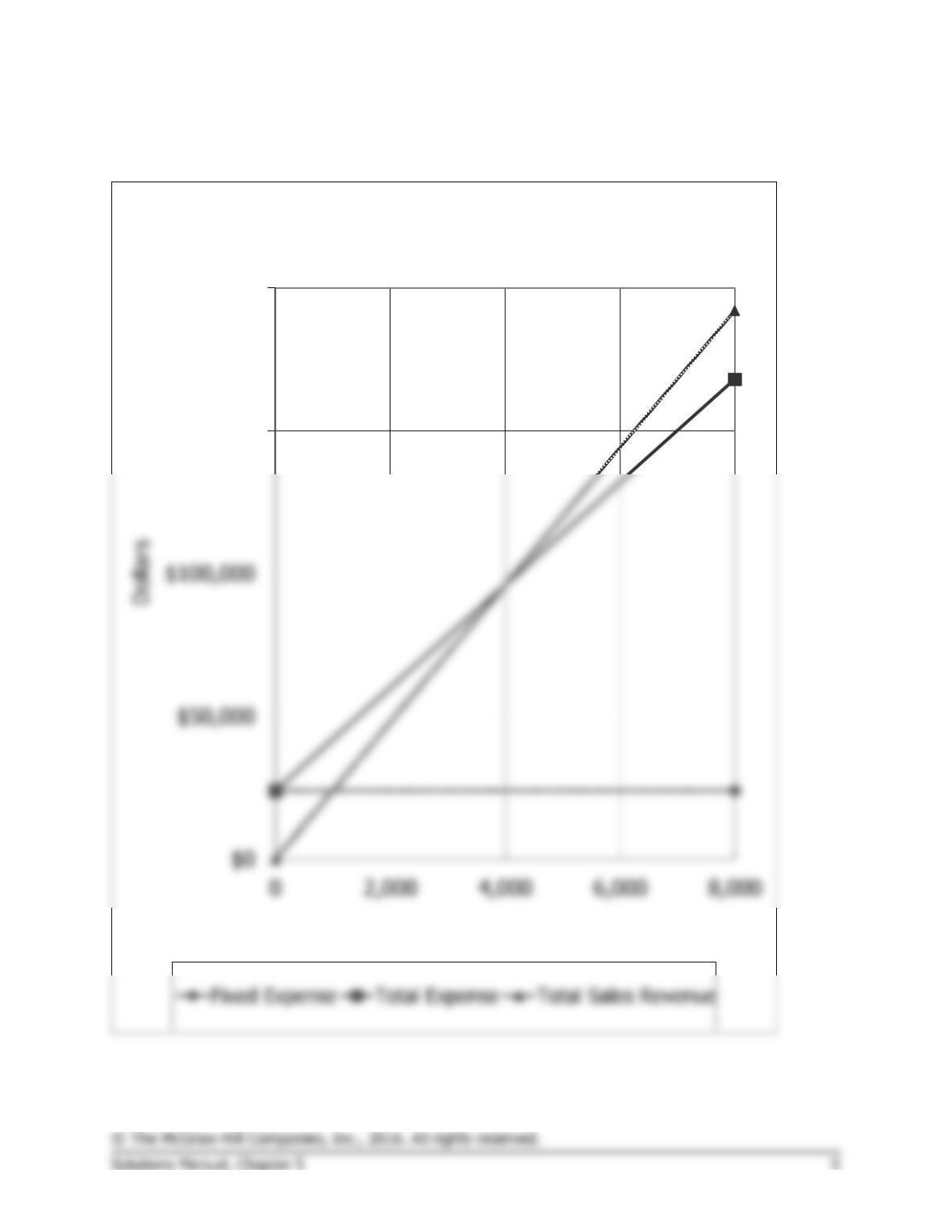
1. The CVP graph can be plotted using the three steps outlined in the text.
The graph appears on the next page.
Step 1. Draw a line parallel to the volume axis to represent the total
fixed expense. For this company, the total fixed expense is $24,000.
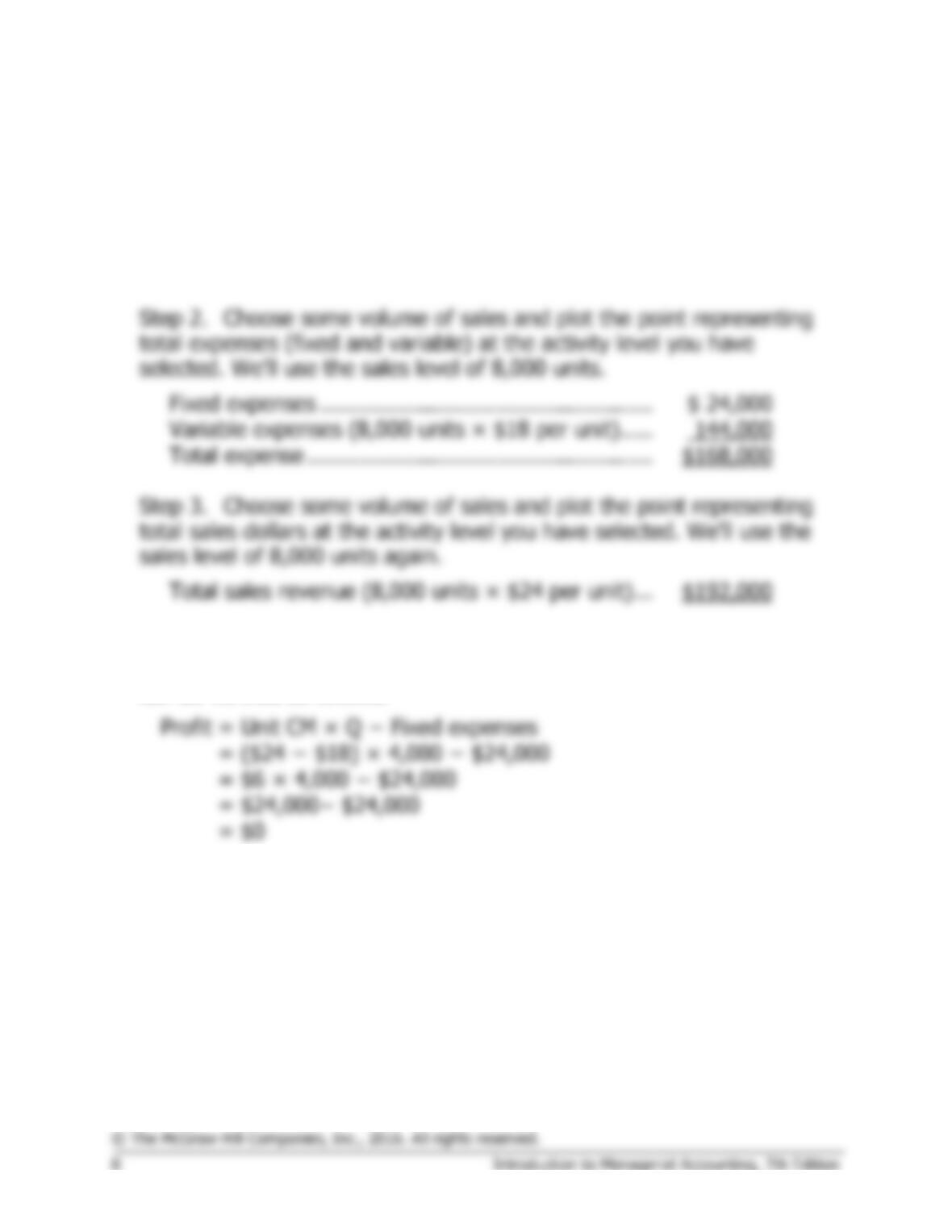
2. The break-even point is the point where the total sales revenue and the
total expense lines intersect. This occurs at sales of 4,000 units. This
can be verified as follows:
Exercise 5-2 (continued)
$150,000
$200,000
Volume in Units
CVP Graph
Exercise 5-3 (15 minutes)
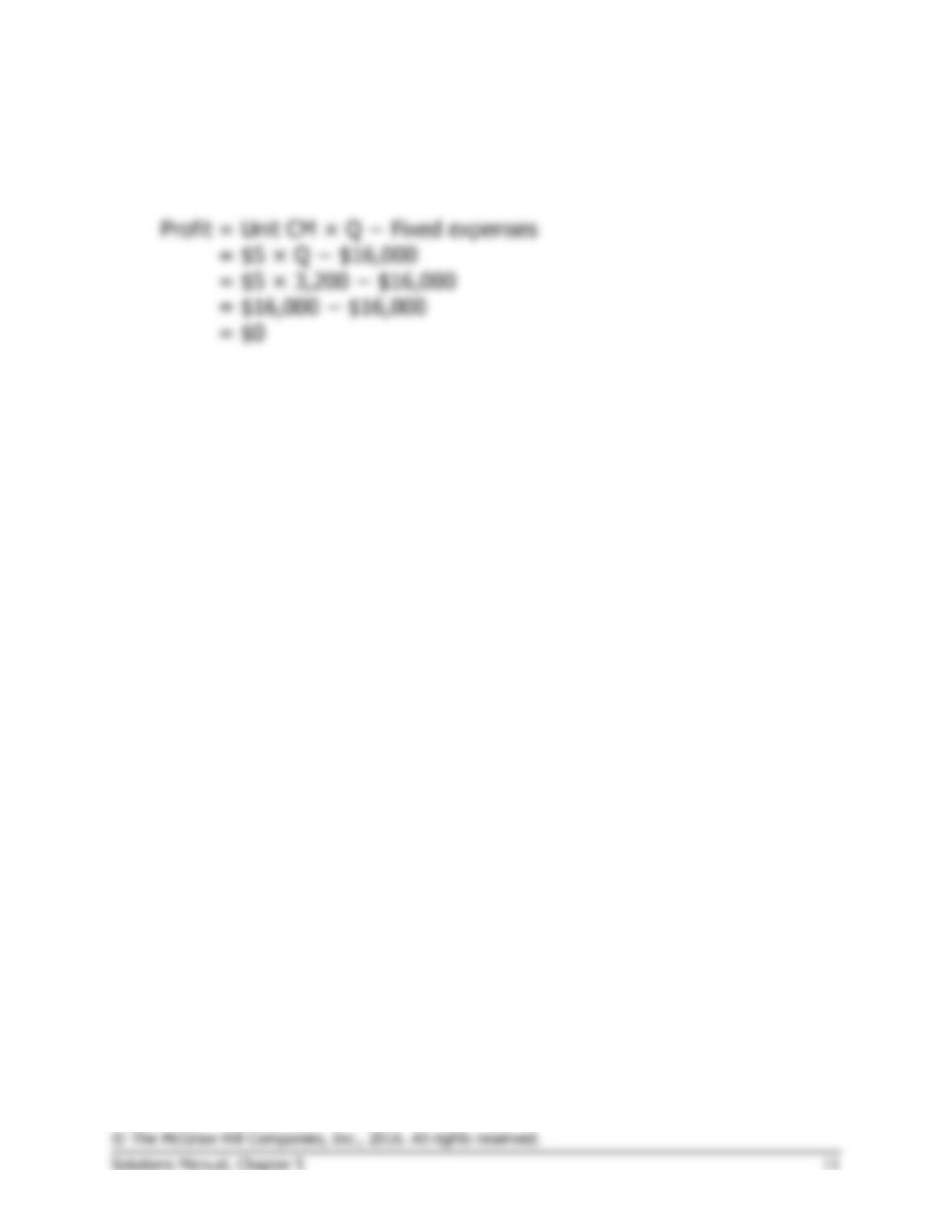
1. The profit graph is based on the following simple equation:
$0
$5,000
Profit Graph
Exercise 5-3 (continued)
2. Looking at the graph, the break-even point appears to be 3,200 units.
This can be verified as follows:
Exercise 5-4 (10 minutes)
1. The company’s contribution margin (CM) ratio is:
Total sales ……………………….
$200,000
Total variable expenses ………
120,000
= CM ratio ……………………….
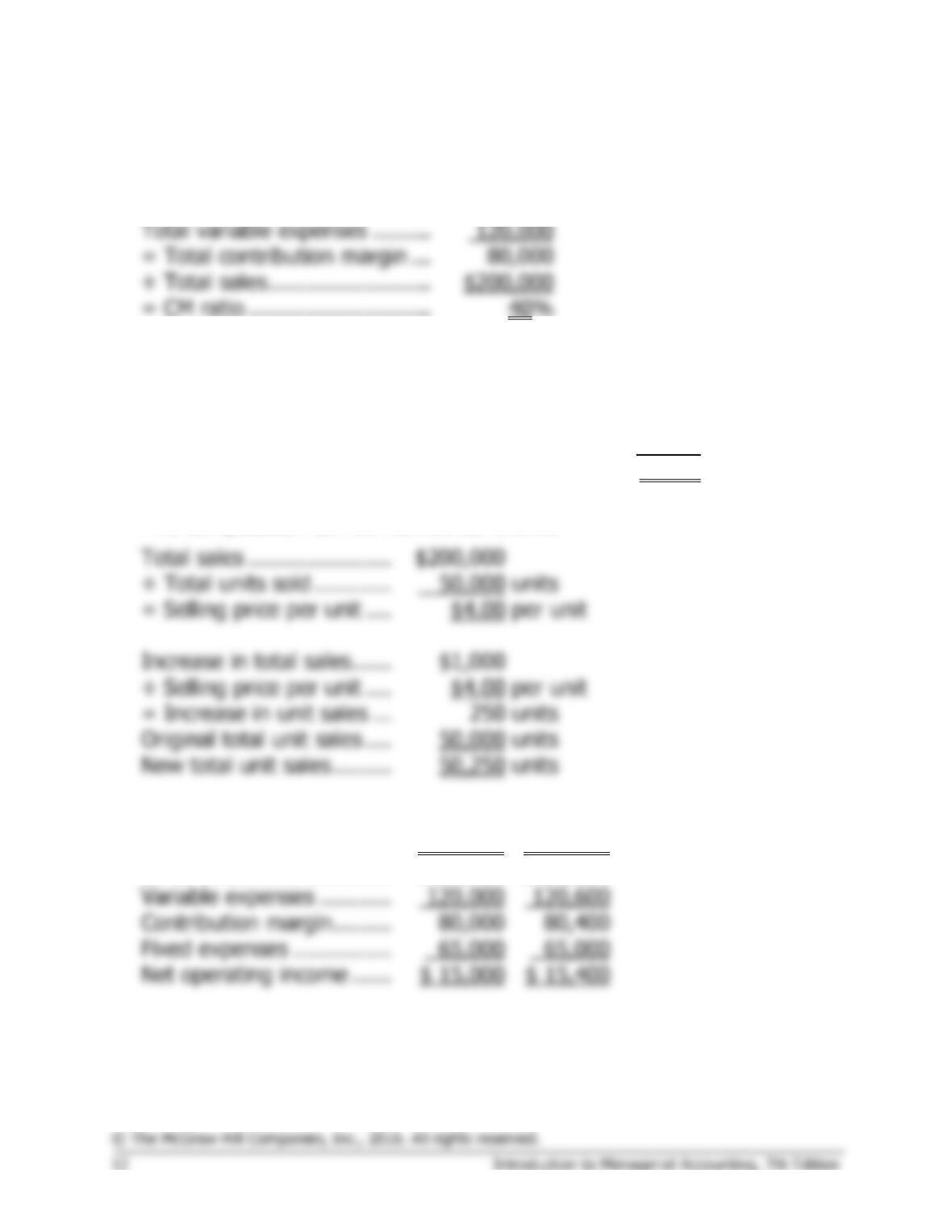
2. The change in net operating income from an increase in total sales of
$1,000 can be estimated by using the CM ratio as follows:
Change in total sales …………………………………
$1,000
× CM ratio ………………………………………………
40
%
= Estimated change in net operating income ….
$ 400
This computation can be verified as follows:
Total sales ………………….
$200,000
÷ Total units sold …………
units
= Selling price per unit ….
per unit
÷ Selling price per unit ….
per unit
= Increase in unit sales …
units
Original total unit sales ….
units
New total unit sales ………
units
Original
New
Total unit sales…………….
50,000
50,250
Sales …………………………
$200,000
$201,000
Contribution margin ………
Fixed expenses ……………
Net operating income ……
Exercise 5-5 (20 minutes)
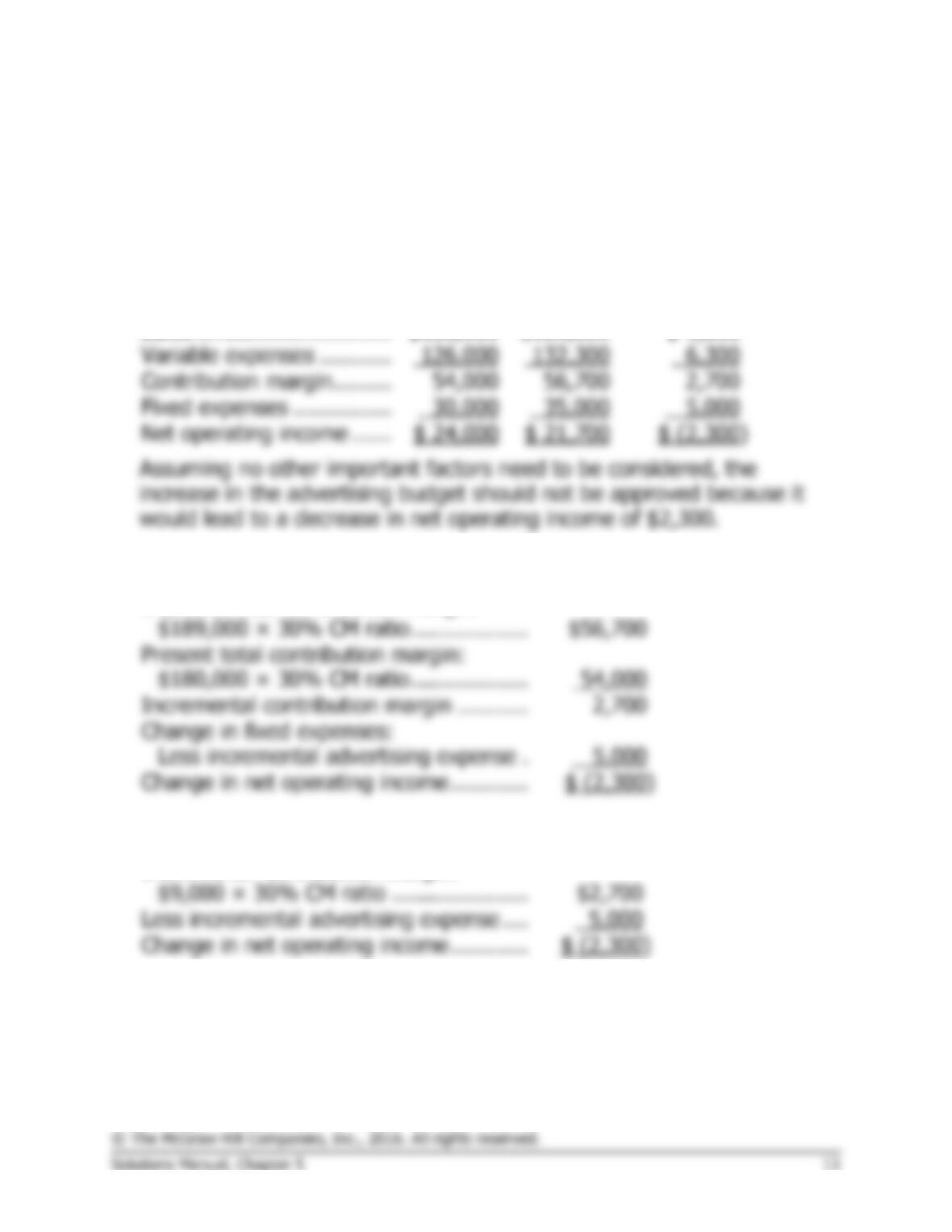
1. The following table shows the effect of the proposed change in monthly
advertising budget:
Sales With
Additional
Current
Advertising
Sales
Budget
Difference
Sales …………………………
$180,000
$189,000
$ 9,000
Variable expenses ………..
Net operating income ……
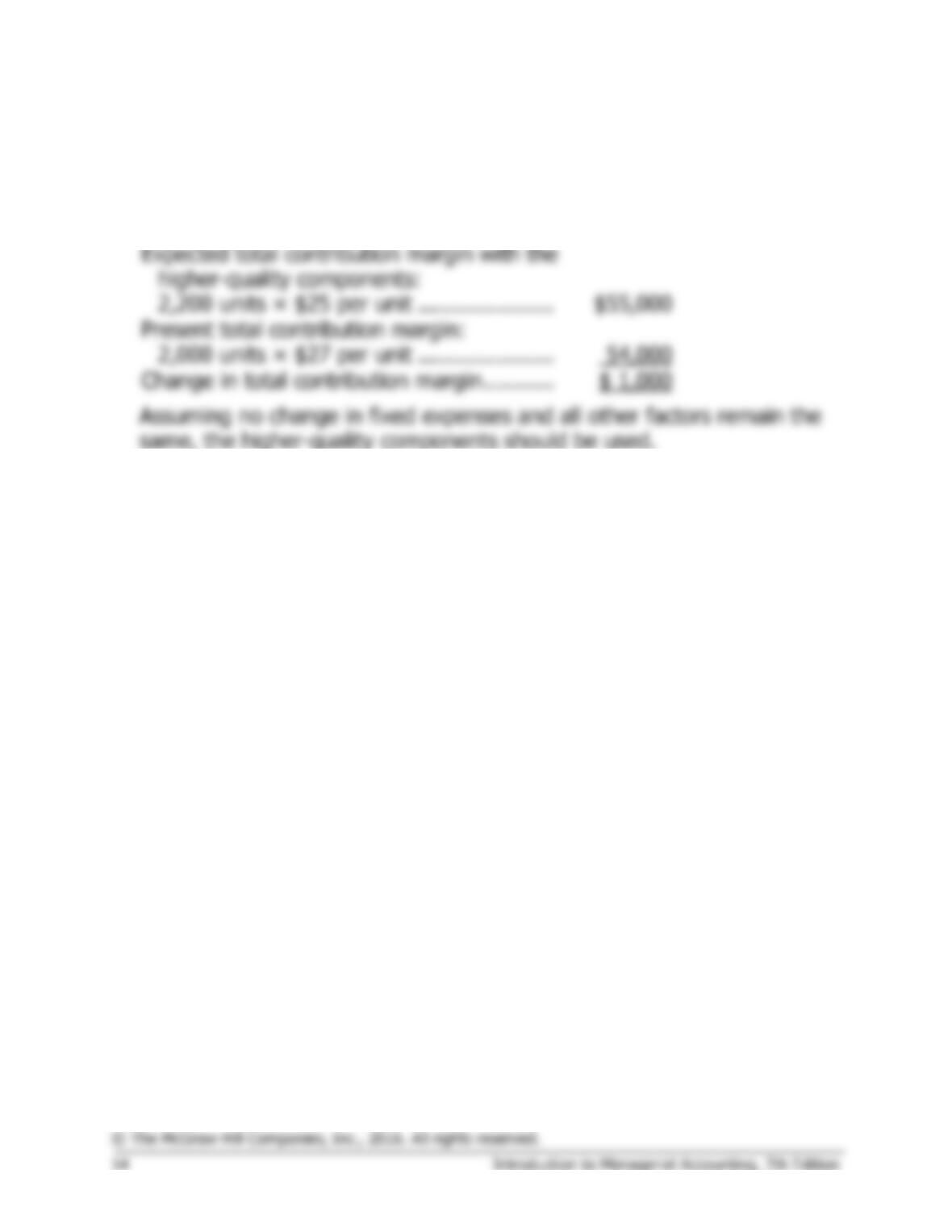
Alternative Solution 1
Change in fixed expenses:
Change in net operating income …………
Expected total contribution margin:
Alternative Solution 2
Less incremental advertising expense ….
Incremental contribution margin:
Exercise 5-5 (continued)
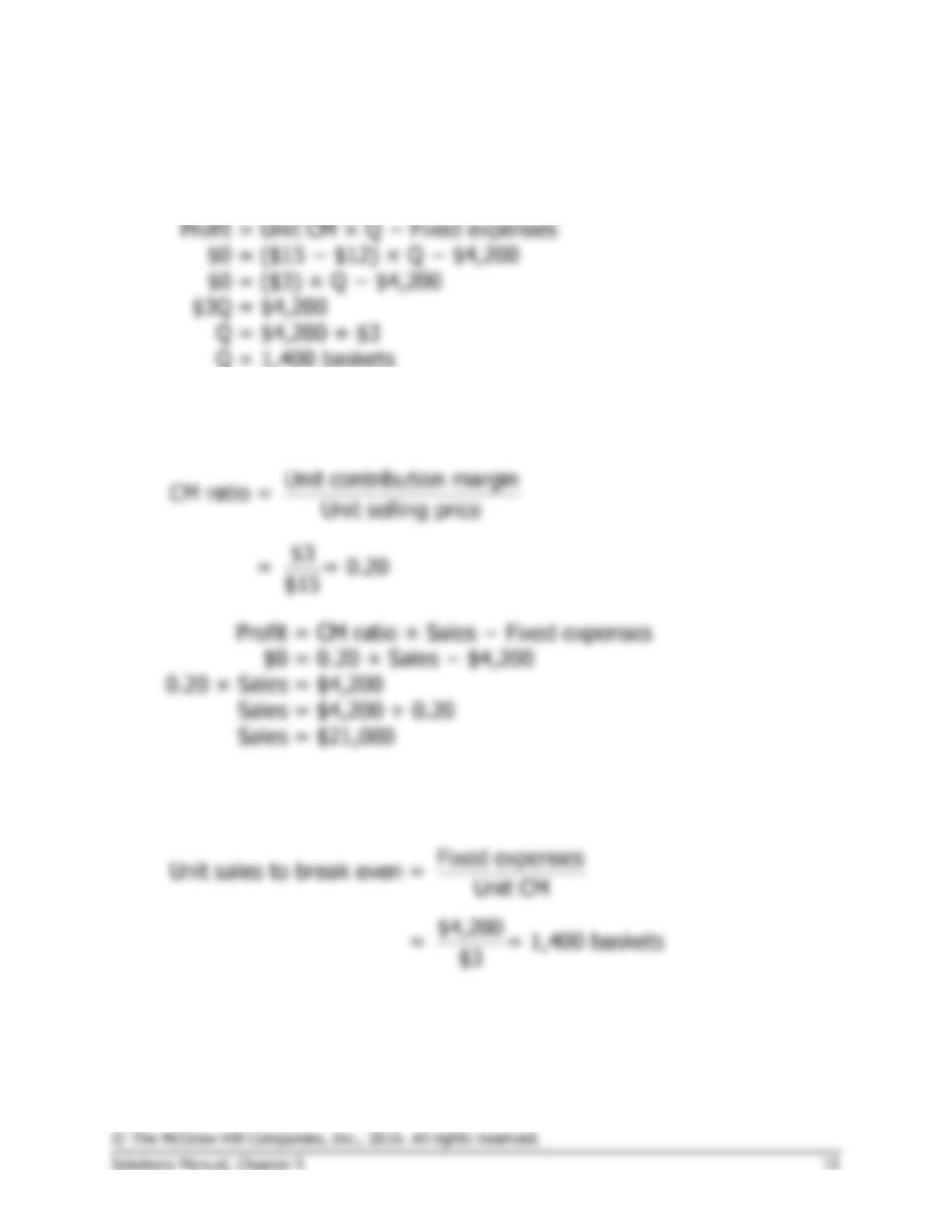
2. The $2 increase in variable expense will cause the unit contribution
margin to decrease from $27 to $25 with the following impact on net
operating income:
Exercise 5-6 (20 minutes)
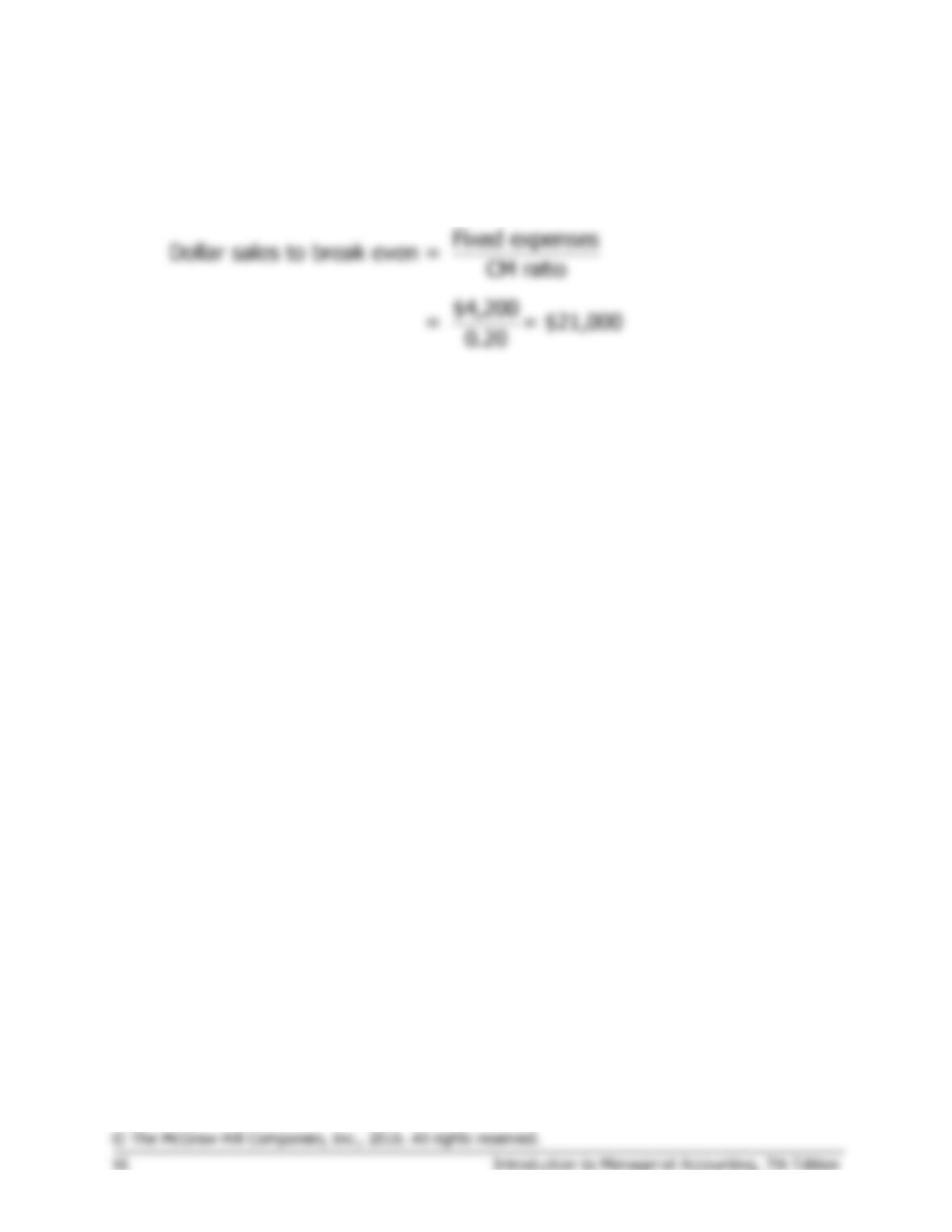
1. The equation method yields the break-even point in unit sales, Q, as
follows:
2. The equation method can be used to compute the break-even point in
dollar sales as follows:
3. The formula method gives an answer that is identical to the equation
method for the break-even point in unit sales:
Exercise 5-6 (continued)
4. The formula method also gives an answer that is identical to the
equation method for the break-even point in dollar sales:
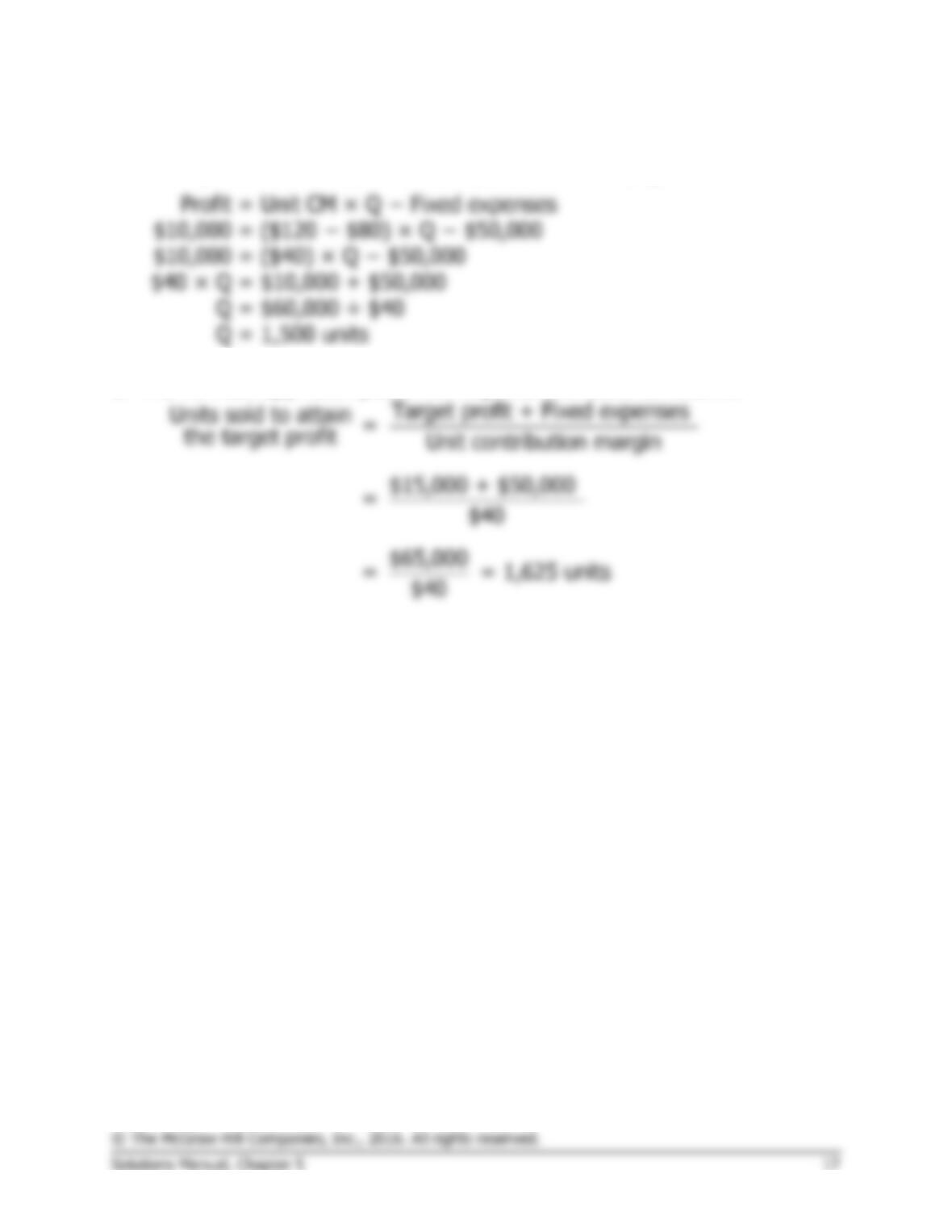
Exercise 5-7 (10 minutes)
1. The equation method yields the required unit sales, Q, as follows:
2. The formula approach yields the required unit sales as follows:
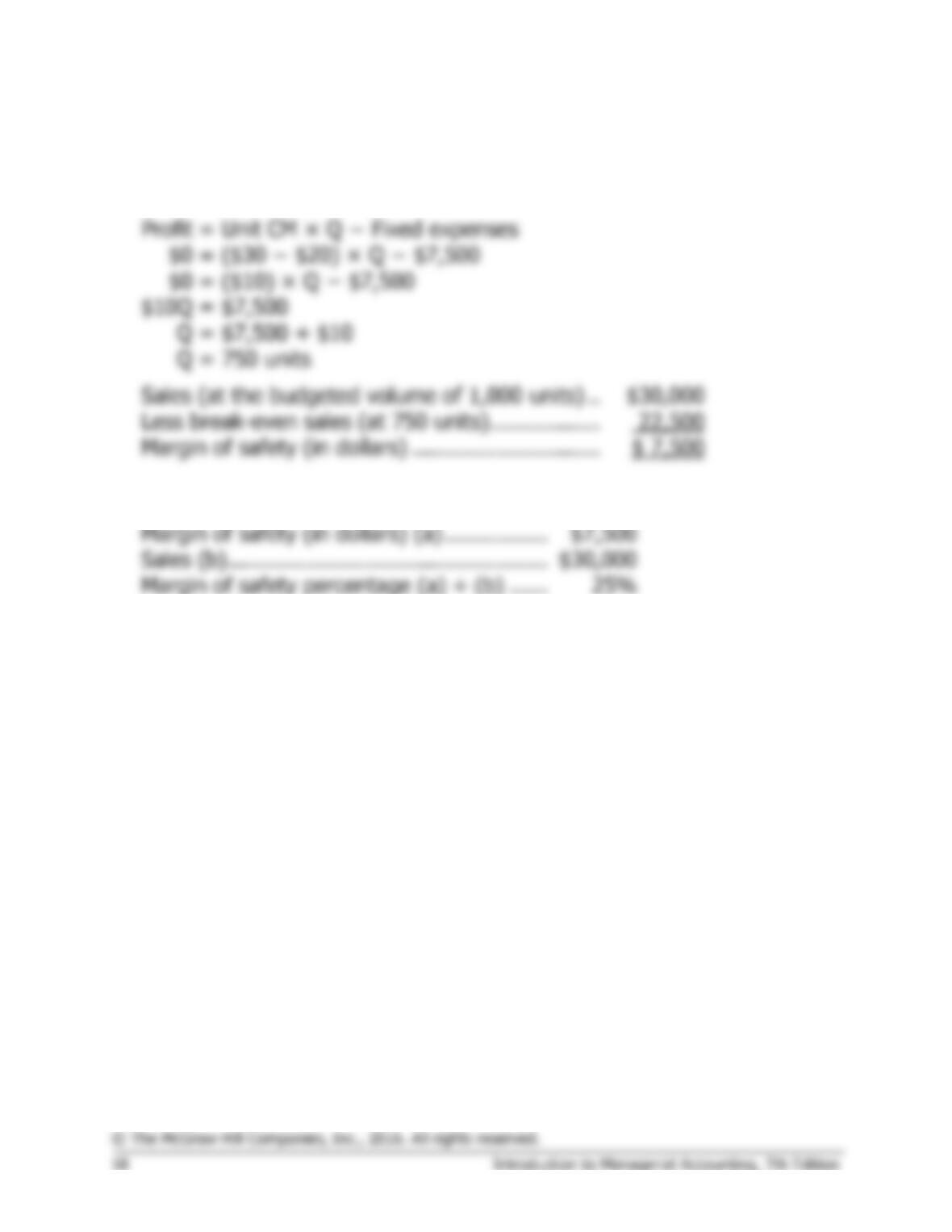
Exercise 5-8 (10 minutes)
1. To compute the margin of safety, we must first compute the break-even
unit sales.
2. The margin of safety as a percentage of sales is as follows:
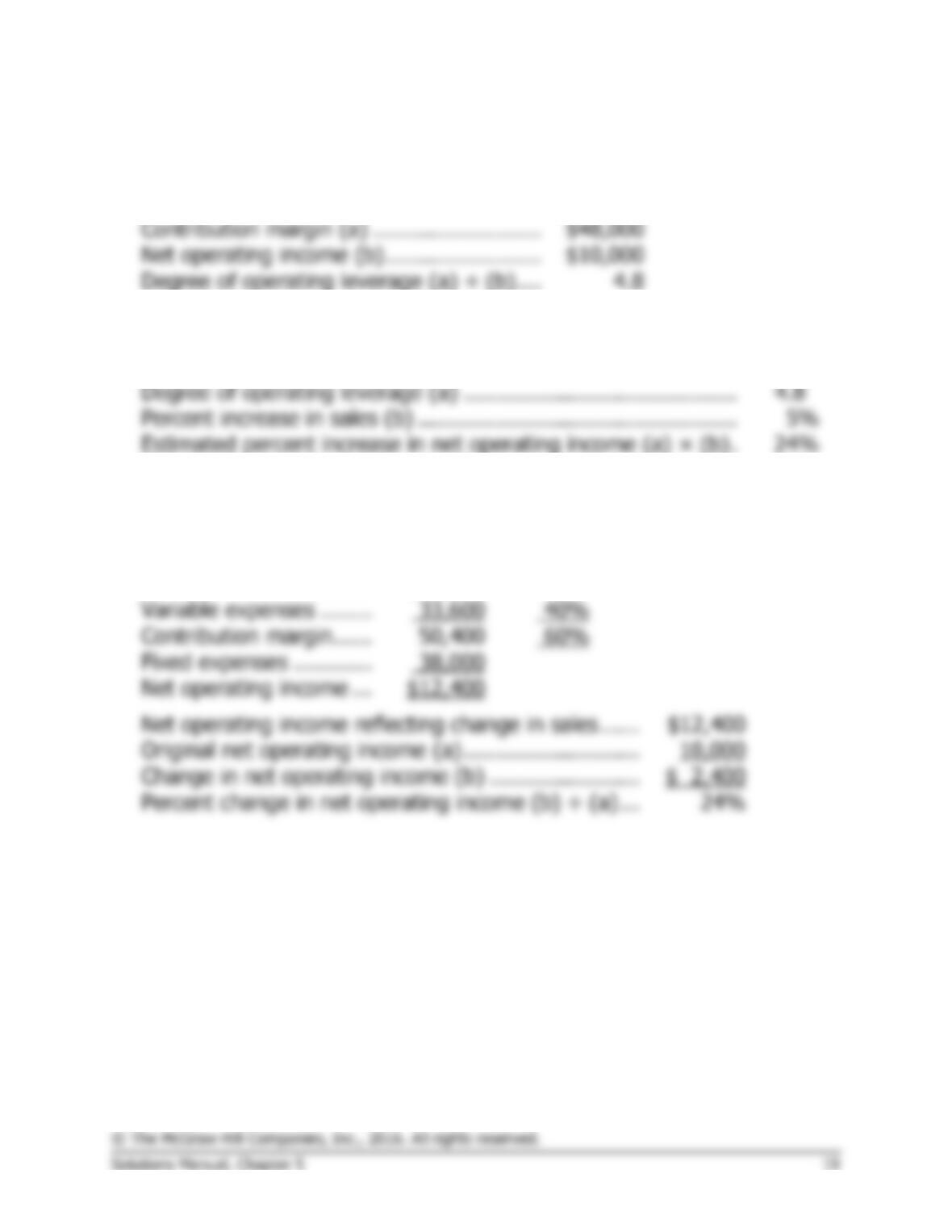
Exercise 5-9 (20 minutes)
1. The company’s degree of operating leverage would be computed as
follows:
Degree of operating leverage (a) ÷ (b) ….
2. A 5% increase in sales should result in a 24% increase in net operating
income, computed as follows:
Degree of operating leverage (a) ……………………………………
Percent increase in sales (b) ………………………………………….
Estimated percent increase in net operating income (a) × (b) .
3. The new income statement reflecting the change in sales is:
Amount
Percent
of Sales
Sales ………………………
$84,000
100%
Fixed expenses …………
Net operating income …
$12,400
Net operating income reflecting change in sales ……
Original net operating income (a) ………………………
Change in net operating income (b) …………………..
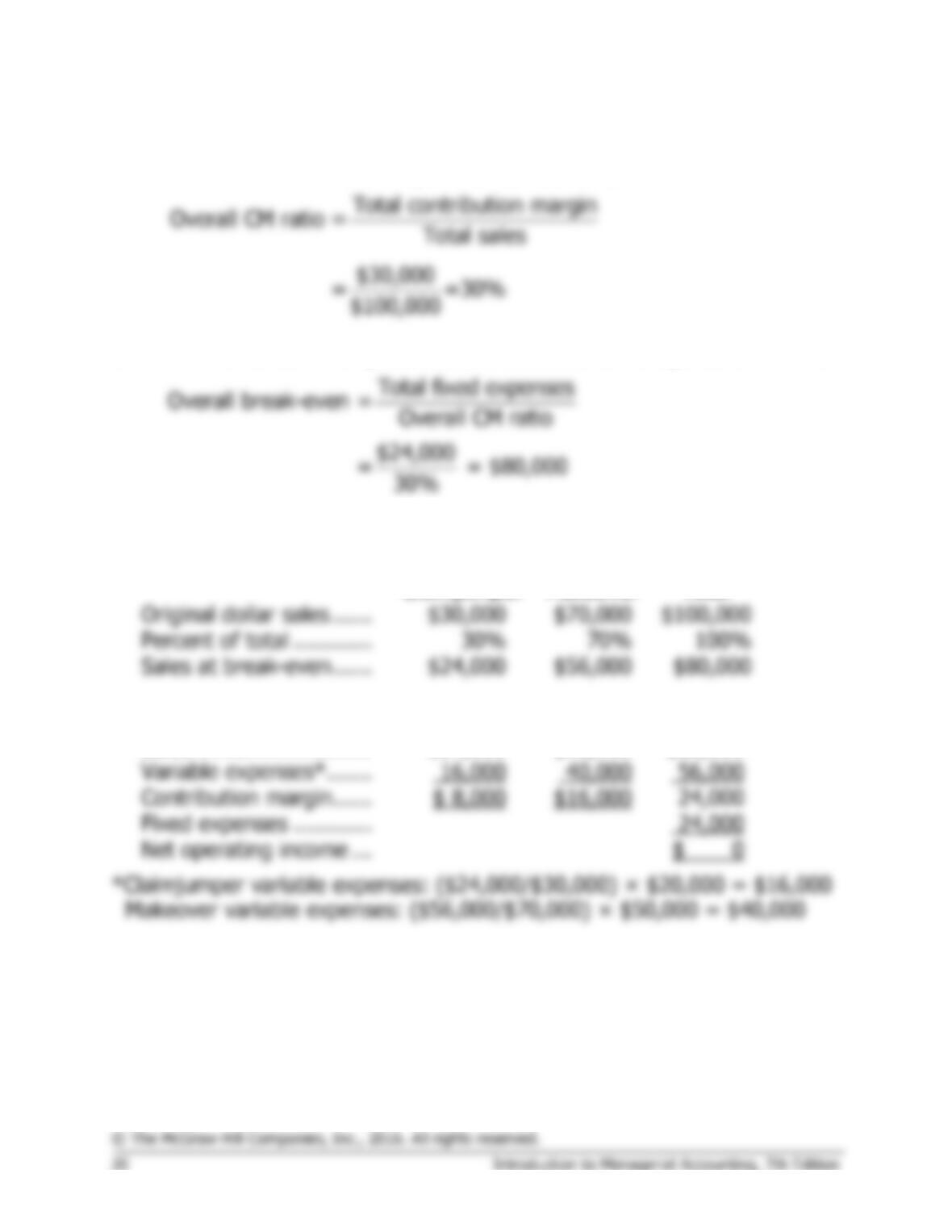
Exercise 5-10 (20 minutes)
1. The overall contribution margin ratio can be computed as follows:
2. The overall break-even point in dollar sales can be computed as follows:
3. To construct the required income statement, we must first determine
the relative sales mix for the two products:
Claimjumper
Makeover
Total
Original dollar sales ……
$30,000
$70,000
Percent of total …………
Sales at break-even ……
$24,000
$56,000
Claimjumper
Makeover
Total
Sales ………………………
$24,000
$56,000
$80,000
Variable expenses* …….
Contribution margin ……
Fixed expenses …………
Net operating income …
$ 0