Exercise 5-15A (20 minutes)
Periodic Inventory
Ending
Inventory
Cost of
Goods Sold
a. Specific Identification
(50 x $2.80) + (10 x $2.00) ……………………………….
$160.00
$2,540.00 [Goods Available] – $160.00 [Ending Inventory] …….
$2,380.00
b. Weighted Average ($2,540.00/1,000 = $2.54)
(60 x $2.54)…………………………………………………….
152.40
$2,540.00 [Goods Available] – $152.40 [Ending Inventory] …….
2,387.60
c. FIFO
(22 x $2.00) + (38 x 2.30) …………………………………
131.40
(138 x $3.00) + (300 x $2.80) + (502 x $2.30) …….
2,408.60
d. LIFO
(60 x $3.00)…………………………………………………….
180.00
Exercise 5-16B (20 minutes)
At Cost
At Retail
Goods available for sale
Beginning inventory ……………………………………………
$ 63,800
$128,400
Cost of goods purchased ……………………………………
115,060
196,800
Goods available for sale ……………………………………..
$178,860
325,200
Deduct net sales at retail ……………………………………….
260,000
$ 65,200
Exercise 5-17B (20 minutes)
Goods available for sale
Beginning inventory, January 1 …………………………..
$ 225,000
Net cost of goods purchased* ………………………………..
802,250
Goods available for sale ………………………………………..
1,027,250
Less estimated cost of goods sold
Net sales ……………………………………………………………….
$1,000,000
Exercise 5-18 (20 minutes)
a. FIFO—Perpetual
Date
Goods Purchased
Cost of Goods Sold
Inventory Balance
1/1
40 @ $2
= $ 80
1/3
30 @ $2 = $ 60
10 @ $2
= $ 20
2/14
70 @ $3 = $210
10 @ $2
= $230
70 @ $3
2/15
10 @ $2
20 @ $3
= $ 60
50 @ $3 = $170
6/30
90 @ $4 = $360
20 @ $3
= $420
90 @ $4
11/6
20 @ $3
11/19
20 @ $5 = $100
24 @ $4
______
20 @ $5
$554
Exercise 5-18 (Concluded)
b. LIFO—Perpetual
Date
Goods Purchased
Cost of Goods Sold
Inventory Balance
1/1
40 @ $2
= $ 80
1/3
30 @ $2 = $ 60
10 @ $2
= $ 20
2/14
70 @ $3 = $ 210
10 @ $2
= $230
70 @ $3
2/15
10 @ $2
= $ 50
60 @ $3 = $ 180
10 @ $3
6/30
90 @ $4 = $ 360
10 @ $2
10 @ $3
11/6
86 @ $4 = $344
10 @ $3
11/19
20 @ $5 = $ 100
10 @ $2
10 @ $3
Ending Cost of
Alternate Solution Format Inventory Goods Sold
a. FIFO
(20 x $5) + (24 x $4) ……………………………………………………….. $196
(30 x $2) + (10 x $2) + (50 x $3) +
(20 x $3)+ (66 x $4) ………………………………………………………… $554
b. LIFO
(10 x $2) + (10 x $3) + (4 x $4) + (20 x $5) ………………………… $166
(30 x $2) + (60 x $3) + (86 x $4) ………………………………………. $584
c. Gross Margin Computations
Exercise 5-19A (20 minutes)
Ending Cost of
Periodic Inventory System Inventory Goods Sold
Instructor note: The assignment reports there are 220 units available for sale
and that 176 units are sold. Thus, we see that 44 units remain in inventory.
a. FIFO—Periodic
(20 x $5) + (24 x $4) ……………………………………………. $196
(40 x $2) + (70 x $3) + (66 x $4) …………………………... $554
c.
FIFO—Periodic Gross Margin
Sales revenue (176 units sold x $8 selling price) ………………
$1,408
Less: FIFO cost of goods sold ………………………………………..
554
Gross margin ………………………………………………………………….
$ 854
Sales revenue (176 units sold x $8 selling price) ………………
$1,408
Less: LIFO cost of goods sold ………………………………………..
658
Wild and Shaw, Financial & Managerial Accounting, 8e Solutions Manual: Chapter 5
PROBLEM SET A
Problem 5-1A (40 minutes)
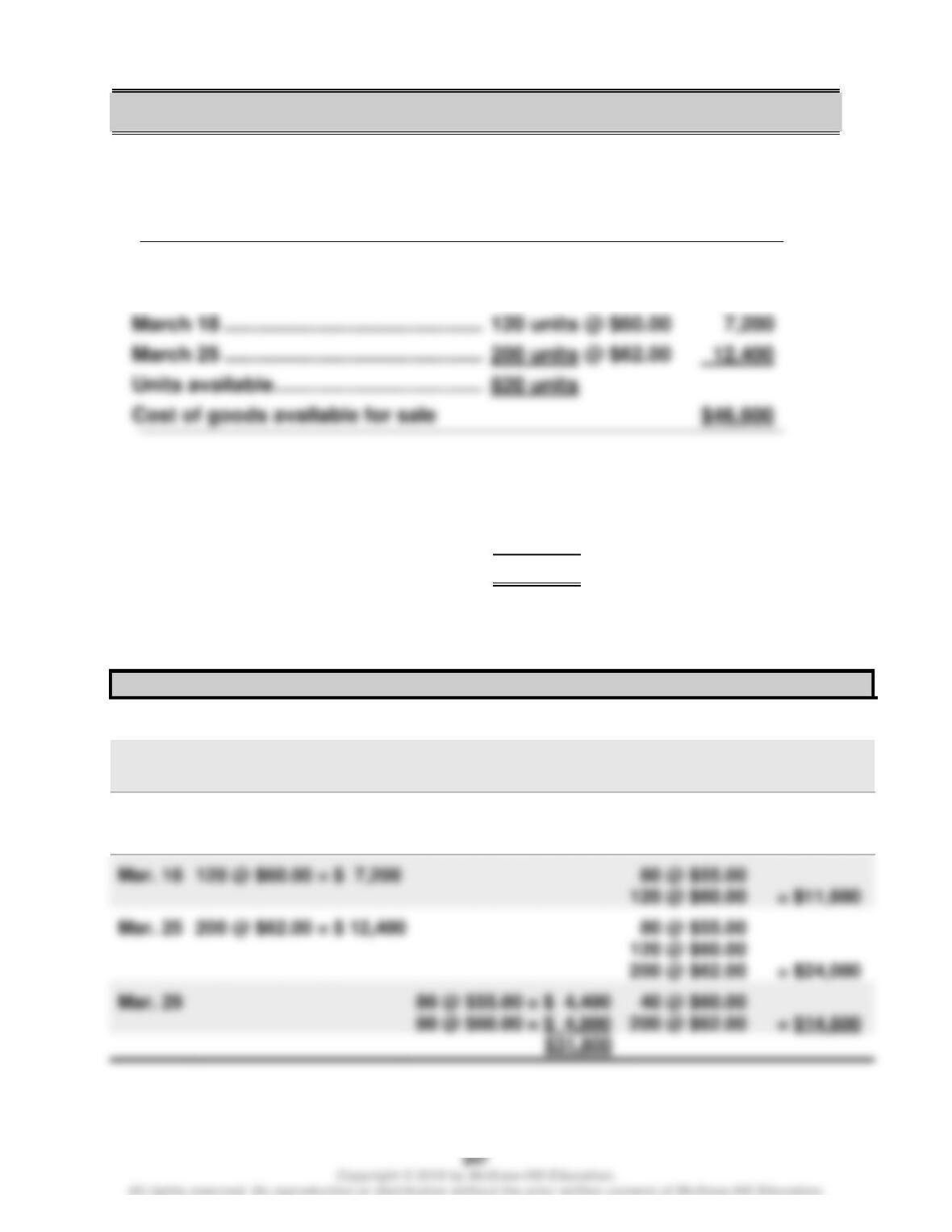
1. Compute cost of goods available for sale and units available for sale
Beginning inventory ………………………..
100 units @ $50.00
$ 5,000
March 5
400 units @ $55.00
22,000
March 18 …………………………………………
120 units @ $60.00
March 25 …………………………………………
200 units @ $62.00
Units available …………………………………
820 units
2. Units in ending inventory
Units available (from part 1) ………………………..
820 units
Less: Units sold (420 + 160) ………………………..
580 units
Ending Inventory (units) …………………………..
240 units
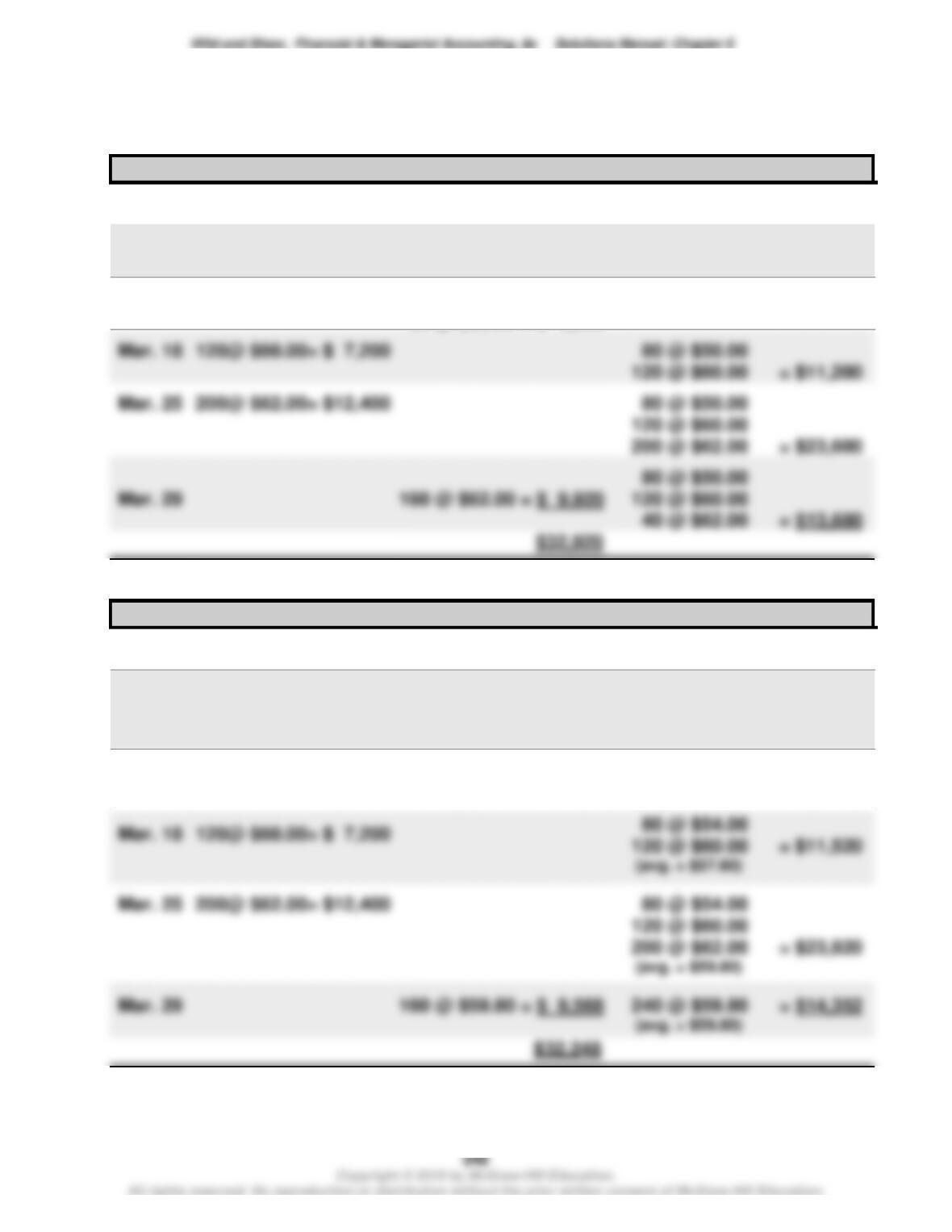
3a. FIFO perpetual
Date
Goods Purchased
Cost of Goods Sold
Inventory Balance
Mar. 1
100 @ $50.00 = $ 5,000
Mar. 5
400 @ $55.00 = $22,000
100 @ $50.00
400 @ $55.00 = $27,000
Mar. 9
100 @ $50.00 = $ 5,000
320 @ $55.00 = $17,600
80 @ $55.00 = $ 4,400
Mar. 18
120 @ $60.00 = $ 7,200
120 @ $60.00 = $11,600
120 @ $60.00
200 @ $62.00 = $24,000
Mar. 29
200 @ $62.00 = $14,800
Problem 5-1A (Continued)
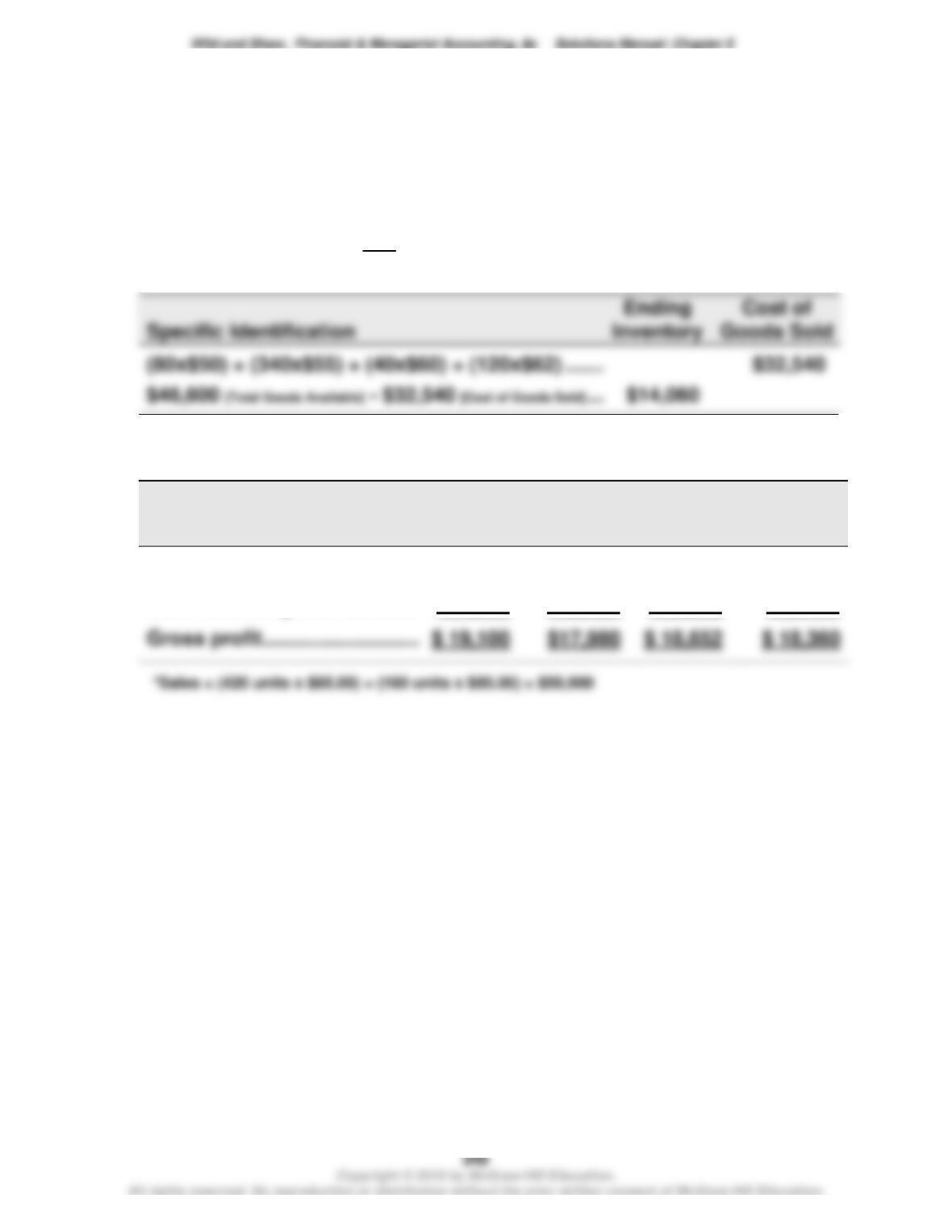
3b. LIFO perpetual
Date
Goods Purchased
Cost of Goods Sold
Inventory Balance
Mar. 1
100 @ $50.00 = $ 5,000
Mar. 5
400@ $55.00= $22,000
100 @ $50.00
400 @ $55.00 = $27,000
Mar. 9
400 @ $55.00 = $22,000
20 @ $50.00 = $ 1,000
80 @ $50.00 = $ 4,000
Mar. 18
120@ $60.00= $ 7,200
80 @ $50.00
120 @ $60.00 = $11,200
120 @ $60.00
200 @ $62.00 = $23,600
Mar. 29
160 @ $62.00 = $ 9,920
120 @ $60.00
3c. Weighted Average perpetual
Date
Goods Purchased
Cost of Goods Sold
Inventory Balance
Mar. 1
100 @ $50.00 = $ 5,000
Mar. 5
400@ $55.00= $22,000
100 @ $50.00
400 @ $55.00 = $27,000
(avg. = $54.00)
Mar. 9
420 @ $54.00 = $22,680
80 @ $54.00 = $ 4,320
(avg. = $54.00)
80 @ $54.00
120 @ $60.00 = $11,520
(avg. = $59.80)
240 @ $59.80 = $14,352
Problem 5-1A (Concluded)
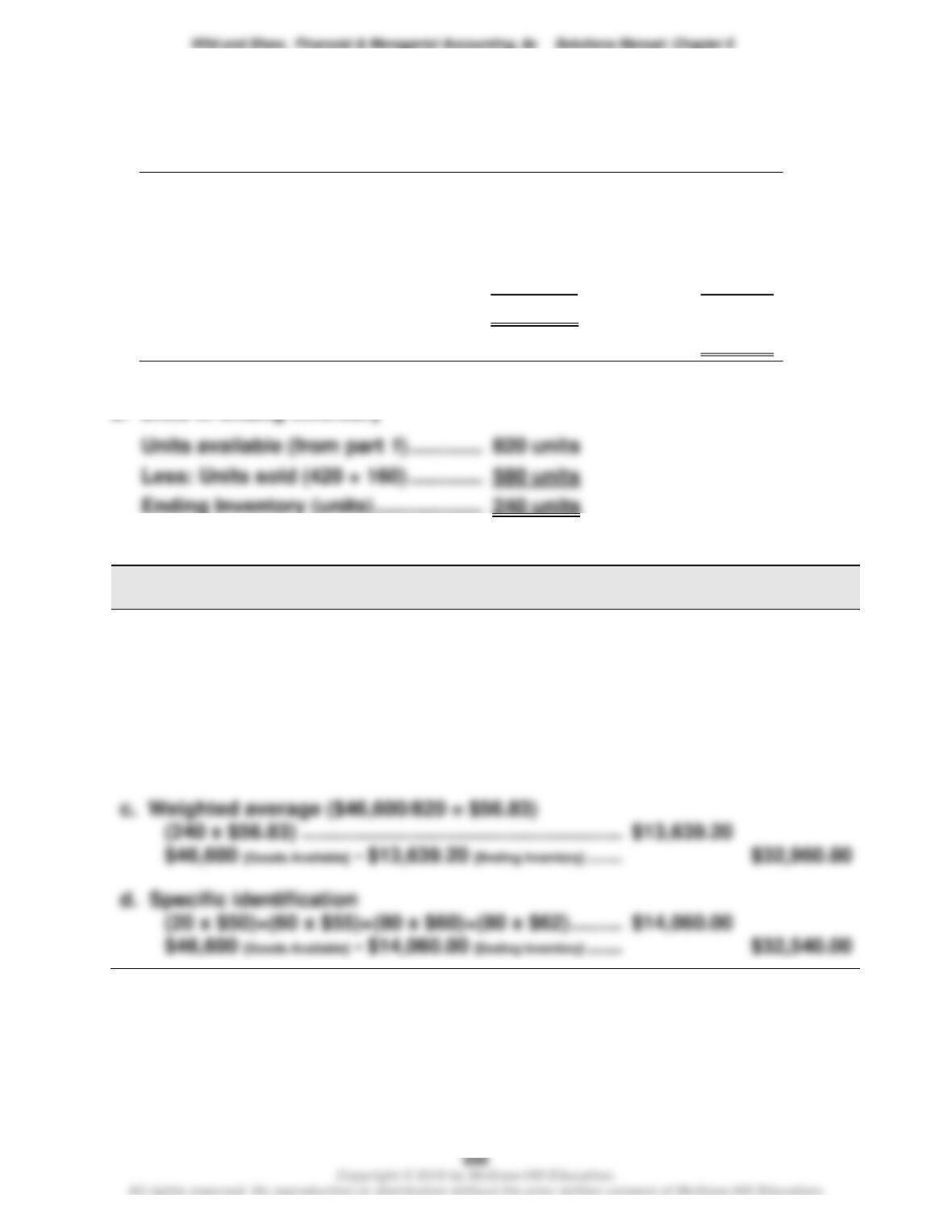
3d. Specific Identification
Cost of goods sold— 80 units from beginning inventory
340 units from March 5 purchase
40 units from March 18 purchase
120 units from March 25 purchase
580 units sold in total
4.
FIFO
LIFO
Weighted
Average
Specific
Identifi-
cation
Sales* ………………………………..
$50,900
$50,900
$50,900
$50,900
Less: Cost of goods sold ……
31,800
32,920
32,248
32,540
Problem 5-2A (40 minutes)
1. Compute cost of goods available for sale and units available for sale
Beginning inventory ………………………
100 units @ $50.00
$ 5,000
March 5 …………………………………………
400 units @ $55.00
22,000
March 18 ………………………………………..
120 units @ $60.00
7,200
March 25 ………………………………………..
200 units @ $62.00
12,400
Units available ……………………………….
820 units
Cost of goods available for sale
$46,600
Units available (from part 1) ……………………….
Less: Units sold (420 + 160) ……………………….
3.
Periodic Inventory
Ending
Inventory
Cost of
Goods Sold
a. FIFO
(200 x $62.00) + (40 x $60.00) …………………………...
$14,800.00
(100 x $50.00) + (400 x $55.00) + (80 x $60.00) …..
$31,800.00
b. LIFO
(100 x $50.00) + (140 x $55.00) ………………………….
$12,700.00
(200 x $62.00) + (120 x $60.00) + (260 x $55.00) …
$33,900.00
c. Weighted average ($46,600/820 = $56.83)
(240 x $56.83) ………………………………………………….
$13,639.20
d. Specific identification
(20 x $50)+(60 x $55)+(80 x $60)+(80 x $62) ……….
$14,060.00
Problem 5-2A (Concluded)
4.
FIFO
LIFO
Weighted
Average
Specific
Identifi-
cation
Sales* ………………………………..
$50,900.00
$50,900.00
$50,900.00
$50,900.00
Less: Cost of goods sold ……
31,800.00
33,900.00
32,960.80
32,540.00
Problem 5-3A (40 minutes)
1. Calculate cost of goods available for sale and units available for sale
Beginning inventory ………………………..
600 units @ $45.00
$27,000
Feb. 10 ………………………………………….
400 units @ $42.00
16,800
Mar. 13 ………………………………………….
200 units @ $27.00
5,400
Aug. 21 ………………………………………….
100 units @ $50.00
5,000
500 units @ $46.00
2. Units in ending inventory
Units available (from part 1) ………………………..
1,800
Less: Units sold (800 + 600) ………………………..
1,400
Ending Inventory (units) …………………………..
400
Problem 5-3A (Continued)
3a. FIFO perpetual
Date
Goods Purchased
Cost of Goods Sold
Inventory Balance
1/1
600 @ $45.00 = $27,000
2/10
400 @ $42.00= $16,800
600 @ $45.00
400 @ $42.00 = $43,800
3/13
200 @ $27.00= $ 5,400
600 @ $45.00
400 @ $42.00 = $49,200
200 @ $27.00
3/15
600 @ $45.00
200 @ $42.00 = $35,400
200 @ $42.00
200 @ $27.00 = $13,800
8/21
100 @ $50.00= $ 5,000
200 @ $42.00
200 @ $27.00 = $18,800
100 @ $50.00
200 @ $27.00
100 @ $50.00
500 @ $46.00 = $41,800
100 @ $50.00
FIFO Alternate Solution Format
Cost of goods available for sale
$77,200
Less: Cost of sales
600 @ $45.00
$27,000
400 @ $42.00
16,800
200 @ $27.00
5,400
100 @ $50.00
5,000
100 @ $46.00
4,600
Total cost of goods sold
58,800
Ending Inventory
$18,400
Proof of Ending Inventory
$18,400
Problem 5-3A (Continued)
3b. LIFO perpetual
Date
Goods Purchased
Cost of Goods Sold
Inventory Balance
1/1
600 @ $45.00 = $27,000
2/10
400 @ $42.00= $16,800
600 @ $45.00
400 @ $42.00 = $43,800
200 @ $27.00= $ 5,400
600 @ $45.00
400 @ $42.00 = $49,200
200 @ $27.00
200 @ $45.00 = $31,200
8/21
100 @ $50.00= $ 5,000
400 @ $45.00
100 @ $50.00 = $23,000
9/5
500 @ $46.00= $23,000
400 @ $45.00
100 @ $50.00
500 @ $46.00 = $46,000
9/10
500 @ $46.00
LIFO alternate solution format
Cost of goods available for sale
$77,200
Less: Cost of sales
500 @ $46
$23,000
100 @ 50
5,000
200 @ 27
5,400
400 @ 42
16,800
200 @ 45
9,000
Cost of Goods Sold
59,200
Ending Inventory
$18,000
Proof of Ending Inventory
18,000
Problem 5-3A (Continued)
3c. Weighted Average
Date
Goods Purchased
Cost of Goods Sold
Inventory Balance
1/1
600 @ $45.00 = $27,000
2/10
400 @ $42.00= $16,800
600 @ $45.00
400 @ $42.00 = $43,800
(avg. cost is $43.80)
(avg. cost is $41.00)
3/15
800 @ $41.00 = $32,800
400 @ $41.00 = $16,400
8/21
100 @ $50.00= $ 5,000
400 @ $41.00
100 @ $50.00 = $21,400
(avg. cost is $42.80)
9/5
500 @ $46.00= $23,000
400 @ $41.00
100 @ $50.00
500 @ $46.00 = $44,400
(avg. cost is $44.40)
Problem 5-3A (Continued)
3d. Specific Identification
Cost of goods available for sale ……………….
$77,200
Less: Cost of Goods Sold
600 @ $45.00 ……………………………….
$27,000
300 @ $42.00 ……………………………….
12,600
200 @ $27.00 ……………………………….
250 @ $46.00 ……………………………….
11,500
Total cost of goods sold …………………………..
Proof of Ending Inventory
100 @ $42
$ 4,200
50 @ $50
$ 2,500
250 @ $46
11,500
Ending Inventory……….
400 units
$18,200
4.
FIFO
LIFO
Specific
Identifi-
cation
Weighted
Average
Sales (1,400 x $75) ……………..
$105,000
$105,000
$105,000
$105,000
Less: Cost of goods sold ……
58,800
59,200
59,000
59,440
Gross profit ………………………..
$ 46,200
$ 45,800
$ 46,000
$ 45,560
Problem 5-4A (40 minutes)
1. Calculate cost of goods available for sale and units available for sale
Beginning inventory ………………………
600 units @ $45.00
$27,000
Feb. 10 ………………………………………….
400 units @ $42.00
16,800
Mar. 13 ………………………………………….
200 units @ $27.00
5,400
Aug. 21 ………………………………………….
100 units @ $50.00
5,000
500 units @ $46.00
2. Units in ending inventory
Units available (from part 1) ……………………….
1,800
Less: Units sold (800 + 600) ……………………….
1,400
Ending Inventory (units) …………………………..
400
3.
Periodic Inventory
Ending
Inventory
Cost of
Goods Sold
a. FIFO
(400 x $46.00)………………………………………………………
$18,400.00
(600 x $45.00) + (400 x $42.00) + (200 x $27.00) +
(100 x $50.00) + (100 x $46.00) ……………………………..
$58,800.00
b. LIFO
(400 x $45.00)………………………………………………………
$18,000.00
(500 x $46.00) + (100 x $50.00) + (200 x $27.00) +
(400 x $42.00) + (200 x $45.00) ……………………………..
$59,200.00
(400 x $42.89)………………………………………………………
$17,156.00
d. Specific identification
(100 x $42.00) + (50 x $50.00) + (250 x $46.00) ………
$18,200.00
4.
FIFO
LIFO
Specific
Identifi-
cation
Weighted
Average
Sales (1,400 x $75) ……………..
$105,000
$105,000
$105,000
$105,000
Less: Cost of goods sold ……
58,800
59,200
59,000
60,044
Gross profit ………………………..
$ 46,200
$ 45,800
$ 46,000
$ 44,956
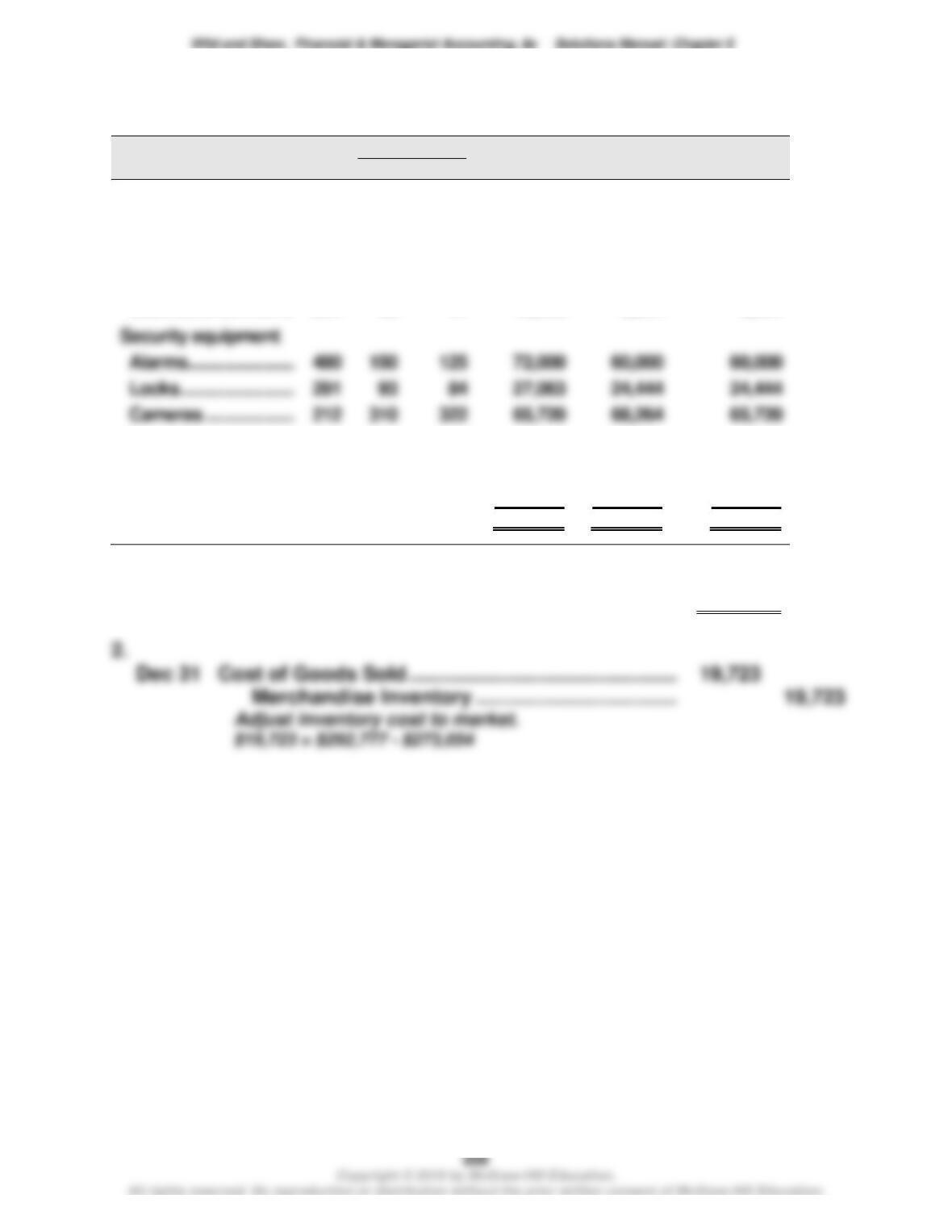
Problem 5-5A (50 minutes)
Per Unit
Total
Total
LCM Applied
to Items
Inventory Items
Units
Cost
Market
Cost
Market
Car audio equipment
Speakers…………………
345
$ 90
$ 98
$ 31,050
$ 33,810
$ 31,050
Stereos ……………………
260
111
100
28,860
26,000
26,000
Amplifiers ……………….
326
86
95
28,036
30,970
28,036
Subwoofers …………….
204
52
41
10,608
8,364
8,364
Security equipment
Alarms …………………….
480
150
125
72,000
60,000
60,000
Locks………………………
291
93
84
27,063
24,444
24,444
Cameras …………………
212
310
322
65,720
68,264
65,720
Binocular equipment
Tripods ……………………
185
70
84
12,950
15,540
12,950
Stabilizers ……………….
170
97
105
16,490
17,850
16,490
Total ………………………….
$292,777
$285,242
$273,054
1. Lower of cost or market for inventory applied separately = $273,054
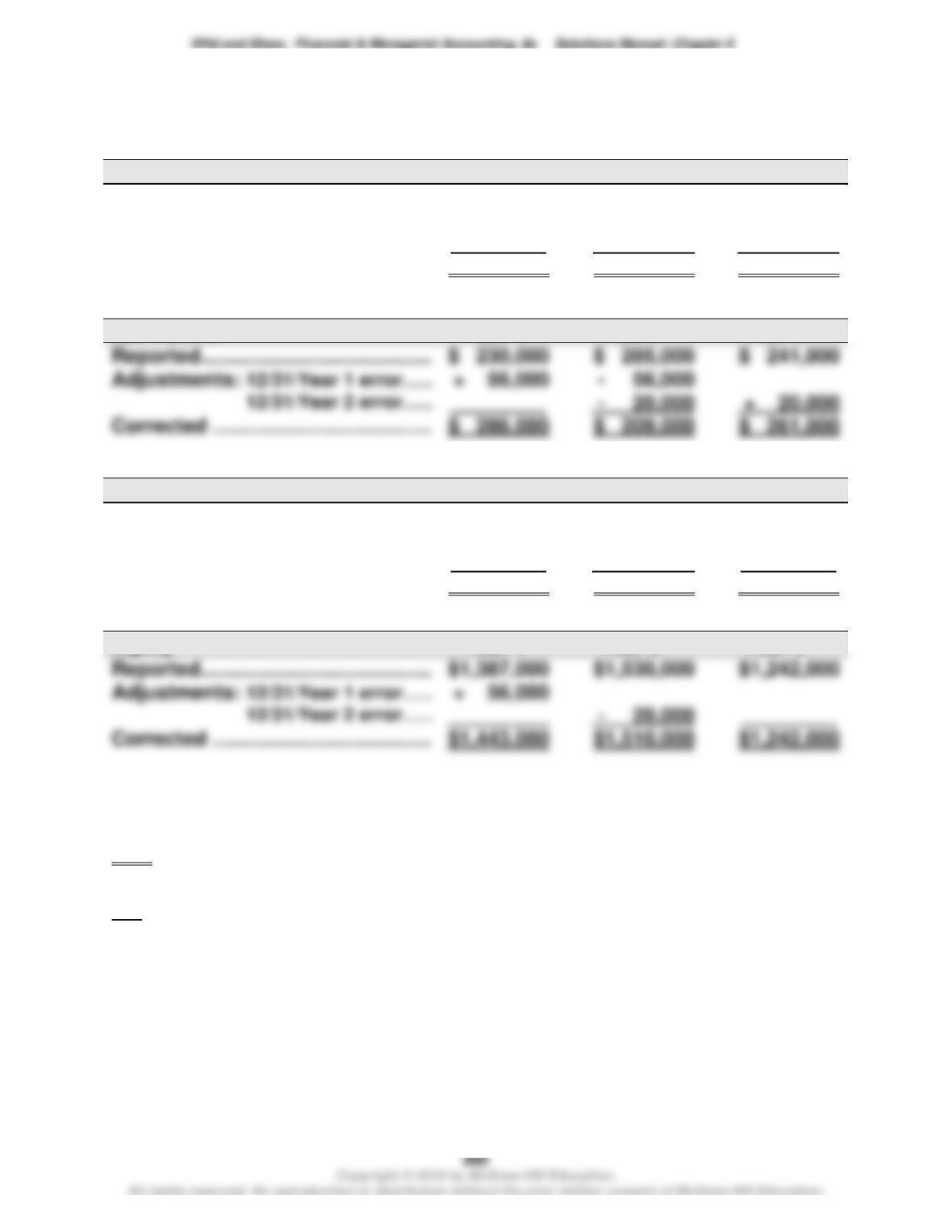
Problem 5-6A (35 minutes)
Part 1
(a)
Cost of goods sold
Year 1
Year 2
Year 3
Reported …………………………………….
$ 615,000
$ 957,000
$ 780,000
Adjustments: 12/31/Year 1 error ………
– 56,000
+ 56,000
12/31/Year 2 error ………
.
+ 20,000
– 20,000
Corrected …………………………………..
$ 559,000
$1,033,000
$ 760,000
(b)
Net income
Year 1
Year 2
Year 3
Reported …………………………………….
$ 230,000
$ 285,000
$ 241,000
.
– 20,000
+ 20,000
Corrected …………………………………..
$ 286,000
$ 209,000
$ 261,000
(c)
Total current assets
Year 1
Year 2
Year 3
Reported …………………………………….
$1,255,000
$1,365,000
$1,200,000
Adjustments: 12/31/Year 1 error ………
+ 56,000
12/31/Year 2 error ………
.
– 20,000
.
Corrected …………………………………..
$1,311,000
$1,345,000
$1,200,000
(d)
Year 1
Year 2
Year 3
Reported …………………………………….
$1,387,000
$1,530,000
$1,242,000
Adjustments: 12/31/Year 1 error ………
+ 56,000
_________
– 20,000
.
Part 2
Zero (there is no error in combined net income).
Explanation: Total net income for the combined three-year period ($756,000) is
not affected by the errors. This is because these errors are “self-correcting”—
that is, each overstatement (or understatement) of net income is offset by a
matching understatement (or overstatement) in the following year.
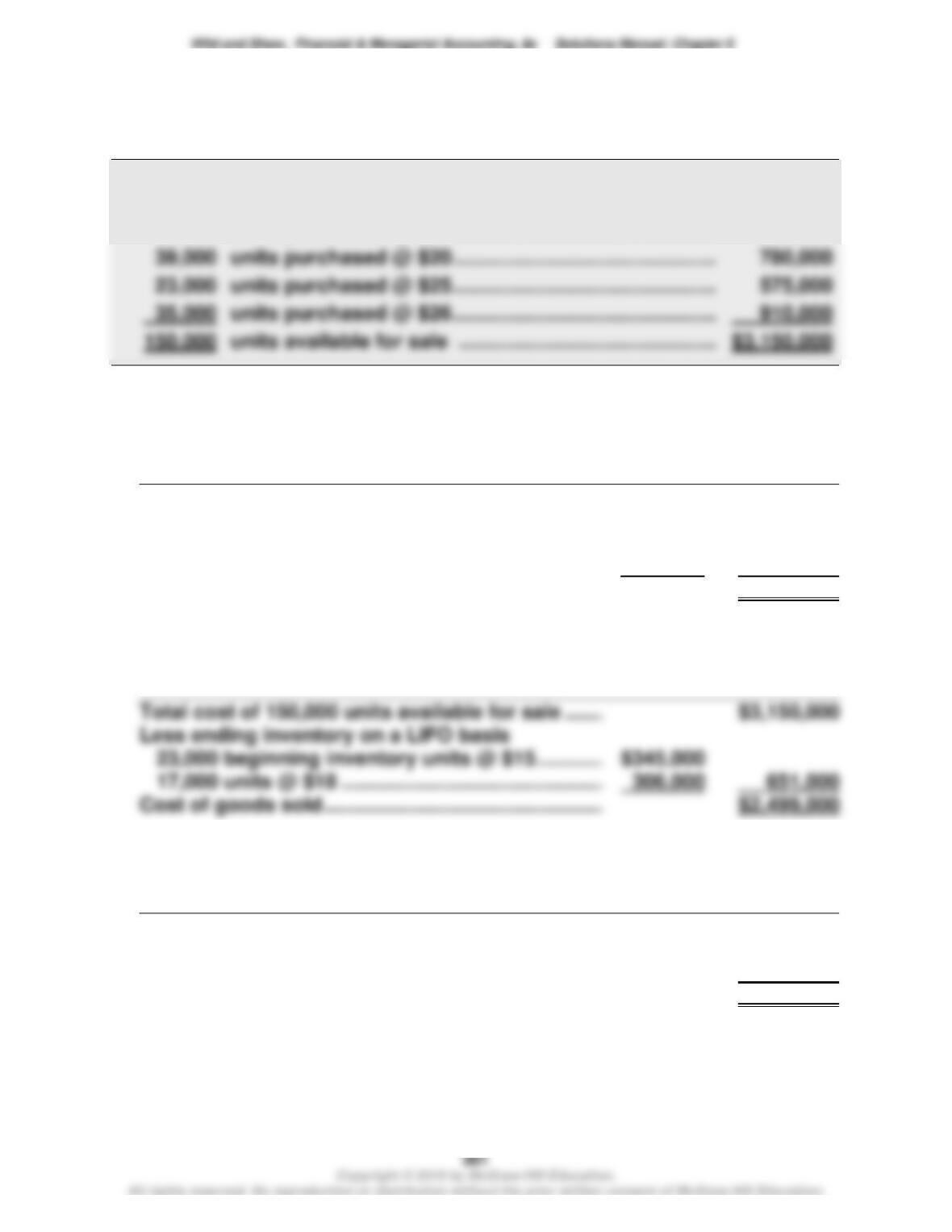
Problem 5-7AA (25 minutes)
Part 1
Number and total cost of units available for sale
23,000 units in beginning inventory @ $15 …………………….. $ 345,000
30,000 units purchased @ $18 ……………………………………….. 540,000
Part 2
a. FIFO periodic
Total cost of 150,000 units available for sale ……………….
$3,150,000
Less ending inventory on a FIFO basis
35,000 units @ $26 …………………………………………………..
$910,000
5,000 units @ $25 …………………………………………………..
125,000
1,035,000
Cost of goods sold ……………………………………………………..
$2,115,000
b. LIFO periodic
Total cost of 150,000 units available for sale ……………….
$3,150,000
Less ending inventory on a LIFO basis
23,000 beginning inventory units @ $15 ……………………
$345,000
17,000 units @ $18 …………………………………………………..
306,000
651,000
c. Weighted average periodic
Total cost of 150,000 units available for sale ……………….
$3,150,000
Less ending inventory at weighted average
($3,150,000/150,000) x 40,000 …………………………..
840,000
Cost of goods sold ……………………………………………………..
$2,310,000
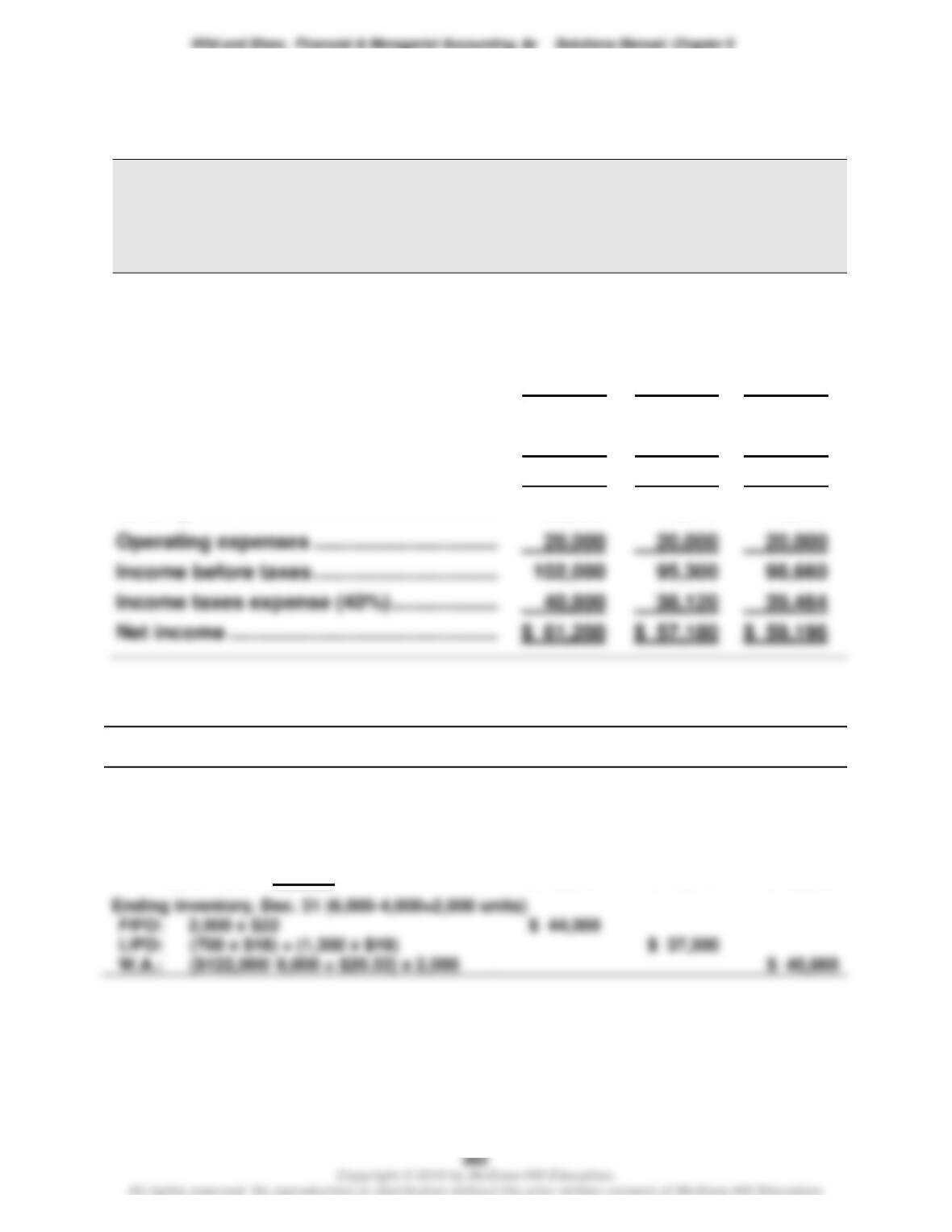
Problem 5-8AA (50 minutes)
Part 1
QP CORP.
Income Statements Comparing FIFO, LIFO, and Weighted Average
For Year Ended December 31
FIFO
LIFO
Weighted
Average
Sales ……………………………………………………..
$200,000
$200,000
$200,000
Cost of goods sold
Beginning inventory, Jan. 1 …………………..
12,600
12,600
12,600
Cost of purchases…………………………………
109,400
109,400
109,400
Cost of goods available for sale …………….
122,000
122,000
122,000
Ending inventory, Dec. 31 ………………………
44,000
37,300
40,660
Cost of goods sold ……………………………….
78,000
84,700
81,340
Gross profit ……………………………………………
122,000
115,300
118,660
20,000
20,000
20,000
102,000
40,800
38,120
39,464
Supporting calculations
FIFO
LIFO
Weighted
Average
Beginning inventory, Jan. 1 (700 x $18). ……….
$ 12,600
$ 12,600
$ 12,600
Purchases
1,700 x $19 = $32,300
800 x $20 = 16,000
500 x $21 = 10,500
2,300 x $22 = 50,600
$109,400
$109,400
$109,400
Ending inventory, Dec. 31 (6,000-4,000=2,000 units)
(700 x $18) + (1,300 x $19)
($122,000/ 6,000 = $20.33) x 2,000