
(continued) P 5-65B
Req. 2
December 31
BALANCE SHEET
2017
2016
Current assets:
Note receivable …………………………………………
$15,600
$38,000
Interest receivable …………………………………….
192
364
(30-40 min.) P 5-66B
Req. 1
Dollar amounts in millions
2017
2016
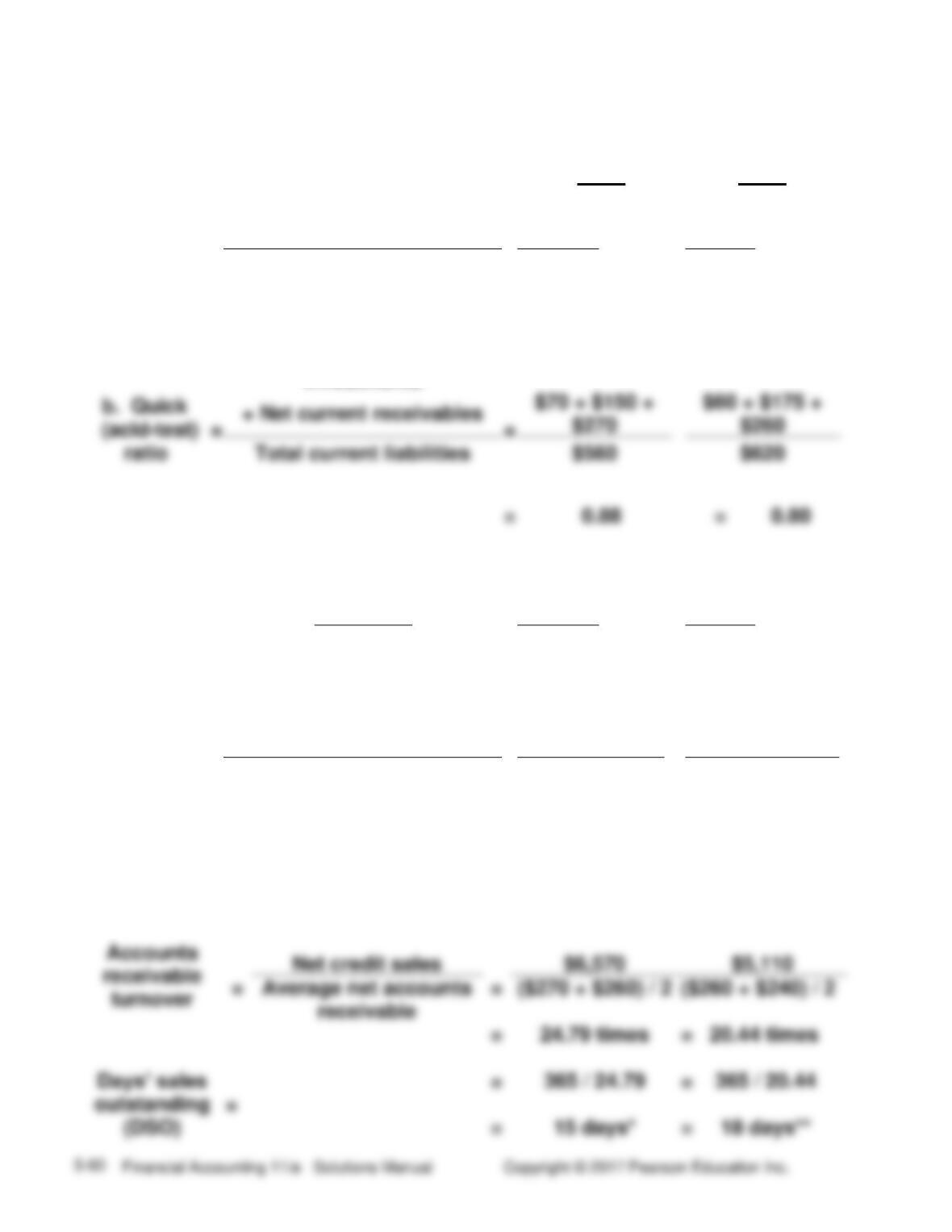
a. Current
=
Total current assets
=
$910
= 1.63
$860
= 1.39
ratio
Total current liabilities
$560
$620
Cash + Short-term
=
c. One
day’s
sales
=
Net sales
=
$6,570
= $18
$5,110
= $14
365
365
365
Days’ sales
in
receivables
=
Average net receivables
=
($270+$260)/2
($260+$240)/2
One day’s sales
$18
$14
=
15 days*
= 18 days**
An alternate way to compute days’ sales outstanding:
(continued) P 5-66B
Req. 2
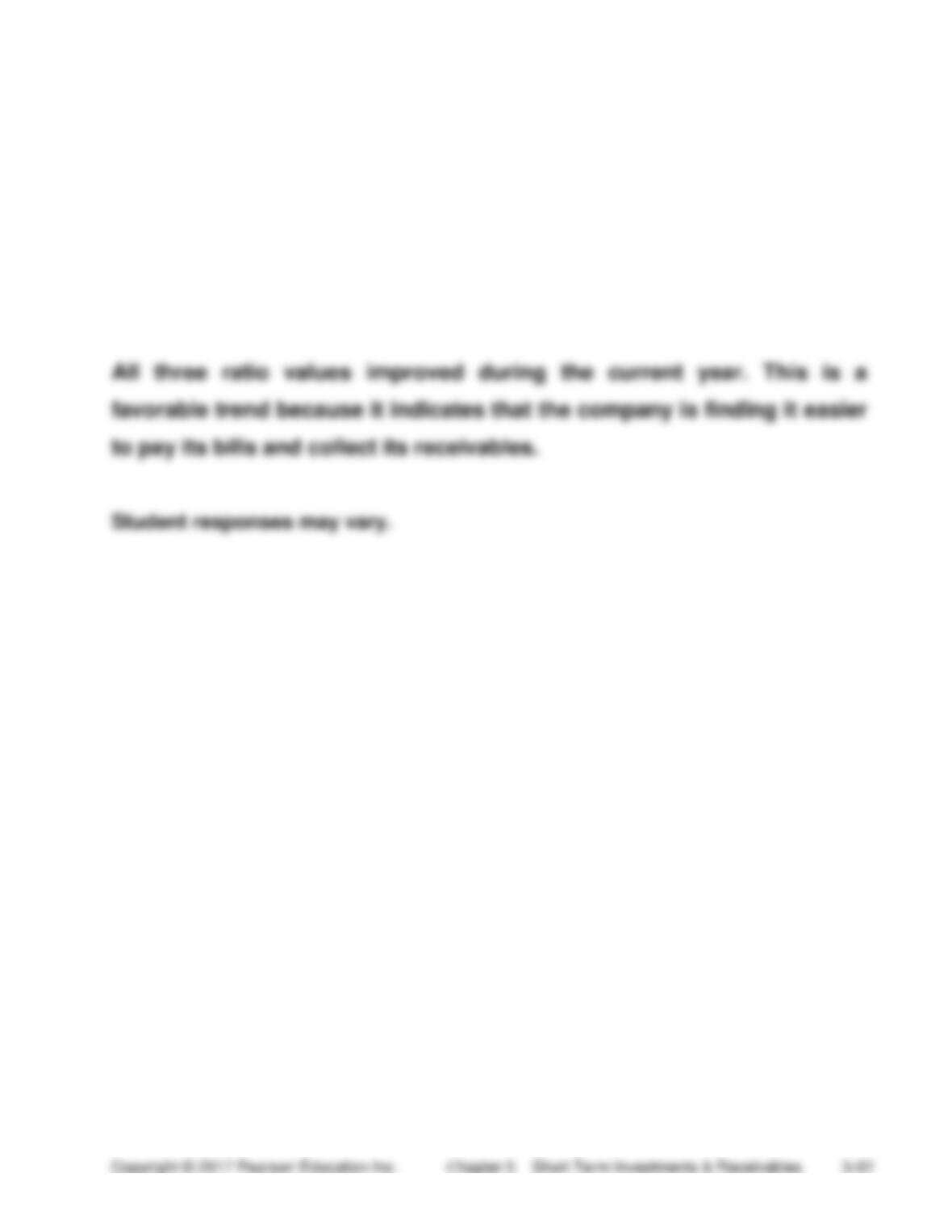
The current ratio improved from 1.39 to 1.63. The quick (acid-test) ratio
increased from 0.80 to 0.88. Days’ sales in receivables improved from 18
days to 15 days.
Req. 3
Gold Pools can improve cash flow from receivables by offering a
discount for early payment and/or emphasizing credit cards for sales.
Challenge Exercises and Problem
(15-20 min.) E 5-67
Actual without
Bank Cards
Expected with
Bank Cards
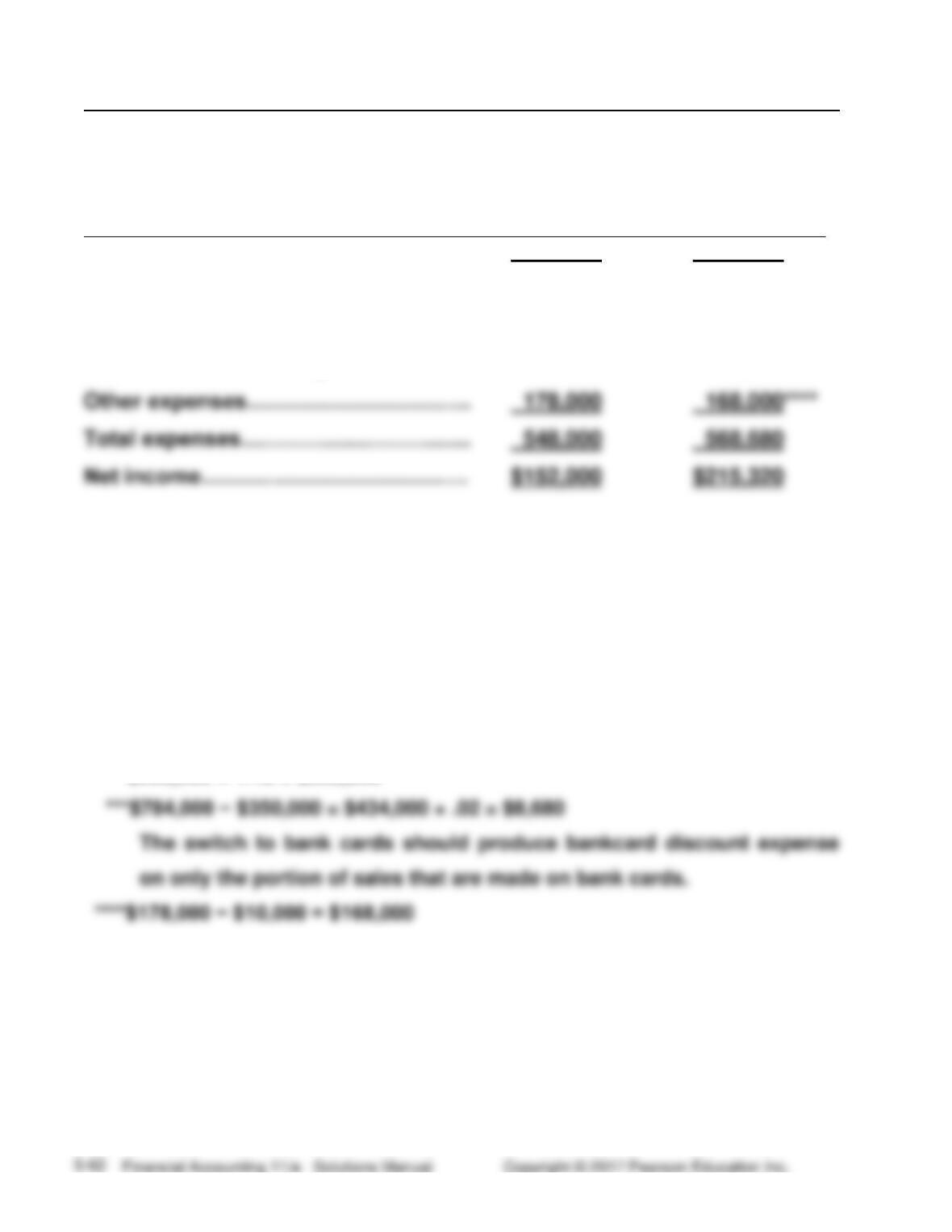
Sales revenue ………………………….
$700,000
$784,000*
Cost of goods sold……………………..
$350,000
$392,000**
Uncollectible-account expense……….
20,000
—
Bank-card discount expense………….
—
8,680***
Other expenses………………………….
Total expenses…………………………..
Net income……………………………….
$152,000
Decision: Accept bank cards because of the expected increase in net
income.
_____
*$700,000 × 1.12 = $784,000
(15-20 min.) E 5-68
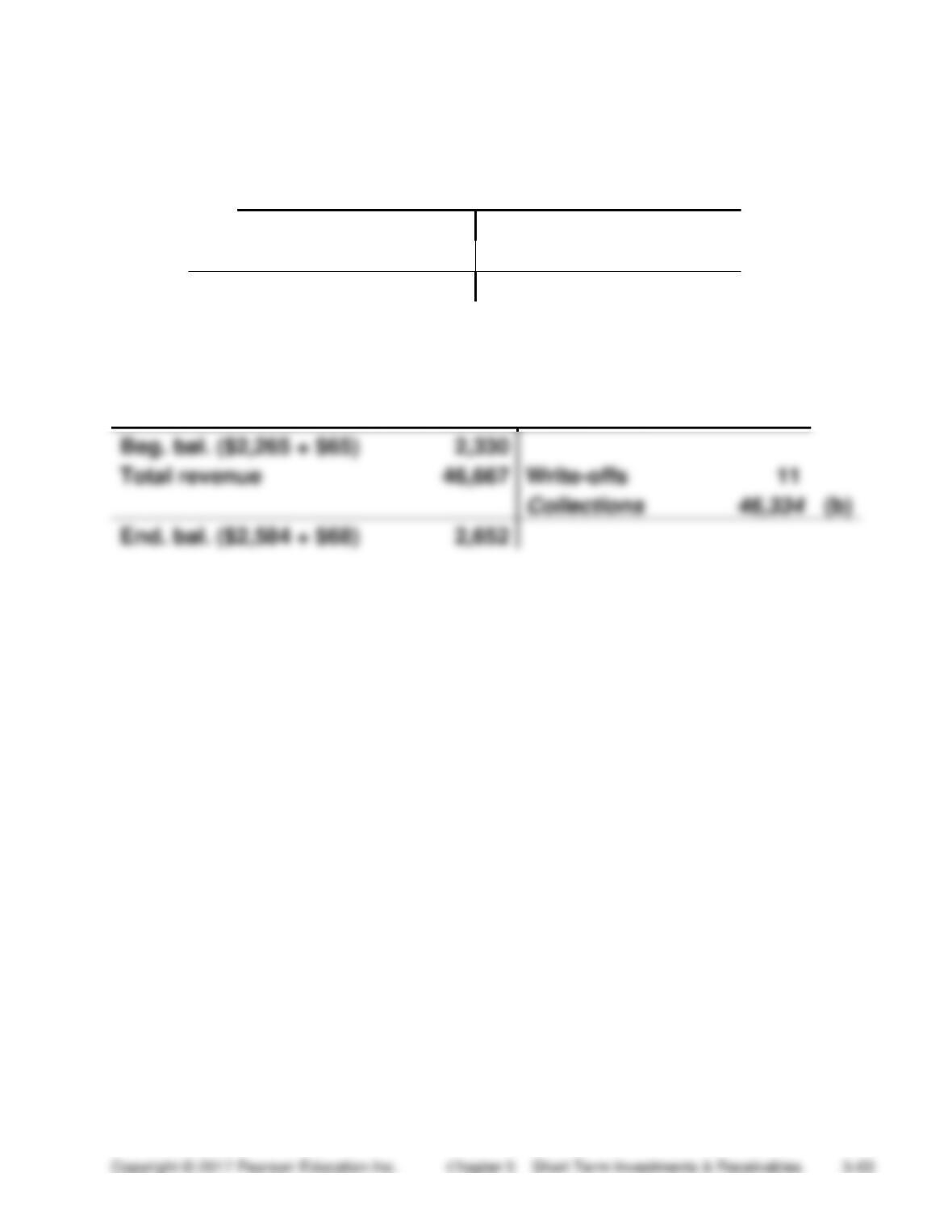
T-accounts are helpful, as follows (in millions):
Allowance for Doubtful Accounts
Beg. bal.
65
(a)
Write-offs
11
Expense
14
End. bal.
68
Gross Accounts Receivable
Beg. bal. ($2,265 + $65)
Total revenue
Write-offs
11
End. bal. ($2,584 + $68)
(15-20 min.) P 5-69
Req. 1
Beginning Allowance balance $ 990
+ Uncollectible account expense b 260
– Write-offs 200
= Ending Allowance balance $1,050
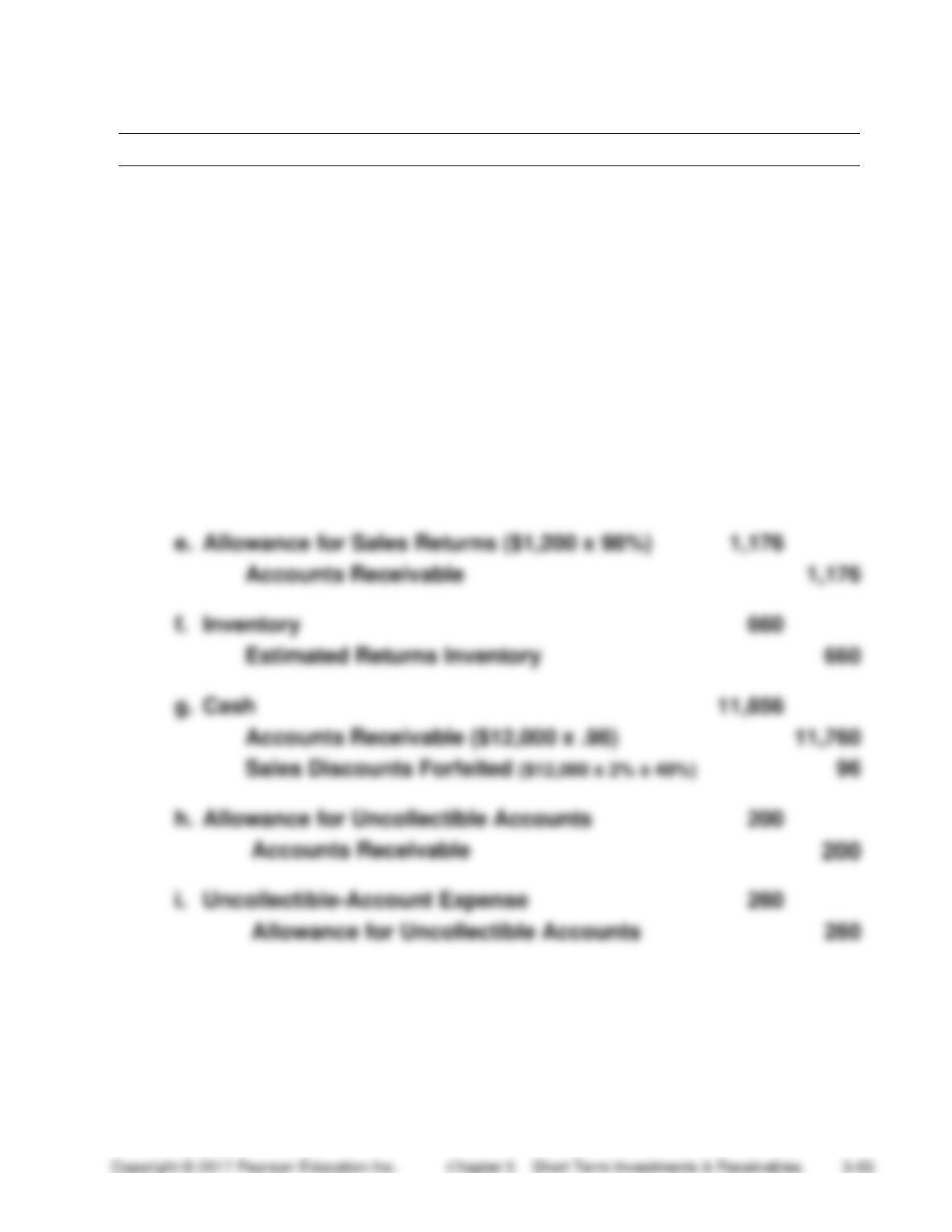
Req. 2
Beginning Acct Rec balance $ 9,900
+ Credit sales ($13,200 x 98%) 12,936
– Returns ($1,200 x 98%) 1,176
Req. 3
Allowance for
Accounts Receivable Uncollectible Accounts
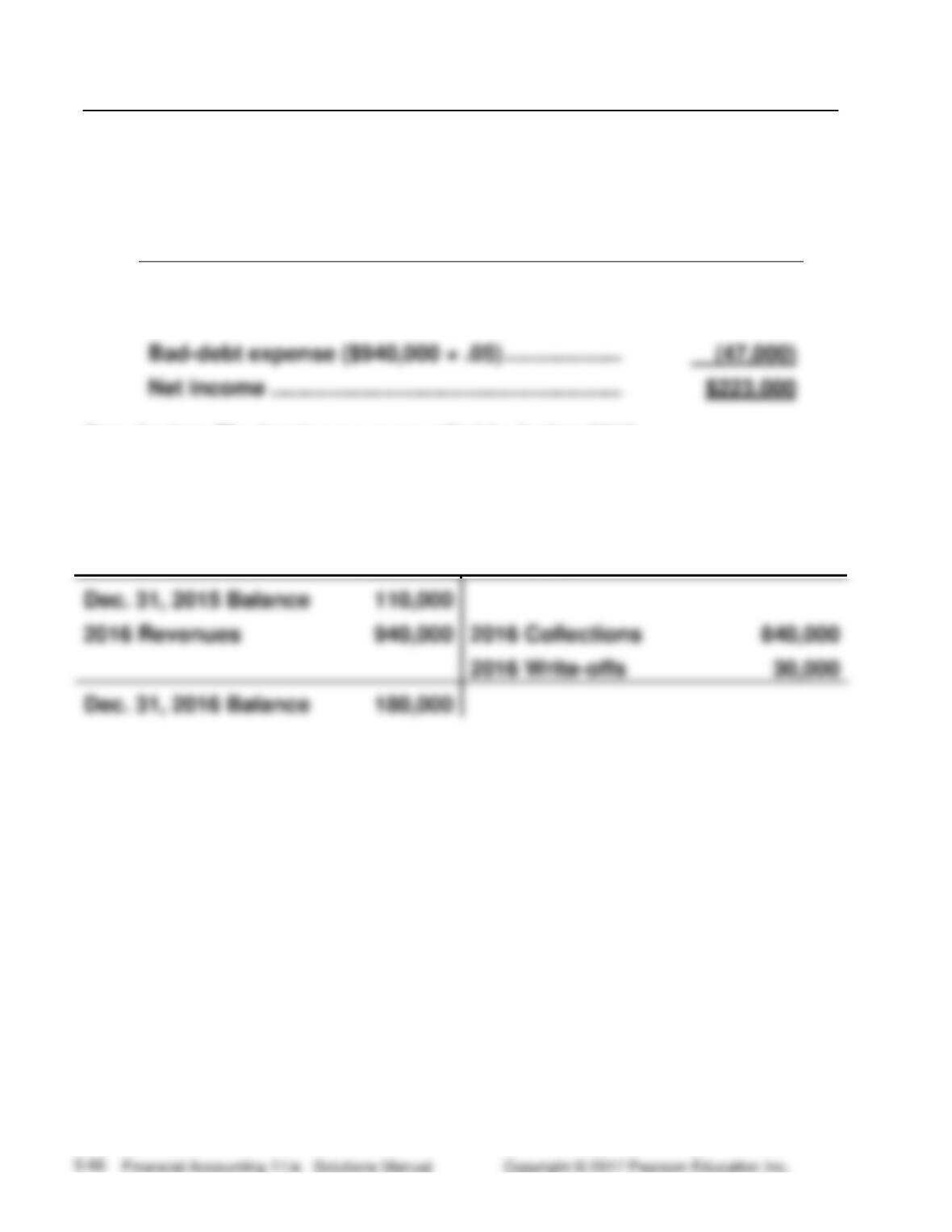
Journal entries:
Journal
DATE
ACCOUNT TITLES AND EXPLANATION
DEBIT
CREDIT
2016
a.
Accounts Receivable ($13,200 x 98%)
12,936
Sales Revenue
12,936
b.
Cost of Goods Sold
7,260
Inventory
7,260
c.
Sales Revenue ($12,936 x 5%)
647
Allowance for Sales Returns
647
d.
Estimated Returns Inventory ($7,260 x 5%)
363
Cost of Goods Sold
e.
Allowance for Sales Returns ($1,200 x 98%)
1,176
Accounts Receivable
Inventory
660
Estimated Returns Inventory
g.
Cash
Accounts Receivable ($12,000 x .98)
Sales Discounts Forfeited ($12,000 x 2% x 40%)
h.
Allowance for Uncollectible Accounts
200
Accounts Receivable
i.
Uncollectible-Account Expense
260
Allowance for Uncollectible Accounts
363
Decision Cases
(20-25 min.) Decision Case 1
Sinclair Entertainment, Inc.
Summary Income Statement
Year Ended December 31, 2016
Service revenue ………………………………………….
$940,000
Total expenses, excluding bad debt ……………..
(670,000)
Bad-debt expense ($940,000 × .05) ……………….
Net income …………………………………………………
$223,000
Conclusion: The business was profitable during 2016.
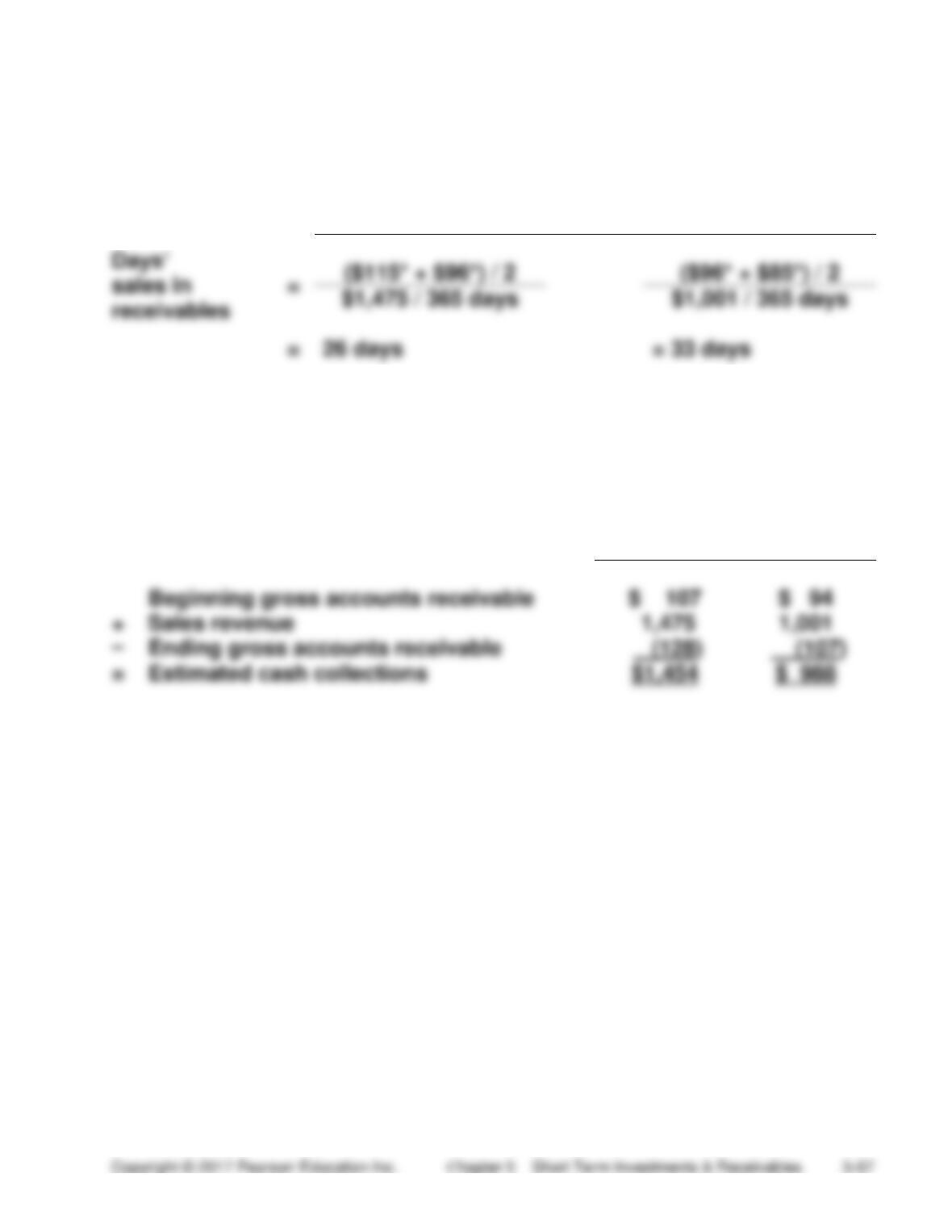
Computation:
Accounts Receivable
Dec. 31, 2015 Balance
Dec. 31, 2016 Balance
(15-20 min.) Decision Case 2
The trend of sales is increasing.
(Dollars in thousands)
2017
2016
26 days
= 33 days
_____
*Net accounts receivable
Days’ sales in receivables decreased nicely during 2017.
Cash collections from customers for 2017 and 2016:
2017
2016
Beginning gross accounts receivable
+
Sales revenue
Ending gross accounts receivable
=
Estimated cash collections
Collections from customers increased dramatically during 2017.
Based on the improving trends of sales and collections from customers,
and the drop in days’ sales in receivables, we would lend $500,000 to
Evert Beauty Solutions.
Ethical Issue
(20-30 minutes)
Req. 1
The ethical issue in this case is whether it is acceptable to “smooth” earnings
by way of judgmental positive or negative changes to uncollectible accounts
expense that understate or overstate the amount, based on what management
decides they want net income to be. What should be the determining factors
in making the judgments for this computation?
Req. 2 and Req. 3
The stakeholders to this decision are Rockville Loan Company, its officers
and directors, its shareholders, its creditors, Rockville’s banker, securities
analysts, and the equity and credit markets.
Economic analysis: The stock and credit markets don’t like surprises. The
markets usually reward steadily performing and upward-trending earnings
with increasing share prices and good credit ratings, but only if these trends
are real and not “engineered” by management. Laber’s reasoning is faulty.
(continued) Ethical Issue
Legal analysis: As explained in chapter 4, material and intentional
manipulations of earnings are known as fraudulent financial reporting, and are
illegal. Such dealings will eventually result in adverse legal and regulatory
consequences for the company, as well as its officers and directors.
Req. 4
Uncollectible accounts expense and the allowance for uncollectible accounts
should be based on a truthful and accurate projection of how much a
company truly expects to collect over the next operating cycle, rather than
figuring out what a company wants net income to be and adjusting the
expense and allowance accordingly.
Focus on Financials: Apple Inc.
(30-40 min.)
Req. 1
a. According to Note 1, the “Short-Term Marketable Securities”
account includes short-term debt or equity securities. Debt
securities maturing in 12 months or less are classified here. Equity
securities are considered short-term based on the nature of the
security and its availability for use in current operations.
c. The balance in Marketable Securities decreased by 57%, from
$26,287 million in 2013 to $11,233 million in 2014. The company
has decreased cash and cash equivalents from 2013 to 2014. The
company has put less money into marketable securities.
e. Note 2 shows that, during 2014, the company had $418 million of
unrealized gains and $511 million of unrealized losses on
marketable securities. Since the losses are larger, the market
value of the portfolio decreased during the year.
(continued) Apple Inc.
Req. 2
Apple recognizes revenue from product sales or services rendered when
the following four criteria are met:
• Persuasive evidence of an arrangement exists,
• Delivery has occurred,
Req. 3
“Less Allowances” means “net of allowance for doubtful accounts.”
Allowances are any factors that might affect the customers’ ability to
pay.
Req. 4
Req. 5
According to Note 1, the allowance for doubtful customer and vendor
accounts receivable is $86 million in 2014 and $99 million in 2013.
(continued) Apple Inc.
Req. 6
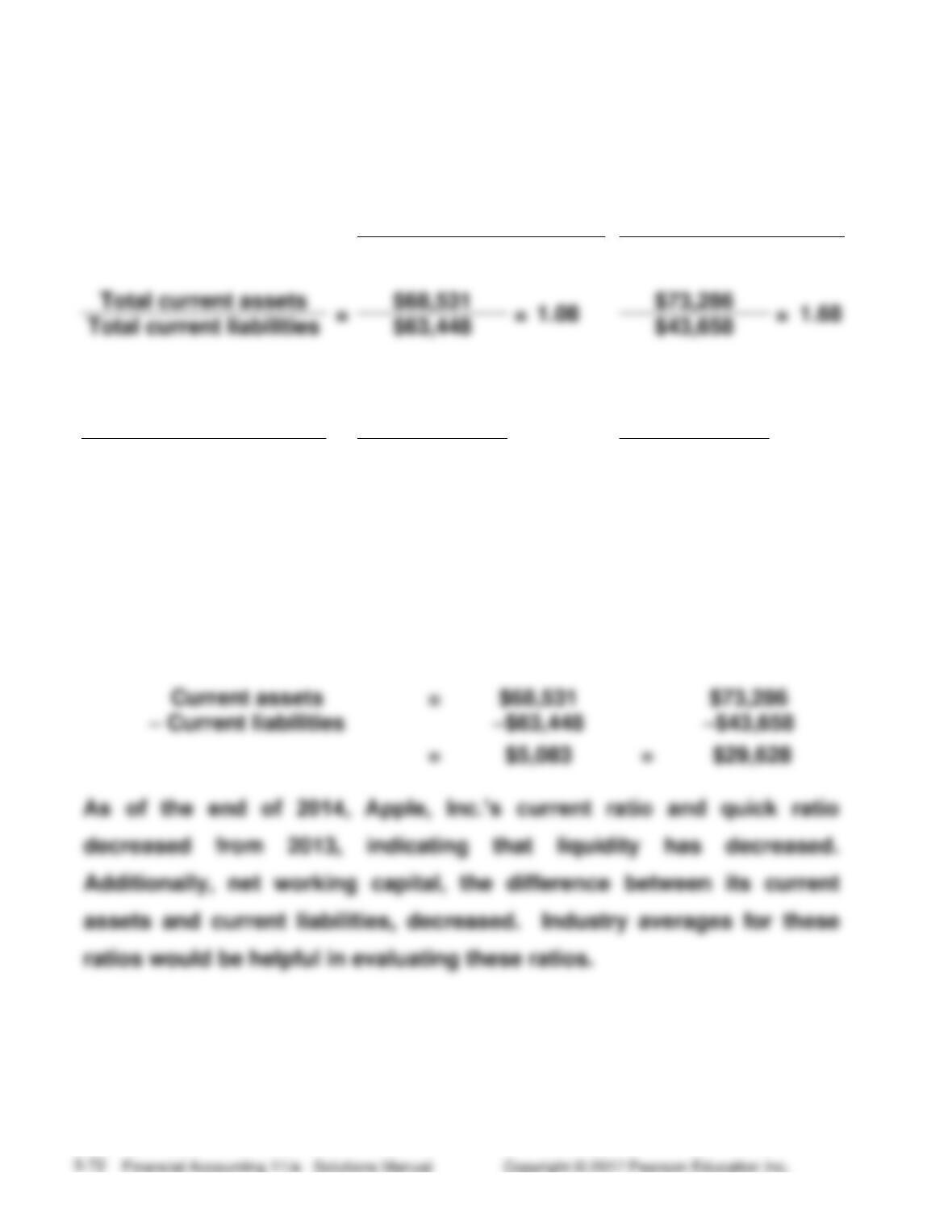
2014
2013
Current ratio:
(Dollar amounts in millions)
$68,531
1.08
$73,286
Total current liabilities
$63,448
$43,658
Quick ratio:
Quick assets*
=
$42,537
=
0.67
$53,648
=
1.23
Total current liabilities
$63,448
$43,658
*Quick assets include cash, short-term marketable securities and net
accounts receivable. For 2014: $13,844 + $11,233 + $17,460; For 2013: $14,259
+ $26,287 + $13,102
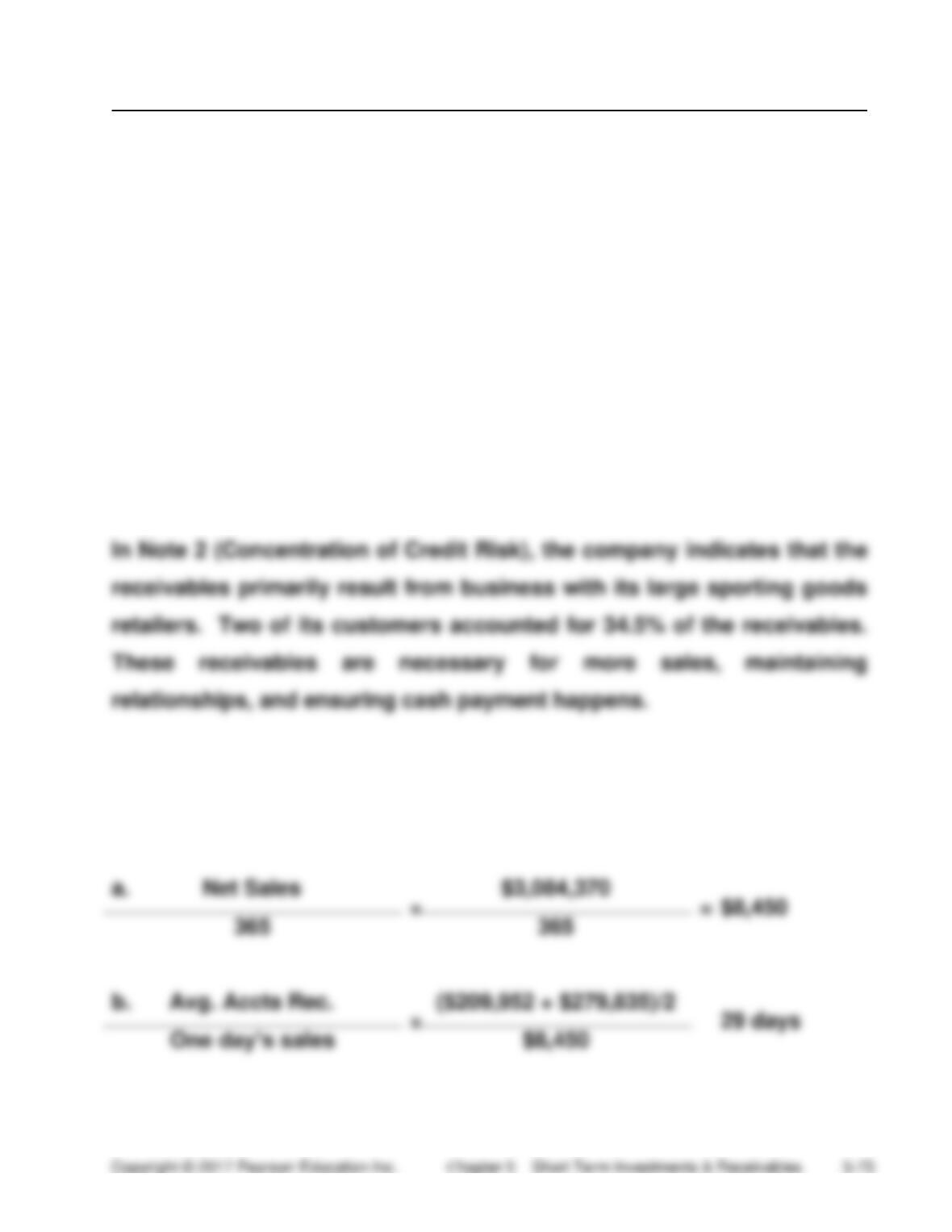
Net working capital:
Focus on Analysis: Under Armour, Inc.
(20 min.)
Req. 1
According to Note 2, Under Armour, Inc.’s revenue primarily comes from
net sales and license and other revenues. Sales are recognized at the
time of ownership and risk of loss is transferred. License revenues and
other revenues are recognized based on the shipment of the product
sold by the company’s licensees. The majority of that revenue is from
large sporting goods retailers.
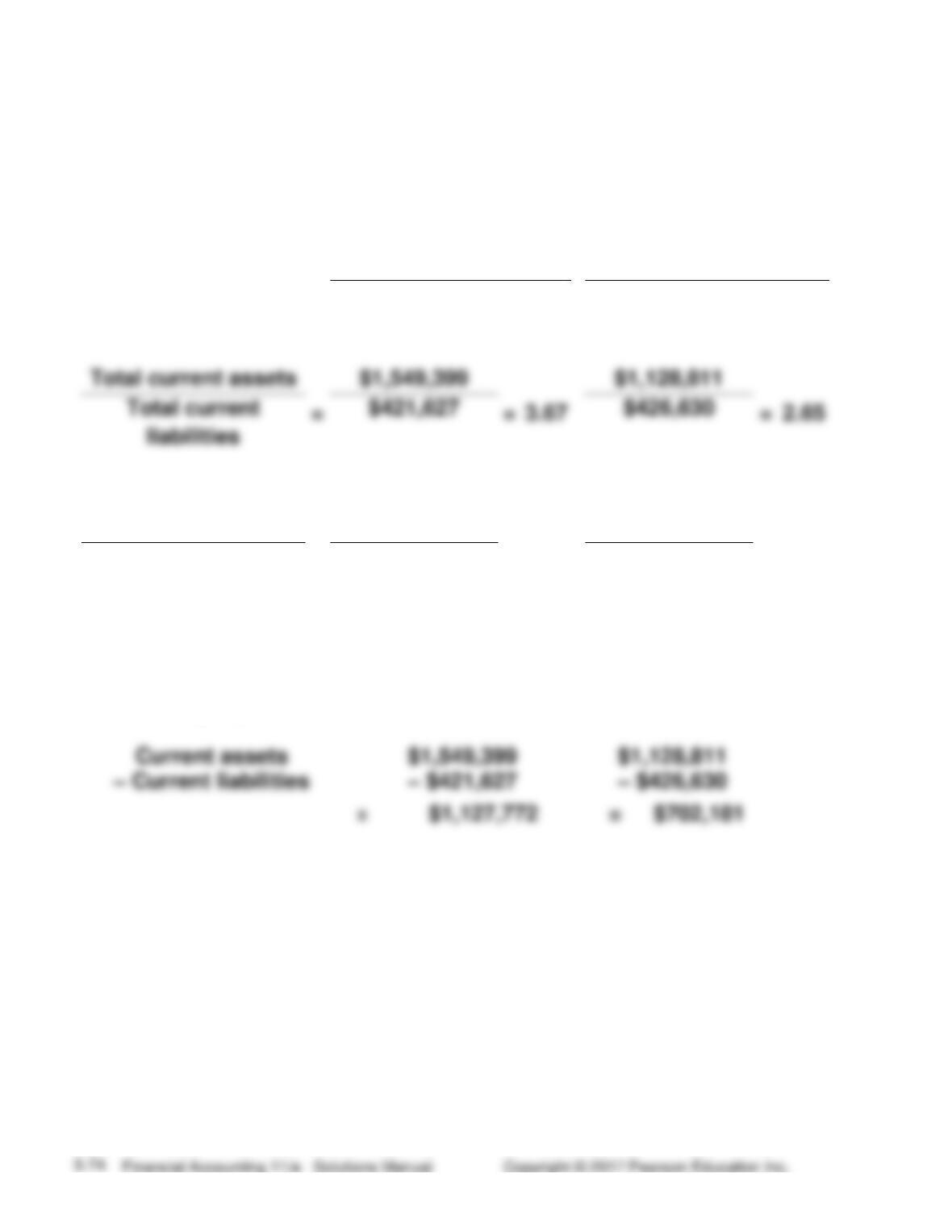
Req. 2
Req. 3 (in thousands)
(continued) Under Armour, Inc.
Req. 4
Current ratio:
2014
2013
(Dollar amounts in thousands)
Quick ratio:
Quick assets*
=
$873,010
=
2.07
$557,441
=
1.31
Total current
liabilities
$421,627
$426,630
*Quick assets include cash and accounts receivable.
Net working capital:
The current ratio, quick ratio, and net working capital have increased
significantly from 2013 to 2014. Thus, the company’s liquidity has
increased from 2013 to 2014. Since the current ratio and quick ratio are
both well above 1, the company will have no trouble paying its current
liabilities. Some information that would be very helpful in evaluating
these ratios would be industry averages for these ratios. This would
allow for benchmarking Under Armour to the industry.

Group Project
Student responses will vary.