
5-1
CHAPTER 5
PRODUCT AND SERVICE COSTING:
JOB-ORDER SYSTEM
DISCUSSION QUESTIONS
1. Cost measurement is the process of deter-
mining the dollar amounts of direct materi-
als, direct labor, and overhead that should
be assigned to production. Cost accumula-
tion (or assignment) is the process of asso-
ciating costs with the units produced. Essen-
tially, cost measurement is concerned with
whether actual or estimated costs should be
used, and cost assignment is concerned
with whether costs should be assigned to
jobs or processes.
2. Actual costing is rarely used because man-
agers cannot wait until the end of the year to
obtain product costs. Information on product
costs is needed as the year unfolds for
planning, control, and decision making.
3. Job–order costing accumulates costs by jobs,
and process costing accumulates costs by
processes. Job-order costing is suitable for op-
erations that produce custom-made products
that receive different doses of manufacturing
costs. Process costing, on the other hand, is
suitable for operations that produce homoge-
neous products that receive equal doses of
manufacturing costs in each process.
4. The principal difference between a manual
and an automated system is the nature of
the records. In an automated system, termi-
nals can be used to input data directly to the
job, thus eliminating the need for many
source documents such as time tickets and
requisition forms. Even if these forms are
used and the data are entered on a batch
basis, the job-order cost sheet has been re-
placed with an electronic record. Instead of
cabinets with collections of job-order cost
sheets, files are collections of job records
located on disk or tape.
5. Materials requisition forms serve as the
source document for posting materials usage
and costs to individual jobs. Time or work
tickets serve a similar function for labor.
Predetermined overhead rates are used to
assign overhead costs to individual jobs.
6. Additional source documents must be de-
veloped to track use of multiple drivers in an
activity-based costing system. Thus, if a
purchasing rate is developed based on
number of purchase orders, then a source
document tracing the use of purchase or-
ders by individual jobs must be created.
7. Activity drivers are those factors that drive or
cause the consumption of overhead. Know-
ing what drives overhead costs allows a
more accurate assignment of overhead
costs to products.
8. Expected actual activity is the level of produc-
tion activity expected for the coming year.
Normal activity is the long-run average activi-
ty level. Practical activity is the level of activity
achievable under efficient operating condi-
tions. Theoretical activity is the level of activi-
ty achievable under ideal operating condi-
tions.
9. Assignment using normal activity produces
less fluctuation in period-to-period overhead
assignments. It also avoids assigning the
costs of idle capacity to products when pro-
duction is down.
10. When normal costing is used, the actual use
of overhead is not assigned to jobs. Instead,
applied overhead is assigned.
11. Unit cost:
Direct materials ……………….. $ 7,500
Direct labor ……………………… 10,000
Overhead ($5 × 1,000)……… 5,000
Total…………………………. $22,500
Unit cost = $22,500/500 = $45
12. More paperwork is required. Labor and
materials are assigned to departments in a
process-costing system. In a job-order sys-
tem, labor and materials must be tracked to
each job, requiring time tickets and more
use of materials requisitions. Additionally, a
job-order system requires a separate job
sheet for each job.

5-2
13. The normal cost of goods sold uses applied
overhead only. Adjusted cost of goods sold
is the normal cost of goods sold adjusted for
an overhead variance (increased for un-
derapplied and decreased for overapplied).
14. The cost of spoilage in this case is charged
to Overhead Control, because the demands
of the job itself did not lead to the spoilage.
15. In this case, the spoilage was due to the
demands of this particular job and would be
charged to the job.
5-3
CORNERSTONE EXERCISES
Cornerstone Exercise 5.1
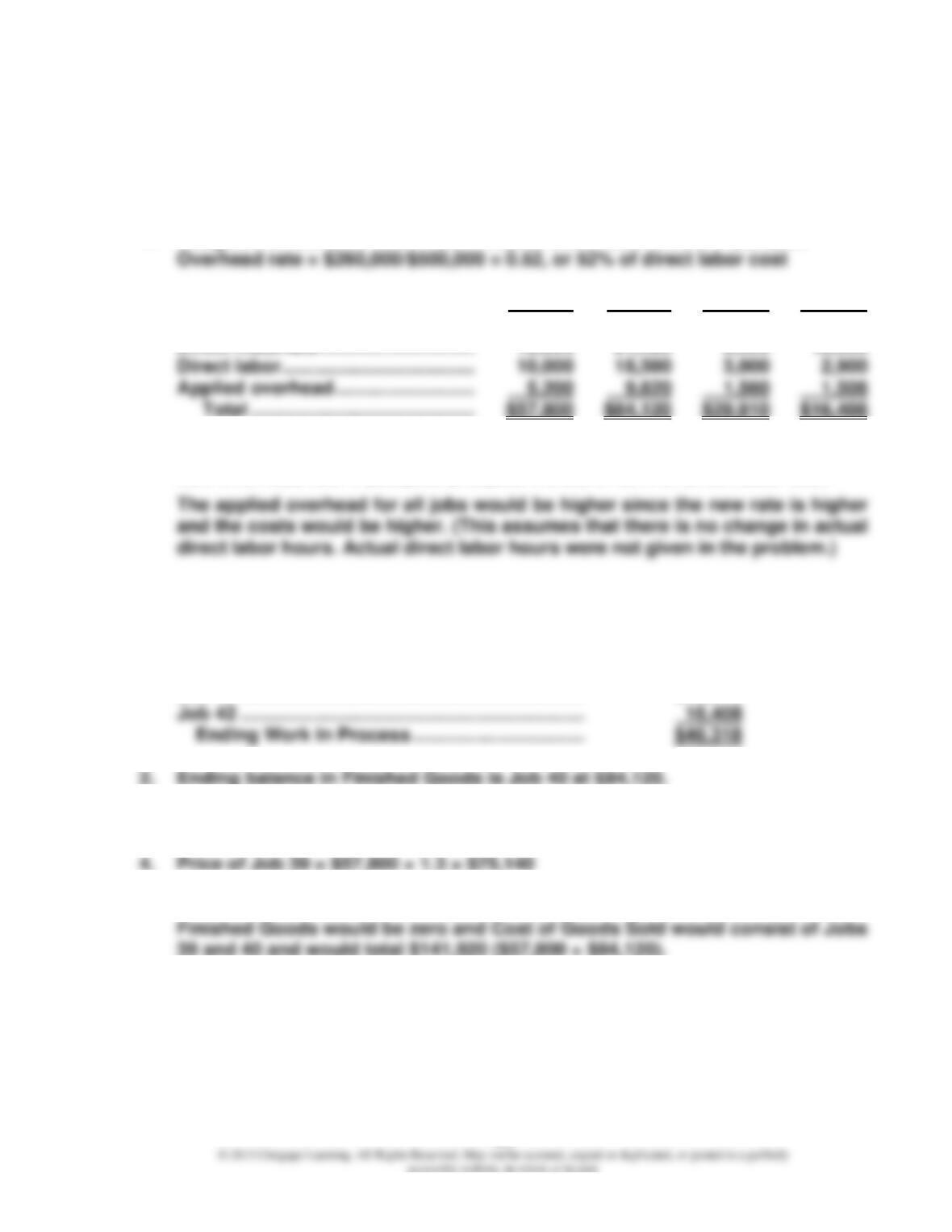
1. Budgeted direct labor cost = $25 × 20,000 direct labor hours = $500,000
2. Job 39 Job 40 Job 41 Job 42
Balance, June 1 ………………………… $23,700 $34,600 $17,000 $ 0
Direct materials ………………………… 18,900 21,400 8,350 12,000
3. New budgeted direct labor cost = $20 × 20,000 direct labor hours = $400,000
New overhead rate = $260,000/$400,000 = 0.65, or 65% of direct labor cost
Cornerstone Exercise 5.2:
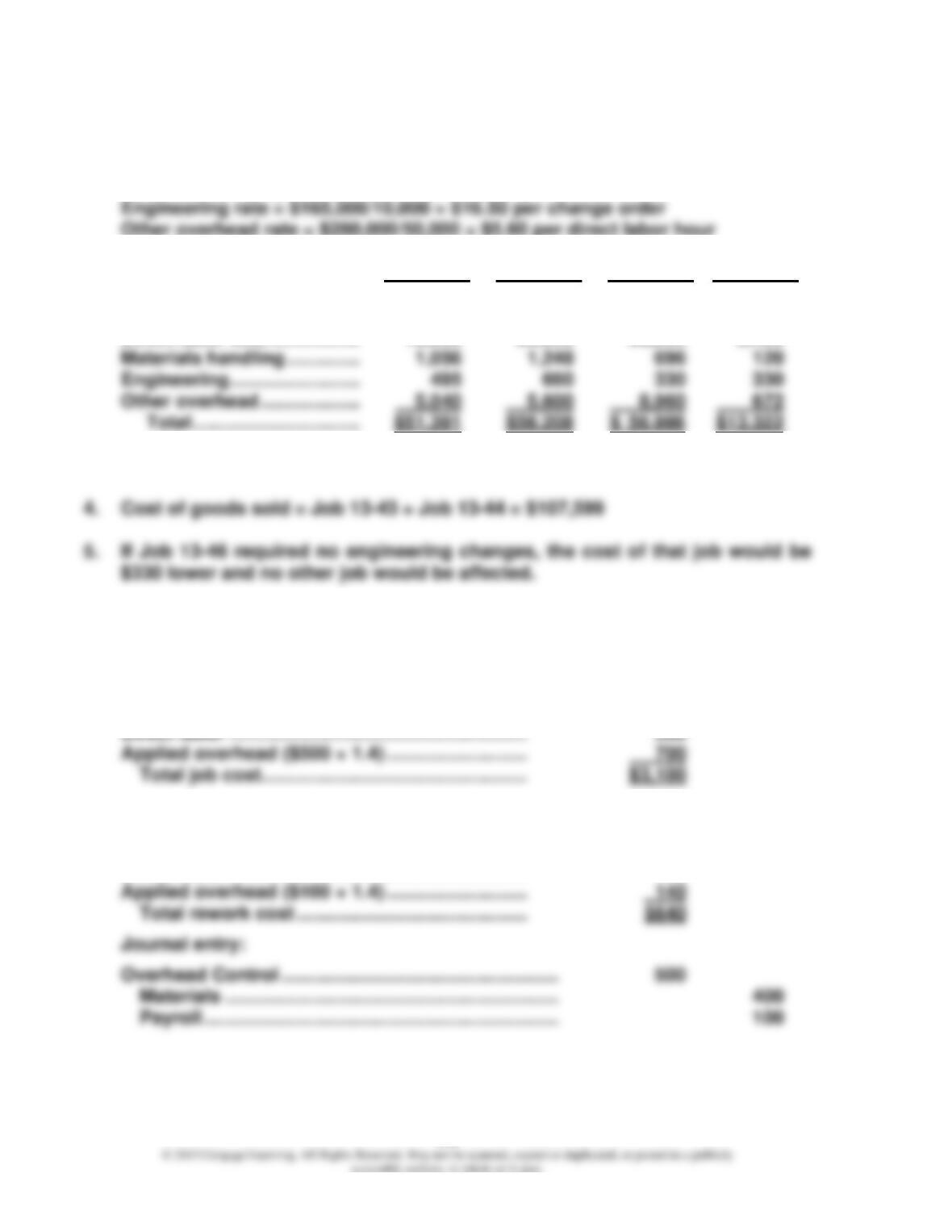
1. Ending Work in Process consists of Jobs 41 and 42:
Job 41 ………………………………………………………… $29,910
3. Cost of goods sold = Job 39 = $57,800
5. If the customer for Job 40 was able to pay for it by June 30, the balance in
5-4
Cornerstone Exercise 5.3
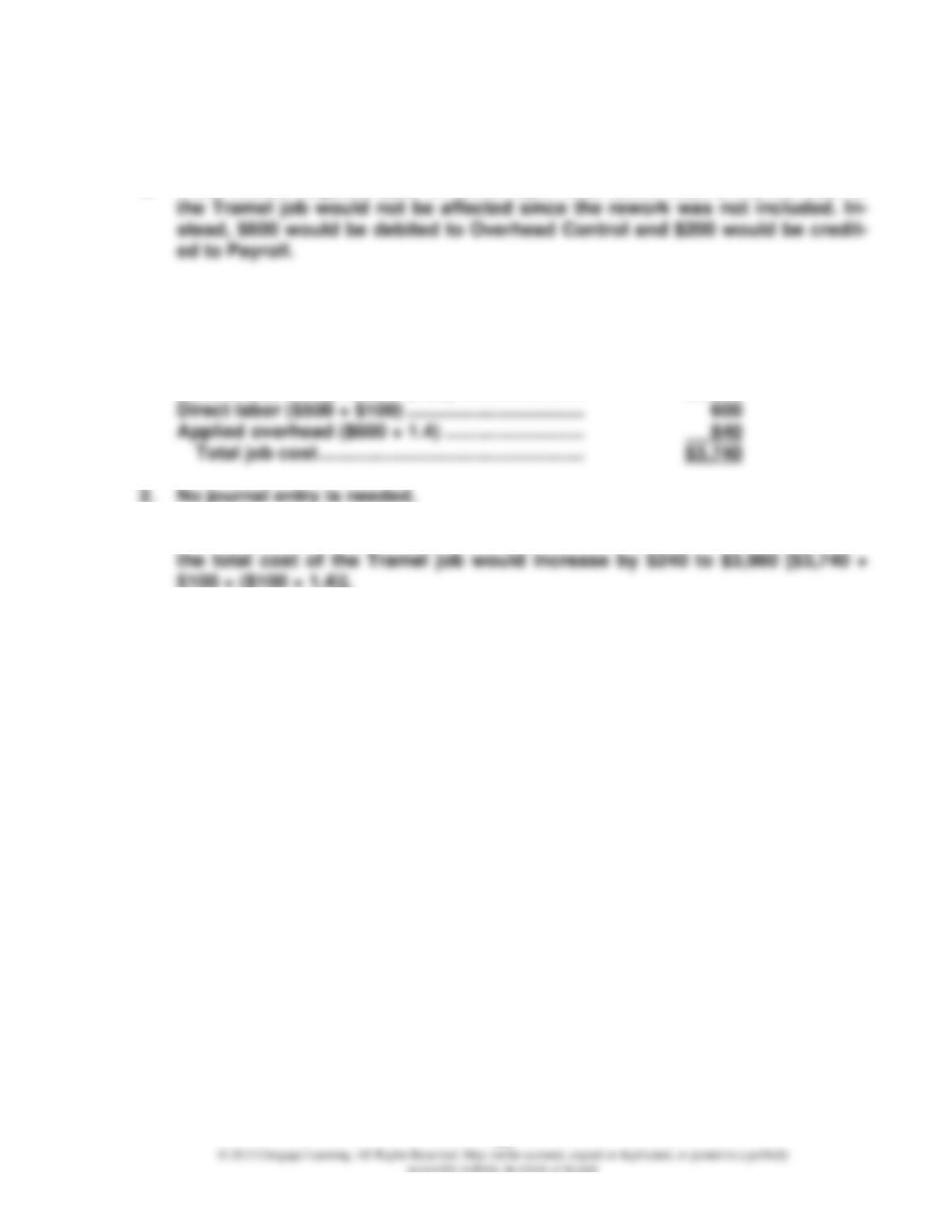
1. Materials handling rate = $72,000/3,000 = $24 per move
2. Job 13-43 Job 13-44 Job 13-45 Job 13-46
Balance, July 1 ………………. $20,300 $19,800 $ 2,300 $ 0
Direct materials………………. 6,500 8,900 12,700 9,800
Direct labor cost …………….. 18,000 20,000 32,000 2,400
3. Ending Work in Process consists of Jobs 13-45 and 13-46 = $70,308.
Cornerstone Exercise 5.4
1. Cost of the Tramel job with normal spoilage:
Direct materials…………………………………………… $1,900
2. Cost of rework:
Direct materials…………………………………………… $400
Direct labor ………………………………………………… 100
5-5
Cornerstone Exercise 5.4 (Concluded)
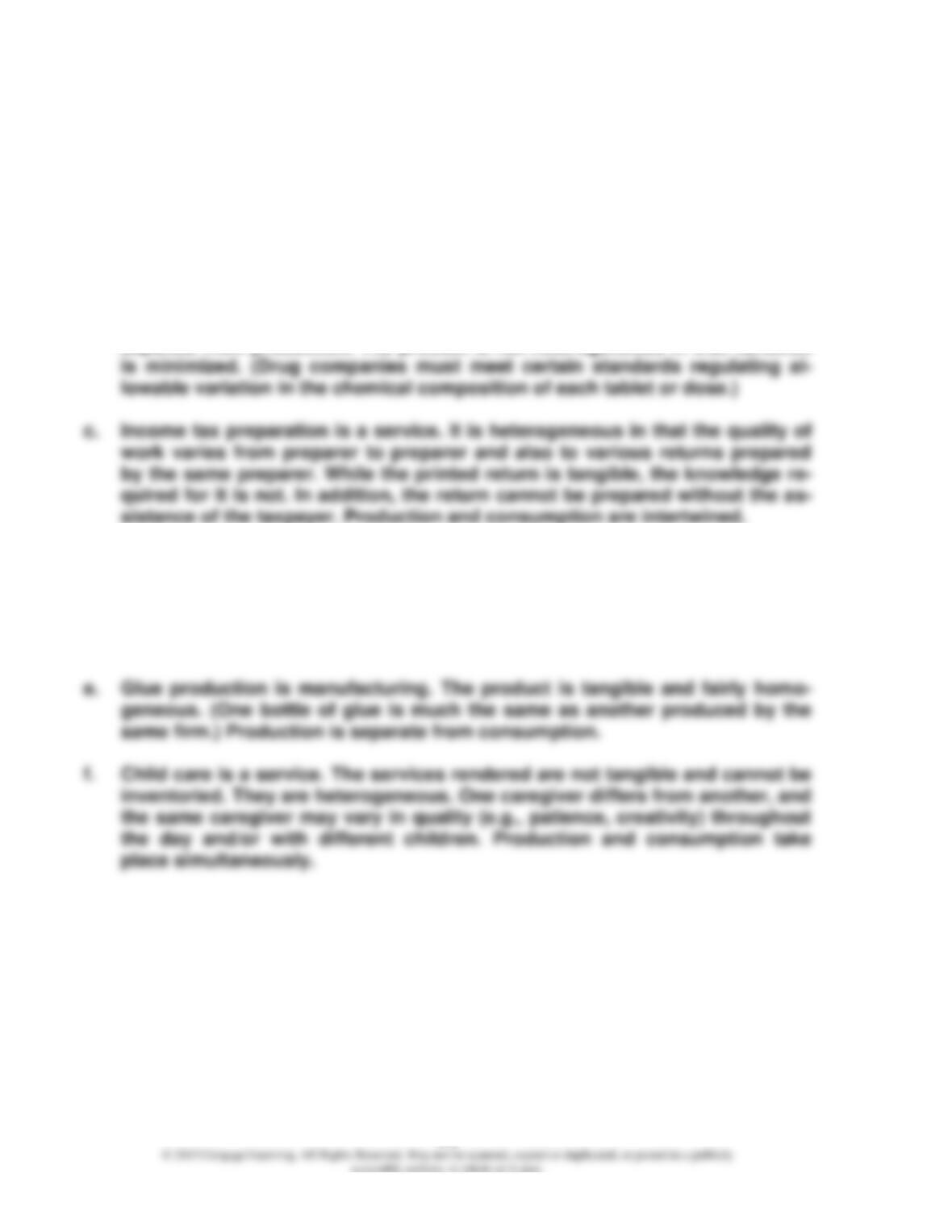
3. If the rework required $200 of direct labor cost rather than $100, the cost of
Cornerstone Exercise 5.5
1. Cost of the Tramel job with spoilage:
Direct materials ($1,900 + $400) …………………… $2,300
3. If the additional rework required $200 of direct labor rather than $100, then
5-6
EXERCISES
Exercise 5.6
a. Bicycle production is manufacturing. The product is tangible and fairly ho-
mogeneous. (One bicycle model is much the same as another.) Production is
separate from consumption.
b. Pharmaceuticals are manufacturing. A drug is tangible, and consumption is
separate from production. The product is not heterogeneous in that variation
d. The application of artificial nails is a service. It is heterogeneous in that the
quality of work varies from manicurist to manicurist. Additionally, the same
manicurist may do a better job with some customers than with others. The
production and consumption process are overlapping. While the nails are
tangible, the application process is not and cannot be inventoried.
5-7
Exercise 5.7
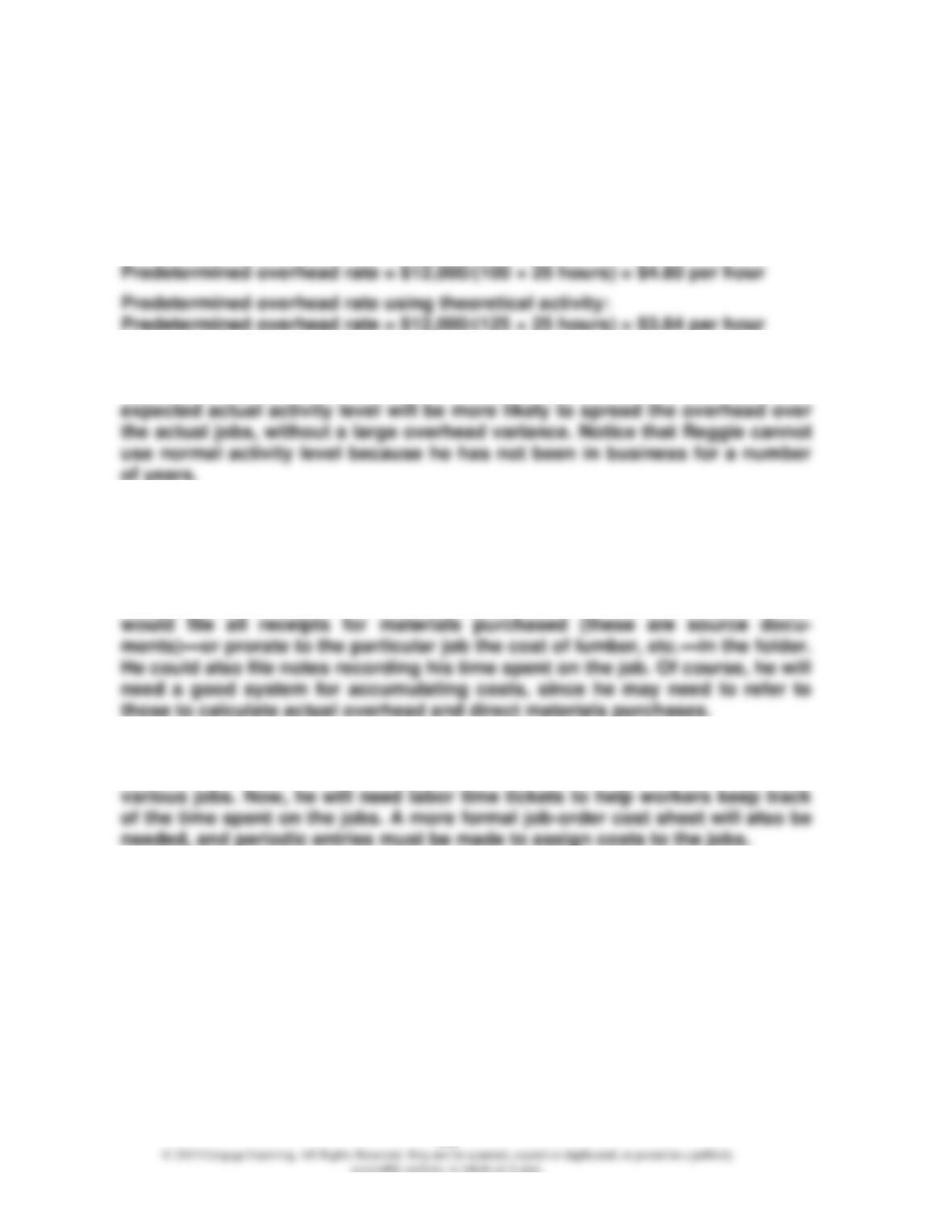
1. EcoScape Company should use job-order costing because each installation
2. Predetermined overhead rate = $50,400/6,720 = $7.50 per direct labor hour
Average wage rate = $66,495/6,045 = $11 per direct labor hour
3. The company cannot use an actual cost system; it needs to know the cost of
each installation as it is completed. Since overhead is incurred unevenly
Exercise 5.8
1. Irrigation Specialties should use a process-costing system because each wa-
2. If Irrigation Specialties uses an actual costing system, the average amounts
for actual direct materials, actual direct labor, and actual overhead must be
calculated for each month.
Average Amounts June July August
Direct materials …………………………………. $18,000 $24,000 $36,000
Direct labor ……………………………………….. 12,000 16,000 24,000
3. Predetermined overhead rate = $54,000/600 = $90 per system installed
5-8
Exercise 5.9
1. The two measures of activity level considered by Reggie are expected actual
activity and theoretical activity.
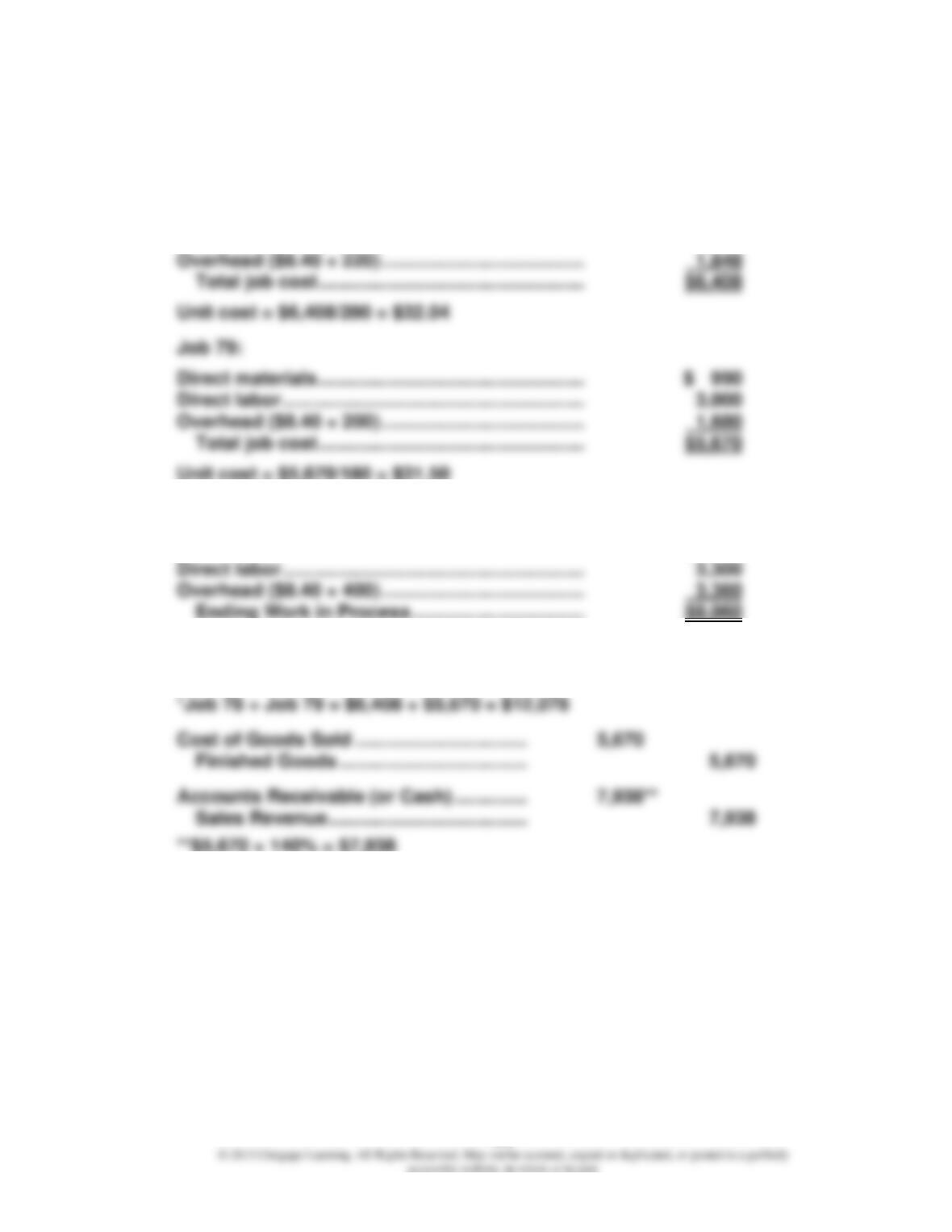
2. Predetermined overhead rate using expected actual activity:
3. Reggie should use expected actual activity because it is unlikely that he will
approach the theoretical activity level, especially with a new business. The
Exercise 5.10
1. Because the business is so small (Reggie is the only employee), all he really
needs is a job-order cost sheet. Actually, a folder for each job would do. He
2. Now, the business is considerably larger. Reggie will no longer be able to re-
construct job costs from memory, since he is not the only one working on the
5-9
Exercise 5.11
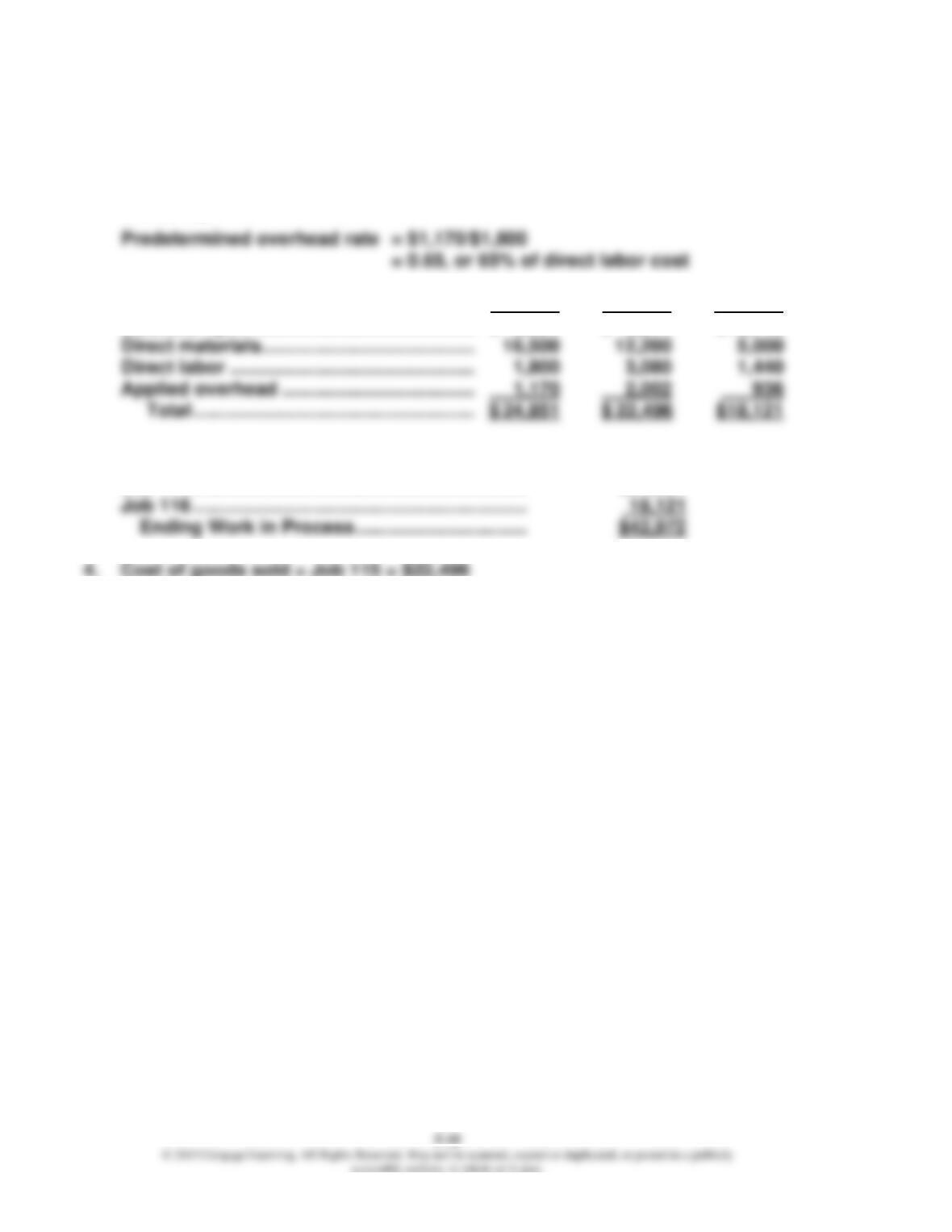
1. Job 78:
Direct materials …………………………………………… $1,560
Direct labor …………………………………………………. 3,000
2. Job 80:
Direct materials …………………………………………… $2,400
3. Finished Goods …………………………………. 12,078*
Work in Process …………………………….. 12,078
Exercise 5.12
1. Using Job 114 (any of the three jobs could be used, the overhead rate will be
the same):
2. Job 114 Job 115 Job 116
Balance, April 1………………………………….. $ 5,381 $ 5,214 $10,745
3. Ending Work in Process consists of Jobs 114 and 116:
Job 114 ………………………………………………………. $24,851
5. Price of Job 115 = $22,496 × 1.25 = $28,120
Exercise 5.13
1. Journal entries:
a. Materials ………………………………………………… 29,000
Accounts Payable ……………………………….. 29,000
b. Work in Process ……………………………………… 33,700
2.
Materials
Work in Process
Bal. 12,730
(b) 33,700
Bal. 21,340
(f) 22,496
(a) 29,000
(b) 33,700
8,030
(c) 6,320
(d) 4,108
42,972
Bal. 8,700
(g) 22,496
(f) 22,496
8,700
Exercise 5.14
2. 70 71 72 73 74 75 76
Balance, August 1 ……. $4,925 $4,275 $ 2,425 — — — —
3. By August 31, Jobs 71, 74, and 76 are still in process:
Job 71 ………………………………………………………… $7,960
4. Cost of goods sold for August consists of Jobs 72 and 75:
5. August sales revenue = $11,890 × 1.20 = $14,268
Exercise 5.15
Cairle Company
Income Statement
For the Month of August
Sales …………………………………………………………………………………………….. $14,268
Cost of goods sold ………………………………………………………………………… 11,890
Gross margin ……………………………………………………….……………………….. $ 2,378
Exercise 5.16
1. a. Materials ………………………………………………… 45,670
Accounts Payable ……………………………….. 45,670
b. Work in Process ……………………………………… 40,990
Materials …………………………………………….. 40,990
2. Ending balances:
a. Materials Inventory = $1,200 + $45,670 – $40,990 = $5,880
5-14
Exercise 5.17
1. Job 39:
Direct materials…………………………………………… $ 700
Direct labor ………………………………………………… 1,980
2. Job 41:
Direct materials…………………………………………… $ 800
3. Finished Goods ………………………………………….. 7,588*
Work in Process ………………………………………. 7,588
5-15
Exercise 5.18
1. Job 13-280:
Direct materials …………………………………………………….. $4,730
Direct labor …………………………………………………………… 2,000
Job 13-282:
Direct materials …………………………………………………….. $5,600
Direct labor …………………………………………………………… 800
2. Job 13-281:
Direct materials …………………………………………………….. $ 3,800
Direct labor …………………………………………………………… 4,600
Applied overhead:
3. Finished Goods …………………………………………… 16,882*
Work in Process ………………………………………. 16,882