Ethical Obligations and Decision Making in Accounting, 4/e 1
Case 5-3 Imperial Valley Community Bank
Bill Stanley, of Jacobs, Stanley & Company, started to review the working paper files on his
client, Imperial Valley Community Bank, in preparation for the audit of the client’s financial
statements for the year ended December 31, 2016. The bank was owned by a parent company,
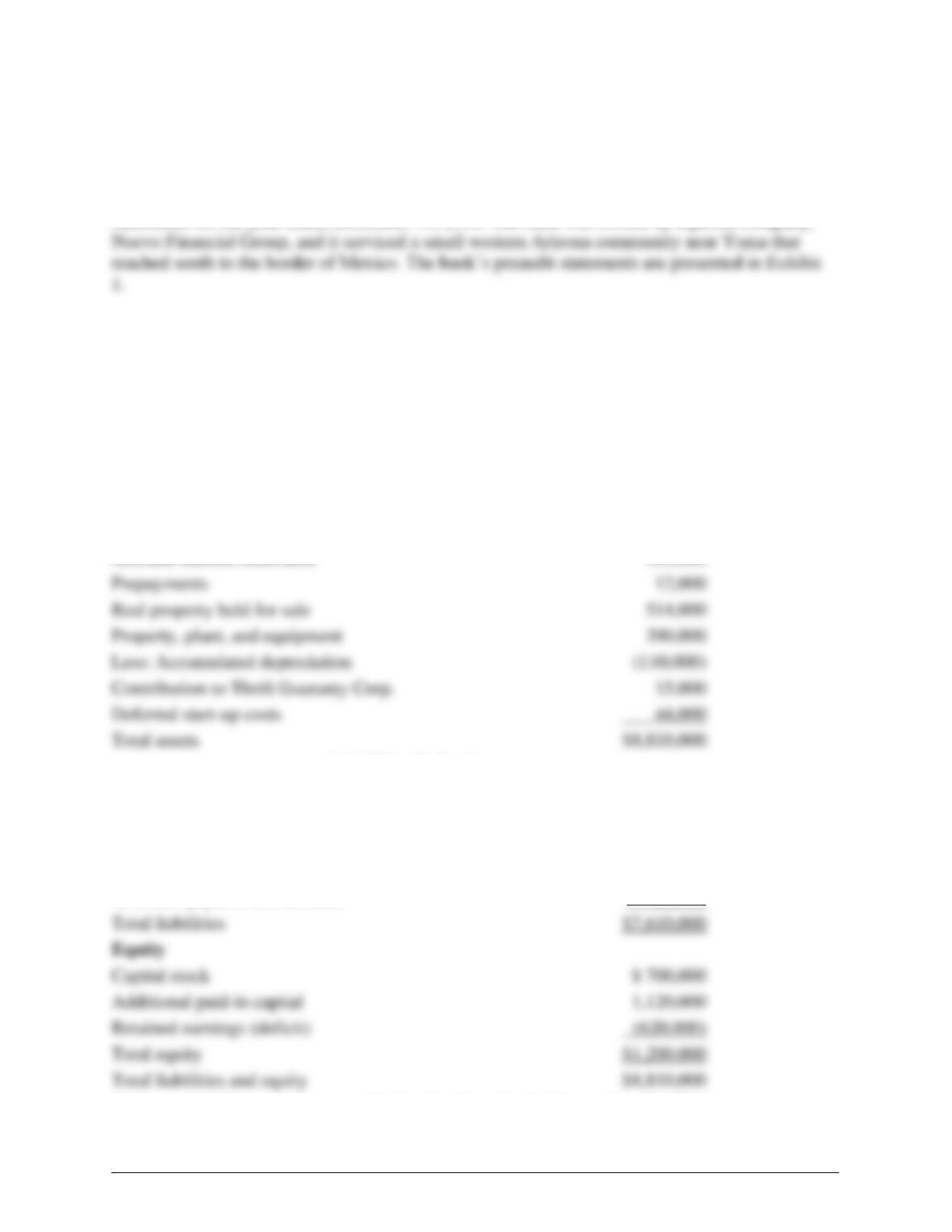
EXHIBIT 1
IMPERIAL VALLEY COMMUNITY BANK
Balance Sheet (preaudit) December 31, 2016
Assets
Cash and cash equivalents
$1,960,000
Loans receivable
6,300,000
Less: Reserve for loan losses
(25,000)
Unearned discounts and fees
(395,000)
Accrued interest receivable
105,000
Prepayments
Real property held for sale
514,000
Property, plant, and equipment
390,000
Less: Accumulated depreciation
(110,000)
Contribution to Thrift Guaranty Corp.
Deferred start-up costs
44,000
Total assets
$8,810,000
Liabilities & Equity
Liabilities
Regular and money market savings
$2,212,000
T-bills and CDs
5,180,000
Accrued interest payable
190,000
Accounts payable and accruals
28,000
Total liabilities
$7,610,000
Equity
Capital stock
$ 700,000
Additional paid-in capital
1,120,000
Retained earnings (deficit)
Total equity
$1,200,000
Total liabilities and equity
$8,810,000
Statement of Operations (preaudit) for the Year Ended December 31, 2016
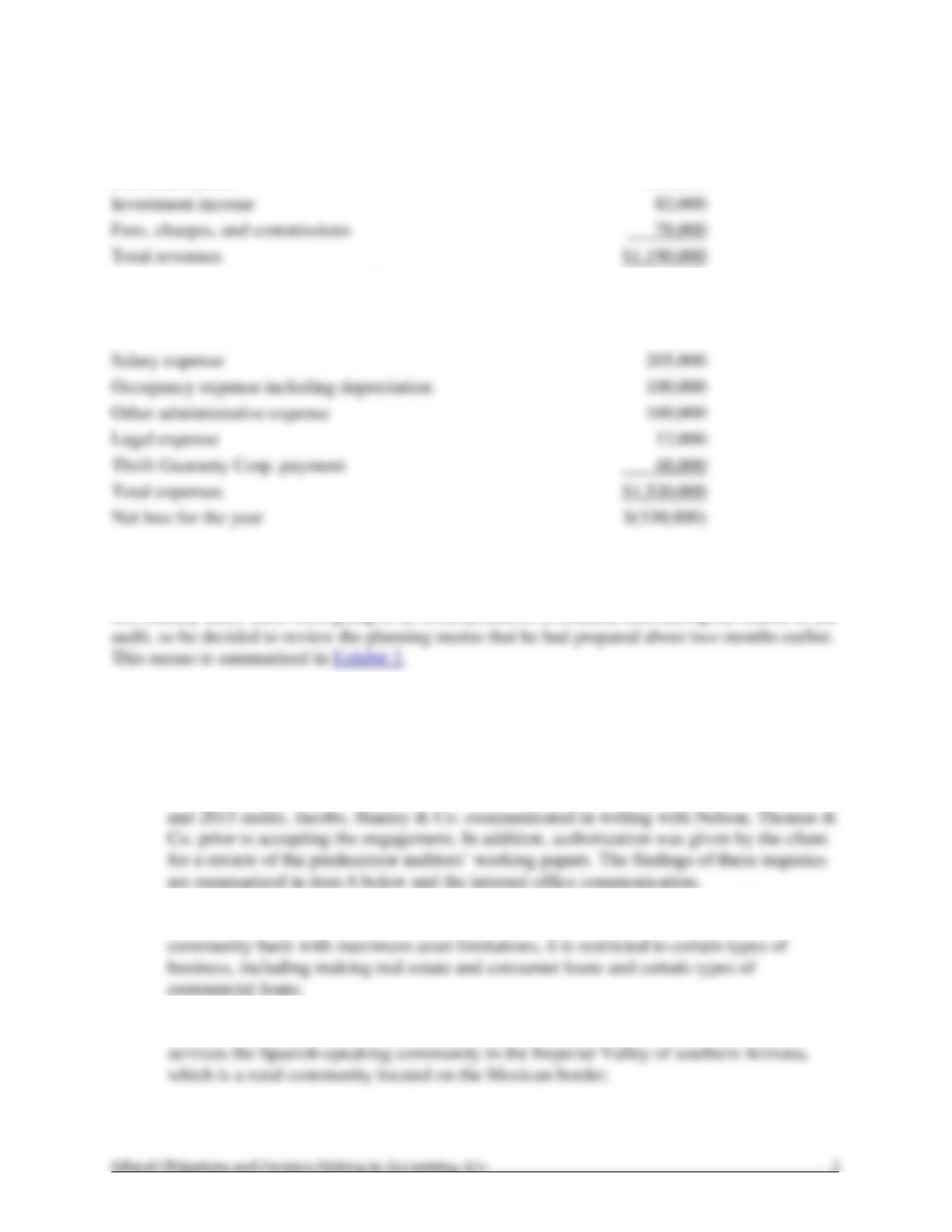
Revenues
Interest earned
$ 820,000
Discount earned
210,000
Investment income
Fees, charges, and commissions
Total revenues
Expenses
Interest expense
$ 815,000
Provision for loan losses
180,000
Salary expense
205,000
Occupancy expense including depreciation
100,000
Other administrative expense
160,000
Legal expense
Thrift Guaranty Corp. payment
Total expenses
Net loss for the year
Background
Bill Stanley knew there were going to be some problems to contend with during the course of the
EXHIBIT 2
Planning Memo
1. The firm of Jacobs, Stanley & Co. succeeded the firm of Nelson, Thomas & Co. as
auditors for Imperial Valley Community Bank. The prior auditors conducted the 2014
2. Imperial Valley Community Bank was incorporated in Arizona on June 12, 2000. It is a
wholly owned subsidiary of Nuevo Financial Group, S.A., a Mexican corporation. As a
3. Imperial Valley accepts deposits in the form of interest-bearing passbook accounts and
certificates of deposit. Most of the depositors are of Spanish descent. The client primarily
4. The principal officers of Imperial Valley are Jose Ortega and his brother, Arturo. They
5. Imperial Valley is subject to the regulations of the Arizona Community Bank Law and is
6. Based on review of the prior auditors’ working papers, the following items were noted:
1. The client’s lack of profitability was due to a high volume of loan losses resulting
from poor underwriting procedures and faulty documentation.
2. Imperial Valley has a narrow net interest margin due to the fact that all deposits
are interest bearing and it pays the highest interest rates in the area.
3. Due to the small size of the client and its focus on handling day-to-day operating
The next item he reviewed was an internal office communication on potential audit risks. This
communication described three areas of particular concern:
1. The client charged off $420,000 in loans in 2015 and had already charged off $535,000
through July 31, 2016. Assuming that reserve requirements by law are a minimum of
1.25 percent of loans outstanding, this statutory amount probably would not be large
2. The audit report issued on the 2015 financial statements contained an unmodified opinion
3. The client had weak internal controls according to the prior auditors. Some of the items to
look out for, in addition to proper loan documentation, were whether the preaudit
financial statement information provided by the client was supported by the general
Audit Findings
Jacobs, Stanley & Company conducted the audit of the financial statements for the year ended
December 31, 2016, and the following were the areas of greatest concern to Stanley:
1. Adequacy of Loan Collateral. A review of 30 loan files representing $2,100,000 of total
loans outstanding (33.3 percent of the portfolio) indicated that much of the collateral for
the loans was in the form of second or third mortgages on real property. This gave the
2. Collectibility of Loans. Many loans were structured in such a way as to require interest
payments only for a small number of years (two or three years), with a balloon payment
3. Weakness in Internal Controls. Internal control weaknesses were a pervasive concern.
The auditors recomputed certain accruals and unearned discounts, confirmed loan and
deposit balances, and reconciled the preaudit financial information provided by the client
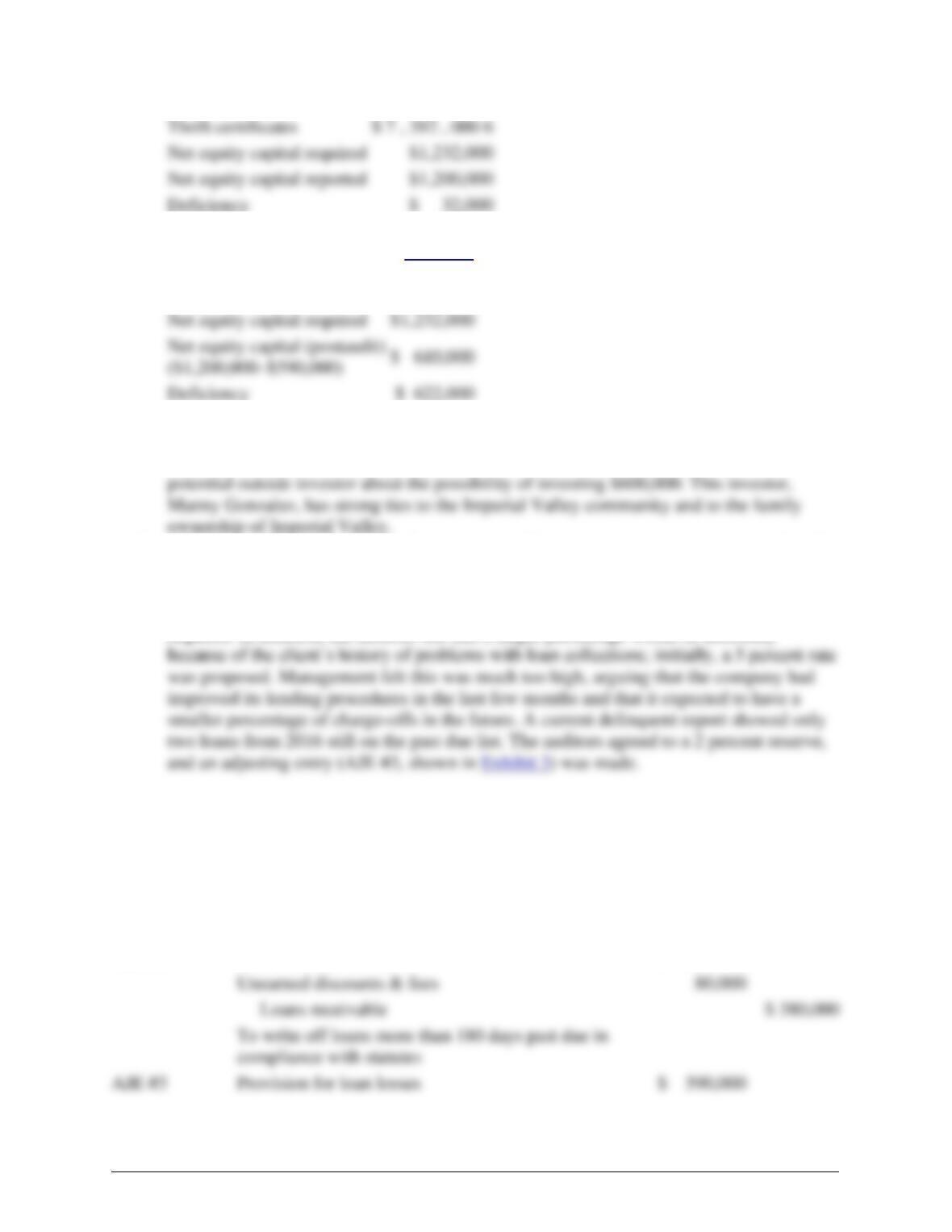
4. Status of Additional Capital Infusion. The audit engagement team is working under the
assumption that under Arizona regulatory requirements, a community bank must
maintain a 6:1 ratio of “thrift certificates” to net equity capital. Based on the financial
Ethical Obligations and Decision Making in Accounting, 4/e 5
5. Audit adjustments explained in Exhibit 3 increased the capital deficiency to $622,000, as
follows:
Net equity capital required
$1,232,000
Deficiency
6. There was a possibility that the parent company, Nuevo Financial Group, would
contribute the additional equity capital. Also, management had been in contact with a
7. Adequacy of General Reserve Requirement. The general reserve requirement of 1.25
percent had not been met. Based on the client’s reported outstanding loan balance of
$6,300,000, a reserve of $78,750 would be necessary. However, audit adjustments for the
charge-off of uncollectible loan amounts significantly affected the amount actually
required. In addition, the auditors felt that a larger percentage would be necessary
EXHIBIT 3
Audit Adjustments
AJE #1
Reserve for loan losses
$ 200,000
Loans receivable
$ 200,000
To write down loans to net realizable value
AJE #2
Reserve for loan losses
$ 300,000
Unearned discounts & fees
Loans receivable
compliance with statutes
AJE #3
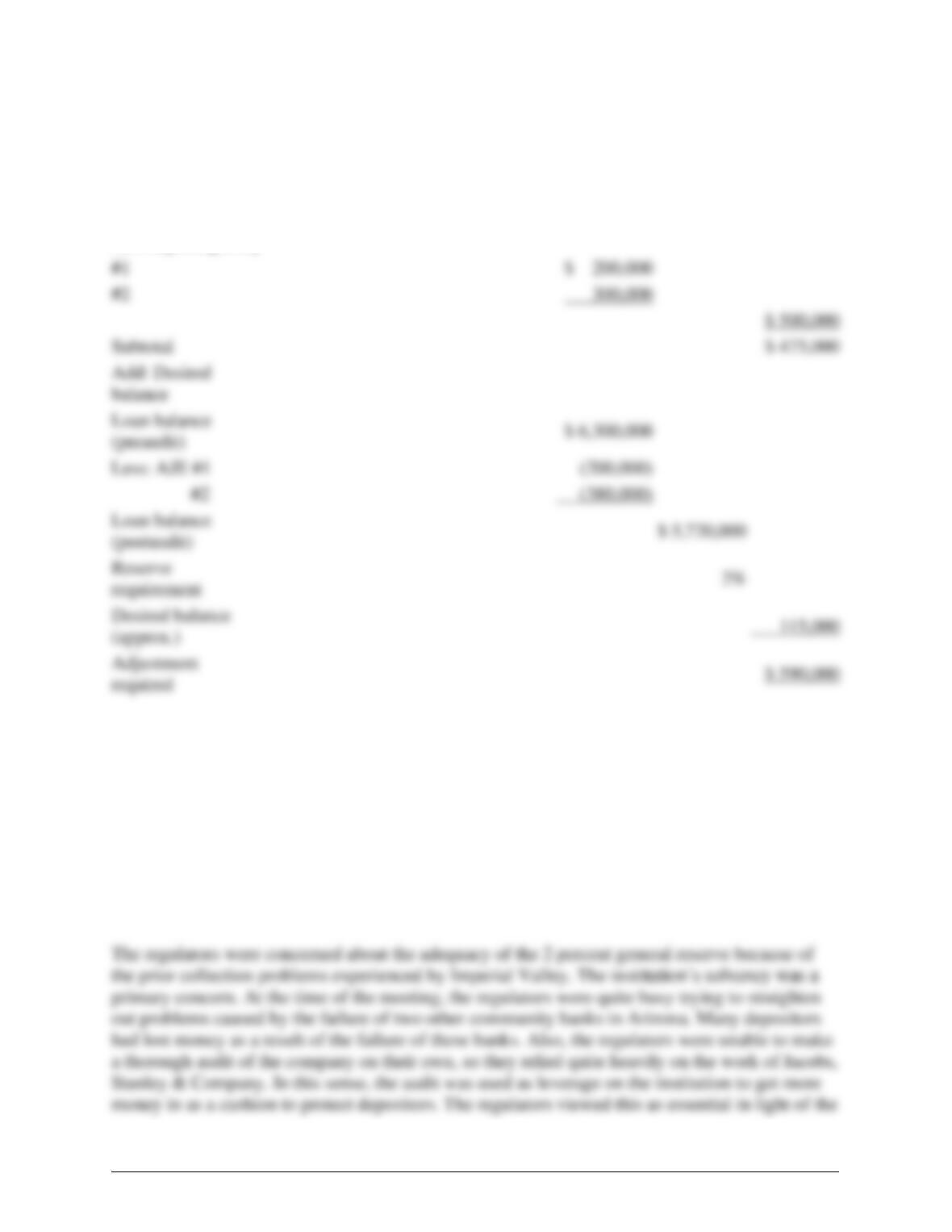
Provision for loan losses
$ 590,000
Thrift certificates
$ 7 , 392 , 000 6
Net equity capital required
Net equity capital reported
Deficiency
Ethical Obligations and Decision Making in Accounting, 4/e 6
Reserve for loan losses
$ 590,000
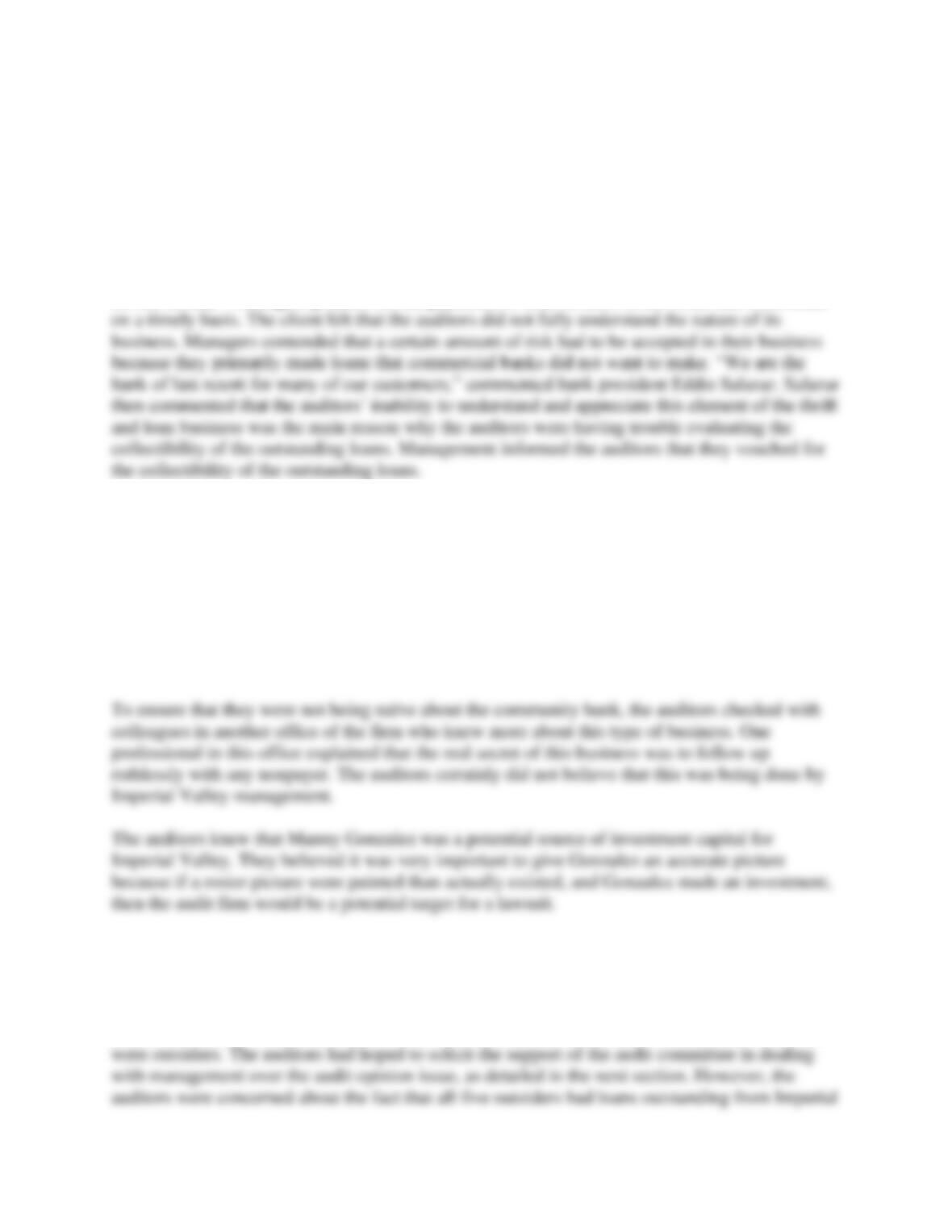
To increase the reserve balance to 2 percent of
outstanding loans as follows: Reserve balance
(preaudit)
$ (25,000)
Less adjusting entry
Regulatory Environment
Imperial Valley Community Bank was approaching certain regulatory filing deadlines during the
course of the audit. Stanley had a meeting with the regulators at which representatives of
management were present. Gonzalez also attended the meeting because he had expressed some
interest in possibly making a capital contribution. There was a lot of discussion about the ability
of Imperial Valley to keep its doors open if the loan losses were recorded as proposed by the
auditors. This was a concern because the proposed adjustments would place the client in a
position of having net equity capital significantly below minimum requirements.
#1
#2
$ 500,000
Subtotal
$ 475,000
balance
(preaudit)
Less: AJE #1
#2
(postaudit)
$ 5,720,000
requirement
(approx.)
115,000
required
Ethical Obligations and Decision Making in Accounting, 4/e 7
other bank failures and the fact that the insurance protection mechanism for thrift and loan
depositors was less substantial than depository insurance available through the Federal Deposit
Insurance Corporation (FDIC) in commercial banks and in savings and loans (S&Ls).
Summary of the Client’s Position
The management of Imperial Valley Community Bank placed a great deal of pressure on the
auditors to reduce the amount of the loan write-offs. It maintained that the customers were “good
for the money.” Managers pointed out the payments to date on most of the loans had been made
Outstanding Loans
The auditors’ contended that the payments to date, which were mostly annual interest amounts,
were not necessarily a good indication that timely balloon principal payments would be made.
They felt it was very difficult to evaluate the collectibility of the balloon payments adequately,
primarily because the borrowers’ source of cash for loan repayment had not been identified.
They could not objectively audit or support borrowers’ good intentions to pay or undocumented
resources as represented by client management.
Board of Trustees
The auditors approached the nine-member board of trustees that oversaw the operations of
Imperial Valley, three of whom also served on the audit committee. Of the nine board members,
four were officers with the banks and five were “outsiders.” All members of the audit committee
Ethical Obligations and Decision Making in Accounting, 4/e 8
Auditor Responsibilities
The management of Imperial Valley was pressuring the auditors to give an unmodified opinion.
If the auditors decided to modify the opinion, then, in the client’s view, this would present a
picture to their customers and the regulators that their financial statements were not accurate.
The client maintained that this would be a blow to its integrity and would shake depositors’
confidence in the institution.
Memo: Going-Concern Question
The question of the going-concern status of Imperial Valley Community Bank is being raised
because of the client’s continuing operating losses and high level of loan losses that has resulted
in a “capital impairment” designation by the Arizona Department of Corporations. The client lost
$920,000 after audit adjustments in 2016. This is in addition to a loss of $780,000 in 2015.
Imperial Valley has also reported a loss of $45,000 for the first two months of 2017.
Ethical Obligations and Decision Making in Accounting, 4/e 9
We have been unable to obtain enough support for the value of much of the collateral backing
outstanding loans. We also have concluded that there is a substantial doubt about the bank’s
ability to continue in business. The reasons for this conclusion include the following:
Questions
1. What is the role of professional skepticism in auditing financial statements? Do you
think that the auditors were skeptical enough in evaluating the operations of
Imperial Valley? Explain.
As discussed in the chapter, characteristics of skepticism are a questioning mind,
suspension of judgment, and a search for knowledge. These characteristics include being
unlikely to accept information at face value, requiring proof or justification and suspend
judgments until making additional inquiries and obtaining evidence.
2. What is the role of assessing risk including materiality in an audit? Do you
Ethical Obligations and Decision Making in Accounting, 4/e 10
think the auditors did an adequate job in this regard? Explain.
Audit risk and materiality need to be considered together in determining the nature,
timing, and extent of auditing procedures and in evaluating the results of those
procedures. According to AU 315 the auditor should consider audit risk and materiality
both in (a) planning the audit and designing auditing procedures and (b) evaluating
whether the financial statements taken as a whole are presented fairly, in all material
respects, in conformity with GAAP.
3. Assume that the auditors decide to support management’s position and reduce the
amount of loan write-offs. The decision was made in part because of concerns that
regulators might force the bank to close its doors, and then many customers would
have nowhere else to go to borrow money. Evaluate the ethics of the auditors’
decision.
Ethical Obligations and Decision Making in Accounting, 4/e 11
A decision to reduce the amount of loan write-offs demonstrates a stage 3 level of
reasoning on Kohlberg’s scale. The auditors are aware of stakeholder interests but
ultimately decide to side with management indicating influence by the client take
4. Assume that you were asked to review the information in this case as the
engagement review partner on the audit of Imperial Valley Community. How would
you assess the quality of the audit? Include an assessment of internal controls in
your analysis.
The quality of the audit was low. Auditors failed to exercise due care and exercise
professional skepticism. Internal controls were weak; loan documentation poor; audit
evidence frequently unavailable; collectability of loans more doubtful than the client has
evaluated; loan losses were at a high level; and the auditors did not adequately challenge
management’s representations.