
CHAPTER 5
PRODUCT AND SERVICE COSTING: JOB-ORDER SYSTEM
Product costing plays a critical role in the new manufacturing environment and is also a significant factor
in service industries. This chapter introduces students to job-order costing. This costing system can be
used in either manufacturing or service environments. Students will understand how costs are
accumulated, measured, and assigned. Overhead application and the use of single versus multiple
overhead rates are discussed along with accounting for spoilage.
LEARNING OBJECTIVES
After studying Chapter 5, students should be able to:
1. Differentiate the cost accounting systems of service and manufacturing firms and of unique and
standardized products.
2. Discuss the interrelationship of cost accumulation, cost measurement, and cost assignment.
4. Describe the cost flows associated with job-order costing, and prepare the journal entries.
6. Explain how spoiled units are accounted for in a job-order costing system.
KEY TOPICS
The following major topics are covered in this chapter (related learning objectives are listed for each
topic):
1. Characteristics of the Production Process (LO 1)
2. Setting Up the Cost Accounting System (LO 2)
3. The Job-Order Costing System: General Description (LO 3)
5. Job-Order Costing with Activity-Based Costing (LO 5)
6. Accounting for Spoiled Units in a Traditional Job-Order Costing System (LO 6)

I. CHARACTERISTICS OF THE PRODUCTION PROCESS
Manufacturing involves combining direct materials, direct labor, and overhead to produce a new product.
The good produced is tangible and can be inventoried and transported from the plant to the customer. A
service is characterized by its intangible nature. It is not separable from the customer and cannot be
inventoried.
The four dimensions that differentiate service from tangible products are intangibility, inseparability,
heterogeneity, and perishability. Intangibility refers to the nonphysical nature of services. Inseparability
means that production and consumption cannot be separated. Heterogeneity refers to the greater chances
for variation in the performance of services than in the production of products. Perishability means that
services cannot be inventoried but must be consumed when performed.
Exhibit 5.2 (p. 206) summarizes the relationship of each of these terms to business and the impact of each
term on the cost management system.
II. SETTING UP THE COST ACCOUNTING SYSTEM
A good accounting information system is flexible and reliable. It provides information for a variety of
purposes and can be used to answer a variety of questions. In general, the system is used to satisfy the
needs for cost accumulation, cost measurement, and cost assignment.
Cost accumulation refers to the recognition and recording of costs. The cost accountant needs to develop
source documents, which keep track of costs as they occur. A source document describes a transaction.
Data from these source documents can then be recorded in a database. Well-designed source documents
can supply information in a flexible manner.
Cost measurement refers to classifying costs and consists of determining the dollar amounts of direct
materials, direct labor, and overhead. Two common methods of cost measurement in production are (1)
actual costing and (2) normal costing. An actual costing system uses actual costs for direct materials,
direct labor, and overhead to determine unit cost. A normal costing system uses actual costs for direct
materials and direct labor but measures overhead costs on a predetermined basis.
Cost assignment refers to distributing costs to units of product manufactured or units of service delivered.
Once the measure(s) of activity are chosen, we still need to predict the level of activity usage that applies
to the coming year. The two leading candidates are expected actual activity and normal activity. Expected
activity level is simply the production level the firm expects to attain for the coming year. Normal activity
level is the average activity usage that a firm experiences in the long term.
III. THE JOB-ORDER COSTING SYSTEM: GENERAL DESCRIPTION
In a job-order costing system, costs are accumulated by job. Firms operating in job-order industries
produce a wide variety of products or jobs that are usually quite distinct from each other. Customized or
built-to-order products fit into this category, as do services that vary from customer to customer. The key
feature of job-order costing is that the cost of one job differs from another job and must be monitored
separately. Once any given job is completed, the unit cost can be computed by dividing total job costs by
the number of units produced on that job.

It is important for students to understand the different documents used in a job-order costing system. The
document that identifies each job and accumulates its manufacturing costs is the job-order cost sheet,
which is shown in Exhibit 5.5 (p. 215). The job-order cost sheet reflects direct materials, direct labor, and
overhead costs for the job and serves as a subsidiary ledger to the work-in–process inventory account. The
total of the costs for all job-cost sheets must equal the total for the controlling work-in-process inventory
account.
A. Materials Requisitions
The cost of direct materials is traced to each job through the use of a materials requisition form. When
direct materials are issued to production, the materials requisition form identifies the job, the quantity and
type of direct materials, and the cost of direct materials. A materials requisition form is presented in
Exhibit 5.6 on page 216.
B. Job Time Tickets
Job time tickets are the source documents used to assign direct labor costs to jobs. When a direct laborer
works on a job, he or she fills out a time ticket indicating the time spent on the job, along with the wage
rate. Exhibit 5.7 on page 217 illustrates a time ticket.
C. Overhead Application
Overhead is assigned to jobs using predetermined rates. If the rate is based on direct labor hours, then the
predetermined rate and the information from the time tickets are used to assign overhead to jobs. If
another cost driver is used (e.g., machine hours), then another source document must be used to collect
the amount of the activity driver used by each job.
D. Unit Cost Calculation
Once a job is completed, its total manufacturing cost is computed by first totaling the costs of direct
materials, direct labor, and overhead, and then summing these individual totals. If there are multiple units
in a job, the grand total can be divided by the number of units produced to obtain the unit cost.
Cornerstone 5.1 (p. 218) shows how to set up a simplified job-order cost sheet.
IV. JOB-ORDER COSTING: SPECIFIC COST FLOW DESCRIPTION
Accountants are concerned with tracing the manufacturing costs from the point of incurrence to the
recognition as expenses on the income statement.
Teaching hint: Exercise 5.13 in the text is a good example to use in class to illustrate the basic journal
entries and cost flows in job-order costing. When discussing job-order costing, a simple example of a
general contractor can be used. In the following example, the company worked on three houses during the
year. The following information should be provided to the students on the board:
Direct materials:
House #1
$ 90,000
House #2
100,000
House #3
30,000
Total direct materials
$220,000
Direct labor:
House #1
$ 65,000
House #2
70,000
House #3
15,000
Total direct labor
$150,000
Overhead is applied at 50 percent of direct labor costs.
Houses #1 and #2 are completed during the period.
House #1 is sold for $200,000 cash.
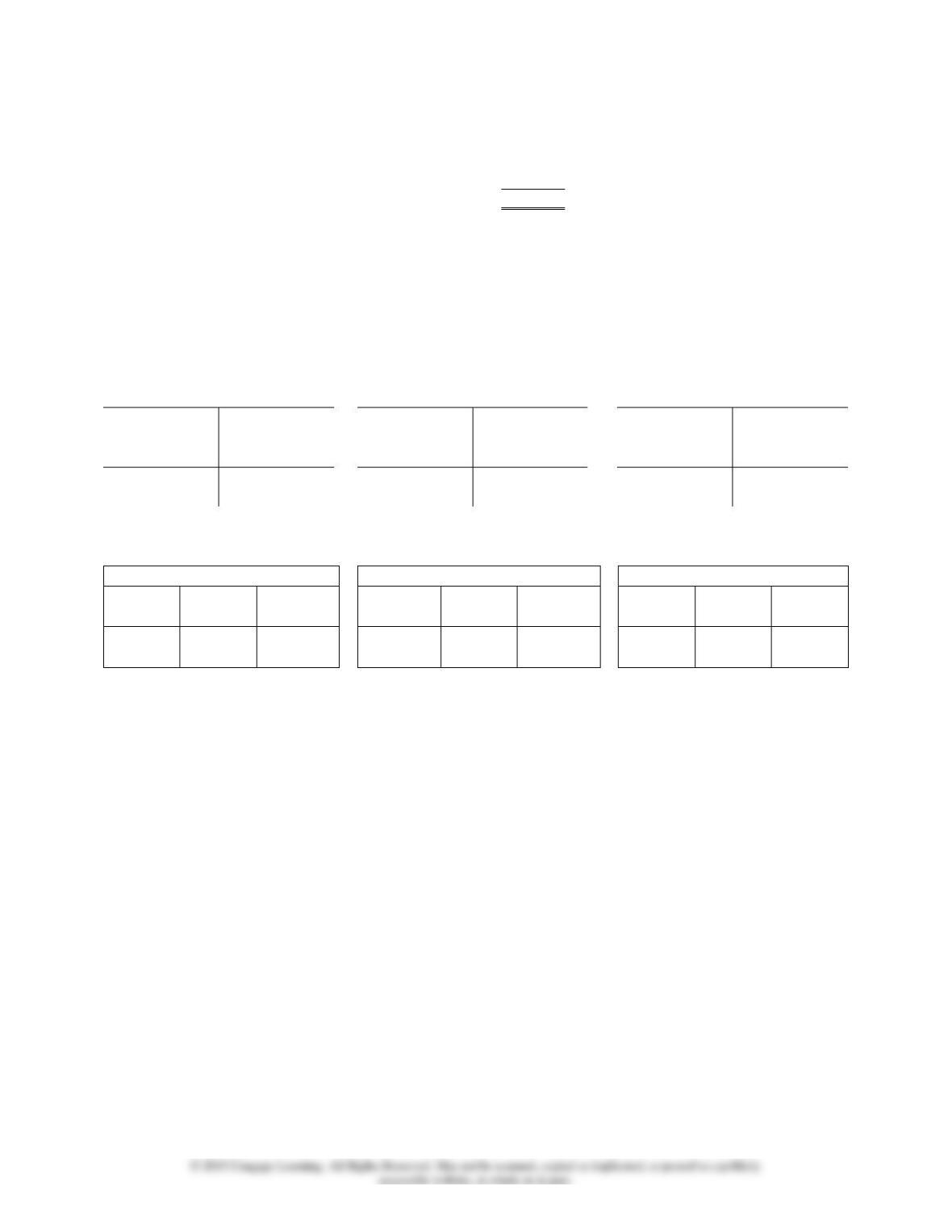
T-Accounts
Work-in-Process Inventory
Finished Goods Inventory
Cost of Goods Sold
220,000
187,500
187,500
187,500
187,500
150,000
205,000
205,000
75,000
52,500
205,000
187,500
Job Cost Sheets
House #1
House #2
House #3
DM
DL
OH
DM
DL
OH
DM
DL
OH
$90,000
$65,000
$32,500
$100,000
$70,000
$35,000
$30,000
$15,000
$7,500
Total
$187,500
Total
$205,000
Total
$52,500
V. JOB-ORDER COSTING WITH ACTIVITY-BASED COSTING
Using a single rate to assign overhead costs to jobs may result in unfair cost assignments and distortion of
overhead costs. This can occur if the activity base does not correlate well with the consumption of
overhead resources. One approach to improving the assignment of overhead costs may be to use
departmental rates or activity-based costing. Cornerstone 5.3 (p. 229) illustrates how to set up a job-order
cost sheet for a company using activity-based costing.
Teaching hint: Problem 5.28 is a good problem to use in class as an illustration.
VI. ACCOUNTING FOR SPOILED UNITS IN A TRADITIONAL JOB-ORDER COSTING
SYSTEM
Spoilage is a natural result of a production process because mistakes are made. Defective units that are
produced are either thrown away or reworked and sold.

If the defective work was a consequence of the demanding nature of this particular job, then rework
(spoilage) is assigned to the job. On the other hand, if the defective work was a consequence of assigning
new, untrained labor to the job, then the rework (spoilage) is assigned to overhead control.
The cost of spoiled units that cannot be reworked are similarly charged to the job if caused by the
demands of the job, and to overhead control if not.
VII. INFORMATION ABOUT EXERCISES, PROBLEMS, AND CASES
Exercises and problems are described below and on the following page and on the next page according to
coverage of content, learning objective(s), and level of difficulty. The time required to solve the problems
is roughly proportional to the level of difficulty.
In general, basic exercises/problems are fairly simple and straightforward. The text material is relatively
brief; only one or two concepts are covered. Basic exercises and problems should take about 15 to 20
minutes each.
Moderate exercises/problems may take longer and involve more concepts. These problems may have a
“twist” and require more thought. Moderate exercises and problems may take 20 to 40 minutes each.
Challenging problems are more comprehensive and may cover more concepts. The text material is
relatively longer and may include some ambiguity. Challenging problems may take 60 to 90 minutes
each.
Cornerstone
Exercise (CS)/
Exercise/
Problem/Case
Topic
Learning
Objective
Degree of
Difficulty
CS 5.1
Job Costs Using a Plantwide Overhead Rate
LO 3, 4
Basic
CS 5.2
Job Costs Using a Plantwide Overhead Rate
LO 3, 4
Basic
CS 5.3
Job Costs Using Activity-Based Costing
LO 5
Basic
CS 5.4
Cost of Normal Spoilage
LO 6
Basic
CS 5.5
Cost of Abnormal Spoilage
LO 6
Basic
5.6
Classifying Firms as Either Manufacturing or Service
LO 1
Basic
5.7
Characteristics of Production Process, Cost
Measurement
LO 1, 2
Basic
5.8
Characteristics of Production Process, Cost
Measurement
LO 1, 2
Basic
5.9
Activity Levels Used to Compute Overhead Rates
LO 2
Basic
5.10
Source Documents, Job Cost Flows
LO 3, 4
Basic
5.11
Job Costs, Ending Work in Process
LO 4
Basic
5.12
Predetermined Overhead Rate, Application of
Overhead to Jobs, Job Cost
LO 3, 4
Basic
5.13
Job Cost Flows, Journal Entries
LO 4
Basic
5.14
Predetermined Overhead Rate, Application of
Overhead to Jobs, Job Cost, Unit Cost
LO 2, 4
Moderate
5.15
Income Statement
LO 4
Basic
5.16
Journal Entries, T-Accounts
LO 4
Basic
5.17
Unit Cost, Ending Work-in–Process Inventory, Journal
Entries
LO 4, 5
Moderate

Cornerstone
Exercise (CS)/
Exercise/
Problem/Case
Topic
Learning
Objective
Degree of
Difficulty
5.18
Activity-Based Costing, Unit Cost, Ending Work-in–
Process Inventory, Journal Entries
LO 4, 5
Moderate
5.19
Journal Entries, T-Accounts
LO 4
Basic
5.20
Activity-Based Costing, Unit Cost, Ending Work-in–
Process Inventory
LO 4, 5
Moderate
5.21
CPA-Type Exercise
LO2
Basic
5.22
CPA-Type Exercise
LO2
Basic
5.23
CPA-Type Exercise
LO2
Basic
5.24
CPA-Type Exercise
LO2
Basic
5.25
CPA-Type Exercise
LO2
Basic
5.26
Journal Entries, T-Accounts, Cost of Goods
Manufactured and Sold
LO 4, 5
Moderate
5.27
Overhead Application, Activity-Based Costing, Bid
Prices
LO 4, 5
Moderate
5.28
Plantwide Overhead Rate, Activity-Based Costing, Job
Costs
LO 3, 5
Moderate
5.29
Plantwide Overhead Rate versus Departmental Rates,
Effects on Pricing Decisions
LO 5
Moderate
5.30
Cost of Spoiled Units
LO 6
Moderate
5.31
Cost of Reworked Units
LO 6
Moderate
5.32
Job-Order Costing, Housing
LO 3, 4
Moderate
5.33
Case on Job-Order Costing: Dental Practice
LO 3, 4
Challenging
5.34
Case on Job-Order Costing and Pricing Decisions
LO 3, 4
Challenging
5.35
Research Assignment
LO 1, 2, 3, 4
Challenging
5.36
Cyber Research Case
LO 1, 2, 3
Challenging
LIST OF ILLUSTRATIONS
Illustration
Topic
Exhibit 5.1
Continuum of Services and Manufactured Products
Exhibit 5.2
Features of Service Firms and Their Interface with the Cost Management System
Exhibit 5.3
Relationship of Cost Accumulation, Cost Measurement, and Cost Assignment
Exhibit 5.4
Measures of Activity Level
Exhibit 5.5
The Job-Order Cost Sheet
Exhibit 5.6
Materials Requisition Form
Exhibit 5.7
Time Ticket
Exhibit 5.8
Summary of Direct Materials Cost Flows
Exhibit 5.9
Summary of Direct Labor Cost Flows
Exhibit 5.10
Summary of Overhead Cost Flows
Exhibit 5.11
Completed Job-Order Cost Sheet
Exhibit 5.12
Summary of Finished Goods Cost Flow
Exhibit 5.13
Statement of Cost of Goods Manufactured
Exhibit 5.14
Statement of Cost of Goods Sold
Exhibit 5.15
All Signs Company Summary of Manufacturing Cost Flows
Exhibit 5.16
Income Statement