Exercise 5-18 (continued)
4. Margin of safety in dollar terms:
Margin of safety = Total sales – Break-even sales
in dollars
= $450,000 – $360,000 = $90,000
Margin of safety in percentage terms:
Margin of safety in dollars
Margin of safety=
percentage Total sales
$90,000
= = 20%
$450,000
5. The CM ratio is 60% [= ($30 – $12) ÷ $30].
Expected total contribution margin: ($500,000 × 60%) ..
$300,000
Present total contribution margin: ($450,000 × 60%) ….
270,000
Increased contribution margin …………………………………
$ 30,000
Problem 5-19 (45 minutes)
1.
Sales (15,000 units × $70 per unit) ………………….
$1,050,000
Variable expenses (15,000 units × $40 per unit) …
600,000
Contribution margin ……………………………………..
450,000
Fixed expenses ……………………………………………
540,000
Net operating loss ………………………………………..
$ (90,000)
3. See the next page.
4. At a selling price of $58 per unit, the contribution margin is $18 per unit.
Therefore:
Fixed expenses
Unit sales to =
break even Unit contribution margin
$540,000
=
$18
= 30,000 units
30,000 units × $58 per unit = $1,740,000 to break even.
Problem 5-19 (continued)
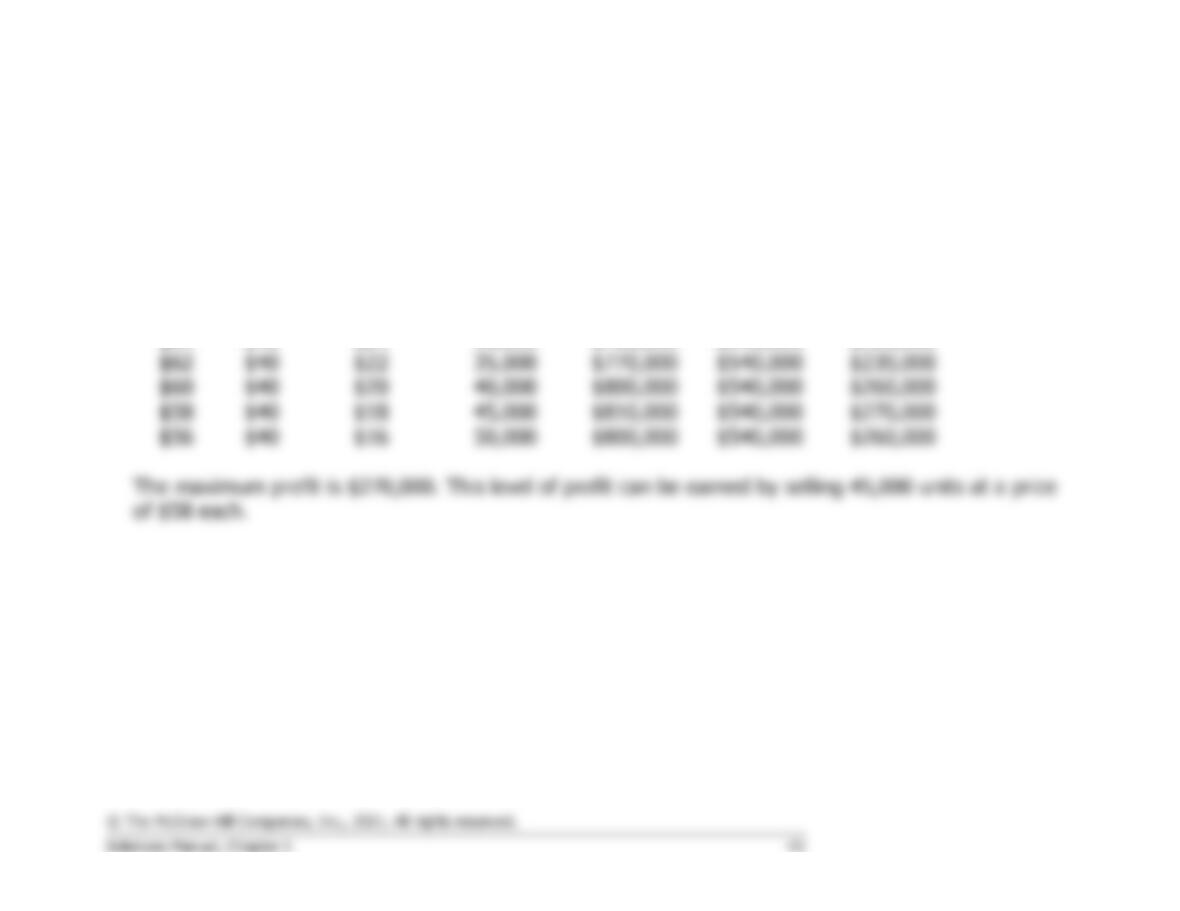
3.
Unit
Selling
Price
Unit
Variable
Expense
Unit
Contribution
Margin
Volume
(Units)
Total
Contribution
Margin
Fixed
Expenses
Net operating
income (loss)
$70
$40
$30
15,000
$450,000
$540,000
$ (90,000)
$68
$40
$28
20,000
$560,000
$540,000
$ 20,000
$66
$40
$26
25,000
$650,000
$540,000
$110,000
$64
$40
$24
30,000
$720,000
$540,000
$180,000
$62
$40
$22
35,000
$770,000
$540,000
$230,000
$60
$40
$20
40,000
$800,000
$540,000
$260,000
$58
$40
$18
45,000
$810,000
$540,000
$56
$40
$16
50,000
$800,000
$540,000
Problem 5-20 (75 minutes)
1.
a.
Selling price …………………
$25
100%
Variable expenses …………
15
60%
Contribution margin ………
$10
40%
Profit
= Unit CM × Q − Fixed expenses
$0
= $10 × Q − $210,000
$10Q
= $210,000
Q
= $210,000 ÷ $10
Q
= 21,000 balls
b. The degree of operating leverage is:
Contribution margin
Degree of =
operating leverage Net operating income
$300,000
= = 3.33 (rounded)
$90,000
2. The new CM ratio will be:
Selling price ………………..
$25
100%
Variable expenses ………..
18
72%
Contribution margin ………
$ 7
28%
Profit
= Unit CM × Q − Fixed expenses
$0
= $7 × Q − $210,000
= $210,000
Q
= $210,000 ÷ $7
Problem 5-20 (continued)
Alternative solution:
Fixed expenses
Unit sales to =
break even Unit contribution margin
$210,000
=
$7
= 30,000 balls
3.
Profit
= Unit CM × Q − Fixed expenses
$90,000
= $7 × Q − $210,000
$7Q
= $90,000 + $210,000
Q
= $300,000 ÷ $7
Q
= 42,857 balls (rounded)
Alternative solution:
Target profit + Fixed expenses
Unit sales to attain =
target profit Unit contribution margin
$90,000 + $210,000
= = 42,857 balls
$7
Thus, sales will have to increase by 12,857 balls (= 42,857 balls –
30,000 balls = 12,857 balls) to earn the same amount of net operating
income as last year. The computations above and in part (2) show the
dramatic effect that increases in variable costs can have on an
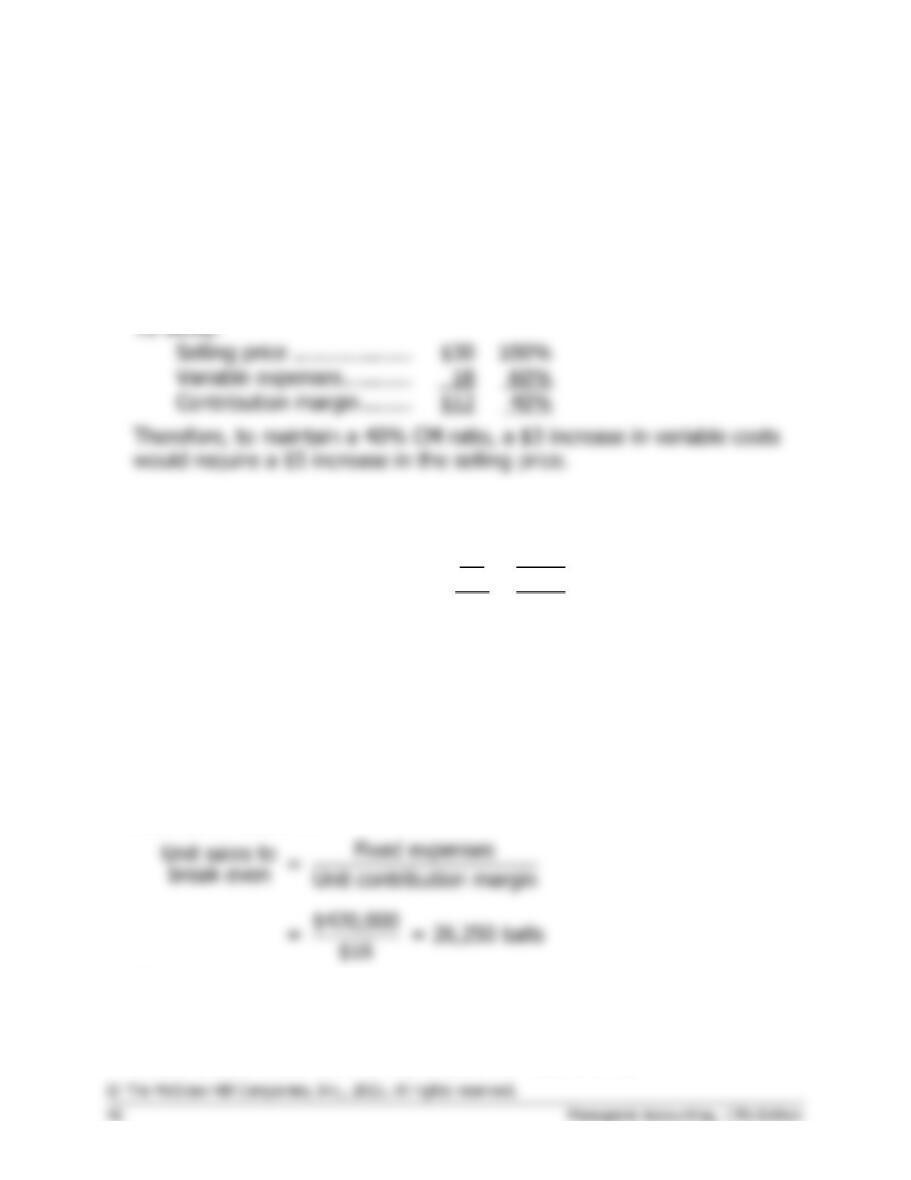
organization. The effects on Northwood Company are summarized
below:
Break-even point (in balls) …………………………...
Sales (in balls) needed to earn a $90,000 profit ..
Problem 5-20 (continued)
4. The contribution margin ratio last year was 40%. If we let P equal the
new selling price, then:
P =
$18 + 0.40P
0.60P =
$18
P =
$18 ÷ 0.60
P =
$30
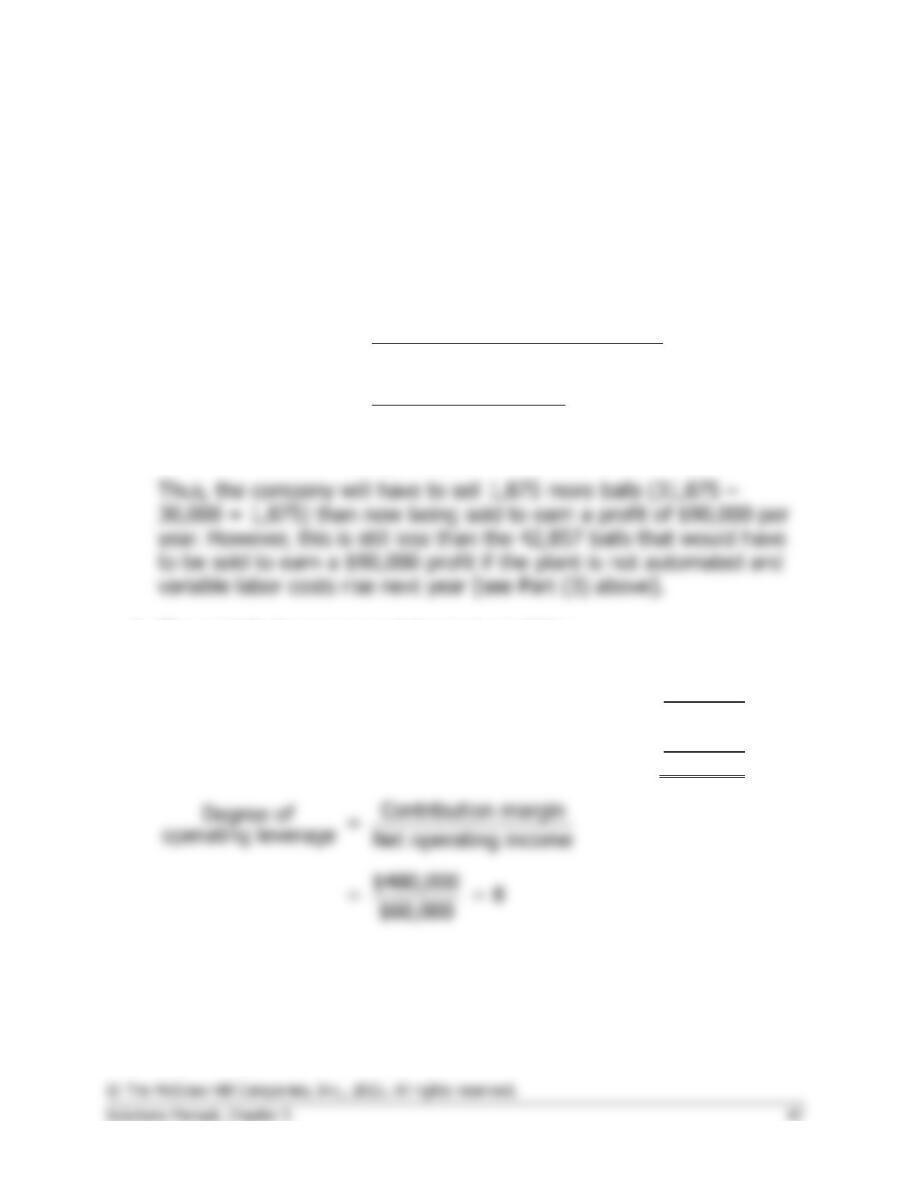
Selling price ……………….
$30
100%
Variable expenses ………..
Contribution margin ……..
5. The new CM ratio would be:
Selling price ……………………
$25
100%
Variable expenses …………….
9*
36%
Contribution margin ………….
$16
64%
*$15 – ($15 × 40%) = $9
The new break-even point would be:
Profit
= Unit CM × Q − Fixed expenses
$0
= $16 × Q – ($210,000 × 2)
$16Q
= $420,000
Q
= $420,000 ÷ $16
Q
= 26,250 balls
Alternative solution:
Although this new break-even point is greater than the company’s
present break-even point of 21,000 balls [see Part (1) above], it is less
than the break-even point will be if the company does not automate and
variable labor costs rise next year [see Part (2) above].
Problem 5-20 (continued)
6.
a.
Profit
= Unit CM × Q − Fixed expenses
$90,000
= $16 × Q − $420,000
$16Q
= $90,000 + $420,000
Q
= $510,000 ÷ $16
Q
= 31,875 balls
Alternative solution:
Unit sales to attain Target profit + Fixed expenses
=
target profit Unit contribution margin
$90,000 + $420,000
=
$16
= 31,875 balls
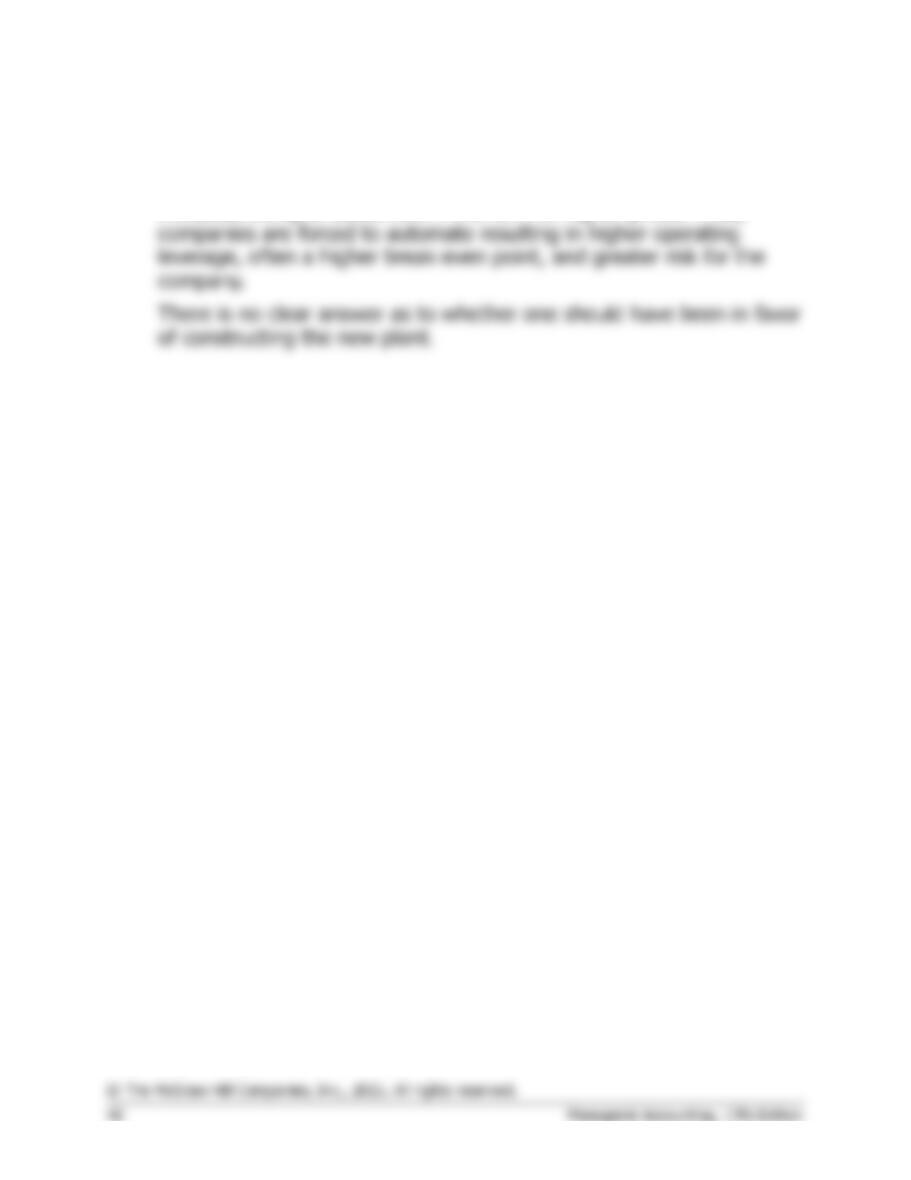
b. The contribution income statement would be:
Sales (30,000 balls × $25 per ball) ………………..
$750,000
Variable expenses (30,000 balls × $9 per ball) …
270,000
Contribution margin ……………………………………
480,000
Fixed expenses ………………………………………….
420,000
Net operating income …………………………………
$ 60,000
Problem 5-20 (continued)
c. This problem illustrates the difficulty faced by some companies. When
variable labor costs increase, it is often difficult to pass these cost
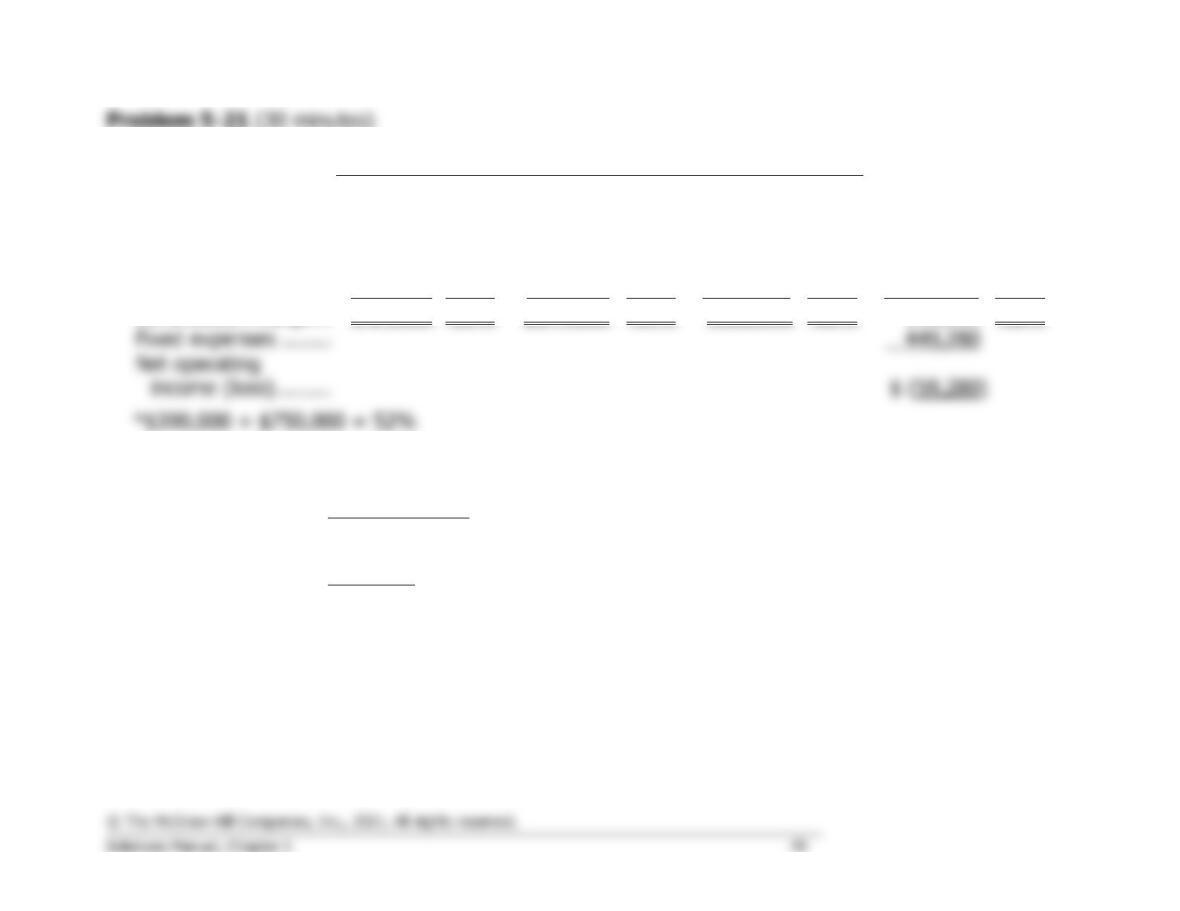
1.
Product
White
Fragrant
Loonzain
Total
Percentage of total
sales …………………
40%
24%
36%
100%
Sales …………………..
$300,000
100%
$180,000
100%
$270,000
100%
$750,000
100%
Variable expenses ….
216,000
72%
36,000
20%
108,000
40%
360,000
48%
Contribution margin ..
$ 84,000
28%
$144,000
80%
$162,000
52%
*
Fixed expenses ……..
449,280
Net operating
2. Break-even sales would be:
Fixed expenses
Dollar sales to =
break even CM ratio
$449,280
= = $864,000
0.52
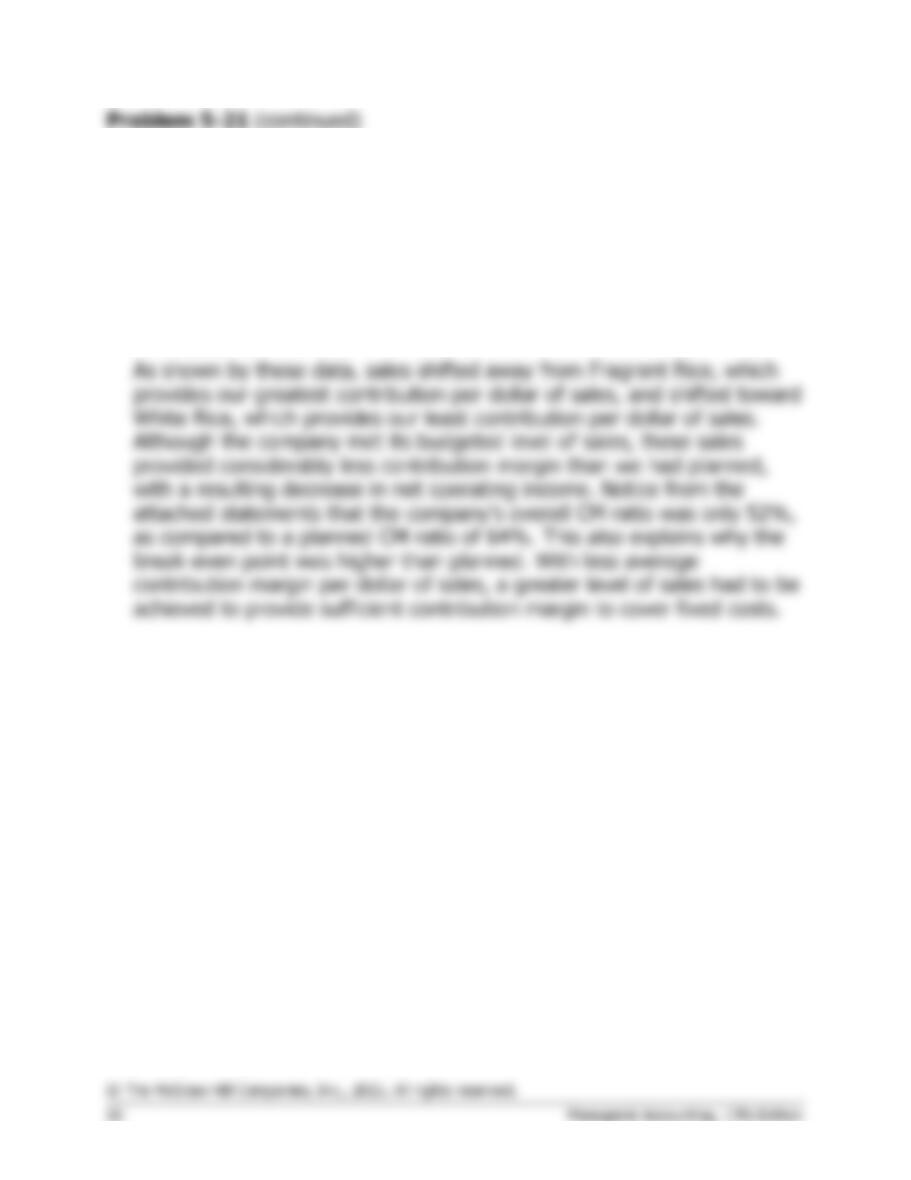
3. Memo to the president:
Although the company met its sales budget of $750,000 for the month,
the mix of products changed substantially from that budgeted. This is
the reason the budgeted net operating income was not met, and the
reason the break-even sales were greater than budgeted. The
company’s sales mix was planned at 20% White, 52% Fragrant, and
28% Loonzain. The actual sales mix was 40% White, 24% Fragrant, and
36% Loonzain.
Problem 5-22 (60 minutes)
1. The CM ratio is 30%.
Total
Per Unit
Percent of Sales
Sales (19,500 units) ……..
$585,000
$30.00
100%
Variable expenses ………..
409,500
21.00
70%
Contribution margin ………
$175,500
$ 9.00
30%
The break-even point is:
Profit
= Unit CM × Q − Fixed expenses
$0
= ($30 − $21) × Q − $180,000
$0
= ($9) × Q − $180,000
$9Q
= $180,000
Q
= $180,000 ÷ $9
Q
= 20,000 units
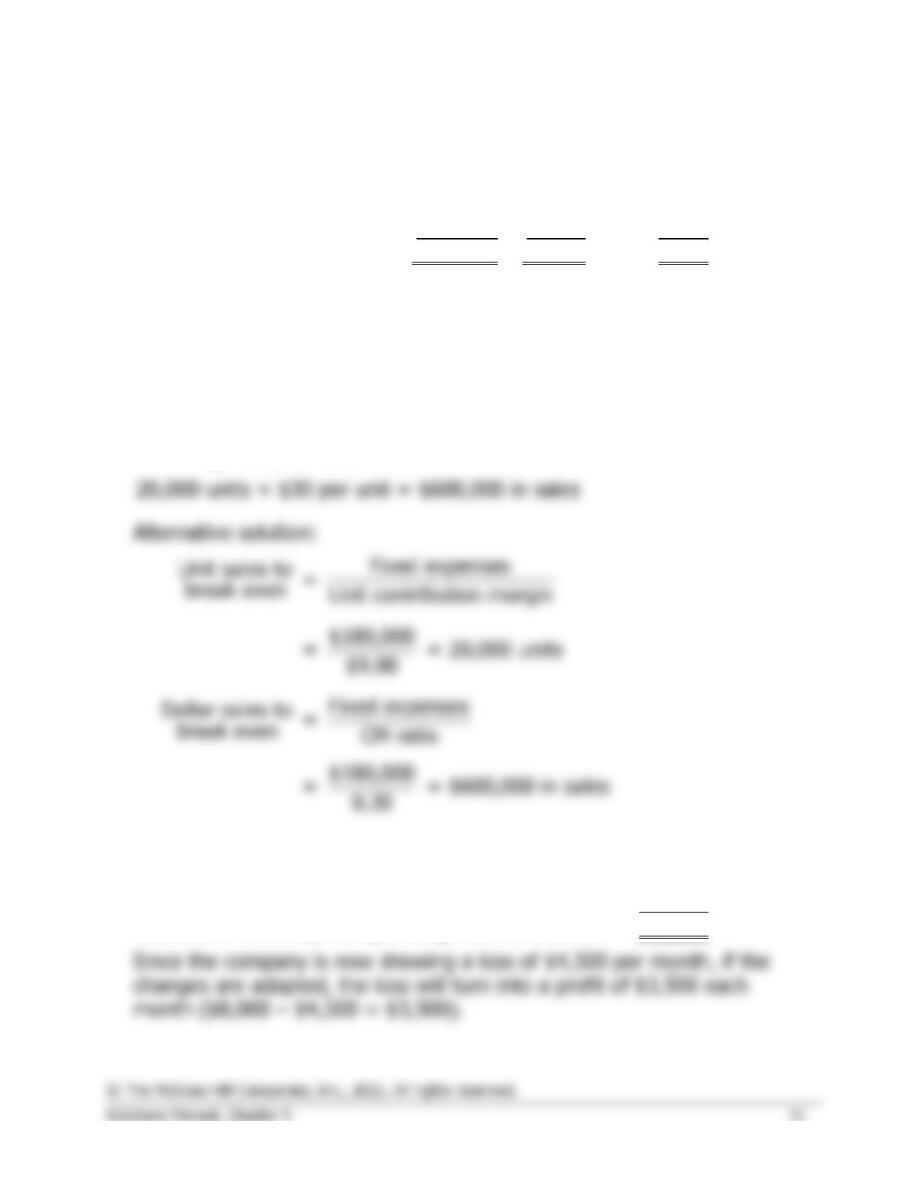
20,000 units × $30 per unit = $600,000 in sales
2.
Incremental contribution margin:
$80,000 increased sales × 0.30 CM ratio …………
$24,000
Less increased advertising cost ……………………….
16,000
Increase in monthly net operating income …………
$ 8,000
Problem 5-22 (continued)
3.
Sales (39,000 units @ $27.00 per unit*) ………
$1,053,000
Variable expenses
(39,000 units @ $21.00 per unit) ……………..
819,000
Contribution margin ………………………………..
234,000
Fixed expenses ($180,000 + $60,000) ………..
240,000
Net operating loss …………………………………..
$ (6,000)
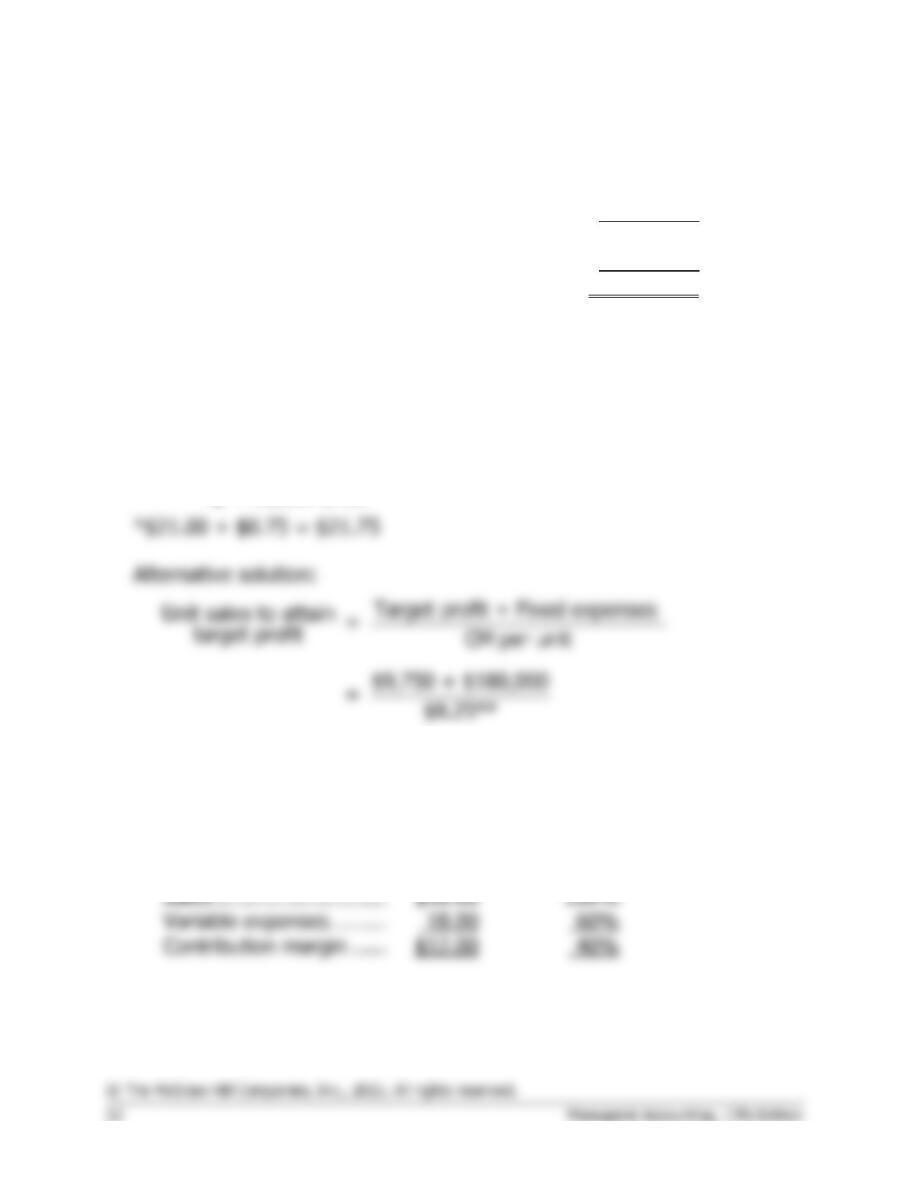
*$30.00 – ($30.00 × 0.10) = $27.00
4.
Profit
= Unit CM × Q − Fixed expenses
$9,750
= ($30.00 − $21.75) × Q − $180,000
$9,750
= ($8.25) × Q − $180,000
$8.25Q
= $189,750
Q
= $189,750 ÷ $8.25
Q
= 23,000 units
= 23,000 units
**$30.00 – $21.75 = $8.25
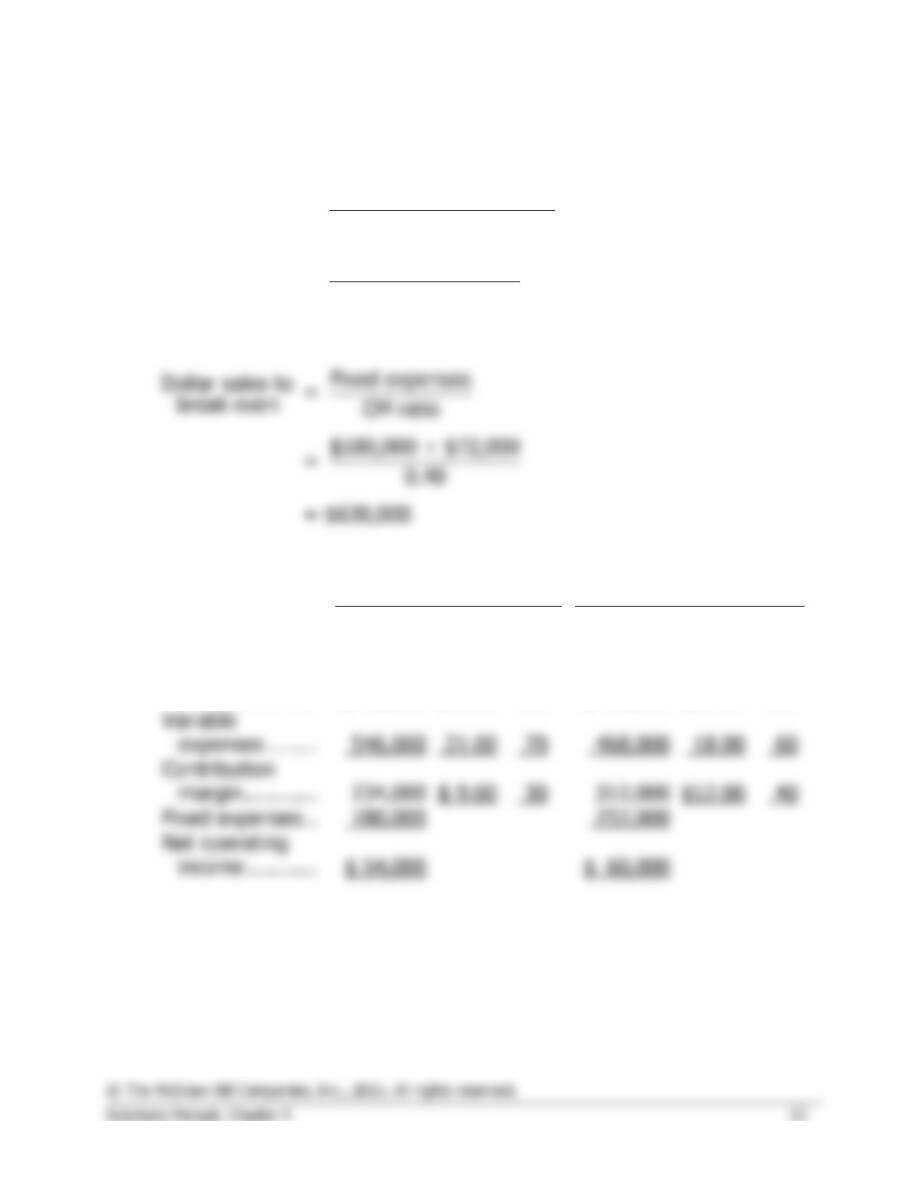
5. a. The new CM ratio would be:
Per Unit
Percent of Sales
Sales ……………………….
$30.00
Variable expenses ………
18.00
Contribution margin ……
$12.00
Problem 5-22 (continued)
The new break-even point would be:
Fixed expenses
Unit sales to =
break even Unit contribution margin
$180,000 + $72,000
=
$12.00
= 21,000 units
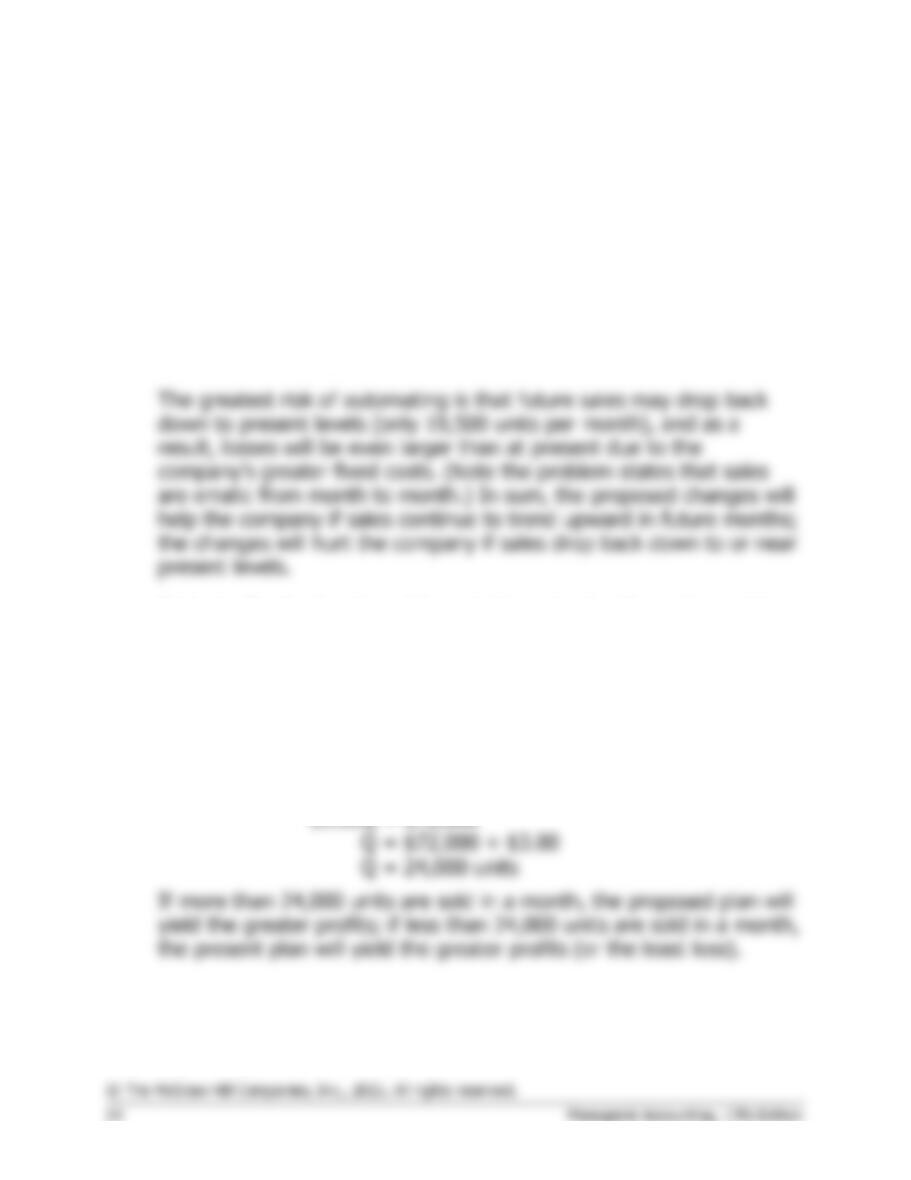
b. Comparative income statements follow:
Not Automated
Automated
Total
Per
Unit
%
Total
Per
Unit
%
Sales (26,000
units)…………..
$780,000
$30.00
100
$780,000
$30.00
100
21.00
Contribution
$ 9.00
$12.00
Problem 5-22 (continued)
c. Whether or not the company should automate its operations depends
on how much risk the company is willing to take and on prospects for
future sales. The proposed changes would increase the company’s
fixed costs and its break-even point. However, the changes would
also increase the company’s CM ratio (from 0.30 to 0.40). The higher
CM ratio means that once the break-even point is reached, profits will
increase more rapidly than at present. If 26,000 units are sold next
month, for example, the higher CM ratio will generate $6,000 (=
$60,000 – $54,000) more in profits than if no changes are made.
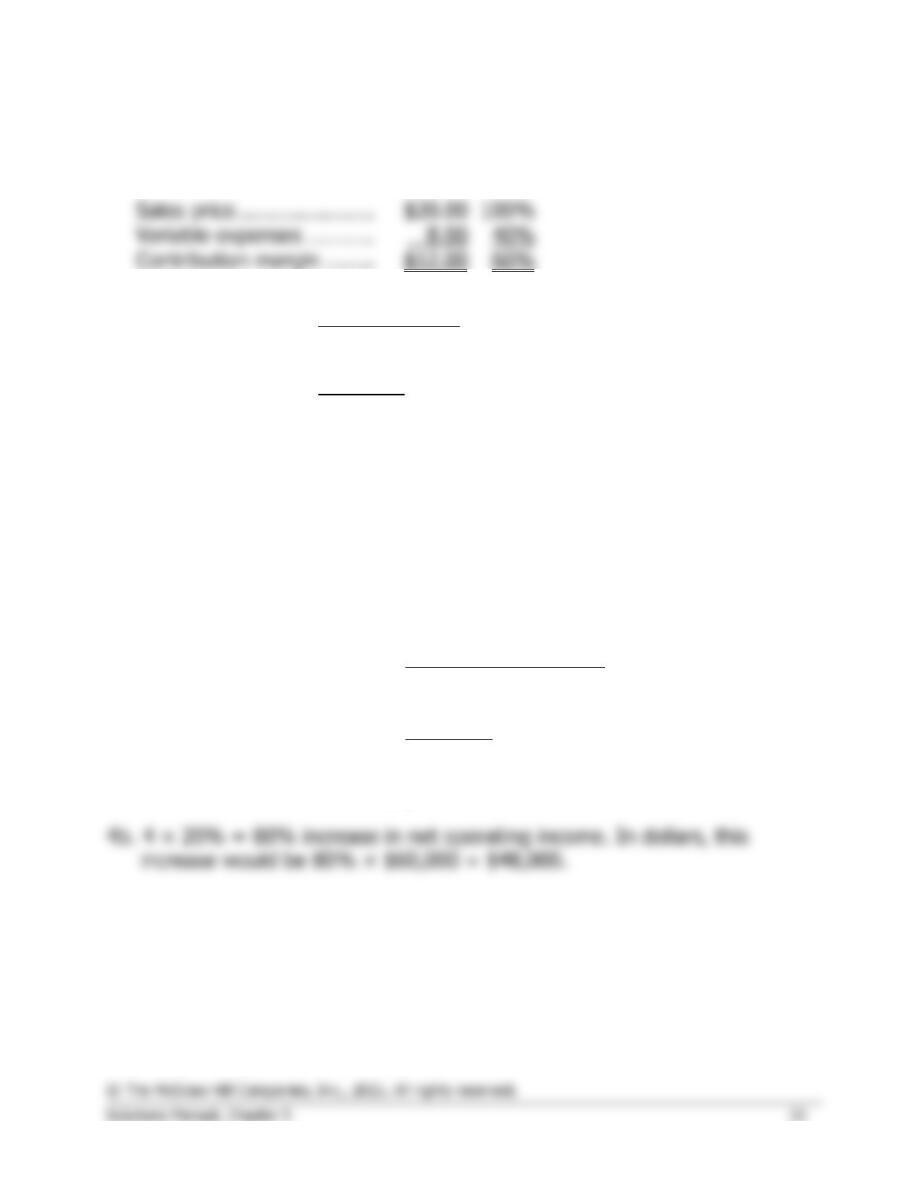
Note to the Instructor: Although it is not asked for in the problem,
if time permits you may want to compute the point of indifference
between the two alternatives in terms of units sold; i.e., the point
where profits will be the same under either alternative. At this point,
total revenue will be the same; hence, we include only costs in our
equation:
Let Q =
Point of indifference in units sold
$21.00Q + $180,000 =
$18.00Q + $252,000
24,000 units
Problem 5-23 (60 minutes)
1. The CM ratio is 60%:
2.
Fixed expenses
Dollar sales to =
break even CM ratio
$180,000
=
0.60
= $300,000
3. $75,000 increased sales × 0.60 CM ratio = $45,000 increased
contribution margin. Because the fixed costs will not change, net
operating income should also increase by $45,000.
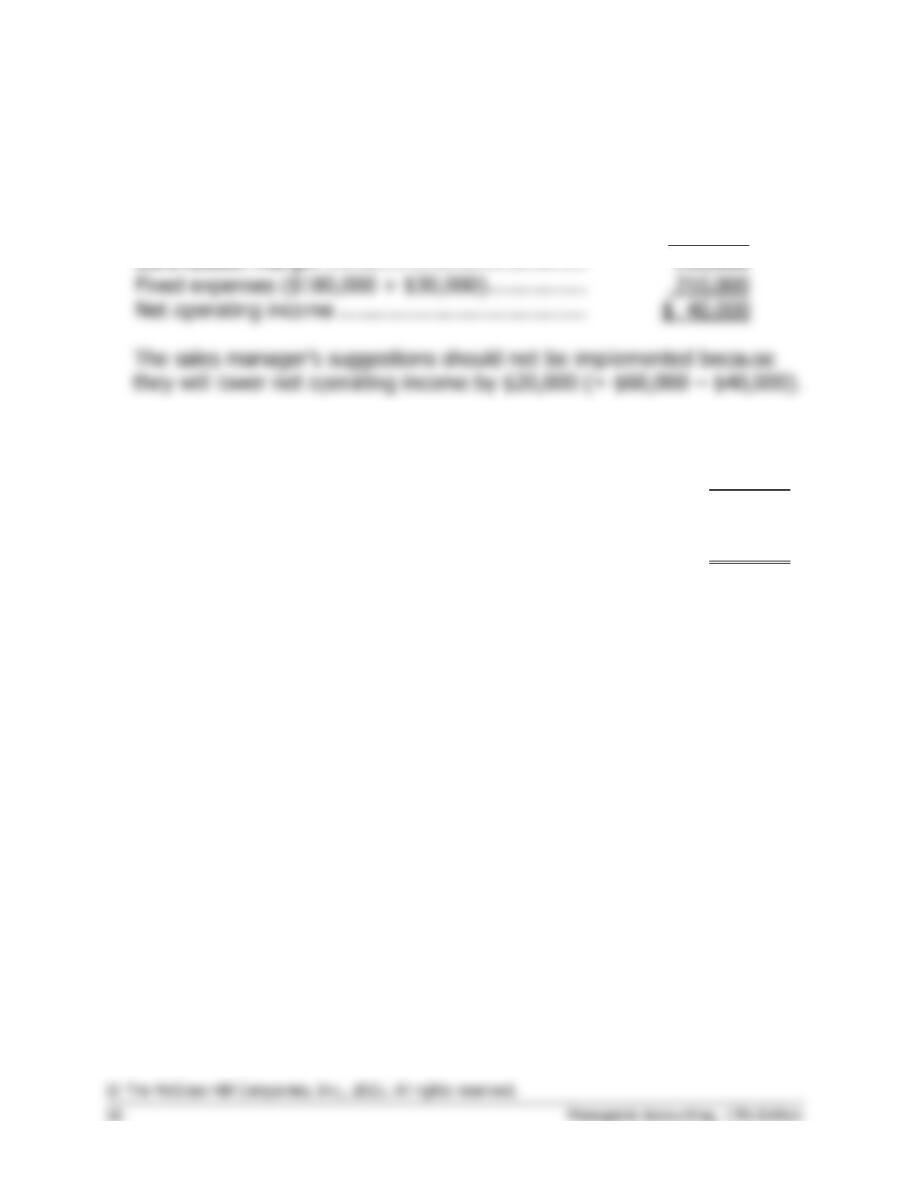
4a. The degree of operating leverage is calculated as follows:
Contribution margin
Degree of
=
operating leverage Net operating income
$240,000
=
$60,000
= 4
Problem 5-23 (continued)
5. This year’s net operating income is computed as follows:
Sales (25,000 units × $18 per unit) ………………..
$450,000
Variable expenses (25,000 units × $8 per unit) …
200,000
Contribution margin ……………………………………
Fixed expenses ($180,000 + $30,000) …………….
Net operating income ………………………………….
6.
Expected total contribution margin:
20,000 units × 1.25 × $11.00 per unit* ……………………
$275,000
Present total contribution margin ………………………………
240,000
Incremental contribution margin, and the amount by
which advertising can be increased with net operating
income remaining unchanged…………………………………
$ 35,000
*$20.00 – ($8.00 + $1.00) = $11.00
Problem 5-24 (30 minutes)
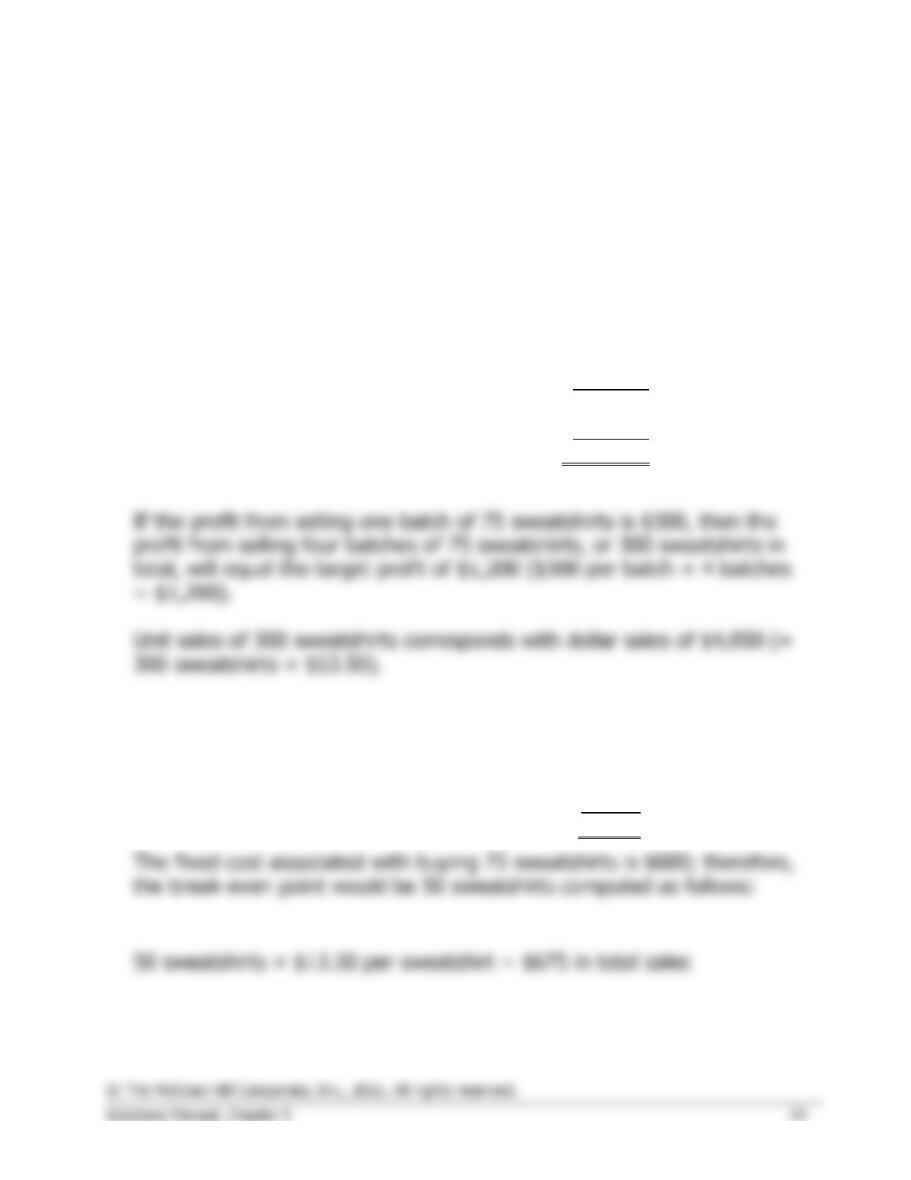
The key to solving the requirements of this problem is understanding that
the sweatshirts represent a step-fixed cost. They cannot be purchased at a
cost of $8 each. They must be bought in batches of 75 sweatshirts at a
cost of $600 per batch (75 sweatshirts × $8 per shirt = $600 per batch).
1. A good starting point for solving this problem is to compute the profit
from buying and selling one batch of 75 sweatshirts:
Sales (75 shirts × $13.50) ……………………
$1,012.50
Variable expenses (75 shirts × $1.50) …….
112.50
Contribution margin …………………………...
900.00
Step-fixed expense ($600 × 1 batch) ……..
600.00
Net operating income ………………………….
$ 300.00
2. The contribution margin per sweatshirt is:
Selling price …………………………………..
$13.50
Variable expenses …………………………..
1.50
Contribution margin …………………………
$12.00
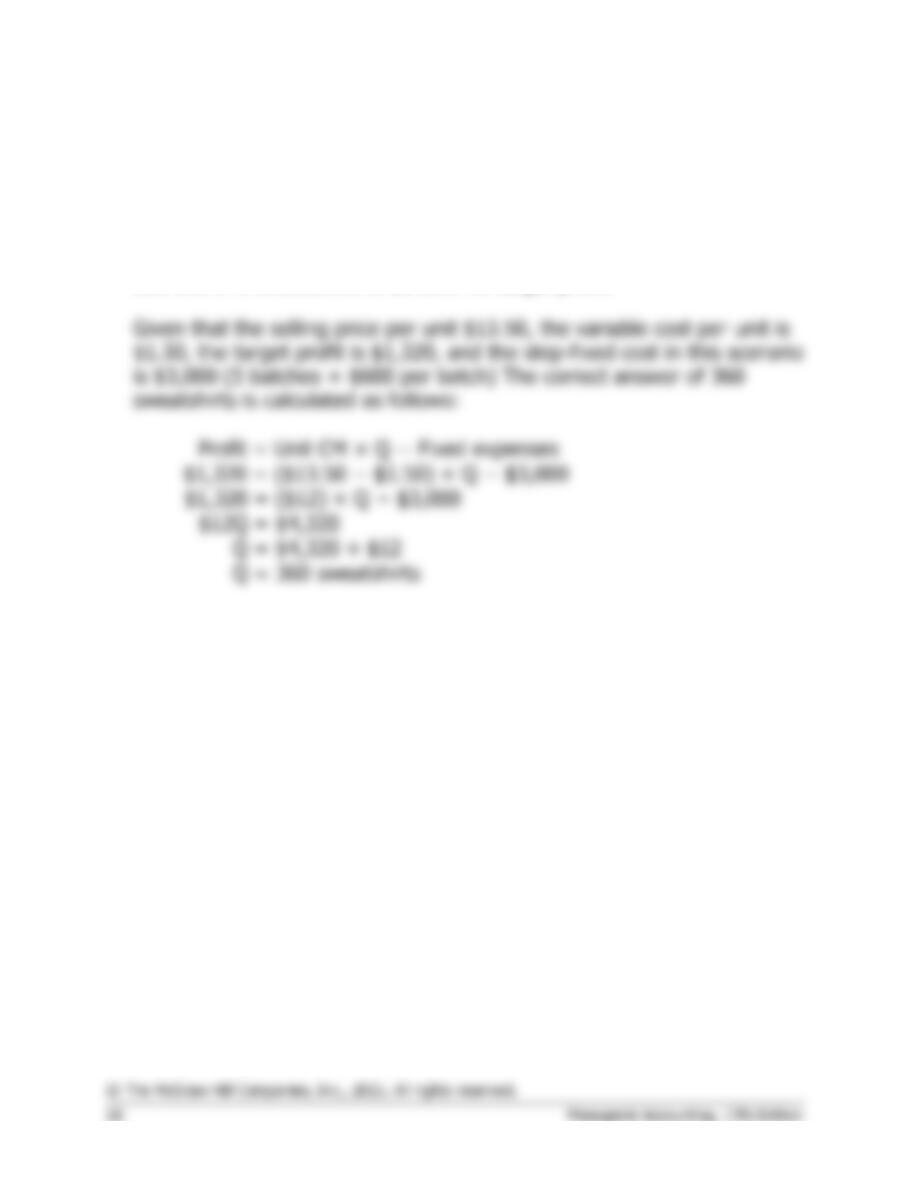
Problem 5-24 (continued)
3. Purchasing four batches of sweatshirts, or a total of 300 sweatshirts,
yields a profit of $1,200. If Hooper purchased and sold five batches of
sweatshirts, or a total of 375 sweatshirts, he would earn a profit of
$1,500 ($1,200 + $300). Since the target profit of $1,320 is between
$1,200 and $1,500, Hooper will need to attain a sales volume between
300 and 375 sweatshirts to achieve his target profit.
Problem 5-25 (60 minutes)
1. The break-even point is calculated as follows:
Profit
= Unit CM × Q − Fixed expenses
$0
= ($3 − $1) × Q − $22,000
$0
= ($2) × Q − $22,000
$2Q
= $22,000
Q
= $22,000 ÷ $2
Q
= 11,000 units
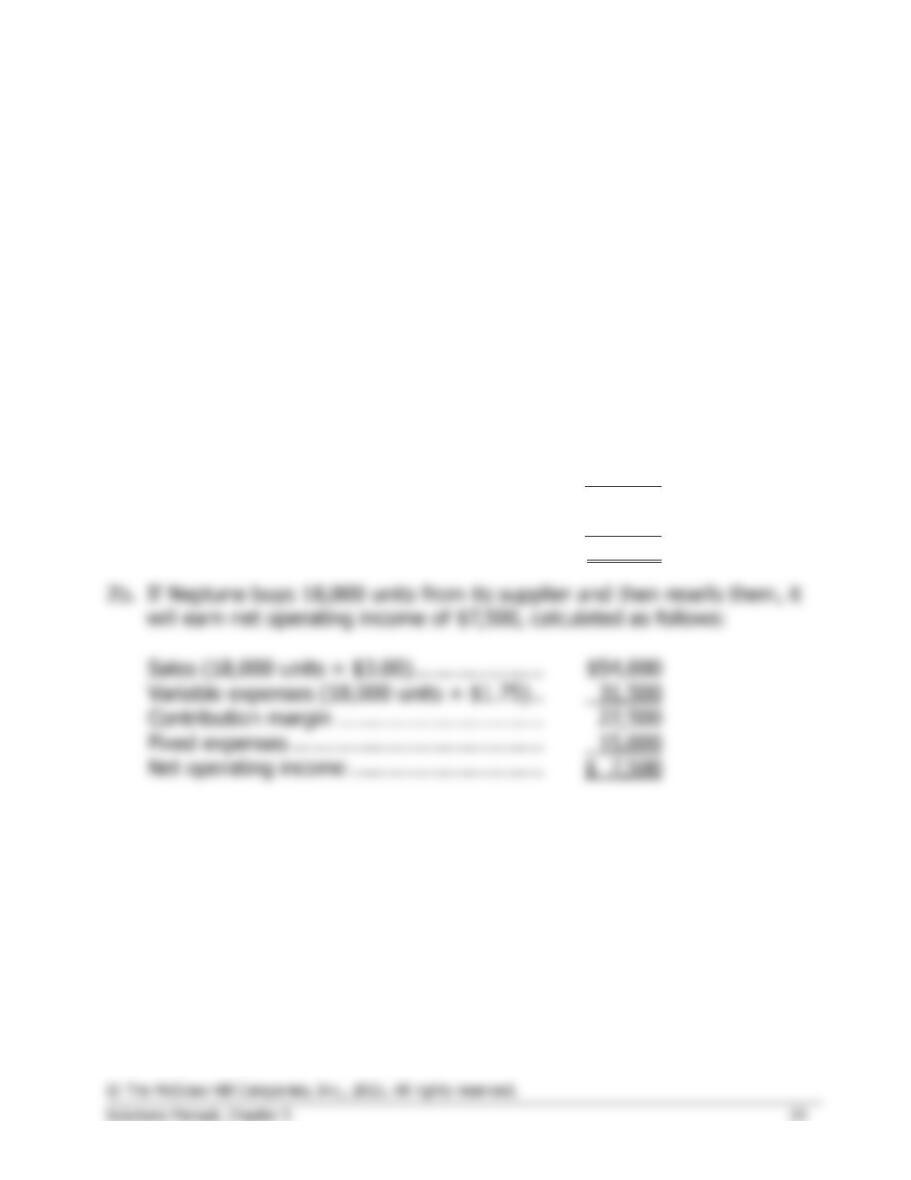
2a. If Neptune produces and sells 18,000 units, it will earn net operating
income of $14,000, calculated as follows:
Sales (18,000 units × $3.0) ………………….
$54,000
Variable expenses (18,000 units × $1.00) ..
18,000
Contribution margin …………………………...
36,000
Fixed expenses ………………………………….
22,000
Net operating income ………………………….
$14,000
Sales (18,000 units × $3.00)…………………
Variable expenses (18,000 units × $1.75) ..
Contribution margin …………………………...
Fixed expenses ………………………………….
15,000
Net operating income ………………………….
Problem 5-25 (continued)
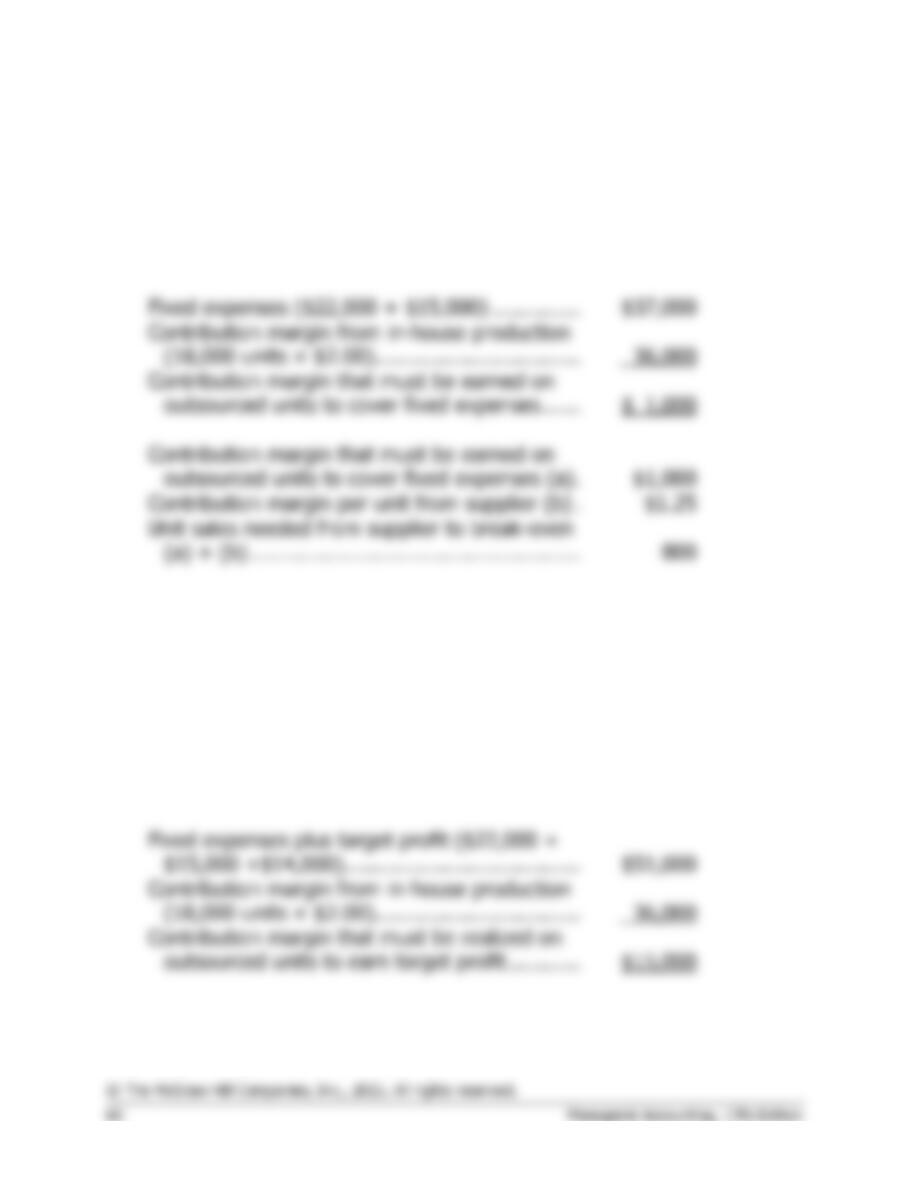
3. In this scenario, the total fixed expenses are $37,000 ($22,000 +
$15,000), the contribution margin per unit for the first 18,000 units
produced in-house is $2.00 per unit, and the contribution margin per
unit for each unit produced by the supplier is $1.25 per unit. Thus, the
break-even point of 18,800 units is computed as follows:
The total unit sales required to break-even is 18,000 units produced in-
house plus 800 units provided by the supplier, or a total of 18,800
units.
4a. In this scenario, the total fixed expenses plus target profit is $51,000
($22,000 + $15,000 +$14,000), the contribution margin per unit for
the first 18,000 units produced in-house is $2.00 per unit, and the
contribution margin per unit for each unit produced by the supplier is
$1.25 per unit. Thus, the required unit sales is computed as follows: