
CHAPTER 19 (FIN MAN); CHAPTER 5 (MAN)
SUPPORT DEPARTMENT AND JOINT COST ALLOCATION
DISCUSSION QUESTIONS
1. Support department costs are only indirectly related to production, so it can be difficult to find an
appropriate cost driver for applying these costs to a product. For example, maintenance services are
necessary for safe and efficient production, but applying maintenance costs to products based on
units produced, batches run, or the number of product lines is not entirely accurate, because none
of these potential drivers cause, by themselves, the maintenance cost to occur.
3. When a single driver is used for all overhead costs, it is unlikely that the driver selected is
5. Management normally determines the order based on the following: Departments with higher costs
are allocated earlier, departmments serving a large number of support departments are allocated
earlier, and departments with more accurate cost drivers are allocated earlier.
6. Large companies are more likely to use the reciprocal services method. This is because the larger a
company is, the more likely it is that cost allocation methods will yield substantially different
results. Thus, the cost of using the more accurate reciprocal services method will be justified in
spite of the complexity of this method.
9. Revenue from by-products is most often either used to offset the cost of the joint production
process or reported as other reveue on the income statement with no related cost of goods sold.
10. Production employees are often evaluated, at least in part, on their ability to keep production
CHAPTER 19 (FIN MAN); CHAPTER 5 (MAN) Support Department and Joint Cost Allocation
BASIC EXERCISES
BE 19–1 (FIN MAN); BE 5–1 (MAN)
a. Percentage of Janitorial costs to be allocated to the Assembly Department:
46,400 ÷ (33,600 + 46,400) = 58%
BE 19–2 (FIN MAN); BE 5–2 (MAN)
a. Percentage of Cafeteria costs to be allocated to the Molding Department:
27 ÷ (27 + 30 + 3) = 45%
BE 19–3 (FIN MAN); BE 5–3 (MAN)
a. Percentage of Janitorial costs to be allocated to the Security Department:
CHAPTER 19 (FIN MAN); CHAPTER 5 (MAN) Support Department and Joint Cost Allocation
BE 19–4 (FIN MAN); BE 5–4 (MAN)
Joint Product
Guns per Batch
Proportion
Joint Costs
Allocation
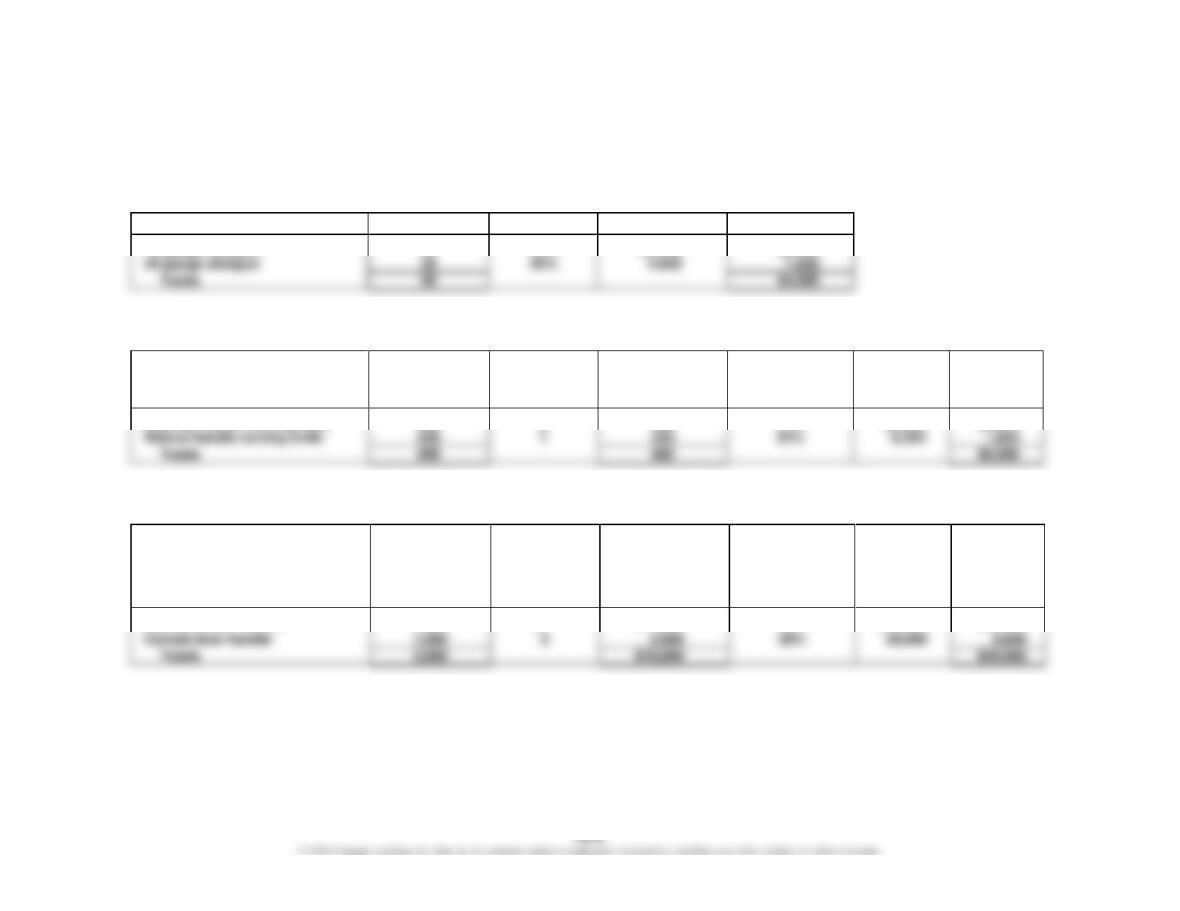
BE 19–5 (FIN MAN); BE 5–5 (MAN)
Joint Product
Knife Blades at
Split-Off
Weight Factor
Weighted Blades
of Molding Time
Weighted
Percent of
Molding Time
Joint Costs
Allocation
Red oak handle carving knife
$6,500
$4,875
$6,500
BE 19–6 (FIN MAN); BE 5–6 (MAN)
Joint Product
Door Handles at
Split-Off
Selling Price
per Door
Handle at
Split-Off
Total Market
Value at Split-Off
Percent of Total
Market Value at
Split-Off
Joint Costs
Allocation
Standard door handle
2,000
$4
$ 8,000
80%
$29,000
$23,200
Curved door handle
29,000
CHAPTER 19 (FIN MAN); CHAPTER 5 (MAN) Support Department and Joint Cost Allocation
EXERCISES
Ex. 19–1 (FIN MAN); Ex. 5–1 (MAN)
Support Department 1 cost allocation:
Production Department 1:
1,400 ÷ (1,400 + 100 + 500) = 70%
70% × $142,000 = $99,400
5% × $142,000 = $7,100
Production Department 3:
500 ÷ (1,400 + 100 + 500) = 25%
Ex. 19–2 (FIN MAN); Ex. 5–2 (MAN)
Support Department 1 cost allocation:
Support Department 2:
7 ÷ (7 + 25 + 18) = 14%
14% × $20,000 = $2,800
50% × $20,000 = $10,000
36% × $20,000 = $7,200
Ex. 19–3 (FIN MAN); Ex. 5–3 (MAN)
Total cost to be allocated from Security Department (S):
Total costs of Security Department include 10 ÷ (10 + 40 + 50) = 10% of Cafeteria
Department costs
Thus, S = $273,000 + (0.1 × C)
CHAPTER 19 (FIN MAN); CHAPTER 5 (MAN) Support Department and Joint Cost Allocation
Ex. 19–3 (FIN MAN); Ex. 5–3 (MAN) (Concluded)
Security Department cost allocation:
Cafeteria Department:
2,400 ÷ (2,400 + 4,000 + 1,600) = 30%
30% × $300,000 = $90,000
Laser Department:
4,000 ÷ (2,400 + 4,000 + 1,600) = 50%
50% × $300,000 = $150,000
Forming Department:
1,600 ÷ (2,400 + 4,000 + 1,600) = 20%
20% × $300,000 = $60,000
Ex. 19–4 (FIN MAN); Ex. 5–4 (MAN)
Maintenance Department cost allocation:
Cutting Department:
9 ÷ (9 + 1) = 90%
90% × $7,800 = $7,020
Pruning Department:
1 ÷ (9 + 1) = 10%
25% × $5,000 = $1,250
Pruning Department:
10% × $7,800 = $780
Production departments’ total costs:
Cutting Department:
$7,020 + $1,250 + $54,500 = $62,770
Pruning Department:
$780 + $3,750 + $11,000 = $15,530
Ex. 19–5 (FIN MAN); Ex. 5–5 (MAN)
Security Department cost allocation:
10% × $3,000 = $300
3,200 ÷ (800 + 3,200 + 4,000) = 40%
40% × $3,000 = $1,200
4,000 ÷ (800 + 3,200 + 4,000) = 50%
50% × $3,000 = $1,500
CHAPTER 19 (FIN MAN); CHAPTER 5 (MAN) Support Department and Joint Cost Allocation
Ex. 19–5 (FIN MAN); Ex. 5–5 (MAN) (Concluded)
Maintenance Department cost allocation:
Cutting Department:
3,700 ÷ (3,700 + 5,550) = 40%
40% × $2,600 = $1,040
60% × $2,600 = $1,560
Sewing Department:
$1,500 + $1,560 + $20,800 = $23,860
Ex. 19–6 (FIN MAN); Ex. 5–6 (MAN)
Total cost to be allocated from Maintenance Department (M):
Total costs of Maintenance include $2,000 ÷ ($2,000 + $2,500 + $5,500) = 20%
of Security costs
Thus, M = $36,000 + (0.2 × S)
Now plug the value for S into the M equation:
M = $36,000 + (0.2 × $20,000)
= $36,000 + $4,000
= $40,000
Maintenance Department cost allocation:
Security Department:
2,000 ÷ (2,000 + 7,200 + 10,800) = 10%
10% × $40,000 = $4,000
Cutting Department:
7,200 ÷ (2,000 + 7,200 + 10,800) = 36%
36% × $40,000 = $14,400
Sewing Department:
10,800 ÷ (2,000 + 7,200 + 10,800) = 54%
CHAPTER 19 (FIN MAN); CHAPTER 5 (MAN) Support Department and Joint Cost Allocation
Ex. 19–6 (FIN MAN); Ex. 5–6 (MAN) (Concluded)
Security Department cost allocation:
Maintenance Department:
$2,000 ÷ ($2,000 + $2,500 + $5,500) = 20%
20% × $20,000 = $4,000
Cutting Department:
$2,500 ÷ ($2,000 + $2,500 + $5,500) = 25%
25% × $20,000 = $5,000
Sewing Department:
$5,500 ÷ ($2,000 + $2,500 + $5,500) = 55%
55% × $20,000 = $11,000
Production departments’ total costs:
Cutting Department:
$14,400 + $5,000 + $64,000 = $83,400
Sewing Department:
$21,600 + $11,000 + $82,000 = $114,600
Ex. 19–7 (FIN MAN); Ex. 5–7 (MAN)
Janitorial Department cost allocation:
20% × $310,000 = $62,000
Assembly Department:
4,000 ÷ (1,000 + 4,000) = 80%
80% × $310,000 = $248,000
Cafeteria Department cost allocation:
Cutting Department:
30 ÷ (30 + 10) = 75%
75% × $169,000 = $126,750
Assembly Department:
10 ÷ (30 + 10) = 25%
25% × $169,000 = $42,250
Ex. 19–8 (FIN MAN); Ex. 5–8 (MAN)
Cafeteria Department:
5,000 ÷ (5,000 + 1,000 + 4,000) = 50%
50% × $310,000 = $155,000
Cutting Department:
1,000 ÷ (5,000 + 1,000 + 4,000) = 10%
10% × $310,000 = $31,000
Assembly Department:
4,000 ÷ (5,000 + 1,000 + 4,000) = 40%
CHAPTER 19 (FIN MAN); CHAPTER 5 (MAN) Support Department and Joint Cost Allocation
Ex. 19–8 (FIN MAN); Ex. 5–8 (MAN) (Concluded)
Cafeteria Department total cost to be allocated:
$169,000 + $155,000 = $324,000
Ex. 19–9 (FIN MAN); Ex. 5–9 (MAN)
Total cost to be allocated from the Janitorial Department (J):
Total costs of Janitorial include 10 ÷ (10 + 30 + 10) = 20% of Cafeteria costs
J = $310,000 + (0.2 × C)
Now plug the value for C into the J equation:
J = $310,000 + (0.2 × $360,000)
= $310,000 + $72,000
= $382,000
Janitorial Department cost allocation:
CHAPTER 19 (FIN MAN); CHAPTER 5 (MAN) Support Department and Joint Cost Allocation
Ex. 19–9 (FIN MAN); Ex. 5–9 (MAN) (Concluded)
Cafeteria Department cost allocation:
Janitorial Department:
10 ÷ (10 + 30 + 10) = 20%
20% × $360,000 = $72,000
Ex. 19–10 (FIN MAN); Ex. 5–10 (MAN)
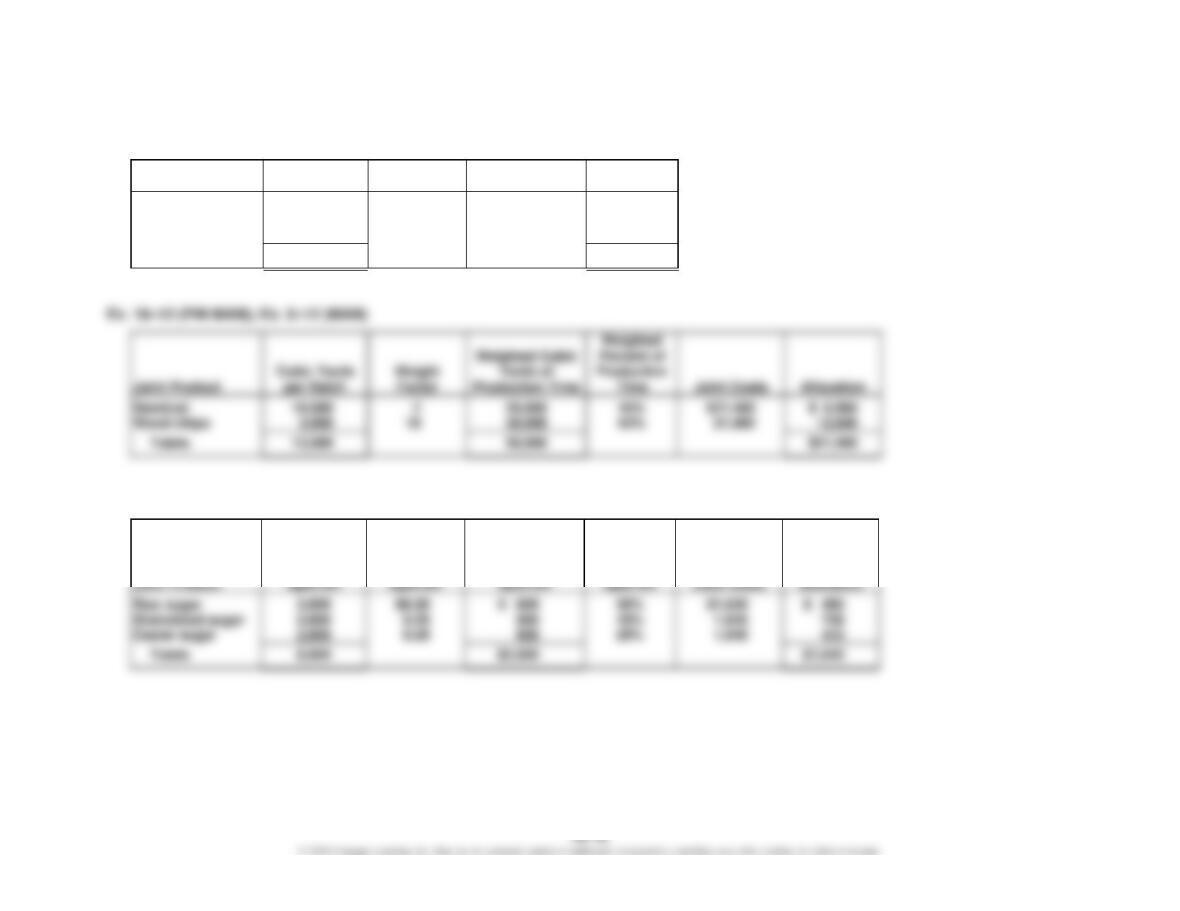
a. Under the direct method, the Assembly Department is allocated the most
support department costs, as follows:
Cutting Department:
$62,000 + $126,750 = $188,750
Assembly Department:
$248,000 + $42,250 = $290,250
Cutting Department:
$38,200 + $216,000 = $254,200
Assembly Department:
$152,800 + $72,000 = $224,800
CHAPTER 19 (FIN MAN); CHAPTER 5 (MAN) Support Department and Joint Cost Allocation
Ex. 19–11 (FIN MAN); Ex. 5–11 (MAN)
Joint Product
Boards
per Batch
Proportion
Joint Costs
Allocation
Washed
45
45%
$710
$319.50
Stained
35
35%
710
248.50
Pressure treated
20
20%
710
142.00
Totals
100
$710.00
Sawdust
Wood chips
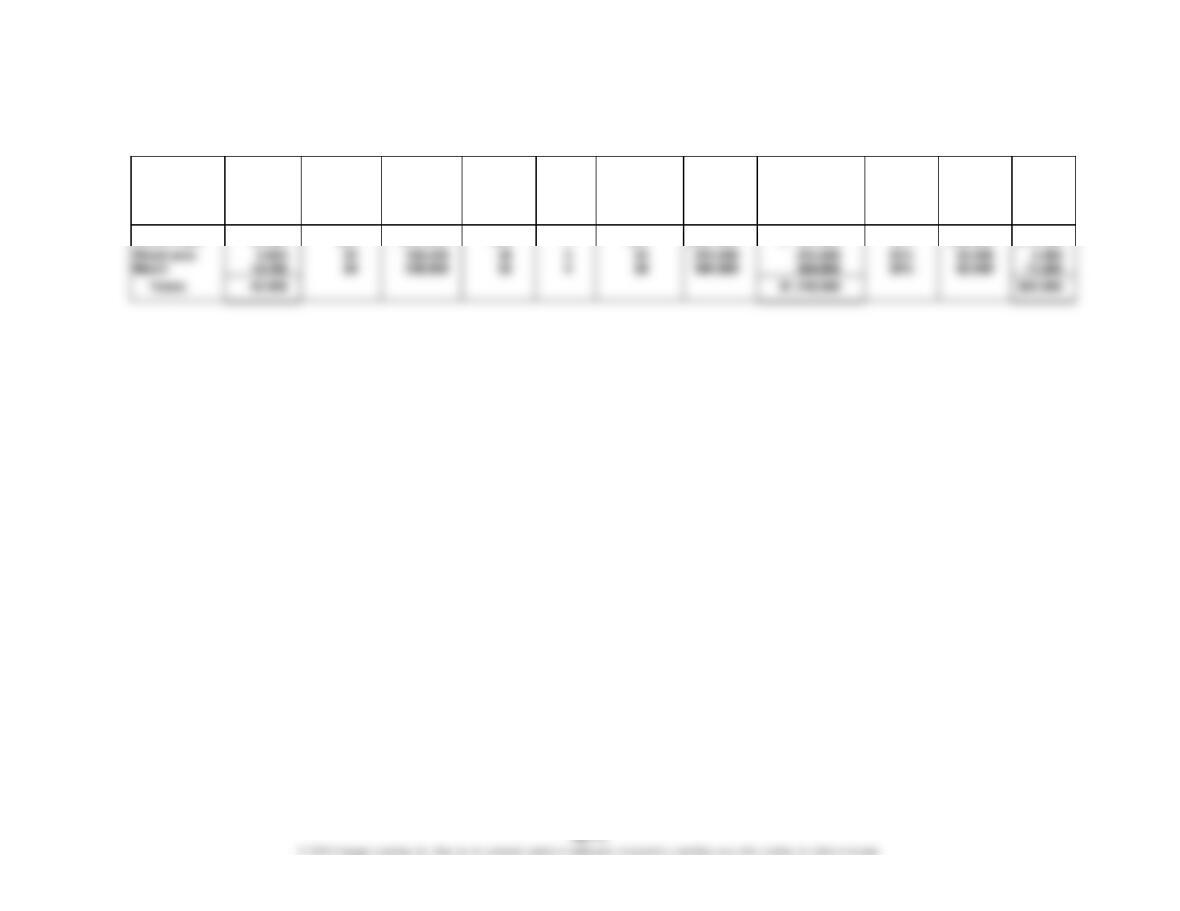
Ex. 19–13 (FIN MAN); Ex. 5–13 (MAN)
Split-Off
Raw sugar
900
500
Pounds at
Market Value
per Pound at
Total Market
Value at
Percent of
Total Market
Value at
CHAPTER 19 (FIN MAN); CHAPTER 5 (MAN) Support Department and Joint Cost Allocation
Ex. 19–14 (FIN MAN); Ex. 5–14 (MAN)
Joint Product
Cubic Yards
per Batch
Market Value
per Cubic
Yard at
Split-Off
Total Market
Value at
Split-Off
Market
Price
per Cubic
Yard
Added
Cost per
Cubic
Yard
Net Realizable
Value per
Cubic Yard
Total Net
Realizable
Value
Greater of Total
NRV and Market
Value at Split-Off
Proportion
Joint Costs
Allocation
Wood pulp
198,528
6,400
Mulch
338,400
CHAPTER 19 (FIN MAN); CHAPTER 5 (MAN) Support Department and Joint Cost Allocation
Ex. 19–15 (FIN MAN); Ex. 5–15 (MAN)
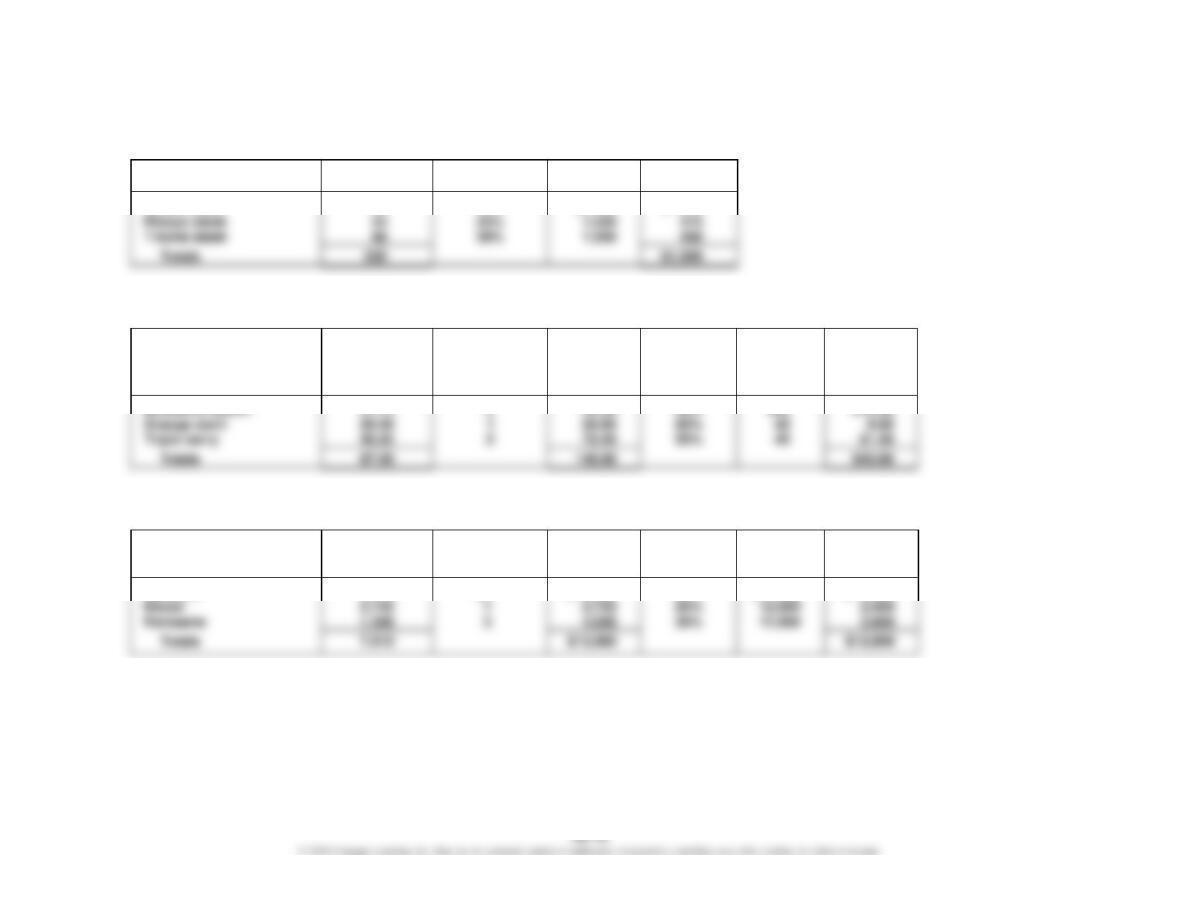
Joint Product
Pounds at
Split-Off
Proportion
Joint Costs
Allocation
Sirloin steak
99
45%
$1,500
$ 675
Ex. 19–16 (FIN MAN); Ex. 5–16 (MAN)
Joint Product
Cups per
Batch
Weight
Factor
Weighted
Cups of
Mixing Time
Weighted
Percent of
Mixing Time
Joint Costs
Allocation
Ex. 19–17 (FIN MAN); Ex. 5–17 (MAN)
Joint Product
Gallons per
Batch
Market Value
per Gallon at
Split-Off
Total Market
Value at
Split-Off
Percent of
Total MV at
Split-Off
Joint Costs
Allocation
Gasoline
3,415
$2
$ 6,830
50%
$12,000
$ 6,000
Diesel
12,000
Kerosene
1,366
30%

CHAPTER 19 (FIN MAN); CHAPTER 5 (MAN) Support Department and Joint Cost Allocation
Ex. 19–18 (FIN MAN); Ex. 5–18 (MAN)
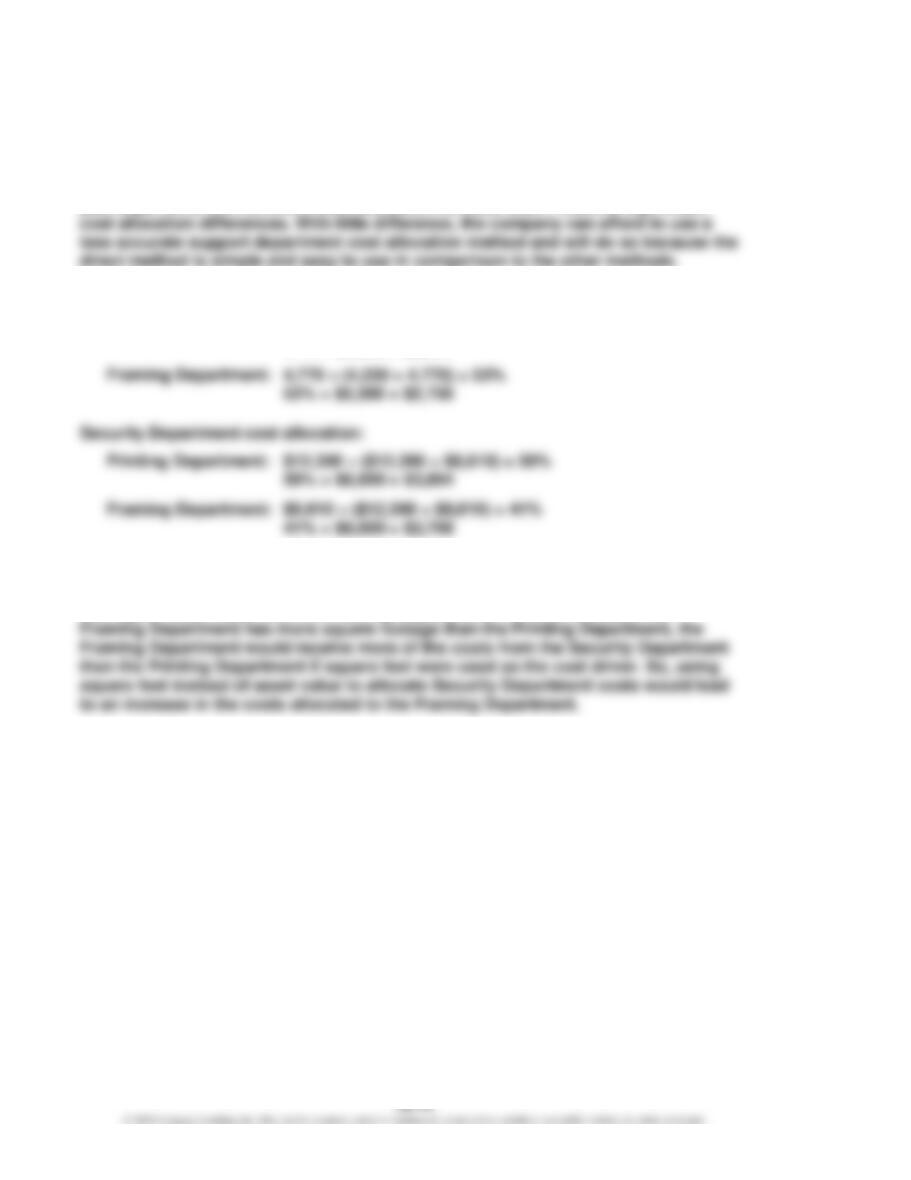
Joint Product
Cups per
Batch
Market
Value per
Cup at Split-
Off
Total
Market
Value at
Split-Off
Market Price
per Cup
Added Cost
per Batch
Total Net
Realizable
Value
Greater of
Total NRV and
Market Value at
Split-Off
Proportion
Joint Costs
Allocation
Pure lemonade
32
$0.80
$25.60
$0.80
$ —
$25.60
$25.60
40%
$30
$12
1.00
19.20
CHAPTER 19 (FIN MAN); CHAPTER 5 (MAN) Support Department and Joint Cost Allocation
PROBLEMS
Prob. 19–1A (FIN MAN); Prob. 5–1A (MAN)
1. Blue Mountain Masterpieces would most likely use the direct method, because its
2. Janitorial Department cost allocation:
Printing Department:
4,230 ÷ (4,230 + 4,770) = 47%
47% × $5,200 = $2,444
53% × $5,200 = $2,756
59% × $6,600 = $3,894
Framing Department:
$8,610 ÷ ($12,390 + $8,610) = 41%
3. Using asset value, the Printing Department receives more of the Security
Department costs than the Framing Department, because the Printing Department
has higher asset value than the Framing Department. However, because the
CHAPTER 19 (FIN MAN); CHAPTER 5 (MAN) Support Department and Joint Cost Allocation
Prob. 19–2A (FIN MAN); Prob. 5–2A (MAN)
1. Maintenance costs should not continue to be allocated based on machine hours,
because a more accurate cost driver for maintenance costs has been identified
2. Total cost to be allocated from Maintenance (M):
Total costs of Maintenance include $200,000 ÷ ($200,000 + $300,000 + $300,000)
= 25% of Security costs
Thus, M = $25,000 + (0.25 × S)
Now plug the value for S into the M equation:
M = $25,000 + (0.25 × $50,000)
= $25,000 + $12,500
= $37,500
Maintenance cost allocation:
Security:
20 ÷ (20 + 60 + 20) = 20%
20% × $37,500 = $7,500
60% × $37,500 = $22,500
CHAPTER 19 (FIN MAN); CHAPTER 5 (MAN) Support Department and Joint Cost Allocation
Prob. 19–2A (FIN MAN); Prob. 5–2A (MAN) (Concluded)
Security cost allocation:
Maintenance:
$200,000 ÷ ($200,000 + $120,000 + $480,000) = 25%
25% × $50,000 = $12,500
Mining:
$120,000 ÷ ($200,000 + $120,000 + $480,000) = 15%
15% × $50,000 = $7,500
Cutting:
$480,000 ÷ ($200,000 + $120,000 + $480,000) = 60%
60% × $50,000 = $30,000
Production activities total costs:
Mining:
$22,500 + $7,500 + $160,000 = $190,000
Cutting:
$7,500 + $30,000 + $95,000 = $132,500
3. Maintenance cost allocation:
Mining:
75% × $25,000 = $18,750
Cutting:
25% × $25,000 = $6,250
Security cost allocation:
Mining:
$120,000 ÷ ($120,000 + $480,000) = 20%
20% × $42,500 = $8,500
Cutting:
$480,000 ÷ ($120,000 + $480,000) = 80%
80% × $42,500 = $34,000
Production activities total costs:
Mining:
$18,750 + $8,500 + $160,000 = $187,250
Cutting:
$6,250 + $34,000 + $95,000 = $135,250