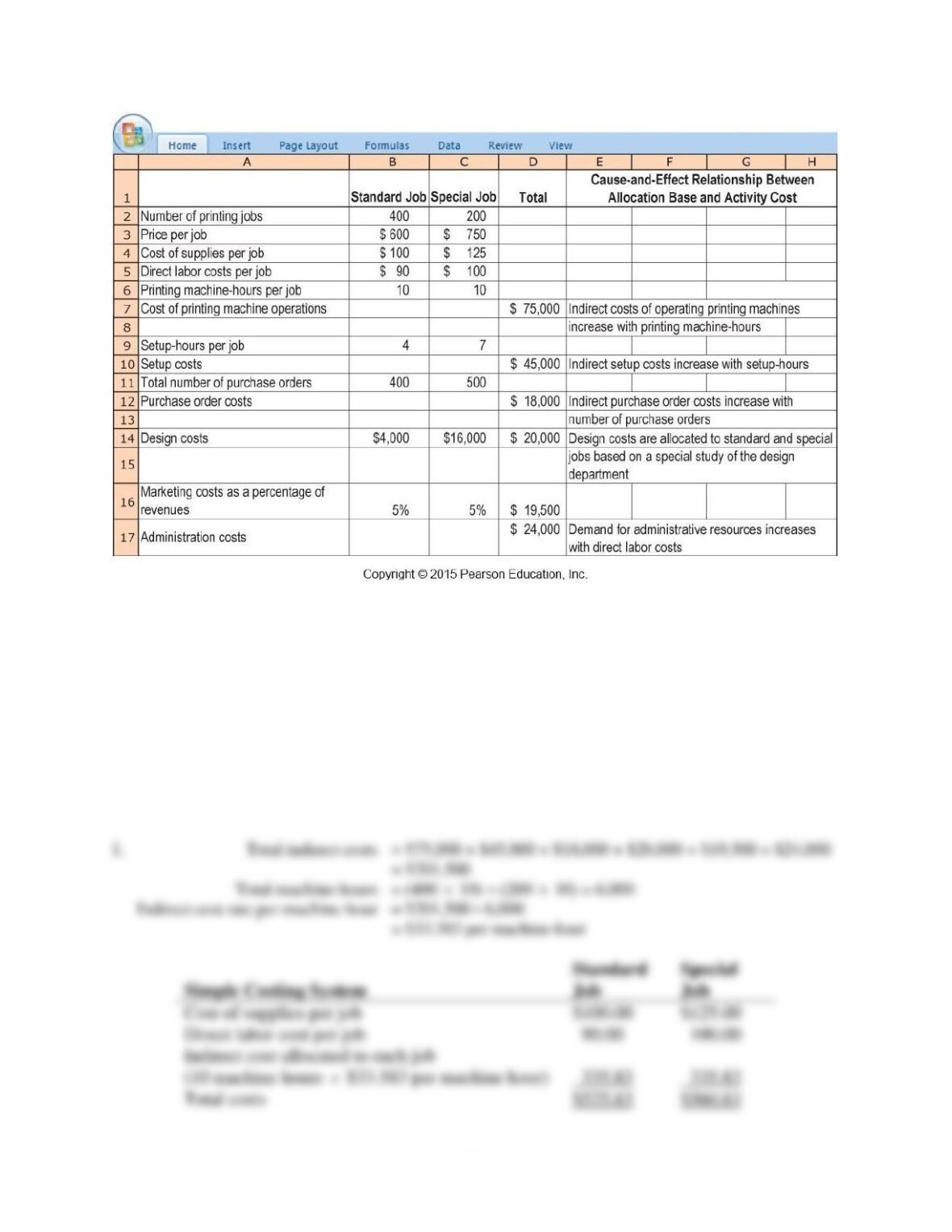
5-21
Required:
1. Calculate the cost of a standard job and a special job under the simple costing system.
2. Calculate the cost of a standard job and a special job under the activity-based costing system.
3. Compare the costs of a standard job and a special job in requirements 1 and 2. Why do the
simple and activity-based costing systems differ in the cost of a standard job and a special
job?
4. How might Speediprint use the new cost information from its activity-based costing system
to better manage its business?
SOLUTION
5-22
5-23
5-24 (30 min.) Activity-based costing, manufacturing.
Fancy Doors, Inc., produces two types of doors, interior and exterior. The company’s simple
costing system has two direct cost categories (materials and labor) and one indirect cost pool.
The simple costing system allocates indirect costs on the basis of machine-hours. Recently, the
owners of Fancy Doors have been concerned about a decline in the market share for their interior
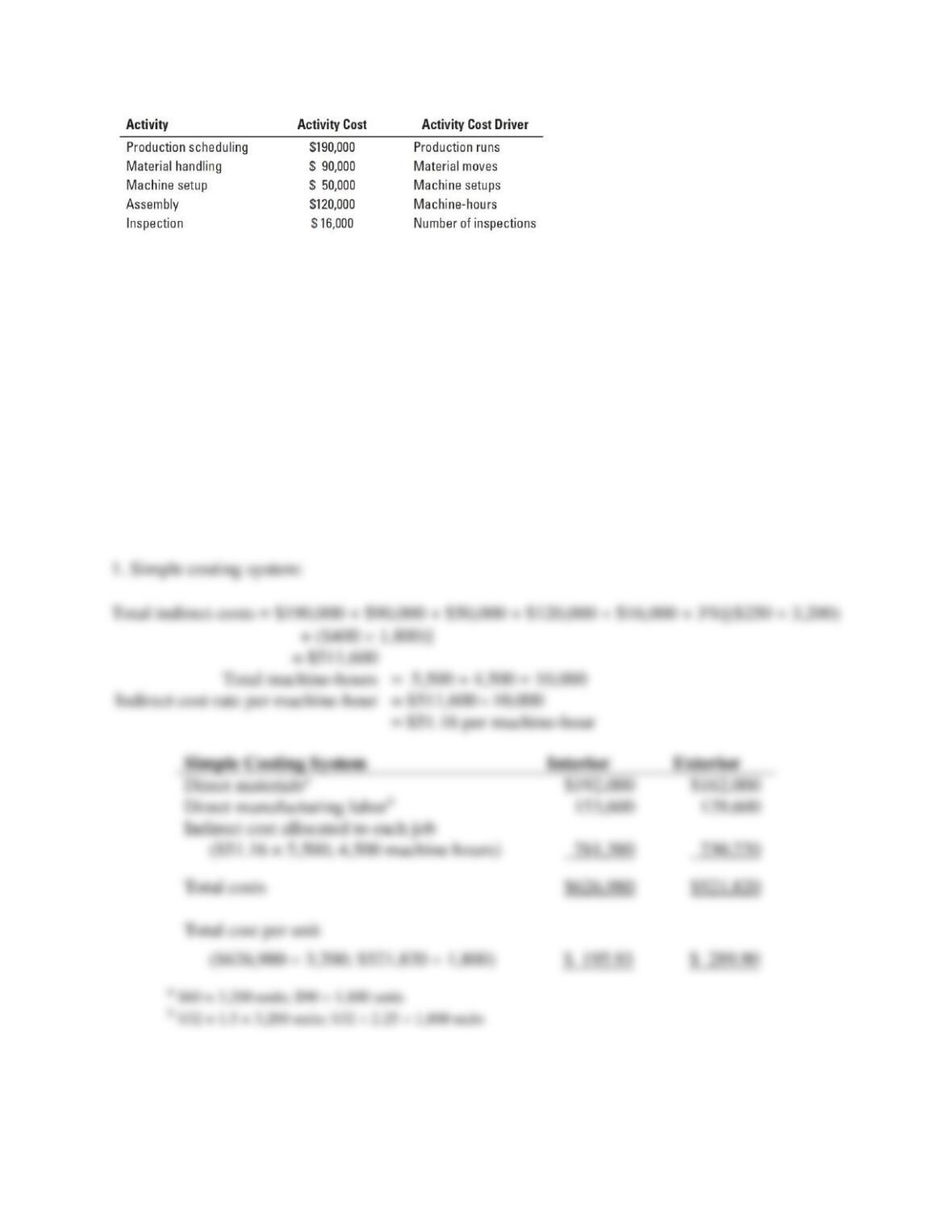
doors, usually their biggest seller. Information related to Fancy Doors production for the most
recent year follows:
The owners have heard of other companies in the industry that are now using an activity-based
costing system and are curious how an ABC system would affect their product costing decisions.
After analyzing the indirect cost pool for Fancy Doors, the owners identify six activities as
generating indirect costs: production scheduling, material handling, machine setup, assembly,
inspection, and marketing. Fancy Doors collected the following data related to the indirect cost
activities:
5-24
Marketing costs were determined to be 3% of the sales revenue for each type of door.
Required:
1. Calculate the cost of an interior door and an exterior door under the existing simple costing
system.
2. Calculate the cost of an interior door and an exterior door under an activity-based costing
system.
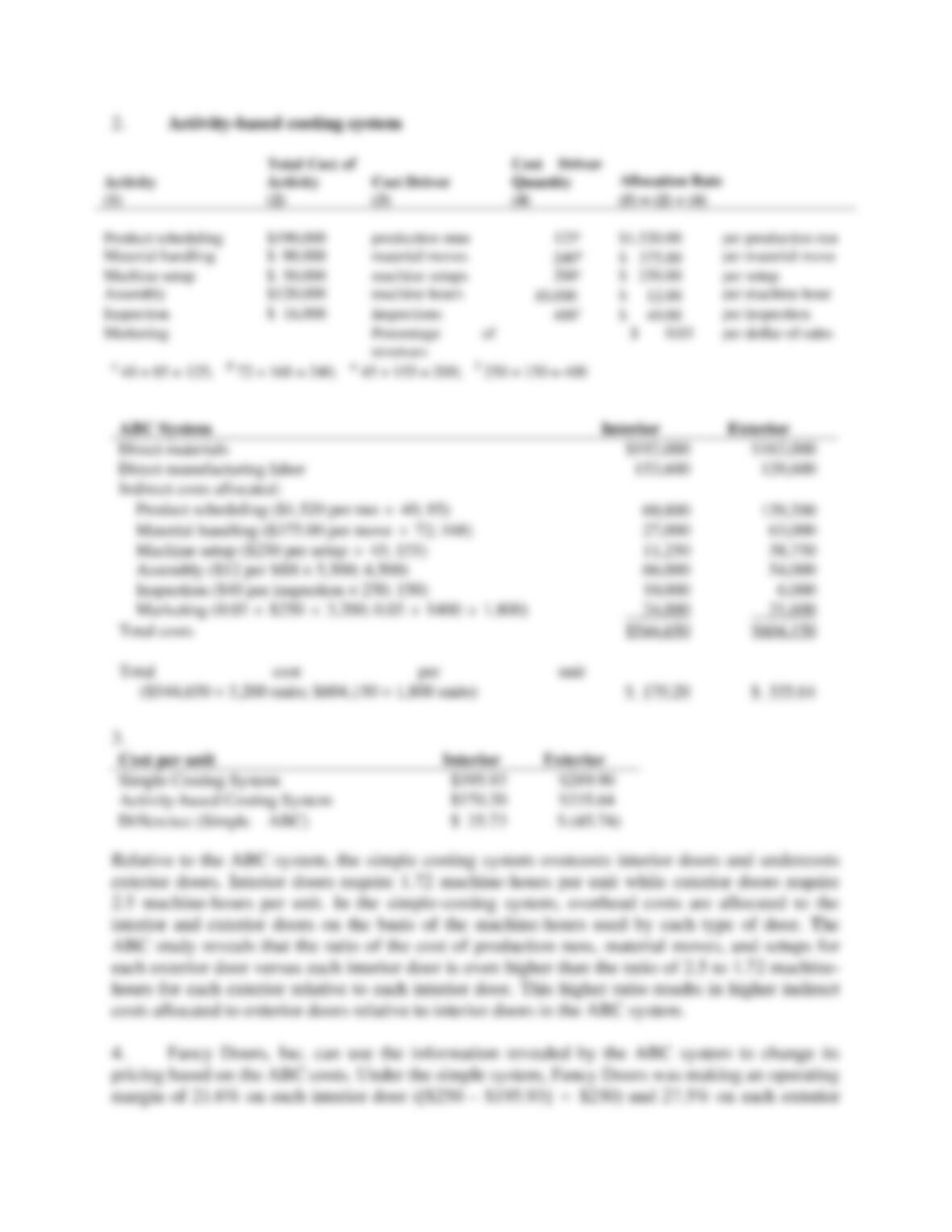
3. Compare the costs of the doors in requirements 1 and 2. Why do the simple and activity–
based costing systems differ in the cost of an interior and exterior door?
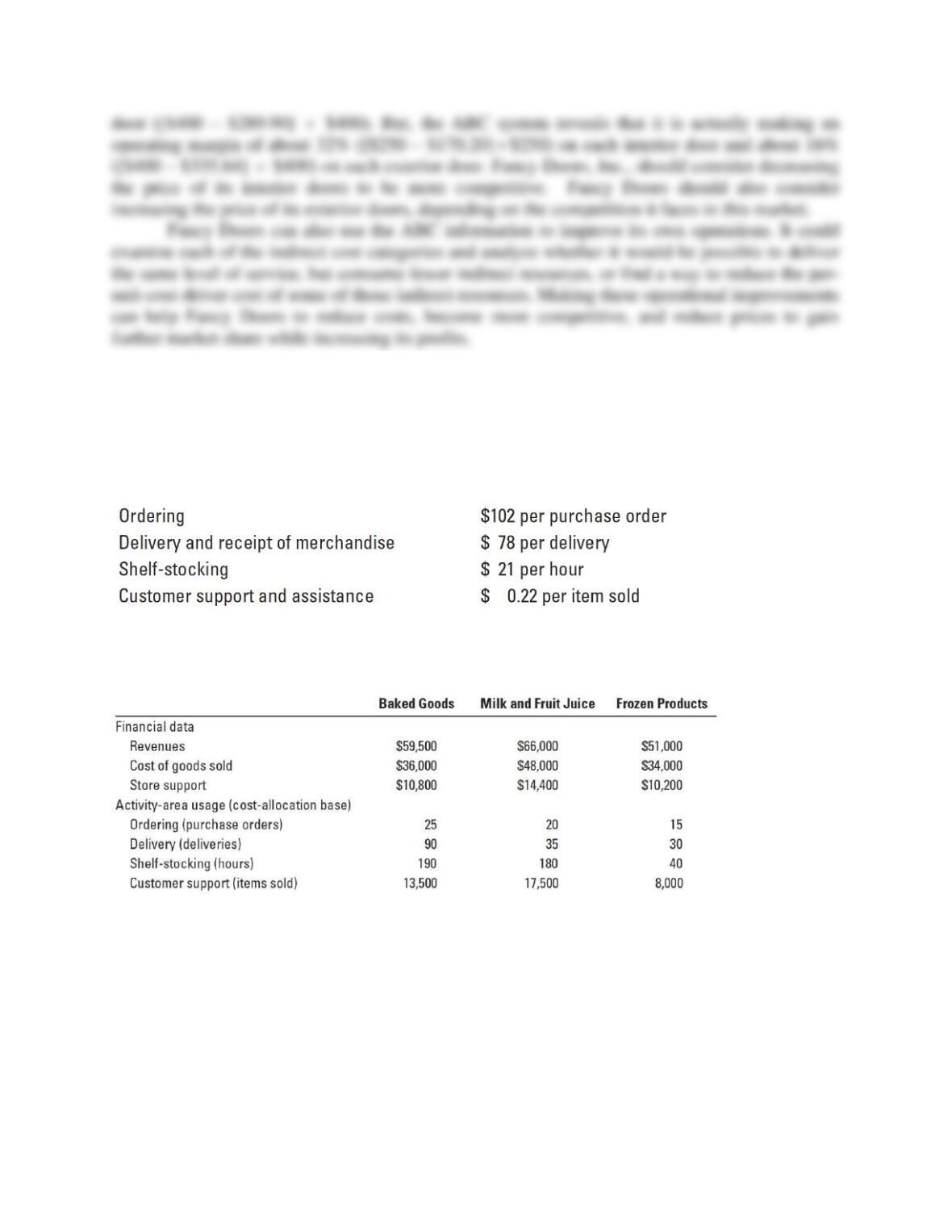
4. How might Fancy Door, Inc., use the new cost information from its activity-based costing
system to address the declining market share for interior doors?
SOLUTION
5-25
5-26
5-25 (30 min.) ABC, retail product-line profitability.
Henderson Supermarkets (HS) operates at capacity and decides to apply ABC analysis to three
product lines: baked goods, milk and fruit juice, and frozen foods. It identifies four activities and
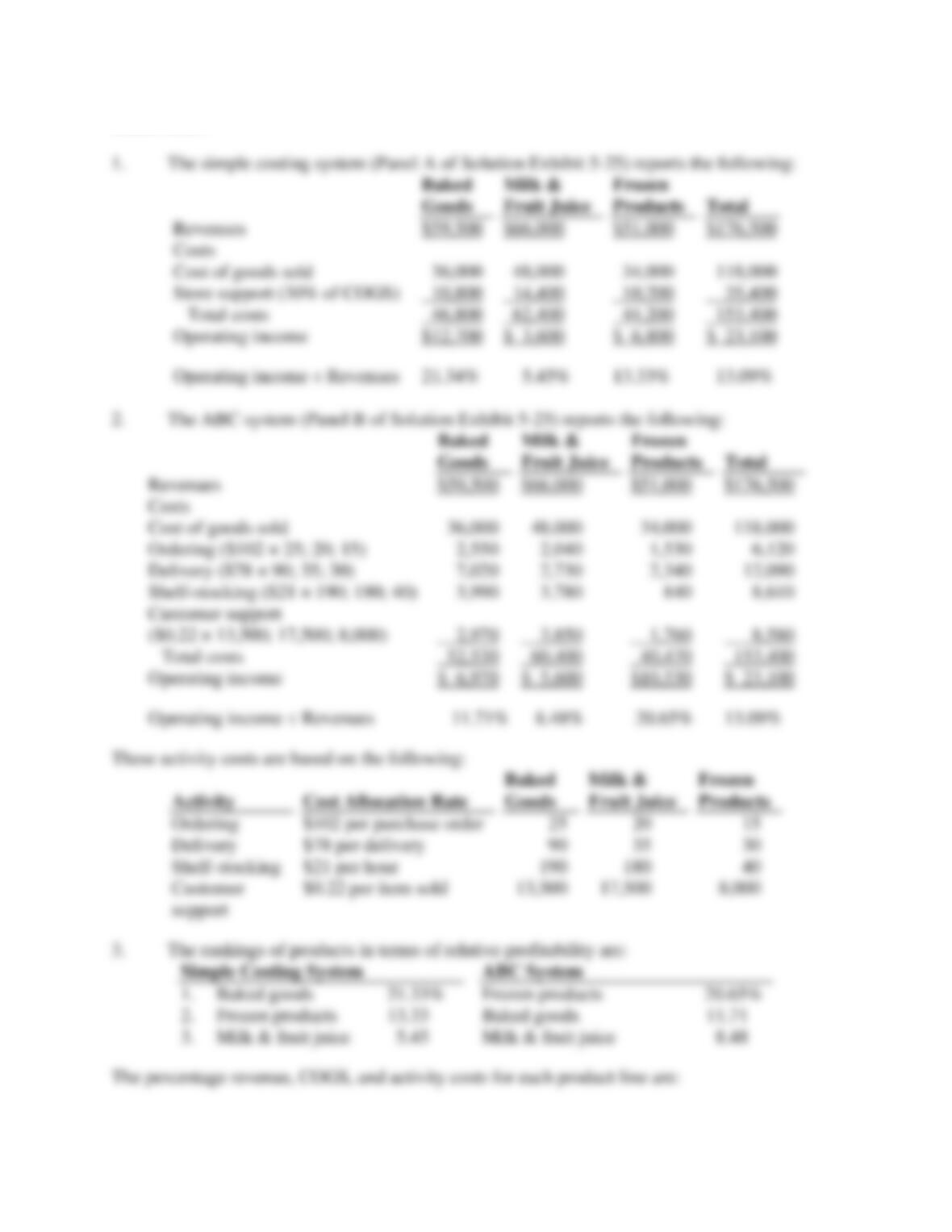
their activity cost rates as follows:
The revenues, cost of goods sold, store support costs, activities that account for the store support
costs, and activity-area usage of the three product lines are as follows:
Under its simple costing system, HS allocated support costs to products at the rate of 30% of cost
of goods sold.
Required:
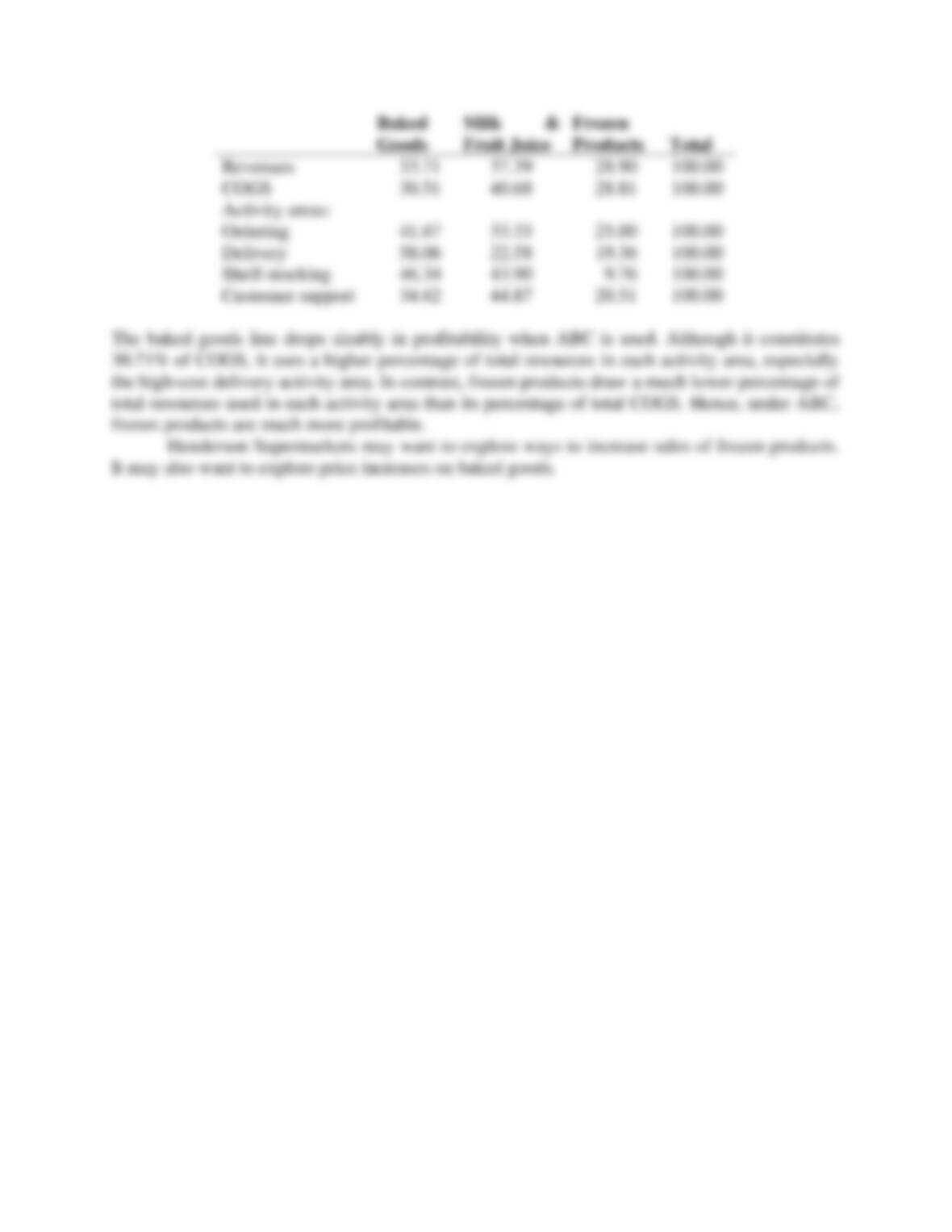
1. Use the simple costing system to prepare a product-line profitability report for HS.
2. Use the ABC system to prepare a product-line profitability report for HS.
3. What new insights does the ABC system in requirement 2 provide to HS managers?
5-27
SOLUTION
5-28
5-29
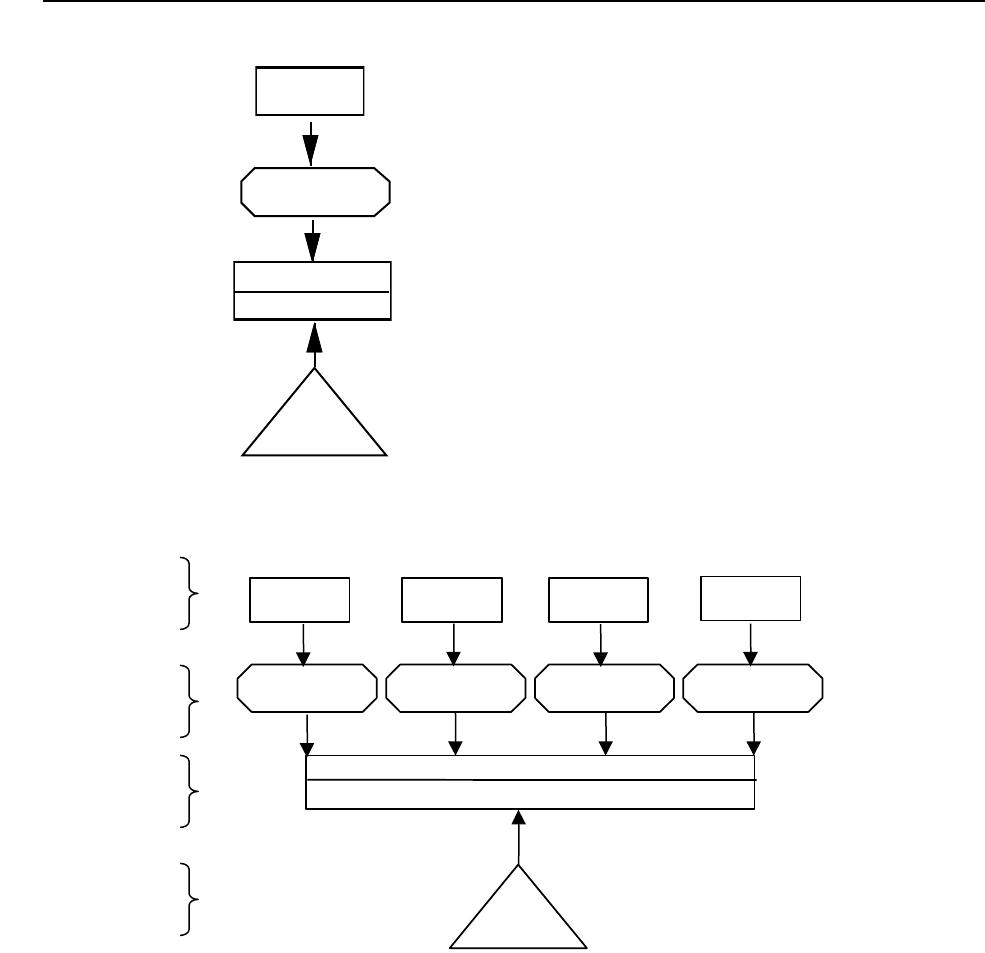
SOLUTION EXHIBIT 5-25
Product-Costing Overviews of Henderson Supermarkets
PANEL A: SIMPLE COSTING SYSTEM
COST OBJECT:
PRODUCT LINE
Indirect Costs
Direct Costs
Store
Support
COGS
COGS
INDIRECT
COST
POOL
COST
ALLOCATION
BASE
DIRECT
COST
PANEL B: ABC SYSTEM
Ordering Delivery Shelf-
Stocking
Customer
Support
Number of
Purchase Order
Number of
Deliveries
Hours of
Shelf-Stocking
Number of
Items Sold
Indirect Costs
Direct Costs
COGS
INDIRECT
COST
POOL
COST
ALLOCATION
BASE
COST OBJECT:
PRODUCT LINE
DIRECT
COST
5-26 (15–20 min.) ABC, wholesale, customer profitability.
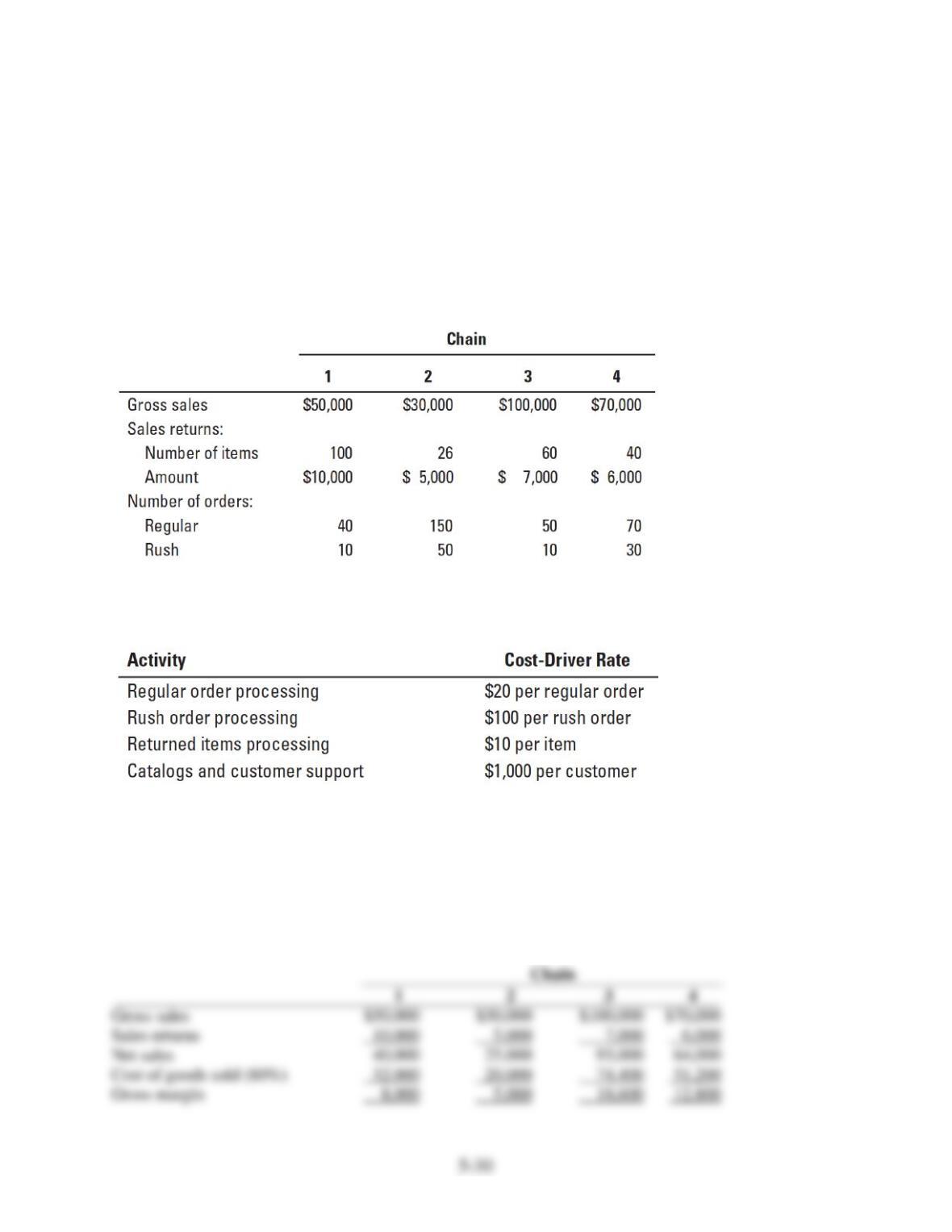
Ramirez Wholesalers operates at capacity and sells furniture items to four department-store
chains (customers). Mr. Ramirez commented, “We apply ABC to determine product-line
profitability. The same ideas apply to customer profitability, and we should find out our
customer profitability as well.” Ramirez Wholesalers sends catalogs to corporate purchasing
departments on a monthly basis. The customers are entitled to return unsold merchandise within
a six- month period from the purchase date and receive a full purchase price refund. The
following data were collected from last year’s operations:
Ramirez has calculated the following activity rates:
Customers pay the transportation costs. The cost of goods sold averages 80% of sales.
Required:
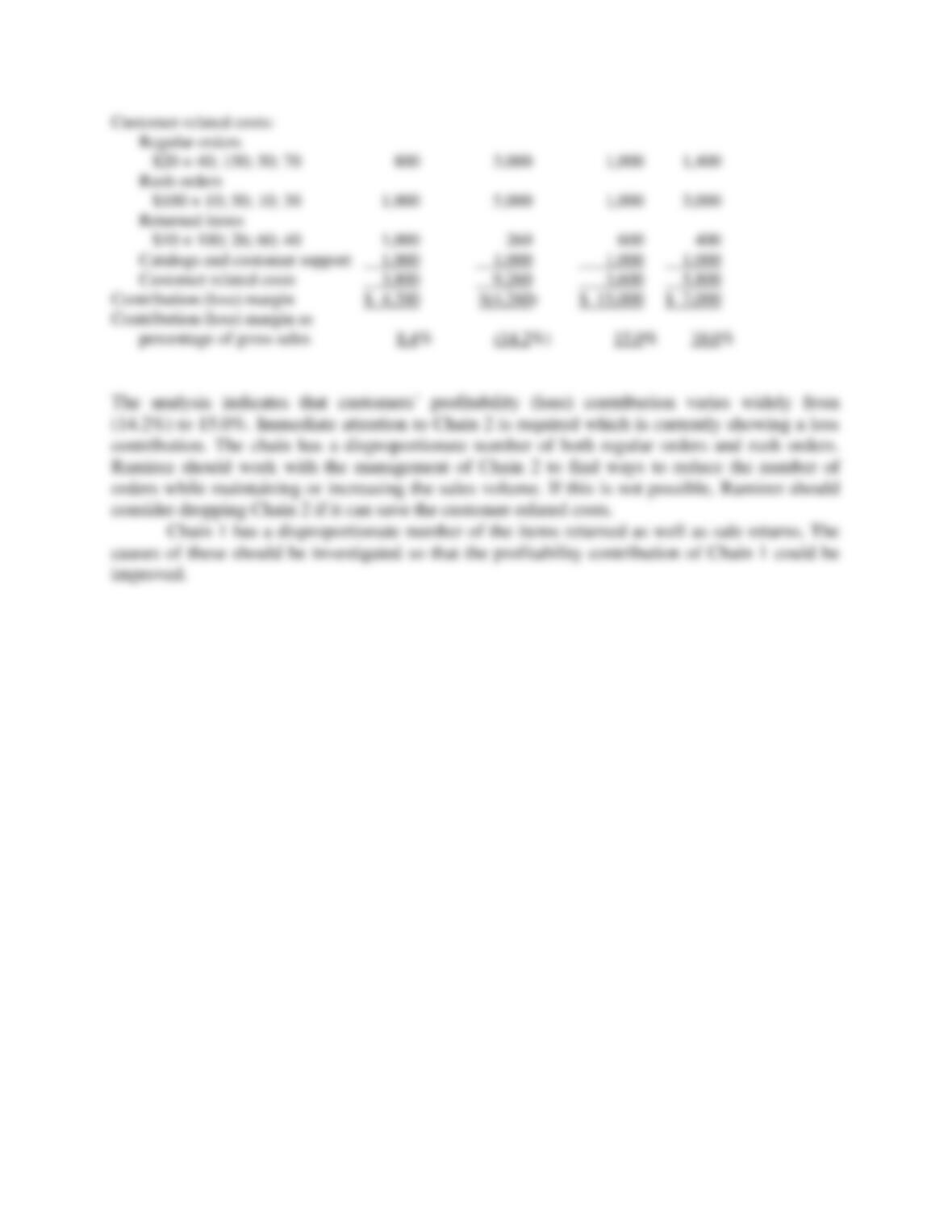
Determine the contribution to profit from each chain last year. Comment on your solution.
SOLUTION
5-31
5-27 (50 min.) ABC, activity area cost-driver rates, product cross-subsidization.
Intex Potatoes (IP) operates at capacity and processes potatoes into potato cuts at its highly
automated Pocatello plant. It sells potatoes to the retail consumer market and to the institutional
market, which includes hospitals, cafeterias, and university dormitories.
IP’s simple costing system, which does not distinguish between potato cuts processed for
retail and institutional markets, has a single direct-cost category (direct materials; that is, raw
potatoes) and a single indirect-cost pool (production support). Support costs, which include
packaging materials, are allocated on the basis of pounds of potato cuts processed. The company
uses 1,800,000 pounds of raw potatoes to process 1,600,000 pounds of potato cuts. At the end of
2014, IP unsuccessfully bid for a large institutional contract. Its bid was reported to be 30%
above the winning bid. This feedback came as a shock because IP included only a minimum
profit margin on its bid, and the Pocatello plant was acknowledged as the most efficient in the
industry.
As a result of its review process of the lost contract bid, IP decided to explore ways to refine
its costing system. The company determined that 90% of the direct materials (raw potatoes)
related to the retail market and 10% to the institutional market. In addition, the company
identified that packaging materials could be directly traced to individual jobs ($190,000 for retail
and $9,000 for institutional). Also, the company used ABC to identify three main activity areas
that generated support costs: cleaning, cutting, and packaging.
▪ Cleaning Activity Area—The cost-allocation base is pounds of raw potatoes cleaned.
5-32
▪ Cutting Activity Area—The production line produces (a) 150 pounds of retail potato cuts
per cutting-hour and (b) 200 pounds of institutional potato cuts per cutting-hour. The cost-
allocation base is cutting-hours on the production line.
▪ Packaging Activity Area—The packaging line packages (a) 25 pounds of retail potato cuts
per pack- aging-hour and (b) 80 pounds of institutional potato cuts per packaging-hour. The
cost-allocation base is packaging-hours on the production line.
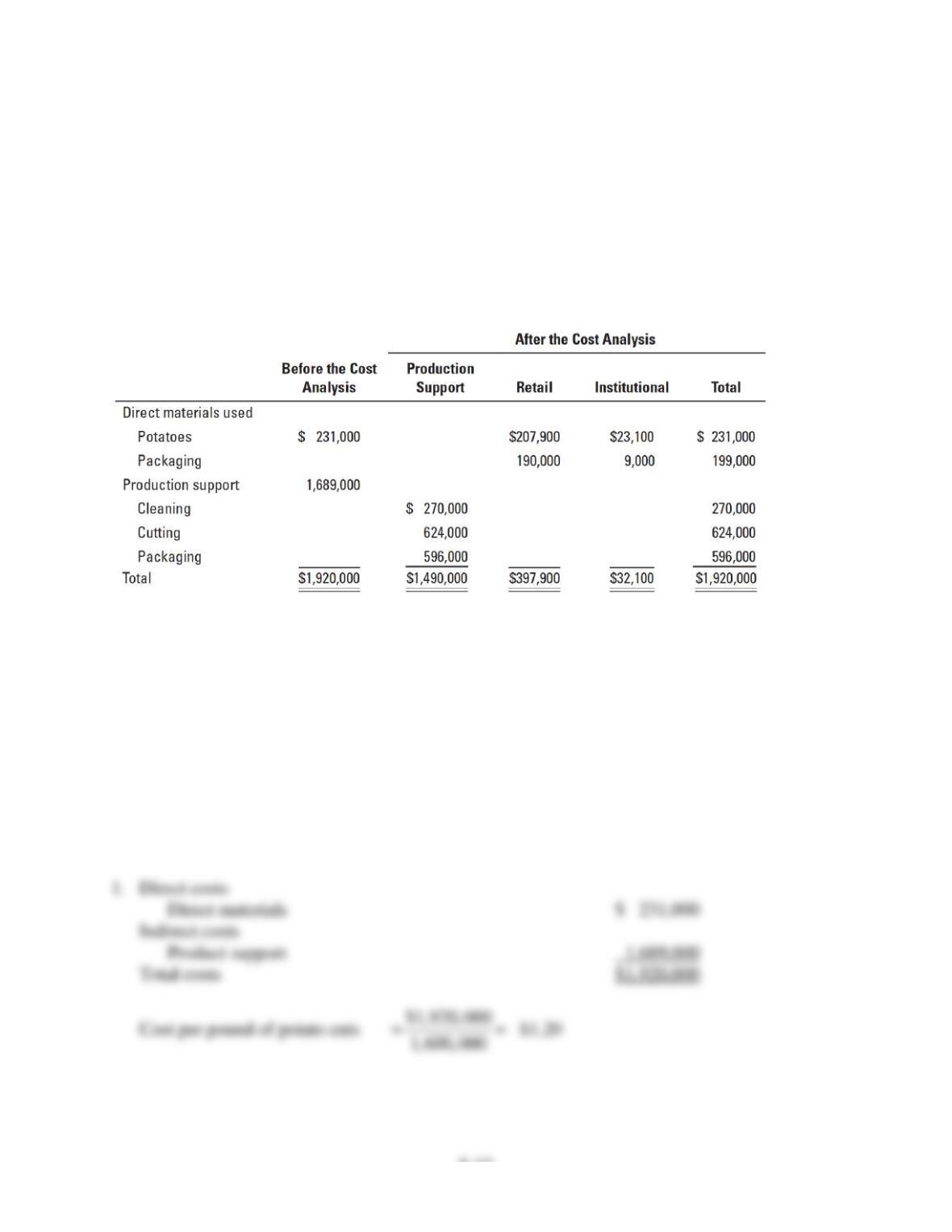
The following table summarizes the actual costs for 2014 before and after the preceding cost
analysis.
Required:
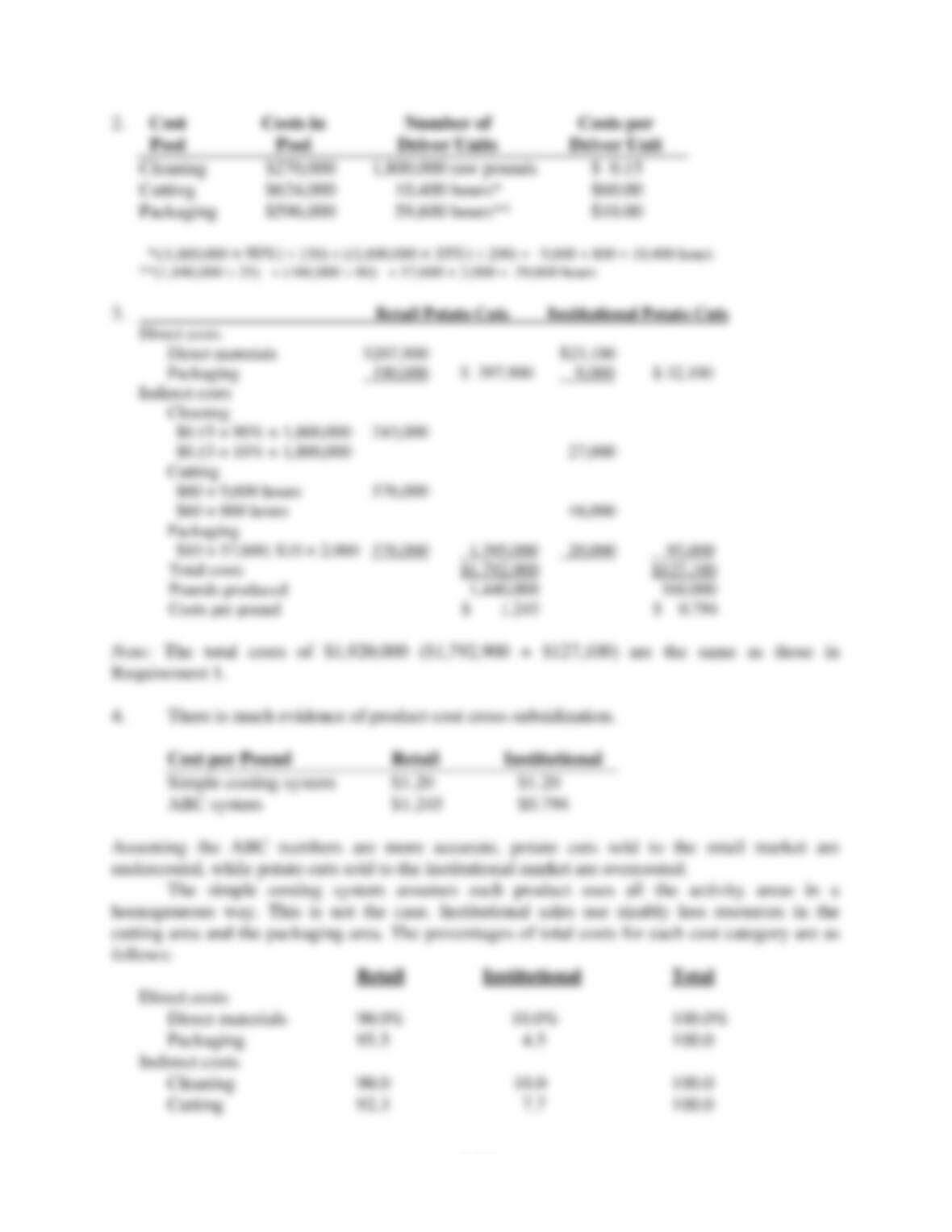
1. Using the simple costing system, what is the cost per pound of potato cuts produced by IP?
2. Calculate the cost rate per unit of the cost driver in the (a) cleaning, (b) cutting, and (c)
packaging activity areas.
3. Suppose IP uses information from its activity cost rates to calculate costs incurred on retail
potato cuts and institutional potato cuts. Using the ABC system, what is the cost per pound of (a)
retail potato cuts and (b) institutional potato cuts?
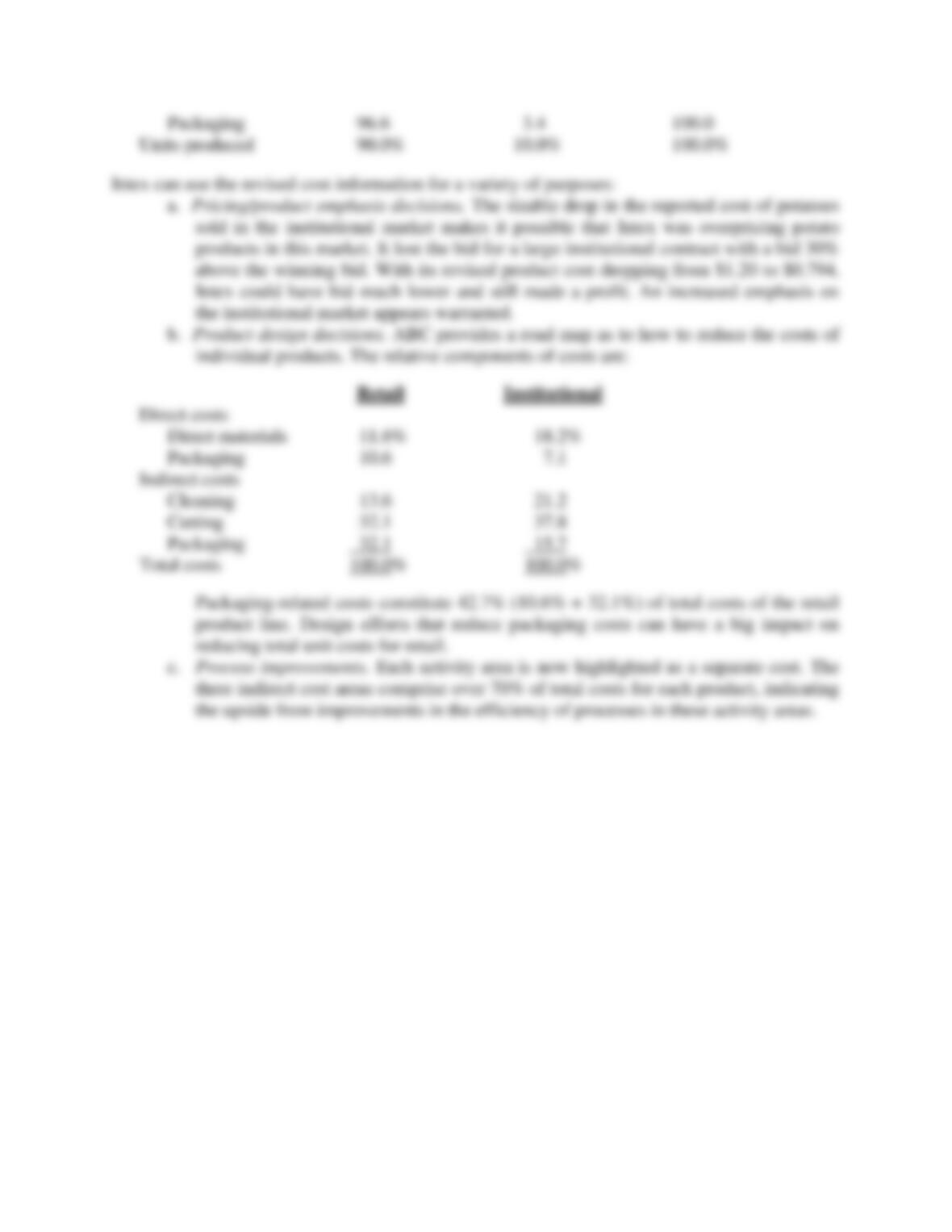
4. Comment on the cost differences between the two costing systems in requirements 1 and 3.
How might IP use the information in requirement 3 to make better decisions?
SOLUTION
5-33
5-34
5-28 (20–25 min.) Activity-based costing, job-costing system.
The job costing system at Sheri’s Custom Framing has five indirect cost pools (purchasing,
material handling, machine maintenance, product inspection, and packaging). The company is in
the process of bidding on two jobs: Job 215, an order of 15 intricate personalized frames, and Job
325, an order of 6 standard personalized frames. The controller wants you to compare overhead
allocated under the current simple job-costing system and a newly designed activity-based job-
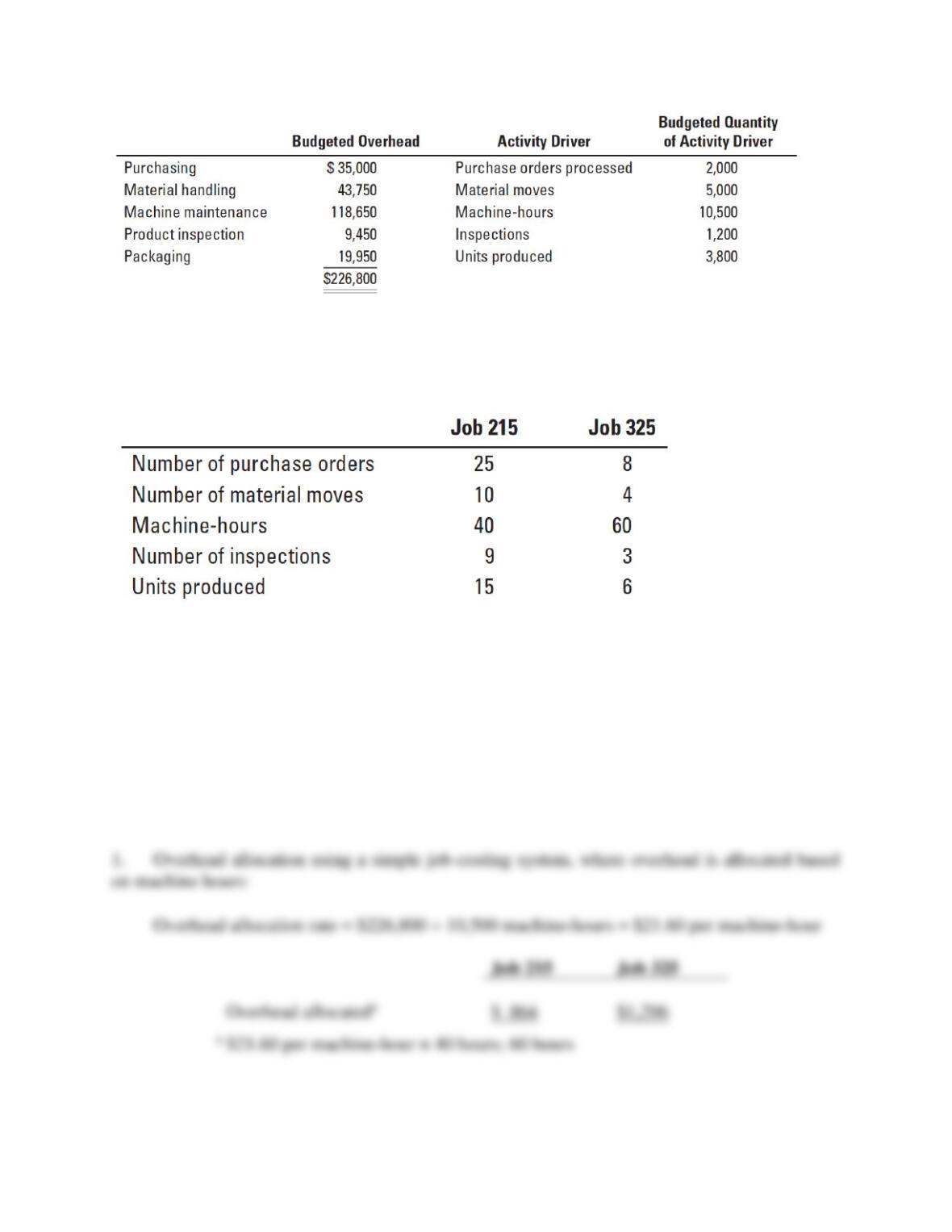
costing system. Total budgeted costs in each indirect cost pool and the budgeted quantity of
activity driver are as follows.
5-35
Information related to Job 215 and Job 325 follows. Job 215 incurs more batch-level costs
because it uses more types of materials that need to be purchased, moved, and inspected relative
to Job 325.
Required:
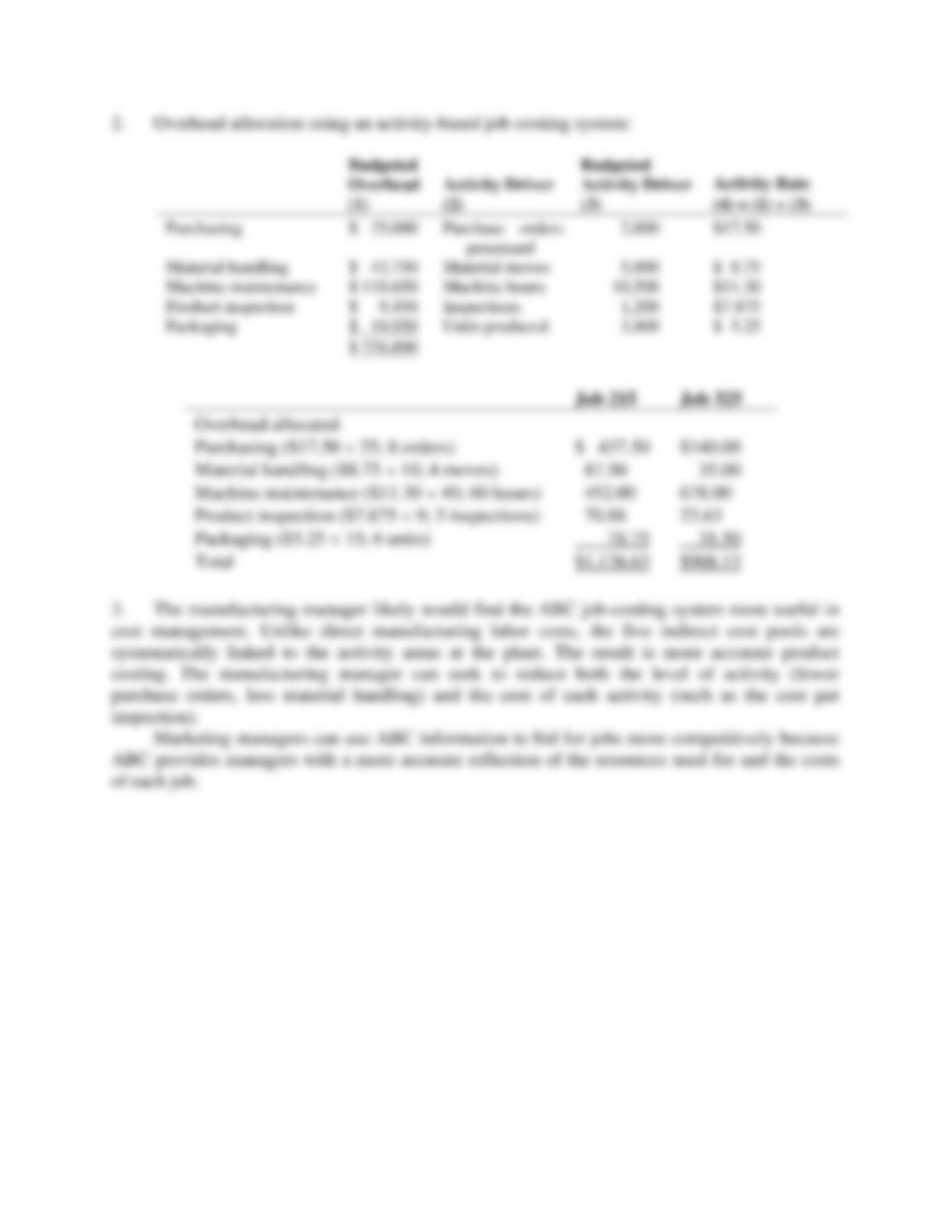
1. Compute the total overhead allocated to each job under a simple costing system, where
overhead is allocated based on machine-hours.
2. Compute the total overhead allocated to each job under an activity-based costing system
using the appropriate activity drivers.
3. Explain why Sheri’s Custom Framing might favor the ABC job-costing system over the
simple job-costing system, especially in its bidding process.
SOLUTION
5-36
5-29 (30 min.) ABC, product-costing at banks, cross-subsidization.
United Savings Bank (USB) is examining the profitability of its Premier Account, a combined
savings and checking account. Depositors receive a 7% annual interest rate on their average
deposit. USB earns an interest rate spread of 3% (the difference between the rate at which it
lends money and the rate it pays depositors) by lending money for home-loan purposes at 10%.
Thus, USB would gain $60 on the interest spread if a depositor had an average Premier Account
balance of $2,000 in 2014 ($2,000 * 3% = $60).
The Premier Account allows depositors unlimited use of services such as deposits,
withdrawals, checking accounts, and foreign currency drafts. Depositors with Premier Account
balances of $1,000 or more receive unlimited free use of services. Depositors with minimum
balances of less than $1,000 pay a $22-a-month service fee for their Premier Account.
5-37
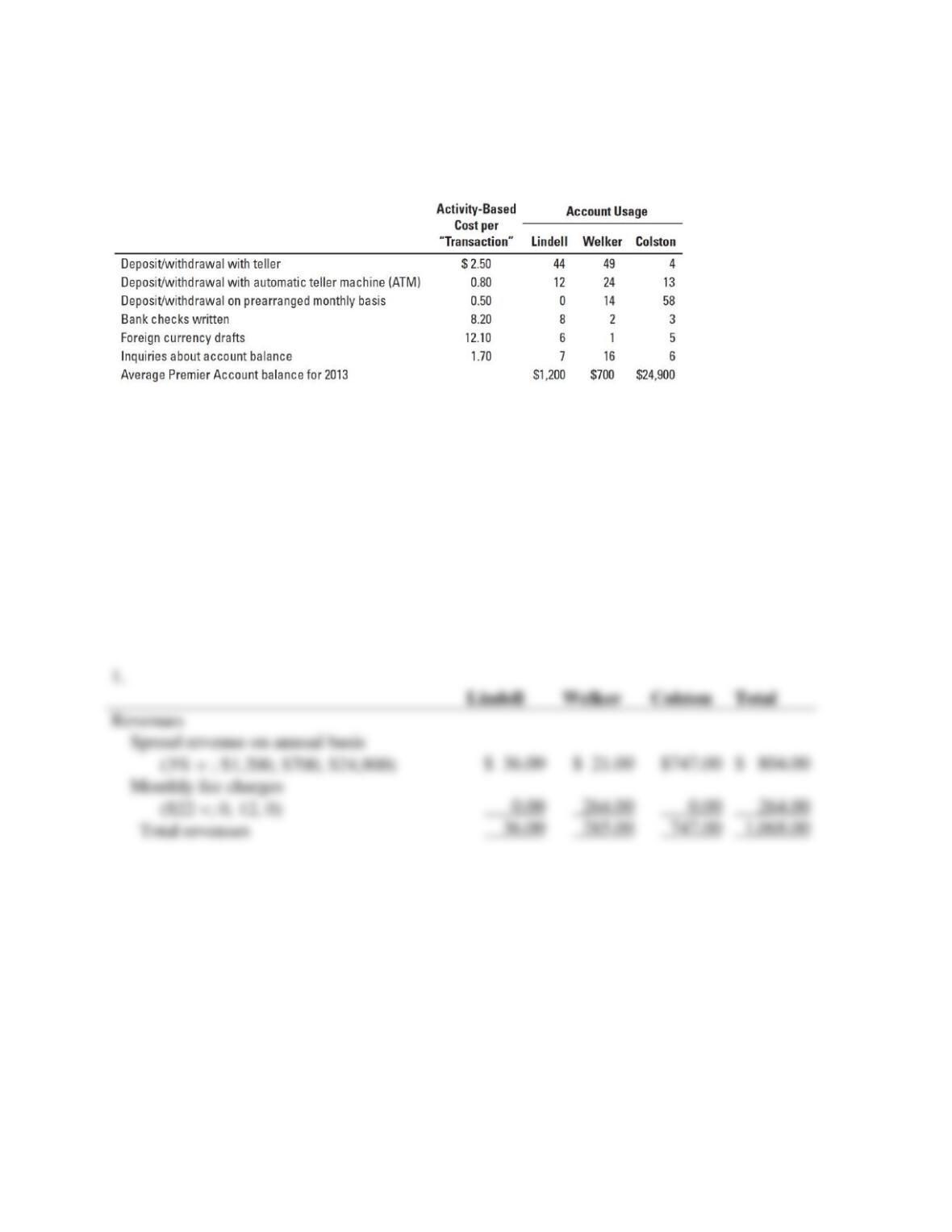
USB recently conducted an activity-based costing study of its services. It assessed the
following costs for six individual services. The use of these services in 2014 by three customers
is as follows:
Assume Lindell and Colston always maintain a balance above $1,000, whereas Welker always
has a balance below $1,000.
Required:
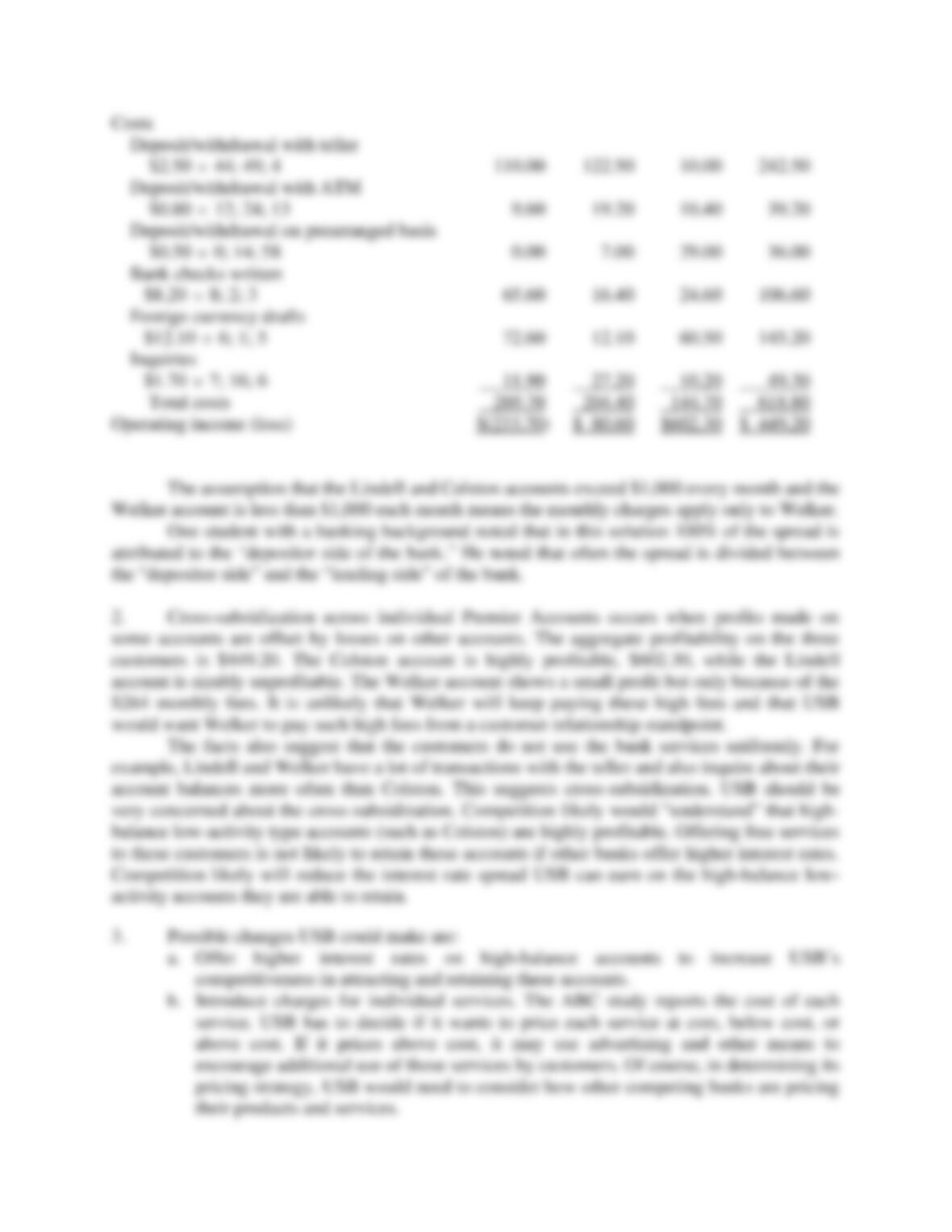
1. Compute the 2014 profitability of the Lindell, Welker, and Colston Premier Accounts at
USB.
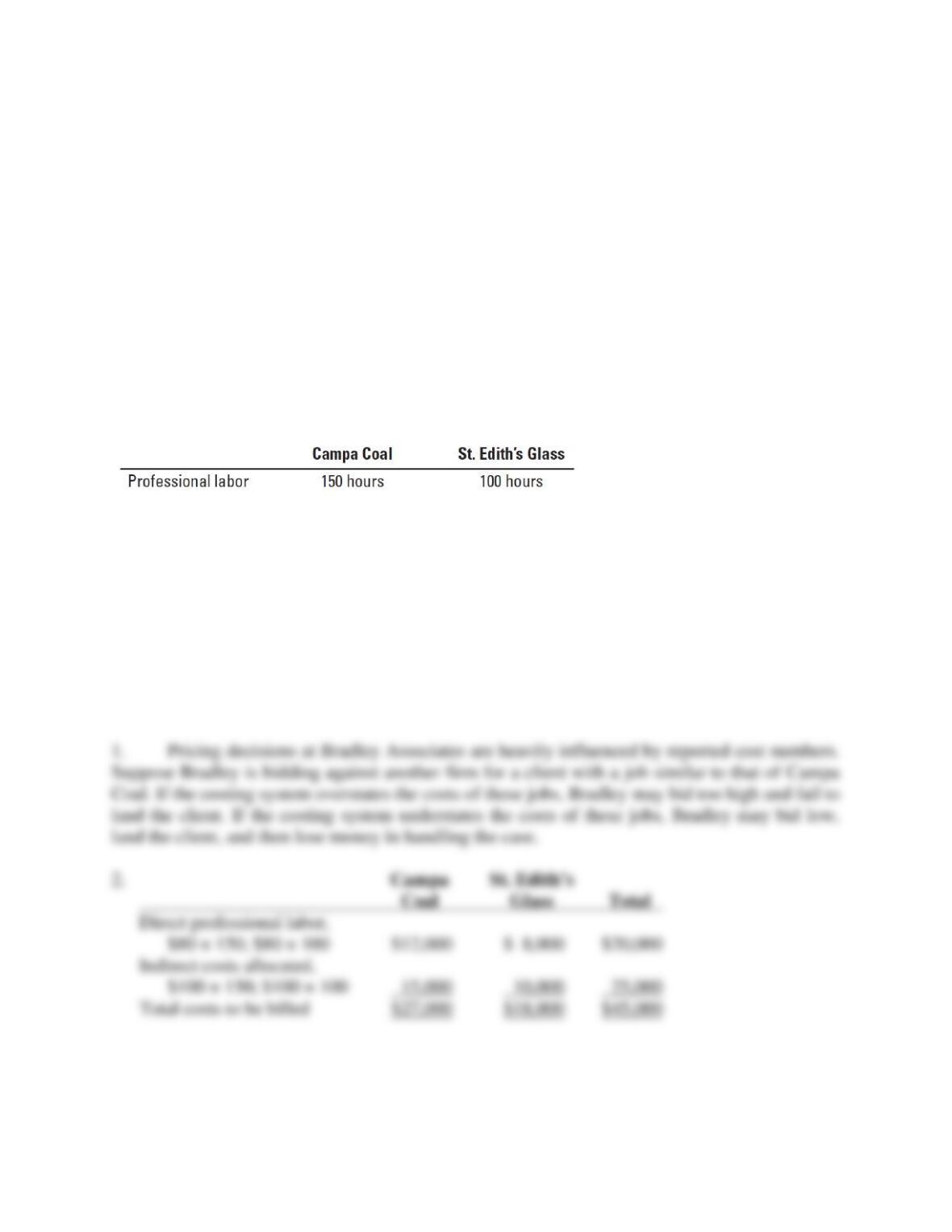
2. Why might USB worry about the profitability of individual customers if the Premier Account
product offering is profitable as a whole?
3. What changes would you recommend for USB’s Premier Account?
SOLUTION
5-38
5-39
5-30 (15 min.) Job costing with single direct-cost category, single indirect-cost pool, law
firm.
Bradley Associates is a recently formed law partnership. Emmit Harrington, the managing
partner of Bradley Associates, has just finished a tense phone call with Martin Omar, president
of Campa Coal. Omar strongly complained about the price Bradley charged for some legal work
done for Campa Coal.
Harrington also received a phone call from its only other client (St. Edith’s Glass), which was
very pleased with both the quality of the work and the price charged on its most recent job.
Bradley Associates operates at capacity and uses a cost-based approach to pricing (billing)
each job. Currently it uses a simple costing system with a single direct-cost category
(professional labor-hours) and a single indirect-cost pool (general support). Indirect costs are
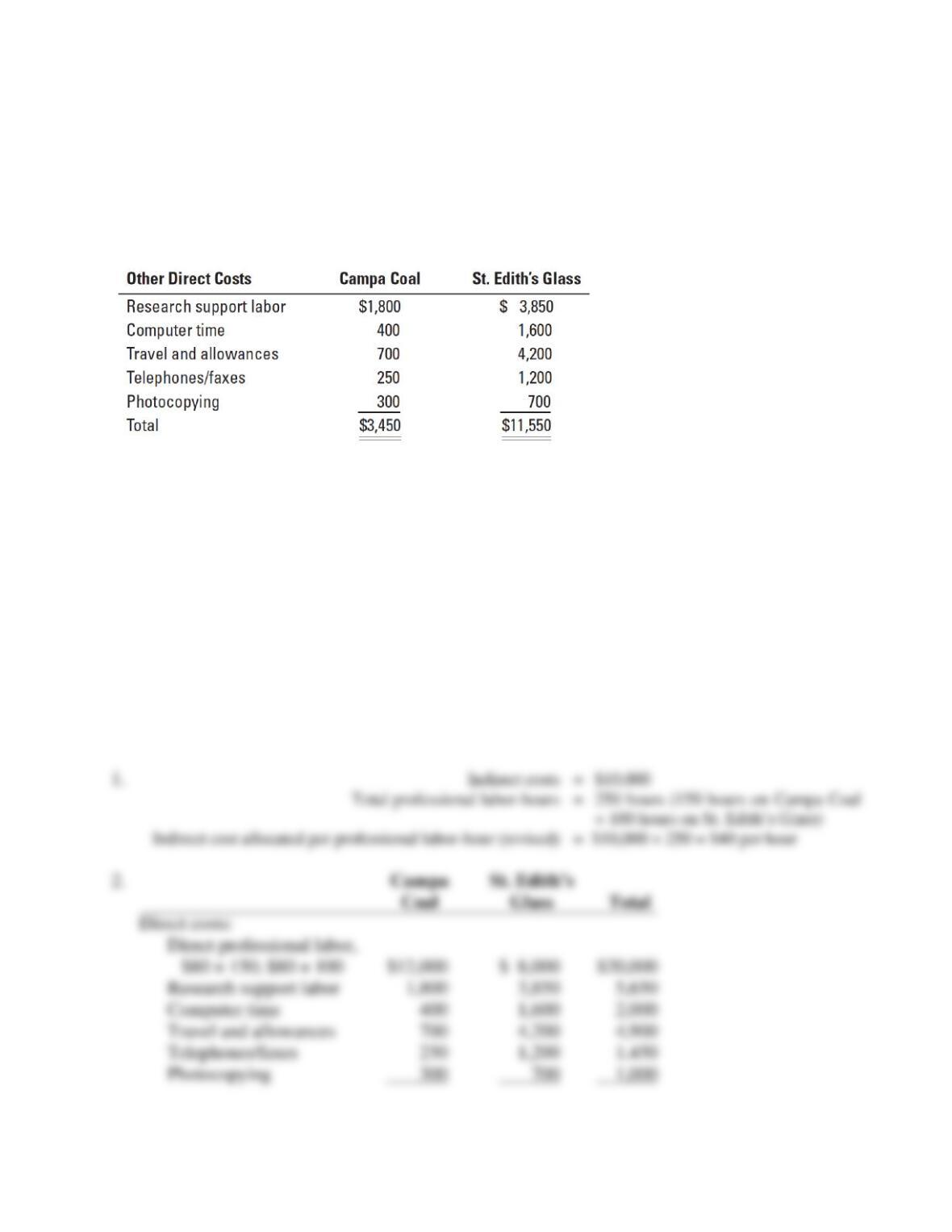
allocated to cases on the basis of professional labor-hours per case. The job files show the
following:
Professional labor costs at Bradley Associates are $80 an hour. Indirect costs are allocated to
cases at $100 an hour. Total indirect costs in the most recent period were $25,000.
1. Why is it important for Bradley Associates to understand the costs associated with individual
jobs?
2. Compute the costs of the Campa Coal and St. Edith’s Glass jobs using Bradley’s simple
costing system.
SOLUTION
5-40
5-31 (20–25 min.) Job costing with multiple direct-cost categories, single indirect-cost
pool, law firm (continuation of 5-30).
Harrington asks his assistant to collect details on those costs included in the $25,000 indirect–
cost pool that can be traced to each individual job. After analysis, Bradley is able to reclassify
$15,000 of the $25,000 as direct costs:
Harrington decides to calculate the costs of each job as if Bradley had used six direct cost-pools
and a single indirect-cost pool. The single indirect-cost pool would have $10,000 of costs and
would be allocated to each case using the professional labor-hours base.
Required:
1. Calculate the revised indirect-cost allocation rate per professional labor-hour for Bradley
Associates when total indirect costs are $10,000.
2. Compute the costs of the Campa and St. Edith’s jobs if Bradley Associates had used its
refined costing system with multiple direct-cost categories and one indirect-cost pool.
3. Compare the costs of Campa and St. Edith’s jobs in requirement 2 with those in requirement
2 of Problem 5-30. Comment on the results.
SOLUTION