Wild and Shaw, Financial & Managerial Accounting, 8e Solutions Manual: Chapter 5
Chapter 5
Inventories and Cost of Sales
QUESTIONS
1. (a) FIFO: The cost of the first (earliest) items purchased in inventory flow to cost of
goods sold first.
(b) LIFO: The cost of the last (most recent) items purchased in inventory flow to cost
of goods sold first.
2. Merchandise inventory is disclosed on the balance sheet as a current asset. It is
also sometimes reported in the income statement as part of the calculation of cost
of goods sold.
3. LIFO will result in the lower cost of goods sold when costs are declining because it
assigns the most recent, lower cost purchases to cost of goods sold.
4. Many people make important business decisions based on period-to-period
fluctuations in a company’s financial numbers, including gross profit and net
income. As such, inventory errors—which can substantially impact gross profit, net
income, current assets, and cost of sales—should not be permitted to cause such
fluctuations and impair business decisions. (Note: Since such errors are “self–
correcting,” they will distort net income in only two consecutive accounting
periods—the period of the error and the next period.)
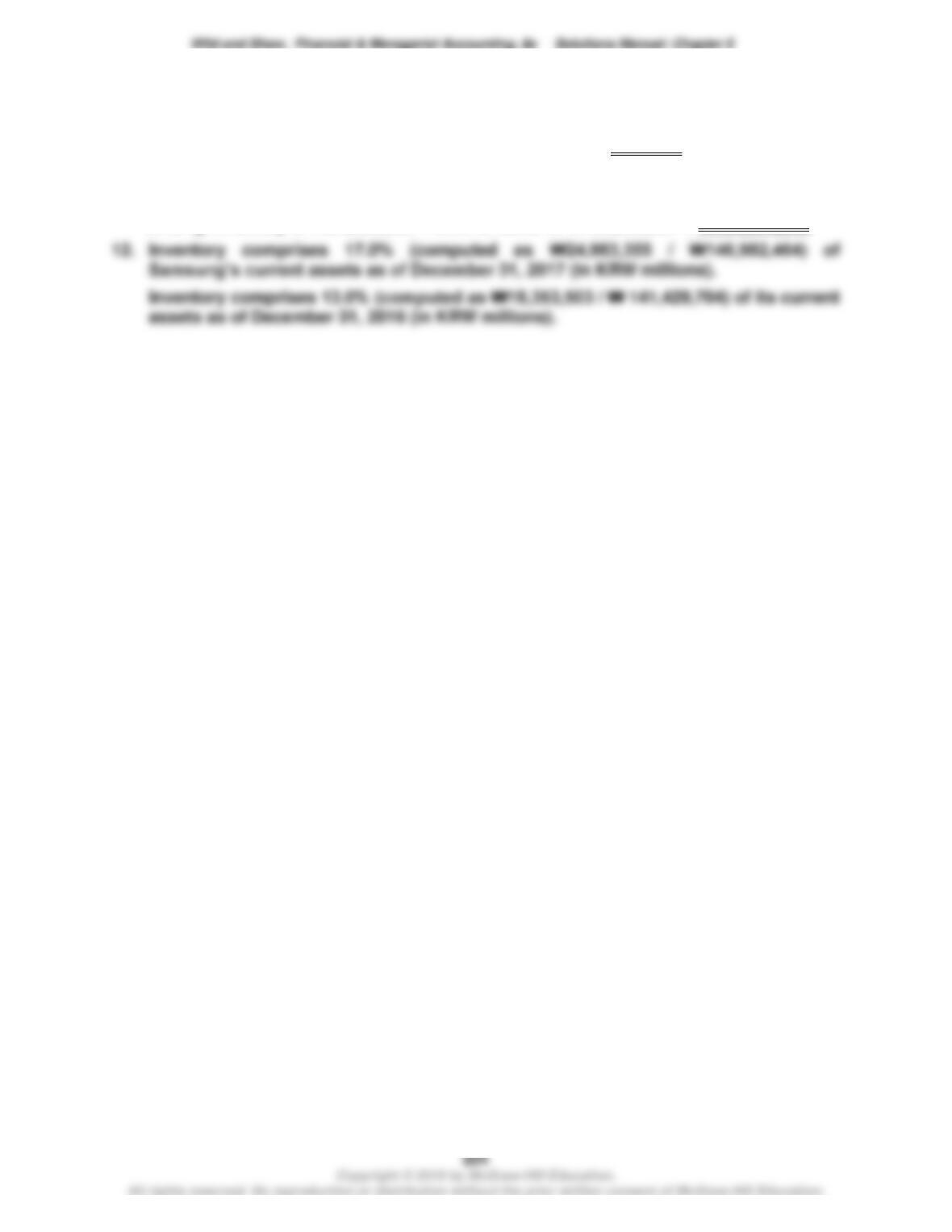
10. Cost of goods available for sale equals ending inventory plus cost of sales. It is
computed as ($ millions):
Ending Inventory of $4,855 + Cost of Sales of $141,048 = $145,903
11. Cost of goods available for sale equals ending inventory plus cost of sales. It is
computed as (in KRW millions):
Ending Inventory of ₩24,983,355 + Cost of Sales of ₩129,290,661 = ₩154,274,016
Wild and Shaw, Financial & Managerial Accounting, 8e Solutions Manual: Chapter 5
QUICK STUDIES
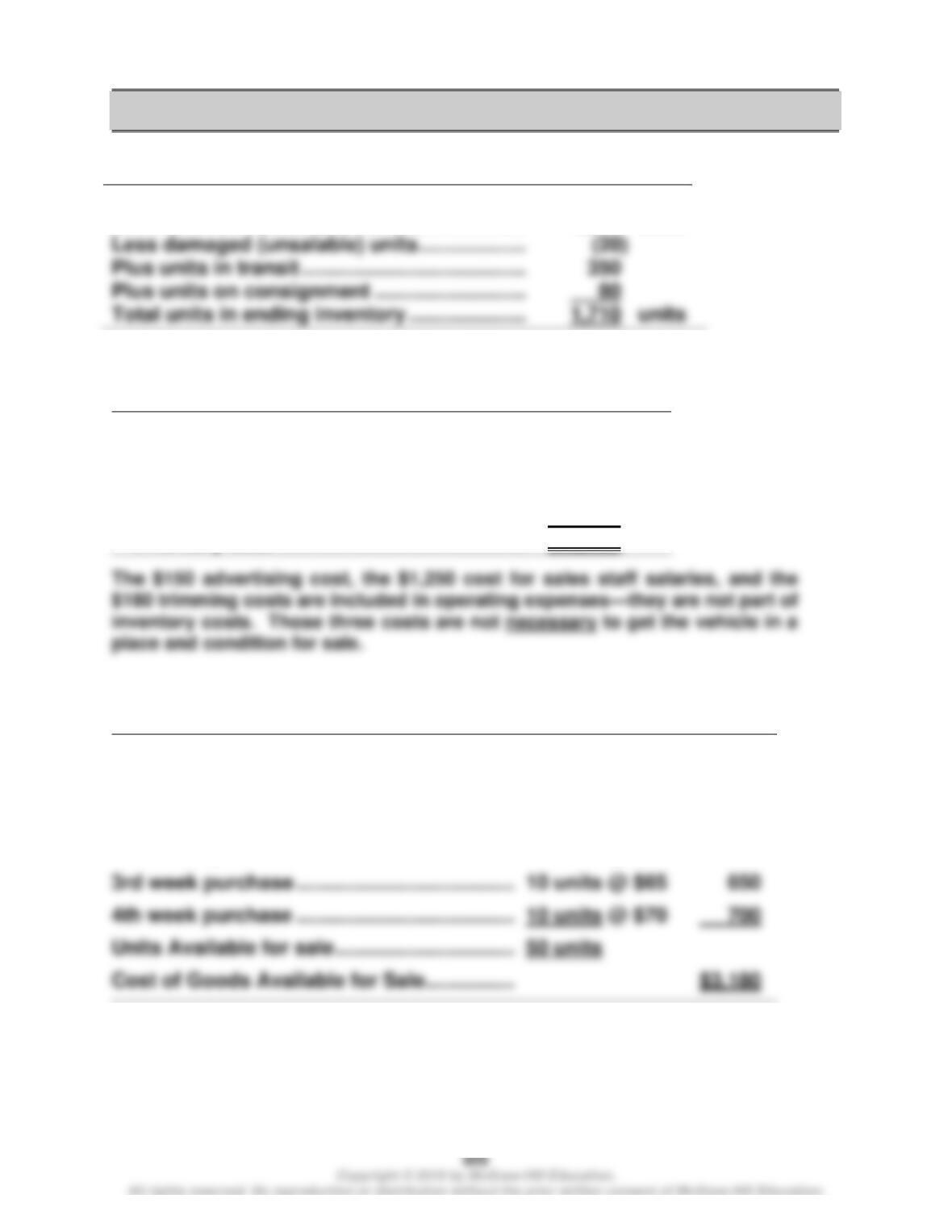
Quick Study 5-1 (10 minutes)
Units in ending inventory
Units stored in basement …………………………..
1,300
units
Less damaged (unsalable) units …………………….
350
Quick Study 5-2 (10 minutes)
Cost ……………………………………………………….
$14,000
Plus
Transportation-in ……………………………………….
250
Import duties ……………………………………………..
900
Insurance …………………………………………………..
300
Inventory Cost …………………………………………..
$15,450
Quick Study 5-3 (10 minutes)
Beginning inventory ……………………………….
10 units @ $60
$ 600
Plus
1st week purchase …………………………………
10 units @ $61
610
2nd week purchase ………………………………..
10 units @ $62
620
3rd week purchase …………………………………
10 units @ $65
650
4th week purchase …………………………………
10 units @ $70
50 units
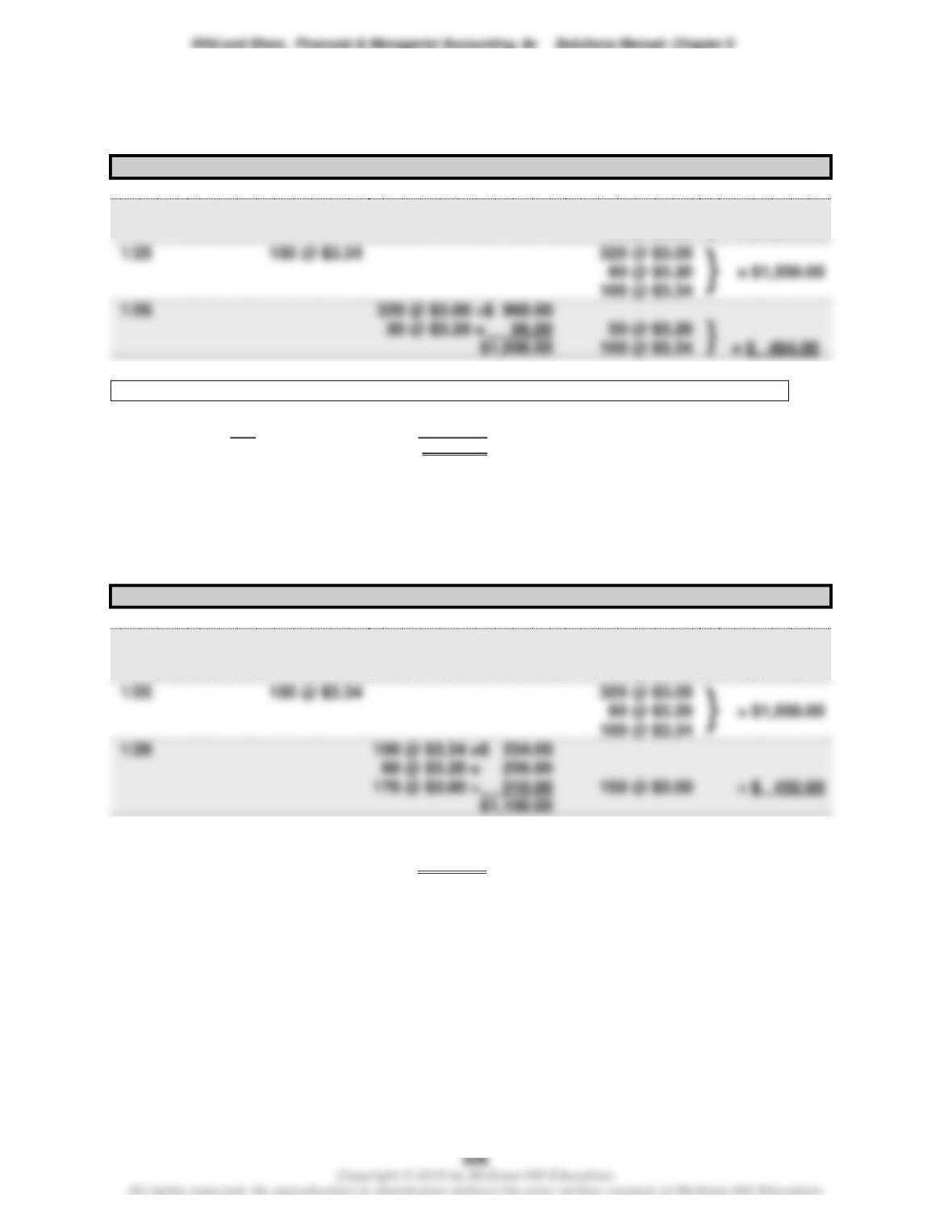
Quick Study 5-4 (10 minutes)
FIFO—Perpetual
Date
Goods Purchased
Cost of Goods Sold
Inventory Balance
1/1
320 @ $3.00
= $ 960.00
1/9
80 @ $3.20
320 @ $3.00
80 @ $3.20
= $1,216.00
1/25
320 @ $3.00
80 @ $3.20
= $1,550.00
100 @ $3.34
1/26
30 @ $3.20 = 96.00
50 @ $3.20
100 @ $3.34
Alternate solution format
FIFO:
100
@ $3.34 =
$ 334.00
50
@ $3.20 =
160.00
150
$ 494.00
Ending inventory cost
Quick Study 5-5 (10 minutes)
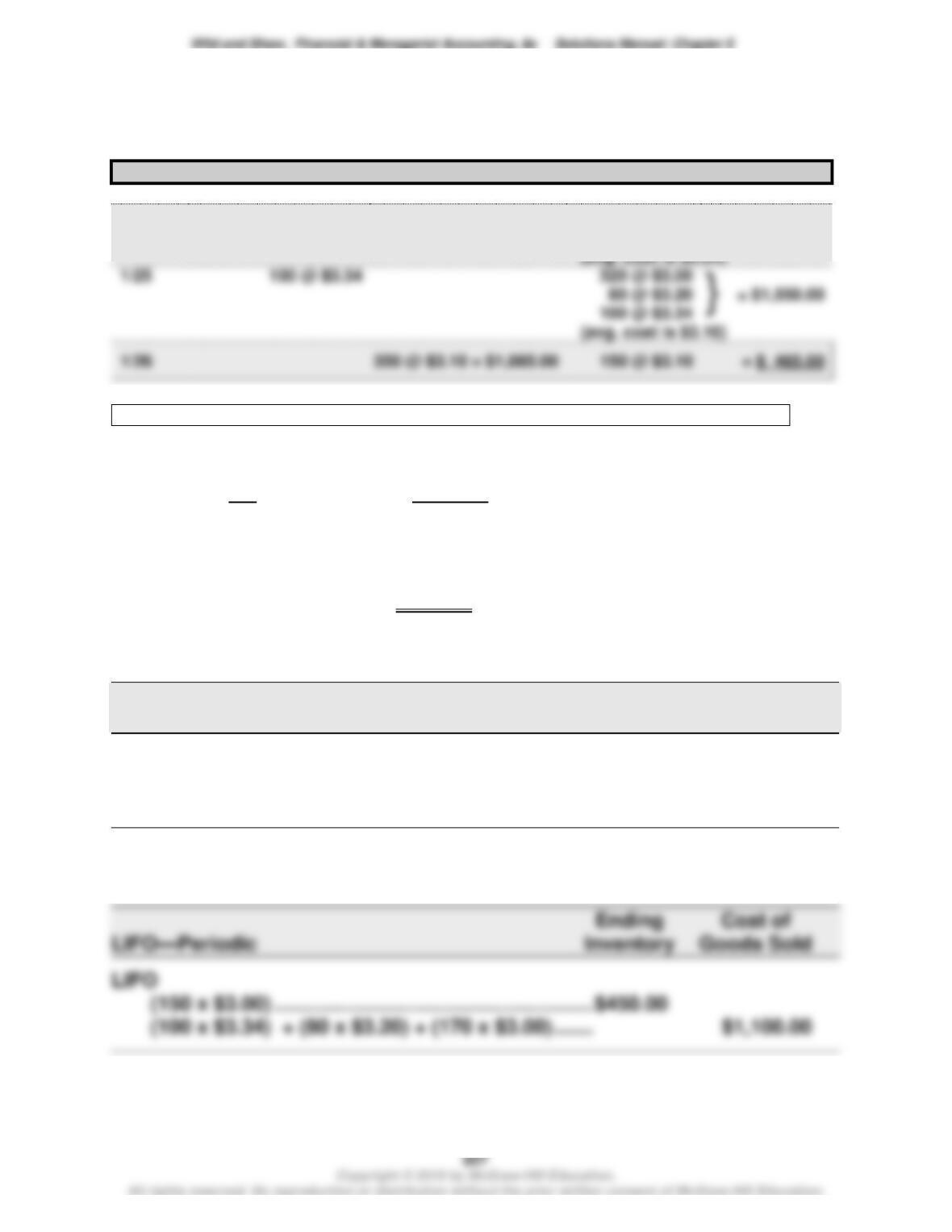
LIFO—Perpetual
Date
Goods Purchased
Cost of Goods Sold
Inventory Balance
1/1
320 @ $3.00
= $ 960.00
1/9
80 @ $3.20
320 @ $3.00
80 @ $3.20
= $1,216.00
1/25
320 @ $3.00
80 @ $3.20
= $1,550.00
100 @ $3.34
1/26
80 @ $3.20 = 256.00
150 @ $3.00
Alternate solution format
LIFO:
150
@ $3.00 =
$ 450.00
Ending inventory cost
}
}
Quick Study 5-6 (10 minutes)
Weighted Average—Perpetual
Date
Goods Purchased
Cost of Goods Sold
Inventory Balance
1/1
320 @ $3.00
= $ 960.00
1/9
80 @ $3.20
320 @ $3.00
80 @ $3.20
= $1,216.00
(avg. cost is $3.04)
1/25
320 @ $3.00
80 @ $3.20
= $1,550.00
100 @ $3.34
(avg. cost is $3.10)
Alternate solution format
Weighted average:
320
@ $3.00 =
$ 960.00
80
@ $3.20 =
256.00
100
@ $3.34 =
334.00
500
$1,550.00
Cost of goods available for sale
$1,550.00/500 = $3.10 weighted average cost per unit
150 units @ $3.10 = $ 465.00 Ending inventory cost
Quick Study 5-7A (10 minutes)
Ending Cost of
FIFO—Periodic Inventory Goods Sold
FIFO
(100 x $3.34) + (50 x $3.20) …………………………... $494.00
(320 x $3.00) + (30 x $3.20) …………………………... $1,056.00
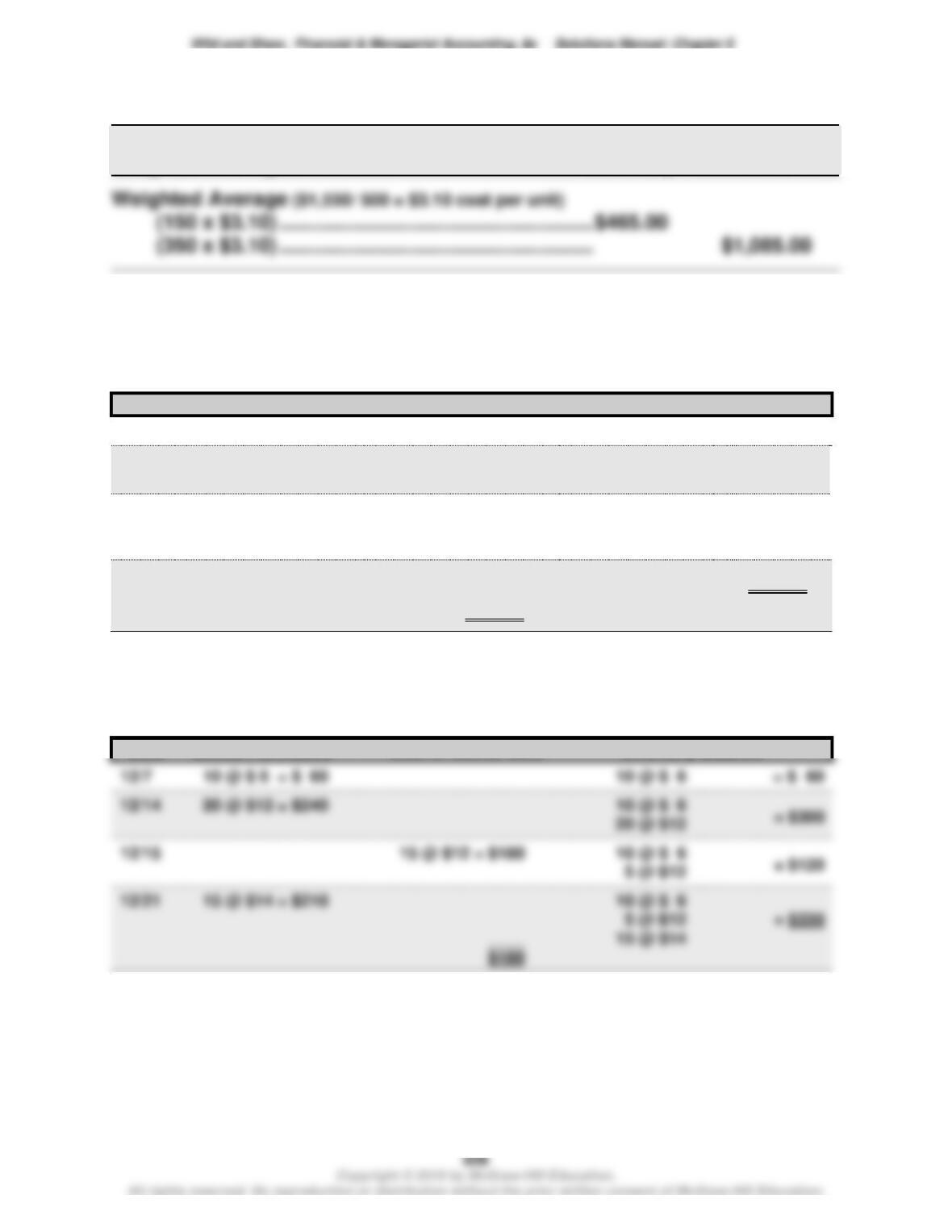
Quick Study 5-8A (10 minutes)
}
Quick Study 5-9A (10 minutes)
Ending Cost of
Weighted Average—Periodic Inventory Goods Sold
Quick Study 5-10 (25 minutes)
FIFO—Perpetual
Date
Goods Purchased
Cost of Goods Sold
Inventory Balance
12/ 7
10 @ $ 6 = $ 60
10 @ $ 6
= $ 60.00
12/14
20 @ $12 = $240
10 @ $ 6
= $300.00
20 @ $12
12/15
10 @ $ 6
15 @ $12
= $180.00
5 @ $12 = $120.00
12/21
15 @ $14 = $210
15 @ $12
= $390.00
______
15 @ $14
$120.00
Quick Study 5-11 (25 minutes)
LIFO—Perpetual
Goods Purchased
Cost of Goods Sold
10 @ $ 6
12/14
10 @ $ 6
20 @ $12
10 @ $ 6
12/21
10 @ $ 6
15 @ $14
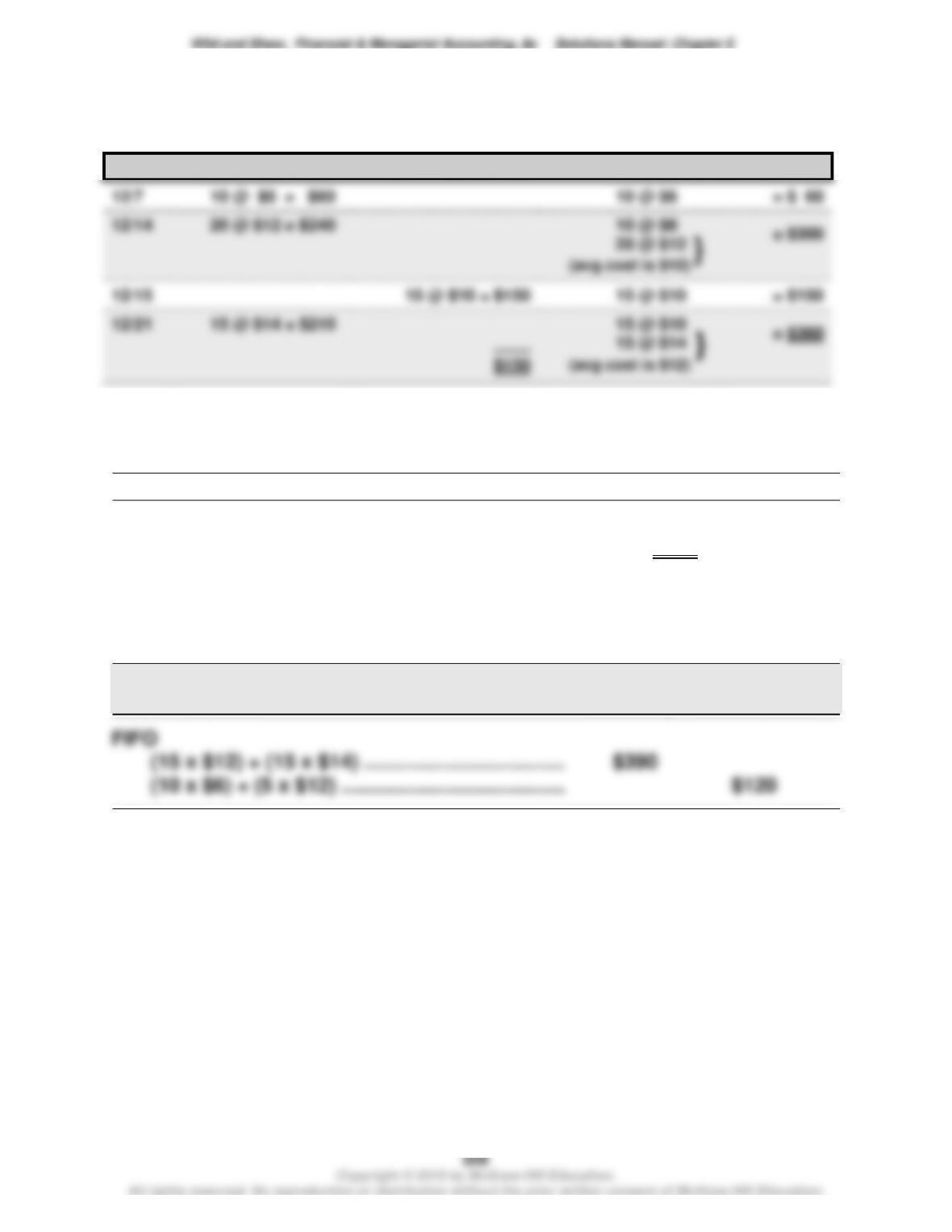
Quick Study 5-12
Weighted Average—Perpetual (25 minutes)
Quick Study 5-13 (10 minutes)
Specific Identification—Perpetual
Ending inventory under specific identification:
(2 units x $6) + (13 units x $12) + (15 units x $14) = $378.
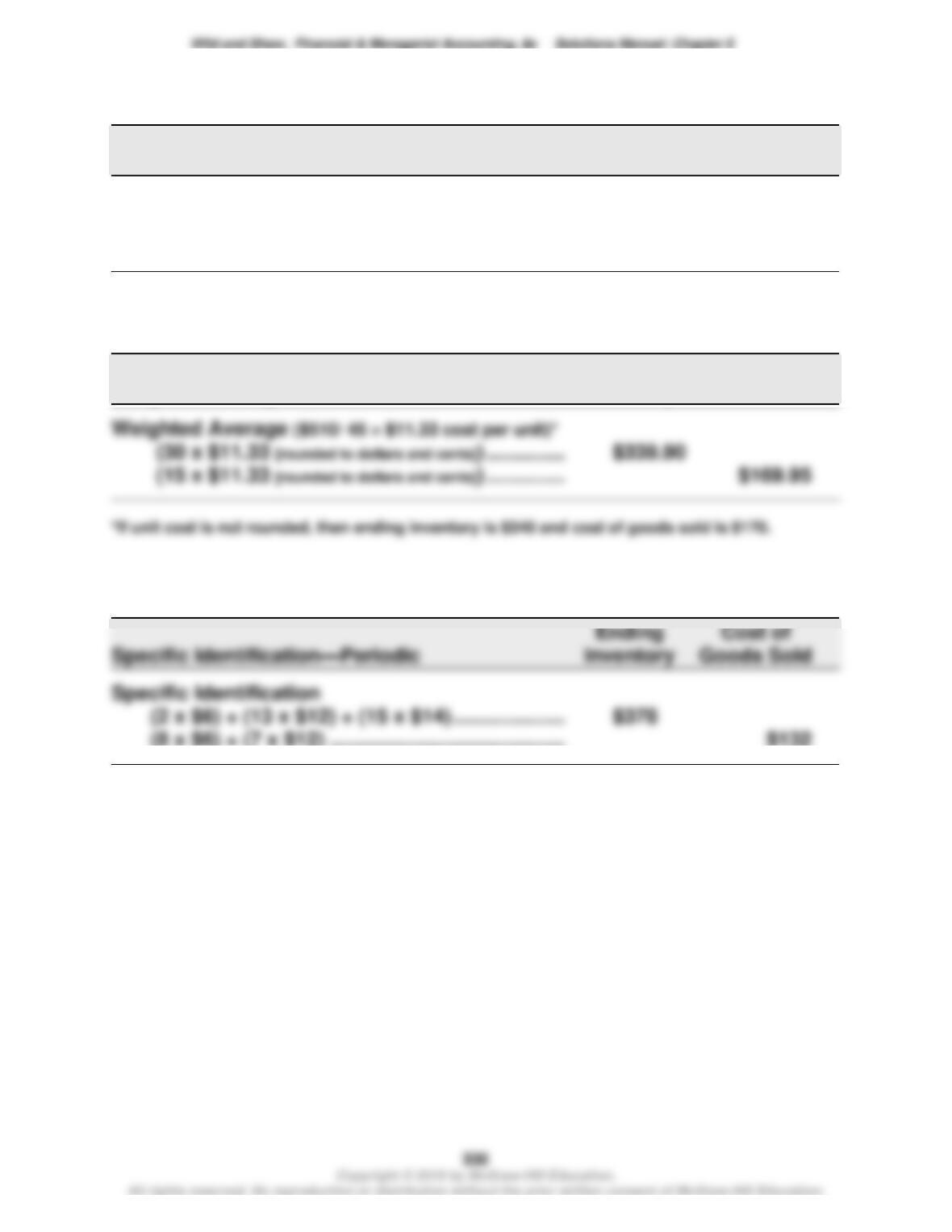
Quick Study 5-14A (10 minutes)
Ending Cost of
FIFO—Periodic Inventory Goods Sold
Date
Goods Purchased
Cost of Goods Sold
Inventory Balance
Quick Study 5-15A (10 minutes)
Ending Cost of
LIFO—Periodic Inventory Goods Sold
LIFO
(10 x $6) + (20 x $12) ……………………………….. $300
(15 x $14) …………………………..…………………… $210
Quick Study 5-16A (10 minutes)
Ending Cost of
Weighted Average—Periodic Inventory Goods Sold
Quick Study 5-17A (10 minutes)
Quick Study 5-18 (10 minutes)
1. LIFO
2. FIFO
3. LIFO
4. LIFO
5. Specific identification
Quick Study 5-19 (20 minutes)
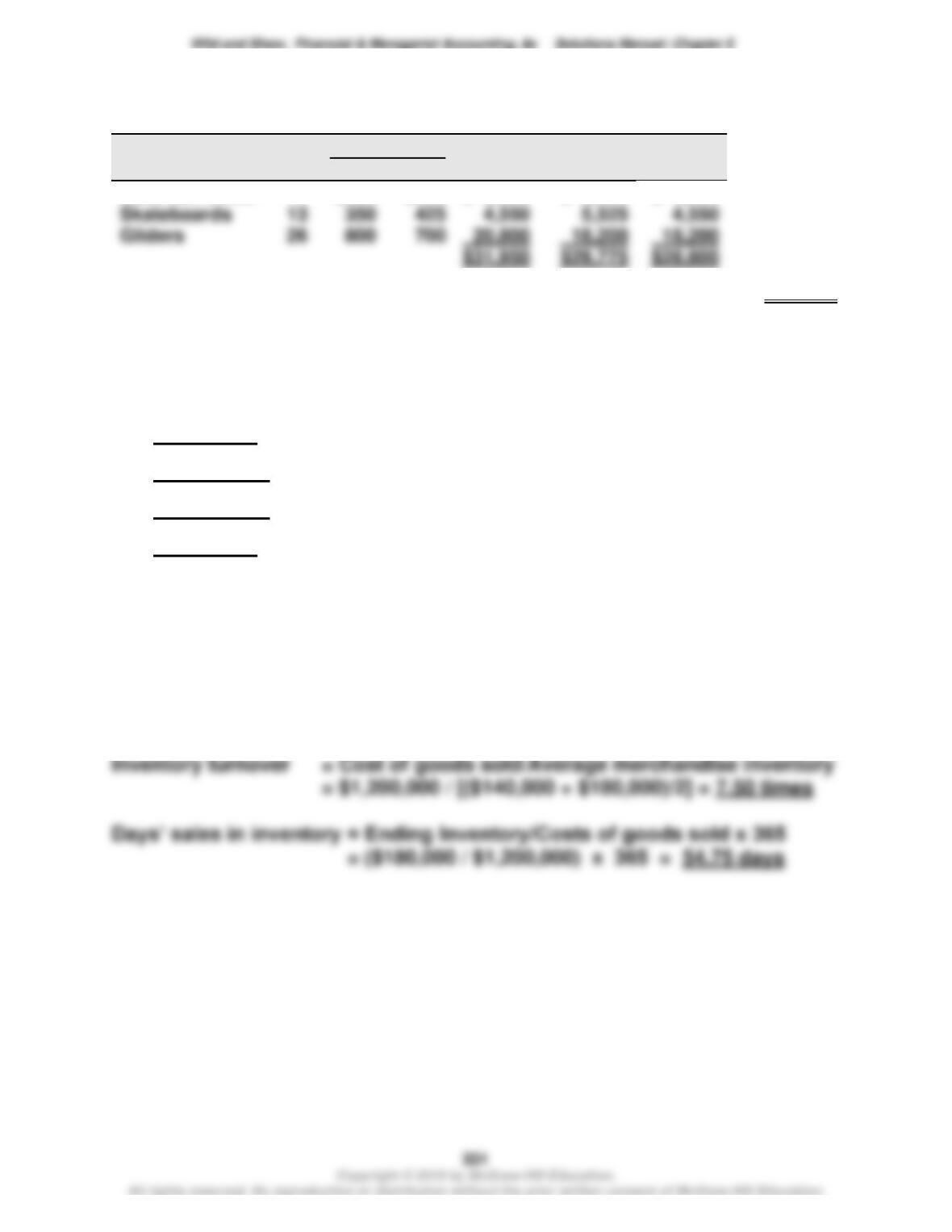
Per Unit
Total
Total
LCM –
Items
Inventory Items
Units
Cost
Market
Cost
Market
Mountain bikes
11
$600
$550
$ 6,600
$ 6,050
$ 6,050
Skateboards
Gliders
LCM applied to each product ………………………………………………
$28,800
Quick Study 5-20 (15 minutes)
a. Overstates Year 1 cost of goods sold (because EI too low).
b. Understates Year 1 net income (because COGS too high).
c. Understates Year 2 cost of goods sold (because BI too low).
d. Overstates Year 2 net income (because COGS too low).
Instructor note: The understated Year 1 net income and the overstated Year 2 net income
yield a correct combined income for the two-year period. Also, the Year 1 inventory error
does not affect years after Year 2.
Quick Study 5-21 (10 minutes)
Quick Study 5-22B (15 minutes)
Goods available for sale
Inventory, January 1 …………………………..…………………………..
$190,000
Cost of goods purchased (net) ……………………………………………..
352,000
Goods available for sale (at cost) …………………………..
542,000
Net sales at retail …………………………..…………………………..
$685,000
Estimated cost of goods sold [$685,000 x (1 – 44%)] ……………………..
Quick Study 5-23 (10 minutes)
Cost ……………………………………………………………..
$9,000
Plus
Transportation-in ……………………………………….
280
Shipping insurance ……………………………………
135
Wild and Shaw, Financial & Managerial Accounting, 8e Solutions Manual: Chapter 5
EXERCISES
Exercise 5-1 (10 minutes)
1. Answer: Barr Co.
The title will pass at “destination,” which is Lee Company’s receiving
dock. Barr should show the $12,500 in its inventory at year–end as Barr
retains title until the goods reach Lee Company.
2. The consignor is Parris Company. The consignee is Harlow Company.
Exercise 5-2 (10 minutes)
Cost of inventory
Price …………………………………………………………………………….
$75,000
Transportation-in ………………………………………………………….
2,400
Insurance on shipment ………………………………………………….
Cleaning and refurbishing ……………………………………………..
Exercise 5-3 (45 minutes)
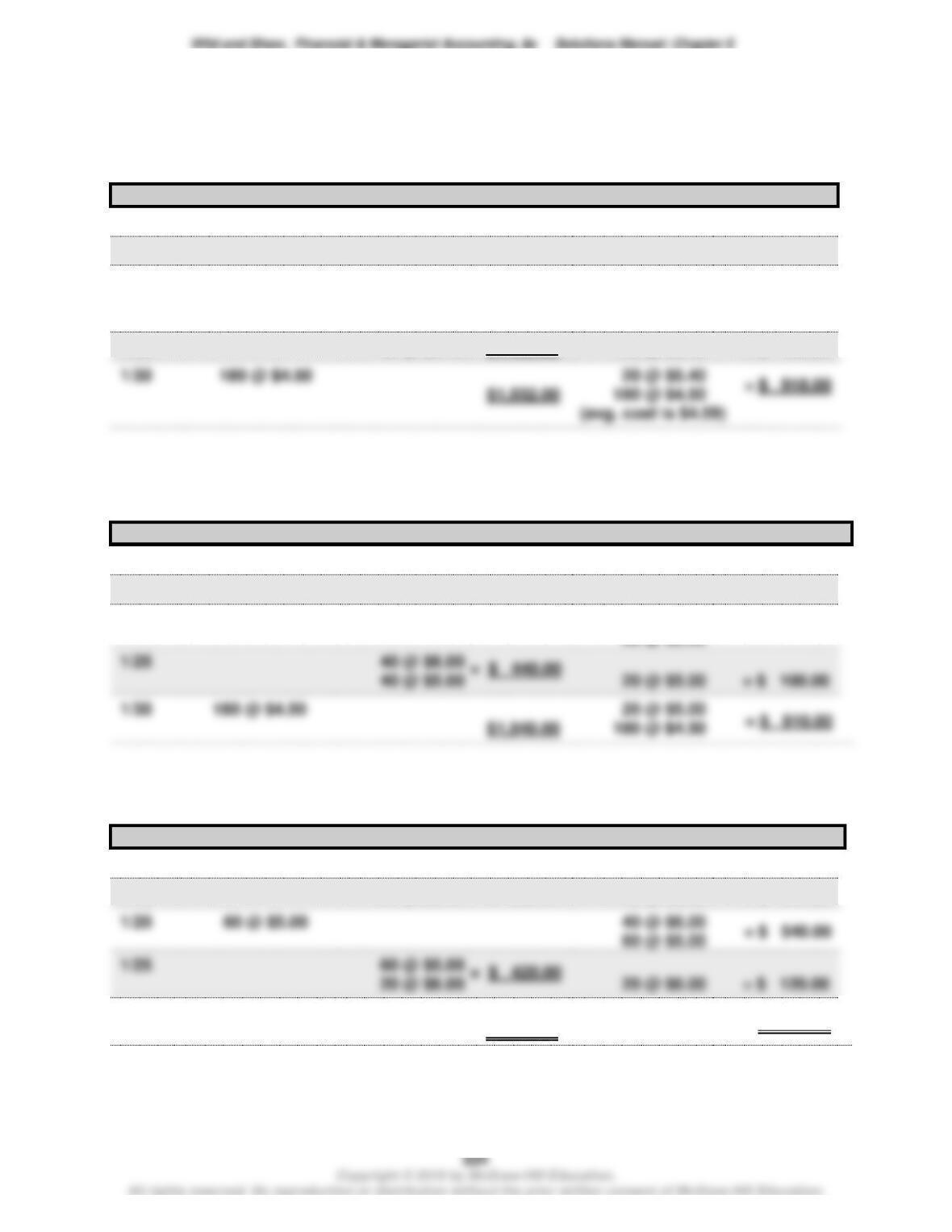
a. Specific identification
Ending inventory—180 units from January 30, 5 units from January 20, and 15
units from beginning inventory
Ending Cost of
Specific Identification Inventory Goods Sold
Exercise 5-3 (continued)
b. Weighted Average—Perpetual
Date
Goods Purchased
Cost of Goods Sold
Inventory Balance
1/1
140 @ $6.00
= $ 840.00
1/10
100 @ $6.00 = $ 600.00
40 @ $6.00
= $ 240.00
1/20
60 @ $5.00
40 @ $6.00
= $ 540.00
60 @ $5.00
(avg. cost is $5.40)
1/25
80 @ $5.40 = $ 432.00
20 @ $5.40
= $ 108.00
1/30
20 @ $5.40
180 @ $4.50
(avg. cost is $4.59)
c. FIFO—Perpetual
Date
Goods Purchased
Cost of Goods Sold
Inventory Balance
1/1
140 @ $6.00
= $ 840.00
1/10
100 @ $6.00 = $ 600.00
40 @ $6.00
= $ 240.00
1/20
60 @ $5.00
40 @ $6.00
= $ 540.00
60 @ $5.00
1/25
40 @ $6.00
40 @ $5.00
20 @ $5.00
1/30
180 @ $4.50
20 @ $5.00
= $ 910.00
$1,040.00
180 @ $4.50
d. LIFO—Perpetual
Date
Goods Purchased
Cost of Goods Sold
Inventory Balance
1/1
140 @ $6.00
= $ 840.00
1/10
100 @ $6.00 = $ 600.00
40 @ $6.00
= $ 240.00
1/20
60 @ $5.00
40 @ $6.00
= $ 540.00
60 @ $5.00
1/25
60 @ $5.00
20 @ $6.00
20 @ $6.00
1/30
180 @ $4.50
20 @ $6.00
= $ 930.00
$1,020.00
180 @ $4.50
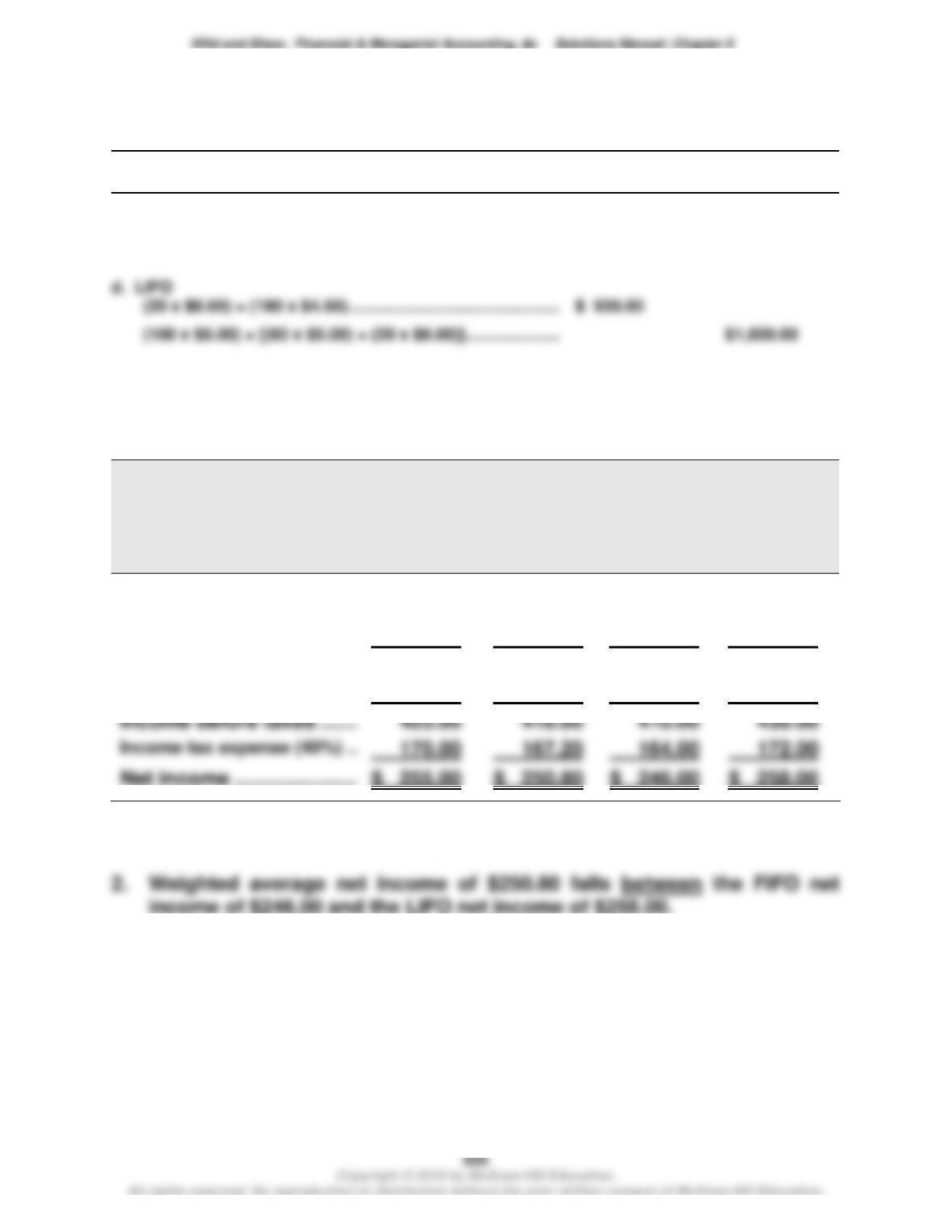
Exercise 5-3 (Concluded)
Alternate Solution Format for FIFO and LIFO Perpetual
Ending Cost of
Computations Inventory Goods Sold
c. FIFO
(180 x $4.50) + (20 x $5.00) ……………………………………….. $ 910.00
(100 x $6.00) + (40 x $6.00) + (40 x $5.00) ………………….. $1,040.00
Exercise 5-4 (20 minutes)
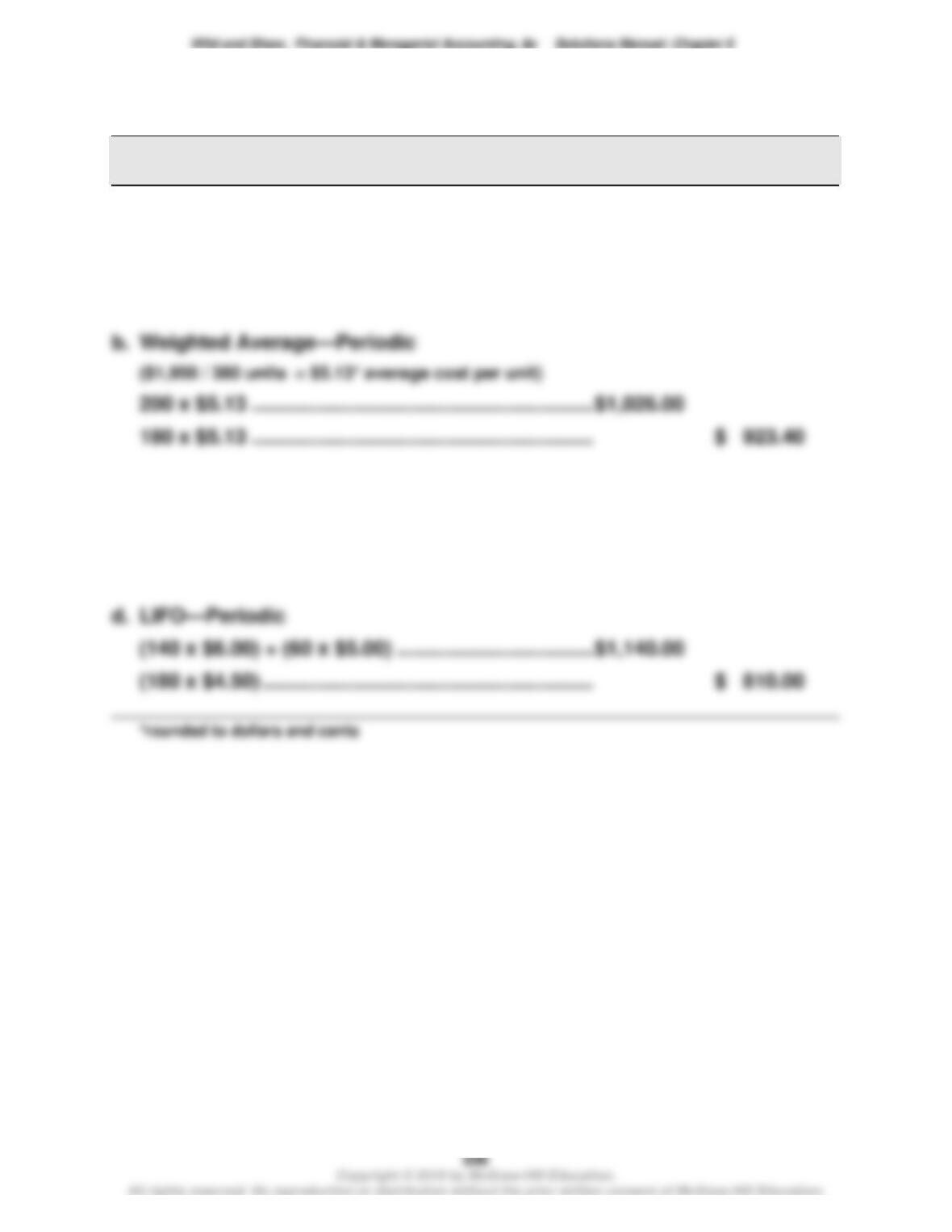
LAKER COMPANY
Income Statements
For Month Ended January 31
Specific
Identification
Weighted
Average
FIFO
LIFO
Sales …………………………..……
$2,700.00
$2,700.00
$2,700.00
$2,700.00
(180 units x $15 price)
Cost of goods sold …………..
1,025.00
1,032.00
1,040.00
1,020.00
Gross profit ……………………..
1,675.00
1,668.00
1,660.00
1,680.00
Expenses …………………………
1,250.00
1,250.00
1,250.00
1,250.00
Income before taxes …………
170.00
167.20
164.00
172.00
1. LIFO method results in the highest net income of $258.00.
3. If costs were rising instead of falling, then the FIFO method would yield
the highest net income.
Exercise 5-5A (35 minutes)
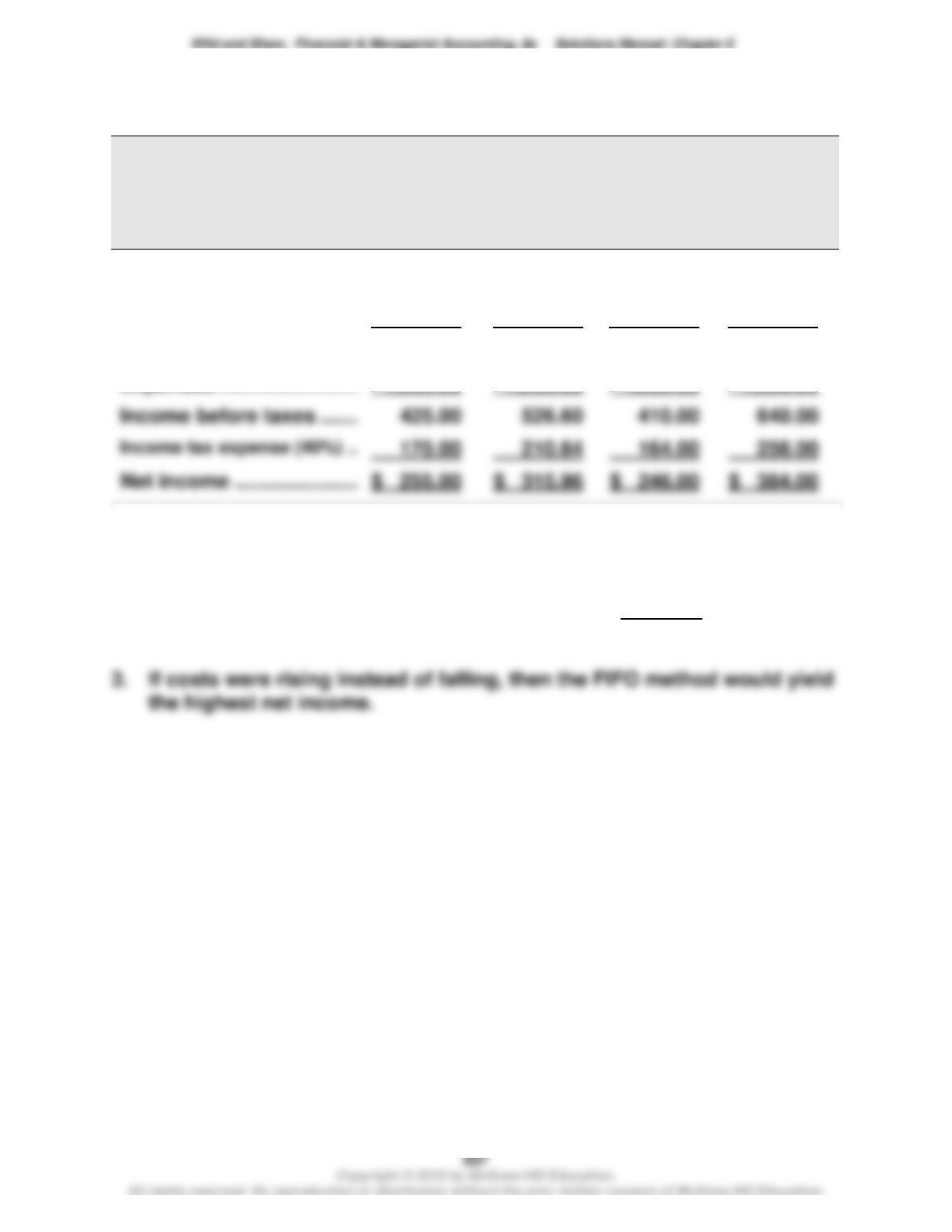
Ending Cost of
Periodic Inventory Computations Inventory Goods Sold
a. Specific Identification—Periodic
(180 x $4.50) + (5 x $5.00) + (15 x $6) ………………. $ 925.00
$1,950 [Total Goods Available] – $925 [Ending Inventory] ………… $1,025.00
c. FIFO—Periodic
(180 x $4.50) + (20 x $5.00) …………………………….. $ 910.00
(140 x $6.00) + (40 x $5.00) …………………………….. $1,040.00
Exercise 5-6 (20 minutes)
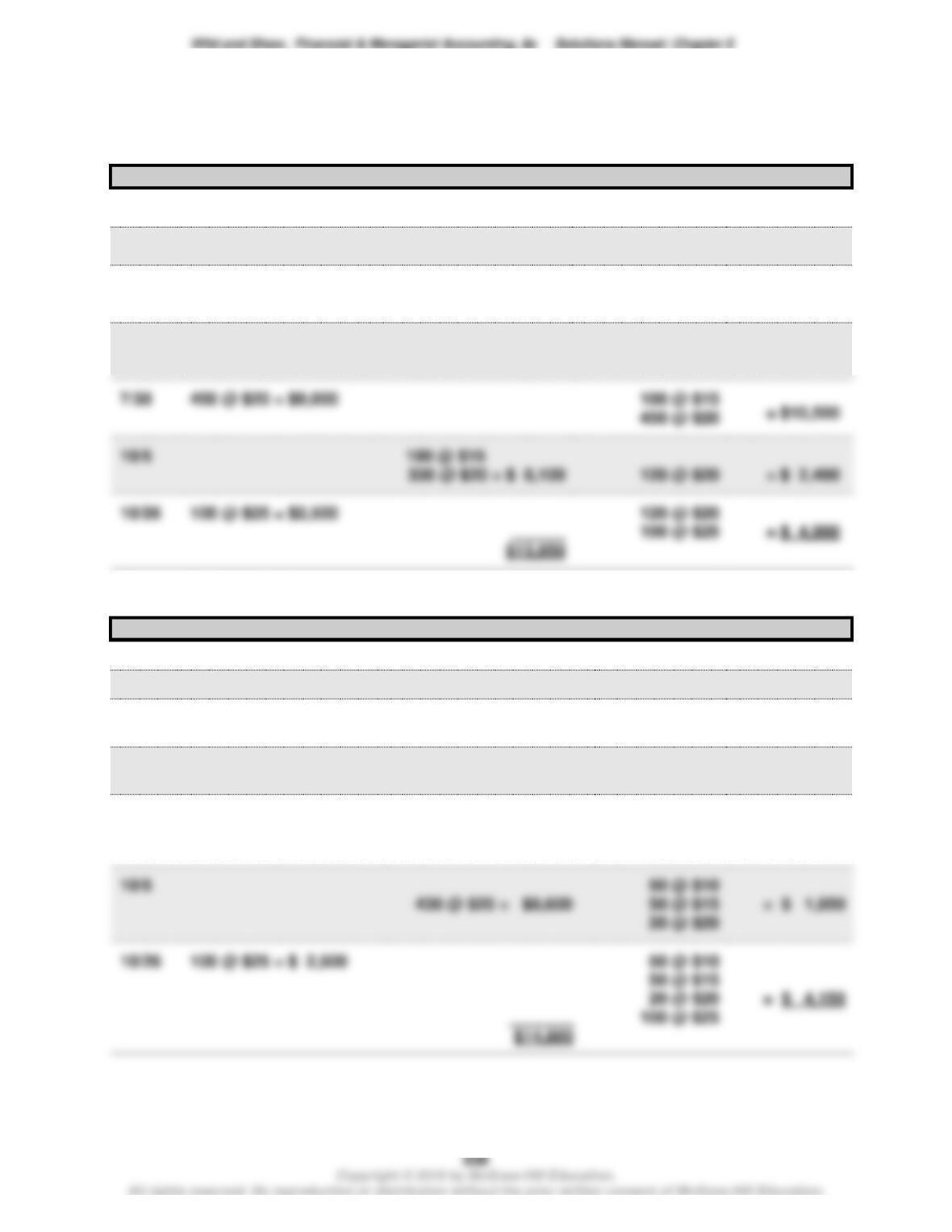
LAKER COMPANY
Income Statements
For Month Ended January 31
Specific
Identification
Weighted
Average
FIFO
LIFO
Sales …………………………..……
$2,700.00
$2,700.00
$2,700.00
$2,700.00
(180 units x $15 price)
Cost of goods sold …………..
1,025.00
923.40
1,040.00
810.00
Gross profit ……………………..
1,675.00
1,776.60
1,660.00
1,890.00
1. LIFO method results in the highest net income of $384.00.
2. Weighted average net income of $315.96 falls between the FIFO net
income of $246.00 and the LIFO net income of $384.00.
Exercise 5-7 (20 minutes)
a. FIFO—Perpetual
Date
Goods Purchased
Cost of Goods Sold
Inventory Balance
1/1
200 @ $10
= $ 2,000
1/10
150 @ $10 = $ 1,500
50 @ $10
= $ 500
3/14
350 @ $15 = $5,250
50 @ $10
= $ 5,750
350 @ $15
3/15
50 @ $10
100 @ $15
= $ 1,500
250 @ $15 = $ 4,250
7/30
450 @ $20 = $9,000
100 @ $15
450 @ $20
10/5
330 @ $20 = $ 8,100
120 @ $20
10/26
100 @ $25 = $2,500
120 @ $20
100 @ $25
b. LIFO—Perpetual
Date
Goods Purchased
Cost of Goods Sold
Inventory Balance
1/1
200 @ $10
= $ 2,000
1/10
150 @ $10 = $ 1,500
50 @ $10
= $ 500
3/14
350 @ $15 = $ 5,250
50 @ $10
= $ 5,750
350 @ $15
3/15
50 @ $10
= $ 1,250
300 @ $15 = $ 4,500
50 @ $15
7/30
450 @ $20 = $ 9,000
50 @ $10
50 @ $15
= $ 10,250
450 @ $20
10/5
50 @ $10
10/26
100 @ $25 = $ 2,500
50 @ $10
50 @ $15
20 @ $20
Exercise 5-7 (Concluded)
Alternate Solution Format
Ending Cost of
Inventory Goods Sold
a. FIFO
(100 x $25) + (120 x $20) ………………………………………………… $4,900
(150 x $10) + (50 x $10) + (250 x $15) +
FIFO Gross Margin
Sales revenue (880 units sold x $40 selling price) …………………….
$35,200
Less: FIFO cost of goods sold ………………………………………………..
13,850
Gross profit …………………………………………………………………………….
$21,350
LIFO Gross Margin
Sales revenue (880 units sold x $40 selling price) …………………….
$35,200
Less: LIFO cost of goods sold ………………………………………………..
14,600
Exercise 5-8 (15 minutes)
a. Specific Identification method—Cost of goods sold
Cost of goods available for sale ………………………………………
$18,750
Ending inventory under specific identification
3/14 purchase ( 45 @ $15) ………………………………………..
$ 675
7/30 purchase ( 75 @ $20) …………………………………………
4,675
$14,075
b. Specific Identification method—Gross margin
Sales revenue (880 units sold x $40 selling price) …………….
$35,200
Less: Specific identification cost of goods sold ………………
14,075
Gross profit …………………………………………………………………….
$21,125
Exercise 5-9A (20 minutes)
Ending Cost of
Periodic Inventory System Inventory Goods Sold
a. FIFO—Periodic
(100 x $25) + (120 x $20) …………………………………….. $4,900
(200 x $10) + (350 x $15) + (330 x $20) ………………… $13,850
c.
FIFO—Periodic Gross Margin
Sales revenue (880 units sold x $40 selling price) …………….
$35,200
Less: FIFO cost of goods sold ………………………………………..
13,850
Gross margin ……………………………………………………….………….
$21,350
LIFO—Periodic Gross Margin
Sales revenue (880 units sold x $40 selling price) …………….
$35,200
Less: LIFO cost of goods sold ………………………………………..
16,450
Gross margin ……………………………………………………….………….
$18,750
Exercise 5-10 (15 minutes)
Per Unit
Total
Total
LCM Applied
to Items
Inventory Items
Units
Helmets ………..
Lower of cost or market of inventory by product = $7,394
1. a. LIFO ratio computations
LIFO current ratio (Year 2) = $220/$200 = 1.1
LIFO inventory turnover (Year 2) = $740/ [($110+$160)/2] = 5.5
LIFO days’ sales in inventory (Year 2) = ($160/$740) x 365 = 78.9 days
2. The use of LIFO versus FIFO for Cruz markedly impacts the ratios computed.
Specifically, LIFO makes Cruz appear worse in comparison to FIFO numbers
on the current ratio (1.1 vs. 1.5) but better on inventory turnover (5.5 vs. 3.8)
and days’ sales in inventory (78.9 vs. 132.7).
These results can be generalized. That is, when costs are rising and
quantities are stable or rising, the FIFO inventory exceeds LIFO inventory.
This suggests that (relative to FIFO) the LIFO current ratio is understated, the
Exercise 5-12 (25 minutes)
2. Reported income figures
Year 1
Year 2
Year 3
Sales …………………………….
$850,000
$850,000
$850,000
Cost of goods sold
Beginning inventory …..
$250,000
$230,000
$250,000
Cost of purchases ………
500,000
500,000
500,000
Good available for sale ……
750,000
730,000
750,000
Ending inventory ………..
230,000
250,000
250,000
Cost of goods sold ……..
Exercise 5-13 (20 minutes)
Year 3 Inventory turnover Year 3 Days’ Sales in Inventory
$643,825/[($87,750 + $97,400)/2]
= 7.0 times $97,400/$643,825 x 365 days = 55.2 days
Exercise 5-14A (20 minutes)
Ending
Inventory
Cost of
Goods Sold
a. Specific identification
(50 x $2.90) + (50 x $2.80) + (50 x $2.50) ………….
$410.00
$3,855 [Goods Available] – $410.00 [Ending Inventory] …………
$3,445.00
b. Weighted average ($3,855/1,500 = $2.57)
150 x $2.57 [rounded to cents] ………………………………….
385.50
$3,855 [Goods Available] – $385.50 [Ending Inventory] …………
3,469.50
c. FIFO
(150 x $2.90)…………………………………………………..
435.00
(96 x $2.00) + (220 x $2.25) + (544 x $2.50) +
d. LIFO