FINANCIAL ACCOUNTING – Eleventh Edition Solutions Manual
E5-34B
(10-15 min.)
Solution:
DATE DEBIT CREDIT
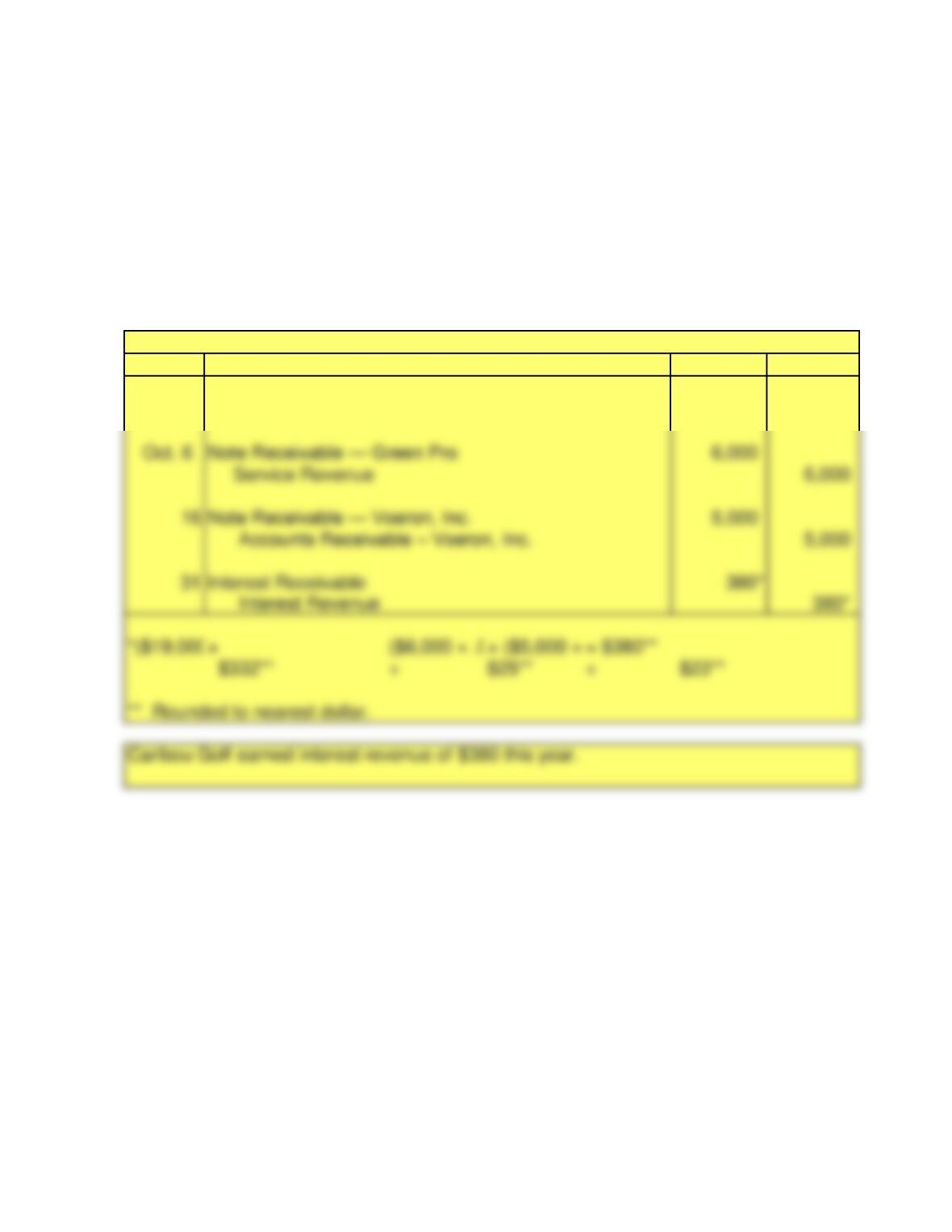
Aug. 1 Note Receivable — Carl Fajar 19,000
Cash 19,000
Record the following note receivable transactions in the journal of Caribou Golf. How
much interest revenue did Caribou earn this year? Use a 365-day year for interest
computations, and round interest amounts to the nearest dollar. Caribou Golf has an
October 31 fiscal year-end.
Journal
ACCOUNT TITLES AND EXPLANATION
Chapter 5: Short-Term Investments and Receivables Page 41 of 87
FINANCIAL ACCOUNTING – Eleventh Edition Solutions Manual
E5-35B
(10-15 min.)
Requirements
Solution:
Req. 1
(a)
(b)
Req. 2
=
=
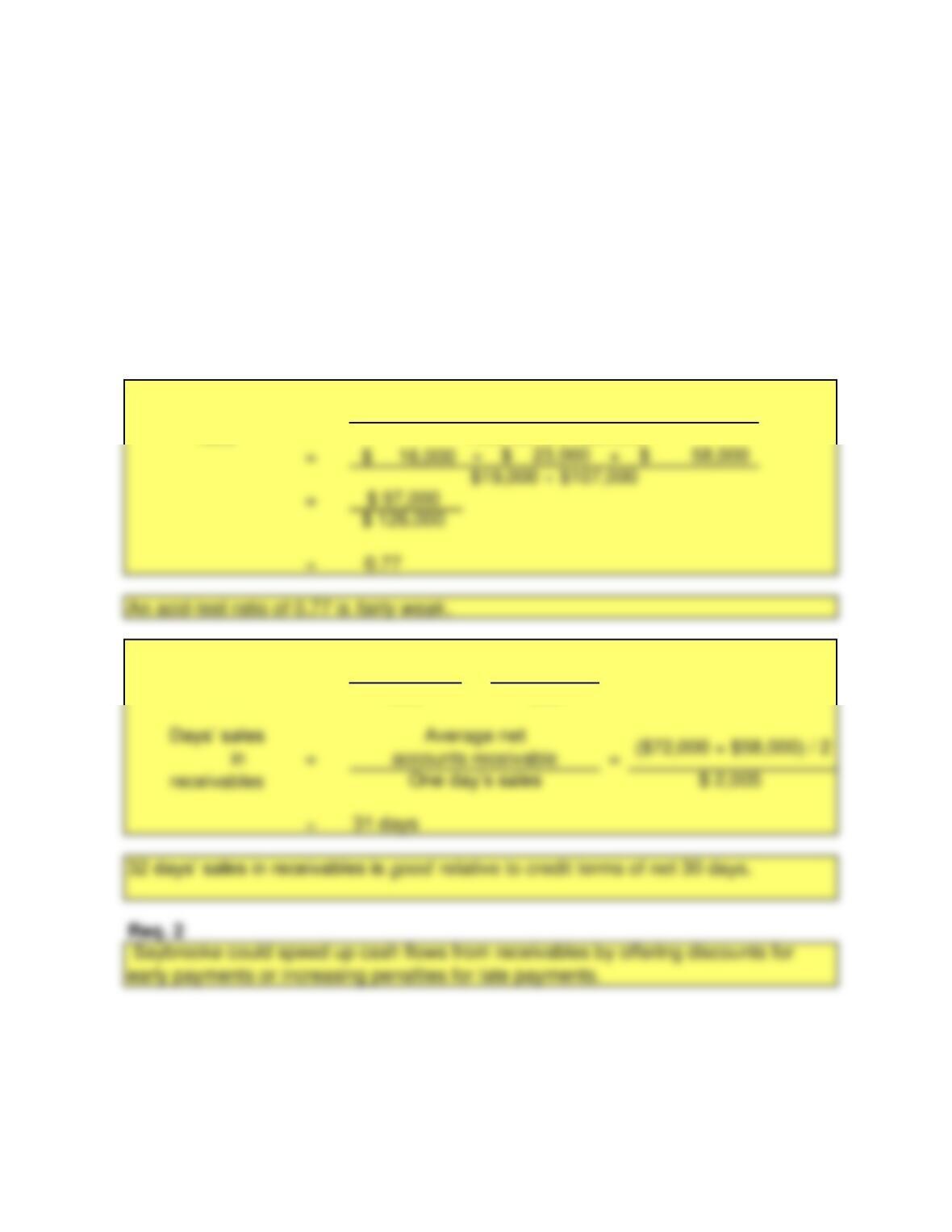
1. Compute Saybrooke’s (a) quick (acid-test) ratio and (b) days’ sales outstanding
for 2016. Evaluate each ratio value as strong or weak. All sales are on account with
terms of net 30 days.
2. Recommend two ways for Saybrooke to speed up its cash flow from receivables.
Quick
(acid-test)
ratio
=
Cash and
cash equiv.
+
Marketable
securites
+
Net current
receivables
Total current liabilities
One day’s
sales
=
Sales
revenue
=
$ 732,000
=
$ 2,005
365
365
Chapter 5: Short-Term Investments and Receivables Page 42 of 87
FINANCIAL ACCOUNTING – Eleventh Edition Solutions Manual
E5-36B
(10-15 min.)
Requirements
Solution:
Req. 1
Average collection period: Millions of dollars
One day’s sales = = 1,585$
Req. 2
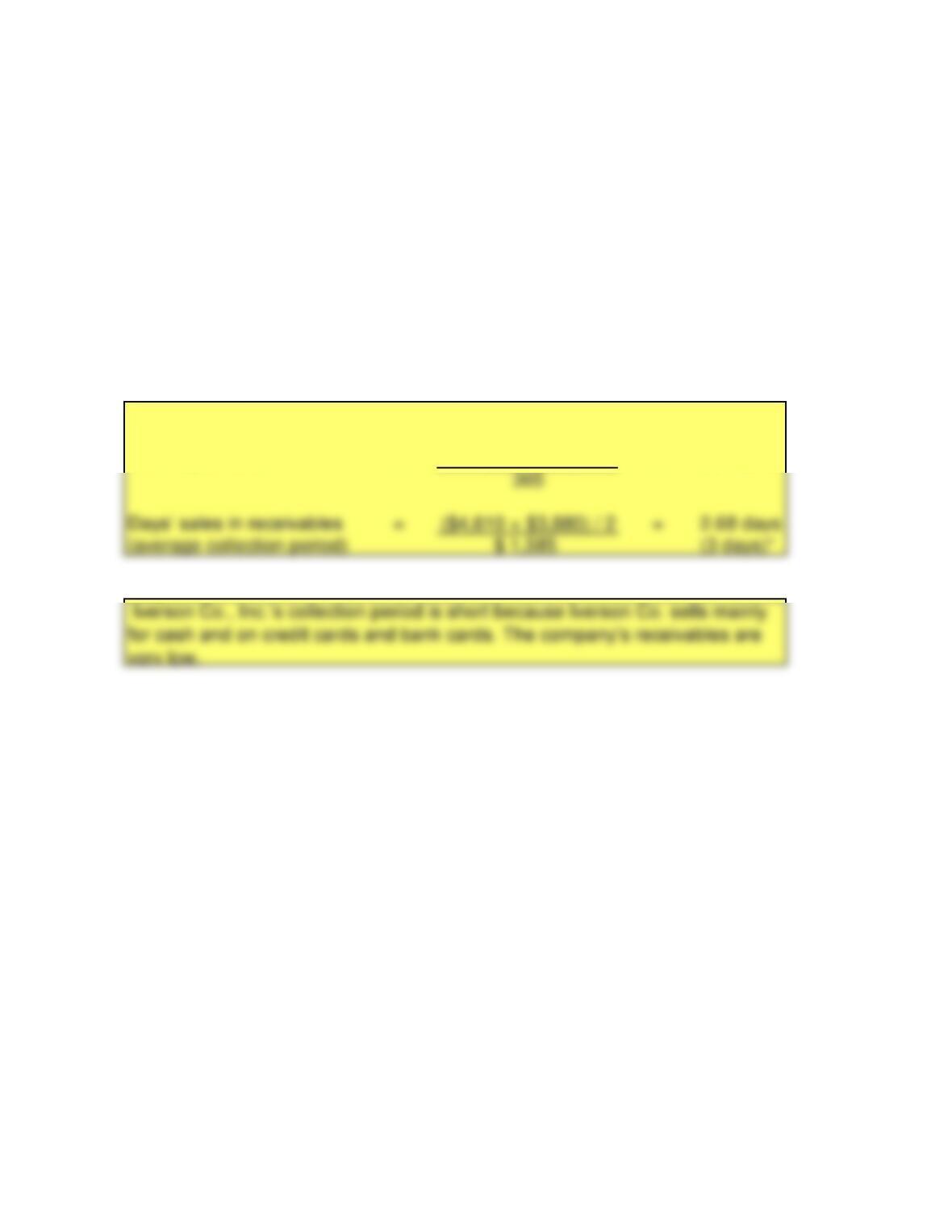
1. Compute Iverson’s days’ sales in receivables or days’ sales outstanding
(DSO) during 2017.
2. Is Iverson’s DSO long or short? Dartex Networks takes 39 days to collect its
average level of receivables. Defranco, the overnight shipper, takes 33 days.
What causes Iverson’s collection period to be so different?
$ 578,525
Chapter 5: Short-Term Investments and Receivables Page 43 of 87
Days’ sales in receivables = = 2.68 days
FINANCIAL ACCOUNTING – Eleventh Edition Solutions Manual
Quiz
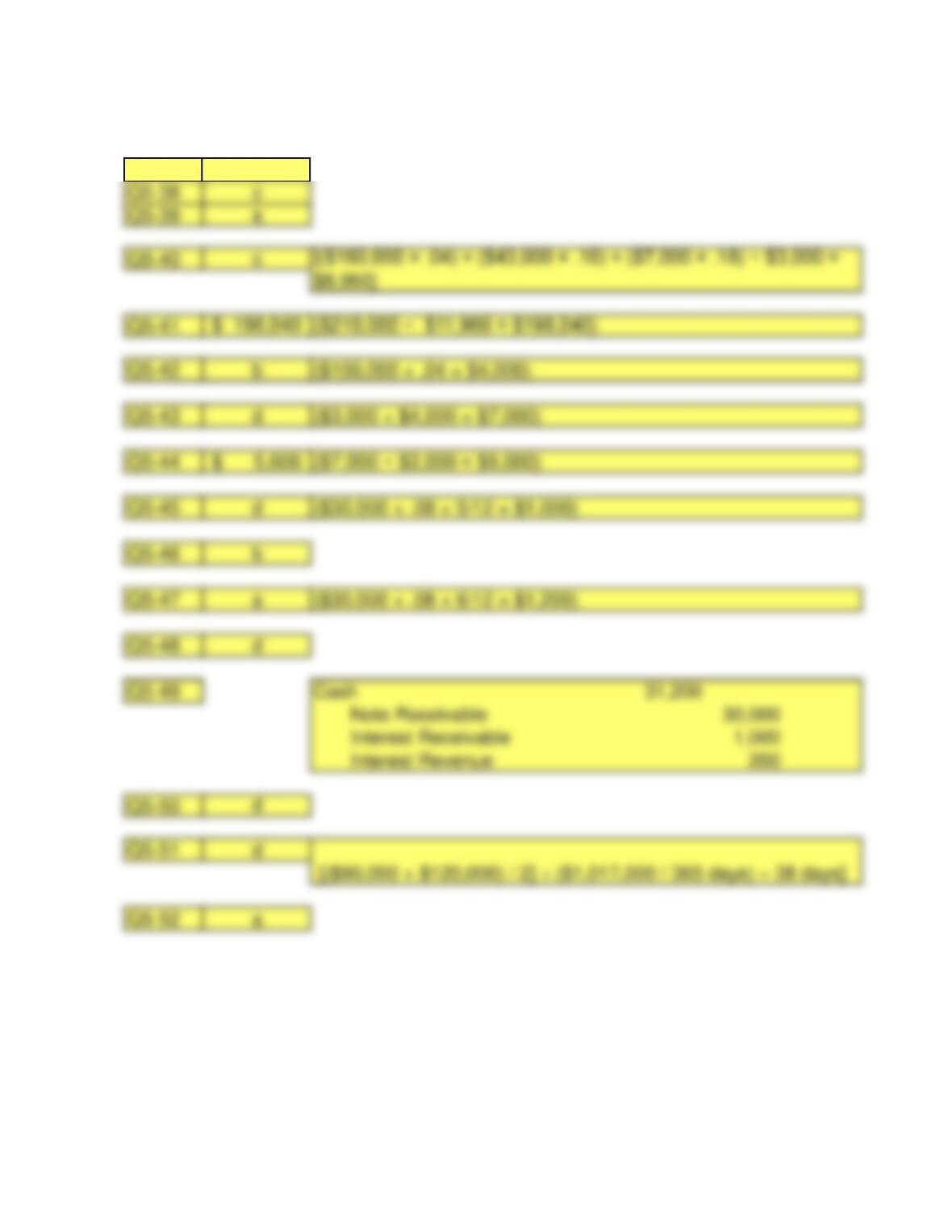
Q5-37 c
Chapter 5: Short-Term Investments and Receivables Page 44 of 87
FINANCIAL ACCOUNTING – Eleventh Edition Solutions Manual
P5-53A
(20-30 min.)
Requirements
Solution:
Reqs. 1 and 2
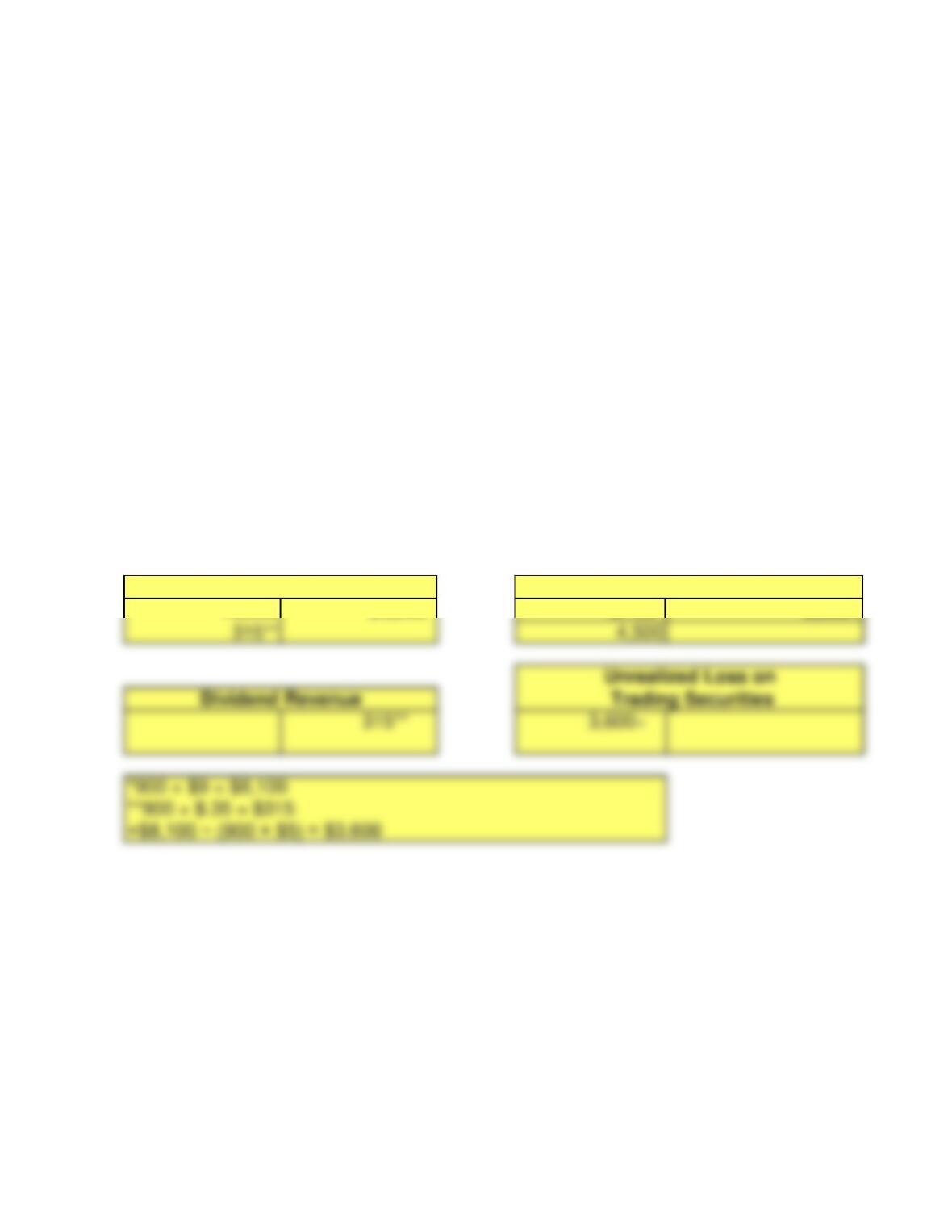
19,000 20,000* 8,100* 3,600+
1. Open T-accounts for Cash (including its beginning balance of $19,000), Investment in
Trading Securities, Dividend Revenue, and Unrealized Gain (Loss) on Trading
Securities.
2. Journalize the foregoing transactions and post to the T-accounts.
3. Show how to report the short-term investment on Abbott’s balance sheet at
December 31, 2016.
4. Show how to report whatever should appear on Abbott’s income statement for the
year ended December 31, 2016.
5. Abbott sold the trading securities for $6,300 on January 14, 2017. Journalize the sale.
6. Assume that the securities were classified as available-for-sale. Further, assume that
the fair value was $10 per share on December 31, 2017, and $10.50 per share on
January 1, 2018, when they were sold. Repeat steps 3–4 for 2016 and 2017, and
journalize the sale of the securities on January 1, 2018. Follow the example in Exhibit 5-
2.
Cash
Investment in Trading Securities
Chapter 5: Short-Term Investments and Receivables Page 45 of 87
FINANCIAL ACCOUNTING – Eleventh Edition Solutions Manual
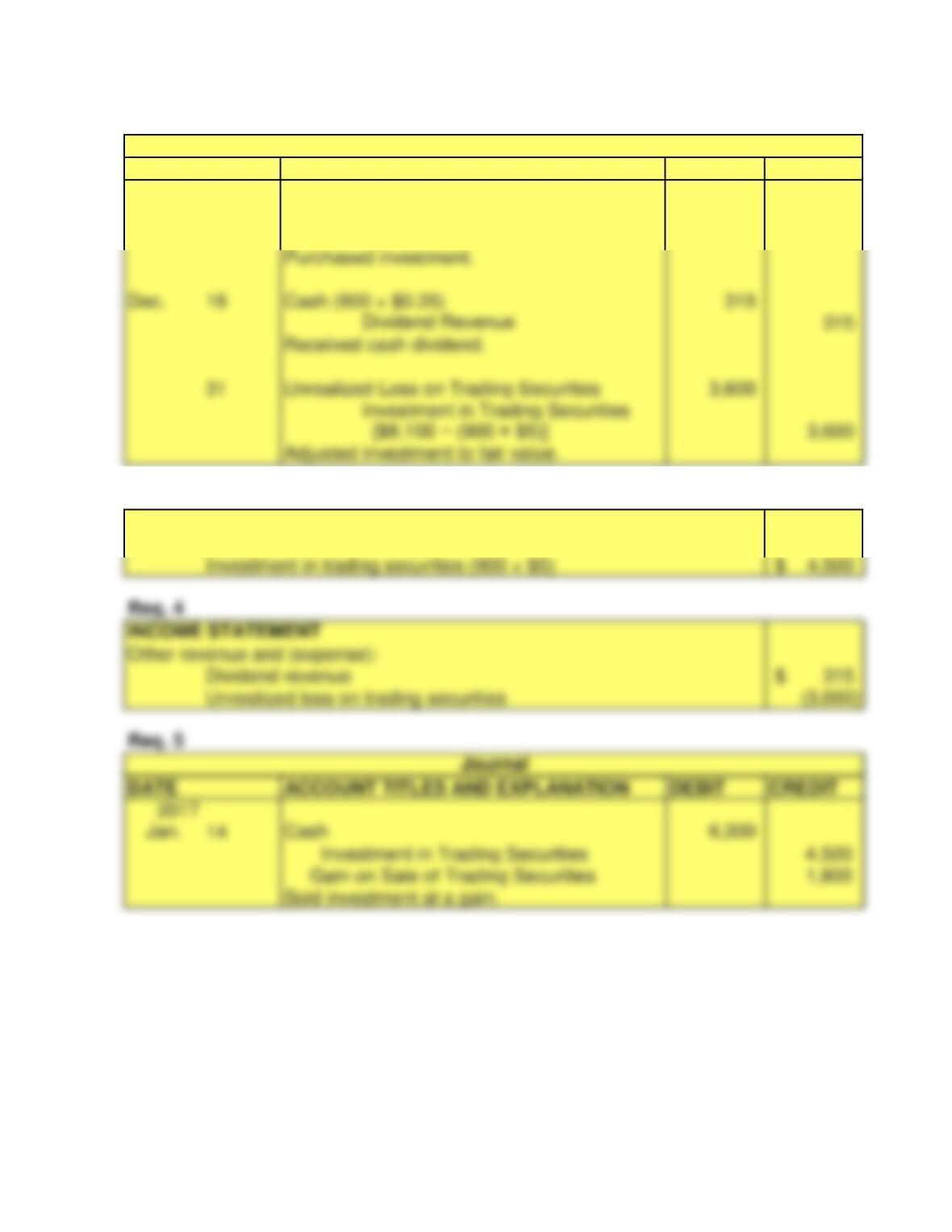
Req. 2
DATE DEBIT CREDIT
2016
Nov. 16 Investment in Trading Securities 8,100
Cash (900 × $9) 8,100
Req. 3
BALANCE SHEET
Current assets:
Req. 4
INCOME STATEMENT
Other revenue and (expense):
Req. 5
2017
Journal
ACCOUNT TITLES AND EXPLANATION
Journal
ACCOUNT TITLES AND EXPLANATION
Chapter 5: Short-Term Investments and Receivables Page 46 of 87
Dividend Revenue 315
FINANCIAL ACCOUNTING – Eleventh Edition Solutions Manual
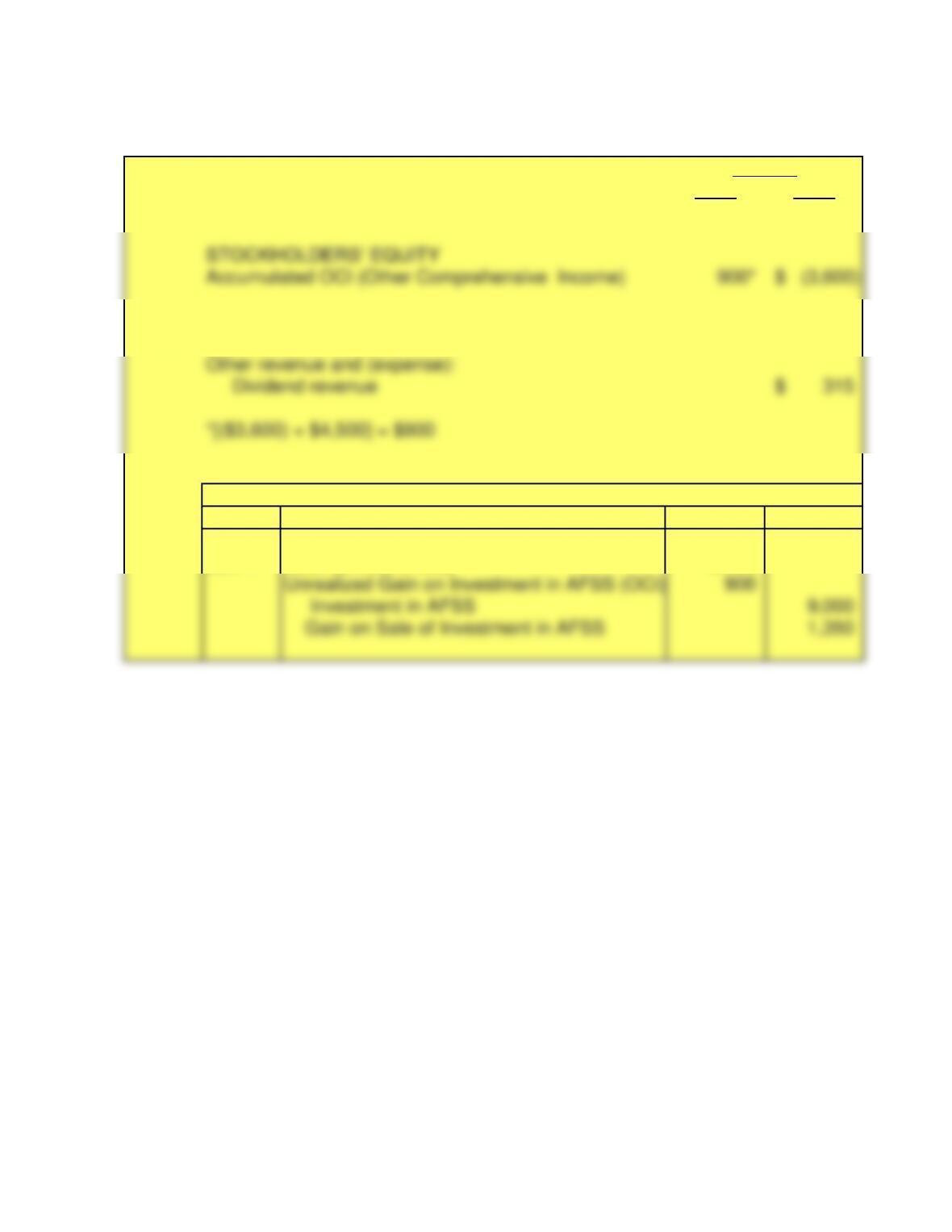
Req. 6
3 BALANCE SHEET
Current assets: 2017 2016
Investment in AFSS 9,000$ 4,500$
4 INCOME STATEMENT
Other revenue and (expense):
Dividend revenue 315$
5 Sale of securities:
DATE ACCOUNT TITLES AND EXPLANATION DEBIT CREDIT
2018
Jan. 1 Cash ($10.50 x 900) 9,450
Journal
Dec. 31
Chapter 5: Short-Term Investments and Receivables Page 47 of 87
Accumulated OCI (Other Comprehensive Income) 900* (3,600)$
FINANCIAL ACCOUNTING – Eleventh Edition Solutions Manual
P5-54A
(10-15 min.)
Requirement
Solution:
MEMORANDUM
DATE:
TO: Management of Bogoda Industries, Inc.
FROM: Student Name
RE: Evaluation of internal control over cash receipts from customers
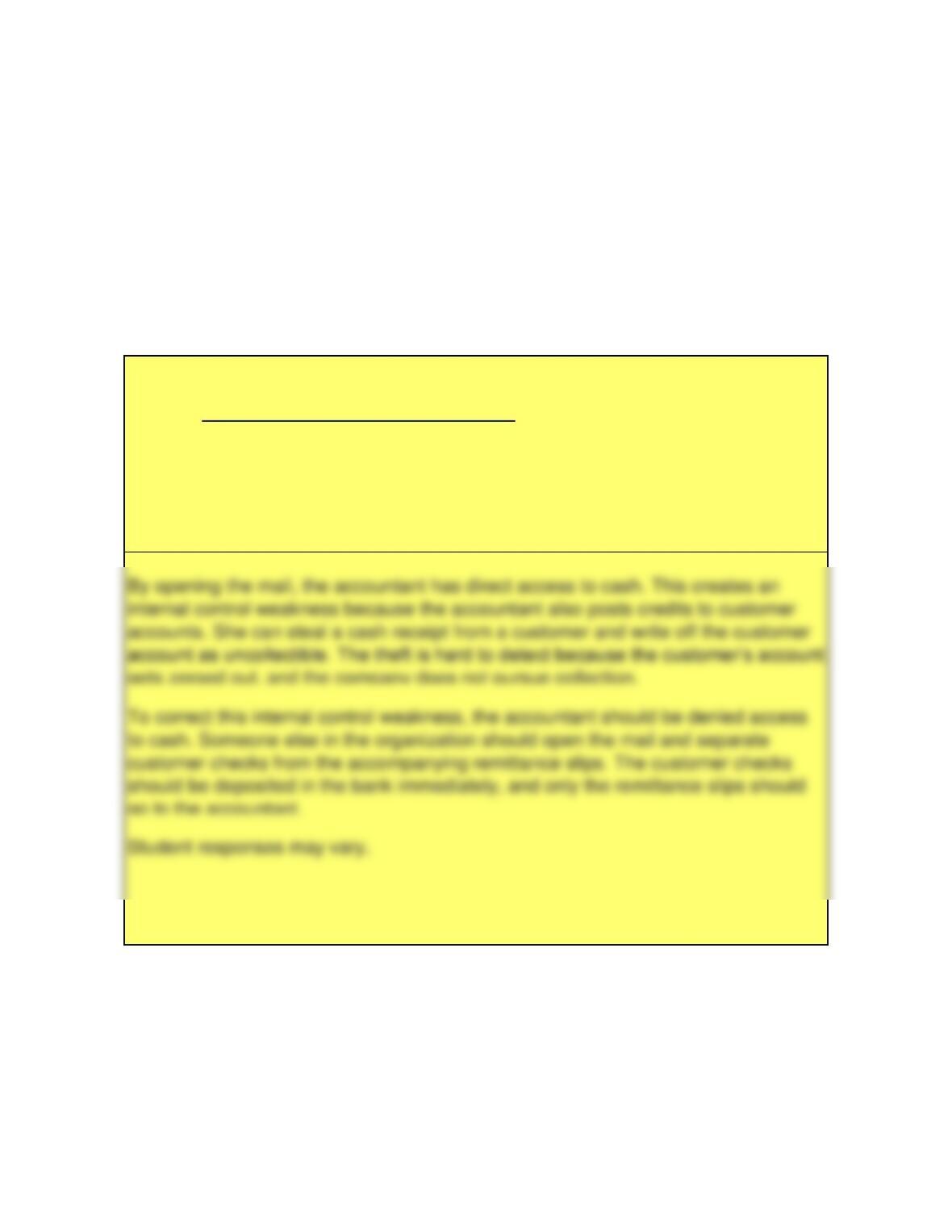
1. As a consultant hired by Bogoda Industries, Inc., write a memo to management
evaluating the company’s internal controls over cash receipts from customers. If the
system is effective, identify its strong features. If the system has flaws, propose a
way to strengthen the controls.
Chapter 5: Short-Term Investments and Receivables Page 48 of 87
Student responses may vary.
FINANCIAL ACCOUNTING – Eleventh Edition Solutions Manual
P5-55A
(15-20 min.)
Requirements
Solution:
(All amounts in millions)
Req. 1 and 3
3,600 28,860 230
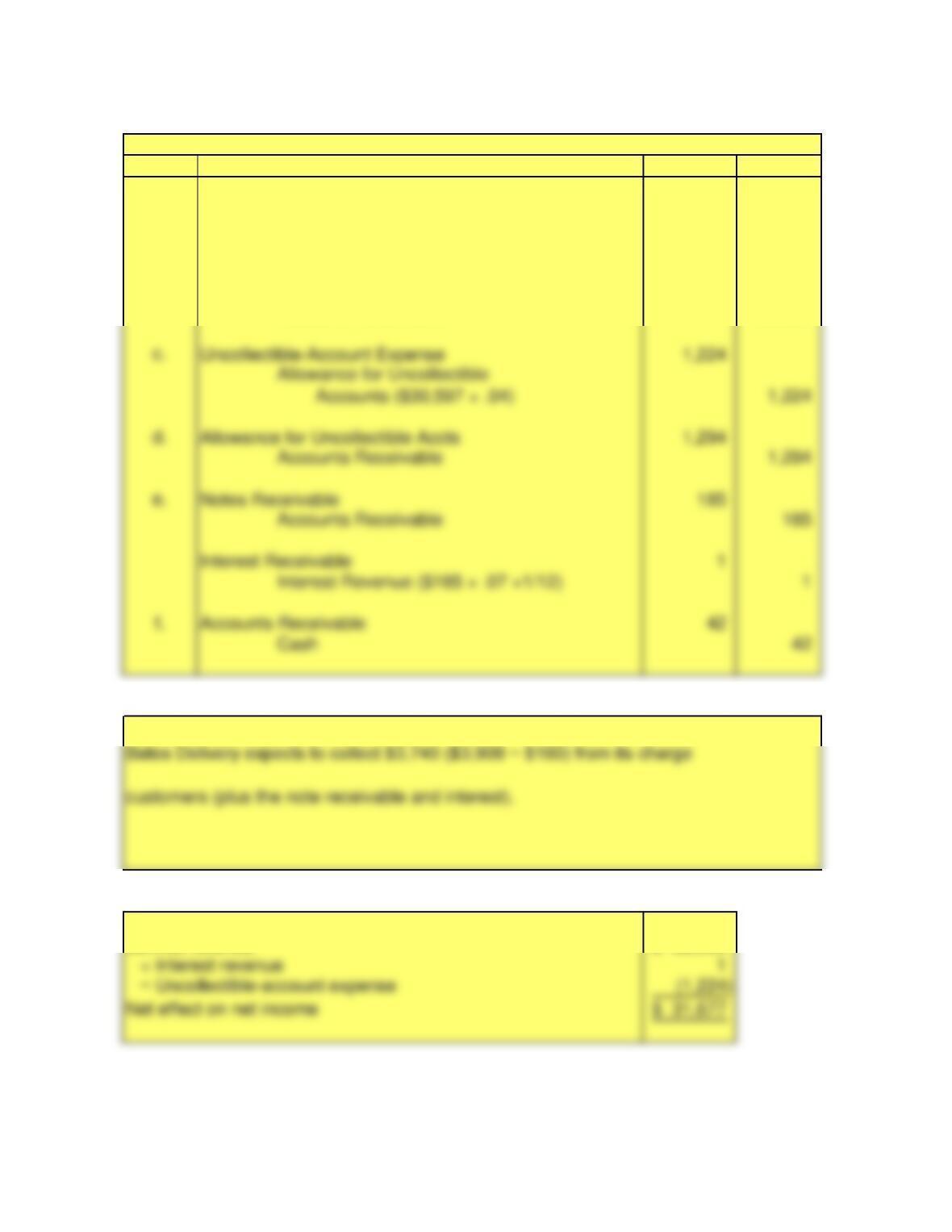
1. Prepare T-accounts for Accounts Receivable and Allowance for Uncollectible
Accounts, and insert the October 31, 2016, balances as given.
2. Journalize the following transactions of Bates Delivery Corp. for the year ended
October 31, 2017 (explanations are not required):
a. Service revenue was $32,900 million, of which 7% is cash and the remainder is on
account.
b. Collections from customers on account were $28,860 million.
c. Uncollectible-account expense was 4% of service revenue on account.
d. Write-offs of uncollectible accounts receivable were $1,294 million.
e. On October 1, Bates Delivery received a 2-month, 7%, $185 million note receivable
from a large corporate customer in exchange for the customer’s past due account;
Bates Delivery made the proper year-end adjusting entry for the interest on this note.
f. Bates Delivery’s October 31, 2017, year-end bank statement reported $42 million of
NSF checks from customers.
3. Post your entries to the Accounts Receivable and the Allowance for Uncollectible
Accounts T-accounts.
4. Compute the ending balances for Accounts Receivable and the Allowance for
Uncollectible Accounts and compare your balances to the actual October 31, 2017,
amounts. They should be the same. How much does Bates Delivery expect to collect
from its customers after October 31, 2017?
5. Show the net effect of these transactions on Bates Delivery’s net income for the year
ended October 31, 2017.
Accounts Receivable
Allowance for Uncollectible Accts
Chapter 5: Short-Term Investments and Receivables Page 49 of 87
3,900 160
FINANCIAL ACCOUNTING – Eleventh Edition Solutions Manual
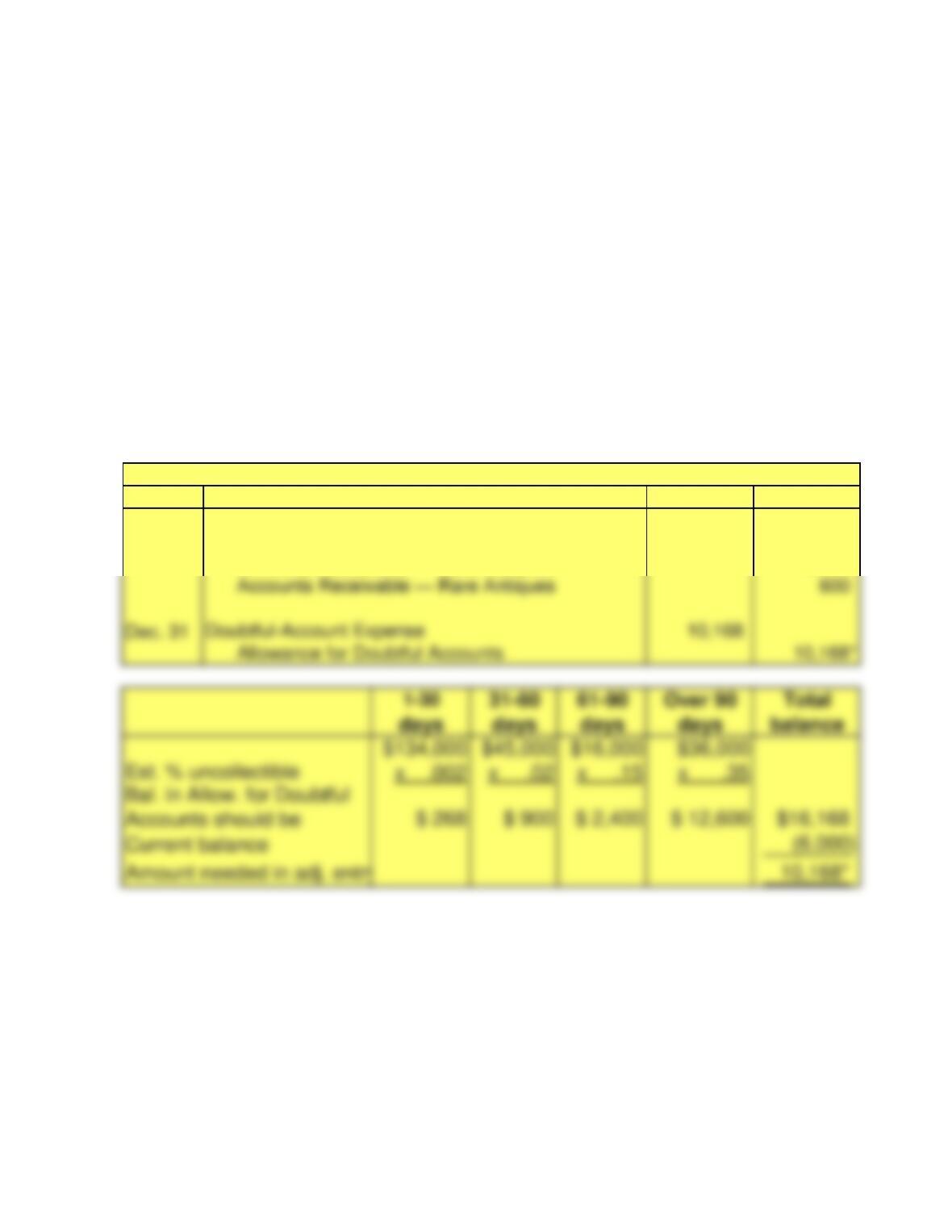
Req. 2
DATE DEBIT CREDIT
a. Cash 2,303
Accounts Receivable 30,597
Service Revenue 32,900
b. Cash 28,860
Accounts Receivable 28,860
Req. 4
These balances agree with the actual Bates Delivery amounts.
Req. 5
INCOME STATEMENT
Service revenue 32,900$
+ Interest revenue 1
Journal
ACCOUNT TITLES AND EXPLANATION
Chapter 5: Short-Term Investments and Receivables Page 50 of 87
Allowance for Uncollectible
d. Allowance for Uncollectible Accts 1,294
Accounts Receivable 1,294
e. Notes Receivable 185
Accounts Receivable 185
Interest Receivable 1
Interest Revenue ($185 × .07 ×1/12) 1
FINANCIAL ACCOUNTING – Eleventh Edition Solutions Manual
P5-56A
(25-35 min.)
Requirements
Solution:
Req. 1
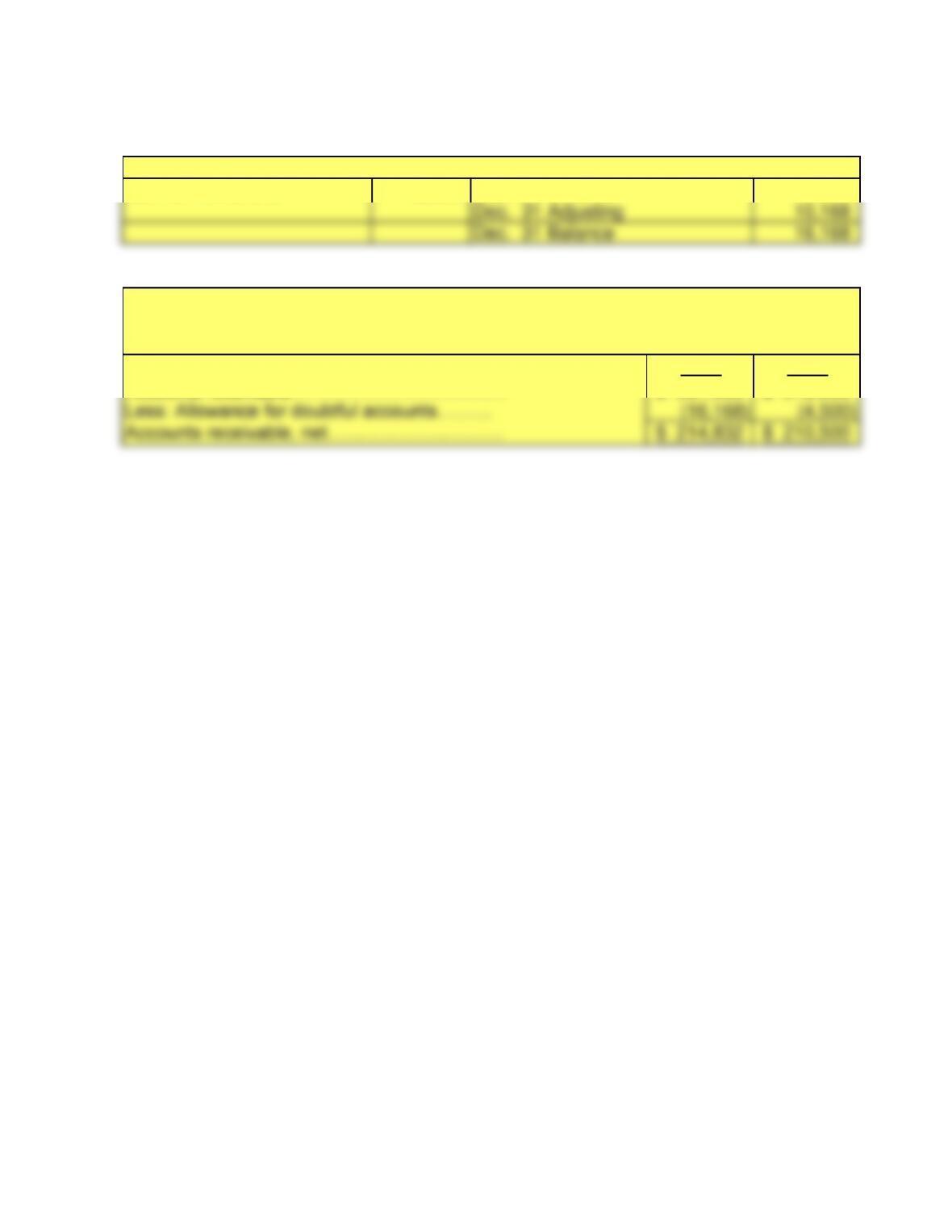
DATE ACCOUNT TITLES AND EXPLANATION DEBIT CREDIT
Nov. 30 Allowance for Doubtful Accounts 2,200
Accounts Receivable — Black Carpets 1,600
1. Record the transactions for the last quarter of 2017 in the journal. Explanations are not
required.
2. Prepare a T-account for Allowance for Doubtful Accounts with the appropriate
beginning balance. Post the entries from requirement 1 to that account.
3. Show how First Data Communications will report its accounts receivable in a
comparative balance sheet for 2016 and 2017. Use the three-line reporting format. At
December 31, 2016, the company’s Accounts Receivable balance was $215,000, and
the Allowance for Doubtful Accounts stood at $4,500.
Journal
Chapter 5: Short-Term Investments and Receivables Page 51 of 87
Accounts Receivable — Rare Antiques 600
Dec. 31 Doubtful-Account Expense 10,168
FINANCIAL ACCOUNTING – Eleventh Edition Solutions Manual
Req. 2
Nov. 30 Write-offs 2,200 Sept. 30 Balance 8,200
Req. 3
2017 2016
Accounts receivable…………………………..….. 231,000$ 215,000$
Less: Allowance for doubtful accounts……… (16,168) (4,500)
December 31, 2017 and December 31, 2016
Allowance for Doubtful Accounts
First Data Communications
Comparative Balance Sheets (Partial)
Chapter 5: Short-Term Investments and Receivables Page 52 of 87
FINANCIAL ACCOUNTING – Eleventh Edition Solutions Manual
P5-57A
(20-25 min.)
Requirements
Solution:
Req. 1
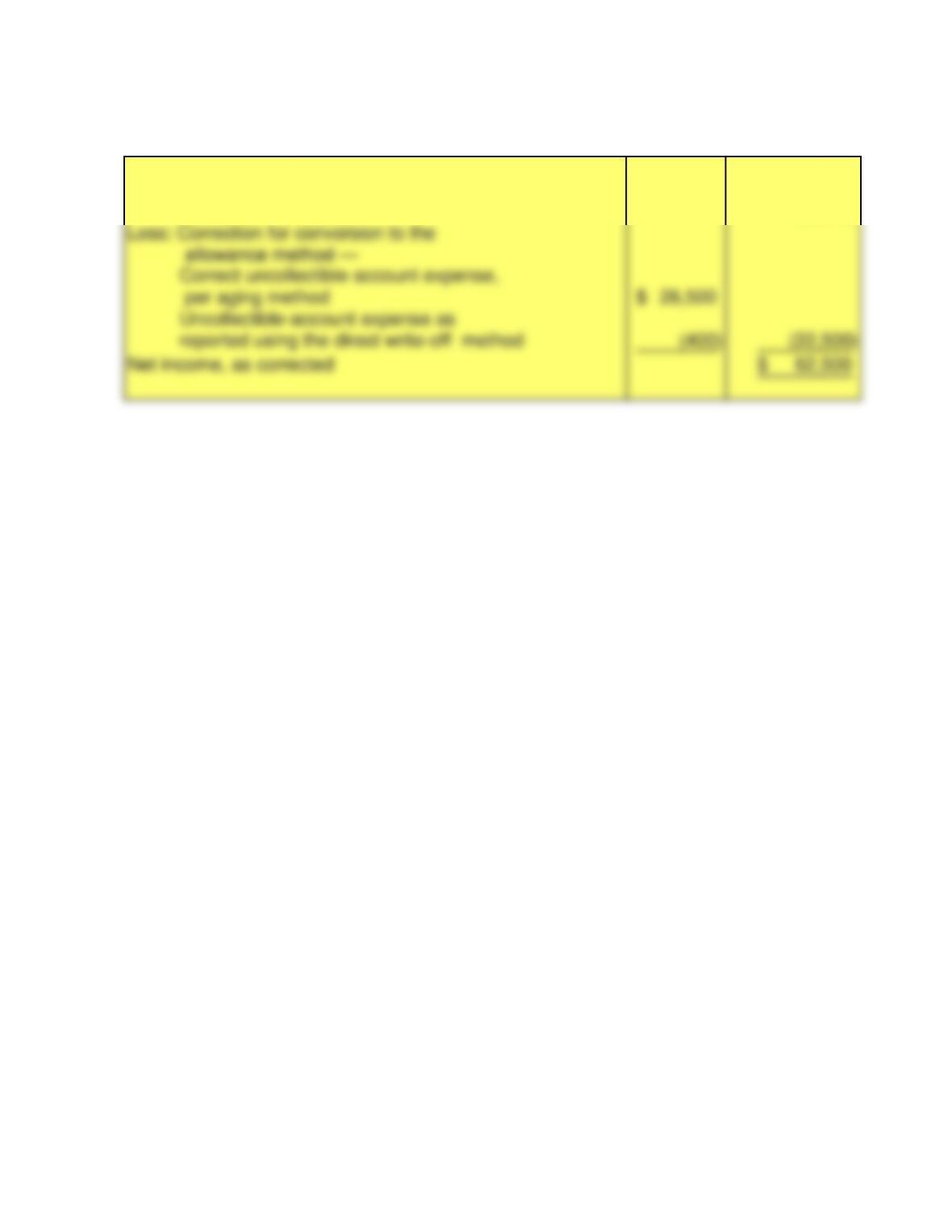
Cash ($50,000 − $18,000) 32,000$
Investment in trading securities 17,000
Req. 2
Corrected
Current $ 191,000
$ 106,000
42,000$
1. Restate Ocean Mist’s current accounts to conform to GAAP. (Challenge)
2. Compute Ocean Mist’s current ratio and quick (acid-test) ratio both before and after
your corrections.
3. Determine Ocean Mist’s correct net income for 2016. (Challenge)
As reported
$ 137,500
Chapter 5: Short-Term Investments and Receivables Page 53 of 87
Inventory 62,000
Accounts payable 66,000$
FINANCIAL ACCOUNTING – Eleventh Edition Solutions Manual
Req. 3
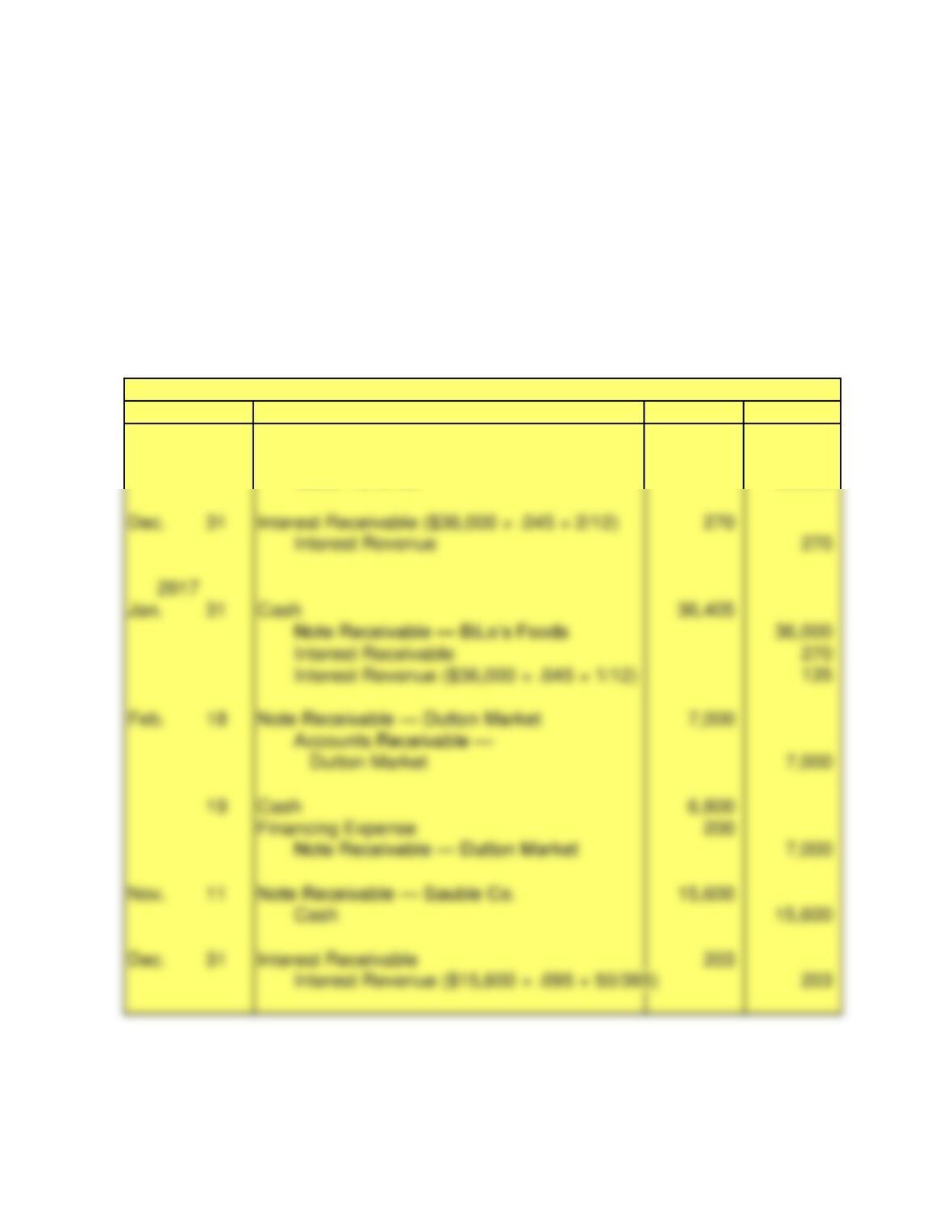
Net income, as reported $ 94,000
Less: Unrealized loss on trading investments
($14,000 − $12,000) (9,000)
Chapter 5: Short-Term Investments and Receivables Page 54 of 87
Less: Correction for conversion to the
allowance method —
FINANCIAL ACCOUNTING – Eleventh Edition Solutions Manual
P5-58A
(20-30 min.)
Requirements
Solution:
Req. 1
DATE ACCOUNT TITLES AND EXPLANATION DEBIT CREDIT
2016
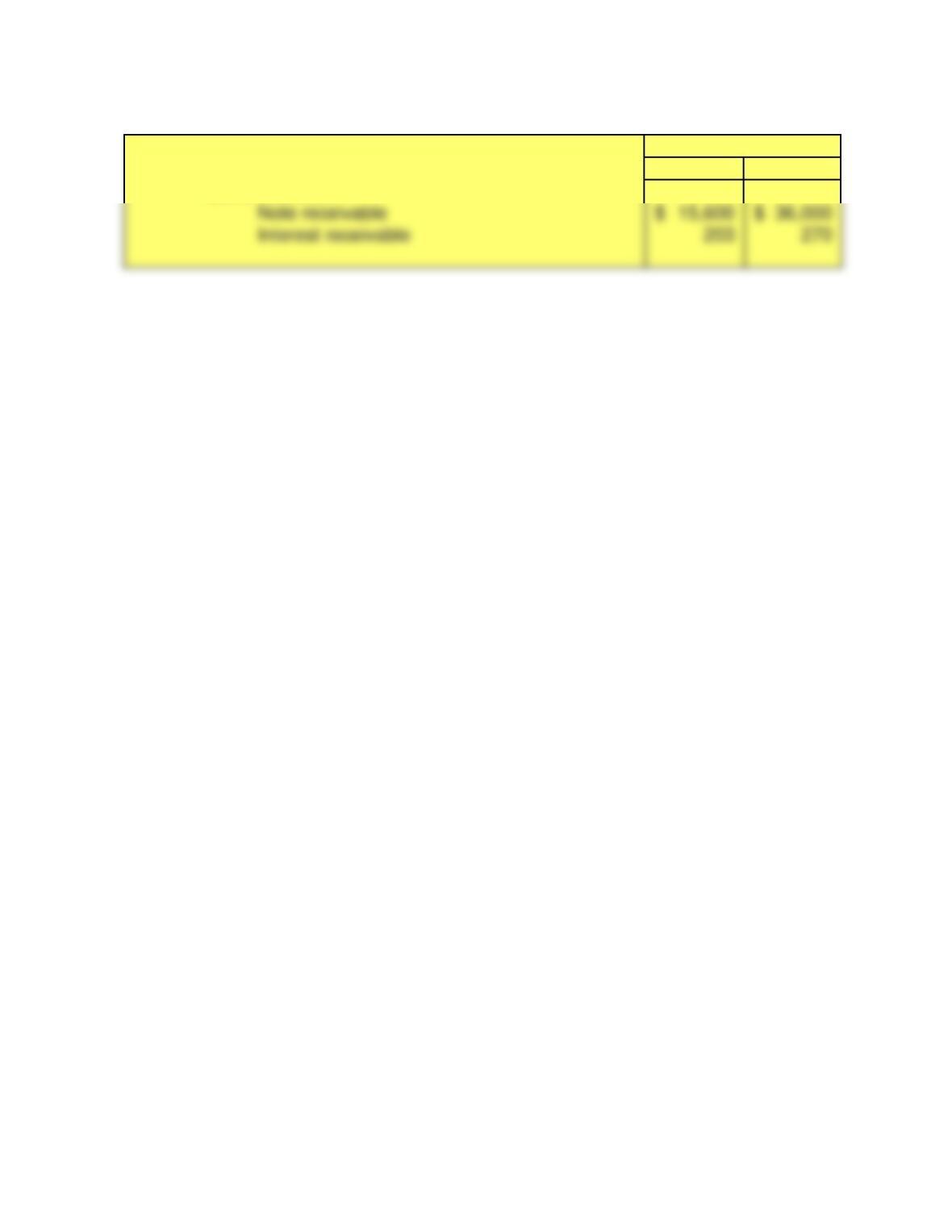
Oct. 31 Note Receivable — BiLo’s Foods 36,000
Sales Revenue 36,000
1. Record the transactions in Hughes Foods’ journal. Assume that no sales returns
are expected. Round all amounts to the nearest dollar. Explanations are not required.
2. Show what Hughes Foods will report on its comparative classified balance sheet at
December31, 2017, and December 31, 2016.
Journal
Chapter 5: Short-Term Investments and Receivables Page 55 of 87
Interest Revenue 270
2017
Dutton Market 7,000
Cash 15,600
Interest Revenue ($15,600 × .095 × 50/365) 203
FINANCIAL ACCOUNTING – Eleventh Edition Solutions Manual
Req. 2
BALANCE SHEET
2017 2016
Current assets:
December 31,
Chapter 5: Short-Term Investments and Receivables Page 56 of 87
FINANCIAL ACCOUNTING – Eleventh Edition Solutions Manual
P5-59A
(15-25 min.)
Requirements
Solution:
Req. 1
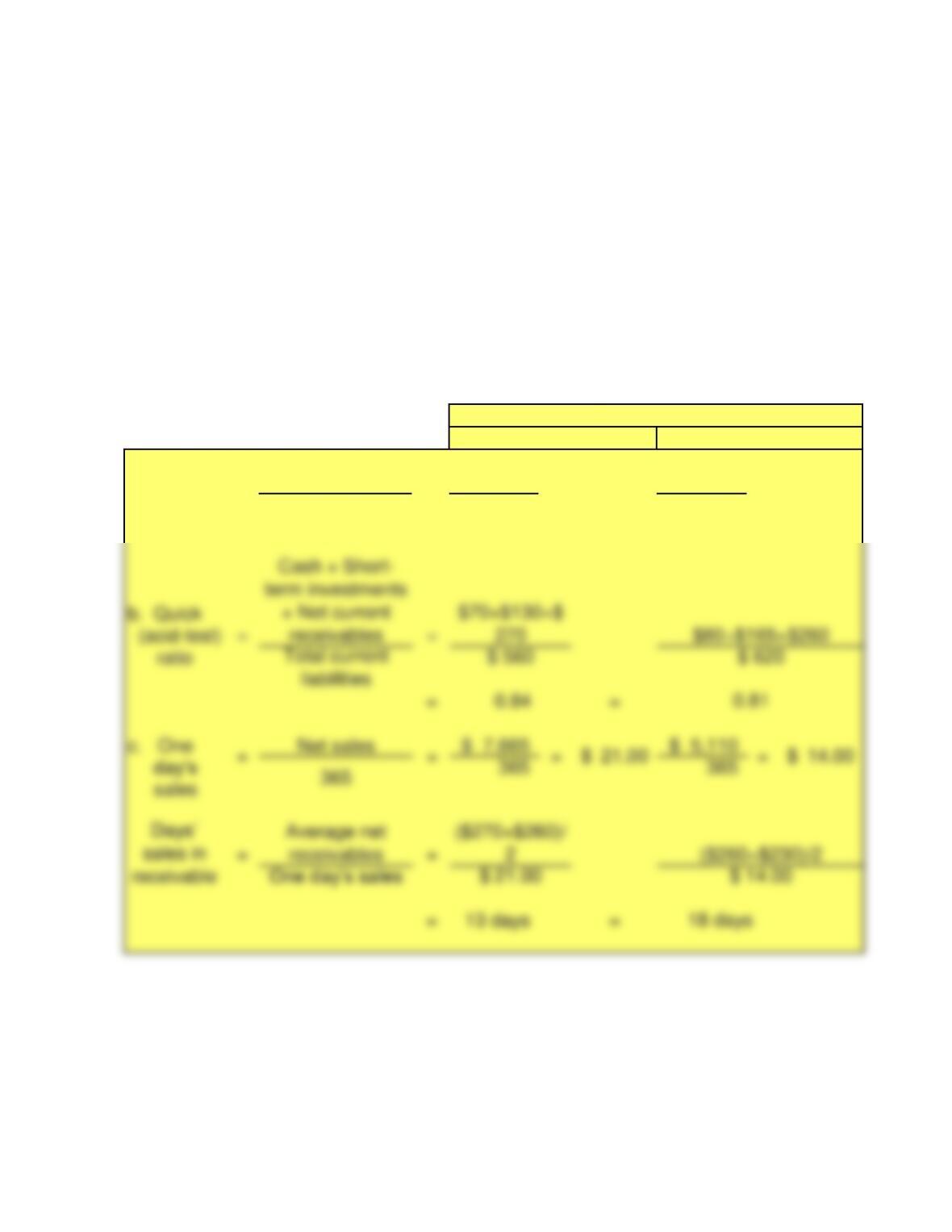
a. Current $ 885 $ 860
ratio $ 560 $ 620
1. Compute these ratios for 2017 and 2016:
a. Current ratio
b. Quick (acid-test) ratio
c. Days’ sales in receivables
2. Which ratios improved from 2016 to 2017 and which ratios deteriorated? Is this trend
favorable or unfavorable?
3. Recommend two ways for Kenmore Pools to improve cash flows from receivables.
Total current
liabilities
Total current
assets
=
=
=
1.58
2017
2016
Dollar amounts in millions
1.39
=
Chapter 5: Short-Term Investments and Receivables Page 57 of 87
(acid-test)
ratio
c. One Net sales 7,665$ 5,110$
sales
=
=
=
Total current
FINANCIAL ACCOUNTING – Eleventh Edition Solutions Manual
Req. 2
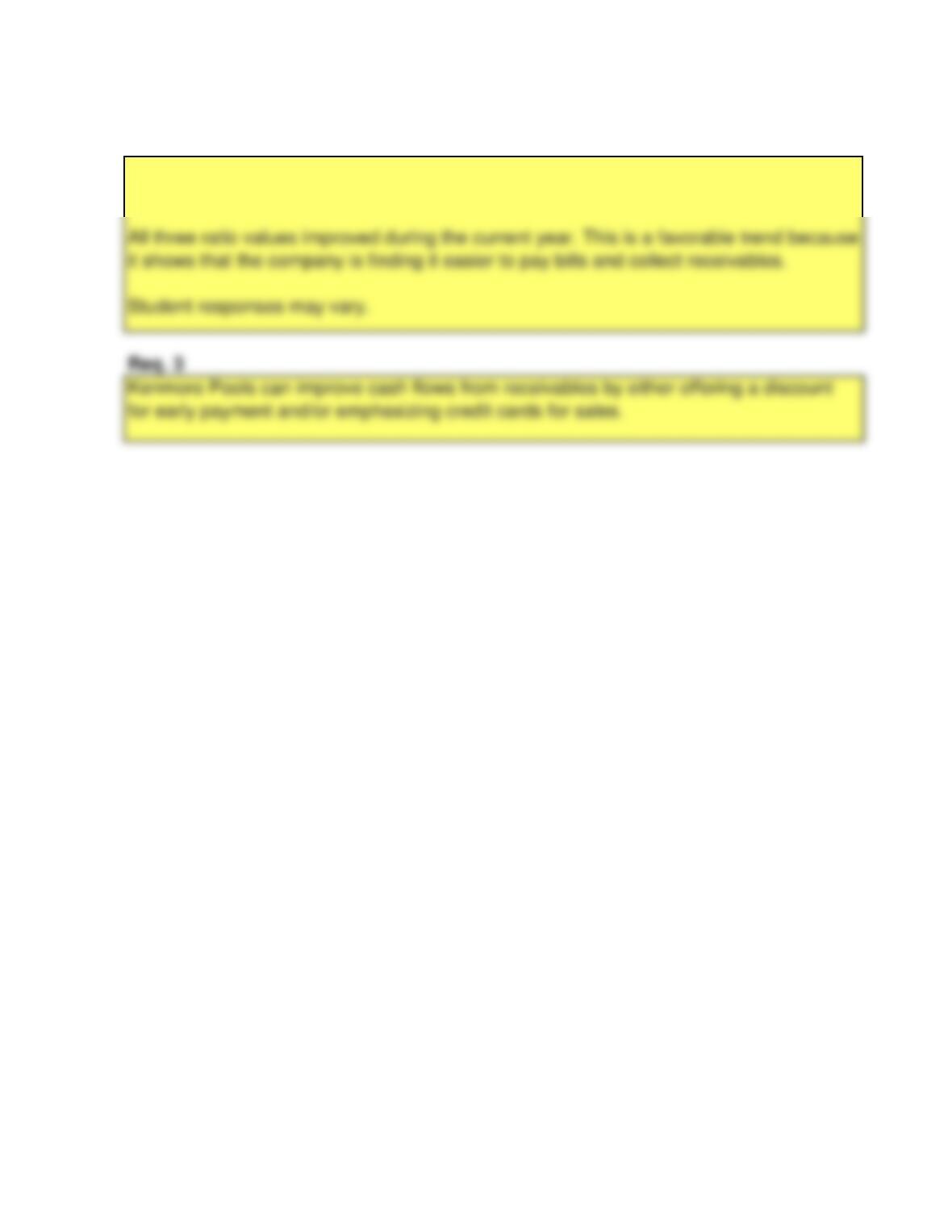
The current ratio improved from 1.39 to 1.58. The quick (acid-test) ratio increased
slightly from 0.81 to 0.84. Days’ sales in receivables decreased from 18 days to 13 days.
Chapter 5: Short-Term Investments and Receivables Page 58 of 87
Req. 3
FINANCIAL ACCOUNTING – Eleventh Edition Solutions Manual
P5-60B
(20-30 min.)
Requirements
Solution:
Reqs. 1 and 2
1. Open T-accounts for Cash (including its beginning balance of $15,000), Investment in
Trading Securities, Dividend Revenue, and Unrealized Gain (Loss) on Trading Securities.
2. Journalize the foregoing transactions and post to the T-accounts.
3. Show how to report the short-term investment on Zinner’s balance sheet at December 31,
2016.
4. Show how to report whatever should appear on Zinner’s income statement for the year
ended December 31, 2016.
5. Zinner sold the trading securities for $10,400 on January 11, 2017. Journalize the sale.
6. Assume that the securities were classified as available-for-sale. Further, assume that the
fair value was $10 per share on December 31, 2017, and $10.50 per share on January 1,
2018, when they were sold. Repeat steps 3–4 for 2016 and 2017, and journalize the sale of
the securities on January 1, 2018. Follow the example in Exhibit 5-2.
Cash
Investment in Trading Securities
Chapter 5: Short-Term Investments and Receivables Page 59 of 87
FINANCIAL ACCOUNTING – Eleventh Edition Solutions Manual
Req. 2
DATE DEBIT CREDIT
2016
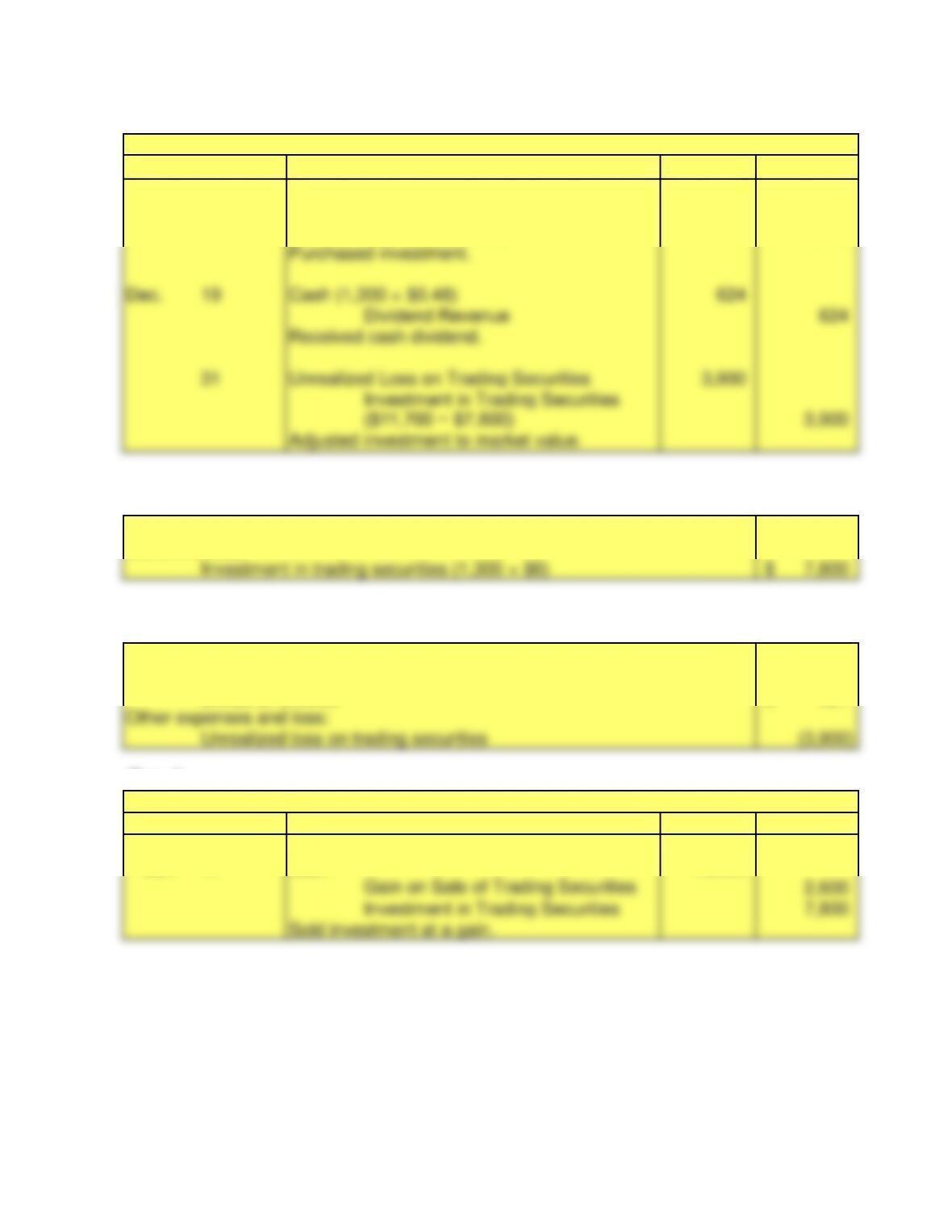
Nov. 17 Investment in Trading Securities 11,700
Cash (1,300 × $9) 11,700
Req. 3
BALANCE SHEET
Current assets:
Investment in trading securities (1,300 × $6) 7,800$
Req. 4
INCOME STATEMENT
Other revenue and gain:
Dividend revenue 624$
Other expenses and loss:
Unrealized loss on trading securities (3,900)
Req. 5
DATE DEBIT CREDIT
2017
Jan. 11 Cash 10,400
Investment in Trading Securities 7,800
Journal
ACCOUNT TITLES AND EXPLANATION
Journal
ACCOUNT TITLES AND EXPLANATION
Chapter 5: Short-Term Investments and Receivables Page 60 of 87
Dividend Revenue 624
Investment in Trading Securities