CHAPTER 5
SOLUTIONS TO PROBLEMS: SET B
PROBLEM 5-1B
(a)
Variable costs (per haircut)
Fixed costs (per month)
Barbers’ commission $3.00
Rent .60
Barbers’ salaries $7,500*
Rent 700
(b)
$10X = $4X + $9,000
1,500 haircuts X $10 = $15,000
(c)
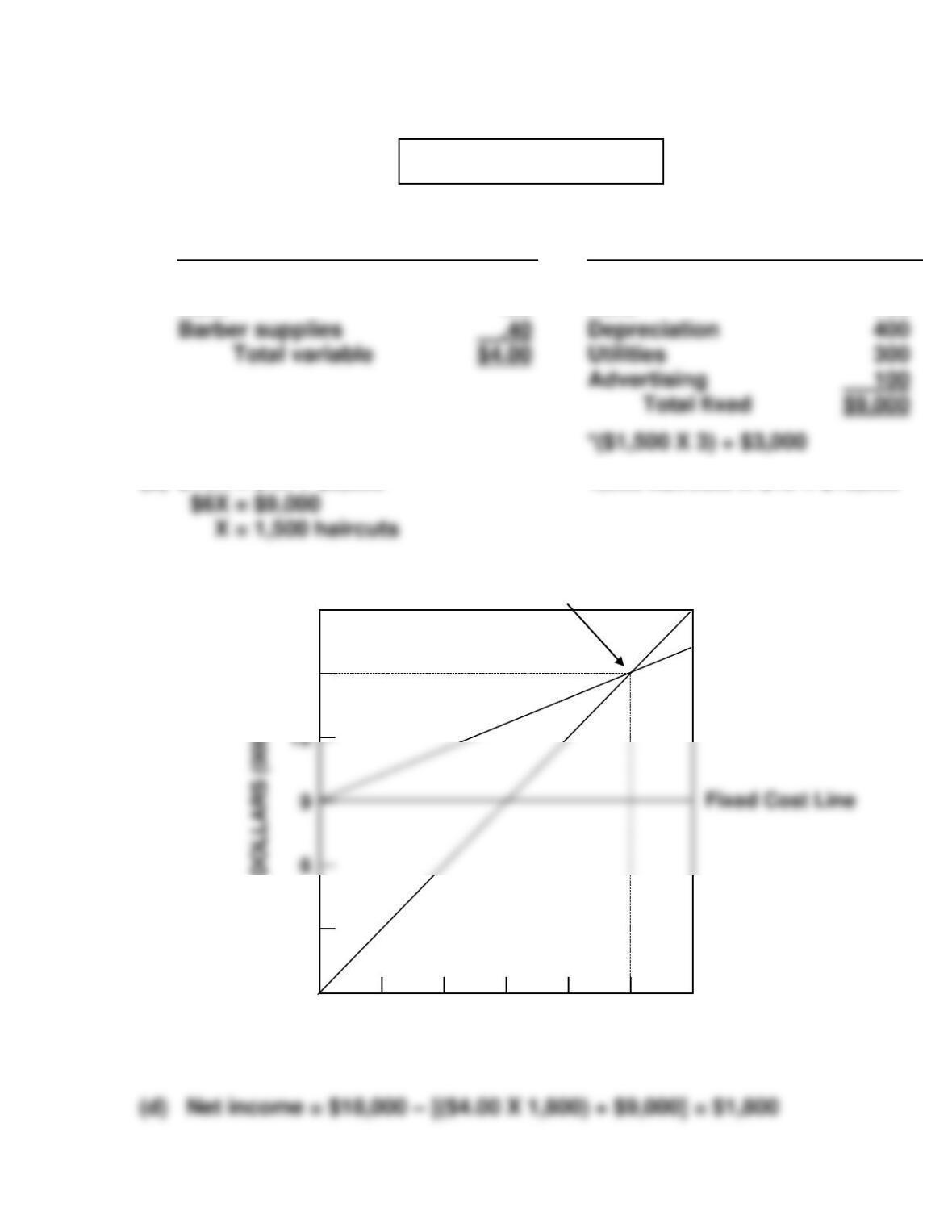
18
Break-even Point
Sales Line
DOLLARS (000)
15
Total Cost Line
12
9
6
3
300
600
900
1,200
1,500
1,800
Number of Haircuts
PROBLEM 5-2B
(a) ALL FRUTE COMPANY
CVP Income Statement (Estimated)
For the Year Ending December 31, 2016
Sales ………………………………………………. $2,500,000
Variable expenses
Cost of goods sold ……………………. $1,080,000 (1)
Selling expenses ………………………. 80,000
(b) Variable costs = 48% of sales ($1,200,000 ÷ $2,500,000) or $.24 per
bottle ($.50 X 48%). Total fixed costs = $780,000.
1. $.50X = $.24X + $780,000
$.26X = $780,000
(c) Contribution margin ratio = ($.50 – $.24) ÷ $.50
= 52%
PROBLEM 5-3B
(a) Sales were $1,800,000 and variable expenses were $1,170,000, which
means contribution margin was $630,000 and CM ratio was 35%. Fixed
expenses were $840,000. Therefore, the breakeven point in dollars is:
(b) 1. The effect of this alternative is to increase the selling price per unit
to $37.50 ($30 X 125%). Total sales become $2,250,000 (60,000 X
$37.50). Thus, the contribution margin ratio changes to 48%
2. The effects of this alternative are to change total fixed costs to
$660,000 ($840,000 – $180,000) and to change the contribution margin
to .30 [($1,800,000 – $1,170,000 – $90,000) ÷ $1,800,000]. The new
breakeven point is:
3. The effects of this alternative are: (1) variable and fixed cost of
goods sold become $675,000 each, (2) total variable costs become
$915,000 ($675,000 + $125,000 + $115,000), and (3) total fixed costs
are $1,095,000 ($675,000 + $355,000 + $65,000). The new breakeven
point is:
PROBLEM 5-4B
(a) Current break-even point: $30X = $12X + $216,000
(where X = pairs of shoes)
(b) Current margin of safety ratio =
(20,000 X $30) – (12,000 X $30)
(20,000 X $30)
(c) COSTLESS SHOE STORE
CVP Income Statement
Current
New
Sales (20,000 X $30)
Variable expenses (20,000 X $12)
$600,000
240,000
$648,000
288,000
(24,000 X $27)
(24,000 X $12)
PROBLEM 5-5B
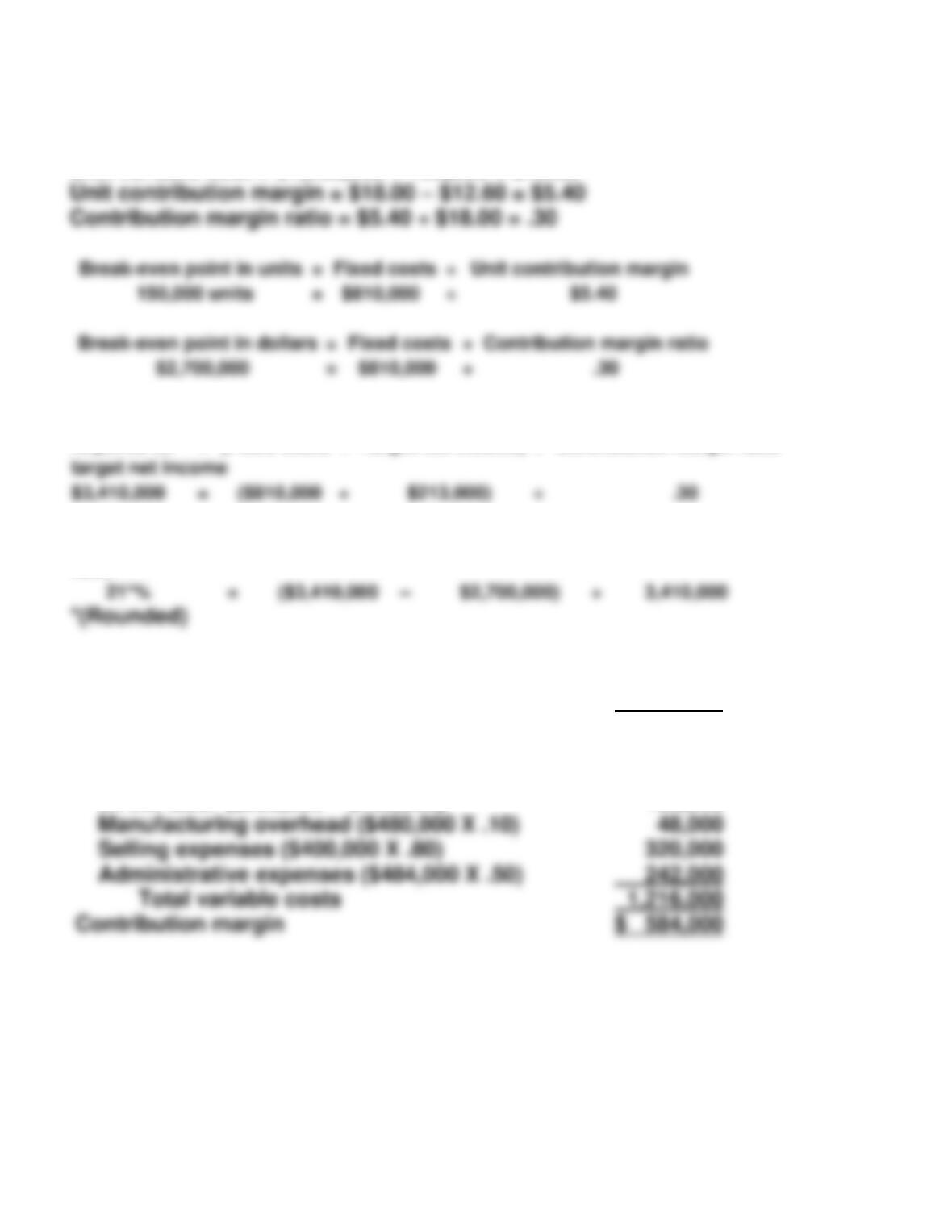
(a)
(1)
Current Year
Sales
Variable costs
Direct materials
Direct labor
$1,800,000
456,000
250,000
Current Year
Projected Year
Contribution margin
$ 540,000
X 1.2
Sales
Variable costs
Direct materials
Direct labor
$1,800,000
456,000
250,000
X 1.2
X 1.2
X 1.2
$2,160,000
547,200
300,000
(2)
Current
Projected
Fixed Costs
Year
Year
Manufacturing overhead ($480,000 X .60)
$288,000
$288,000
Selling expenses ($400,000 X .30)
Contribution margin
PROBLEM 5-5B (Continued)
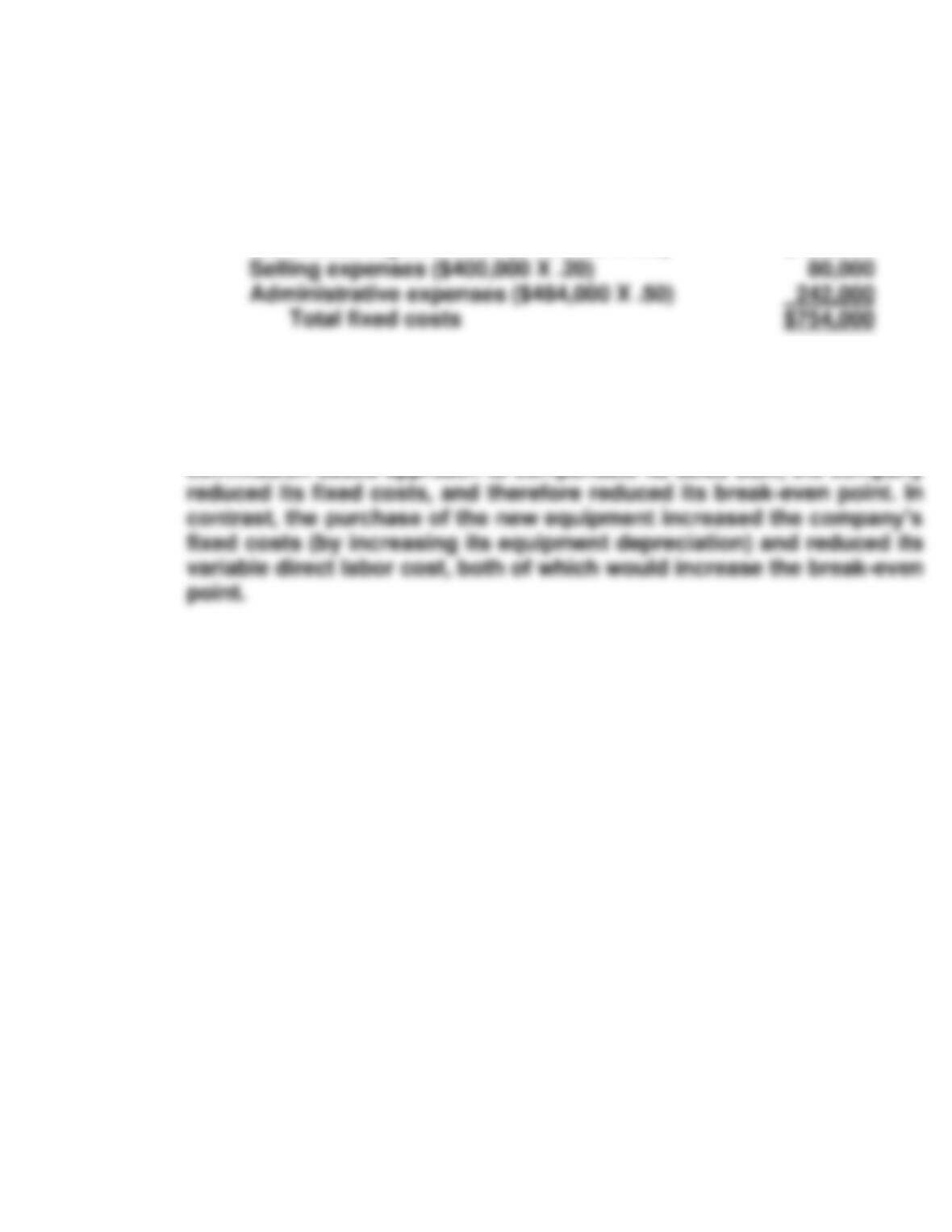
(b) Unit selling price = $1,800,000 ÷ 100,000 = $18.00
Unit variable cost = $1,260,000 ÷ 100,000 = $12.60
(c) Sales dollars
required for
=
(Fixed costs
+
Target net income)
÷
Contribution margin ratio
$3,410,000
=
+
÷
(d) Margin of safety
ratio
=
(Expected sales
–
Break-even sales)
÷
Expected sales
=
÷
(e)
(1)
Sales
Variable costs
Direct materials
Direct labor ($250,000 – $100,000)
$1,800,000
456,000
150,000
Break-even point in units
=
Fixed costs
÷
Unit contribution margin
=
÷
Break-even point in dollars
=
Fixed costs
÷
Contribution margin ratio
=
÷
PROBLEM 5-5B (Continued)
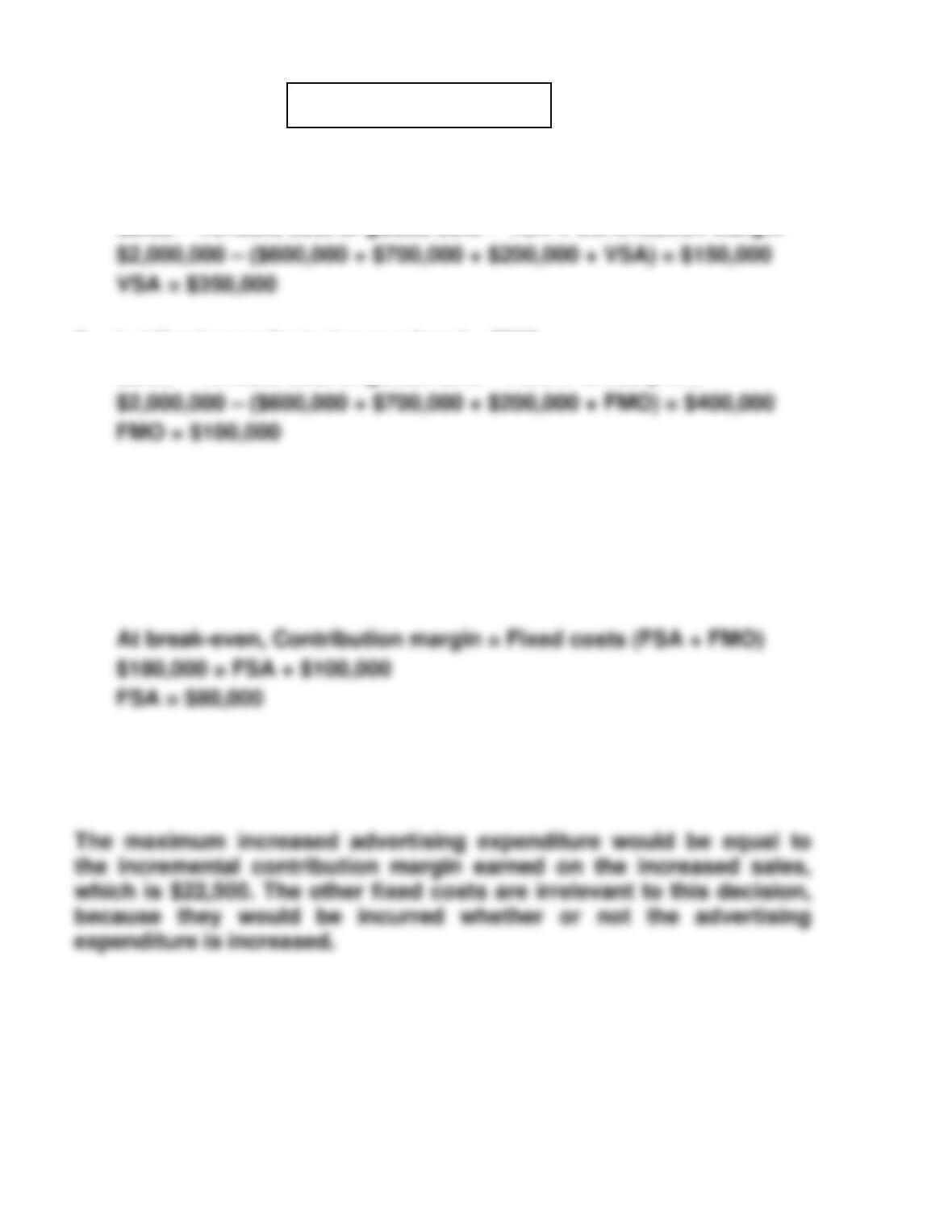
(2) Contribution margin ratio = $584,000 ÷ $1,800,000 = .32 (Rounded)
(3) Break–even point in dollars = $754,000 ÷ .32 = $2,356,250
Fixed costs
Manufacturing overhead ($480,000 X .90)
$432,000
The break-even point in dollars declined from $2,700,000 to $2,356,250.
This means that overall the company’s risk has declined because it
doesn’t have to generate as much in sales. The two changes actually
had opposing effects on the break-even point. By changing to a more
PROBLEM 5-6B
(a) 1. Let variable selling and administrative expenses = VSA
Sales – Variable cost of goods sold – VSA = Contribution Margin
2. Let fixed manufacturing overhead = FMO
Sales – Variable cost of goods sold – FMO = Gross profit
3. Let fixed selling and administrative expenses = FSA
Contribution margin ratio = $150,000 ÷ $2,000,000 = 7.50%
Contribution margin at break-even = $2,400,000 X 7.50% = $180,000
(b) Incremental sales = $2,000,000 X 15% = $300,000
Incremental contribution margin = $300,000 X 7.50% = $22,500