
5-1
CHAPTER 5
Merchandising Operations and the Multiple-Step Income
Statement
Learning Objectives
1. Identify the differences between a service company and a merchandising company.
2. Explain the recording of purchases under a perpetual inventory system.
3. Explain the recording of sales revenues under a perpetual inventory system.
4. Distinguish between a single-step and a multiple-step income statement.
5. Determine the cost of goods sold under a periodic system.
6. Explain the factors affecting the profitability.
7. Identify a quality of earnings indicator.
*8. Explain the recording of purchases and sales of inventory under a periodic inventory
system.
5-2
Chapter Outline
Learning Objective 1 – Identify the Differences between a Service Company
and a Merchandising Company.
Merchandising Operations—In a merchandising company, the primary source of
revenues is the sale of merchandise, referred to as sales revenue or sales.
Unlike expenses for a service company, expenses for a merchandising company are
divided into two categories:
▪ Cost of goods sold – the total cost of merchandise sold during the period.
▪ Operating expenses – selling and administrative expenses.
TEACHING TIP
Ask students to give examples of service companies and merchandising companies in the
local area. Direct students to examples other than those offered in the text. Consider flower
Operating cycle of a merchandising company ordinarily is longer than that of a
service company.
▪ The purchase of inventory and its eventual sale lengthen the cycle.
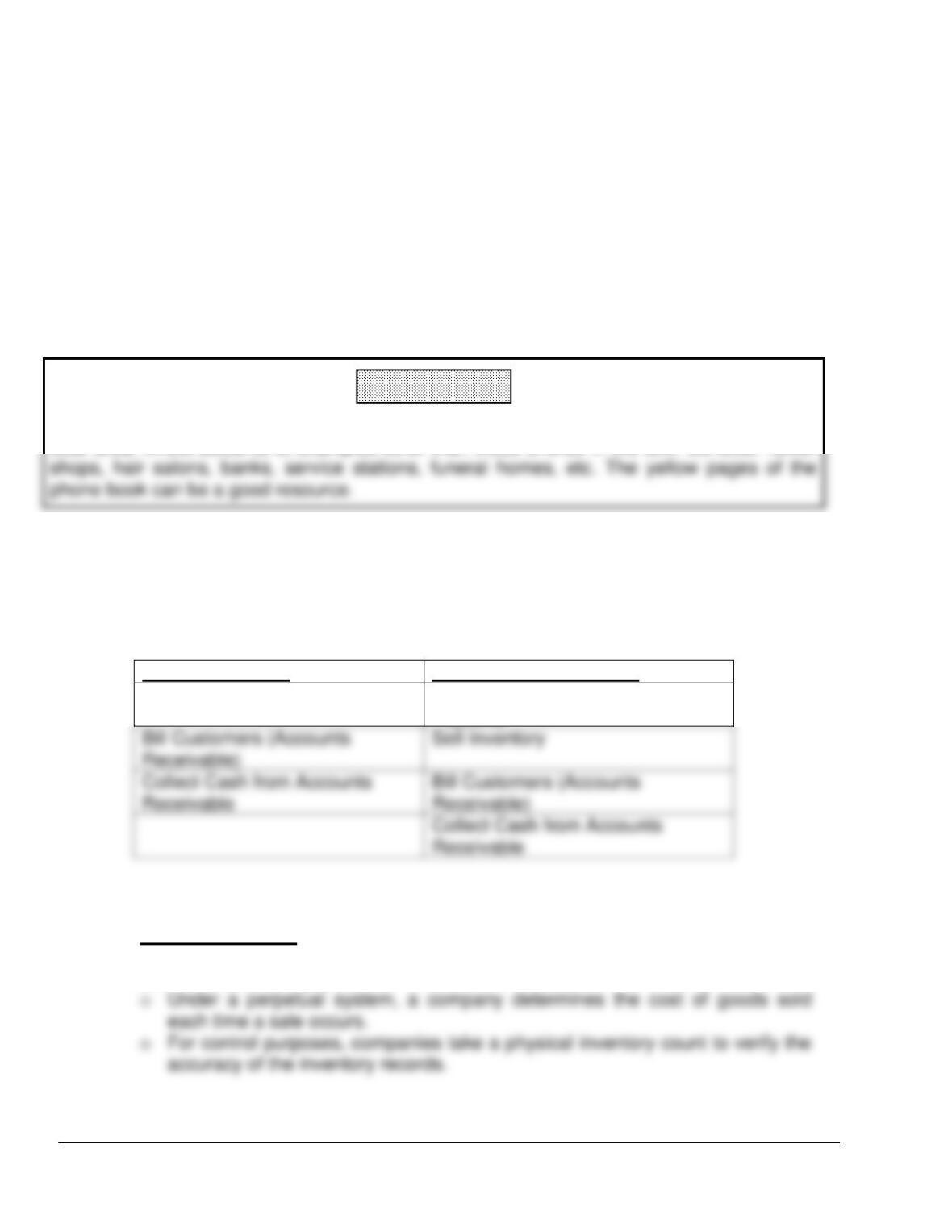
▪ Steps in the operating cycles for a service company and a merchandising
company:
Service Company
Merchandising Company
Perform Services
Buy Inventory (Cash or Accounts
Payable)
Bill Customers (Accounts
Receivable)
Sell Inventory
Collect Cash from Accounts
Receivable
Bill Customers (Accounts
Receivable)
Collect Cash from Accounts
Receivable
Flow Of Costs—Merchandising companies use one of two systems to account for
inventory
▪ Perpetual System– Detailed records of the cost of each inventory purchase and
sale are maintained and the records continuously show the inventory that should
be on hand for every item.
5-3
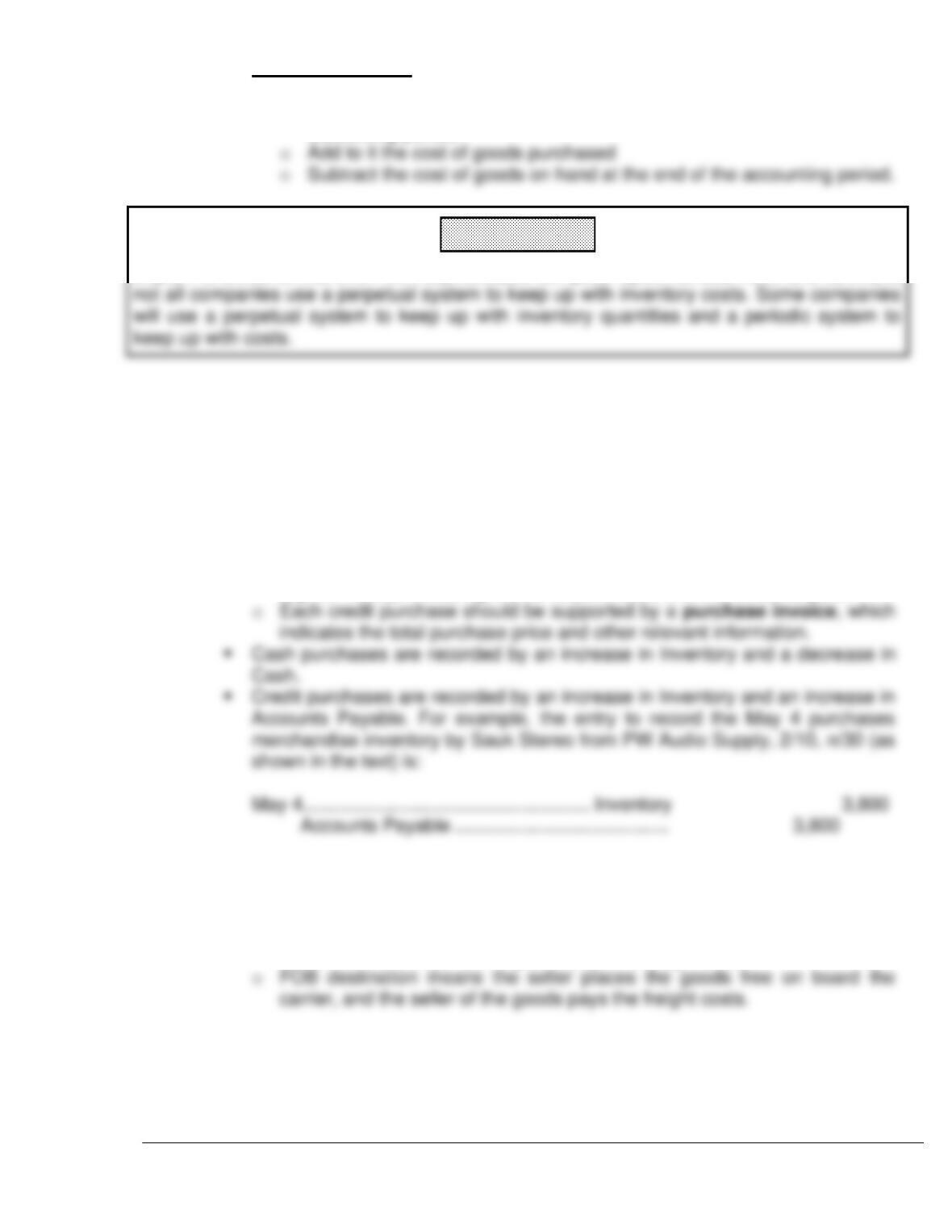
▪ Periodic System – Detailed records of the goods on hand are not kept
throughout the period. To determine the cost of goods sold:
o Determine the cost of goods on hand at the beginning of the
accounting period.
TEACHING TIP
Explain to students that even with sophisticated computer systems, scanners, and software,
Learning Objective 2 – Explain the Recording of Purchases under a Perpetual
Inventory System.
Recording Purchases of Merchandise—purchase of inventory for resale is
normally recorded by the merchandiser when the goods are received from the seller.
▪ Every purchase should be supported by business documents that provide
written evidence of the transaction.
o Every cash purchase should be supported by a canceled check or a cash
register receipt indicating the items purchased and the amounts paid.
FREIGHT COSTS—the cost of transporting the goods to the buyer’s place of
business.
▪ Freight terms are expressed as FOB shipping point or FOB destination.
o FOB shipping point means the seller places the goods free on board the
carrier, and the buyer of the goods pays the freight costs.
▪ Freight Costs Incurred by Buyer—the costs are considered part of the cost
of purchasing inventory. In this instance, Inventory is increased (debited)
and Cash is decreased.
5-4
May 6 Inventory ………………………………………… 150
Cash …………………………………………… 150
(To record payment of freight on goods
purchased)
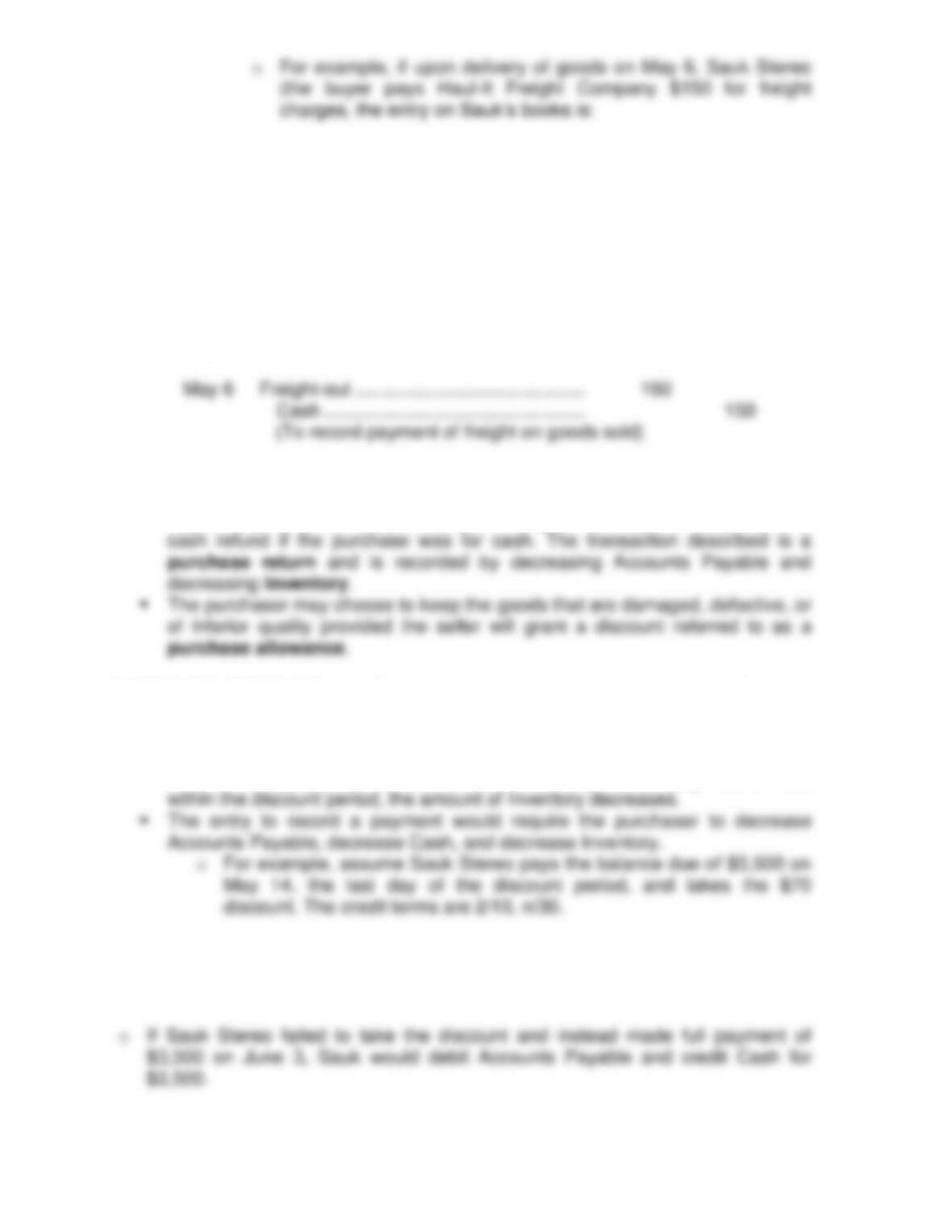
▪ Freight Costs Incurred by Seller—on outgoing merchandise are an
operating expense to the seller and labeled Freight-out or Delivery Expense.
Freight-out is recorded by increasing Freight-out (debited) and decreasing
Cash. For example, if the freight terms require that the seller pay $150 freight
charges, the entry would be:
PURCHASE RETURNS AND ALLOWANCES—purchaser may return goods to the
seller if the goods do not meet the buyer’s specifications or the goods are damaged.
▪ Goods returned to the seller for credit if the sale was made on credit, or for a
PURCHASE DISCOUNT—credit terms of a purchase on account may allow the
buyer to claim a discount if prompt payment is made.
▪ A common credit term is 2/10, n/30, which means a 2 percent purchase
discount may be taken if the invoice is paid within 10 days of the invoice
date. Net amount of the invoice is due within 30 days. When payment is made
May 14 Accounts Payable ………………………………………… 3,500
Cash …………………………………………………….. 3,430
Inventory ………………………………………………. 70
5-5
Learning Objective 3 – Explain the Recording of Sales Revenues under a
Perpetual Inventory System.
RECORDING SALES OF MERCHANDISE—Sales revenues are recorded when
earned, in accordance with the revenue recognition principle. Typically this occurs
when goods are transferred from the seller to the buyer.
▪ Sales may be made on credit or for cash.
▪ Each sales transaction should be supported by a business document that
May 4 Accounts Receivable …………………………………… 3,800
Sales Revenue ………………………………………. 3,800
TEACHING TIP
Ask students why the following journal entry is not appropriate for this transaction:
May 4 Accounts Receivable ……………………………………. 3,800
SALES RETURNS AND ALLOWANCES—the seller accepts goods back from the
buyer of grants the buyer a reduction in the purchase price.
▪ Sales Returns and Allowances is a contra revenue account to Sales, it may be
used to record credit for returned goods or a reduction in the purchase price.
5-6
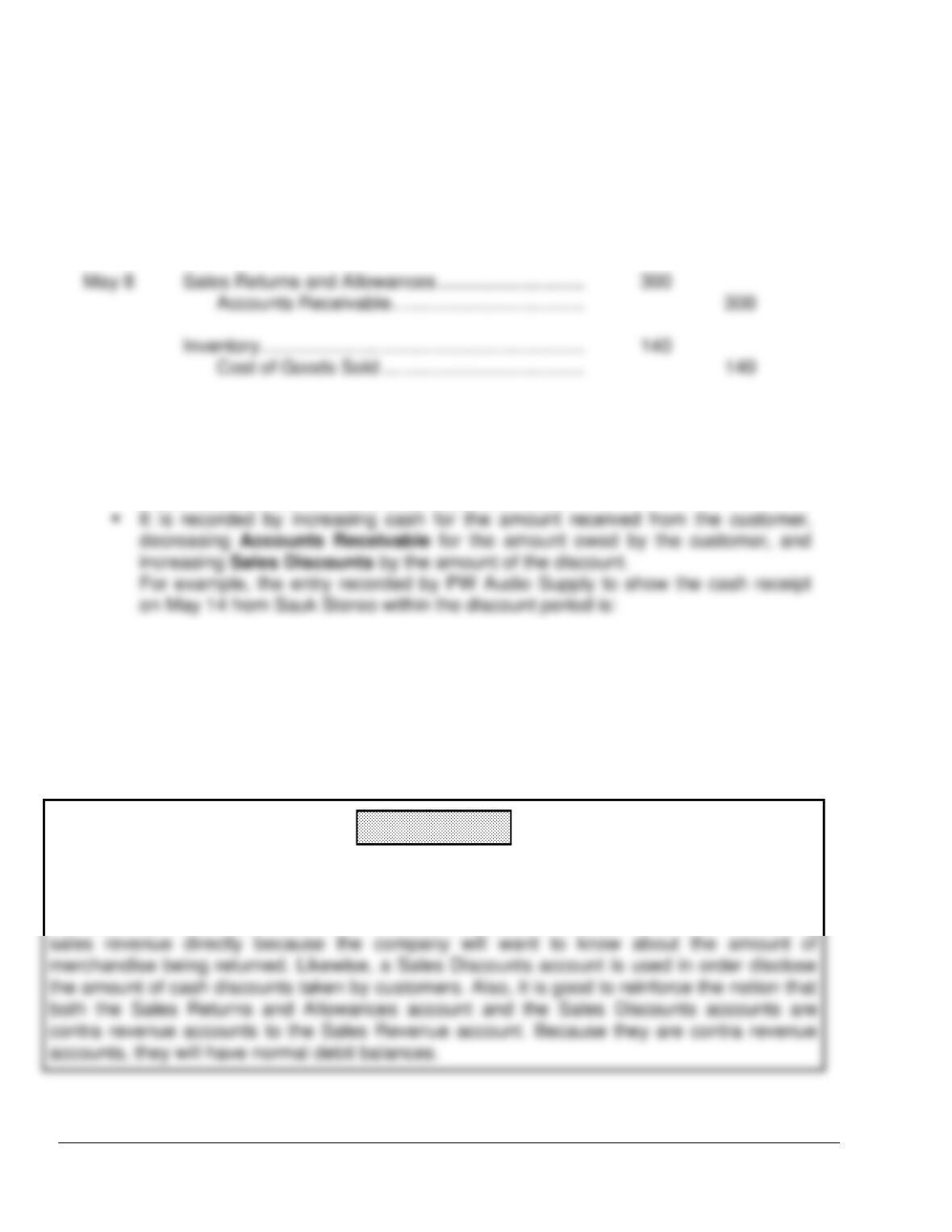
▪ Two entries are required to record the credit for Sales Returns and Allowances.
o The first entry is an increase in Sales Returns and Allowances and a
decrease in Accounts Receivable.
o The second entry is an increase in Inventory and a decrease in Cost of
Goods Sold.
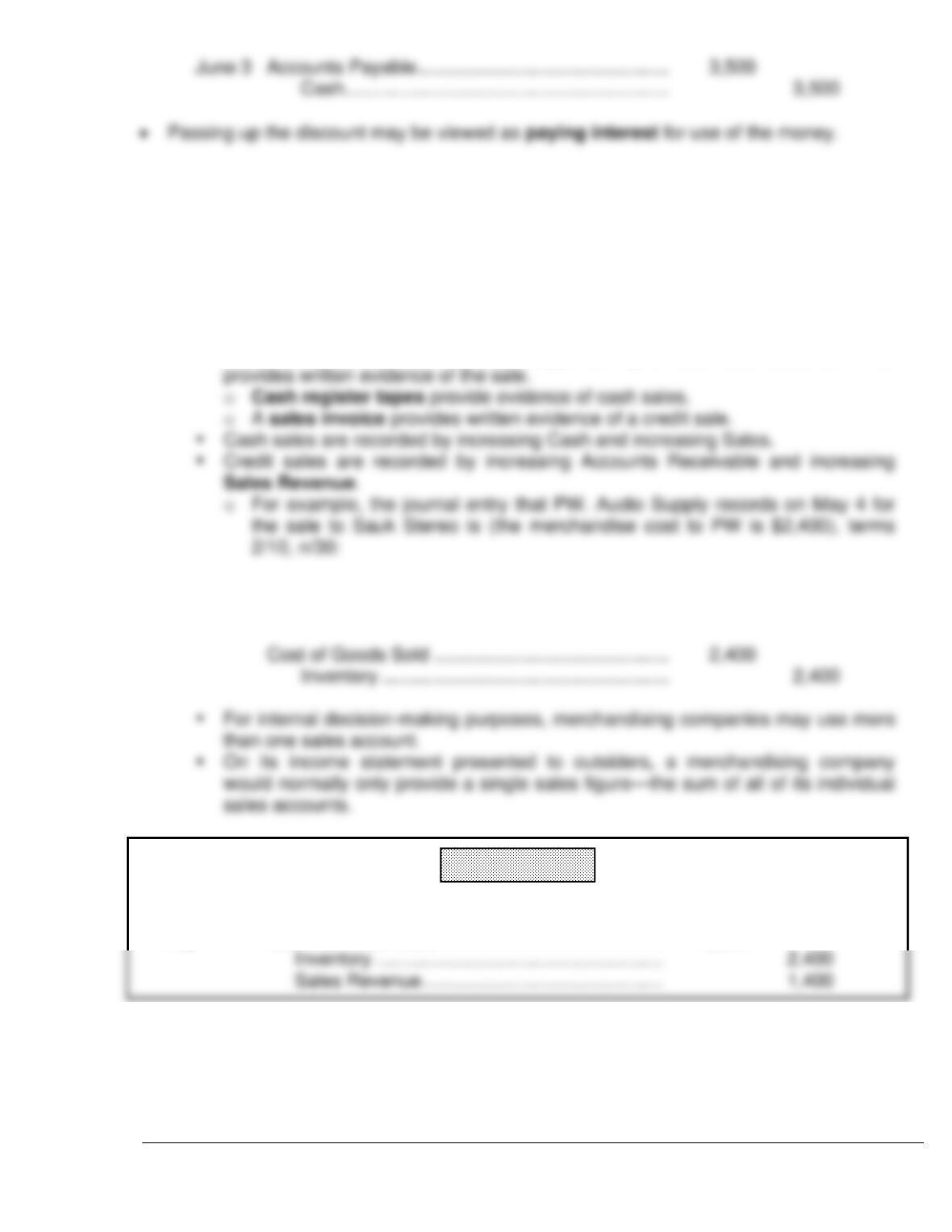
o For example, the entry that PW Audio Supply records for a return from a
customer on
May 8 for which the selling price was $300 and the merchandise cost to PW
was $140 is:
SALES DISCOUNTS—seller may offer the customer a cash discount for the prompt
payment of the balance due.
▪ A sales discount, which is based on the invoice price less any returns and
allowances.
▪ Sales discount is a contra revenue account to Sales
May 14 Cash ………………………………………………………….. 3,430
Sales Discounts …………………………………………… 70
Accounts Receivable ………………………………. 3,500
(To record collection within 2/10,n/30
discount period from Sauk Stereo)
.
TEACHING TIP
Explain to students the importance of having the net sales figure as well as the amounts in
the contra asset accounts—sales returns and allowances and sales discounts.
Tell students that a Sales Returns and Allowances account is used rather than decreasing
5-7
Learning Objective 4 – Distinguish Between a Single-Step and a Multiple-Step
Income Statement.
INCOME STATEMENT PRESENTATION—There are two forms of income statements
widely used by companies.
▪ Single-step income statement—one step is required in determining net
income—subtract total expenses from total revenues.
▪ Multiple-step income statement—which highlights the components of net
income.
o Includes gross profit (which is net sales less cost of goods sold).
SALES REVENUES—for a merchandising concern typically presents gross sales
revenues for the period and deducts the contra revenue accounts (sales returns and
allowances and sales discounts) to arrive at net sales.
GROSS PROFIT—is calculated by deducting cost of goods sold from net sales.
TEACHING TIP
Students also need to be told that for a merchandising company the cost of goods sold is an
expense and, traditionally, the largest expense item the company will have.
OPERATING EXPENSES—are subtracted from gross profit in order to determine
income from operations
NONOPERATING ACTIVITIES—various revenues and expenses that are unrelated to
the company’s primary line of operations.
▪ Nonoperating items are preceded by Income from operations in the income
statement.
5-8
TEACHING TIP
Ask students whether they would rather have a single-step or multiple-step income if they
were a manager or a potential investor. Why?
In trying to predict future earnings, which is the more relevant figure – net income or operating
income?
Learning Objective 5 – Determine Cost of Goods Sold under a Periodic
Inventory System.
DETERMINING COST OF GOODS SOLD UNDER A PERIODIC SYSTEM—a
periodic system does not determine cost of goods sold until the end of the period.
▪ At the end of the period, the company performs a count to determine the
ending balance of inventory.
▪ It then calculates the cost of goods sold thusly:
Beginning Inventory (amount of ending inventory for the previous period)
Add: Cost of Goods Purchased, which includes:
Purchases
Less: Purchase Returns and Allowances
Purchase Discounts
Add: Freight-in
been sold during the accounting period)
at Gross Profit)
Learning Objective 6 – Explain the Factors Affecting Profitability.
EVALUATING PROFITABILITY—using several measures to analyze the
profitability of a company’s performance.
▪ Gross profit rate, calculated by dividing the amount of gross profit by net sales.
o It is generally considered to be more informative than the gross profit
5-9
▪ Profit margin ratio, calculated by dividing net income by net sales, measures
the percentage of each dollar of sales that results in net income.
o The profit margin ratio measures the extent by which selling price covers
all expenses (including cost of goods sold) and the gross profit rate
measures the margin by which selling price exceeds cost of goods sold.
TEACHING TIP
Ask students to consider the following problem:
Smith Company has had gross profit percentages of 20 – 22% for the past 5 years. The
current gross profit percentage is 14%.
TEACHING TIP
Ask students to suggest ways in which a company can either improve its profit margin ratio
or control its operating expenses.
Learning Objective 7 – Identify a Quality of Earnings Indicator.
KEEPING AN EYE ON CASH—earnings have high quality if they provide a
full and transparent presentation of how a company performed.
▪ The quality of earnings ratio Is an indicator of the quality of earnings
5-10
Learning Objective 8 (Appendix) – Explain the Recording of Purchases and
Sales of Inventory Under a Periodic
Inventory
System.
◆ PERIODIC INVENTORY SYSTEM—key difference between the perpetual inventory
system and the periodic inventory system is the point at which the company
computes cost of goods sold.
▪ Recording Merchandise Transactions—companies do not attempt on the date
of sale to record the cost of the merchandise sold. At the end of the period they:
▪ Recording Purchases of Merchandise— under the periodic system the buying
of merchandise on account is recorded as follows:
▪ Freight Costs—when incurred by the buyer are recorded as follows;
May 6 Freight-In………………. XXX
Cash………………………………. XXX
▪ Purchases Returns and Allowances—are recorded as follows:
May 8 Accounts Payables……. XXX
Purchases Returns and Allowances……. XXX
▪ Purchase Discounts—are recorded as follows:
▪ Recording Sales of Merchandise— under the periodic system the selling of
merchandise on account is recorded as follows:
May 4 Accounts Receivable…………….. XXXX
Sales Revenue ……………….. XXXX
▪ Sales Returns and Allowances—are recorded as follows:
5-11
Learning Objective 9 – Compare the accounting procedures for merchandising
under GAAP and IFRS.
A Look at IFRS—The basic accounting entries for merchandising are the same
under both GAAP and IFRS. The income statement is a required statement under
both sets of standards. The basic format is similar although some differences to
exist.
KEY POINTS
▪ Under both GAAP and IFRS, a company can choose to use either a perpetual or
a periodic system.
▪ Inventories are defined by IFRS as held-for-sale in the ordinary course of
▪ Under GAAP, companies generally classify income statement items by function.
Classification by function leads to descriptions like administration, distribution,
and manufacturing. Under IFRS, companies must classify expenses by either
▪ Presentation of the income statement under GAAP follows either a single-step or
multiple-step format. IFRS does not mention a single-step or multiple-step
approach.
▪ IAS 1.”Presentation of Financial Statements,” provides general guidelines for the
reporting of income statement information. Subsequently, a number of
international standards have been issued that provide additional guidance to
5-12
LOOKING TO THE FUTURE
The IASB and FASB are working on a project that would rework the structure of financial
statements. Specifically, this project will address the issue of how to classify various items
in the income statement. A main goal of this new approach is to provide information that