145
CHAPTER 5
INTERNAL CONTROL AND CASH
CLASS DISCUSSION QUESTIONS
1. a. Congress passed the Sarbanes-
Oxley Act because of the Enron,
WorldCom, Tyco, Adelphia, and oth-
er financial scandals that caused
stockholders, creditors, and other in-
to as publicly held companies.
2. Internal control is broadly defined as the
procedures and processes used by a
company to safeguard its assets, process
information accurately, and ensure
compliance with laws and regulations.
3. a. The five elements of internal control
are the control environment, risk
assessment, control procedures,
monitoring, and information and
communication. The control envi-
goals will be achieved. Monitoring is
the evaluation of the internal control
system. Information and communi-
cation provide management with
feedback about internal control.
b. No. All five elements are necessary
for effective internal control and are
equally important.
procedures. Also, rotation helps to disclose any
irregularities that may occur.
5. Authorizing complete control over a sequence of
related operations by one individual presents
opportunities for inefficiency, errors, and fraud.
should not be responsible for handling cash re-
ceipts (operations) and maintaining the accounts
receivable records (accounting).
7. No. Combining the responsibility for related op-
erations, such as the functions of purchasing,
receiving, and storing of supplies, increases the
possibility of errors and fraud. The responsibilities
for operations, custody of assets, and accounting
should be separated. In this way, the accounting
records serve as an independent check on the
operating managers and the employees who
records should be separated from the responsi-
bility for operations so that the accounting rec-
ords can serve as an independent check on
operations.
10. Controls that could have prevented or detected
the fraud include: (1) requiring supporting docu-
mentation, such as receiving reports and pur-
chase orders of all payments, (2) requiring
146
11. The three documents supporting the
liability are vendor’s invoice, purchase
order, and receiving report. The invoice
should be compared with the receiving
report to determine that the items billed
have been received and with the pur-
chase order to verify quantities, prices,
and terms.
13. The Cash balance and the bank state-
ment balance are likely to differ because
of (1) a delay by the bank or company in
recording transactions (e.g., outstanding
checks, deposits in transit, bank fees,
etc.) and (2) errors by the bank or com-
pany in recording transactions.
according to the bank statement. Once identified,
any errors can be corrected.
15. They represent (a) additions made by the bank to
the company’s balance. This is because on the
bank’s records the company’s account represents
a liability. A credit memorandum increases the
company’s account on the bank’s records.
payments, (3) requiring support (receipts) for
payments from the fund, and (4) periodic
review of the funds on hand and the pay-
ments by an independent person.
17. a. Cash and cash equivalents are usually re-
ported as one amount in the Current Assets
section of the balance sheet.
147
EXERCISES
E5–1
Section 404 requires management’s internal control report to do the following:
(1) state the responsibility of management for establishing and maintaining
an adequate internal control structure and procedures for financial report-
ing; and
The complete AICPA summary of Section 404 of Sarbanes-Oxley is as follows:
Section 404: Management Assessment of Internal Controls.
Requires each annual report of an issuer to contain an “internal control re-
port,” which shall:
(1) state the responsibility of management for establishing and maintaining
an adequate internal control structure and procedures for financial report-
The language in the report of the Committee which accompanies the bill to
explain the legislative intent states, “. . . the Committee does not intend that
the auditor’s evaluation be the subject of a separate engagement or the basis
for increased charges or fees.”
148
E5–2
a. Agree. Jittery has made one employee responsible for the cash drawer in ac-
cordance with the internal control principle of assignment of responsibility. In
addition, Jittery has segregated the operations (preparing the orders) from
the accounting (taking orders and payments).
E5–3
a. The sales clerks could steal money by writing phony refunds and pocketing
the cash supposedly refunded to these fictitious customers.
b. Honeybee Hippie suffers from inadequate separation of responsibilities for
related operations since the clerks issue refunds and restock all merchan-
dise. In addition, there is a lack of proofs and security measures since the
supervisors authorize returns two hours after they are issued.
149
E5–3, Concluded
A disadvantage of issuing a store credit for returns without a receipt is that
preholiday sales might drop as gift-givers realize the return policy has been
tightened. After the holidays, customers wishing to return items for cash re-
funds may be frustrated when they learn the store policy has changed. The ill
will may reduce future sales. It may take longer to explain the new policy and
fill out the paperwork for a store credit, lengthening lines at the return counter
after the holidays. Sales clerks will need to be trained to apply the new policy
and write up a store credit. Sales clerks will also need to be trained to handle
the redemption of the store credit on future merchandise purchases.
E5–4
As an internal auditor, you would probably disagree with the change in policy.
One way to help minimize the risks associated with potential loan defaults is to
carefully evaluate loan applications. Large loans present a greater risk in the
event of default than do smaller loans. Thus, it is reasonable to have more than
one person involved in making the decision to grant a large loan. In addition,
150
E5–5
The trading losses show how small lapses in internal control can have large con-
sequences. When the losses became so large they could no longer be hidden, it
was too late. The loss could have been avoided with a number of internal con-
trols. First, the separation of duties control was overcome by the trader’s intimate
knowledge of the monitoring software. This knowledge of the monitoring system
allowed the trader to effectively hide trades. The design of the monitoring soft-
E5–6
This is an example of a fraud with significant collusion. Frauds that are perpetrat-
ed with multiple parties in different positions of control make detecting fraud
more difficult. In this case, the fraud began with an employee responsible for au-
thorizing claim payments. This is a sensitive position because his decisions
would initiate payments. However, claims would need to be authorized and veri-
fied before payment would be made. Knowing this, the employee made sure each
claim had a phony “victim.” Thus, there was a verifiable story behind each claim.
151
E5–7
Awesome Sound Inc. should not have relied on the unusual nature of the vendors
and delivery frequency to uncover this fraud. The purchase and payment cycle is
one of the most critical business cycles to control because the potential for
abuse is so great. Purchases should be initiated by a requisition document. This
document should be countersigned by an upper-level manager so two people agree
as to what is being purchased. The requisition should initiate a purchase order to
a vendor for goods or services. The vendor responds to the purchase order by
delivering the goods. The goods should be formally received using a receiving
E5–8
a. The most difficult frauds to detect are those that involve a company’s senior
management in a conspiracy to commit the fraud. The senior managers have
the power to access many parts of the accounting system, while the normal
separation of duties is being subverted by involving many people in the fraud.
In addition, the authorization control is subverted because most of the
authorization power resides with the senior management.
152
E5–9
a. The sales clerks should not have access to the cash register tapes.
b. The cash register tapes should be locked in the cash register and the key
retained by the cashier. An employee of the cashier’s office should remove the
cash register tape, record the total on the memo form, and note discrepancies.
E5–10
Mamma’s Burgers suffers from a failure to separate responsibilities for related
operations.
Mamma’s Burgers could stop this theft by limiting the drive-through clerk to taking
customer orders, entering them on the cash register, accepting the customers’
payments, returning customers’ change, and handing customers their orders that
another employee has assembled. By making another employee responsible for
assembling orders, the drive-through clerk must enter the orders on the cash reg-
ister. This will produce a printed receipt or an entry on a computer screen at the
food bin area, specifying the items that must be assembled to fill each order. Once
E5–11
a. The remittance advices should not be sent to the cashier.
E5–12
a. $3,625
153
d. The reason(s) for the differences should be investigated. As a result of the in-
vestigation, action should be taken. For example, if the cashier has not been
trained in how to account for cash receipts, the cashier should receive addi-
tional training.
E5–13
a. $9,380
b. $9,300
c. The cash overage of $80 should be recorded as Cash Short and Over.
E5–14
The use of the voucher system is appropriate, the essentials of which are out-
lined below. (Although invoices could be used instead of vouchers, the latter
more satisfactorily provide for account distribution, signatures, and other signifi-
cant data.)
2. The file for unpaid vouchers should be composed of 31 compartments, one
for each day of the month. Each voucher should be filed in the compartment
representing the last day of the discount period or the due date if the invoice
is not subject to a cash discount.
3. Each day, the vouchers should be removed from the appropriate section of
the file and checks issued by the disbursing official. If the bank balance is
insufficient to pay all of the vouchers, those that remain unpaid should be
refiled according to the date when payment should next be considered.
154
E5–15
To prevent the fraud scheme described, Torpedo must separate responsibilities
for related operations. As in the past, all service requisitions should be submitted
to the Purchasing Department. After receiving the service request, Purchasing
should complete a Service Verification form, stating what service has been or-
dered and the name of the company that will provide the service. This form
should be delivered via intracompany mail to the person responsible for verifying
E5–16
a. Additions to the balance per bank: (3), (5)
b. Deductions from the balance per bank: (6)
E5–17
(1), (2), (4), (7)
The preceding additions to and deductions from the cash balance according to
the company’s records require entries in the company’s records. Additions to
155
E5–18
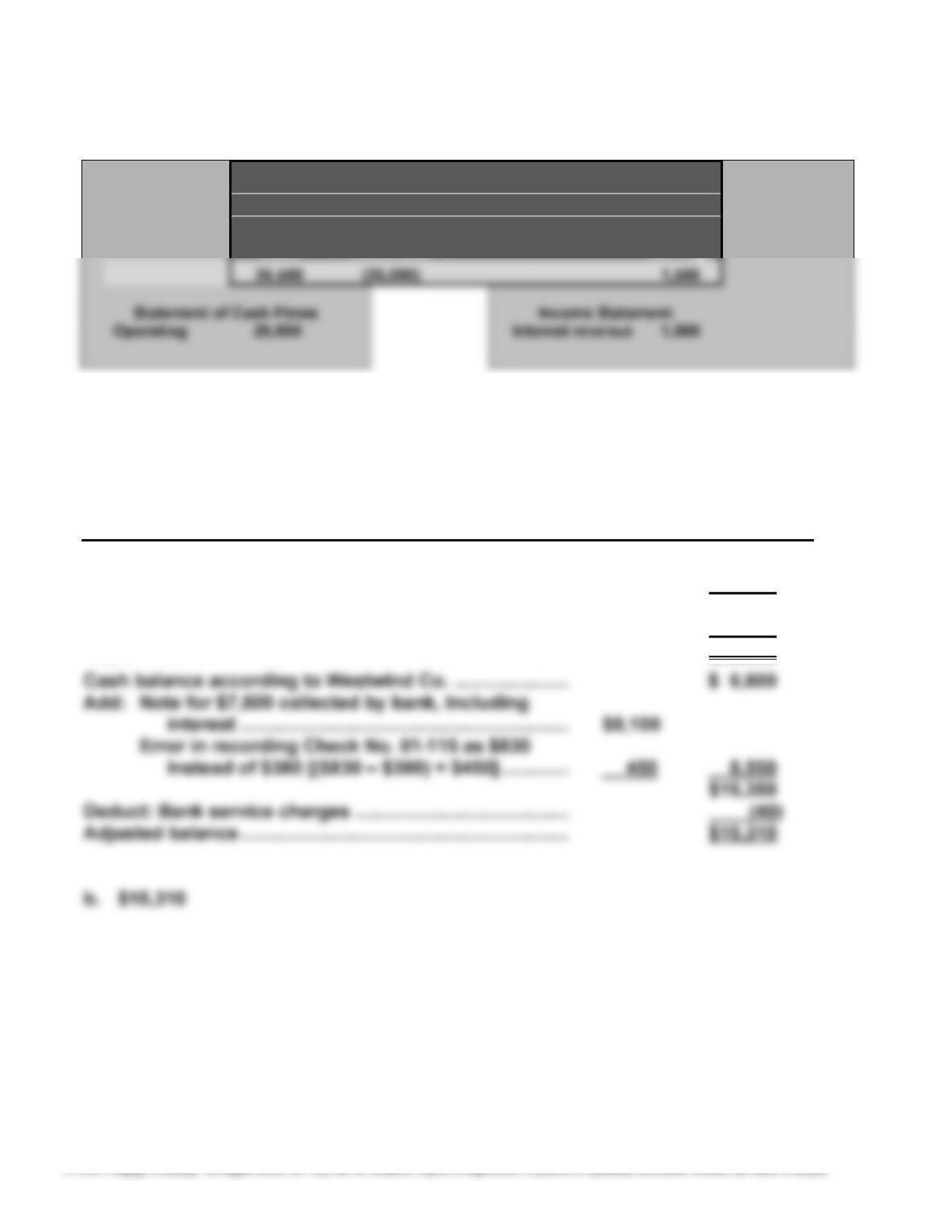
WOLFPACK BREAD INC.
Bank Reconciliation
August 31, 20Y9
Cash balance according to bank statement …………………………… $ 9,165
Add deposit in transit, not recorded by bank …………………………. 1,075
$10,240
Deduct outstanding checks ………………………………………………….. (2,855)
Adjusted balance …………………………………………………………………. $ 7,385
E5–19
Increase in Cash
Balance Sheet
Assets = Liabilities + Stockholders’ Equity
g
Decrease in Cash
Balance Sheet
Assets = Liabilities + Stockholders’ Equity
Retained
Cash = Earnings
Aug. 31. (20) (20)
Statement of Cash Flows Income Statement
Operatin
g
(
20
)
Misc. expense
(
20
)
156
E5–20
Balance Sheet
Assets = Liabilities + Stockholders’ Equity
Notes Retained
E5–21
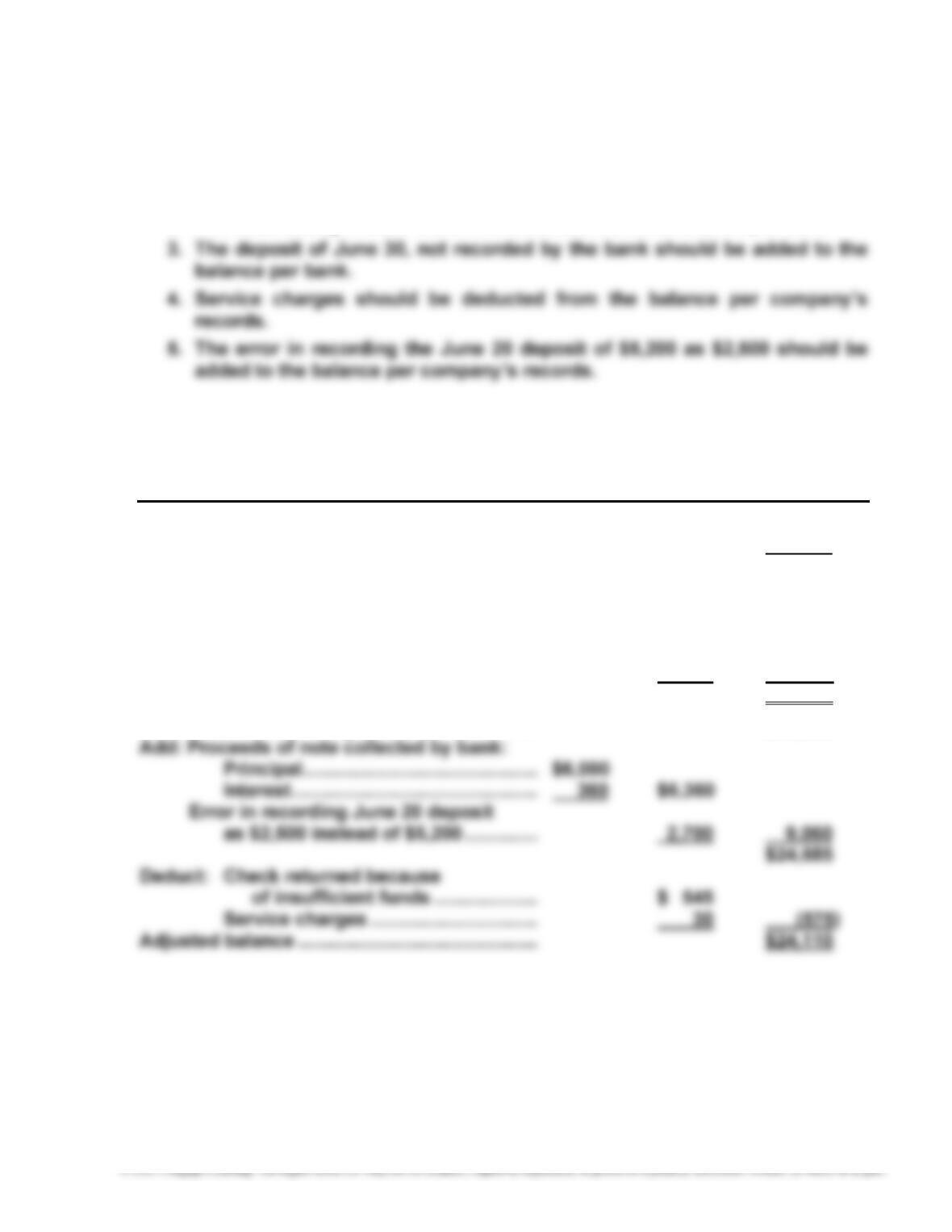
a.
WESTWIND CO.
Bank Reconciliation
August 31, 20Y6
Cash balance according to bank statement ……………….. $17,325
Add: Deposit in transit on August 31 …………………………. 2,175
$19,500
Deduct: Outstanding checks …………………………………….. (4,190)
Adjusted balance ……………………………………………………… $15,310
157
E5–22
a. 1. The heading should be June 30, 20Y3, and not For the Month Ended June
30, 20Y3.
2. The outstanding checks should be deducted from the balance per bank.
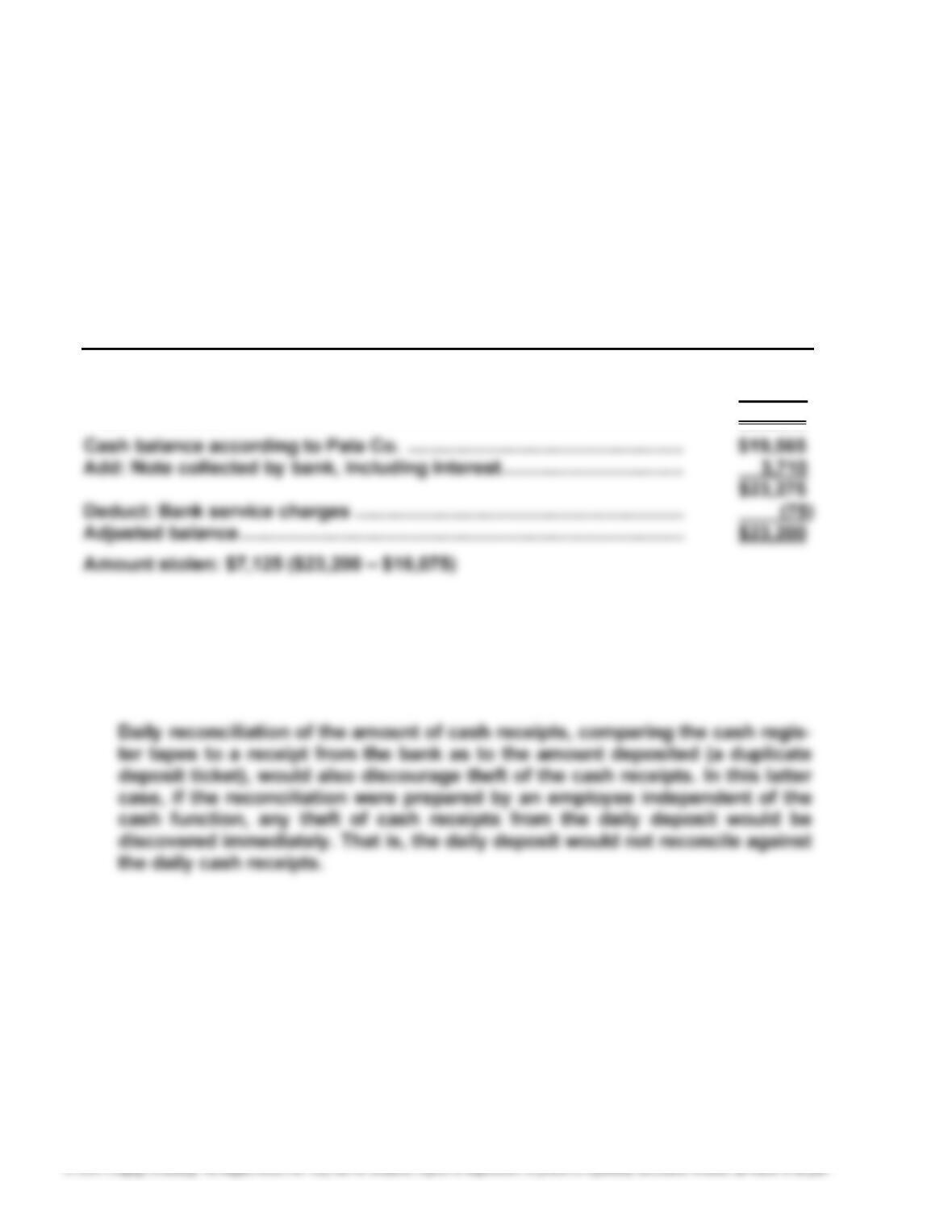
b. A correct bank reconciliation would be as follows:
DAKOTA CO.
Bank Reconciliation
June 30, 20Y3
Cash balance according to bank statement $ 22,900
Add deposit of June 30, not recorded by bank 6,200
$29,100
Deduct outstanding checks:
No. 7715 ……………………………………………. $1,450
7760 ……………………………………………. 915
7764 ……………………………………………. 1,850
7765 ……………………………………………. 775 (4,990)
Adjusted balance ………………………………………. $ 24,110
Cash balance according to Dakota Co. ………. $15,625
158
E5–23
a. The amount of cash receipts stolen by the sales clerk can be determined by
attempting to reconcile the bank account. The bank reconciliation will not
reconcile by the amount of cash receipts stolen. The amount stolen by the
sales clerk is $7,125, determined as shown below.
PALA CO.
Bank Reconciliation
April 30, 20Y1
Cash balance according to bank statement …………………………………… $28,175
Deduct: Outstanding checks ………………………………………………………… (12,100)
Adjusted balance …………………………………………………………………………. $16,075
b. The theft of the cash receipts might have been prevented by having more
than one person make the daily deposit. Collusion between two individuals
would then have been necessary to steal cash receipts. In addition, two
employees making the daily cash deposits would tend to discourage theft of
the cash receipts from the employees on the way to the bank.

159
E5–24
a.
Balance Sheet
Assets = Liabilities + Stockholders’ Equit
y
Petty
(
)
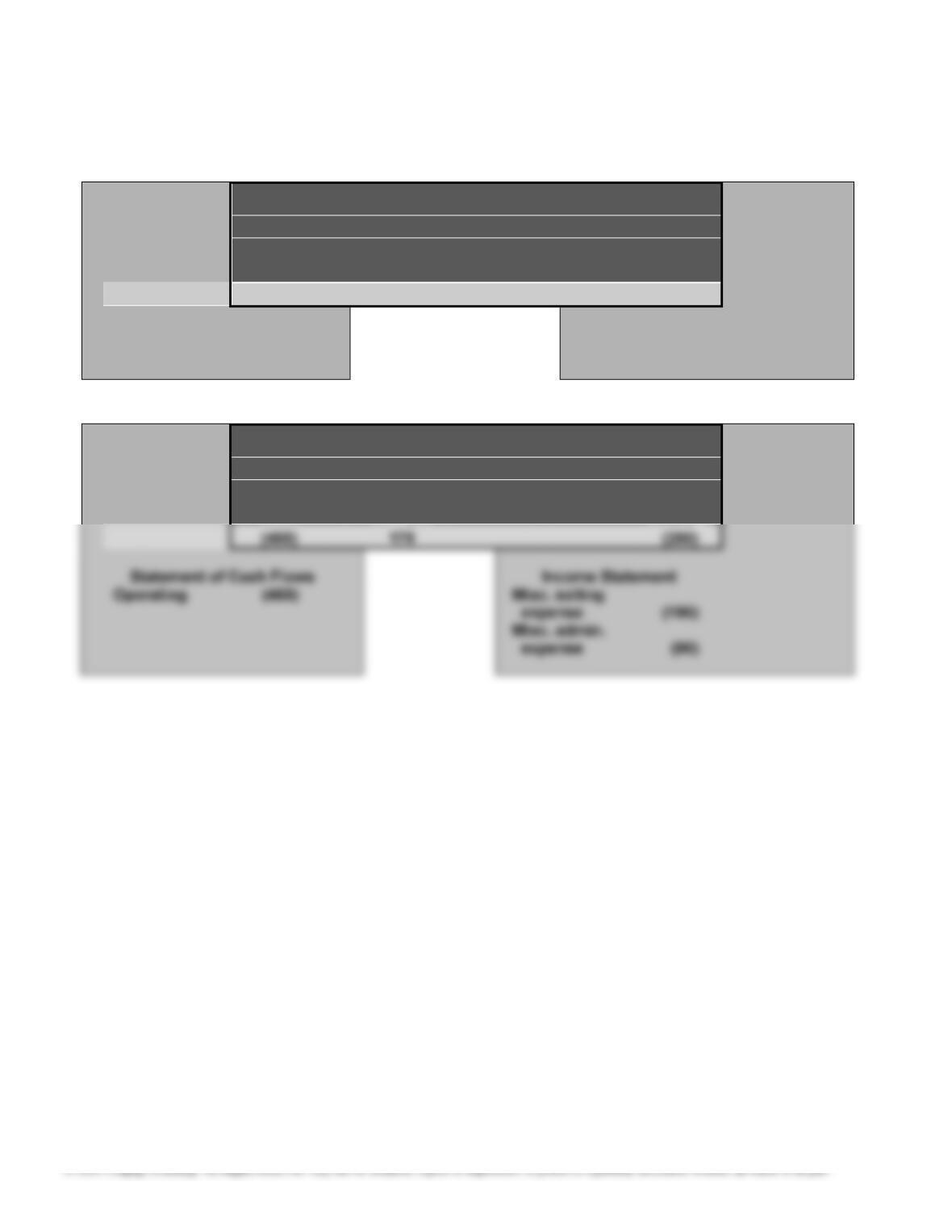
b.
Balance Sheet
Assets = Liabilities + Stockholders’ Equity
Office Retained
Cash + Supplies = Earnings
(610) 325 (285)
Statement of Cash Flows Income Statement
Operating (610) Misc. selling
expense
(
200
)
Misc. admin.
expense
(
85
)
160
E5–25
a.
Balance Sheet
Assets = Liabilities + Stockholders’ Equit
y
Petty
Cash + Cash
(
500
)
500
Statement of Cash Flows Income Statement
No effect 0 No effect 0
b.
Balance Sheet
Assets = Liabilities + Stockholders’ Equity
Office Retained
(
)
(
)