5-41
PROBLEM 5-54 (50 MINUTES)
1.
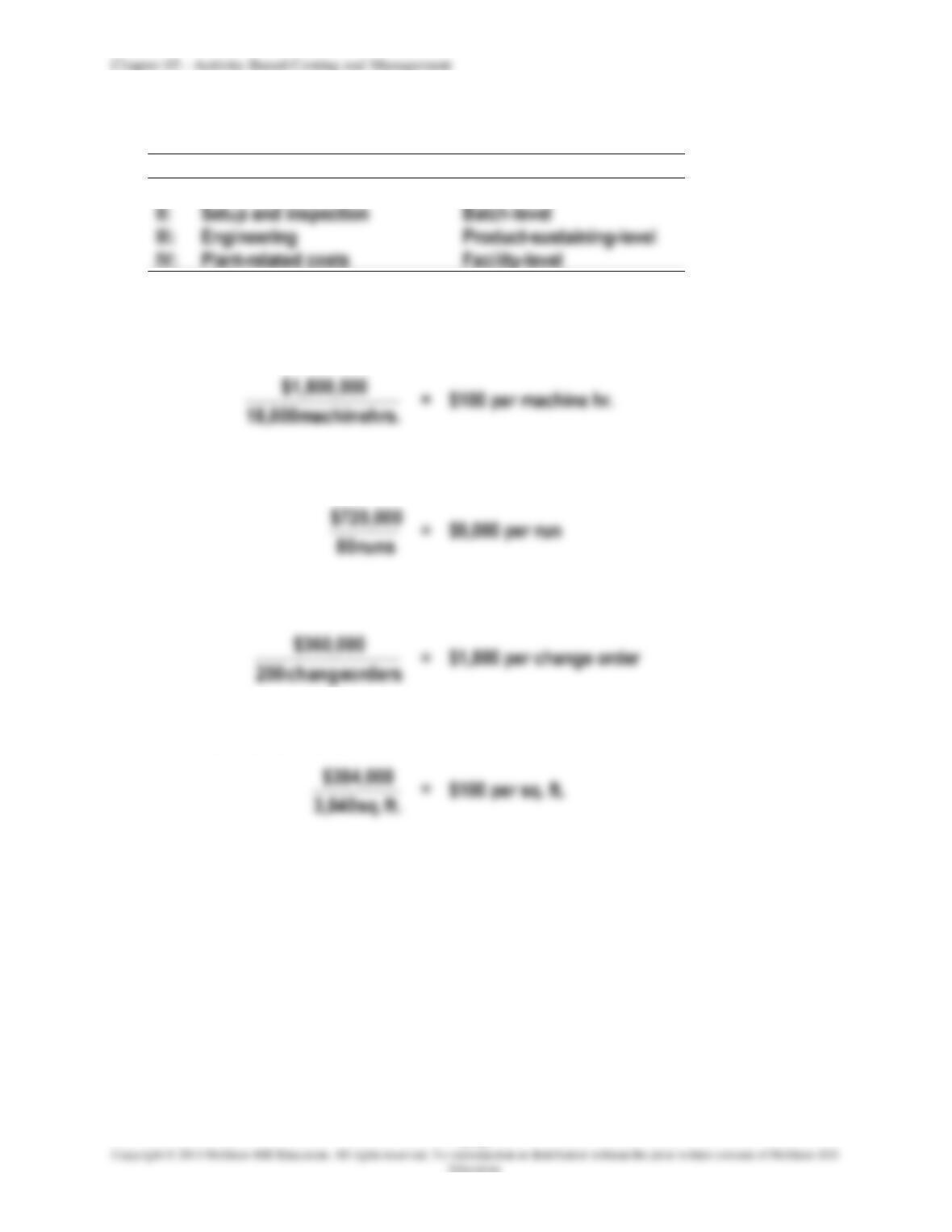
Activity Cost Pool
Type of Activity
I:
Machine-related costs
Unit-level
II:
Setup and inspection
Batch-level
III:
Engineering
Product-sustaining-level
IV:
Plant-related costs
Facility-level
2.
Calculation of pool rates:
I:
Machine-related costs:
II.
Setup and inspection:
III.
Engineering:
IV.
Plant-related costs:
5-42
PROBLEM 5-54 (CONTINUED)
3.
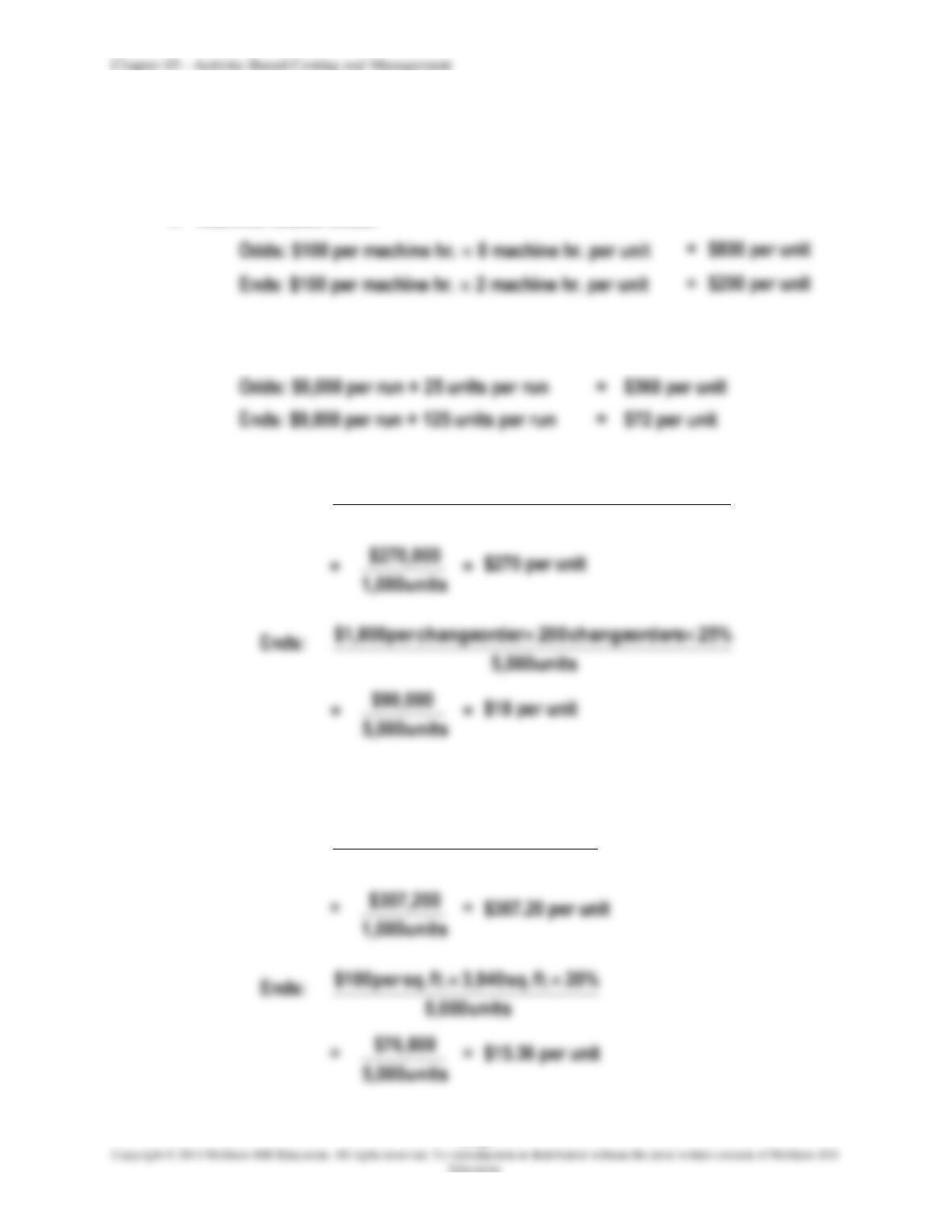
Unit costs for odds and ends:
I:
Machine-related costs:
II:
Setup and inspection:
Odds: $9,000 per run ÷ 25 units per run
=
$360 per unit
Ends: $9,000 per run ÷ 125 units per run
=
$72 per unit
III:
Engineering:
Odds:
units 1,000
75% orders change 200 order change per $1,800
units 5,000
25% orders change 200 order change per $1,800
IV.
Plant-related costs:
Odds:
units 1,000
80% ft. sq. 3,840 ft. sq. per $100
Ends:
units 5,000
20% ft. sq. 3,840 ft. sq. per $100
Chapter 05 – Activity-Based Costing and Management
5-43
PROBLEM 5-54 (CONTINUED)
4.
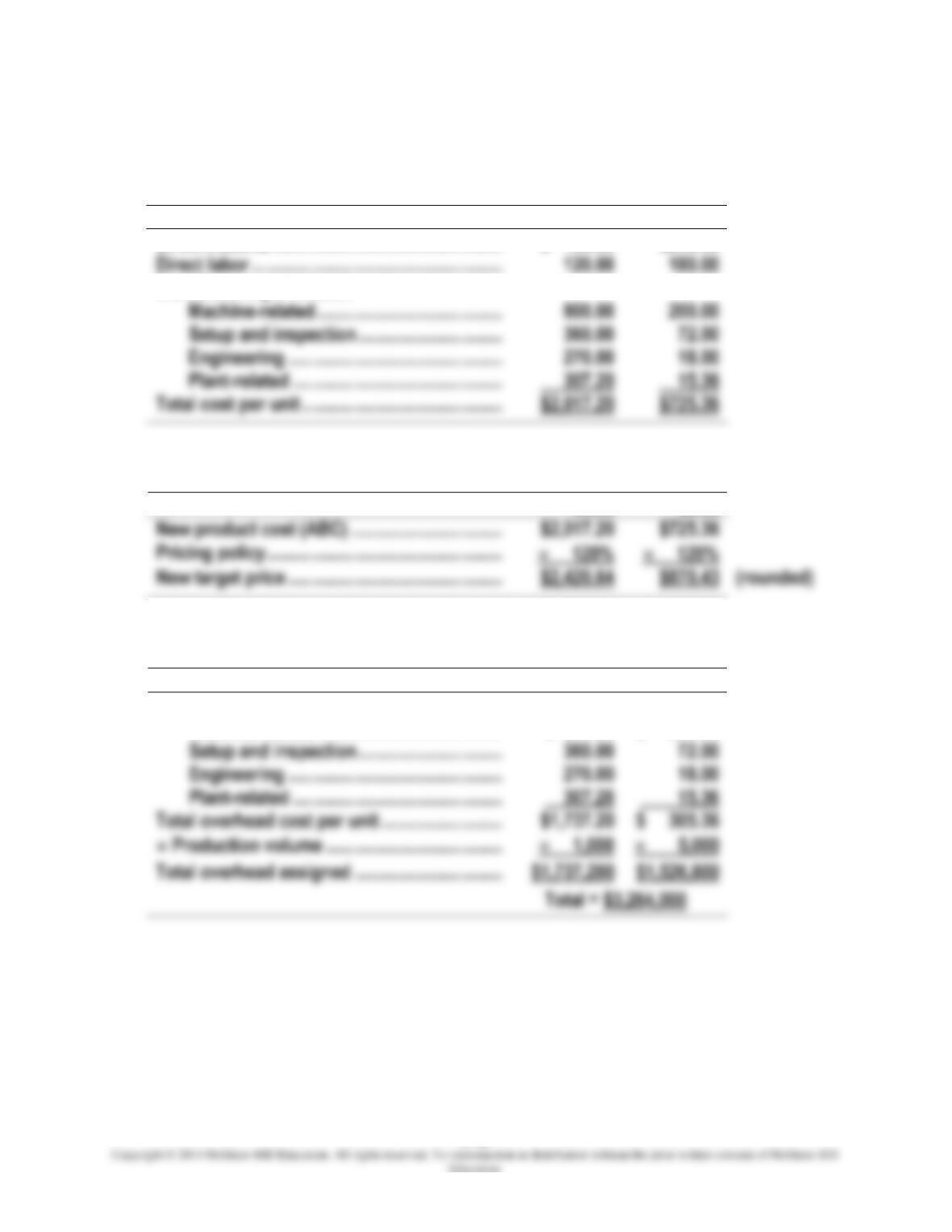
New product cost per unit using the ABC system:
Odds
Ends
Direct material ……………………………………………………….
$ 160.00
$240.00
Direct labor ……………………………………………………….
Manufacturing overhead:
Machine-related …………………………………………………….
Setup and inspection …………………………..
Engineering ……………………………………………………….
Plant-related ……………………………………………………….
307.20
15.36
5.
New target prices:
Odds
Ends
New product cost (ABC) ………………………………………………
$2,017.20
$725.36
6.
Full assignment of overhead costs:
Odds
Ends
Manufacturing overhead costs:
Machine-related …………………………………………………….
$ 800.00
$ 200.00
Setup and inspection …………………………..
Engineering ……………………………………………………….
Plant-related ……………………………………………………….
307.20
Total overhead cost per unit …………………………..
$1,737.20
$ 305.36
Chapter 05 – Activity-Based Costing and Management
5-44
PROBLEM 5-54 (CONTINUED)
7.
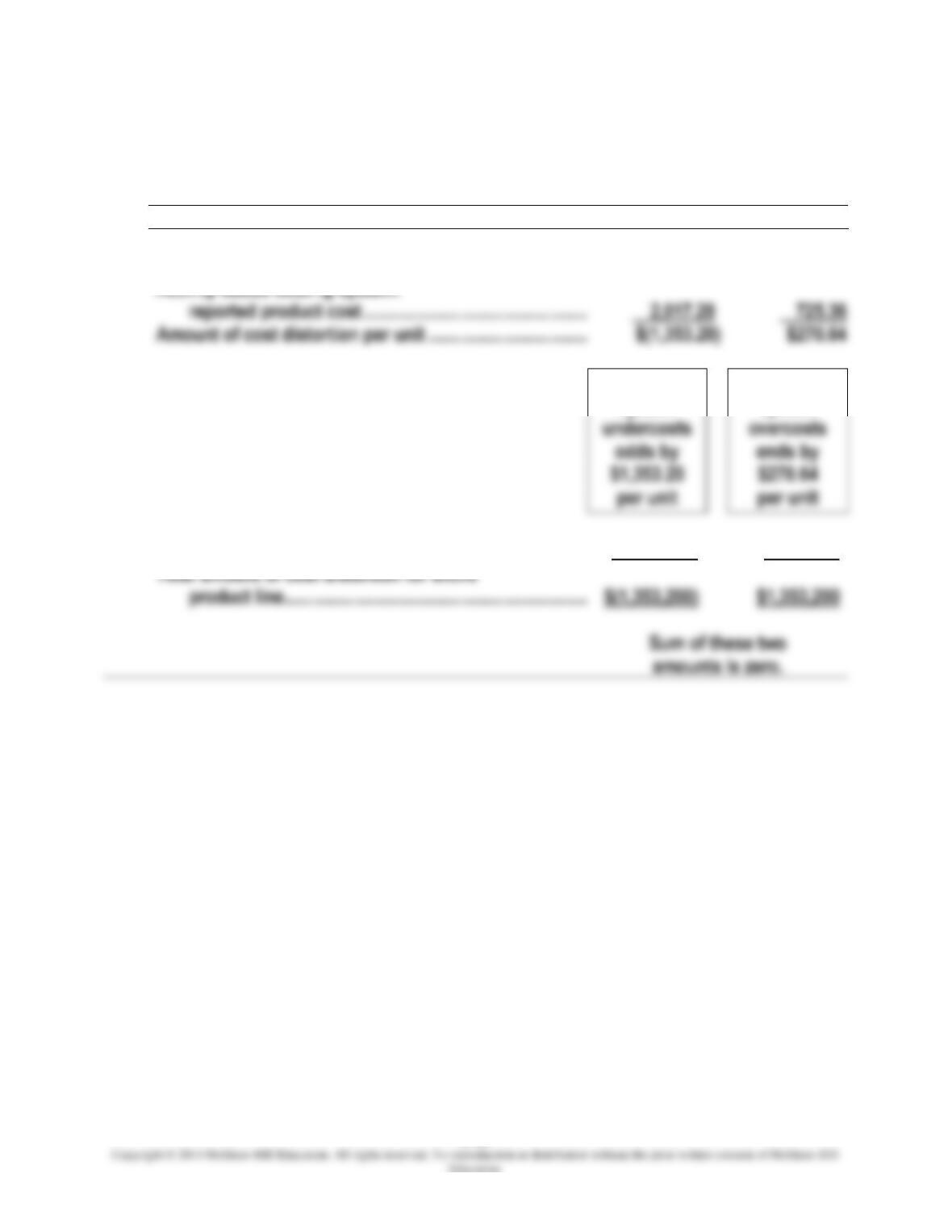
Cost distortion:
Odds
Ends
Traditional volume-based costing system:
reported product cost ……………………………………………
$ 664.00
$996.00
Activity-based costing system:
reported product cost ……………………………………………
2,017.20
Amount of cost distortion per unit ……………………………….
)
$270.64
Traditional
system
Traditional
system
Production volume ………………………………………………………
1,000
5,000
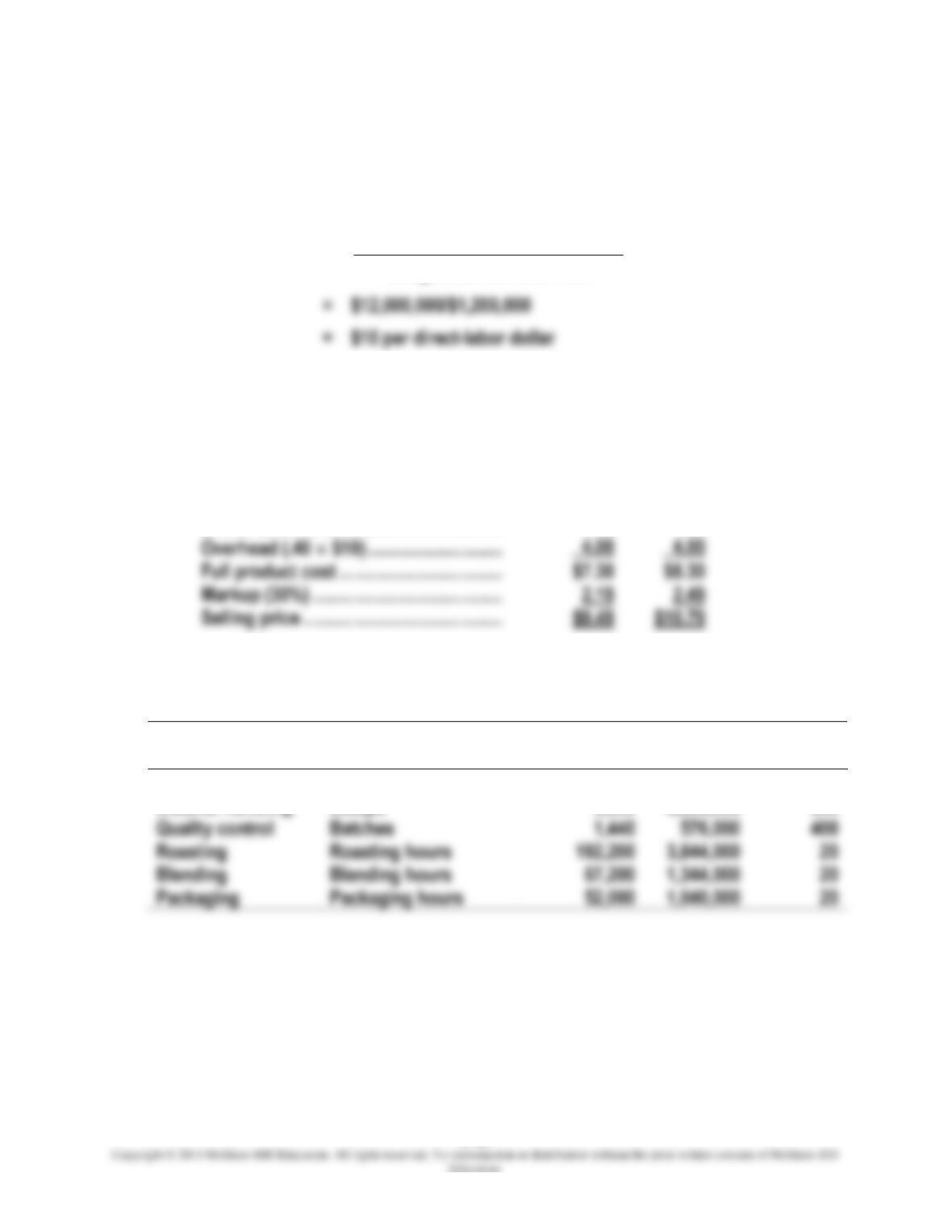
Total amount of cost distortion for entire
product line …………………………………………………………..
Chapter 05 – Activity-Based Costing and Management
5-45
PROBLEM 5-55 (45 MINUTES)
1.
a.
GSCC’s predetermined overhead rate, using direct-labor cost as the single cost
driver, is $10 per direct labor dollar, calculated as follows:
Overhead rate
=
cost labor–direct budgeted
cost overhead–ingmanufactur total
=
$12,000,000/$1,200,000
=
b.
The full product costs and selling prices of one pound of Jamaican and one
pound of Colombian coffee are calculated as follows:
Jamaican
Colombian
Direct material ………………………………….
$2.90
$ 3.90
Direct labor ………………………………………
.40
.40
Full product cost ……………………………..
$7.30
$8.30
Markup (30%) …………………………………..
Selling price …………………………………….
$9.49
2.
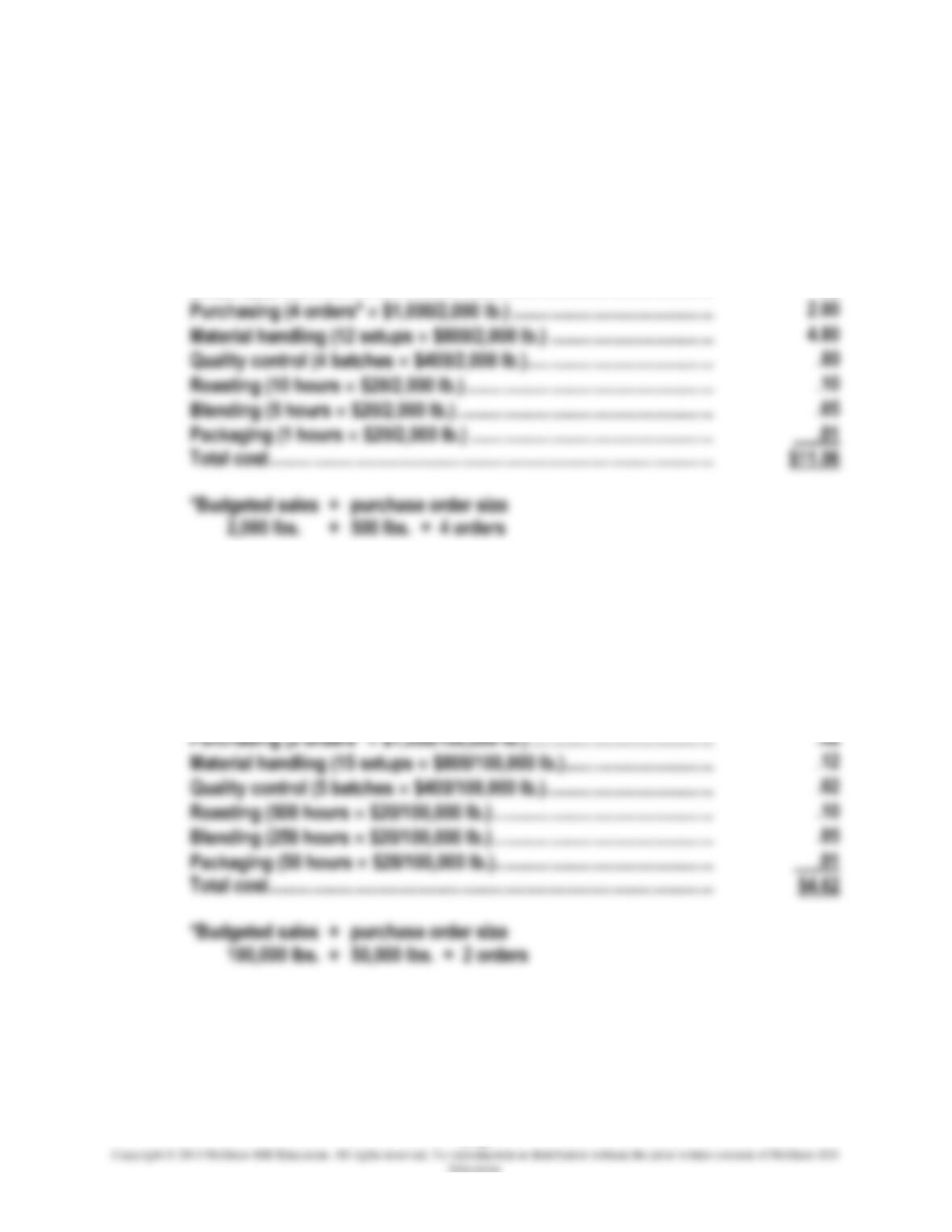
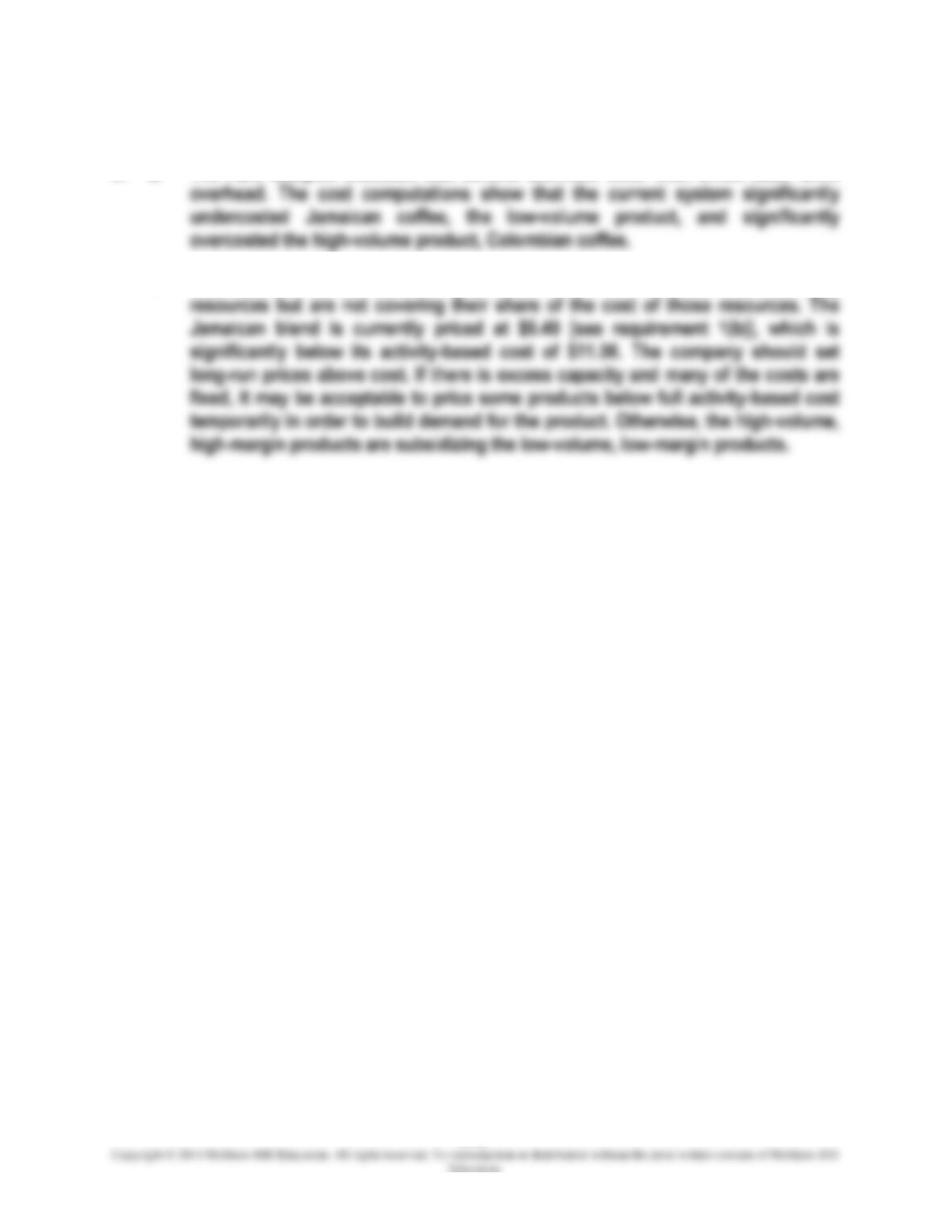
The new product cost, under an activity-based costing approach, is $11.06 per pound
of Jamaican and $4.62 per pound of Columbian coffee, calculated as follows:
Activity
Cost Driver
Budgeted
Activity
Budgeted
Cost
Unit Cost
Purchasing
Purchase orders
2,316
$2,316,000
$1,000
Material handling
Setups
3,600
2,880,000
800
Quality control
Batches
1,440
400
Roasting
Roasting hours
3,844,000
Blending
Blending hours
1,344,000
Packaging
Packaging hours
1,040,000
Chapter 05 – Activity-Based Costing and Management
5-46
PROBLEM 5-55 (CONTINUED)
Jamaican Coffee
Standard cost per pound:
Direct material ……………………………………………………………………………
$2.90
Direct labor ………………………………………………………………………………..
.40
Total cost …………………………………………………………………………………..
*Budgeted sales ÷ purchase order size
2,000 lbs. ÷ 500 lbs. = 4 orders
Colombian Coffee
Standard cost per pound:
Direct material ……………………………………………………………………………
$3.90
Direct labor ………………………………………………………………………………..
.40
Total cost …………………………………………………………………………………..
$4.62
*Budgeted sales ÷ purchase order size
100,000 lbs. ÷ 50,000 lbs. = 2 orders
Chapter 05 – Activity-Based Costing and Management
5-47
PROBLEM 5-55 (CONTINUED)
3.
a.
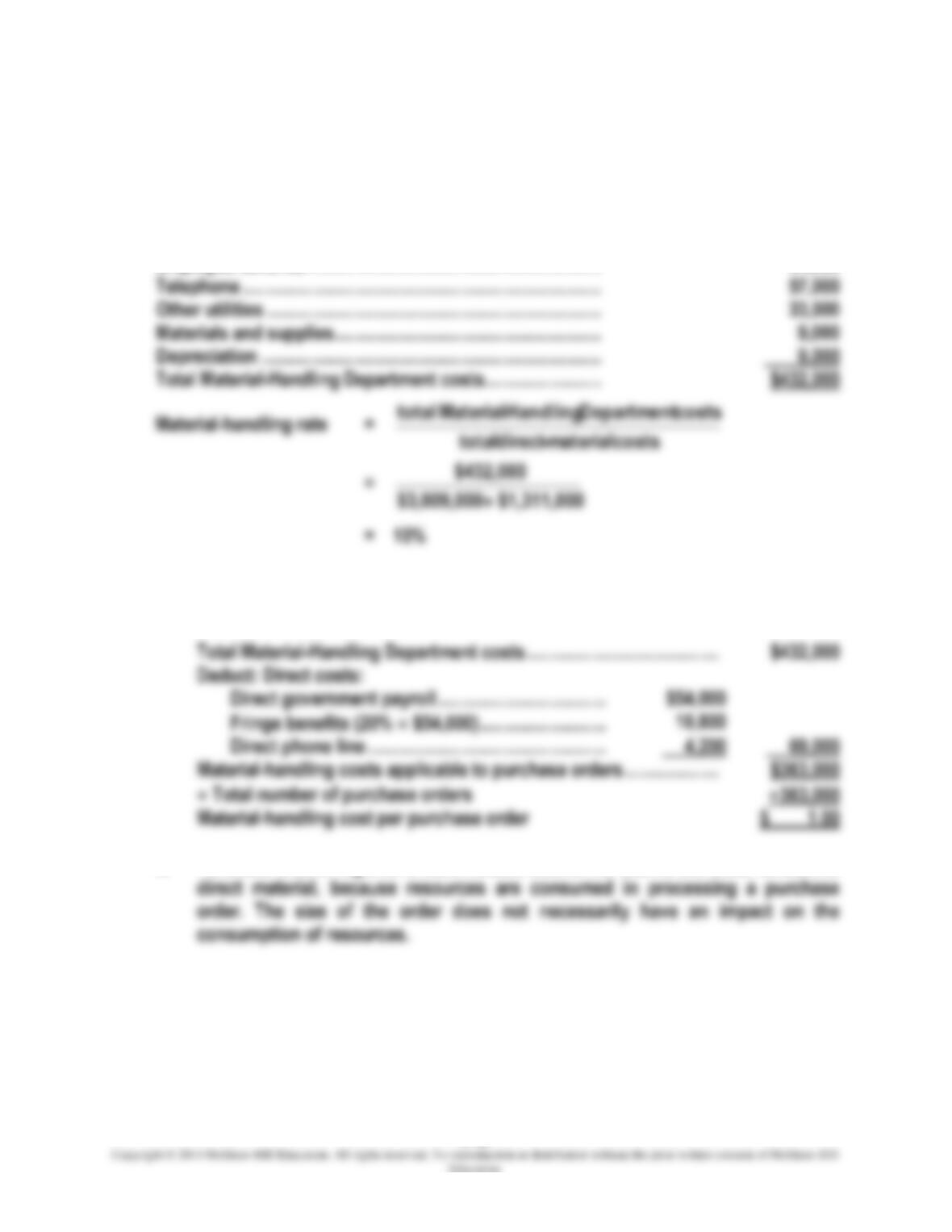
The ABC analysis indicates that several activities other than direct labor drive
b.
The implication of the ABC analysis is that the low-volume products are using
Chapter 05 – Activity-Based Costing and Management
5-48
PROBLEM 5-56 (60 MINUTES)
1.
Kara Lindley’s predecessor at Pensacola Air Industries (PAI) would have used a 10
percent material-handling rate, calculated as follows:
Payroll ………………………………………………………………………..
$270,000
Employee benefits……………………………………………………….
54,000
Telephone …………………………………………………………………..
Other utilities ………………………………………………………………
33,000
Materials and supplies …………………………………………………
Depreciation ……………………………………………………………….
Total Material-Handling Department costs …………………….
$432,000
=
2.
a.
The revised material-handling costs to be allocated on a per-purchase-order
basis is $1.00, calculated as follows:
Total Material-Handling Department costs …………………………………..
Deduct: Direct costs:
Direct government payroll ………………………………
Direct phone line ……………………………………………
Material-handling costs applicable to purchase orders ………………..
Material-handling cost per purchase order
b.
Purchase orders might be a more reliable cost driver than is the dollar amount of
Chapter 05 – Activity-Based Costing and Management
5-49
PROBLEM 5-56 (CONTINUED)
3.
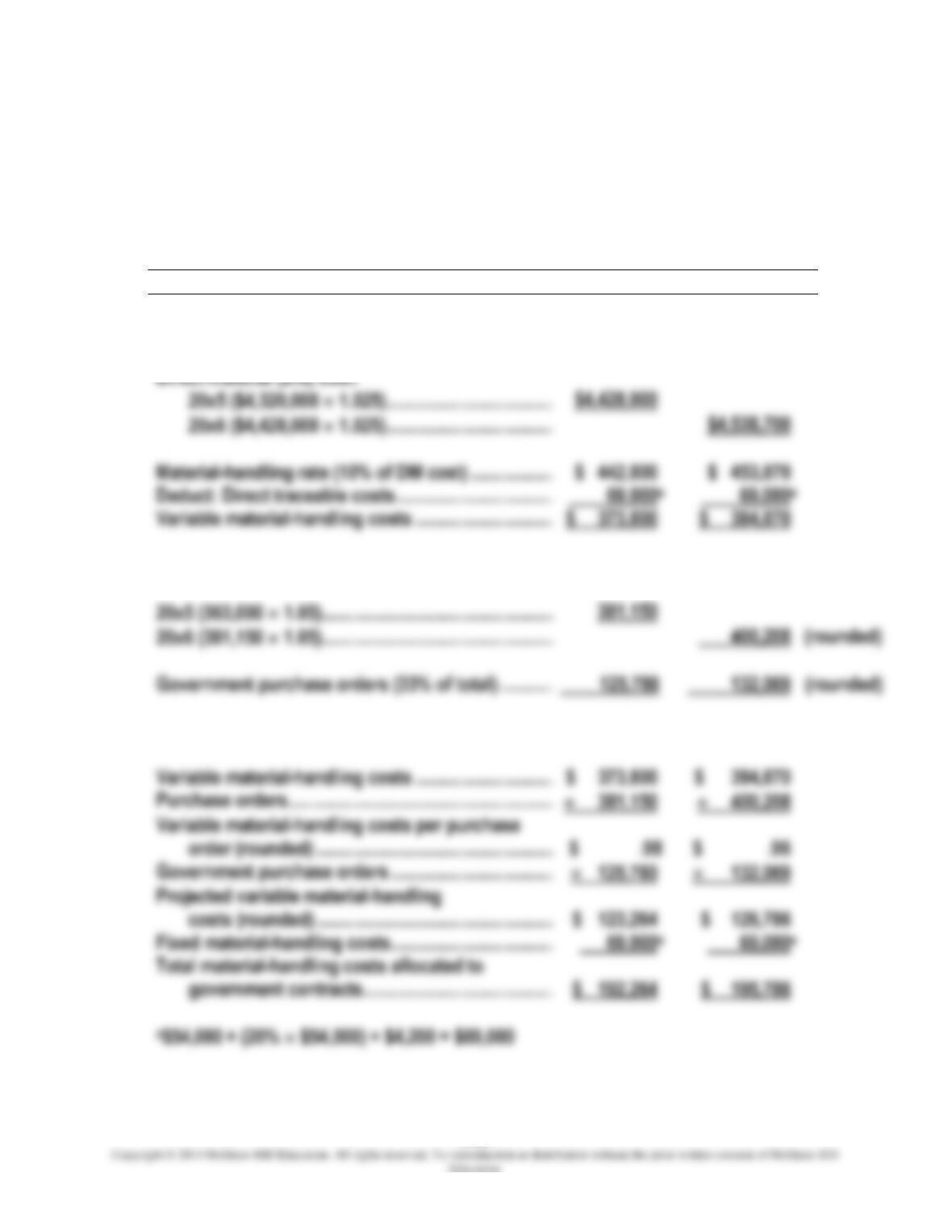
There is a $111,900 reduction in material-handling costs allocated to government
contracts by PAI as a result of the new allocation method, calculated as follows:
Previous method:
Government material …………………………………………………..
$ 3,009,000
Total (previous method) ………………………………………………
New method:
Directly traceable material-handling costs
Total (new method) ……………………………………………………..
Net reduction ………………………………………………………………
Chapter 05 – Activity-Based Costing and Management
5-50
PROBLEM 5-56 (CONTINUED)
4.
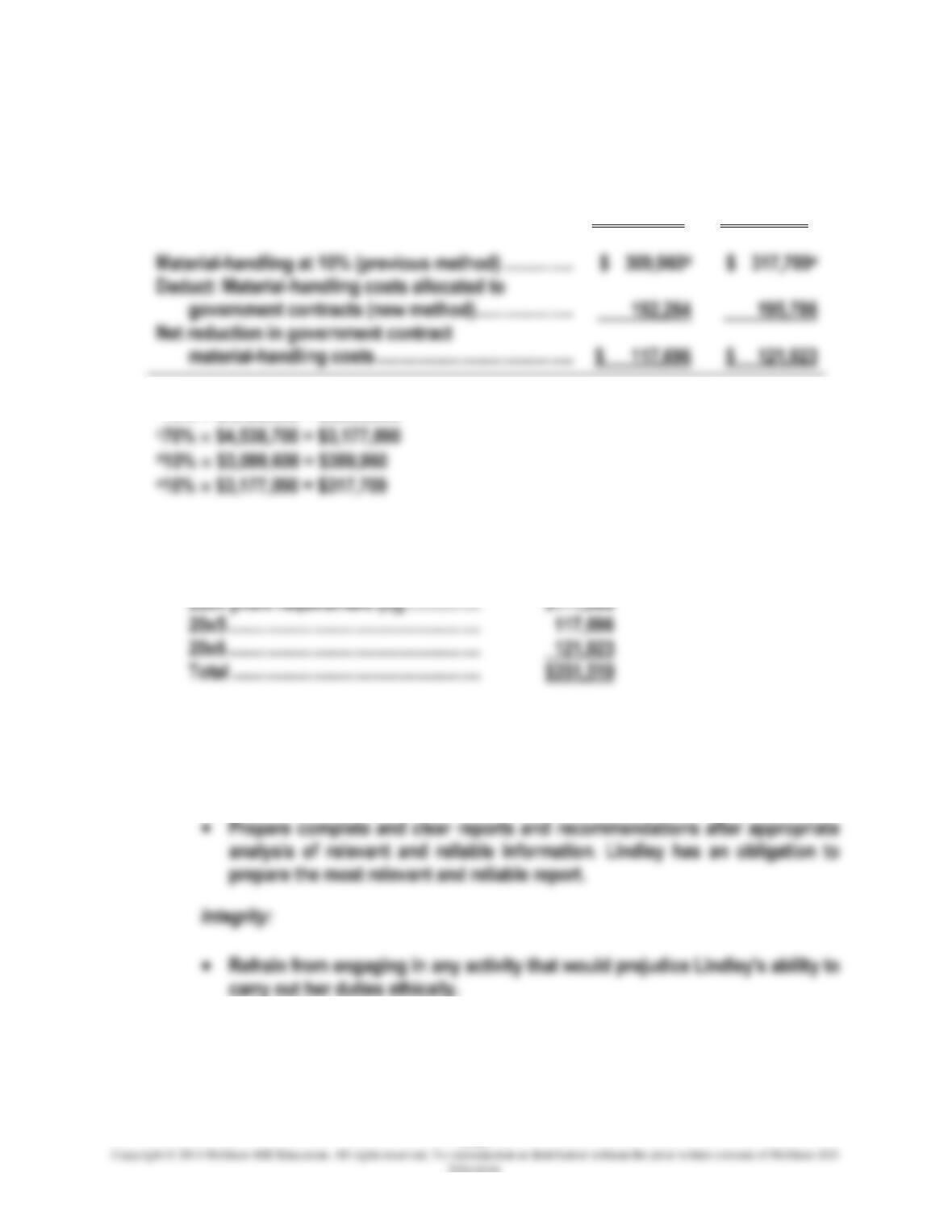
A forecast of the cumulative dollar impact over a three-year period from 20×4 through
20×6 of Kara Lindley’s recommended change for allocating Material-Handling
Department costs to the Government Contracts Unit is $351,519, calculated as
follows:
20×5
20×6
Calculation of forecasted variable material-handling costs:
Direct-material (DM) cost:
Material-handling rate (10% of DM cost) ……………………….
Deduct: Direct traceable costs ……………………………………..
Variable material-handling costs …………………………..
Calculation of forecasted purchase orders:
Government purchase orders (33% of total) ………………….
Calculation of material-handling costs allocated to government contracts:
Variable material-handling costs …………………………..
Variable material-handling costs per purchase
order (rounded) …………………………………………………….
Projected variable material-handling
costs (rounded) …………………………………………………….
Fixed material-handling costs ………………………………………
Total material-handling costs allocated to
government contracts ……………………………………………
Chapter 05 – Activity-Based Costing and Management
5-51
PROBLEM 5-56 (CONTINUED)
Calculation of cumulative dollar impact:
Government material at 70% ………………………………………..
$ 3,099,600b
$ 3,177,090 c
Material-handling at 10% (previous method) …………………
Deduct: Material-handling costs allocated to
government contracts (new method) ………………………
Net reduction in government contract
b70% $4,428,000 = $3,099,600
d10% $3,099,600 = $309,960
In summary, the cumulative dollar impact of the recommended change in allocating
Material-Handling Department costs is $351,519, calculated as follows:
Total ……………………………………………..
5.
a.
Referring to the standards of ethical conduct for management accountants, Kara
Lindley faces the following ethical issues:
Competence:
5-52
PROBLEM 5-56 (CONTINUED)
• Communicate unfavorable as well as favorable information and professional
judgments and opinions.
Credibility:
b.
The steps Kara Lindley could take to resolve this ethical conflict are as follows:
• Lindley should first follow the established policies at PAI.
• If this approach does not resolve the conflict or if such policies do not exist,
she should discuss the problem with her immediate superior, except when it
Chapter 05 – Activity-Based Costing and Management
5-53
PROBLEM 5-57 (45 MINUTES)
1.
An activity-based costing system is a two-stage process of assigning costs to
products. In stage one, activity-cost pools are established. In stage two a cost driver is
2.
Queensland Electronics should not continue with its plans to emphasize the Zodiac
model and phase out the Novelle model. As shown in the following activity-based
costing analysis, the Zodiac model has a gross margin of less than 1 percent, while
the Novelle model generates a gross margin of nearly 42 percent.
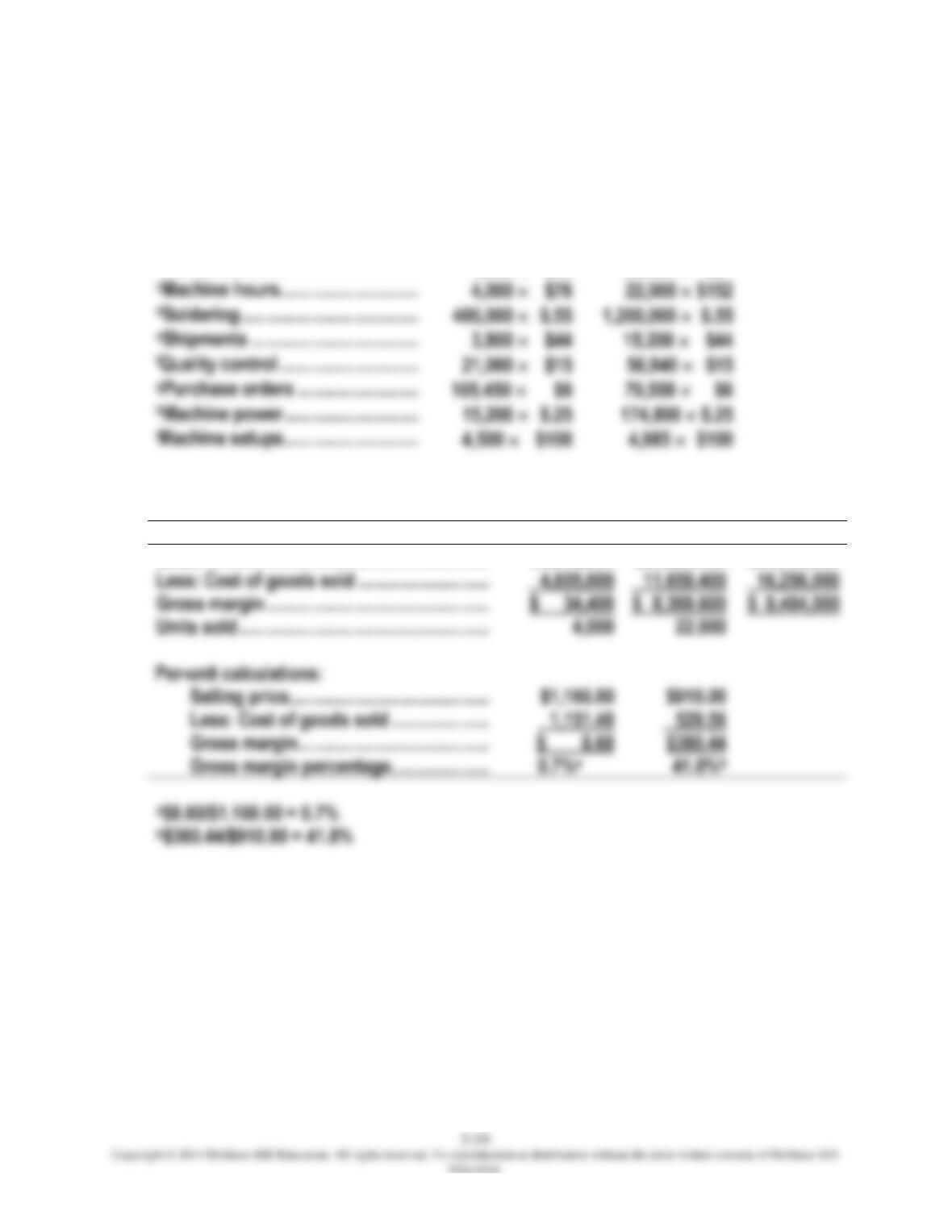
Cost per event for each cost driver:
Soldering ………………..
$ 880,000
1,600,000
=
$ .55 per solder joint
Shipments ………………
836,000
19,000
=
44.00 per shipment
Quality control ………..
78,000
=
15.00 per inspection
Purchase orders ……..
=
6.00 per order
Machine power ………..
=
.25 per hour
Machine setups ……….
=
100.00 per setup
Costs per model:
Zodiac
Novelle
Direct costs:
Materiala ……………………………………………………….………
$2,316,000
$ 4,642,000
Direct laborb ……………………………………………………….
196,000
462,000
Machine hoursc ……………………………………………………..
Total direct costs ……………………………………………………….
$2,816,000
$ 8,448,000
Assigned costs:
Solderingd …………………………………………………………….
Shipmentse ……………………………………………………………
167,200
668,800
Quality controlf ……………………………………………………..
315,900
854,100
Purchase ordersg …………………………………………………..
632,700
477,300
Machine powerh …………………………………………………….
Machine setupsi …………………………………………………….
Total assigned costs ……………………………………………………
$1,789,600
Chapter 05 – Activity-Based Costing and Management
PROBLEM 5-57 (CONTINUED)
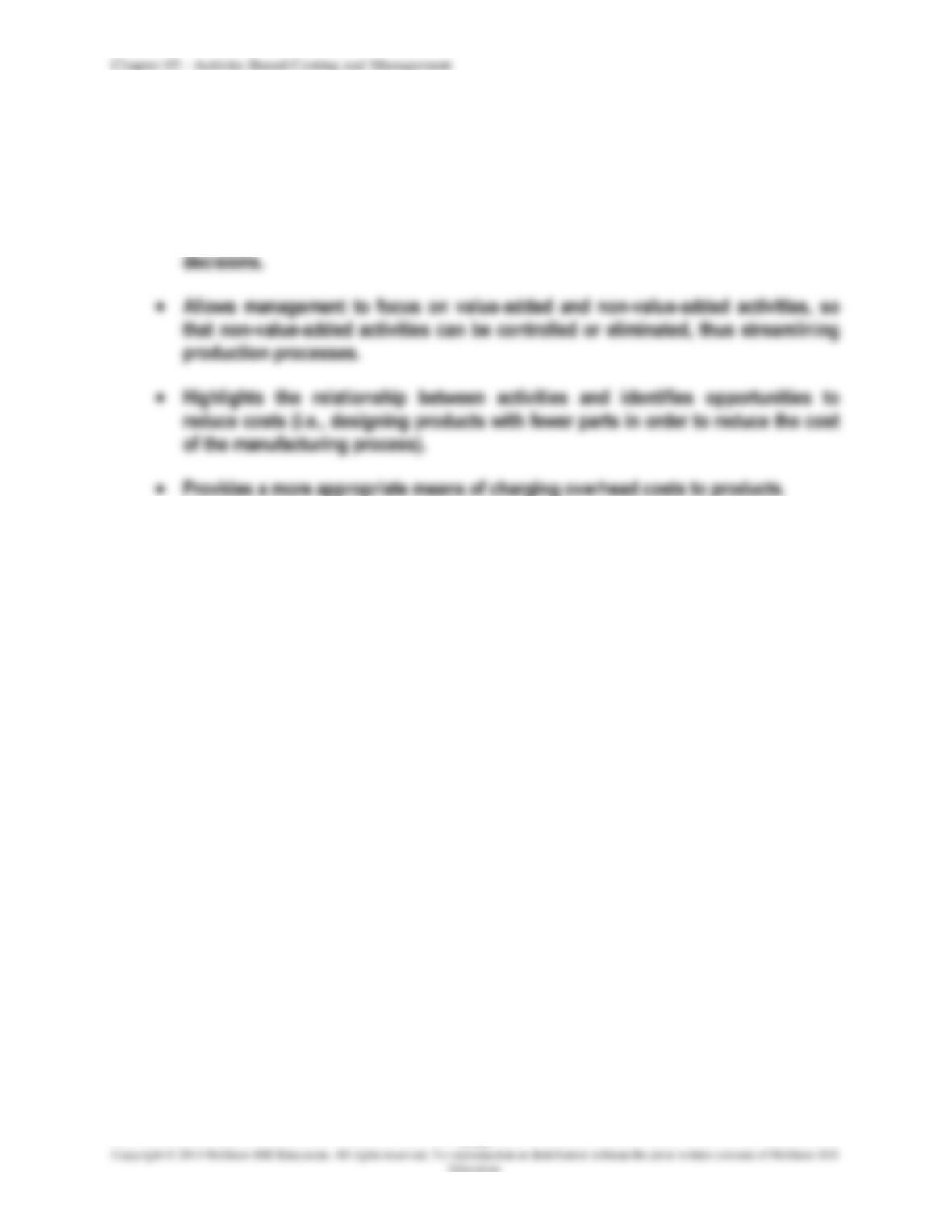
Calculations:
Zodiac
Novelle
aMaterial …………………………………..
4,000 $579
22,000 $211
bDirect labor ……………………………..
4,000 $49
22,000 $21
cMachine hours …………………………
22,000 $152
eShipments ………………………………
gPurchase orders ……………………..
Profitability analysis:
Zodiac
Novelle
Total
Sales ……………………………………………………..
$4,640,000
$20,020,000
$24,660,000
Less: Cost of goods sold ……………………….
Gross margin …………………………………………
$ 8,404,000
Units sold ………………………………………………
Per-unit calculations:
Selling price …………………………………….
Less: Cost of goods sold …………………
Gross margin …………………………………..
Gross margin percentage …………………
5-55
PROBLEM 5-58 (60 MINUTES)
1.
General advantages associated with activity-based costing include the following:
• Provides management with a more thorough understanding of complex product
costs and product profitability for improved resource management and pricing
5-56
PROBLEM 5-58 (CONTINUED)
2.
Using Ultratech’s unit cost data, the total contribution margin expected from the PC
board is $4,720,000, calculated as follows:
Per Unit
Total for
40,000
Units
Revenue ……………………………………………………………………..
$600
$24,000,000
Direct material …………………………………………………………….
$280
$11,200,000
Material-handling charge (10% of material) …………………..
Total cost ……………………………………………………………..
$482
$19,280,000
Unit contribution margin ……………………………………………..
$118
*Variable overhead rate: $2,240,000 ÷ 280,000 hr. = $8 per hr.
The total contribution margin expected from the TV board is $3,900,000, calculated as
follows:
Per Unit
Total for
65,000
Units
Revenue ……………………………………………………………………..
$300
$19,500,000
Direct material …………………………………………………………….
$160
$10,400,000
Material-handling charge (10% of material) …………………..
Total cost ……………………………………………………………..
$240
$15,600,000
Unit contribution margin ……………………………………………..
*Variable-overhead rate: $2,240,000 ÷ 280,000 hr. = $8 per hr.
5-57
PROBLEM 5-58 (CONTINUED)
3.
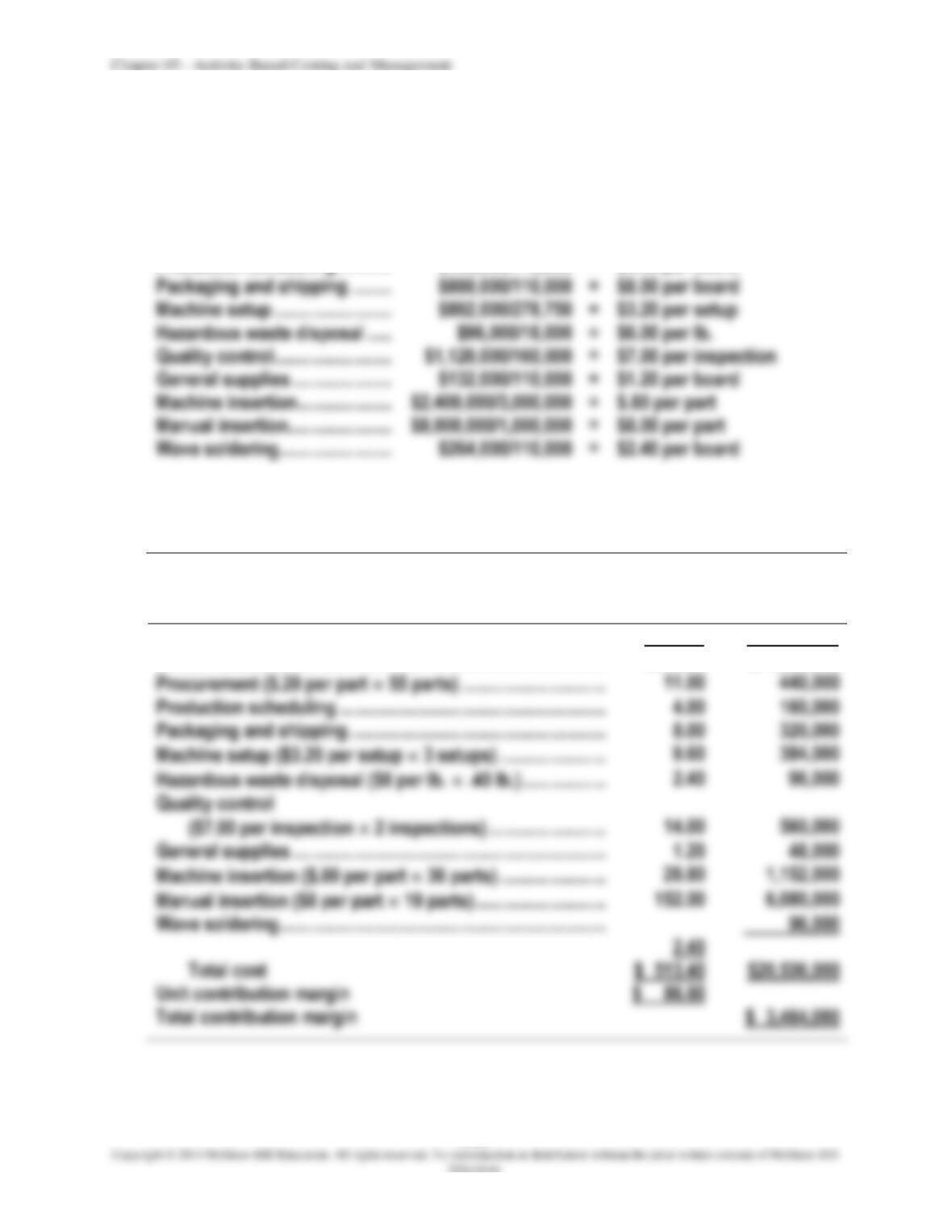
The pool rates, which apply to both the PC board and the TV board, are calculated as
follows:
Procurement ……………………….
$800,000/4,000,000
=
$.20 per part
Production scheduling ………..
$440,000/110,000
=
$4.00 per board
Packaging and shipping ………
$880,000/110,000
=
$8.00 per board
Machine setup …………………….
$892,000/278,750
=
$3.20 per setup
Hazardous waste disposal …..
=
$6.00 per lb.
Quality control …………………….
$1,120,000/160,000
=
$7.00 per inspection
General supplies …………………
$132,000/110,000
=
$1.20 per board
Machine insertion ………………..
=
$.80 per part
Manual insertion ………………….
=
$8.00 per part
Wave soldering ……………………
$264,000/110,000
=
$2.40 per board
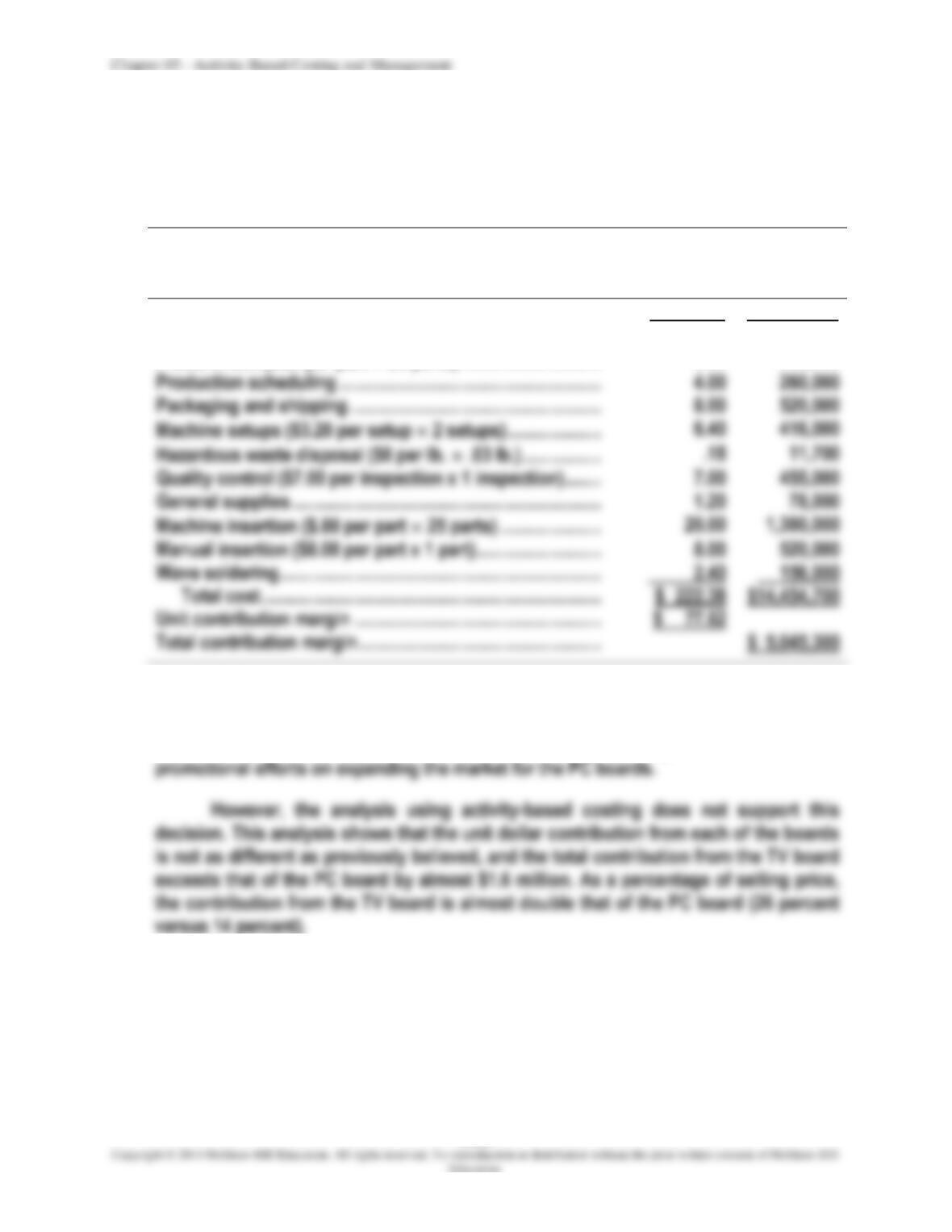
Using activity-based costing, the total contribution margin expected from the PC
board is $3,464,000, calculated as follows:
Per Unit
Total for
40,000
Units
Revenue ………………………………………………………………………
$600.00
$24,000,000
Direct material ……………………………………………………………..
$280.00
$11,200,000
Production scheduling …………………………………………………
Packaging and shipping ……………………………………………….
Quality control
General supplies ………………………………………………………….
Wave soldering …………………………………………………………….
Total cost
Unit contribution margin
5-58
PROBLEM 5-58 (CONTINUED)
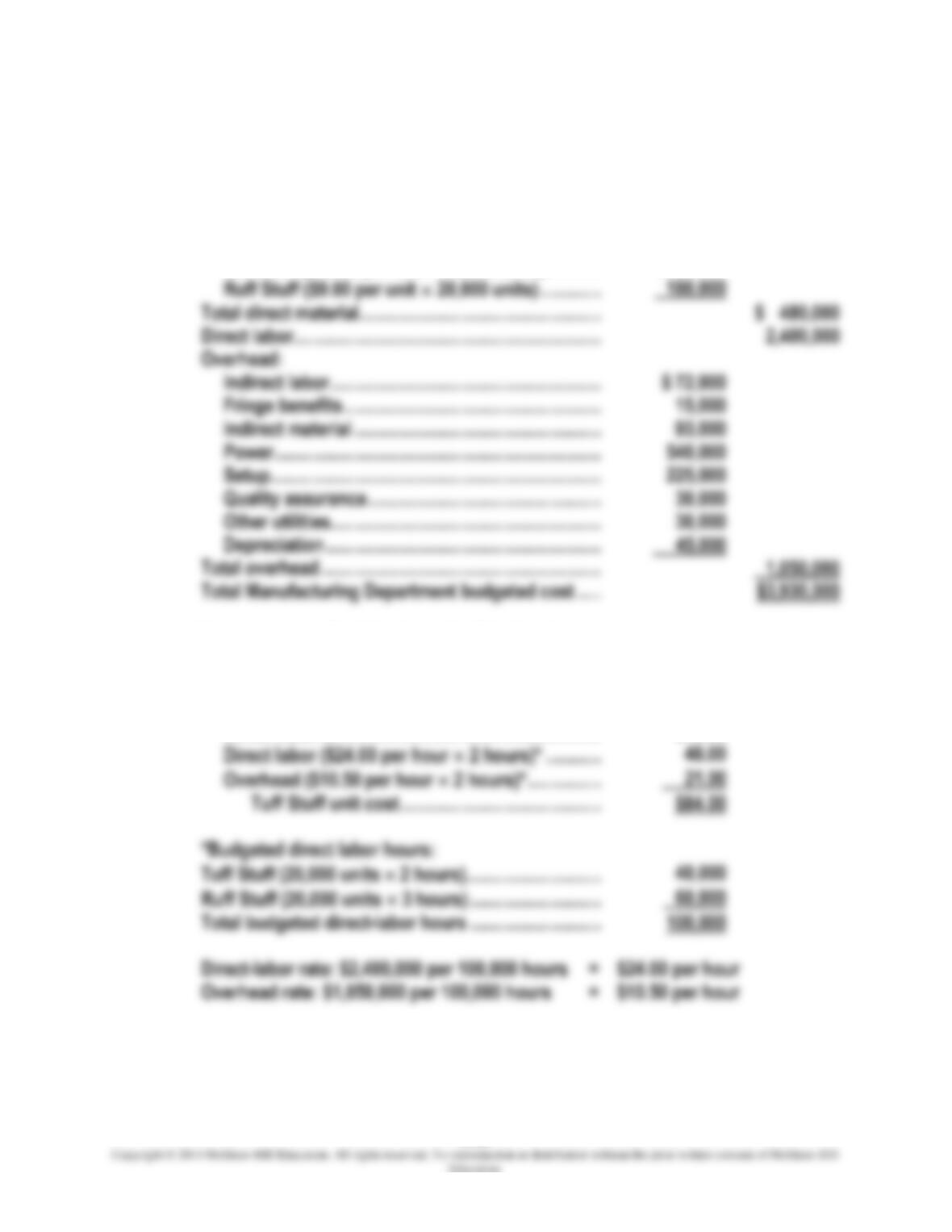
Using activity-based costing, the total contribution margin expected from the TV board
is $5,045,300, calculated as follows:
Per Unit
Total for
65,000
Units
Revenue ……………………………………………………………………..
$ 300.00
$19,500,000
Direct material …………………………………………………………….
$ 160.00
$10,400,000
Procurement ($.20 per part 26 parts) …………………………
5.20
338,000
Production scheduling ………………………………………………..
Packaging and shipping ………………………………………………
Hazardous waste disposal ($6 per lb. .03 lb.) ……………..
Quality control ($7.00 per inspection x 1 inspection) ……..
General supplies …………………………………………………………
Manual insertion ($8.00 per part x 1 part) ………………………
Wave soldering ……………………………………………………………
Total cost ……………………………………………………………….
$ 222.38
$14,454,700
Unit contribution margin ……………………………………………..
4.
The analysis using the previously reported costs indicates that the unit contribution of
the PC board is almost double that of the TV board. On this basis, management is
likely to accept the suggestion of the production manager and concentrate
Chapter 05 – Activity-Based Costing and Management
5-59
PROBLEM 5-59 (50 MINUTES)
1.
a.
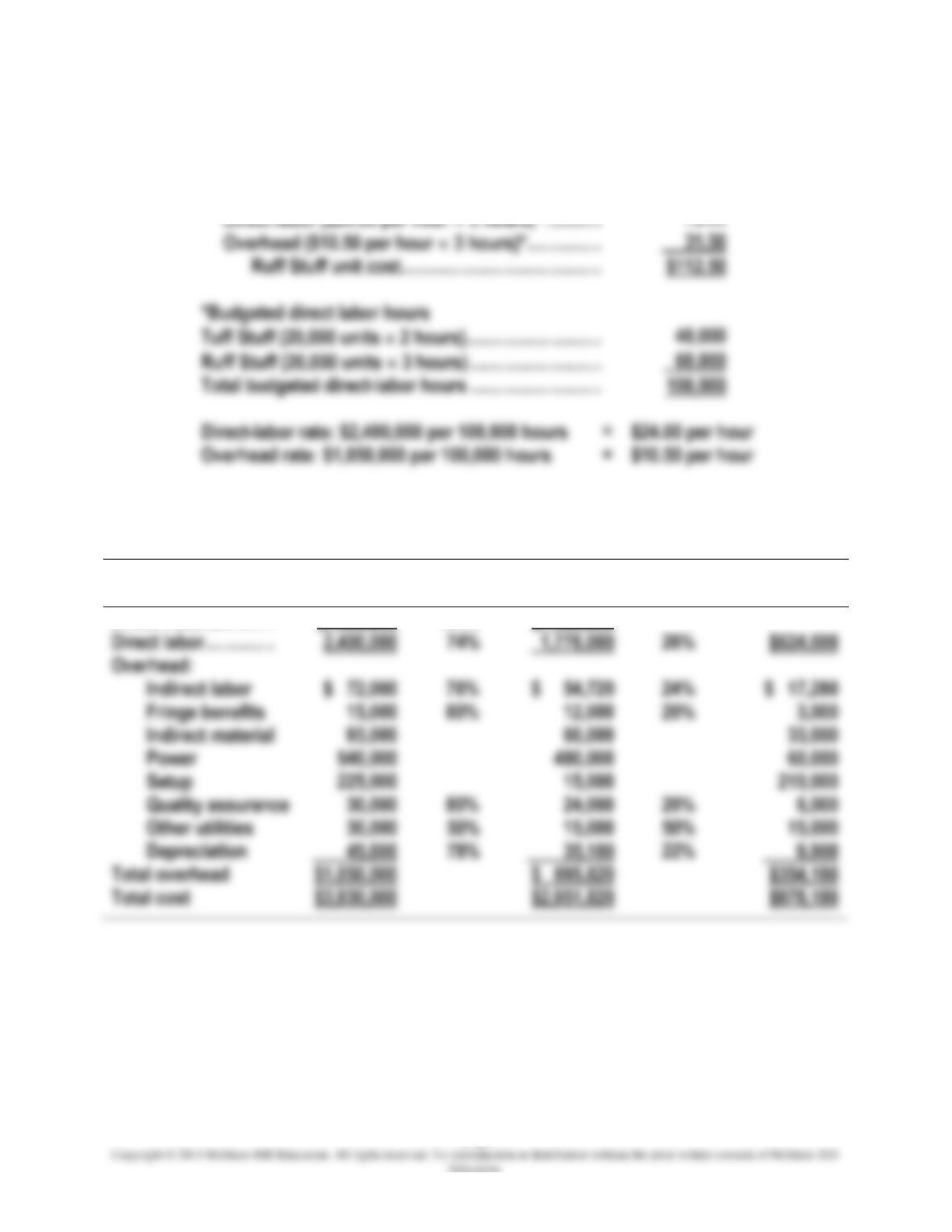
The calculation of total budgeted costs for the Manufacturing Department at
Scott Manufacturing is as follows:
Direct material:
Tuff Stuff ($15.00 per unit 20,000 units) …………
$300,000
Total direct material …………………………………………….
Direct labor …………………………………………………………
Overhead:
Indirect labor ………………………………………………….
Fringe benefits ……………………………………………….
15,000
Indirect material ……………………………………………..
93,000
Power …………………………………………………………….
Setup ……………………………………………………………..
Quality assurance …………………………………………..
30,000
Other utilities ………………………………………………….
30,000
Depreciation …………………………………………………..
Total overhead ……………………………………………………
Total Manufacturing Department budgeted cost …..
b.
The unit costs of Tuff Stuff and Ruff Stuff, with overhead assigned on the basis
of direct-labor hours, are calculated as follows:
Tuff Stuff:
Direct material ………………………………………………..
$15.00
Overhead ($10.50 per hour 2 hours)* …………….
Tuff Stuff unit cost …………………………………….
$84.00
*Budgeted direct labor hours:
Ruff Stuff (20,000 units 3 hours) ……………………….
Total budgeted direct-labor hours ……………………….
Direct-labor rate: $2,400,000 per 100,000 hours
=
Overhead rate: $1,050,000 per 100,000 hours
=
$10.50 per hour
Chapter 05 – Activity-Based Costing and Management
5-60
PROBLEM 5-59 (CONTINUED)
Ruff Stuff:
Direct material ………………………………………………..
$ 9.00
Ruff Stuff unit cost …………………………………….
$112.50
*Budgeted direct labor hours
Total budgeted direct-labor hours ……………………….
100,000
Direct-labor rate: $2,400,000 per 100,000 hours
=
$24.00 per hour
Overhead rate: $1,050,000 per 100,000 hours
=
$10.50 per hour
2.
The total budgeted cost of the Fabricating and Assembly Departments, after
separation of costs into the activity cost pools, is calculated as follows:
Total
Fabricating
Assembly
Percent
Dollars
Percent
Dollars
Direct material ……….
$ 480,000
100%
$ 480,000
Overhead:
Indirect labor
$ 54,720
Fringe benefits
Indirect material
480,000
Setup
210,000
Quality assurance
Other utilities
Depreciation
Total overhead
$ 695,820