
CHAPTER 19 (FIN MAN); CHAPTER 5 (MAN) Support Department and Joint Cost Allocation
Prob. 19–3A (FIN MAN); Prob. 5–3A (MAN)
1.
Joint Product
Bottles
per Batch
Market Value
per Bottle at
Split-Off
Total Market
Value at
Split-Off
Percent of
Total MV at
Split-Off
Joint Costs
Allocation
Hand lotion
80
$2.50
$200
50%
$250
$125
Body lotion
Foot lotion
Totals
145
$400
$250
2. Lovely Lotion Inc. processes body lotion after the split-off point at a cost of $0.25 per bottle and
then sells it for $2.75 more per bottle than its market value at split-off ($5.75 – $3.00), providing a
$2.50 extra profit ($2.75 – $0.25) per bottle due to further processing after the split-off point. So,

CHAPTER 19 (FIN MAN); CHAPTER 5 (MAN) Support Department and Joint Cost Allocation
Prob. 19–3A (FIN MAN); Prob. 5–3A (MAN) (Concluded)
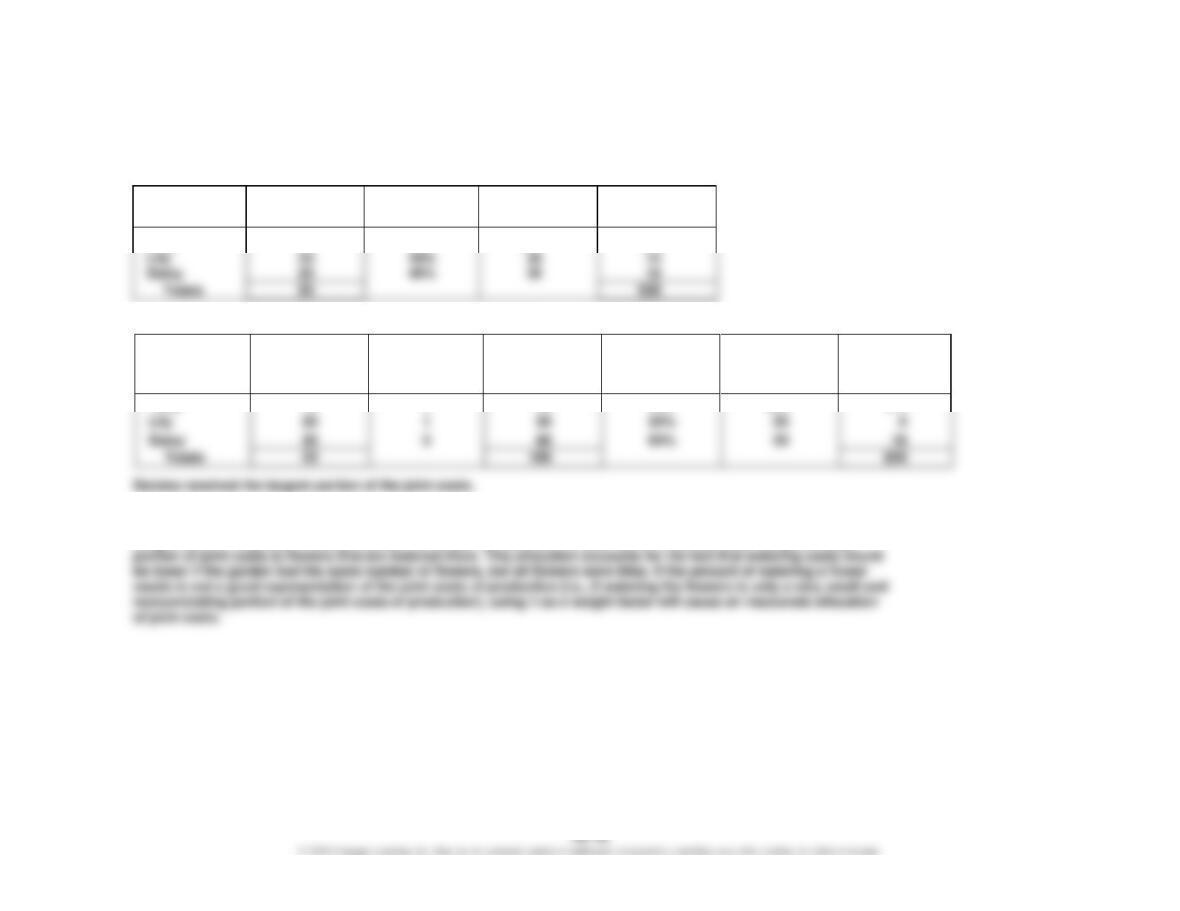
3.
Joint Product
Bottles
per Batch
Market Value
per Bottle
at Split-Off
Total
Market Value
at Split-Off
Market Price
per Bottle
Added Cost
per Bottle
NRV
per Bottle
Total Net
Realizable
Value
Greater of
Total NRV
and Total
Market Value
at Split-Off
Proportion
Joint Costs
Allocation
Hand lotion
$2.50
Body lotion
120.00
5.75
Foot lotion
4.00
CHAPTER 19 (FIN MAN); CHAPTER 5 (MAN) Support Department and Joint Cost Allocation
Prob. 19–4A (FIN MAN); Prob. 5–4A (MAN)
1.
Joint Product
Flowers
per Harvest
Proportion
Joint Costs
Allocation
Tulip
10
20%
$30
$ 6
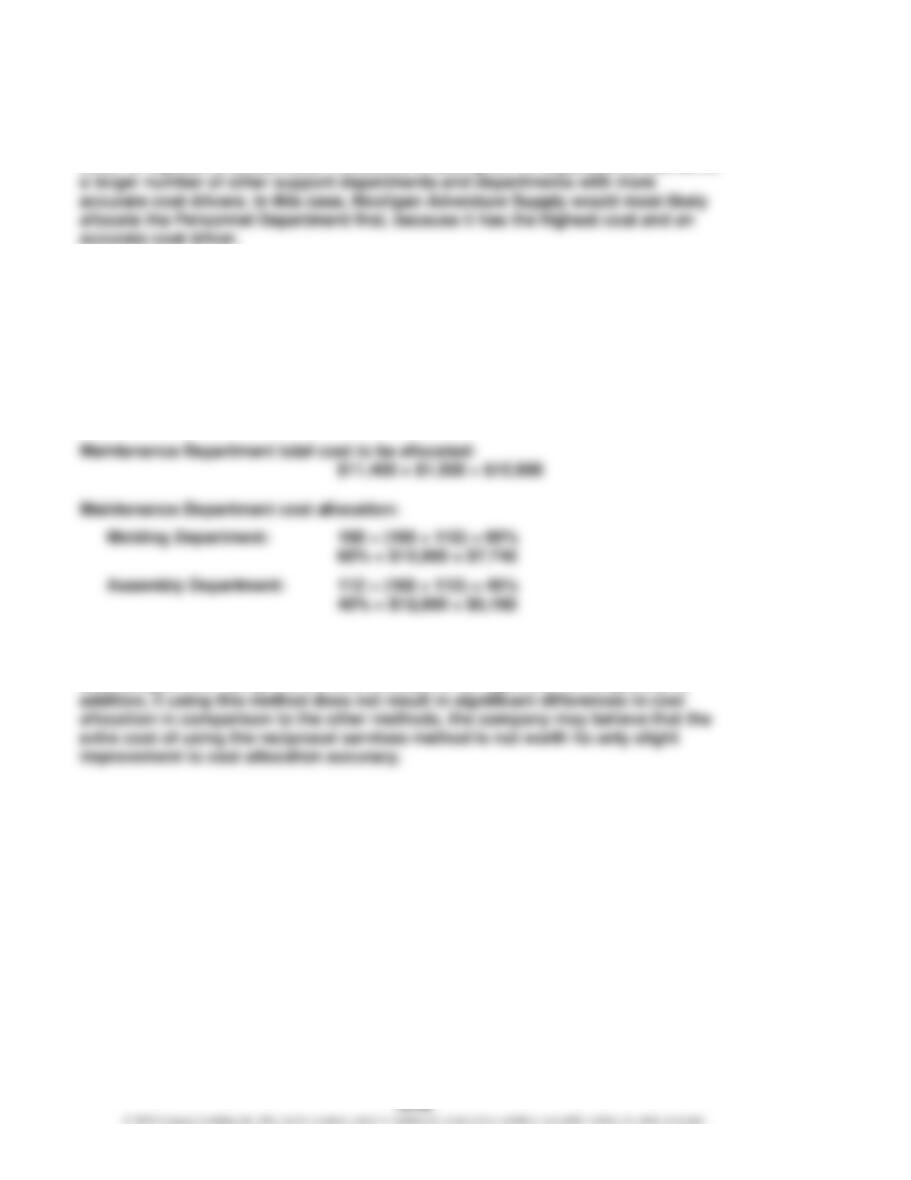
Lilies and daisies received the largest portion of the joint costs.
2.
Joint Product
Flowers per
Harvest
Weight
Factor
Weighted
Flowers
of Water
Weighted
Percent of Water
Joint Costs
Allocation
Tulip
10
2
20
20%
$30
$ 6
Lily
20
1
20
20%
30
3. As we saw from the answers to parts (1) and (2), using the weighted average method substantially changes the
allocation of the joint costs. Given this discrepancy, considering whether the amount of watering is an appropriate
weight factor is important, because using it to weight the allocation of joint costs to each product assigns a larger
CHAPTER 19 (FIN MAN); CHAPTER 5 (MAN) Support Department and Joint Cost Allocation
Prob. 19–1B (FIN MAN); Prob. 5–1B (MAN)
1. When using the sequential method, the support departments are often allocated in
2. Personnel Department cost allocation:
Maintenance Department:
10 ÷ (10 + 41 + 49) = 10%
10% × $15,000 = $1,500
Molding Department:
41 ÷ (10 + 41 + 49) = 41%
41% × $15,000 = $6,150
Assembly Department:
49 ÷ (10 + 41 + 49) = 49%
49% × $15,000 = $7,350
168 ÷ (168 + 112) = 60%
60% × $12,900 = $7,740
112 ÷ (168 + 112) = 40%
40% × $12,900 = $5,160
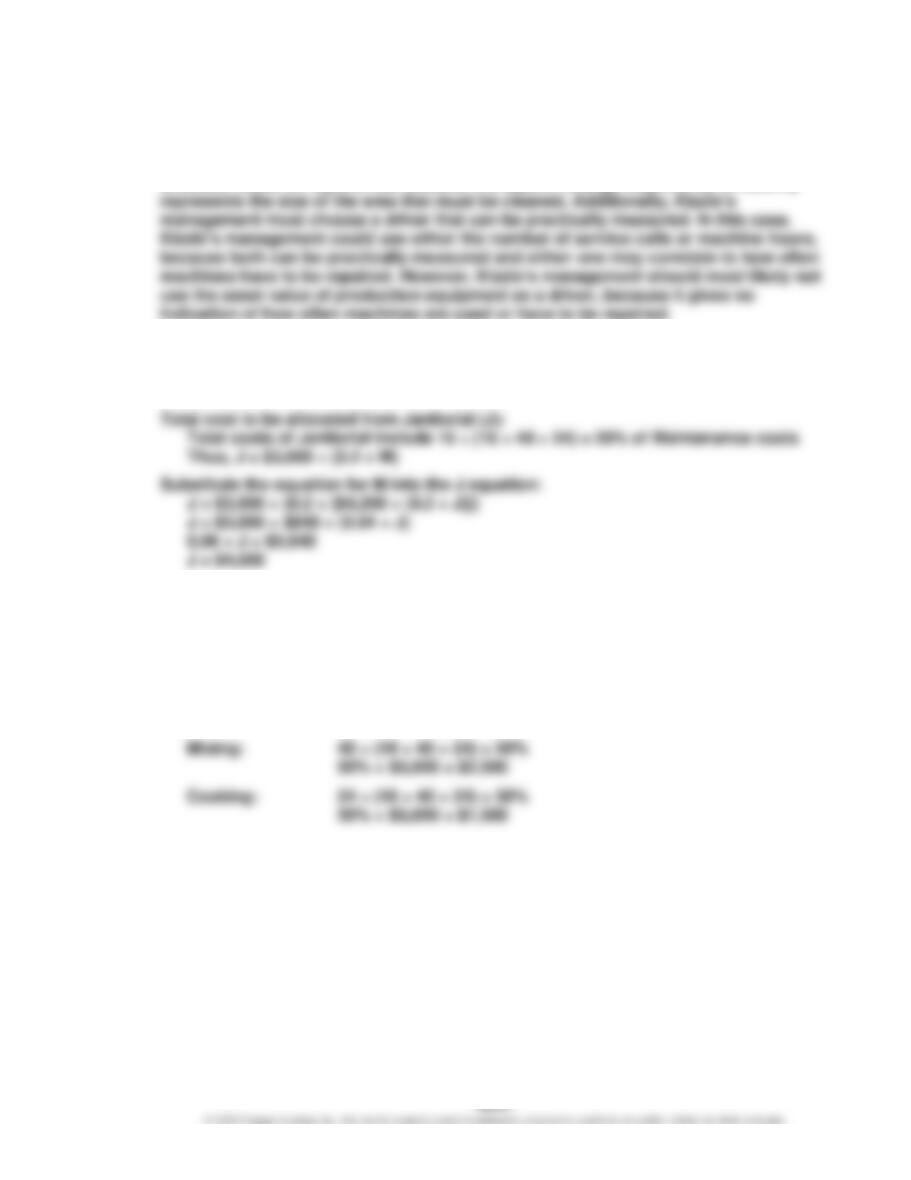
3. The reciprocal services method is the most accurate method of support
department cost allocation. However, Hooligan Adventure Supply may be
discouraged from using this method because of its high level of complexity. In
CHAPTER 19 (FIN MAN); CHAPTER 5 (MAN) Support Department and Joint Cost Allocation
Prob. 19–2B (FIN MAN); Prob. 5–2B (MAN)
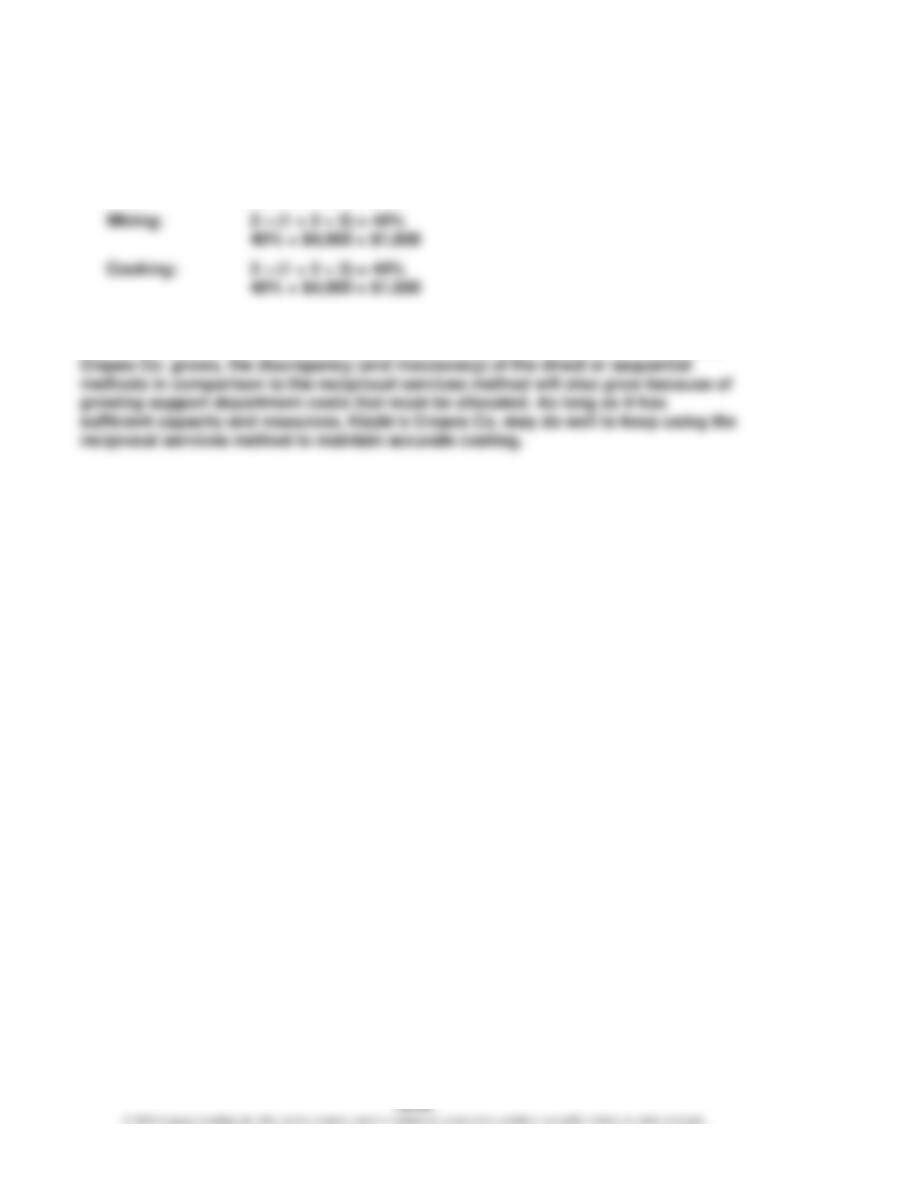
1. In choosing a cost driver, Kizzle’s management should consider how well the driver
represents the costs of the department. For example, Janitorial costs are often
2. Total cost to be allocated from Maintenance (M):
Total costs of Maintenance include 1 ÷ (1 + 2 + 2) = 20% of Janitorial costs
Thus, M = $4,200 + (0.2 × J)
Now plug the value for J into the M equation:
M = $4,200 + (0.2 × $4,000)
= $4,200 + $800
= $5,000
Maintenance cost allocation:
Janitorial:
16 ÷ (16 + 40 + 24) = 20%
20% × $5,000 = $1,000
50% × $5,000 = $2,500
Cooking:
24 ÷ (16 + 40 + 24) = 30%
30% × $5,000 = $1,500
CHAPTER 19 (FIN MAN); CHAPTER 5 (MAN) Support Department and Joint Cost Allocation
Prob. 19–2B (FIN MAN); Prob. 5–2B (MAN) (Concluded)
Janitorial cost allocation:
Maintenance:
1 ÷ (1 + 2 + 2) = 20%
20% × $4,000 = $800
40% × $4,000 = $1,600
Cooking:
2 ÷ (1 + 2 + 2) = 40%
40% × $4,000 = $1,600
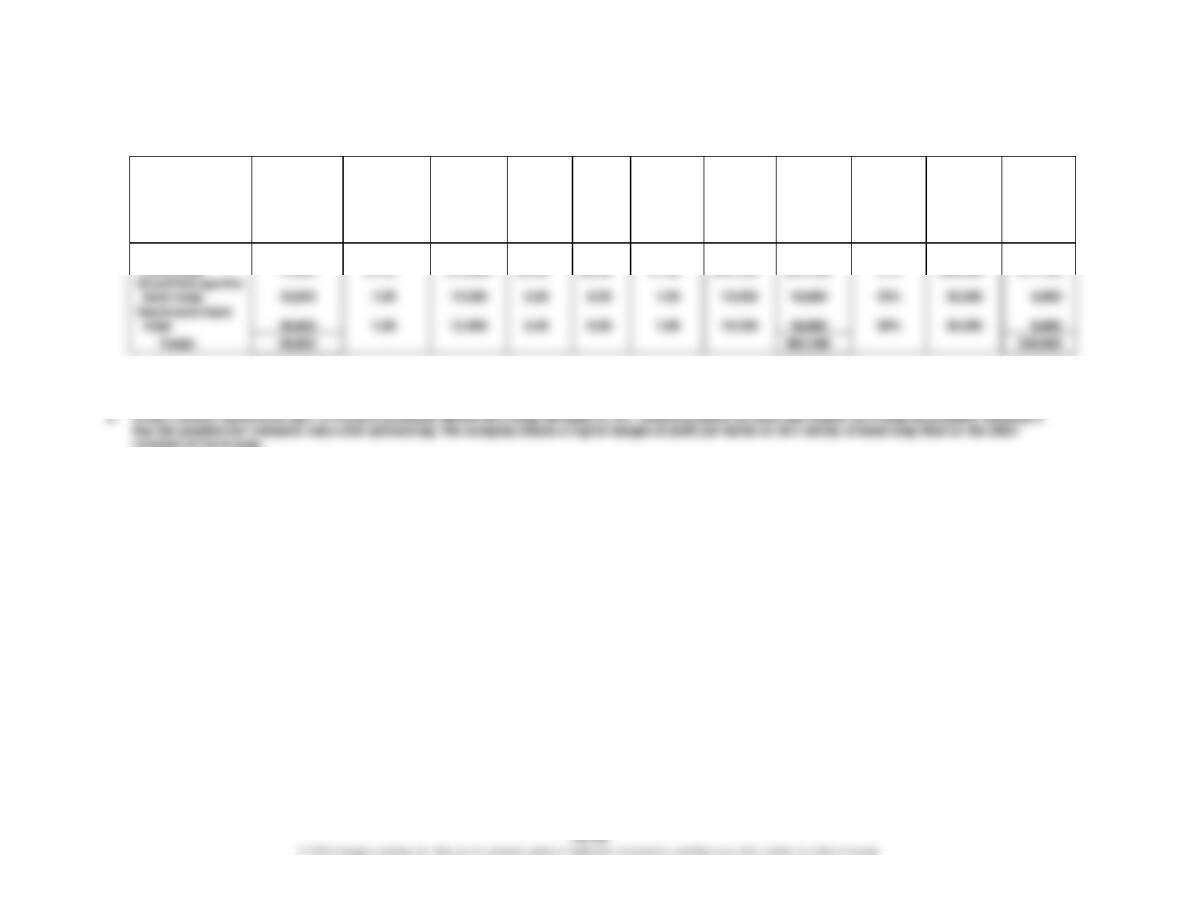
3. The reciprocal services method is the most difficult of the three support department
cost allocation methods. However, it is also the most accurate method. As Kizzle’s
CHAPTER 19 (FIN MAN); CHAPTER 5 (MAN) Support Department and Joint Cost Allocation
Prob. 19–3B (FIN MAN); Prob. 5–3B (MAN)
1.
Joint Product
Bottles
per Batch
Market Value
per Bottle
at Split-Off
Total
Market
Value at
Split-Off
Market
Price
per Bottle
Added
Cost per
Bottle
NRV
per Bottle
Total Net
Realizable
Value
Greater of
Total NRV
and Market
Value at
Split-Off
Proportion
Joint Costs
Allocation
Morning glory
$30,000
$11,100
Snowflake sparkle
Sea breeze hand
soap
12,500
0.60
18,000
30,000
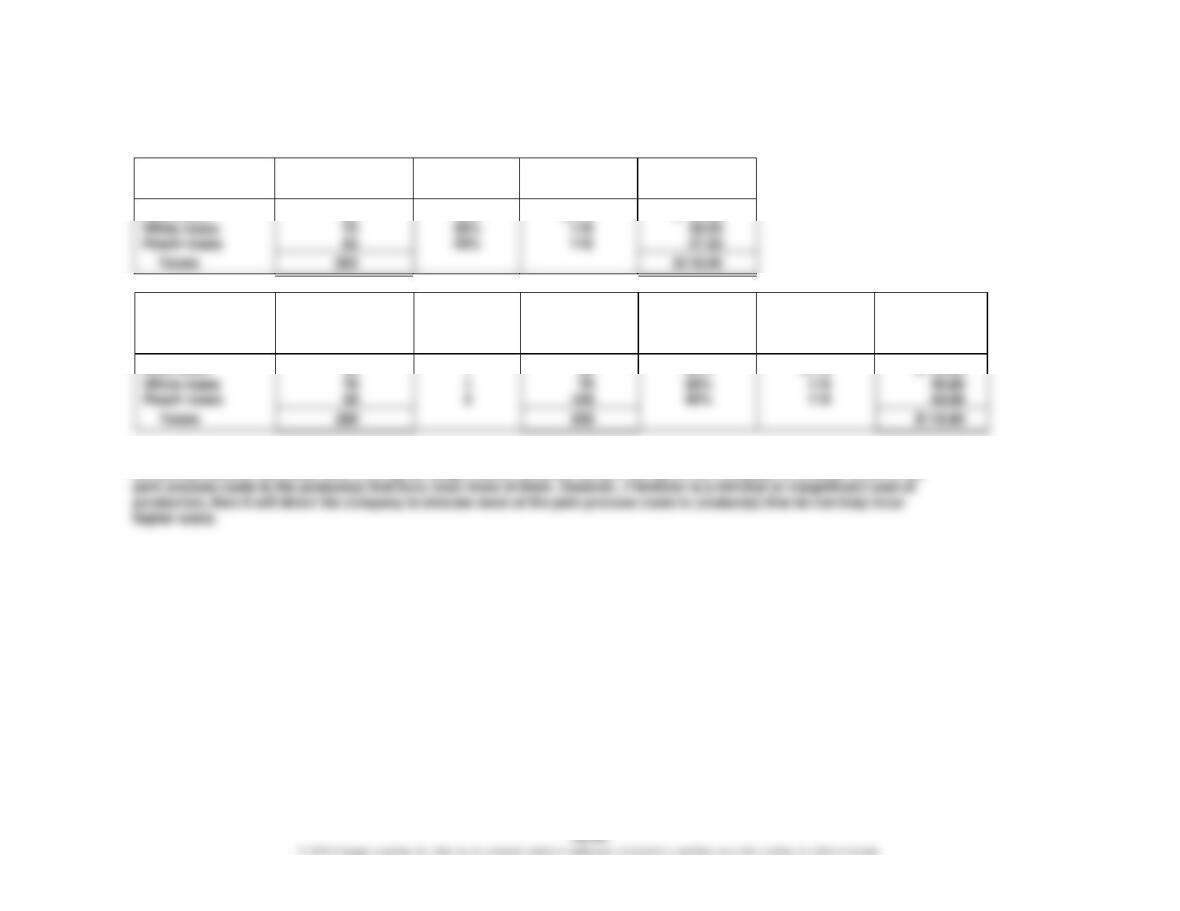
2. McKenzie’s Soap Sensations, Inc., always processes each variety of hand soap beyond the split-off point, because the net realizable value of each variety of hand
soap after further processing (beyond the split-off point) is higher than the market value of each variety of hand soap at the split-off point.
CHAPTER 19 (FIN MAN); CHAPTER 5 (MAN) Support Department and Joint Cost Allocation
Prob. 19–4B (FIN MAN); Prob. 5–4B (MAN)
1.
Joint Product
Roses per Harvest
Proportion
Joint Costs
Allocation
Red roses
80
40%
$110
$ 44.00
White roses
Peach roses
2.
Joint Product
Roses per Harvest
Weight
Factor
Weighted
Roses of
Fertilizer
Weighted
Percent of
Fertilizer
Joint Costs
Allocation
White roses
Peach roses
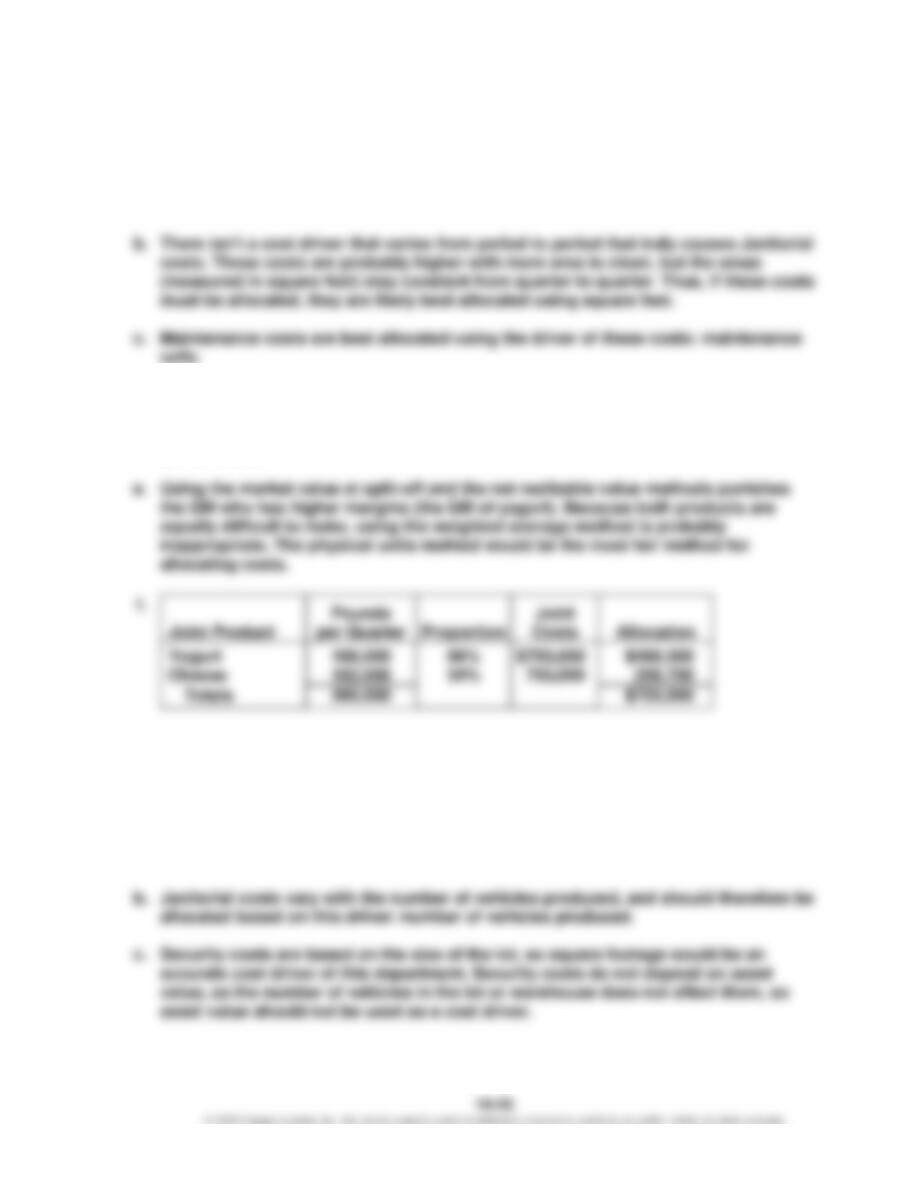
3. The cost of the type of fertilizer required by each type of rose may be a good weight factor. If fertilizer is a significant cost of
CHAPTER 19 (FIN MAN); CHAPTER 5 (MAN) Support Department and Joint Cost Allocation
MAKE A DECISION
MAD 19–1 (FIN MAN); MAD 5–1 (MAN)
a. Because company bonuses are based on cost allocations, an accurate cost
allocation is important. Thus, the reciprocal services method is advisable.
d. Maintenance costs are likely controllable by the GMs and should be allocated for
performance evaluation purposes. The GMs can’t control the square footage their
plant uses, so the Janitorial costs should likely be ignored when evaluating GM
performance.
MAD 19–2 (FIN MAN); MAD 5–2 (MAN)
a. Management has noted the need for highly accurate support department cost
allocation because cost management performance affects a portion of company
bonuses. In addition, management is not worried about using a highly complex
method. Thus, the reciprocal services method should be used because it is the
most accurate, and its complexity is not expected to pose a significant problem.
CHAPTER 19 (FIN MAN); CHAPTER 5 (MAN) Support Department and Joint Cost Allocation
MAD 19–2 (FIN MAN); MAD 5–2 (MAN) (Concluded)
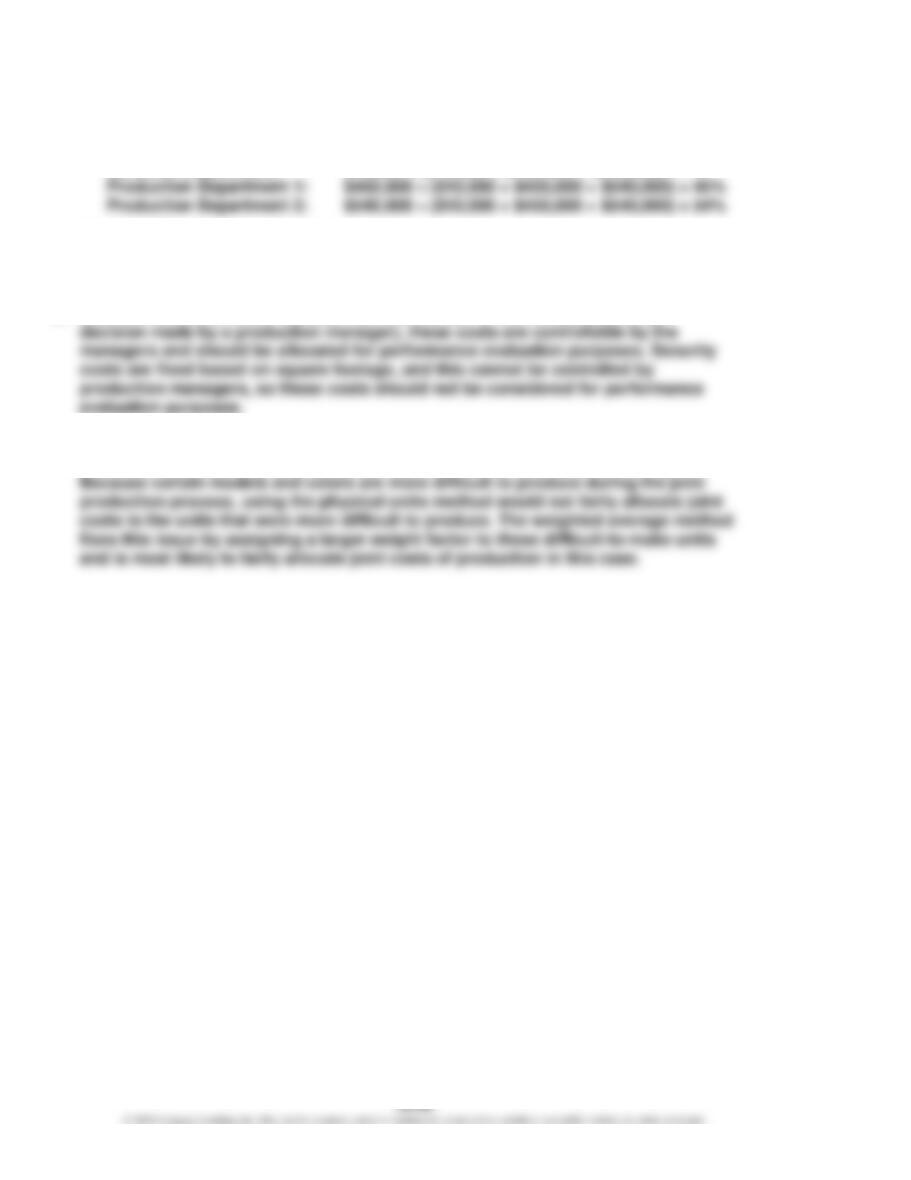
d. Security Department cost allocation:
Janitorial Department:
$10,000 ÷ ($10,000 + $450,000 + $540,000) = 1%
Production Department 1:
$450,000 ÷ ($10,000 + $450,000 + $540,000) = 45%
Production Department 2:
$540,000 ÷ ($10,000 + $450,000 + $540,000) = 54%
Janitorial Department cost allocation:
Production Department 1:
54,000 ÷ (54,000 + 36,000) = 60%
Production Department 2:
36,000 ÷ (54,000 + 36,000) = 40%
e. Because Janitorial costs increase with the number of vehicles produced (a
f. The market value at split-off and net present value methods may not fairly allocate
joint costs because all joint products are produced and sold at similar margins.
CHAPTER 19 (FIN MAN); CHAPTER 5 (MAN) Support Department and Joint Cost Allocation
MAD 19–3 (FIN MAN); MAD 5–3 (MAN)
Orange Julius Flavor
Market Value
per Cup at
Split-Off
Market
Price per
Cup After
Further
Processing
Added Cost
per Cup
Net Realizable
Value
per Cup
Greater of
NRV and
Market Value
at Split-Off
per Cup
Strawberry orange
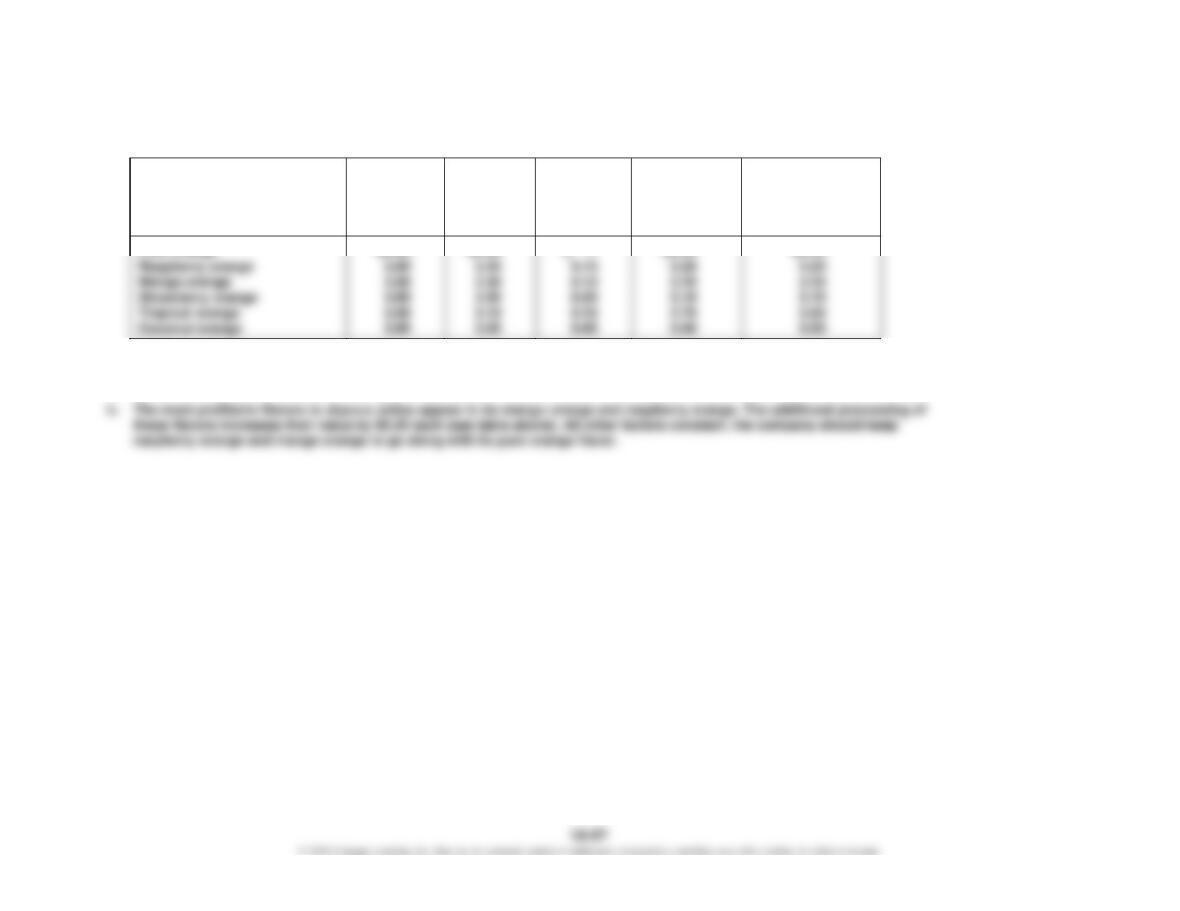
a. Yes. Joyous Julius, Inc., should discontinue processing its tropical orange and coconut orange flavors, because they are
worth more at the split-off point than after further processing (see table above).
CHAPTER 19 (FIN MAN); CHAPTER 5 (MAN) Support Department and Joint Cost Allocation
MAD 19–3 (FIN MAN); MAD 5–3 (MAN) (Concluded)
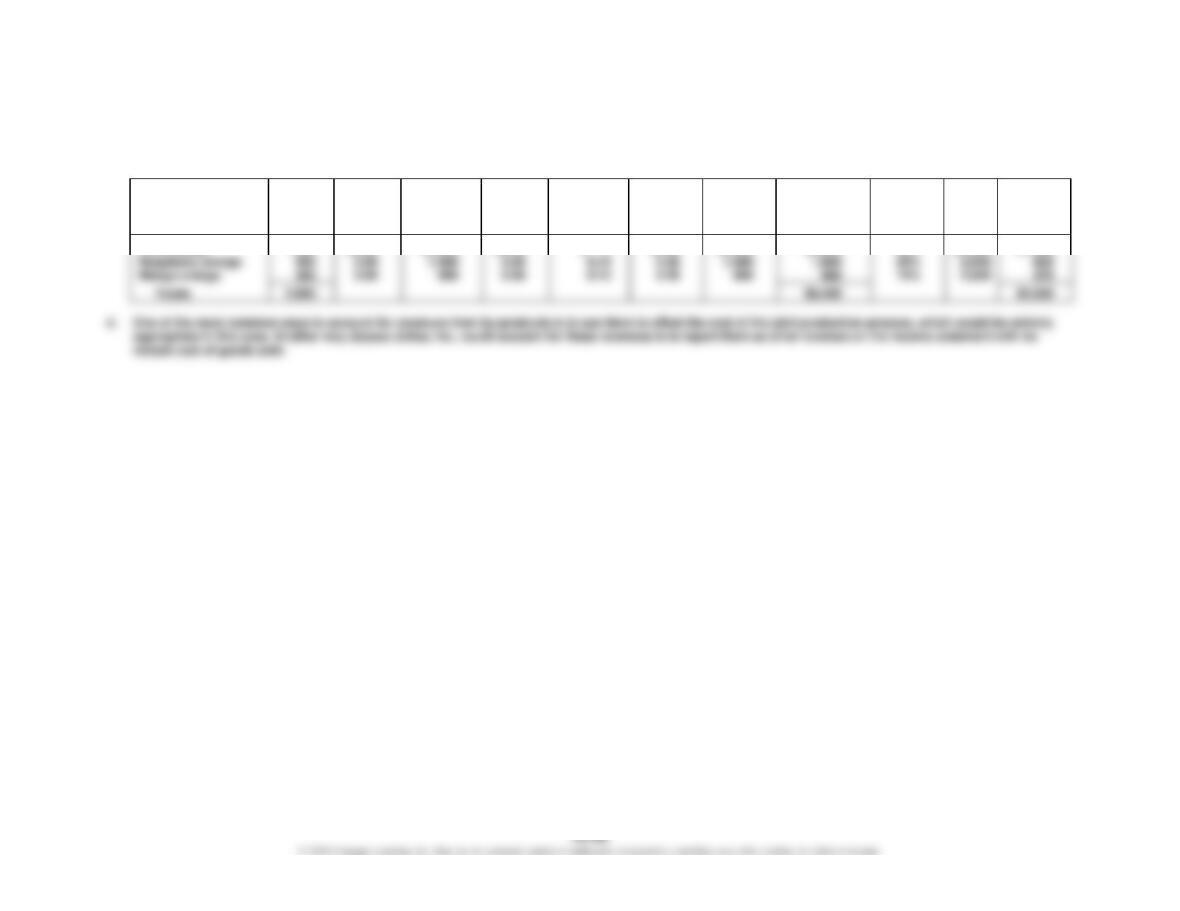
c. Pure orange: 900 + 150 + 130 + 100 = 1,280
Orange Julius Flavor
Cups per
Batch
Market
Value
per Cup at
Split-Off
Total Market
Value at
Split-Off
Market
Price
per Cup
Added Cost
per Cup
Net
Realizable
Value
per Cup
Total Net
Realizable
Value
Greater of
NRV or Market
Value at
Split-Off
Proportion
Joint
Costs
Allocation
Raspberry orange
2,500
Mango orange
2,500
CHAPTER 19 (FIN MAN); CHAPTER 5 (MAN) Support Department and Joint Cost Allocation
MAD 19–4 (FIN MAN); MAD 5–4 (MAN)
a. Management’s highest priority with regard to the cost allocation process is to keep
it simple and cost-effective. In addition, performance evaluations do not depend on
them, and William’s Ball & Jersey Shop is a small company, so the different support
department cost allocation methods are unlikely to yield significant cost allocation
differences. Thus, the direct method should be used, because it is the simplest and
c. William needs to know the market value of the toddler-size jersey at the split-off
point and the market price of the toddler-size jersey after further processing. In
addition, it would be helpful to know the current exact share of the joint production
costs that the toddler-size jersey will incur. Finally, any information about market
demand for the product and whether or not there may be risks of cannabilization
costs (sales of other products decreasing as a result of the new product line) should
also be considered.
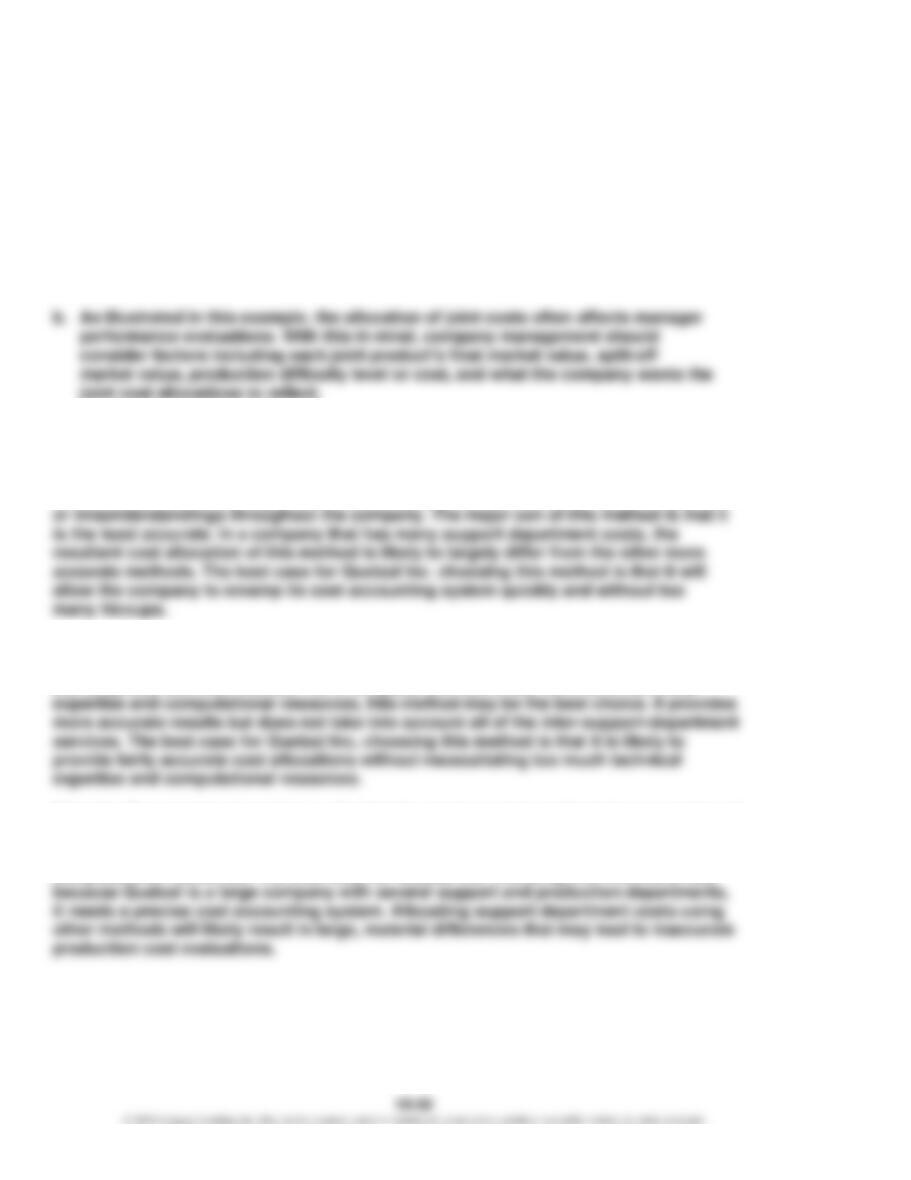
e. Support Department 1 cost allocation:
Production Department 1:
22 ÷ (22 + 18) = 55%
Production Department 2:
18 ÷ (22 + 18) = 45%
Production Department 1:
2,280 ÷ (2,280 + 1,720) = 57%
Production Department 2:
1,720 ÷ (2,280 + 1,720) = 43%
CHAPTER 19 (FIN MAN); CHAPTER 5 (MAN) Support Department and Joint Cost Allocation
TAKE IT FURTHER
TIF 19–1 (FIN MAN); TIF 5–1 (MAN)
a. The line manager exhibited motivated reasoning; that is, she ignored evidence
against her preference and overweighted evidence for her preference. She acted
out of her own self-interest rather than considering what the best decision would
be, given all the facts. Even though her motivated reasoning may not have been a
conscious decision, motivated reasoning can lead us to make unethical choices
without our feeling unethical about them.
joint cost allocations to reflect.
TIF 19–2 (FIN MAN); TIF 5–2 (MAN)
Liam: The direct method is simple and easy to use. It is easily implemented and
communicated, so choosing this method will likely result in few cost accounting errors
Rose: The sequential method is a compromise between practicality and accuracy. It is
more difficult to implement and use than the direct method, but it is not as complex as
Miranda: The reciprocal services method is the most accurate method. It accounts for all
inter-support-department services and provides the most precise support department
cost possible. The downside is that it requires a lot of technical expertise and

CHAPTER 19 (FIN MAN); CHAPTER 5 (MAN) Support Department and Joint Cost Allocation
TIF 19–3 (FIN MAN); TIF 5–3 (MAN)
The content of the memo should be similar to the following response:
I disagree with the Mackalite production manager’s argument. Although the two
products come from an inseparable process, Mackalite is more costly to make because
it requires more heat than Jemmerite in the joint production process. In other words, if
CHAPTER 19 (FIN MAN); CHAPTER 5 (MAN) Support Department and Joint Cost Allocation
CERTIFIED MANAGEMENT ACCOUNTANT (CMA®)
EXAMINATION QUESTIONS (ADAPTED)
1. b. Using the direct method of allocation, only the hours of the production departments
2.
a.
Total overhead in the Machining Department would be $407,500, determined
as follows:
Machining overhead
$200,000
Maintenance ($350,000 × 0.5)
Systems [($95,000 + $35,000*) × 0.25**]
$407,500
3. b. The units should be processed after the split-off point only if the additional cost
is less than the additional revenue. Only J-60 units warrant further processing.
B-40
J-60
H-102
Additional revenue
$2.25
$1.70
$2.50