
Chapter 05 – Accounting for General Capital Assets and Capital Projects
5-1
CHAPTER 5: ACCOUNTING FOR GENERAL CAPITAL ASSETS AND
CAPITAL PROJECTS
OUTLINE
Number
Topic
Type/Task
Status
(re: 18/e)
Questions:
5-1
Defining and reporting general capital assets
Define and explain
Same
5-2
Capital asset disclosures
Explain
Same
5-3
Capital asset valuation
Explain
Revised
5-4
Lease accounting
Describe
Revised
5-5
Intangible assets
Describe
Same
5-6
Modified approach for infrastructure assets
Compare
Same
5-7
Encumbrances
Explain
Same
5-8
Special assessments
Explain
Same
5-9
Residual or deficit capital projects fund balances
Explain
New
5-10
Service concession arrangements
Explain
Same
Cases:
5-11
Modified approach for infrastructure assets
Evaluate, write
Same
5-12
Construction costs spiraling out of control
Evaluate, write
New
5-13
Criteria for intangible asset recognition
Evaluate, explain
Same
5-14
Potential impairment of capital assets
Evaluate, explain
New
5-15
Service concession arrangements
Evaluate, explain
Same
Exercises/Problems:
5-16
Examine the CAFR
Examine
Same
5-17
Various
Multiple Choice
Items 8, 12,
14 and 15
are new; 1-2
revised
5-18
General capital assets
Journal entries
Revised
5-19
Capital asset disclosure schedule
Financial
statement
Same
5-20
Lease classification and accounting
Calculate; JEs
Revised
5-21
Asset impairment
JEs; reporting
Same
5-22
Capital projects fund
JEs
Same
5-23
Funding capital projects
JEs
New
5-24
Capital projects fund financial statements
FS; explain
Revised
5-25
Multi-project construction fund
JEs & FS
Revised
5-26
Capital project transactions
JEs & FS
New
Chapter 05 – Accounting for General Capital Assets and Capital Projects
5-2
CHAPTER 5: ACCOUNTING FOR GENERAL CAPITAL ASSETS AND
CAPITAL PROJECTS
Answers to Questions
5-1. General capital assets are those assets acquired with the resources of governmental
funds. The resources used by the governmental funds to acquire a general capital asset
are reported as an expenditure of the acquiring governmental fund in the fund financial
statements. General capital assets are reported as assets in the Governmental Activities
column of the government-wide financial statements at historical cost. Those capital
assets identified as depreciable are shown net of accumulated depreciation. (Donated
capital assets are recorded at acquisition value and depreciated, as appropriate.)
General Problem Information: Defining and reporting general capital assets
Learning Objective: 5-1
Topic: Accounting for General Capital Assets
5-2. Capital asset disclosures required by the GASB include descriptions of policies for
capitalizing assets and for estimating the useful lives of depreciable assets. In addition,
the disclosures should include: (1) beginning-of-year and end-of-year balances showing
accumulated depreciation separate from historical cost, (2) capital acquisitions during the
year, (3) sales or other dispositions during the year, (4) depreciation expense showing
amounts charged to each function in the statement of activities, and (5) disclosures
regarding collections of art or historical treasures.
Chapter 05 – Accounting for General Capital Assets and Capital Projects
5-3
Ch. 5, Answers, Question 5-2 (Cont’d)
General Problem Information: Capital asset disclosures
Learning Objective: 5-5
Topic: Required Disclosures about Capital Assets
5-3. In general, the valuation principles used in government and for-profit accounting are very
similar. Assets acquired should be valued at historical cost when possible, and the
definition of historical cost is basically the same for both. However, governments are
more likely to receive capital assets through donation. Capital assets donated to a
5-4. When an asset is acquired with lease financing, the governmental fund journal entry on
the date of inception will include a debit to Expenditures and a credit to Other Financing
Sources—Lease Agreements for the present value of all lease payments. The journal
entry at the government-wide level will include a debit to Leased Assets and a credit to
Lease Obligations Payable for the same amount. Leased Assets is an intangible asset
account that represents the government’s right to use the leased asset. Cash paid at the
inception of the lease is recorded with a credit.
General Problem Information: Lease accounting
Learning Objective: 5-4
Topic: General Capital Assets Acquired under Capital Lease Agreements
Chapter 05 – Accounting for General Capital Assets and Capital Projects
5-5. Under both GASB and FASB standards intangible assets are defined as assets that lack
physical substance. Intangible assets held by a government might include easements,
water, timber, mineral rights, patents, trademarks, and computer software. In addition,
under GASB Statement No. 87, leased assets represent the government’s right to use the
leased assets and are deemed intangible assets. The GASB considers intangible assets to
be a type of general capital asset; therefore, intangibles are reported under the capital
asset heading in the statement of net position. In contrast, under FASB standards
intangible assets are reported under the heading intangibles, appearing after the property,
plant, and equipment heading in the balance sheet. FASB standards do not consider
leased assets to be intangible assets.
General Problem Information: Intangible assets
Learning Objective: 5-1
5-6. Under the modified approach to accounting for infrastructure assets, adjusting entries,
recognizing depreciation expense, and accumulated depreciation are not required. Rather,
the government reports, as an expense, the costs of maintaining the infrastructure assets
at an established level or condition. By doing this, the book value of the infrastructure
asset remains unchanged (i.e., there is no accumulated depreciation). This is unlike the
depreciation method, whereby the book value of the infrastructure assets decreases each
time depreciation expense is recorded. Only certain infrastructure assets are eligible to
use the modified approach. Eligible assets are defined as those assets that are parts of
General Problem Information: Modified approach for infrastructure assets
Learning Objective: 5-2
Topic: Infrastructure Assets
Bloom’s Taxonomy: Understand
Accreditation Skills tag: AACSB: Communication, AICPA: FN Reporting
Level of Difficulty: Medium
5-5
5-7. To facilitate preparation of financial statements at the end of the fiscal year, all operating
accounts should be closed; however, since the project is still underway and contractual
commitments still exist to pay contractors when billed, it is essential that Encumbrances
be maintained. (If a government chooses to close encumbrance accounts at year-end, they
should be reestablished at the beginning of the next year in order to maintain budgetary
control over outstanding commitments.) Since encumbrances and encumbrances
outstanding are budgetary accounts, they will not be reported on the capital projects fund
balance sheet; however, the fund balances should be classified as restricted, committed or
assigned, as appropriate, with no reference to encumbrances.
General Problem Information: Encumbrances
Topic: Multi-Period and Multiple-Project Funds
Bloom’s Taxonomy: Understand
Accreditation Skills tag: AACSB: Communication, AICPA: FN Reporting
Level of Difficulty: Medium
5-8. A special assessment is a mandatory tax levy against specified properties to fund a
service or property improvement that will benefit the property owner. For example,
homeowners’ associations often collect special assessments from homeowners within the
community to repair roads, erect a fountain, or install streetlights within the subdivision.
Some of these improvements also benefit the general citizenry of the adjoining
community. Improvements under a special assessment are fully or primarily funded by
affected property owners, whereas general improvements for a local government are
funded by all taxpayers within the government. General capital assets financed wholly or
partially through collections of special assessments are recorded in the same manner as
any other general capital assets in the governmental activities category at the
government-wide level.
General Problem Information: Special Assessments
Learning Objective: 5-4
Chapter 05 – Accounting for General Capital Assets and Capital Projects
5-6
5-9. It is not uncommon for a capital project to end with a small residual or deficit fund
balance. If long-term debt has been incurred for the purposes of the capital projects fund,
the residual equity is ordinarily transferred to the fund that services the debt. If the
residual equity has come from grants or shared revenues restricted for capital acquisitions
or construction, legal advice may indicate that any residual equity must be returned to the
source(s) of the restricted grants or restricted shared revenues. If the deficit is a relatively
small amount, the legislative body of the government may be able to authorize transfers
from one or more other funds to cover the deficit in the capital projects fund. If the deficit
is relatively large, and/or if intended transfers are not feasible, the government may seek
additional grants or shared revenues from other governments to cover the deficit. If no
other alternative is available, the government would need to finance the deficit by issuing
debt in whatever form is legally possible and feasible under market conditions then
existing.
General Problem Information: Residual or Deficit Capital Projects Fund Balances
5-10. Under a service concession arrangement, a government transfers the rights and
obligations of a capital asset to another legally separate government or private sector
entity. This external entity, the operator, provides public services through the use of the
General Problem Information: Service concession arrangements
Learning Objective: 5-2
Topic: Service Concession Arrangements
Bloom’s Taxonomy: Understand
Chapter 05 – Accounting for General Capital Assets and Capital Projects
5-7
Solutions to Cases
5-11. a. Discuss with students various methods of obtaining financial statements to make
comparisons across entities. The Government Finance Officers Association (GFOA)
b. An important communication skill for students to master is the ability to convey
technical financial accounting information in an effective way so that decision makers
find the information useful for making informed decisions. You may wish to ask
students to show their memo or essay to a finance director of a city and get the
director’s opinion about whether the student has captured the fundamental issues
relating to infrastructure and communicated it in a professional and informative
manner.
General Problem Information: Modified approach for infrastructure assets
Learning Objective: 5-2
Topic: Infrastructure Assets
Bloom’s Taxonomy: Analyze
Level of Difficulty: Medium
5-12. a. Student responses will vary, but they are likely to question how the budget increased
by nearly $20 million, how the deficit will be covered, and if there will be a reduction
in other governmental operations. Some will wonder if it is possible for a city to
legally overspend to this extent. This provides a good opportunity to discuss state
and local laws governing these issues. The students may be interested in researching
b. The article that this case is based upon described some of the reasons that spending
eclipsed the budget – construction cost increases, especially in the Oregon area, and
design improvements. It also discussed efforts to curb costs, such as reduced
Chapter 05 – Accounting for General Capital Assets and Capital Projects
5-8
Ch. 5, Solutions, Case 5-12 (Cont’d)
General Problem Information: General capital asset funding
Learning Objective: 5-1
Learning Objective: 5-2
Topic: Capital Projects Funds
5-13. a. The GASB guidelines for the accounting treatment of intangible assets appear in
Codification Section 1400.138–153). To really understand this particular issue, one
needs to first understand the definition of an asset and then the characteristics that
describe an intangible asset.
The GASB provided the definition of an asset in Concepts Statement No. 4. An asset
is “a resource with present service capacity that the government presently controls.”
Two important terms in this definition are resource and present service capacity. A
resource is “an item that can be drawn on to provide services to the citizenry.” Present
service capacity is an asset’s “existing capability to enable the government to provide
services, which in turn enables the government to fulfill its mission.”
b. Given these definitions, does the government’s power to tax meet the definition of an
intangible asset? Consider the three characteristics of an intangible asset. First, the
power to tax has no physical substance. Second, the power to tax is non-financial in
nature. Finally, the power to tax does have a useful life that is greater than a single
accounting period. So, it looks like the power to tax has the three characteristics of an
intangible asset.
Chapter 05 – Accounting for General Capital Assets and Capital Projects
Ch. 5, Solutions, Case 5-13 (Cont’d)
c. When the power to tax is exercised, an asset with present service capacity is created –
taxes receivable.
General Problem Information: Intangible assets
Learning Objective: 5-1
Topic: Intangible assets
5-14. a. GASB Codification Section 1400.181 defines asset impairment as “a significant,
unexpected decline in the service utility of a capital asset” related to events not
considered “normal or ordinary.” Physical damage is a common indicator of
impairment, and the damage to Fairview’s city hall appears significant enough to
demonstrate impairment. If it is determined that an impairment has occurred, the
restorative approach to measuring the impairment appears to be appropriate, since
Items 1-3 and 5 appear to be reasonable costs related to the city hall damage.
Whether valid or not, lost productivity does not represent an outlay of resources and
is likely not covered by insurance; however, the cost of rent and moving are generally
recoverable. Thus, the costs related to the tornado damage total $ 917,000 ($447,000
+ 175,000 + 95,000 + 75,000 + 125,000). Insurance proceeds of $1,000,000 cover
the costs and result in an impairment gain of $83,000, which would be reported as an
extraordinary item on government-wide financial statements.
General Problem Information: Recording and reporting damaged capital assets
Learning Objective: 5-2
Topic: Asset Impairments and Insurance Recoveries
Bloom’s Taxonomy: Analyze
Accreditation Skills tag: AACSB: Knowledge Application, AICPA: FN Reporting
Level of Difficulty: Medium
Chapter 05 – Accounting for General Capital Assets and Capital Projects
5–10
5-15. a. Some relevant questions might include:
Are there any alternative uses for the parking operations that the town might like to
exercise in the next 20 years?
Who retains any risk associated with the parking operations?
Who will maintain the assets?
Does the economy appear to be turning around?
b. On a short-term basis, the proposal appears favorable. The town receives a cash
infusion that may help to alleviate current budget woes. Citizens will be relieved that
the town’s finances are stable, and they will likely not notice much difference in
parking operations. It is important to note, that selling or leasing assets to cover
current financial obligations, in and of itself, is not a solid public policy, hence the
town should not make a habit of this type of transaction unless it enhances efficiency.
c. It depends. In the case of the City of Chicago and the State of Arizona, bond rating
agencies downgraded bond ratings, because they viewed such arrangements as one-
time cash infusions to pay current operating expenses. If the proposal improves
efficiency in an area where a government has not been particularly successful, bond
ratings might be unaffected in the short-term but might improve in the longer-term.
General Problem Information: Service concession arrangements
Learning Objective: 5-2
Topic: Service Concession Arrangements
5–11
5-16. Each student will have a different annual report, so he or she will have different answers
to questions in this exercise. The various kinds of capital assets and capital projects, wide
variety of financing mechanisms, and different accounting policies used in and by
5-17. 1. d. 6. b. 11. a.
3. d. 8. d. 13. d.
5. c. 10. c. 15. d
General Problem Information: Various
Learning Objective: 5-1
Learning Objective: 5-2
Learning Objective: 5-3
Learning Objective: 5-4

Chapter 05 – Accounting for General Capital Assets and Capital Projects
5–12
5-18. CITY OF LOVELAND
Debits Credits
1. General Fund:
THERE WOULD BE NO ENTRY SINCE THERE IS NO FLOW OF FINANCIAL
RESOURCES.
Governmental Activities:
LAND 5,200,000
2. General Fund:
CASH 6,000
OTHER FINANCING SOURCES—PROCEEDS
OF SALE OF ASSETS 6,000
Governmental Activities:
CASH 6,000
ACCUMULATED DEPRECIATION 28,700
3. General Fund:
EXPENDITURES—GENERAL GOVERNMENT 30,000
OTHER FINANCING SOURCES—LEASE
AGREEMENTS 29,000
CASH 1,000

Chapter 05 – Accounting for General Capital Assets and Capital Projects
5–13
Ch. 5, Solutions, Exercise 5-18 (Cont’d)
Debits Credits
Governmental Activities:
LEASED ASSETS—MACHINERY AND EQUIPMENT 30,000
LEASE OBLIGATIONS PAYABLE 29,000
CASH 1,000
4. Capital Projects Fund:
EXPENDITURES—GENERAL GOVERNMENT 750,000
CASH 750,000
General Fund:
CASH 5,000
OTHER FINANCING SOURCES—INTERFUND
TRANSFERS IN 5,000
Governmental Activities:
BUILDING 9,720,000
CONSTRUCTION WORK IN PROGRESS 9,720,000
5. General Fund:
Chapter 05 – Accounting for General Capital Assets and Capital Projects
5–14
Ch. 5, Solutions, Exercise 5-18, part 5 (Cont’d)
Debits Credits
Governmental Activities:
6. General Fund:
THERE WOULD BE NO ENTRY SINCE THERE IS NO FLOW OF FINANCIAL
RESOURCES.
Governmental Activities:
EXPENSES—GENERAL GOVERNMENT 1,156,000
MACHINERY AND EQUIPMENT 1,156,000
General Problem Information: General Capital Assets
Learning Objective: 5-2
Learning Objective: 5-4
5-19. a. No, the note does not comply with GASB requirements. The following changes
would help bring the note into compliance.
2. Separate line disclosures should be provided for asset classes such as land,
buildings and equipment.
4. Leased assets should be amortized rather than depreciated, and the
amortization amount should be disclosed.
Chapter 05 – Accounting for General Capital Assets and Capital Projects
5–15
Ch. 5, Solutions, Exercise 5-19, a. (Cont’d)
5. Leased assets and their associated amortization amounts should be reported
separately from other capital assets.
b. Yes. Infrastructure is listed with “Total capital assets not being depreciated”;
therefore, the government must be using the modified approach to maintaining
infrastructure. If the modified approach was not being used the infrastructure
assets would need to be depreciated.
General Problem Information: Capital asset disclosure schedule
Learning Objective: 5-1
Learning Objective: 5-5
5-20. Debits Credits
a. Capital Projects Fund:
EXPENDITURES 12,000,000
Governmental Activities:
LEASE ASSETS—BUILDINGS 12,000,000
CASH 822,441
LEASE OBLIGATIONS PAYABLE 11,177,559
Chapter 05 – Accounting for General Capital Assets and Capital Projects
5–16
Ch. 5, Solutions, Exercise 5-20 (Cont’d)
c. It is not uncommon for government lease agreements to contain a “fiscal funding
clause,” or cancellation clause, which permits government lessees to terminate the
agreement on an annual basis if funds are not appropriated to make required lease
payments. GASBS 87 specifies that lease agreements containing such clauses should
be evaluated, but the clause should not impact the lease term unless it is reasonably
certain the clause will be exercised. Thus, in most cases, the accounting is not
impacted.
General Problem Information: Lease classification and accounting
Learning Objective: 5-2
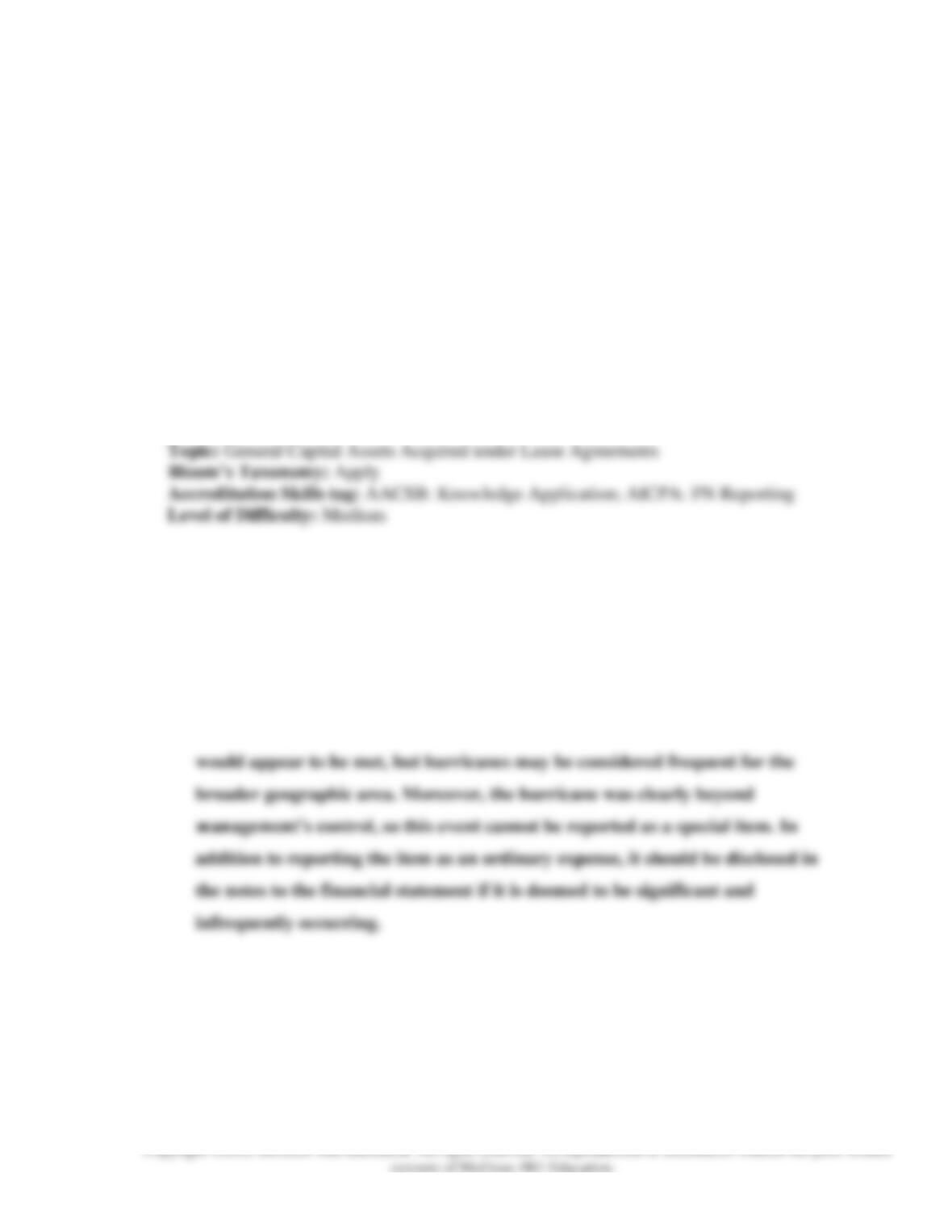
5-21. a. Because Sunshine City is located in an area that is susceptible to hurricanes, the
unusual criterion would not be met for the loss to be reported as extraordinary.
To be reported as a special item requires that the event be either unusual or
infrequent in occurrence (but not both) and be within management’s control.
Since this is the first hurricane to hit the city in 48 years, the infrequent criterion

Chapter 05 – Accounting for General Capital Assets and Capital Projects
5–17
Ch. 5, Solutions, Exercise 5–21 (Cont’d)
Debits Credits
b. Governmental Activities:
EXPENSES—CULTURE AND RECREATION 230,000
BUILDINGS 230,000
c. GASB requires that the $120,000 insurance recoveries be reported as program
General Problem Information: Asset Impairment
Learning Objective: 5-2
Topic: Asset Impairments and Insurance Recoveries
5-22. FULBRIGHT COUNTY
Debits Credits
1. Capital Projects Fund:
CASH 6,000,000
OTHER FINANCING SOURCES—PROCEEDS
OF BONDS 6,000,000
Governmental Activities:
2. Capital Projects Fund:
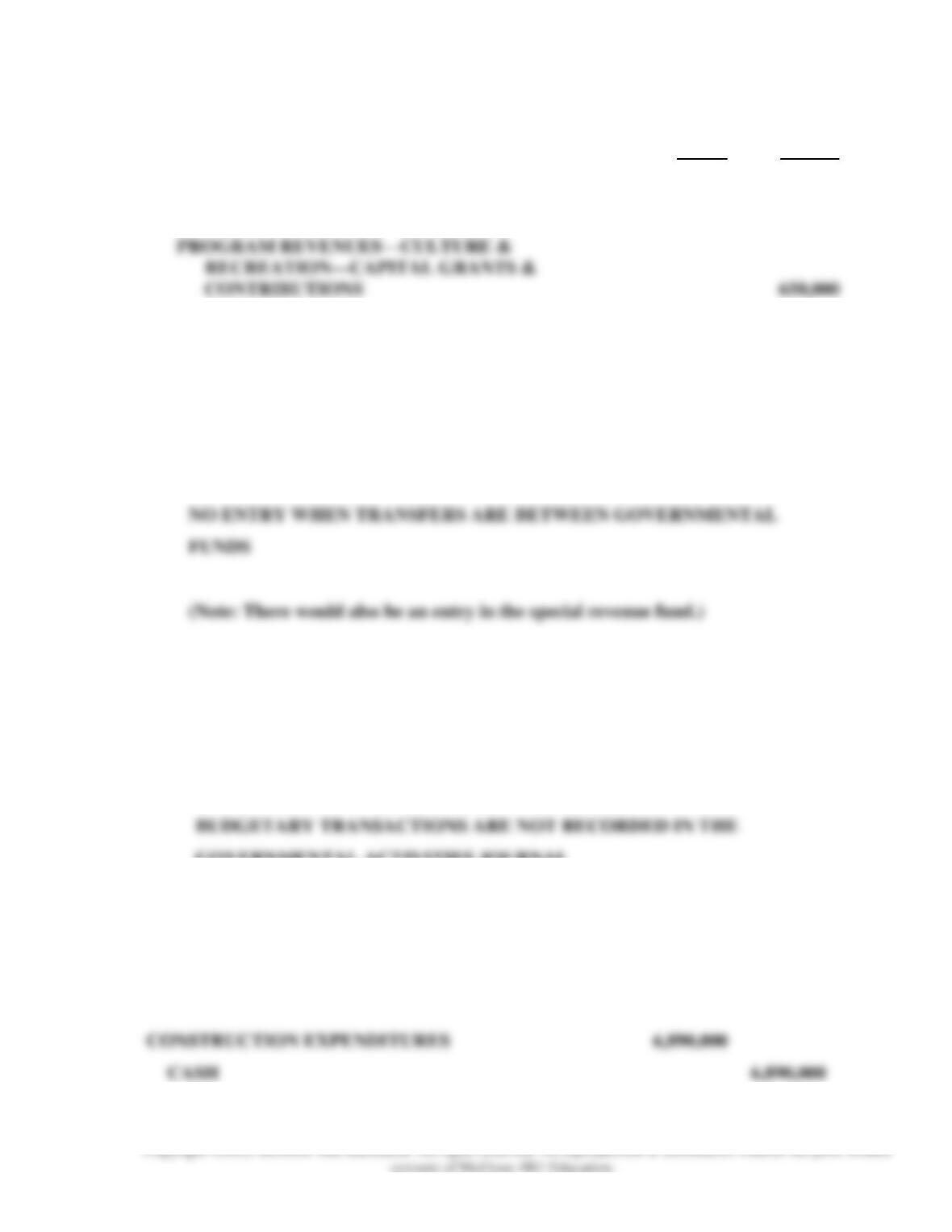
Chapter 05 – Accounting for General Capital Assets and Capital Projects
5–18
Chapter 5, Solutions, Exercise 5-22, part 2 (Cont’d)
Debits Credits
Governmental Activities:
CASH 650,000
3. Capital Projects Fund:
CASH 250,000
OTHER FINANCING SOURCES—INTERFUND
TRANSFERS IN 250,000
Governmental Activities:
4. Capital Projects Fund:
ENCUMBRANCES 6,800,000
ENCUMBRANCES OUTSTANDING 6,800,000
Governmental Activities:
GOVERNMENTAL ACTIVITIES JOURNAL
5. Capital Projects Fund:
ENCUMBRANCES OUTSTANDING 6,800,000
ENCUMBRANCES 6,800,000
Chapter 05 – Accounting for General Capital Assets and Capital Projects
5–19
Chapter 5, Solutions, Exercise 5-22, part 5 (Cont’d)
Debits Credits
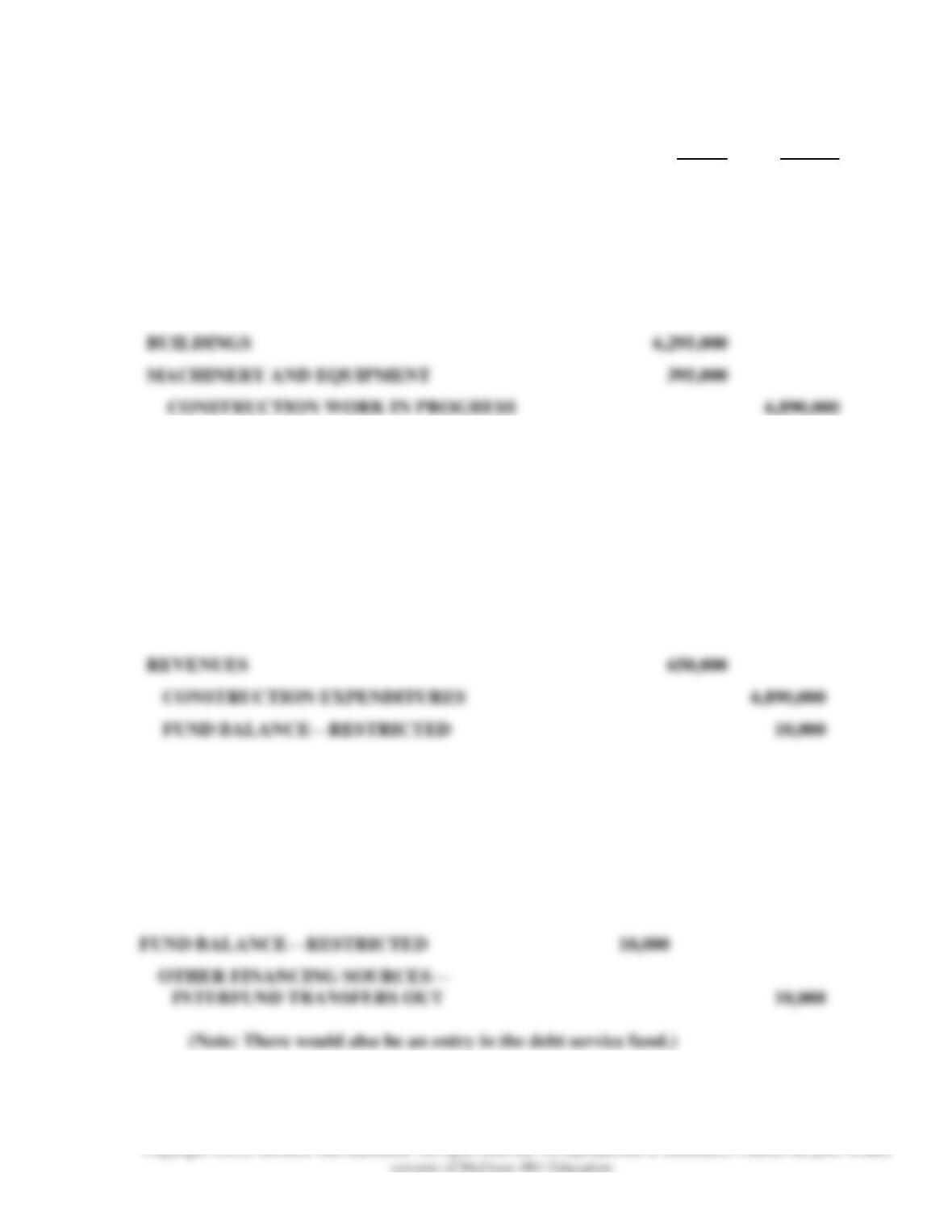
Governmental Activities:
CONSTRUCTION WORK IN PROGRESS 6,890,000
CASH 6,890,000
LAND 200,000
6. Capital Projects Fund:
To close nominal accounts:
OTHER FINANCING SOURCES—
PROCEEDS OF BONDS 6,000,000
OTHER FINANCING SOURCES—
INTERFUND TRANSFERS IN 250,000
To close the fund:
OTHER FINANCING SOURCES—
INTERFUND TRANSFERS OUT 10,000
CASH 10,000
Governmental Activities:
NO ENTRY SINCE THE CLOSING ONLY RELATES TO THE FUND