1. For plantwide rates, overhead is first collected in a plantwide pool, using direct tracing. Next, an
overhead rate is computed and used to assign overhead to products.
4. Product diversity is present whenever products have different consumption ratios for different
overhead activities.
5. An overhead consumption ratio measures the proportion of an overhead activity consumed by
a product.
6. Activity-based product costing is an overhead costing approach that first assigns costs to
activities and then to cost objects. The assignment is made possible through the identification of
activities, their costs, and the use of cost drivers.
7. An activity dictionary is a list of activities accompanied by information that describes each
10. Activit
y
-based su
pp
lier costin
g
traces all su
pp
lier-caused activit
y
costs to su
pp
liers. Often, man
y
costs are overlooked b
y
traditional costin
g
. B
y
assi
g
nin
g
all costs that are caused b
y
su
pp
liers,
a com
p
an
y
ma
y
find that its low-cost su
pp
lier does not corres
p
ond to the one that has the
lowest
p
urchase
p
rice.
11. Driver analysis is concerned with identifying the root causes of activity costs. Knowing the root
causes of activity costs is the key to improvement and innovation. Once a manager understands
why costs are being incurred, efforts can be taken to improve cost efficiency.
ACTIVITY-BASED COSTING
AND MANAGEMENT
5
DISCUSSION QUESTIONS
CHAPTER 5 Activity-Based Costing and Management
13. Nonvalue-added activities are unnecessary activities or activities that are necessary but inefficient
and improvable. An example is moving goods. Nonvalue-added costs are those costs caused by
nonvalue-added activities. An example is the cost of materials handling.
15. Cycle time is the length of time required to produce one unit of product; velocity is the number of
units that can be produced in a given period of time.
5-1. a
5-2. d
5-7. e
5-8. c $40,000 × 0.25 = $10,000
5-9. d $80,000/40,000 moves = $2
p
er move
5-13. d
5-14. a
5-15. e
5-16. e
MULTIPLE-CHOICE QUESTIONS
CHAPTER 5 Activity-Based Costing and Management
BE 5-21
1. Activit
y
Drive
r
Cutting hours 0.43 0.57
Assembly hours 0.38 0.62
Inspection hours 0.28 0.72
2. There is evidence of product diversity, but it is not strong. The consumption ratios
vary from 0.25 to 0.43, revealing that the vaquero boots vary in their consumption
of the activities. However, the range is narrow and so the diversity is not great.
BE 5-22
Cutting: $225,600/9,400 = $24 per Cutting hou
r
Assembling: $300,000/7,500 = $40 per Assembling hou
r
r
BE 5-23
Processing transactions:
$0.20 × 12,000……………..………………
$0.20 × 7,200……………..………………
…
Preparing statements:
$0.95 × 12,000……………..………………
$0.95 × 7,200……………..………………
…
BRIEF EXERCISES: SET A
Vaquero Vaquera
Classic Gold
Activity
11,400
$ 2,400
$ 1,440
6,840
a
b
c
a
b
c
CHAPTER 5 Activity-Based Costing and Management
BE 5-24
BE 5-25
Order Filling Rate = ($1,455,127 + $970,085)/3,636 orders = $667 per order
Selling Call Rate = ($719,820 + $479,880)/900 orders = $1,333 per sales call
Large Smalle
r
Cost assignment: Retailer Retailers
Ordering
$667 × 36……………………….…………
…
$24,012
$667 × 3,600……………………….……… $2,401,200
Cost Assignment
Activity
CHAPTER 5 Activity-Based Costing and Management
BE 5-26
Test Rate = $1,200,000/2,000* failed tests
= $600 per failed test
Reorder Rate = $300,000/100** reorders
= $3,000 per reorder
125X 30Y 125X 30Y
Purchase cost:
$10 × 120,000…………… $1,200,000
$26 × 60,000……………
…
$1,560,000
$12 × 15,000……………
…
$180,000
$28 × 15,000……………
…
$420,000
…
Reorderin
g
components:
$3,000 × 60………………
…
180,000
$3,000 × 40………………
…
120,000
$3,000 × 0………………
…
0
$3,000 × 0………………
…
0
BE 5-27
Retesting: Nonvalue-Added Cost = $720,000. Retesting is a nonvalue-added activity,
BE 5-28
V
elocity = 144,000 units/36,000 hours = 4 units per hou
r
Cycle Time = 36,000 hours/144,000 units = 0.25 hour (15 minutes)
Notice that cycle time is the inverse of velocity.
A
lpha Electronics La Paz Compan
y
CHAPTER 5 Activity-Based Costing and Management
BE 5-29
1. Activity Driver Casual Formal
Cutting hours 0.40 0.60
Sewinghours 0.30 0.70
Inspection hours 0.33 0.67
Rework hours 0.40 0.60
2. There is evidence of product diversity, but it is not strong. The consumption ratios
vary from 0.30 to 0.40, revealing that the casual shirts vary in their consumption
of the activities. However, the range is narrow and so the diversity is not great.
BE 5-30
BE 5-31
Processing transactions:
$0.20 × 20,000……………..……………
…
$0.20 × 12,000……………..……………
…
Preparing statements:
$0.85 × 20,000……………..……………
…
…
$2.00 × 40,000……………..……………
…
…
$1.80 × 80,000……………..……………
…
$1.80 × 24,000……………..……………
…
Total cost…………………………………………
…
Unit cost……………………………………………
…
BRIEF EXERCISES: SET B
Activity Silve
r
Premium
$ 4,000
$ 2,400
17,000
80,000
144,000
43,200
$245,000 $175,800
12,500 50,000
$ 19.60 $ 3.52
÷÷
a
b
c
d
a
b
c
d
CHAPTER 5 Activity-Based Costing and Management
BE 5-32
Activity
Unloading goods 0.25 × $440,000 = $110,000
BE 5-33
Order Filling Rate = ($646,400 + $161,600)/1,520 orders = $532 per order
Selling Call Rate = ($320,000 + $80,000)/824 orders = $485 per sales call
Large Smalle
r
Cost assignment: Retailer Retailers
Ordering
$532 × 20……………………….……………… $10,640
$532 × 1,500……………………….…………
…
$ 798,000
Cost Assignment
CHAPTER 5 Activity-Based Costing and Management
BE 5-34
Test Rate = $4,500,000/7,500* failed tests
= $600 per failed test
Using these rates and the activity data, the total purchasing cost per unit of each
component is computed as follows:
#625 #827 #625 #827
Purchase cost:
$30 × 450,000…………
…
$13,500,000
$78 × 225,000…………
…
$17,550,000
$36 × 56,250……………
…
$2,025,000
…
…
…
Reordering components:
$3,000 × 225……………
…
675,000
$3,000 × 150……………
…
450,000
$3,000 × 0………………
…
0
…
BE 5-35
Reworking: Nonvalue-Added Cost = $740,000. Reworking is a nonvalue-added
activity, and its value-added standard is therefore 0. All cost is waste.
Purchasing: $900,000/45,000 purchasing hours = $20 per purchasing hour
Nonvalue-Added Cost = (AQ – SQ)$20 = (45,000 – 24,000) × $20 = $420,000
BE 5-36
Otavalo Manufacturing Piura Company
CHAPTER 5 Activity-Based Costing and Management
E 5-37
1.
Inspection hours………………………
…
0.60 0.40
Setup hours……………………………
…
0.70 0.30
Machine hours…………………………
…
0.25 0.75
Number of moves……………………
…
0.80 0.20
2. The consumption ratios vary significantly from driver to driver, ranging from 0.25 to
0.80 for Scented and 0.20 to 0.75 for the Regular cards. Thus, there seems to be
significant product diversity. If machine hours are used as the only driver, Scented
3. Rates:
Inspecting products:
$45,000/1,800 inspection hours = $25 per inspection hou
r
Setting up equipment:
$28,500/600 setup hours = $47.50 per setup hou
r
Cost
Hours
Cost
Rate
Scented Cards Regular Cards
EXERCISES
Rate =
Inspection Hours = = $45,000/$20 = 2,250 inspection hours
4.
a
b
c
d
a
b
c
d
CHAPTER 5 Activity-Based Costing and Management
E 5-38
1. Molding Activity Overhead Cost = $675,000 × 0.80 = $540,000
=$540,000/3,000,000 pounds
=$0.18 per pound molded
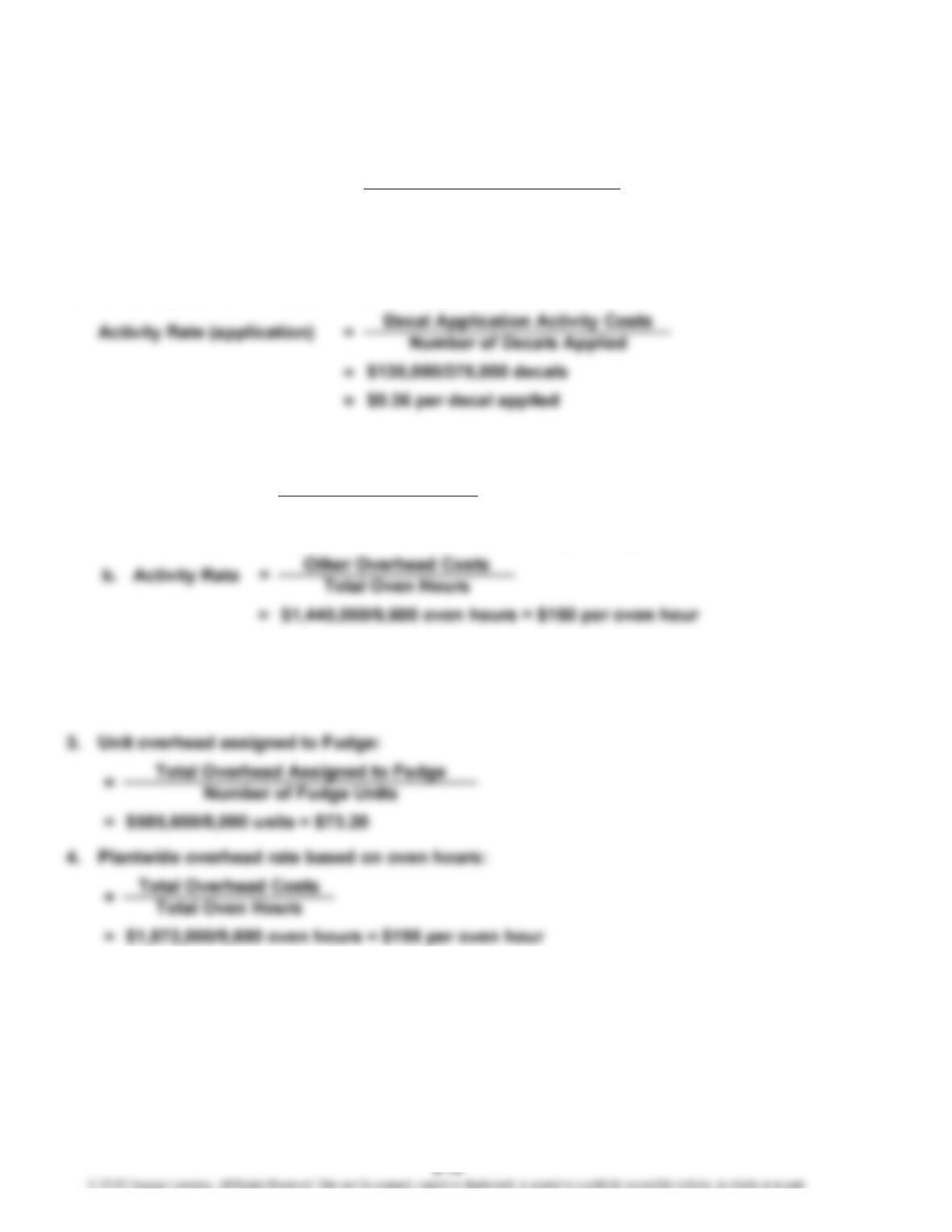
2. Decal Application Overhead Cost = $675,000 × 0.20 = $135,000
E 5-39
=$432,000/8,000 setup hours = $54 per setup hour
2. Total overhead costs assigned to Fudge (ABC rates):
= (Setup Rate × Fudge Setup Hours) + (Oven Hour Rate × Fudge Oven Hours)
= ($54 × 6,400) + ($150 × 1,600) = $585,600
5. Total overhead costs assigned to Fudge (plantwide rate):
= Plantwide Rate × Number of Oven Hours Used by Fudge
= $195 × 1,600 = $312,000
1.
=Activity Rate
Total Setup Hours
a.
Molding Activity Costs
Pounds of Plastic Molded
Setup Costs
=Activity Rate (molding)
CHAPTER 5 Activity-Based Costing and Management
E 5-39
(
Concluded
)
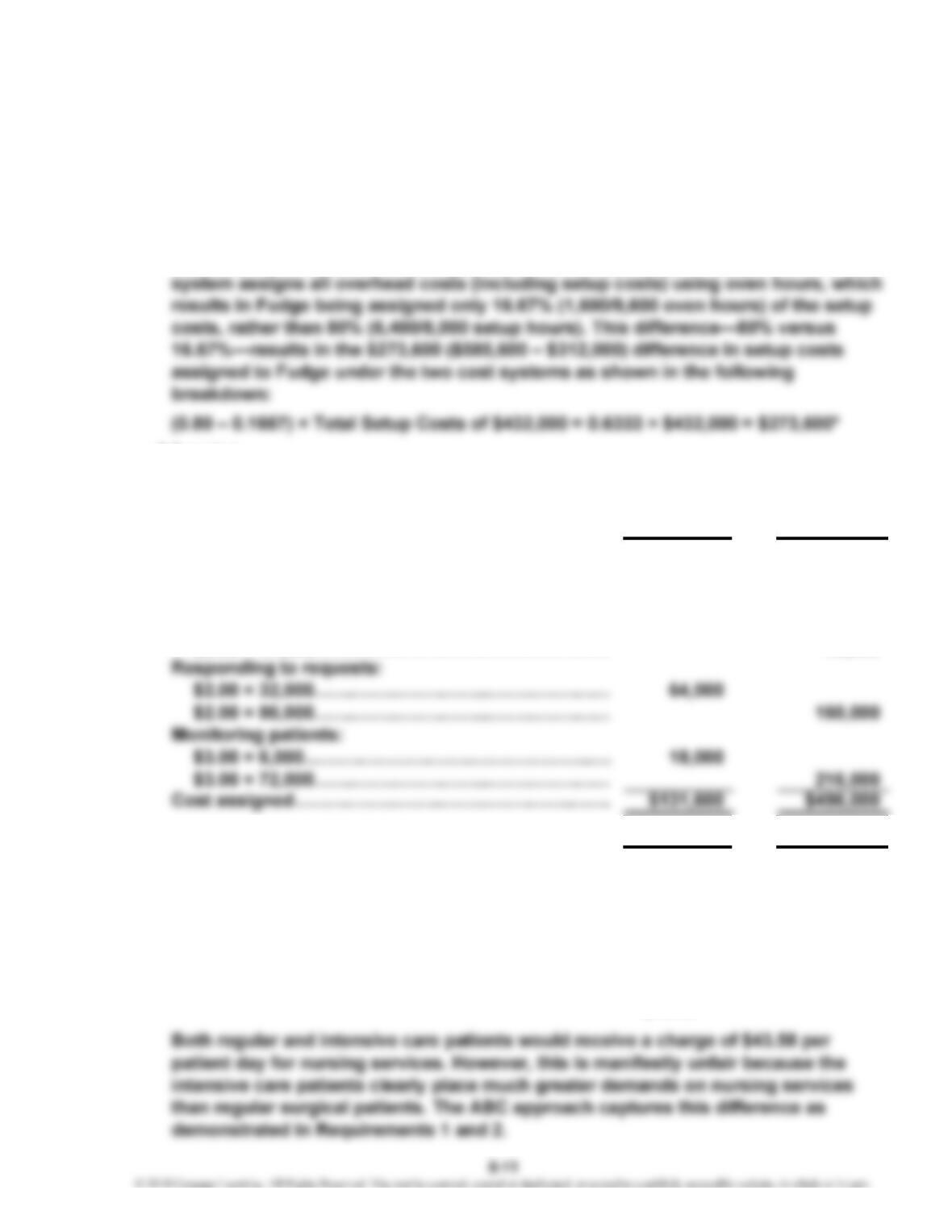
6. The difference in overhead assi
g
nment to Fud
g
e between the two s
y
stems is due to
their different treatment of setup costs
(
i.e., both s
y
stems use oven hours to assi
g
n
“other overhead” costs
)
. The total overhead assi
g
ned to Fud
g
e under the ABC
s
y
stem is much hi
g
her
(
$585,600
)
than under the nonABC s
y
stem
(
$312,000
)
because the ABC system recognizes that Fudge consumes 80% of the setup hour
s
(6,400/8,000) and, therefore, assigns 80% of the setup costs to Fudge. The nonABC
*Rounded
E 5-40
1. Treating patients: Normal Intensive
$4.00 × 6,400………………………..……………….…
…
$ 25,600
$4.00 × 8,000………………………..……………….…
…
$ 32,000
Providing hygienic care:
$5.00 × 4,800………………………..……………….…
…
24,000
$5.00 × 17,600………………………..……………….
…
88,000
…
…
…
…
2. Nursing cost per patient day: Normal Intensive
$131,600/8,000 patient days…………………………
…
$16.45
$496,000/6,400 patient days…………………………
…
$77.50
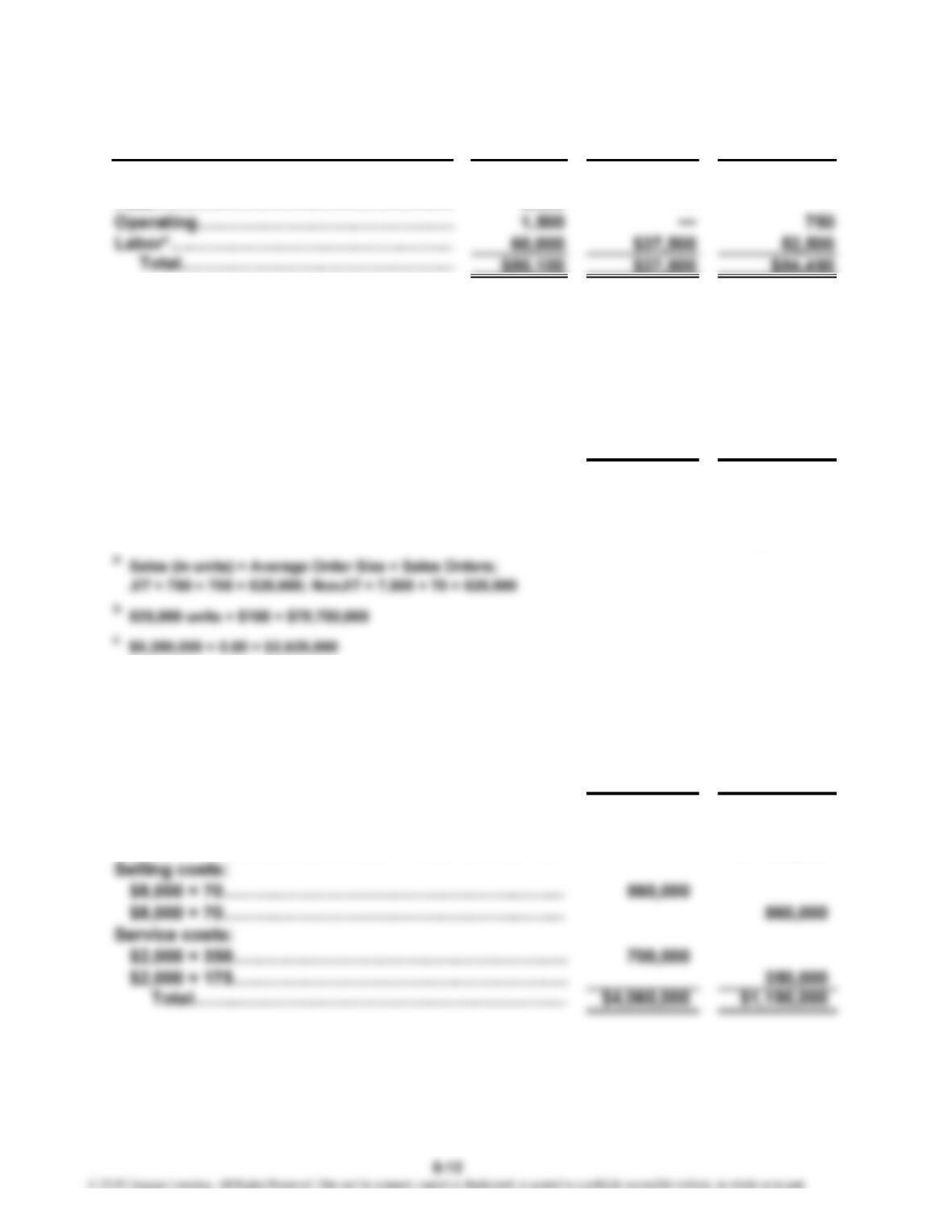
3. From Requirement 1, Total Nursing Cost = $131,600 + $496,000
= $627,600
Thus, using patient days (8,000 + 6,400):
Nursing Cost per Patient Da
y
= $627,600/14,400
= $43.58
CHAPTER 5 Activity-Based Costing and Management
E 5-41
1. Resource Unloading Counting Inspecting
Equipment……………………………………
…
$15,000 —$ 1,200
*(0.40 × $150,000; 0.25 × $150,000; 0.35 × $150,000)
2. Direct tracing and driver tracing are used. When the resource is used only by one
activity, then direct tracing is possible. When the activities are shared, as in the
case of labor, then resource drivers must be used.
E 5-42
1. JIT NonJIT
Sales (in units)
a
………………………………………………
…
525,000 525,000
Sales
b
…………………………………………………………
…
$78,750,000
Allocation
c
……………………………………………………
…
$2,625,000 $2,625,000
2. Activity rates:
Ordering Rate = $3,080,000/770 sales orders = $4,000 per sales order
Selling Rate = $1,120,000/140 sales calls = $8,000 per sales call
Service Rate = $1,050,000/525 sales calls = $2,000 per sales call
JIT NonJIT
Ordering costs:
$4,000 × 700……….…………….………………………….
…
$2,800,000
$4,000 × 70……….…………….………………………….
…
$ 280,000
…
…
…
…
$78,750,000
E 5-42
(
Concluded
)
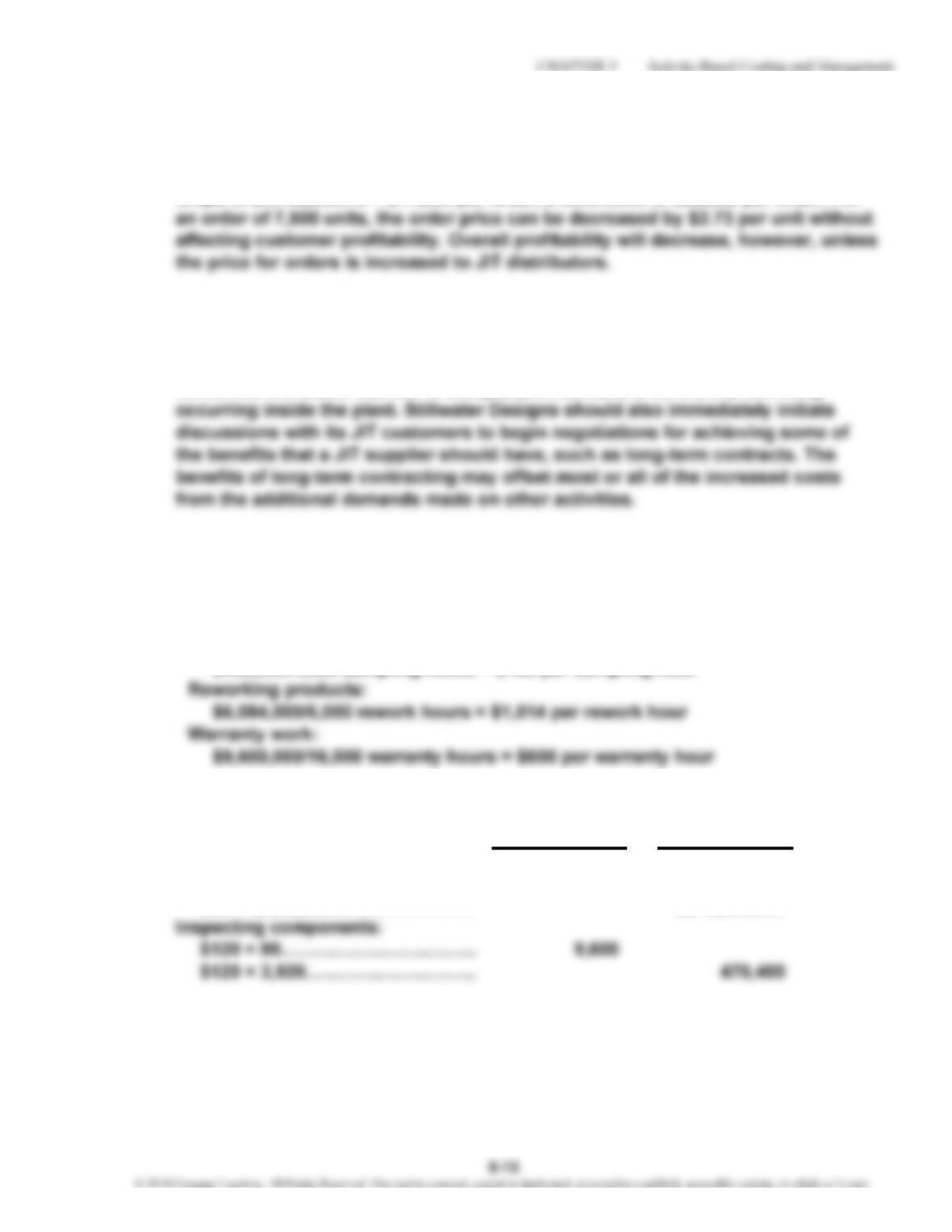
For the nonJIT distributors, the customer costs amount to $2,625,000/70 =
$37,500 per order under the ori
g
inal allocation. Usin
g
activit
y
assi
g
nments, this
3. It sounds like the JIT buyers are switching their inventory carrying costs to
Stillwater Designs without any significant benefit to Stillwater Designs. Stillwater
Designs needs to increase prices to reflect the additional demands on customer-
support activities. Furthermore, additional price increases may be needed to
E 5-43
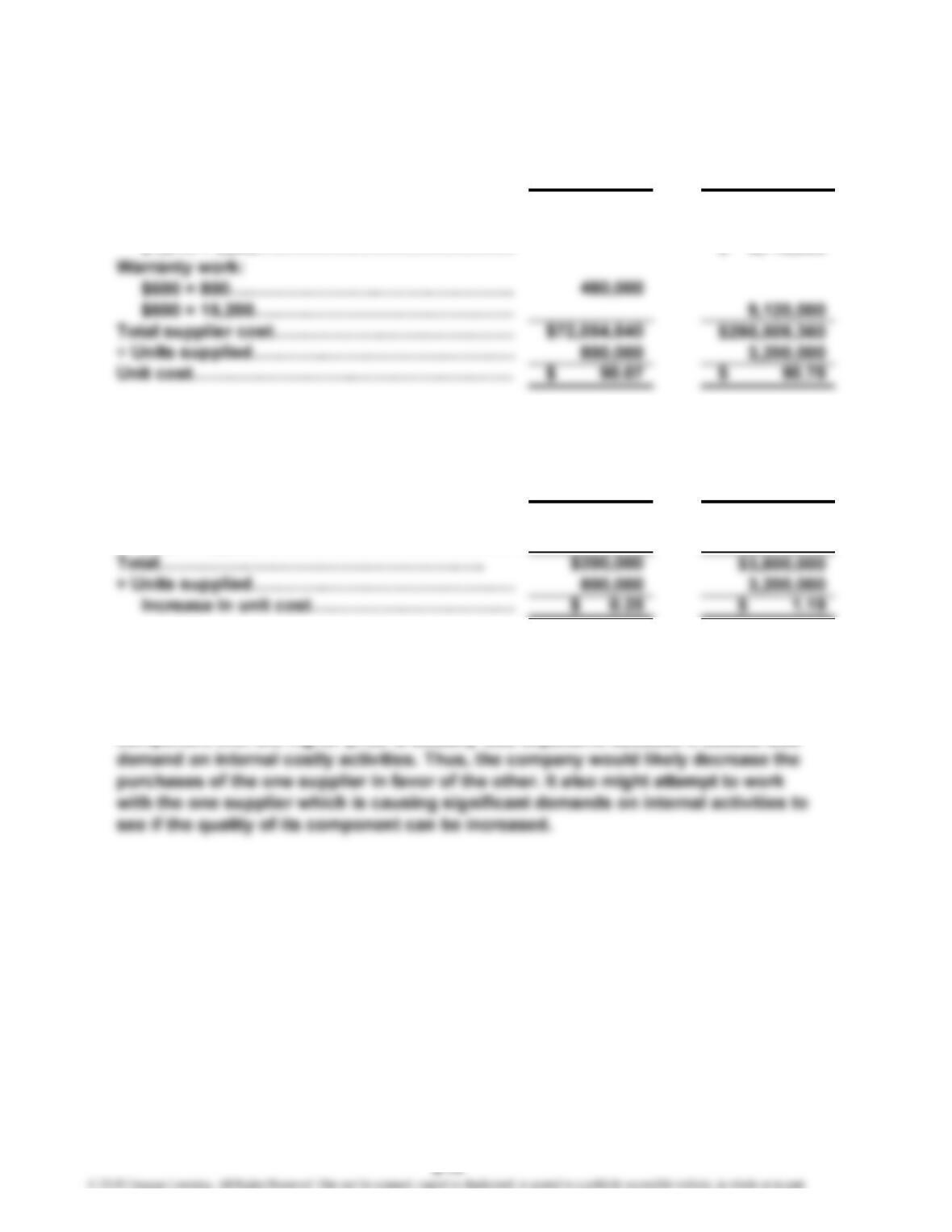
1. Supplier cost:
First, calculate the activity rates for assigning costs to suppliers:
Inspecting components:
Next, calculate the cost per component by supplier:
Buckner
Manzer Inc. Company
Purchase cost:
$89 × 800,000……………………… $71,200,000
$86 × 3,200,000……………………
…
$275,200,000
CHAPTER 5 Activity-Based Costing and Management
E 5-43 (Concluded)
Buckner
Company
Reworkin
g
products:
$1,014 × 360…..….………….….…………………
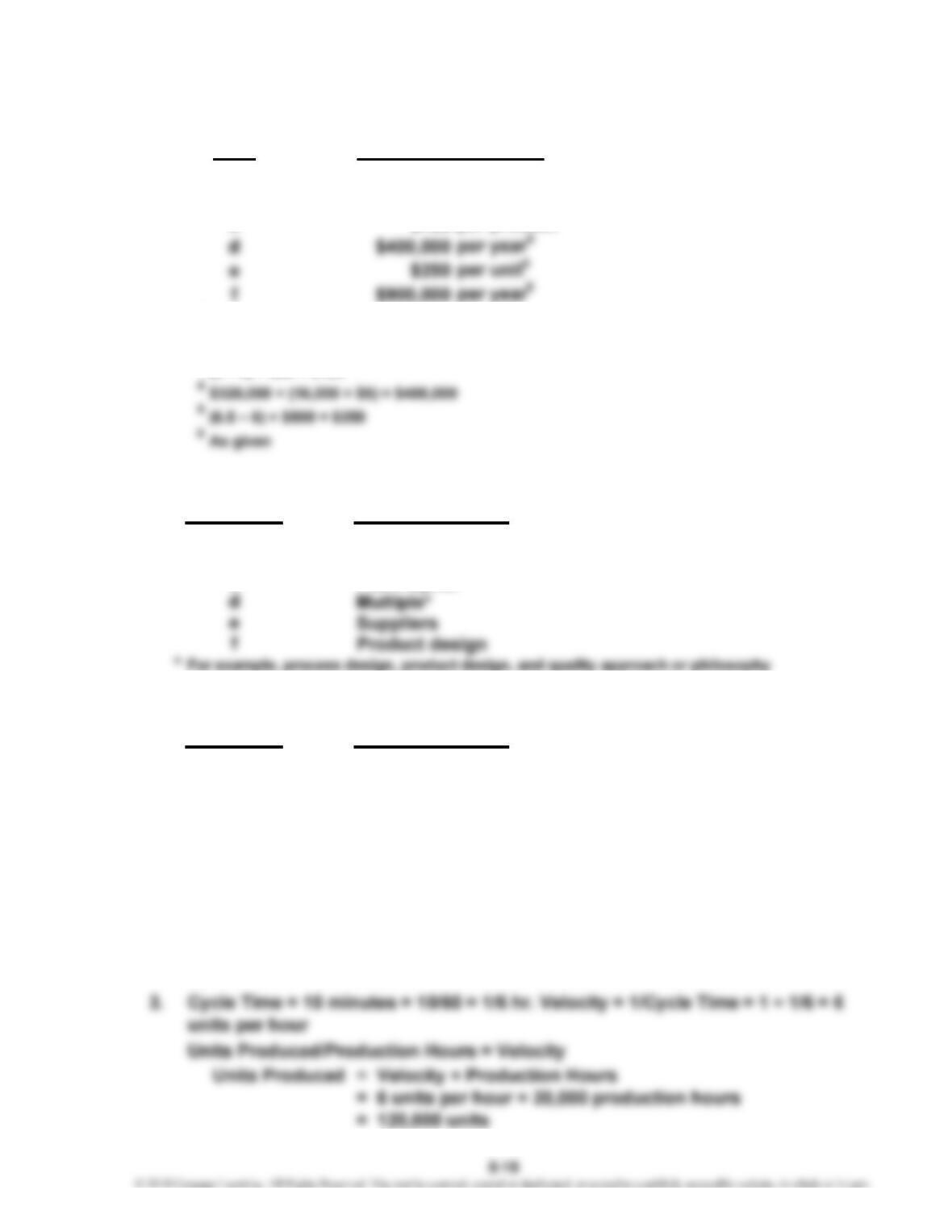
2. Using warranty hours, the rate is $4,000,000/16,000 = $250 per warranty hour.
The cost assigned to each component would be:
Bucker
Lost sales: Company
$250 × 800…..….………….….……………………
$250 × 15,200…..….………….….………………
…
$3,800,000
3. As with product costing, accurate assignment of costs to the cost object is essential
for well-grounded decision making. Suppliers can cause a firm to perform costly
activities such as inspection, rework, and warranty work. The total cost of a
component is thus more than its purchase price. As this example shows, the
Manzer Inc.
$200,000
Manzer Inc.
$ 365,040
…
CHAPTER 5 Activity-Based Costing and Management
E 5-44
Nonvalue-Added Cost
$9 per unit
1
$300 per setup
2
3
1(0.50 × $12) – (0.25 × $8) + [(8 – 7.5) × $10] = $9
2(8 – 2) × $50 = $300
3(6 – 0) × $20 = $120
E 5-45
f
E 5-46
Activity selection
Activity reduction
Activity elimination
Activity elimination
Activity selection
Activity sharing
E 5-47
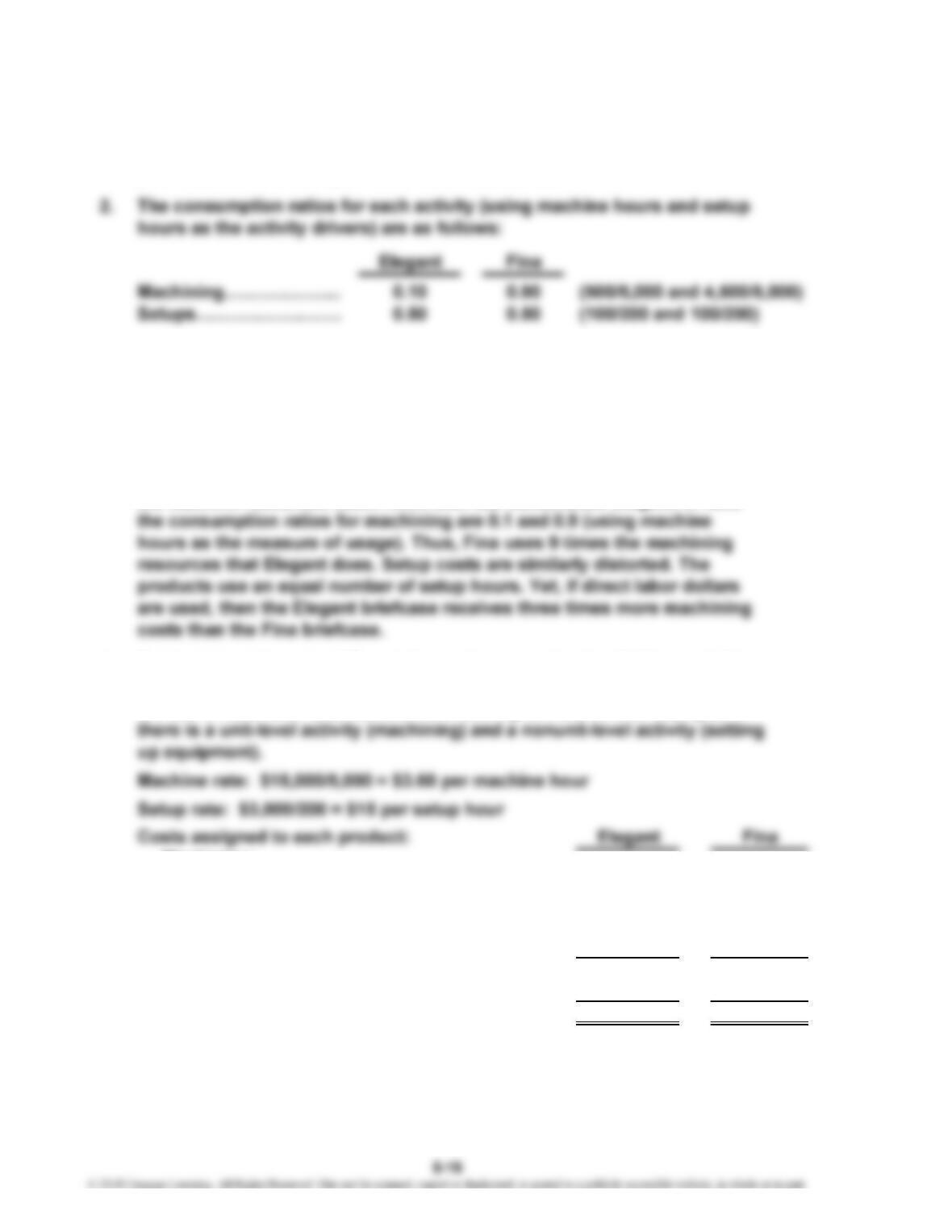
1.
V
elocity = 80,000/20,000 = 4 units per hou
r
2. Cycle Time = 20,000/80,000 = 1/4 hour per unit = 15 minutes per uni
t
e
f
Case
a
b
c
Cost Reduction
d
a
b
cPlant layou
Process design
Product design
Root Cause
Case
a
b
Case
4
5
6
CHAPTER 5 Activity-Based Costing and Management
E 5-48
1. Yes. Because direct materials and direct labor are directly traceable to each
product, their cost assignment should be accurate.
3. Ele
g
ant: $1.75* × $9,000/3,000 = $5.25 per briefcase
Fina: $1.75* × $3,000/3,000 = $1.75 per briefcase
*Overhead Rate = $21,000/$12,000 = $1.75 per direct labor dollar (or 175% of direct
labor cost)
More machine and setup costs are assigned to Elegant than Fina. This is
clearly a distortion because the production of Fina is automated and uses
4. Products tend to make different demands on overhead activities, and this
should be reflected in overhead cost assignments. Usually, this means
the use of both unit- and nonunit-level activity drivers. In this example,
Machining:
$3.60 × 500…………………………………………
…
$1,800
$3.60 × 4,500………………………………………… $16,200
Setups:
$15 × 100…………………………………………… 1,500 1,500
Total……………………………………………….……
…
$3,300 $17,700
÷ Units………………………………………………… 3,000 3,000
Unit overhead cost……………………………….
.
$ 1.10 $ 5.90
CHAPTER 5 Activity-Based Costing and Management
E 5-49
1. Total overhead: $152,000
(
$80,000 + $24,000 + $18,000 + $30,000
)
Activit
y
driver: Machine hours (20,000 + 20,000 = 40,000)
2. Consumption ratios:
Machine Receiving Packing
Hours Setups Orders Orders
Infantry……………………
…
0.50 0.75 0.90 0.67
Special forces……………
…
0.50 0.25 0.10 0.33
3. Activity rates:
Machining: $80,000/40,000 machine hours = $2.00 per machine hou
r
Special
4. Overhead assignment: Infantry Forces
Machining:
$2.00 × 20,000…………………………….……………
…
$40,000
$2.00 × 20,000…………………………….……………
…
$40,000
Setups:
$60.00 × 300…………………………….………………
…
18,000
$60.00 × 100…………………………….………………
…
6,000
…
…
…
…
5. Using only machine hours undercosts the infantry product and overcosts th
e
special forces product. The consumption ratios reveal this before the actual
calculations are made.
Product
CHAPTER 5 Activity-Based Costing and Management
E 5-50
Activity Dictionary:
Providin
g
nursin
g
care
Supervising nurses Coordinating nursing Number of nurses
activities
Feeding patients Providing meals to patients Number of meals
E 5-51
1. Activity rates:
Setups = $2,000,000/500 setups = $4,000 per setup
Machining = $80,000,000/400,000 machine hours = $200 per machine hou
r
Engineering = $6,000,000/150,000 engineering hours = $40 per engineering hou
r
Packing = $100,000/500,000 packing orders = $0.20 per packing orde
r
2. Calculation of unit product costs: Deluxe Regula
r
…
…
Engineering:
$40 × 50,000…………………………….…
…
2,000,000
$40 × 100,000…………………………….
…
4,000,000
Packing:
$0.20 × 100,000…………………………… 20,000
…
Activity Name Activity Description Activity Driver
Satisfying patient needs Nursing hours
CHAPTER 5 Activity-Based Costing and Management
E 5-52
1. First, receivin
g
is viewed as a value-added activit
y
because the efficient level
of the activit
y
is nonzero. Second, receivin
g
enables other activities to be
performed. Third, there is a chan
g
e of state—from a state of no materials
received to a state of materials received. Fourth, the receivin
g
state should
not have been achieved b
y
a prior activit
y
. Fifth, it is a necessar
y
activit
y—
one essential for the firm to remain in business.
2. Activity Rate = $630,000/72,000 orders = $8.75 per orde
r
V
alue-Added Costs = $8.75 × 36,000 = $315,000
Nonvalue-Added Costs = $8.75 × 36,000 = $315,000
CHAPTER 5 Activity-Based Costing and Management
P 5-53
1. Cost before addition of duffel ba
g
s:
$60,000*/100,000 = $0.60 per unit
2. Activity-based cost assignment:
Stage 1:
Activity Rate = $120,000/80,000 transactions = $1.50 per transaction
3. Product cost assignment:
Overhead rates:
Patterns: $30,000/15,000 direct labor hours = $2.00 per direct labor hour
Finishing: $90,000/30,000 direct labor hours = $3.00 per direct labor hour
Unit cost computation: Backpacks Duffel Bags
PROBLEMS