Problem 5-8BA (30 minutes)
Part 1
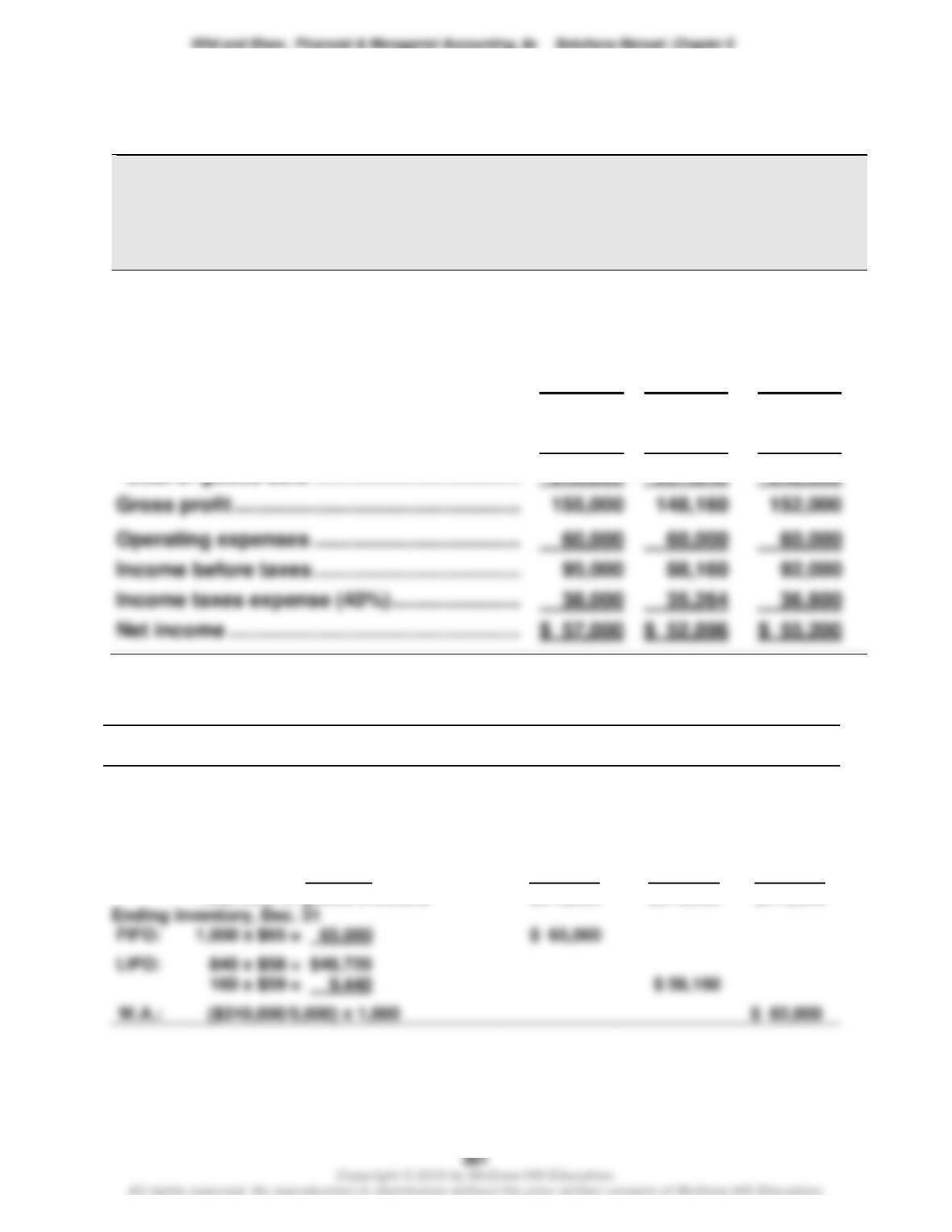
SHEPARD COMPANY
Income Statements Comparing FIFO, LIFO, and Weighted Average
For Year Ended December 31
FIFO
LIFO
Weighted
Average
Sales ……………………………………………………..
$400,000
$400,000
$400,000
Cost of goods sold
Beginning inventory, Jan. 1 …………………..
48,720
48,720
48,720
Cost of purchases…………………………………
261,280
261,280
261,280
Cost of goods available for sale …………….
310,000
310,000
310,000
Ending inventory, Dec. 31 ……………………..
65,000
58,160
62,000
Cost of goods sold ……………………………….
245,000
251,840
248,000
60,000
60,000
60,000
88,160
92,000
38,000
35,264
36,800
Supporting calculations
FIFO
LIFO
Weighted
Average
Beginning inventory, Jan. 1 (840 x $58) …………
$ 48,720
$ 48,720
$ 48,720
Purchases
600 x $59 = $ 35,400
1,205 x $61 = 73,505
700 x $64 = 44,800
1,655 x $65 = 107,575
261,280
261,280
261,280
Total cost of goods available
Ending inventory, Dec. 31
W.A.:
$ 62,000
Problem 5-8BA (Concluded)
Part 2
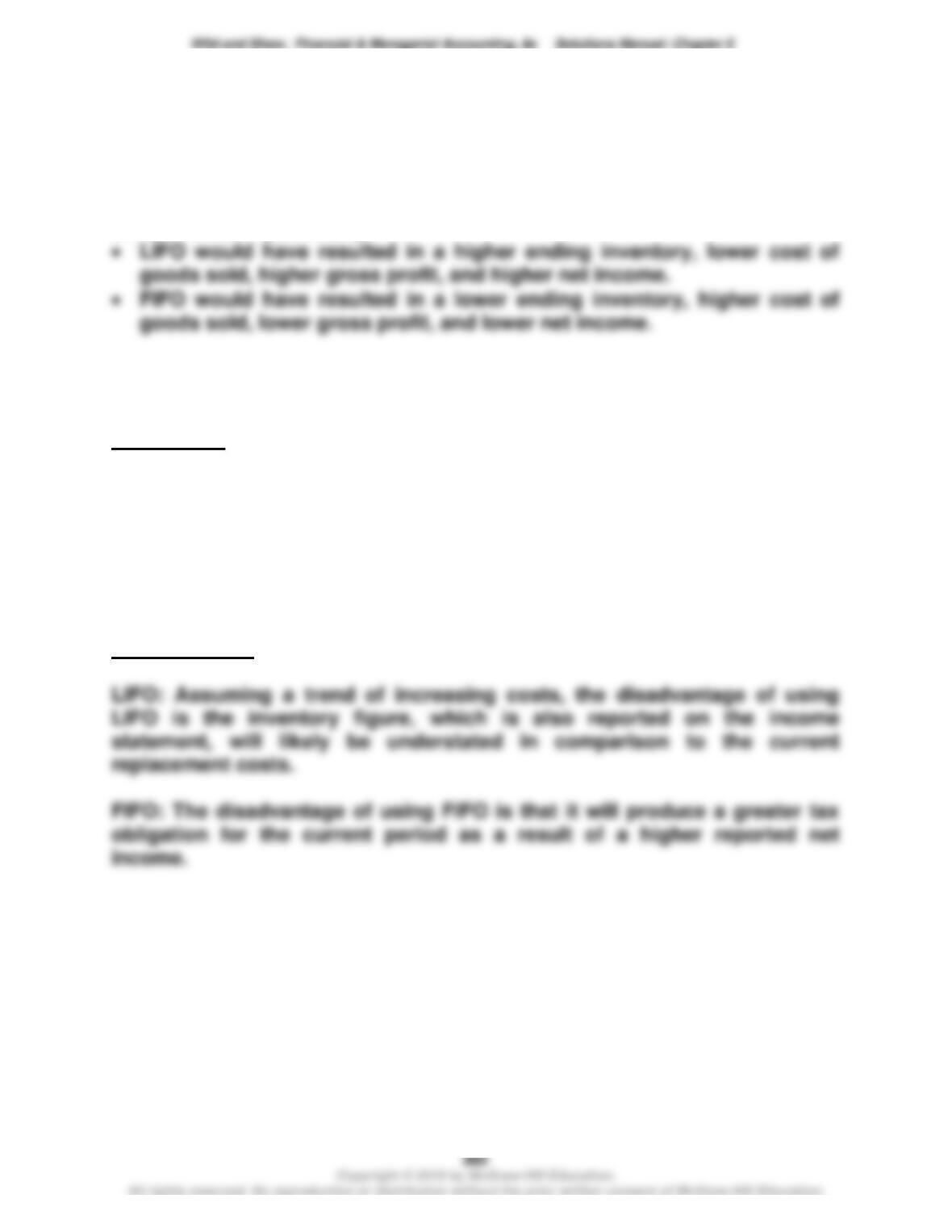
If Shepard Company had been experiencing decreasing costs in the
acquisition of inventory, we would observe the opposite results in our
comparisons. Specifically:
Part 3
Advantages
LIFO: Assuming a trend of increasing costs, the advantage of using LIFO is
that the lower net income will result in a lower tax obligation (tax deferral).
Also, LIFO is likely to better match current costs against revenues.
FIFO: The advantage of using FIFO is that the inventory figure reported on
the balance sheet is likely similar to the current replacement cost.
Disadvantages
Problem 5-9BB (25 minutes)
Part 1
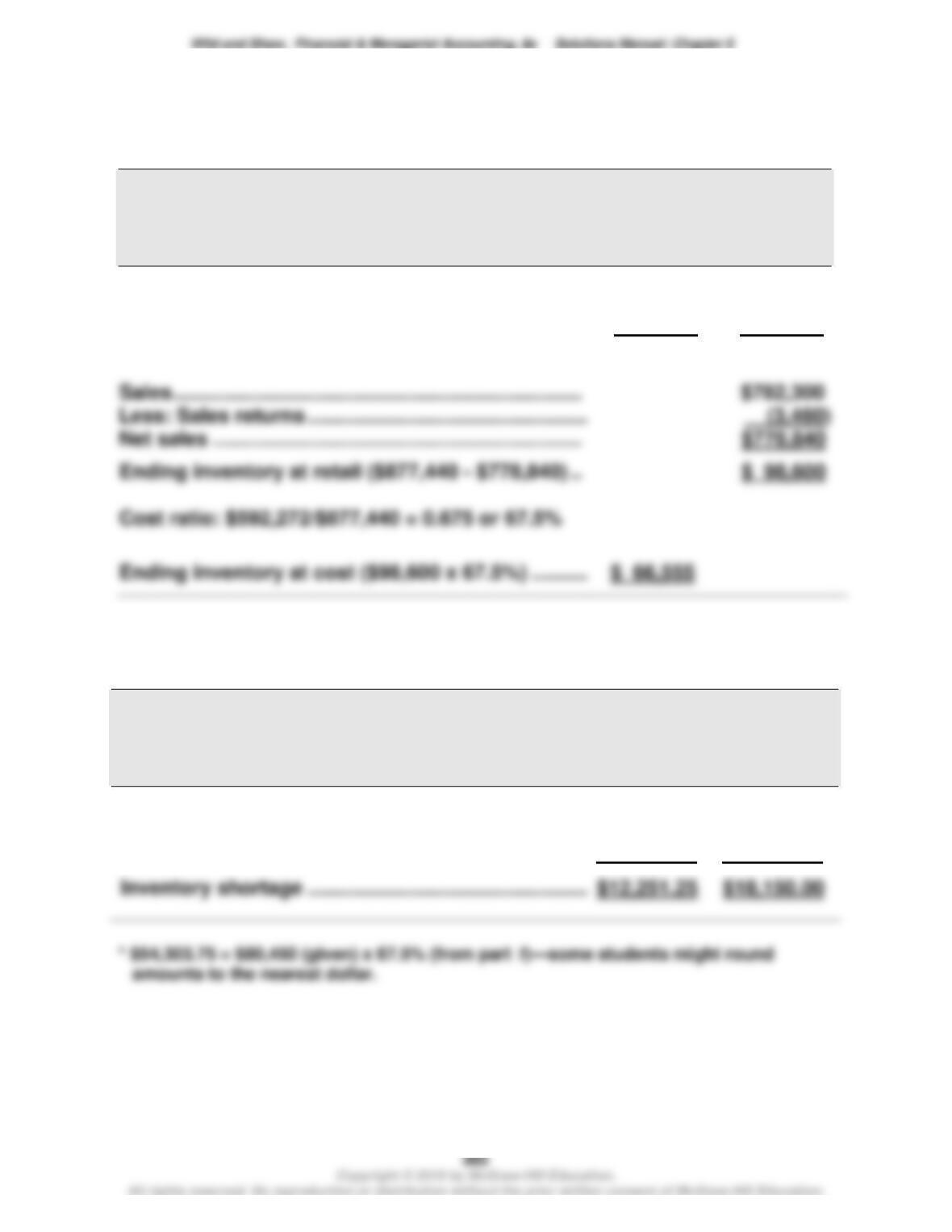
MACKLIN COMPANY
Estimated Inventory
December 31
At Cost At Retail
Goods available for sale
Beginning inventory ………………………………………
$ 90,022
$115,610
Cost of goods purchased ……………………………….
502,250
761,830
Goods available for sale …………………………………
$592,272
$877,440
Less: Sales returns …………………………………………..
Net sales ………………………………………………………...
Part 2
MACKLIN COMPANY
Inventory Shortage
December 31
At Cost At Retail
Estimated inventory (from part 1) ……………………….
$66,555.00
$98,600.00
Physical inventory* …………………………………………….
54,303.75
80,450.00

Problem 5-10BB (25 minutes)
OTINGO EQUIPMENT CO.
Estimated Inventory at March 31
At Cost
At Retail
Goods available for sale
Beginning inventory, Jan. 1 ………………………
$ 802,880
Cost of goods purchased ………………………….
2,209,636
Goods available for sale …………………………...
3,012,516
Less estimated cost of goods sold
Sales ………………………………………………………..
Less sales returns ……………………………………
Net sales ………………………………………………….
Estimated cost of goods sold
[$3,680,960 x (1 – 35%)] …………………………
Wild and Shaw, Financial & Managerial Accounting, 8e Solutions Manual: Chapter 5
SERIAL PROBLEM — SP 5
Serial Problem — SP 5, Business Solutions (20 minutes)
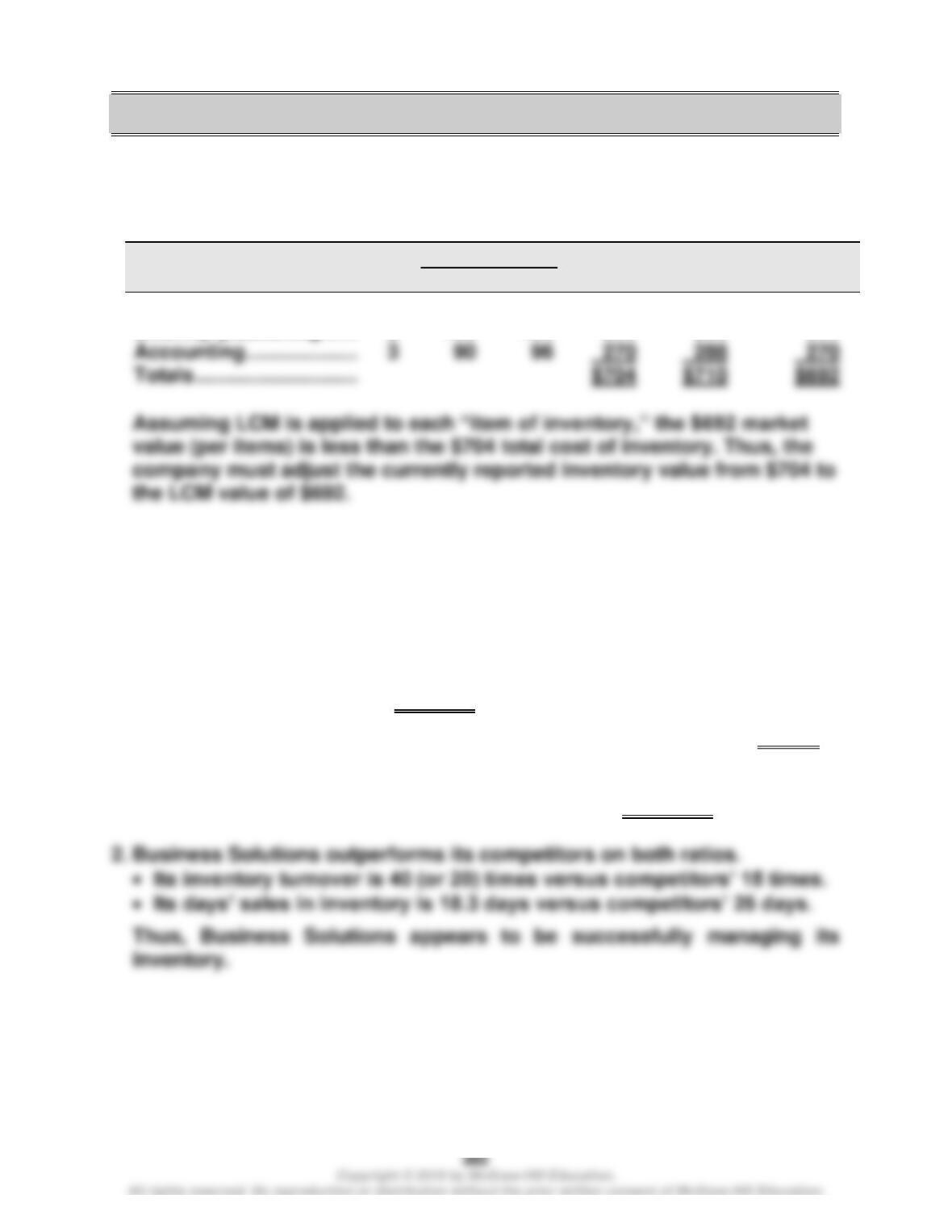
Part A
Per Unit
Total
Total
LCM Applied
Inventory Items
Units
Cost
Market
Cost
Market
To Items
Office productivity ……..
3
$ 76
$ 74
$228
$222
$222
Desktop publishing ……
2
103
100
206
200
200
3
Part B
1. Ratio computations for the three months ended March 31, 2020:
Inventory Turnover = Cost of Goods Sold / Average Inventory
= $14,052 / [($0 + $704)/2]
= 40 times (Because this is the first period of carrying
inventory, it is acceptable to substitute ending inventory for
average inventory. This would yield a turnover of 20 times.)
Days’ Sales in Inventory = (Ending Inventory/Cost of Goods Sold) x 365
= ($704 / $14,052) x 365 = 18.3 days
Wild and Shaw, Financial & Managerial Accounting, 8e Solutions Manual: Chapter 5
Financial Analysis — AA 5-1 (20 minutes)
($ millions for all parts)
1. a. $4,855
b. $2,132
3. Lower.
Explanation: As long as Apple has enough inventory to meet demand,
Apple would prefer inventory to be lower. Companies prefer assets to
be used more productively than tied up in inventory.
Wild and Shaw, Financial & Managerial Accounting, 8e Solutions Manual: Chapter 5
Comparative Analysis — AA 5-2 (35 minutes)
($ millions)
1. Inventory turnover =
Apple — current year
Inventory turnover = = 40.4 times
Apple — one year prior
Inventory turnover = = 58.6 times
Cost of sales
Average inventory
$141,048
($4,855 + $2,132) / 2
$131,376
($2,132 + $2,349) / 2
Wild and Shaw, Financial & Managerial Accounting, 8e Solutions Manual: Chapter 5
Comparative Analysis (Concluded)
2. Days’ sales in inventory = x 365
Current year — Apple’s days’ sales in inventory
= ($4,855/$141,048) x 365 = 12.6 days
One year prior —Apple’s days’ sales in inventory
= ($2,132/$131,376) x 365 = 5.9 days
Two years prior—Apple’s days’ sales in inventory
= ($2,349/$140,089) x 365 = 6.1 days
3. a. Outperformed.
Explanation: Apple compares favorably to (exceeds) the industry
average of 15 for inventory turnover for the current year.
Ending Inventory
Costs of Goods Sold
Global Analysis — AA 5-3 (25 minutes)
1. Inventory turnover =
a. Current year — Samsung (₩ millions):
Inventory turnover = = 6.0 times
Days’ sales in inventory = x 365
b. Current year —Samsung days’ sales in inventory (₩ millions):
x 365 days = 70.5 days
One year prior —Samsung days’ sales in inventory (₩ millions):
x 365 days = 55.7 days
Cost of sales
Average inventory
Ending Inventory
Costs of Goods Sold
₩129,290,661
(₩24,983,355 + ₩18,353,503) /2
₩24,983,355
₩129,290,661
₩18,353,503
₩120,277,715
Ethics Challenge — BTN 5-1
1. Profit Margin: In an economic environment of rising costs, the use of
FIFO results in a lower cost of goods sold than LIFO. If cost of goods
sold is lower, then net income will be higher. A higher net income will
improve the profit margin ratio, which is calculated as net income
divided by net sales.
2. First, it is true that managers have discretion in choosing an inventory
costing method. It appears, however, that Golf Challenge’s owner does
not understand that changing methods can only be done very
selectively over time. A change in method must be justified by
management for improving the financial reporting of the company.
Third, the full disclosure principle requires the owner to disclose to the
bank that the company has implemented a change in inventory costing
method from LIFO to FIFO.
Wild and Shaw, Financial & Managerial Accounting, 8e Solutions Manual: Chapter 5
Communicating in Practice — BTN 5-2
[Note: An acceptable memorandum format should be used.]
The body of the memo would likely recommend use of the LIFO method for
this start-up business. The memo should explain that this would allow for
Taking It to the Net — BTN 5-3
1. Apple designs, manufactures, and markets mobile communication and
media devices, personal computers, and sells a variety of related
software, services, accessories, networking solutions, and third-party
digital content and applications.
2. Its summary of significant accounting policies (Note 1) reports:
“Inventories are stated at the lower of cost, computed using the first-in,
first-out method and net realizable value.”
3. Its gross margin is ($ millions):
4. Inventory turnover
$141,048 mil./ [($4,855 mil. + $2,132 mil.)/2] = 40.4 times
Days’ sales in inventory
($4,855 mil. / $141,048 mil.) x 365 days = 12.6 days
Teamwork in Action — BTN 5-4
Concepts and procedures to illustrate in expert presentation:
Specific Identification Expert:
(a) and (b) Concept:
Purchases are always recorded at the actual specific costs. The specific
identification cost flow assumption requires units sold be assigned their
actual cost. Total cost of goods sold is tallied based on these individual
cost assignments. The new inventory balance is perpetually determined to
be the amount after sales at actual cost is deducted.
(a) and (b) Procedures:
Date
Goods Purchased
Cost of Goods Sold
Inventory Balance
Jan. 1
50 @ $100 = $ 5,000
Jan.10
$20,000
Feb.15
100 @ $ 120 = $12,000
20 @ $100 = $ 2,000
50 @ $120 = 6,000
$ 8,000
Apr.30
200 @ $150 = $30,000
20 @ $100 = $ 2,000
50 @ $120 = 6,000
200 @ $150 = 30,000
$38,000
Sept 26
300 @ $200 = $60,000
20 @ $100 = $ 2,000
50 @ $120 = 6,000
200 @ $150 = 30,000
300 @ $200 = 60,000
$98,000
Teamwork in Action (Continued)
LIFO Expert:
(a) and (b) Concept:
Purchases are always recorded at actual costs. The LIFO cost flow
assumption requires (i) units sold be assigned the most recent cost—total
cost of goods sold is tallied based on these individual cost assignments,
and (ii) that the inventory balance be perpetually determined to be the
amount after goods sold (using the most recent costs) are deducted.
(a) and (b) Procedures:
Date
Goods Purchased
Cost of Goods Sold
Inventory Balance
Jan. 1
50 @ $100 = $ 5,000
Jan.10
$20,000
Feb.15
100 @ $120 = $12,000
20 @ $100 = $ 2,000
50 @ $120 = 6,000
$ 8,000
Apr.30
200 @ $150 =$30,000
20 @ $100 = $ 2,000
50 @ $120 = 6,000
200 @ $150 = 30,000
$38,000
Sept 26
300 @ $200 = $60,000
20 @ $100 = $ 2,000
50 @ $120 = 6,000
200 @ $150 = 30,000
300 @ $200 = 60,000
$98,000
Wild and Shaw, Financial & Managerial Accounting, 8e Solutions Manual: Chapter 5
Teamwork in Action (Continued)
FIFO Expert:
(a) and (b) Concept:
Purchases are always recorded at actual costs. The FIFO cost flow
assumption requires units sold be assigned the first (earliest) cost of
purchases. Total cost of goods sold is tallied based on these individual
cost assignments. The inventory balance is perpetually determined to be
the amount after deducting goods sold using the earliest costs.
(a) and (b) Procedures:
Date
Goods Purchased
Cost of Goods Sold
Inventory Balance
Jan. 1
50 @ $100 = $ 5,000
Jan.10
30 @ $100 = $ 3,000
20 @ $100 = $ 2,000
Jan.14
150 @ $120 = $18,000
150 @ $120 = 18,000
$20,000
Apr.30
200 @ $150 = $30,000
70 @ $120 = $ 8,400
200 @ $150 = 30,000
$38,400
Sept 26
300 @ $200 = $60,000
70 @ $120 = $ 8,400
200 @ $150 = 30,000
300 @ $200 = 60,000
$98,400
Wild and Shaw, Financial & Managerial Accounting, 8e Solutions Manual: Chapter 5
Teamwork in Action (Continued)
Weighted Average Expert:
(a) and (b) Concept:
Purchases are always recorded at actual costs. The Weighted Average
cost flow assumption requires units sold be assigned a cost based on
running weighted average cost per unit in the inventory balance. This
(a) and (b) Procedures:
Date
Goods Purchased
Cost of Goods Sold
Inventory Balance
Jan. 1
50 @ $100 = $ 5,000
Jan.10
30 @ $100 = $ 3,000
20 @ $100 = $ 2,000
Jan.14
150 @ $120 = $18,000
170 @ $117.647 = $20,000
Feb.15
100 @ $117.647 = $11,765*
70 @ $117.647 = $ 8,235*
Apr.30
200 @ $150 = $30,000
270 @ $141.611*= $38,235*
(8,235+30,000)/
(70 +200)
Sept 26
300 @ $200 = $60,000
570 @ $172.342* = $98,235*
(38,235 +60,000)/
(270 +300)
Oct. 5
350 @ $172.342 = $60,320
220 @ $172.342* =
Wild and Shaw, Financial & Managerial Accounting, 8e Solutions Manual: Chapter 5
Teamwork in Action (Concluded)
(c) Cost Flow versus Actual Physical Flow
Typical comments experts may express in response to (c):
• Physical flow of goods can be affected by the type of products in
inventory and/or the way inventory is stored and/or displayed.
• Actual physical flow of goods is not relevant in selecting an acceptable
method of accounting for inventory. Any one of the four methods is
acceptable. The method chosen should be consistently applied.
More Specific Expert Comments to (c):
Specific Identification—Always reflects the actual cost flow. Electronic
scanning has increased the ability to use this method in businesses that sell
homogeneous goods.
FIFO—Most businesses try to move their older or earlier acquired inventory
first, particularly if they sell perishable goods. Therefore, FIFO will frequently
reflect the physical flow of goods.
(d) Impact of Methods
Typical comments experts may express in response to (d):
In a period of rising prices LIFO will generally result in the highest cost of
goods sold and therefore the lowest net income and lowest tax. However,
LIFO must be used for financial reporting if it is used for tax purposes.
In a period of rising prices FIFO will generally result in the lowest cost of
goods sold and therefore the highest net income and highest tax.
Weighted Average will usually result in a reported net income and tax
consequences somewhere in between LIFO and FIFO.
Entrepreneurial Decision — BTN 5-5
Part 1
(a) Current inventory turnover = $120,000 / $30,000 = 4 times
Current days’ sales in inventory = ($30,000/$120,000) x 365
= 91.25 days
*Ratio definitions:
Inventory turnover =
Days’ sales in inventory = x 365
Part 2
The proposal would yield a much improved inventory turnover of 8 vis–
à-vis the current turnover of 4. On the downside, its days’ sales in
inventory would dramatically decline from 91 days to 46 days. Assuming
an inventory buffer of 46 days is sufficient, then the proposal should be
implemented.
Hitting the Road — BTN 5-6
There is no formal solution for this field activity. The required solution
does allow students to see the relevance of studying merchandise
activities and inventory accounting.
Cost of goods sold
Average inventory
Ending inventory
Cost of goods sold