CHAPTER 5
Merchandising Operations
and the Multiple-Step Income Statement
Learning Objectives
1. Identify the differences between a service company and a merchandising company.
2. Explain the recording of purchases under a perpetual inventory system.
3. Explain the recording of sales revenues under a perpetual inventory system.
4. Distinguish between a single-step and a multiple-step income statement.
5. Determine cost of goods sold under a periodic system.
6. Explain the factors affecting profitability.
7. Identify a quality of earnings indicator.
*8. Explain the recording of purchases and sales of inventory under a periodic inventory system.
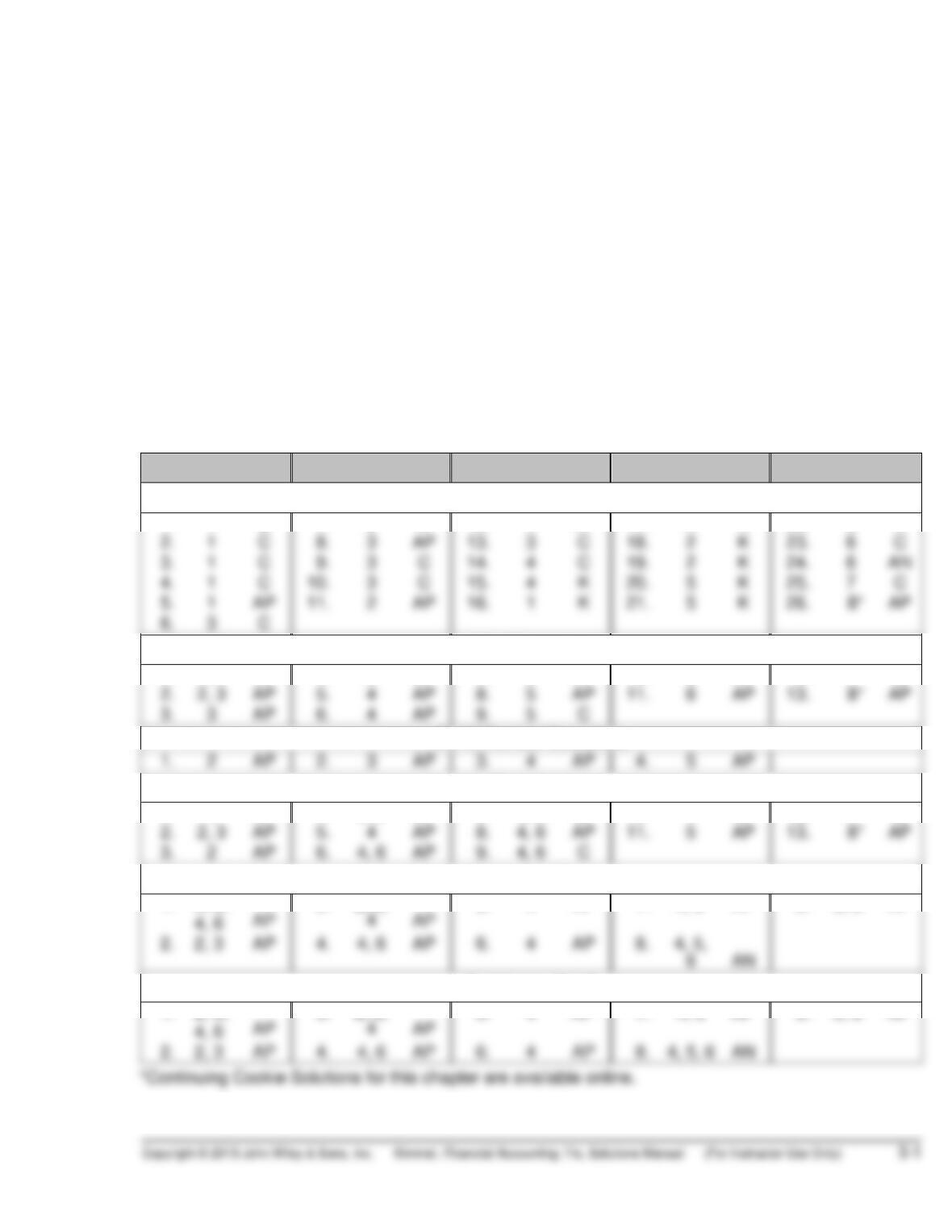
Summary of Questions by Learning Objectives and Bloom’s Taxonomy
Item LO BT Item LO BT Item LO BT Item LO BT Item LO BT
Questions
1. 1 C 7. 3 K 12. 4
A
P 17. 4 K 22. 6 K
A
A
A
A
A
Brief Exercises
1. 1, 4
A
P 4. 2
A
P7.5
A
P 10. 6
A
P 12. 7 C
A
A
A
A
A
A
A
Do It! Review Exercises
A
A
A
A
Exercises
1. 3
A
P 4. 2, 3
A
P7.4, 6
A
P 10. 5
A
P 12. 7 C
A
A
A
A
A
A
A
Problems: Set A
1. 2, 3,
A
A
A
3. 2, 3,
5. 4
A
P7.4, 5
A
P 9. 5, 8*
A
P
Problems: Set B
1. 2, 3,
A
A
A
A
3. 2, 3,
5. 4
A
P7.4, 5
A
P 9. 5, 8*
A
P
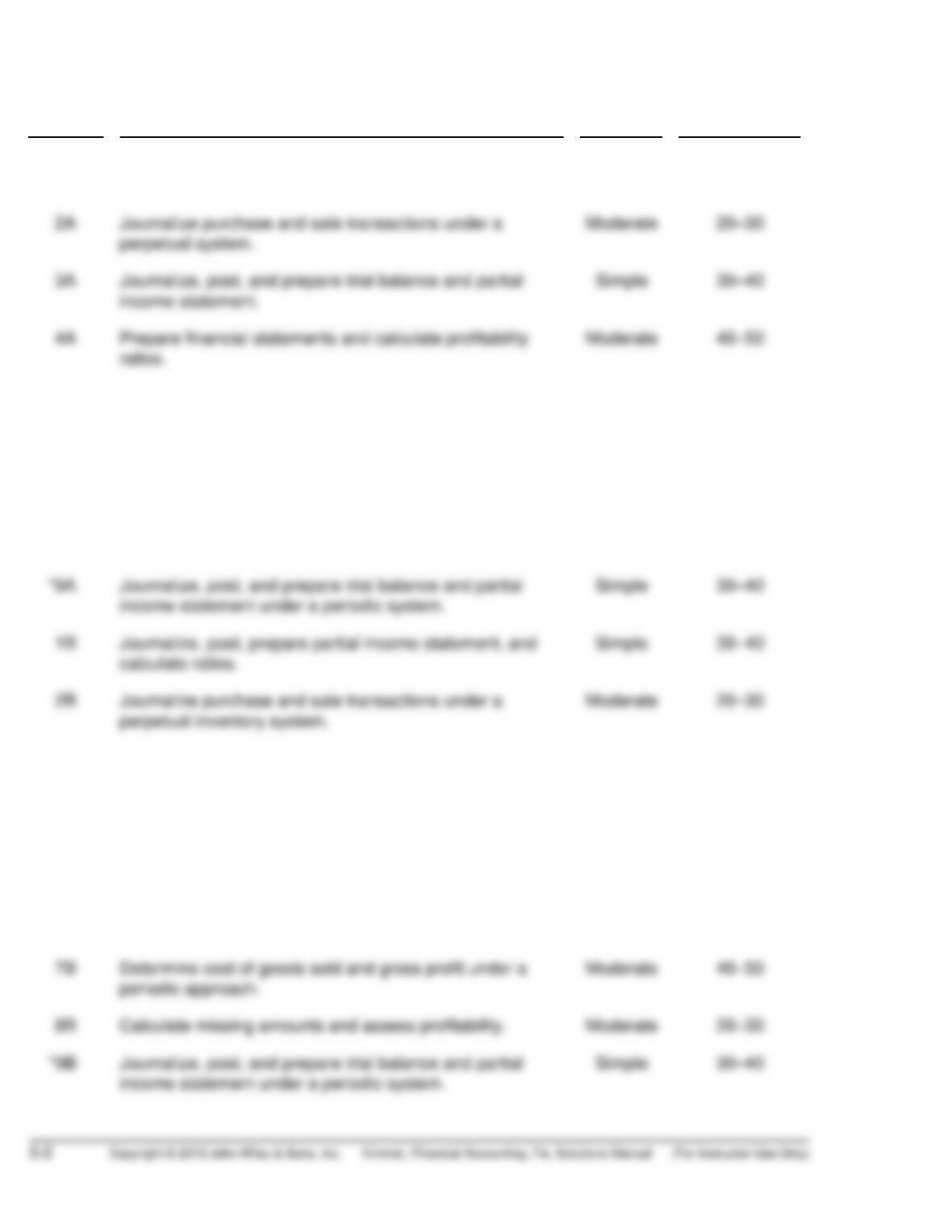
ASSIGNMENT CHARACTERISTICS TABLE
Problem
Number
Description
Difficulty
Level
Time
Allotted (min.)
1A Journalize, post, prepare partial income statement, and
calculate ratios.
Simple 30–40
5A Prepare a correct multiple-step income statement. Complex 20–30
6A Journalize, post, and prepare adjusted trial balance and
financial statements.
Moderate 40–50
7A Determine cost of goods sold and gross profit under a
periodic system.
Moderate 40–50
8A Calculate missing amounts and assess profitability. Moderate 20–30
3B Journalize, post, and prepare trial balance and partial
income statement.
Simple 30–40
4B Prepare financial statements and calculate profitability
ratios.
Moderate 40–50
5B Prepare a correct multiple-step income statement. Complex 20–30
6B Journalize, post, and prepare adjusted trial balance and
financial statements.
Moderate 40–50
ANSWERS TO QUESTIONS
1. (a) Disagree. The steps in the accounting cycle are the same for both a merchandising company
and a service company.
(b) The measurement of income is conceptually the same. In both types of companies, net
income (or loss) results from the matching of expenses with revenues.
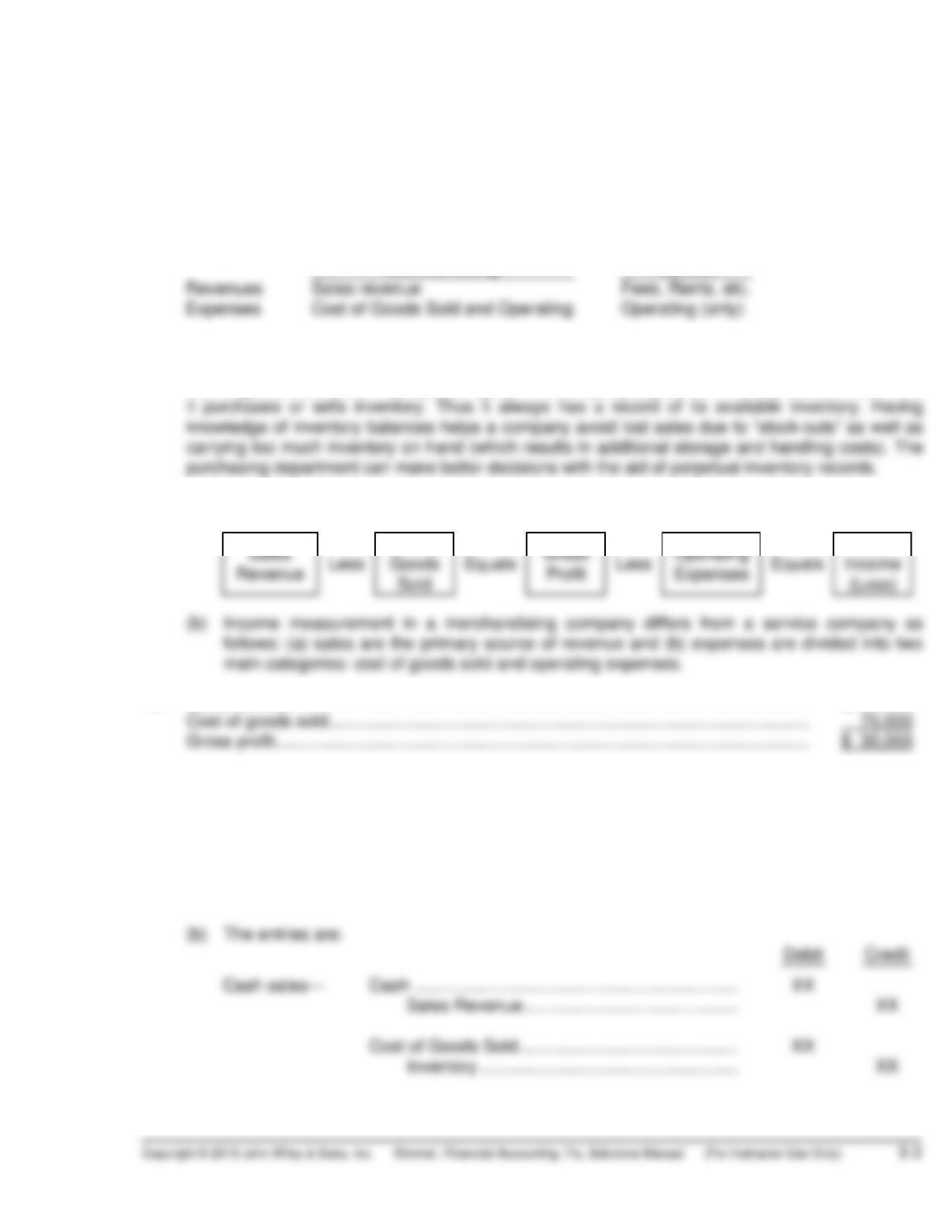
2. The components of revenues and expenses differ as follows:
Merchandising Service
3. Under a periodic inventory system the company does not keep track of how many units are on
hand. Instead it takes a physical count at the end of the period to determine ending inventory and
cost of goods sold. Under a perpetual system the company adjusts its inventory account each time
4. (a) The income measurement process is as follows:
Cost of
Net
5. Sales revenue …………………………………………………………………………………………….. $100,000
6. Agree. In accordance with the revenue recognition principle, sales revenues are generally con-
sidered to be recognized when the goods are transferred from the seller to the buyer; that is,
when the exchange transaction occurs. The recognition of revenue is not dependent on the
collection of credit sales.
7. (a) The primary source documents are (1) cash sales—cash register tapes and (2) credit sales—
sales invoice.
Questions Chapter 5 (Continued)
Credit sales— Accounts Receivable ……………………………………..
XX
8. July 19 Cash ($800 – $8) …………………………………………………………………. 792
9. Shipping unwanted goods to customers is generally considered unethical behavior. In addition, if
proper accounting is applied, in most cases it won’t achieve the desired result of increasing sales. If
10. In most industries returns are not significant, and they are therefore accounted for as they occur.
When returns are expected to be significant, the company should make an adjusting entry at the
11. July 24 Accounts Payable ($1,900 – $300) …………………………………………. 1,600
12. Gross profit ………………………………………………………………………………………… $560,000
13. Its current terms of 1/10, n/30 means that customers get a 1% discount if they pay within 10 days,
otherwise they have to pay the full amount within 30 days. If they switch to 2/10, n/45 customers
would get a 2% discount for paying within 10 days, otherwise they have to pay the full amount in
14. The gain on the sale of the plant represents a one-time gain. That is, it won’t be recurring next
year. If you eliminate the effect of this one-time gain, then the company’s income actually declined
by $5 million relative to the prior year. When predicting future earnings investors frequently place
little weight on non-recurring events such as this.
15. There are three distinguishing features in the income statement of a merchandising company:
(1) a sales revenues section, (2) a cost of goods sold section, and (3) gross profit.
Questions Chapter 5 (Continued)
17. Tootsie Roll uses the term gross margin. It breaks down gross margin into two components, product
gross margin and rental and royalty gross margin. Total gross profit decreased by $4,784,000.
20. (a) (b)
Accounts Added/Deducted Normal Balance
21. (a) X = Purchase returns and allowances and
Y = Purchase discounts, or vice versa.
22. Profitability is affected by gross profit ‘as measured by the gross profit rate’ and by manage-
ment’s ability to control operating expenses, as measured by the profit margin.
23. Factors affecting a company’s gross profit rate include selling products with a higher (or lower)
24. Gross profit represents the amount by which sales exceeds cost of goods sold. In order for the
company to be profitable, gross profit must exceed the company’s operating expenses. Before
25. George Mallein should calculate the company’s quality of earnings ratio. This is calculated by
dividing net cash provided by operating activities by net income. A measure significantly below 1
*26. July 24 Accounts Payable ($1,900 – $400) …………………………….. 1,500
SOLUTIONS TO BRIEF EXERCISES
BRIEF EXERCISE 5-1
(a) Sales = $181,500 ($71,900 + $109,600).
(b) Cost of goods sold = $41,200 ($71,200 – $30,000).
BRIEF EXERCISE 5-2
Gerish Company
Mangus Company
Accounts Receivable …………………………………….. 900
BRIEF EXERCISE 5-3
(a) March 2 Accounts Receivable …………………… 800,000
Sales Revenue …………………….. 800,000
6 Inventory …………………………………….. 94,000
Cost of Goods Sold …………….. 94,000
BRIEF EXERCISE 5-4
(a) March 2 Inventory …………………………………….. 800,000
Accounts Payable ……………….. 800,000
BRIEF EXERCISE 5-5
ALVARADO COMPANY
Income Statement (Partial)
For the Month Ended October 31, 2014
Sales
Sales revenue ($300,000 + $150,000) …………………. $450,000
BRIEF EXERCISE 5-6
As the name suggests, numerous steps are required in determining net
income in a multiple-step statement.
Item Section
Gain on disposal of plant assets
Other revenues and gains
BRIEF EXERCISE 5-7
Beginning inventory ………………………………………….. $ 67,000
Add: Purchases ………………………………………………. 380,000
BRIEF EXERCISE 5-8
Purchases …………………………………………………………. $404,000
Less: Purchase returns and allowances……………. $13,000
BRIEF EXERCISE 5-9
Net sales …………………………………………………………… $612,000
Beginning inventory ………………………………………….. $ 60,000
Add: Cost of goods purchased* ……………………….. 398,000
BRIEF EXERCISE 5-10
(a) Profit margin = $32,500 ÷ $250,000 = 13.0%
The profit margin measures the extent by which selling price covers all
expenses. In this case 87% of sales revenues cover all expenses (cost
(b) Gross profit rate = ($250,000 – $150,000) ÷ $250,000 = 40.0%
The gross profit rate measures the margin by which selling price exceeds
cost of goods sold. In this case, 40% of sales revenues remain (after
BRIEF EXERCISE 5-11
(a) Profit margin = $68,000 ÷ $800,000 = 8.5%
The profit margin measures the extent by which selling price
covers all expenses. In this case, 91.5% of sales revenues cover all
(b) Gross profit rate = ($800,000 – $520,000) ÷ $800,000 = 35.0%
The gross profit rate measures the margin by which selling price exceeds
BRIEF EXERCISE 5-12
The quality of earnings ratio is calculated by dividing net cash provided
by operating activities by net income. For Moritz Corporation this
*BRIEF EXERCISE 5-13
(a) March 2 Purchases …………………………………… 800,000
Accounts Payable ……………….. 800,000
SOLUTIONS TO DO IT! REVIEW EXERCISES
DO IT! 5-1
Oct. 5 Inventory ……………………………………………………………. 5,000
DO IT! 5-2
Oct. 5 Accounts Receivable …………………………………………. 5,000
Cost of Goods Sold……………………………………………. 3,000
Inventory …………………………………………………… 3,000
(To record cost of goods sold on account)
Oct. 8 Sales Returns and Allowances …………………………… 640
Accounts Receivable …………………………………. 640
DO IT! 5-3
VOGT CORP.
Income Statement
For the Year Ended December 31, 2014
Sales
Sales revenue ……………………………………….. $592,000
Less: Sales returns and allowances ……….. 40,000
Net sales …………………………………………………….. $552,000
DO IT! 5-4
(a) Cost of goods purchased $161,400:
Purchases – Purchase returns and allowances – Purchase
SOLUTIONS TO EXERCISES
EXERCISE 5-1
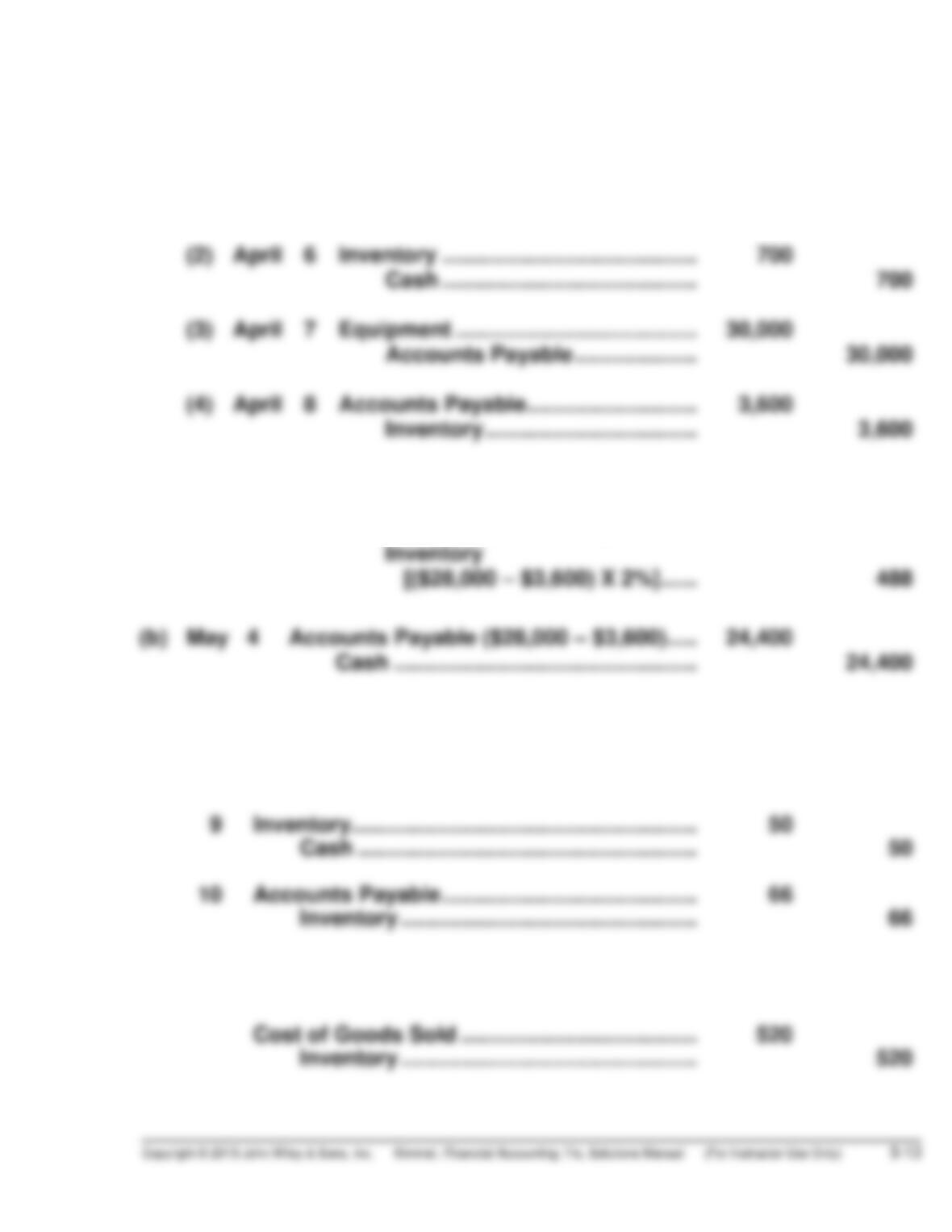
(a) (1) April 5 Inventory …………………………………… 28,000
Accounts Payable ……………….. 28,000
(5) April 15 Accounts Payable
($28,000 – $3,600) ……………………. 24,400
Cash ($24,400 – $488) ………….. 23,912
EXERCISE 5-2
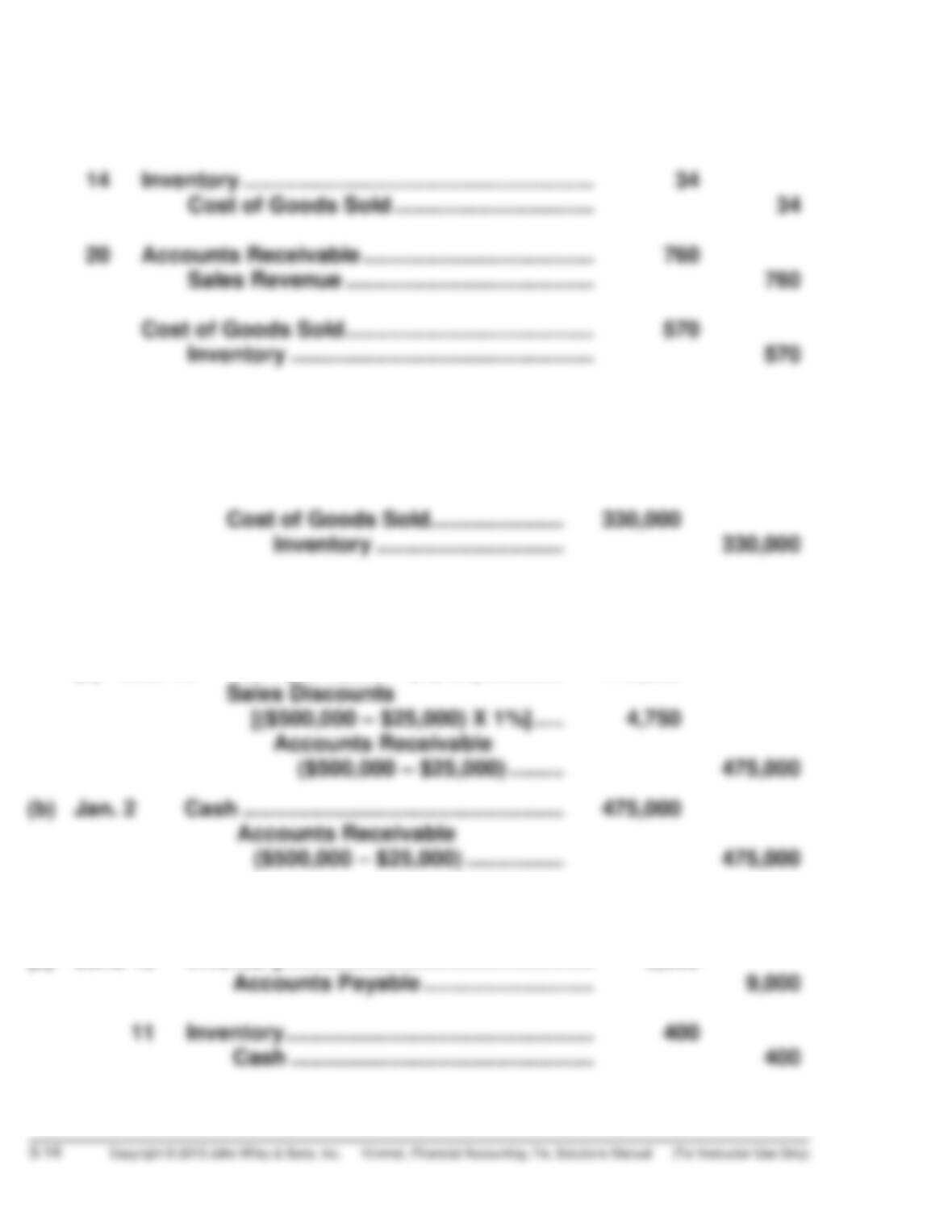
Sept. 6 Inventory ………………………………………………… 1,650
Accounts Payable ……………………………. 1,650
12 Accounts Receivable ………………………………. 690
Sales Revenue …………………………………. 690
EXERCISE 5-2 (Continued)
Sept. 14 Sales Returns and Allowances …………………. 45
Accounts Receivable ………………………… 45
EXERCISE 5-3
(a) (1) Dec. 3 Accounts Receivable ………………. 500,000
Sales Revenue …………………. 500,000
(2) Dec. 8 Sales Returns and Allowances … 25,000
Accounts Receivable ……….. 25,000
(3) Dec. 13 Cash ($475,000 – $4,750) …………. 470,250
EXERCISE 5-4
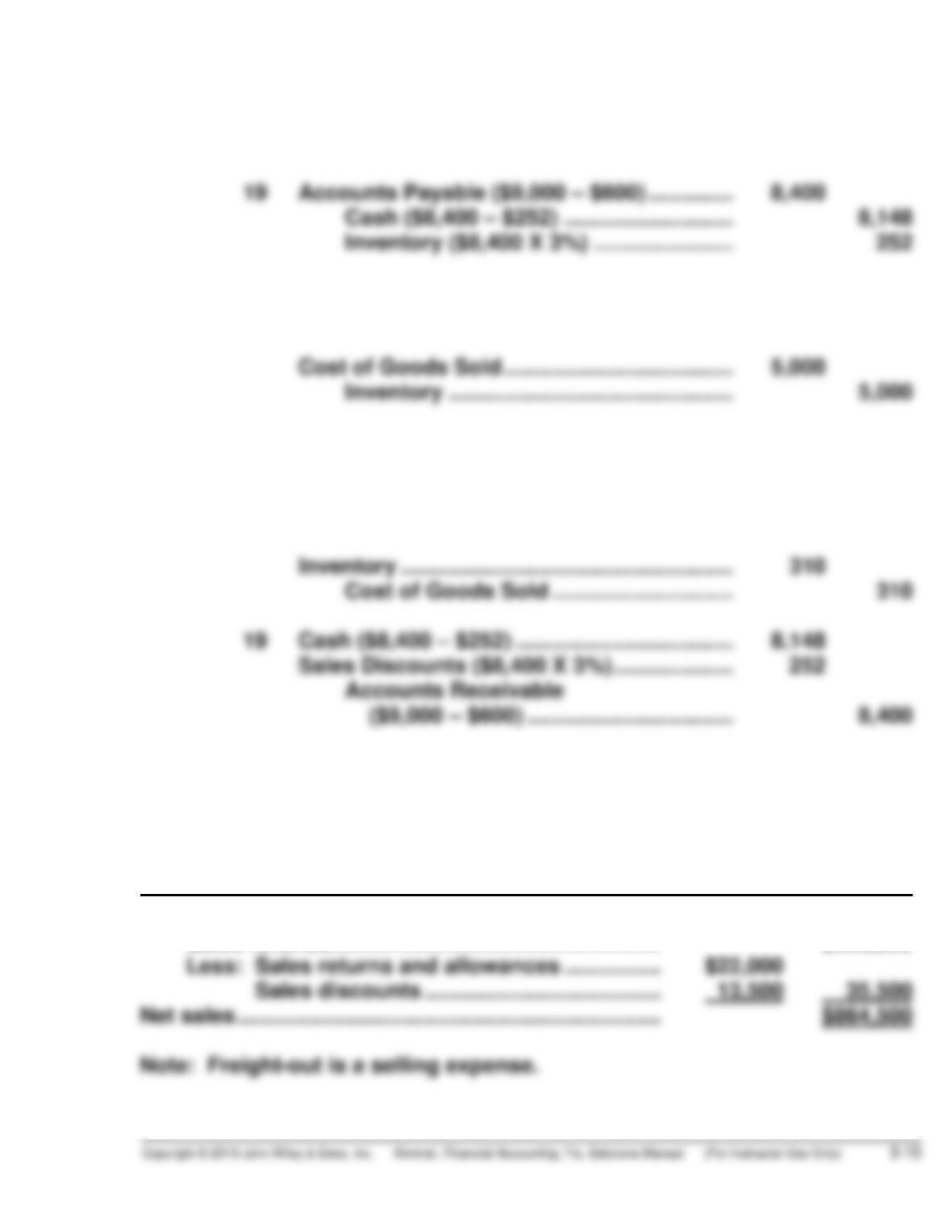
(a) June 10 Inventory …………………………………………… 9,000
EXERCISE 5-4 (Continued)
June 12 Accounts Payable …………………………………. 600
Inventory ……………………………………….. 600
(b) June 10 Accounts Receivable …………………………….. 9,000
Sales Revenue ……………………………….. 9,000
11 No entry
12 Sales Returns and Allowances ………………. 600
Accounts Receivable ……………………… 600
EXERCISE 5-5
HODGES COMPANY
Income Statement (Partial)
For the Year Ended October 31, 2014
Sales
Sales revenue ……………………………………………… $900,000
EXERCISE 5-6
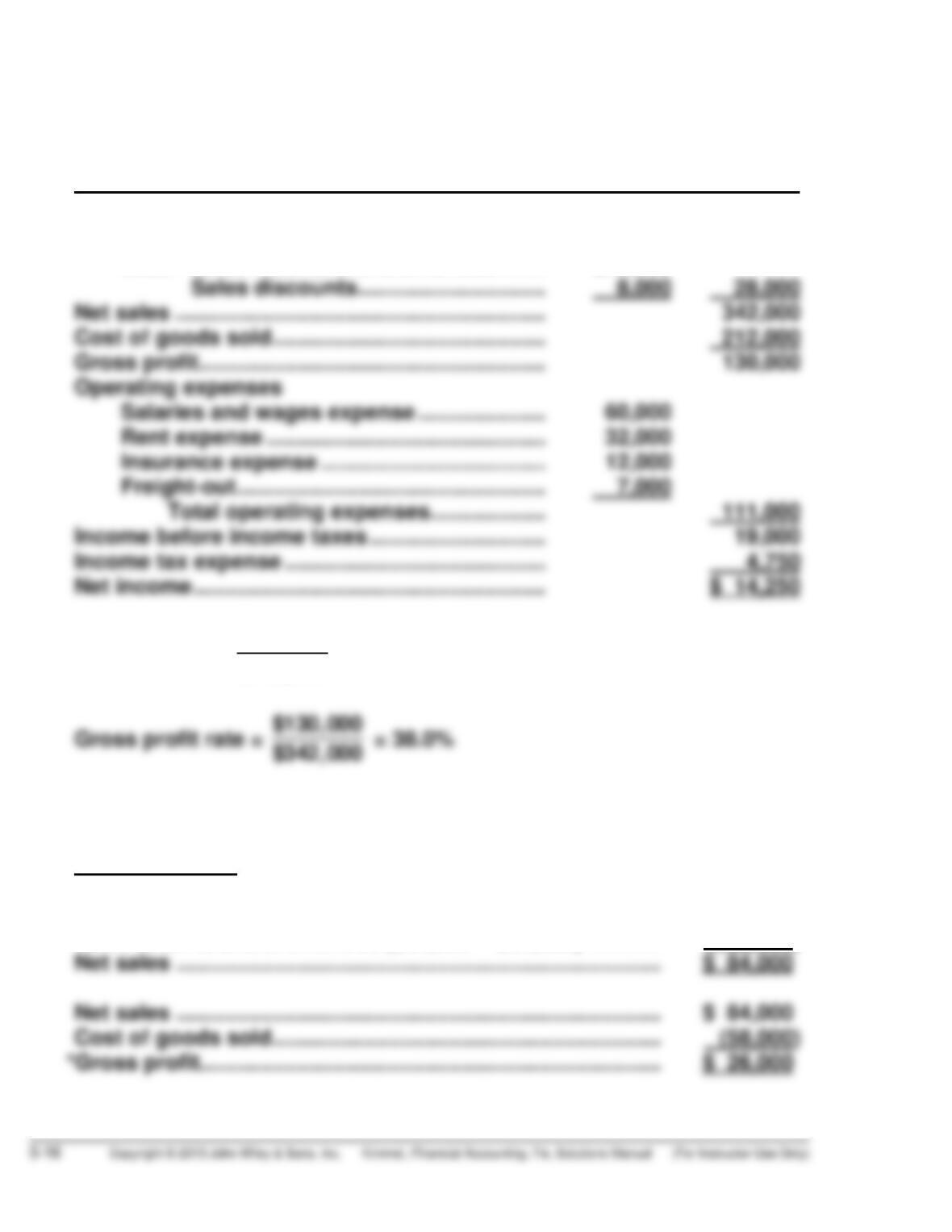
(a) ZHOU Co.
Income Statement
For the Month Ended January 31, 2014
Sales
Sales revenue ……………………………………… $370,000
Less: Sales returns and allowances …….. $20,000
(b) Profit margin = $14, 250
$342, 000 = 4.2%
EXERCISE 5-7
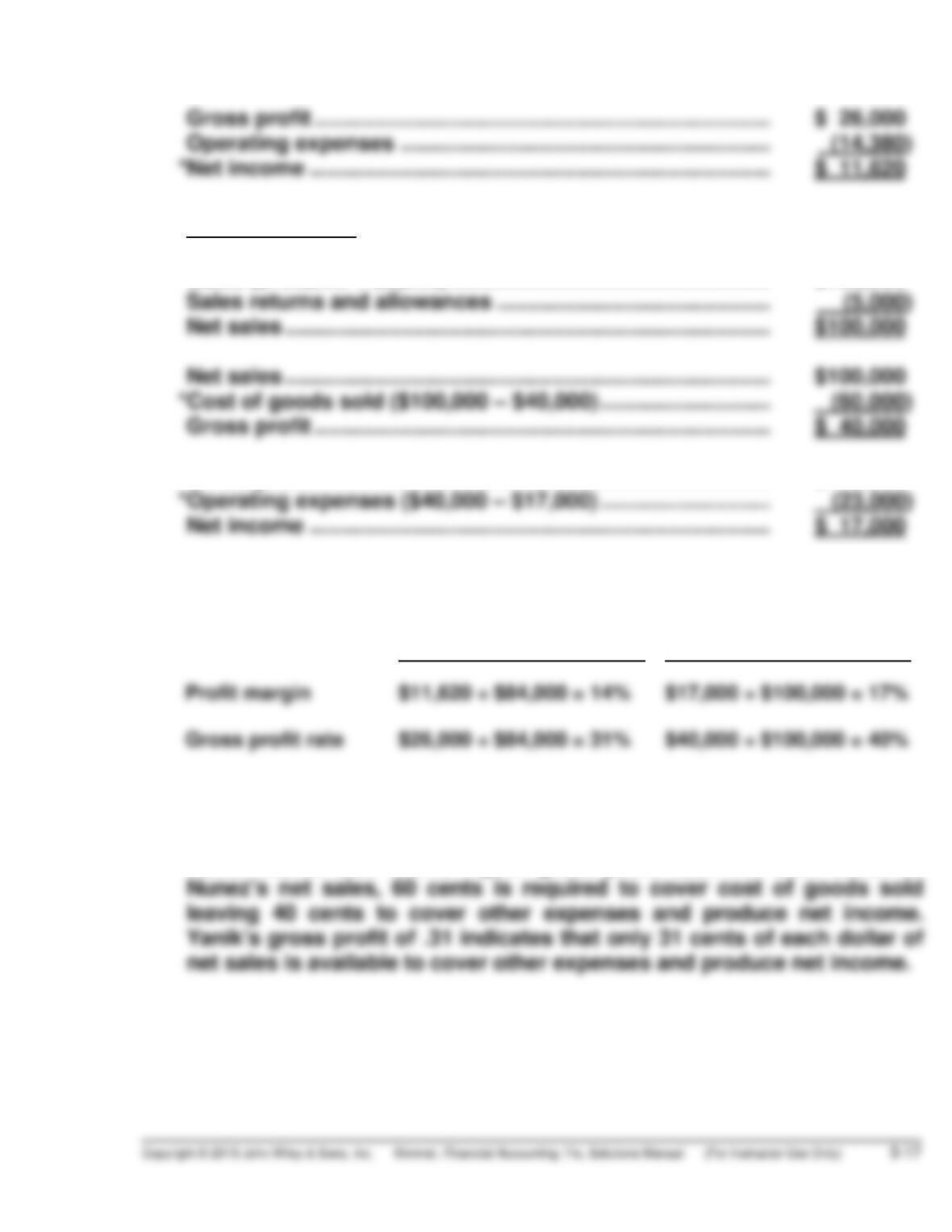
(a) Yanik Company
Sales …………………………………………………………………………… $ 90,000)
*Sales returns and allowances ($90,000 – $84,000) ………… (6,000)
EXERCISE 5-7 (Continued)
Nunez Company
*Sales ($100,000 + $5,000) …………………………………………….. $105,000)
Gross profit ………………………………………………………………… $ 40,000)
*Indicates missing amount
(b)
Y
anik Nunez
(c) Nunez has a higher profit margin than Yanik. Each dollar of net sales by
Nunez results in 17 cents of net income compared to only 14 cents for
Yanik. Nunez also has a higher gross profit rate. For each dollar of
EXERCISE 5-8
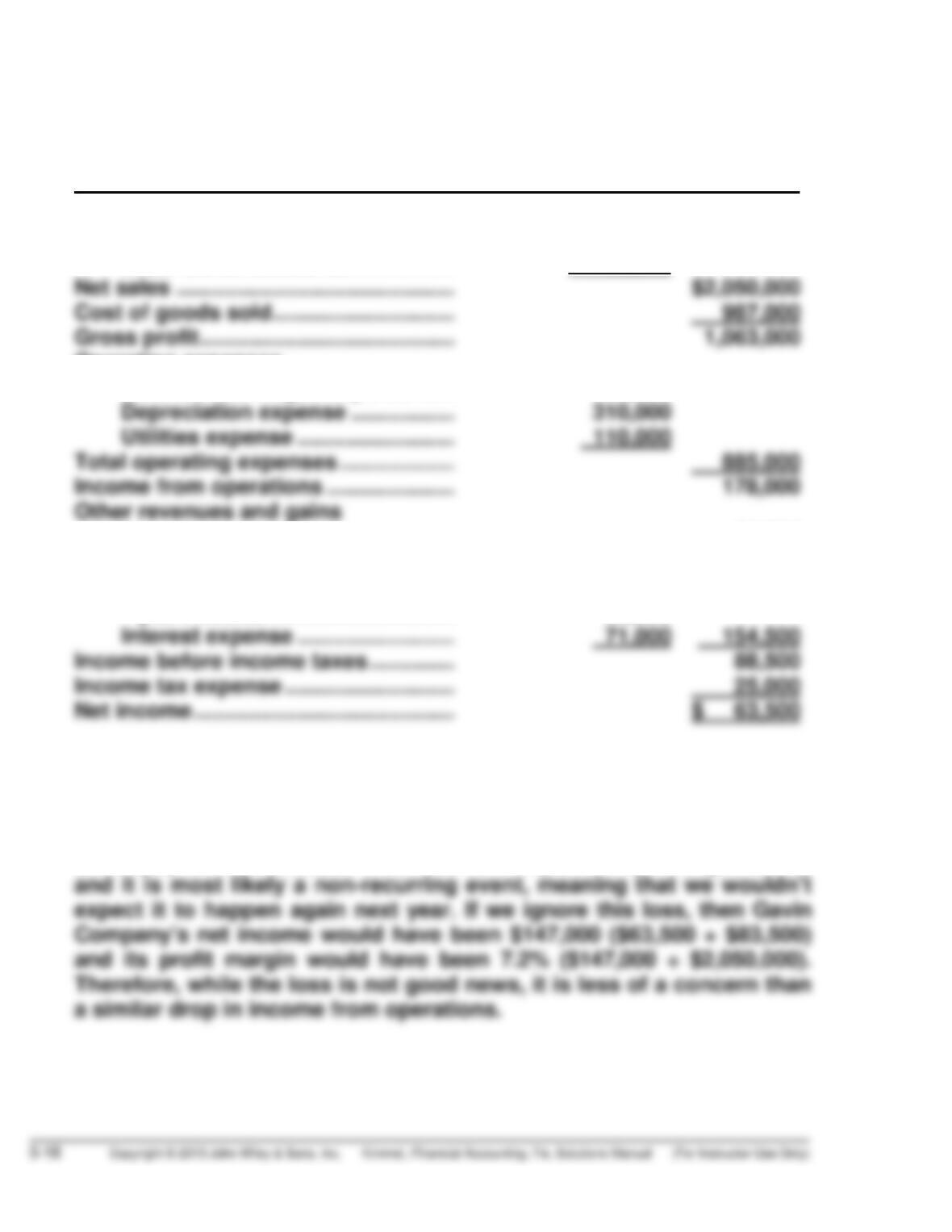
(a) GAVIN COMPANY
Income Statement
For the Year Ended December 31, 2014
Sales
Sales revenue ………………………… $2,210,000
Less: Sales discounts …………….. 160,000
Operating expenses
Salaries and wages expense …… 465,000
Interest revenue ……………………… 65,000
Other expenses and losses
Loss on disposal of
plant assets …………………………. 83,500
(b) Profit margin: $63,500 ÷ $2,050,000 = 3%
Gross profit rate: $1,063,000 ÷ $2,050,000 = 52%
(c) During the current year Gavin had a loss on the sale of property, plant,
and equipment of $83,500. This loss is not part of operating income,
EXERCISE 5-9
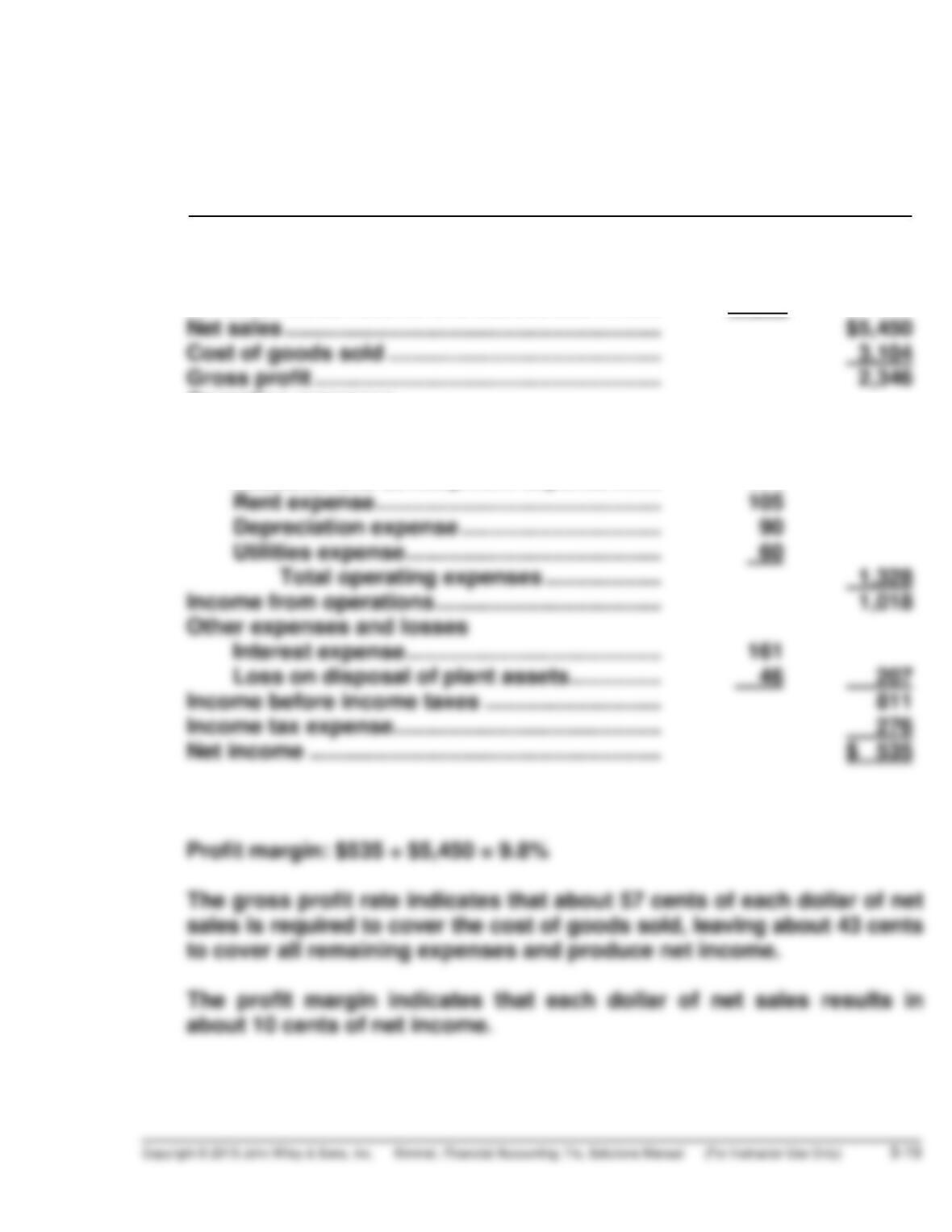
(a) THE CLOROX COMPANY
Income Statement
For the Year Ended June 30, 2014
(amounts in millions)
Sales
Sales revenue ……………………………………….. $5,730
Less: Sales returns and allowances ……….. 280
Operating expenses
Advertising expense …………………………….. 499
Salaries and wages expense …………………. 460
Research and development expense …….. 114
(b) Gross profit rate: $2,346 ÷ $5,450 = 43.0%
EXERCISE 5-9 (Continued)
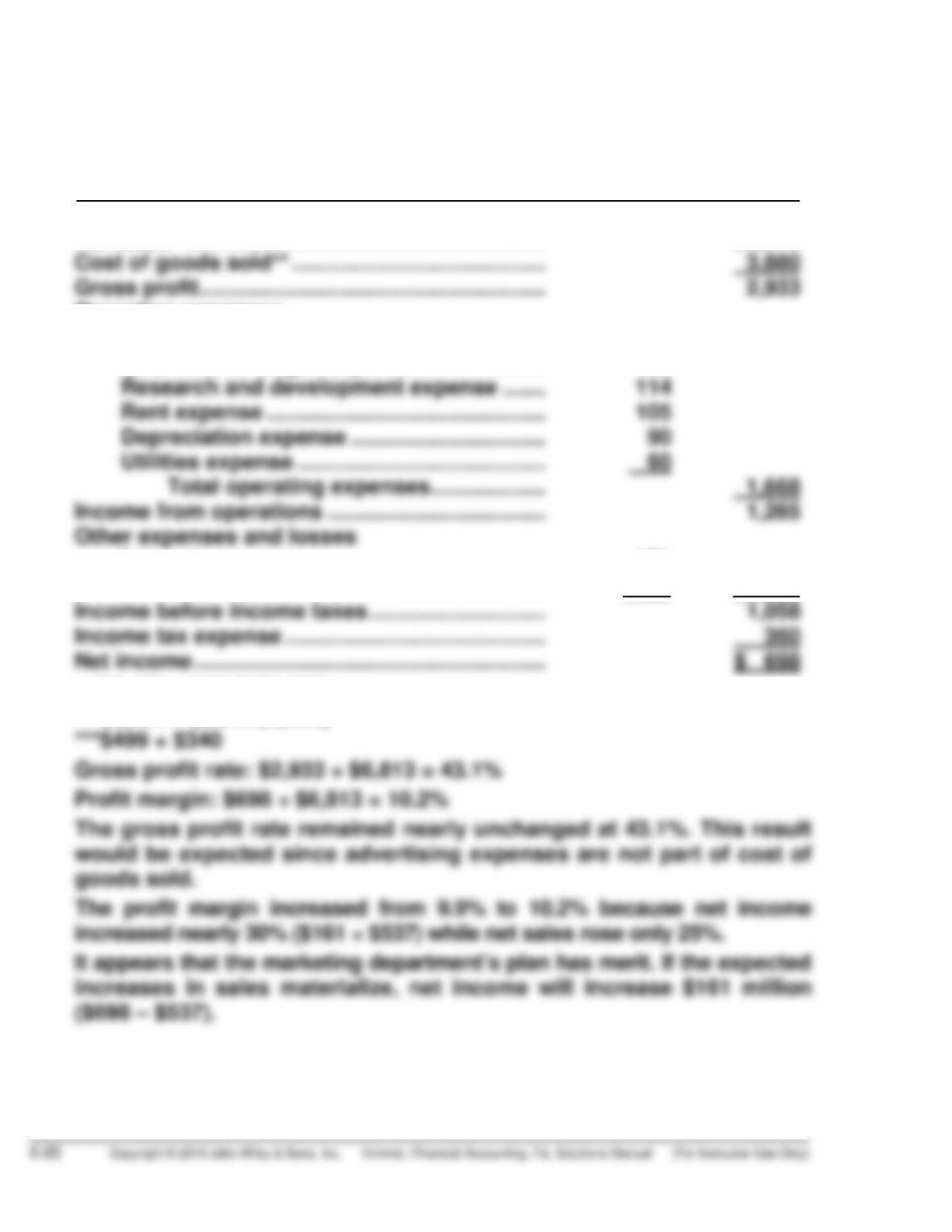
(c) THE CLOROX COMPANY
Income Statement
For the Year Ended June 30, 2014
(amounts in millions)
Sales
Net sales* …………………………………………………… $6,813
Operating expenses
Advertising expense*** ………………………… $839
Salaries and wages expense ………………… 460
Interest expense ………………………………….. 161
Loss on disposal of plant assets ………….. 46 207
*$5,450 + (.25 X $5,450)
**$3,104 + (.25 X $3,104)