
Chapter 5: Postulates, Principles, and Concepts Instructor Manual
Accounting Theory (9
th
edition) Page 1 of 12
CHAPTER HIGHLIGHTS
Chapter 5 starts with an analysis of ARS 1 (by Moonitz) and ARS 3 (by Sprouse and Moonitz),
which were sponsored by the APB at its inception. While the shortcomings of these documents
are discussed in depth, viewing them within the historical context presented in Chapters 5 and 6
is far more important. For example, ARS 1 and ARS 3 say little, if anything, about user
objectives. However user objectives did not begin to make an impact upon accounting theory
until much later in the 1960s.
The chapter closes with a review of the equity theories of accounting. These are essentially
deductive and normative types of theories that attempt to explain the relationship between the
enterprise and its owners. These theories today take a back seat to empirical research findings in
accounting. Nevertheless, they are still useful in terms of assessing certain accounting models.
QUESTIONS
Q-1 Do you think the “broad principles” of ARS 3 are really principles as that term is used in
science?
A principle might be termed as an “enduring truth” in science. Unlike diamonds, however, they
may not last forever. In ARS 3, “principles” are more like rules that are presumed to be useful,
Q-2 “Assuming all other things equal, it is possible that the lower-of-cost-or-market method
can result in any given year in higher income than would be the case under the same
inventory costing method without the use of lower-of-cost-or-market. If so, then
lower-of-cost-or-market cannot be classified as a conservative method.” Do you agree
with this statement? Discuss.
The first statement is true because beginning inventory may be lower as a result of a lower-of-
cost-or-market write-down. If the ending inventory write-down is less than the beginning
inventory write-down, a higher income will occur under lower-of-cost-or-market than would be

Chapter 5: Postulates, Principles, and Concepts Instructor Manual
Accounting Theory (9
th
edition) Page 2 of 12
Q-3 Why is it that postulates stemming from the economic and political climates as well as
the customs and viewpoints of the business community would not serve as a good
foundation for deducing a set of accounting principles?
There is a strong probability (as evidenced by the A and B postulate groups) that these types of
Q-4 Using different studies at different times it still appears to be the case that financial
executives have a higher threshold for materiality than either Certified Public
Accountants or financial analysts who, in turn, have a higher materiality threshold than
users. Why do you think this ordering exists?
Since financial executives are responsible for preparing financial statements, the higher mean for
materiality judgments gives them a greater latitude for error by declaring an item as being non-
Q-5 Do you think that the so-called equity theories of accounting are really theories in the
scientific sense? If so, how would you classify them?
Deductive logic appears to have been implicitly used in determining them. Real rigor was never
used in setting down the premises and subsequently deducing the consequences. Hence, while
Q-6 Why do you think the equity theories are less important today than they were, say, 50
years ago?
Empirically testable hypotheses are much richer in terms of providing insights than the
deductively derived equity theories. The equity theories provide interesting outlooks, but they
Q-7 Four postulates (going concern, time period, accounting entity, and monetary unit) were
discussed as part of the basic concepts underlying historical costing. Can any of the
principles discussed under the same general category be deduced or logically derived
from these postulates?
This question does present some interesting possibilities for discussion. We believe that these
postulates are too broad and general to serve as a foundation for the development of accounting
Chapter 5: Postulates, Principles, and Concepts Instructor Manual
Accounting Theory (9
th
edition) Page 3 of 12
Q-8 How does agency theory (Chapters 2 and 4) differ from the equity theories discussed in
this chapter?
Agency theory is much richer in scope than the equity theories. Agency theory is concerned not
only with owners but also with managers and other parties such as lenders. The firm itself is
Q-9 Does the entity theory or the proprietary theory provide a better description of the
relationship existing between the large modern corporation and its owners?
The entity theory provides a better description of this relationship because stockholders are
Q-10 Why has the entity theory fragmented into two separate conceptions?
There is a duality, as noted in the text, relative to the interpretation of the owners’ equity
Q-11 Of the nine so-called principles shown in Exhibit 5-1, which do you think are the most
important in terms of establishing a historical costing system?
This is an open-ended question that should generate good discussion. In our opinion, realization
and matching are the most important because they define the essence of the expense-revenue
Chapter 5: Postulates, Principles, and Concepts Instructor Manual
Accounting Theory (9
th
edition) Page 4 of 12
Q-12 What is the difference between owners’ equity accounts representing shareholders’
claims as equity holders versus shareholders’ interests as owners?
The conception of owners’ equity accounts representing shareholder claims is much weaker than
Q-13 Postulates are supposed to be tight enough to prevent conflicting conclusions being
deduced from them. Is this the case with ARS 1?
Q-14 Is it fair to categorize ARS 1 and ARS 3 as failures?
No, it is not fair. ARS 1 and ARS 3 should be seen in the historical context in which they arose.
After years of putting out brushfires, it was suddenly decided to pursue a more conceptually
Q-15 How do the imperative postulates (group C) differ from the other two categories of
postulates?
Q-16 Distinguish among the terms realized, realizable, and realization.
Realized and realizable are terms referring to the assets that have been received or will be
received as a result of the firm’s revenue recognition function. Realized means that either cash
has been received or a legitimate claim (accounts receivable) is in place. Realizable refers to the
ability to convert assets already held into known amounts of cash or claims to cash. Certain
Chapter 5: Postulates, Principles, and Concepts Instructor Manual
Accounting Theory (9
th
edition) Page 5 of 12
Q-17 How does conventional retained earnings differ from entity equity under the Anthony
conception of the entity theory?
Q-18 What inconsistencies does Merino see in the proprietary theory at the turn of the
twentieth century before the advent of entity theory?
According to Merino, proprietary theorists wanted to focus upon absentee owners and the large
Q-19 Why is earnings-per-share calculation an example of the residual equity of a firm being
broader than merely its current common shareholders?
Q-20 Why is the residual equity theory more in line with recent research in finance than entity
and proprietary theory?
This is because preferred stock has been viewed as debt leaving the common stock as the sole
residual equity component. Hence, common stock and residual equity are one and the same.
Q-21 Why do you think that security prices are impacted more by “bad news” than “good
news”?
Chapter 5: Postulates, Principles, and Concepts Instructor Manual
Accounting Theory (9
th
edition) Page 6 of 12
Q-22 Why do you think that operating ratios (return-on-assets) are more sensitive to the
combined effect of immateriality items than would be the case with solvency ratios
(debt-to-equity and current ratios)?
It is quite likely that profitability ratios involve relatively smaller numbers – income numbers –
Q-23 At present time, the U.S. federal income tax code allows corporations to deduct interest
expense but not cash dividends paid to stockholders. Does the tax code tie in with any of
the equity theories?
Yes. The tax code is definitely proprietarily oriented. Dividends are not tax deductible on the
Q-24 Why does it make sense to define materiality from the user’s perspective?
Q-25 What similarities are there between materiality and disclosure?
Accounting information is considered material if its omission or misstatement affects decision-
Q-26 Discuss how the concept of conservatism may be changing as viewed by Watts.
Watts, Ross (2003a). “Conservatism in Accounting Part I: Explanations and Implications,”
Accounting Horizons (Sept. 2003), pp. 207-221.
Chapter 5: Postulates, Principles, and Concepts Instructor Manual
Accounting Theory (9
th
edition) Page 7 of 12
CASES, PROBLEMS, AND WRITING ASSIGNMENTS
1.
Assume the following for the year 2000 for the Staubus company:
Revenues $1,000,000
Operating expenses
Cost of goods sold $400,000
Depreciation 100,000
Salaries and wages 200,000
Bond interest (8% Debentures sold at maturity value
of $1,000,000) 80,000
Dividends declared on 6% Preferred Stock (par value
$500,000) 30,000
Dividends declared of $5 per share on Common Stock
(20,000 shares outstanding a par value of $100 per
share) 100,000
Chapter 5: Postulates, Principles, and Concepts Instructor Manual
Accounting Theory (9
th
edition) Page 8 of 12
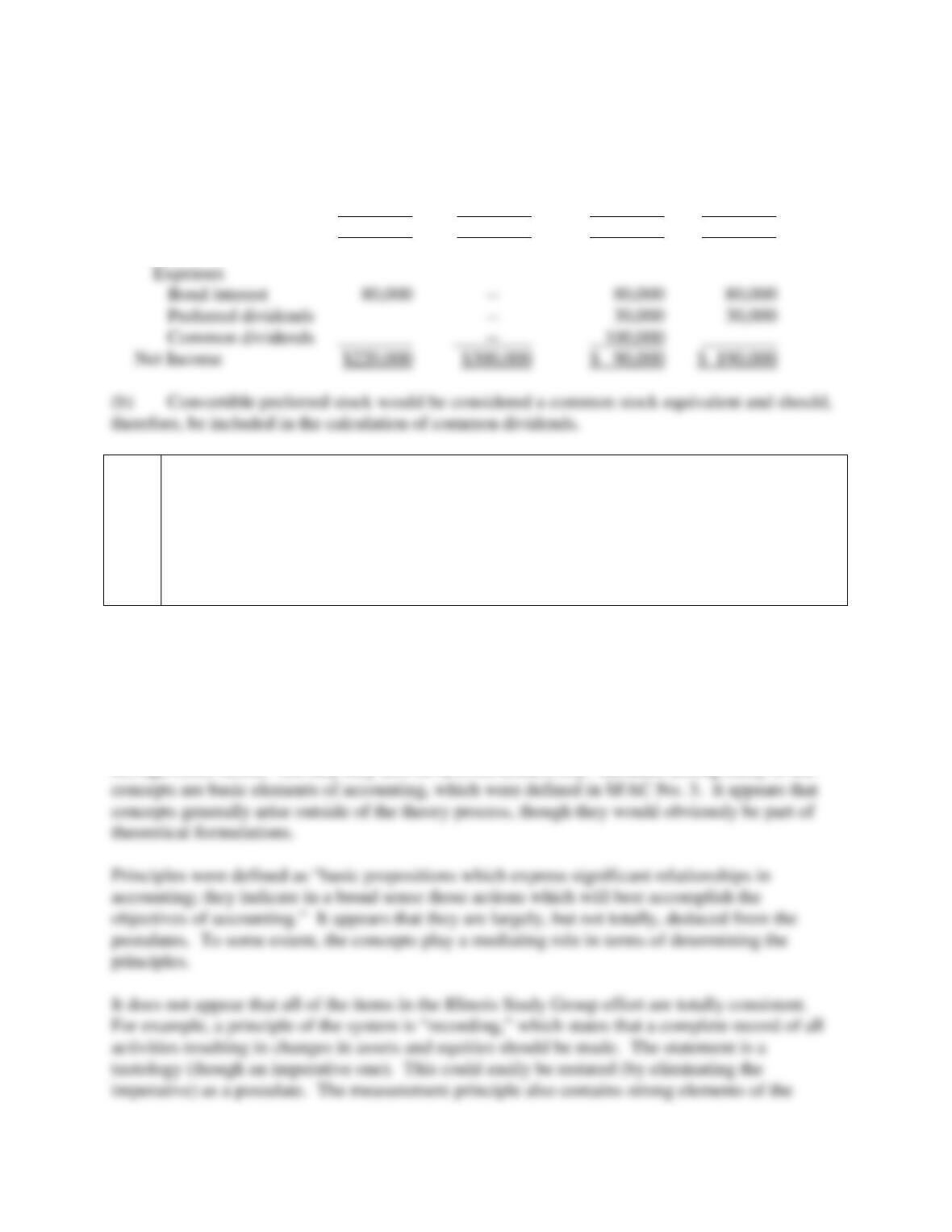
(a) Proprietary Orthodox Unorthodox Residual
Entity Entity Equity
Revenues $1,000,000 $1,000,000 $1,000,000 $1,000,000
Operating Expense 700,000 700,000 700,000 700,000
Operating Income 300,000 300,000 300,000 300,000
Other Revenues and
2. Critique A Statement of Basic Accounting Postulates and Principles by a study group at
the University of Illinois (it should be on reserve or otherwise made available to you).
Your critique should cover, but not be restricted to, the following points:
How do the definitions of postulates, concepts, and principles differ?
Are the examples of postulates, principles, and concepts consistent with their definitions?
Does this set of postulates, principles, and concepts provide a legislative body with a
useful framework for deriving operating rules?
The Illinois Study Group did a study entitled A Statement of Basic Accounting Postulates and
Principles, which appeared in 1964, shortly after ARS 1 and ARS 3. Postulates were defined in
the Statement in much the same way they were defined in ARS 1—as “underlying assumptions”
that are viewed as being valid. Further discussion appears to make it clear that postulates are
intended to be descriptive in nature. However, it also is made clear that other propositions will
be deduced from them. Concepts, according to the Illinois Study Group, “are formed primarily
Chapter 5: Postulates, Principles, and Concepts Instructor Manual
Accounting Theory (9
th
edition) Page 9 of 12
3. List and briefly discuss as many areas as you can in which an accepted method or
technique is conservative, including why it is conservative.
The examples that will be used here, in following the chapter definition, will be relative and will
therefore compare alternatives. We will also cite other reasons that may underlie the situation.
The classic example is lower-of-cost-or-market, which is conservatism in its purest form. This
technique is still applicable to inventories, but since SFAS No. 115, it no longer applies to
marketable equity securities.
SFAS No. 19’s attempt to allow only successful efforts by oil and gas producers is conservative.
As with research and development costs, however, verifiability would be improved by allowing
only one method.
Only loss contingencies (SFAS No. 5) are recognized (provided they are probable and can be
reasonably estimated), whereas gain contingencies are not recognized.
Chapter 5: Postulates, Principles, and Concepts Instructor Manual
Accounting Theory (9
th
edition) Page 10 of 12
4. (Based on an article by nationally syndicated columnist Michael Kinsley). A few years
ago both Halliburton Corporation, a large construction company, and its auditor, Arthur
Andersen, were chided for allowing Halliburton to book a percentage of cost overruns
that Halliburton attempted to collect from customers after projects were completed, but
before both agreed settlements with customers and, of course, collection thereof. The
practice of trying to collect cost overruns in the construction industry is not uncommon.
Until 1998, cost overrun collections were not booked until received. Since that time,
Halliburton “began guessing how much of a disputed surcharge would ultimately get paid
and crediting itself in advance.”
Required:
Is there a case that can be made for allowing Halliburton to book these overruns? What
arguments, if any, support Halliburton’s accounting methods?
What situations should prevent Halliburton from booking these overruns prior to
collection?
a. The strongest case for allowing Halliburton’s approach is that (a) the work is completed
and (b) it is an industry practice to attempt to collect cost overruns. It is also to
Halliburton’s advantage that they are attempting to estimate portions that will be
collectable assuming that the collectable portion is a legitimate estimate rather than an
attempt to “pump up” current earnings. This practice may also provide a better matching
Chapter 5: Postulates, Principles, and Concepts Instructor Manual
Accounting Theory (9
th
edition) Page 11 of 12
CRITICAL THINKING AND ANALYSIS
1. How permanent do you think the postulates and principles underlying historical costing
will be?
Like everything else, some degree of change is bound to occur. The postulates may stay around
but how much influence they will have is another matter. We have already mentioned that going
concern leads to a logical dead end. Accounting entity will be important but the actual concept
itself may change. For example, an increasing number of firms now have strategic alliances with
each other without affecting ownership. We wonder if there will be some recognition of this on
the balance sheet. While the monetary unit still appears to be stable, it is possible that current
values will be enhanced on the balance sheet even though significant verifiability problems still
exist with unique items of plant and equipment.
2. If you could relate materiality, disclosure, and conservatism to types of measurements
(nominal, ordinal, interval, and ratio scale), how would you do so?
Materiality would likely be a nominal measure. Is it material, yes or no? If an item is material,
to what extent do you disclose (in financial statements only, notes only, both financial statements
and notes). These would likely be interval metrics. Conservatism could be measured using a

Chapter 5: Postulates, Principles, and Concepts Instructor Manual
Accounting Theory (9
th
edition) Page 12 of 12
3. Zeff (2007) describes the SEC’s positions regarding historical costing in the 20
th
century,
eventually questioning whether the United States has ever “had a private-sector process
for establishing ‘generally accepted accounting principles’. To what extent do you
agree/disagree with Zeff’s point?
Zeff, Stephen A. (2007 Special Issue). “The SEC Rules Historical Cost Accounting: 1934 to the
1970s.” Accounting & Business Research, 49–62.