Chapter 5
The Accounting Cycle Completed
Chapter Overview
This chapter begins with a review of the entire accounting cycle while concentrating on journalizing and
posting adjusting entries. Once adjusting journal entries are completed and posted, certain accounts in the
general ledger are closed for the accounting period. Closing entries are used to return the balances of
temporary accounts (revenue, expenses, withdrawals) to zero. These accounts begin the next accounting
period with a zero balance and can accurately measure the total activity in each account for the year.
Closing entries are also used to modify the balance in the owner’s equity account to reflect the income, loss,
and withdrawals that occurred during the year.
Four closing entries are generally needed:
2) Expenses are closed into the temporary account called “Income Summary”.
4) Withdrawals for the year are closed into Capital.
After the closing entries are prepared and posted, a post-closing trial balance is prepared. This trial balance
consists solely of balance sheet accounts since all other accounts have a zero balance at this point in time.
Learning Objectives
After studying Chapter 5, your students should gain proficiency in the following:
1. Journalize and Post Adjusting Entries.
3. Prepare a Post-Closing Trial Balance.
Chapter 5 Assignment Grid
Estimated Level
Learning Time in of
Assignment Topic(s) Objective(s) Minutes Difficulty
Discussion Questions and Critical Thinking/Ethical Case
1 Worksheet completion 1 5 Easy
2 Adjusting Entries 1 5 Easy
3 Closing Entries 2 5 Medium
Concept Checks
1 Journalizing and Posting Adjusting Entries 1 5 Easy
2 Steps of Closing & Journalizing Closing Entries 2 10 Medium
Exercises (Set A)
5A-1 Adjusting Journal Entries 1 15 Easy
5A-2 Permanent and Temporary Accounts 1, 2 10 Easy
Exercises (Set B)
5B-1 Adjusting Journal Entries 1 15 Easy
Problems (Set A)
5A-1 Worksheet, Adjusting and Closing Entries 1, 2 40 Medium
Problems (Set B)
5B-1 Worksheet, Adjusting and Closing Entries 1, 2 40 Medium
Learning Time in Level of
Assignment Topic(s) Objective(s) Minutes Difficulty
Financial Report Problem
Reading Amazon’s Annual Report 3 15 Easy
Keeping It Real
Suarez Computer Center 1, 2, 3 60 Medium
Mini Practice Set
Sherman Realty 1, 2, 3 5 hours Medium
Computerized Accounting Application
Chapter 5
The Accounting Cycle Completed
Introduction Summary:
In Chapters 3 & 4, we completed the following steps of a manual accounting systems:
1) Business transactions occurred and generated source documents.
3) Information was posted or transferred from journal to ledger.
5) A worksheet was completed.
Chapter 5 covers the following steps needed to complete the accounting cycle:
7) Journalizing and posting adjusting entries.
9) Preparing a post-closing trial balance.
Learning Unit 5-1: Adjusting Entries (Step 7 of the Accounting
Cycle)
Summary: Adjusting journal entries are journal entries needed to update ledger accounts so they can
reflect the correct balances at the end of an accounting period. The information in the worksheet is up-to–
date, but the worksheet is an informal report. The information concerning the adjustments has not been
Key Concepts: Adjusting journal entries
Lecture Outline:
1) Adjusting journal entries:
a) are needed to update specific ledger accounts to reflect correct balances at the end of an accounting
period.
b) show debits and credits in the adjustment columns of the worksheet, (See Fig 5.1)
Teaching Tips/Strategy:
Use the “Ten-Minute Quiz” questions #1 and #4 to reinforce Learning Objective 5-1 concepts.
Learning Unit 5-2: Closing Entries (Step 8 of the Accounting Cycle)
Summary: Permanent (real) accounts are accounts whose balances are carried over to the next accounting
period. The balances that do not change when a new accounting period begins are: assets, liabilities, and
capital accounts. Temporary (nominal) accounts are those accounts whose balances are not carried over to
Key Concepts: Permanent (real) accounts, temporary (nominal) accounts, closing journal entries, income
summary
Lecture Outline:
1) Permanent v. temporary accounts
a) Permanent (real) accounts:
i) have balances that are carried over to the next accounting period.
b) Temporary (nominal) accounts:
i) have balances not carried over to the next accounting period.
ii) help summarize the total activity for an accounting period.
2) Closing process:
a) totals the revenue and expense accounts for the accounting period.
3) Closing journal entries:
4) Four types of closing entries:
a) Step #1: Close Revenues (see Fig. 5.5)
i) Revenue accounts are individually closed into Income Summary.
ii) Revenues have a credit balance. Closing entries debit the revenue accounts.
Dr. Revenue XX
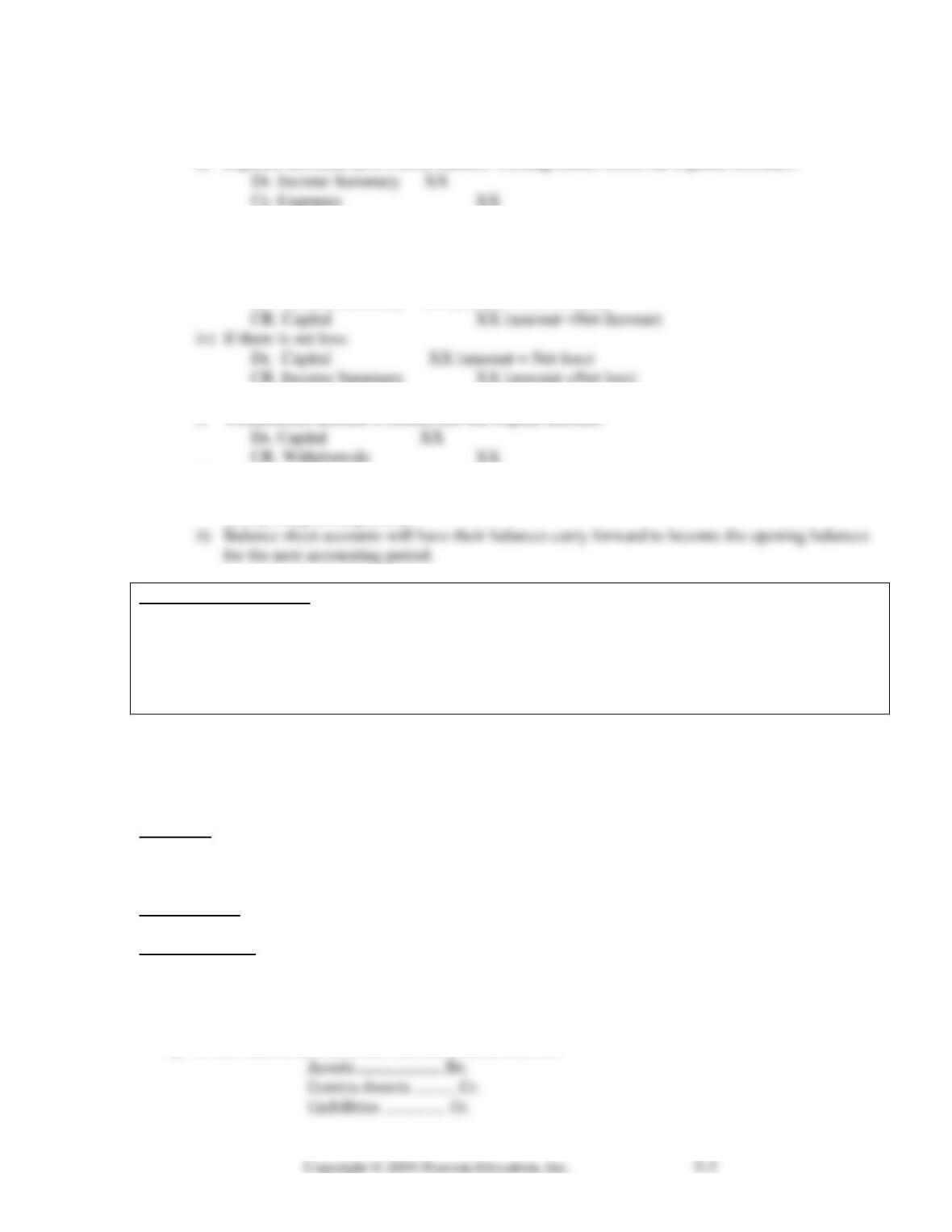
b) Step #2: Close Expenses (see Fig. 5.6)
i) Expense accounts are individually closed into Income summary.
ii) Expense accounts have a debit balance. Closing entries credit the expense accounts.
Cr. Expenses XX
c) Step #3: Close Income Summary
i) Income Summary is used to determine if you have a net income or net loss.
ii) Income summary is closed into the Capital account.
iii) If there is net income: (See Fig. 5.7)
Dr. Income Summary XX (amount = Net Income)
CR. Income Summary XX (amount =Net loss)
d) Step #4: Closing withdrawals: (See Fig. 5.8)
i) Withdrawals account is closed into the Capital account.
e) The closing entries are posted to the general ledger.
i) Revenues, expenses, withdrawals, and Income Summary account balances should equal zero
after posting closing entries.
Teaching Tips/Strategy: Differentiate between temporary and permanent accounts. Utilize Exercise 5A-2
to indicate the correct category for each account. Use the “Success Coach” LU 5-2 to review and explain
the concept of closing entries. Demonstrate the closing process with the Concept Checks #2, #3, #4 and #5.
They will review the proper closing sequence which includes journalizing and posting of the closing entries.
Use the “Ten-Minute Quiz” questions #2, #3, #5, #6, #7, #8 and #10 to reinforce the Learning
Objective 5-2 concepts.
Learning Unit 5–3: The Post-Closing Trial Balance (Step 9 of the
Accounting Cycle)
Summary: After adjusting and closing entries have been posted, the balances from the permanent accounts
are used to create the post-closing trial balance. These post-closing balances are the opening balances for
the new accounting period.
Key Concepts: Post-closing trial balance
Lecture Outline:
1) Post-closing trial balance:
a) contains only permanent accounts.
b) is one where all temporary accounts have been closed.
c) is one where all temporary accounts are summarized in the capital account.
d) is one where, the structure should look as follows:
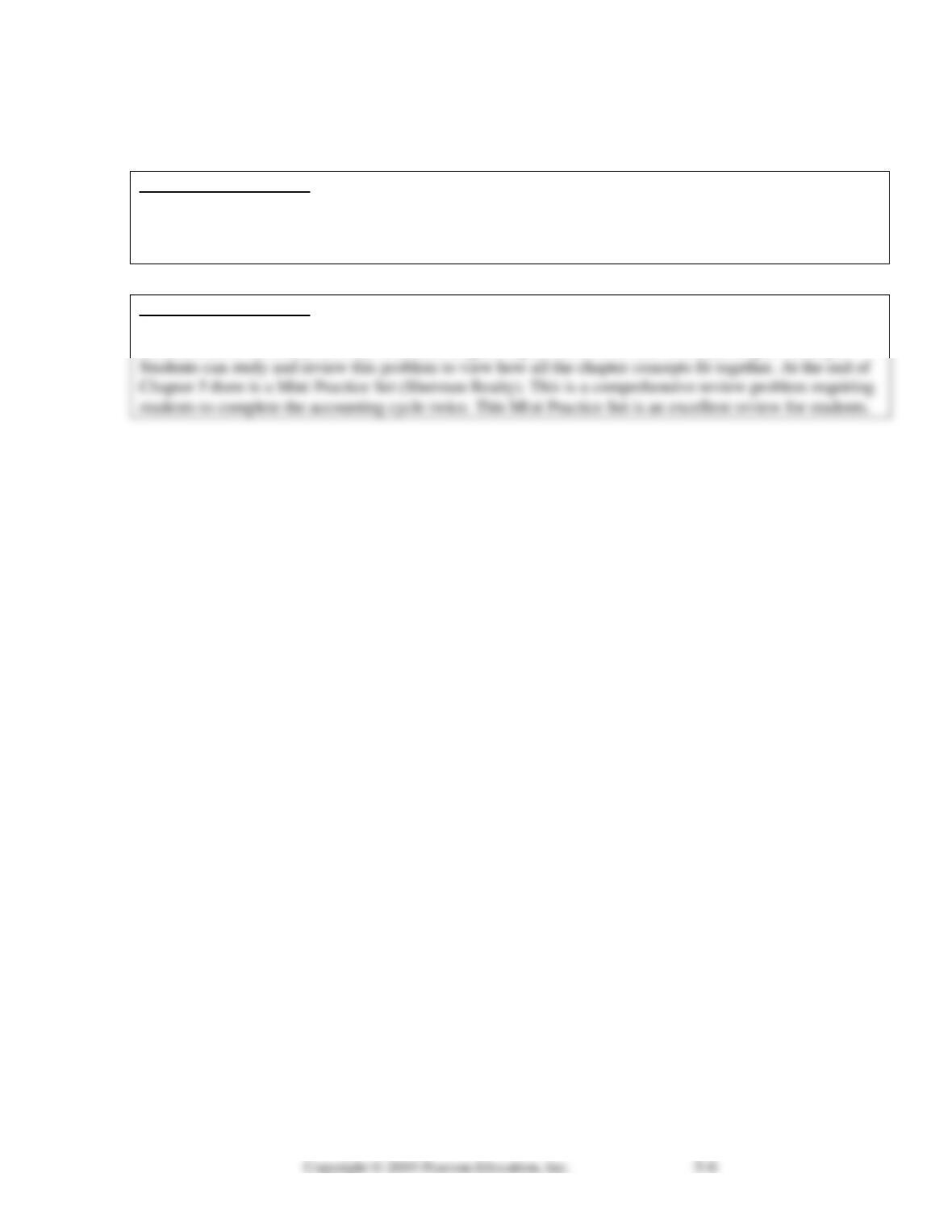
Ending Capital …..….. Cr.
e) Only assets, liabilities, and the ending capital should be presented.
Teaching Tips/Strategy: Use the “Success Coach” LU5-3 to review and apply critical thinking skills
related to the post-closing trial balance. Exercises 5A-5 and 5B-5 are excellent for classwork to evaluate
student understanding of the objective.
Use the “Ten-Minute Quiz” question #9 to reinforce the Learning Objective 5-3 concepts.
Teaching Tips/Strategy: Each chapter contains a “Try It!” at the end of each Learning Unit. The ”Try its!”
are intended as practice for students and/or as checking of student understanding. There is also a
Demonstration Summary Problem with each chapter to provide an overview of all the chapter concepts.

Name Date Section
CHAPTER 5
TEN-MINUTE QUIZ
Circle the letter of the best response.
1. Which of the following is not an adjusting entry?
a. The supplies used during the period.
b. The cash payment on a note from the bank.
c. The depreciation of equipment.
d. The salaries owed but not yet paid.
2. Which of the following accounts is a permanent account?
a. Cash
b. Salary expense
c. Interest income
d. Revenue
3. Which of the following accounts is a temporary account?
a. Cash
b. Accounts Payable
c. Capital
d. Revenue
4. Which of the following is an adjusting entry?
a. Accounts receivable is closed to reflect the amounts paid during the year.
b. Depreciation on automobiles is $1,000 for the year.
c. Revenues are closed to reflect the revenue earned but not yet received.
d. Capital is closed to reflect the withdrawals during the year.
5. Which of the following accounts is a closing entry?
a. Accounts receivable is closed to reflect the amounts paid during the year.
b. Salary expense is closed to reflect the salaries owed but not yet paid.
c. Revenues are closed to allow an accurate account of annual revenue.
d. Capital is closed to reflect the withdrawals during the year.
6. What is the correct way to close expenses?
a. Debit expenses and credit Capital.
b. Debit Capital and credit expenses.
c. Debit expenses and credit Income Summary.
d. Debit Income Summary and credit expenses.
7. What is the correct way to close withdrawals?
a. Debit withdrawals and credit Capital.
b. Debit Capital and credit withdrawals.
c. Debit withdrawals and credit Income Summary.
d. Debit Income Summary and credit withdrawals.
8. The entry to close Income Summary
a. depends on the total amount of revenues and total amount of expenses.
b. is always a debit to Income Summary and a credit to Capital.

c. is always a debit to Capital and a credit to Income Summary.
d. never occurs.
9. A post-closing trial balance
a. only reflects the balance sheet accounts.
b. only reflects the changes during the year.
c. shows every account has a zero balance
d. does not show total debits equal total credits.
10. Which of the following is not true?
a. All information from closing can be obtained from the worksheet or ledger.
b. Closing entries are usually done only at year-end.
c. Assets, liabilities, and capital are temporary accounts.
d. When closing is complete, all revenue accounts will have a zero balance.
Answer Key to Chapter 5 Quiz
1. b