————–———————-————–———— CHAPTER 5 —————-———-————–——
REVIEW QUESTIONS
Q5-1. Establishing an allowance for uncollectible property taxes causes revenues to be recognized in an
Q5–2. Property tax revenues are recognized in the fiscal period for which the taxes are levied, provided the
Q5–4. Revenues from sales taxes and personal income taxes are derived from underlying exchanges.
Revenues from those taxes are recognized (net of refunds and other uncollectible amounts) in the period the
Q5–5. A government will record deferred revenues when:
a. property taxes will not be collected in time to pay liabilities of the current period; that is, more
Q5–6. Revenues on intergovernmental grants accounted for in governmental-type funds are recognized
Q5–7. As applied to the recognition of expenditures in governmental–type funds, the phrase “normally
expected to be liquidated with expendable available financial resources” means that the liability has
Q5–8. The four categories of interfund transactions are: interfund loans, interfund services provided and
Q5–9. Depreciation is not recorded in governmental-type funds because it is an expense, not an
Q5-10. Under the purchases method of accounting for expenditures, the entire cost of inventory purchased
during the year is charged to expenditures. Accounting standards require that material amounts of inventory
Q5-12. Fund balance is reported in five classifications to help users of financial statements determine the
extent to which an entity is free to use its available fund balance for general governmental purposes. Fund
Q5-13. Open encumbrances at year-end result from unfulfilled purchase orders or contracts; that is, the
DISCUSSION ISSUES AND SCENARIOS
D5-1 The governor probably likes the standard for pension accounting within the General Fund because
the standard does not require recognizing pension and retiree health care expenditures on the accrual basis
of accounting. The accrual basis requires recognizing pension and retiree health care expenditures as the
benefits are earned by active employees. The modification to accrual basis accounting, permitted by the
D5–2. The “current financial resources measurement focus” was a source of controversy before GASB
Statement No. 34, and remains so. Some issues that students might raise in response to this question are:
a. On the resource inflow side, the term “current” is not defined consistently. For property taxes,
“available to pay liabilities of the current period” assumes that the liabilities, once incurred, will
be paid within 60 days (unless unusual circumstances justify a greater period of time). (This
b. The standard regarding property taxes is that revenues are recognized in the fiscal period for
c. The resource outflow side raises even more concerns, because recognition of some financial
resource outflows depends not on when the government incurs the liability, but rather on when the
What kind of message does the fund operating statement convey? One can argue the operating statement is
more like a modified cash flow statement than a statement that assesses whether the resource inflows were
sufficient to cover the costs of services received by the citizens during a particular year. Although the
modifications provide some discipline (e.g., salaries earned but not paid need to be accrued), the statement
is nevertheless subject to the same kinds of manipulation that cash flow statements are subject.
What kind of message does the fund balance sheet convey? The net financial resources “available” for
spending are available only to the extent one chooses to ignore the failure to finance certain salary-related
D5–3. Councilwoman Doubleton is correct to the extent that the city will probably obtain the tax revenues
eventually. The problem, however, is that several years may elapse before the city forecloses on the
D5–4. The action proposed by Mayor Babitt has actually been taken by many governments. Nevertheless,
it is a flawed practice, because it is tantamount to borrowing for the purpose of financing current operating
D5–5. Sutter’s action may be both unethical and illegal. Being the city assessor and an active member of
Homes for People and using his position as city assessor to forgive the payment in lieu of taxes (PILOT),
EXERCISES
E5-1 (Moderate – 15 minutes)
1. Property taxes receivable 2,000,000
2. Allowance for refunds and uncollectible taxes 60,000
3. Cash 1,800,000
4. Property taxes receivable – delinquent 140,000
5. Revenues – property taxes 25,000
1. Property taxes receivable 1,000,000
2. Cash 693,000
Allowance for discounts on property taxes 6,000
3. Cash 275,000
Property taxes receivable 275,000
To record collections of property taxes.
E5-3 (Moderate – 15 minutes)
1a. Expenditures – special education 450,000
2a. Cash 100,000
b. Expenditures – special education 65,000
E5-4 (Moderate – 25 minutes)
2. $16,000. Earned vacation pay is a liability that is recognized in governmental funds when
E5-5 (Moderate: 10 minutes)
E5-6 (Moderate: 15 minutes)
1. Entries are needed to close the encumbrances and record an assignment of fund balance, as follows:
Budgetary fund balance reserved for encumbrances 75,000
2. Entries are needed to restore the encumbrances and reverse the assigned classification, as follows:
Encumbrances 75,000
E5-7 (Moderate:20 minutes)
1. This is an example of interfund services provided and used. Journal entries are:
General Fund
Expenditures – electric services 15,000
2. This is an example of an interfund loan (short-term). Journal entries are:
General Fund
Due from Parks Special Revenue Fund 30,000
3. This is an example of an interfund transfer. Journal entries are:
General Fund
Transfer out to Mass Transit Authority 50,000
E5-8 (Moderate: 5 minutes)
Supplies inventory 8,000
E5-9 (Moderate: 10 minutes)
Nonspendable fund balance – supplies inventory $112,000
E5–10 Home study problem.
E5–11 (Moderate – 15 minutes)
1. a
PROBLEMS
P5-1 (Moderate – 15 minutes)
1. Cash 3,250,000
2. Personal income taxes receivable 400,000
To 2012.
3a. Personal income taxes receivable 55,000
Revenues – personal income taxes 220,000
P5-2 (Moderately difficult – 30 minutes)
1. Property taxes receivable 1,515,000
2. Cash 1,534,000
3. Deferred property tax revenues 15,000
4. Tax liens receivable 9,000
Revenues – interest and penalties 1,000
5. Cash 37,000
Tax liens receivable 9,000
6. Allowance for uncollectible taxes – delinquent 8,000
7. Allowance for uncollectible taxes 12,000
8a. Property taxes receivable – delinquent 25,000
Property taxes receivable 25,000
To record unpaid receivables as delinquent.
b. Allowance for uncollectible taxes 3,000
P5-3 (Moderate – 15 minutes)
1. Revenues – property taxes 25,000
Deferred property tax revenues 25,000
2. Sales taxes receivable 195,000
Revenues – sales taxes 195,000
3. Due from state government 65,000
Advance received on grant 175,000
P5-4 (Moderate: 15 minutes)
1. Expenditures – salaries 620,000
Accrued salaries payable 620,000
2. No accrual is needed
3. Expenditures – retiree health care benefits 18,000
Accrued liabilities 18,000
Principle: Pensions and retiree health care benefits paid from the General Fund are recognized in an
P5-5 (Moderate: 15 minutes)
1. a
2. c
P5-6 (Moderate: 20 minutes)
1. General Fund
Due from Special Revenue Fund 75,000
2. General Fund
Transfer out to Debt Service Fund 100,000
3. General Fund
Expenditures – motor vehicle services 45,000
4. General Fund
Due from Capital Projects Fund 10,000
Expenditures – consulting services 10,000
P5-7 (Moderate: 10 minutes)
1. Revenues 10,000
2. Revenues 15,000
4. Revenues 25,000
P5-8 (Easy: 30 minutes) Regents Park Commission
Special Revenue Fund
Statement of Revenues, Expenditures, and Changes in Fund Balance
Year Ended December 31, 2012
Revenues:
Property taxes $300,000
Regents Park Commission
Special Revenue Fund
Budgetary Comparison Schedule
Year Ended December 31, 2012
Original Variance
and Final Favorable
Budget Actual (Unfavorable)
Appropriations:
Wages and salaries 200,000 199,000 1,000
Capital equipment 300,000 296,000 4,000
P5-9 (Moderate: 40 minutes)
1. Property taxes receivable 4,000,000
2. Cash 1,764,000
Allowance for discounts on taxes 36,000
Property taxes receivable 1,800,000
3. Cash 1,553,400
4. Due from Enterprise Fund 10,250
Intragovernment service charges 10,250
5. Advance to Water Utility Enterprise Fund 220,000
Cash 220,000
6. Encumbrances 32,000
7. Transfer out to Internal Service Fund 600,000
8. Appropriations – street maintenance 20,000
9. Budgetary fund balance reserved for encumbrances 32,000
Encumbrances 32,000
10. Revenues – property taxes 42,000
11. Allowance for uncollectible taxes – delinquent 9,500
12. Due from Library Special Revenue Fund 3,850
P5-10 (Moderate: 40 minutes)
1. Cash 40,000
Allowance for uncollectible taxes – delinquent 5,000
Property taxes receivable – delinquent 45,000
2. Assigned fund balance 12,000
Unassigned fund balance 12,000
3. Estimated revenues – property taxes 550,000
Estimated revenues – miscellaneous 50,000
4. Property taxes receivable 575,000
5. Allowance for uncollectible property taxes 20,000
Property taxes receivable 20,000
6. Property taxes receivable – delinquent 25,000
Property taxes receivable 25,000
To record delinquent receivables.
7. Expenditures – pensions 40,000
8. Transfer out to Mass Transit Authority 20,000
9. Unassigned fund balance 35,000
Assigned fund balance 35,000
Summary Problem (Moderate: 150 minutes)
1. Estimated revenues – property taxes 3,200,000
Estimated revenues – income taxes 2,400,000
Estimated revenues – intergovernmental grants 300,000
2. Encumbrances 15,000
Budgetary fund balance reserved for encumbrances 15,000
3. Cash 52,000
Property taxes receivable – delinquent 50,000
4. Cash 80,000
5. Property taxes receivable 3,300,000
6. Cash 3,150,000
Allowance for uncollectible taxes and discounts 90,000
7. Property taxes receivable – delinquent 60,000
8. Cash 2,300,000
9. Income taxes receivable 50,000
Revenues – income taxes 70,000
Income tax refunds payable 120,000
10. Cash 200,000
11. Expenditures – food inspection program 580,000
Cash 580,000
12. Cash 85,000
13. Encumbrances 280,000
To record purchase orders for supplies and materials.
14a. Budgetary fund balance reserved for encumbrances 265,000
Encumbrances 265,000
15. Salaries payable 25,000
16. Expenditures – salaries (other programs) 80,000
17. Budgetary fund balance 40,000
18. Transfer out to Debt Service Fund 440,000
Cash 440,000
To record transfer to Debt Service Fund.
19a. Expenditures – other program costs 10,000
20. Supplies and materials 5,000
21. Unassigned fund balance 50,000
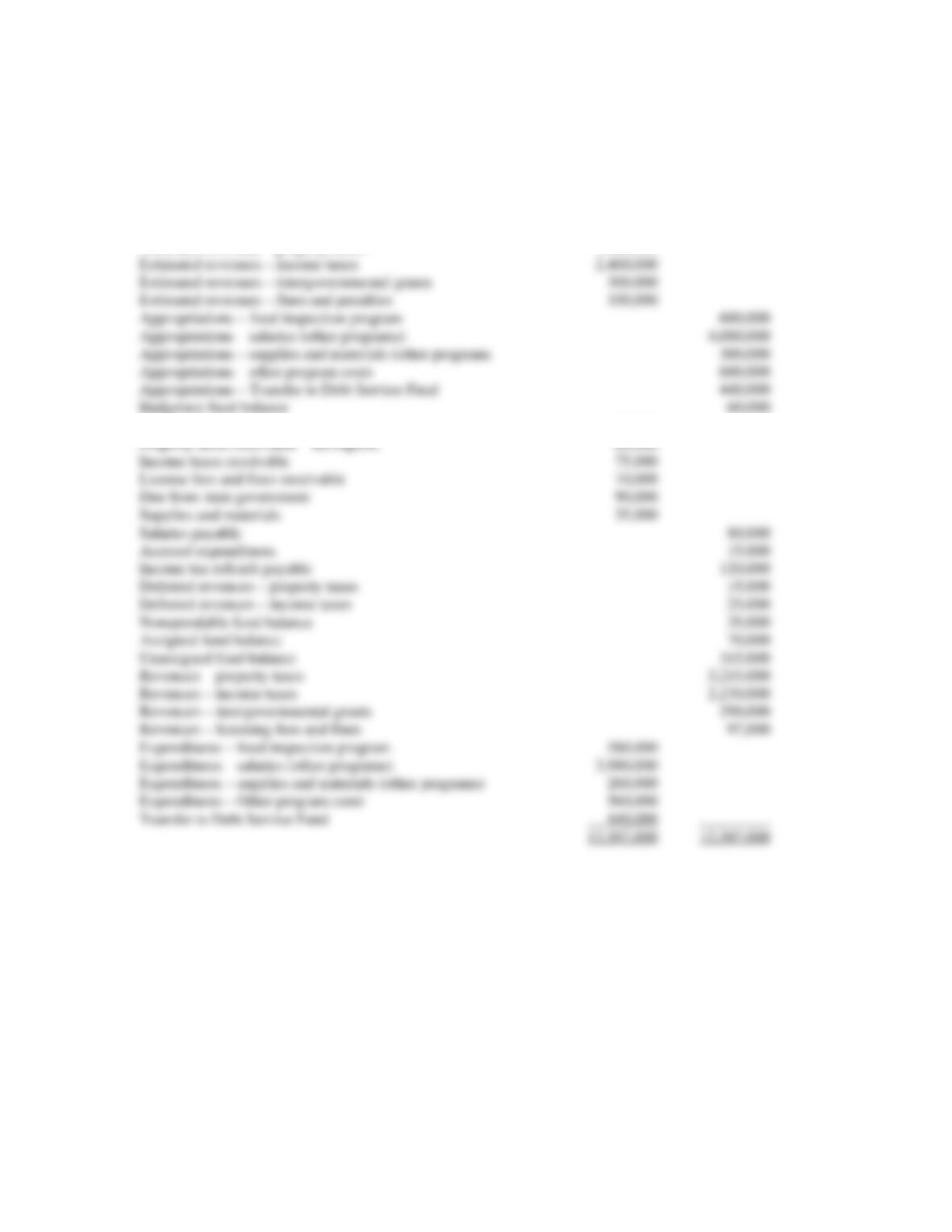
Leisure City
General Fund
Trial Balance
December 31, 2013
Debits Credits
Estimated revenues – property taxes 3,200,000
Cash 417,000
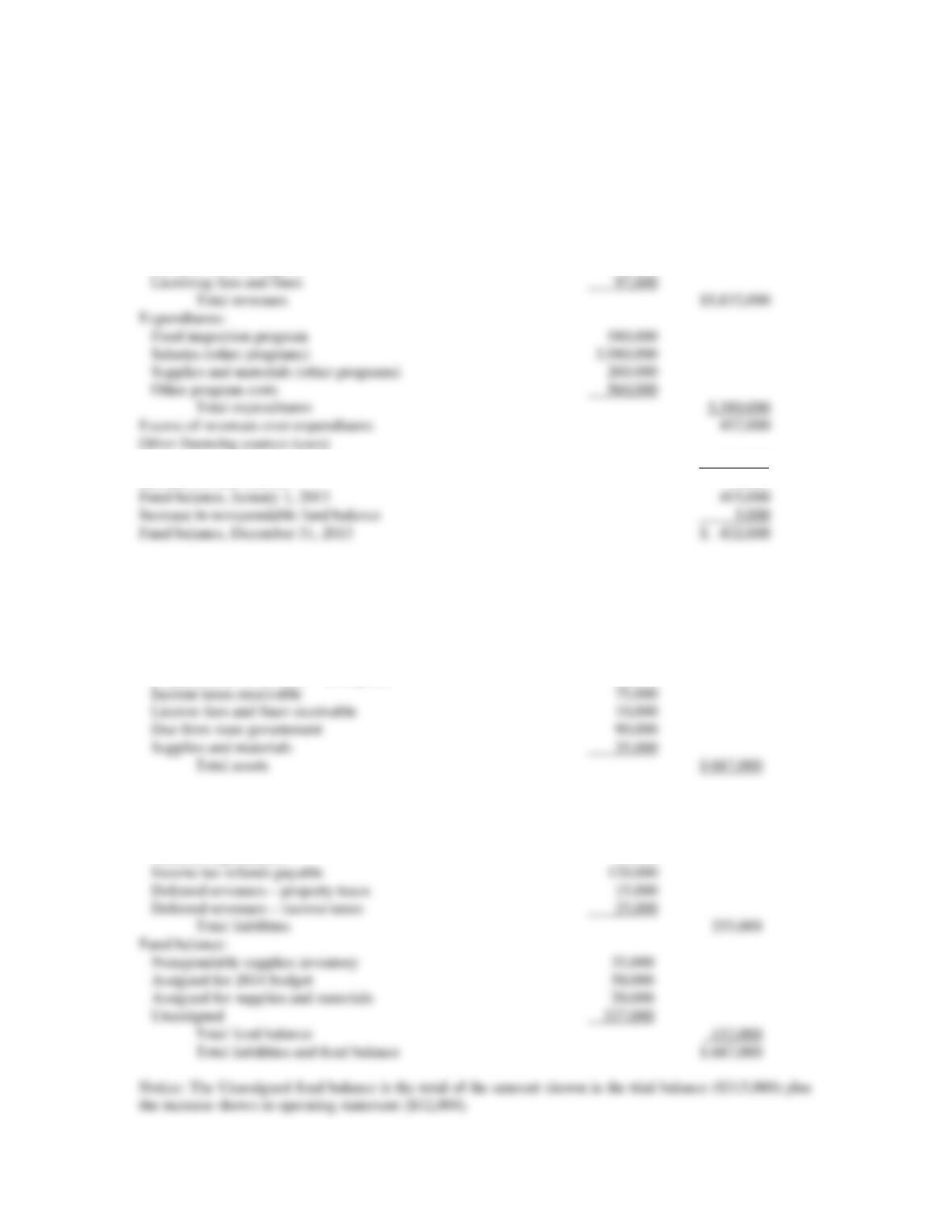
Leisure City
General Fund
Statement of Revenues, Expenditures, and Changes in Fund Balance
Year Ended December 31, 2013
Revenues:
Property taxes $3,215,000
Income taxes 2,230,000
Intergovernmental grants 290,000
Transfer out to Debt Service Fund 440,000
Increase in fund balance 12,000
Leisure City
General Fund
Balance Sheet
December 31, 2013
Assets:
Cash $ 417,000
Property taxes receivable – delinquent 60,000
Liabilities and Fund Balance:
Liabilities:
Salaries payable 80,000
Accrued expenditures 15,000
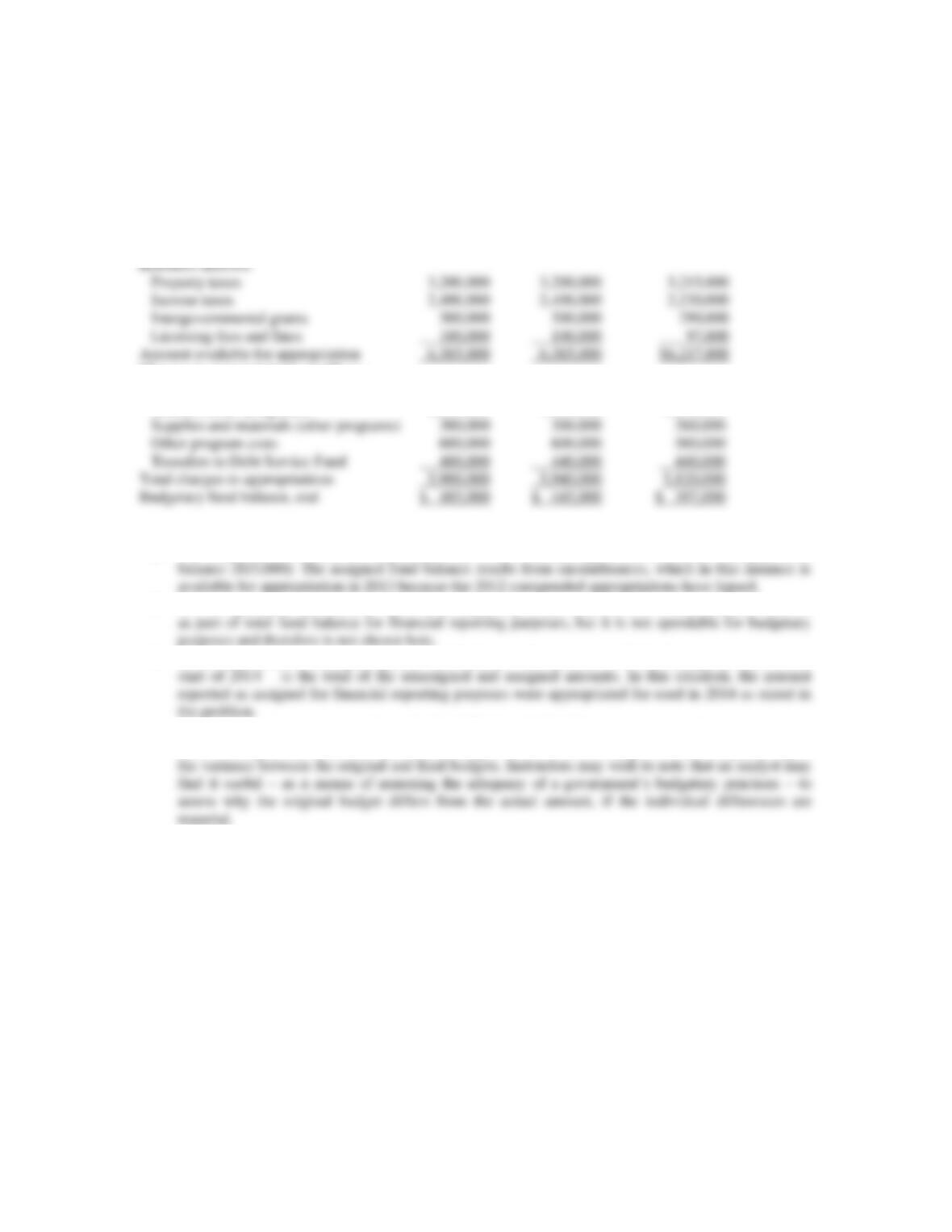
Leisure City
General Fund
Budgetary Comparison Statement
Year Ended December 31, 2013
Budgeted Amounts Actual Amounts
Original Final Budgetary Basis
Budgetary fund balance beginning $ 385,000 $ 385,000 $ 385,000
Charges to appropriations (outflows
Food inspection program 600,000 600,000 580,000
Salaries (other programs) 4,000,000 4,000,000 3,980,000
Notes:
1. The budgetary fund balance at beginning is the total of the unassigned ($370,000) plus assigned fund
2. The nonspendable fund balance ($30,000 at beginning of year and $35,000 at end of year) is shown
3. In this situation, the ending budgetary fund balance – the amount available for appropriation at the
4. A variance column may be added. GASB COD Sec. 2400.102 encourages but does not require a
column to report the variance with the final budget and actual amounts; governments may also report