John J. Wild, Financial Accounting: Information for Decisions, 8th Edition
5-1
Chapter 5
Reporting and Analyzing Inventories
Student Learning Objectives and Related Assignment Materials*
Student Learning Objectives
Discussion
Questions
Quick
Studies
Exercises
Problems
(A &B set)**
Beyond the
Numbers
Conceptual objectives:
C1. Identify the items making up
merchandise inventory.
12
5-1, 5-17,
5-23
5-1
5-8
C2. Identify the costs of
merchandise inventory.
2, 3
5-2, 5-23
5-2
5-1, 5-8
Analytical objectives:
A1. Analyze the effects of
inventory methods for both
financial and tax reporting.
4, 5, 6, 7, 14.
15, 16, 17
5-18
5-4, 5-6,
5-11
5-8
5-3, 5-4, 5-6
A2. Analyze the effects of
inventory errors on current and
future financial statements.
8, 9
5-20
5-12
5-6
A3. Assess inventory management
using both inventory turnover
and days’ sales in inventory.
5-21
5-11, 5-13
SP 5
5-1, 5-2, 5-5,
5-7, 5-9
Procedural objectives:
P1. Compute inventory in a periodic
system using the methods of
specific identification, FIFO,
LIFO,and weighted average.
1
5-3, 5-4, 5-5,
5-6, 5-10,
5-11, 5-12,
5-13
5-3, 5-7, 5-8,
5-14, 5-15
5-1, 5-3, 5-7,
5-8
P2. Compute the lower of cost or
market amount of inventory.
10, 11
5-19, 5-23
5-10, 5-18
5-5, SP 5
P3. Compute inventory in a
perpetual system using the
methods of specific
identification, FIFO, LIFO, and
weighted average.
(Appendix 5A)
13
5-7, 5-8,
5-9, 5-14,
5-15, 5-16
5-5, 5-9
5-2, 5-4
5-6
and gross profit methods to
estimate inventory.
(Appendix 5B)
John J. Wild, Financial Accounting: Information for Decisions, 8th Edition
5-2
Additional Information on Related Assignment Material
Connect
Available on the instructor’s course-specific website) repeats all numerical Quick Studies, all Exercises
and Problems Set A. Connect also provides algorithmic versions for Quick Study, Exercises and
Problems. It allows instructors to monitor, promote, and assess student learning. It can be used in
practice, homework, or exam mode.
The Serial Problem (SP) for Success Systems continues in this chapter.
General Ledger
Assignable within Connect, General Ledger (GL) problems offer students the ability to see how transactions post
from the general journal all the way through the financial statements. Critical thinking and analysis components are
added to each GL problem to ensure understanding of the entire process. GL problems are auto-graded and provide
instant feedback to the student.
Synopsis of Chapter Revisions
• NEW opener—Tesla Motors
• Updated box on wireless inventory scans.
• Updated box on employees receiving kickbacks or gifts from suppliers.
John J. Wild, Financial Accounting: Information for Decisions, 8th Edition
5-3
Chapter Outline
Notes
I. Inventory Basics
A. Determining Inventory Items
Merchandise inventory includes all goods that a company owns and
holds for sale. The following inventory items require special
attention:
1. Goods in Transit
If ownership has passed to the purchaser, the goods are included
2. Goods on Consignment—goods shipped by the owner, called the
consignor, to another party, the consignee.
3. Goods Damaged or Obsolete
a. Damaged and obsolete (and deteriorated) goods are not
B. Determining Inventory Costs
1. The cost of an inventory item includes its invoice cost minus any
2. The expense recognition or matching principle states that
inventory costs should be recorded against revenue in the period
C. Internal Controls and Taking a Physical Count
1. Events (theft, loss, damage, and errors) can cause the inventory
account balance to differ from the actual inventory on hand.
2. Nearly all companies take a physical count of inventory at least
John J. Wild, Financial Accounting: Information for Decisions, 8th Edition
5-4
Chapter Outline
Notes
a. Prenumbered inventory tickets; each ticket must be
accounted for.
and only once.
II. Inventory Costing under a Periodic System
The major goal is to properly assign costs with sales. The expense
recognition (or matching principle) is used to decide how much of the
cost of goods available for sale is deducted from sales (on the income
statement) and how much is carried forward as inventory (on the
balance sheet). One of the most important issues in accounting for
inventory is determining the per unit cost assigned to inventory items.
A. Inventory Cost Flow Assumptions
Four methods are commonly used to assign costs to inventory and
cost of goods sold. Each method assumes a particular pattern for
how costs flow through inventory. Physical flow and cost flow
need not be the same.
2. Last-in, first-out (LIFO)—assumes costs flow in the reverse
order incurred. (Results differ from perpetual in the appendix
because the periodic method applies its computation at period-
end only versus the perpetual method that applies its
computation at each sale.)
John J. Wild, Financial Accounting: Information for Decisions, 8th Edition
5-5
Chapter Outline
Notes
B. Inventory Costing Illustration
1. Specific identification—At period-end, cost of goods sold is
charged with the actual or invoice cost, leaving actual costs of
inventory available in the inventory account.
2. First-in, first-out (FIFO)— At period-end, FIFO charges costs
of the earliest units acquired to cost of goods sold, leaving
costs of the most recent purchases in inventory.
C. Financial Statement Effects of Costing Methods
1. When purchase prices do not change, each inventory costing
method assigns the same amounts to inventory and to cost of
goods sold. When purchase prices are different, the methods
assign different cost amounts. When purchase costs regularly
rise:
b. LIFO assigns the highest amount to cost of goods sold
a. FIFO assigns the lowest amount to cost of goods sold
resulting in the highest gross profit and the highest net
income. Advantage: Inventory on the balance sheet
approximates its current replacement cost; it also mimics
the actual flow of goods for most businesses.
D. Tax Effects of Costing Methods
Since inventory costs affect net income, they have potential tax
effects.
1. Financial reporting often differs from the method used for tax
reporting.
John J. Wild, Financial Accounting: Information for Decisions, 8th Edition
5-6
Chapter Outline
Notes
2. Exception: LIFO may only be used for tax purposes if it is
also used for financial reporting.
E. Consistency in Using Costing Methods
categories of inventory.
1. Consistency concept requires the use of the same accounting
methods period after period so the financial statements are
comparable across periods.
III. Valuating Inventory at LCM and the Effects of Inventory Errors
A. Lower of Cost or Market
Accounting principles require that inventory be reported on the
balance sheet at the lower of cost or market (LCM).
is lower, no adjustment is made.
1. Computing the Lower of Cost or Market:
Market is the current replacement cost of purchasing the same
inventory items in the usual manner.
requires lower LCM to be applied to individual items.
4. Recording the Lower of Cost or Market: accounting rules
require that inventory be adjusted to market when market is
less than cost, but inventory normally cannot be written up to
market when market exceeds cost. The conservatism
B. Financial Statement Effects of Inventory Errors.
An inventory error causes misstatements in cost of goods sold,
gross profit, net income, current assets, and equity. It also causes
misstatements in the next period’s financial statements because
ending inventory of one period is the beginning inventory of the
next.
John J. Wild, Financial Accounting: Information for Decisions, 8th Edition
5-7
Chapter Outline
Notes
1. Income Statement Effects:
a. If ending inventory is understated, cost of goods sold is
overstated and net income is understated.
2. Balance Sheet Effects:
a. If ending inventory is understated, assets and equity are
understated.
IV. Global View
A. Items and Costs Making Up Inventory – Both GAAP and IFRS
include broad and similar guidance for the items and costs making
up merchandise inventory which includes all items that a company
C. Estimating Inventory Costs – The value of inventory can change
while it awaits sale to customers and this value can decrease or
increase.
1. Decreases in Inventory Value – Both GAAP and IFRS require
companies to write down (reduce the recorded cost) for inventory
John J. Wild, Financial Accounting: Information for Decisions, 8th Edition
5-8
Chapter Outline
Notes
V. Decision Analysis—Inventory Turnover and Days’ Sales in
Inventory
A. Inventory Turnover
depend on how quickly inventory is sold.
1. Inventory turnover, also called simply turns, is used to
measure a company’s ability to pay short-term obligations can
B. Days’ Sales in Inventory
1. Day’s sales in inventory measures how much inventory is
available in terms of the number of days’ sales.
C. Analysis of Inventory Management
Inventory management is a major emphasis for most
VI. Inventory Costing under a Perpetual System
The major goal is to properly assign costs with sales. The expense
recognition (matching principle) is used to decide how much of the
cost of goods available for sale is deducted from sales (on the income
statement) and how much is carried forward as inventory (on the
balance sheet). One of the most important issues in accounting for
inventory is determining the per unit cost assigned to inventory items.
A. Inventory Cost Flow Assumptions
Four methods are commonly used to assign costs to inventory and
cost of goods sold. Each method assumes a particular pattern for
how costs flow through inventory. Physical flow and cost flow
need not be the same.
1. First-in, first-out (FIFO)—assumes costs flow in the order
incurred.
John J. Wild, Financial Accounting: Information for Decisions, 8th Edition
5-9
Chapter Outline
Notes
VII. Inventory Estimation Methods (Appendix 5B)
Inventory sometimes requires estimation for two reasons. First,
companies often require interim financial statements, but only take an
annual physical count of inventory. Second, companies may require an
inventory estimate if some casualty makes taking a physical count
impossible. Estimates are usually only required for companies that use
the periodic system.
A. Retail Inventory Method
The retail inventory method estimates the cost of ending
inventory for interim statements in a periodic inventory when a
physical count is taken only annually. Steps include:
3. Apply cost ratio to ending inventory at retail to convert to
taken using retail price to cost. Shrinkage can be measured by
comparing converted to estimated inventory.
1. Subtract sales (general ledger amount) from goods available
B. Gross Profit Method
The gross profit method estimates the cost of ending inventory
by applying the gross profit ratio to net sales (at retail). This type
of estimate is often used for insurance claims when inventory is
destroyed, lost or stolen. Steps include:
2. Find the cost of goods percentage (100% less gross profit
1. Determine the normal gross profit percentage from recent
years.
John J. Wild, Financial Accounting: Information for Decisions, 8th Edition
5-10
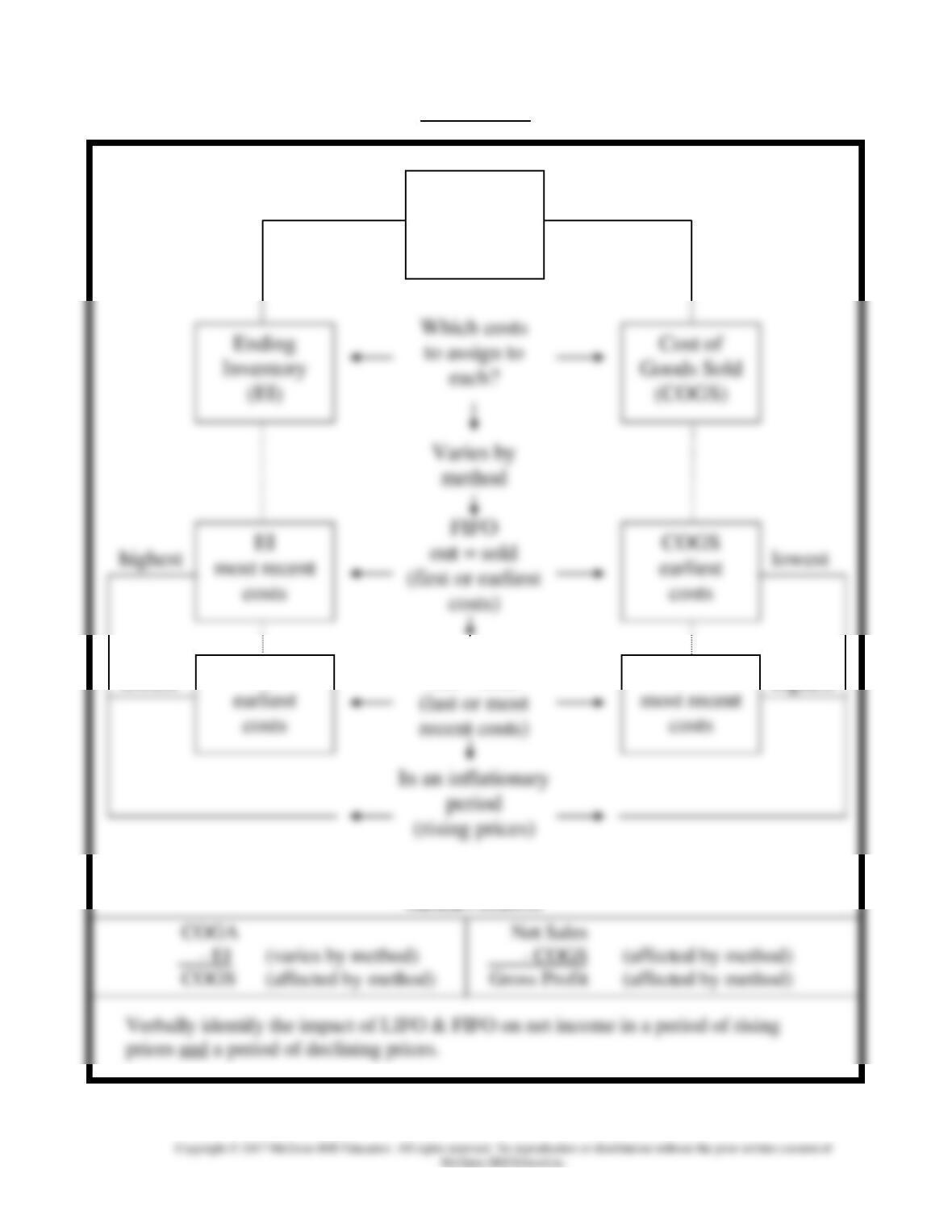
VISUAL #5-1
Computation of Cost of Goods Available
Units Cost Total
Jan. 1 Beginning Inventory 60 @ $10 = $ 600
Methods of Assigning Cost to Units in Ending Inventory
(1) Specific Identification – requires that each item in an inventory be
(2) Weighted Average – a weighted average cost per unit is determined
John J. Wild, Financial Accounting: Information for Decisions, 8th Edition
5-11
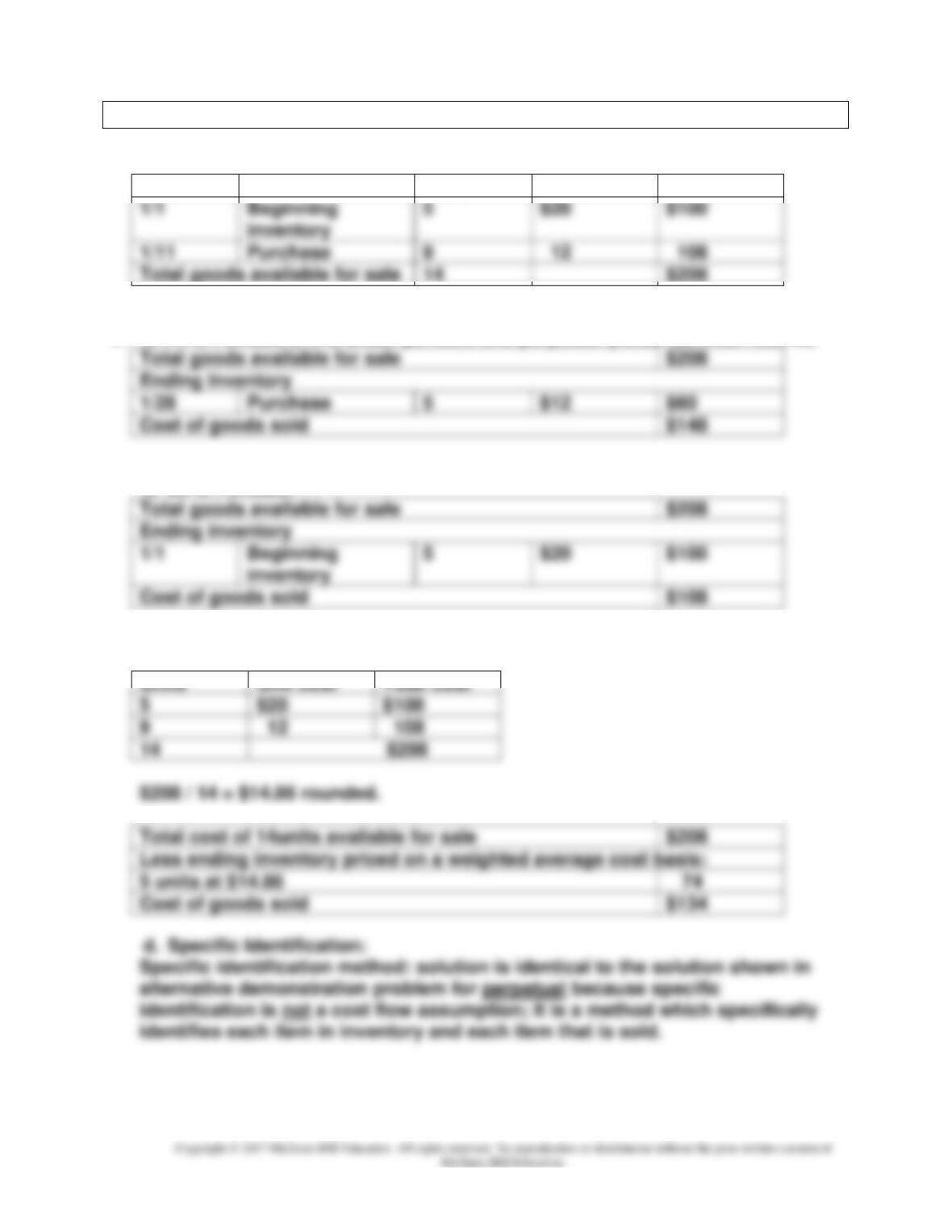
VISUAL #5-2
O
EI
COGS
highest
lowest
LIFO
out = sold
EI
COGS
lowest
highest
OBSERVATIONS
Goods
Available
(COGA)
has 2 parts

John J. Wild, Financial Accounting: Information for Decisions, 8th Edition
Chapter 5 – Alternate Demonstration Problem #1 (Periodic)
The ABC Company had the following inventory record for the month of
January:
# of
Unit
Date
Description
Items
Price
Item
1/1
Beginning
inventory
5
$20
Z1, Z2, Z3, Z4, Z5
1/5
Sale
2
Z2, Z5
1/11
Purchase
9
12
Z6, Z7, Z8, Z9, Z10, Z11,
Z12, Z13, Z14
1/28
Sale
7
Z1, Z3, Z6, Z7, Z8, Z9, Z14
Required:
Assuming a periodic system is in use, determine the following:
1. Cost of goods available for sale.
2. Cost of goods sold and the ending inventory using each of the
following methods:
a. FIFO
b. LIFO
c. Weighted Average
d. Specific Identification
John J. Wild, Financial Accounting: Information for Decisions, 8th Edition
5-13
Solution: Chapter 5 – Alternate Demonstration Problem #1
1. Cost of goods available for sale:
Date
Units
Unit Cost
Cost
inventory
1/11
Purchase
9
Total goods available for sale
$208
2. a. FIFO Periodic (FIFO under periodic and perpetual yields identical results).
Total goods available for sale
$208
1/28
Purchase
5
Cost of goods sold
$148
b. LIFO Periodic:
Total goods available for sale
$208
Ending inventory
inventory
Cost of goods sold
$108
c. Weighted Average Periodic:
Units
Unit cost
Total cost
5
$100
9
$208
Total cost of 14units available for sale
$208
Less ending inventory priced on a weighted average cost basis:
5 units at $14.86
John J. Wild, Financial Accounting: Information for Decisions, 8th Edition
5-14
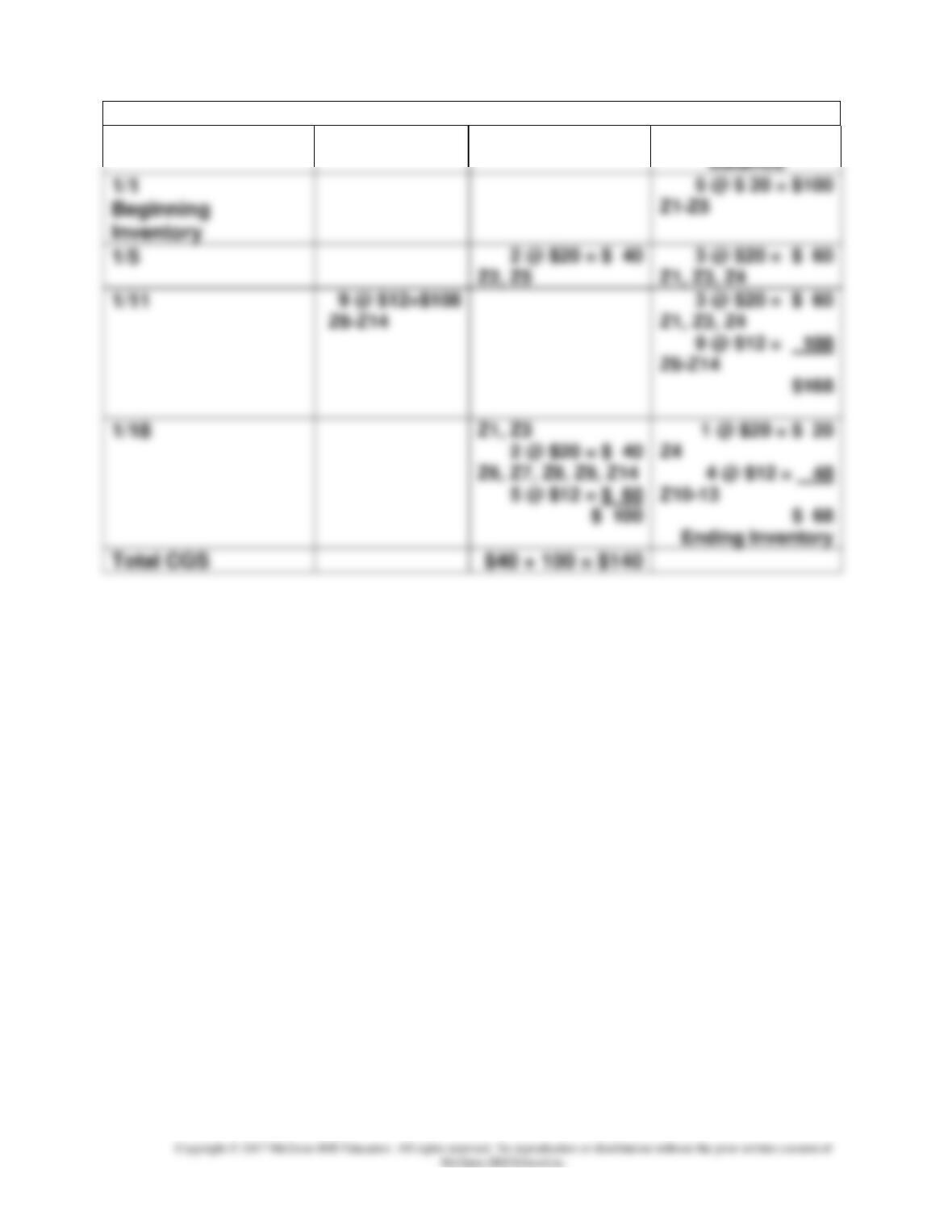
Specific Identification Periodic
Date
Purchases
Sales at Cost
Inventory

John J. Wild, Financial Accounting: Information for Decisions, 8th Edition
Chapter 5 – Alternate Demonstration Problem #2 (Perpetual)
The ABC Company had the following inventory record for the month of
January:
# of
Unit
Date
Description
Items
Price
Item
1/1
Beginning
inventory
5
$20
Z1, Z2, Z3, Z4, Z5
1/5
Sale
2
Z2, Z5
1/11
Purchase
9
12
Z6, Z7, Z8, Z9, Z10, Z11,
Z12, Z13, Z14
1/28
Sale
7
Z1, Z3, Z6, Z7, Z8, Z9, Z14
Required:
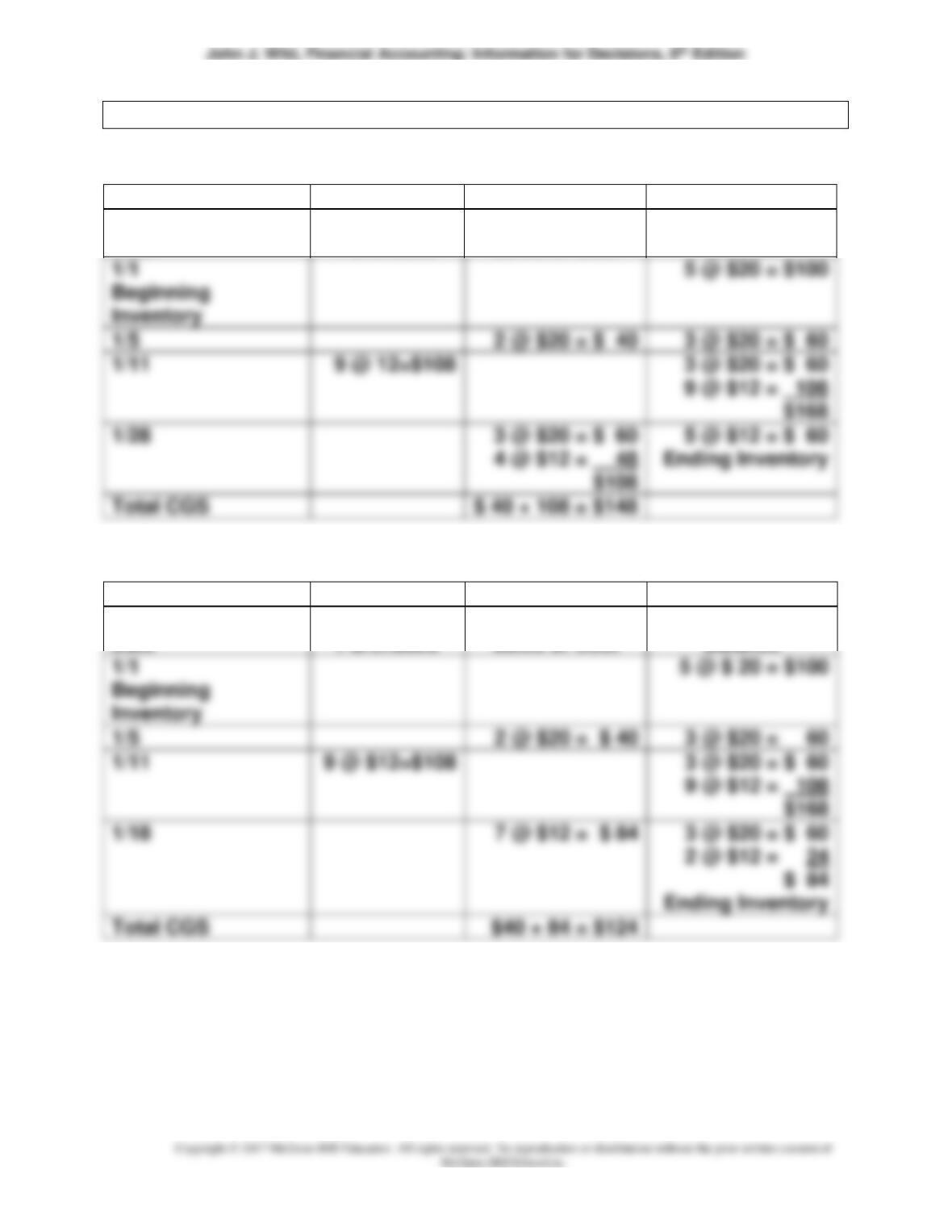
Assuming a perpetual system is in use, determine the cost of goods sold
and the ending inventory using each of the following methods:
1. FIFO
2. LIFO
3. Weighted average
4. Specific identification
5-16
Solution: Chapter 5 – Alternate Demonstration Problem #2
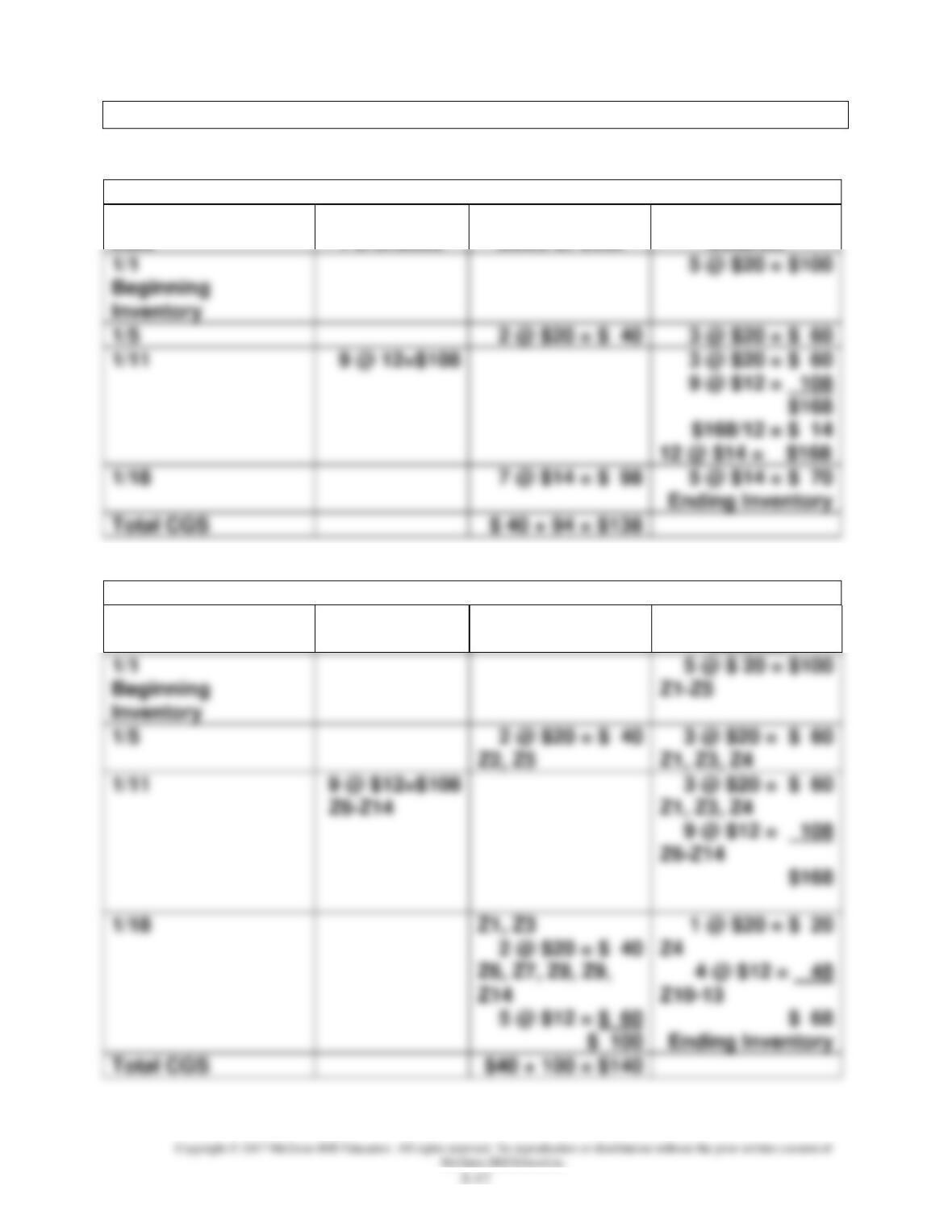
1.
FIFO Perpetual
Date
Purchases
Sales at Cost
Inventory
Balance
Total CGS
2.
LIFO Perpetual
Date
Purchases
Sales at Cost
Inventory
Balance
Total CGS
John J. Wild, Financial Accounting: Information for Decisions, 8th Edition
Solution: Chapter 5 – Alternate Demonstration Problem #2, continued
3.
Weighted Average Perpetual
Date
Purchases
Sales at Cost
Inventory
Balance
12 @ $14 = $168
Total CGS
4.
Specific Identification Perpetual
Date
Purchases
Sales at Cost
Inventory
Balance