TIME AND PURPOSE OF PROBLEMS
Problem 5.1 (Time 30–35 minutes)
Problem 5.2 (Time 35–40 minutes)
Purpose—to provide the student with the opportunity to prepare a complete balance sheet, involving
Problem 5.3 (Time 40–45 minutes)
Purpose—to provide an opportunity for the student to prepare a balance sheet in good form. Emphasis
Problem 5.4 (Time 40–45 minutes)
Purpose—to provide the student with the opportunity to analyze a balance sheet and correct it where
Problem 5.5 (Time 40–45 minutes)
Purpose—to provide the student with the opportunity to prepare a balance sheet in good form. Additional
Problem 5.6 (Time 35–45 minutes)
Purpose—to provide the student with an opportunity to prepare a complete statement of cash flows. A
Problem 5.7 (Time 40–50 minutes)
Purpose—to provide the student with an opportunity to prepare a balance sheet in good form and a
SOLUTIONS TO PROBLEMS
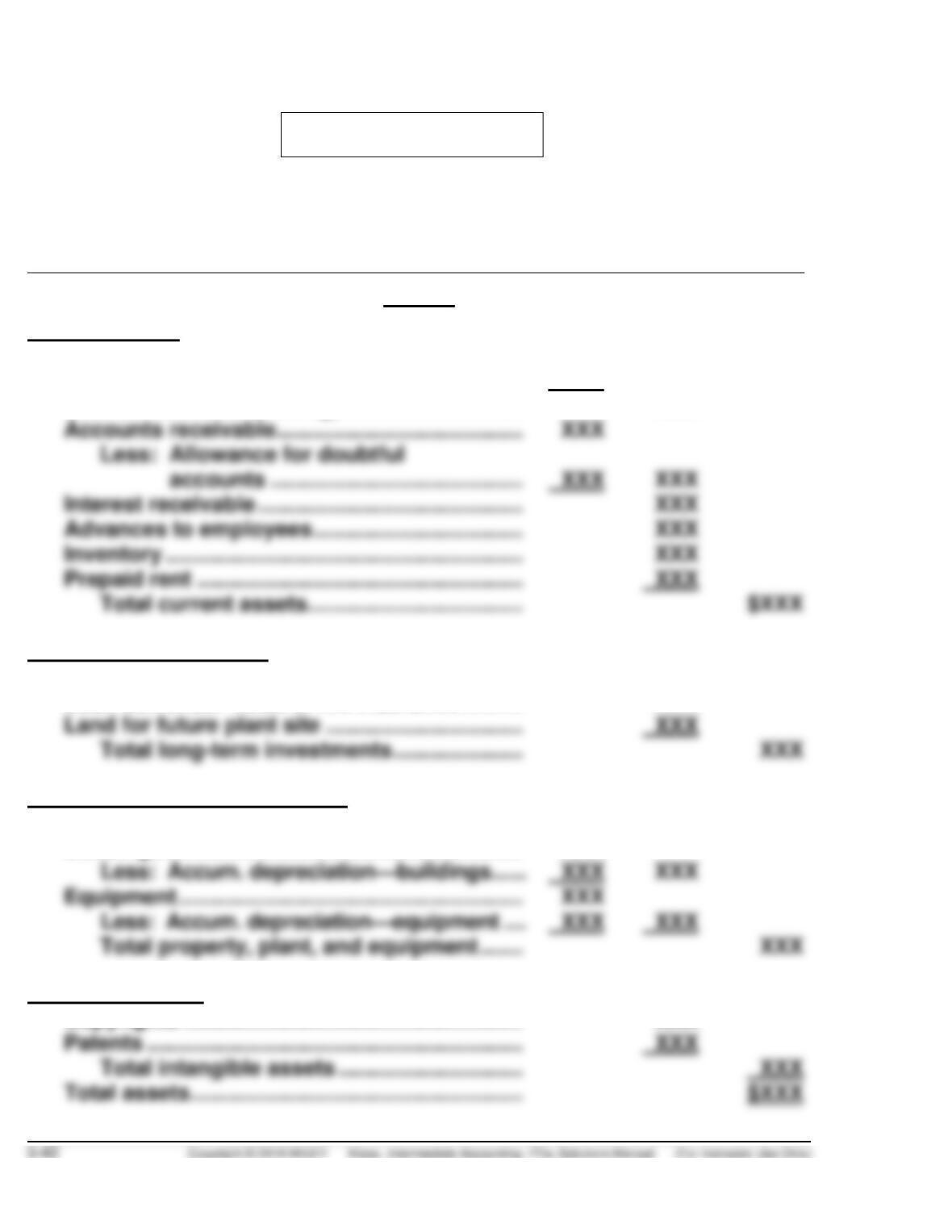
PROBLEM 5.1
COMPANY NAME
Balance Sheet
December 31, 20XX
Assets
Current assets
Cash on hand (including petty cash) ………….
$XXX
Cash in bank …………………………………………….
XXX
$XXX
Debt investments (trading) ………………………..
XXX
Accounts receivable ………………………………….
Interest receivable …………………………………….
XXX
Advances to employees …………………………….
Inventory ………………………………………………….
XXX
Prepaid rent ……………………………………………..
Total current assets ……………………………..
Long-term investments
Bond sinking fund …………………………………….
XXX
Cash surrender value of life insurance ……….
XXX
Land for future plant site …………………………..
Total long-term investments …………………
Property, plant, and equipment
Land …………………………………………………………
XXX
Buildings ………………………………………………….
XXX
Less: Accum. depreciation—buildings ……
XXX
Equipment ………………………………………………..
Less: Accum. depreciation—equipment ….
Total property, plant, and equipment …….
Intangible assets
Copyrights ……………………………………………….
XXX
Patents …………………………………………………….
PROBLEM 5.1 (Continued)
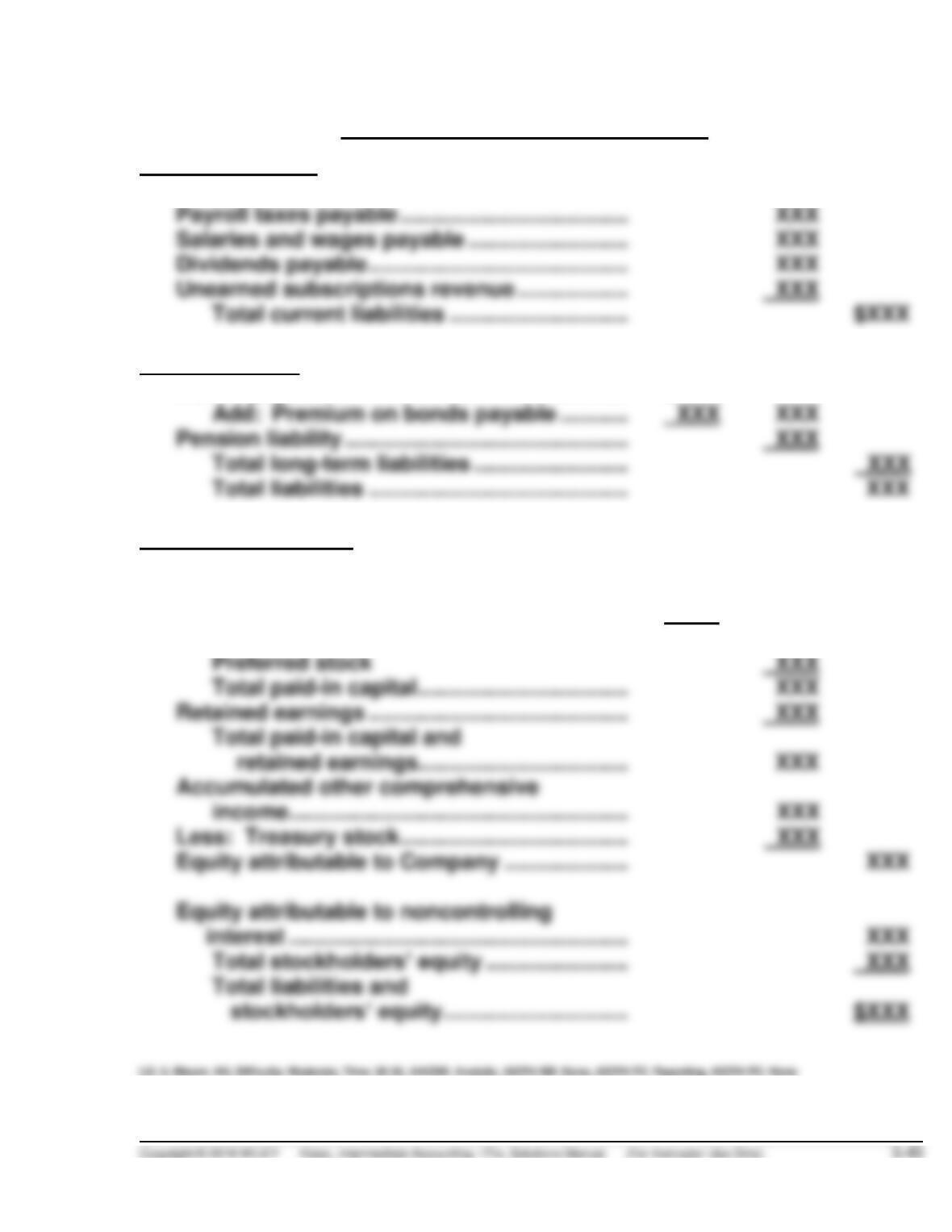
Liabilities and Stockholders’ Equity
Current liabilities
Notes payable ………………………………………….
$XXX
Payroll taxes payable ……………………………….
Salaries and wages payable ……………………..
XXX
Dividends payable ……………………………………
XXX
Unearned subscriptions revenue ………………
Total current liabilities ………………………..
Long-term debt
Bonds payable …………………………………………
$XXX
Add: Premium on bonds payable ………..
XXX
XXX
Pension liability …………………………..…………..
Total long-term liabilities …………………….
Total liabilities ……………………………………
Stockholders’ equity
Capital stock
Preferred stock (description) ……………….
XXX
Common stock (description) ……………….
XXX
XXX
Total paid-in capital …………………………….
XXX
Retained earnings ……………………………………
Total paid-in capital and
Accumulated other comprehensive
Less: Treasury stock ……………………………….
Equity attributable to Company ………………..
Total stockholders’ equity …………………..
Paid-in capital in excess of par –
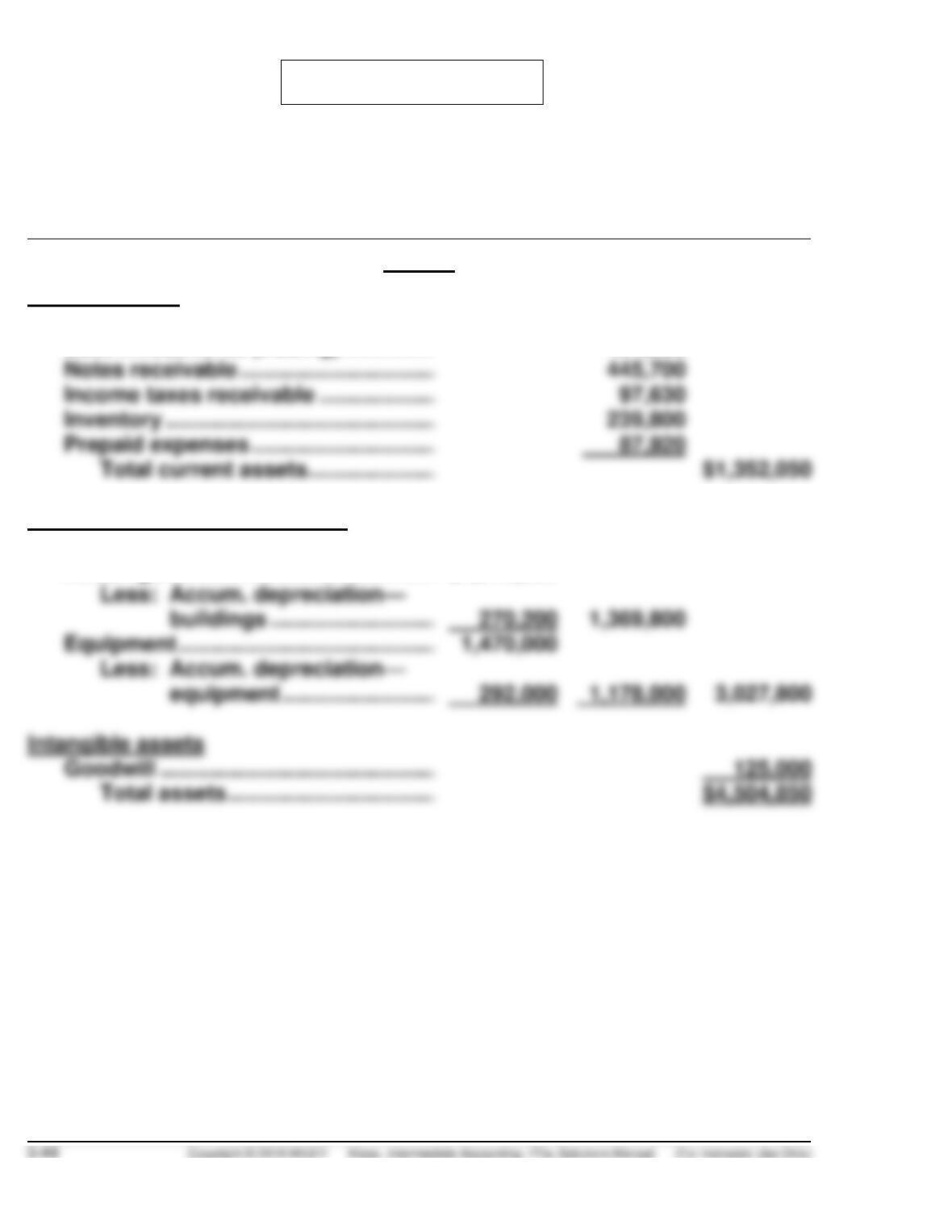
PROBLEM 5.2
MONTOYA, INC.
Balance Sheet
December 31, 2020
Assets
Current assets
Cash …………………………………………….
$ 360,000
Debt investments (trading) …………….
121,000
Notes receivable …………………………..
445,700
Income taxes receivable ………………..
Inventory ………………………………………
239,800
Prepaid expenses ………………………….
Total current assets ………………….
$1,352,050
Property, plant, and equipment
Land ……………………………………………..
480,000
Buildings ………………………………………
$1,640,000
Equipment …………………………………….
Intangible assets
Goodwill ……………………………………….
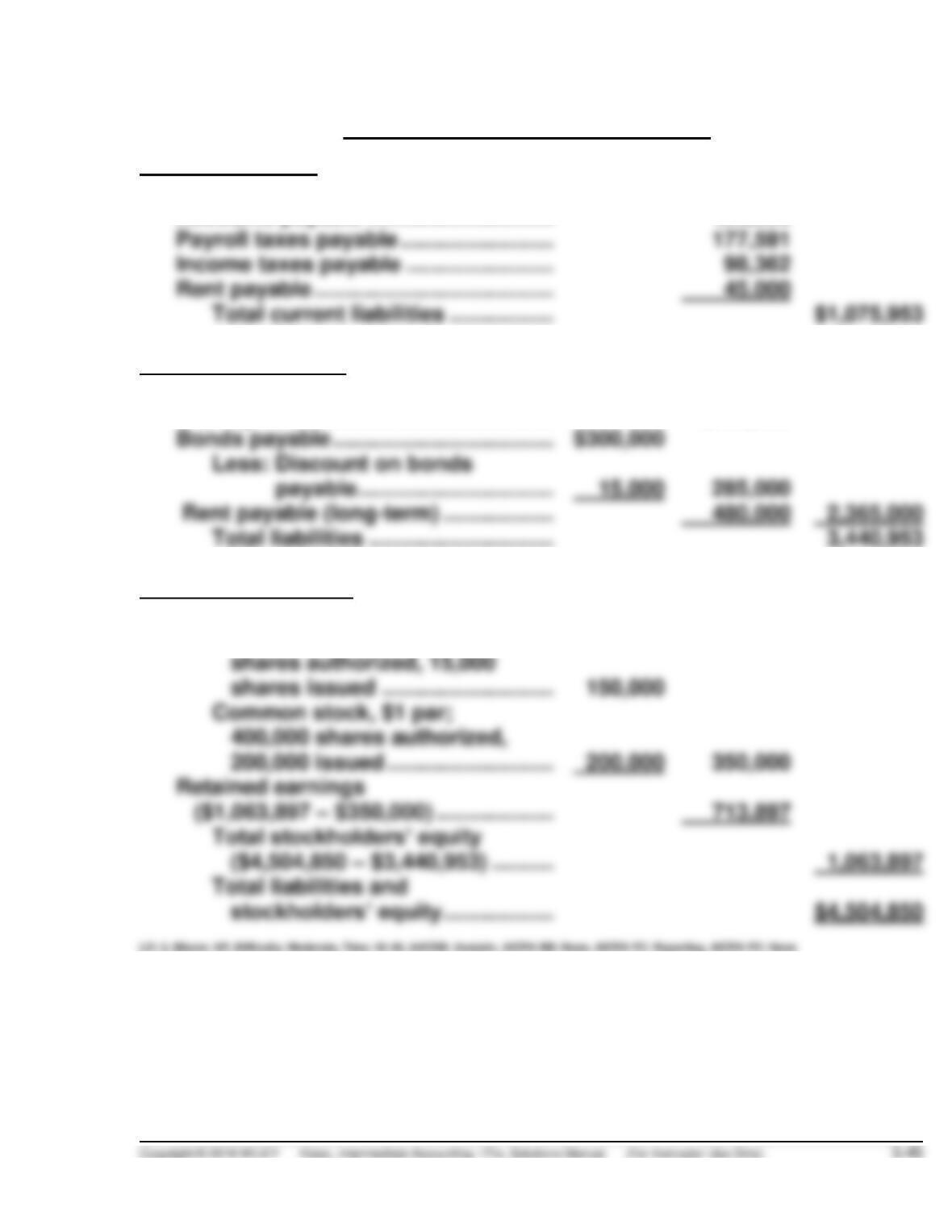
PROBLEM 5.2 (Continued)
Liabilities and Stockholders’ Equity
Current liabilities
Notes payable …………………………………
$ 265,000
Accounts payable …………………………..
490,000
Payroll taxes payable ………………………
Income taxes payable ……………………..
Rent payable …………………………………..
Total current liabilities ……………….
Long-term liabilities
Notes payable
(long-term) ………………………………….
1,600,000
Bonds payable ………………………………..
Rent payable (long-term) ………………..
Total liabilities …………………………..
Stockholders’ equity
Capital stock
Common stock, $1 par;
Preferred stock, $10 par; 20,000
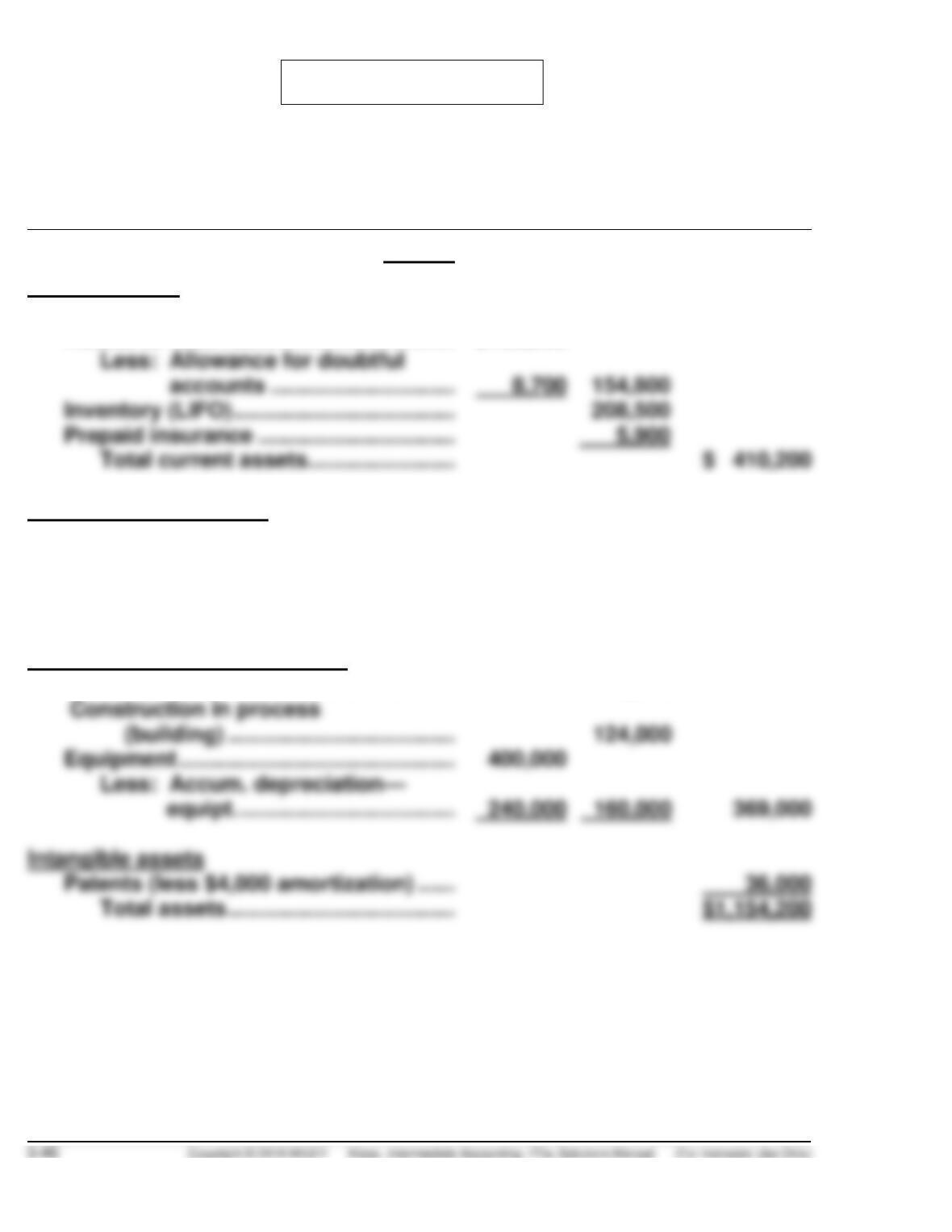
PROBLEM 5.3
EASTWOOD COMPANY
Balance Sheet
December 31, 2020
Assets
Current assets
Cash ………………………………………………..
$ 41,000
Accounts receivable ………………………….
$163,500
Inventory (LIFO) ………………………………..
Prepaid insurance …………………………..
Total current assets ……………………..
Long-term investments
Equity investments
($120,000 have been pledged as
security for notes payable)—
at fair value ……………………………………
339,000
Property, plant, and equipment
Land …………………………..……………………
85,000
Equipment ………………………………………..
Intangible assets
Patents (less $4,000 amortization) ……..
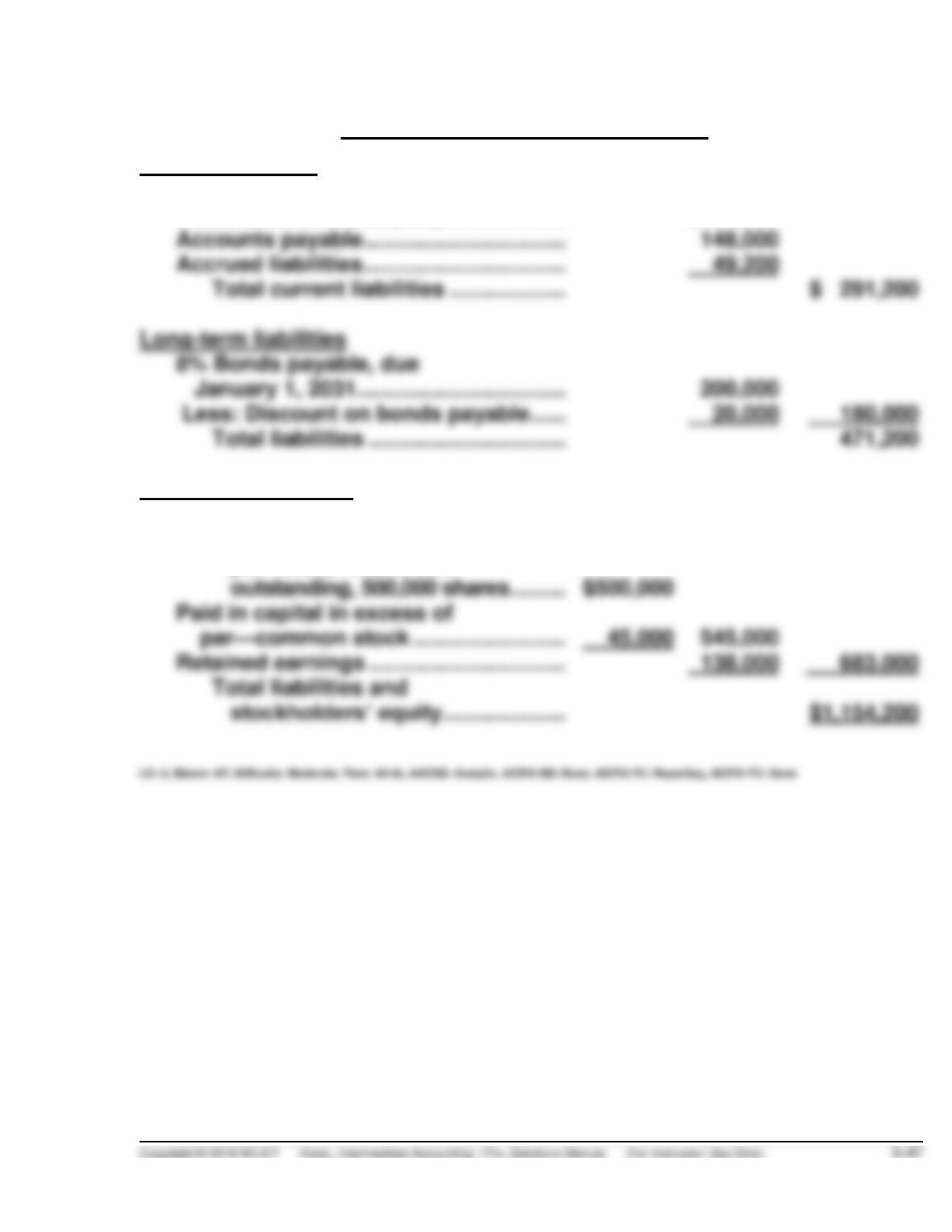
PROBLEM 5.3 (Continued)
Liabilities and Stockholders’ Equity
Current liabilities
Notes payable (secured by
investments of $120,000) ………………..
$ 94,000
Total current liabilities ……………….
Total liabilities …………………………..
Stockholders’ equity
Common stock
Retained earnings …………………………..
Authorized 600,000 shares of $1
par value; issued and
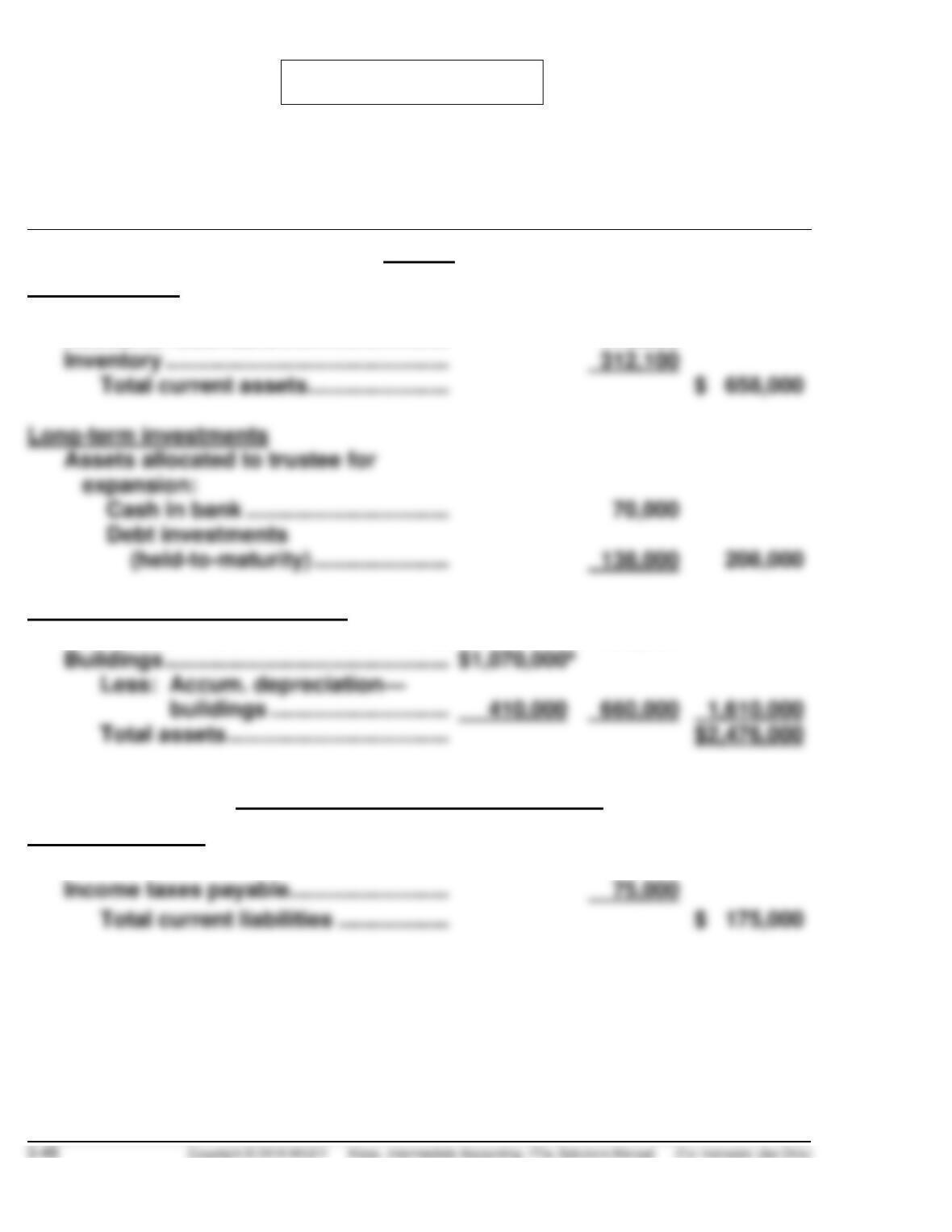
PROBLEM 5.4
KISHWAUKEE CORPORATION
Balance Sheet
December 31, 2020
Assets
Current assets
Cash ……………………………………………….
$175,900
Accounts receivable …………………………
170,000
Inventory …………………………………………
Total current assets …………………….
Long-term investments
Cash in bank ……………………………..
Property, plant, and equipment
Land ………………………………………………..
950,000
Buildings …………………………………………
Total assets ………………………………..
Liabilities and Stockholders’ Equity
Current liabilities
Notes payable—current installment ……
$100,000
PROBLEM 5.4 (Continued)
Long-term liabilities
Notes payable ($600,000 – $100,000) ……….
500,000b
Total liabilities ……………………………..
675,000
Stockholders’ equity
Retained earnings ……………………………..
Common stock, no par; 1,000,000
a$1,640,000 – $570,000 (to eliminate the excess of appraisal value over cost
from the Buildings account. Note that the appreciation capital account is
also deleted).
b$600,000 – $100,000 (to reclassify the currently maturing portion of the
notes payable as a current liability).
PROBLEM 5.5
SARGENT CORPORATION
Balance Sheet
December 31, 2020
Assets
Current assets
Cash ……………………………………………….
$150,000
Equity investments (at fair value) ………
Accounts receivable …………………………
Total current assets …………………….
Long-term investments
Bond sinking fund …………………………..
Land held for future use ……………………
270,000
Equity investments
Property, plant, and equipment
Land ………………………………………………..
500,000
Buildings …………………………………………
1,040,000
Less: Accum. depreciation—
Equipment ……………………………………….
Intangible assets
Franchise ………………………………………..
165,000
Goodwill ………………………………………….
100,000
265,000
Total assets ………………………………..
$3,115,000
PROBLEM 5.5 (Continued)
Liabilities and Stockholders’ Equity
Current liabilities
Notes payable …………………………………..
$ 80,000
Accounts payable …………………………..
140,000
Income taxes payable ……………………….
Unearned rent revenue ……………………..
5,000
Total current liabilities ………………….
$ 265,000
Long-term liabilities
Notes payable …………………………………..
Bonds payable, due 2028 ………………….
Less: Discount on bonds payable ……..
960,000
1,080,000
Total liabilities …………………………..
Stockholders’ equity
Capital stock
Paid-in capital in excess of par—
Preferred stock, no par value;
200,000 shares authorized,
($10.00 – $1.00)] ………………………….
900,000
1,450,000
Retained earnings …………………………..
320,000
Total stockholders’ equity …………….
1,770,000
Total liabilities and
PROBLEM 5.6
(a) LANSBURY INC.
Statement of Cash Flows
For the Year Ended December 31, 2020
Cash flows from operating activities
Net income …………………………………………………..
$32,000
Gain on sale of investments …………………….
Net cash provided by operating activities ………
Adjustments to reconcile net income to
Cash flows from investing activities
Sale of investments ………………………………………
15,000
Purchase of land …………………………………………..
(13,000)
Net cash provided by investing activities ……….
2,000
Cash flows from financing activities
Issuance of common stock …………………………...
Retirement of notes payable ………………………….
Payment of cash dividends …………………………..
Net cash used by financing activities …………….
Net increase in cash …………………………………………..
Cash at beginning of year …………………………………..
PROBLEM 5.6 (Continued)
(b) LANSBURY INC.
Balance Sheet
December 31, 2020
Assets
Liabilities and Stockholders’ Equity
Cash
$37,000
Accounts payable
$30,000
Debt
Bonds payable
(5)
Plant assets (net)
Land
Accounts
Notes payable
(1) $32,000 – ($15,000 – $3,400)
(2) $81,000 – $11,000
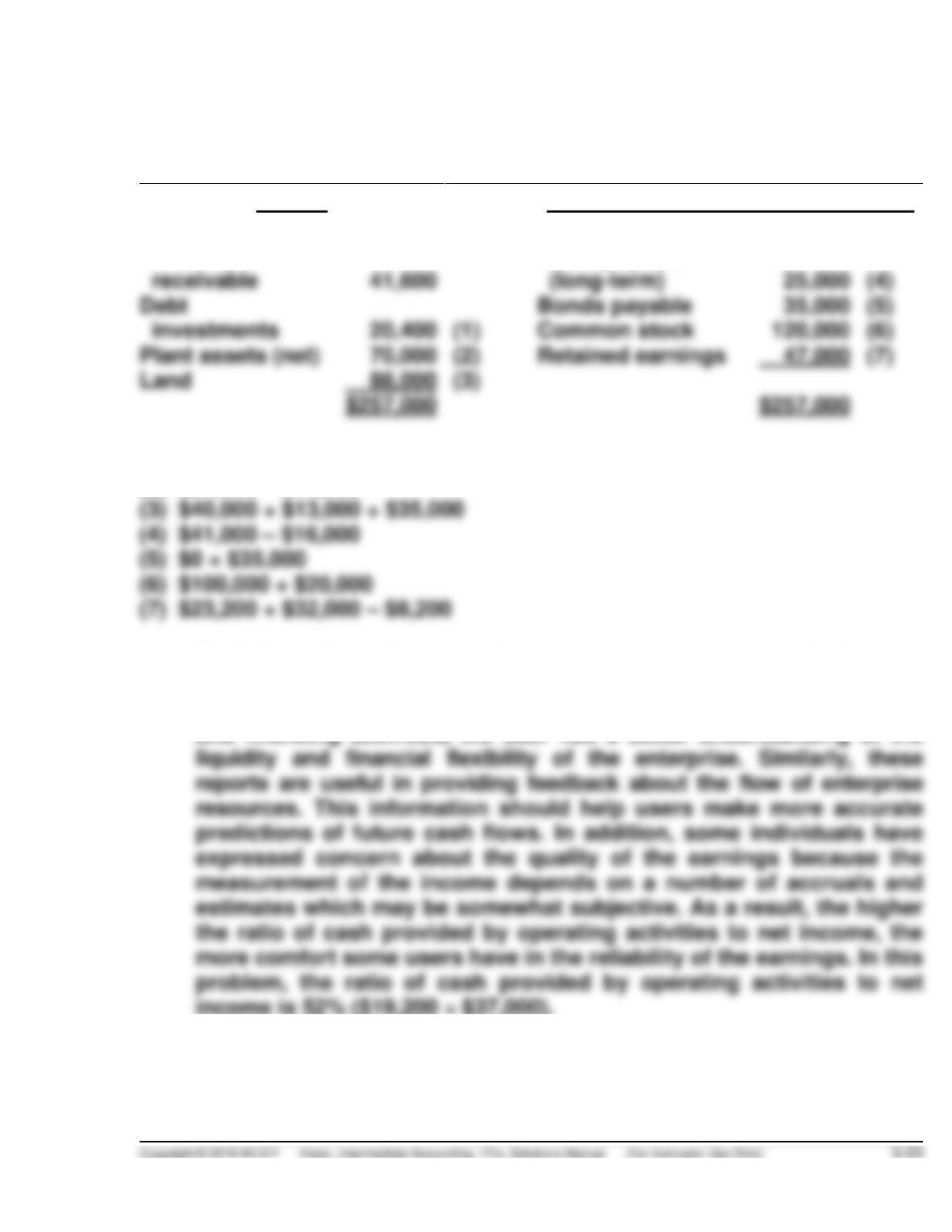
(c) Cash flow information is useful for assessing the amount, timing, and
uncertainty of future cash flows. For example, by showing the specific
inflows and outflows from operating activities, investing activities,
income is 52% ($19,200 ÷ $37,000).
PROBLEM 5.6 (Continued)
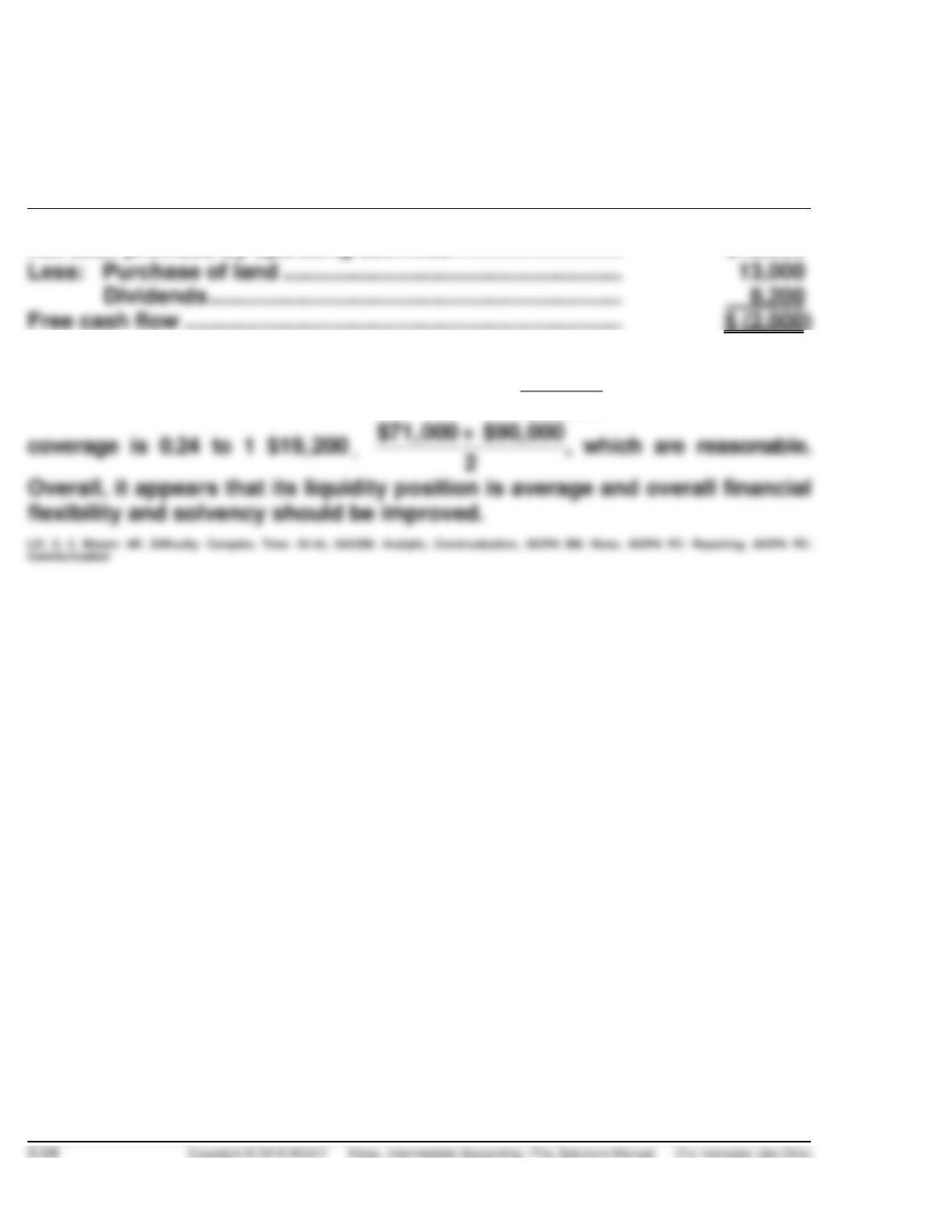
An analysis of Lansbury’s free cash flow indicates it is negative as shown
below:
Free Cash Flow Analysis
Net cash provided by operating activities …………………………
$19,200
Its current cash debt coverage is 0.64 to 1
æö
÷
ç÷
ç÷
ç
èø
$19,200
$30,000
and its cash debt
PROBLEM 5.7
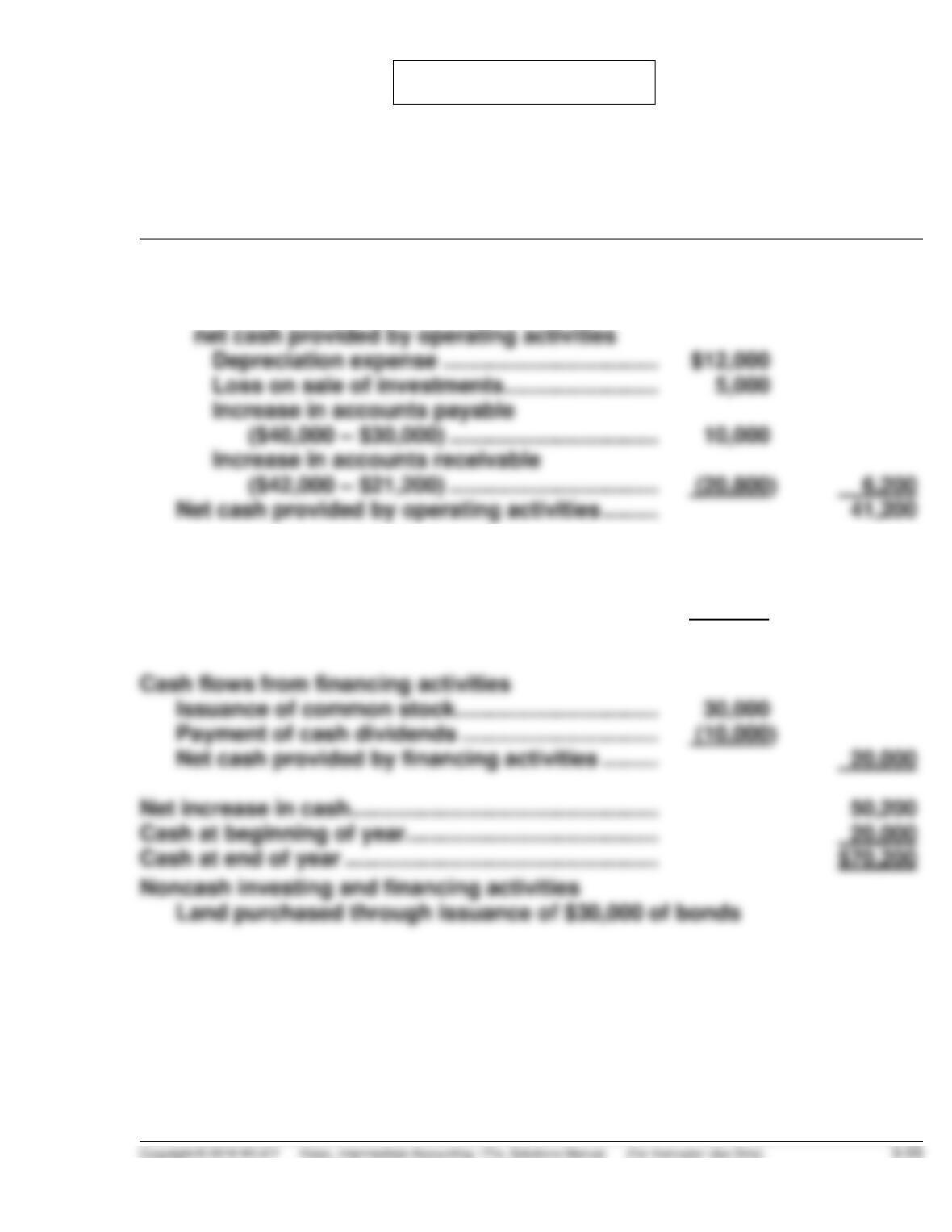
(a) AERO INC.
Statement of Cash Flows
For the Year Ended December 31, 2020
Cash flows from operating activities
Net income …………………………………………………….
$35,000
Depreciation expense ……………………………….
Loss on sale of investments ………………………
Increase in accounts receivable
Net cash provided by operating activities ………..
Adjustments to reconcile net income to
Cash flows from investing activities
Sale of debt investments ($32,000 – $5,000) ……..
27,000
Purchase of land ……………………………………………
(38,000)
Net cash used by investing activities ………………
(11,000)
Cash flows from financing activities
Issuance of common stock……………………………..
30,000
Payment of cash dividends …………………………..
Net cash provided by financing activities ………..
Net increase in cash …………………………………………….
Cash at beginning of year …………………………………….
PROBLEM 5.7 (Continued)
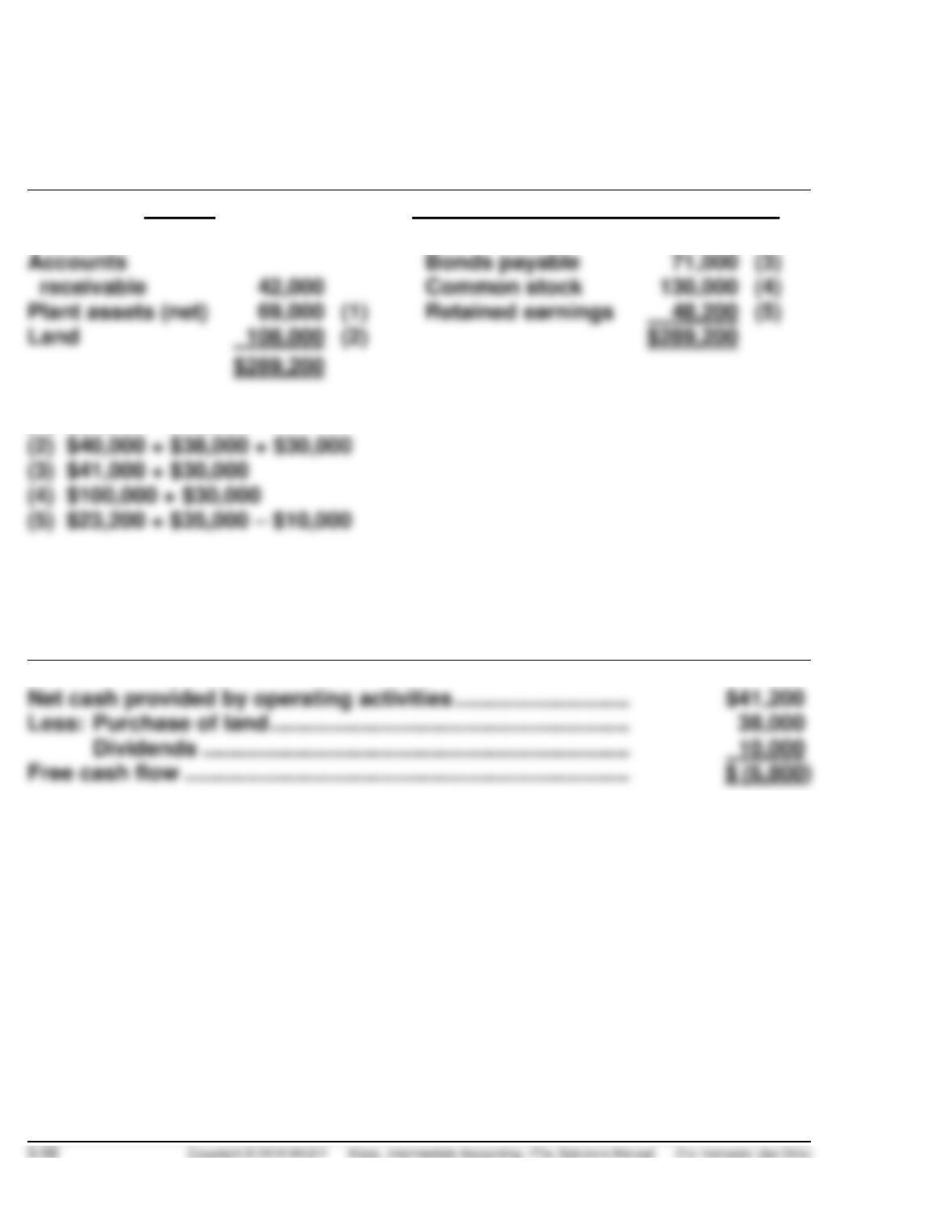
(b) AERO INC.
Balance Sheet
December 31, 2020
Assets
Liabilities and Stockholders’ Equity
Cash
$ 70,200
Accounts payable
$ 40,000
(1)
Retained earnings
(5)
(1) $81,000 – $12,000
(c) An analysis of Aero’s free cash flow indicates it is negative as shown
below:
Free Cash Flow Analysis
Net cash provided by operating activities …………………………
Dividends ……………………………………………………………..
PROBLEM 5.7 (Continued)
Its current cash debt coverage is 1.18 to 1
$41,200
$35,000 *
. Overall, it appears
(d) This type of information is useful for assessing the amount, timing,
and uncertainty of future cash flows. For example, by showing the
specific inflows and outflows from operating activities, investing
TIME AND PURPOSE OF CONCEPTS FOR ANALYSIS
CA 5.1 (Time 20–25 minutes)
Purpose—to provide a varied number of financial transactions and then determine how each of these
CA 5.2 (Time 30–35 minutes)
Purpose—to present the asset section of a partial balance sheet that must be analyzed to assess its
CA 5.3 (Time 20–25 minutes)
Purpose—to present a balance sheet that must be analyzed to assess its deficiencies. Items such as
CA 5.4 (Time 20–25 minutes)
Purpose—to present the student an ethical issue related to the presentation of balance sheet
CA 5.5 (Time 40–50 minutes)
Purpose—to present a cash flow statement that must be analyzed to explain differences in cash flow
SOLUTIONS TO CONCEPTS FOR ANALYSIS
CA 5.1
1. The new estimate would be used in computing depreciation expense for 2020. No adjustment of
the balance in accumulated depreciation at the beginning of the year would be made. Instead, the
remaining depreciable cost would be divided by the estimated remaining life. This is a change in
CA 5.2
1. Unclaimed payroll checks should be shown as a current liability if these are claims by employees.
2. Debt investments (trading) should be reported at fair value, not cost.
6. Land should not be depreciated.
7. Buildings and equipment and their related accumulated depreciation balances should be separately
disclosed.
8. The valuation basis for stocks should be disclosed (fair value or equity) and the description should
CA 5.3
Criticisms of the balance sheet of the Sameed Brothers Corporation:
1. The basis for the valuation of marketable securities should be shown. Marketable securities are
valued at fair value. In addition, they should be classified as either debt or equity and as either
debt trading securities, debt available-for-sale securities, or debt held-to-maturity securities.
5. Treasury stock is not an asset. It should be presented as a deduction in the shareholders’ equity
section of the balance sheet. The class of stock, number of shares, and basis of valuation should
be indicated.
6. Buildings and land should be segregated. The Reserve for Depreciation should be shown as a
subtraction from the Buildings account only. Also, the term “reserve for” should be replaced by
“accumulated.”
10. Unamortized Premium on Bonds Payable should be appropriately shown as an addition to the
related Bonds Payable in the long-term liability section. The use of the term deferred credits is
inappropriate.
11. Bonds Payable is inadequately disclosed. The interest rate, interest payment dates, and maturity
date should be indicated.