Chapter 05 – Communicating and Interpreting Accounting Information
5-12
G. Notes to Financial Statements
a. Accounting rules applied in the company’s statements
b. Additional detail supporting reported numbers
company’s net income and its cash flows
iii. Accrual basis net income +/- adjustments for
H. Voluntary Disclosures
See International Perspective
1. GAAP and SEC regulations set only the minimum level
of required financial disclosures.
feature “Differences in
Accounting Methods
Acceptable Under IFRS and
U.S. GAAP”
2. Many companies provide important disclosures beyond
those required.
LO 5-4 Analyze a company’s performance based on return on assets and its components and the
effects of transactions on financial ratios.
IV. ROA Analysis: A Framework for Evaluating Company
Performance
A. Key Ratio Analysis – Return on Assets (ROA)
1. Return on Assets = Net Income ÷ Average Total Assets
2. Measures how much the firm earned for each dollar of
investment
3. Firms with higher ROA are doing a better job of selecting
and managing investments
organization (e.g., on a division or product line basis)
B. ROA Profit Driver Analysis and Business Strategy
1. ROA profit driver analysis (ROA decomposition or
DuPont analysis) breaks down ROA into two factors
Illustrated in Exhibit 5.8
2. Factors are called profit drivers or profit levers because
they describe the ways that ROA can be improved
expenses
Chapter 05 – Communicating and Interpreting Accounting Information
5-13
b. Total asset turnover (efficiency)
i. Total Asset Turnover = Net Sales ÷ Average Total
Assets
generates with each dollar of assets.
ii. Measures how many sales dollars the company
necessary to generate each dollar of sales
C. Profit Drivers and Business Strategy
1. High value or product-differentiation strategy
Illustrated in Exhibit 5.9
a. Strategy relies on research and development and
product promotion to convince customers of
D. How Transactions Affect Ratios
1. Three-step process to compute the effects of transactions
on ratios:
a. Journalize the transaction to determine its effects on
2. Transaction effects depend on what part of the ratio is
affected (numerator and/or denominator)
a. If a transaction only affects the numerator or
denominator of the ratio, it will have the following
effects:
i. Numerator increases: Ratio increases
ii. Numerator decreases: Ratio decreases
Chapter 05 – Communicating and Interpreting Accounting Information
5-14
ii. If original ratio value was greater than 1.00:
• The same increase in both the numerator and
Chapter 05 – Communicating and Interpreting Accounting Information
5-15
Supplemental Enrichment Activities
Note: These activities would be suitable for individual or group activities.
1. Handout 5-1
Use Handout 5-1 for an in-class activity to review the classification of accounts in the financial
2. Handout 5-2
3. Handout 5-3
Use Handout 5-3 for an in-class activity to review the preparation of a multistep income statement.
Chapter 05 – Communicating and Interpreting Accounting Information
5-16
HANDOUT 5 – 1
CLASSIFYING ACCOUNTS ON FINANCIAL STATEMENTS
The following is a list of financial statement items and amounts from a recent income statement and
balance sheet of Basic Corporation. All accounts have normal balances. The company’s year ended on
December 31 of the current year.
For each financial statement item listed, indicate whether it appears on the income statement or balance
sheet.
Financial Statement Item
Amount
Income
Statement
Balance
Sheet
Accounts payable
$ 41,000
Accounts receivable
262,000
Accrued expenses payable
37,000
Additional paid-in capital
70,000
Cash and cash equivalents
125,000
Common stock ($10 par value)
100,000
Cost of sales
350,000
General and administrative expenses
75,000
Income tax expense
32,000
Intangible assets, net
85,000
Interest and other income, net
10,000
167,000
Long-term notes payable
433,000
Other current assets
5,000
Other current liabilities
89,000
Other noncurrent assets
15,000
Prepaid expenses
31,000
Property, plant and equipment (net)
184,000
Research and development costs
250,000
Retained earnings
161,000
Sales and service revenues
943,000
Selling expenses
125,000
Short-term investments
57,000
Chapter 05 – Communicating and Interpreting Accounting Information
5-17
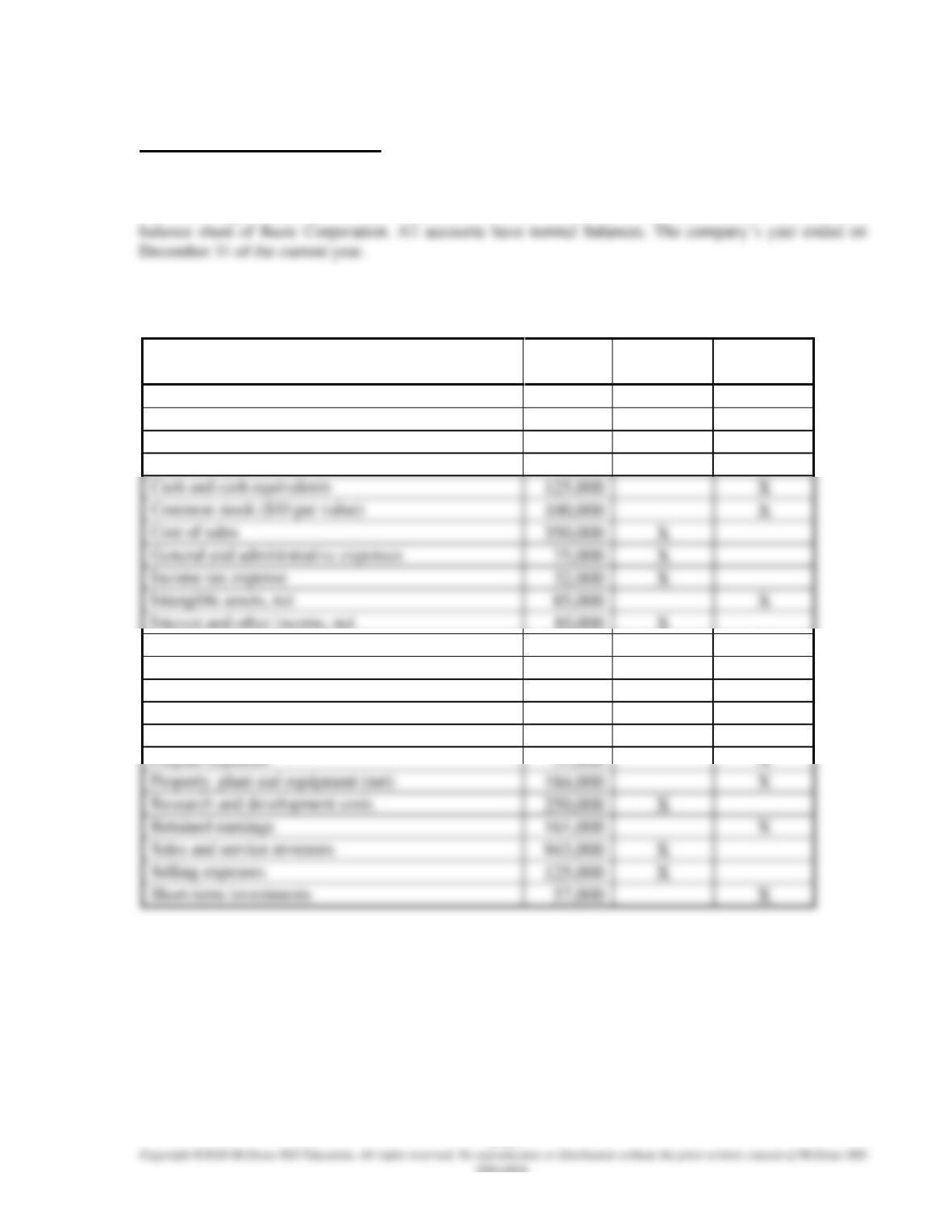
HANDOUT 5 – 1 SOLUTION
CLASSIFYING ACCOUNTS ON FINANCIAL STATEMENTS
The following is a list of financial statement items and amounts from a recent income statement and
For each financial statement item listed, indicate whether it appears on the income statement or balance
sheet.
Financial Statement Item
Amount
Income
Statement
Balance
Sheet
Accounts payable
$ 41,000
X
Accounts receivable
262,000
X
Accrued expenses payable
37,000
X
Additional paid-in capital
70,000
X
Cash and cash equivalents
125,000
X
Common stock ($10 par value)
100,000
X
Cost of sales
350,000
X
General and administrative expenses
75,000
X
Income tax expense
32,000
X
Intangible assets, net
85,000
X
Interest and other income, net
10,000
X
Inventory
167,000
X
Long-term notes payable
433,000
X
Other current assets
5,000
X
Other current liabilities
89,000
X
Other noncurrent assets
15,000
X
Prepaid expenses
31,000
X
Property, plant and equipment (net)
184,000
X
Research and development costs
250,000
X
Retained earnings
161,000
X
Sales and service revenues
943,000
X
Selling expenses
125,000
X

Chapter 05 – Communicating and Interpreting Accounting Information
5-18
HANDOUT 5 – 2
PREPARATION OF BALANCE SHEET
Using the information provided in Handout 5-1, prepare in good form a classified balance sheet as of
December 31 of the current year.
Chapter 05 – Communicating and Interpreting Accounting Information
5-19
HANDOUT 5 – 2 SOLUTION
PREPARATION OF BALANCE SHEET
Using the information provided in Handout 5-1, prepare in good form a classified balance sheet as of
December 31 of the current year.
Basic Corporation
Balance Sheet
December 31, Current Year
ASSETS
Current Assets:
Cash and cash equivalents
$125,000
Short-term investments
57,000
Accounts receivable
262,000
Inventory
167,000
Prepaid expenses
31,000
Other current assets
5,000
Total Current Assets
647,000
Noncurrent Assets:
Property, plant and equipment (net)
184,000
Intangible assets, net
85,000
Other noncurrent assets
15,000
Total Assets
$931,000
LIABILITIES AND STOCKHOLDERS’ EQUITY
Current Liabilities:
Accounts payable
$ 41,000
Accrued expenses payable
37,000
Other current liabilities
89,000
Total Current Liabilities
$167,000
Long-Term Liabilities:
Long-term notes payable
433,000
Total Liabilities
600,000
Stockholders’ Equity:
Common stock ($10 par value)
100,000
Additional paid-in capital
70,000
Retained earnings
161,000
Total Stockholders’ Equity
331,000
Total Liabilities and Stockholders’ Equity
$931,000

Chapter 05 – Communicating and Interpreting Accounting Information
5-20
HANDOUT 5 – 3
PREPARATION OF INCOME STATEMENT
Using the information provided in Handout 5-1, prepare in good form a multistep income statement
including earnings per share information for the year ended December 31 of the current year.
Chapter 05 – Communicating and Interpreting Accounting Information
HANDOUT 5 – 3 SOLUTION
PREPARATION OF INCOME STATEMENT
Using the information provided in Handout 5-1, prepare in good form a multistep income statement
including earnings per share information for the year ended December 31 of the current year.
Basic Corporation
Income Statement
for the year ended December 31, Current Year
Sales and service revenues
$943,000
Cost of sales
350,000
Gross profit
593,000
Operating expenses:
General and administrative expenses
75,000
Selling expenses
125,000
Research and development costs
250,000
Total operating expenses
450,000
Operating income
143,000
Nonoperating income and expenses:
Interest and other income, net
10,000
Income before income taxes
153,000
Income tax expense