CHAPTER 4
Reporting Earnings and Financial Position
THINKING BEYOND THE QUESTION
How do we report earnings and financial position to stockholders?
Using common rules and formats is important so that decision makers
can compare results across companies and so they will have faith in the
QUESTIONS
Q4-1 Dividends are NEVER an expense. Dividends are a distribution of income,
not a component of it.
Q4-2 Students will have many responses but among them might be the follow-
ing:
a. What was the total selling price of goods and services sold this peri-
od?
b. What was the amount of gross profit this period?
92 Chapter 4
Q4-3 Students will have many responses but among them might be the follow-
ing:
a. What amount of cash did the firm have on hand at the end of the pe-
Q4-4 The primary reason is to maximize the amount of profit-related infor-
mation conveyed to users. By breaking the information into separate and
distinct categories, additional information is conveyed. Consider the op-
posite situation. At the extreme, one could report a one-section or even a
Q4-5 The purpose of consolidated financial statements is to report combined
financial information of the parent and its subsidiaries as if they were all
the same organization. Legally, they are separate corporations. But, be-
Reporting Earnings and Financial Position 93
Q4-6 In general, this statement is true. Income statement information is devel-
oped using accrual basis accounting. This means that sales revenue is
Q4-7 A classified balance sheet is one in which assets and liabilities are both
divided into subcategories. For example, a classified balance sheet might
Q4-8 The left side of a balance sheet reveals how an organization’s managers
have used investors’ capital. That is, what does the organization own? Or,
what amount of capital has been committed to which assets? The right
Q4-9 Only the ending balances of the stockholders’ equity accounts are re-
ported on the balance sheet. If the only information of interest was the
Q4-10 Preparation of the income statement, statement of stockholders’ equity,
and balance sheet occurs sequentially. This is because the results of
each statement are reported as components of the next statement. For
example, the income statement must be prepared before the statement of
94 Chapter 4
Q4-11 Articulation refers to the process by which information on one financial
Q4-12 Each of the three financial statements has a different purpose. The pur-
pose of the income statement is to report accrual-basis profitability in-
formation that covers a period of time. It does so by reporting revenues
Q4-13 When historical cost information is relatively recent, there is no meaning-
ful limitation. Over time, however, the cost of assets and liabilities tends
to lose relevance as the value of these items change. As an extreme ex-
Q4-14 Periodic measurement requires that financial reports be prepared for arbi-
trarily short time periods such as a quarter or a year. Transformation pro-
EXERCISES
E4-1 Definitions of all terms are listed in the glossary.
Reporting Earnings and Financial Position 95
E4-2
a.
Changes in a corporation’s
stockholders’ equity for a
fiscal period
Statement of stockholders’ equity
b.
The dollar amount of
resources available at a
Balance sheet
E4-3 1. I 9. I and SE
particular date
The amount of credit sales
Balance sheet
Accrual-based operating
results for a fiscal period
Income statement
The sources of finances
used to acquire resources
Balance sheet
stock on the amount of
contributed capital during
a period
The amount of profit
earned during a period
Income statement
96 Chapter 4
E4-4 Valentine Company
Income Statement
For the Month of September 2007
Sales revenue $48,500
E4-5 a. Gross profit:
Sales revenue $81,000
d. Pretax income:
Income from operations $78,000
Interest expense 7,500
Pretax income $70,500
Reporting Earnings and Financial Position 97
E4-6 a. Sales revenue (item 1) arises from the primary operating activities of
b. Gross profit (item 3) is the difference between the prices at which
c. Cost of goods sold (item 2), operating expenses (item 4), and other
expenses (item 7) are all categories of expense. Each represents re-
sources that were consumed to produce revenue.
d. Each of the items represents a different type of expense. Cost of
e. Income taxes (item 9) are an expense, as are cost of goods sold, op-
erating expenses, and other expenses. Businesses could not exist
E4-7 a. Primary source of revenue: transporting passengers.
98 Chapter 4
E4-8 a. Harley-Davidson earned $5,015,190,000 in revenues from selling
motorcycles in 2004.
b. Harley-Davidson earned $305,262,000 in revenues from providing
financial services in 2004.
E4-9 a. Gross profit: $169,837
b. Product costs expensed = cost of sales: $549,313
E4–10 a. Ratio of net income to net revenues
b. Ratio of cost of revenues to net revenues
c. Ratio of operating expenses to net revenues
Reporting Earnings and Financial Position 99
e. Bio–Tek’s operating results improved between 2005 and 2006. Net in-
come increased by 57.4%. Revenues and earnings per share in-
E4–11 a. Current assets:
Cash $ 34,500
b. Current liabilities:
c. Property, plant, and equipment:
d. Total assets:
Current assets $ 592,600
100 Chapter 4
Total liabilities $790,600
g. Stockholders’ equity:
Contributed capital $ 700,000
Retained earnings 279,000
Stockholders’ equity $ 979,000
E4–12 Advances Unlimited
Balance Sheet
January 31
Assets
Current assets:
Accounts payable $ 275
Accrued expenses 348
Income taxes payable 93
Other current liabilities 46
Total current liabilities $ 762
Reporting Earnings and Financial Position 101
E4–13 Marvelous Enterprises
Balance Sheet
April 30
Assets
Current assets:
Cash $ 10,360
Accounts receivable 14,700
Other assets:
Copyrights and trademarks $ 5,000
Patents 3,300
Total liabilities $ 81,900
Stockholders’ Equity:
Contributed capital $ 38,770
Retained earnings* 11,740
Total stockholders’ equity $ 50,510
102 Chapter 4
E4–14 a. Current assets Current liabilities
Cash Accounts payable
Accounts receivable Interest payable
b. 1. Total current assets $1,936
E4–15
1. Gross profit:
2. Operating income:
Gross profit $243,000
3. Net income:
Operating income $111,000
5. Current assets:
Cash $ 35,000
Reporting Earnings and Financial Position 103
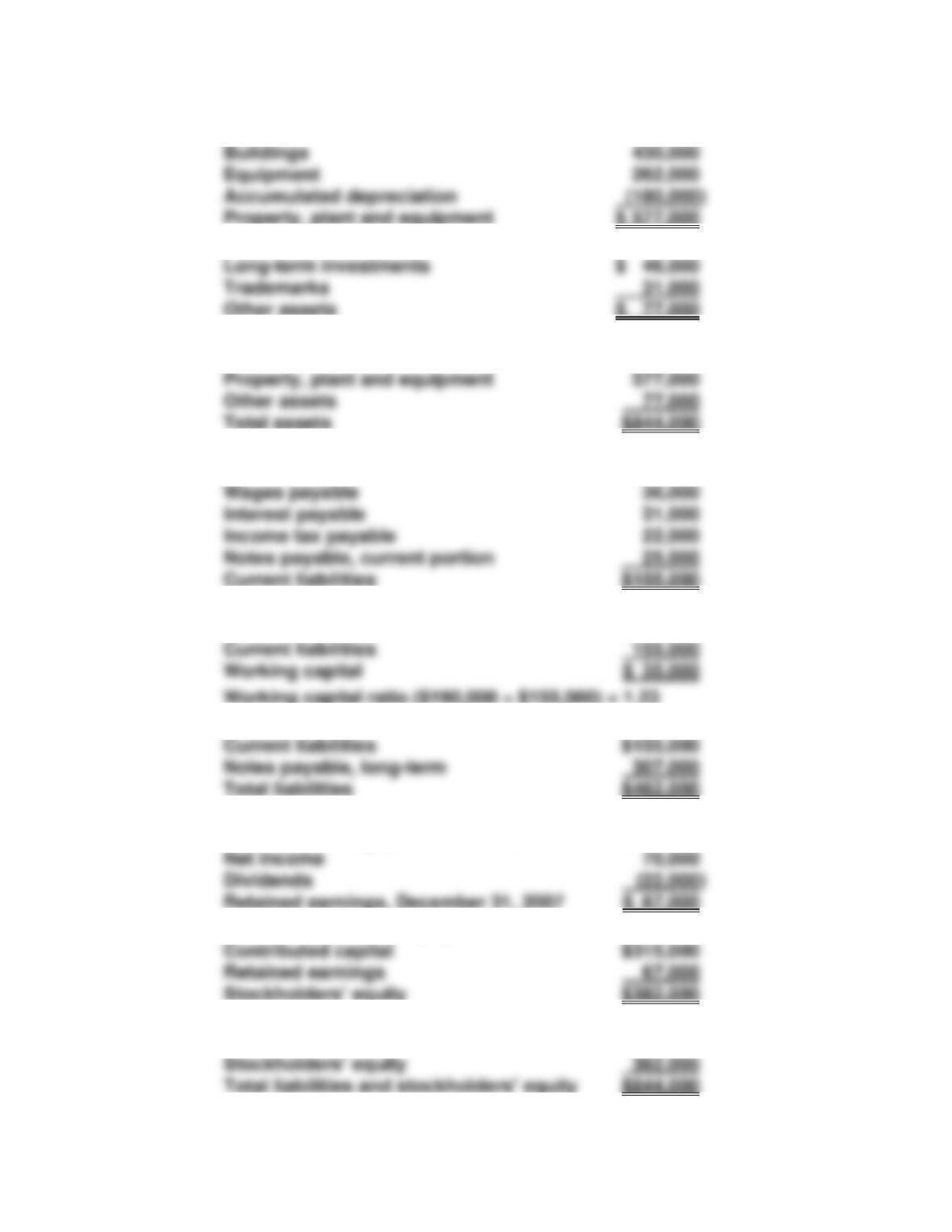
6. Property, plant and equipment:
Land $ 65,000
7. Other assets:
8. Total assets:
Current assets $190,000
9. Current liabilities:
Accounts payable $ 41,000
10. Working capital and working capital ratio:
Current assets $190,000
11. Total liabilities:
12. Retained earnings, December 31, 2007:
Retained earnings, December 31, 2006 $ 19,000
13. Total stockholders’ equity:
14. Total liabilities and stockholders’ equity:
Total liabilities $462,000
104 Chapter 4
E4–16
a.
Loss on sale of equip-
ment
Income statement
b.
Taxes payable
Balance sheet
c.
Trademark
Balance sheet
E4–17
Item
Financial Statement
Information Provided
1.
Accounts
receivable
Balance sheet
Cash to be received in the future
from prior sales
2.
Rent payable
Balance sheet
Cash to be paid in the future for
past usage of rental space
Retained earnings
Balance sheet and
Profits earned from past opera-
tions that have been reinvested
in the company
4.
Cost of sales
Income statement
Cost of resources consumed in
operations in the generation of
sales revenue during the operat-
ing period just ended
Prepaid rent
Balance sheet
Cost of rental resources paid for
in the past to be used in future
operations
Supplies expense
Income statement
Cost of supplies used in opera-
tions during the operating period
just ended
Accumulated other
comprehensive income
Statement of stockholders’ equity
e.
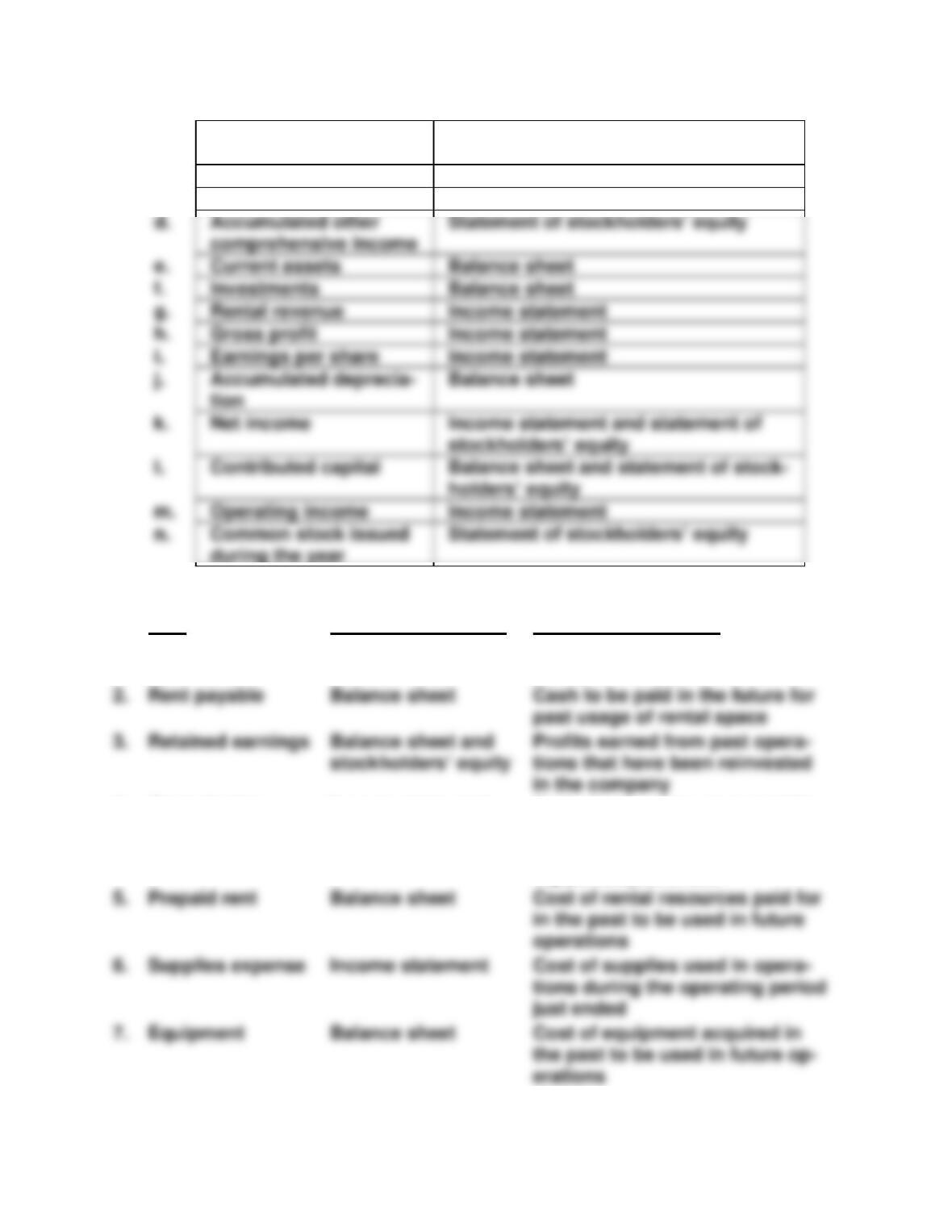
Current assets
Balance sheet
Investments
Balance sheet
g.
Rental revenue
Income statement
h.
Gross profit
Income statement
Earnings per share
Income statement
Accumulated deprecia-
tion
Balance sheet
k.
Net income
Income statement and statement of
Contributed capital
Balance sheet and statement of stock-
Operating income
Income statement
Common stock issued
Reporting Earnings and Financial Position 105
8.
Dividends
Stockholders’ equity
Cash paid and/or promised to
owners as a result of profitable
operations
11.
Accrued liabilities
Balance sheet
Cash to be paid in the future for
resources already consumed
12.
Wages payable
Balance sheet
Cash to be paid in the future for
labor services used in past op-
erations
operations
Notes payable
Balance sheet
Cash borrowed in the past, to be
repaid in the future
Service revenue
Income statement
The reward that has been earned
customers
16.
Inventory
Balance sheet
Cost of merchandise acquired in
the past to be sold in the future
Advertising
expense
Income statement
Cost of advertising services
consumed in operations during
the operating period just ended
ceived in the past in exchange
for shares of ownership in the
firm
E4–18 a. Articulation refers to the interrelationships among financial state-
ments. It is the process by which financial statements work together
9.
Depreciation
expense
Income statement
The portion of long-term fixed
assets that was consumed dur-
ing the period just ended
10.
Copyrights
Balance sheet
Cost of legal protection re-
sources acquired in the past to
be used in future operations
106 Chapter 4
E4–19 Crane Pool Corporation
Statement of Stockholders’ Equity
For the Year Ended June 30, 2007
Contributed
Capital
Retained
Earnings
Total
Balance at June 30, 2006
$657
$1,536
$ 2,193
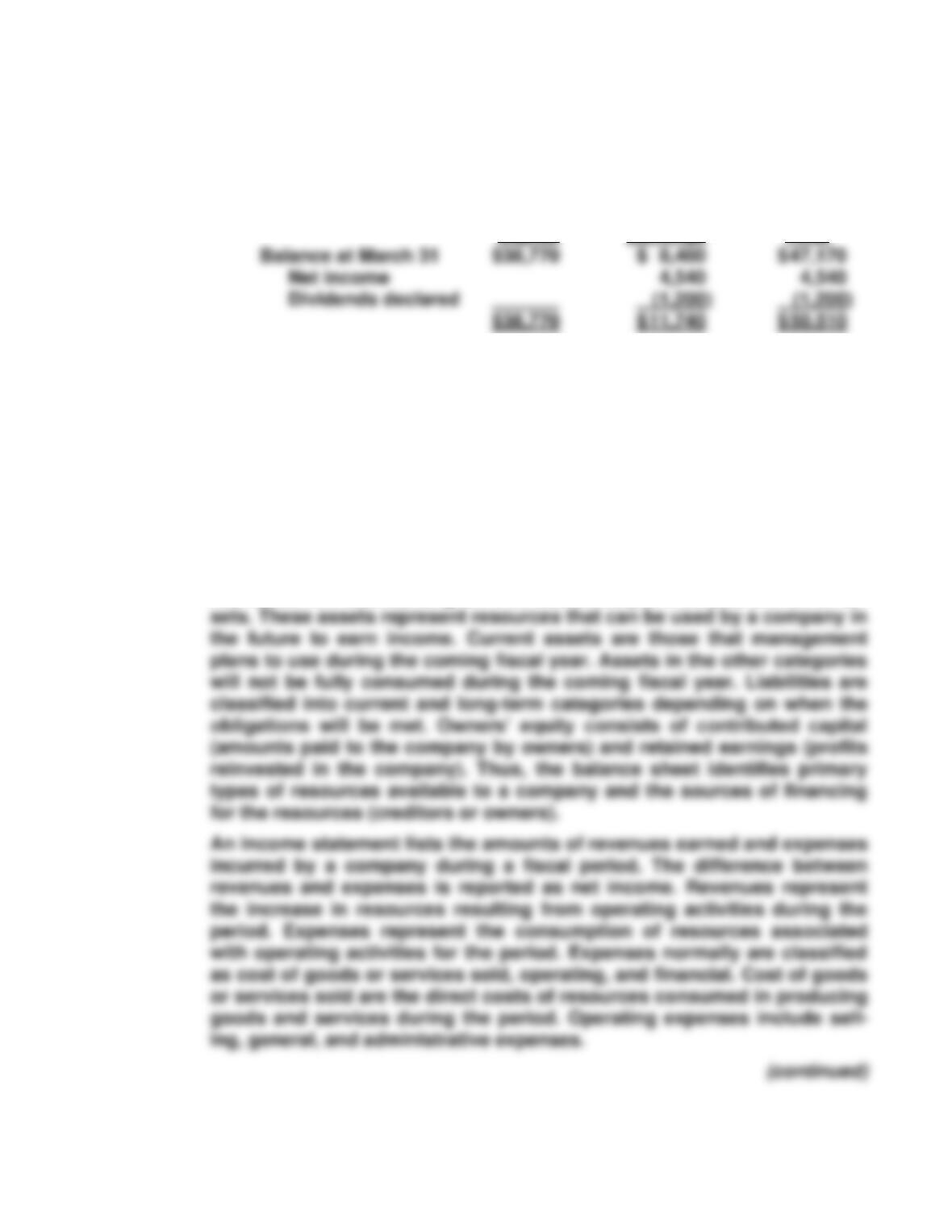
E4–20 a. Marvelous Enterprises
Income Statement
For the Month Ended April 30
Sales revenue $26,000
Cost of goods sold 15,050
Gross profit $10,950
Reporting Earnings and Financial Position 107
b. Marvelous Enterprises
Statement of Stockholders’ Equity
For the Month Ended April 30
Contributed
Capital
Retained
Earnings
Total
PROBLEMS
P4-1 An example report follows:
THE PURPOSE OF FINANCIAL STATEMENTS
Report for A. Suliman
Corporations in the United States provide four primary financial state-
ments: a balance sheet, an income statement, a statement of cash flows,
and a statement of stockholders’ equity. The balance sheet identifies ma-
jor categories of assets, liabilities, and owners’ equity. Assets are classi-
fied as current assets, long-term investments, plant assets, and other as-
108 Chapter 4
A statement of cash flows identifies the change in cash during a fiscal pe-
riod. The change is explained by cash receipts and payments associated
A statement of stockholders’ equity describes changes in stockholders’
equity during a fiscal period. These changes include issuing or repur-
chasing stock, which affects the amount of contributed capital. They also
P4-2 A. Dating the sales in April rather than May will increase Green–Grow’s
sales revenue and net income for the fiscal year ending in April. Al-
B. Assuming the additional sales are sufficient, the company will meet
the banks’ net income and working capital ratio requirements.
C. The company’s president should consider alternatives that resolve
D. Flower is in a tough position, but not one in which she should com-
Reporting Earnings and Financial Position 109
P4-3 A. 1. Company is not identified (no company name in title)
2. Date expressed incorrectly (should be stated: For the year ending
December 31, 2007)
with net income.
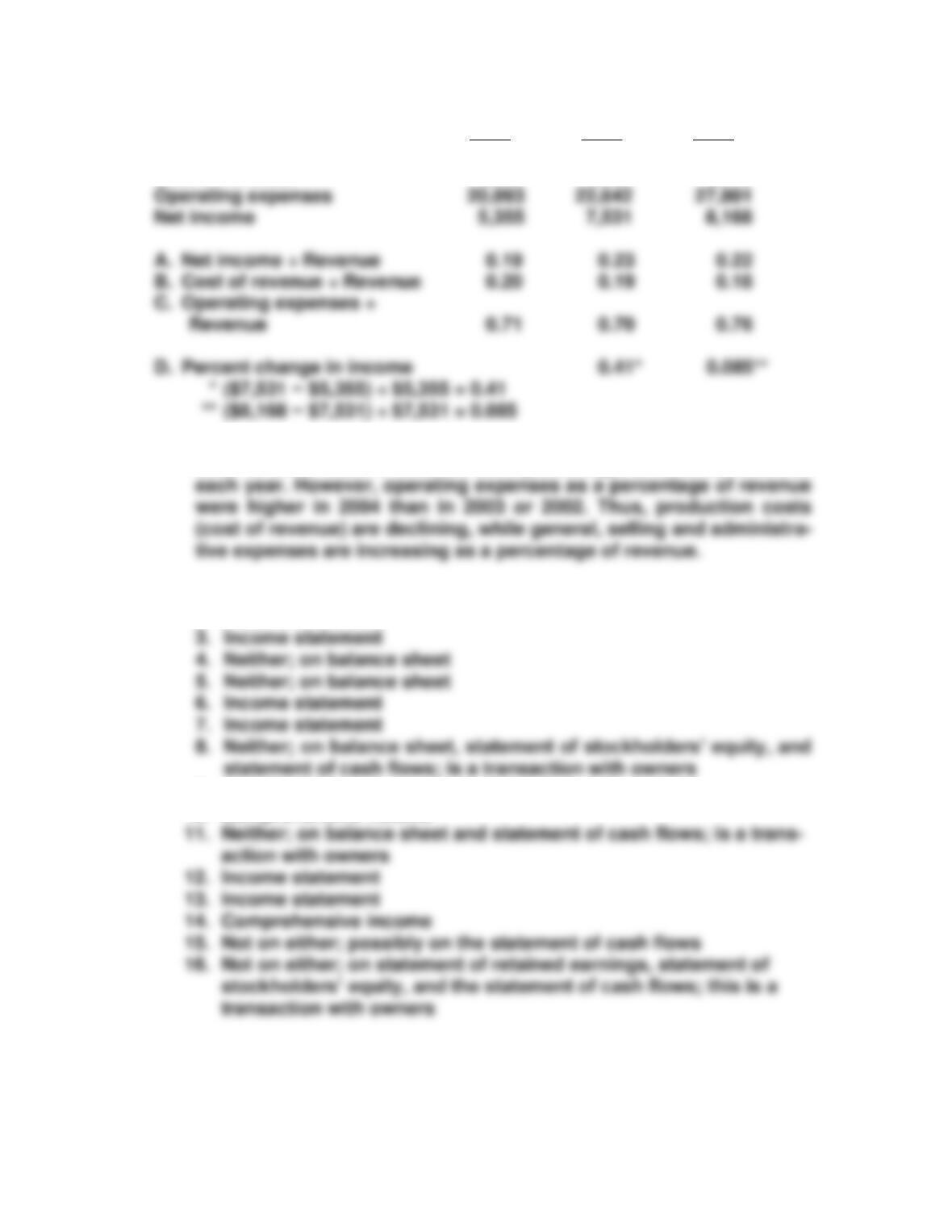
B. Parrot Company
Income Statement
For Year Ending December 31, 2007
Sales revenue $ 260,722
Cost of goods sold 102,690
110 Chapter 4
P4-4
2002
2003
2004
Revenue
$28,365
$32,187
$36,835
Cost of revenue
5,699
6,059
6,716
E. Microsoft’s performance improved over the three-year period from
2002 to 2004. Cost of revenue as a percentage of revenue declined
P4-5 A. 1. Income statement
2. Income statement
9. Income statement
10. Comprehensive income
Operating expenses
27,801
Net income
5,355
7,531
8,168
Revenue