1,840
$253,900
24,800
Deposit for future advertising
Total assets
Investments
Building, not in use
(continued)
June 30, 2011
Total current assets
Chapter 4, P 9.
Assets
Beauty Supplies Corporation
Balance Sheet
$ 11,000
statement of cash flows. The elements from these three statements are used to com-
2.
sets, liabilities, and equity, it’s also important to consider Net Revenue and Net In-
come from the income statement and Cash Flows from Operating Activities from the
User Insight
In addition to considering the key elements of the balance sheet, such as total as-
Common stock, $1.10 par value, 10,000 shares
authorized, issued, and outstanding
Chapter 4, P 9. (Continued)
Liabilities
Stockholders’ Equity
Contributed capital
$1,428,780
5,600
$1,434,380
$ 3.61
$566,340
72,260
Net income
Earnings per share
1b. Statement of retained earnings prepared
Retained earnings, December 31, 2010
Cubicle Corporation
Statement of Retained Earnings
For the Year Ended December 31, 2011
Total revenues
Cubicle Corporation
Single-step income statement prepared
Chapter 4, P 10.
Revenues
1a.
For the Year Ended December 31, 2011
Income Statement
Interest income
Net sales
$ 56,800
112,000
$283,240
Chapter 4, P 10. (Continued)
Assets
Cubicle Corporation
Balance Sheet
December 31, 2011
Investments
Property, plant, and equipment
Store fixtures
Investment in securities
1c.
Classified balance sheet prepared
Current assets
Cash
$100,000
Common stock, $1.00 par value, 20,000 shares
Stockholders’ Equity
Current liabilities
Notes payable
Chapter 4, P 10. (Continued)
Liabilities
Contributed capital
Profitability measures computed
Net Sales = 5.1%
$72,260
2.
(a) Profit Margin =
=
Net Income
0.8
Net Sales
6.8%
$72,260
$1,066,300
=
=
(c) Cash Flow Yield = = =
$1,428,780
$60,000
$72,260
Cash Flow from
Operating Activities
Net Income
=
(g) Return on Equity
Chapter 4, P 10. (Continued)
Average Stockholders’ Equity
Net Income
3.6 percent, but its asset turnover ratio of 1.3 is much lower than the industry aver-
3. User Insight: Financial ratios discussed
Cubicle Corporation’s profit margin of 5.1 percent exceeds the industry average of
material depends on who is using the financial statements. To management, it rep-
is material if there is a reasonable expectation that knowledge of it would influence
Chapter 4, C 2.
the decisions of users of financial statements. The $120,000 inventory loss repre-
sents 4 percent of net income ($120,000 ÷ $3,000,000). Whether or not this loss is
remain in use from one accounting period to another unless management decides
that a new procedure is preferable and discloses information about the change in
Materiality refers to the relative importance of an item or event. In general, an item
its financial statements. Such consistency ensures the comparability of financial
Consistency requires that an accounting procedure, once adopted by a company,
statements.)
Materiality refers to the relative importance of an item or event. In general, an item
is material if there is a reasonable expectation that knowledge of it would influence
the decisions of users of financial statements. In this case, the change from the
Chapter 4, C 1.
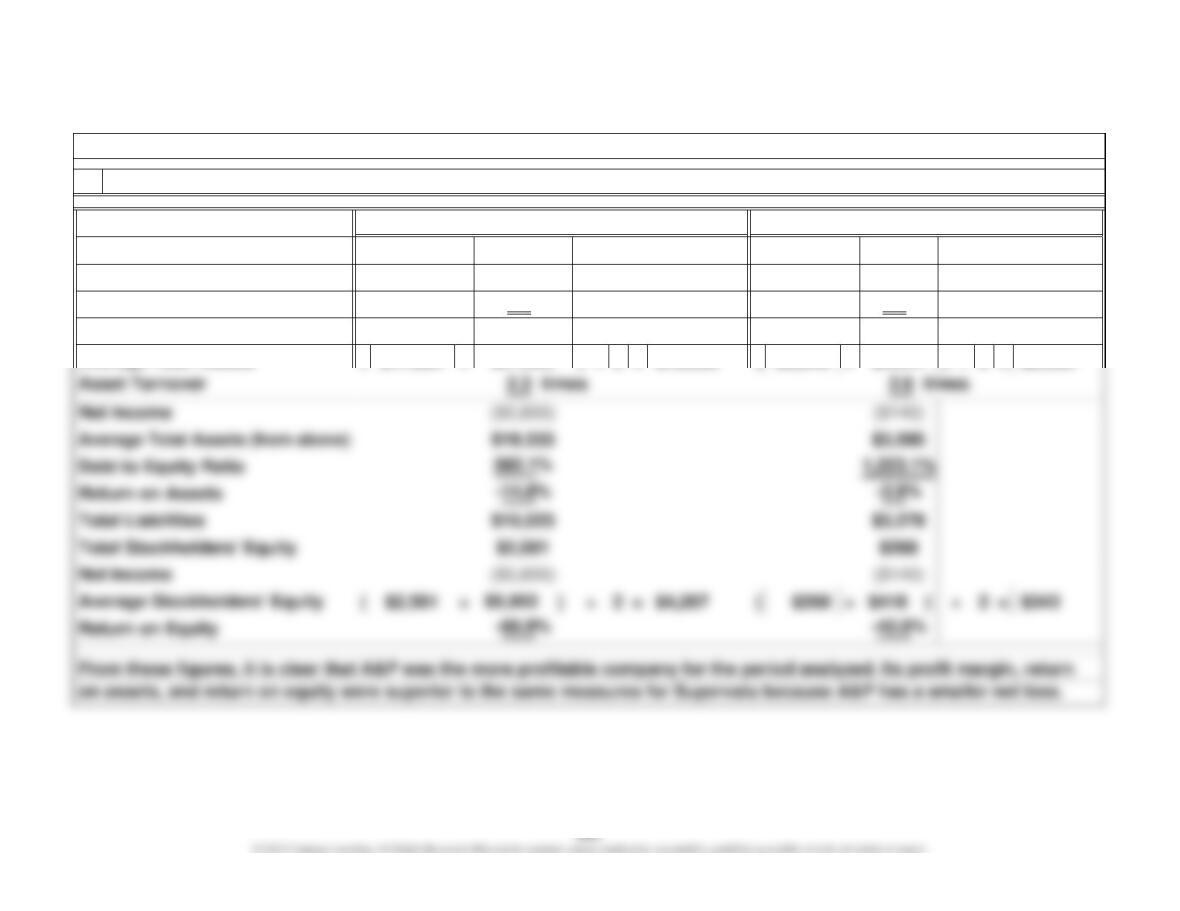
( $17,604 + ) ÷ 2 = $19,333 ( $3,546 + ) ÷ 2 = $3,595
-1.5%
$3,644
$9,516
Net Income (Loss)
Net Sales
($2,855) ($140)
$9,516
Chapter 4, C 3.
Supervalu A&P
1. Profitability ratios computed (in millions) and discussed
Average Total Assets
Net Sales
-6.4%
$44,564
$21,062
Profit Margin
$44,564
Profit Margin
Debt financing discussed3.
Chapter 4, C 3. (Continued)
equity over what they earn on assets. Both companies have more debt than equity;
Despite low profit margins, grocery stores tend to have high debt because they are
very stable businesses. Both companies use this method to increase their return on
2. Return on assets discussed
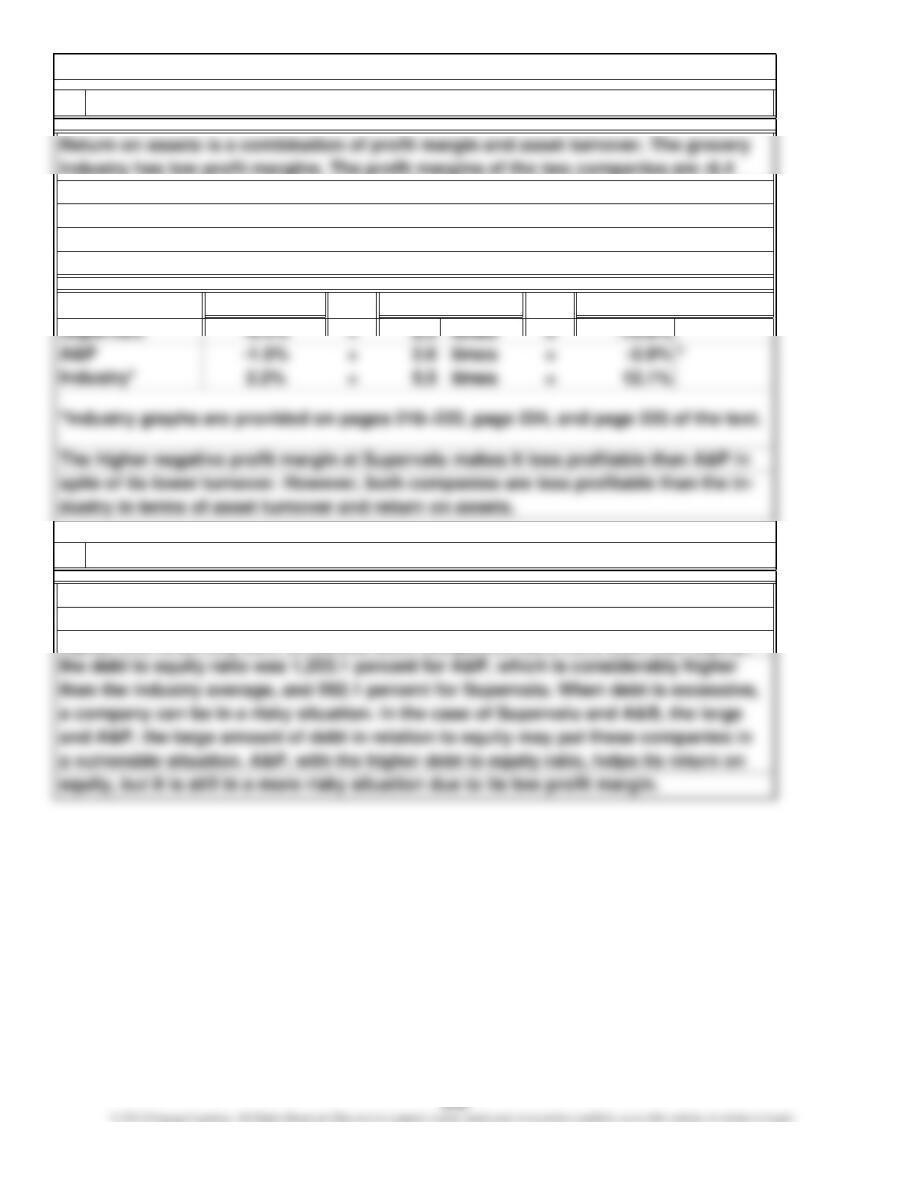
and -1.5 percent. The industry tries to overcome its low profit margin by turning over
its assets many times during the year. A&P has an asset turnover of 2.6 times, which
exceeds that of Supervalu of 2.3. The relationships of the two companies’ ratios
and the industry ratios are as follows:
×Asset Turnover =Return on Assets
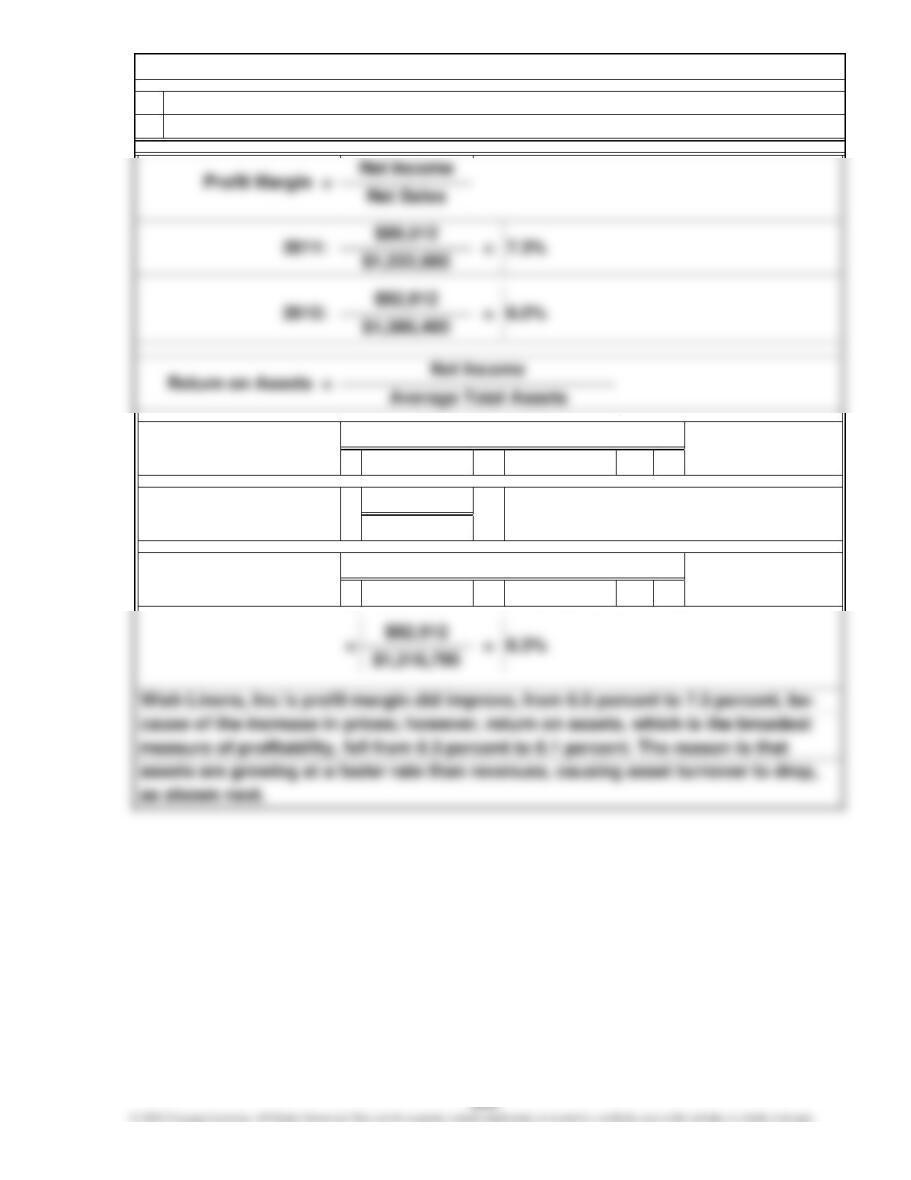
( $1,536,910 + $1,386,810 ) ÷ 2
$89,512
$1,461,860
( $1,386,810 + $1,246,780 ) ÷ 2
1.
computed as follows:
To evaluate profitability, the profit margin and return on assets must be
2011: $89,512
Chapter 4, C 4.
2010: $82,912
= 6.1%=
2.
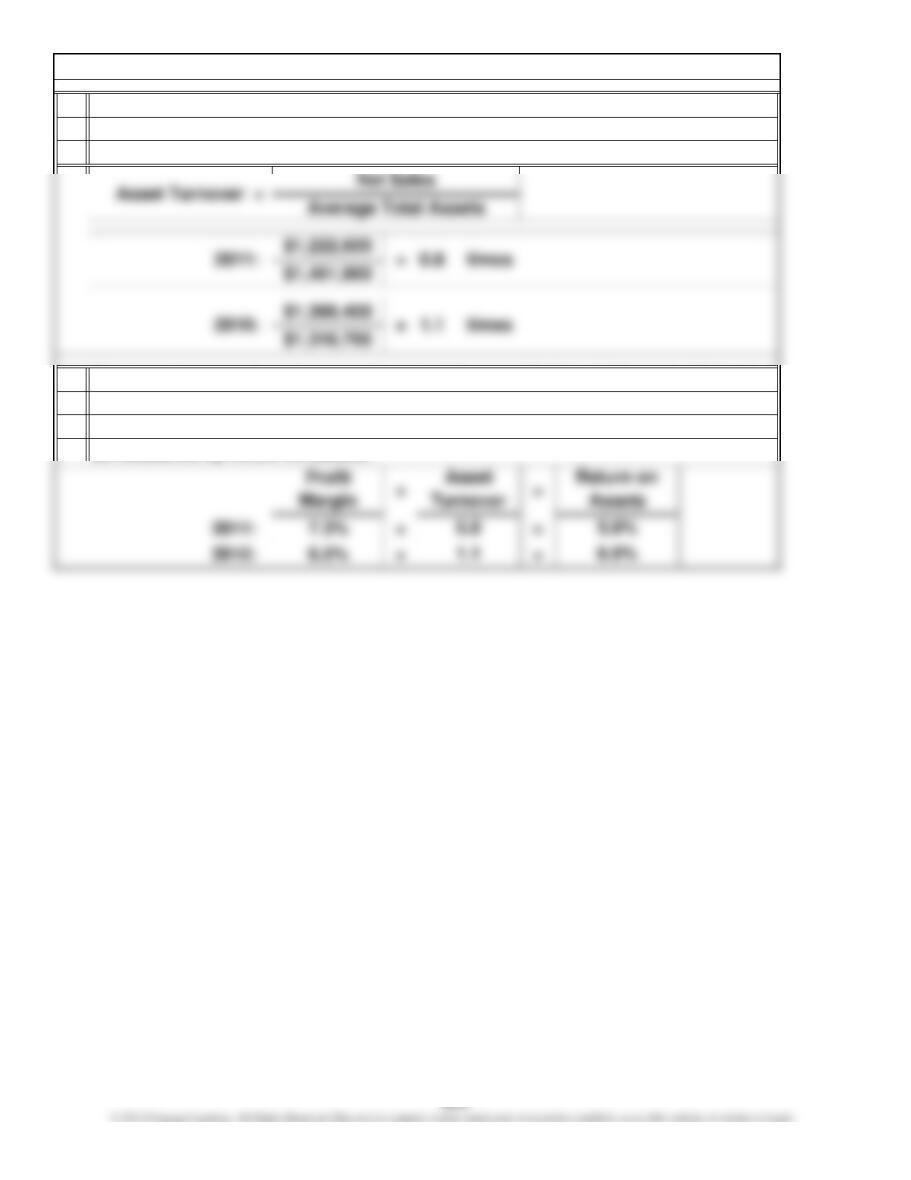
total assets. This decrease in asset turnover has an adverse affect on profitability
as measured by return on assets:
In her evaluation of profitability, Wish is focusing only on the profit margin, fail-
ing to take into account that the overall profitability must be evaluated in terms
of total investment in assets and the amount of sales generated by those assets.
Chapter 4, C 4. (Continued)
The asset turnover has decreased from 1.1 times in 2010 to 0.8 times in 2011 be-
cause of the decrease in sales (due to higher prices) and the increase in average
b.
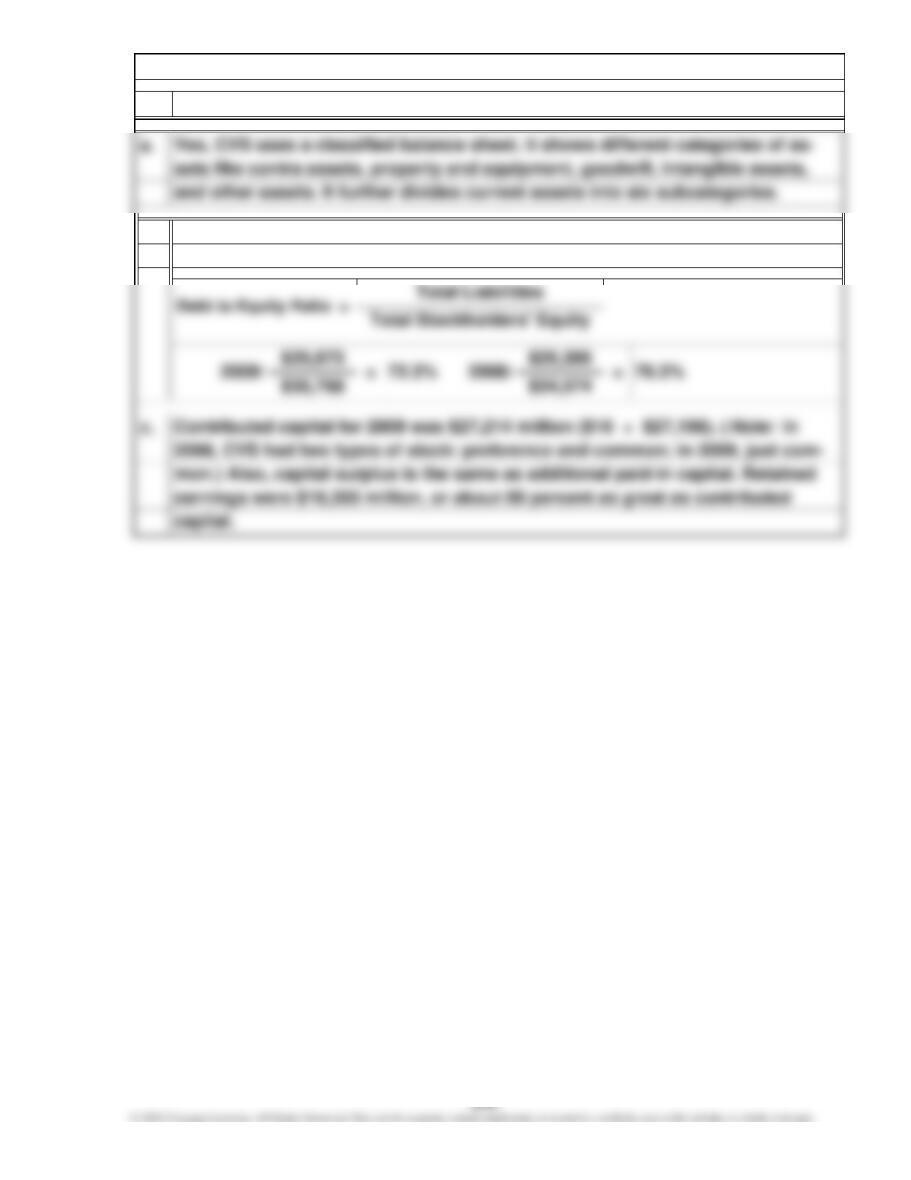
Consolidated balance sheets ($ amounts in millions)
Chapter 4, C 5.
1.
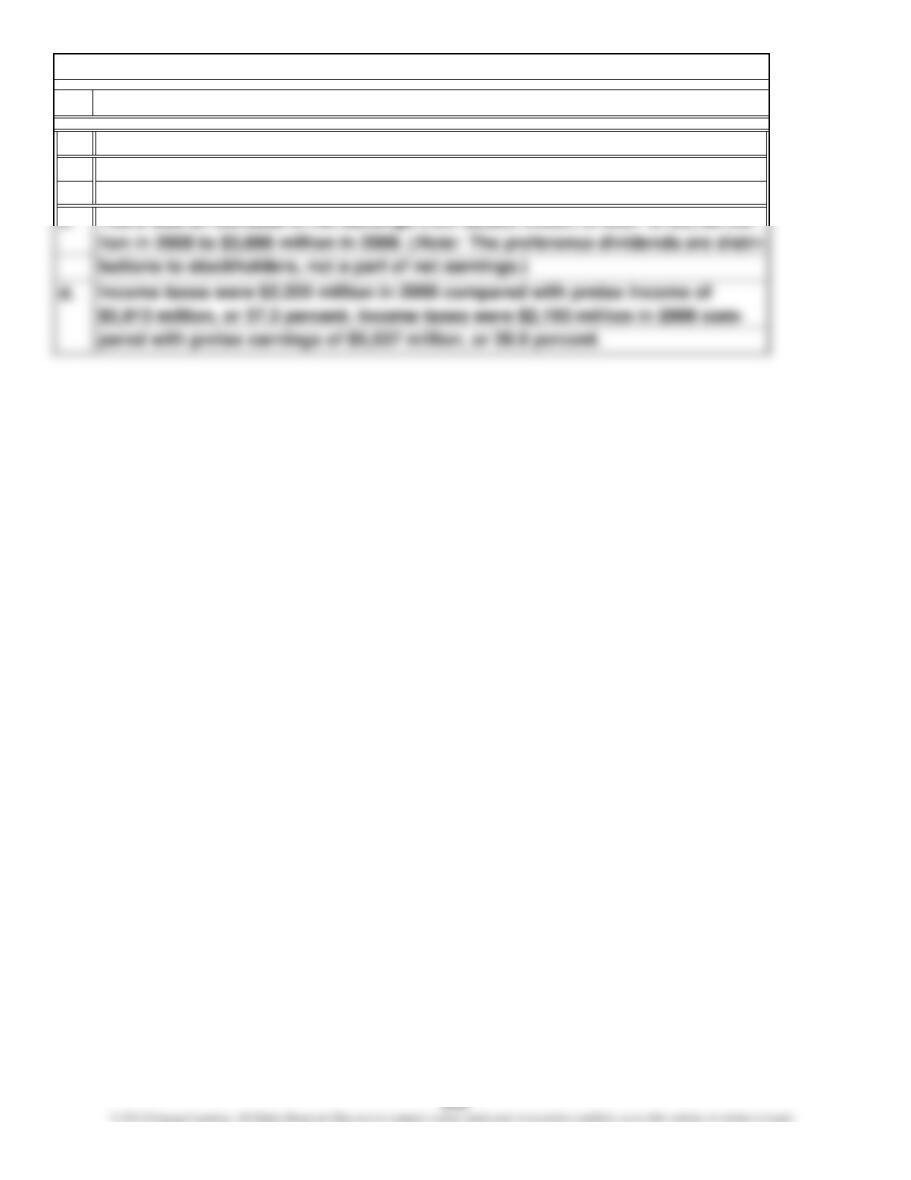
cent in 2009.
Yes, the debt to equity ratio decreased from 76.3 percent in 2008 to 72.3 per-
a.
b.
Chapter 4, C 5. (Continued)
Yes, it is a comparative statement because it presents more than one year of
data for comparison.
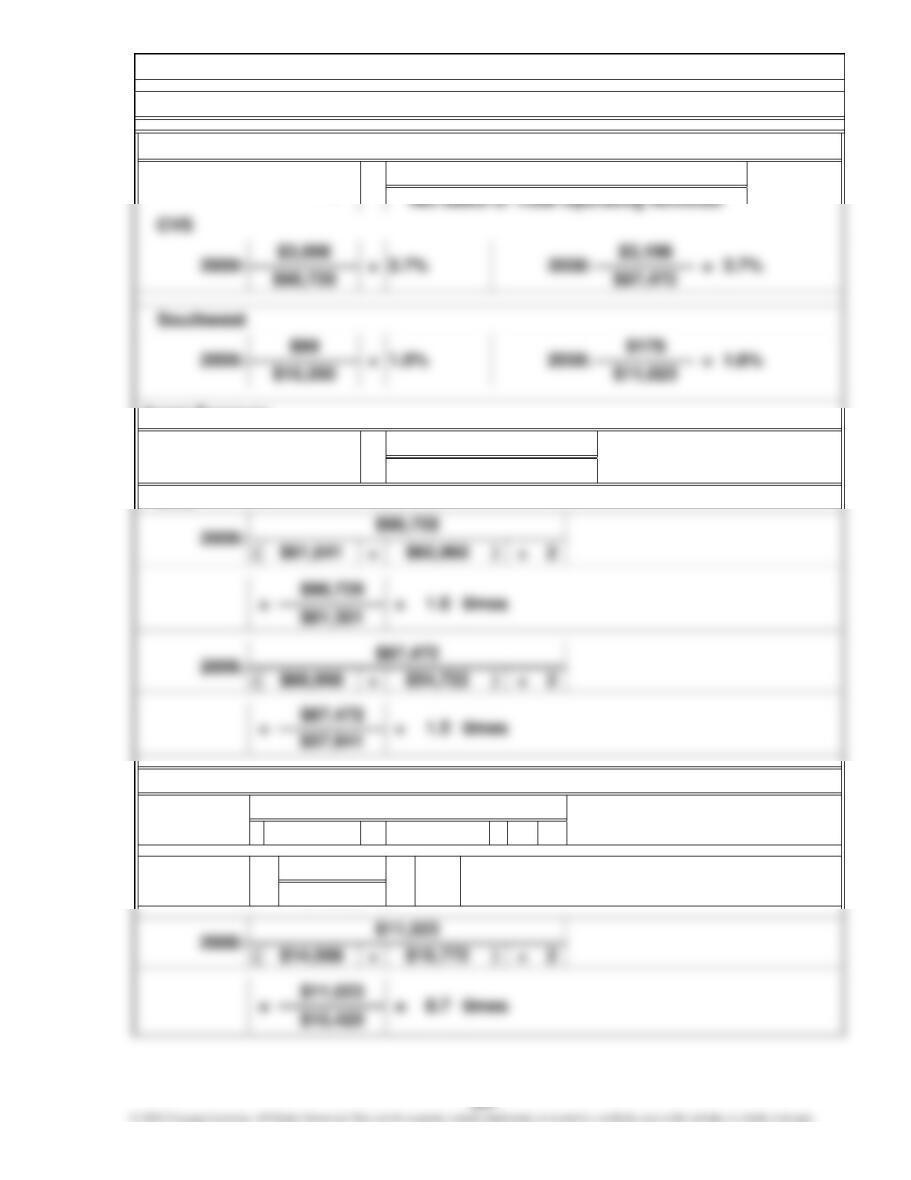
2. Consolidated statements of operations
CVS uses a multistep form of income statement.
(+ ÷2
=
Southwest
2009:
Net Income (Loss)
Chapter 4, C 6. (Continued)
Profit Margin
Asset Turnover
=Net Sales
CVS
Asset Turnover
$14,269
$10,350
=$10,350 = 0.7 times
)$14,068
$14,169
Average Total Assets
Profit Margin
1. Liquidity and profitability calculated
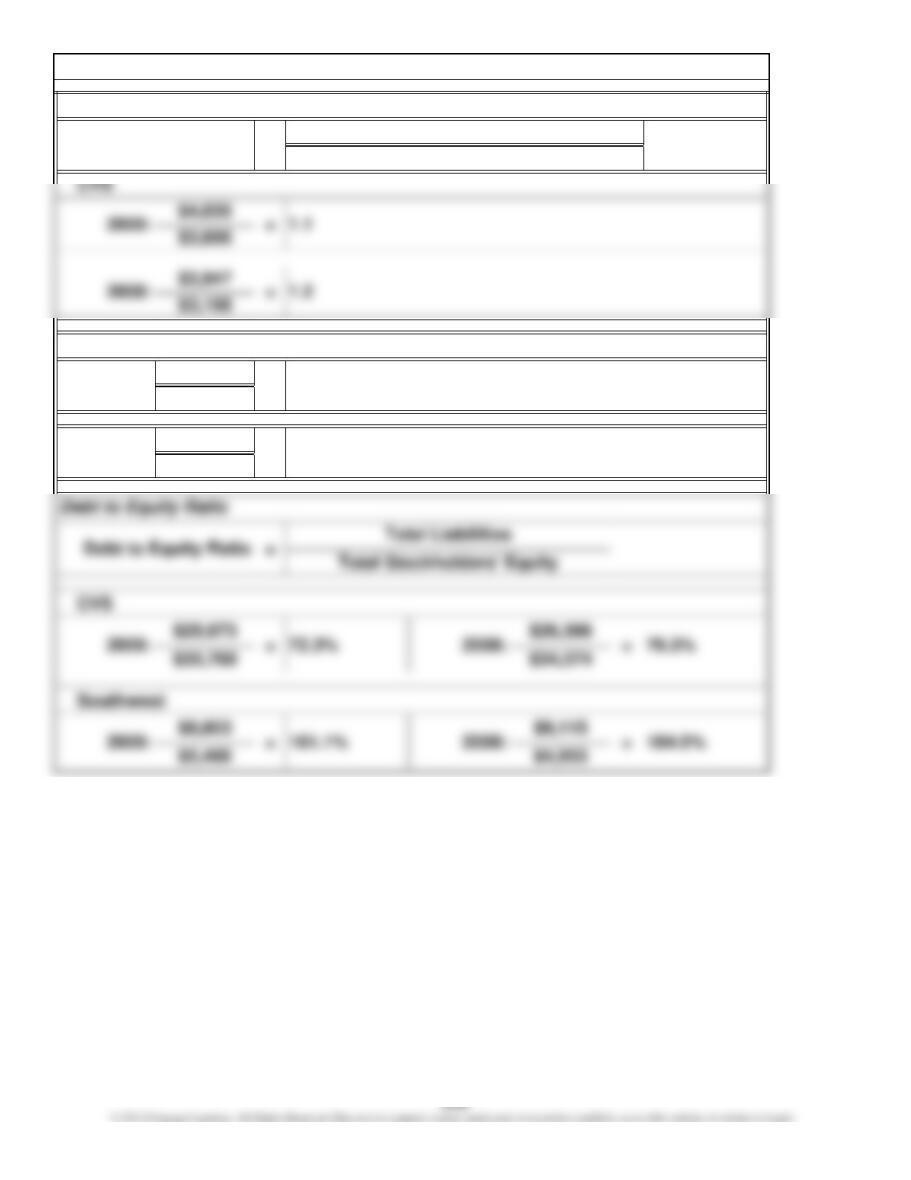
Cash Flow Yield
Chapter 4, C 6. (Continued)
Southwest
2009: $985
$99 =
Cash Flow Yield
=Cash Flows from Operating Activities
Net Income
2008: ($1,521)
$178 =
-8.5
9.9
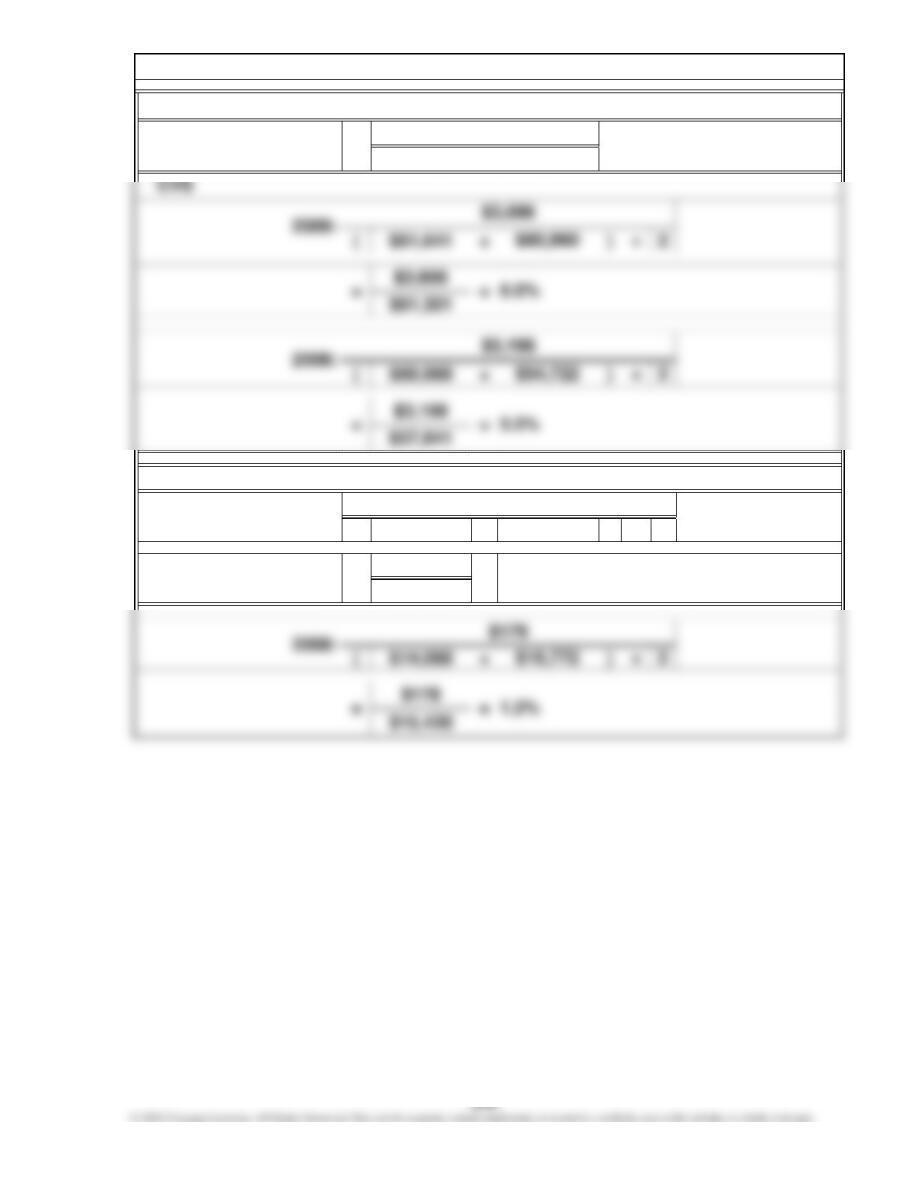
( $14,269 + ) 2
$99
$14,169
=
$14,068
Chapter 4, C 6. (Continued)
Return on Assets
÷
Southwest
$99
= = 0.7%
Average Total Assets
Net Income
Return on Assets
2009:
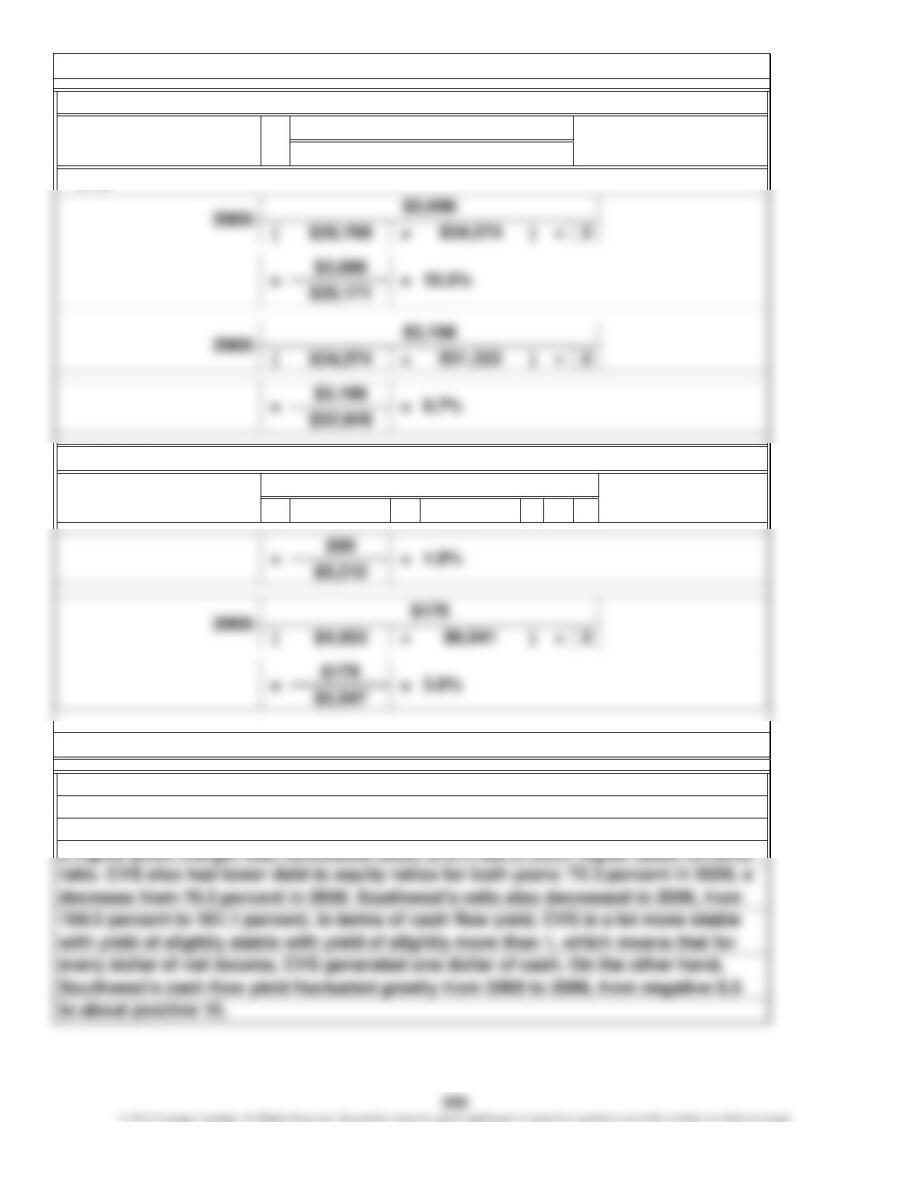
( $5,466 + ) 2
Southwest
CVS
Chapter 4, C 6. (Continued)
Return on Equity Average Stockholders’ Equity
Net Income
=
Return on Equity
2009: $99
$4,953
In general, CVS’s peformance exceeds the performance of Southwest, both in re-
spect to liquidity and profitability. CVS’s profitability measures, especially return on
assets and return on equity, are much better than those of Southwest. Also, CVS has
2. Performance discussed
÷
Chapter 4, C 7.
or accepted the work performed to date.
This situation is framed so that the difference between 75 percent and 90 percent
is material but also falls within the range of judgment. Thus, one can take either
side of the issue. Some students may say that the first report is tentative and that
Discussion of whether a student, in assuming the position of the controller, would
prepare the report may center on the conflict between the controller’s duty to top
management and his or her personal ethics. The proper action would be to reex-